

The Regulation of Entry
Open accessThe DOI matches its Crossref record, with a small difference in title or year; 39 of the 39 references it cites were found in a registry or an index; none of the 13 sources its claims cite is checked for support yet.
Abstract
1%(5 :25.,1* 3$3(5 6(5,(6 7+( 5(*8/$7,21 2) (175< 6LPHRQ 'MDQNRY 5DIDHO /D 3RUWD )ORUHQ.LR /RSH]GH6LODQHV $QGUHL 6KOHLIHU :RUNLQJ 3DSHU KWWSZZZQEHURUJSDSHUVZ 1$7,21$/ %85($8 2) (&2120,& 5(6($5&+ 0DVVD.KXVHWWV $YHQXH &DPEULGJH 0$ 6HSWHPEHU :H WKDQN 2OJD ,RIIH 7DWLDQD 1HQRYD DQG (NDWHULQD 7UL]ORYD IRU DEOH UHVHDU.K DVVLVWDQ.H DQG +DPLG $ODYL ,ULQD $VWUDNKDQ $EKLMLW %DQHUMHH 5L.KDUG &DYHV -D.TXHOLQH &RROLGJH -DPHV (PHU\ 1LKDO (O0DJKDUEHO -HDQ 3DXO *DXWKLHU (G *ODHVHU 6LPRQ -RKQVRQ /DZUHQ.H .DW] 3HWHU .X.HUD 'DYLG /DLEVRQ ,UD /LHEHUPDQ 'DYLQ 0D.NLQ]LH 0DULH )UDQ.RLVH 0DULH1HOO\ 0DU.HOR 2ODUUHDJD *X\ 3IHIIHUPDQQ 6DQWLDJR 6HGD.D /HLOD :HEVWHU 3HWHU :ULJKW DQG VHPLQDU SDUWL.LSDQWV DW WKH 8QLYHUVLW\ RI 0DU\ODQG DW &ROOHJH 3DUN IRU KHOSIXO .RPPHQWV 7KH .ROOH.WLRQ RI GDWD IRU WKLV SDSHU ZDV RUJDQL]HG DQG ILQDQ.HG E\ WKH :RUOG %DQN $Q DSSHQGL[ GHV
Overview
CoChat Summary
TL;DR
This paper assembles a new cross-country dataset on business entry regulation in 75 countries and uses it to compare the helping-hand, capture, and tollbooth theories of regulation. The evidence is most consistent with the tollbooth view: heavier entry regulation is associated with more corruption, a larger unofficial economy, and less representative, more autocratic governments.
Key findings
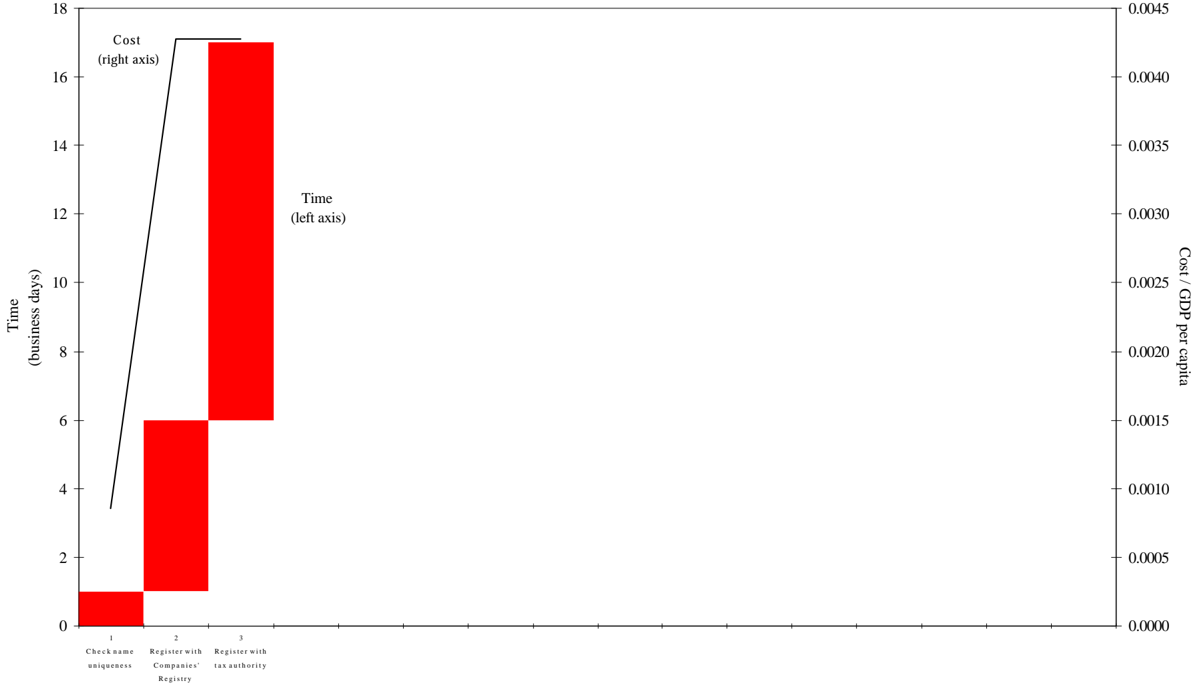
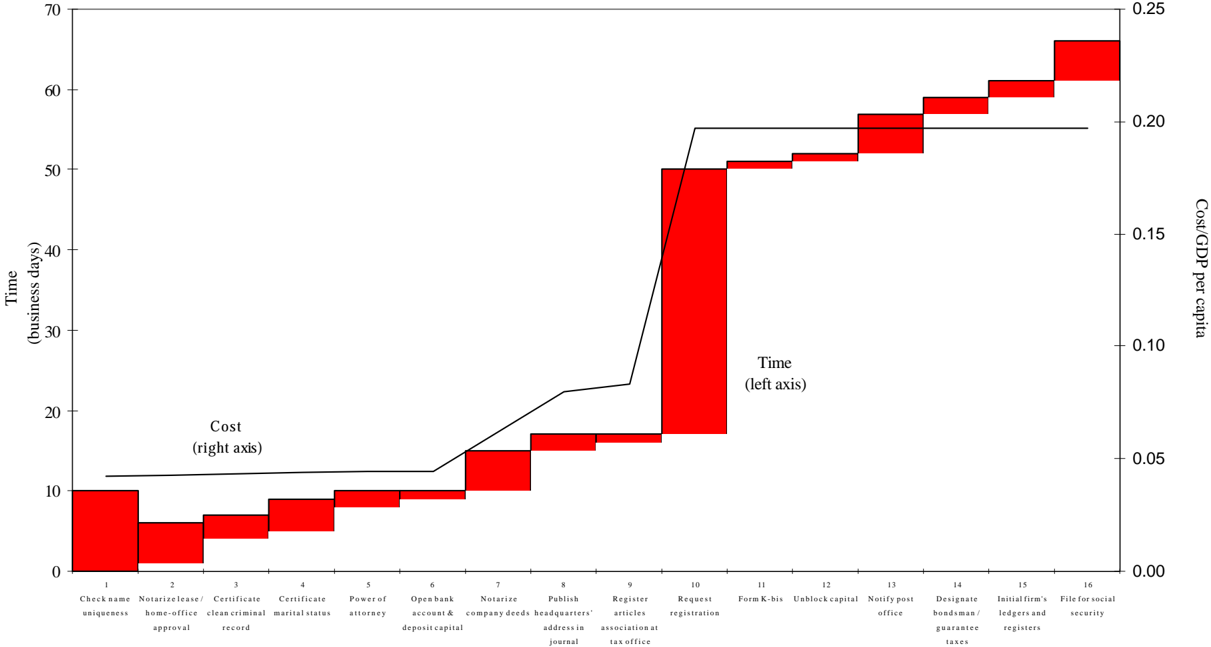
- Across the 75-country sample, the number of entry procedures ranges from 2 in Canada to 20 in Bolivia, with a sample average of 10.17 procedures; the average official time is 63.05 business days and the average cost is 0.34 of GDP per capita.
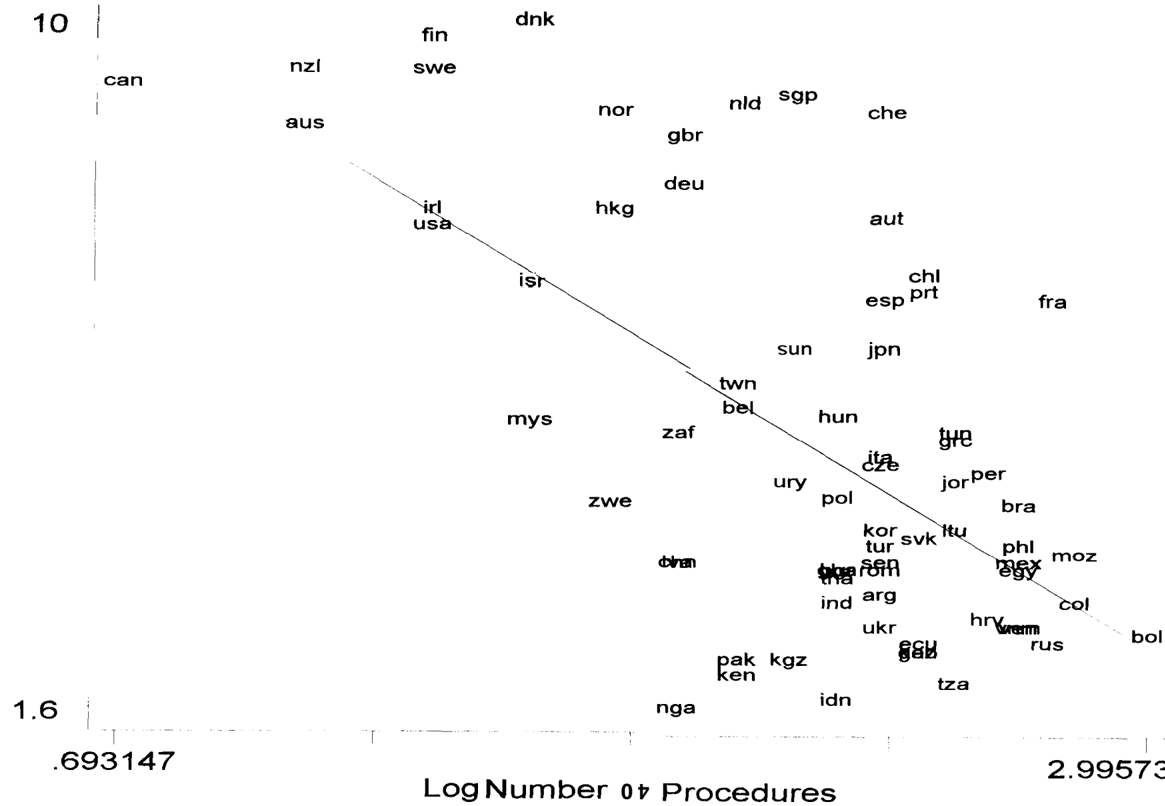
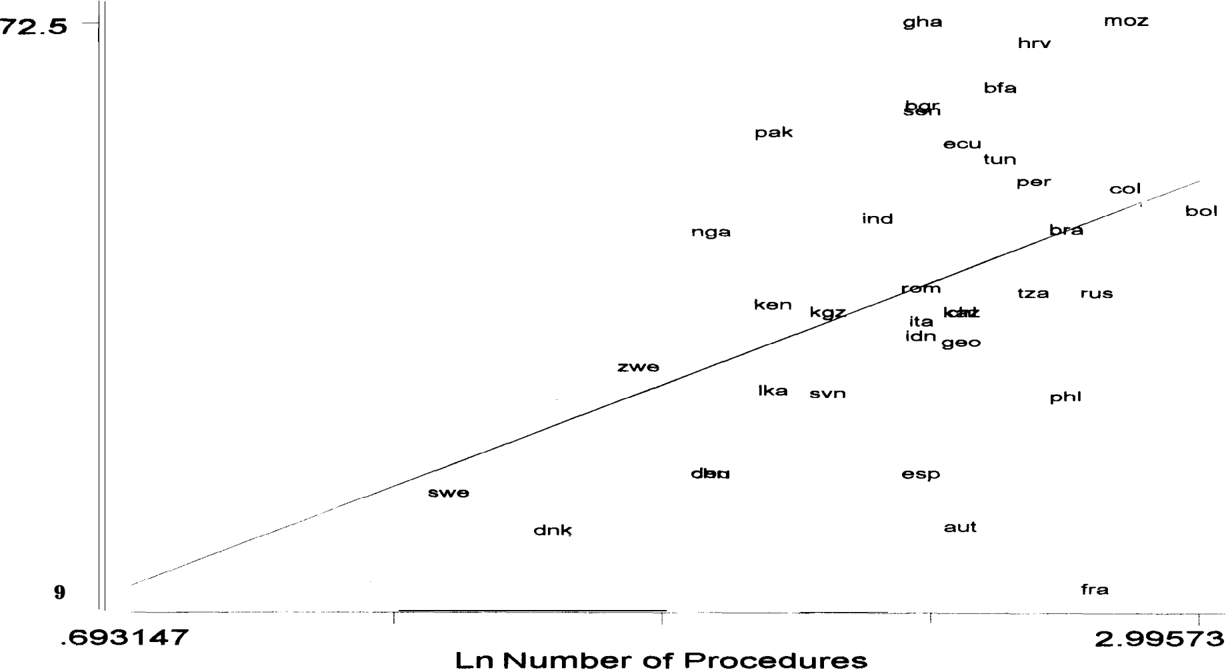
- The number of procedures is strongly correlated with time and cost: the paper reports correlations of 0.75 with log time and 0.62 with log cost.
- The helping-hand tests do not support a beneficial-regulation story: in Table IV, more procedures are associated with lower ISO quality standards (e.g. coefficient -0.2646) and larger unofficial economy measures (e.g. coefficient 13.6277 for size of unofficial economy; 19.8763 for employment in the unofficial economy), while pollution and health outcomes do not improve.
- The tollbooth evidence is stronger: Table VI reports that more procedures are associated with worse corruption scores, with a coefficient of -3.2809 (and -1.7249 with GDP per capita controls) for the corruption regressions.
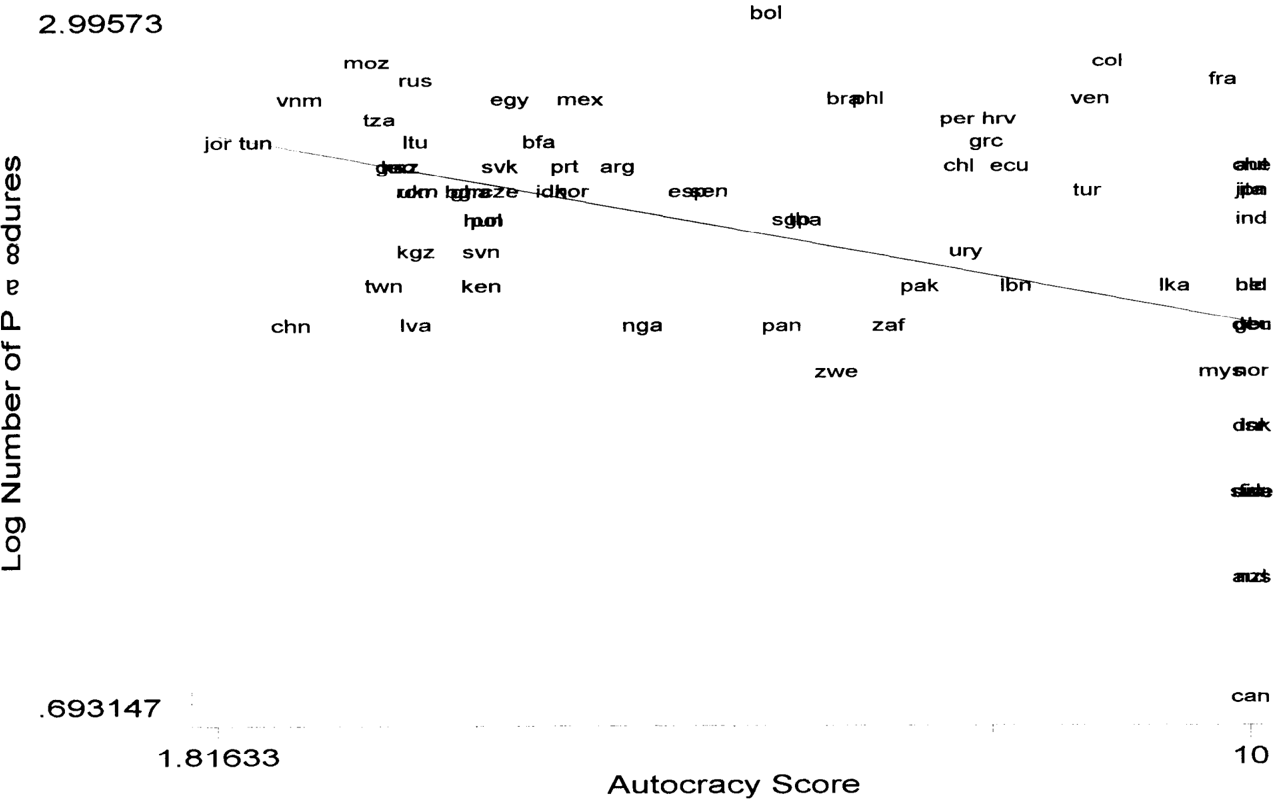
- In Table VIII, better government is associated with lighter regulation; the paper states that countries with more limited and representative governments have statistically significantly fewer procedures using 5 out of 6 measures of better government, and that more autocratic countries regulate more heavily.
Methods
- The paper builds a new database on entry regulation for 75 countries, focusing on the legal requirements, official time, and official cost for a standardized start-up firm.
- Data were gathered from written government sources, World Bank- and USAID-sponsored studies, government web pages, direct contacts with agencies, and independent double-checks in 73 countries via local consulting reports; the remaining 2 countries were double-checked through government contacts.
- The main analysis uses cross-country OLS regressions relating entry regulation measures to outcomes such as quality, pollution, unofficial economy, corruption, political institutions, legal origin, and GDP per capita; the paper also reports correlations and test-of-means comparisons across income quartiles.
Limitations
- The paper itself notes that the capture-theory tests are based on crude measures and that the data are probably least suited to test the capture hypothesis.
- The authors say the data almost surely underestimate the cost and complexity of entry because they focus on the capital city, omit industry-specific requirements and foreign-ownership steps, and ignore some informal delays and bribes.
- Evident from the text: the study is cross-sectional and based on official procedures/costs, so causal interpretation is limited and informal corruption/bureaucratic delays are not directly measured except indirectly through correlations.
Model-written summary. Check it against the paper before relying on it.
Integrity signals
Registry
Cites
Statistics
Figures
Verification
Claims the paper makes
0 Valid · 3 Not valid · 13 Not checked · 114 Own results and interpretations
A result the paper reports from its own data — it cites no other source for it, so there is none to check. The quote shows it is in the paper.
In the paper
“Very few entry regulations cover tax and labor issues.”
plain- Asserted: passes — The authors put it forward as true.
- Checkable: passes — It can be checked against evidence.
- Load-bearing: unclear — It is unclear whether the paper’s conclusions depend on it.
- Based: passes — The paper gives a reason why it holds.
In the paper
“The data show that the numbers of entry and of labor market regulations are positively correlated across countries, contrary to the substitutes hypothesis.”
What the sources say
- Not matchedcites Djankov et al., 2000
An author–year citation the paper’s reference list doesn’t settle. We don’t search these by name.
plainstates an association- Asserted: passes — The authors put it forward as true.
- Checkable: passes — It can be checked against evidence.
- Load-bearing: unclear — It is unclear whether the paper’s conclusions depend on it.
- Based: passes — The paper gives a reason why it holds.
- Not matched
A result the paper reports from its own data — it cites no other source for it, so there is none to check. The quote shows it is in the paper.
In the paper
“It often takes the form of screening procedures.”
- Also stated in: § III. Basic Results. · plain
“Instead, much of what governments do to regulate entry falls into the category of screening procedures.”
plain- Asserted: passes — The authors put it forward as true.
- Checkable: passes — It can be checked against evidence.
- Load-bearing: unclear — It is unclear whether the paper’s conclusions depend on it.
- Based: passes — The paper gives a reason why it holds.
- Also stated in: § III. Basic Results. · plain
A result the paper reports from its own data — it cites no other source for it, so there is none to check. The quote shows it is in the paper.
In the paper
“First, the cost-to-per-capita-GDP ratio decreases uniformly with GDP per capita.”
plainstates an association- Asserted: passes — The authors put it forward as true.
- Checkable: passes — It can be checked against evidence.
- Load-bearing: unclear — It is unclear whether the paper’s conclusions depend on it.
- Based: passes — The paper gives a reason why it holds.
A result the paper reports from its own data — it cites no other source for it, so there is none to check. The quote shows it is in the paper.
In the paper
“In contrast, countries in the other three quartiles of per capita income are not statistically different from each other in terms of the number of procedures and the time required to fulfill them.”
plain- Asserted: passes — The authors put it forward as true.
- Checkable: passes — It can be checked against evidence.
- Load-bearing: passes — The paper’s conclusions depend on it.
- Based: passes — The paper gives a reason why it holds.
49 more claims
Create a free account to see all 130 claims and every source verdict.
- Probably not a substantial claim. 21
- It may state two separate claims as one. 54
- The quote only partly states this claim. 26
Claims other papers make about this one
Each is checked against this paper’s own text: does it say what the citing paper says it does?
The source backs part of the claim, not all of it — or backs it for a different population, condition or comparison.
In the citing paper
“Our findings suggest an explanation for the low level of incorporation in Italy: the average direct cost associated with fulfilling the bureaucratic regulations for registering a new corporation in Italy is 20% of per capita GNP compared to 10% of per capita GNP on average for other G-7 European countries.”
From Entry regulation as a barrier to entrepreneurship (2006) · cites this paper as Djankov et al. (2002)
Experimental — accuracy not yet measuredThe cited source says what the claim attributes to it.
In the citing paper
“Given the explicit link made by Djankov et al . (2002) between the speed and ease with which businesses may be established in a country and its economic performance - and the enthusiasm with which this link has been grasped by European Union policy makers - our findings imply this link needs reconsidering.”
From The Effect of Business Regulations on Nascent and Young Business Entrepreneurship (2007) · cites this paper as Djankov et al . (2002)
Citations
Cites
La Porta, R., Lopez‐de‐Silanes, F., Shleifer, A., & Vishny, R. W. (1998) · Journal of Political Economy · doi:10.1086/250042 · Cited by 18,025
Self-citationThe Theory of Economic Regulation
Stigler, G. J. (1971) · The Bell Journal of Economics and Management Science · doi:10.2307/3003160 · Cited by 8,098
Journal of Economic Literature
(2019) · AEA Papers and Proceedings · doi:10.1257/pandp.109.633 · Cited by 7,468
The Quarterly Journal of Economics
Kuznets, S. (2024) · Business Cycle Theory, Part I Volume 4 · doi:10.4324/9781003549741-8 · Cited by 7,176
La Porta, R. (1999) · Journal of Law, Economics, and Organization · doi:10.1093/jleo/15.1.222 · Cited by 5,699 · cited 2×
“Legal origin has been viewed as a proxy for the government’s proclivity to intervene in the economy and the stance of the law toward the security of property rights in a country [La Porta et al. 1999].”
The Theory of Economic Regulation
Stigler, G. J. (2021) · The Political Economy · doi:10.4324/9781315495811-8 · Cited by 5,483
Pigou, A. C. (1933) · The Economic Journal · doi:10.2307/2224491 · Cited by 5,137
Toward a More General Theory of Regulation
Peltzman, S. (1976) · The Journal of Law and Economics · doi:10.1086/466865 · Cited by 4,729
Moffitt, R. A. (2009) · American Economic Review · doi:10.1257/aer.99.2.660 · Cited by 4,694
Shleifer, A., & Vishny, R. W. (1993) · The Quarterly Journal of Economics · doi:10.2307/2118402 · Cited by 3,778
Self-citation
Research works printed but not linked: 7
- McLiesh Caralee, 2001, NBER Working Paper No., 8288
- Kasnako lu, Zehra, and Münür Yayla, 'Unrecorded Economy in Turkey: A Monetary Approach', 1999. "Unrecorded Economy in Turkey (A Monetary Approach)" in Informal Sector in Turkey (I), Tuncer Bulutay (ed.), SIS, Ankara, forthcoming.
- Fred, 1987, Journal of Legal Studies, 101
- Olson, Mancur, 1991, 'Autocracy, Democracy, and Prosperity,' in Richard Zeckhauser, ed., Strategy of Choice, Cambridge, MA: MIT Press.
- 1967, Western Economic Journal, 232
- World Economic Forum (1999), The Global Competitiveness Report 1999 , Schwab, Klaus et al., eds., New York: Oxford University Press.
- World Economic Forum, The Global Competitiveness Report 2001, Klaus Schwab et al., eds. (New York, NY: Oxford University Press, 2001).
Cited by
Items 701–800 of 3,986
Jandik, T., & Kali, R. (2008) · Journal of International Business Studies · doi:10.1057/jibs.2008.95 · Cited by 73
“…and joint ventures than for 9 In addition to the Quality of Legal System and Quality of Accounting System variables, we performed the empirical analysis utilizing an inverse measure of cost of debt recovery for various countries (Djankov et al., 2002) as a measure of institutional quality.”
7 The Evolution of Personal Wealth in the Former Soviet Union and Central and Eastern Europe
Guriev, S. M., & Rachinsky, A. (2008) · Oxford University Press eBooks · doi:10.1093/acprof:oso/9780199548880.003.0007 · Cited by 69
The Rise of the Regulatory StatePreprint
Glaeser, E. L., & Shleifer, A. (2001) · SSRN Electronic Journal · doi:10.2139/ssrn.290287 · Cited by 64
Self-citationFinance, Firm Size and GrowthPreprint
Beck, T., Demirgüç‐Kunt, A., Laeven, L. A., & Levine, R. E. (2004) · SSRN Electronic Journal · doi:10.2139/ssrn.628086 · Cited by 58
What Can the Rule of Law Variable Tell Us About Rule of Law Reforms?Preprint
Davis, K. E. (2004) · SSRN Electronic Journal · doi:10.2139/ssrn.595142 · Cited by 64
Reaching through the fog: Institutional environment and cross‐border giving of corporate foundations
Hornstein, A. S., & Zhao, M. (2018) · Strategic Management Journal · doi:10.1002/smj.2939 · Cited by 65
Nkengfack, H., Fotio, H. K., & Totouom, A. (2020) · Journal of the Knowledge Economy · doi:10.1007/s13132-020-00685-7 · Cited by 65
Determinants of catching up or falling behind: interaction of formal and informal institutions
Winiecki, J. (2004) · Post-Communist Economies · doi:10.1080/1463137042000223859 · Cited by 63
“For example, Djankov et al. (2000) show some laggards superior to leaders with respect to some barriers to entry.”
Patterns of business creation, survival and growth: Evidence from Africa
Klapper, L. F., & Richmond, C. (2011) · Labour Economics · doi:10.1016/j.labeco.2011.09.004 · Cited by 80
Private benefits of public control: Evidence of political and economic benefits of state ownership
D’Souza, J., & Nash, R. (2017) · Journal of Corporate Finance · doi:10.1016/j.jcorpfin.2017.07.001 · Cited by 67
The role of product market regulations in the process of structural change
Messina, J. (2006) · European Economic Review · doi:10.1016/j.euroecorev.2005.06.007 · Cited by 76
“Thus, Column 2 of Table 2 reports the total cost of product market regulations used for the calibration, which amount to a 20 percent of the regulatory costs reported by Djankov et al. (2002).”
InfluentialThe levers of legal design: Institutional determinants of the quality of law
Hadfield, G. K. (2008) · Journal of Comparative Economics · doi:10.1016/j.jce.2007.10.002 · Cited by 72
The European Venture Capital and Private Equity Country Attractiveness IndicesPreprint
Groh, A. P., Liechtenstein, H., & Lieser, K. (2008) · SSRN Electronic Journal · doi:10.2139/ssrn.1307090 · Cited by 63
Bureaucratic Rents and Life Satisfaction
Luechinger, S., Meier, S., & Stutzer, A. (2007) · The Journal of Law Economics and Organization · doi:10.1093/jleo/ewm057 · Cited by 65
“17 (Djankov et al. 2002), as well as protection from international trade (Ades and Di Tella 1999), are associated with higher levels of perceived corruption.”
InfluentialThe Bribery Paradox in Transition Economies and the Enactment of ‘New Normal’ Business Environments
Eddleston, K. A., Banalieva, E. R., & Verbeke, A. C. (2020) · Journal of Management Studies · doi:10.1111/joms.12551 · Cited by 70
“…is associated with a variety of downward cascading effects: reduced foreign direct investment, misdirected entrepreneurial talent, increases in venture start-up costs, expansion of the informal economy, etc. (Clarke and Xu, 2004; Djankov et al., 2002; Doh et al., 2012; Misangyi et al., 2008).”
State Agency Discretion and Entrepreneurship in Regulated Markets
Grandy, J. B., & Hiatt, S. R. (2020) · Administrative Science Quarterly · doi:10.1177/0001839220911022 · Cited by 73
“Regulations can also disproportionately burden new firms through the permitting process (Djankov et al., 2002; Biber and Ruhl, 2014).”
Entrepreneurial dynamics and higher education institutions in the post-Communist world
Korosteleva, J. A., & Belitski, M. (2015) · Regional Studies · doi:10.1080/00343404.2015.1103370 · Cited by 73
Investigating the impact of entrepreneurship on economic development: a regional analysis
Kasseeah, H. (2016) · Journal of Small Business and Enterprise Development · doi:10.1108/jsbed-09-2015-0130 · Cited by 91
Exports and governance: Is the Middle East and North Africa region different?
Martínez‐Zarzoso, I., & Márquez‐Ramos, L. (2018) · World Economy · doi:10.1111/twec.12633 · Cited by 74
Urban, B. (2018) · The International Journal of Entrepreneurship and Innovation · doi:10.1177/1465750318796721 · Cited by 77
Munemo, J. (2018) · African Development Review · doi:10.1111/1467-8268.12345 · Cited by 92
Financial Development And Innovation In Small Firms
Sharma, S. (2007) · World Bank, Washington, DC eBooks · doi:10.1596/1813-9450-4350 · Cited by 62
“26See www.doingbusiness.org for details; these measures were first developed in Djankov et al. (2002).”
Corruption Around the World: Evidence from a Structural ModelPreprint
Dreher, A., Kotsogiannis, C., & McCorriston, S. (2004) · SSRN Electronic Journal · doi:10.2139/ssrn.555946 · Cited by 58
Entry regulation and entrepreneurship: a natural experiment in German craftsmanship
Rostam‐Afschar, D. (2013) · Empirical Economics · doi:10.1007/s00181-013-0773-7 · Cited by 90
Age driven influence of role‐models on entrepreneurship in a transition economy
Lafuente, E., & Vaillant, Y. (2013) · Journal of Small Business and Enterprise Development · doi:10.1108/14626001311298475 · Cited by 83
IMPACT OF CORRUPTION ON FIRM‐LEVEL EXPORT DECISIONS
Olney, W. W. (2015) · Economic Inquiry · doi:10.1111/ecin.12257 · Cited by 62
ENTREPRENEURSHIP IN TRANSITIONAL ECONOMIES: REVIEW AND INTEGRATION OF TWO DECADES OF RESEARCH
Manev, I. M., & Manolova, T. S. (2010) · Journal of Developmental Entrepreneurship · doi:10.1142/s1084946710001427 · Cited by 79
Cao, J., Ding, Y., & Zhang, H. (2014) · Journal of Business Ethics · doi:10.1007/s10551-014-2383-5 · Cited by 72
“…the role of formal measures for governing institutions (Acemoglu and Robinson 2000; Acemoglu et al. 2001, 2002; Acemoglu 2003; La Porta et al. 1999; Djankov et al. 2002), it is becoming important to understand the effects of informal corporate governance on firm performance (Aguilera et al. 2008).”
E-Government and Entrepreneurship: Online Government Services and the Ease of Starting Business
Das, A., & Das, S. S. (2021) · Information Systems Frontiers · doi:10.1007/s10796-021-10121-z · Cited by 81
Regulating entrepreneurship quality and quantity
Audretsch, D. B., Belitski, M., Chowdhury, F., & Desai, S. (2023) · Research Policy · doi:10.1016/j.respol.2023.104942 · Cited by 84
Financial structure, firm size and industry growth
Kim, D., Lin, S., & Chen, T.-C. (2015) · International Review of Economics & Finance · doi:10.1016/j.iref.2015.10.002 · Cited by 74
Entrepreneurship and enforcement institutions: disaggregated evidence for Spain
García-Posada, M., & Mora‐Sanguinetti, J. S. (2014) · European Journal of Law and Economics · doi:10.1007/s10657-014-9470-z · Cited by 71
“24 Although entry regulations (see Djankov et al. 2002; Klapper et al. 2006 for a discussion on this specific issue) and, in general, institutions, change slowly over time (and thus the province-fixed effects correlations among some of the variables due to the business cycle (e.g., entry and exit…”
From mine to coast: Transport infrastructure and the direction of trade in developing countries
Bonfatti, R., & Poelhekke, S. (2017) · Journal of Development Economics · doi:10.1016/j.jdeveco.2017.03.004 · Cited by 88
The Effect of Credit Competition on Banks’ Loan-Loss Provisions
Dou, Y., Ryan, S. G., & Zou, Y. (2018) · Journal of Financial and Quantitative Analysis · doi:10.1017/s0022109018000054 · Cited by 69
Quantifying Creative Destruction: Entrepreneurship and Productivity in New Zealand
McMillan, J. (2007) · Research on technological innovation, management and policy · doi:10.1016/s0737-1071(05)09011-6 · Cited by 61
The Evolution of Labour Law: Calibrating and Comparing Regulatory RegimesPreprint
Deakin, S. F., Lele, P. P., & Siems, M. (2007) · SSRN Electronic Journal · doi:10.2139/ssrn.1029694 · Cited by 70
Where Do Firms Incorporate? Deregulation and the Cost of Entry
Becht, M., Mayer, C., & Wagner, H. F. (2008) · Oxford University Research Archive (ORA) (University of Oxford) · doi:10.1016/j.jcorpfin.2008.04.002 · Cited by 112
Land inequality and the transition to modern growth
Adamopoulos, T. (2007) · Review of Economic Dynamics · doi:10.1016/j.red.2007.07.004 · Cited by 65
Mateev, M., Sahyouni, A., & Tariq, M. U. (2022) · Review of Managerial Science · doi:10.1007/s11846-022-00529-5 · Cited by 59
Does corruption matter for international entrepreneurship?
Chowdhury, F., Audretsch, D. B., & Belitski, M. (2015) · International Entrepreneurship and Management Journal · doi:10.1007/s11365-015-0372-5 · Cited by 70
King, E. M., Montenegro, C. E., & Orazem, P. F. (2012) · Economic Development and Cultural Change · doi:10.1086/666948 · Cited by 71
Bureaucracy intermediaries, corruption and red tape
Fredriksson, A. (2014) · Journal of Development Economics · doi:10.1016/j.jdeveco.2014.02.005 · Cited by 59
“For the same procedure, the number of offices to be visited, monetary costs, as well as time spent, tend to be significantly higher in the developing world, as compared to developed countries (Djankov et al., 2002; World Bank, 2012b).”
Industrial Policy in Developing Countries: Failing Markets, Weak States
Altenburg, T., & Lütkenhorst, W. (2015) · Edward Elgar Publishing eBooks · doi:10.4337/9781781000267 · Cited by 169
Predation, Protection, and Productivity: A Firm-Level Perspective
Besley, T. J., & Mueller, H. (2018) · American Economic Journal Macroeconomics · doi:10.1257/mac.20160120 · Cited by 72
How Do Regulations Affect SMEs? A Review of the Qualitative Evidence and a Research Agenda
Mallett, O., Wapshott, R., & Vorley, T. (2018) · International Journal of Management Reviews · doi:10.1111/ijmr.12191 · Cited by 95
Does gender equality bridge or buffer the entrepreneurship gender gap? A cross-country investigation
Vracheva, V. P., & Stoyneva, I. (2020) · International Journal of Entrepreneurial Behaviour & Research · doi:10.1108/ijebr-03-2020-0144 · Cited by 83
Foreign Direct Investment and Governance Quality in Russia
Kuzmina, O., Volchkova, N., & Zueva, T. (2014) · Journal of Comparative Economics · doi:10.1016/j.jce.2014.08.001 · Cited by 84
POLICY COMPROMISES: CORRUPTION AND REGULATION IN A DEMOCRACY
Aidt, T. S., & Dutta, J. (2008) · Economics and Politics · doi:10.1111/j.1468-0343.2008.00332.x · Cited by 78
Better Means More: Property Rights and High-Growth Aspiration EntrepreneurshipPreprint
Estrin, S., Korosteleva, J. A., & Mickiewicz, T. M. (2009) · SSRN Electronic Journal · doi:10.2139/ssrn.1489219 · Cited by 61
“…to entrepreneurs in pursuing market opportunities for setting up new ventures and generating new jobs (North 1990, 1994; Baumol 1990, 1993; Djankov et al. 2002; Davidsson and Henrekson 2002; Harper 2003; Bowen and De Clercq 2008), while a weak institutional environment is an impediment to…”
Pritchett, L. H., & Hallward-Driemeier, M. C. (2011) · The World Bank Open Knowledge Repository (World Bank) · doi:10.1596/1813-9450-5563 · Cited by 90
Importing Corruption Culture from Overseas: Evidence from Corporate Tax Evasion in the United StatesPreprint
DeBacker, J. M., Heim, B. T., & Tran, A. (2012) · SSRN Electronic Journal · doi:10.2139/ssrn.1941412 · Cited by 59
“9 For example, see Fisman (2001), Djankov et al. (2002), and Barth et al. (2009).”
Adomako, S., & Danso, A. (2014) · Journal of Small Business and Enterprise Development · doi:10.1108/jsbed-01-2014-0004 · Cited by 85
Regulatory costs on entrepreneurship and establishment employment size
Calcagno, P. T., & Sobel, R. S. (2013) · Small Business Economics · doi:10.1007/s11187-013-9493-9 · Cited by 72
Cabral, L. (2007) · Portuguese Economic Journal · doi:10.1007/s10258-007-0018-9 · Cited by 56
“…Time to obtain legal status (days) 76 47.7 Cost of obtaining legal status 0.1844 0.4708 Total cost 0.4884 0.6598 GDP per capita 10,600 8,226 Source: Djankov et al. (2002) as we compare Portugal to developing countries (as I do for the most part in this paper), then we should be aware of the…”
InfluentialExplaining nation-wide differences in entrepreneurial activity: a legitimacy perspective
Diéz‐Martín, F., Blanco‐González, A., & Román, C. P. (2016) · International Entrepreneurship and Management Journal · doi:10.1007/s11365-015-0381-4 · Cited by 77
The cumulative cost of regulations
Coffey, B., McLaughlin, P. A., & Peretto, P. F. (2020) · Review of Economic Dynamics · doi:10.1016/j.red.2020.03.004 · Cited by 77
Testing the self-selection theory in high corruption environments: evidence from African SMEs
Gomes, E., Vendrell-Herrero, F., Mellahi, K., Angwin, D., & Sousa, C. M. P. (2018) · International Marketing Review · doi:10.1108/imr-03-2017-0054 · Cited by 66
Foreign direct investment and the dark side of decentralization
Kessing, S. G., Konrad, K. A., & Kotsogiannis, C. (2006) · Economic Policy · doi:10.1111/j.1468-0327.2007.00172.x · Cited by 69
“Djankov et al. (2002).”
The Unofficial Economy in Africa
Porta, R. L., & Shleifer, A. (2011) · National Bureau of Economic Research · doi:10.3386/w16821 · Cited by 69
“The registration fee – including the value of the entrepreneurs’ time – would probably amount to roughly $1,740 (Djankov et al., 2002).”
Self-citationProduct Market Regulation And Macroeconomic Performance : A Review Of Cross-Country Evidence
Schiantarelli, F. (2005) · World Bank, Washington, DC eBooks · doi:10.1596/1813-9450-3770 · Cited by 64
Eifert, B. P. (2009) · SSRN Electronic Journal · doi:10.2139/ssrn.1390326 · Cited by 85
Entrepreneurship as a non-profit-seeking activity
Benz, M. (2009) · International Entrepreneurship and Management Journal · doi:10.1007/s11365-006-0031-y · Cited by 172
Does Career Risk Deter Potential Entrepreneurs?
Gottlieb, J. D., TOWNSEND, R. R., & Xu, T. (2016) · Review of Financial Studies · doi:10.1093/rfs/hhab105 · Cited by 90
“Entry regulations have been show to limit entrepreneurship both across (Djankov et al., 2002; Desai, Gompers, and Lerner, 2003; Klapper, Laeven, and Rajan, 2006) and within countries (Mullainathan and Schnabl, 2010; Bruhn, 2011; Branstetter et al., 2014).”
He, W., & Wang, B. (2024) · Energy Economics · doi:10.1016/j.eneco.2024.107358 · Cited by 64
Political connections and trade expansion: Evidence from Chinese private firms
Lu, Y. (2011) · Economics of Transition · doi:10.1111/j.1468-0351.2010.00402.x · Cited by 60
Prospect theory and the effects of bankruptcy laws on entrepreneurial aspirations
Estrin, S., Mickiewicz, T. M., & Rebmann, A. (2016) · Small Business Economics · doi:10.1007/s11187-016-9810-1 · Cited by 67
“…have stressed the role of both ‘higher order’ institutions (e.g. constitutional protection of property rights) and of government regulations (e.g. Djankov et al. 2002; Klapper et al. 2006; van Stel et al. 2007; McMullen et al. 2008; Bowen and De Clercq 2008; Sobel 2008; The order of the…”
Democratization and the Conditional Dynamics of Income Distribution
Dorsch, M., & Maarek, P. (2019) · American Political Science Review · doi:10.1017/s0003055418000825 · Cited by 68
“3 See also De Long and Shleifer (1993); De Luca, Litina, and Sekeris”
Asset growth and stock returns: Evidence from Asian financial markets
Yao, T., Yu, T., Zhang, T., & Chen, S. K. (2010) · Pacific-Basin Finance Journal · doi:10.1016/j.pacfin.2010.09.004 · Cited by 83
Kaufmann, D., Kraay, A., & Mastruzzi, M. (2012) · The World Bank Economic Review · Cited by 61
What Makes a Successful Entrepreneur? Evidence from BrazilPreprint
Djankov, S., Qian, Y., Roland, G., & Zhuravskaya, E. V. (2007) · RePEc: Research Papers in Economics · Cited by 66
Self-citationDobeš, K., Kot, S., Kramoliš, J., & Sopková, G. (2017) · Journal of Competitiveness · doi:10.7441/joc.2017.03.03 · Cited by 56
“Literature often concentrates on weaknesses in legal systems, high levels of state regulation, and corruption (La Porta et al. 1999; Djankov et al. 2002).”
Hà, L. T., Hoang, D. P., & Thanh, T. T. (2022) · International Journal of Sustainable Development & World Ecology · doi:10.1080/13504509.2022.2025500 · Cited by 57
Mahbub, T., Ahammad, M. F., Tarba, S. Y., & Mallick, S. (2022) · Energy Strategy Reviews · doi:10.1016/j.esr.2022.100865 · Cited by 152
Informality in developing economies: Regulation and fiscal policies
Charlot, O., Malherbet, F., & Terra, C. (2014) · Journal of Economic Dynamics and Control · doi:10.1016/j.jedc.2014.09.031 · Cited by 76
Entrepreneurship and economic development: the valley of backwardness
Acs, Z. J. (2010) · Annals of Innovation & Entrepreneurship · doi:10.3402/aie.v1i1.5602 · Cited by 56
A survey on institutions and new firm entry: How and why do entry rates differ in emerging markets?
Estrin, S., & Prevezer, M. (2010) · Economic Systems · doi:10.1016/j.ecosys.2010.01.003 · Cited by 71
Good governance, institutions and performance of public private partnerships
Sabry, M. I. (2015) · International Journal of Public Sector Management · doi:10.1108/ijpsm-01-2015-0005 · Cited by 68
Agency theory and entrepreneurship: A cross-country analysis
Solomon, S. J., Bendickson, J. S., Marvel, M. R., McDowell, W. C., & Mahto, R. V. (2020) · Journal of Business Research · doi:10.1016/j.jbusres.2020.09.003 · Cited by 100
Democracy, Inequality and Corruption: Korea, Taiwan and the Philippines Compared
You, J. (2015) · Cited by 54
Market imperfections, wealth inequality, and the distribution of trade gains
Foellmi, R., & Oechslin, M. (2010) · Journal of International Economics · doi:10.1016/j.jinteco.2010.03.001 · Cited by 73
“…that matter) is divided along the same lines: The relatively poor owners of small firms (i.e., the import-competing entrepreneurs) are likely to lose from an integration into world markets while the more affluent owners of big establishments (i.e., the export-oriented entrepreneurs) stand to win.”
THE ROLE OF LAW IN ECONOMIC GROWTH: A LITERATURE REVIEW
Xu, G. (2011) · Journal of Economic Surveys · doi:10.1111/j.1467-6419.2011.00691.x · Cited by 63
The credit crunch and fall in employment during the Great Recession
Haltenhof, S., Lee, S. J., & Stebunovs, V. (2014) · Journal of Economic Dynamics and Control · doi:10.1016/j.jedc.2014.03.013 · Cited by 64
Ufere, N., Gaskin, J. E., Perelli, S. J., Somers, A. M., & Boland, R. (2019) · Journal of Business Research · doi:10.1016/j.jbusres.2019.09.060 · Cited by 65
International trade, exit and entry: A cross-country and industry analysis
Colantone, I., & Sleuwaegen, L. E. (2010) · Journal of International Business Studies · doi:10.1057/jibs.2009.105 · Cited by 66
Mitchener, K. J. (2007) · The Journal of Law and Economics · doi:10.1086/511323 · Cited by 53
Creating an enabling environment for private sector development in Sub-Saharan Africa
Altenburg, T., & von Drachenfels, C. (2007) · Cited by 68
Regulation and InvestmentPreprint
Alesina, A., Ardagna, S., Nicoletti, G., et al. (2003) · SSRN Electronic Journal · doi:10.2139/ssrn.373100 · Cited by 55
The Curse of AidPreprint
Djankov, S., Montalvo, J. G., & Reynal‐Querol, M. (2006) · SSRN Electronic Journal · doi:10.2139/ssrn.893558 · Cited by 61
Self-citationNexus between economic growth and foreign private investment: Evidence from Pakistan economy
Sadiq, M., Usman, M. Z., Zamir, A., Shabbir, M. S., & Arif, A. (2021) · Cogent Economics & Finance · doi:10.1080/23322039.2021.1956067 · Cited by 70
Rocha, E. A. G. (2012) · Procedia Economics and Finance · doi:10.1016/s2212-5671(12)00348-6 · Cited by 54
Bitzenis, A., Vlachos, V., & SCHNEIDER, F. G. (2016) · Journal of Economic Issues · doi:10.1080/00213624.2016.1147918 · Cited by 54
“…characteristics determine the risk of exposure to bribery (Mocan 2008), but increased bureaucracy is typically associated with higher corruption (Djankov et al., 2002) and the variations in policies and regulations across industries explain the incidence of corruption (Svensson 2003).”
Taussig, M. D. (2016) · Journal of International Business Studies · doi:10.1057/s41267-016-0032-1 · Cited by 59
Institutional Quality and the Growth Rates of the Italian Regions
Vita, G. D. (2014) · Papers of the Regional Science Association · doi:10.1111/pirs.12290 · Cited by 58
SME access to market-based finance across Eurozone countries
Bongini, P. A., Ferrando, A., Rossi, E., & Rossolini, M. (2019) · Small Business Economics · doi:10.1007/s11187-019-00285-z · Cited by 85
“…of a developed capital market (Black and Gilson 1998; Gompers and Lerner 2000; Schertler 2003), labour market flexibility (Black and Gilson 1998; Djankov et al. 2002) and entrepreneurial culture for venture capital, measured, for instance, through the number of patents and the volume of…”
Inequality, persistence of the informal economy, and club convergence
Gutiérrez‐Romero, R. (2020) · World Development · doi:10.1016/j.worlddev.2020.105211 · Cited by 68
Electricity connections and firm performance in 183 countries
Geginat, C., & Ramalho, R. (2018) · Energy Economics · doi:10.1016/j.eneco.2018.08.034 · Cited by 66
What to avoid to succeed as an entrepreneur
Mas‐Tur, A., Pinazo-Dallenbach, P., Porcar, A. M. T., & Masferrer, M. S. (2015) · Journal of Business Research · doi:10.1016/j.jbusres.2015.06.011 · Cited by 71
Determinants of Vertical Integration: Finance, Contracts, and Regulation
Acemoğlu, D., Johnson, S., & Mitton, T. (2005) · National Bureau of Economic Research · doi:10.3386/w11424 · Cited by 63
Armour, J. H., Deakin, S. F., Lele, P. P., & Siems, M. (2009) · SSRN Electronic Journal · doi:10.2139/ssrn.1431008 · Cited by 53
Kovač, M., & Spruk, R. (2015) · Journal of Institutional Economics · doi:10.1017/s1744137415000077 · Cited by 64
Metadata
- Authors
- Djankov, S., La Porta, R., Lopez-de-Silanes, F., & Shleifer, A.
- Affiliations
- World Bank (US)
- National Bureau of Economic Research (US)
- ORCID
- Djankov, S.
- Venue
- The Quarterly Journal of Economics
- Publisher
- Oxford University Press (OUP)
- Published
- 2002-02-01
- Volume
- 117
- Issue
- 1
- Pages
- 1-37
- ISSN
- 0033-5533
- 1531-4650
- OpenAlex
- W2139896179
- Cited by
- 3,956
- References
- 30
- Citations by year
- 2026: 223 · 2025: 185 · 2024: 157 · 2023: 120 · 2022: 140 · 2021: 150 · 2020: 151 · 2019: 161 · 2018: 157 · 2017: 162 · 2016: 166 · 2015: 193 · 2014: 200 · 2013: 183 · 2012: 193
- Type
- report
- Language
- en
- Open access
- green
- doi.org
- Licence
- other-oa
- Locations
- World Bank, Washington, DC eBooks (publishedVersion)
- The Quarterly Journal of Economics (publishedVersion)
- The World Bank Open Knowledge Repository (World Bank) (publishedVersion)
- National Bureau of Economic Research (publishedVersion, other-oa)
- RePEc: Research Papers in Economics (submittedVersion)
- Digital Access to Scholarship at Harvard (DASH) (Harvard University) (submittedVersion, cc-by)
- SSRN Electronic Journal (submittedVersion)
- OpenGrey (Institut de l'Information Scientifique et Technique) (submittedVersion)
- The World Bank Open Knowledge Repository (World Bank) (submittedVersion, cc-by)
- Topics
- Social Sciences › Sociology and Political Science › Corruption and Economic Development
- Social Sciences › Economics, Econometrics and Finance › Economics and Econometrics › Taxation and Compliance Studies
- Social Sciences › Business, Management and Accounting › Strategy and Management › Political Influence and Corporate Strategies
- Keywords
- start-up firms, bureaucratic procedures, corruption, informal economy, democracy, government size, public choice theory, public interest theory
About these checks
Registry, retraction, Cites and statistics results are computed, not judged, with one exception: a printed reference that no index lists is read once by a model before it counts as a citation error. Claims are extracted by a model and kept only when their quote appears verbatim in the text; each cited source is then checked, with a model’s help, for whether it says what the claim relies on. Those verdicts can be wrong — read the claim’s quote and the cited source before relying on one.
A language model drew the claims from the paper on 2026-10-01, under version 3 of the claim definition (model deepseek-v4.1-flash, prompt extract-v3).
A second model labelled each claim on 2026-10-01 (model jev-1.13-20260917, definition revision gold-guideline-v0.2).
Statistics and arithmetic are recomputed, not judged.
Confidence bands are shown only for fields calibrated on our annotated test set. None is calibrated yet, so no band is shown.
What counts as a claim ›How we measure confidence ›How we check this ›
Are you an author, or do you see a problem with this page? Request a review
Data sources
Bibliographic data: Semantic Scholar, OpenAlex, Crossref.
Contains information from the Semantic Scholar Academic Graph Datasets, made available under the ODC Attribution License (ODC-BY 1.0).
Semantic Scholar’s data is described in: Kinney, R., et al. (2023). The Semantic Scholar Open Data Platform. arXiv:2301.10140.
