

The Regulation of Entry
Open accessThe DOI matches its Crossref record, with a small difference in title or year; 39 of the 39 references it cites were found in a registry or an index; none of the 13 sources its claims cite is checked for support yet.
Abstract
1%(5 :25.,1* 3$3(5 6(5,(6 7+( 5(*8/$7,21 2) (175< 6LPHRQ 'MDQNRY 5DIDHO /D 3RUWD )ORUHQ.LR /RSH]GH6LODQHV $QGUHL 6KOHLIHU :RUNLQJ 3DSHU KWWSZZZQEHURUJSDSHUVZ 1$7,21$/ %85($8 2) (&2120,& 5(6($5&+ 0DVVD.KXVHWWV $YHQXH &DPEULGJH 0$ 6HSWHPEHU :H WKDQN 2OJD ,RIIH 7DWLDQD 1HQRYD DQG (NDWHULQD 7UL]ORYD IRU DEOH UHVHDU.K DVVLVWDQ.H DQG +DPLG $ODYL ,ULQD $VWUDNKDQ $EKLMLW %DQHUMHH 5L.KDUG &DYHV -D.TXHOLQH &RROLGJH -DPHV (PHU\ 1LKDO (O0DJKDUEHO -HDQ 3DXO *DXWKLHU (G *ODHVHU 6LPRQ -RKQVRQ /DZUHQ.H .DW] 3HWHU .X.HUD 'DYLG /DLEVRQ ,UD /LHEHUPDQ 'DYLQ 0D.NLQ]LH 0DULH )UDQ.RLVH 0DULH1HOO\ 0DU.HOR 2ODUUHDJD *X\ 3IHIIHUPDQQ 6DQWLDJR 6HGD.D /HLOD :HEVWHU 3HWHU :ULJKW DQG VHPLQDU SDUWL.LSDQWV DW WKH 8QLYHUVLW\ RI 0DU\ODQG DW &ROOHJH 3DUN IRU KHOSIXO .RPPHQWV 7KH .ROOH.WLRQ RI GDWD IRU WKLV SDSHU ZDV RUJDQL]HG DQG ILQDQ.HG E\ WKH :RUOG %DQN $Q DSSHQGL[ GHV
Overview
CoChat Summary
TL;DR
This paper assembles a new cross-country dataset on business entry regulation in 75 countries and uses it to compare the helping-hand, capture, and tollbooth theories of regulation. The evidence is most consistent with the tollbooth view: heavier entry regulation is associated with more corruption, a larger unofficial economy, and less representative, more autocratic governments.
Key findings
- Across the 75-country sample, the number of entry procedures ranges from 2 in Canada to 20 in Bolivia, with a sample average of 10.17 procedures; the average official time is 63.05 business days and the average cost is 0.34 of GDP per capita.
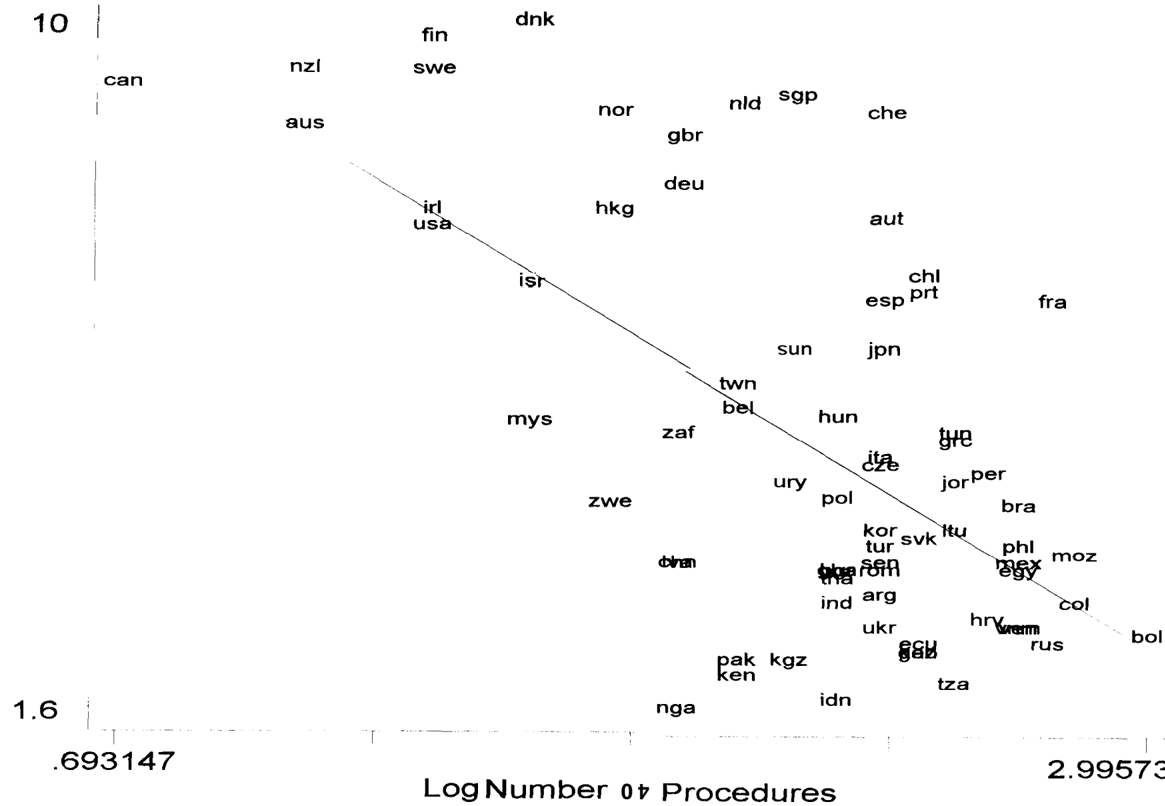
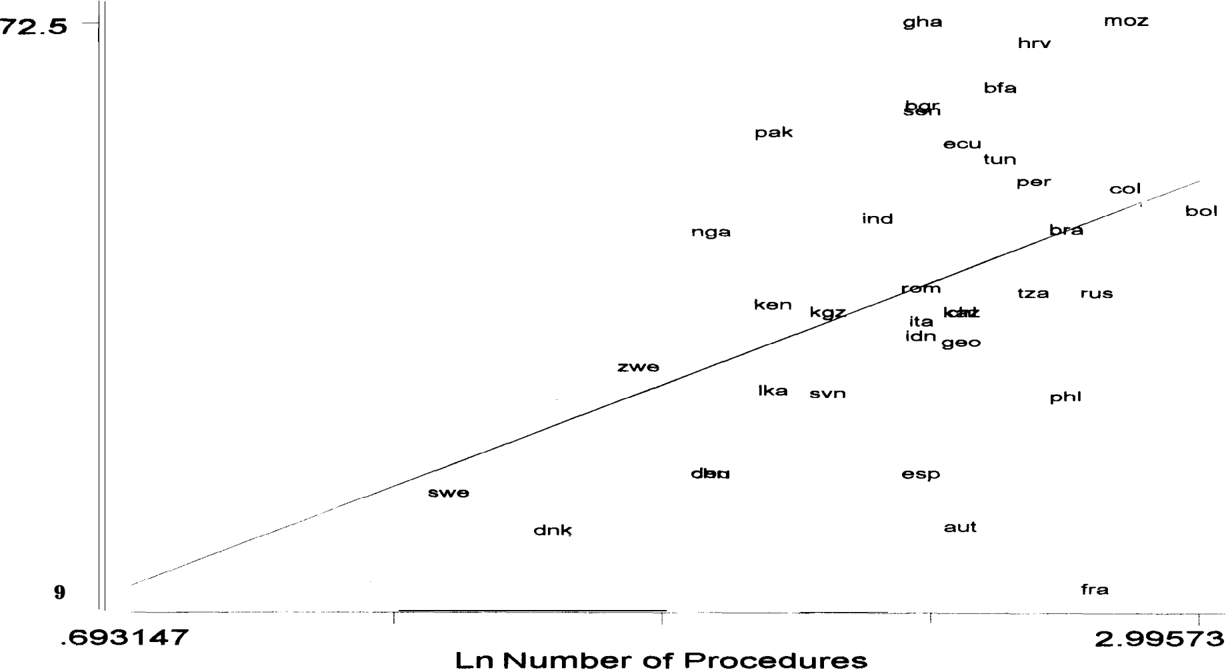
- The number of procedures is strongly correlated with time and cost: the paper reports correlations of 0.75 with log time and 0.62 with log cost.
- The helping-hand tests do not support a beneficial-regulation story: in Table IV, more procedures are associated with lower ISO quality standards (e.g. coefficient -0.2646) and larger unofficial economy measures (e.g. coefficient 13.6277 for size of unofficial economy; 19.8763 for employment in the unofficial economy), while pollution and health outcomes do not improve.
- The tollbooth evidence is stronger: Table VI reports that more procedures are associated with worse corruption scores, with a coefficient of -3.2809 (and -1.7249 with GDP per capita controls) for the corruption regressions.
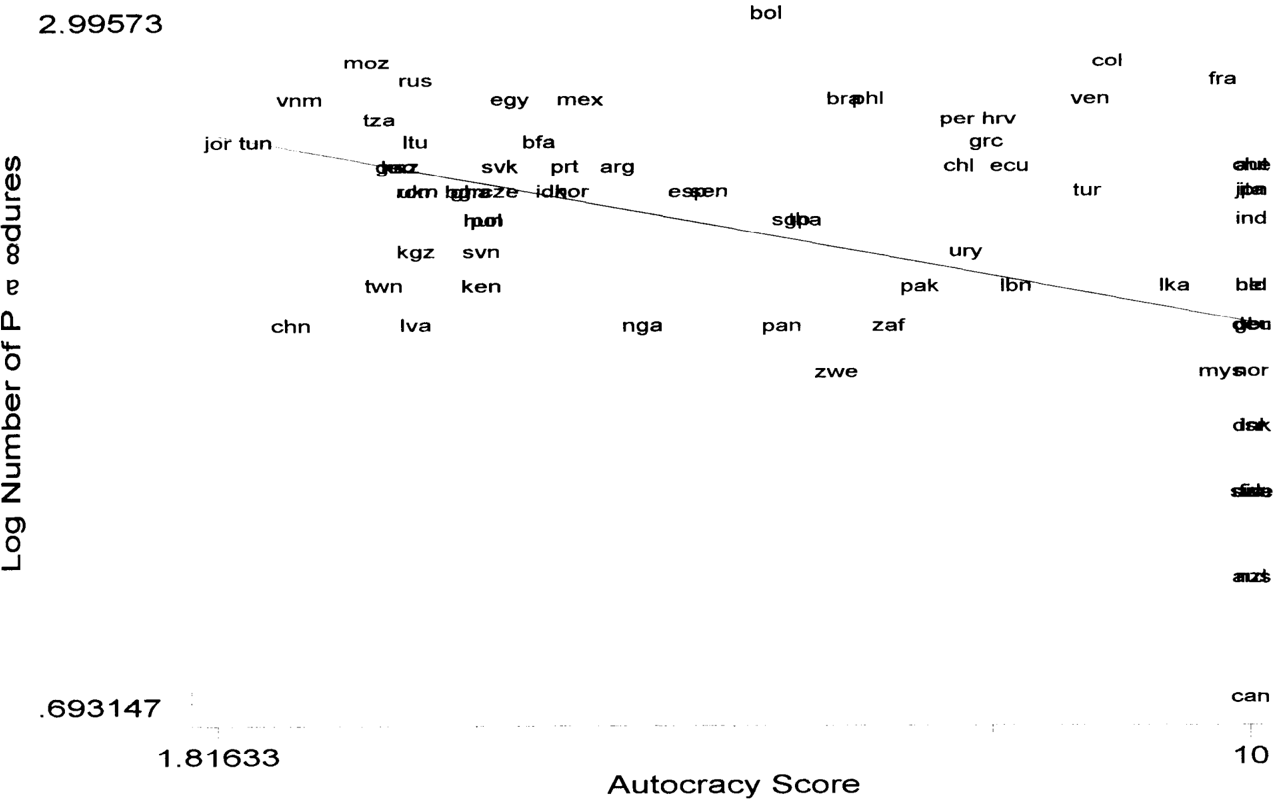
- In Table VIII, better government is associated with lighter regulation; the paper states that countries with more limited and representative governments have statistically significantly fewer procedures using 5 out of 6 measures of better government, and that more autocratic countries regulate more heavily.
Methods
- The paper builds a new database on entry regulation for 75 countries, focusing on the legal requirements, official time, and official cost for a standardized start-up firm.
- Data were gathered from written government sources, World Bank- and USAID-sponsored studies, government web pages, direct contacts with agencies, and independent double-checks in 73 countries via local consulting reports; the remaining 2 countries were double-checked through government contacts.
- The main analysis uses cross-country OLS regressions relating entry regulation measures to outcomes such as quality, pollution, unofficial economy, corruption, political institutions, legal origin, and GDP per capita; the paper also reports correlations and test-of-means comparisons across income quartiles.
Limitations
- The paper itself notes that the capture-theory tests are based on crude measures and that the data are probably least suited to test the capture hypothesis.
- The authors say the data almost surely underestimate the cost and complexity of entry because they focus on the capital city, omit industry-specific requirements and foreign-ownership steps, and ignore some informal delays and bribes.
- Evident from the text: the study is cross-sectional and based on official procedures/costs, so causal interpretation is limited and informal corruption/bureaucratic delays are not directly measured except indirectly through correlations.
Model-written summary. Check it against the paper before relying on it.
Integrity signals
Registry
Cites
Statistics
Figures
Verification
Claims the paper makes
0 Valid · 3 Not valid · 13 Not checked · 114 Own results and interpretations
A result the paper reports from its own data — it cites no other source for it, so there is none to check. The quote shows it is in the paper.
In the paper
“Very few entry regulations cover tax and labor issues.”
plain- Asserted: passes — The authors put it forward as true.
- Checkable: passes — It can be checked against evidence.
- Load-bearing: unclear — It is unclear whether the paper’s conclusions depend on it.
- Based: passes — The paper gives a reason why it holds.
In the paper
“The data show that the numbers of entry and of labor market regulations are positively correlated across countries, contrary to the substitutes hypothesis.”
What the sources say
- Not matchedcites Djankov et al., 2000
An author–year citation the paper’s reference list doesn’t settle. We don’t search these by name.
plainstates an association- Asserted: passes — The authors put it forward as true.
- Checkable: passes — It can be checked against evidence.
- Load-bearing: unclear — It is unclear whether the paper’s conclusions depend on it.
- Based: passes — The paper gives a reason why it holds.
- Not matched
A result the paper reports from its own data — it cites no other source for it, so there is none to check. The quote shows it is in the paper.
In the paper
“It often takes the form of screening procedures.”
- Also stated in: § III. Basic Results. · plain
“Instead, much of what governments do to regulate entry falls into the category of screening procedures.”
plain- Asserted: passes — The authors put it forward as true.
- Checkable: passes — It can be checked against evidence.
- Load-bearing: unclear — It is unclear whether the paper’s conclusions depend on it.
- Based: passes — The paper gives a reason why it holds.
- Also stated in: § III. Basic Results. · plain
A result the paper reports from its own data — it cites no other source for it, so there is none to check. The quote shows it is in the paper.
In the paper
“First, the cost-to-per-capita-GDP ratio decreases uniformly with GDP per capita.”
plainstates an association- Asserted: passes — The authors put it forward as true.
- Checkable: passes — It can be checked against evidence.
- Load-bearing: unclear — It is unclear whether the paper’s conclusions depend on it.
- Based: passes — The paper gives a reason why it holds.
A result the paper reports from its own data — it cites no other source for it, so there is none to check. The quote shows it is in the paper.
In the paper
“In contrast, countries in the other three quartiles of per capita income are not statistically different from each other in terms of the number of procedures and the time required to fulfill them.”
plain- Asserted: passes — The authors put it forward as true.
- Checkable: passes — It can be checked against evidence.
- Load-bearing: passes — The paper’s conclusions depend on it.
- Based: passes — The paper gives a reason why it holds.
49 more claims
Create a free account to see all 130 claims and every source verdict.
- Probably not a substantial claim. 21
- It may state two separate claims as one. 54
- The quote only partly states this claim. 26
Claims other papers make about this one
Each is checked against this paper’s own text: does it say what the citing paper says it does?
The source backs part of the claim, not all of it — or backs it for a different population, condition or comparison.
In the citing paper
“Our findings suggest an explanation for the low level of incorporation in Italy: the average direct cost associated with fulfilling the bureaucratic regulations for registering a new corporation in Italy is 20% of per capita GNP compared to 10% of per capita GNP on average for other G-7 European countries.”
From Entry regulation as a barrier to entrepreneurship (2006) · cites this paper as Djankov et al. (2002)
Experimental — accuracy not yet measuredThe cited source says what the claim attributes to it.
In the citing paper
“Given the explicit link made by Djankov et al . (2002) between the speed and ease with which businesses may be established in a country and its economic performance - and the enthusiasm with which this link has been grasped by European Union policy makers - our findings imply this link needs reconsidering.”
From The Effect of Business Regulations on Nascent and Young Business Entrepreneurship (2007) · cites this paper as Djankov et al . (2002)
Citations
Cites
La Porta, R., Lopez‐de‐Silanes, F., Shleifer, A., & Vishny, R. W. (1998) · Journal of Political Economy · doi:10.1086/250042 · Cited by 18,025
Self-citationThe Theory of Economic Regulation
Stigler, G. J. (1971) · The Bell Journal of Economics and Management Science · doi:10.2307/3003160 · Cited by 8,098
Journal of Economic Literature
(2019) · AEA Papers and Proceedings · doi:10.1257/pandp.109.633 · Cited by 7,468
The Quarterly Journal of Economics
Kuznets, S. (2024) · Business Cycle Theory, Part I Volume 4 · doi:10.4324/9781003549741-8 · Cited by 7,176
La Porta, R. (1999) · Journal of Law, Economics, and Organization · doi:10.1093/jleo/15.1.222 · Cited by 5,699 · cited 2×
“Legal origin has been viewed as a proxy for the government’s proclivity to intervene in the economy and the stance of the law toward the security of property rights in a country [La Porta et al. 1999].”
The Theory of Economic Regulation
Stigler, G. J. (2021) · The Political Economy · doi:10.4324/9781315495811-8 · Cited by 5,483
Pigou, A. C. (1933) · The Economic Journal · doi:10.2307/2224491 · Cited by 5,137
Toward a More General Theory of Regulation
Peltzman, S. (1976) · The Journal of Law and Economics · doi:10.1086/466865 · Cited by 4,729
Moffitt, R. A. (2009) · American Economic Review · doi:10.1257/aer.99.2.660 · Cited by 4,694
Shleifer, A., & Vishny, R. W. (1993) · The Quarterly Journal of Economics · doi:10.2307/2118402 · Cited by 3,778
Self-citation
Research works printed but not linked: 7
- McLiesh Caralee, 2001, NBER Working Paper No., 8288
- Kasnako lu, Zehra, and Münür Yayla, 'Unrecorded Economy in Turkey: A Monetary Approach', 1999. "Unrecorded Economy in Turkey (A Monetary Approach)" in Informal Sector in Turkey (I), Tuncer Bulutay (ed.), SIS, Ankara, forthcoming.
- Fred, 1987, Journal of Legal Studies, 101
- Olson, Mancur, 1991, 'Autocracy, Democracy, and Prosperity,' in Richard Zeckhauser, ed., Strategy of Choice, Cambridge, MA: MIT Press.
- 1967, Western Economic Journal, 232
- World Economic Forum (1999), The Global Competitiveness Report 1999 , Schwab, Klaus et al., eds., New York: Oxford University Press.
- World Economic Forum, The Global Competitiveness Report 2001, Klaus Schwab et al., eds. (New York, NY: Oxford University Press, 2001).
Cited by
Items 801–900 of 3,986
Koten, S. V., & Ortmann, A. (2008) · Energy Economics · doi:10.1016/j.eneco.2008.07.002 · Cited by 66
Institutional constraints and economic development
Gurvich, E. T. (2016) · Russian Journal of Economics · doi:10.1016/j.ruje.2016.11.002 · Cited by 60
“Djankov et al. (2002) analyzed data for 85 countries and found that tighter regulation did not lead to higher quality or safety for the products and services provided by the private or public sector.”
Assenova, V. (2019) · Organization Science · doi:10.1287/orsc.2020.1390 · Cited by 70
Formal and informal entrepreneurship: a cross-country policy perspective
Laing, E., van Stel, A. J., & STOREY, D. J. (2021) · Small Business Economics · doi:10.1007/s11187-021-00548-8 · Cited by 77
The changing nature of the OECD shadow economy
Bovi, M., & Dell’Anno, R. (2009) · Journal of Evolutionary Economics · doi:10.1007/s00191-009-0138-8 · Cited by 56
Carbonara, E., Santarelli, E., & Tran, H. T. (2016) · Small Business Economics · doi:10.1007/s11187-016-9715-z · Cited by 63
“(2000); Frye and Zhuravskaya (2000); Djankov et al. (2006). These are empirical studies and mainly deal with the incentives to hide”
Chong, A. E., & Gradstein, M. (2009) · Journal of Economic Growth · doi:10.1007/s10887-009-9037-y · Cited by 65
“(2004) and Djankov et al. (2003). We also used an alternative variable, corruption obstacles and obtain virtually identical results.”
ENTERPRISE REFORM AND CORPORATE GOVERNANCE IN RUSSIA: A QUANTITATIVE SURVEY
Iwasaki, I. (2007) · Journal of Economic Surveys · doi:10.1111/j.1467-6419.2007.00520.x · Cited by 49
“Dolgopyatova (2003a) discussed CEO turnover and suggested that it increased after the 1998 financial crisis.”
InfluentialCorruption Distance and Foreign Direct Investment
Qian, X., Sandoval-Hernandez, J., & Garrett, J. Z. (2015) · Emerging Markets Finance and Trade · doi:10.1080/1540496x.2015.1047301 · Cited by 72
THE IMPACTS OF CORRUPTION ON FIRM PERFORMANCE: SOME LESSONS FROM 40 AFRICAN COUNTRIES
Williams, C. C., & Kedir, A. M. (2016) · Journal of Developmental Entrepreneurship · doi:10.1142/s1084946716500229 · Cited by 78
Will Money Talk? Firm Bribery and Credit Access
Qi, S., & Ongena, S. R. G. (2018) · Financial Management · doi:10.1111/fima.12218 · Cited by 59
Building Ease-of-Doing-Business synthetic indicators using a double reference point approach
Ruiz, F., Cabello, J. M., & Pérez‐Gladish, B. (2017) · Technological Forecasting and Social Change · doi:10.1016/j.techfore.2017.06.005 · Cited by 59
FDI location and size: Does employment protection legislation matter?
Gross, D. M., & Ryan, M. (2008) · Regional Science and Urban Economics · doi:10.1016/j.regsciurbeco.2008.05.012 · Cited by 64
Bushman, R. M., & Smith, A. J. (2003) · Federal Reserve Bank of New York Economic policy review · Cited by 808
Toward a Microeconomics of Growth
Burgess, R., & Venables, A. J. (2004) · World Bank, Washington, DC eBooks · doi:10.1596/1813-9450-3257 · Cited by 76
Politics, Investor Protection and Competition
Perotti, E. C., & Volpin, P. F. (2007) · SSRN Electronic Journal · doi:10.2139/ssrn.957783 · Cited by 52
“We will also consider freedom of the press, which is a qualitative measure of the independence of the press produced by Freedom House; state ownership of the press, which is a more objective measure of press independence from Djankov et al. (2003); and the degree of education, as measured by the number of years of sch…”
The Political Economy of FinancePreprint
Perotti, E. C. (2013) · SSRN Electronic Journal · doi:10.2139/ssrn.2222630 · Cited by 55
“20 This is consistent with Djankov et al. (2003), whose review on recent evidence suggests that restrictive regulation in developing countries reflects political opportunism rather than an optimal response to greater moral hazard, driven by exogenously poor rules and enforcement.”
Measuring Corruption Indicators and IndicesPreprint
Malito, D. V. (2014) · SSRN Electronic Journal · doi:10.2139/ssrn.2393335 · Cited by 74
Creative destruction and productivity: entrepreneurship by type, sector and sequence
Andersson, M., Braunerhjelm, P., & Thulin, P. (2012) · Journal of Entrepreneurship and Public Policy · doi:10.1108/20452101211261417 · Cited by 70
The Challenges of Bankruptcy Reform
Cirmizi, E., Klapper, L. F., & Uttamchandani, M. (2011) · The World Bank Research Observer · doi:10.1093/wbro/lkr012 · Cited by 52
Disaster risk reduction in developing countries: costs, benefits and institutions
Kenny, C. J. (2012) · Disasters · doi:10.1111/j.1467-7717.2012.01275.x · Cited by 61
Going public in China: Reverse mergers versus IPOs
Lee, C. M. C., Qu, Y., & Shen, T. (2019) · Journal of Corporate Finance · doi:10.1016/j.jcorpfin.2019.04.003 · Cited by 55
Is Regulation to Blame for the Decline in American Entrepreneurship?
Goldschlag, N., & Tabarrok, A. T. (2014) · Economic Policy · doi:10.1093/epolic/eix019 · Cited by 81
Risk Taking and Performance of Public Insurers: An International Comparison
Fields, L. P., Gupta, M., & Prakash, P. (2012) · Journal of Risk & Insurance · doi:10.1111/j.1539-6975.2012.01479.x · Cited by 57
Supermarkets and planning regulation
Griffith, R., & Harmgart, H. (2008) · doi:10.1920/re.ifs.2024.0787 · Cited by 52
Product Market Deregulation and Labor Market OutcomesPreprint
Ebell, M., & Haefke, C. (2004) · SSRN Electronic Journal · doi:10.2139/ssrn.486007 · Cited by 71
Are Any Growth Theories Robust?Preprint
Durlauf, S. N., Kourtellos, A., & Tan, C. M. (2007) · SSRN Electronic Journal · doi:10.2139/ssrn.969530 · Cited by 52
Giannetti, M., & Simonov, A. (2005) · SSRN Electronic Journal · doi:10.2139/ssrn.554511 · Cited by 58
“Djankov et al. (2002) reveal large cross-country differences in start-up costs.”
Gauthier, B., Goyette, J., & Kouame, W. A. K. (2021) · Journal of Economic Behavior & Organization · doi:10.1016/j.jebo.2021.06.041 · Cited by 63
Lee, K., Choi, S. O., Kim, J., & Jung, M. (2018) · Journal of Open Innovation Technology Market and Complexity · doi:10.3390/joitmc4030041 · Cited by 68
Kaller, A., Bielen, S., & Marneffe, W. (2018) · Energy Policy · doi:10.1016/j.enpol.2018.09.008 · Cited by 59
Entrepreneurship, innovation and competitiveness: A public institution love triangle
Veiga, P. M., Teixeira, S. J., Figueiredo, R., & Fernandes, C. (2020) · Socio-Economic Planning Sciences · doi:10.1016/j.seps.2020.100863 · Cited by 64
How Petty is Petty Corruption? Evidence from Firm Surveys in Africa
Clarke, G. R. G. (2010) · World Development · doi:10.1016/j.worlddev.2010.11.002 · Cited by 69
Tax Compliance Costs: A Review of Cost Burdens and Cost Structures
Eichfelder, S., & Vaillancourt, F. (2014) · Revista Hacienda Pública Española · doi:10.2139/ssrn.2535664 · Cited by 69
“For example, the especially high burden of self-employed taxpayers and small businesses may reduce the number of business startups (Djankov et al., 2002).”
14 Housing and Personal Wealth in a Global Context
Muellbauer, J. N. J. (2008) · Oxford University Press eBooks · doi:10.1093/acprof:oso/9780199548880.003.0014 · Cited by 51
Business start-up regulations and the complementarity between foreign and domestic investment
Munemo, J. (2014) · Review of World Economics · doi:10.1007/s10290-014-0189-2 · Cited by 50
Benefits of a registration policy for microenterprise performance in India
Sharma, S. (2013) · Small Business Economics · doi:10.1007/s11187-013-9475-y · Cited by 57
Does political economy reduce agency costs? Some evidence from dividend policies around the world
Choy, H. T., Gul, F. A., & Yao, J. A. (2010) · Journal of Empirical Finance · doi:10.1016/j.jempfin.2010.10.001 · Cited by 51
Persistent inter‐industry wage differences: rent sharing and opportunity costs
Abowd, J. M., Kramarz, F., Lengermann, P. A., McKinney, K. L., & Roux, S. (2012) · IZA Journal of Labor Economics · doi:10.1186/2193-8997-1-7 · Cited by 67
“Djankov et al. (2002) have also shown that entry regulations, as measured by requirements to starting a new business in France, are common, time-consuming and costly.”
Drivers of firm formalization in Vietnam: an attention theory explanation
Nguyen, T. T., Verreynne, M., & Steen, J. T. (2014) · Entrepreneurship and Regional Development · doi:10.1080/08985626.2014.959069 · Cited by 67
“In fact, in developing economies, informal firms can incur bribes of up to 20% of their revenue (Djankov et al. 2002). At the macro-level, Friedman et al. (2000) suggest that countries with more corruption have a higher share of the unofficial or informal economy; firm-level data in Poland, Romania, Russia, Slovakia a…”
InfluentialThe Injustice of InequalityPreprint
Glaeser, E. L., Scheinkman, J. A., & Shleifer, A. (2002) · SSRN Electronic Journal · doi:10.2139/ssrn.321261 · Cited by 50
Self-citationAccounting for Rising Corporate Profits: Intangibles or Regulatory Rents?Preprint
Bessen, J. (2016) · SSRN Electronic Journal · doi:10.2139/ssrn.2778641 · Cited by 73
The European Index of Digital Entrepreneurship SystemsPreprint
Autio, E., László, S., Komlosi, E. S., & Tiszberger, M. G. (2018) · RePEc: Research Papers in Economics · doi:10.2760/39256 · Cited by 82
Small and medium-sized enterprise policy: Designed to fail?
Wapshott, R., & Mallett, O. (2017) · Environment and Planning C Politics and Space · doi:10.1177/2399654417719288 · Cited by 69
“It won influential support with the work of Djankov (e.g. Djankov et al., 2002, Djankov, 2009) which argued that the costs of regulation present a burden on entrepreneurs and that the creation of a low regulation economy, principally through deregulation, would therefore encourage business start-up…”
Pradhan, R. P., Nair, M. S., Hall, J. H., & Bennett, S. E. (2024) · Journal of Cleaner Production · doi:10.1016/j.jclepro.2024.140842 · Cited by 52
Hwang, Y. K., & Venter, A. (2024) · Renewable Energy · doi:10.1016/j.renene.2024.121884 · Cited by 66
Short-run Strategies for Attracting Foreign Direct Investment
Azémar, C., & Desbordes, R. (2010) · World Economy · doi:10.1111/j.1467-9701.2010.01226.x · Cited by 59
“(18)Djankov et al. (2002) find some evidence that in countries which regulates the most entry, competition is perceived to be less intense. Griffith and Harrison (2004) show that the difficulty of starting a business and labour regulations have a positive impact on mark-ups in OECD countries.”
Music business models and piracy
Bustinza, Ó. F., Vendrell-Herrero, F., Parry, G., & Myrthianos, V. (2013) · Industrial Management & Data Systems · doi:10.1108/02635571311289638 · Cited by 71
“Japan has the second lowest file sharing activity and in exploring links it was found that Japan and Germany share legal origin, (Djankov et al. 2002).”
Government size, institutions, and export performance among OECD economies
Bournakis, I., & Tsoukis, C. (2015) · Economic Modelling · doi:10.1016/j.econmod.2015.11.011 · Cited by 60
Entry, Exit and Investment-Specific Technical Change, Second Version
Samaniego, R. M. (2008) · American Economic Review · doi:10.1257/aer.100.1.164 · Cited by 53
“According to the Djankov et al (2002) measure, institutional entry costs range up to 80% of GDP per head (or d = 1.8) for countries in the sample, so entry costs can reduce steady state GDP by about 1% in the sample, or up to 1.4% in an economy with entry costs of around 200% of GDP per capita (or…”
InfluentialRamifications of varying banking regulations on performance of Islamic Banks
Alam, N., Zainuddin, S. S. B., & Rizvi, S. A. R. (2018) · Borsa Istanbul Review · doi:10.1016/j.bir.2018.05.005 · Cited by 63
Labor market institutions, firm-specific skills, and trade patterns
Tang, H. (2012) · Journal of International Economics · doi:10.1016/j.jinteco.2012.01.001 · Cited by 63
Business regulation and labor market performance around the world
Feldmann, H. (2007) · Journal of Regulatory Economics · doi:10.1007/s11149-007-9040-1 · Cited by 61
Preferences for Collective Versus Individualised Wage Setting
Boeri, T., & Burda, M. C. (2009) · The Economic Journal · doi:10.1111/j.1468-0297.2009.02286.x · Cited by 62
Estimating the Productivity Selection and Technology Spillover Effects of Imports
Acharya, R. N., & Keller, W. (2008) · National Bureau of Economic Research · doi:10.3386/w14079 · Cited by 69
Financial Dependence, Formal Credit, and Informal Jobs: New Evidence from Brazilian Household DataPreprint
Catão, L., Pagés, C., & Rosales, M. R. (2009) · SSRN Electronic Journal · doi:10.2139/ssrn.1519245 · Cited by 50
Entry Regulation and Business Start-Ups: Evidence from MexicoPreprint
Seira, E., Kaplan, D. S., & Piedra, E. (2007) · SSRN Electronic Journal · doi:10.2139/ssrn.978863 · Cited by 49
Characterizing The Business Cycles Of Emerging Economies
Calderón, C., & Fuentes, R. (2010) · The World Bank Open Knowledge Repository (World Bank) · doi:10.1596/1813-9450-5343 · Cited by 74
On the Welfare Effects and Political Economy of Competition-Enhancing PoliciesPreprint
Aghion, P., & Schankerman, M. A. (2003) · SSRN Electronic Journal · doi:10.2139/ssrn.417900 · Cited by 49
Tax Morale in Central and Eastern European Countries
Torgler, B. (2007) · QUT ePrints (Queensland University of Technology) · Cited by 52
Kedia, B. L., & Bilgili, T. V. (2015) · International Business Review · doi:10.1016/j.ibusrev.2015.01.001 · Cited by 55
The Evolution of Business Groups’ Corporate Social Responsibility
Cuervo-Cazurra, Á. (2018) · Journal of Business Ethics · doi:10.1007/s10551-018-3912-4 · Cited by 57
Lindner, T., Klein, F., & Schmidt, S. (2018) · International Business Review · doi:10.1016/j.ibusrev.2018.05.005 · Cited by 54
Barriers to growth of SMEs in Western Balkan countries
Rehman, N. U., Çela, A., Morina, F., & Gura, K. S. (2019) · Journal of Management Development · doi:10.1108/jmd-09-2018-0273 · Cited by 64
The trade comovement puzzle and the margins of international trade
Liao, W. Y., & Santacreu, A. M. (2015) · Journal of International Economics · doi:10.1016/j.jinteco.2015.02.004 · Cited by 57
China's anti-corruption shock and resource reallocation in the energy industry
Guo, J., Wang, Y., & Yang, W. (2021) · Energy Economics · doi:10.1016/j.eneco.2021.105182 · Cited by 51
Public policy and the creation of active venture capital markets
Cumming, D. J. (2011) · Venture Capital · doi:10.1080/13691066.2010.492989 · Cited by 48
“For a more complete discussion of these alternative policy instruments, see Djankov et al. (2002), Audretsch (2007a, 2007b), Jääskeläinen, Maula, and Murray (2007); Keuschnigg and Nielsen (2001, 2003a, 2003b, 2004a, 2004b, 2004c), Klapper, Laeven, and Rajan (2006), Cumming and Johan (2009,…”
Egalitarianism, Cultural Distance, and FDI: A New ApproachPreprint
Siegel, J. I., Licht, A. N., & Schwartz, S. H. (2007) · SSRN Electronic Journal · doi:10.2139/ssrn.957306 · Cited by 45
“and Durkheim (1915), and permeates contemporary institutional and organizational theory (e.”
Should Continued Family Firms Face Lower Taxes than Other Estates?Preprint
Grossmann, V., & Strulik, H. (2008) · SSRN Electronic Journal · doi:10.2139/ssrn.1093310 · Cited by 49
“On average the startup of a new business in Germany takes 42 days and costs 15.7 percent of GDP per capita, according to Djankov et al. (2002).”
InfluentialWholly owned foreign subsidiary relation-based strategies in volatile environments
White, G. O., Hemphill, T. A., Joplin, J. R. W., & Marsh, L. A. (2013) · International Business Review · doi:10.1016/j.ibusrev.2013.05.006 · Cited by 53
Economic growth and the environment in China: an empirical analysis of productivity
Managi, S., & Kaneko, S. (2006) · International Journal of Global Environmental Issues · doi:10.1504/ijgenvi.2006.009402 · Cited by 50
The Political Foundations of Development: The Case of Botswana
Beaulier, S. A., & Subrick, J. R. (2006) · Constitutional Political Economy · doi:10.1007/s10602-006-0002-x · Cited by 68
Charron, N., Dahlström, C., & Lapuente, V. (2012) · Journal of Comparative Economics · doi:10.1016/j.jce.2011.12.004 · Cited by 63
“Regulation of Entry (Djankov et al. 2002.)”
InfluentialA Review of China’s Financial System and Initiatives for the Future
Allen, F., Qian, J. “., Qian, M., & Zhao, M. (2009) · The Milken Institute series on financial innovation and economic growth · doi:10.1007/978-0-387-93769-4_1 · Cited by 56
Exploring factors hindering SMEs’ growth: evidence from Nambia
Baporikar, N., Geoffrey, N., & Gomxos, G. (2016) · Journal of Science and Technology Policy Management · doi:10.1108/jstpm-11-2015-0036 · Cited by 75
Entrepreneurship and economic theory
Parker, S. C. (2018) · Oxford Review of Economic Policy · doi:10.1093/oxrep/gry013 · Cited by 63
Harraf, A., Ghura, H., Hamdan, A., & Li, X. (2020) · Journal of Entrepreneurship and Public Policy · doi:10.1108/jepp-06-2020-0033 · Cited by 55
Institutional clusters and economic performance
Jellema, J., & Roland, G. (2011) · Journal of Economic Behavior & Organization · doi:10.1016/j.jebo.2011.04.003 · Cited by 58
“Two papers covered different aspects of the regulatory burden for 85 countries, again around the year 2000 (Botero et al., 2004 and Djankov et al., 2002).”
Entrepreneurial Entry: Which Institutions Matter?Preprint
Aidis, R., Estrin, S., & Mickiewicz, T. M. (2009) · SSRN Electronic Journal · doi:10.2139/ssrn.1391795 · Cited by 62
“The Institute for the Study of Labor (IZA) in Bonn is a local and virtual international research center and a place of communication between science, politics and business.”
R&D and Productivity: Estimating Production Functions When Productivity is EndogenousPreprint
Doraszelski, U., & Jaumandreu, J. (2008) · SSRN Electronic Journal · doi:10.2139/ssrn.1080306 · Cited by 57
Law and Financial Development: What We Are Learning from Time-Series EvidencePreprint
Armour, J. H., Deakin, S. F., Mollica, V., & Siems, M. (2010) · doi:10.67929/ecgi-law-148-2010 · Cited by 80
Palafox, B., Patouillard, E., Tougher, S., Goodman, C., Hanson, K., Kleinschmidt, I., Rueda, S. T., Kiefer, S., O’Connell, K. A., Zinsou, C., et al. (2014) · PLoS ONE · doi:10.1371/journal.pone.0093763 · Cited by 46
Inefficient predation and political transitions
Dorsch, M., & Maarek, P. (2014) · European Journal of Political Economy · doi:10.1016/j.ejpoleco.2014.10.010 · Cited by 46
Lucas, D. S., & Boudreaux, C. J. (2020) · Research Policy · doi:10.1016/j.respol.2020.103952 · Cited by 46
Demand risk and diversification through international trade
Esposito, F. (2022) · Journal of International Economics · doi:10.1016/j.jinteco.2021.103562 · Cited by 69
Anti-corruption, safety compliance and coal mine deaths: Evidence from China
Xu, G., Wang, X., Wang, R., Yano, G., & Zou, R. (2021) · Journal of Economic Behavior & Organization · doi:10.1016/j.jebo.2021.05.013 · Cited by 50
An Institutional Analysis of the Europe 2020 Strategy
Pasimeni, F., & Pasimeni, P. (2015) · Social Indicators Research · doi:10.1007/s11205-015-1013-7 · Cited by 56
“Knack and Keefer (1997) suggest using property rights enforcements as main indicators of institutions; others look at measures of corruption (Mauro 1995), or at the levels of entry barriers (Djankov et al. 2002), as good proxies.”
Institutional reforms, productivity and profitability: From rents to competition?
Driffield, N. L., Mickiewicz, T. M., & Temouri, Y. (2012) · Journal of Comparative Economics · doi:10.1016/j.jce.2012.08.001 · Cited by 59
The Binding Constraint on the Growth of Firms in Developing Countries
Dinh, H. T., Mavridis, D. A., & Nguyen, H. (2012) · World Bank, Washington, DC eBooks · doi:10.1596/9780821396322_ch04 · Cited by 59
Governance, Corruption, and the Informal Economy
OUEDRAOGO, I. M. (2017) · Modern Economy · doi:10.4236/me.2017.82018 · Cited by 46
“Using a tax collection model that puts together a taxpayer and potentially corruptible tax inspector, [6] emphasized the effect of regulation on corruption and showed a positive correlation between regulatory intensity (measured by the regulation of entry), corruption, and the size of the unofficial economy.”
Can corruption really function as “protection money” and “grease money”? Evidence from Chinese firms
Xu, G., Zhang, D., & Yano, G. (2017) · Economic Systems · doi:10.1016/j.ecosys.2017.03.001 · Cited by 46
Ketteni, E., & Kottaridi, C. (2018) · International Business Review · doi:10.1016/j.ibusrev.2018.11.001 · Cited by 46
Revisiting native and immigrant entrepreneurial activity
Lassmann, A., & Busch, C. (2015) · Small Business Economics · doi:10.1007/s11187-015-9665-x · Cited by 60
“…economic, institutional, geographical, political, and technological conditions that potential entrepreneurs face (e.g., Reynolds et al. 1994, 1999; Djankov et al. 2002; Klapper et al. 2006; Glaeser 2007;Djankov 2009; Bjørnskov and Foss 2008; Ardagna and Lusardi 2010; Klapper et al. 2010; Bruhn…”
Braunerhjelm, P. (2010) · RePEc: Research Papers in Economics · Cited by 73
Banking Reform in Russia: Problems and ProspectsPreprint
Tompson, W. J. (2004) · SSRN Electronic Journal · doi:10.2139/ssrn.627882 · Cited by 45
“Shleifer and Vishny (1998); Djankov et al. (2002).”
Economic Development, Competition Policy, and the World Trade Organization
Mavroidis, P. C., & Hoekman, B. M. (2002) · World Bank, Washington, DC eBooks · doi:10.1596/1813-9450-2917 · Cited by 46
Tax Neutrality: Illusion or Reality? The Case of EntrepreneurshipPreprint
Kanniainen, V., & Panteghini, P. M. (2008) · SSRN Electronic Journal · doi:10.2139/ssrn.1137844 · Cited by 46
State Ownership and Corporate Cash HoldingsPreprint
Chen, R., Ghoul, S. E., Guedhami, O., et al. (2015) · SSRN Electronic Journal · doi:10.2139/ssrn.2707441 · Cited by 46
Does FDI promote entrepreneurial activities? A meta-analysis
Hong, S., Reed, W. R., Tian, B., Wu, T., & Chen, G. (2021) · World Development · doi:10.1016/j.worlddev.2021.105436 · Cited by 48
3 Long‐Run Changes in the Concentration of Wealth: An Overview of Recent Findings
Ohlsson, H., Roine, J., & Waldenström, D. (2008) · Personal Wealth from a Global Perspective · doi:10.1093/acprof:oso/9780199548880.003.0003 · Cited by 44
Metadata
- Authors
- Djankov, S., La Porta, R., Lopez-de-Silanes, F., & Shleifer, A.
- Affiliations
- World Bank (US)
- National Bureau of Economic Research (US)
- ORCID
- Djankov, S.
- Venue
- The Quarterly Journal of Economics
- Publisher
- Oxford University Press (OUP)
- Published
- 2002-02-01
- Volume
- 117
- Issue
- 1
- Pages
- 1-37
- ISSN
- 0033-5533
- 1531-4650
- OpenAlex
- W2139896179
- Cited by
- 3,956
- References
- 30
- Citations by year
- 2026: 223 · 2025: 185 · 2024: 157 · 2023: 120 · 2022: 140 · 2021: 150 · 2020: 151 · 2019: 161 · 2018: 157 · 2017: 162 · 2016: 166 · 2015: 193 · 2014: 200 · 2013: 183 · 2012: 193
- Type
- report
- Language
- en
- Open access
- green
- doi.org
- Licence
- other-oa
- Locations
- World Bank, Washington, DC eBooks (publishedVersion)
- The Quarterly Journal of Economics (publishedVersion)
- The World Bank Open Knowledge Repository (World Bank) (publishedVersion)
- National Bureau of Economic Research (publishedVersion, other-oa)
- RePEc: Research Papers in Economics (submittedVersion)
- Digital Access to Scholarship at Harvard (DASH) (Harvard University) (submittedVersion, cc-by)
- SSRN Electronic Journal (submittedVersion)
- OpenGrey (Institut de l'Information Scientifique et Technique) (submittedVersion)
- The World Bank Open Knowledge Repository (World Bank) (submittedVersion, cc-by)
- Topics
- Social Sciences › Sociology and Political Science › Corruption and Economic Development
- Social Sciences › Economics, Econometrics and Finance › Economics and Econometrics › Taxation and Compliance Studies
- Social Sciences › Business, Management and Accounting › Strategy and Management › Political Influence and Corporate Strategies
- Keywords
- start-up firms, bureaucratic procedures, corruption, informal economy, democracy, government size, public choice theory, public interest theory
About these checks
Registry, retraction, Cites and statistics results are computed, not judged, with one exception: a printed reference that no index lists is read once by a model before it counts as a citation error. Claims are extracted by a model and kept only when their quote appears verbatim in the text; each cited source is then checked, with a model’s help, for whether it says what the claim relies on. Those verdicts can be wrong — read the claim’s quote and the cited source before relying on one.
A language model drew the claims from the paper on 2026-10-01, under version 3 of the claim definition (model deepseek-v4.1-flash, prompt extract-v3).
A second model labelled each claim on 2026-10-01 (model jev-1.13-20260917, definition revision gold-guideline-v0.2).
Statistics and arithmetic are recomputed, not judged.
Confidence bands are shown only for fields calibrated on our annotated test set. None is calibrated yet, so no band is shown.
What counts as a claim ›How we measure confidence ›How we check this ›
Are you an author, or do you see a problem with this page? Request a review
Data sources
Bibliographic data: Semantic Scholar, OpenAlex, Crossref.
Contains information from the Semantic Scholar Academic Graph Datasets, made available under the ODC Attribution License (ODC-BY 1.0).
Semantic Scholar’s data is described in: Kinney, R., et al. (2023). The Semantic Scholar Open Data Platform. arXiv:2301.10140.
