

The Regulation of Entry
Open accessThe DOI matches its Crossref record, with a small difference in title or year; 39 of the 39 references it cites were found in a registry or an index; none of the 13 sources its claims cite is checked for support yet.
Abstract
1%(5 :25.,1* 3$3(5 6(5,(6 7+( 5(*8/$7,21 2) (175< 6LPHRQ 'MDQNRY 5DIDHO /D 3RUWD )ORUHQ.LR /RSH]GH6LODQHV $QGUHL 6KOHLIHU :RUNLQJ 3DSHU KWWSZZZQEHURUJSDSHUVZ 1$7,21$/ %85($8 2) (&2120,& 5(6($5&+ 0DVVD.KXVHWWV $YHQXH &DPEULGJH 0$ 6HSWHPEHU :H WKDQN 2OJD ,RIIH 7DWLDQD 1HQRYD DQG (NDWHULQD 7UL]ORYD IRU DEOH UHVHDU.K DVVLVWDQ.H DQG +DPLG $ODYL ,ULQD $VWUDNKDQ $EKLMLW %DQHUMHH 5L.KDUG &DYHV -D.TXHOLQH &RROLGJH -DPHV (PHU\ 1LKDO (O0DJKDUEHO -HDQ 3DXO *DXWKLHU (G *ODHVHU 6LPRQ -RKQVRQ /DZUHQ.H .DW] 3HWHU .X.HUD 'DYLG /DLEVRQ ,UD /LHEHUPDQ 'DYLQ 0D.NLQ]LH 0DULH )UDQ.RLVH 0DULH1HOO\ 0DU.HOR 2ODUUHDJD *X\ 3IHIIHUPDQQ 6DQWLDJR 6HGD.D /HLOD :HEVWHU 3HWHU :ULJKW DQG VHPLQDU SDUWL.LSDQWV DW WKH 8QLYHUVLW\ RI 0DU\ODQG DW &ROOHJH 3DUN IRU KHOSIXO .RPPHQWV 7KH .ROOH.WLRQ RI GDWD IRU WKLV SDSHU ZDV RUJDQL]HG DQG ILQDQ.HG E\ WKH :RUOG %DQN $Q DSSHQGL[ GHV
Overview
CoChat Summary
TL;DR
This paper assembles a new cross-country dataset on business entry regulation in 75 countries and uses it to compare the helping-hand, capture, and tollbooth theories of regulation. The evidence is most consistent with the tollbooth view: heavier entry regulation is associated with more corruption, a larger unofficial economy, and less representative, more autocratic governments.
Key findings
- Across the 75-country sample, the number of entry procedures ranges from 2 in Canada to 20 in Bolivia, with a sample average of 10.17 procedures; the average official time is 63.05 business days and the average cost is 0.34 of GDP per capita.
- The number of procedures is strongly correlated with time and cost: the paper reports correlations of 0.75 with log time and 0.62 with log cost.
- The helping-hand tests do not support a beneficial-regulation story: in Table IV, more procedures are associated with lower ISO quality standards (e.g. coefficient -0.2646) and larger unofficial economy measures (e.g. coefficient 13.6277 for size of unofficial economy; 19.8763 for employment in the unofficial economy), while pollution and health outcomes do not improve.
- The tollbooth evidence is stronger: Table VI reports that more procedures are associated with worse corruption scores, with a coefficient of -3.2809 (and -1.7249 with GDP per capita controls) for the corruption regressions.
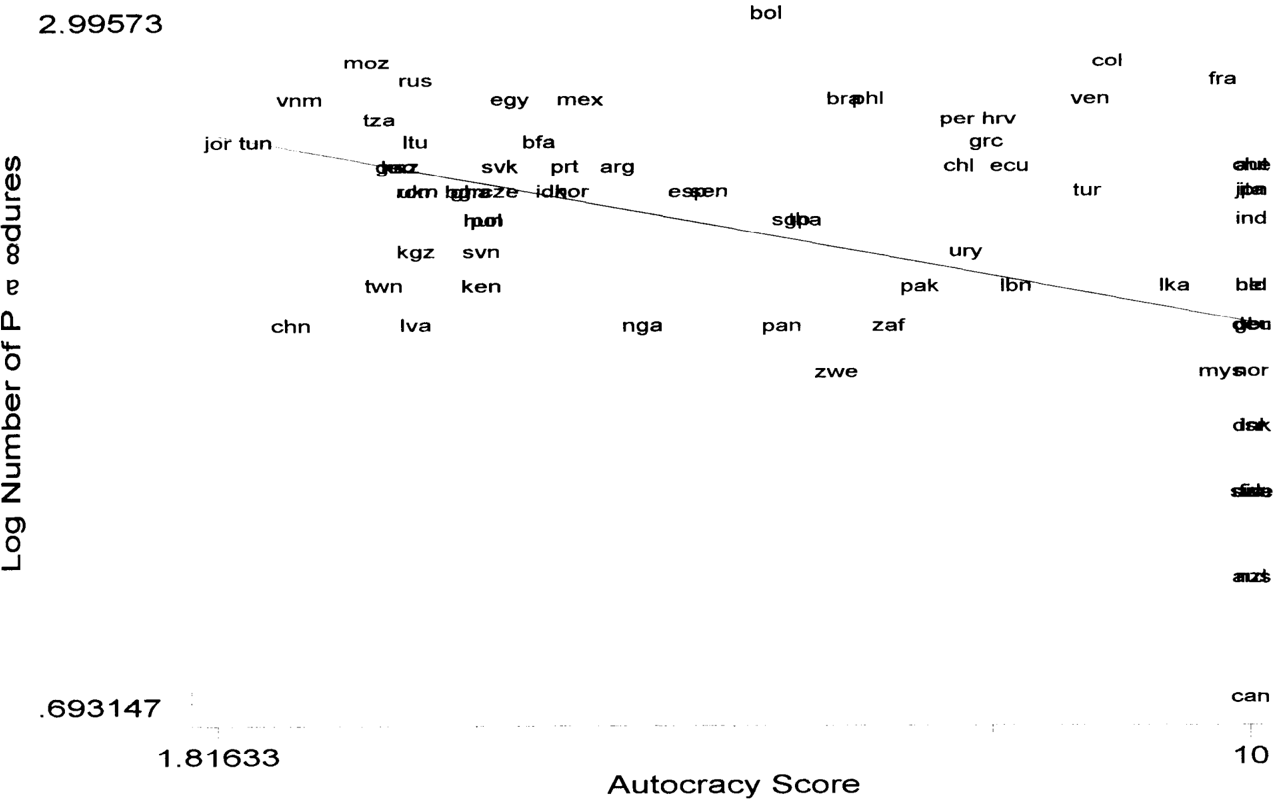
- In Table VIII, better government is associated with lighter regulation; the paper states that countries with more limited and representative governments have statistically significantly fewer procedures using 5 out of 6 measures of better government, and that more autocratic countries regulate more heavily.
Methods
- The paper builds a new database on entry regulation for 75 countries, focusing on the legal requirements, official time, and official cost for a standardized start-up firm.
- Data were gathered from written government sources, World Bank- and USAID-sponsored studies, government web pages, direct contacts with agencies, and independent double-checks in 73 countries via local consulting reports; the remaining 2 countries were double-checked through government contacts.
- The main analysis uses cross-country OLS regressions relating entry regulation measures to outcomes such as quality, pollution, unofficial economy, corruption, political institutions, legal origin, and GDP per capita; the paper also reports correlations and test-of-means comparisons across income quartiles.
Limitations
- The paper itself notes that the capture-theory tests are based on crude measures and that the data are probably least suited to test the capture hypothesis.
- The authors say the data almost surely underestimate the cost and complexity of entry because they focus on the capital city, omit industry-specific requirements and foreign-ownership steps, and ignore some informal delays and bribes.
- Evident from the text: the study is cross-sectional and based on official procedures/costs, so causal interpretation is limited and informal corruption/bureaucratic delays are not directly measured except indirectly through correlations.
Model-written summary. Check it against the paper before relying on it.
Integrity signals
Registry
Cites
Statistics
Figures
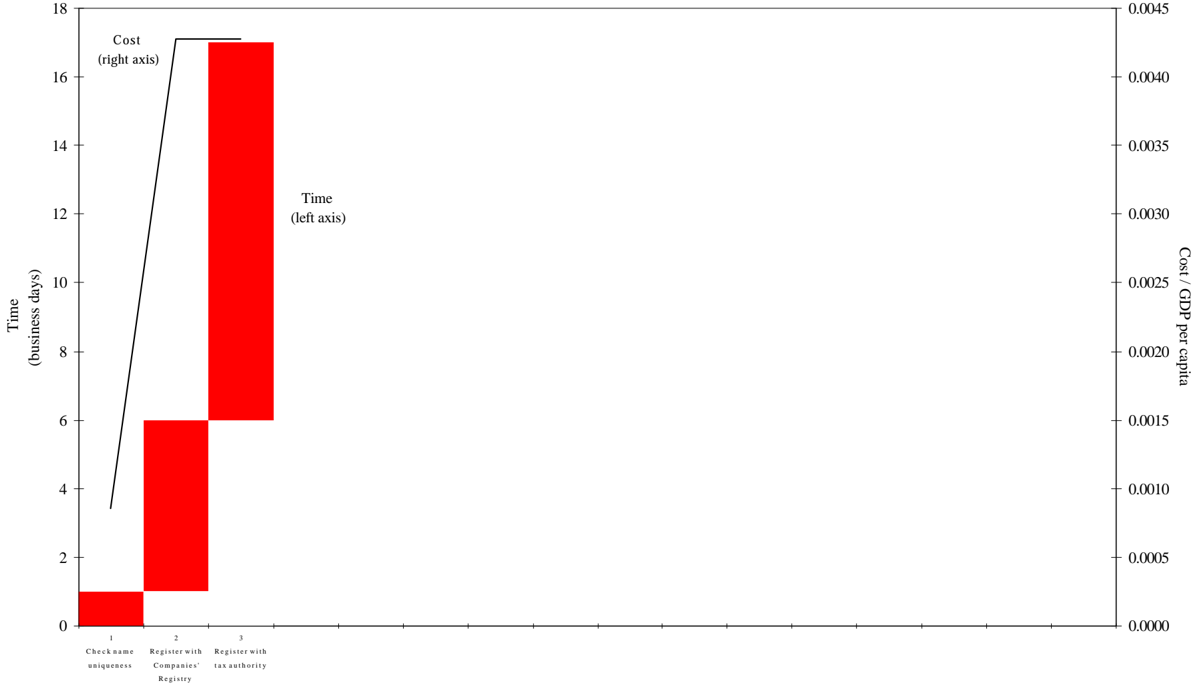
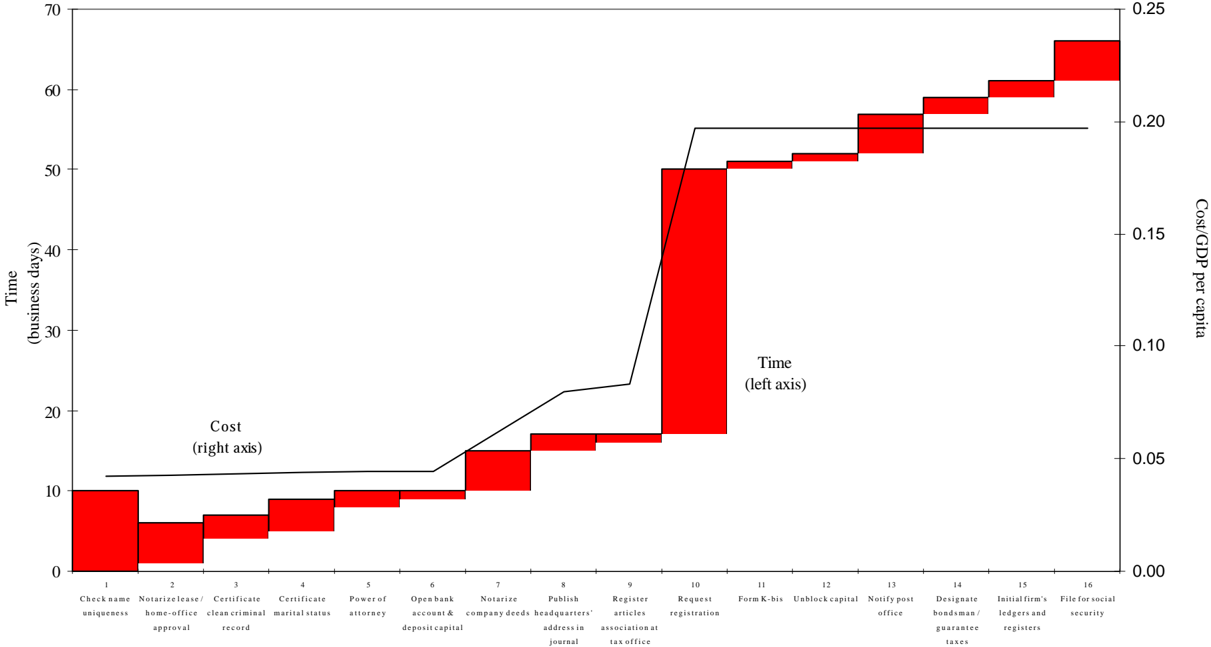
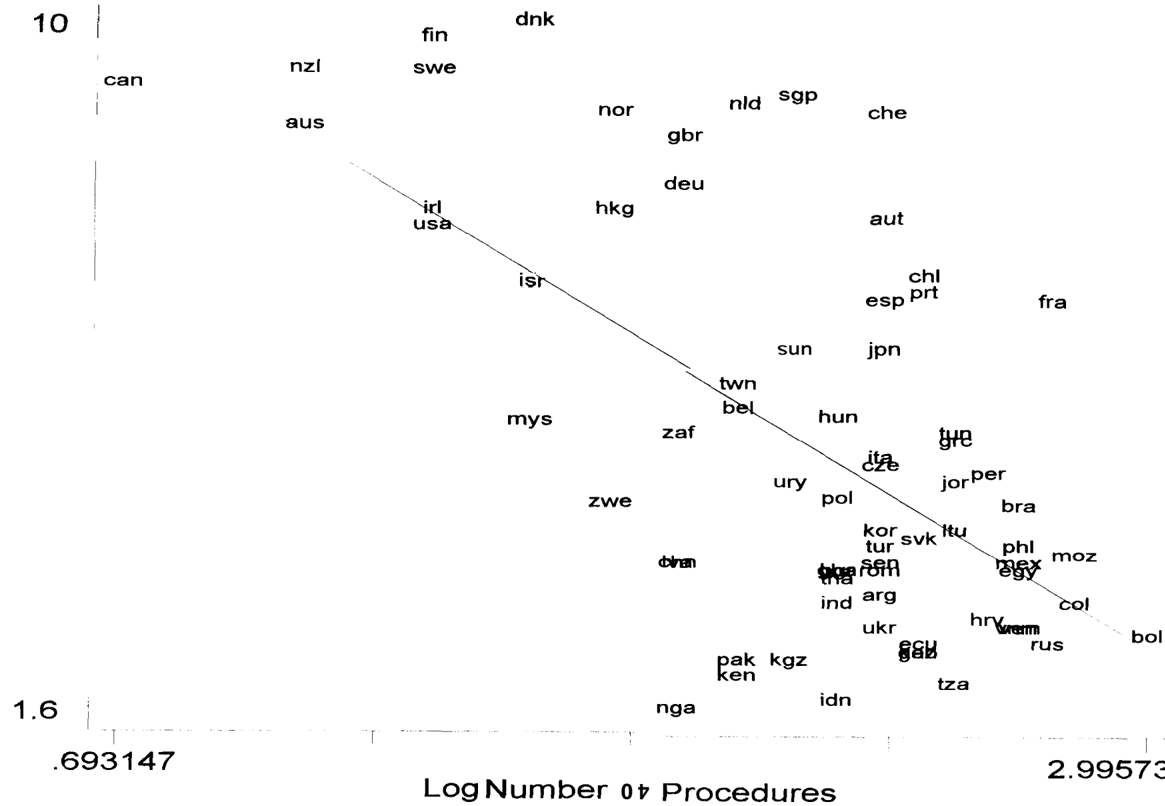
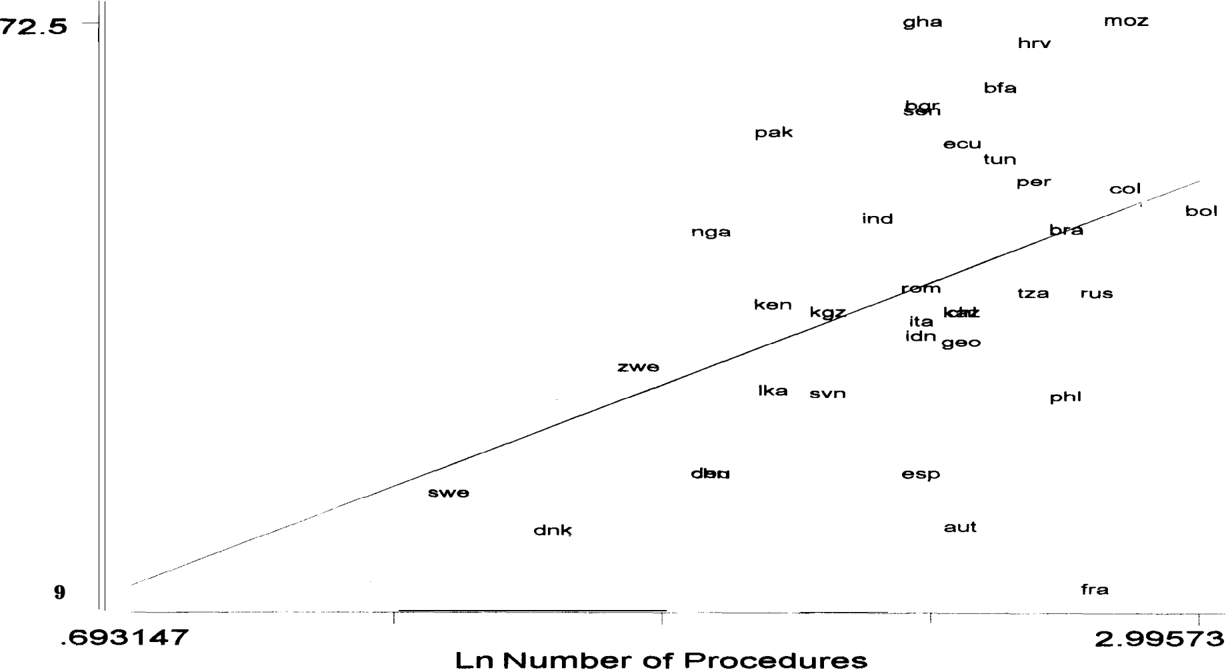
Verification
Claims the paper makes
0 Valid · 3 Not valid · 13 Not checked · 114 Own results and interpretations
A result the paper reports from its own data — it cites no other source for it, so there is none to check. The quote shows it is in the paper.
In the paper
“Very few entry regulations cover tax and labor issues.”
plain- Asserted: passes — The authors put it forward as true.
- Checkable: passes — It can be checked against evidence.
- Load-bearing: unclear — It is unclear whether the paper’s conclusions depend on it.
- Based: passes — The paper gives a reason why it holds.
In the paper
“The data show that the numbers of entry and of labor market regulations are positively correlated across countries, contrary to the substitutes hypothesis.”
What the sources say
- Not matchedcites Djankov et al., 2000
An author–year citation the paper’s reference list doesn’t settle. We don’t search these by name.
plainstates an association- Asserted: passes — The authors put it forward as true.
- Checkable: passes — It can be checked against evidence.
- Load-bearing: unclear — It is unclear whether the paper’s conclusions depend on it.
- Based: passes — The paper gives a reason why it holds.
- Not matched
A result the paper reports from its own data — it cites no other source for it, so there is none to check. The quote shows it is in the paper.
In the paper
“It often takes the form of screening procedures.”
- Also stated in: § III. Basic Results. · plain
“Instead, much of what governments do to regulate entry falls into the category of screening procedures.”
plain- Asserted: passes — The authors put it forward as true.
- Checkable: passes — It can be checked against evidence.
- Load-bearing: unclear — It is unclear whether the paper’s conclusions depend on it.
- Based: passes — The paper gives a reason why it holds.
- Also stated in: § III. Basic Results. · plain
A result the paper reports from its own data — it cites no other source for it, so there is none to check. The quote shows it is in the paper.
In the paper
“First, the cost-to-per-capita-GDP ratio decreases uniformly with GDP per capita.”
plainstates an association- Asserted: passes — The authors put it forward as true.
- Checkable: passes — It can be checked against evidence.
- Load-bearing: unclear — It is unclear whether the paper’s conclusions depend on it.
- Based: passes — The paper gives a reason why it holds.
A result the paper reports from its own data — it cites no other source for it, so there is none to check. The quote shows it is in the paper.
In the paper
“In contrast, countries in the other three quartiles of per capita income are not statistically different from each other in terms of the number of procedures and the time required to fulfill them.”
plain- Asserted: passes — The authors put it forward as true.
- Checkable: passes — It can be checked against evidence.
- Load-bearing: passes — The paper’s conclusions depend on it.
- Based: passes — The paper gives a reason why it holds.
49 more claims
Create a free account to see all 130 claims and every source verdict.
- Probably not a substantial claim. 21
- It may state two separate claims as one. 54
- The quote only partly states this claim. 26
Claims other papers make about this one
Each is checked against this paper’s own text: does it say what the citing paper says it does?
The source backs part of the claim, not all of it — or backs it for a different population, condition or comparison.
In the citing paper
“Our findings suggest an explanation for the low level of incorporation in Italy: the average direct cost associated with fulfilling the bureaucratic regulations for registering a new corporation in Italy is 20% of per capita GNP compared to 10% of per capita GNP on average for other G-7 European countries.”
From Entry regulation as a barrier to entrepreneurship (2006) · cites this paper as Djankov et al. (2002)
Experimental — accuracy not yet measuredThe cited source says what the claim attributes to it.
In the citing paper
“Given the explicit link made by Djankov et al . (2002) between the speed and ease with which businesses may be established in a country and its economic performance - and the enthusiasm with which this link has been grasped by European Union policy makers - our findings imply this link needs reconsidering.”
From The Effect of Business Regulations on Nascent and Young Business Entrepreneurship (2007) · cites this paper as Djankov et al . (2002)
Citations
Cites
La Porta, R., Lopez‐de‐Silanes, F., Shleifer, A., & Vishny, R. W. (1998) · Journal of Political Economy · doi:10.1086/250042 · Cited by 18,025
Self-citationThe Theory of Economic Regulation
Stigler, G. J. (1971) · The Bell Journal of Economics and Management Science · doi:10.2307/3003160 · Cited by 8,098
Journal of Economic Literature
(2019) · AEA Papers and Proceedings · doi:10.1257/pandp.109.633 · Cited by 7,468
The Quarterly Journal of Economics
Kuznets, S. (2024) · Business Cycle Theory, Part I Volume 4 · doi:10.4324/9781003549741-8 · Cited by 7,176
La Porta, R. (1999) · Journal of Law, Economics, and Organization · doi:10.1093/jleo/15.1.222 · Cited by 5,699 · cited 2×
“Legal origin has been viewed as a proxy for the government’s proclivity to intervene in the economy and the stance of the law toward the security of property rights in a country [La Porta et al. 1999].”
The Theory of Economic Regulation
Stigler, G. J. (2021) · The Political Economy · doi:10.4324/9781315495811-8 · Cited by 5,483
Pigou, A. C. (1933) · The Economic Journal · doi:10.2307/2224491 · Cited by 5,137
Toward a More General Theory of Regulation
Peltzman, S. (1976) · The Journal of Law and Economics · doi:10.1086/466865 · Cited by 4,729
Moffitt, R. A. (2009) · American Economic Review · doi:10.1257/aer.99.2.660 · Cited by 4,694
Shleifer, A., & Vishny, R. W. (1993) · The Quarterly Journal of Economics · doi:10.2307/2118402 · Cited by 3,778
Self-citation
Research works printed but not linked: 7
- McLiesh Caralee, 2001, NBER Working Paper No., 8288
- Kasnako lu, Zehra, and Münür Yayla, 'Unrecorded Economy in Turkey: A Monetary Approach', 1999. "Unrecorded Economy in Turkey (A Monetary Approach)" in Informal Sector in Turkey (I), Tuncer Bulutay (ed.), SIS, Ankara, forthcoming.
- Fred, 1987, Journal of Legal Studies, 101
- Olson, Mancur, 1991, 'Autocracy, Democracy, and Prosperity,' in Richard Zeckhauser, ed., Strategy of Choice, Cambridge, MA: MIT Press.
- 1967, Western Economic Journal, 232
- World Economic Forum (1999), The Global Competitiveness Report 1999 , Schwab, Klaus et al., eds., New York: Oxford University Press.
- World Economic Forum, The Global Competitiveness Report 2001, Klaus Schwab et al., eds. (New York, NY: Oxford University Press, 2001).
Cited by
Items 601–700 of 3,986
Contractor, F. J., Nuruzzaman, N., Dangol, R., & Raghunath, S. (2021) · Journal of International Management · doi:10.1016/j.intman.2021.100834 · Cited by 99
“There are two competing institutions-based view of entry regulations (Djankov, et. al.”
Corruption, governance, investment and growth in emerging markets
Everhart, S. S., Vázquez, J. M., & McNab, R. M. (2009) · Applied Economics · doi:10.1080/00036840701439363 · Cited by 90
“Accountability allows for the punishment of politicians who adopt bad policies and the limitation of bureaucratic monopoly power, thereby more closely aligning politicians’ and bureaucrats preferences with those of the populace (RoseAckerman, 1998, 1999; Laffont and Meleu, 2001; Djankov et al., 2002).”
Tax Policy and the Missing Middle: Optimal Tax Remittance with Firm-Level Administrative Costs
Dharmapala, D., Slemrod, J., & Wilson, J. D. (2008) · Journal of Public Economics · doi:10.1016/j.jpubeco.2010.10.013 · Cited by 129
“It forms part of a wider cluster of interrelated characteristics – including a large informal sector and regulatory barriers to entry into the formal sector – that have often been explained with reference to the “grabbing hand” associated with bureaucratic inefficiency and corruption (e.g. Friedman et al., 2000; Djank…”
InfluentialThe Central Role of Entrepreneurs in Transition Economies
McMillan, J., & Woodruff, C. (2003) · Springer eBooks · doi:10.1007/978-94-010-0009-3_6 · Cited by 94
Administrative Barriers to Foreign Investment in Developing Countries
Morisset, J., & Neso, O. L. (2002) · World Bank, Washington, DC eBooks · doi:10.1596/1813-9450-2848 · Cited by 78
Bribery, inefficiency, and bureaucratic delay
Ahlin, C., & Bose, P. (2006) · Journal of Development Economics · doi:10.1016/j.jdeveco.2005.12.002 · Cited by 89
Digital government as a business facilitator
Martins, J., & Veiga, L. G. (2022) · Information Economics and Policy · doi:10.1016/j.infoecopol.2022.100990 · Cited by 100
PRODUCT MARKET REGULATION, FIRM SELECTION, AND UNEMPLOYMENT
Felbermayr, G. J., & Prat, J. (2011) · Journal of the European Economic Association · doi:10.1111/j.1542-4774.2011.01011.x · Cited by 93
The Ease of Doing Business Index as a tool for investment location decisions
Alves, R. P., & Zambujal‐Oliveira, J. (2012) · Economics Letters · doi:10.1016/j.econlet.2012.04.026 · Cited by 93
Product market competition and analyst forecasting activity: International evidence
Haw, I.-M. G., Hu, B., & Lee, J. J. (2015) · Journal of Banking & Finance · doi:10.1016/j.jbankfin.2015.02.010 · Cited by 75
Legal institutions and high-growth aspiration entrepreneurship
Troilo, M. (2011) · Economic Systems · doi:10.1016/j.ecosys.2010.08.001 · Cited by 91
Mas‐Tur, A., & Soriano, D. R. (2013) · Service Business · doi:10.1007/s11628-013-0186-x · Cited by 95
PROTECTION OF PROPERTY RIGHTS AND GROWTH AS POLITICAL EQUILIBRIA
Asoni, A. (2008) · Journal of Economic Surveys · doi:10.1111/j.1467-6419.2008.00554.x · Cited by 96
Differential Properties in the Ratings of Certified vs. Non-Certified Bond Rating AgenciesPreprint
Beaver, W. H., Shakespeare, C. M., & Soliman, M. T. (2004) · SSRN Electronic Journal · doi:10.2139/ssrn.596626 · Cited by 77
Ashraf, J., Luo, L., & Khan, M. A. (2021) · Spatial Statistics · doi:10.1016/j.spasta.2021.100566 · Cited by 88
“Grabbing Hand” or “Helping Hand”?: Corruption and the Economic Role of the State
Hopkin, J., & Rodríguez‐Pose, A. (2007) · Governance · doi:10.1111/j.1468-0491.2007.00353.x · Cited by 94
“1999) and that particular kinds of regulatory burdens are associated with corruption (Djankov et al. 2002).”
InfluentialDistribution and development in a model of misgovernance
Blackburn, K., & Forgues‐Puccio, G. F. (2006) · European Economic Review · doi:10.1016/j.euroecorev.2006.10.003 · Cited by 96
TECHNOLOGICAL CATCH‐UP AND GEOGRAPHIC PROXIMITY*
Griffith, R., Redding, S. J., & Simpson, H. (2009) · Journal of Regional Science · doi:10.1111/j.1467-9787.2009.00630.x · Cited by 106
“…the macroeconomic literature on convergence.5 Our paper contributes to an emerging literature that emphasizes the characteristics of 1See, inter alia, Baily, Hulten, and Campbell (1992), Davis and Haltiwanger (1991), Nicoletti and Scarpetta (2002), Djankov et al. (2002), and Aghion et al. (2009).”
McKinney, J. A., & Moore, C. W. (2007) · Journal of Business Ethics · doi:10.1007/s10551-007-9395-3 · Cited by 96
Small Business, Entrepreneurship and Violent Conflict in Developing Countries
Brück, T., Naudé, W. A., & Verwimp, P. (2011) · Journal of Small Business & Entrepreneurship · doi:10.1080/08276331.2011.10593532 · Cited by 102
“…disguised unemployment due to its low productivity (e.g. Loayza, 1996), other authors have explained the existence of an informal sector with reference to limited access to formal contract enforcement or financial means (e.g. Djankov et al., 2002), and challenge the pure barrenness of the sector.”
Democracy, Diversification and Growth Reversals
Cuberes, D., & Jerzmanowski, M. (2009) · The Economic Journal · doi:10.1111/j.1468-0297.2009.02287.x · Cited by 96
“Many variables have the expected sign (at least when included in isolation – Table 6), but few are significant.(15) More importantly, democracy is always negative and significant, and the magnitude of the coefficient does not change very much regardless of which additional controls are included.”
InfluentialDileo, I., & García‐Pereiro, T. (2018) · International Entrepreneurship and Management Journal · doi:10.1007/s11365-018-0528-1 · Cited by 100
“For instance, less developed economies, compared to more developed ones, have an institutional system composed of rigid bureaucracy and procedures which impede or slow down the application of social norms and the achievement of higher competition levels (Djankov et al. 2002).”
Culture and the regulation of entry
Davis, L., & Williamson, C. R. (2016) · Journal of Comparative Economics · doi:10.1016/j.jce.2016.09.007 · Cited by 81
Dreher, A., & Gassebner, M. (2007) · RePEc: Research Papers in Economics · doi:10.3929/ethz-a-005389461 · Cited by 84
“Djankov et al. (2002) find that regulation of firm entry is associated with higher corruption, but not higher quality of public or private goods.”
Corruption and Regulatory Structures*
Ogus, A. I. (2004) · Law & Policy · doi:10.1111/j.1467-9930.2004.00181.x · Cited by 88
Individualism, democracy, and contract enforcement
Cline, B. N., & Williamson, C. R. (2017) · Journal of Corporate Finance · doi:10.1016/j.jcorpfin.2017.07.010 · Cited by 80
Bureaucrats or Markets in Innovation Policy? – a critique of the entrepreneurial state
Karlson, N., Sandström, C. G., & Wennberg, K. J. (2020) · The Review of Austrian Economics · doi:10.1007/s11138-020-00508-7 · Cited by 83
“Removing regulations and impediments to new firm entry and competition with incumbents (Djankov et al. 2002) or designing intellectual property legislature that incentivize R&D and in particular high-risk R&D are equally potent policy conclusions from the theory (Shapiro 2001).”
Political uncertainty and firm entry: Evidence from Chinese manufacturing industries
Chen, S., Mao, H., & Feng, Z. (2020) · Journal of Business Research · doi:10.1016/j.jbusres.2020.07.021 · Cited by 80
Ease of doing business and FDI inflow to Sub‐Saharan Africa and Asian countries
Morris, R., & Aziz, A. (2011) · Cross Cultural Management An International Journal · doi:10.1108/13527601111179483 · Cited by 110
Does immigrant employment matter for export sales? Evidence from Denmark
Hiller, S. (2013) · Review of World Economics · doi:10.1007/s10290-013-0146-5 · Cited by 101
Strategic Analysis of Petty Corruption: Entrepreneurs and Bureaucrats
Radner, R., Lambert‐Mogiliansky, A., & Majumdar, M. (2005) · Faculty Digital Archive (New York University Florence) · Cited by 75
Explaining Corruption in the Developed World: The Potential of Sociological Approaches
Heath, A., Richards, L., & de Graaf, N. D. (2016) · Annual Review of Sociology · doi:10.1146/annurev-soc-081715-074213 · Cited by 87
Laws and stigma: the case of prostitution
Immordino, G., & Russo, F. F. (2015) · European Journal of Law and Economics · doi:10.1007/s10657-015-9491-2 · Cited by 84
How Does Personal Bankruptcy Law Affect Start-Ups?
Cerqueiro, G., & Penas, M. F. (2011) · Review of Financial Studies · doi:10.1093/rfs/hhw081 · Cited by 87
The Political Economy of Structural Reform: Empirical Evidence from OECD Countries
Høj, J., Galasso, V., Nicoletti, G., & Dang, T.-T. (2006) · OECD Economics Department working papers · doi:10.1787/881353527404 · Cited by 73
Who Fears Competition From Informal Firms ? Evidence From Latin America
González, A. S., & Lamanna, F. (2007) · World Bank, Washington, DC eBooks · doi:10.1596/1813-9450-4316 · Cited by 93
Why Doesn't Capitalism Flow to Poor Countries?
Tella, R. D., & MacCulloch, R. (2007) · National Bureau of Economic Research · doi:10.3386/w13164 · Cited by 71
Daniels, R. J., Trebilcock, M. J., & Carson, L. D. (2010) · The American Journal of Comparative Law · doi:10.5131/ajcl.2010.0015 · Cited by 103
Informality, growth, and development in Africa
Benjamín, N., & Mbaye, A. A. (2014) · WIDER Working Paper Series · doi:10.35188/unu-wider/2014/773-8 · Cited by 86
“Recent literature views informality as a rational choice in response to costs and benefits of formal versus informal status, e.g. Perry et al. (2007), Kanbur (2009), Djankov et al. (2002), Loayza et al. (2005), Ishengoma and Kappel (2006), Arterido et al. (2007), and Marcouiller and Young (1995).”
Aparicio, S., Audretsch, D. B., & Urbano, D. (2020) · Journal of World Business · doi:10.1016/j.jwb.2020.101177 · Cited by 87
Imports, entry and competition law as market disciplines
Kee, H. L., & Hoekman, B. M. (2006) · European Economic Review · doi:10.1016/j.euroecorev.2006.06.006 · Cited by 84
“Djankov et al. (2002) and Hoekman et al. (2004)”
What is the objective of professional licensing? Evidence from the US market for lawyers
Pagliero, M. (2010) · International Journal of Industrial Organization · doi:10.1016/j.ijindorg.2010.09.002 · Cited by 91
Judicial efficiency and entrepreneurs’ expectations on the reliability of European legal systems
Ippoliti, R., Melcarne, A., & Ramello, G. B. (2014) · European Journal of Law and Economics · doi:10.1007/s10657-014-9456-x · Cited by 85
“Jappelli et al. (2005) investigate the influence of judicial efficiency on credit lending using data from Italy.”
InfluentialBorlea, S. N., Achim, M. V., & Miron, M. G. A. (2017) · Studia Universitatis „Vasile Goldis” Arad – Economics Series · doi:10.1515/sues-2017-0006 · Cited by 81
Botha, M. (2006) · UpSpace Institutional Repository (University of Pretoria) · Cited by 128
Nguyen, C. P., Schınckus, C., Su, T. D., & Chong, F. H. L. (2018) · Review of Development Finance · doi:10.1016/j.rdf.2018.11.005 · Cited by 80
Financial inclusion and micro, small, and medium enterprises (MSMEs) growth in Uganda
Lakuma, C. P., Marty, R., & Muhumuza, F. (2019) · Journal of Innovation and Entrepreneurship · doi:10.1186/s13731-019-0110-2 · Cited by 129
Institutional Quality, Culture, and Norms of Cooperation: Evidence from Behavioral Field Experiments
Cassar, A., D’Adda, G., & Grosjean, P. A. (2014) · The Journal of Law and Economics · doi:10.1086/678331 · Cited by 87
Bank regulation and efficiency: What works for Africa?
Triki, T., Kouki, I., Dhaou, M. B., & Calice, P. (2016) · Research in International Business and Finance · doi:10.1016/j.ribaf.2016.07.027 · Cited by 91
“These include Ben Naceur et al. (2009) who study the effect of change in capital adequacy regulation in Egypt, Hauner and Peiris (2005) who use a sample of 14 commercial banks from Uganda to assess changes in efficiency following the privatization of UCB to Stanbic and consolidation of the banking sector in 2002 and A…”
Rui, H., Cuervo-Cazurra, Á., & Un, C. A. (2016) · Journal of World Business · doi:10.1016/j.jwb.2016.07.007 · Cited by 82
Do subsidiaries of foreign MNEs invest more in R&D than domestic firms?
Un, C. A., & Cuervo-Cazurra, Á. (2008) · Research Policy · doi:10.1016/j.respol.2008.07.006 · Cited by 91
Regulation of Entry and the Distortion of Industrial Organization
Fisman, R. J., & Sarria‐Allende, V. (2010) · Journal of Applied Economics · doi:10.1016/s1514-0326(10)60005-0 · Cited by 100
Market reforms in the time of imbalance
Cacciatore, M., Duval, R., Fiori, G., & Ghironi, F. P. (2016) · Journal of Economic Dynamics and Control · doi:10.1016/j.jedc.2016.03.008 · Cited by 81
Gatti, R. V., & Honorati, M. (2008) · World Bank, Washington, DC eBooks · doi:10.1596/1813-9450-4476 · Cited by 96
“There is consensus that unevenly enforced and burdensome regulations (De Soto, 1989; Djankov et al., 2002; Loayza et al, 2005; Loayza and Rigolini, 2006), corruption5 (Friedman et al., 2000), financial development and entry costs (Straub, 2005) are significantly associated with informality.6 In…”
By Choice and by Necessity: Entrepreneurship and Self-Employment in the Developing WorldPreprint
Margolis, D. N. (2014) · SSRN Electronic Journal · doi:10.2139/ssrn.2462705 · Cited by 82
Entrepreneurship and Enforcement Institutions: Disaggregated Evidence for SpainPreprint
García-Posada, M., & Mora‐Sanguinetti, J. S. (2014) · SSRN Electronic Journal · doi:10.2139/ssrn.2413422 · Cited by 74
4 Concentration among the Rich
Atkinson, A. B. (2008) · Oxford University Press eBooks · doi:10.1093/acprof:oso/9780199548880.003.0004 · Cited by 81
Gimenez-Jimenez, D., & Calabrò, A. (2017) · International Entrepreneurship and Management Journal · doi:10.1007/s11365-017-0480-5 · Cited by 108
The impact of Payment Services Directive 2 on the PayTech sector development in Europe
Polasik, M., Huterska, A. A., Iftikhar, R., & Mikula, Š. (2020) · Journal of Economic Behavior & Organization · doi:10.1016/j.jebo.2020.07.010 · Cited by 105
Institutional flexibility and economic growth
Davis, L. (2010) · Journal of Comparative Economics · doi:10.1016/j.jce.2010.05.001 · Cited by 83
Foreign direct investment via M&A and domestic entrepreneurship: blessing or curse?
Danakol, S. H., Estrin, S., Reynolds, P. D., & Weitzel, U. (2016) · Small Business Economics · doi:10.1007/s11187-016-9792-z · Cited by 91
“…are the development level of a national economy (GDP per capita); institutional quality, often indicated in this context by business regulations (Djankov et al., 2002); prevalence of corruption (Aidis et al., 2012; Anokhin and Schulze, 2009); and indicators of national culture (Kwon and…”
Property Rights Institutions and Firm Performance: A Cross-Country Analysis
Yaşar, M., Paul, C. J. M., & Ward, M. R. (2010) · World Development · doi:10.1016/j.worlddev.2010.09.009 · Cited by 94
How attractive is central Eastern Europe for risk capital investors?
Groh, A. P., & Liechtenstein, H. (2009) · Journal of International Money and Finance · doi:10.1016/j.jimonfin.2009.01.006 · Cited by 83
A Strategic Interpretation of Legal Transplants
Garoupa, N. M., & Ogus, A. I. (2006) · The Journal of Legal Studies · doi:10.1086/505053 · Cited by 90
The governance environment and innovative SMEs
Yang, J. S. (2016) · Small Business Economics · doi:10.1007/s11187-016-9802-1 · Cited by 84
Lobbying on EntryPreprint
Perotti, E. C., & Volpin, P. F. (2004) · SSRN Electronic Journal · doi:10.2139/ssrn.558588 · Cited by 80
“Djankov, La Porta, Lopez-de-Silanes, and Shleifer (2002) show that countries with higher entry barriers tend to have higher corruption and larger unofficial economies.1 Klapper, Laeven, and Rajan (2003) show that onerous barriers appear to reduce growth and entry in naturally high entry sectors.”
InfluentialIndustrial Policy in Developing Countries : Overview and lessons from seven country casesPreprint
Altenburg, T. (2011) · RePEc: Research Papers in Economics · Cited by 164
China's Financial System: Past, Present, and FuturePreprint
Allen, F., Qian, J. “., & Qian, M. (2005) · SSRN Electronic Journal · doi:10.2139/ssrn.978485 · Cited by 97
Le, T. N. L., Nasir, M. A., & Huynh, T. L. D. (2020) · The Quarterly Review of Economics and Finance · doi:10.1016/j.qref.2020.06.001 · Cited by 132
de Langen, P. W., & Pallis, A. A. (2007) · Maritime Policy & Management · doi:10.1080/03088830701585134 · Cited by 70
Munemo, J. (2016) · The Quarterly Review of Economics and Finance · doi:10.1016/j.qref.2016.08.010 · Cited by 84
Corporate Governance in Developing Economies
McGee, R. W. (2008) · Springer eBooks · doi:10.1007/978-0-387-84833-4_1 · Cited by 80
What Drives International Bank Flows? Politics, Institutions and Other DeterminantsPreprint
Papaioannou, E. (2005) · SSRN Electronic Journal · doi:10.2139/ssrn.647961 · Cited by 86
Martín, M. Á. G., Picazo, M. T. M., & Martínez, M. S. C. (2019) · International Journal of Entrepreneurial Behaviour & Research · doi:10.1108/ijebr-06-2019-0336 · Cited by 95
5 Changes in the Distribution of Wealth in China, 1995–2002
Li, S., & Renwei, Z. (2008) · Oxford University Press eBooks · doi:10.1093/acprof:oso/9780199548880.003.0005 · Cited by 82
Can oil-rich countries encourage entrepreneurship?
Farzanegan, M. R. (2014) · Entrepreneurship and Regional Development · doi:10.1080/08985626.2014.981869 · Cited by 80
“Farzanegan (2009) suggests that about 90% of export smuggling in Iran involves oil-related products, explaining the role of energy subsidies which cause the large price disparity between Iran and her neighbours.”
InfluentialVolchek, D., Jantunen, A., & Saarenketo, S. (2013) · Journal of International Entrepreneurship · doi:10.1007/s10843-013-0115-z · Cited by 95
Venture Creation Speed and Subsequent Growth: Evidence from South America
Capelleras, J., Greene, F. J., Kantis, H., & Rabetino, R. (2010) · Journal of Small Business Management · doi:10.1111/j.1540-627x.2010.00296.x · Cited by 84
“Djankov et al (2002) identified the costs and time associated with establishing a new formally registered firm in 85 countries and showed that, for example, it takes 83 days for a Peruvian entrepreneur to set up a new venture, 63 in Brazil, and 48 in Argentina.”
Cuervo-Cazurra, Á., & Ramamurti, R. (2017) · Competitiveness Review An International Business Journal incorporating Journal of Global Competitiveness · doi:10.1108/cr-04-2016-0021 · Cited by 94
Law, Finance, and Politics: The Case of India
Armour, J. H., & Lele, P. P. (2009) · Law & Society Review · doi:10.1111/j.1540-5893.2009.00380.x · Cited by 96
Entrepreneurial Progress: Climbing the Entrepreneurial Ladder in Europe and the United States
van der Zwan, P., Verheul, I., Thurik, R., & Grilo, I. (2011) · Regional Studies · doi:10.1080/00343404.2011.598504 · Cited by 91
“DJANKOV et al. (2002) found that countries with stricter entry regulation are characterized by more corruption and larger unofficial economies.”
Subjective and objective measures of governmental regulations in OECD nations
Nicoletti, G., & Pryor, F. L. (2005) · Journal of Economic Behavior & Organization · doi:10.1016/j.jebo.2004.05.003 · Cited by 77
About the interactive influence of culture and regulatory barriers on entrepreneurial activity
Fernández‐Serrano, J., & Romero, I. (2014) · International Entrepreneurship and Management Journal · doi:10.1007/s11365-014-0296-5 · Cited by 82
“Furthermore, Djankov et al. (2002) have pointed out that countries with stronger entry regulations also have more corruption and larger unofficial economies, but not a better quality of public or private goods.”
The responsiveness of entrepreneurs to working time regulations
Stephen, F. H., Urbano, D., & Almazor, E. V. H. (2008) · Small Business Economics · doi:10.1007/s11187-007-9096-4 · Cited by 90
“Djankov et al. (2002) show that administrative and bureaucratic costs of starting up a limited liability company vary significantly across countries.”
Informality and the Playing Field in Vietnam's Business Sector
Tenev, S., Carlier, A., Chaudry, O., & Nguyen, Q.-T. (2003) · World Bank Publications · Cited by 117
The Relationship between Governance Effectiveness and Entrepreneurship
Friedman, B. A. (2011) · Cited by 73
Corruption and Productivity: Firm-level Evidence
Rosa, D. D., Gooroochurn, N., & Görg, H. (2015) · Jahrbücher für Nationalökonomie und Statistik · doi:10.1515/jbnst-2015-0203 · Cited by 79
Institutional Quality and the Gains from Trade
Borrmann, A., Busse, M., & Neuhaus, S. (2006) · Kyklos · doi:10.1111/j.1467-6435.2006.00336.x · Cited by 109
“Along these lines, the French legal origin is highly correlated with an excessive regulatory environment and may lead to lower quality institutions, particularly when the French legal system was implemented in developing countries (Djankov et al., 2002).”
Do institutions not matter in China? Evidence from manufacturing enterprises
Lu, Y., Png, I., & Tao, Z. (2011) · Journal of Comparative Economics · doi:10.1016/j.jce.2011.11.002 · Cited by 83
“Moreover, property rights protection has been shown to be more important than other economic institutions (e.g., contract enforcement) in determining economic performance (Johnson, McMillan, and Woodruff, 2002; Acemoglu and Johnson, 2005).”
InfluentialMoney Laundering and Its Regulation
Chong, A. E., & López‐de‐Silanes, F. (2007) · Economics and Politics · doi:10.1111/ecpo.12051 · Cited by 116
Self-citationA Theory of Destructive Entrepreneurship
Desai, S., & Acs, Z. J. (2007) · doi:10.2139/ssrn.1029648 · Cited by 66
Goerke, L., & Runkel, M. (2011) · Scottish Journal of Political Economy · doi:10.1111/j.1467-9485.2011.00565.x · Cited by 65
THE GOVERNANCE OF FINANCIAL SUPERVISION: RECENT DEVELOPMENTS
Masciandaro, D., & Quintyn, M. (2015) · Journal of Economic Surveys · doi:10.1111/joes.12130 · Cited by 79
Audretsch, D. B., Belitski, M., & Guerrero, M. (2023) · Technovation · doi:10.1016/j.technovation.2023.102742 · Cited by 83
Regional deregulation and entrepreneurial growth in China's transition economy
Zhou, W. (2011) · Entrepreneurship and Regional Development · doi:10.1080/08985626.2011.577816 · Cited by 77
“As such regulations were removed, albeit often in a piecemeal and gradual manner in many regions (Naughton 2007), potential entrepreneurs encountered less difficulty in starting businesses, and, thus, rates of entrepreneurial entry increased, particularly in previously restricted industries (Djankov et al. 2002; Capel…”
Aterido, R., Hallward-Driemeier, M. C., & Pagés, C. (2011) · SSRN Electronic Journal · doi:10.2139/ssrn.1820915 · Cited by 66
Infrastructure Governance And Corruption : Where Next ?
Kenny, C. J. (2007) · World Bank, Washington, DC eBooks · doi:10.1596/1813-9450-4331 · Cited by 65
“18 See Djankov et al. (2000) for a broader discussion of the limited impact of regulation of entry on quality of service provision, but its stronger link with the extent of corruption, across a range of sectors.”
InfluentialEmployment Protection, Technology Choice, and Worker AllocationPreprint
Bartelsman, E. J., Gautier, P. A., & de Wind, J. (2010) · SSRN Electronic Journal · doi:10.2139/ssrn.1592162 · Cited by 65
Politically-Connected Firms: Can They Squeeze the State?Preprint
Faccio, M. (2002) · SSRN Electronic Journal · doi:10.2139/ssrn.305099 · Cited by 76
Corporate Governance Around the World
Naciri, A. (2008) · Routledge eBooks · doi:10.4324/9780203930670 · Cited by 65
“, 2003), the legal procedures that an entrepreneur needs to carry out to begin operating a firm (Djankov et al., 2002), the value of voting rights and private benefit associated with control (Nenova, 2003), or, finally, the State’s share of bank capital (La Porta et al.”
Metadata
- Authors
- Djankov, S., La Porta, R., Lopez-de-Silanes, F., & Shleifer, A.
- Affiliations
- World Bank (US)
- National Bureau of Economic Research (US)
- ORCID
- Djankov, S.
- Venue
- The Quarterly Journal of Economics
- Publisher
- Oxford University Press (OUP)
- Published
- 2002-02-01
- Volume
- 117
- Issue
- 1
- Pages
- 1-37
- ISSN
- 0033-5533
- 1531-4650
- OpenAlex
- W2139896179
- Cited by
- 3,956
- References
- 30
- Citations by year
- 2026: 223 · 2025: 185 · 2024: 157 · 2023: 120 · 2022: 140 · 2021: 150 · 2020: 151 · 2019: 161 · 2018: 157 · 2017: 162 · 2016: 166 · 2015: 193 · 2014: 200 · 2013: 183 · 2012: 193
- Type
- report
- Language
- en
- Open access
- green
- doi.org
- Licence
- other-oa
- Locations
- World Bank, Washington, DC eBooks (publishedVersion)
- The Quarterly Journal of Economics (publishedVersion)
- The World Bank Open Knowledge Repository (World Bank) (publishedVersion)
- National Bureau of Economic Research (publishedVersion, other-oa)
- RePEc: Research Papers in Economics (submittedVersion)
- Digital Access to Scholarship at Harvard (DASH) (Harvard University) (submittedVersion, cc-by)
- SSRN Electronic Journal (submittedVersion)
- OpenGrey (Institut de l'Information Scientifique et Technique) (submittedVersion)
- The World Bank Open Knowledge Repository (World Bank) (submittedVersion, cc-by)
- Topics
- Social Sciences › Sociology and Political Science › Corruption and Economic Development
- Social Sciences › Economics, Econometrics and Finance › Economics and Econometrics › Taxation and Compliance Studies
- Social Sciences › Business, Management and Accounting › Strategy and Management › Political Influence and Corporate Strategies
- Keywords
- start-up firms, bureaucratic procedures, corruption, informal economy, democracy, government size, public choice theory, public interest theory
About these checks
Registry, retraction, Cites and statistics results are computed, not judged, with one exception: a printed reference that no index lists is read once by a model before it counts as a citation error. Claims are extracted by a model and kept only when their quote appears verbatim in the text; each cited source is then checked, with a model’s help, for whether it says what the claim relies on. Those verdicts can be wrong — read the claim’s quote and the cited source before relying on one.
A language model drew the claims from the paper on 2026-10-01, under version 3 of the claim definition (model deepseek-v4.1-flash, prompt extract-v3).
A second model labelled each claim on 2026-10-01 (model jev-1.13-20260917, definition revision gold-guideline-v0.2).
Statistics and arithmetic are recomputed, not judged.
Confidence bands are shown only for fields calibrated on our annotated test set. None is calibrated yet, so no band is shown.
What counts as a claim ›How we measure confidence ›How we check this ›
Are you an author, or do you see a problem with this page? Request a review
Data sources
Bibliographic data: Semantic Scholar, OpenAlex, Crossref.
Contains information from the Semantic Scholar Academic Graph Datasets, made available under the ODC Attribution License (ODC-BY 1.0).
Semantic Scholar’s data is described in: Kinney, R., et al. (2023). The Semantic Scholar Open Data Platform. arXiv:2301.10140.
