

The Regulation of Entry
Open accessThe DOI matches its Crossref record, with a small difference in title or year; 39 of the 39 references it cites were found in a registry or an index; none of the 13 sources its claims cite is checked for support yet.
Abstract
1%(5 :25.,1* 3$3(5 6(5,(6 7+( 5(*8/$7,21 2) (175< 6LPHRQ 'MDQNRY 5DIDHO /D 3RUWD )ORUHQ.LR /RSH]GH6LODQHV $QGUHL 6KOHLIHU :RUNLQJ 3DSHU KWWSZZZQEHURUJSDSHUVZ 1$7,21$/ %85($8 2) (&2120,& 5(6($5&+ 0DVVD.KXVHWWV $YHQXH &DPEULGJH 0$ 6HSWHPEHU :H WKDQN 2OJD ,RIIH 7DWLDQD 1HQRYD DQG (NDWHULQD 7UL]ORYD IRU DEOH UHVHDU.K DVVLVWDQ.H DQG +DPLG $ODYL ,ULQD $VWUDNKDQ $EKLMLW %DQHUMHH 5L.KDUG &DYHV -D.TXHOLQH &RROLGJH -DPHV (PHU\ 1LKDO (O0DJKDUEHO -HDQ 3DXO *DXWKLHU (G *ODHVHU 6LPRQ -RKQVRQ /DZUHQ.H .DW] 3HWHU .X.HUD 'DYLG /DLEVRQ ,UD /LHEHUPDQ 'DYLQ 0D.NLQ]LH 0DULH )UDQ.RLVH 0DULH1HOO\ 0DU.HOR 2ODUUHDJD *X\ 3IHIIHUPDQQ 6DQWLDJR 6HGD.D /HLOD :HEVWHU 3HWHU :ULJKW DQG VHPLQDU SDUWL.LSDQWV DW WKH 8QLYHUVLW\ RI 0DU\ODQG DW &ROOHJH 3DUN IRU KHOSIXO .RPPHQWV 7KH .ROOH.WLRQ RI GDWD IRU WKLV SDSHU ZDV RUJDQL]HG DQG ILQDQ.HG E\ WKH :RUOG %DQN $Q DSSHQGL[ GHV
Overview
CoChat Summary
TL;DR
This paper assembles a new cross-country dataset on business entry regulation in 75 countries and uses it to compare the helping-hand, capture, and tollbooth theories of regulation. The evidence is most consistent with the tollbooth view: heavier entry regulation is associated with more corruption, a larger unofficial economy, and less representative, more autocratic governments.
Key findings
- Across the 75-country sample, the number of entry procedures ranges from 2 in Canada to 20 in Bolivia, with a sample average of 10.17 procedures; the average official time is 63.05 business days and the average cost is 0.34 of GDP per capita.
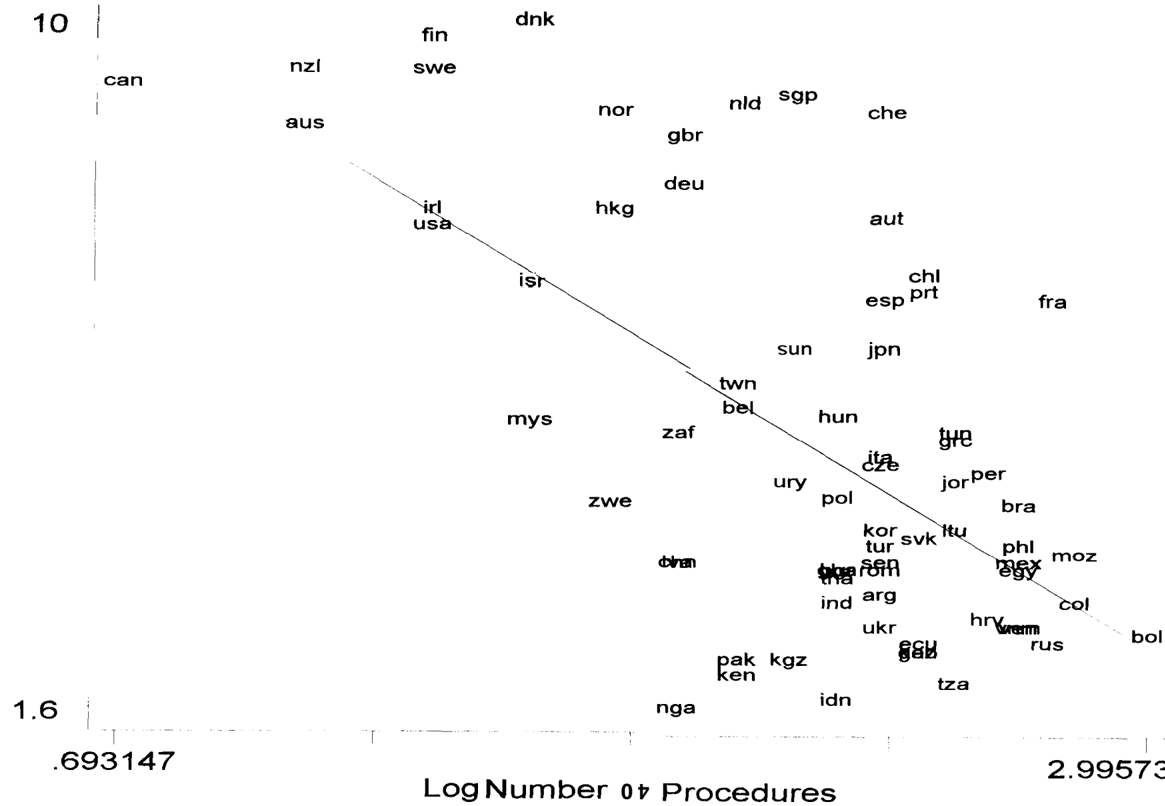
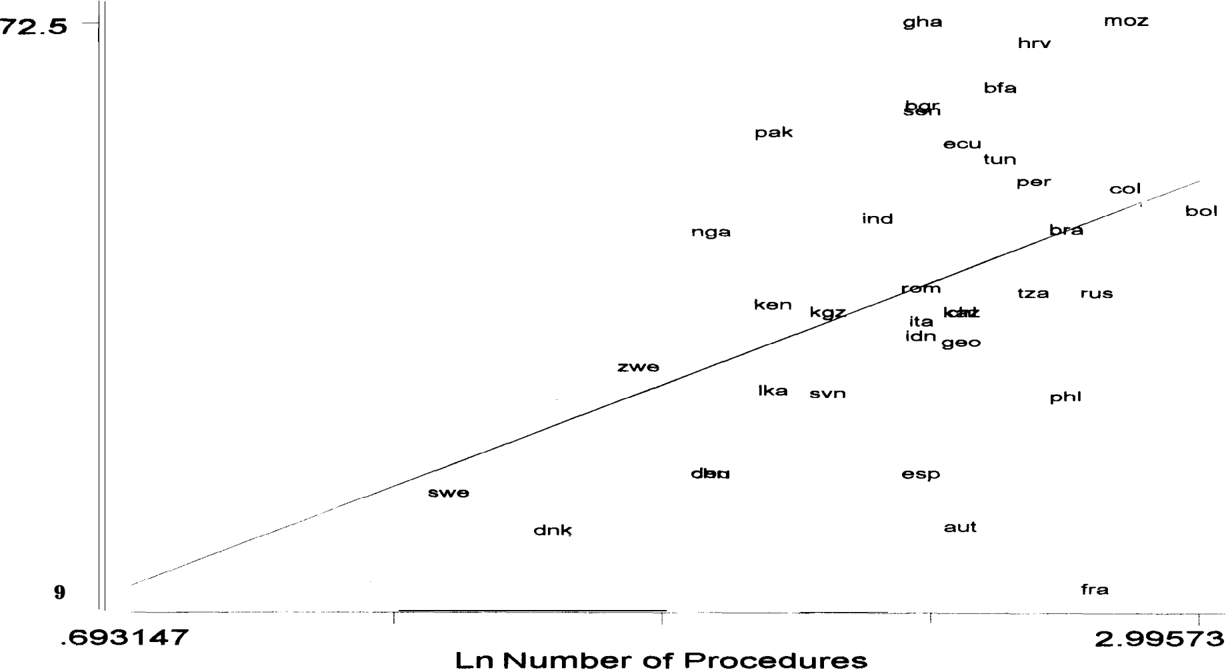
- The number of procedures is strongly correlated with time and cost: the paper reports correlations of 0.75 with log time and 0.62 with log cost.
- The helping-hand tests do not support a beneficial-regulation story: in Table IV, more procedures are associated with lower ISO quality standards (e.g. coefficient -0.2646) and larger unofficial economy measures (e.g. coefficient 13.6277 for size of unofficial economy; 19.8763 for employment in the unofficial economy), while pollution and health outcomes do not improve.
- The tollbooth evidence is stronger: Table VI reports that more procedures are associated with worse corruption scores, with a coefficient of -3.2809 (and -1.7249 with GDP per capita controls) for the corruption regressions.
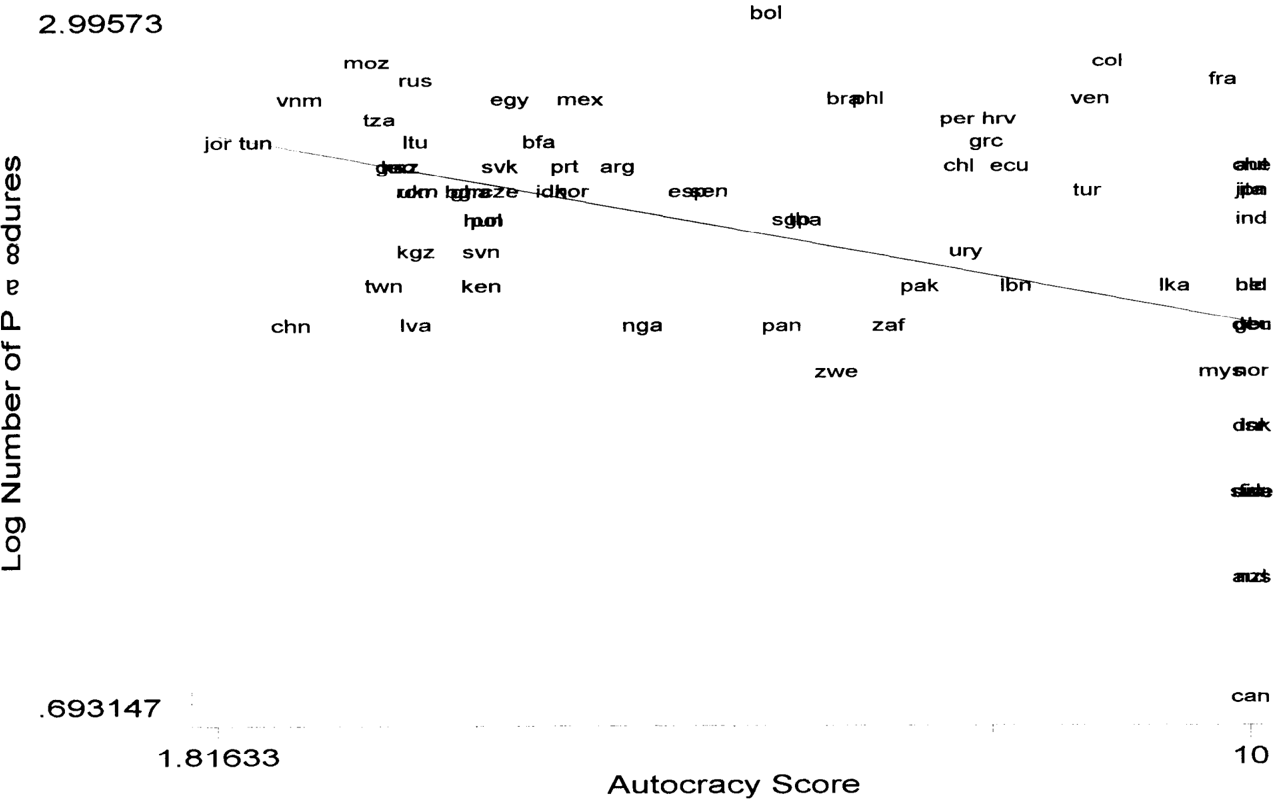
- In Table VIII, better government is associated with lighter regulation; the paper states that countries with more limited and representative governments have statistically significantly fewer procedures using 5 out of 6 measures of better government, and that more autocratic countries regulate more heavily.
Methods
- The paper builds a new database on entry regulation for 75 countries, focusing on the legal requirements, official time, and official cost for a standardized start-up firm.
- Data were gathered from written government sources, World Bank- and USAID-sponsored studies, government web pages, direct contacts with agencies, and independent double-checks in 73 countries via local consulting reports; the remaining 2 countries were double-checked through government contacts.
- The main analysis uses cross-country OLS regressions relating entry regulation measures to outcomes such as quality, pollution, unofficial economy, corruption, political institutions, legal origin, and GDP per capita; the paper also reports correlations and test-of-means comparisons across income quartiles.
Limitations
- The paper itself notes that the capture-theory tests are based on crude measures and that the data are probably least suited to test the capture hypothesis.
- The authors say the data almost surely underestimate the cost and complexity of entry because they focus on the capital city, omit industry-specific requirements and foreign-ownership steps, and ignore some informal delays and bribes.
- Evident from the text: the study is cross-sectional and based on official procedures/costs, so causal interpretation is limited and informal corruption/bureaucratic delays are not directly measured except indirectly through correlations.
Model-written summary. Check it against the paper before relying on it.
Integrity signals
Registry
Cites
Statistics
Figures
Verification
Claims the paper makes
0 Valid · 3 Not valid · 13 Not checked · 114 Own results and interpretations
A result the paper reports from its own data — it cites no other source for it, so there is none to check. The quote shows it is in the paper.
In the paper
“Very few entry regulations cover tax and labor issues.”
plain- Asserted: passes — The authors put it forward as true.
- Checkable: passes — It can be checked against evidence.
- Load-bearing: unclear — It is unclear whether the paper’s conclusions depend on it.
- Based: passes — The paper gives a reason why it holds.
In the paper
“The data show that the numbers of entry and of labor market regulations are positively correlated across countries, contrary to the substitutes hypothesis.”
What the sources say
- Not matchedcites Djankov et al., 2000
An author–year citation the paper’s reference list doesn’t settle. We don’t search these by name.
plainstates an association- Asserted: passes — The authors put it forward as true.
- Checkable: passes — It can be checked against evidence.
- Load-bearing: unclear — It is unclear whether the paper’s conclusions depend on it.
- Based: passes — The paper gives a reason why it holds.
- Not matched
A result the paper reports from its own data — it cites no other source for it, so there is none to check. The quote shows it is in the paper.
In the paper
“It often takes the form of screening procedures.”
- Also stated in: § III. Basic Results. · plain
“Instead, much of what governments do to regulate entry falls into the category of screening procedures.”
plain- Asserted: passes — The authors put it forward as true.
- Checkable: passes — It can be checked against evidence.
- Load-bearing: unclear — It is unclear whether the paper’s conclusions depend on it.
- Based: passes — The paper gives a reason why it holds.
- Also stated in: § III. Basic Results. · plain
A result the paper reports from its own data — it cites no other source for it, so there is none to check. The quote shows it is in the paper.
In the paper
“First, the cost-to-per-capita-GDP ratio decreases uniformly with GDP per capita.”
plainstates an association- Asserted: passes — The authors put it forward as true.
- Checkable: passes — It can be checked against evidence.
- Load-bearing: unclear — It is unclear whether the paper’s conclusions depend on it.
- Based: passes — The paper gives a reason why it holds.
A result the paper reports from its own data — it cites no other source for it, so there is none to check. The quote shows it is in the paper.
In the paper
“In contrast, countries in the other three quartiles of per capita income are not statistically different from each other in terms of the number of procedures and the time required to fulfill them.”
plain- Asserted: passes — The authors put it forward as true.
- Checkable: passes — It can be checked against evidence.
- Load-bearing: passes — The paper’s conclusions depend on it.
- Based: passes — The paper gives a reason why it holds.
49 more claims
Create a free account to see all 130 claims and every source verdict.
- Probably not a substantial claim. 21
- It may state two separate claims as one. 54
- The quote only partly states this claim. 26
Claims other papers make about this one
Each is checked against this paper’s own text: does it say what the citing paper says it does?
The source backs part of the claim, not all of it — or backs it for a different population, condition or comparison.
In the citing paper
“Our findings suggest an explanation for the low level of incorporation in Italy: the average direct cost associated with fulfilling the bureaucratic regulations for registering a new corporation in Italy is 20% of per capita GNP compared to 10% of per capita GNP on average for other G-7 European countries.”
From Entry regulation as a barrier to entrepreneurship (2006) · cites this paper as Djankov et al. (2002)
Experimental — accuracy not yet measuredThe cited source says what the claim attributes to it.
In the citing paper
“Given the explicit link made by Djankov et al . (2002) between the speed and ease with which businesses may be established in a country and its economic performance - and the enthusiasm with which this link has been grasped by European Union policy makers - our findings imply this link needs reconsidering.”
From The Effect of Business Regulations on Nascent and Young Business Entrepreneurship (2007) · cites this paper as Djankov et al . (2002)
Citations
Cites
La Porta, R., Lopez‐de‐Silanes, F., Shleifer, A., & Vishny, R. W. (1998) · Journal of Political Economy · doi:10.1086/250042 · Cited by 18,025
Self-citationThe Theory of Economic Regulation
Stigler, G. J. (1971) · The Bell Journal of Economics and Management Science · doi:10.2307/3003160 · Cited by 8,098
Journal of Economic Literature
(2019) · AEA Papers and Proceedings · doi:10.1257/pandp.109.633 · Cited by 7,468
The Quarterly Journal of Economics
Kuznets, S. (2024) · Business Cycle Theory, Part I Volume 4 · doi:10.4324/9781003549741-8 · Cited by 7,176
La Porta, R. (1999) · Journal of Law, Economics, and Organization · doi:10.1093/jleo/15.1.222 · Cited by 5,699 · cited 2×
“Legal origin has been viewed as a proxy for the government’s proclivity to intervene in the economy and the stance of the law toward the security of property rights in a country [La Porta et al. 1999].”
The Theory of Economic Regulation
Stigler, G. J. (2021) · The Political Economy · doi:10.4324/9781315495811-8 · Cited by 5,483
Pigou, A. C. (1933) · The Economic Journal · doi:10.2307/2224491 · Cited by 5,137
Toward a More General Theory of Regulation
Peltzman, S. (1976) · The Journal of Law and Economics · doi:10.1086/466865 · Cited by 4,729
Moffitt, R. A. (2009) · American Economic Review · doi:10.1257/aer.99.2.660 · Cited by 4,694
Shleifer, A., & Vishny, R. W. (1993) · The Quarterly Journal of Economics · doi:10.2307/2118402 · Cited by 3,778
Self-citation
Research works printed but not linked: 7
- McLiesh Caralee, 2001, NBER Working Paper No., 8288
- Kasnako lu, Zehra, and Münür Yayla, 'Unrecorded Economy in Turkey: A Monetary Approach', 1999. "Unrecorded Economy in Turkey (A Monetary Approach)" in Informal Sector in Turkey (I), Tuncer Bulutay (ed.), SIS, Ankara, forthcoming.
- Fred, 1987, Journal of Legal Studies, 101
- Olson, Mancur, 1991, 'Autocracy, Democracy, and Prosperity,' in Richard Zeckhauser, ed., Strategy of Choice, Cambridge, MA: MIT Press.
- 1967, Western Economic Journal, 232
- World Economic Forum (1999), The Global Competitiveness Report 1999 , Schwab, Klaus et al., eds., New York: Oxford University Press.
- World Economic Forum, The Global Competitiveness Report 2001, Klaus Schwab et al., eds. (New York, NY: Oxford University Press, 2001).
Cited by
Items 101–200 of 3,986
R&D and Productivity: Estimating Endogenous Productivity
Doraszelski, U., & Jaumandreu, J. (2013) · The Review of Economic Studies · doi:10.1093/restud/rdt011 · Cited by 522
“We follow LP and ACF and do not account for sample selection by modelling a firm’s exit decision because the institutional realities in Spain render it unlikely that a firm is able to exit the industry immediately after receiving an adverse shock to productivity (see, e.g. Djankov et al., 2002).”
Aghion, P., Algan, Y., Cahuc, P., & Shleifer, A. (2009) · National Bureau of Economic Research · doi:10.3386/w14648 · Cited by 509
Self-citationTransparency, financial accounting information, and corporate governance
Bushman, R. M., & Smith, A. J. (2003) · Cited by 508
Obtaining a Driver's License in India: An Experimental Approach to Studying Corruption
Bertrand, M., Djankov, S., Hanna, R., & Mullainathan, S. (2007) · The Quarterly Journal of Economics · doi:10.1162/qjec.2007.122.4.1639 · Cited by 500
“All extralegal payments happen through private intermediaries (“agents”).”
Self-citationInstitutions and Entrepreneurship Quality
Chowdhury, F., Audretsch, D. B., & Belitski, M. (2019) · Entrepreneurship Theory and Practice · doi:10.1177/1042258718780431 · Cited by 514
“Interestingly, at a low corporate tax rate we observe a positive effect on the quantity of entrepreneurship for both developed and developing countries, suggesting that barriers are conducive to increasing the number of businesses (Djankov et al. 2002).”
InfluentialWhere does microfinance flourish? Microfinance institution performance in macroeconomic context
Ahlin, C., Lin, J., & Maio, M. (2011) · Journal of Development Economics · doi:10.1016/j.jdeveco.2010.04.004 · Cited by 508
“A complementary approach to measuring institutional characteristics, pioneered by de Soto (1989) and furthered by Djankov et al. (2002) and Botero et al. (2004), seeks to quantify specific barriers to doing business via case studies and consultation with experts.”
A theoretical grounding and test of the GEM model
Levie, J., & Autio, E. (2008) · Small Business Economics · doi:10.1007/s11187-008-9136-8 · Cited by 513
Institutional Polycentrism, Entrepreneurs' Social Networks, and New Venture Growth
Batjargal, B., Hitt, M. A., Tsui, A. S., Arregle, J.-L., Webb, J. W., & Miller, T. L. (2013) · Academy of Management Journal · doi:10.5465/amj.2010.0095 · Cited by 487
Desa, G. (2012) · Entrepreneurship Theory and Practice · doi:10.1111/j.1540-6520.2010.00430.x · Cited by 466
Djankov, S., McLiesh, C., & Ramalho, R. M. (2006) · Economics Letters · doi:10.1016/j.econlet.2006.03.021 · Cited by 486
Self-citationBankruptcy around the World: Explanations of Its Relative Use
Claessens, S. (2005) · American Law and Economics Review · doi:10.1093/aler/ahi004 · Cited by 448
“TIME is the number of business days required for a business to become operational (Djankov et al., 2000).”
The Role of Institutions in Growth and Development
Acemoğlu, D., & Robinson, J. A. (2010) · Review of Economics and Institutions · doi:10.5202/rei.v1i2.1 · Cited by 351
“Knack and Keefer (1995), for instance, looked at measures of property rights enforcement compiled by international business organizations, Mauro (1995) looked at measures of corruption, and Djankov et al. (2002) compiled measures of entry barriers across countries.”
Tonoyan, V., Strohmeyer, R., Habib, M., & Perlitz, M. (2010) · Entrepreneurship Theory and Practice · doi:10.1111/j.1540-6520.2010.00394.x · Cited by 455
Entrepreneurship, Geography, and American Economic Growth
Acs, Z. J., & Armington, C. (2006) · Cambridge University Press eBooks · doi:10.1017/cbo9780511510816 · Cited by 452
Does Entry Regulation Hinder Job Creation? Evidence from the French Retail Industry
Bertrand, M., & Kramarz, F. (2002) · The Quarterly Journal of Economics · doi:10.1162/003355302320935052 · Cited by 444
The Limits of Institutional Reform in Development: Changing Rules for Realistic Solutions
(2018) · Governance · doi:10.1111/gove.12345 · Cited by 447
Dorobantu, S., Kaul, A., & Zelner, B. (2017) · Strategic Management Journal · doi:10.1002/smj.2590 · Cited by 441
Glaeser, E., Scheinkman, J., & Shleifer, A. (2003) · Journal of Monetary Economics · doi:10.1016/s0304-3932(02)00204-0 · Cited by 424
Self-citationBird, R. M., Martinez-Vazquez, J., & Torgler, B. (2008) · Economic Analysis and Policy · doi:10.1016/s0313-5926(08)50006-3 · Cited by 424
Chapter 7 Growth Theory through the Lens of Development Economics
Banerjee, A. V., & Duflo, E. (2005) · Handbook of Economic Growth · doi:10.1016/s1574-0684(05)01007-5 · Cited by 420
Promarket Reforms and Firm profitability in Developing Countries
Cuervo-Cazurra, A., & Dau, L. A. (2009) · Academy of Management Journal · doi:10.5465/amj.2009.47085192 · Cited by 418
How do institutions affect corruption and the shadow economy?
Dreher, A., Kotsogiannis, C., & McCorriston, S. (2009) · International Tax and Public Finance · doi:10.1007/s10797-008-9089-5 · Cited by 421
Public policy and the creation of active venture capital markets
Da Rin, M., Nicodano, G., & Sembenelli, A. (2006) · Journal of Public Economics · doi:10.1016/j.jpubeco.2005.09.013 · Cited by 403
Service Regulation and Growth: Evidence from OECD Countries
Barone, G., & Cingano, F. (2011) · The Economic Journal · doi:10.1111/j.1468-0297.2011.02433.x · Cited by 502
Innovation and Economic Development
Fagerberg, J., Srholec, M., & Verspagen, B. (2010) · Handbook of the Economics of Innovation · doi:10.1016/s0169-7218(10)02004-6 · Cited by 410
Size matters: entrepreneurial entry and government
Aidis, R., Estrin, S., & Mickiewicz, T. M. (2012) · Small Business Economics · doi:10.1007/s11187-010-9299-y · Cited by 409
“The significance of corruption as an indicator of institutional quality arises from the fact that it becomes institutionally embedded; where widespread it is transformed into a social norm of behaviour, which becomes difficult to change and responds only slowly to formal institutional reform.”
InfluentialThe role of informal institutions in corporate governance: Brazil, Russia, India, and China compared
Estrin, S., & Prevezer, M. (2011) · Asia Pacific Journal of Management · doi:10.1007/s10490-010-9229-1 · Cited by 408
Entry Barriers in Retail Trade
Schivardi, F., & Viviano, E. (2011) · The Economic Journal · doi:10.1111/j.1468-0297.2009.02348.x · Cited by 389
“are the most effective instrument for restricting competition (Djankov et al., 2002; Klapper et al., 2006).”
La Porta, R., Lopez de Silanes, F., & Shleifer, A. (2000) · SSRN Electronic Journal · doi:10.2139/ssrn.236434 · Cited by 364
Self-citationDjankov, S. D., La Porta, R., Lopez de Silanes, F., Shleifer, A., & Botero, J. C. (2003) · SSRN Electronic Journal · doi:10.2139/ssrn.408480 · Cited by 387
Self-citationWhy is the developed world obese?
Bleich, S. N., Cutler, D., Murray, C., & Adams, A. (2008) · Annual Review of Public Health · doi:10.1146/annurev.publhealth.29.020907.090954 · Cited by 404
Informal sector: The credit market channel
Straub, S. (2005) · Journal of Development Economics · doi:10.1016/j.jdeveco.2004.09.005 · Cited by 393
“Although Friedman et al. (2000) present instrumental regressions using the set of instruments suggested by La Porta, Lopez-de-Silanes, Shleifer and Vishny (1997, 1999), which includes ethnolinguistic fragmentation, origin of the legal system, religious composition and latitude, some recent works suggest that at least…”
InfluentialThe Rule of Law and Economic Growth: Where are We?
Haggard, S., & Tiede, L. (2011) · World Development · doi:10.1016/j.worlddev.2010.10.007 · Cited by 399
“7 contracts; not surprisingly, a major strand of the law and economic development literature has dealt with financial development (La Porta et al. 1998; Djankov et al. 2002).”
Policy Distortions and Aggregate Productivity with Heterogeneous Plants
Restuccia, D., & Rogerson, R. (2007) · National Bureau of Economic Research · doi:10.3386/w13018 · Cited by 401
Macro-level determinants of formal entrepreneurship versus informal entrepreneurship
Thai, M. T. T., & Turkina, E. (2014) · Journal of Business Venturing · doi:10.1016/j.jbusvent.2013.07.005 · Cited by 399
Economic and political institutions and entry into formal and informal entrepreneurship
Autio, E., & Fu, K. (2015) · Asia Pacific Journal of Management · doi:10.1007/s10490-014-9381-0 · Cited by 397
Bankruptcy Law and Entrepreneurship
Armour, J., & Cumming, D. (2008) · American Law and Economics Review · doi:10.1093/aler/ahn008 · Cited by 381
The Impact of Regulation on Economic Growth in Developing Countries: A Cross-Country Analysis
Jalilian, H., Kirkpatrick, C., & Parker, D. (2007) · World Development · doi:10.1016/j.worlddev.2006.09.005 · Cited by 394
“…that the regulator will receive all of the information required to regulate optimally to maximise social welfare, the results of regulation, in terms of outputs and prices remain “second best” to those of a competitive market, which centres attention on barriers to entry (Djankov et al., 2002).”
Capital Structure Decisions around the World: Which Factors Are Reliably Important?
Öztekin, Ö. (2015) · Journal of Financial and Quantitative Analysis · doi:10.1017/s0022109014000660 · Cited by 411
Besley, T., & Burgess, R. (2003) · Journal of Economic Perspectives · doi:10.1257/089533003769204335 · Cited by 386
When arm's length is too far: Relationship banking over the credit cycle
Beck, T., Degryse, H., De Haas, R., & van Horen, N. (2018) · Journal of Financial Economics · doi:10.1016/j.jfineco.2017.11.007 · Cited by 372
Oligarchic Versus Democratic Societies
Acemoglu, D. (2008) · Journal of the European Economic Association · doi:10.1162/jeea.2008.6.1.1 · Cited by 375
“†This paper is a revised version of “The Form of Property Rights: Oligarchic vs. Democratic Societies” NBER Working Paper No. 10037, 2003.”
Regulatory Burden, Rule of Law, and Entry of Strategic Entrepreneurs: An International Panel Study
Levie, J., & Autio, E. (2011) · Journal of Management Studies · doi:10.1111/j.1467-6486.2010.01006.x · Cited by 382
Entrepreneurship and competitiveness dynamics in Latin America
Acs, Z. J., & Amorós, J. E. (2008) · Small Business Economics · doi:10.1007/s11187-008-9133-y · Cited by 381
What causes firms to hide output? The determinants of informality
Dabla-Norris, E., Gradstein, M., & Inchauste, G. (2008) · Journal of Development Economics · doi:10.1016/j.jdeveco.2006.05.007 · Cited by 429
“Djankov, S., R. La Porta, F. Lopez-de-Silanes, and A. Shleifer, 2002, “The Regulation of Entry,” Quarterly Journal of Economics, Vol. 117, pp. 1–37.”
The VAT in Developing and Transitional Countries
Bird, R., & Gendron, P.-P. (2007) · Cambridge University Press eBooks · doi:10.1017/cbo9780511619366 · Cited by 376
Institutional dimensions and entrepreneurial activity: an international study
Urbano, D., & Alvarez, C. (2014) · Small Business Economics · doi:10.1007/s11187-013-9523-7 · Cited by 375
The Rule of Law and Economic Development
Haggard, S., MacIntyre, A., & Tiede, L. (2008) · Annual Review of Political Science · doi:10.1146/annurev.polisci.10.081205.100244 · Cited by 365
“Perhaps the most dynamic body of research on the link between the rule of law and economic development has grown out of a series of important papers by La Porta et al. (1997, 1998, 1999, 2000, 2002, 2004) and their colleagues (Glaeser & Shleifer 2002; Djankov et al. 2002, 2003) on legal origins.”
Institutional exceptions on global projects: a process model
Orr, R. J., & Scott, W. R. (2008) · Journal of International Business Studies · doi:10.1057/palgrave.jibs.8400370 · Cited by 369
Capital Allocation and Timely Accounting Recognition of Economic Losses
Bushman, R. M., Piotroski, J. D., & Smith, A. J. (2011) · Journal of Business Finance & Accounting · doi:10.1111/j.1468-5957.2010.02231.x · Cited by 345
Which country matters? Institutional development and foreign affiliate performance
Chan, C. M., Isobe, T., & Makino, S. (2008) · Strategic Management Journal · doi:10.1002/smj.705 · Cited by 365
“Mgmt. J., 29: 1179–1205 (2008) DOI: 10.1002/smj Mutti, 1991), investment regulations (Contractor, 1990; Djankov et al., 2002), restrictions on foreign ownership (Gomes-Casseres, 1990), government protection (Boddewyn and Brewer, 1994; Salorio, 1993), and foreign exchange controls (Casson, 1982).”
InfluentialThe mortality cost of political connections
Fisman, R. J., Hirshleifer, D., Hong, H., Kamenica, E., Matsusaka, J., Murphy, K., & Seru, A. (2013) · Cited by 352
Informality: Causes and Consequences for Development
Ulyssea, G. (2020) · Annual Review of Economics · doi:10.1146/annurev-economics-082119-121914 · Cited by 352
“In particular, great emphasis has been placed in reducing registration costs, which are often regarded as a major constraint to firm creation and formalisation (e.g. De Soto 1989, Djankov et al. 2002).”
Growth Theory through the Lens of Development Economics
Banerjee, A. V., & Duflo, E. (2004) · SSRN Electronic Journal · doi:10.2139/ssrn.651483 · Cited by 352
“Djankov et al. (2002) document wide variation in the ability of someone to start a new firm in 85 countries. They argue that the costs of entry are high in most countries (on average, they sum up to 47% of a country’s GDP per capita), and can be very high indeed: While it take 3 procedures and 3 days to obtain the per…”
InfluentialThe multinationalization of developing country MNEs: The case of multilatinas
Cuervo-Cazurra, A. (2008) · Journal of International Management · doi:10.1016/j.intman.2007.09.001 · Cited by 353
An International Comparison of Capital Structure and Debt Maturity Choices
Fan, J. P. H., Twite, G. J., & Titman, S. (2011) · SSRN Electronic Journal · doi:10.2139/ssrn.423483 · Cited by 339
Shleifer, A. (2005) · European Financial Management · doi:10.1111/j.1354-7798.2005.00291.x · Cited by 350
“Some empirical evidence assembled by La Porta et al. (2004) is broadly consistent with this point of view.”
Self-citationDo Institutions Play a Role in Skilled Migration? The Case of Italy
Nifo, A., & Vecchione, G. (2014) · Regional Studies · doi:10.1080/00343404.2013.835799 · Cited by 352
“…with measuring it both for cross-country (BARRO and LEE, 1993; NUGENT, 1993; MAURO, 1995; WORLD BANK, 1997a; BRUNETTI, 1997; KNACK and KEEFER, 1997; DJANKOV et al., 2002) and inter-regional comparisons (HELLIWELL and PUTNAM, 1995; BARRO and SALA-I-MARTIN, 1995; ARRIGHETTI and SERRAVALLI, 1999;…”
A theory of entrepreneurship and institutional uncertainty
Bylund, P. L., & McCaffrey, M. (2017) · Journal of Business Venturing · doi:10.1016/j.jbusvent.2017.05.006 · Cited by 345
Institutions, Capital Constraints and Entrepreneurial Firm Dynamics: Evidence from Europe
Desai, M., Gompers, P., & Lerner, J. (2003) · National Bureau of Economic Research · doi:10.3386/w10165 · Cited by 344
CORRUPTION AND THE SHADOW ECONOMY*
Choi, J. P., & Thum, M. (2005) · International Economic Review · doi:10.1111/j.1468-2354.2005.00347.x · Cited by 337
License to Sell: The Effect of Business Registration Reform on Entrepreneurial Activity in Mexico
Bruhn, M. (2011) · Review of Economics and Statistics · doi:10.1162/rest_a_00059 · Cited by 339
Nicotra, M., Romano, M., Del Giudice, M., & Schillaci, C. E. (2018) · The Journal of Technology Transfer · doi:10.1007/s10961-017-9628-2 · Cited by 342
Small and Medium Enterprises across the Globe: A New Database
Ayyagari, M., Beck, T., & Demirguc-Kunt, A. (2003) · World Bank, Washington, DC eBooks · doi:10.1596/1813-9450-3127 · Cited by 433
Cumming, D. J., Grilli, L., & Murtinu, S. (2017) · Journal of Corporate Finance · doi:10.1016/j.jcorpfin.2014.10.016 · Cited by 364
Differential properties in the ratings of certified versus non-certified bond-rating agencies
Beaver, W. H., Shakespeare, C., & Soliman, M. T. (2006) · Journal of Accounting and Economics · doi:10.1016/j.jacceco.2006.06.002 · Cited by 302
Bank Regulation and Supervision: What Works Best?
Barth, J. R., Caprio, G., & Levine, R. E. (2001) · SSRN Electronic Journal · doi:10.2139/ssrn.269488 · Cited by 308
To formalize or not to formalize: Entrepreneurship and pro-market institutions
Dau, L. A., & Cuervo-Cazurra, A. (2014) · Journal of Business Venturing · doi:10.1016/j.jbusvent.2014.05.002 · Cited by 333
The Global Entrepreneurship Monitor (GEM) and Its Impact on Entrepreneurship Research
Bosma, N. (2013) · Foundations and Trends® in Entrepreneurship · doi:10.1561/0300000033 · Cited by 331
How do bankruptcy laws affect entrepreneurship development around the world?
Lee, S.-H., Yamakawa, Y., Peng, M. W., & Barney, J. B. (2011) · Journal of Business Venturing · doi:10.1016/j.jbusvent.2010.05.001 · Cited by 326
“Venturing (2010), doi:10.1016/j.jbusvent.2010.05.001 1998), and on the regulation of entry (Djankov et al., 2002).”
InfluentialTrade, regulations, and income
Freund, C., & Bolaky, B. (2008) · Journal of Development Economics · doi:10.1016/j.jdeveco.2007.11.003 · Cited by 326
When Do Employees Become Entrepreneurs?
Hellmann, T. (2007) · Management Science · doi:10.1287/mnsc.1060.0648 · Cited by 313
Bankruptcy Law and Entrepreneurship Development: A Real Options Perspective
Lee, S.-H., Peng, M. W., & Barney, J. B. (2007) · Academy of Management Review · doi:10.5465/amr.2007.23464070 · Cited by 323
“…bankruptcy law, informed by a real options perspective, may facilitate entrepreneurship development at the societal level by encouraging more risk taking through curtailing downside risks for failed entrepreneurs and their firms and through more enthusiastic creation of new firms (Efrat, 2002).”
The Demand for, and Consequences of, Formalization among Informal Firms in Sri Lanka
de Mel, S., McKenzie, D., & Woodruff, C. (2013) · American Economic Journal: Applied Economics · doi:10.1257/app.5.2.122 · Cited by 320
The institutional economics of corruption and reform: theory, evidence, and policy
(2007) · Choice Reviews Online · doi:10.5860/choice.45-0389 · Cited by 320
Competition Policy and Productivity Growth: An Empirical Assessment
Buccirossi, P., Ciari, L., Duso, T., Spagnolo, G., & Vitale, C. (2013) · The Review of Economics and Statistics · doi:10.1162/rest_a_00304 · Cited by 316
Service Regulation and Growth: Evidence from OECD CountriesPreprint
Barone, G., & Cingano, F. (2008) · SSRN Electronic Journal · doi:10.2139/ssrn.1160183 · Cited by 319
Are Any Growth Theories Robust?
Durlauf, S. N., Kourtellos, A., & Tan, C. M. (2008) · The Economic Journal · doi:10.1111/j.1468-0297.2007.02123.x · Cited by 311
“…on executive power institute, an index of legal formalism based on the number of procedures for collecting on a bounced cheque (CHEQUE) developed by Djankov et al. (2002) and an index for the quality of governance in 1996 using a composite governance index developed (KKZ96) by Kaufmann et al.…”
Lerner, J., & Malmendier, U. (2013) · Review of Financial Studies · doi:10.1093/rfs/hht024 · Cited by 299
ENTREPRENEURSHIP AND DEVELOPMENT: CAUSE OR CONSEQUENCE?
Boettke, P. J., & Coyne, C. J. (2004) · Advances in Austrian Economics · doi:10.1016/s1529-2134(03)06005-8 · Cited by 300
Entrepreneurship And Firm Formation Across Countries
Amit, R., Klapper, L., Guillén, M. F., & Quesada, J. M. (2007) · World Bank, Washington, DC eBooks · doi:10.1596/1813-9450-4313 · Cited by 308
“…E-MAIL, ECONOMIC DEVELOPMENT, PRIVATE SECTOR, REGISTRIES, REGULATORY ENVIRONMENT, RESULTS, WEB Disciplines Management Sciences and Quantitative Methods This journal article is available at ScholarlyCommons: https://repository.upenn.edu/mgmt_papers/305 Entrepreneurship and Firm Formation Across…”
Foreign direct investment in Africa: Performance, challenges, and responsibilities
Dupasquier, C., & Osakwe, P. N. (2006) · Journal of Asian Economics · doi:10.1016/j.asieco.2005.07.002 · Cited by 308
“Country 1991-1995 1996-2000 Japan 20 340 Netherlands 297 8 6 New Zealand - - Norway 45 - 48 Portugal 96 ,560 Spain 50 476 Sweden 4 97 Switzerland 452 69 United Kingdom 2,376 3,269 United States 278 9,249 Source: World Investment Report, UNCTAD, 2002.”
InfluentialPharmaceutical Price Controls and Entry Strategies
Kyle, M. K. (2007) · Review of Economics and Statistics · doi:10.1162/rest.89.1.88 · Cited by 297
Enterprise Restructuring in Transition: A Quantitative Survey
Djankov, S. D., & Murrell, P. (2000) · SSRN Electronic Journal · doi:10.2139/ssrn.238716 · Cited by 301
“Djankov et al. (2002a ) document the number of procedures and the associated time and cost for starting a new business in 85 countries around the world, including 22 transition economies, to explain poor aggregate growth performance in the CIS.”
Self-citationThe Political Economy of Institutions and Corruption in American States
Alt, J. E., & Lassen, D. D. (2003) · Journal of Theoretical Politics · doi:10.1177/0951692803015003006 · Cited by 292
“'D ; *&" ) " #" & " D = ') " +) ) D 6 "+ + $ & # $ ) D ?”
Robinson, J. A., & Torvik, R. (2005) · Journal of Public Economics · doi:10.1016/j.jpubeco.2004.05.004 · Cited by 301
What drives the comparability effect of mandatory IFRS adoption?
Cascino, S., & Gassen, J. (2015) · Review of Accounting Studies · doi:10.1007/s11142-014-9296-5 · Cited by 280
How do country regulations and business environment impact foreign direct investment (FDI) inflows?
Contractor, F. J., Dangol, R., Nuruzzaman, N., & Raghunath, S. (2020) · International Business Review · doi:10.1016/j.ibusrev.2019.101640 · Cited by 294
Corruption's asymmetric impacts on firm innovation
Paunov, C. (2016) · Journal of Development Economics · doi:10.1016/j.jdeveco.2015.07.006 · Cited by 289
The Impact of the home country on internationalization
Cuervo-Cazurra, A., Luo, Y., Ramamurti, R., & Ang, S. H. (2018) · Journal of World Business · doi:10.1016/j.jwb.2018.06.002 · Cited by 292
Firms, Misallocation, and Aggregate Productivity: A Review
Hopenhayn, H. A. (2014) · Annual Review of Economics · doi:10.1146/annurev-economics-082912-110223 · Cited by 281
What Determines Corporate Transparency?Preprint
Bushman, R. M., Piotroski, J. D., & Smith, A. J. (2003) · SSRN Electronic Journal · doi:10.2139/ssrn.428601 · Cited by 289
Big Business Owners in Politics
Bunkanwanicha, P., & Wiwattanakantang, Y. (2009) · Review of Financial Studies · doi:10.1093/rfs/hhn083 · Cited by 285
Historical and Comparative Institutional Analysis
Greif, A. (1998) · American Economic Review · Cited by 410
Amine, L. S., & Staub, K. M. (2009) · Entrepreneurship & Regional Development · doi:10.1080/08985620802182144 · Cited by 285
“Other problems facing women who want to start or grow their own businesses have been documented by Fick (2002), Chamlee-Wright (2002), Akinola (2005), Kibas (2005) and the International Labor Organisation (ILO 2006).”
What does “entrepreneurship” data really show?
Acs, Z. J., Desai, S., & Klapper, L. F. (2008) · Small Business Economics · doi:10.1007/s11187-008-9137-7 · Cited by 283
Branstetter, L., Lima, F., Taylor, L. J., & Venâncio, A. (2014) · The Economic Journal · doi:10.1111/ecoj.12044 · Cited by 277
“In an effort to take the concerns raised by public interest theory seriously, some work focuses on the impact of regulation on potential market failures such as sub-standard product quality, pollution or public health (Djankov et al. , 2002; Bruhn, 2011; Yakovlev and Zhuravskaya, forthcoming).”
InfluentialImporting corruption culture from overseas: Evidence from corporate tax evasion in the United States
DeBacker, J., Heim, B. T., & Tran, A. (2015) · Journal of Financial Economics · doi:10.1016/j.jfineco.2012.11.009 · Cited by 273
Djankov, S., Glaeser, E., Porta, R. L., Lopez-de-Silane, F., & Shleifer, A. (2003) · National Bureau of Economic Research · doi:10.3386/w9608 · Cited by 257
Self-citationWhy Firms Engage in Corruption: A Top Management Perspective
Collins, J. D., Uhlenbruck, K., & Rodriguez, P. (2009) · Journal of Business Ethics · doi:10.1007/s10551-008-9872-3 · Cited by 271
“The necessity of obtaining official government approval for potentially lucrative public contracts has long been seen as a vehicle for corruption (DeSoto, 2000; Shleifer et al., 2002).”
Metadata
- Authors
- Djankov, S., La Porta, R., Lopez-de-Silanes, F., & Shleifer, A.
- Affiliations
- World Bank (US)
- National Bureau of Economic Research (US)
- ORCID
- Djankov, S.
- Venue
- The Quarterly Journal of Economics
- Publisher
- Oxford University Press (OUP)
- Published
- 2002-02-01
- Volume
- 117
- Issue
- 1
- Pages
- 1-37
- ISSN
- 0033-5533
- 1531-4650
- OpenAlex
- W2139896179
- Cited by
- 3,956
- References
- 30
- Citations by year
- 2026: 223 · 2025: 185 · 2024: 157 · 2023: 120 · 2022: 140 · 2021: 150 · 2020: 151 · 2019: 161 · 2018: 157 · 2017: 162 · 2016: 166 · 2015: 193 · 2014: 200 · 2013: 183 · 2012: 193
- Type
- report
- Language
- en
- Open access
- green
- doi.org
- Licence
- other-oa
- Locations
- World Bank, Washington, DC eBooks (publishedVersion)
- The Quarterly Journal of Economics (publishedVersion)
- The World Bank Open Knowledge Repository (World Bank) (publishedVersion)
- National Bureau of Economic Research (publishedVersion, other-oa)
- RePEc: Research Papers in Economics (submittedVersion)
- Digital Access to Scholarship at Harvard (DASH) (Harvard University) (submittedVersion, cc-by)
- SSRN Electronic Journal (submittedVersion)
- OpenGrey (Institut de l'Information Scientifique et Technique) (submittedVersion)
- The World Bank Open Knowledge Repository (World Bank) (submittedVersion, cc-by)
- Topics
- Social Sciences › Sociology and Political Science › Corruption and Economic Development
- Social Sciences › Economics, Econometrics and Finance › Economics and Econometrics › Taxation and Compliance Studies
- Social Sciences › Business, Management and Accounting › Strategy and Management › Political Influence and Corporate Strategies
- Keywords
- start-up firms, bureaucratic procedures, corruption, informal economy, democracy, government size, public choice theory, public interest theory
About these checks
Registry, retraction, Cites and statistics results are computed, not judged, with one exception: a printed reference that no index lists is read once by a model before it counts as a citation error. Claims are extracted by a model and kept only when their quote appears verbatim in the text; each cited source is then checked, with a model’s help, for whether it says what the claim relies on. Those verdicts can be wrong — read the claim’s quote and the cited source before relying on one.
A language model drew the claims from the paper on 2026-10-01, under version 3 of the claim definition (model deepseek-v4.1-flash, prompt extract-v3).
A second model labelled each claim on 2026-10-01 (model jev-1.13-20260917, definition revision gold-guideline-v0.2).
Statistics and arithmetic are recomputed, not judged.
Confidence bands are shown only for fields calibrated on our annotated test set. None is calibrated yet, so no band is shown.
What counts as a claim ›How we measure confidence ›How we check this ›
Are you an author, or do you see a problem with this page? Request a review
Data sources
Bibliographic data: Semantic Scholar, OpenAlex, Crossref.
Contains information from the Semantic Scholar Academic Graph Datasets, made available under the ODC Attribution License (ODC-BY 1.0).
Semantic Scholar’s data is described in: Kinney, R., et al. (2023). The Semantic Scholar Open Data Platform. arXiv:2301.10140.
