

A Step-by-Step Process of Thematic Analysis to Develop a Conceptual Model in Qualitative Research
Open accessThe DOI matches its Crossref record; 77 of the 78 references it cites were found in a registry or an index, and 1 are not checked yet; 2 of the 57 sources its claims cite were checked for support.
Abstract
Thematic analysis is a highly popular technique among qualitative researchers for analyzing qualitative data, which usually comprises thick descriptive data. However, the application and use of thematic analysis has also involved complications due to confusion regarding the final outcome’s presentation as a conceptual model. This paper develops a systematic thematic analysis process for creating a conceptual model from qualitative research findings. It explores the adaptability of the proposed process across various research methodologies, including constructivist methodologies, positivist methodologies, grounded theory, and interpretive phenomenology, and justifies their application. The paper distinguishes between inductive and deductive coding approaches and emphasizes the merits of each. It suggests that the derived systematic thematic analysis model is valuable across multiple disciplines, particularly in grounded theory, ethnographic approaches, and narrative approaches, while also being adaptable to more descriptive, positivist-based methodologies. By providing a methodological roadmap, this study enhances the rigor and replicability of thematic analysis and offers a comprehensive strategy for theoretical conceptualization in qualitative research. The contribution of this paper is a systematic six-step thematic analysis process that leads to the development of a conceptual model; each step is described in detail and examples are given.
Verified 2026-11-22 · 1 reference not checked yet
Overview
CoChat Summary
TL;DR
This methodological paper presents a six-step systematic thematic analysis process for developing a conceptual model from qualitative data, illustrated with Naeem and Ozuem’s (2022a) panic-buying study. It introduces 6Rs for keyword selection, 6Rs for coding, and 4Rs for theming to enhance rigor and trustworthiness.
Key findings
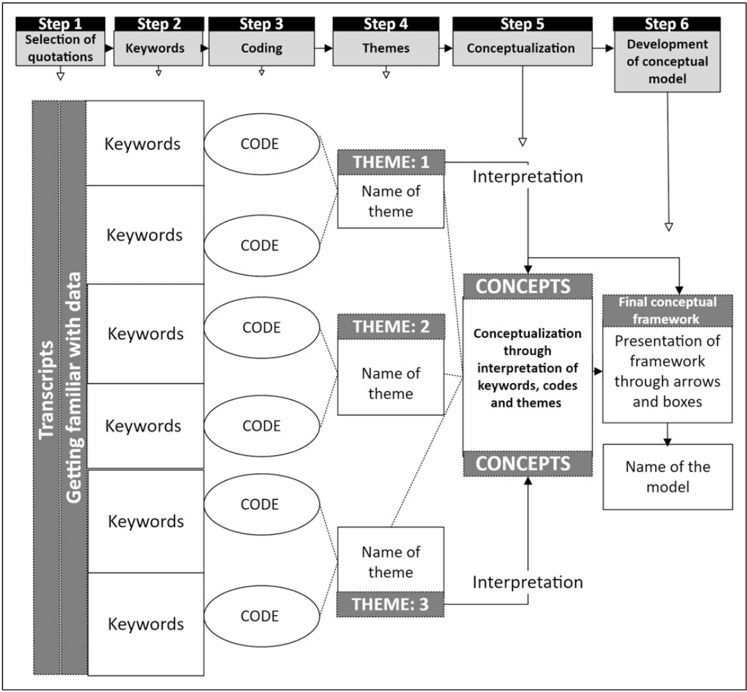
- The paper proposes six steps: transcription/familiarization and quotation selection; keyword selection; coding; theme development; conceptualization through interpretation of keywords, codes, and themes; and development of a conceptual model.
- It introduces 6Rs for keyword selection (realness, richness, repetition, rationale, repartee, regal), 6Rs for coding (robust, reflective, resplendent, relevant, radical, righteous), and 4Rs for theming (reciprocal, recognizable, responsive, resourceful).
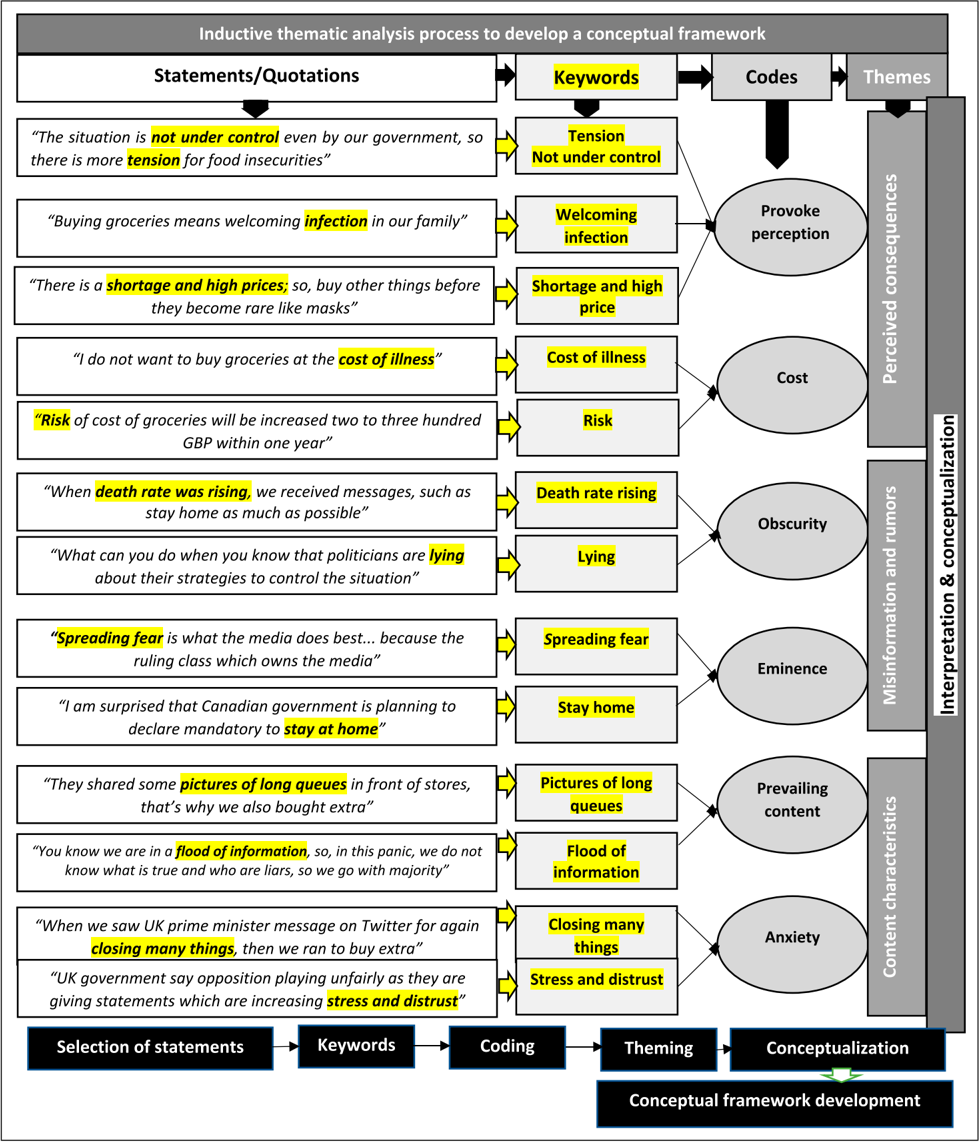
- In the exemplar study, three main themes emerged: “Perceived consequences” from codes “Provoke perception” and “Cost”; “Misinformation and rumors” from codes “Obscurity” and “Eminence”; and “Content Characteristics” from codes “Prevailing content” and “Anxiety.”
- The exemplar’s final model, “Panic buying as social practice,” was based on Protection Motivation Theory (PMT) and the Theory of Rumor Transmission (TORT).
Methods
- Design: a methodological/conceptual paper that presents a comprehensive systematic model for thematic analysis culminating in a conceptual model, using Naeem and Ozuem (2022a) as an exemplar.
- Exemplar data: qualitative data gathered from Twitter, YouTube, and interviews; the exemplar used a six-stage thematic analysis and a social constructionist perspective with PMT and TORT as theoretical foundations.
- Main analysis: the paper describes each of the six steps in detail, provides practical examples from the exemplar, and compares the proposed process with Braun and Clarke’s (2006) six steps of thematic analysis.
Limitations
- The paper states that the potential of the process to address other research contexts or quantitative methods may require further exploration, and that the efficiency of the method compared with other model-building approaches has not been empirically tested.
- Evident from the text: the proposed six-step process and the 6Rs/4Rs are illustrated through a single exemplar study and are not independently validated or empirically compared with alternative thematic analysis approaches.
Model-written summary. Check it against the paper before relying on it.
Integrity signals
Registry
Cites
Statistics
Figures

Verification
Claims the paper makes
0 Valid · 4 Not valid · 56 Not checked · 89 Own results and interpretations
The cited sources that could be checked couldn’t confirm or dispute this claim.
In the paper
“For narrative approaches, conceptual model development focuses on personal experiences, emotions, and life histories (Eldh et al., 2020).”
§ A Step-by-Step Process of Thematic Analysis to Develop a Conceptual Model in Qualitative Research > Step 6: Development of Conceptual Model.
What the sources say
- Could not verifycites Eldh et al., 2020 matched to “Quotations in Qualitative Studies: Reflections on Constituents, Custom, and Purpose” (2020) sourceExperimental — accuracy not yet measured
The Discussion and Conclusions (page numbers unavailable) address how quotations can illustrate qualitative analysis and findings. A search for narrative approaches, conceptual model development, emotions, and life histories found no passage addressing the attributed claim. (LLM, conf=0.72)
plainstates an association- Asserted: passes — The authors put it forward as true.
- Checkable: passes — It can be checked against evidence.
- Load-bearing: unclear — It is unclear whether the paper’s conclusions depend on it.
- Based: passes — The paper gives a reason why it holds.
- Could not verify
In the paper
“The analytical process balances between descriptive analysis, which outlines patterns or trends, and interpretive analysis, which offers subjective perspectives (Miles & Huberman, 1994, p. 56).”
§ A Step-by-Step Process of Thematic Analysis to Develop a Conceptual Model in Qualitative Research > Step 2: Selection of Keywords.
What the sources say
- Not matchedcites Miles & Huberman, 1994, p. 56
An author–year citation the paper’s reference list doesn’t settle. We don’t search these by name.
plain- Asserted: passes — The authors put it forward as true.
- Checkable: passes — It can be checked against evidence.
- Load-bearing: passes — The paper’s conclusions depend on it.
- Based: passes — The paper gives a reason why it holds.
- Not matched
In the paper
“However, the thematic analysis approach could also fit a post-positivist paradigm (Howell, 2012, p. 30).”
§ A Step-by-Step Process of Thematic Analysis to Develop a Conceptual Model in Qualitative Research > Step 2: Selection of Keywords.
What the sources say
- Not matchedcites Howell, 2012, p. 30
An author–year citation the paper’s reference list doesn’t settle. We don’t search these by name.
hedgedstates an association- Asserted: passes — The authors put it forward as true.
- Checkable: passes — It can be checked against evidence.
- Load-bearing: unclear — It is unclear whether the paper’s conclusions depend on it.
- Based: passes — The paper gives a reason why it holds.
- Not matched
In the paper
“Hence, quotation selection is not simply a mechanical task but is influenced by the researcher's philosophical and theoretical approach (Jackson & Mazzei, 2012).”
§ A Step-by-Step Process of Thematic Analysis to Develop a Conceptual Model in Qualitative Research > Step 1: Transcription, Familiarization With the Data, and Selection of Quotations.
What the sources say
- Not matchedcites Jackson & Mazzei, 2012
An author–year citation the paper’s reference list doesn’t settle. We don’t search these by name.
plainstates a cause- Asserted: passes — The authors put it forward as true.
- Checkable: passes — It can be checked against evidence.
- Load-bearing: passes — The paper’s conclusions depend on it.
- Based: passes — The paper gives a reason why it holds.
- Not matched
A conclusion the paper draws from its own results — it cites no other source for it, so there is none to check. The quote shows it is in the paper.
In the paper
“Thus, keywords serve as a critical bridge between data and themes in different methodologies.”
§ A Step-by-Step Process of Thematic Analysis to Develop a Conceptual Model in Qualitative Research > Step 4: Theme Development.
boostedstates an association- Asserted: passes — The authors put it forward as true.
- Checkable: passes — It can be checked against evidence.
- Load-bearing: unclear — It is unclear whether the paper’s conclusions depend on it.
- Based: passes — The paper gives a reason why it holds.
10 more claims
Create a free account to see all 149 claims and every source verdict.
- It may state two separate claims as one. 54
- Probably not a substantial claim. 128
Claims other papers make about this one
Each is checked against this paper’s own text: does it say what the citing paper says it does?
The source backs part of the claim, not all of it — or backs it for a different population, condition or comparison.
In the citing paper
“With the identified keywords, initial coding was further informed by and cross-referenced to the literature on AI ethics and governance, particularly addressing public concerns in government AI, alongside the author team's collective expertise in AI-driven digital transformation in public administration.”
From Accountability in Government Use of AI : Citizen Concerns and Preferences (2025) · cites this paper as Naeem et al. 2023
Experimental — accuracy not yet measuredThe source backs part of the claim, not all of it — or backs it for a different population, condition or comparison.
In the citing paper
“Thematic analysis is a highly popular technique among qualitative researchers for analyzing qualitative data, which usually comprises thick descriptive data (Naeem et al., 2023).”
From The Psycho-Emotive Effects of AI-Generated Fake News on Social Media Users (2026) · cites this paper as Naeem et al., 2023
Experimental — accuracy not yet measuredThe cited source says what the claim attributes to it.
In the citing paper
“The selection of keywords was guided by the 6Rs framework-Realness, Richness, Repetition, Rationale, Repartee, and Regal-to ensure they accurately represented the essence of the data (Naeem et al. 2023).”
From Accountability in Government Use of AI : Citizen Concerns and Preferences (2025) · cites this paper as Naeem et al. 2023
The cited source says what the claim attributes to it.
In the citing paper
“The data were analyzed through Naeem et al.'s (2023) six-step thematic analysis process to develop a conceptual framework (Naeem & Ozuem, 2022).”
From “It’s Not Just About Competition – It’s Ceremony”: Introducing the Embedded Indigeneity Framework for Understanding Identity, Mission, and Practice in TCU and NASNTI Athletics (2026) · cites this paper as Naeem et al. (2023)
The cited source says what the claim attributes to it.
In the citing paper
“The selected methodology was implemented due to the end results that 1) presented a novel conceptual framework and 2) serves as a contextually specific extension of existing theory/theories (Naeem et al., 2023).”
From “It’s Not Just About Competition – It’s Ceremony”: Introducing the Embedded Indigeneity Framework for Understanding Identity, Mission, and Practice in TCU and NASNTI Athletics (2026) · cites this paper as Naeem et al., 2023
Self-check
Percentages, sums and reported differences re-computed from the paper’s own numbers.
Each contradiction between two passages listed here was confirmed by an independent check.
Rated minor: it would not touch a result — a value no result rests on, a p-value that stays on the same side of the significance level, or a conflict that is clerical, resolved elsewhere in the paper, or outside its own findings.
In the paper
§ A Step-by-Step Process of Thematic Analysis to Develop a Conceptual Model in Qualitative Research > Step 6: Development of Conceptual Model.
“Positivism, which favours inductive methods, builds its model on top of previously established theories and conducts its experiments in an unbiased manner.”
§ A Step-by-Step Process of Thematic Analysis to Develop a Conceptual Model in Qualitative Research > Step 6: Development of Conceptual Model.
“An inductive approach is primarily data-driven, whereby themes are derived from the data itself without the influence of pre-existing theories (Braun & Clarke, 2006).”
Citations
Cites
Using thematic analysis in psychology
Braun, V., & Clarke, V. (2006) · Qualitative Research in Psychology · doi:10.1191/1478088706qp063oa · Cited by 194,414
Qualitative Data Analysis: An Expanded Sourcebook
(1994) · Journal of Environmental Psychology · doi:10.1016/s0272-4944(05)80231-2 · Cited by 48,420 · cited 2×
“In the coding process, consideration of keywords helps in multiple ways: The analytical process balances between descriptive analysis, which outlines patterns or trends, and interpretive analysis, which offers subjective perspectives (Miles & Huberman, 1994, p. 56).”
Lincoln, Y. S., Guba, E. G., & Pilotta, J. J. (1985) · International Journal of Intercultural Relations · doi:10.1016/0147-1767(85)90062-8 · Cited by 45,787 · cited 1×
“…degrees of subjectivity and objectivity has underscored the fl exibility intrinsic to research methodologies and highlighted that these tools of analysis are intimately intertwined with, and, indeed, emerge from the distinctive nature of speci fi c disciplines and perspectives (Lincoln & Guba, 1985).”
BackgroundThe Discovery of Grounded Theory: Strategies for Qualitative Research
Glaser, B. G., & Strauss, A. L. (2017) · Aldine (Routledge reprint) · doi:10.4324/9780203793206 · Cited by 25,789
The qualitative content analysis process
Elo, S., & Kyngäs, H. (2008) · Journal of Advanced Nursing · doi:10.1111/j.1365-2648.2007.04569.x · Cited by 22,617 · cited 1×
“Deductive coding, linked with descriptive analysis, is a top-down approach where pre-existing theories, models, or codes guide the data analysis (Elo & Kyng¨as, 2008).”
Method(2009) · Cited by 21,330
Reflecting on reflexive thematic analysis
Braun, V., & Clarke, V. (2019) · Qualitative Research in Sport, Exercise and Health · doi:10.1080/2159676x.2019.1628806 · Cited by 19,677
(1998) · Medical Entomology and Zoology · Cited by 18,397
(2014) · Cited by 15,747
S., N. L. (2017) · doi:10.1177/1609406917733847 · Cited by 14,051 · cited 3×
“· Robust: Coding should convey the true essence of data in a theoretical manner (Nowell et al., 2017).”
Background
Research works printed but not linked: 9
- 1. Arar, K. (2017). The what's and why's of the how to of qualitative research. Qualitative Report, 22(11), 2956-2958.
- 16. Creswell, J. W. (2012). Educational research. Pearson.
- 19. Denzin, N. K., & Salvo, J. (2020). New directions in theorizing qualitative research: Theory as resistance. Myers Education Press.
- 62. Oliver, P. (2021). Using qualitative methods to answer your research question (First). Open University Press.
- 63. Patton, M. Q. (2015). Qualitative research & evaluation methods: Integrating theory and practice (fourth). Sage Publications, Inc. Qualitative research (pp. 273-290). Sage.
- 67. Saldana, J. (2021). The coding manual for qualitative researchers (Fourth). Sage.
- 68. Saldana, J. M. (2016). The coding manual for qualitative researchers (4rd ed.). Sage Publications.
- 74. Seale, C. (2013). Qualitative research practice. In C. Seale, G. Gobo, J. Gubrium, & D. Silverman (Eds.), Concise paperback. Sage.
- 80. Tracy, S. J. (2019). Qualitative research methods: Collecting evi- dence, crafting analysis, communicating impact (2nd ed.). Wiley Blackwell.
Cited by
Items 1,001–1,100 of 2,204
Ng, A. Z. Y., YEO, S.-M., & Neo, S. H. (2026) · Palliative Care and Social Practice · doi:10.1177/26323524261460927
Redefining immunochemistry for contemporary biomedical science
Olaniyan, M. F., & Odegbemi, O. B. (2026) · Discover Immunity. · doi:10.1007/s44368-026-00028-9
“Historically, immunochemistry has been dominated by classical immunoassays such as ELISA, RIA, immunodiffusion, and various precipitation and agglutination techniques [60, 61, 62, 63].”
Sáenz-Hernández, C., Rodríguez-Navarro, J. E., Cuadros-Antolínez, R. D., Parrado-Rodríguez, J. F., & Boada, E. (2026) · Transactions of the Institute of Aviation · doi:10.2478/tar-2026-0015
Transition of Disabled Immigrant Adolescents and Young Adults into Adulthood: A Qualitative Study
Nyikach, D. A., Hansen, K. L., Kassah, A. K., & Kuvoame, M. D. (2026) · Disabilities · doi:10.3390/disabilities6050076
“As noted by [46], selecting certain quotations while discarding others enhances the data analysis process.”
Quimco, K. (2025) · International Journal For Multidisciplinary Research · doi:10.36948/ijfmr.2025.v07i03.45012
“Thematic analysis is a highly popular technique among qualitative researchers for analyzing qualitative data, which usually comprises thick descriptive data (Naeem, Ozuem, Howell & Ranfagni, 2023).”
Alotaibi, M., Summan, A. S., Chackroun, R., et al. (2026) · Journal of Occupational and Environmental Hygiene · doi:10.1080/15459624.2025.2607129
Undergraduate Engineering Students’ Perception and Utilization of Academic Coaching Services
Yang, Y., & Betz, A. R. (2026) · ASEE Annual Conference & Exposition · doi:10.18260/1-2--61116
Advancing digital equity: a qualitative case study using the Implementation Research Logic Model
Santilli, J., Leedahl, S. N., Juris, J. J., McGregor, C. M., & Liebermann, E. (2026) · Implementation Science Communications · doi:10.1186/s43058-026-00880-8 · Cited by 1
“2), from which the IRLM was subsequently derived [60, 61].”
Transforming waste in the Philippines: Circular economy's impact on business and environment
Salvacion, J., & Campos, K. (2024) · Journal of Process Management New Technologies · doi:10.5937/jpmnt12-54560 · Cited by 1
Battisti, F., & Dalvit, L. (2025) · Javnost - The Public · doi:10.1080/13183222.2025.2579382
“…articulated and discussed through an inductive process of thematic development and nuanced conceptualisation consistent with the recommendation by Naeem et al. (2023) to improve coding beyond keywords for the categorisation to be robust, re fl ective, resplendent, relevant, radical and righteous.”
You stay, I’ll go: modelling how couples make the decision for one partner to leave a calling
Fraser, V. H., & Duxbury, L. E. (2025) · Employee Relations · doi:10.1108/er-02-2025-0132
Boakye-Yiadom, N., Darko, I. N., & Salami, B. O. (2026) · Frontiers in Sociology · doi:10.3389/fsoc.2026.1914141
Id, Ego, and Superego in The Catcher in the Rye: A Psychoanalytic Literary Analysis
Suardi, Wuryandari, D. A., & Wurjantoro, W. (2026) · Lingua Journal of Linguistics and Language · doi:10.61978/lingua.v4i1.1473 · Cited by 1
“Thematic analysis is widely recognized as an effective method for analyzing qualitative textual data because it facilitates the identification of patterns and meanings across narrative contexts (Naeem et al., 2023).”
Ngubeni, P., Ijoma, G., Mearns, K., Semenya, K., & Ogola, H. J. O. (2026) · African Journal of Hospitality Tourism and Leisure · doi:10.46222/ajhtl.19770720.798
Uzoechina, G., Fatima, S., Osajiuba, T., et al. (2026) · BMC Medical Education · doi:10.1186/s12909-026-09269-6
“Qualitative data were analysed using thematic analy‑ sis following Braun and Clarke’s six‑step approach [14].”
Dunne, J., Ryan, S., & Egan, J. (2024) · Cyber Research Conference - Ireland (Cyber-RCI) · doi:10.1109/cyber-rci60769.2024.10939649
“Statements from the interviewees were used to generate keywords, similar keywords were used to create codes, codes that had commonality from multiple interviewees allowed themes to emerge from the research [23].”
Those who rush stumble and fall: a case study of revenue recognition reform in Japan
Miyauchi, T., & Sanada, M. (2026) · Qualitative Research in Accounting & Management · doi:10.1108/qram-08-2024-0181
Sturgeon, D., & Richardson, A. (2026) · Radiography · doi:10.1016/j.radi.2026.103534
Proposed Marketing Strategy to Increase Sales of Selaras Outdoor
Diva, R. R. (2024) · Co-Value Jurnal Ekonomi Koperasi dan kewirausahaan · doi:10.59188/covalue.v14i10.4300
Exploring Nonviolent Communication and Empathy in the University Environment: A Qualitative Study
Mahmoud, G. N. M., Karim, N. A. H. A., Aboserea, M. M., & Ghaith, R. F. A. H. (2024) · Cuestiones de Fisioterapia · doi:10.48047/w5g31070 · Cited by 1
Li, C., Pathak, K., Li, Z., Agarwal, S., & Albishri, N. A. (2026) · Journal of Knowledge Management · doi:10.1108/jkm-01-2026-0198
Sawintri, A. B., & Wajiran, W. (2025) · Humanitatis Journal of Language and Literature · doi:10.30812/humanitatis.v11i2.4517
Food service managers’ views on food safety systems in Gauteng public hospitals
Mavhutha, L., Ncube, L. J., & Kleynhans, C. I. (2025) · Health SA Gesondheid · doi:10.4102/hsag.v30i0.3097
“Data saturation was achieved through iterative analysis of each interview, with new codes and themes added until no further patterns emerged, consistent with the approach recommended by Naeem et al. (2023).”
The Human Side of Hand Dysfunction: Challenges and Experiences in Home-based Rehabilitation
Yan, H., Caldwell, G. A., Teıxeıra, M. B. F., Quijano, L., Chen, Y., Wei, Y., & Chamorro‐Koc, M. (2025) · Australian Conference on Human-Computer Interaction (OzCHI) · doi:10.1145/3764687.3769948
Teacher Discourse Analysis: Recent Technological Methods and Applications
Falcón, S. (2026) · IGI Global eBooks · doi:10.4018/979-8-3373-1042-8.ch006
Kerr, S., & Mack, A. C. (2026) · Frontiers in Human Dynamics · doi:10.3389/fhumd.2026.1844393
Sentanu, I. G. E. P. S., Adi, M. W. P., & Lestari, Y. (2025) · E3S Web of Conferences · doi:10.1051/e3sconf/202567703010
Lived Experiences: A Case Study
Raiola, B. L. (2026) · Springer eBooks · doi:10.1007/978-3-032-29299-5_3
Safie, S. I., Zahid, M. M., Sapry, H. R. M., & Rahman’auf, N. H. A. (2026) · Case Studies on Transport Policy · doi:10.1016/j.cstp.2026.101781
Ras Al Khaimah Students’ Attitudes Toward Science: A Qualitative Study
Ibrahem, N. A. H. (2026) · Gulf Education and Social Policy Review (GESPR) · doi:10.18502/gespr.v7i2.20325
“The six-step process is widely cited and recommended for ensuring systematic and credible analysis (Naeem et al., 2023).”
Developing TactiMath Flips for Subtraction and Addition
Cabarles, J. K. T. , Etcobanez, K. J. T. , Gabato, C. G. , et al. (2024) · International Journal For Multidisciplinary Research · doi:10.36948/ijfmr.2024.v06i03.17711
Lyles, A. L., Grainger, A., & Vasilaki, A. T. (2026) · JAND Global Reports · doi:10.1016/j.jaglob.2026.100023
Melby, S. R., Kumar, J. N. A., Bigus, E. R., & Kellis, S. (2026) · Frontiers in Human Neuroscience · doi:10.3389/fnhum.2026.1771146 · Cited by 1
“KOL interview responses were analyzed through thematic analysis, following the implementation outlined by Naeem et al. (2023).”
Fradelos, Ε. C., Eloranta, S., Tsatsou, I., Dimitriadou, I., Mört, S., Korsström, N., Lundberg, A., Häger, M., Šteinmiller, J., Melbārde-Kelmere, A., et al. (2026) · Geriatrics · doi:10.3390/geriatrics11030073
Uysal, J., Schwarz, E., Liambila, W., et al. (2025) · Sexual and Reproductive Health Matters · doi:10.1080/26410397.2025.2570528
Insights from English pronunciation MOOC users: The view from ‘the other forgotten continent’
Henderson, A., Rupp, L., Wilson, A., et al. (2026) · AUC PHILOLOGICA · doi:10.14712/24646830.2025.24
Women in administrative roles: experiences of career progression in a Ghanaian University setting
Apendaadem, P. A., Adjuik, R. Y., & Tuolong, J. G. (2025) · SN Social Sciences · doi:10.1007/s43545-025-01197-4 · Cited by 1
“This framework was constructed using a hybrid approach, incorporating both deductive elements based on the interview guide and inductive elements derived from emerging patterns identified through preliminary transcript analysis (Naeem et al. 2023).”
Hu, Y. M., Ngai, C. S. B., & Ellithorpe, M. E. (2026) · Journal of Media Psychology Theories Methods and Applications · doi:10.1027/1864-1105/a000522
Cartwright, R. (2024) · The Plymouth Student Scientist · doi:10.70156/1754-2383.1503
Toward Social License for Planning Natural Heritage Systems
DeLoyde, C. N. M. (2025) · Journal of Planning Education and Research · doi:10.1177/0739456x251383484
“The thematic analysis carried out in the research allowed for development of a conceptual framework of stakeholder’s involvement in NHS, identifying the themes of knowledge of NHS planning and familiarity with ecosystem services, following similar analysis carried out by Naeem et al. (2023).”
Baker, Z. A., Snodgrass, T. D., Benway, N. R., & Preston, J. L. (2026) · Perspectives of the ASHA Special Interest Groups · doi:10.1044/2026_persp-25-00301
Bertulfo, H. M. R., Espiritu, J. T. C., Gomez, J. G. C., et al. (2025) · International Conference on Engineering Management of Communication and Technology (EMCTECH) · doi:10.1109/emctech65814.2025.11220577
“Thematic analysis is a research method employed to identify and explore patterns or themes within a dataset, often yielding new insights and understanding (Naeem et al., 2023) [17].”
Reimagining Public Service in Africa: A Case for Human-Centric Leadership in Zimbabwe
Zvavahera, P., & Svongoro, P. (2024) · Humanism in business series · doi:10.1007/978-3-031-73522-6_14
Lisbo, K., Barretto, N. A. P., & Sumapal, R. A. (2026) · Ius gentium · doi:10.1007/978-3-032-17654-7_18
Yahya, N., Fadzil, H. M., & Abdullah, M. N. S. (2026) · STEM Education · doi:10.3934/steme.2026033
Makhubu, A. J., Osman, A., & Saidi, F. (2026) · International Journal of Architectural Research Archnet-IJAR · doi:10.1108/arch-08-2025-0356
Osobajo, O. A., Lawani, A., Oke, A., Kamudyariwa, X. B., & Adebayo, Y. (2025) · International Journal of Managing Projects in Business · doi:10.1108/ijmpb-10-2024-0250 · Cited by 3
Rogeon, F., Boch, E., Kirova, V., & Destoumieux, L. (2026) · Organizational Behavior Teaching Review · doi:10.1177/10525629261433516
Hewitt, M., Ackermann, F., Harvey, E. S., et al. (2026) · SSRN Electronic Journal · doi:10.2139/ssrn.6314761
Fathalla, A. M., Chang, S., Audehm, R. G., Chiang, C. Y., Gorelik, A., Yates, C. J., Snow, S., Barmanray, R., Price, S., Collins, L., et al. (2026) · Journal of Medical Internet Research · doi:10.2196/83764
“A relational content analysis was conducted [33,34], and the findings were organized using both inductive (bottom-up) and deductive (top-down) methods, grouping diverse ideas into meaningful categories.”
Williams, J. A., & Pho, J. (2025) · Pacific Journal of Health · doi:10.56031/2576-215x.1100
Sabillena, A. N. D., Villanueva, L. Y. A., Allic, J. A. D., Bautista, C. G. B., Añonuevo, A. M., Eraga, I. P., & Tenerife, J. T. (2026) · International Conference on Smart Mechatronics (ICSMech) · doi:10.1109/icsmech69390.2026.11647215
“Open-ended survey responses and expert interviews were analyzed using thematic analysis to extract patterns and insights relevant to system feasibility, usability, and adaptive feedback design [41].”
Djannah, S. N., Trisnowati, H., Akmal, A., et al. (2025) · Social medicine · doi:10.71164/socialmedicine.v18i3.2025.2017
Kershen, J. L., & Brugar, K. A. (2026) · English Teaching Practice & Critique · doi:10.1108/etpc-09-2025-0205
Curran, L., Joltreau, T., & Gnekpe, C. (2026) · Emerald Group Publishing Limited eBooks · doi:10.1108/s1745-88622026000020a002
Alexander, V. D., & Gilbert, O. P. (2026) · Culture · doi:10.3390/culture2030023
ACADEMIC DISCOURSE ON EMPLOYEE PARTICIPATION MODELS
Wang, Y., Parasuraman, B., & Yajid, A. A. (2026) · Advanced International Journal of Business Entrepreneurship and SMEs · doi:10.35631/aijbes.828011
Block, A., & Whitney, K. S. (2026) · Case Studies in the Environment · doi:10.1525/cse.2026.2696500
Vu, H. N. V., Korte, S.-M., Keskitalo, P., & Turunen, T. (2026) · Scandinavian Journal of Educational Research · doi:10.1080/00313831.2026.2700570
Al-Hashimi, H. A. (2025) · International Conference on Modeling, Simulation & Intelligent Computing (MoSICom) · doi:10.1109/mosicom67153.2025.11398253
“The following steps are followed during the thematic analysis [10-12] of this study:”
Bibliometric and thematic insights into intrinsic and extrinsic religiosity
Hasanadka, P., Koodamara, N. K., & Narayanan, S. L. (2026) · Cogent Arts and Humanities · doi:10.1080/23311983.2026.2679417
Mehta, A. (2025) · Towards Excellence · doi:10.37867/te170111
Building a Mental Health–Ready Nursing Workforce: A Scoping Review of Preparatory Interventions
Angkawijaya, I. F., Gan, C. J. J. H., Li, Z., & Goh, Y. S. (2026) · International Journal of Mental Health Nursing · doi:10.1111/inm.70343
Yago-Alonso, C., Bleda, C. P., & Martínez, C. M. (2025) · Feminismo/s · doi:10.14198/fem.2025.46.08
Volunteerism as Civic Education: Recommendations for University-Led Volunteer Courses
Lyall, B., Woodbridge, L., & Ghazarian, Z. (2026) · Journal of Political Science Education · doi:10.1080/15512169.2026.2612700
Vidal, C., Vamboi, J., Ryan, L. M., Ackerman, J. P., & Campo, J. V. (2026) · Nursing Science Quarterly · doi:10.1177/08943184261425397 · Cited by 1
“We followed a qualitative inductive thematic analysis of the transcribed study interviews (Naeem et al., 2023).”
Hardware, S., Quiogue, C., Gallo, M., & Avis, M. (2026) · Teaching & Learning Inquiry The ISSOTL Journal · doi:10.20343/teachlearninqu.14.33
Ingeniería de procesos para fortalecer la capacidad operativa institucional en gobiernos locales
Cercado, M. D. P. Q., & Limones, M. D. P. (2026) · Ciencia Interdisciplinaria Internacional · doi:10.70577/cieninter.v4i3.66
Current Perspectives on Analysis of Text in Context
Dontcheva-Navrátilová, O., & Povolná, R. (2025) · Springer eBooks · doi:10.1007/978-3-032-01392-7_1
Steklács, J., Almunawaroh, N. F., Sipos, Z., et al. (2026) · Social Sciences & Humanities Open · doi:10.1016/j.ssaho.2026.103644
Psychosocial Health of the Badjao People During COVID-19 in Jolo, Philippines: An Exploratory Study
Masong, Z. T., & Pangandaman, H. K. (2024) · Nurse Media Journal of Nursing · doi:10.14710/nmjn.v14i2.55968
Cook, I. R., Griffin, N. S., Laing, M., Barwick, D., & Mitchell, S. D. (2026) · The British Journal of Criminology · doi:10.1093/bjc/azag021
Bowleg, M. G., Guell, C., Higgs, N. D., Wilson, R. W., & Ellis, R. P. (2026) · Ocean & Coastal Management · doi:10.1016/j.ocecoaman.2026.108308
Sanchez, J. P., & Palmary, I. (2026) · Youth · doi:10.3390/youth6030130
Kikoyo, J. N., Nkala, B., Shabalala, F. S., Dlamini, F., Kay, A. W., Joloba, M. L., Hermans, S., Acácio, S., Ehrlich, J., Carratalá-Castro, L., et al. (2026) · Research Square · doi:10.21203/rs.3.rs-9609814/v1
The impact of school leadership styles on instructional practices in South African schools
Agyeman, N. Y. B., Tanga, M. N., & Tyilo, N. (2026) · Multidisciplinary Science Journal · doi:10.31893/multiscience.2026639
“The duration for conducting interviews allowed for an in-depth exploration of the research objective (Naeem et al., 2023).”
Innes, P., Skaptadóttir, U. D., & Wojtyńska, A. (2024) · Journal of Multilingual and Multicultural Development · doi:10.1080/01434632.2024.2440570 · Cited by 2
Qi, Y., Wang, H., Xia, R., & Zheng, S. (2026) · Convergence The International Journal of Research into New Media Technologies · doi:10.1177/13548565251413939 · Cited by 1
“According to the guidelines of thematic analysis (Braun and Clarke, 2006; Naeem et al., 2023), each author has independently reviewed and manually coded data from interview transcripts, and navigated potential themes.”
Romano, M., Intenza, M., Netti, A., & Favino, C. (2026) · Journal of Management & Organization · doi:10.1017/jmo.2026.10098 · Cited by 2
“Lastly, the model is tailored to capture the core aspects of primary research, covering specific processes, such as data collection, analysis, and outcome generation (Naeem et al., 2023; Snyder, 2019).”
der Rheede), L. H. (. (2026) · Journal of Education · doi:10.17159/2520-9868/i105a04
“By examining how participants described their experiences, I established themes in relation to inclusive practice, learner engagement, and perceived barriers to implementation (Naeem et al., 2023).”
AI in the clinic: a scoping review of AI and clinical expertisePreprint
Owens, E., Buchholz, O., Douar, Y., Thapliyal, V., & Blasimme, A. (2026) · Research Square · doi:10.21203/rs.3.rs-10229460/v1
Agyeibi, K. B. Y., Mulyanti, B., Riza, L. S., & Ilhamdania (2025) · International Symposium on Materials and Electrical Engineering (ISMEE) · doi:10.1109/ismee68179.2025.11473099
“Descriptive mapping provided an overview of the research landscape, while thematic analysis allowed deeper exploration of recurring issues, solutions, and gaps (Naeem et al., 2023).”
Engineering Purpose: Why Civilian Engineers Choose Military Careers in the Swedish Armed Forces
Bäckström, P. (2026) · Scandinavian Journal of Military Studies · doi:10.31374/sjms.442
Lo, K. C., & Nam Sing, W. A. N. (2026) · Research in Developmental Disabilities · doi:10.1016/j.ridd.2026.105315
Asare, J. L., Okafor-Yarwood, I. M., Arthur, K., Johnson, R. K. B., Kweigyah, I. N., Mevuta, G., Stojanovic, T. A., & Tenkorang, E. Y. (2026) · SSRN Electronic Journal · doi:10.2139/ssrn.6849993
Baynit, M., Mnyanyi, C., & Msoroka, M. S. (2025) · African Quarterly Social Science Review · doi:10.51867/aqssr.2.1.12
“Significance of thematic analysis has been supported by the work of (Naeem et al., 2023)who emphasised that the analysis is used to identify and analyze recurring themes or patterns within the qualitative data (Naeem et al., 2023).”
Molnár, M., Andersson, E., & Dalhammar, C. J. (2026) · Cleaner and Responsible Consumption · doi:10.1016/j.clrc.2026.100492
Lofaro, R. J., Bohler, R. M., Smith, K. D., Vest, N. A., Harris, T. V., Williams, C., & Mase, W. A. (2026) · Substance Use & Addiction Journal · doi:10.1177/29767342251400062 · Cited by 1
Boas, A. S. D. C. V., Wernet, M., Ruiz, M. T., Silveira, A. O., Charepe, Z. B., Linares, A. M., & da Silva, J. A. (2026) · Revista da Escola de Enfermagem da USP · doi:10.1590/1980-220x-reeusp-2025-0394es
Hossain, A., Shazed, A. N., Haque, M. M., Alif, A., & Alam, S. (2025) · Advances in computational intelligence and robotics book series · doi:10.4018/979-8-3373-6018-8.ch009 · Cited by 1
The role of the T helper 17 and T regulatory cell ratio in the gut-thyroid axis
Williams, J., Melén, A. G., & Barrow, M. (2025) · Clinical Immunology Communications · doi:10.1016/j.clicom.2025.06.002 · Cited by 1
Zhu, H., & Carr, N. (2026) · Leisure Studies · doi:10.1080/02614367.2026.2686708
Seeing gender inequality through glass metaphors: Epistemic power and blind spots
Koçancı, M., Aksoy, B., & Çetintürk, V. E. (2026) · Women s Studies International Forum · doi:10.1016/j.wsif.2026.103429
Competencies for the AI era: Lessons from cross-border higher education collaboration
Trávníčková, H., Purk, J., Löhr, A., & Šálková, D. (2026) · Industry and Higher Education · doi:10.1177/09504222261487339
Godlessness in the Land of Gods: Unravelling Atheism in a Hindu Context
Badiani, F., & Willard, A. K. (2026) · Secularism and Nonreligion · doi:10.5334/snr.236 · Cited by 1
Sejati, A. E., Sumarmi, Astina, I. K., Susilo, S., Anasi, P. T., & Ikhsan, F. A. (2026) · Asian journal of social science · doi:10.1016/j.ajss.2026.100239 · Cited by 5
Metadata
- Authors
- Naeem, M., Ozuem, W., Howell, K., & Ranfagni, S.
- Affiliations
- University of Gloucestershire (GB)
- University of Cumbria (GB)
- Northumbria University (GB)
- University of Florence (IT)
- Corresponding author
- Naeem, Muhammad
- Venue
- International Journal of Qualitative Methods
- Publisher
- SAGE Publications
- Published
- 2023-10
- Volume
- 22
- ISSN
- 1609-4069 (ISSN-L)
- OpenAlex
- W4388503650
- Cited by
- 2,243
- References
- 71
- Citations by year
- 2026: 1000 · 2025: 981 · 2024: 258 · 2023: 4
- FWCI
- 1654.78
- Type
- journal article
- Language
- en
- Open access
- gold
- doi.org
- Licence
- Locations
- International Journal of Qualitative Methods (publishedVersion, cc-by-nc)
- Insight (University of Cumbria) (acceptedVersion)
- DOAJ (DOAJ: Directory of Open Access Journals) (submittedVersion, cc-by-sa)
- Florence Research (University of Florence) (submittedVersion)
- Topics
- Social Sciences › Education › Qualitative Research Methods and Applications
- Social Sciences › Sociology and Political Science › Qualitative Research Methods and Ethics
- Social Sciences › General Social Sciences › Computational and Text Analysis Methods
- Keywords
- thematic analysis, conceptual modeling, qualitative data analysis, inductive coding, deductive coding, grounded theory, interpretive phenomenology, constructivist research, positivist research, theoretical conceptualization, replicability
About these checks
Registry, retraction, Cites and statistics results are computed, not judged, with one exception: a printed reference that no index lists is read once by a model before it counts as a citation error. Claims are extracted by a model and kept only when their quote appears verbatim in the text; each cited source is then checked, with a model’s help, for whether it says what the claim relies on. Those verdicts can be wrong — read the claim’s quote and the cited source before relying on one.
The claim verdicts this report counts are experimental: their accuracy is not yet measured.
A language model drew the claims from the paper on 2026-10-10, under version 3 of the claim definition (model deepseek-v4.1-flash, prompt extract-v3).
A second model labelled each claim on 2026-10-10 (model jev-1.13-20260917, definition revision gold-guideline-v0.2).
Cited sources are checked with a language model’s help (gpt-6-sol).
Statistics and arithmetic are recomputed, not judged.
Confidence bands are shown only for fields calibrated on our annotated test set. None is calibrated yet, so no band is shown.
What counts as a claim ›How we measure confidence ›How we check this ›
Are you an author, or do you see a problem with this page? Request a review
Data sources
Bibliographic data: Semantic Scholar, OpenAlex, Crossref.
Contains information from the Semantic Scholar Academic Graph Datasets, made available under the ODC Attribution License (ODC-BY 1.0).
Semantic Scholar’s data is described in: Kinney, R., et al. (2023). The Semantic Scholar Open Data Platform. arXiv:2301.10140.
