

A Step-by-Step Process of Thematic Analysis to Develop a Conceptual Model in Qualitative Research
Open accessThe DOI matches its Crossref record; 77 of the 78 references it cites were found in a registry or an index, and 1 are not checked yet; 2 of the 57 sources its claims cite were checked for support.
Abstract
Thematic analysis is a highly popular technique among qualitative researchers for analyzing qualitative data, which usually comprises thick descriptive data. However, the application and use of thematic analysis has also involved complications due to confusion regarding the final outcome’s presentation as a conceptual model. This paper develops a systematic thematic analysis process for creating a conceptual model from qualitative research findings. It explores the adaptability of the proposed process across various research methodologies, including constructivist methodologies, positivist methodologies, grounded theory, and interpretive phenomenology, and justifies their application. The paper distinguishes between inductive and deductive coding approaches and emphasizes the merits of each. It suggests that the derived systematic thematic analysis model is valuable across multiple disciplines, particularly in grounded theory, ethnographic approaches, and narrative approaches, while also being adaptable to more descriptive, positivist-based methodologies. By providing a methodological roadmap, this study enhances the rigor and replicability of thematic analysis and offers a comprehensive strategy for theoretical conceptualization in qualitative research. The contribution of this paper is a systematic six-step thematic analysis process that leads to the development of a conceptual model; each step is described in detail and examples are given.
Verified 2026-11-22 · 1 reference not checked yet
Overview
CoChat Summary
TL;DR
This methodological paper presents a six-step systematic thematic analysis process for developing a conceptual model from qualitative data, illustrated with Naeem and Ozuem’s (2022a) panic-buying study. It introduces 6Rs for keyword selection, 6Rs for coding, and 4Rs for theming to enhance rigor and trustworthiness.
Key findings
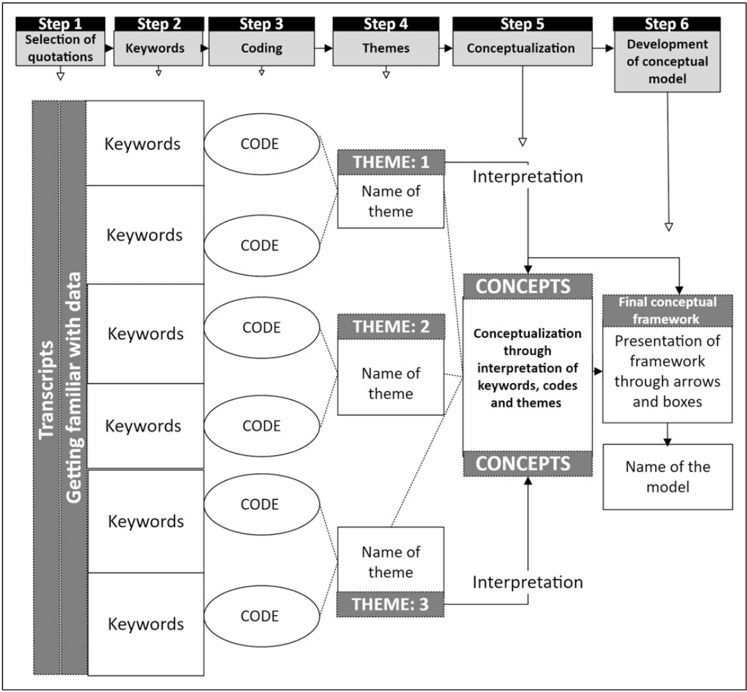
- The paper proposes six steps: transcription/familiarization and quotation selection; keyword selection; coding; theme development; conceptualization through interpretation of keywords, codes, and themes; and development of a conceptual model.
- It introduces 6Rs for keyword selection (realness, richness, repetition, rationale, repartee, regal), 6Rs for coding (robust, reflective, resplendent, relevant, radical, righteous), and 4Rs for theming (reciprocal, recognizable, responsive, resourceful).
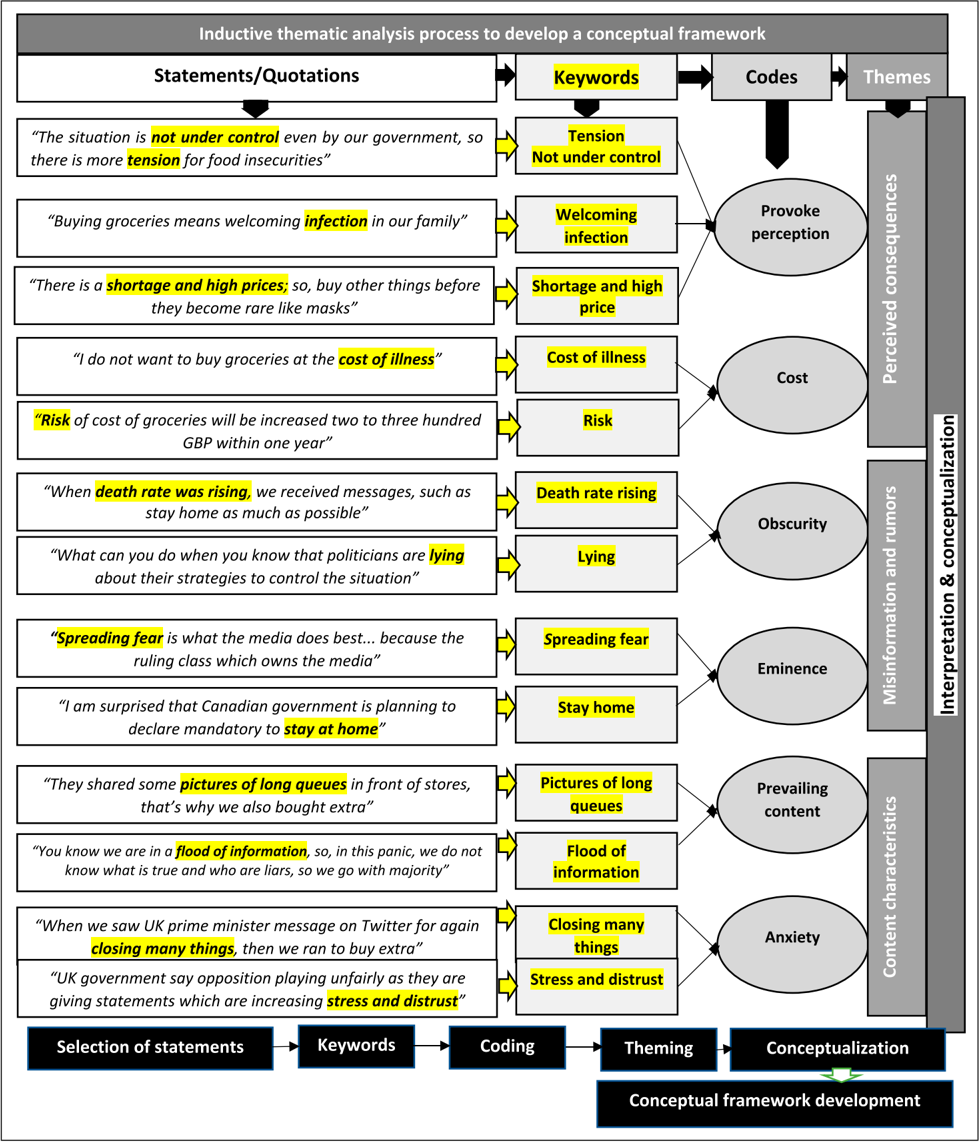
- In the exemplar study, three main themes emerged: “Perceived consequences” from codes “Provoke perception” and “Cost”; “Misinformation and rumors” from codes “Obscurity” and “Eminence”; and “Content Characteristics” from codes “Prevailing content” and “Anxiety.”
- The exemplar’s final model, “Panic buying as social practice,” was based on Protection Motivation Theory (PMT) and the Theory of Rumor Transmission (TORT).
Methods
- Design: a methodological/conceptual paper that presents a comprehensive systematic model for thematic analysis culminating in a conceptual model, using Naeem and Ozuem (2022a) as an exemplar.
- Exemplar data: qualitative data gathered from Twitter, YouTube, and interviews; the exemplar used a six-stage thematic analysis and a social constructionist perspective with PMT and TORT as theoretical foundations.
- Main analysis: the paper describes each of the six steps in detail, provides practical examples from the exemplar, and compares the proposed process with Braun and Clarke’s (2006) six steps of thematic analysis.
Limitations
- The paper states that the potential of the process to address other research contexts or quantitative methods may require further exploration, and that the efficiency of the method compared with other model-building approaches has not been empirically tested.
- Evident from the text: the proposed six-step process and the 6Rs/4Rs are illustrated through a single exemplar study and are not independently validated or empirically compared with alternative thematic analysis approaches.
Model-written summary. Check it against the paper before relying on it.
Integrity signals
Registry
Cites
Statistics
Figures

Verification
Claims the paper makes
0 Valid · 4 Not valid · 56 Not checked · 89 Own results and interpretations
The cited sources that could be checked couldn’t confirm or dispute this claim.
In the paper
“For narrative approaches, conceptual model development focuses on personal experiences, emotions, and life histories (Eldh et al., 2020).”
§ A Step-by-Step Process of Thematic Analysis to Develop a Conceptual Model in Qualitative Research > Step 6: Development of Conceptual Model.
What the sources say
- Could not verifycites Eldh et al., 2020 matched to “Quotations in Qualitative Studies: Reflections on Constituents, Custom, and Purpose” (2020) sourceExperimental — accuracy not yet measured
The Discussion and Conclusions (page numbers unavailable) address how quotations can illustrate qualitative analysis and findings. A search for narrative approaches, conceptual model development, emotions, and life histories found no passage addressing the attributed claim. (LLM, conf=0.72)
plainstates an association- Asserted: passes — The authors put it forward as true.
- Checkable: passes — It can be checked against evidence.
- Load-bearing: unclear — It is unclear whether the paper’s conclusions depend on it.
- Based: passes — The paper gives a reason why it holds.
- Could not verify
In the paper
“The analytical process balances between descriptive analysis, which outlines patterns or trends, and interpretive analysis, which offers subjective perspectives (Miles & Huberman, 1994, p. 56).”
§ A Step-by-Step Process of Thematic Analysis to Develop a Conceptual Model in Qualitative Research > Step 2: Selection of Keywords.
What the sources say
- Not matchedcites Miles & Huberman, 1994, p. 56
An author–year citation the paper’s reference list doesn’t settle. We don’t search these by name.
plain- Asserted: passes — The authors put it forward as true.
- Checkable: passes — It can be checked against evidence.
- Load-bearing: passes — The paper’s conclusions depend on it.
- Based: passes — The paper gives a reason why it holds.
- Not matched
In the paper
“However, the thematic analysis approach could also fit a post-positivist paradigm (Howell, 2012, p. 30).”
§ A Step-by-Step Process of Thematic Analysis to Develop a Conceptual Model in Qualitative Research > Step 2: Selection of Keywords.
What the sources say
- Not matchedcites Howell, 2012, p. 30
An author–year citation the paper’s reference list doesn’t settle. We don’t search these by name.
hedgedstates an association- Asserted: passes — The authors put it forward as true.
- Checkable: passes — It can be checked against evidence.
- Load-bearing: unclear — It is unclear whether the paper’s conclusions depend on it.
- Based: passes — The paper gives a reason why it holds.
- Not matched
In the paper
“Hence, quotation selection is not simply a mechanical task but is influenced by the researcher's philosophical and theoretical approach (Jackson & Mazzei, 2012).”
§ A Step-by-Step Process of Thematic Analysis to Develop a Conceptual Model in Qualitative Research > Step 1: Transcription, Familiarization With the Data, and Selection of Quotations.
What the sources say
- Not matchedcites Jackson & Mazzei, 2012
An author–year citation the paper’s reference list doesn’t settle. We don’t search these by name.
plainstates a cause- Asserted: passes — The authors put it forward as true.
- Checkable: passes — It can be checked against evidence.
- Load-bearing: passes — The paper’s conclusions depend on it.
- Based: passes — The paper gives a reason why it holds.
- Not matched
A conclusion the paper draws from its own results — it cites no other source for it, so there is none to check. The quote shows it is in the paper.
In the paper
“Thus, keywords serve as a critical bridge between data and themes in different methodologies.”
§ A Step-by-Step Process of Thematic Analysis to Develop a Conceptual Model in Qualitative Research > Step 4: Theme Development.
boostedstates an association- Asserted: passes — The authors put it forward as true.
- Checkable: passes — It can be checked against evidence.
- Load-bearing: unclear — It is unclear whether the paper’s conclusions depend on it.
- Based: passes — The paper gives a reason why it holds.
10 more claims
Create a free account to see all 149 claims and every source verdict.
- It may state two separate claims as one. 54
- Probably not a substantial claim. 128
Claims other papers make about this one
Each is checked against this paper’s own text: does it say what the citing paper says it does?
The source backs part of the claim, not all of it — or backs it for a different population, condition or comparison.
In the citing paper
“With the identified keywords, initial coding was further informed by and cross-referenced to the literature on AI ethics and governance, particularly addressing public concerns in government AI, alongside the author team's collective expertise in AI-driven digital transformation in public administration.”
From Accountability in Government Use of AI : Citizen Concerns and Preferences (2025) · cites this paper as Naeem et al. 2023
Experimental — accuracy not yet measuredThe source backs part of the claim, not all of it — or backs it for a different population, condition or comparison.
In the citing paper
“Thematic analysis is a highly popular technique among qualitative researchers for analyzing qualitative data, which usually comprises thick descriptive data (Naeem et al., 2023).”
From The Psycho-Emotive Effects of AI-Generated Fake News on Social Media Users (2026) · cites this paper as Naeem et al., 2023
Experimental — accuracy not yet measuredThe cited source says what the claim attributes to it.
In the citing paper
“The selection of keywords was guided by the 6Rs framework-Realness, Richness, Repetition, Rationale, Repartee, and Regal-to ensure they accurately represented the essence of the data (Naeem et al. 2023).”
From Accountability in Government Use of AI : Citizen Concerns and Preferences (2025) · cites this paper as Naeem et al. 2023
The cited source says what the claim attributes to it.
In the citing paper
“The data were analyzed through Naeem et al.'s (2023) six-step thematic analysis process to develop a conceptual framework (Naeem & Ozuem, 2022).”
From “It’s Not Just About Competition – It’s Ceremony”: Introducing the Embedded Indigeneity Framework for Understanding Identity, Mission, and Practice in TCU and NASNTI Athletics (2026) · cites this paper as Naeem et al. (2023)
The cited source says what the claim attributes to it.
In the citing paper
“The selected methodology was implemented due to the end results that 1) presented a novel conceptual framework and 2) serves as a contextually specific extension of existing theory/theories (Naeem et al., 2023).”
From “It’s Not Just About Competition – It’s Ceremony”: Introducing the Embedded Indigeneity Framework for Understanding Identity, Mission, and Practice in TCU and NASNTI Athletics (2026) · cites this paper as Naeem et al., 2023
Self-check
Percentages, sums and reported differences re-computed from the paper’s own numbers.
Each contradiction between two passages listed here was confirmed by an independent check.
Rated minor: it would not touch a result — a value no result rests on, a p-value that stays on the same side of the significance level, or a conflict that is clerical, resolved elsewhere in the paper, or outside its own findings.
In the paper
§ A Step-by-Step Process of Thematic Analysis to Develop a Conceptual Model in Qualitative Research > Step 6: Development of Conceptual Model.
“Positivism, which favours inductive methods, builds its model on top of previously established theories and conducts its experiments in an unbiased manner.”
§ A Step-by-Step Process of Thematic Analysis to Develop a Conceptual Model in Qualitative Research > Step 6: Development of Conceptual Model.
“An inductive approach is primarily data-driven, whereby themes are derived from the data itself without the influence of pre-existing theories (Braun & Clarke, 2006).”
Citations
Cites
Using thematic analysis in psychology
Braun, V., & Clarke, V. (2006) · Qualitative Research in Psychology · doi:10.1191/1478088706qp063oa · Cited by 194,414
Qualitative Data Analysis: An Expanded Sourcebook
(1994) · Journal of Environmental Psychology · doi:10.1016/s0272-4944(05)80231-2 · Cited by 48,420 · cited 2×
“In the coding process, consideration of keywords helps in multiple ways: The analytical process balances between descriptive analysis, which outlines patterns or trends, and interpretive analysis, which offers subjective perspectives (Miles & Huberman, 1994, p. 56).”
Lincoln, Y. S., Guba, E. G., & Pilotta, J. J. (1985) · International Journal of Intercultural Relations · doi:10.1016/0147-1767(85)90062-8 · Cited by 45,787 · cited 1×
“…degrees of subjectivity and objectivity has underscored the fl exibility intrinsic to research methodologies and highlighted that these tools of analysis are intimately intertwined with, and, indeed, emerge from the distinctive nature of speci fi c disciplines and perspectives (Lincoln & Guba, 1985).”
BackgroundThe Discovery of Grounded Theory: Strategies for Qualitative Research
Glaser, B. G., & Strauss, A. L. (2017) · Aldine (Routledge reprint) · doi:10.4324/9780203793206 · Cited by 25,789
The qualitative content analysis process
Elo, S., & Kyngäs, H. (2008) · Journal of Advanced Nursing · doi:10.1111/j.1365-2648.2007.04569.x · Cited by 22,617 · cited 1×
“Deductive coding, linked with descriptive analysis, is a top-down approach where pre-existing theories, models, or codes guide the data analysis (Elo & Kyng¨as, 2008).”
Method(2009) · Cited by 21,330
Reflecting on reflexive thematic analysis
Braun, V., & Clarke, V. (2019) · Qualitative Research in Sport, Exercise and Health · doi:10.1080/2159676x.2019.1628806 · Cited by 19,677
(1998) · Medical Entomology and Zoology · Cited by 18,397
(2014) · Cited by 15,747
S., N. L. (2017) · doi:10.1177/1609406917733847 · Cited by 14,051 · cited 3×
“· Robust: Coding should convey the true essence of data in a theoretical manner (Nowell et al., 2017).”
Background
Research works printed but not linked: 9
- 1. Arar, K. (2017). The what's and why's of the how to of qualitative research. Qualitative Report, 22(11), 2956-2958.
- 16. Creswell, J. W. (2012). Educational research. Pearson.
- 19. Denzin, N. K., & Salvo, J. (2020). New directions in theorizing qualitative research: Theory as resistance. Myers Education Press.
- 62. Oliver, P. (2021). Using qualitative methods to answer your research question (First). Open University Press.
- 63. Patton, M. Q. (2015). Qualitative research & evaluation methods: Integrating theory and practice (fourth). Sage Publications, Inc. Qualitative research (pp. 273-290). Sage.
- 67. Saldana, J. (2021). The coding manual for qualitative researchers (Fourth). Sage.
- 68. Saldana, J. M. (2016). The coding manual for qualitative researchers (4rd ed.). Sage Publications.
- 74. Seale, C. (2013). Qualitative research practice. In C. Seale, G. Gobo, J. Gubrium, & D. Silverman (Eds.), Concise paperback. Sage.
- 80. Tracy, S. J. (2019). Qualitative research methods: Collecting evi- dence, crafting analysis, communicating impact (2nd ed.). Wiley Blackwell.
Cited by
Items 1,201–1,300 of 2,204
Wakgari, N., Watson, S., Tessema, G. A., Bekele, D., & Bradfield, Z. (2026) · Reproductive Health · doi:10.1186/s12978-026-02393-y
“The qualitative data were analysed using inductive thematic analysis [90].”
Amir, A., Oralbayeva, N., Tungatarova, A., et al. (2025) · IEEE International Conference on Robot and Human Interactive Communication (RO-MAN) · doi:10.1109/ro-man63969.2025.11217875
“Thematic analysis is a method for analyzing qualitative data [25], which encompasses six steps from creating and familiarizing with transcripts, identifying keywords, selecting codes, developing themes, interpreting keywords, codes, and to developing a conceptual model.”
Rees, J., Yan, R., Clark, M., Jolly, M., Fisher, A., Devine, A., Laws, S. M., Moes, K., & Cruickshank, T. M. (2026) · Disability and Rehabilitation · doi:10.1080/09638288.2026.2735448
Feminism Among Muslimah Students: A Gender Perspective Study Through Islamic Values
Amira, F. F., & Abdillah, H. T. (2025) · Jurnal Pendidikan Agama Islam Indonesia (JPAII) · doi:10.37251/jpaii.v6i2.1801
Davies, J., Broad, R., Diviák, T., Giese, C., Gadd, D., & Payne, S. (2026) · Probation Journal · doi:10.1177/02645505261453306
“Interview data were thematically analysed, which is widely used in qualitative research to understand and organise recurring and/or important areas of interest (Naeem et al., 2023).”
Lotan, M., David, N. B., & Bibas, M. (2026) · Children · doi:10.3390/children13010079
“During the meetings, an open discussion was conducted for data collection [41].”
Sociocultural Considerations in Heart Failure Self-Care Readiness: A Thematic Analysis
Lewis, N. D., Turrise, S. L., Kleman, C., Jenkins, C. A., Meyer, K., Winslow, H., Williams, B., & Lutz, B. J. (2026) · SAGE Open Nursing · doi:10.1177/23779608251412529
“Consistent coding by the research team and theme validation by a subset of participants and experts strengthened the rigor of this study (Naeem et al., 2023).”
Mohammad, Z., & Zhang, W. Z. (2026) · SSRN Electronic Journal · doi:10.2139/ssrn.6985151
Adisa, I. O., Bailey, C. S., & Irgens, G. A. (2026) · Journal of the Learning Sciences · doi:10.1080/10508406.2026.2676870
Machela, T. (2025) · The Southern African Journal of Entrepreneurship and Small Business Management · doi:10.4102/sajesbm.v17i1.1123
How Teachers Learn Racial Competency: The Role of Peers and Contexts
Lindsay, C. A., Wilson, S., Kumar, J., Byers, T., & Gershenson, S. (2025) · The Urban Review · doi:10.1007/s11256-025-00796-y
“The team utilized a multi-phased analytic approach to conduct a thematic analysis to describe the data (Naeem et al., 2023 ).”
Ber, I., Na’amnih, W., Perlman, S., Kasstan, B., Lerman, Y., & Muhsen, K. (2024) · Human Vaccines & Immunotherapeutics · doi:10.1080/21645515.2024.2429233 · Cited by 2
DeBord, J. (2026) · doi:10.46409/sr.pcuc7001 · Cited by 1
Baena, A. S., & Sari, W. W. (2025) · Acta Biochimica Indonesiana · doi:10.32889/actabioina.189
Reimagining Play: Build a TechToy with Me - Partnering with Parents for Children with Cerebral Palsy
Schaly, S., Zhang, W., Conroy, M., McEwan, A. L., Randhawa, K., Withana, A. I., & Karlsson, P. (2026) · International Journal of Disability Development and Education · doi:10.1080/1034912x.2026.2636739
Post-Exchange Growth of ASEAN Educators: A Case at Saint Louis University
Busbus, S. O., Dayami, K. Z. V., Domansi, C. S. M., et al. (2026) · ETDC Indonesian Journal of Research and Educational Review · doi:10.51574/ijrer.v6i1.5189
Castaldo, S., Ciacci, A., Penco, L., & Testa, G. (2026) · Management Decision · doi:10.1108/md-10-2025-3320 · Cited by 2
Pettersson, A. J., Ramhult, A., Larsson, O., & Bokrantz, J. (2026) · Production & Manufacturing Research · doi:10.1080/21693277.2026.2652731 · Cited by 1
Immersion Programs: Beyond Language Learning
Tamayo, I. Y. R., Rodriguez, J., & Rodríguez, A. S. M. (2024) · Enletawa Journal · doi:10.19053/uptc.2011835x.17941
Working abroad: Stressors and coping strategies of low-skilled migrant workers
Atay, E., Terpstra-Tong, J. L. Y., Hta, M. K. Z., Danışman, S. A., & Rahman, A. (2025) · German Journal of Human Resource Management Zeitschrift für Personalforschung · doi:10.1177/23970022251394627
Khan, S. A., Khan, M. A., Lynch, I., Khan, N., Khan, S. E., Zafar, F., Ventura-Gabarró, C., Westwood, E., Kalbarczyk, A., Morgan, R., et al. (2026) · Health Policy and Planning · doi:10.1093/heapol/czag029
“…from thematic synthesis principles described by Thomas and Harden (2008), enabled us to move beyond descriptive categorization to make visible the mechanisms — often implicit in the literature and field insights (Naeem et al. 2023) — through which inequities shape antimicrobial resistance risks.”
Literary Places Between Fiction and Reality: Perceived Authenticity at the Museum of Innocence
Yıldırım, G. S., Adak, Ş., Özgül, K., Yılmaz, S., Yaman, A. H., & Doğan, E. (2026) · Advances in Hospitality and Tourism Research (AHTR) · doi:10.30519/ahtr.1900612
McKeegan, G. F. (2026) · Evidence-based practices in behavioral health · doi:10.1007/978-3-032-18372-9_9
Asserting Recognition: Nomadic Women’s Experiences of Socio-Cultural Exclusion
Nisar, M. (2026) · Springer eBooks · doi:10.1007/978-3-032-24712-4_5
Surviving digital disruption: Ghanaian newspapers’ response to digitalisation
Tindi, S., & Kwode, P. A. K. (2025) · Journalism · doi:10.1177/14648849251355814
Uzorka, A., & Odebiyi, O. A. (2026) · International Journal of Educational Research Open · doi:10.1016/j.ijedro.2026.100598
Hammock, K. L. (2024) · MOspace Institutional Repository (University of Missouri) · doi:10.32469/10355/105894
Carchi-Naula, W. B., Huanca-Ordóñez, M. M., Carchi-Huanca, A. E., Aguirre-Pesantes, A. V., & Román-Román, A. P. (2026) · Revista Científica Ciencia y Método · doi:10.55813/gaea/rcym/v4/n3/255
“Este procedimiento siguió principios contemporáneos de codificación y tematización cualitativa, en los cuales las categorías organizaron la evidencia sin sustituir la interpretación reflexiva del investigador (Saldaña, 2025; Naeem et al., 2023).”
Ma, J. K.-Y., Viviers, M., & Edwards, L. (2026) · Frontiers in Neurology · doi:10.3389/fneur.2026.1719167
Deniable Encrypted Messaging: User Understanding after Hands-on Social Experience
Rajendran, A., Yadav, T., Al-Jbour, M., et al. (2024) · European Symposium on Usable Security (EuroUSEC) · doi:10.1145/3688459.3688479
“Thiscodingprocesswasfollowedbythematicanalysis [23],whichhelpedinidentifyingthemeswithintheresponses.”
Beyond Service: Appalachian Immersion and Socially Responsive APRN Formation
Wilkinson, M. R., Ogg-Gress, J., Haras, M. S., et al. (2026) · The Journal for Nurse Practitioners · doi:10.1016/j.nurpra.2026.106014
Fármacos en el ambiente: aproximaciones para su estudio a través de una revisión de alcance
Prieto, D. M. Q., Orozco-Díaz, J. G., Toro, J., & Ballesteros-Cabrera, M. D. P. (2025) · Gestión y Ambiente · doi:10.15446/ga.v28n1.120427 · Cited by 1
Peeters, M., Strain, K., Doucet, S. A., Gulliver, A., Samson, A., Bridges, S., Ma, A., Fowler, S. A., Richards, D. P., Somal, R., et al. (2026) · Research Involvement and Engagement · doi:10.1186/s40900-026-00961-x
“In keeping with this tendency, we chose inductive thematic analysis as our analytic method, with Braun and Clarke’s six step process serving as a framework for generating codes and themes derived from our reading of the experiences and perspectives related by our participants [39–41].”
Communicating Contested Science in a Polarized World: Scientists’ Views on Science Communication
Donois, K., Goodings, L., & Carey, E. W. (2026) · SAGE Open · doi:10.1177/21582440261417757
“Consequently, this is a bottom-up, exploratory, and data-driven approach where keywords and codes are generated from the data, which in turn allow for patterns and themes to be identified (Naeem et al., 2023).”
InfluentialSalinas, S. C., Herrera-Seda, C., Quezada, N. F., Vidal, C. R., & Espinoza, J. (2025) · International Journal of Qualitative Studies in Education · doi:10.1080/09518398.2025.2454293
“In the second stage, when work with the educational programmes was completed, the university team partly used a thematic analysis approach to understand the multiple perspectives teachers raised in the sessions and systematisation meetings (Naeem et al., 2023).”
Maluka, M. D., & Mulaudzi, M. C. (2026) · International Journal of Research in Business and Social Science (2147-4478) · doi:10.20525/ijrbs.v15i1.4605
“Thematic analysis is flexible and allows researchers to comprehend and analyse large amounts of data in a systematic manner (Naeem et al., 2023).”
School-based professionals’ experiences in supporting autistic learners in feminised settings
Ndou-Chikwena, N. N., & Sefotho, M. M. (2025) · South African Journal of Childhood Education · doi:10.4102/sajce.v15i1.1617
A Multiperspective Exploration of Decision Making in Family Business Context
Kozlova, V. (2026) · Lecture notes in networks and systems · doi:10.1007/978-3-032-19245-5_68
Navigating Pediatric Organ Transplant: Nurses' Perspectives on Challenges and Coping.
Taşdemir, H. İ., & Taşdemir, D. (2026) · Experimental and Clinical Transplantation · doi:10.6002/ect.mesot2025.p186
Exploring public acceptance of low impact development within the City of Hamilton, Ontario, Canada
Bronsema, E., Abdelaal, A., & Hassini, S. (2026) · Urban Water Journal · doi:10.1080/1573062x.2026.2683582
Subjetividad política en docentes de derechos humanos
Fonseca, E. F., & González-Reyes, R. A. (2025) · Ciencias Sociales y Educación · doi:10.22395/csye.4957
“…se realizó a partir del paradigma interpretativo y se orientó a favorecer la teorización interdisciplinar del objeto de estudio (Charry Joya, 2017; Naeem et al. , 2023) mediante una aproximación comparativa a las actitudes políticas y conductas de participación (Holzner et al. , 2015) que…”
Niland, H., Hamrick, J., Ahmed, A., & Banda, D. R. (2026) · Behavior Analysis in Practice · doi:10.1007/s40617-026-01206-9
Swanepoel, R. B. (2026) · Impact Assessment and Project Appraisal · doi:10.1080/14615517.2026.2720826
Khaile, T. (2026) · Journal of Law Society and Development · doi:10.25159/2520-9515/21412
Rethinking Tourism Crowding: Social Media Insights for Urban Planning and ManagementPreprint
Buzova, D., Álvarez, M. D., & Blas, S. S. (2026) · SSRN Electronic Journal · doi:10.2139/ssrn.6960034
Bilateral Versus Unilateral Hearing Aid Fitting for Individuals with Bilateral Hearing LossPreprint
Mobaireek, W. (2024) · doi:10.14293/pr2199.001223.v1
Davis, M. E., Sharma, M., Ancker, J. S., Pathak, J., & Sharko, M. (2026) · Journal of the American Medical Informatics Association · doi:10.1093/jamia/ocag096
The Lived Experiences of Previously Incarcerated Mothers in Fulfilling Their Maternal Roles
Aprecio, A. K., Caballes, M. V., Ramos, M. K. L., et al. (2026) · Raniag International Journal of Education Management and Social Action · doi:10.66332/sa.qhlp3968
A Qualitative Study on the Sexual Needs of People in Evacuation Centers After Disasters
Ramdani, W. F., Wulandari, E. T., & Fajarputranto, A. (2025) · Health in Emergencies & Disasters Quarterly · doi:10.32598/hdq.10.2.554.1
Development of an effective TVET robotics trainer: Insights from a comprehensive need analysis
Idris, M. R., Thangarajoo, R. A. L. G., & Jaffar, A. B. (2025) · AIP conference proceedings · doi:10.1063/5.0298921
Saïsset, L., Stéphane, A., & Moccia, O. (2025) · Elsevier eBooks · doi:10.1016/b978-0-443-15976-3.00142-2
Huang, X. (2026) · SSRN Electronic Journal · doi:10.2139/ssrn.6468709
Tibane, C. C., & Mafa-Theledi, O. N. (2025) · Education and human development · doi:10.5772/intechopen.1014068
Hikuwai, M. V., Patorniti, N. P., & Stewart, R. A. (2025) · Journal of Safety Science and Resilience · doi:10.1016/j.jnlssr.2025.03.002
Horgan, L., Ruvolo, P., Lynch, C., et al. (2026) · ASEE Annual Conference & Exposition · doi:10.18260/1-2--59034
Depleted and disposable? Burnout among migrant hotel workers
Choi, K., Fang, M., & Coffey, D. (2026) · Tourism and Hospitality Research · doi:10.1177/14673584261465844
Komodromos, M. (2026) · Advances in computational intelligence and robotics book series · doi:10.4018/979-8-3373-7021-7.ch006
Cuyan, R. S. A. S. (2025) · International Journal of Environmental Sciences · doi:10.64252/shbfpg20
Hanafiah, M. M., Mohammad, M. Z., Samsudin, N. S., et al. (2026) · PLANNING MALAYSIA · doi:10.21837/pm.v24i41.2007
Attawet, J., Ng, L., Qiu, Y., Kendal, E. S., Ojabo, M., Jefford, S., & Peters, M. D. J. (2026) · Women and Birth · doi:10.1016/j.wombi.2026.102168 · Cited by 1
Wang, F., & Yue, Z.-N. (2026) · Journal of Documentation · doi:10.1108/jd-10-2025-0298
Mutsamwira, S. (2026) · SSRN Electronic Journal · doi:10.2139/ssrn.6170787 · Cited by 1
Design, Reflect, Create: Game Poem Practices with Generative AI Tools
Wang, Z., Ma, L., Lc, R., & Holopainen, J. P. (2025) · Lecture notes in computer science · doi:10.1007/978-3-032-12405-0_7
Sonthako, T., Chaisu, K., & Phongthiya, T. (2026) · Asian Journal of Technology Innovation · doi:10.1080/19761597.2026.2687883
Sekyi, J. R., Setlalentoa, W. N., & Alexander, G. (2026) · E-Journal of Humanities Arts and Social Sciences · doi:10.38159/ehass.20267315
A Co-Created Framework to Define Digital Twinning Use Cases for Urban Transport Decarbonisation
Steele, H., Duvnjak, J., Byron, P., Matyas, M., Easton, J. M., Roberts, C., Flynn, D., & Greening, P. (2026) · Urban Science · doi:10.3390/urbansci10030140
“Rigour was ensured by following Naeem et al.’s systematic approach [26] with transparent reporting.”
Living with contamination: Place-based wellbeing in the long aftermath of the Sidoarjo mudflow
Baskhoro, A. E. (2026) · Wellbeing Space and Society · doi:10.1016/j.wss.2026.100467
Jarvis, L. (2026) · VOLUNTAS International Journal of Voluntary and Nonprofit Organizations · doi:10.1017/s0957876526000550 · Cited by 1
The political economy of green industrial policy in liberal statesPreprint
Arcand, B. (2025) · SSRN Electronic Journal · doi:10.2139/ssrn.5429318
Dodd, L., Meyer, R. W., & Marino, L. V. (2026) · BMC Public Health · doi:10.1186/s12889-026-27155-0
“Following analysis of basic study information, data synthesis was completed and an established approach to content analysis was utilised to identify descriptive features regarding the data fields [43].”
Coenen, E., Almeida, D., Sepodes, B. M. N., & Torre, C. (2026) · Therapeutic Innovation & Regulatory Science · doi:10.1007/s43441-026-01034-7
Beyond Burnout: Decoding School Counselors’ Departure From the Profession
Turner, S. M., Gossett, R., & Fay, C. M. (2025) · Professional School Counseling · doi:10.1177/2156759x251403475
“This thematic approach enabled us to identify and articulate fi ndings, corroborating the quantitative results and uncovering additional themes, such as advocacy burnout and loss of hope (Naeem et al., 2023).”
Teachers’ practices on teaching intercultural competence in higher education ELT classrooms
Suharni, S., Saidi, S. B., & Hussein, N. H. (2025) · Muallim Journal of Social Science and Humanities · doi:10.33306/mjssh/355 · Cited by 2
Bullying Faced by Muslim Students in Public Schools
Khaja, K., & Alhajri, W. (2026) · Children & Schools · doi:10.1093/cs/cdag002 · Cited by 1
Prince, H., Garrett, B., & Ager, J. (2026) · Journal of Adventure Education & Outdoor Learning · doi:10.1080/14729679.2026.2618234 · Cited by 2
Edwards, A. R. ‐., Greffin, K., Masser, B., et al. (2026) · Vox Sanguinis · doi:10.1111/vox.70354
Can natural capital accounting bring accountability for nature?
Hull, R. A., Fudge, M., Horner, C. A., Barmuta, L. A., Jones, M. E., Pinkard, E. A., Lee, E. T. C. A., & Leith, P. (2026) · Ecological Economics · doi:10.1016/j.ecolecon.2026.109258
Alajoki, R., Kiel, K., Bender, H., Duong, K., Taneja, P., Dreyer, E., Eco, S., Laoprasert, M., Saroyan, A., Wolff, L., et al. (2026) · Frontiers in Education · doi:10.3389/feduc.2025.1648972 · Cited by 1
Digital Metacognitive Scaffolding in the Context of Academic Writing in Higher Education
Markel, J., & Umutlu, D. (2026) · TechTrends · doi:10.1007/s11528-026-01225-x
“4, were synthesized to develop a comprehensive conceptual model detailing how novice writers negotiate metacognitive supports throughout the academic writing process (Lindgren et al., 2020; Naeem et al., 2023).”
Indian adolescents’ customer relationship with food brands: exploring the role of brand love
Mandal, M., & Dash, S. (2025) · South Asian Journal of Business Studies · doi:10.1108/sajbs-05-2024-0174 · Cited by 1
Wahab, N. A., Hashim, S., & Rais, K. M. (2026) · International Journal of Islamic Finance and Sustainable Development · doi:10.55188/ijifsd.v18i3.1155
“Initial codes were generated to mark meaningful parts of the data by assigning codes that reflected their content (Naeem et al. , 2023).”
Kumar, D., Hauter, I., Canlas, F. C., Sunaryoko, F. Y., Maharjan, G. R., Anowar, M. M., Khosa, H., Tan, Y.-R., & Yap, P. (2025) · PLOS Global Public Health · doi:10.1371/journal.pgph.0003696 · Cited by 1
“This adds value to the current literature which mainly focus on participants who have the capacity and accessibility to participate in such studies, thus leaving out hard-to-reach populations [19].”
Developing Competences for Democratic Culture for Young Learners Through Language Education
Kramar, M., Svoboda, M., & Jelešković, E. (2025) · IGI Global eBooks · doi:10.4018/979-8-3373-2670-2.ch002
Jackson, G., & Sakshi (2026) · Geoforum · doi:10.1016/j.geoforum.2026.104770
Ali, A. A. S. H., SYAHIDIN, S., & Hermawan, W. (2024) · Lentera Pendidikan Jurnal Ilmu Tarbiyah dan Keguruan · doi:10.24252/lp.2024v27n2i8
Rega, A. P., & Gimbut, M. (2025) · The Journal of Arts Management Law and Society · doi:10.1080/10632921.2025.2599952 · Cited by 1
Enabling Innovation Capability Through Collaborative Digital Innovation in the Public Sector
Jonsson, K., Westergren, U. H., & Brauns, A. G. (2026) · Lecture notes in computer science · doi:10.1007/978-3-032-35747-2_25
Hungry for equity in the Green Mountain State: food insecurity among college students in Vermont
Bhurosy, T., Danzy, J., Scott, L., et al. (2026) · BMC Public Health · doi:10.1186/s12889-026-28092-8
“1) [38].”
Mohlaloka, S. M. B., & Ntlhare, L. A. (2026) · Journal of Education and Learning Technology · doi:10.38159/jelt.2026729
Mahfud, T., Winnarko, H., Kusuma, B. J., Irawan, C., Novri, F., & Masek, A. (2026) · African Journal of Hospitality Tourism and Leisure · doi:10.46222/ajhtl.19770720.769
Sun, J., Dong, Y., Boliboun, J., Koo, K., Cui, M. X., Rizzo, V. M., & Rowe, J. M. (2026) · Innovation in Aging · doi:10.1093/geroni/igag083
“Transcripts were imported into ATLAS.ti, version 24.1.1 for analysis using thematic analysis (Naeem et al., 2023).”
InfluentialEffective Implementation of XAI in Healthcare: Results from a Survey with Non-Technical Users
Inayat, Z., Açıl, O., Daneva, M., Sinderen, M. J. V., Guizzardi, G., & Santos, L. B. D. S. (2026) · IEEE International Requirements Engineering Conference Workshops (REW) · doi:10.1109/rew72749.2026.00086
“In parallel, the systematic six-step inductive thematic analysis process of Neem et al. [31] was used for the open-ended questions to identify perspectives which were not covered in our closed-ended questions.”
A Brief but Spectacular Take: Reflecting on Professionalism by Student Physical Therapists
Stickley, L. A. (2024) · Journal of Physical Therapy Education · doi:10.1097/jte.0000000000000363 · Cited by 1
A Conceptual Framework for Cybersecurity Awareness
Komane, K., Khoza, L. T., & Radebe, F. M. (2025) · Journal of Cyber Security · doi:10.32604/jcs.2025.059712 · Cited by 3
“To find themes, researchers sort through the data set in search of patterns and significance, as employed in the thematic data analysis approach [74].”
Effects of Synchronous Movement on Human Trust in Robots *
Marji, M., Doshi, M. V., Suresh, S., Zinn, M., Mutlu, B., & Niedenthal, P. M. (2025) · IEEE RO-MAN · doi:10.1109/ro-man63969.2025.11217881
“2) Qualitative: Interview and free-response survey data were used to conduct a thematic analysis using the standard six-step approach and applying inductive coding [26], [27].”
Rees, J., Moes, K., Devine, A., Clark, M., Sambell, R., Laws, S. M., & Cruickshank, T. M. (2025) · Health Expectations · doi:10.1111/hex.70412
“Codes were reviewed to ensure the themes adequately captured the data and refined into categories to clarify what each group represented [29].”
Sturm, A., Burillo-Lafuente, M., Guerrero, A. V. S., & Roth, R. (2025) · Physiotherapy Theory and Practice · doi:10.1080/09593985.2025.2601188 · Cited by 1
“To enhance rigor we employed systematic procedures, combining theory-driven (deductive) and data-driven (inductive) approaches to gain insights into complex ethical phenomena (Naeem, Ozuem, Howell, and Ranfagni, 2023; Proudfoot, 2023).”
Metadata
- Authors
- Naeem, M., Ozuem, W., Howell, K., & Ranfagni, S.
- Affiliations
- University of Gloucestershire (GB)
- University of Cumbria (GB)
- Northumbria University (GB)
- University of Florence (IT)
- Corresponding author
- Naeem, Muhammad
- Venue
- International Journal of Qualitative Methods
- Publisher
- SAGE Publications
- Published
- 2023-10
- Volume
- 22
- ISSN
- 1609-4069 (ISSN-L)
- OpenAlex
- W4388503650
- Cited by
- 2,243
- References
- 71
- Citations by year
- 2026: 1000 · 2025: 981 · 2024: 258 · 2023: 4
- FWCI
- 1654.78
- Type
- journal article
- Language
- en
- Open access
- gold
- doi.org
- Licence
- Locations
- International Journal of Qualitative Methods (publishedVersion, cc-by-nc)
- Insight (University of Cumbria) (acceptedVersion)
- DOAJ (DOAJ: Directory of Open Access Journals) (submittedVersion, cc-by-sa)
- Florence Research (University of Florence) (submittedVersion)
- Topics
- Social Sciences › Education › Qualitative Research Methods and Applications
- Social Sciences › Sociology and Political Science › Qualitative Research Methods and Ethics
- Social Sciences › General Social Sciences › Computational and Text Analysis Methods
- Keywords
- thematic analysis, conceptual modeling, qualitative data analysis, inductive coding, deductive coding, grounded theory, interpretive phenomenology, constructivist research, positivist research, theoretical conceptualization, replicability
About these checks
Registry, retraction, Cites and statistics results are computed, not judged, with one exception: a printed reference that no index lists is read once by a model before it counts as a citation error. Claims are extracted by a model and kept only when their quote appears verbatim in the text; each cited source is then checked, with a model’s help, for whether it says what the claim relies on. Those verdicts can be wrong — read the claim’s quote and the cited source before relying on one.
The claim verdicts this report counts are experimental: their accuracy is not yet measured.
A language model drew the claims from the paper on 2026-10-10, under version 3 of the claim definition (model deepseek-v4.1-flash, prompt extract-v3).
A second model labelled each claim on 2026-10-10 (model jev-1.13-20260917, definition revision gold-guideline-v0.2).
Cited sources are checked with a language model’s help (gpt-6-sol).
Statistics and arithmetic are recomputed, not judged.
Confidence bands are shown only for fields calibrated on our annotated test set. None is calibrated yet, so no band is shown.
What counts as a claim ›How we measure confidence ›How we check this ›
Are you an author, or do you see a problem with this page? Request a review
Data sources
Bibliographic data: Semantic Scholar, OpenAlex, Crossref.
Contains information from the Semantic Scholar Academic Graph Datasets, made available under the ODC Attribution License (ODC-BY 1.0).
Semantic Scholar’s data is described in: Kinney, R., et al. (2023). The Semantic Scholar Open Data Platform. arXiv:2301.10140.
