

Grounded theory research: A design framework for novice researchers
Open accessThe DOI matches its Crossref record; 30 of the 33 references it cites were found in a registry or an index; 2 of the 69 sources its claims cite were checked for support.
Abstract
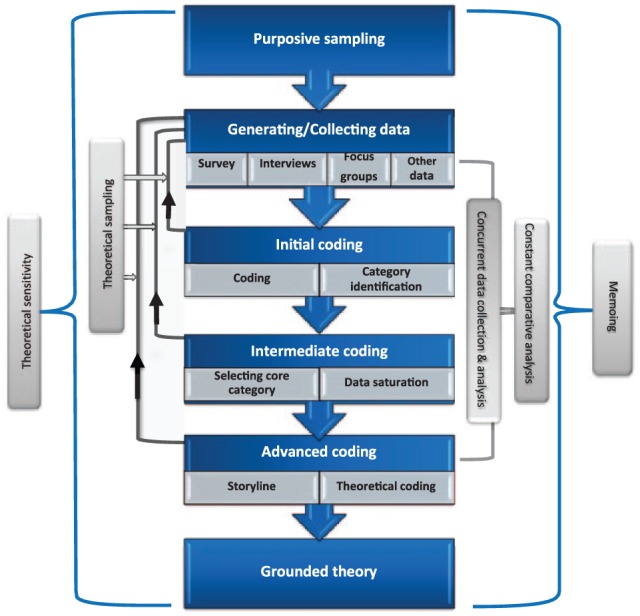
Background: Grounded theory is a well-known methodology employed in many research studies. Qualitative and quantitative data generation techniques can be used in a grounded theory study. Grounded theory sets out to discover or construct theory from data, systematically obtained and analysed using comparative analysis. While grounded theory is inherently flexible, it is a complex methodology. Thus, novice researchers strive to understand the discourse and the practical application of grounded theory concepts and processes. Objective: The aim of this article is to provide a contemporary research framework suitable to inform a grounded theory study. Result: This article provides an overview of grounded theory illustrated through a graphic representation of the processes and methods employed in conducting research using this methodology. The framework is presented as a diagrammatic representation of a research design and acts as a visual guide for the novice grounded theory researcher. Discussion: As grounded theory is not a linear process, the framework illustrates the interplay between the essential grounded theory methods and iterative and comparative actions involved. Each of the essential methods and processes that underpin grounded theory are defined in this article. Conclusion: Rather than an engagement in philosophical discussion or a debate of the different genres that can be used in grounded theory, this article illustrates how a framework for a research study design can be used to guide and inform the novice nurse researcher undertaking a study using grounded theory. Research findings and recommendations can contribute to policy or knowledge development, service provision and can reform thinking to initiate change in the substantive area of inquiry.
Overview
CoChat Summary
TL;DR
This article presents a contemporary, diagrammatic research design framework to help novice researchers visualise and apply the iterative methods and processes of grounded theory (GT). It defines the essential GT methods and processes and situates them within a non-linear, recursive design rather than debating philosophical genres.
Key findings
- GT is described as a structured yet flexible methodology appropriate when little is known about a phenomenon, aiming to produce or construct an explanatory theory grounded in data.
- Three distinct GT genres are identified: traditional/classic GT (Glaser), evolved GT (Strauss, Corbin and Clarke), and constructivist GT (Charmaz), distinguished by the researcher's philosophical position, use of literature, and approach to coding, analysis and theory development.
- Coding terminology differs by genre: traditional uses open, selective and theoretical coding; evolved uses open, axial and selective coding; constructivist uses initial, focused and theoretical coding (Table 1, adapted from Birks and Mills).
- The framework (Figure 1) depicts the interplay of purposive sampling, concurrent data generation/collection and analysis, constant comparative analysis, memoing, coding (initial, intermediate, advanced), theoretical sampling, theoretical sensitivity, and theoretical saturation, all directed toward an integrated substantive theory.
- Quality and rigour are related to three areas: the researcher's expertise, knowledge and research skills; methodological congruence with the research question; and procedural precision in the use of methods.
Methods
This is a methodological/discussion article, not an empirical study; no sample or dataset is analysed. It synthesises GT literature and prior works (notably Birks and Mills) to construct a graphic research design framework (Figure 1) and to define each essential GT method and process. The framework is presented as a visual guide for novice grounded theory researchers, illustrated with exemplars from other GT studies (Boxes 1–3).
Limitations
The paper states no formal limitations. Evident from the text: it deliberately avoids engagement in philosophical discussion or debate of the different GT genres, so it does not adjudicate between them; the framework is offered as a visual guide rather than an empirically tested model; and it is oriented specifically toward the novice nurse researcher, which may limit transferability to other disciplines or experienced researchers.
Model-written summary. Check it against the paper before relying on it.
Integrity signals
Registry
Cites
Statistics
Figures
Verification
Claims the paper makes
1 Valid · 4 Not valid · 49 Not checked · 18 Own results and interpretations
A statement the paper makes itself — it cites no source for it, so there is none to check. The quote shows it is in the paper.
In the paper
“As presented in Figure 1, initial purposive sampling directs the collection and/or generation of data.”
§ Grounded theory research: A design framework for novice researchers > Discussion > Purposive sampling
plainstates a cause- Asserted: passes — The authors put it forward as true.
- Checkable: passes — It can be checked against evidence.
- Load-bearing: passes — The paper’s conclusions depend on it.
- Based: passes — The paper gives a reason why it holds.
In the paper
“Constant comparative analysis generates increasingly more abstract concepts and theories through inductive processes.16”
§ Grounded theory research: A design framework for novice researchers > Discussion > Constant comparative analysis
What the sources say
- Not matchedcites [16] Charmaz K. Constructing grounded theory: a practical guide through qualitative analysis. Thousand Oaks, CA: SAGE, 2006.
Its entry has no title and year that we can search by.
plainstates a cause- Asserted: passes — The authors put it forward as true.
- Checkable: passes — It can be checked against evidence.
- Load-bearing: unclear — It is unclear whether the paper’s conclusions depend on it.
- Based: passes — The paper gives a reason why it holds.
- Not matched
In the paper
“Several analytic tools and techniques can be used to enhance theoretical sensitivity and increase the grounded theorist’s sensitivity to theoretical constructs in the data.28”
§ Grounded theory research: A design framework for novice researchers > Discussion > Theoretical sensitivity
What the sources say
- Not checked — no full text of the sourcecites [28] Corbin JM Strauss AL. Basics of qualitative research: techniques and procedures for developing grounded theory. 3rd ed. Thousand Oaks, CA: SAGE, 2008. source
plainstates a cause- Asserted: passes — The authors put it forward as true.
- Checkable: passes — It can be checked against evidence.
- Load-bearing: unclear — It is unclear whether the paper’s conclusions depend on it.
- Based: passes — The paper gives a reason why it holds.
In the paper
“Advanced coding that integrates extant theory adds further explanatory power to the findings.6”
§ Grounded theory research: A design framework for novice researchers > Discussion > Advanced coding
What the sources say
- Not matchedcites [6] Birks M Mills J. Grounded theory: a practical guide. 2nd ed. London: SAGE, 2015.
Its entry has no title and year that we can search by.
plainstates a cause- Asserted: passes — The authors put it forward as true.
- Checkable: passes — It can be checked against evidence.
- Load-bearing: unclear — It is unclear whether the paper’s conclusions depend on it.
- Based: passes — The paper gives a reason why it holds.
- Not matched
In the paper
“While interviews are a common method of generating data, data sources can include focus groups, questionnaires, surveys, transcripts, letters, government reports, documents, grey literature, music, artefacts, videos, blogs and memos.9”
§ Grounded theory research: A design framework for novice researchers > Discussion > Generating/collecting data
What the sources say
- Not checked — no full text of the sourcecites [9] Mills J Birks M Hoare KJ. Grounded theory. In: Mills J Birks M (eds) Qualitative methodology: a practical guide. London: SAGE, 2014, pp. 107– 121. source
plain- Asserted: passes — The authors put it forward as true.
- Checkable: passes — It can be checked against evidence.
- Load-bearing: unclear — It is unclear whether the paper’s conclusions depend on it.
- Based: passes — The paper gives a reason why it holds.
5 more claims
Create a free account to see all 72 claims and every source verdict.
- Probably not a substantial claim. 58
- It may state two separate claims as one. 17
Claims other papers make about this one
Each is checked against this paper’s own text: does it say what the citing paper says it does?
The cited source says what the claim attributes to it.
In the citing paper
“The epistemological and ontological differences principally address the proposition that theory is either discovered or co-constructed (Bryant, 2017), leading to opposing views on how the steps in the Grounded Theory method are understood (Bøttcher Berthelsen, 2018; Chun Tie, Birks and Francis, 2019; Tarozzi, 2020).”
From Application and challenges of using a Constructivist Grounded Theory methodology to address an undertheorized clinical challenge: A discussion paper (2024) · cites this paper as Chun Tie, Birks and Francis, 2019
The cited source says what the claim attributes to it.
In the citing paper
“Though the comparison of data, researchers emphasize consistencies, comprehend differences, and refine interviews, consistently comparing specific data points with others to establish categories (Bryant, 2017; Charmaz, 2014; Chun Tie et al., 2019).”
From Application and challenges of using a Constructivist Grounded Theory methodology to address an undertheorized clinical challenge: A discussion paper (2024) · cites this paper as Chun Tie et al., 2019
The cited source says what the claim attributes to it.
In the citing paper
“Nevertheless, this initial stage aims to deconstruct / fracture the data, allowing details to emerge (Bryant and Charmaz, 2019) to create the opportunity to identify both similarities and differences, pose analytical inquiries (Charmaz and Thornberg, 2021), and thereby establish to attain a more profound level of meaning (Chun Tie et al., 2019).”
From Application and challenges of using a Constructivist Grounded Theory methodology to address an undertheorized clinical challenge: A discussion paper (2024) · cites this paper as Chun Tie et al., 2019
Citations
Cites
The Discovery of Grounded Theory: Strategies for Qualitative Research.
Wagner, H. R., Glaser, B. G., & Strauss, A. L. (1968) · Social Forces · doi:10.2307/2575405 · Cited by 46,361
The Discovery of Grounded Theory; Strategies for Qualitative Research
Glaser, B. G., Strauss, A. L., & Strutzel, E. (1968) · Nursing Research · doi:10.1097/00006199-196807000-00014 · Cited by 39,449
(1998) · Sage eBooks · Cited by 38,631
Basics of Qualitative Research (3rd ed.): Techniques and Procedures for Developing Grounded Theory
Corbin, J., & Strauss, A. (2008) · SAGE · doi:10.4135/9781452230153 · Cited by 24,827
Basics of Qualitative Research: Grounded Theory Procedures and Techniques
Long, D. R., Strauss, A., & Corbin, J. (1993) · The Modern Language Journal · doi:10.2307/328955 · Cited by 17,576
Research Design: Qualitative, Quantitative, and Mixed Methods Approaches
Sloane-Seale, A. (2009) · Canadian Journal of University Continuing Education · doi:10.21225/d54s3d · Cited by 14,328
The Coding Manual for Qualitative Researchers
Lungu, M. (2022) · American Journal of Qualitative Research · doi:10.29333/ajqr/12085 · Cited by 10,826
Constructing grounded theory. A practical guide through qualitative analysis
Brink, E., Dellve, L., Hallberg, U., Abrahamsson, K. H., Klingberg, G., & Wentz, K. (2006) · International Journal of Qualitative Studies on Health and Well-being · doi:10.3402/qhw.v1i3.4932 · Cited by 6,862
(1978) · Medical Entomology and Zoology · Cited by 6,077
The Sage Handbook of Qualitative Research[1]
(2006) · Qualitative Research in Organizations and Management: An International Journal · doi:10.1108/17465640610666642 · Cited by 5,842
Research works printed but not linked: 13
- Crotty M. The foundation of social research: meaning and perspective in the research process. Thousand Oaks, CA: SAGE, 1998.
- Charmaz K. The power and potential of grounded theory. Med Sociol 2012; 6: 2– 15.
- Glaser BG. Basics of grounded theory analysis. Mill Valley, CA: Sociology Press, 1992.
- Ralph N Birks M Chapman Y. The methodological dynamism of grounded theory. Int J Qual Methods 2015; 14: 1–6.
- Bryant A Charmaz K. The Sage handbook of grounded theory. Thousand Oaks, CA: SAGE, 2007. · DOI · Paper page
- Charmaz K Bryant A. Grounded theory and credibility. In: Silverman D (ed.) Qualitative research. 3rd ed. London: SAGE, 2011, pp. 291– 309.
- Glaser BG Holton J. Remodeling grounded theory. Forum Qualitative Sozialforschung/Forum: Qualitative Social Research 2004; 5: 1– 22.
- Mackenzie N Knipe S. Research dilemmas: paradigms, methods and methodology. Issues Educ Res 2006; 16: 193– 205.
- Chamberlain-Salaun J. Consumers and the social world of health care: outsiders in the expert’s world: a grounded theory study. PhD Thesis, College of Health Care Sciences, James Cook University, Townsville, QLD, Australia, 2015, p. 198.
- Moghaddam A. Coding issues in grounded theory. Issues Educ Res 2006; 16: 53– 61.
- Evans LE. A novice researcher’s first walk through the maze of grounded theory: rationalization for classical grounded theory. Ground Theory Rev 2013; 14: 37–55.
- Glaser BG. The grounded theory perspective III: theoretical coding. Mill Valley, CA: Sociology Press, 2005.
- Baldwin A. Reconciling professional identity: a grounded theory study of nurse academics’ role modelling. PhD Thesis, College of Healthcare Sciences, James Cook University, Townsville, QLD, Australia, 2016, p. 246.
Cited by
Items 1,401–1,500 of 1,857
Marek-Sinclair, N. J. P. (2023) · doi:10.46569/5m60r062t
Ninan, J., Hertogh, M. J. C. M., & Scheurwater, G. –. J. (2023) · IPMA SENET Project Management Conference · doi:10.5592/co/senet.2022.20 · Cited by 1
Lee, D., Cheong, M. J., Kim, S. H., et al. (2023) · European Journal of Integrative Medicine · doi:10.1016/j.eujim.2023.102295
An exploratory study of in-home respite care for people living with dementia in Australia
Liu, C. K. (2023) · Queensland University of Technology · doi:10.5204/thesis.eprints.242764
The Role of Tourism Bubble Destination for Sustainability Development
Augustinus, D. C., Isa, S. M., & Lemy, D. M. (2023) · International Journal of Advanced Research in Economics and Finance · doi:10.55057/ijaref.2023.5.3.15
Le design à l’épreuve du territoire : pratiques exploratoires et métiers émergents
Hémon, S., Gentès, A., & Bessières, D. (2023) · Sciences du Design · doi:10.3917/sdd.017.0082
Expedited Systems Engineering for Rapid Capability
Colombi, J. M. (2023) · Wiley eBooks · doi:10.1002/9781394203314.ch9
Jamadon, N. H., Ramli, M. I. H., Sukor, S. M. A. S., Abdulllah, A. A., & Misran, N. B. (2023) · International Journal of Islam and Contemporary Affairs · doi:10.61465/jurnalyadim.v3i1.129
Bernard-Giglio, M., French, S. D., Myburgh, C., & de Luca, K. E. (2023) · Chiropractic & Manual Therapies · doi:10.1186/s12998-023-00516-x · Cited by 5
“An emergent substantive theory provides a theoretical interpretation or explanation of a phenomenon under study [15].”
BackgroundDesign principles for a workshop using 3D food printers: participatory digital food design research
Ogata, K., & Mizuno, D. (2023) · doi:10.21606/iasdr.2023.321
“According to Chun et al. (2019), “Where initial coding fractures the data, intermediate coding begins to transform basic data into more abstract concepts allowing the theory to emerge from the data.””
Embodied Relational Gestalt: Theories and Applications
Hochman, E. R. (2023) · Gestalt Review · doi:10.5325/gestaltreview.27.2.0198
Antropomorfización de Radio Nueva Q durante su product placement en la novela Luz de Luna
Robles, D. I. V. (2022) · Universidad Peruana de Ciencias Aplicadas (UPC) · doi:10.19083/tesis/667174
Achieving sustainability at the individual and community levels through development assistance
Kim, J., & Shin, Y. A. (2023) · International Review of Public Administration · doi:10.1080/12294659.2023.2265120 · Cited by 1
“4 As the data-collection process progressed, we used theoretical sampling to further develop the concepts and theory (Chun Tie et al., 2019; Morse & Clark, 2019).”
MethodSpecial Issue on Social Emergency Medicine
Saucedo, C. (2023) · Western Journal of Emergency Medicine · doi:10.5811/westjem.62279 · Cited by 1
Wan, Z., Zhang, S., & Chang, X.-Z. (2023) · SSRN Electronic Journal · doi:10.2139/ssrn.4602680
Vestal, L. E., Schmidt, A. M., Dougherty, N. L., Rolf, L., Newland, J. G., Mueller, N. B., & for the COMPASS‐T Study Group (2023) · Journal of School Health · doi:10.1111/josh.13404
Amini, N., Faizi, M., & Khakzand, M. (2023) · Journal of Urbanism International Research on Placemaking and Urban Sustainability · doi:10.1080/17549175.2023.2257192
“To reach higher levels of abstraction while maintaining theoretical sensitivity, constant comparison of the concepts, codes, and categories and a coding paradigm were utilized (Chun Tie, Birks, and Francis 2019; Corbin and Strauss 1998) (Figure 2).”
Hamdan, R. (2023) · Malay Literature · doi:10.37052/ml36(2)no3
SWB Conceptualization: Enhancers (Subjective Well-Being) and Reducers (Subjective Ill-Being)
Bhatnagar, T. (2023) · Springer eBooks · doi:10.1007/978-981-99-6526-7_4
Dartey, A. F., Dzansi, G., Ohene, L. A., Salia, S. M., Sarpong, E., & Armah-Kessey, M. (2023) · Nursing & Midwifery Research Journal · doi:10.1177/0974150x231204172
Valenzi, N. (2023) · Western Journal of Emergency Medicine · doi:10.5811/westjem.62602
Mthembu, N. E. (2023) · DUT Open Scholar (Durban University of Technology) · doi:10.51415/10321/5101
Guiding with wisdom: a model for early childhood sexual education classroom management
Nofridasari, E. A., & Hasanah, E. (2023) · Jurnal Fundadikdas (Fundamental Pendidikan Dasar) · doi:10.12928/fundadikdas.v6i2.8973
Empoderamento juvenil em saúde: uma estrutura teórica das práticas de letramento
Barros, M. B. S. C., Nascimento, M. M. D. S., Rosario, R. V., Galvão, D. M. P. G., da Silva, R. G. M., Soares, K. H. D., Leandro, V. C. C. A., & Monteiro, E. M. L. M. (2023) · Revista gaúcha de enfermagem · doi:10.1590/1983-1447.2023.20220126.pt
Methodological thoughts: Phenomenology
Stephen, A. (2023) · doi:10.5151/ead2023-1bil-01full-07stephen · Cited by 2
ENTERPRISE DATA AGILITY AND STRUCTURATION BETWEEN CHIEF DATA OFFICERS AND ENTERPRISE ARCHITECTS
(2023) · IADIS INTERNATIONAL JOURNAL ON COMPUTER SCIENCE AND INFORMATION SYSTEMS · doi:10.33965/ijcsis_2023180108
“Considered as appropriate when little is known about a phenomenon to produce an explanatory theory that uncovers a process inherent to the substantive area of inquiry (Chun Tie et al., 2019).”
BackgroundA Grounded Theory of Resilience among Elite Musicians Who Survived Childhood Maltreatment
Knizek, O. A. (2023) · University of North Texas Digital Library (University of North Texas) · doi:10.12794/metadc2178814
Hendricks‐Sturrup, R., Emmott, N., Nafie, M., Edgar, L. M., Johnson-Glover, T., Christensen, K. D., Argetsinger, S., & Lu, C. Y. (2023) · Health Affairs Scholar · doi:10.1093/haschl/qxad066 · Cited by 2
“11 The resulting codes were built into categorical and actionable themes that were deliberated upon and discussed among all members of the research team until strong ( > 95”
BackgroundMendez, J., Gallo, S., Jaramillo, C., & Ramirez, A. (2023) · Research Square · doi:10.21203/rs.3.rs-3731310/v1
MOIȘ, M. M. (2023) · Studia Universitatis Babeș-Bolyai Ephemerides · doi:10.24193/subbeph.2022.2.04
Behind human faces : how exemplars experience the news process
Allison, A. (2020) · MOspace Institutional Repository (University of Missouri) · doi:10.32469/10355/89922
African Hybridity, Information, and Psychological Distress During COVID-19
Kumwenda, J. I. (2023) · Routledge eBooks · doi:10.4324/9781003425861-14
Design-Based Research as a Value-Added Methodology for Artificial Intelligence in Education
Koh, J., Cowling, M., Jha, M., & Sim, K. N. (2023) · Advances in higher education and professional development book series · doi:10.4018/978-1-6684-9472-1.ch022 · Cited by 3
Clus, J., Yakimova, S., Pithon, G., Jourjon, A., Guilbert, L., & Broc, G. (2023) · Le travail humain · doi:10.3917/th.863.0243
Bharati, R., Romero, D. R., Pozen, A., Sherry, J. M., Paudel, B., Adhikari, M., & Acharya, P. (2024) · Research Square · doi:10.21203/rs.3.rs-3624786/v1
Determinants of rheumatic heart disease: findings from qualitative research approach
Ajeng, R. N., Rahman, M. M., Said, A. B., Adenan, A. S., Ameenudeen, M., Goh, G.-M.-K.-C., Siddiq, M., & Gahamat, M. F. (2023) · Paediatrica Indonesiana · doi:10.14238/pi63.6.2023.483-91
“12 The coding was undertaken line by line and focused on the respondent’s lines.”
BackgroundUnveiling the Adaptive Reading Strategy Framework: A Grounded Theory ExplorationPreprint
Wudneh, A. M., & Woemego, E. (2024) · Research Square · doi:10.21203/rs.3.rs-3843860/v1
ISLAMIC INTEGRATED MARKETING COMMUNICATION AND THE EMPOWERMENT OF ENTREPRENEURS
Mokhtar, A. (2023) · Advanced International Journal of Business Entrepreneurship and SMEs · doi:10.35631/aijbes.518023
Explaining the Process of Adaptation to the Disease in Patients with Epilepsy: A Qualitative Study
Asadizaker, M., Gheibizadeh, M., Azizi-Fini, I., & Yadollahi, S. (2023) · Journal of Qualitative Research in Health Sciences · doi:10.34172/jqr.2023.21
“This methodology is appropriate when little is known about a phenomenon; the aim being to produce or construct an explanatory theory that uncovers a process inherent to the substantive area of inquiry (19).”
BackgroundFitzpatrick, N. K., Chachay, V., Capra, S. M., Briskey, D. R., Jackman, S. R., Shore, A. C., & Bowtell, J. L. (2024) · BMC Public Health · doi:10.1186/s12889-024-17637-4
“As a novel field of research, future studies looking to advance the validity and reliability of measurement of electronic device use behaviours may consider developing new instruments through grounded theory methodology [35, 36].”
BackgroundMetode Penelitian Kualitatif_ChapterPreprint
Alaslan, A. (2024) · OSF Preprints (OSF Preprints) · doi:10.31219/osf.io/r6y4u
Wolfe, R. L., Wang, E. L., & Master, B. K. (2024) · RAND Corporation eBooks · doi:10.7249/rra239-8
Where Do We Go From Here: A Hudson’s Bay Company Case Study
Issakidis, E. (2024) · doi:10.32920/25164539.v1
Strong-Nasabal, S., Hebert, L. H., Pollock, M., et al. (2024) · ASEE Annual Conference & Exposition · doi:10.18260/1-2--42692
VPN Activism: Defending Freedom and Truth by Circumventing Internet CensorshipPreprint
Kwak-Danciu, G. (2024) · SocArXiv (OSF Preprints) · doi:10.31235/osf.io/ch6z2 · Cited by 1
Narayanan, M., Ordynans, J. G., Wang, A. Y., et al. (2024) · doi:10.31235/osf.io/p85tr
Tolahah, A. B., & Ahmad, N. (2023) · AL-BURHĀN JOURNAL OF QURʾĀN AND SUNNAH STUDIES · doi:10.31436/alburhn.v7i1.281
Peer Relationship and Mental Health Damage from Academic-Stress and Depersonalization in High School
Ha, Z., & Kelly, C. (2023) · Journal of Student Research · doi:10.47611/jsrhs.v12i3.4890 · Cited by 1
de Chile, U., González, D., Montero, A., de Chile, U., Ramírez-Pereira, M., de Chile, U., Fuente, B., Robledo, P., Casas, L., Portales, U. D., et al. (2024) · Revista Facultad Nacional de Salud Pública · doi:10.17533/udea.rfnsp.e353511
“El análisis incluye la codificación abierta, la creación de códigos a partir de datos específicos y la generación de categorías y metacategorías [9].”
Online Learning 28 (1) - Full Issue
Shea, P. (2024) · Online Learning · doi:10.24059/olj.v28i1.4431
Moran, L., Bayes, S. J., & Foster, K. (2024) · European Journal of Midwifery · doi:10.18332/ejm/178385
“They form an architectural foundation of documented ideas that serve to provide an insight and auditable trail of the researcher’s thoughts, insights, feelings, and contemplations 30 .”
BackgroundMethodInfluentialPrimary teachers’ perspectives and understanding of social and emotional learning in Vietnam
Thi, D. (2023) · Eötvös Loránd Tudományegyetem · doi:10.15476/elte.2023.077
An Opportunity-Based Approach to Information Security Risk
Tran, D. U., Selnes, S. H., Jøsang, A., & Hagen, J. M. (2024) · Lecture notes in computer science · doi:10.1007/978-3-031-54129-2_1
Maras, S. A., McKelvy, J. N., Milligan, K., Kelley, A., Lucas, V. A., Carr, T., Osinuga, A., Frerichs, L., & Dave, G. (2024) · The Qualitative Report · doi:10.46743/2160-3715/2024.6541 · Cited by 1
Chen, W., Mangi, E., Zhang, Q., Heath, T., Cheshmehzangi, A., & Yu, J. (2024) · SSRN Electronic Journal · doi:10.2139/ssrn.4755887
New Cooperatives Based on the Solidarity Economyinsights from Hungary
Simsek, E. T. (2024) · Eötvös Loránd Tudományegyetem · doi:10.15476/elte.2023.143 · Cited by 2
Making COVID-19-Related Decisions: A Qualitative Study of University Students
Methvin, J., Gardner, A. J., Pylate, L. B. P., Hunt, B. P., Seitz, H. H., & Hyatt, R. Y. (2022) · Journal of Public Health in the Deep South · doi:10.55533/2996-6833.1019
Pangestuti, I., Syarrah, I. S., & Heikal, J. (2023) · EXCELLENT · doi:10.36587/exc.v10i2.1597
Benker, B. (2024) · Food Culture & Society · doi:10.1080/15528014.2024.2329441 · Cited by 1
“In order to maintain consistency between data sets, this data was reflexively thematically analyzed (Braun and Clarke 2019) with a critical bricolage framework (Kincheloe 2005) and grounded theory (Chun, Birks, and Francis 2019; Glaser and Strauss 1967).”
Mason, M. (2024) · SSRN Electronic Journal · doi:10.2139/ssrn.4762183
Conducting sexuality education research: A review of the process and qualitative example
Miočević, O. (2022) · doi:10.31274/td-20240329-163 · Cited by 1
Ekhaese, E. N., & Ndimako, O. O. (2024) · Preprints.org · doi:10.20944/preprints202403.1531.v1
Teaching at rehabilitation schools: An exploration of approaches
Bakar, N. I. A., Hashim, A. T. M., Bakar, A. A., Zalli, M. M. M., & Idris, I. B. (2024) · International Journal of Education and Practice · doi:10.18488/61.v12i2.3720
“CGT focuses on social phenomena that occur in society (Tie, Birks, & Francis, 2019) with the specific aim of finding answers to the questions of “what” and “how” (Charmaz, 2014) pertaining to something that happened.”
BackgroundMethodDigitalization and Learning: A Longitudinal Study on Hr Professionals Informing the Kyer FrameworkPreprint
kappala, M., & Porika, R. (2024) · SSRN Electronic Journal · doi:10.2139/ssrn.4812286
Implementation and Evaluation of a Virtual Statewide Book Club to Address Nutrition Misinformation
Norman‐Burgdolf, H., DeWitt, E., Combs, E., Luecking, C. T., & West, H. (2024) · Journal of Nutrition Education and Behavior · doi:10.1016/j.jneb.2024.03.015
Ellingson, S. E. (2024) · Chapman University Digital Commons (Chapman University) · doi:10.36837/chapman.000541
Mosca, C., & Kruger, J. P. (2024) · African Journal of Emergency Medicine · doi:10.1016/j.afjem.2024.03.004 · Cited by 2
“The researchers applied theoretical sensitivity throughout the data collection and analysis processes in order to explore and understand the incidental findings pertaining to the phenomenon of Financial Medicine [10,12].”
BackgroundMethodInfluentialPomerleau, K. A. M. (2024) · Digital Repository Service (Northeastern University) · doi:10.17760/d20659795 · Cited by 1
Towards a Quantum Technology PCK for Teachers
Verbraeken, L., Andreotti, E., Frans, R., et al. (2024) · Journal of Physics Conference Series · doi:10.1088/1742-6596/2750/1/012045
Building the Foundation: a Constitutional Framework for Decentralized Autonomous OrganizationsPreprint
van Vulpen, P., van Dijk, M., & Jansen, S. (2024) · SSRN Electronic Journal · doi:10.2139/ssrn.4831039 · Cited by 1
Long-Term Adjustment of Body Function among Patients with Colostmy: A Grounded Theory Approach
Shalini, J. K. D. (2023) · International Journal of Science and Research (IJSR) · doi:10.21275/sr23112215307
Study of the social, environmental and economic dimensions in rural communities
Batista, G. D., Rosini, A. M., Pedrinho, D. R., et al. (2024) · Journal on Innovation and Sustainability RISUS · doi:10.23925/2179-3565.2023v15i1p14-25
Exploring Users’ Perspectives of Mobile Health Privacy and Autonomy
Starks, T., Patil, K., & Martin-Hammond, A. M. (2024) · Lecture notes of the Institute for Computer Sciences, Social Informatics and Telecommunications Engineering · doi:10.1007/978-3-031-59717-6_5
Simultaneous bilateral total hip arthroplasty—a survey of Irish orthopaedic surgeons’ practice
Doyle, T. R., Davey, M. S., Toale, J. P., et al. (2024) · Irish Journal of Medical Science (1971 -) · doi:10.1007/s11845-024-03726-1
“Free text responses were assessed by two authors (TRD and JPT) using qualitative analysis following the grounded-theory approach [34].”
The Evolution of Pure, Bi-Focal and Market-Exposed Social Innovations within Community-Based Systems
Hrivnák, M., & Moritz, P. (2024) · Systems · doi:10.3390/systems12060196 · Cited by 1
Professionals’ perspectives on trusted persons in French nursing homes
Ropaul, M., & Khalil, C. (2026) · BMC Health Services Research · doi:10.1186/s12913-026-14978-1
“This concurrent collection and analysis [8] enabled constant comparison of emerging codes and concepts, guiding theoretical sampling.”
Woodcock, A., Cook, A., & McGowan, J. (2024) · Journal of Forensic Practice · doi:10.1108/jfp-12-2023-0073
Advancing childhood cancer research through young investigator and advocate collaboration
Weiner, A. K., Palmer, A., Moll, M. F., et al. (2024) · Pediatric Blood & Cancer · doi:10.1002/pbc.31127
Shah, S. B., Gul, M., & Obaid, Z. (2024) · Business & Economic Review · doi:10.22547/ber/16.1.3
Limlamai, N., Wilson, E., & Gere, A. R. (2024) · Across the Disciplines · doi:10.37514/atd-j.2024.21.1.02
Knight, L. M., Seth, D., Zuckerman, D., Rogers, E. J., Talukdar, Z., Holloway, R. G., Gomez, C. M., Mojica-Henshaw, M. P., Privitera, M. R., & Dowling, F. (2024) · bioRxiv (Cold Spring Harbor Laboratory) · doi:10.1101/2024.06.18.599502
Okta, D. F., & Mais, R. G. (2024) · International Journal of Social Science · doi:10.53625/ijss.v4i1.7969
“The literature review serves as a foundation for developing the theoretical framework and hypotheses, ensuring that the research is grounded in existing knowledge and identifies gaps for future investigation (Chun Tie et al., 2019).”
BackgroundWalker, C. E. (2024) · University of North Texas Digital Library (University of North Texas) · doi:10.12794/metadc2332651
Bashan, A., Notea, A., & Jacob, A. B. (2024) · American Journal of Management Science and Engineering · doi:10.11648/j.ajmse.20240902.11
Academic entrepreneurship assessment model in Iranian sport science faculties
Rahimi, A., Gómez, J. L. C., & Hasanzadeh, N. (2024) · SPORT TK-Revista EuroAmericana de Ciencias del Deporte · doi:10.6018/sportk.554091 · Cited by 1
Miranda, R. B., Goldberg, A., & Bermúdez, X. P. D. (2024) · Health & Justice · doi:10.1186/s40352-024-00285-6 · Cited by 6
“The interviews were transcribed and analyzed using an open, focused coding process (Nico et al., 2007; Chun Tie et al., 2019).”
MethodReuben, S. (2024) · Children and Youth Services Review · doi:10.1016/j.childyouth.2024.107798 · Cited by 1
IS SUSTAINABLE COMPETITIVE ADVANTAGE ANTEDILUVIAN?
Kriel, V., & Goldman, G. A. (2024) · Eastern European Journal for Regional Studies · doi:10.53486/2537-6179.10-1.04 · Cited by 1
Aisyah, D., Mudinillah, A., Rezi, M., & Hanifaturrahmi, H. (2024) · Tanwir Arabiyyah Arabic As Foreign Language Journal · doi:10.31869/aflj.v4i1.5425 · Cited by 2
Barra, I. A., Yonge, R. M., Regord, F. V., García‐Reyes, R. P. S., & Espinosa, A. C. (2024) · American Journal of Industrial Medicine · doi:10.1002/ajim.23638
Metadata
- Authors
- Chun Tie, Y., Birks, M., & Francis, K.
- Affiliations
- Nursing and Midwifery, College of Healthcare Sciences, James Cook University, Townsville, QLD, Australia
- James Cook University (AU)
- University of Tasmania (AU)
- Venue
- SAGE Open Medicine
- Publisher
- SAGE Publications
- Published
- 2019-01
- Volume
- 7
- Pages
- 2050312118822927-2050312118822927
- ISSN
- 2050-3121 (ISSN-L)
- PMC
- PMC6318722
- OpenAlex
- W2906994370
- Cited by
- 1,869
- References
- 29
- Citations by year
- 2026: 200 · 2025: 285 · 2024: 370 · 2023: 370 · 2022: 302 · 2021: 226 · 2020: 108 · 2019: 8
- FWCI
- 433.86
- Type
- journal article
- Language
- en
- Open access
- gold
- doi.org
- Licence
- cc-by-nc
- journals.sagepub.com/page/policies/text-and-data-mining-license (tdm)
- Locations
- SAGE Open Medicine (publishedVersion, cc-by-nc)
- Europe PMC (PubMed Central) (publishedVersion, cc-by-nc)
- PubMed Central (publishedVersion, cc-by-nc)
- PubMed (publishedVersion)
- UTAS Research Repository (acceptedVersion)
- ResearchOnline at James Cook University (James Cook University) (submittedVersion)
- DOAJ (DOAJ: Directory of Open Access Journals) (submittedVersion, cc-by-sa)
- Figshare (submittedVersion, cc-by-nc)
- Topics
- Social Sciences › Education › Qualitative Research Methods and Applications
- Health Sciences › Nursing › Research and Theory › Methodologies in Health Research and Practice
- Social Sciences › Education › Educational Research and Methods
- Keywords
- grounded theory, research design framework, novice researchers, nurse researchers, qualitative research methodology, comparative analysis
About these checks
Registry, retraction, Cites and statistics results are computed, not judged, with one exception: a printed reference that no index lists is read once by a model before it counts as a citation error. Claims are extracted by a model and kept only when their quote appears verbatim in the text; each cited source is then checked, with a model’s help, for whether it says what the claim relies on. Those verdicts can be wrong — read the claim’s quote and the cited source before relying on one.
The claim verdicts this report counts are experimental: their accuracy is not yet measured.
A language model drew the claims from the paper on 2026-10-10, under version 3 of the claim definition (model deepseek-v4.1-flash, prompt extract-v3).
A second model labelled each claim on 2026-10-10 (model jev-1.13-20260917, definition revision gold-guideline-v0.2).
Statistics and arithmetic are recomputed, not judged.
Confidence bands are shown only for fields calibrated on our annotated test set. None is calibrated yet, so no band is shown.
What counts as a claim ›How we measure confidence ›How we check this ›
Are you an author, or do you see a problem with this page? Request a review
Data sources
Bibliographic data: Semantic Scholar, OpenAlex, Crossref.
Contains information from the Semantic Scholar Academic Graph Datasets, made available under the ODC Attribution License (ODC-BY 1.0).
Semantic Scholar’s data is described in: Kinney, R., et al. (2023). The Semantic Scholar Open Data Platform. arXiv:2301.10140.
