

Grounded theory research: A design framework for novice researchers
Open accessThe DOI matches its Crossref record; 30 of the 33 references it cites were found in a registry or an index; 2 of the 69 sources its claims cite were checked for support.
Abstract
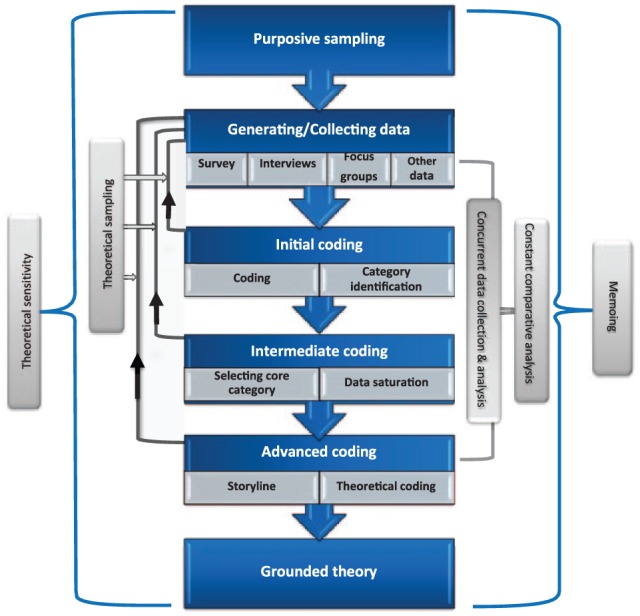
Background: Grounded theory is a well-known methodology employed in many research studies. Qualitative and quantitative data generation techniques can be used in a grounded theory study. Grounded theory sets out to discover or construct theory from data, systematically obtained and analysed using comparative analysis. While grounded theory is inherently flexible, it is a complex methodology. Thus, novice researchers strive to understand the discourse and the practical application of grounded theory concepts and processes. Objective: The aim of this article is to provide a contemporary research framework suitable to inform a grounded theory study. Result: This article provides an overview of grounded theory illustrated through a graphic representation of the processes and methods employed in conducting research using this methodology. The framework is presented as a diagrammatic representation of a research design and acts as a visual guide for the novice grounded theory researcher. Discussion: As grounded theory is not a linear process, the framework illustrates the interplay between the essential grounded theory methods and iterative and comparative actions involved. Each of the essential methods and processes that underpin grounded theory are defined in this article. Conclusion: Rather than an engagement in philosophical discussion or a debate of the different genres that can be used in grounded theory, this article illustrates how a framework for a research study design can be used to guide and inform the novice nurse researcher undertaking a study using grounded theory. Research findings and recommendations can contribute to policy or knowledge development, service provision and can reform thinking to initiate change in the substantive area of inquiry.
Overview
CoChat Summary
TL;DR
This article presents a contemporary, diagrammatic research design framework to help novice researchers visualise and apply the iterative methods and processes of grounded theory (GT). It defines the essential GT methods and processes and situates them within a non-linear, recursive design rather than debating philosophical genres.
Key findings
- GT is described as a structured yet flexible methodology appropriate when little is known about a phenomenon, aiming to produce or construct an explanatory theory grounded in data.
- Three distinct GT genres are identified: traditional/classic GT (Glaser), evolved GT (Strauss, Corbin and Clarke), and constructivist GT (Charmaz), distinguished by the researcher's philosophical position, use of literature, and approach to coding, analysis and theory development.
- Coding terminology differs by genre: traditional uses open, selective and theoretical coding; evolved uses open, axial and selective coding; constructivist uses initial, focused and theoretical coding (Table 1, adapted from Birks and Mills).
- The framework (Figure 1) depicts the interplay of purposive sampling, concurrent data generation/collection and analysis, constant comparative analysis, memoing, coding (initial, intermediate, advanced), theoretical sampling, theoretical sensitivity, and theoretical saturation, all directed toward an integrated substantive theory.
- Quality and rigour are related to three areas: the researcher's expertise, knowledge and research skills; methodological congruence with the research question; and procedural precision in the use of methods.
Methods
This is a methodological/discussion article, not an empirical study; no sample or dataset is analysed. It synthesises GT literature and prior works (notably Birks and Mills) to construct a graphic research design framework (Figure 1) and to define each essential GT method and process. The framework is presented as a visual guide for novice grounded theory researchers, illustrated with exemplars from other GT studies (Boxes 1–3).
Limitations
The paper states no formal limitations. Evident from the text: it deliberately avoids engagement in philosophical discussion or debate of the different GT genres, so it does not adjudicate between them; the framework is offered as a visual guide rather than an empirically tested model; and it is oriented specifically toward the novice nurse researcher, which may limit transferability to other disciplines or experienced researchers.
Model-written summary. Check it against the paper before relying on it.
Integrity signals
Registry
Cites
Statistics
Figures
Verification
Claims the paper makes
1 Valid · 4 Not valid · 49 Not checked · 18 Own results and interpretations
A statement the paper makes itself — it cites no source for it, so there is none to check. The quote shows it is in the paper.
In the paper
“As presented in Figure 1, initial purposive sampling directs the collection and/or generation of data.”
§ Grounded theory research: A design framework for novice researchers > Discussion > Purposive sampling
plainstates a cause- Asserted: passes — The authors put it forward as true.
- Checkable: passes — It can be checked against evidence.
- Load-bearing: passes — The paper’s conclusions depend on it.
- Based: passes — The paper gives a reason why it holds.
In the paper
“Constant comparative analysis generates increasingly more abstract concepts and theories through inductive processes.16”
§ Grounded theory research: A design framework for novice researchers > Discussion > Constant comparative analysis
What the sources say
- Not matchedcites [16] Charmaz K. Constructing grounded theory: a practical guide through qualitative analysis. Thousand Oaks, CA: SAGE, 2006.
Its entry has no title and year that we can search by.
plainstates a cause- Asserted: passes — The authors put it forward as true.
- Checkable: passes — It can be checked against evidence.
- Load-bearing: unclear — It is unclear whether the paper’s conclusions depend on it.
- Based: passes — The paper gives a reason why it holds.
- Not matched
In the paper
“Several analytic tools and techniques can be used to enhance theoretical sensitivity and increase the grounded theorist’s sensitivity to theoretical constructs in the data.28”
§ Grounded theory research: A design framework for novice researchers > Discussion > Theoretical sensitivity
What the sources say
- Not checked — no full text of the sourcecites [28] Corbin JM Strauss AL. Basics of qualitative research: techniques and procedures for developing grounded theory. 3rd ed. Thousand Oaks, CA: SAGE, 2008. source
plainstates a cause- Asserted: passes — The authors put it forward as true.
- Checkable: passes — It can be checked against evidence.
- Load-bearing: unclear — It is unclear whether the paper’s conclusions depend on it.
- Based: passes — The paper gives a reason why it holds.
In the paper
“Advanced coding that integrates extant theory adds further explanatory power to the findings.6”
§ Grounded theory research: A design framework for novice researchers > Discussion > Advanced coding
What the sources say
- Not matchedcites [6] Birks M Mills J. Grounded theory: a practical guide. 2nd ed. London: SAGE, 2015.
Its entry has no title and year that we can search by.
plainstates a cause- Asserted: passes — The authors put it forward as true.
- Checkable: passes — It can be checked against evidence.
- Load-bearing: unclear — It is unclear whether the paper’s conclusions depend on it.
- Based: passes — The paper gives a reason why it holds.
- Not matched
In the paper
“While interviews are a common method of generating data, data sources can include focus groups, questionnaires, surveys, transcripts, letters, government reports, documents, grey literature, music, artefacts, videos, blogs and memos.9”
§ Grounded theory research: A design framework for novice researchers > Discussion > Generating/collecting data
What the sources say
- Not checked — no full text of the sourcecites [9] Mills J Birks M Hoare KJ. Grounded theory. In: Mills J Birks M (eds) Qualitative methodology: a practical guide. London: SAGE, 2014, pp. 107– 121. source
plain- Asserted: passes — The authors put it forward as true.
- Checkable: passes — It can be checked against evidence.
- Load-bearing: unclear — It is unclear whether the paper’s conclusions depend on it.
- Based: passes — The paper gives a reason why it holds.
5 more claims
Create a free account to see all 72 claims and every source verdict.
- Probably not a substantial claim. 58
- It may state two separate claims as one. 17
Claims other papers make about this one
Each is checked against this paper’s own text: does it say what the citing paper says it does?
The cited source says what the claim attributes to it.
In the citing paper
“The epistemological and ontological differences principally address the proposition that theory is either discovered or co-constructed (Bryant, 2017), leading to opposing views on how the steps in the Grounded Theory method are understood (Bøttcher Berthelsen, 2018; Chun Tie, Birks and Francis, 2019; Tarozzi, 2020).”
From Application and challenges of using a Constructivist Grounded Theory methodology to address an undertheorized clinical challenge: A discussion paper (2024) · cites this paper as Chun Tie, Birks and Francis, 2019
The cited source says what the claim attributes to it.
In the citing paper
“Though the comparison of data, researchers emphasize consistencies, comprehend differences, and refine interviews, consistently comparing specific data points with others to establish categories (Bryant, 2017; Charmaz, 2014; Chun Tie et al., 2019).”
From Application and challenges of using a Constructivist Grounded Theory methodology to address an undertheorized clinical challenge: A discussion paper (2024) · cites this paper as Chun Tie et al., 2019
The cited source says what the claim attributes to it.
In the citing paper
“Nevertheless, this initial stage aims to deconstruct / fracture the data, allowing details to emerge (Bryant and Charmaz, 2019) to create the opportunity to identify both similarities and differences, pose analytical inquiries (Charmaz and Thornberg, 2021), and thereby establish to attain a more profound level of meaning (Chun Tie et al., 2019).”
From Application and challenges of using a Constructivist Grounded Theory methodology to address an undertheorized clinical challenge: A discussion paper (2024) · cites this paper as Chun Tie et al., 2019
Citations
Cites
The Discovery of Grounded Theory: Strategies for Qualitative Research.
Wagner, H. R., Glaser, B. G., & Strauss, A. L. (1968) · Social Forces · doi:10.2307/2575405 · Cited by 46,361
The Discovery of Grounded Theory; Strategies for Qualitative Research
Glaser, B. G., Strauss, A. L., & Strutzel, E. (1968) · Nursing Research · doi:10.1097/00006199-196807000-00014 · Cited by 39,449
(1998) · Sage eBooks · Cited by 38,631
Basics of Qualitative Research (3rd ed.): Techniques and Procedures for Developing Grounded Theory
Corbin, J., & Strauss, A. (2008) · SAGE · doi:10.4135/9781452230153 · Cited by 24,827
Basics of Qualitative Research: Grounded Theory Procedures and Techniques
Long, D. R., Strauss, A., & Corbin, J. (1993) · The Modern Language Journal · doi:10.2307/328955 · Cited by 17,576
Research Design: Qualitative, Quantitative, and Mixed Methods Approaches
Sloane-Seale, A. (2009) · Canadian Journal of University Continuing Education · doi:10.21225/d54s3d · Cited by 14,328
The Coding Manual for Qualitative Researchers
Lungu, M. (2022) · American Journal of Qualitative Research · doi:10.29333/ajqr/12085 · Cited by 10,826
Constructing grounded theory. A practical guide through qualitative analysis
Brink, E., Dellve, L., Hallberg, U., Abrahamsson, K. H., Klingberg, G., & Wentz, K. (2006) · International Journal of Qualitative Studies on Health and Well-being · doi:10.3402/qhw.v1i3.4932 · Cited by 6,862
(1978) · Medical Entomology and Zoology · Cited by 6,077
The Sage Handbook of Qualitative Research[1]
(2006) · Qualitative Research in Organizations and Management: An International Journal · doi:10.1108/17465640610666642 · Cited by 5,842
Research works printed but not linked: 13
- Crotty M. The foundation of social research: meaning and perspective in the research process. Thousand Oaks, CA: SAGE, 1998.
- Charmaz K. The power and potential of grounded theory. Med Sociol 2012; 6: 2– 15.
- Glaser BG. Basics of grounded theory analysis. Mill Valley, CA: Sociology Press, 1992.
- Ralph N Birks M Chapman Y. The methodological dynamism of grounded theory. Int J Qual Methods 2015; 14: 1–6.
- Bryant A Charmaz K. The Sage handbook of grounded theory. Thousand Oaks, CA: SAGE, 2007. · DOI · Paper page
- Charmaz K Bryant A. Grounded theory and credibility. In: Silverman D (ed.) Qualitative research. 3rd ed. London: SAGE, 2011, pp. 291– 309.
- Glaser BG Holton J. Remodeling grounded theory. Forum Qualitative Sozialforschung/Forum: Qualitative Social Research 2004; 5: 1– 22.
- Mackenzie N Knipe S. Research dilemmas: paradigms, methods and methodology. Issues Educ Res 2006; 16: 193– 205.
- Chamberlain-Salaun J. Consumers and the social world of health care: outsiders in the expert’s world: a grounded theory study. PhD Thesis, College of Health Care Sciences, James Cook University, Townsville, QLD, Australia, 2015, p. 198.
- Moghaddam A. Coding issues in grounded theory. Issues Educ Res 2006; 16: 53– 61.
- Evans LE. A novice researcher’s first walk through the maze of grounded theory: rationalization for classical grounded theory. Ground Theory Rev 2013; 14: 37–55.
- Glaser BG. The grounded theory perspective III: theoretical coding. Mill Valley, CA: Sociology Press, 2005.
- Baldwin A. Reconciling professional identity: a grounded theory study of nurse academics’ role modelling. PhD Thesis, College of Healthcare Sciences, James Cook University, Townsville, QLD, Australia, 2016, p. 246.
Cited by
Items 1,201–1,300 of 1,857
The perceived influence of Christian leadership competencies during COVID-19
Bleeker, M., Barkhuizen, N. E., & Braine, R. T. D. (2024) · South African Journal of Business Management · doi:10.4102/sajbm.v55i1.4537 · Cited by 5
Xiao, J. (2024) · Leisure Sciences · doi:10.1080/01490400.2024.2407012 · Cited by 2
“Grounded theory was chosen for this study due to its iterative nature and its ability to generate theory from data (Chun Tie et al., 2019), making it particularly suitable for exploring the complex relationship between travel and trauma recovery.”
Blocksidge, K., & Primeau, H. (2024) · The Journal of Academic Librarianship · doi:10.1016/j.acalib.2024.102966 · Cited by 1
Mixed-methods analysis of personal growth in an equity-centered leadership development program
McKelvy, J. N., Du, C., Song, M., et al. (2024) · Journal of Clinical and Translational Science · doi:10.1017/cts.2024.597 · Cited by 1
Sheehan, C. A., Butler, J. E., & O’Neill, C. (2024) · Education Sciences · doi:10.3390/educsci14121385 · Cited by 4
George, O. (2024) · East Asian Journal of Popular Culture · doi:10.1386/eapc_00139_1 · Cited by 1
Qualitative-Based Versus Quantitative-Based Research
Papajorgji, P. J., & Moskowitz, H. (2024) · Springer eBooks · doi:10.1007/978-3-031-78078-3_4 · Cited by 2
Toward a conceptual framework for policy implementation inquiry: A multi-perspective approach
Ayoub, A. (2024) · Doha International Family Institute Journal · doi:10.5339/difi.2024.3 · Cited by 1
Conducting a Grounded Theory Study in the Wake of a Traumatic Event: A Research Protocol
Ferguson, A., Ward, K. L., & Parke, R. L. (2025) · International Journal of Qualitative Methods · doi:10.1177/16094069241312019 · Cited by 2
Why Do They Persist? Understanding Living Kidney Donors and Persistence
Nottingham, K. L., Klosterman, H., Prevost, O., et al. (2025) · Transplantation Proceedings · doi:10.1016/j.transproceed.2024.12.025 · Cited by 1
Dunsmore, M. E., Schneider, J. M., McKenzie, H. A., & Gillespie, J. (2025) · SAGE Open · doi:10.1177/21582440241312464 · Cited by 1
Zhu, T.-D., Yang, M.-J., & Wu, H. (2025) · Frontiers in Medicine · doi:10.3389/fmed.2025.1496836 · Cited by 3
Khamidulina, M. S., & Maloshonok, N. (2025) · Высшее образование в России · doi:10.31992/0869-3617-2025-34-1-106-127 · Cited by 4
Yates, T. S., Sigwebela, S., Seedat, S., Milham, M. P., du Plessis, S., Abramson, L., Niemiec, E., Worthman, C. M., Rotheram‐Borus, M. J., Salum, G. A., et al. (2025) · Biological Psychiatry Global Open Science · doi:10.1016/j.bpsgos.2025.100457 · Cited by 1
Evaluation of AI for Strategic Communication Practices and Continuous Improvement
Sutherland, K. E. (2025) · Springer eBooks · doi:10.1007/978-981-96-2575-8_11 · Cited by 4
Mezzalira, E., Longhini, J., Ambrosi, E., Marini, G., Saiani, L., Falco, A. D., Leardini, C., & Canzan, F. (2025) · Primary Health Care Research & Development · doi:10.1017/s1463423625000210 · Cited by 3
“The study followed the principles of inductive iteration, comparative analysis, and abductive reasoning central to constructivist grounded theory (Chun Tie et al ., 2019).”
Patient Perspectives on Emergency Department–initiated Buprenorphine/Naloxone: A Qualitative Study
Liu, Q., Badke, K., Small, S. S., et al. (2025) · The Canadian Journal of Addiction · doi:10.1097/cxa.0000000000000225 · Cited by 1
“24”
Lai, J. H. J., Ireland, P. J., Nguyen, D. T., et al. (2025) · Orphanet Journal of Rare Diseases · doi:10.1186/s13023-025-03630-6 · Cited by 1
Gan, I. (2025) · Communication Studies · doi:10.1080/10510974.2025.2483583 · Cited by 2
“…temporary nurses’ work arrangements influence nurse-to-nurse relationships in general and on travel nurses’ work experiences in particular (Gan, 2020b; Spector et al., 2024), the grounded theory approach is an appropriate methodology for this study (Chun Tie et al., 2019; Strauss & Corbin, 1990).”
Tarokh, A. S. (2025) · Journal of Poverty · doi:10.1080/10875549.2025.2493612 · Cited by 3
Strategic Planning by State Chief Information Officers
Na, S., & Russ-Eft, D. F. (2025) · Advances in human resources management and organizational development book series · doi:10.4018/979-8-3693-3791-2.ch004 · Cited by 1
Beyond Entertainment: An Investigation of Externalization Design in Video Games
Becker, F., Warnking, R. P., Brückler, H., & Blascheck, T. (2025) · Computer Graphics Forum · doi:10.1111/cgf.70124 · Cited by 1
Gunn, E., Sinyard, R. D., Cummins, E., Yule, S., & Smink, D. S. (2025) · Journal of the American College of Surgeons · doi:10.1097/xcs.0000000000001506 · Cited by 1
A self-disclosure model for adolescents with perinatally acquired HIV in Eswatini
Dlamini, B. P., & Mtshali, G. N. (2025) · Curationis · doi:10.4102/curationis.v48i1.2741 · Cited by 1
“Conducting a grounded theory research study is not linear, but rather it is iterative and recursive (Chun Tie, Birks & Francis 2019).”
InfluentialYu, J., Burns, J. K., Mikhail, E., Solmi, M., Hatcher, S., Smith, A. L., Robillard, R., Nguyen, T., Edgar, N. E., Kendzerska, T., et al. (2025) · International Journal of Qualitative Studies on Health and Well-Being · doi:10.1080/17482631.2025.2540795 · Cited by 3
“The consolidated codes were then further grouped into broader themes that were used to develop a model to describe the feasibility and acceptability of tinted glasses for participants and clinicians, respectively (Chun Tie et al., 2019).”
Personal Financial Planning Theories: A Scoping Review
Asebedo, S. D. (2025) · Financial Planning Research Journal · doi:10.2478/fprj-2025-0006 · Cited by 3
Ravichandran, N., Murphy, N., Broughan, J., Xie, Y., McCombe, G., O'Donoghue, B. N., McDonald, K., Murtagh, G., Gallagher, J., Morrissey, J., et al. (2025) · Irish Journal of Psychological Medicine · doi:10.1017/ipm.2025.10158
Elinkowski, K., & Romney, M. R. (2020) · Scholarly Commons (University of Pennsylvania) · Cited by 2
Dukhaykh, S. (2020) · International Journal of Business and Applied Social Science · doi:10.33642/ijbass.v6n7p8 · Cited by 3
Implementation of Motorcycle Rental Information System at the Trans Jaya Tangerang
Setiawan, A., Avrizal, R., & Auliya, R. N. (2020) · SYSTEMATICS · doi:10.35706/sys.v2i2.3847 · Cited by 1
“1Metode Penelitian Metode penelitian yang digunakan dalam penelitian ini, yaitu grounded research[8] menjelaskan bahwa metode ini dapat menjadi solusi untuk mencari teori-teori yang baru dari pengalaman di lapangan.”
BackgroundBrakke, S. A. (2021) · SMU Journal of Undergraduate Research · doi:10.25172/jour.6.1.5
“Coding is critical in Grounded Theory because it provides a link between collecting or generating data and developing a theory to explain the data (Chun Tie et al. 2019).”
BackgroundKonseling dalam Bai’at Tarekat Shiddiqiyyah
Syakur, A. (2021) · Jurnal Bimbingan dan Konseling Islam · doi:10.29080/jbki.2021.11.1.1-21 · Cited by 1
Anticipatory Completions in Conversations Between People Who Stutter and People Who Do Not Stutter
Kondrashov, S. M., & Tetnowski, J. A. (2021) · Perspectives of the ASHA Special Interest Groups · doi:10.1044/2021_persp-21-00058 · Cited by 1
Pamuji, S. (2022) · MANAZHIM · doi:10.36088/manazhim.v4i1.1615 · Cited by 1
Kesurupan Massal di Sekolah Menengah: Kerasukan Roh Jahat atau Emotional Contagion?
Hamzah, I. (2022) · Psympathic Jurnal ilmiah Psikologi · doi:10.15575/psy.v8i2.7940 · Cited by 1
An Academic-Community Research Partnership to Enhance Structural Competency for Health Equity
Bagchi, A. D., Corasmin, E., Menifield, C. E., Weber, P. F., Baveja, A., Damas, K., Hill, D., & Peavy, D. (2022) · The Journal of Continuing Higher Education · doi:10.1080/07377363.2022.2067729 · Cited by 1
“This involved a cyclical approach to data review, starting with each reviewer reading the survey responses at least three times to become familiar with the content (Chun Tie et al., 2019).”
MethodDietary Behaviour and Mental Health Status among Students of Higher Education Institutes in Malaysia
Muniandy, N. D., Azhar, S. N. S., Dewi, A. D. A., & Ibrahim, D. N. B. (2022) · Environment-Behaviour Proceedings Journal · doi:10.21834/ebpj.v7i20.3394 · Cited by 3
Cybercrimes Law and Citizen Journalism Clampdown During the Covid-19 Pandemic in Tanzania
Solomon, E. (2022) · Springer eBooks · doi:10.1007/978-3-030-95100-9_13 · Cited by 1
Merritt, O. A., Rowa, K., & Purdon, C. L. (2022) · Cognitive Therapy and Research · doi:10.1007/s10608-022-10318-9 · Cited by 3
“In accordance with grounded theory, lower-order codes were collapsed into categories or “higher-order” codes, which allow an understanding of larger themes in the data (Charmaz, 2006; Chun Tie et al., 2019).”
BackgroundMethodInfluentialThe experience of mothering a preterm: a prolonged crisis with the potential for personal growth
Offer, S., & Ben‐Ari, O. T. –. (2022) · Journal of Reproductive and Infant Psychology · doi:10.1080/02646838.2022.2110222 · Cited by 3
“In addition to employing our skills and knowledge as researchers experienced in this method, we maintained methodological congruence with the research aim, as well as procedural precision in the use of the method (Birks & Mills, 2015; Chun Tie et al., 2019).”
MethodOccupants’ perception of thermal pleasure in Built Environment: a qualitative study in Yazd
Abarghuie, F. A., Ayatollahi, S. M. H., Afrasiabi, H., & Naik, N. S. (2022) · Architectural Science Review · doi:10.1080/00038628.2022.2108755 · Cited by 2
Qualitative research in vascular surgery
Ma, G., Botros, D., deLuca, L. S., et al. (2022) · Seminars in Vascular Surgery · doi:10.1053/j.semvascsurg.2022.10.005 · Cited by 1
Mixed-methods assessment of barriers to physical activity for middle school Latina girls
McDaniel, M. D., Ocegueda, A. S., Morales-Campos, D., & Parra-Medina, D. M. (2022) · Health Behavior Research · doi:10.4148/2572-1836.1154
“DMC and SO analyzed the transcripts using the grounded theory approach (Chun Tie et al., 2019; Glaser & Strauss, 1967; Hill et al., 2005; Strauss & Corbin, 1990).”
MANEJO FORESTAL Y SABERES DE LOS EJIDATARIOS DE SAN SEBASTIÁN RÍO HONDO, OAXACA
Martínez, A. R., López, A. M. C., & Sánchez, P. R. (2022) · Textual · doi:10.5154/r.textual.2022.79.09 · Cited by 1
“The record units are added to their respective context units, the context unit representing some semantic feature of each record unit; this process is known as data coding (Navarro and Diaz, 2007; Chun et al., 2019).”
BackgroundA Qualitative Examination of the Leadership Traits of Rām from Srimad Vālmīki Rāmāyaṇ
Subramaniam, R. (2023) · Palgrave studies in workplace spirituality and fulfillment · doi:10.1007/978-3-031-06234-6_8 · Cited by 1
Impact of Social Media in Making Political Decisions in Developing Countries
Yogapriya, G., & Chettri, N. (2022) · Technoarete Transactions on Advances in Social Sciences and Humanities · doi:10.36647/ttassh/02.02.a001 · Cited by 3
Shea, C., Jackson, N., & Sordille, M. A. (2023) · The Open Journal of Occupational Therapy · doi:10.15453/2168-6408.1997 · Cited by 3
Finding stability between sports ministry and sports ministry management. A church-based review.
Smith, J. D. (2022) · Journal of the Christian Society for Kinesiology Leisure and Sport Studies · doi:10.7290/jcskls07zibw · Cited by 1
Oliveira, I. V., do Nascimento, M. M. G., Rezende, C. D. P., Neves, C. D. M., Silva, H. M., César, A. L. M., & de Oliveira, D. R. (2023) · The Qualitative Report · doi:10.46743/2160-3715/2023.6196
Koomen, M. H., Ross, J., Hinrichs, E., Hofstede, E., Grimes, J., & Mohl, E. K. (2023) · Bulletin of the Ecological Society of America · doi:10.1002/bes2.2101 · Cited by 1
Non-Laboratory Project-Based Learning for Final Year Bioscience Students: Lessons From COVID-19
McKenna, D. J. (2023) · British Journal of Biomedical Science · doi:10.3389/bjbs.2023.11561 · Cited by 2
Understanding the professional identity development of undergraduate osteopathic students in the UK
McKenna, B. (2020) · University of Bedfordshire Repository (University of Bedfordshire) · Cited by 1
Muhammady, F. F. E. (2021) · eScholarship@McGill (McGill) · doi:10.82308/40264 · Cited by 1
Shongwe, E. J. (2021) · Unisa Institutional Repository (University of South Africa) · Cited by 1
Strategic responses to disruption by established SMEs in a declining industry
Thomas, G. H. (2021) · Queensland University of Technology · doi:10.5204/thesis.eprints.212900 · Cited by 1
Niesel, C. (2021) · Queensland University of Technology · doi:10.5204/thesis.eprints.212786 · Cited by 3
Marwat, P. K. (2021) · MOspace Institutional Repository (University of Missouri) · doi:10.32469/10355/88132 · Cited by 5
Atik, E., Schückes, M., & Apolinário-Hagen, J. (2022) · doi:10.2196/preprints.36806 · Cited by 1
Unfolding the Decision-Making Dynamics of News Visualization Production in ChinaPreprint
Ma, Q. (2021) · OSF Preprints (OSF Preprints) · doi:10.31219/osf.io/62swr · Cited by 1
ICSPConference Proceedings 2022
(2022) · doi:10.52987/icsp.2022 · Cited by 1
Seangrung, R., Tempeetikul, T., Pannarunothai, S., & Sakdanuwatwong, S. (2021) · Research Square · doi:10.21203/rs.3.rs-916542/v1 · Cited by 1
Lee, Y. J., Kazungu, R., Liu, C., Kim, R., van der Velde, N., Taylor, C., Walsh, A., Asasira, M., Katongole, I., Hatfield-King, J., et al. (2022) · Research Square · doi:10.21203/rs.3.rs-1758673/v1 · Cited by 1
Akter, F., Afroz, T., & Mahbub, M. (2022) · doi:10.31235/osf.io/u4adn · Cited by 1
Ramdial, J. (2022) · MOspace Institutional Repository (University of Missouri) · doi:10.32469/10355/94093 · Cited by 2
To Conserve and Protect: “Making Sense” of Conservation Officer uses of Emotional Labour
Dowdall, C. M. (2023) · doi:10.36939/ir.202303271145 · Cited by 3
ale undergraduate students’ perceptions of male student mental health
Wolstenholme, C. (2022) · Sheffield Hallam University · doi:10.7190/shu-thesis-00506 · Cited by 2
First-Generation College Students: Persistence and Adaptability in Post-Secondary Institutions
Lewis, C. E. (2022) · Louisiana State University · doi:10.31390/gradschool_dissertations.5873 · Cited by 4
Tourism and beyond: Commodification of communist memoryscapes in Central and East Europe
Janinovic, J. (2023) · UVaDOC UVaDOC University of Valladolid Documentary Repository (University of Valladolid) · doi:10.35376/10324/59779 · Cited by 1
Victims as perpetrators of gender-based violence in Bulawayo, Zimbabwe
Matumbu, N. (2023) · DUT Open Scholar (Durban University of Technology) · doi:10.51415/10321/4824 · Cited by 2
Ogunyemi, A. O., Balogun, M., Ojo, A., et al. (2023) · medRxiv · doi:10.1101/2023.07.02.23292141 · Cited by 1
“163 This study used a grounded theory approach to investigate the research [21].”
MethodDigital Lobbying: How Digital Transformation and Social Networks affect lobbying in GermanyPreprint
Kuhn, K., Rademacher, L., Fenton, P., et al. (2023) · Research Square · doi:10.21203/rs.3.rs-3398324/v1 · Cited by 1
Thomas, K. (2023) · Digital Repository Service (Northeastern University) · doi:10.17760/d20618664 · Cited by 3
Abbasian, E., & Mohebbi, A. (2023) · Research Square · doi:10.21203/rs.3.rs-3676942/v1 · Cited by 1
Spirit in the woods : The grounding of spiritual values in forest management
de Pater, C. (2024) · doi:10.18174/649526 · Cited by 3
Ko, Y. K., Kagaya, W., Omondi, P., et al. (2024) · medRxiv · doi:10.1101/2024.04.20.24306116 · Cited by 1
Um, T. S., Ownby, R. L., & Chou, S. (2024) · medRxiv · doi:10.1101/2024.09.28.24314456 · Cited by 2
Ramaiya, A., Wheeler, J., Stones, W. R., et al. (2025) · Research Square · doi:10.21203/rs.3.rs-6822872/v1 · Cited by 1
Auguste, A., & CaSIDEC study group (2025) · medRxiv · doi:10.1101/2025.08.17.25333877 · Cited by 1
“Transcripts will be initially analysed through the grounded theory approach, a data-driven, open coding process [60].”
ZHENG, Y., Jing, X., Yuan, J., Li, Y., Liu, S., Liao, J., Yun, L., & Zhang, L. (2025) · Research Square · doi:10.21203/rs.3.rs-7229762/v1 · Cited by 1
Parker, A. G., Vardoulakis, L., & Harrington, C. (2026) · CHI Conference on Human Factors in Computing Systems · doi:10.1145/3772318.3791451 · Cited by 1
“Regarding this latter point, following qualitative research best practices [20], our analysis process extended into the writing of this manuscript.”
JSE 36:2 Summer 2022 Whole Issue PDF
Erickson, K. E. (2022) · Journal of Scientific Exploration · doi:10.31275/20222713
Public Schools' Identification and Management of Underage Alcohol Use: A Qualitative Study
Robison, W. T., Soares, M., Meca, A., Jean-Jacques, J., Tubman, J. G., & Schwartz, S. J. (2019) · Health Behavior and Policy Review · doi:10.14485/hbpr.6.6.7
Vélez, V. L., Santiago, N. G., Vega-Riveros, J. F., & Bellido, C. (2021) · ASEE Annual Conference & Exposition · doi:10.18260/1-2--36690
McWilliams, C., Nims, B., & Dwyer, K. M. (2020) · IRL - University of Missouri, St. Louis (University of Missouri–St. Louis) · Cited by 3
Foundations of the DEFT Project: tertiary educators Developing Expertise Fostering Thinking
Osborn, J.-A. H., Larkins, J., McBain, B., Ellerton, P. J., Black, J., Borwein, N. S., Breuer, F., & Roberts, M. (2020) · International Journal of Innovation in Science and Mathematics Education · doi:10.30722/ijisme.28.02.001
“This is not formal coding as might be undertaken in a methodology such as Grounded Theory (Chun Tie, Birks, & Francis, 2019) but is reminiscent of the initial stages of coding in such approaches.”
MethodTheoritical Sensitivity: Mengungkap Konsep dalam Penelitian Ilmiah Kajian Sastra
Rodiah, I. (2020) · Jurnal Kajian Islam Interdisipliner · doi:10.14421/jkii.v5i1.1138
Citizens’ Reflection on Democracy and Disaster in Nepal in the Wake of the 2015 Earthquake
Sharma, I. (2020) · Dhaulagiri Journal of Sociology and Anthropology · doi:10.3126/dsaj.v14i0.29759
“This methodology is appropriate when little is known about a phenomenon; the aim being to produce or construct new knowledge” (Tie et al., 2019).”
BackgroundMethodWijayanayaka, T. (2020) · Scholarship@Western (Western University) · Cited by 1
Setiawati, I. (2020) · MOspace Institutional Repository (University of Missouri) · doi:10.32469/10355/78630
An analysis of Youth Work Ireland, Cork’s ‘Mind Your Head’ programme
Koyce, C. (2020) · Arrow@dit (Dublin Institute of Technology)
Eklind, E., & Gåsste, K. (2021) · Gothenburg University Publications Electronic Archive (Gothenburg University)
Badawi, A., Santos, C., Rochkind, K., et al. (2021) · Research Square · doi:10.21203/rs.3.rs-228855/v1
“To develop an understanding of working parents’ experiences on their child’s ear infections during the COVID-19 era, we used grounded theory methodology to identify themes on this topic.[15] The senior investigator [TC] who is trained in qualitative research and has published research using qualitative methodologies g…”
MethodCalder, C. M. (2020) · Unisa Institutional Repository (University of South Africa)
Melesko, J. (2020) · Summit (Simon Fraser University)
Oluoch, P. M., Doledec, D., Mutea, F., et al. (2021) · Research Square · doi:10.21203/rs.3.rs-320561/v1
“The analysis was informed by grounded theory, which consists in developing a theory of explanation grounded in and emerging from the data rather than from pre-existing categories and theoretical frameworks (Tie et al, 2019).”
MethodSomba, M., Kaaya, S., Siril, H. N., Oljemark, K., Ainebyona, D., McAdam, E., Todd, J., Andrew, I., McAdam, K. P. W. J., Simwinga, A., et al. (2021) · Prevention Science · doi:10.1007/s11121-021-01230-x · Cited by 1
Metadata
- Authors
- Chun Tie, Y., Birks, M., & Francis, K.
- Affiliations
- Nursing and Midwifery, College of Healthcare Sciences, James Cook University, Townsville, QLD, Australia
- James Cook University (AU)
- University of Tasmania (AU)
- Venue
- SAGE Open Medicine
- Publisher
- SAGE Publications
- Published
- 2019-01
- Volume
- 7
- Pages
- 2050312118822927-2050312118822927
- ISSN
- 2050-3121 (ISSN-L)
- PMC
- PMC6318722
- OpenAlex
- W2906994370
- Cited by
- 1,869
- References
- 29
- Citations by year
- 2026: 200 · 2025: 285 · 2024: 370 · 2023: 370 · 2022: 302 · 2021: 226 · 2020: 108 · 2019: 8
- FWCI
- 433.86
- Type
- journal article
- Language
- en
- Open access
- gold
- doi.org
- Licence
- cc-by-nc
- journals.sagepub.com/page/policies/text-and-data-mining-license (tdm)
- Locations
- SAGE Open Medicine (publishedVersion, cc-by-nc)
- Europe PMC (PubMed Central) (publishedVersion, cc-by-nc)
- PubMed Central (publishedVersion, cc-by-nc)
- PubMed (publishedVersion)
- UTAS Research Repository (acceptedVersion)
- ResearchOnline at James Cook University (James Cook University) (submittedVersion)
- DOAJ (DOAJ: Directory of Open Access Journals) (submittedVersion, cc-by-sa)
- Figshare (submittedVersion, cc-by-nc)
- Topics
- Social Sciences › Education › Qualitative Research Methods and Applications
- Health Sciences › Nursing › Research and Theory › Methodologies in Health Research and Practice
- Social Sciences › Education › Educational Research and Methods
- Keywords
- grounded theory, research design framework, novice researchers, nurse researchers, qualitative research methodology, comparative analysis
About these checks
Registry, retraction, Cites and statistics results are computed, not judged, with one exception: a printed reference that no index lists is read once by a model before it counts as a citation error. Claims are extracted by a model and kept only when their quote appears verbatim in the text; each cited source is then checked, with a model’s help, for whether it says what the claim relies on. Those verdicts can be wrong — read the claim’s quote and the cited source before relying on one.
The claim verdicts this report counts are experimental: their accuracy is not yet measured.
A language model drew the claims from the paper on 2026-10-10, under version 3 of the claim definition (model deepseek-v4.1-flash, prompt extract-v3).
A second model labelled each claim on 2026-10-10 (model jev-1.13-20260917, definition revision gold-guideline-v0.2).
Statistics and arithmetic are recomputed, not judged.
Confidence bands are shown only for fields calibrated on our annotated test set. None is calibrated yet, so no band is shown.
What counts as a claim ›How we measure confidence ›How we check this ›
Are you an author, or do you see a problem with this page? Request a review
Data sources
Bibliographic data: Semantic Scholar, OpenAlex, Crossref.
Contains information from the Semantic Scholar Academic Graph Datasets, made available under the ODC Attribution License (ODC-BY 1.0).
Semantic Scholar’s data is described in: Kinney, R., et al. (2023). The Semantic Scholar Open Data Platform. arXiv:2301.10140.
