

Grounded theory research: A design framework for novice researchers
Open accessThe DOI matches its Crossref record; 30 of the 33 references it cites were found in a registry or an index; 2 of the 69 sources its claims cite were checked for support.
Abstract
Background: Grounded theory is a well-known methodology employed in many research studies. Qualitative and quantitative data generation techniques can be used in a grounded theory study. Grounded theory sets out to discover or construct theory from data, systematically obtained and analysed using comparative analysis. While grounded theory is inherently flexible, it is a complex methodology. Thus, novice researchers strive to understand the discourse and the practical application of grounded theory concepts and processes. Objective: The aim of this article is to provide a contemporary research framework suitable to inform a grounded theory study. Result: This article provides an overview of grounded theory illustrated through a graphic representation of the processes and methods employed in conducting research using this methodology. The framework is presented as a diagrammatic representation of a research design and acts as a visual guide for the novice grounded theory researcher. Discussion: As grounded theory is not a linear process, the framework illustrates the interplay between the essential grounded theory methods and iterative and comparative actions involved. Each of the essential methods and processes that underpin grounded theory are defined in this article. Conclusion: Rather than an engagement in philosophical discussion or a debate of the different genres that can be used in grounded theory, this article illustrates how a framework for a research study design can be used to guide and inform the novice nurse researcher undertaking a study using grounded theory. Research findings and recommendations can contribute to policy or knowledge development, service provision and can reform thinking to initiate change in the substantive area of inquiry.
Overview
CoChat Summary
TL;DR
This article presents a contemporary, diagrammatic research design framework to help novice researchers visualise and apply the iterative methods and processes of grounded theory (GT). It defines the essential GT methods and processes and situates them within a non-linear, recursive design rather than debating philosophical genres.
Key findings
- GT is described as a structured yet flexible methodology appropriate when little is known about a phenomenon, aiming to produce or construct an explanatory theory grounded in data.
- Three distinct GT genres are identified: traditional/classic GT (Glaser), evolved GT (Strauss, Corbin and Clarke), and constructivist GT (Charmaz), distinguished by the researcher's philosophical position, use of literature, and approach to coding, analysis and theory development.
- Coding terminology differs by genre: traditional uses open, selective and theoretical coding; evolved uses open, axial and selective coding; constructivist uses initial, focused and theoretical coding (Table 1, adapted from Birks and Mills).
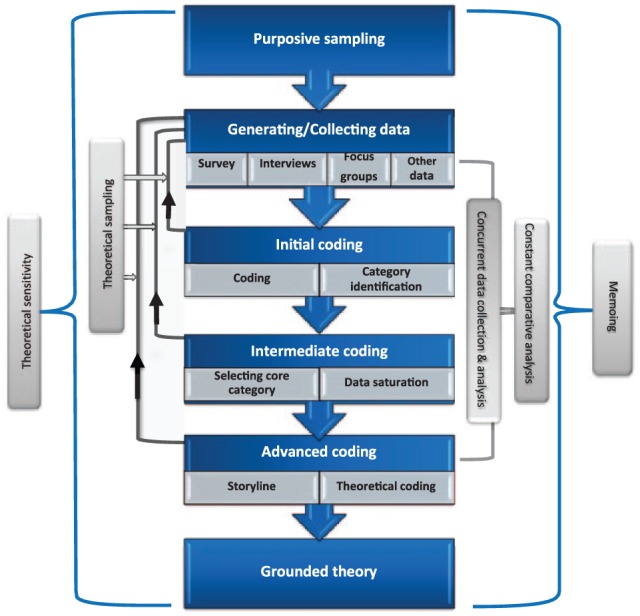
- The framework (Figure 1) depicts the interplay of purposive sampling, concurrent data generation/collection and analysis, constant comparative analysis, memoing, coding (initial, intermediate, advanced), theoretical sampling, theoretical sensitivity, and theoretical saturation, all directed toward an integrated substantive theory.
- Quality and rigour are related to three areas: the researcher's expertise, knowledge and research skills; methodological congruence with the research question; and procedural precision in the use of methods.
Methods
This is a methodological/discussion article, not an empirical study; no sample or dataset is analysed. It synthesises GT literature and prior works (notably Birks and Mills) to construct a graphic research design framework (Figure 1) and to define each essential GT method and process. The framework is presented as a visual guide for novice grounded theory researchers, illustrated with exemplars from other GT studies (Boxes 1–3).
Limitations
The paper states no formal limitations. Evident from the text: it deliberately avoids engagement in philosophical discussion or debate of the different GT genres, so it does not adjudicate between them; the framework is offered as a visual guide rather than an empirically tested model; and it is oriented specifically toward the novice nurse researcher, which may limit transferability to other disciplines or experienced researchers.
Model-written summary. Check it against the paper before relying on it.
Integrity signals
Registry
Cites
Statistics
Figures
Verification
Claims the paper makes
1 Valid · 4 Not valid · 49 Not checked · 18 Own results and interpretations
A statement the paper makes itself — it cites no source for it, so there is none to check. The quote shows it is in the paper.
In the paper
“As presented in Figure 1, initial purposive sampling directs the collection and/or generation of data.”
§ Grounded theory research: A design framework for novice researchers > Discussion > Purposive sampling
plainstates a cause- Asserted: passes — The authors put it forward as true.
- Checkable: passes — It can be checked against evidence.
- Load-bearing: passes — The paper’s conclusions depend on it.
- Based: passes — The paper gives a reason why it holds.
In the paper
“Constant comparative analysis generates increasingly more abstract concepts and theories through inductive processes.16”
§ Grounded theory research: A design framework for novice researchers > Discussion > Constant comparative analysis
What the sources say
- Not matchedcites [16] Charmaz K. Constructing grounded theory: a practical guide through qualitative analysis. Thousand Oaks, CA: SAGE, 2006.
Its entry has no title and year that we can search by.
plainstates a cause- Asserted: passes — The authors put it forward as true.
- Checkable: passes — It can be checked against evidence.
- Load-bearing: unclear — It is unclear whether the paper’s conclusions depend on it.
- Based: passes — The paper gives a reason why it holds.
- Not matched
In the paper
“Several analytic tools and techniques can be used to enhance theoretical sensitivity and increase the grounded theorist’s sensitivity to theoretical constructs in the data.28”
§ Grounded theory research: A design framework for novice researchers > Discussion > Theoretical sensitivity
What the sources say
- Not checked — no full text of the sourcecites [28] Corbin JM Strauss AL. Basics of qualitative research: techniques and procedures for developing grounded theory. 3rd ed. Thousand Oaks, CA: SAGE, 2008. source
plainstates a cause- Asserted: passes — The authors put it forward as true.
- Checkable: passes — It can be checked against evidence.
- Load-bearing: unclear — It is unclear whether the paper’s conclusions depend on it.
- Based: passes — The paper gives a reason why it holds.
In the paper
“Advanced coding that integrates extant theory adds further explanatory power to the findings.6”
§ Grounded theory research: A design framework for novice researchers > Discussion > Advanced coding
What the sources say
- Not matchedcites [6] Birks M Mills J. Grounded theory: a practical guide. 2nd ed. London: SAGE, 2015.
Its entry has no title and year that we can search by.
plainstates a cause- Asserted: passes — The authors put it forward as true.
- Checkable: passes — It can be checked against evidence.
- Load-bearing: unclear — It is unclear whether the paper’s conclusions depend on it.
- Based: passes — The paper gives a reason why it holds.
- Not matched
In the paper
“While interviews are a common method of generating data, data sources can include focus groups, questionnaires, surveys, transcripts, letters, government reports, documents, grey literature, music, artefacts, videos, blogs and memos.9”
§ Grounded theory research: A design framework for novice researchers > Discussion > Generating/collecting data
What the sources say
- Not checked — no full text of the sourcecites [9] Mills J Birks M Hoare KJ. Grounded theory. In: Mills J Birks M (eds) Qualitative methodology: a practical guide. London: SAGE, 2014, pp. 107– 121. source
plain- Asserted: passes — The authors put it forward as true.
- Checkable: passes — It can be checked against evidence.
- Load-bearing: unclear — It is unclear whether the paper’s conclusions depend on it.
- Based: passes — The paper gives a reason why it holds.
5 more claims
Create a free account to see all 72 claims and every source verdict.
- Probably not a substantial claim. 58
- It may state two separate claims as one. 17
Claims other papers make about this one
Each is checked against this paper’s own text: does it say what the citing paper says it does?
The cited source says what the claim attributes to it.
In the citing paper
“The epistemological and ontological differences principally address the proposition that theory is either discovered or co-constructed (Bryant, 2017), leading to opposing views on how the steps in the Grounded Theory method are understood (Bøttcher Berthelsen, 2018; Chun Tie, Birks and Francis, 2019; Tarozzi, 2020).”
From Application and challenges of using a Constructivist Grounded Theory methodology to address an undertheorized clinical challenge: A discussion paper (2024) · cites this paper as Chun Tie, Birks and Francis, 2019
The cited source says what the claim attributes to it.
In the citing paper
“Though the comparison of data, researchers emphasize consistencies, comprehend differences, and refine interviews, consistently comparing specific data points with others to establish categories (Bryant, 2017; Charmaz, 2014; Chun Tie et al., 2019).”
From Application and challenges of using a Constructivist Grounded Theory methodology to address an undertheorized clinical challenge: A discussion paper (2024) · cites this paper as Chun Tie et al., 2019
The cited source says what the claim attributes to it.
In the citing paper
“Nevertheless, this initial stage aims to deconstruct / fracture the data, allowing details to emerge (Bryant and Charmaz, 2019) to create the opportunity to identify both similarities and differences, pose analytical inquiries (Charmaz and Thornberg, 2021), and thereby establish to attain a more profound level of meaning (Chun Tie et al., 2019).”
From Application and challenges of using a Constructivist Grounded Theory methodology to address an undertheorized clinical challenge: A discussion paper (2024) · cites this paper as Chun Tie et al., 2019
Citations
Cites
The Discovery of Grounded Theory: Strategies for Qualitative Research.
Wagner, H. R., Glaser, B. G., & Strauss, A. L. (1968) · Social Forces · doi:10.2307/2575405 · Cited by 46,361
The Discovery of Grounded Theory; Strategies for Qualitative Research
Glaser, B. G., Strauss, A. L., & Strutzel, E. (1968) · Nursing Research · doi:10.1097/00006199-196807000-00014 · Cited by 39,449
(1998) · Sage eBooks · Cited by 38,631
Basics of Qualitative Research (3rd ed.): Techniques and Procedures for Developing Grounded Theory
Corbin, J., & Strauss, A. (2008) · SAGE · doi:10.4135/9781452230153 · Cited by 24,827
Basics of Qualitative Research: Grounded Theory Procedures and Techniques
Long, D. R., Strauss, A., & Corbin, J. (1993) · The Modern Language Journal · doi:10.2307/328955 · Cited by 17,576
Research Design: Qualitative, Quantitative, and Mixed Methods Approaches
Sloane-Seale, A. (2009) · Canadian Journal of University Continuing Education · doi:10.21225/d54s3d · Cited by 14,328
The Coding Manual for Qualitative Researchers
Lungu, M. (2022) · American Journal of Qualitative Research · doi:10.29333/ajqr/12085 · Cited by 10,826
Constructing grounded theory. A practical guide through qualitative analysis
Brink, E., Dellve, L., Hallberg, U., Abrahamsson, K. H., Klingberg, G., & Wentz, K. (2006) · International Journal of Qualitative Studies on Health and Well-being · doi:10.3402/qhw.v1i3.4932 · Cited by 6,862
(1978) · Medical Entomology and Zoology · Cited by 6,077
The Sage Handbook of Qualitative Research[1]
(2006) · Qualitative Research in Organizations and Management: An International Journal · doi:10.1108/17465640610666642 · Cited by 5,842
Research works printed but not linked: 13
- Crotty M. The foundation of social research: meaning and perspective in the research process. Thousand Oaks, CA: SAGE, 1998.
- Charmaz K. The power and potential of grounded theory. Med Sociol 2012; 6: 2– 15.
- Glaser BG. Basics of grounded theory analysis. Mill Valley, CA: Sociology Press, 1992.
- Ralph N Birks M Chapman Y. The methodological dynamism of grounded theory. Int J Qual Methods 2015; 14: 1–6.
- Bryant A Charmaz K. The Sage handbook of grounded theory. Thousand Oaks, CA: SAGE, 2007. · DOI · Paper page
- Charmaz K Bryant A. Grounded theory and credibility. In: Silverman D (ed.) Qualitative research. 3rd ed. London: SAGE, 2011, pp. 291– 309.
- Glaser BG Holton J. Remodeling grounded theory. Forum Qualitative Sozialforschung/Forum: Qualitative Social Research 2004; 5: 1– 22.
- Mackenzie N Knipe S. Research dilemmas: paradigms, methods and methodology. Issues Educ Res 2006; 16: 193– 205.
- Chamberlain-Salaun J. Consumers and the social world of health care: outsiders in the expert’s world: a grounded theory study. PhD Thesis, College of Health Care Sciences, James Cook University, Townsville, QLD, Australia, 2015, p. 198.
- Moghaddam A. Coding issues in grounded theory. Issues Educ Res 2006; 16: 53– 61.
- Evans LE. A novice researcher’s first walk through the maze of grounded theory: rationalization for classical grounded theory. Ground Theory Rev 2013; 14: 37–55.
- Glaser BG. The grounded theory perspective III: theoretical coding. Mill Valley, CA: Sociology Press, 2005.
- Baldwin A. Reconciling professional identity: a grounded theory study of nurse academics’ role modelling. PhD Thesis, College of Healthcare Sciences, James Cook University, Townsville, QLD, Australia, 2016, p. 246.
Cited by
Items 1,601–1,700 of 1,857
Sanyaolu, O., Nabors, L., King, K. A., Reeves-Doyle, B., & Adabla, S. (2025) · Journal of American College Health · doi:10.1080/07448481.2025.2501012 · Cited by 1
Clevenger, S. M., DeLuca, J. R., & Sauder, M. H. (2025) · Sport Management Education Journal · doi:10.1123/smej.2024-0008
Shanbhag, P. R., Yogesh Pai, P., Pattusamy, M., & Prabhu, N. K. P. (2025) · SSRN Electronic Journal · doi:10.2139/ssrn.5352844
Xie, S., Liu, W., Xie, S., Zhang, Y., & Wu, Y. (2025) · Asia-Pacific Journal of Oncology Nursing · doi:10.1016/j.apjon.2025.100776 · Cited by 1
“44 Following grounded theory methodology, 36,41,45 both researchers independently analyzed transcripts through open coding, focused coding, and memoing to develop categories and concepts.”
Rios, C. M., Silva, C., & Carvalho, L. (2025) · SSRN Electronic Journal · doi:10.2139/ssrn.5399094
Proposing grounded theory as a method to facilitate and extend reflective practice
Williams, K. J., & Murray, D. W. (2025) · Higher Education · doi:10.1007/s10734-025-01516-x
“Furthermore, as noted by Birks and Mills (2015; cited by Tie, et al., 2019, p. 4), the very practice of memo writing is itself partly a reflective process: “memos are reflective interpretive pieces that build a historic audit trail to document ideas, events and the thought processes inherent in the…”
Kim, Y., Kresovich, A., Page, S., Tran, H., Emery, S., & Kostygina, G. (2025) · Tobacco Control · doi:10.1136/tc-2025-059523
Bruce, D. R. (2025) · ASEE Annual Conference & Exposition · doi:10.18260/1-2--57718
Sun, J., Sarker, M. N. I., & Yi, F. (2025) · SAGE Open · doi:10.1177/21582440251367513 · Cited by 3
“…out’’ strategy should provide selected excellent young and middle-aged professional teachers with 1 year of practical experience at excellent enterprises by either implementing training at these enterprises or using winter and summer breaks for short-term field training (Chun Tie et al., 2019).”
After the peace dividend: supply chain challenges in the German defense industry
Berlien, L. H. (2025) · Advances in supply management · doi:10.1007/978-3-658-48750-8_10
Watras, E., Sullivan, A., Harrington, E., Therrien, M., Yerxa, K., Barr, M. L., & McNamara, J. (2025) · American Journal of Lifestyle Medicine · doi:10.1177/15598276251377716
Cerrito, B., Connors, A., Fialk, A., Xiao, J., & Buono, F. D. (2025) · doi:10.2196/preprints.82863
Hadisuyatmana, S., Malik, G., Efendi, F., Reisenhofer, S., & Boyd, J. (2025) · Sexuality and Disability · doi:10.1007/s11195-025-09904-y
“[29 , 34 ].”
InfluentialFacilitators to oncological care in foregut cancer: The patient perspective
Sanghera, J. S., Holland, M. M., Liapis, I., Ahmad, R., West, K., Tripathi, M., Hearld, L. R., Chu, D. I., Mehari, K. R., Heslin, M. J., et al. (2025) · Surgical Oncology Insight · doi:10.1016/j.soi.2025.100192
Burke, H., Mackness, J., Udoh, E. E., et al. (2025) · doi:10.12688/verixiv.2115.1
Halamek, L. P., Galindo, R. B., Follmer, S., Yamada, N. K., Catchpole, K., Lusk, C., Pineda, L., Daniels, K. I., Lipman, S., & Lee, H. C. (2025) · Journal of Patient Safety · doi:10.1097/pts.0000000000001361
Combating illegal oil refining and enhancing security in Bayelsa State, Nigeria
Daukere, B. E. (2025) · Journal of Economic Criminology · doi:10.1016/j.jeconc.2025.100191
Burke, H., Mackness, J., Udoh, E. E., et al. (2025) · doi:10.12688/verixiv.2115.2
Dunsmore, M. E., Schneider, J. M., McKenzie, H. A., & Gillespie, J. (2025) · Journal of Advanced Nursing · doi:10.1111/jan.70232 · Cited by 3
“Theoretical coding in GT is the first stage in the analytic process leading to theory development (Charmaz 2014; Tie et al. 2019).”
Pillai, S., Manimaran, H., Mannheim, G. B., & Ramesh, M. V. (2025) · Humanities and Social Sciences Communications · doi:10.1057/s41599-025-05783-y · Cited by 1
“The aim was to develop a conceptual framework grounded in participant narratives, offering practical insight into real-world meditation practice (Corbin and Strauss, 2008; Chun Tie et al., 2019).”
Dunning, K. H., Olivas, T., Camus, C., et al. (2025) · SSRN Electronic Journal · doi:10.2139/ssrn.5526936
Choi, S., Hong, S., Fawole, A., Heck, A., Lincourt, P., Jordan, A. E., Hussain, S., O’Grady, M. A., Bao, Y., Cleland, C. M., et al. (2025) · PLoS ONE · doi:10.1371/journal.pone.0330882 · Cited by 1
“The research team will review initial codes, select core categories at data saturation, and complete advanced theoretical coding to ensure logical and comprehensive analysis [114].”
Rashid, M., Clark, W., Foulds, J. L., John, I., Nguyen, J., Chan, M., Roach, P., Morris, M. I., Whalen‐Browne, M., & Forgie, S. E. D. (2025) · The Clinical Teacher · doi:10.1111/tct.70219 · Cited by 1
Duret, E., & Fisher-Daniel, S. (2025) · Emerald Group Publishing Limited eBooks · doi:10.1108/978-1-80592-273-520251006
Driver, L., Qi, X., Hua, R., Nelson, E., & Macias‐Konstantopoulos, W. (2025) · Transgender Health · doi:10.1177/26884887251374574 · Cited by 1
Gaines, A. G., Wright, P. M., Goldberg, J. H., Ducy, E. M., McPherson, M. L., & Cagle, J. G. (2025) · OMEGA - Journal of Death and Dying · doi:10.1177/00302228251384463 · Cited by 1
Fadda, M., Bernegger, G., Bezani, K., et al. (2025) · Human Vaccines & Immunotherapeutics · doi:10.1080/21645515.2025.2569840
Chiappinotto, S., Eskici, G. T., Miorin, F., et al. (2025) · Kontakt · doi:10.32725/kont.2025.048
Shi, M., Antigua, J. R., Chacha, L. D., Orihuela, N., Diaz, C. M., & Patel, V. V. (2026) · Journal of Migration and Health · doi:10.1016/j.jmh.2026.100420
Developing a Canadian midwifery research priority framework: a Delphi consensus study
Murray‐Davis, B., Ruby, E., Rack, J., Balkhi, S. A., Grenier, L. N., Brunton, G., Darling, E., Hutton, E. K., Banfield, L. E., Mattison, C. A., et al. (2025) · Health Research Policy and Systems · doi:10.1186/s12961-025-01401-0
Making a degree of difference: A grounded theory study of masters qualified nurses in Australia
Dunn, A., Harrison, H., Northam, H. L., et al. (2025) · Nurse Education in Practice · doi:10.1016/j.nepr.2025.104582
Self-citationZhu, B., & Rosli, D. I. (2025) · International Conference on Distance Education and Learning (ICDEL) · doi:10.1109/icdel65868.2025.11193582
“This study used a qualitative case study approach with elements of Grounded theory to explore CBL-ICT integration in public kindergartens in Quanzhou, focusing on cultural adaptation strategies [20].”
Mondy, C., & Rust, D. L. (2026) · Transportation Research Interdisciplinary Perspectives · doi:10.1016/j.trip.2026.102135 · Cited by 1
Jabarethina, G., Chacko, J., & Ravichandran, A. (2025) · BMJ Open · doi:10.1136/bmjopen-2024-092133
“Table 1 Area of Health Information Technology Competencies (HITCOMP) and Indian contextual gap and relevance”
Táticas de enfrentamento ao assédio por professoras de pós-graduação no Nordeste Brasileiro
Cardoso, L. C. M., BUENO, T. C., de Carvalho, M. S., et al. (2025) · Intexto · doi:10.19132/1807-8583.57.145248
Lim, W. W., & Min, C. (2025) · Cureus · doi:10.7759/cureus.95023
“Constructivist Grounded Theory, which prioritises theory generation from data independent of existing frameworks, was deemed inappropriate because the current research aims to explore perceptions rather than develop new theoretical constructs[12].”
Schmidt, T. (2025) · Open Book Publishers · doi:10.11647/obp.0469.17
João, E. S., Baum, T. G., & Downing, C. (2025) · Qualitative Research Journal · doi:10.1108/qrj-07-2025-0224 · Cited by 1
Jamaludin, K. A., Nasri, N., & Nasri, N. M. (2025) · Innovations in Education and Teaching International · doi:10.1080/14703297.2025.2581304
Davie, M., & McGee, J. S. (2025) · Journal of Religion & Spirituality in Social Work Social Thought · doi:10.1080/15426432.2025.2572641
“By collecting narratives directly from survivors, researchers inductively create themes and categories that can be obscured when data are perceived through the lens of an a priori framework such as attachment theory (Chun et al., 2019).”
Jannesari, S., Love, B., & Lawrence, V. C. (2025) · Cambridge University Press eBooks · doi:10.1017/9781009028967.009 · Cited by 1
Murphy, R., Young, C., Furlong, K. R., et al. (2025) · Canadian Journal of Emergency Medicine · doi:10.1007/s43678-025-01056-4
Saini, P., & Pandit, D. (2025) · Journal of Housing and the Built Environment · doi:10.1007/s10901-025-10234-w
Namukose, S., Kiwanuka, S. N., Maina, G. W., & Makumbi, F. E. (2025) · Journal of Health Population and Nutrition · doi:10.1186/s41043-025-01123-7
Chabbouh, A., Kurdi, M. A., Abbas, R., Cheiban, M., Sabalbal, A., Dandan, N., Ghossoub, E., & Kerbage, H. (2025) · Qualitative Health Research · doi:10.1177/10497323251387576
Richterman, A. G., Desire, S., Blaise, W., Derose, E., Moise, A., Wård, L., Millien, C., Thirumurthy, H., Momplaisir, F. M., & Ivers, L. C. (2025) · AIDS and Behavior · doi:10.1007/s10461-025-04933-2
Chaves, E. A., & Kunkler, E. C. (2025) · Obesity Pillars · doi:10.1016/j.obpill.2025.100227
Khussainov, D. (2025) · FIIB Business Review · doi:10.1177/23197145251387907
“It is among the methods that create an unfolding and iterative system of actions inherent in grounded theory studies (Chun Tie et al., 2019).”
Junior doctor medical conferences in the post-Covid era: A mixed-methods study
Giannoudi, M., Crampton, P. E. S., & Ellawala, A. (2025) · The Journal of the Royal College of Physicians of Edinburgh · doi:10.1177/14782715251389277
Wu, H.-W. V., Oeffinger, K. C., Chou, J. F., et al. (2025) · Journal of Psychosocial Oncology · doi:10.1080/07347332.2025.2586559
Alam, J., Rüttger, F., & Albrecht, J. C. (2025) · IEEE European Technology and Engineering Management Summit (E-TEMS) · doi:10.1109/e-tems64751.2025.11239187
“According to Chun Tie, Birks, & Francis [24], grounded theory is a prominent research methodology used for various studies.”
Plunging and bouncing back – the corona pandemic and business continuity of Finland’s seaports
Leviäkangas, P., Wiradanti, B., & Zulkarnain, Z. (2025) · Continuity & Resilience Review · doi:10.1108/crr-04-2025-0012
George-Reyes, C. E., Fernández, M. B., Bustamante-Ruiz, S. P., & Caicedo–Quiroz, R. (2025) · Journal of Latinos and Education · doi:10.1080/15348431.2025.2585826 · Cited by 4
“Analytic coding and constant comparison were performed on the original Spanish transcripts, consistent with grounded theory procedures to develop an explanation of beliefs and perceptions and thus build a new body of knowledge (Chun Tie et al., 2019).”
Letrecher, S., Chemrouk, Y., & Sani, L. (2025) · Frontiers in Psychology · doi:10.3389/fpsyg.2025.1610567
Edwards, J. G., Jeng, M., & Shah, T. (2025) · Pediatric Blood & Cancer · doi:10.1002/mpo.70010
Sushko, K., Sherifali, D., Smith, K., & Lipscombe, L. L. (2025) · Diabetic Medicine · doi:10.1016/j.jcjd.2025.10.054
Riggle, A., Page, A., Roesch, E. A., et al. (2025) · Research Square · doi:10.21203/rs.3.rs-7989348/v1
Fergus, A., Delbridge, A., & Sutton, S. (2025) · Physical & Occupational Therapy In Pediatrics · doi:10.1080/01942638.2025.2591849 · Cited by 1
“Consistent with the constructivist qualitative approach, an iterative comparative analysis was utilized to enhance theoretical sensitivity (Birks & Mills, 2015; Chun Tie et al., 2019).”
Bachynski, J. C., Duhn, L., Costa, I. G., & Plazas, P. C. (2025) · Canadian Journal of Nursing Research · doi:10.1177/08445621251395378
“Theory is generated from constant comparison during concurrent data collection and analysis throughout the research inquiry (Chun Tie et al., 2019).”
Conceptual Development Informing the Kidney Failure Patient Life Goals Survey
Dahlerus, C., Carlozzi, N. E., Hirth, R. A., Price, K., Sardone, J., Miner, J. A., Segal, J. H., Andress, J., Roach, J. L., Balovlenkov, E., et al. (2025) · Kidney Medicine · doi:10.1016/j.xkme.2025.101203 · Cited by 1
Leadership in academia: Key leadership behaviours and roles of formal and peer leaders
Fransen, K., Edelmann, C. M., Vanbeselaere, M., Vansteenwegen, D., Vanbeselaere, N., & Boen, F. (2025) · Management in Education · doi:10.1177/08920206251396796 · Cited by 1
Topart, F., Millot, A., Béguinot, E., Hoek, J. A., & Gallopel‐Morvan, K. (2025) · Tobacco Prevention & Cessation · doi:10.18332/tpc/211970
“Potential participants were contacted using their publicly available email addresses listed on the websites of the French National Assembly and Senate (https://www. assemblee-nationale.fr; https://www.senat.fr).”
Additional file 1 of Antecedents of unfinished nursing care: a systematic review of the literature
Chiappinotto, S., Papastavrou, E., Efstathiou, G., Andreou, P., Stemmer, R., Ströhm, C., Schubert, M., de Wolf‐Linder, S., Longhini, J., & Palese, A. (2022) · Figshare · doi:10.6084/m9.figshare.20064682
Øverhaug, O. M. S., Laue, J., Vis, S. A., & Risør, M. B. (2024) · Figshare · doi:10.6084/m9.figshare.25059588
Øverhaug, O. M. S., Laue, J., Vis, S. A., & Risør, M. B. (2024) · Figshare · doi:10.6084/m9.figshare.26672298
Klopstock, T., Mercimek-Andrews, S., Jurecka, A., et al. (2023) · Figshare · doi:10.6084/m9.figshare.24070161
Edwards, J. G., Barry, M., Essam, D., et al. (2021) · Figshare · doi:10.6084/m9.figshare.16725937
Begum, T., Khan, S. M., Adamou, B., Ferdous, J., Parvez, M. M., Islam, M. S., Kumkum, F. A., Rahman, A., & Anwar, I. (2020) · Figshare · doi:10.6084/m9.figshare.12375647
Dugle, G., Antwi, J., & Quentin, W. (2024) · Figshare · doi:10.6084/m9.figshare.24439468
Bernard-Giglio, M., French, S. D., Myburgh, C., & de Luca, K. E. (2024) · Figshare · doi:10.6084/m9.figshare.26622232
McGowan, D., Morley, C., Hansen, E., Shaw, K. A.-M., & Winzenberg, T. M. (2024) · Figshare · doi:10.6084/m9.figshare.25415000
Fitzpatrick, N. K., Chachay, V., Sandra, C., Briskey, D. R., Jackman, S. R., Shore, A., & Bowtell, J. L. (2024) · Figshare · doi:10.6084/m9.figshare.26668008
Begum, T., Khan, S. M., Adamou, B., Ferdous, J., Parvez, M. M., Islam, M. S., Kumkum, F. A., Rahman, A., & Anwar, I. (2020) · Figshare · doi:10.6084/m9.figshare.12375650
Edwards, J. G., Barry, M., Essam, D., et al. (2021) · Figshare · doi:10.6084/m9.figshare.16725946
Øverhaug, O. M. S., Laue, J., Vis, S. A., & Risør, M. B. (2024) · Figshare · doi:10.6084/m9.figshare.25059396
Edwards, J. G., Barry, M., Essam, D., et al. (2021) · Figshare · doi:10.6084/m9.figshare.16725934
Klopstock, T., Mercimek-Andrews, S., Jurecka, A., et al. (2023) · Figshare · doi:10.6084/m9.figshare.24070164
Noceda, A. V. G., Acierto, L. M. M., Bertiz, M. C. C., Dionisio, D. E. H., Laurito, C. B. L., Sanchez, G. A. T., & Loreche, A. M. (2023) · Figshare · doi:10.6084/m9.figshare.22626359
Hutton, C. J., Kay, M., Round, P., et al. (2024) · Figshare · doi:10.6084/m9.figshare.27042285
Dugle, G., Antwi, J., & Quentin, W. (2023) · Figshare · doi:10.6084/m9.figshare.24439229
Begum, T., Khan, S. M., Adamou, B., Ferdous, J., Parvez, M. M., Islam, M. S., Kumkum, F. A., Rahman, A., & Anwar, I. (2020) · Figshare · doi:10.6084/m9.figshare.12375614
Edwards, J. G., Barry, M., Essam, D., et al. (2021) · Figshare · doi:10.6084/m9.figshare.16725943
Fitzpatrick, N. K., Chachay, V., Sandra, C., Briskey, D. R., Jackman, S. R., Shore, A., & Bowtell, J. L. (2024) · Figshare · doi:10.6084/m9.figshare.26668014
Sahu, B., Babu, G. R., Gurav, K., Karthik, M., Ravi, D., Lobo, E., John, D. A., Oakley, L., Oteng‐Ntim, E., Nadal, I. P., et al. (2021) · Figshare · doi:10.6084/m9.figshare.13978901
McGowan, D., Morley, C., Hansen, E., Shaw, K. A.-M., & Winzenberg, T. M. (2024) · Figshare · doi:10.6084/m9.figshare.25414839
Jones, T., Silverman, T. B., Guzman, A., McGuinness, J. E., Trivedi, M. S., Kukafka, R., & Crew, K. D. (2022) · Figshare · doi:10.6084/m9.figshare.20438372
Edwards, J. G., Barry, M., Essam, D., et al. (2021) · Figshare · doi:10.6084/m9.figshare.16725940
Okrant, E., Reif, S., & Horgan, C. M. (2024) · Figshare · doi:10.6084/m9.figshare.26614402
Bernard-Giglio, M., French, S. D., Myburgh, C., & de Luca, K. E. (2024) · Figshare · doi:10.6084/m9.figshare.26622229
Bouthillier, M. L., Veilleux, S., Loignon, J., Turcotte, M., Trudel, L., & Provencher, V. (2024) · Figshare · doi:10.6084/m9.figshare.25989186
Klopstock, T., Mercimek-Andrews, S., Jurecka, A., et al. (2023) · Figshare · doi:10.6084/m9.figshare.24070167
Rawal, L., Jubayer, S., Choudhury, S., Islam, S. M. S., & Abdullah, A. S. M. (2021) · Figshare · doi:10.6084/m9.figshare.13531903
Fitzsimon, J. P., Patel, K., Peixoto, C., & Belanger, C. (2023) · Figshare · doi:10.6084/m9.figshare.23292059
Fitzpatrick, N. K., Chachay, V., Capra, S. M., Briskey, D. R., Jackman, S. R., Shore, A., & Bowtell, J. L. (2024) · Figshare · doi:10.6084/m9.figshare.26668011
Fitzsimon, J. P., Patel, K., Peixoto, C., & Belanger, C. (2023) · Figshare · doi:10.6084/m9.figshare.23292062
Germain, N., Jémus-Gonzalez, E., Couture, V., Côté, É., Morin, M., Toulouse-Fournier, A., Bert, L., Giguère, R., Sinha, S., Sourial, N., et al. (2024) · Figshare · doi:10.6084/m9.figshare.27129557
Edwards, J. G., Barry, M., Essam, D., et al. (2021) · Figshare · doi:10.6084/m9.figshare.16725931
Morse, S. C., Fockele, C., Huynh, L. N., et al. (2024) · Figshare · doi:10.6084/m9.figshare.26585367
Sahu, B., Babu, G. R., Gurav, K., Karthik, M., Ravi, D., Lobo, E., John, D. A., Oakley, L., Oteng‐Ntim, E., Nadal, I. P., et al. (2021) · Figshare · doi:10.6084/m9.figshare.13978895
Hutton, C. J., Kay, M., Round, P., et al. (2024) · Figshare · doi:10.6084/m9.figshare.27042288
Metadata
- Authors
- Chun Tie, Y., Birks, M., & Francis, K.
- Affiliations
- Nursing and Midwifery, College of Healthcare Sciences, James Cook University, Townsville, QLD, Australia
- James Cook University (AU)
- University of Tasmania (AU)
- Venue
- SAGE Open Medicine
- Publisher
- SAGE Publications
- Published
- 2019-01
- Volume
- 7
- Pages
- 2050312118822927-2050312118822927
- ISSN
- 2050-3121 (ISSN-L)
- PMC
- PMC6318722
- OpenAlex
- W2906994370
- Cited by
- 1,869
- References
- 29
- Citations by year
- 2026: 200 · 2025: 285 · 2024: 370 · 2023: 370 · 2022: 302 · 2021: 226 · 2020: 108 · 2019: 8
- FWCI
- 433.86
- Type
- journal article
- Language
- en
- Open access
- gold
- doi.org
- Licence
- cc-by-nc
- journals.sagepub.com/page/policies/text-and-data-mining-license (tdm)
- Locations
- SAGE Open Medicine (publishedVersion, cc-by-nc)
- Europe PMC (PubMed Central) (publishedVersion, cc-by-nc)
- PubMed Central (publishedVersion, cc-by-nc)
- PubMed (publishedVersion)
- UTAS Research Repository (acceptedVersion)
- ResearchOnline at James Cook University (James Cook University) (submittedVersion)
- DOAJ (DOAJ: Directory of Open Access Journals) (submittedVersion, cc-by-sa)
- Figshare (submittedVersion, cc-by-nc)
- Topics
- Social Sciences › Education › Qualitative Research Methods and Applications
- Health Sciences › Nursing › Research and Theory › Methodologies in Health Research and Practice
- Social Sciences › Education › Educational Research and Methods
- Keywords
- grounded theory, research design framework, novice researchers, nurse researchers, qualitative research methodology, comparative analysis
About these checks
Registry, retraction, Cites and statistics results are computed, not judged, with one exception: a printed reference that no index lists is read once by a model before it counts as a citation error. Claims are extracted by a model and kept only when their quote appears verbatim in the text; each cited source is then checked, with a model’s help, for whether it says what the claim relies on. Those verdicts can be wrong — read the claim’s quote and the cited source before relying on one.
The claim verdicts this report counts are experimental: their accuracy is not yet measured.
A language model drew the claims from the paper on 2026-10-10, under version 3 of the claim definition (model deepseek-v4.1-flash, prompt extract-v3).
A second model labelled each claim on 2026-10-10 (model jev-1.13-20260917, definition revision gold-guideline-v0.2).
Statistics and arithmetic are recomputed, not judged.
Confidence bands are shown only for fields calibrated on our annotated test set. None is calibrated yet, so no band is shown.
What counts as a claim ›How we measure confidence ›How we check this ›
Are you an author, or do you see a problem with this page? Request a review
Data sources
Bibliographic data: Semantic Scholar, OpenAlex, Crossref.
Contains information from the Semantic Scholar Academic Graph Datasets, made available under the ODC Attribution License (ODC-BY 1.0).
Semantic Scholar’s data is described in: Kinney, R., et al. (2023). The Semantic Scholar Open Data Platform. arXiv:2301.10140.
