

Grounded theory research: A design framework for novice researchers
Open accessThe DOI matches its Crossref record; 30 of the 33 references it cites were found in a registry or an index; 2 of the 69 sources its claims cite were checked for support.
Abstract
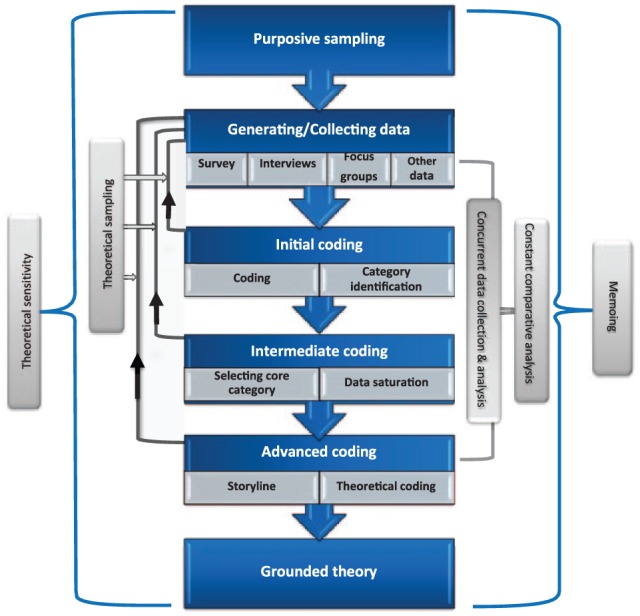
Background: Grounded theory is a well-known methodology employed in many research studies. Qualitative and quantitative data generation techniques can be used in a grounded theory study. Grounded theory sets out to discover or construct theory from data, systematically obtained and analysed using comparative analysis. While grounded theory is inherently flexible, it is a complex methodology. Thus, novice researchers strive to understand the discourse and the practical application of grounded theory concepts and processes. Objective: The aim of this article is to provide a contemporary research framework suitable to inform a grounded theory study. Result: This article provides an overview of grounded theory illustrated through a graphic representation of the processes and methods employed in conducting research using this methodology. The framework is presented as a diagrammatic representation of a research design and acts as a visual guide for the novice grounded theory researcher. Discussion: As grounded theory is not a linear process, the framework illustrates the interplay between the essential grounded theory methods and iterative and comparative actions involved. Each of the essential methods and processes that underpin grounded theory are defined in this article. Conclusion: Rather than an engagement in philosophical discussion or a debate of the different genres that can be used in grounded theory, this article illustrates how a framework for a research study design can be used to guide and inform the novice nurse researcher undertaking a study using grounded theory. Research findings and recommendations can contribute to policy or knowledge development, service provision and can reform thinking to initiate change in the substantive area of inquiry.
Overview
CoChat Summary
TL;DR
This article presents a contemporary, diagrammatic research design framework to help novice researchers visualise and apply the iterative methods and processes of grounded theory (GT). It defines the essential GT methods and processes and situates them within a non-linear, recursive design rather than debating philosophical genres.
Key findings
- GT is described as a structured yet flexible methodology appropriate when little is known about a phenomenon, aiming to produce or construct an explanatory theory grounded in data.
- Three distinct GT genres are identified: traditional/classic GT (Glaser), evolved GT (Strauss, Corbin and Clarke), and constructivist GT (Charmaz), distinguished by the researcher's philosophical position, use of literature, and approach to coding, analysis and theory development.
- Coding terminology differs by genre: traditional uses open, selective and theoretical coding; evolved uses open, axial and selective coding; constructivist uses initial, focused and theoretical coding (Table 1, adapted from Birks and Mills).
- The framework (Figure 1) depicts the interplay of purposive sampling, concurrent data generation/collection and analysis, constant comparative analysis, memoing, coding (initial, intermediate, advanced), theoretical sampling, theoretical sensitivity, and theoretical saturation, all directed toward an integrated substantive theory.
- Quality and rigour are related to three areas: the researcher's expertise, knowledge and research skills; methodological congruence with the research question; and procedural precision in the use of methods.
Methods
This is a methodological/discussion article, not an empirical study; no sample or dataset is analysed. It synthesises GT literature and prior works (notably Birks and Mills) to construct a graphic research design framework (Figure 1) and to define each essential GT method and process. The framework is presented as a visual guide for novice grounded theory researchers, illustrated with exemplars from other GT studies (Boxes 1–3).
Limitations
The paper states no formal limitations. Evident from the text: it deliberately avoids engagement in philosophical discussion or debate of the different GT genres, so it does not adjudicate between them; the framework is offered as a visual guide rather than an empirically tested model; and it is oriented specifically toward the novice nurse researcher, which may limit transferability to other disciplines or experienced researchers.
Model-written summary. Check it against the paper before relying on it.
Integrity signals
Registry
Cites
Statistics
Figures
Verification
Claims the paper makes
1 Valid · 4 Not valid · 49 Not checked · 18 Own results and interpretations
A statement the paper makes itself — it cites no source for it, so there is none to check. The quote shows it is in the paper.
In the paper
“As presented in Figure 1, initial purposive sampling directs the collection and/or generation of data.”
§ Grounded theory research: A design framework for novice researchers > Discussion > Purposive sampling
plainstates a cause- Asserted: passes — The authors put it forward as true.
- Checkable: passes — It can be checked against evidence.
- Load-bearing: passes — The paper’s conclusions depend on it.
- Based: passes — The paper gives a reason why it holds.
In the paper
“Constant comparative analysis generates increasingly more abstract concepts and theories through inductive processes.16”
§ Grounded theory research: A design framework for novice researchers > Discussion > Constant comparative analysis
What the sources say
- Not matchedcites [16] Charmaz K. Constructing grounded theory: a practical guide through qualitative analysis. Thousand Oaks, CA: SAGE, 2006.
Its entry has no title and year that we can search by.
plainstates a cause- Asserted: passes — The authors put it forward as true.
- Checkable: passes — It can be checked against evidence.
- Load-bearing: unclear — It is unclear whether the paper’s conclusions depend on it.
- Based: passes — The paper gives a reason why it holds.
- Not matched
In the paper
“Several analytic tools and techniques can be used to enhance theoretical sensitivity and increase the grounded theorist’s sensitivity to theoretical constructs in the data.28”
§ Grounded theory research: A design framework for novice researchers > Discussion > Theoretical sensitivity
What the sources say
- Not checked — no full text of the sourcecites [28] Corbin JM Strauss AL. Basics of qualitative research: techniques and procedures for developing grounded theory. 3rd ed. Thousand Oaks, CA: SAGE, 2008. source
plainstates a cause- Asserted: passes — The authors put it forward as true.
- Checkable: passes — It can be checked against evidence.
- Load-bearing: unclear — It is unclear whether the paper’s conclusions depend on it.
- Based: passes — The paper gives a reason why it holds.
In the paper
“Advanced coding that integrates extant theory adds further explanatory power to the findings.6”
§ Grounded theory research: A design framework for novice researchers > Discussion > Advanced coding
What the sources say
- Not matchedcites [6] Birks M Mills J. Grounded theory: a practical guide. 2nd ed. London: SAGE, 2015.
Its entry has no title and year that we can search by.
plainstates a cause- Asserted: passes — The authors put it forward as true.
- Checkable: passes — It can be checked against evidence.
- Load-bearing: unclear — It is unclear whether the paper’s conclusions depend on it.
- Based: passes — The paper gives a reason why it holds.
- Not matched
In the paper
“While interviews are a common method of generating data, data sources can include focus groups, questionnaires, surveys, transcripts, letters, government reports, documents, grey literature, music, artefacts, videos, blogs and memos.9”
§ Grounded theory research: A design framework for novice researchers > Discussion > Generating/collecting data
What the sources say
- Not checked — no full text of the sourcecites [9] Mills J Birks M Hoare KJ. Grounded theory. In: Mills J Birks M (eds) Qualitative methodology: a practical guide. London: SAGE, 2014, pp. 107– 121. source
plain- Asserted: passes — The authors put it forward as true.
- Checkable: passes — It can be checked against evidence.
- Load-bearing: unclear — It is unclear whether the paper’s conclusions depend on it.
- Based: passes — The paper gives a reason why it holds.
5 more claims
Create a free account to see all 72 claims and every source verdict.
- Probably not a substantial claim. 58
- It may state two separate claims as one. 17
Claims other papers make about this one
Each is checked against this paper’s own text: does it say what the citing paper says it does?
The cited source says what the claim attributes to it.
In the citing paper
“The epistemological and ontological differences principally address the proposition that theory is either discovered or co-constructed (Bryant, 2017), leading to opposing views on how the steps in the Grounded Theory method are understood (Bøttcher Berthelsen, 2018; Chun Tie, Birks and Francis, 2019; Tarozzi, 2020).”
From Application and challenges of using a Constructivist Grounded Theory methodology to address an undertheorized clinical challenge: A discussion paper (2024) · cites this paper as Chun Tie, Birks and Francis, 2019
The cited source says what the claim attributes to it.
In the citing paper
“Though the comparison of data, researchers emphasize consistencies, comprehend differences, and refine interviews, consistently comparing specific data points with others to establish categories (Bryant, 2017; Charmaz, 2014; Chun Tie et al., 2019).”
From Application and challenges of using a Constructivist Grounded Theory methodology to address an undertheorized clinical challenge: A discussion paper (2024) · cites this paper as Chun Tie et al., 2019
The cited source says what the claim attributes to it.
In the citing paper
“Nevertheless, this initial stage aims to deconstruct / fracture the data, allowing details to emerge (Bryant and Charmaz, 2019) to create the opportunity to identify both similarities and differences, pose analytical inquiries (Charmaz and Thornberg, 2021), and thereby establish to attain a more profound level of meaning (Chun Tie et al., 2019).”
From Application and challenges of using a Constructivist Grounded Theory methodology to address an undertheorized clinical challenge: A discussion paper (2024) · cites this paper as Chun Tie et al., 2019
Citations
Cites
The Discovery of Grounded Theory: Strategies for Qualitative Research.
Wagner, H. R., Glaser, B. G., & Strauss, A. L. (1968) · Social Forces · doi:10.2307/2575405 · Cited by 46,361
The Discovery of Grounded Theory; Strategies for Qualitative Research
Glaser, B. G., Strauss, A. L., & Strutzel, E. (1968) · Nursing Research · doi:10.1097/00006199-196807000-00014 · Cited by 39,449
(1998) · Sage eBooks · Cited by 38,631
Basics of Qualitative Research (3rd ed.): Techniques and Procedures for Developing Grounded Theory
Corbin, J., & Strauss, A. (2008) · SAGE · doi:10.4135/9781452230153 · Cited by 24,827
Basics of Qualitative Research: Grounded Theory Procedures and Techniques
Long, D. R., Strauss, A., & Corbin, J. (1993) · The Modern Language Journal · doi:10.2307/328955 · Cited by 17,576
Research Design: Qualitative, Quantitative, and Mixed Methods Approaches
Sloane-Seale, A. (2009) · Canadian Journal of University Continuing Education · doi:10.21225/d54s3d · Cited by 14,328
The Coding Manual for Qualitative Researchers
Lungu, M. (2022) · American Journal of Qualitative Research · doi:10.29333/ajqr/12085 · Cited by 10,826
Constructing grounded theory. A practical guide through qualitative analysis
Brink, E., Dellve, L., Hallberg, U., Abrahamsson, K. H., Klingberg, G., & Wentz, K. (2006) · International Journal of Qualitative Studies on Health and Well-being · doi:10.3402/qhw.v1i3.4932 · Cited by 6,862
(1978) · Medical Entomology and Zoology · Cited by 6,077
The Sage Handbook of Qualitative Research[1]
(2006) · Qualitative Research in Organizations and Management: An International Journal · doi:10.1108/17465640610666642 · Cited by 5,842
Research works printed but not linked: 13
- Crotty M. The foundation of social research: meaning and perspective in the research process. Thousand Oaks, CA: SAGE, 1998.
- Charmaz K. The power and potential of grounded theory. Med Sociol 2012; 6: 2– 15.
- Glaser BG. Basics of grounded theory analysis. Mill Valley, CA: Sociology Press, 1992.
- Ralph N Birks M Chapman Y. The methodological dynamism of grounded theory. Int J Qual Methods 2015; 14: 1–6.
- Bryant A Charmaz K. The Sage handbook of grounded theory. Thousand Oaks, CA: SAGE, 2007. · DOI · Paper page
- Charmaz K Bryant A. Grounded theory and credibility. In: Silverman D (ed.) Qualitative research. 3rd ed. London: SAGE, 2011, pp. 291– 309.
- Glaser BG Holton J. Remodeling grounded theory. Forum Qualitative Sozialforschung/Forum: Qualitative Social Research 2004; 5: 1– 22.
- Mackenzie N Knipe S. Research dilemmas: paradigms, methods and methodology. Issues Educ Res 2006; 16: 193– 205.
- Chamberlain-Salaun J. Consumers and the social world of health care: outsiders in the expert’s world: a grounded theory study. PhD Thesis, College of Health Care Sciences, James Cook University, Townsville, QLD, Australia, 2015, p. 198.
- Moghaddam A. Coding issues in grounded theory. Issues Educ Res 2006; 16: 53– 61.
- Evans LE. A novice researcher’s first walk through the maze of grounded theory: rationalization for classical grounded theory. Ground Theory Rev 2013; 14: 37–55.
- Glaser BG. The grounded theory perspective III: theoretical coding. Mill Valley, CA: Sociology Press, 2005.
- Baldwin A. Reconciling professional identity: a grounded theory study of nurse academics’ role modelling. PhD Thesis, College of Healthcare Sciences, James Cook University, Townsville, QLD, Australia, 2016, p. 246.
Cited by
Items 1,101–1,200 of 1,857
Kleiner, D., Haghverdi, F., Szépe, O., Horváth, I. L., Sebők, S., Csupor, D., Horvath, A. A., Balogh, A. G., Monostory, K., Kob́ori, L., et al. (2025) · European Journal of Hospital Pharmacy · doi:10.1136/ejhpharm-2025-004478 · Cited by 1
Peterson, M., Rosing, A., Reimer, G. A., et al. (2025) · Population and Environment · doi:10.1007/s11111-025-00499-2 · Cited by 1
“Consistent with CBPR practice, participants were purposively selected based on existing community relationships and experience with our study objectives (Charmaz, 2014; Chun Tie et al., 2019; Wallerstein et al., 2017).”
English Teachers’ Experiences with Artificial Intelligence-Driven Students’ Outputs in the Classroom
Bandao, R. B. (2025) · International Journal of Innovative Science and Research Technology · doi:10.38124/ijisrt/25jul299 · Cited by 2
Developing a male-specific counselling curriculum for HIV treatment in Malawi
Mphande, M., Robson, I., Hubbard, J., Lungu, E., Chikuse, E., Phiri, K., Cornell, M., Phiri, S., Coates, T. J., & Dovel, K. L. (2025) · Gates Open Research · doi:10.12688/gatesopenres.16357.1 · Cited by 4
What Computing Faculty Want: Designing AI Tools for High-Enrollment Courses Beyond CS1
Borela, R., Soylu, M. Y., Lee, J., & Roy, N. (2025) · ACM Conference on International Computing Education Research (ICER) · doi:10.1145/3702653.3744327 · Cited by 2
Mack, A. G., Halperin, B. A., Selig, B. M., Condran, B. R., & Halperin, S. A. (2025) · PLoS ONE · doi:10.1371/journal.pone.0328378 · Cited by 2
Community football pedagogies in Colombia: exploring situated learning and epistemic justice
Núñez, P. D. P. (2025) · Sport Education and Society · doi:10.1080/13573322.2025.2547872 · Cited by 6
Du, S., Freeby, M., Han, M. A., & Lambrechts, S. I. (2025) · BMJ Open Quality · doi:10.1136/bmjoq-2025-003310 · Cited by 2
“20 21 This strategy was used to ensure a representative sample to reach thematic saturation including sufficient perspectives from patients who had and had not completed DR screening.”
Self-advocacy in stroke patients in China: a mixed-methods analysis
Zhao, Z., Jiang, H., Chen, J., Zhang, C., Wang, S., Zhang, Z., Mei, Y., Lin, B., & Wang, X. (2025) · BMJ Open · doi:10.1136/bmjopen-2025-099555 · Cited by 1
Understanding a wayfinding challenges in hospitals: insights from a representative survey
Suchá, L. Z., Birtusová, M. H., & Godišková, G. (2025) · Design for Health · doi:10.1080/24735132.2025.2570563 · Cited by 1
“Grounded theory is an iterative and inductive approach to qualitative data analysis that focuses on building theory directly from the data (Glaser and strauss 1967; chun tie, Birks, and Francis 2019).”
Hyland, C., Kaser, I., Hernández, M., Rodriguez, D. C., & Gordon, L. (2025) · Journal of Agromedicine · doi:10.1080/1059924x.2025.2569371 · Cited by 1
Impact exerted by construction projects implementation on the quality of life of urban residents
Osypchuk, O., Sosik, K., & Chełstowska, A. (2025) · Cities · doi:10.1016/j.cities.2025.106585 · Cited by 1
Zhang, T., Mcmillian, C., & Alberico, C. O. (2025) · Sexually Transmitted Diseases · doi:10.1097/olq.0000000000002267 · Cited by 1
Grounded theory application in sales research
Johnson, J. S. (2025) · Journal of Personal Selling and Sales Management · doi:10.1080/08853134.2025.2574284 · Cited by 2
“Grounded theory is an iterative research process consisting of data acquisition, coding, interpretation, and aggregation (for visual depictions of the process, see examples in articles such as Chun Tie, Birks, and Francis 2019; Seery 2016).”
Technology-facilitated violence against child welfare workers: A qualitative analysis
Regehr, C., Mishna, F., Billard, D., Fallon, B., Schiffer, J., & Lefebvre, R. (2025) · Child Protection and Practice · doi:10.1016/j.chipro.2025.100241 · Cited by 3
Between Secularization and Desecularization: Youth Religiosity in Turkey’s Imam Hatip Schools
Yılmaz, F. (2026) · Religions · doi:10.3390/rel17010087 · Cited by 3
Dunning, K., Olivas, T., Camus, C., Henry, H., Gumbleton, S., Beckham, N., & Willoughby, J. R. (2026) · Fisheries Research · doi:10.1016/j.fishres.2025.107645 · Cited by 1
Addressing communication dynamics in traditional medicine use disclosure to physicians
Gumede, L. (2026) · African Journal of Primary Health Care & Family Medicine · doi:10.4102/phcfm.v18i1.5177 · Cited by 1
Ensuring Rich Rigor of Qualitative Methodologies in Behavior Analytic Research
Lorio-Barsten, D. K., & Layden, S. J. (2026) · Behavior Analysis in Practice · doi:10.1007/s40617-025-01150-0 · Cited by 5
Aslam, Y., Liu, Z., & Rahman, M. M. (2026) · SAGE Open · doi:10.1177/21582440261422023 · Cited by 6
“The categories were systematically labeled and organized according to emerging patterns (Chong & Yeo, 2015; Chun Tie et al., 2019; Creswell, 2015).”
Eco-anxiety in the times of climate crisis: a grounded theory inquiry
Aston, N., Tribe, R., Narvaez, J. C. D. M., & Moura, H. F. (2026) · Geopsychiatry · doi:10.1016/j.geopsy.2026.100051 · Cited by 3
Kunhi, A. A., Arlappa, N., & Jaleel, A. C. P. (2026) · Archives of Gerontology and Geriatrics Plus · doi:10.1016/j.aggp.2026.100262 · Cited by 3
Chaudhary, P. (2026) · Leadership & Organization Development Journal · doi:10.1108/lodj-07-2025-0583 · Cited by 1
Yata, A., Ohta, R., & Iwashita, Y. (2026) · Cureus · doi:10.7759/cureus.103944 · Cited by 1
“Data analysis followed the iterative and concurrent procedures of constructivist grounded theory, whereby data collection and analysis progressed in parallel [16].”
Bowen, J., Mollman, J., Herrmann, L. E., Kinnear, B., Schumacher, D. J., Parsons, A. S., & Kelleher, M. E. (2026) · Academic Pediatrics · doi:10.1016/j.acap.2026.103267 · Cited by 1
Whitehead, D. C., Zachrison, K. S., & Conley, J. J. (2026) · Journal of Advanced Home Medicine · doi:10.64919/001c.2719284 · Cited by 2
Dual edge: exploring technological affordances and constraints of video technology in e-leadership
Koponen, J. P., Salin, L., & Cortellazzo, L. (2026) · Information Technology and People · doi:10.1108/itp-09-2024-1157 · Cited by 5
Vuong, T. L., & Steklács, J. (2026) · Frontiers in Education · doi:10.3389/feduc.2026.1746018 · Cited by 2
Cai, M., Huang, X., Cao, Y., Shao, X., & Xu, X. (2026) · Digital Health · doi:10.1177/20552076261427506 · Cited by 2
Educating in spaces of refuge: pedagogical transformation through Situated Olympism
Núñez, P. D. P., Cruz-Morales, K. N., Morales-Beltrán, R. A., Muñoz-Helú, H., & Zazueta-Beltrán, D. K. (2026) · Physical Education and Sport Pedagogy · doi:10.1080/17408989.2026.2648307 · Cited by 4
A human-centered taxonomy of driver responses to cyber-attacks in automated vehicles
Ban, G., Zhang, K., Mudgil, U., & Jeon, M. (2026) · Transportation Research Part F Traffic Psychology and Behaviour · doi:10.1016/j.trf.2026.103595 · Cited by 1
O’Malley, O., Abouharb, A., Beale, H., et al. (2026) · Bone & Joint Open · doi:10.1302/2633-1462.73.bjo-2025-0306.r1 · Cited by 1
Cropley, D., Whittington, P., & Doğan, H. (2026) · Electronics · doi:10.3390/electronics15071476 · Cited by 1
Circular economy in Southeast Asia: insights from an exploratory analysis of 75 business cases
Berkel, R. V. (2026) · Cleaner Environmental Systems · doi:10.1016/j.cesys.2026.100439 · Cited by 3
Yue, X., Shang, N., Chen, W., & Zheng, X. (2026) · Die Pharmazie · doi:10.31083/pharmazie51744 · Cited by 1
The perceived impact of executive order 14183 on transgender and nonbinary U.S. Service members
Okamuro, K., Schneeberger, A. R., Barton, H. J., Mardonez-Segovia, C., Trasvina, V., Parija, S., Cohen, T. N., Card, A. J., & Anger, J. T. (2026) · International Journal of Transgender Health · doi:10.1080/26895269.2026.2652507 · Cited by 1
Xinyi, W., & Sharif, N. (2026) · British Educational Research Journal · doi:10.1002/berj.70196 · Cited by 1
Richardson, L.-J. (2026) · Time and Mind · doi:10.1080/1751696x.2026.2669390 · Cited by 1
Rosenblatt, A., Williams, V., Lamb, N., & Manworren, R. C. B. (2026) · Journal of Pediatric Hematology/Oncology · doi:10.1097/mph.0000000000003206 · Cited by 1
Low, F., & Earleywine, M. (2026) · Journal of Psychoactive Drugs · doi:10.1080/02791072.2026.2673844 · Cited by 3
Grounded theology: a co-constructivist “two books” approach to qualitative research
Amundson, G. J. (2026) · Frontiers in Psychology · doi:10.3389/fpsyg.2026.1864674 · Cited by 2
“” (Tie et al., 2019) The researchers Barney Glaser and Anselm Strauss are recognized as the founders of the grounded theory method (Glaser and Strauss, 2017).”
First-Person Psychopharmacology (1PPP): A New Way Forward for Clinical Trials
Stupak, R., & Lichtenberg, P. (2026) · Journal of Humanistic Psychology · doi:10.1177/00221678261455500 · Cited by 1
Sharma, S. K., Were, V., Farris, A., et al. (2026) · Community Science · doi:10.1029/2025csj000160 · Cited by 1
Bansema, C. H., Nooteboom, L. A., Nijland, L., de Soet, R., van Hulst, B. M., & Vermeiren, R. R. J. M. (2026) · International Journal of Psychiatry in Clinical Practice · doi:10.1080/13651501.2026.2702937 · Cited by 1
Purposive sampling in research: Types, justifications, applications, and limitations
Zrineh, A. (2026) · Journal of Medicine Surgery and Public Health · doi:10.1016/j.glmedi.2026.100249 · Cited by 12
von der Forst, M., Popp, E., Schäfer, H., et al. (2026) · International Journal of Disaster Risk Reduction · doi:10.1016/j.ijdrr.2026.106392 · Cited by 1
Gao, L., & Zhang, F. (2026) · Frontiers in Psychology · doi:10.3389/fpsyg.2026.1920947 · Cited by 8
“The study primarily followed a procedural grounded theory logic while drawing on broader quality criteria for credibility, analytic fit, and theoretical usefulness (Corbin and Strauss, 1990; Chun Tie et al., 2019; Charmaz and Thornberg, 2021).”
Salih, S., & Njenga, K. (2019) · Open Innovations Conference (OI) · doi:10.1109/oi.2019.8908199 · Cited by 1
How Women in Leadership Describe Their Rise to Leadership in Nigeria
Enyiukwu, H., & Chinyere, P. (2020) · Digital Commons (Liberty University) · Cited by 8
An Empirical Analysis of Factors Affecting Autonomous Truck Adoption
Mondy, C. (2021) · IRL - University of Missouri, St. Louis (University of Missouri–St. Louis) · Cited by 2
Zimbico, O. J., & Manuel, A. (2021) · International Journal of African Higher Education · doi:10.6017/ijahe.v8i3.14157 · Cited by 2
“This was a qualitative (grounded theory design) and comparative study (Tie et al., 2019).”
MethodExploring the return-to-work process in working people with serious mental illness
Maddineshat, M., Cheraghi, F., Ghaleiha, A., Khalafbeigi, M., & Sadeghian, E. (2022) · Archives of Psychiatric Nursing · doi:10.1016/j.apnu.2021.12.007 · Cited by 1
The Fear of Losing Control - What Prevents the Automation of Business Processes in Sensitive Areas
Koch, J., Vollenberg, C., Plattfaut, R., & Coners, A. (2022) · Hawaii International Conference on System Sciences (HICSS) · doi:10.24251/hicss.2022.753 · Cited by 3
TEMEL, M. İ., SEVER, A. E. Y., & Tekdemir, G. (2022) · Ayna Klinik Psikoloji Dergisi · doi:10.31682/ayna.933241 · Cited by 1
Liyanage, S. I. H. (2022) · Innovation, technology and knowledge management · doi:10.1007/978-3-030-97850-1_10 · Cited by 3
Tak, Y., Kim, D., & Ryu, J. (2022) · International Conference of the Immersive Learning Research Network (iLRN) · doi:10.23919/ilrn55037.2022.9815934 · Cited by 1
India-Nepal Border Dispute, Media and Securitization in Nepal: A Critical Discourse Analysis
Uprety, S. (2022) · Advances in public policy and administration (APPA) book series · doi:10.4018/978-1-6684-5822-8.ch007 · Cited by 1
Rightful place of qualitative research in family medicine and healthcare
Tong, S. F., & Tan, C.-E. (2022) · Malaysian Family Physician · doi:10.51866/cm0004 · Cited by 1
"The Role of Archivists in the Industrial Revolution 4.0 and Society 5.0"
Darwina, M. W., & Raharja, T. D. (2022) · International Journal of Social Relevance & Concern · doi:10.26821/ijsrc.10.9.2022.100908 · Cited by 1
Mandal, S., Dasgupta, A., & Bandyopadhyay, L. (2020) · Journal of Comprehensive Health · doi:10.53553/jch.v08i01.005 · Cited by 1
Récit d’un exercice de théorisation en gestion des paradoxes
Girard, N. (2022) · Recherches qualitatives · doi:10.7202/1092820ar · Cited by 1
“Plusieurs images expriment bien ce que représente le mémo en recherche qualitative : une chronique du périple du chercheur (Birks et al., 2008), un capital intellectuel en banque (Clarke, 2005) ou encore un entrepôt d’idées (Chun Tie et al., 2019).”
BackgroundLau, K. H., Snell, R. S., Chan, M. Y. L., & Yeung, C. L. S. (2023) · Metropolitan Universities · doi:10.18060/26113 · Cited by 1
Lwin, K., Fallon, B., Houston, E. A. L., Wilson, R., Fluke, J., Jud, A., & Trocmé, N. (2023) · Journal of Public Child Welfare · doi:10.1080/15548732.2023.2182398 · Cited by 3
“This constant comparative process was used to find similarities and differences among interviewee’s experiences, with the goal of constantly refining concepts and theoretically relevant categories (Chun Tie, Birks, & Francis, 2019).”
MethodLubuzo, B., Hlongwana, K. W., & Ginindza, T. G. (2023) · JMIR Research Protocols · doi:10.2196/34341 · Cited by 1
“…of these thematic categories and codes is both inductive and deductive because the development of themes and subthemes rests on both literature and emerging categories of empirical analysis [53-55, 67, 71 FGDs usually yield both qualitative and observational data where analyses can be demanding.”
Exploring English Teacher Professional Identity in the University Context: A Case Study
Herreño-Contreras, Y. A., & González, F. O. S. (2023) · Advances in higher education and professional development book series · doi:10.4018/978-1-6684-7275-0.ch011 · Cited by 2
The influence of building digital culture on employees' engagement in the ICT sector
Sherin, H. E. R. (2023) · i-manager’s Journal on Management · doi:10.26634/jmgt.17.3.19116 · Cited by 2
Fantastical Authenticity in Correctional Officer Recruitment Videos
Enkhtugs, B., & Walby, K. (2023) · Corrections · doi:10.1080/23774657.2023.2209748 · Cited by 1
Survival protection of patients undergoing hematopoietic stem cell transplantation: grounded theory
Mohamadifard, Z., Fathi-Ashtian, A., Hajifathali, A., Nasrollahi, B., & Ahmadi, F. (2023) · Supportive Care in Cancer · doi:10.1007/s00520-023-07806-3 · Cited by 7
Baker, S., Formo, D. M., Headley, C., & Springer, L. M. M. (2021) · Teaching English in the Two-Year College · doi:10.58680/tetyc202131349 · Cited by 5
de la Peña, I., Knecht, K. T., & Gavaza, P. (2023) · Currents in Pharmacy Teaching and Learning · doi:10.1016/j.cptl.2023.06.011 · Cited by 1
Teorizar com a Grounded Theory: um caminho metodológico para as pesquisas em comunicação
Leite, F. (2023) · Matrizes · doi:10.11606/issn.1982-8160.v17i1p165-192 · Cited by 9
Attribution-based Personas in Virtual Software Engineering Education
Madhi, K., Reimer, L. M., & Jonas, S. (2023) · IEEE/ACM International Conference on Software Engineering: Software Engineering Education and Training (ICSE-SEET) · doi:10.1109/icse-seet58685.2023.00028 · Cited by 2
A qualitative exploration of patient experiences in pyoderma gangrenosum
Herbert, S. M., Haughton, R., Liakos, W., et al. (2023) · British Journal of Dermatology · doi:10.1093/bjd/ljad235 · Cited by 1
Katlego, S., & Letaba, P. T. (2023) · African Journal of Marketing Management · doi:10.5897/ajmm2023.0722 · Cited by 1
Developers’ Privacy Education: A game framework to stimulate secure coding behaviour
Alhazmi, A. H., Hameed, M. A., & Arachchilage, N. A. G. (2022) · IEEE Smart World Congress (SWC) · doi:10.1109/smartworld-uic-atc-scalcom-digitaltwin-pricomp-metaverse56740.2022.00321 · Cited by 2
Hepner, K. A., Sousa, J., Roth, C. P., Huilgol, S. S., Jean, C., Schulson, L., Gandhi, P., Malika, N. M., & Engel, C. C. (2023) · Rand health quarterly · doi:10.7249/rhq-11-01-03 · Cited by 1
Alkhaifi, M., Peircell, E., Mooney, S., Clayton, A., & Simpson, J. S. (2023) · University of Toronto Medical Journal · doi:10.33137/utmj.v100i2.40384 · Cited by 1
McNeely, B. D., Fitzpatrick, N., Leitmeyer, K., et al. (2023) · Clinical Otolaryngology · doi:10.1111/coa.14092 · Cited by 1
“Using validated grounded theory, open coding is the deconstruction of information into common groups based on shared ideas, and axial coding involves organizing information into overarching themes 7 .”
MethodGeneric substitution of epinephrine autoinjectors: Patient and caregiver perceptions and attitudes
Ray, S. E., Boudewyns, V., Oguntimein, O., Conti, D. S., Malik, R., Srivastava, I., & Feibus, K. B. (2023) · Journal of Allergy and Clinical Immunology Global · doi:10.1016/j.jacig.2023.100170 · Cited by 2
Armstrong, R., Alonzo, D., Fernandez-Dalona, I. M., Villacorte-Tabelin, M., Tabelin, C. B., Beltran, A., Orbecido, A. H., Brito‐Parada, P. R., Plancherel, Y., Santos, A., et al. (2023) · Mine closure · doi:10.36487/acg_repo/2315_012 · Cited by 4
The influence of licensure on ABGC certification examination outcomes
Wang, B., Conway, L. J., Taylor, L., et al. (2023) · Journal of Genetic Counseling · doi:10.1002/jgc4.1802 · Cited by 1
(2021) · Global Journal of Business Pedagogy · doi:10.47177/gjbp.05.01.2021.043 · Cited by 1
The Content-Validated Geometry Lessons in Islam Observed Brain-based Learning
Sappari, S. O., Ibarra, F. P., Mukminin, A., et al. (2023) · Qubahan Academic Journal · doi:10.48161/qaj.v3n4a166 · Cited by 1
“The method, grounded theory, according to Tie and Birks (2019) is gaining grounds in the application in education.”
MethodMethi, L. M. (2023) · South African Journal of Higher Education · doi:10.20853/37-6-5801 · Cited by 1
“Constructivist GT allowed me to reflect on my actions and processes (Chun Tie, Birks, and Francis 2019).”
BackgroundMethodA Comparative Investigation on the Metaphors in Chinese and American Mainstream Media
Liu, J., & Fakhruddin, W. F. W. W. (2023) · LSP International Journal · doi:10.11113/lspi.v10.20228 · Cited by 1
Alifa, S. N., Wulandari, S., & Lukita, C. (2024) · Jurnal EDUCATIO Jurnal Pendidikan Indonesia · doi:10.29210/1202323510 · Cited by 1
“By using purposive sampling, researchers select participants and informants who are most suitable for explaining research problems and questions (Chun Tie et al., 2019).”
BackgroundTeachers’ difficulties and strategies in teaching reading online under text-based approach
Meidianti, R., Sukyadi, D., & Damayanti, I. L. (2024) · JOALL (Journal of Applied Linguistics and Literature) · doi:10.33369/joall.v9i1.27773 · Cited by 1
Investigating a Marginalized Business Asset: Opportunity Risk
Jones, L. A., & McAndrew, I. (2024) · Advances in medical technologies and clinical practice book series · doi:10.4018/979-8-3693-1906-2.ch002 · Cited by 1
A Qualitative Study of Maternal Perceptions of Stress and Parenting During Early Childhood
Elansary, M., Brochier, A., Urbina-Johanson, S., Wexler, M. G., Messmer, E., Pierce, L. J., & McCoy, D. C. (2024) · Academic Pediatrics · doi:10.1016/j.acap.2024.01.017 · Cited by 1
A process for Indigenous community research through meaningful engagement with Grandmother’s Bay
Teare, A., Mease, A., Madampage, C. A., King, A., & King, M. (2024) · AlterNative An International Journal of Indigenous Peoples · doi:10.1177/11771801241235348 · Cited by 4
“Several overarching themes were generated from this analysis and used to interpret the data, with supporting quotes from participants (Chun Tie et al., 2019; Westbrook, 1994; Yi, 2018).”
MethodEwart, L. (2024) · Journal of Perioperative Practice · doi:10.1177/17504589241238847 · Cited by 2
“This was an inductive process that involved learning from the data rather than starting with preconceived notions about the subject matter (Tie et al 2019).”
Noh, S., Hong, Y., Ha, J., Kim, S., Youn, I., & Nam, D. (2024) · International Journal of Qualitative Methods · doi:10.1177/16094069241247476 · Cited by 1
“Advanced coding will then conceptualize the core categories, ultimately deriving a grounded theory on the experience of patients with breast cancer with Korean medical treatment (Chun Tie et al., 2019).”
Bayani, D. B., & Wee, H. L. (2024) · International Journal of Technology Assessment in Health Care · doi:10.1017/s0266462324000217 · Cited by 1
“…factor for the effective implementation of RSAs between the government and stake-holders, where “ more of a partnership ” is desired, rather than International Journal of Technology Assessment in Health Care “ I tell you what to do kind of approach ” (Table 2, quote from Interviewee 11, Industry).”
BackgroundPatients' and rheumatologists' perceptions on dose reduction of rituximab in rheumatoid arthritis
Bertrand, D., Deprez, A., Doumen, M., et al. (2024) · Musculoskeletal Care · doi:10.1002/msc.1893 · Cited by 1
Palma, E. J. C. (2024) · International Journal of ADVANCED AND APPLIED SCIENCES · doi:10.21833/ijaas.2024.03.002 · Cited by 7
Capturing the Patient Voice for Diabetes Eye Exams
Du, S., Lambrechts, S. I., & Han, M. A. (2024) · American Journal of Medical Quality · doi:10.1097/jmq.0000000000000175 · Cited by 1
Grief and Sexual Intimacy: Exploring Therapists’ Views of Bereaved Clients
Jones, S., Albuquerque, S., & Pascoal, P. M. (2024) · International Journal of Sexual Health · doi:10.1080/19317611.2024.2354815 · Cited by 3
“This method allows for collecting rich data based on participants’ experiences, allowing for an iterative process to construct theory (Chun Tie et al., 2019).”
MethodLucas, B. A. A., & Núñez, P. D. P. (2024) · Retos · doi:10.47197/retos.v56.105019 · Cited by 4
Ali, A., VARMA, U. C., & Pandya, S. (2024) · International journal of doctoral studies · doi:10.28945/5330 · Cited by 6
Peña, J. R. (2024) · Journal of Chemical Education · doi:10.1021/acs.jchemed.3c00893 · Cited by 1
Metadata
- Authors
- Chun Tie, Y., Birks, M., & Francis, K.
- Affiliations
- Nursing and Midwifery, College of Healthcare Sciences, James Cook University, Townsville, QLD, Australia
- James Cook University (AU)
- University of Tasmania (AU)
- Venue
- SAGE Open Medicine
- Publisher
- SAGE Publications
- Published
- 2019-01
- Volume
- 7
- Pages
- 2050312118822927-2050312118822927
- ISSN
- 2050-3121 (ISSN-L)
- PMC
- PMC6318722
- OpenAlex
- W2906994370
- Cited by
- 1,869
- References
- 29
- Citations by year
- 2026: 200 · 2025: 285 · 2024: 370 · 2023: 370 · 2022: 302 · 2021: 226 · 2020: 108 · 2019: 8
- FWCI
- 433.86
- Type
- journal article
- Language
- en
- Open access
- gold
- doi.org
- Licence
- cc-by-nc
- journals.sagepub.com/page/policies/text-and-data-mining-license (tdm)
- Locations
- SAGE Open Medicine (publishedVersion, cc-by-nc)
- Europe PMC (PubMed Central) (publishedVersion, cc-by-nc)
- PubMed Central (publishedVersion, cc-by-nc)
- PubMed (publishedVersion)
- UTAS Research Repository (acceptedVersion)
- ResearchOnline at James Cook University (James Cook University) (submittedVersion)
- DOAJ (DOAJ: Directory of Open Access Journals) (submittedVersion, cc-by-sa)
- Figshare (submittedVersion, cc-by-nc)
- Topics
- Social Sciences › Education › Qualitative Research Methods and Applications
- Health Sciences › Nursing › Research and Theory › Methodologies in Health Research and Practice
- Social Sciences › Education › Educational Research and Methods
- Keywords
- grounded theory, research design framework, novice researchers, nurse researchers, qualitative research methodology, comparative analysis
About these checks
Registry, retraction, Cites and statistics results are computed, not judged, with one exception: a printed reference that no index lists is read once by a model before it counts as a citation error. Claims are extracted by a model and kept only when their quote appears verbatim in the text; each cited source is then checked, with a model’s help, for whether it says what the claim relies on. Those verdicts can be wrong — read the claim’s quote and the cited source before relying on one.
The claim verdicts this report counts are experimental: their accuracy is not yet measured.
A language model drew the claims from the paper on 2026-10-10, under version 3 of the claim definition (model deepseek-v4.1-flash, prompt extract-v3).
A second model labelled each claim on 2026-10-10 (model jev-1.13-20260917, definition revision gold-guideline-v0.2).
Statistics and arithmetic are recomputed, not judged.
Confidence bands are shown only for fields calibrated on our annotated test set. None is calibrated yet, so no band is shown.
What counts as a claim ›How we measure confidence ›How we check this ›
Are you an author, or do you see a problem with this page? Request a review
Data sources
Bibliographic data: Semantic Scholar, OpenAlex, Crossref.
Contains information from the Semantic Scholar Academic Graph Datasets, made available under the ODC Attribution License (ODC-BY 1.0).
Semantic Scholar’s data is described in: Kinney, R., et al. (2023). The Semantic Scholar Open Data Platform. arXiv:2301.10140.
