

Grounded theory research: A design framework for novice researchers
Open accessThe DOI matches its Crossref record; 30 of the 33 references it cites were found in a registry or an index; 2 of the 69 sources its claims cite were checked for support.
Abstract
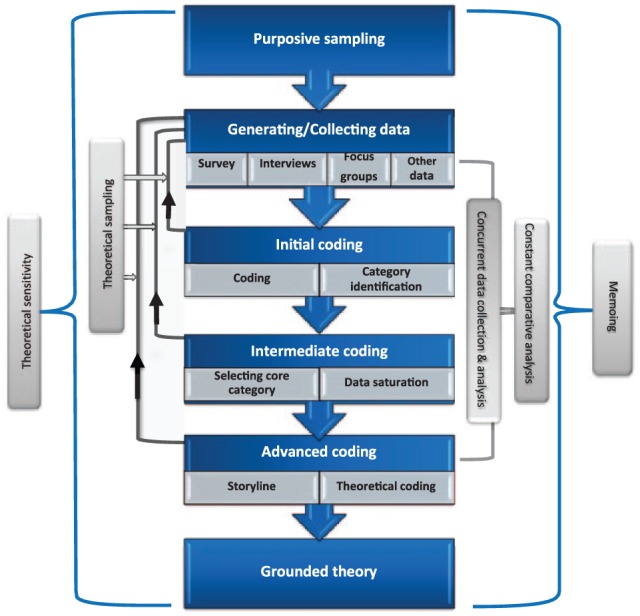
Background: Grounded theory is a well-known methodology employed in many research studies. Qualitative and quantitative data generation techniques can be used in a grounded theory study. Grounded theory sets out to discover or construct theory from data, systematically obtained and analysed using comparative analysis. While grounded theory is inherently flexible, it is a complex methodology. Thus, novice researchers strive to understand the discourse and the practical application of grounded theory concepts and processes. Objective: The aim of this article is to provide a contemporary research framework suitable to inform a grounded theory study. Result: This article provides an overview of grounded theory illustrated through a graphic representation of the processes and methods employed in conducting research using this methodology. The framework is presented as a diagrammatic representation of a research design and acts as a visual guide for the novice grounded theory researcher. Discussion: As grounded theory is not a linear process, the framework illustrates the interplay between the essential grounded theory methods and iterative and comparative actions involved. Each of the essential methods and processes that underpin grounded theory are defined in this article. Conclusion: Rather than an engagement in philosophical discussion or a debate of the different genres that can be used in grounded theory, this article illustrates how a framework for a research study design can be used to guide and inform the novice nurse researcher undertaking a study using grounded theory. Research findings and recommendations can contribute to policy or knowledge development, service provision and can reform thinking to initiate change in the substantive area of inquiry.
Overview
CoChat Summary
TL;DR
This article presents a contemporary, diagrammatic research design framework to help novice researchers visualise and apply the iterative methods and processes of grounded theory (GT). It defines the essential GT methods and processes and situates them within a non-linear, recursive design rather than debating philosophical genres.
Key findings
- GT is described as a structured yet flexible methodology appropriate when little is known about a phenomenon, aiming to produce or construct an explanatory theory grounded in data.
- Three distinct GT genres are identified: traditional/classic GT (Glaser), evolved GT (Strauss, Corbin and Clarke), and constructivist GT (Charmaz), distinguished by the researcher's philosophical position, use of literature, and approach to coding, analysis and theory development.
- Coding terminology differs by genre: traditional uses open, selective and theoretical coding; evolved uses open, axial and selective coding; constructivist uses initial, focused and theoretical coding (Table 1, adapted from Birks and Mills).
- The framework (Figure 1) depicts the interplay of purposive sampling, concurrent data generation/collection and analysis, constant comparative analysis, memoing, coding (initial, intermediate, advanced), theoretical sampling, theoretical sensitivity, and theoretical saturation, all directed toward an integrated substantive theory.
- Quality and rigour are related to three areas: the researcher's expertise, knowledge and research skills; methodological congruence with the research question; and procedural precision in the use of methods.
Methods
This is a methodological/discussion article, not an empirical study; no sample or dataset is analysed. It synthesises GT literature and prior works (notably Birks and Mills) to construct a graphic research design framework (Figure 1) and to define each essential GT method and process. The framework is presented as a visual guide for novice grounded theory researchers, illustrated with exemplars from other GT studies (Boxes 1–3).
Limitations
The paper states no formal limitations. Evident from the text: it deliberately avoids engagement in philosophical discussion or debate of the different GT genres, so it does not adjudicate between them; the framework is offered as a visual guide rather than an empirically tested model; and it is oriented specifically toward the novice nurse researcher, which may limit transferability to other disciplines or experienced researchers.
Model-written summary. Check it against the paper before relying on it.
Integrity signals
Registry
Cites
Statistics
Figures
Verification
Claims the paper makes
1 Valid · 4 Not valid · 49 Not checked · 18 Own results and interpretations
A statement the paper makes itself — it cites no source for it, so there is none to check. The quote shows it is in the paper.
In the paper
“As presented in Figure 1, initial purposive sampling directs the collection and/or generation of data.”
§ Grounded theory research: A design framework for novice researchers > Discussion > Purposive sampling
plainstates a cause- Asserted: passes — The authors put it forward as true.
- Checkable: passes — It can be checked against evidence.
- Load-bearing: passes — The paper’s conclusions depend on it.
- Based: passes — The paper gives a reason why it holds.
In the paper
“Constant comparative analysis generates increasingly more abstract concepts and theories through inductive processes.16”
§ Grounded theory research: A design framework for novice researchers > Discussion > Constant comparative analysis
What the sources say
- Not matchedcites [16] Charmaz K. Constructing grounded theory: a practical guide through qualitative analysis. Thousand Oaks, CA: SAGE, 2006.
Its entry has no title and year that we can search by.
plainstates a cause- Asserted: passes — The authors put it forward as true.
- Checkable: passes — It can be checked against evidence.
- Load-bearing: unclear — It is unclear whether the paper’s conclusions depend on it.
- Based: passes — The paper gives a reason why it holds.
- Not matched
In the paper
“Several analytic tools and techniques can be used to enhance theoretical sensitivity and increase the grounded theorist’s sensitivity to theoretical constructs in the data.28”
§ Grounded theory research: A design framework for novice researchers > Discussion > Theoretical sensitivity
What the sources say
- Not checked — no full text of the sourcecites [28] Corbin JM Strauss AL. Basics of qualitative research: techniques and procedures for developing grounded theory. 3rd ed. Thousand Oaks, CA: SAGE, 2008. source
plainstates a cause- Asserted: passes — The authors put it forward as true.
- Checkable: passes — It can be checked against evidence.
- Load-bearing: unclear — It is unclear whether the paper’s conclusions depend on it.
- Based: passes — The paper gives a reason why it holds.
In the paper
“Advanced coding that integrates extant theory adds further explanatory power to the findings.6”
§ Grounded theory research: A design framework for novice researchers > Discussion > Advanced coding
What the sources say
- Not matchedcites [6] Birks M Mills J. Grounded theory: a practical guide. 2nd ed. London: SAGE, 2015.
Its entry has no title and year that we can search by.
plainstates a cause- Asserted: passes — The authors put it forward as true.
- Checkable: passes — It can be checked against evidence.
- Load-bearing: unclear — It is unclear whether the paper’s conclusions depend on it.
- Based: passes — The paper gives a reason why it holds.
- Not matched
In the paper
“While interviews are a common method of generating data, data sources can include focus groups, questionnaires, surveys, transcripts, letters, government reports, documents, grey literature, music, artefacts, videos, blogs and memos.9”
§ Grounded theory research: A design framework for novice researchers > Discussion > Generating/collecting data
What the sources say
- Not checked — no full text of the sourcecites [9] Mills J Birks M Hoare KJ. Grounded theory. In: Mills J Birks M (eds) Qualitative methodology: a practical guide. London: SAGE, 2014, pp. 107– 121. source
plain- Asserted: passes — The authors put it forward as true.
- Checkable: passes — It can be checked against evidence.
- Load-bearing: unclear — It is unclear whether the paper’s conclusions depend on it.
- Based: passes — The paper gives a reason why it holds.
5 more claims
Create a free account to see all 72 claims and every source verdict.
- Probably not a substantial claim. 58
- It may state two separate claims as one. 17
Claims other papers make about this one
Each is checked against this paper’s own text: does it say what the citing paper says it does?
The cited source says what the claim attributes to it.
In the citing paper
“The epistemological and ontological differences principally address the proposition that theory is either discovered or co-constructed (Bryant, 2017), leading to opposing views on how the steps in the Grounded Theory method are understood (Bøttcher Berthelsen, 2018; Chun Tie, Birks and Francis, 2019; Tarozzi, 2020).”
From Application and challenges of using a Constructivist Grounded Theory methodology to address an undertheorized clinical challenge: A discussion paper (2024) · cites this paper as Chun Tie, Birks and Francis, 2019
The cited source says what the claim attributes to it.
In the citing paper
“Though the comparison of data, researchers emphasize consistencies, comprehend differences, and refine interviews, consistently comparing specific data points with others to establish categories (Bryant, 2017; Charmaz, 2014; Chun Tie et al., 2019).”
From Application and challenges of using a Constructivist Grounded Theory methodology to address an undertheorized clinical challenge: A discussion paper (2024) · cites this paper as Chun Tie et al., 2019
The cited source says what the claim attributes to it.
In the citing paper
“Nevertheless, this initial stage aims to deconstruct / fracture the data, allowing details to emerge (Bryant and Charmaz, 2019) to create the opportunity to identify both similarities and differences, pose analytical inquiries (Charmaz and Thornberg, 2021), and thereby establish to attain a more profound level of meaning (Chun Tie et al., 2019).”
From Application and challenges of using a Constructivist Grounded Theory methodology to address an undertheorized clinical challenge: A discussion paper (2024) · cites this paper as Chun Tie et al., 2019
Citations
Cites
The Discovery of Grounded Theory: Strategies for Qualitative Research.
Wagner, H. R., Glaser, B. G., & Strauss, A. L. (1968) · Social Forces · doi:10.2307/2575405 · Cited by 46,361
The Discovery of Grounded Theory; Strategies for Qualitative Research
Glaser, B. G., Strauss, A. L., & Strutzel, E. (1968) · Nursing Research · doi:10.1097/00006199-196807000-00014 · Cited by 39,449
(1998) · Sage eBooks · Cited by 38,631
Basics of Qualitative Research (3rd ed.): Techniques and Procedures for Developing Grounded Theory
Corbin, J., & Strauss, A. (2008) · SAGE · doi:10.4135/9781452230153 · Cited by 24,827
Basics of Qualitative Research: Grounded Theory Procedures and Techniques
Long, D. R., Strauss, A., & Corbin, J. (1993) · The Modern Language Journal · doi:10.2307/328955 · Cited by 17,576
Research Design: Qualitative, Quantitative, and Mixed Methods Approaches
Sloane-Seale, A. (2009) · Canadian Journal of University Continuing Education · doi:10.21225/d54s3d · Cited by 14,328
The Coding Manual for Qualitative Researchers
Lungu, M. (2022) · American Journal of Qualitative Research · doi:10.29333/ajqr/12085 · Cited by 10,826
Constructing grounded theory. A practical guide through qualitative analysis
Brink, E., Dellve, L., Hallberg, U., Abrahamsson, K. H., Klingberg, G., & Wentz, K. (2006) · International Journal of Qualitative Studies on Health and Well-being · doi:10.3402/qhw.v1i3.4932 · Cited by 6,862
(1978) · Medical Entomology and Zoology · Cited by 6,077
The Sage Handbook of Qualitative Research[1]
(2006) · Qualitative Research in Organizations and Management: An International Journal · doi:10.1108/17465640610666642 · Cited by 5,842
Research works printed but not linked: 13
- Crotty M. The foundation of social research: meaning and perspective in the research process. Thousand Oaks, CA: SAGE, 1998.
- Charmaz K. The power and potential of grounded theory. Med Sociol 2012; 6: 2– 15.
- Glaser BG. Basics of grounded theory analysis. Mill Valley, CA: Sociology Press, 1992.
- Ralph N Birks M Chapman Y. The methodological dynamism of grounded theory. Int J Qual Methods 2015; 14: 1–6.
- Bryant A Charmaz K. The Sage handbook of grounded theory. Thousand Oaks, CA: SAGE, 2007. · DOI · Paper page
- Charmaz K Bryant A. Grounded theory and credibility. In: Silverman D (ed.) Qualitative research. 3rd ed. London: SAGE, 2011, pp. 291– 309.
- Glaser BG Holton J. Remodeling grounded theory. Forum Qualitative Sozialforschung/Forum: Qualitative Social Research 2004; 5: 1– 22.
- Mackenzie N Knipe S. Research dilemmas: paradigms, methods and methodology. Issues Educ Res 2006; 16: 193– 205.
- Chamberlain-Salaun J. Consumers and the social world of health care: outsiders in the expert’s world: a grounded theory study. PhD Thesis, College of Health Care Sciences, James Cook University, Townsville, QLD, Australia, 2015, p. 198.
- Moghaddam A. Coding issues in grounded theory. Issues Educ Res 2006; 16: 53– 61.
- Evans LE. A novice researcher’s first walk through the maze of grounded theory: rationalization for classical grounded theory. Ground Theory Rev 2013; 14: 37–55.
- Glaser BG. The grounded theory perspective III: theoretical coding. Mill Valley, CA: Sociology Press, 2005.
- Baldwin A. Reconciling professional identity: a grounded theory study of nurse academics’ role modelling. PhD Thesis, College of Healthcare Sciences, James Cook University, Townsville, QLD, Australia, 2016, p. 246.
Cited by
Items 1,501–1,600 of 1,857
Trachtenberg, D. (2024) · Studia Judaica · doi:10.4467/24500100stj.24.007.19900
Minichiello, A., Wilkinson, H., Shaw, S., & Miles, A. (2024) · ASEE Annual Conference & Exposition · doi:10.18260/1-2--46789
Matthew, V., Schulz, A., Simancek, R., Telepo, E., Machesky, J. E., Willman, H., & Ismail, A. (2024) · ASEE Annual Conference & Exposition · doi:10.18260/1-2--47242 · Cited by 1
Dewa, S. (2024) · DUT Open Scholar (Durban University of Technology) · doi:10.51415/10321/5380
Sperber, E., & Wietzel, P. (2024) · Journal of Religion in Africa · doi:10.1163/15700666-12340309
Travasso, S. M., Inamdar, A., Shah, D., Nulkar, A., Ajayakumar, A., Bapat, S., Adawadkar, J., Kanade, U., Naik, S., Dabholkar, H., et al. (2024) · Journal of Psychosocial Rehabilitation and Mental Health · doi:10.1007/s40737-024-00426-y
Merced, K., Parameswaran, U., Dearden, S., Pentecost, R., & Latendresse, G. (2024) · Hispanic Health Care International · doi:10.1177/15404153241266585
Online Teacher-Student Rapport in Higher Education
Fitzgerald, J. (2024) · ISU Red - Research and eData (Illinois State University) · doi:10.30707/etd2024.20240827063556923392.999987 · Cited by 2
Lessons Learned Using Rapid Human Factors Methods at Multiple Health Care Facilities
Maddox, K. D., & Chumbler, N. R. (2024) · Proceedings of the International Symposium on Human Factors and Ergonomics in Health Care · doi:10.1177/2327857924131042
“The team used a modified grounded theory approach (Chun Tie et al., 2019) to conduct thematic analysis of the interview data.”
Sidharth, G., & Agarwal, S. (2024) · Business Perspectives and Research · doi:10.1177/22785337241264000
“The grounded theory approach is a systematic research technique to generate a theory grounded in the data collected, both qualitatively and quantitatively (Chun Tie et al., 2019).”
Findings and practical guidelines for interim leaders
Arfken, D. E., Helms, M. M., & Tanner, M. P. (2024) · SAM Advanced Management Journal · doi:10.1108/samamj-03-2024-0005
Grounded Theory as a Systematised Qualitative Research Approach
Venkatesan, K., & Prabakar, S. (2024) · Advances in library and information science (ALIS) book series · doi:10.4018/979-8-3693-1135-6.ch013
Why Do They Persist? Understanding Living Kidney Donors and PersistencePreprint
Nottingham, K. L., Klosterman, H., Prevost, O., et al. (2024) · SSRN Electronic Journal · doi:10.2139/ssrn.4971871
Rahimi‐Ardabili, H., Magrabi, F., Sanderson, B. J., Schuler, T., & Coiera, E. W. (2024) · BMC Health Services Research · doi:10.1186/s12913-024-11672-y · Cited by 1
“An axial coding approach was taken, looking at connections between categories in terms of causation, strategies, consequences, context, and related conditions [34].”
MethodIrhamni, I. (2024) · University of North Texas Digital Library (University of North Texas) · doi:10.12794/metadc2356132 · Cited by 1
The Case of Cogtong’s Timori: Features, Usage and Vitality
Malon, J. C., Rojo, J. G., Fuderanan, B., et al. (2024) · Journal of interdisciplinary perspectives · doi:10.69569/jip.2024.0463
Usher, K., Morehouse, E., Newburg-Rinn, S., Bertrand, J., & Guzman, K. G. (2024) · Journal of Public Child Welfare · doi:10.1080/15548732.2024.2412672
Developing a male-specific counselling curriculum for HIV treatment in MalawiPreprint
Mphande, M., Robson, I., Hubbard, J., Lungu, E., Chikuse, E., Phiri, K., Cornell, M., Phiri, S., Coates, T. J., & Dovel, K. L. (2024) · doi:10.12688/verixiv.83.1
Lubuzo, B., Hlongwana, K. W., & Ginindza, T. G. (2024) · South African Health Review · doi:10.61473/001c.120463
Exploring Retrospective Place Attachment Toward Foster Homes
Shorting, T., McCunn, L. J., & Sawyer, K. (2024) · Child and Adolescent Social Work Journal · doi:10.1007/s10560-024-00983-y · Cited by 1
“Indeed, the present work utilizes grounded theory to isolate themes that emerge from the data itself (as opposed to applying pre-determined themes to data) (Tie et al., 2019).”
Sulaiman, N. A. (2024) · Journal of International Communication · doi:10.1080/13216597.2024.2417093
“The approach depends on sets of comparative analyses to identify themes and patterns by comparing diverse groups and subgroups of data, leading to the development of broader concepts (Glaser and Strauss 1967; Tie, Birks, and Francis 2019).”
Sawangjaithum, K., Riewpaiboon, W., Sirirungruang, I., & Sunsern, R. (2024) · Research Square · doi:10.21203/rs.3.rs-5302190/v1
Commercial forensic interviewing in the South African context: the Ponaletso CFI framework
Graan, C. V., Roos, V., & Katjene, M. (2024) · Journal of Financial Crime · doi:10.1108/jfc-03-2024-0098
Ma, X., Gan, X., & Jiang, T. (2024) · SAGE Open · doi:10.1177/21582440241271227
“…the digital film industry; given the limited number of prior studies focusing on this industry and a smaller number of practitioners, we chose the grounded theory as a structured yet flexible approach that is appropriate to use when little is known about a phenomenon (Chun Tie et al., 2019, p.1).”
Micro-Process of Open Innovation in Megaprojects Under Sense-Making Perspective
Li, F., Liu, Q., & Fang, K. (2024) · Buildings · doi:10.3390/buildings14113464
China's Cultural Diplomacy Through BRI and Its Implications for West Asia
Yazdani, E., & Majidi, M. (2024) · Advances in public policy and administration (APPA) book series · doi:10.4018/979-8-3693-6074-3.ch014
Middle Leadership in Irish Primary Schools: A Critical Analysis of Principals’ Perspectives
O'Mahony, S. (2024) · Proceedings of the ... European conference on management, leadership and governance · doi:10.34190/ecmlg.20.1.2917
Guo, C., Chen, Y., Tian, S., & Lili, C. (2024) · Greener Journal of Educational Research · doi:10.15580/gjer.2024.1.071824096
Potensi Kewirausahaan Bidang Keperawatan dalam Pembangunan Inklusif di Indonesia
Kusumawati, A. S. (2024) · Bappenas Working Papers · doi:10.47266/bwp.v7i3.351
The Meaning of Being a ‘Good Nurse’ in the ICU During the COVID‐19 Pandemic
Haddad, A. A., Arber, A., Cox, A., & Gallagher, A. M. (2024) · Nursing Inquiry · doi:10.1111/nin.12694
Student mistreatment on the surgery clerkship: where are we now?
Bolster, D., Bhatt, N. P., & Fitzgibbons, S. (2024) · Global Surgical Education - Journal of the Association for Surgical Education · doi:10.1007/s44186-024-00323-9
Singh, M., Aparnavi, P., Dagar, R., et al. (2024) · Journal of Primary Care Specialties · doi:10.4103/jopcs.jopcs_21_24
Josa, I. (2021) · UPCommons institutional repository (Universitat Politècnica de Catalunya) · doi:10.5821/dissertation-2117-420265
Noordin, W. N. W., Sukmayadi, V., & Christi, T. V. (2024) · Asian Journal of Communication · doi:10.1080/01292986.2024.2440369 · Cited by 2
“It has gained widespread acceptance as a social science method for exploring social phenomena, human life experiences, and even humanities and communication studies (Chun Tie et al., 2019; Martin et al., 2018; Mediani, 2018).”
Sawangjaithum, K., Riewpaiboon, W., Sirirungruang, I., & Sunsern, R. (2024) · Research Square · doi:10.21203/rs.3.rs-5456673/v1
Ambrose, N., Amin, A., Anderson, B., et al. (2024) · Data & Policy · doi:10.1017/dap.2024.77
“Inductive coding methods were applied using grounded theory approach, an inductive coding approach to describing phenomena, to qualitatively assess and categorize questionnaire and interview data (Chun Tie et al., 2019).”
Karmakar, M., Panduragan, S. L., & -, F. B. S. (2024) · International Journal For Multidisciplinary Research · doi:10.36948/ijfmr.2024.v06i06.33257
“This type of sampling approach can obtain the qualities (opinions/experiences) of the specific demographic group (Chun Tie et al., 2019; Kandi, 2022).”
Maloney, T. (2024) · Race Ethnicity and Education · doi:10.1080/13613324.2024.2446208 · Cited by 1
“Grounded theory ‘is appropriate when little is known about a phenomenon; the aim being to produce or construct an explanatory theory . . . grounded in the data (Chun Tie, Birks, and Francis 2019, 1)’.”
Javadipour, M., & Rahimi, S. (2024) · Culture, education and future. · doi:10.70116/2980274130
Transferability of the Surgical Attire Guideline Adherence Decision‐Making Theory Beyond New England
Mayes, C. G., & Adams, J. (2024) · AORN Journal · doi:10.1002/aorn.14264
West, K. P., Pauley, A., Buono, M., Mikindo, M., Sawe, Y., Kilasara, J., Sakita, F. M., Rent, S. M., Mchome, B. L., Mmbaga, B. T., et al. (2024) · PLOS Global Public Health · doi:10.1371/journal.pgph.0003681 · Cited by 3
Charmant, W. M., Snoeker, B. A. M., van Hout, H. P. J., Nauta, I. H., Boonstra, F., Geleijn, E., Veenhof, C., & Nanayakkara, P. W. B. (2024) · PLoS ONE · doi:10.1371/journal.pone.0314855 · Cited by 3
Im, D. S., Brelje, A. B., Raghunandan, C., Stchur, L., Lyden, A., Hong, A., & Bornheimer, L. A. (2025) · Journal of Medical Education and Curricular Development · doi:10.1177/23821205241310846
Bolajoko, O. O., Fathi, P., Fulwood, D. D., et al. (2025) · JCO Global Oncology · doi:10.1200/go-24-00475
Mussack, B., & Tham, J. C. K. (2024) · Communication Design Quarterly · doi:10.1145/3563890.3713034
“We took a grounded-theory approach but modified it with iterative analysis approach (Tie et al., 2019) to make sense of the data collected both from the student survey and the instructor questionnaire.”
Mussack, B., & Tham, J. C. K. (2024) · Communication Design Quarterly · doi:10.1145/3627691.3627693
Srour, M. L., Ali, S., Hodge, M., Kwobah, C. M., McHenry, M. S., Etling, M. A., Nafiseh, A. A., Prohaska, C. C., Khan, B. A., & Navuluri, N. (2025) · medRxiv · doi:10.1101/2025.01.23.25321025
Hunter, A. M. (2021) · University of North Texas Digital Library (University of North Texas) · doi:10.12794/metadc1873785
Horton, A., Flenady, T., & Massey, D. L. (2025) · SSRN Electronic Journal · doi:10.2139/ssrn.5112519 · Cited by 1
“I Had to Make it Safe in My Mind”: Strategizing and Harm Insulation Among Sexual Assault Survivors
Harris, A. N., Shaw, J., & Bailey, C. (2025) · Sexuality Research and Social Policy · doi:10.1007/s13178-025-01085-9 · Cited by 3
Sanderson, B. (2020) · University of North Texas Digital Library (University of North Texas) · doi:10.12794/metadc1707347
Srour, M. L., Ali, S., Hodge, M., Kwobah, C. M., McHenry, M. S., Etling, M. A., Nafiseh, A. A., Prohaska, C. C., Khan, B., & Navuluri, N. (2025) · Cureus · doi:10.7759/cureus.78980
“Participants were recruited using purposive sampling of all patient-facing members of the GIM teams on the wards at the conclusion of morning rounds or as pre-arranged meetings [13].”
Exploring the School Innovation Ecosystem in Nurturing Student Innovators of Tomorrow
Tanprasertkul, S., & Tep, P. (2024) · International Conference on Business and Industrial Research (ICBIR) · doi:10.1109/icbir61386.2024.10875729
“Therefore, the Grounded Theory (GT) method was employed, which was established to explore new concepts and develop new theories by inductively analyzing data in a specific context grounded in participants’ experience and perceptions [24].”
Balthip, K., Phoomchaiya, S., Nudla, P., Suwanruangsri, S., Lanwong, T., Kitrenu, P., Butimal, P., & Songwathana, P. (2025) · Pacific Rim International Journal of Nursing Research · doi:10.60099/prijnr.2025.270708 · Cited by 1
“23,24 In addition, the Consolidated Criteria for Reporting Qualitative Research (COREQ) checklist was employed to direct the writing of this study.”
Remembering the Dead: What Community Newspaper Memorials Reveal
Wilson, D. M., Grainger, B., Fonteyne, H., Heron, J. E., Fiore, C., Rainsford, S., & Errasti‐Ibarrondo, B. (2025) · Journal of Social Work in End-of-Life & Palliative Care · doi:10.1080/15524256.2025.2469685
“The memorial texts were analyzed in keeping with standard qualitative data analysis practices to identify key words, phrases, and concepts (Tie et al., 2019).”
Shaikh, D., Bhalerao, H., & Simon, A. (2025) · Journal of Lifestyle and SDGs Review · doi:10.47172/2965-730x.sdgsreview.v5.n03.pe05414
“This approach successfully captured subtle points of view about the interaction among social, cultural, and organizational factors in reactions to coming out (Chun Tie, Birks, & Francis, 2019).”
Shak, E. B., Berry, L., Chow, B., Abramowitz, S., & Mehta, K. M. (2025) · BMC Medical Education · doi:10.1186/s12909-024-06524-6
“As one health coach noted, “…my relationships 1) [38].”
Perspectives of community-based peer recovery specialists: systems integration and challenges
Atwood, K. A., Ali, B., Sangpukdee, A., Andrews, E. E., Park, A., Appel, A., Albrecht, W., & Beyene, H. (2025) · Journal of Social Work Practice in the Addictions · doi:10.1080/1533256x.2025.2475030
“Coders first engaged in Initial Coding, defined as line-by-line coding to assign labels to significant portions of the data, and then Focused Coding described as selecting, collapsing, and narrowing down categories (Chun Tie et al., 2019) to arrive at a coding dictionary.”
Sithaldeen, R., August, L., Phetlhu, O., & Kokolo, B. (2025) · New Directions for Higher Education · doi:10.1002/he.20527 · Cited by 6
Pre-admission undergraduate students' prior understanding of academic libraries in Sri Lanka
Bodhinayaka, D., Jamali, H. R., Hider, P. M., & Carroll, M. B. (2025) · The Journal of Academic Librarianship · doi:10.1016/j.acalib.2025.103029 · Cited by 1
“Don’t Just Collect Words”: Strategies for Advanced Indigenous Language Learning
Benson, N. (2024) · Canadian Journal of Applied Linguistics · doi:10.37213/cjal.2024.33396
Maras, S. A., Carthron, D., Irwin, A. K., Ammerman, A. S., Shaikh, S. R., & Mayer-Davis, E. J. (2025) · American Journal of Clinical Nutrition · doi:10.1016/j.ajcnut.2025.03.013
Liu, V. N., Johnson, H. H., Huang, D. R., et al. (2025) · Research Square · doi:10.21203/rs.3.rs-6261097/v1
Lefkowitz, D. (2025) · Critical Social Policy · doi:10.1177/02610183251324117
“My selection of participants was guided by concepts that emerged from the data rather than established in advance of data collection (Charmaz, 1990; Chun Tie et al., 2019).”
Dunne, J., Ryan, S., & Egan, J. (2024) · Cyber Research Conference - Ireland (Cyber-RCI) · doi:10.1109/cyber-rci60769.2024.10939649
“Grounded theory is a qualitative research methodology developed in the 1960s in the field of sociology by Glaser and Strauss and is an inductive approach to theory development that aims to generate theories directly from the data [21].”
Puffer, K. A., & Brooks, R. (2025) · Religions · doi:10.3390/rel16040468
Qualitative research methodology: approaches for nutrition research
Kempen, E. L. (2025) · South African Journal of Clinical Nutrition · doi:10.1080/16070658.2025.2480431 · Cited by 4
“5,16 The approach is useful when little is known about a phenomenon, 16 allowing researchers to identify steps or phases of the process or action over time 5 that can contribute to new concepts in the field of nutrition.”
Sullivan, A., Neptune, L., & McNamara, J. (2025) · Journal of Human Nutrition and Dietetics · doi:10.1111/jhn.70048
Moisan, M.-G., Chatterjee, A., So, M., Ma, C. T., Hart, J. A., Xiong, S., & Mason, M. (2025) · Children and Youth Services Review · doi:10.1016/j.childyouth.2025.108279
Implementation of Corruption Mitigation Strategies by Public Sector Leadership in Sierra Leone
Sam, S. B., & Thompson, E. H. (2025) · Journal of Strategic Innovation and Sustainability · doi:10.33423/jsis.v20i1.7596
“…has an interpretive underpinning (Nigar, 2020), the grounded theory approach is suitable for discovering unknown information about a phenomenon (Chun Tie et al., 2019), the case study approach, looks at the reality of a phenomenon in a specific context (Ridder, 2017).and ethnography involves…”
Ylimmän johdon näkemyksiä etäjohtamisen mahdollisuuksista ja haasteista IT-palveluyrityksissä
Koponen, J. P., & Salin, L. (2025) · Hallinnon Tutkimus · doi:10.37450/ht.143644 · Cited by 12
Unmet Needs of Palliative Cancer Patients: A Grounded Theory Study
Basile, I., Consolo, L., Bellani, A., Rusconi, D., Zappata, S., Caraceni, A. T., & Lusignani, M. (2025) · American Journal of Hospice and Palliative Medicine® · doi:10.1177/10499091251336452
“34 It uses an inductive-abductive logic, involving an iterative process where researchers move back and forth be-tween data.”
A Qualitative Examination of Harbour Development Projects as a Way of Adapting to Climate Change
Rodrigo, N., Mannakkara, S., Newport, C., & Mankelow, C. (2025) · Advances in global change research · doi:10.1007/978-3-031-85359-3_15
Hadisuyatmana, S., Malik, G., Efendi, F., Reisenhofer, S., & Boyd, J. (2025) · Discover Public Health · doi:10.1186/s12982-025-00590-x · Cited by 2
“The fractured data were then read ‘Line-by-line,’ analysed, and compared with other incidents to identify patterns, similarities, and differences [36, 43].”
InfluentialMohamed-Saleem, A., & Osman, I. I. (2025) · Edward Elgar Publishing eBooks · doi:10.4337/9781035333585.00019 · Cited by 1
Boissaud-Cooke, M. A., Yatham, S. S., Hardy, L. J., Higginson, I. N., Thurlow, J., & Schofield, P. (2025) · BMJ Open · doi:10.1136/bmjopen-2024-097320
“Page 8, Line 182–197: Recruitment challenges for Generation X participants are noted but could be addressed further, and targeted recruitment strategies could be expanded – as this may be the greatest threat to the study.”
A grounded theory of Creating Connection between peer support workers and clients
Perry, S., Choi, J., & Jackson, J. (2025) · Archives of Psychiatric Nursing · doi:10.1016/j.apnu.2025.151884
Saini, P., & Pandit, D. (2025) · Transportation research procedia · doi:10.1016/j.trpro.2025.04.024
Reimagining pharmacy processes for expanding hospital at‐home care in Singapore: A qualitative study
Lee, B.-L., Syn, H., Ng, V., et al. (2025) · JACCP JOURNAL OF THE AMERICAN COLLEGE OF CLINICAL PHARMACY · doi:10.1002/jac5.70051
Biologically Sustainable Cyber-Physical Spaces: A Systematic Literature Review
Sangiovanni, M., Manias, G., & van den Heuvel, W. (2025) · Lecture notes of the Institute for Computer Sciences, Social Informatics and Telecommunications Engineering · doi:10.1007/978-3-031-89363-6_19
Watkins, S., Brown, R., Crengle, S. M., Percival, T., & Ward, K. L. (2025) · International Journal of Qualitative Methods · doi:10.1177/16094069251335447
“All sources of data were coded according to GT methods (Birks & Mills, 2015; Chun Tie et al., 2019; Glaser et al., 1967).”
Developing a male-specific counselling curriculum for HIV treatment in MalawiPreprint
Mphande, M., Robson, I., Hubbard, J., Lungu, E., Chikuse, E., Phiri, K., Cornell, M., Phiri, S., Coates, T. J., & Dovel, K. L. (2025) · doi:10.12688/verixiv.83.3 · Cited by 1
Community Belonging: Experiences of Outsiderness in Appalachia
Hudnall, E. B. (2025) · The Research Repository @ WVU (West Virginia University) · doi:10.33915/etd.12767
Metacognitive awareness among doctor of physical therapy students: A mixed-methods investigation
Hartstein, A. J., Barrette, D., Chicarella, M., & Fergus, A. (2025) · Physiotherapy Theory and Practice · doi:10.1080/09593985.2025.2514119 · Cited by 1
“Consistent with the constructivist grounded theory approach, an iterative comparative analysis was used to enhance theoretical sensitivity (Birks and Mills, 2015; Chun Tie, Birks, and Francis, 2019).”
Cops and hotlists: Balancing security and privacy with ALPR technology
Nhan, J., & Helfers, R. C. (2025) · The Police Journal Theory Practice and Principles · doi:10.1177/0032258x251349633
“Speci fi cally, this study employed a grounded theory approach to allow the data to aid in constructing theories and themes to allow for fl exibility and holistic understanding of the processes (See Tie et al., 2019).”
Goubran, D., Ratnayake, I., Hebbard, P. C., Park, C., Darbandi, M. F., Decker, K., & Delisle, M. E. (2025) · Annals of Surgery Open · doi:10.1097/as9.0000000000000585
“12,13 Two members of the research team coded and analyzed the transcripts.”
Wong, R., Borgert, B. J., Matulewicz, R. S., Goldstein, A. O., Shoenbill, K. A., & Bjurlin, M. A. (2025) · Tobacco Use Insights · doi:10.1177/1179173x251355758
“13 Therefore, sample size was determined by thematic saturation rather than power calculation.”
Delgama, D., Galvin, K. L., Gray, K. M., & Leigh, J. (2025) · Cochlear Implants International · doi:10.1080/14670100.2025.2520674 · Cited by 1
“Therefore, a grounded approach was used, in which different thematic ideas were extracted from the results without relying on any pre-existing concepts (Chun Tie et al., 2019).”
Realizing a carbon-neutral healthcare system: a co-created Theory of Change in Catalonia, Spain
Zotova, O., Sazdovski, I., Martinez, M. A., Dasandi, N., Oliva, C., Rovira, J., Blasco, C. I., de'Donato, F. K., Roychoudhury, M., Chen-Xu, J., et al. (2025) · Oxford Open Climate Change · doi:10.1093/oxfclm/kgaf018 · Cited by 3
Klaus, N. M., English, E., Lewis, E., Camp, J., Krogman, S., & Harris, K. (2025) · Children · doi:10.3390/children12070910
Molokomme, R. T. (2025) · International Journal of Research in Business and Social Science (2147-4478) · doi:10.20525/ijrbs.v14i4.4092 · Cited by 2
“According to Chun et al. (2019) novice researchers can also engage in theoretical discussions through academic forums, research networks, or doctoral seminars to refine their understanding of theoretical shortcomings.”
Niedbalski, J. (2025) · International Journal of Developmental Disabilities · doi:10.1080/20473869.2025.2533928
Alessi, E. J., Alexander, L. M., Zuch, M. T., et al. (2025) · Sociology Compass · doi:10.1111/soc4.70086
Clark, M., Beattie, R., & Inkster, T. (2025) · Journal of Hospital Infection · doi:10.1016/j.jhin.2025.06.017
Panda, R., & Nair, J. (2025) · Cureus Journal of Business and Economics. · doi:10.7759/s44404-025-04436-2
“By the constant comparison technique, a key data analysis process is important as GT is not a linear process but an iterative one (Chun Tie et al., 2019), so that the researchers can narrow down the categories, which helps in crystallizing the categories.”
A Knowledge Graph-Based Approach to Enhancing Grounded Theory ResearchPreprint
Song, H., & Wu, Q. (2025) · Research Square · doi:10.21203/rs.3.rs-6433331/v1
A Systematic Approach to Assess Languages Proposed for Rules as CodePreprint
Ali, S., Sileno, G., & van Engers, T. (2025) · SSRN Electronic Journal · doi:10.2139/ssrn.5359159
Metadata
- Authors
- Chun Tie, Y., Birks, M., & Francis, K.
- Affiliations
- Nursing and Midwifery, College of Healthcare Sciences, James Cook University, Townsville, QLD, Australia
- James Cook University (AU)
- University of Tasmania (AU)
- Venue
- SAGE Open Medicine
- Publisher
- SAGE Publications
- Published
- 2019-01
- Volume
- 7
- Pages
- 2050312118822927-2050312118822927
- ISSN
- 2050-3121 (ISSN-L)
- PMC
- PMC6318722
- OpenAlex
- W2906994370
- Cited by
- 1,869
- References
- 29
- Citations by year
- 2026: 200 · 2025: 285 · 2024: 370 · 2023: 370 · 2022: 302 · 2021: 226 · 2020: 108 · 2019: 8
- FWCI
- 433.86
- Type
- journal article
- Language
- en
- Open access
- gold
- doi.org
- Licence
- cc-by-nc
- journals.sagepub.com/page/policies/text-and-data-mining-license (tdm)
- Locations
- SAGE Open Medicine (publishedVersion, cc-by-nc)
- Europe PMC (PubMed Central) (publishedVersion, cc-by-nc)
- PubMed Central (publishedVersion, cc-by-nc)
- PubMed (publishedVersion)
- UTAS Research Repository (acceptedVersion)
- ResearchOnline at James Cook University (James Cook University) (submittedVersion)
- DOAJ (DOAJ: Directory of Open Access Journals) (submittedVersion, cc-by-sa)
- Figshare (submittedVersion, cc-by-nc)
- Topics
- Social Sciences › Education › Qualitative Research Methods and Applications
- Health Sciences › Nursing › Research and Theory › Methodologies in Health Research and Practice
- Social Sciences › Education › Educational Research and Methods
- Keywords
- grounded theory, research design framework, novice researchers, nurse researchers, qualitative research methodology, comparative analysis
About these checks
Registry, retraction, Cites and statistics results are computed, not judged, with one exception: a printed reference that no index lists is read once by a model before it counts as a citation error. Claims are extracted by a model and kept only when their quote appears verbatim in the text; each cited source is then checked, with a model’s help, for whether it says what the claim relies on. Those verdicts can be wrong — read the claim’s quote and the cited source before relying on one.
The claim verdicts this report counts are experimental: their accuracy is not yet measured.
A language model drew the claims from the paper on 2026-10-10, under version 3 of the claim definition (model deepseek-v4.1-flash, prompt extract-v3).
A second model labelled each claim on 2026-10-10 (model jev-1.13-20260917, definition revision gold-guideline-v0.2).
Statistics and arithmetic are recomputed, not judged.
Confidence bands are shown only for fields calibrated on our annotated test set. None is calibrated yet, so no band is shown.
What counts as a claim ›How we measure confidence ›How we check this ›
Are you an author, or do you see a problem with this page? Request a review
Data sources
Bibliographic data: Semantic Scholar, OpenAlex, Crossref.
Contains information from the Semantic Scholar Academic Graph Datasets, made available under the ODC Attribution License (ODC-BY 1.0).
Semantic Scholar’s data is described in: Kinney, R., et al. (2023). The Semantic Scholar Open Data Platform. arXiv:2301.10140.
