

Grounded theory research: A design framework for novice researchers
Open accessThe DOI matches its Crossref record; 30 of the 33 references it cites were found in a registry or an index; 2 of the 69 sources its claims cite were checked for support.
Abstract
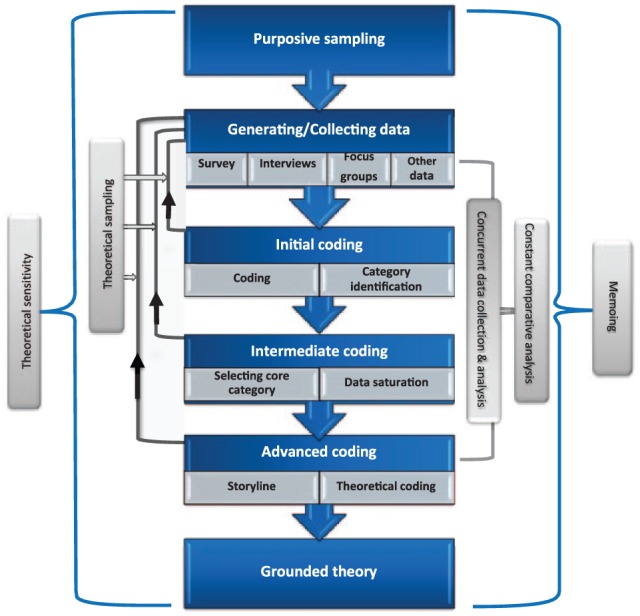
Background: Grounded theory is a well-known methodology employed in many research studies. Qualitative and quantitative data generation techniques can be used in a grounded theory study. Grounded theory sets out to discover or construct theory from data, systematically obtained and analysed using comparative analysis. While grounded theory is inherently flexible, it is a complex methodology. Thus, novice researchers strive to understand the discourse and the practical application of grounded theory concepts and processes. Objective: The aim of this article is to provide a contemporary research framework suitable to inform a grounded theory study. Result: This article provides an overview of grounded theory illustrated through a graphic representation of the processes and methods employed in conducting research using this methodology. The framework is presented as a diagrammatic representation of a research design and acts as a visual guide for the novice grounded theory researcher. Discussion: As grounded theory is not a linear process, the framework illustrates the interplay between the essential grounded theory methods and iterative and comparative actions involved. Each of the essential methods and processes that underpin grounded theory are defined in this article. Conclusion: Rather than an engagement in philosophical discussion or a debate of the different genres that can be used in grounded theory, this article illustrates how a framework for a research study design can be used to guide and inform the novice nurse researcher undertaking a study using grounded theory. Research findings and recommendations can contribute to policy or knowledge development, service provision and can reform thinking to initiate change in the substantive area of inquiry.
Overview
CoChat Summary
TL;DR
This article presents a contemporary, diagrammatic research design framework to help novice researchers visualise and apply the iterative methods and processes of grounded theory (GT). It defines the essential GT methods and processes and situates them within a non-linear, recursive design rather than debating philosophical genres.
Key findings
- GT is described as a structured yet flexible methodology appropriate when little is known about a phenomenon, aiming to produce or construct an explanatory theory grounded in data.
- Three distinct GT genres are identified: traditional/classic GT (Glaser), evolved GT (Strauss, Corbin and Clarke), and constructivist GT (Charmaz), distinguished by the researcher's philosophical position, use of literature, and approach to coding, analysis and theory development.
- Coding terminology differs by genre: traditional uses open, selective and theoretical coding; evolved uses open, axial and selective coding; constructivist uses initial, focused and theoretical coding (Table 1, adapted from Birks and Mills).
- The framework (Figure 1) depicts the interplay of purposive sampling, concurrent data generation/collection and analysis, constant comparative analysis, memoing, coding (initial, intermediate, advanced), theoretical sampling, theoretical sensitivity, and theoretical saturation, all directed toward an integrated substantive theory.
- Quality and rigour are related to three areas: the researcher's expertise, knowledge and research skills; methodological congruence with the research question; and procedural precision in the use of methods.
Methods
This is a methodological/discussion article, not an empirical study; no sample or dataset is analysed. It synthesises GT literature and prior works (notably Birks and Mills) to construct a graphic research design framework (Figure 1) and to define each essential GT method and process. The framework is presented as a visual guide for novice grounded theory researchers, illustrated with exemplars from other GT studies (Boxes 1–3).
Limitations
The paper states no formal limitations. Evident from the text: it deliberately avoids engagement in philosophical discussion or debate of the different GT genres, so it does not adjudicate between them; the framework is offered as a visual guide rather than an empirically tested model; and it is oriented specifically toward the novice nurse researcher, which may limit transferability to other disciplines or experienced researchers.
Model-written summary. Check it against the paper before relying on it.
Integrity signals
Registry
Cites
Statistics
Figures
Verification
Claims the paper makes
1 Valid · 4 Not valid · 49 Not checked · 18 Own results and interpretations
A statement the paper makes itself — it cites no source for it, so there is none to check. The quote shows it is in the paper.
In the paper
“As presented in Figure 1, initial purposive sampling directs the collection and/or generation of data.”
§ Grounded theory research: A design framework for novice researchers > Discussion > Purposive sampling
plainstates a cause- Asserted: passes — The authors put it forward as true.
- Checkable: passes — It can be checked against evidence.
- Load-bearing: passes — The paper’s conclusions depend on it.
- Based: passes — The paper gives a reason why it holds.
In the paper
“Constant comparative analysis generates increasingly more abstract concepts and theories through inductive processes.16”
§ Grounded theory research: A design framework for novice researchers > Discussion > Constant comparative analysis
What the sources say
- Not matchedcites [16] Charmaz K. Constructing grounded theory: a practical guide through qualitative analysis. Thousand Oaks, CA: SAGE, 2006.
Its entry has no title and year that we can search by.
plainstates a cause- Asserted: passes — The authors put it forward as true.
- Checkable: passes — It can be checked against evidence.
- Load-bearing: unclear — It is unclear whether the paper’s conclusions depend on it.
- Based: passes — The paper gives a reason why it holds.
- Not matched
In the paper
“Several analytic tools and techniques can be used to enhance theoretical sensitivity and increase the grounded theorist’s sensitivity to theoretical constructs in the data.28”
§ Grounded theory research: A design framework for novice researchers > Discussion > Theoretical sensitivity
What the sources say
- Not checked — no full text of the sourcecites [28] Corbin JM Strauss AL. Basics of qualitative research: techniques and procedures for developing grounded theory. 3rd ed. Thousand Oaks, CA: SAGE, 2008. source
plainstates a cause- Asserted: passes — The authors put it forward as true.
- Checkable: passes — It can be checked against evidence.
- Load-bearing: unclear — It is unclear whether the paper’s conclusions depend on it.
- Based: passes — The paper gives a reason why it holds.
In the paper
“Advanced coding that integrates extant theory adds further explanatory power to the findings.6”
§ Grounded theory research: A design framework for novice researchers > Discussion > Advanced coding
What the sources say
- Not matchedcites [6] Birks M Mills J. Grounded theory: a practical guide. 2nd ed. London: SAGE, 2015.
Its entry has no title and year that we can search by.
plainstates a cause- Asserted: passes — The authors put it forward as true.
- Checkable: passes — It can be checked against evidence.
- Load-bearing: unclear — It is unclear whether the paper’s conclusions depend on it.
- Based: passes — The paper gives a reason why it holds.
- Not matched
In the paper
“While interviews are a common method of generating data, data sources can include focus groups, questionnaires, surveys, transcripts, letters, government reports, documents, grey literature, music, artefacts, videos, blogs and memos.9”
§ Grounded theory research: A design framework for novice researchers > Discussion > Generating/collecting data
What the sources say
- Not checked — no full text of the sourcecites [9] Mills J Birks M Hoare KJ. Grounded theory. In: Mills J Birks M (eds) Qualitative methodology: a practical guide. London: SAGE, 2014, pp. 107– 121. source
plain- Asserted: passes — The authors put it forward as true.
- Checkable: passes — It can be checked against evidence.
- Load-bearing: unclear — It is unclear whether the paper’s conclusions depend on it.
- Based: passes — The paper gives a reason why it holds.
5 more claims
Create a free account to see all 72 claims and every source verdict.
- Probably not a substantial claim. 58
- It may state two separate claims as one. 17
Claims other papers make about this one
Each is checked against this paper’s own text: does it say what the citing paper says it does?
The cited source says what the claim attributes to it.
In the citing paper
“The epistemological and ontological differences principally address the proposition that theory is either discovered or co-constructed (Bryant, 2017), leading to opposing views on how the steps in the Grounded Theory method are understood (Bøttcher Berthelsen, 2018; Chun Tie, Birks and Francis, 2019; Tarozzi, 2020).”
From Application and challenges of using a Constructivist Grounded Theory methodology to address an undertheorized clinical challenge: A discussion paper (2024) · cites this paper as Chun Tie, Birks and Francis, 2019
The cited source says what the claim attributes to it.
In the citing paper
“Though the comparison of data, researchers emphasize consistencies, comprehend differences, and refine interviews, consistently comparing specific data points with others to establish categories (Bryant, 2017; Charmaz, 2014; Chun Tie et al., 2019).”
From Application and challenges of using a Constructivist Grounded Theory methodology to address an undertheorized clinical challenge: A discussion paper (2024) · cites this paper as Chun Tie et al., 2019
The cited source says what the claim attributes to it.
In the citing paper
“Nevertheless, this initial stage aims to deconstruct / fracture the data, allowing details to emerge (Bryant and Charmaz, 2019) to create the opportunity to identify both similarities and differences, pose analytical inquiries (Charmaz and Thornberg, 2021), and thereby establish to attain a more profound level of meaning (Chun Tie et al., 2019).”
From Application and challenges of using a Constructivist Grounded Theory methodology to address an undertheorized clinical challenge: A discussion paper (2024) · cites this paper as Chun Tie et al., 2019
Citations
Cites
The Discovery of Grounded Theory: Strategies for Qualitative Research.
Wagner, H. R., Glaser, B. G., & Strauss, A. L. (1968) · Social Forces · doi:10.2307/2575405 · Cited by 46,361
The Discovery of Grounded Theory; Strategies for Qualitative Research
Glaser, B. G., Strauss, A. L., & Strutzel, E. (1968) · Nursing Research · doi:10.1097/00006199-196807000-00014 · Cited by 39,449
(1998) · Sage eBooks · Cited by 38,631
Basics of Qualitative Research (3rd ed.): Techniques and Procedures for Developing Grounded Theory
Corbin, J., & Strauss, A. (2008) · SAGE · doi:10.4135/9781452230153 · Cited by 24,827
Basics of Qualitative Research: Grounded Theory Procedures and Techniques
Long, D. R., Strauss, A., & Corbin, J. (1993) · The Modern Language Journal · doi:10.2307/328955 · Cited by 17,576
Research Design: Qualitative, Quantitative, and Mixed Methods Approaches
Sloane-Seale, A. (2009) · Canadian Journal of University Continuing Education · doi:10.21225/d54s3d · Cited by 14,328
The Coding Manual for Qualitative Researchers
Lungu, M. (2022) · American Journal of Qualitative Research · doi:10.29333/ajqr/12085 · Cited by 10,826
Constructing grounded theory. A practical guide through qualitative analysis
Brink, E., Dellve, L., Hallberg, U., Abrahamsson, K. H., Klingberg, G., & Wentz, K. (2006) · International Journal of Qualitative Studies on Health and Well-being · doi:10.3402/qhw.v1i3.4932 · Cited by 6,862
(1978) · Medical Entomology and Zoology · Cited by 6,077
The Sage Handbook of Qualitative Research[1]
(2006) · Qualitative Research in Organizations and Management: An International Journal · doi:10.1108/17465640610666642 · Cited by 5,842
Research works printed but not linked: 13
- Crotty M. The foundation of social research: meaning and perspective in the research process. Thousand Oaks, CA: SAGE, 1998.
- Charmaz K. The power and potential of grounded theory. Med Sociol 2012; 6: 2– 15.
- Glaser BG. Basics of grounded theory analysis. Mill Valley, CA: Sociology Press, 1992.
- Ralph N Birks M Chapman Y. The methodological dynamism of grounded theory. Int J Qual Methods 2015; 14: 1–6.
- Bryant A Charmaz K. The Sage handbook of grounded theory. Thousand Oaks, CA: SAGE, 2007. · DOI · Paper page
- Charmaz K Bryant A. Grounded theory and credibility. In: Silverman D (ed.) Qualitative research. 3rd ed. London: SAGE, 2011, pp. 291– 309.
- Glaser BG Holton J. Remodeling grounded theory. Forum Qualitative Sozialforschung/Forum: Qualitative Social Research 2004; 5: 1– 22.
- Mackenzie N Knipe S. Research dilemmas: paradigms, methods and methodology. Issues Educ Res 2006; 16: 193– 205.
- Chamberlain-Salaun J. Consumers and the social world of health care: outsiders in the expert’s world: a grounded theory study. PhD Thesis, College of Health Care Sciences, James Cook University, Townsville, QLD, Australia, 2015, p. 198.
- Moghaddam A. Coding issues in grounded theory. Issues Educ Res 2006; 16: 53– 61.
- Evans LE. A novice researcher’s first walk through the maze of grounded theory: rationalization for classical grounded theory. Ground Theory Rev 2013; 14: 37–55.
- Glaser BG. The grounded theory perspective III: theoretical coding. Mill Valley, CA: Sociology Press, 2005.
- Baldwin A. Reconciling professional identity: a grounded theory study of nurse academics’ role modelling. PhD Thesis, College of Healthcare Sciences, James Cook University, Townsville, QLD, Australia, 2016, p. 246.
Cited by
Alaslan, A. (2024) · doi:10.31237/osf.io/smrbh · Cited by 422
Pragmatic approaches to analyzing qualitative data for implementation science: an introduction
Ramanadhan, S., Revette, A. C., Lee, R. M., & Aveling, E. L. (2021) · Implementation Science Communications · doi:10.1186/s43058-021-00174-1 · Cited by 280
Understanding Drivers of Coronavirus Disease 2019 Vaccine Hesitancy Among Blacks
Momplaisir, F., Haynes, N., Nkwihoreze, H., Nelson, M., Werner, R. M., & Jemmott, J. (2021) · Clinical Infectious Diseases · doi:10.1093/cid/ciab102 · Cited by 210
“We used a modified grounded theory approach to develop a coding structure that included major themes from a close reading of the transcripts [11].”
Creativity and artificial intelligence—a student perspective
Marrone, R., Taddeo, V., & Hill, G. (2022) · Journal of Intelligence · doi:10.3390/jintelligence10030065 · Cited by 208
Obesity and Its Related Diseases: A New Escalating Alarming in Global Health
Mohajan, D., & Mohajan, H. K. (2023) · Journal of Innovations in Medical Research · doi:10.56397/jimr/2023.03.04 · Cited by 179
Factors influencing data saturation in qualitative studies
Mwita, K. (2022) · International Journal of Research in Business and Social Science (2147- 4478) · doi:10.20525/ijrbs.v11i4.1776 · Cited by 166
Joo, J. H., Bone, L., Forte, J., Kirley, E., Lynch, T., & Aboumatar, H. (2022) · Family Practice · doi:10.1093/fampra/cmac004 · Cited by 162
Clinical competence in nursing: A hybrid concept analysis
Nabizadeh‐Gharghozar, Z., Alavi, N. M., & Ajorpaz, N. M. (2020) · Nurse Education Today · doi:10.1016/j.nedt.2020.104728 · Cited by 208
Stewart, J., Garrido, S., Hense, C., & McFerran, K. S. (2019) · Frontiers in Psychology · doi:10.3389/fpsyg.2019.01199 · Cited by 163
“Through processes of coding, constant comparison and abstraction of concepts from data categories, a conceptual hypothesis or theory can be developed (Chun Tie et al., 2019).”
BackgroundBegum, T., Khan, S. M., Adamou, B., Ferdous, J., Parvez, M. M., Islam, M. S., Kumkum, F. A., Rahman, A., & Anwar, I. (2020) · BMC Health Services Research · doi:10.1186/s12913-020-05322-2 · Cited by 130
Instructional designers’ roles in emergency remote teaching during COVID-19
Xie, J., A, G., & Rice, M. F. (2021) · Distance Education · doi:10.1080/01587919.2020.1869526 · Cited by 119
Why is Anatomy Difficult to Learn? The Implications for Undergraduate Medical Curricula
Cheung, C. C., Bridges, S., & Tipoe, G. L. (2021) · Anatomical Sciences Education · doi:10.1002/ase.2071 · Cited by 140
Messiha, K., Chinapaw, M. J. M., Ket, J. C. F., An, Q., Anand-Kumar, V., Longworth, G. R., CHASTIN, S. F. M., & Altenburg, T. M. (2023) · Journal of Public Health · doi:10.1093/pubmed/fdad046 · Cited by 133
“25,26”
Rawal, L. B., Kanda, K., Biswas, T., Tanim, M. I., Poudel, P., Renzaho, A. M. N., Abdullah, A. S. M., Islam, S. M. S., & Ahmed, S. M. (2019) · BMJ Open · doi:10.1136/bmjopen-2019-029562 · Cited by 111
Antecedents of unfinished nursing care: a systematic review of the literature
Chiappinotto, S., Papastavrou, E., Efstathiou, G., Andreou, P., Stemmer, R., Ströhm, C., Schubert, M., de Wolf‐Linder, S., Longhini, J., & Palese, A. (2022) · BMC Nursing · doi:10.1186/s12912-022-00890-6 · Cited by 125
Matthews, K., Morgan, I., Davis, K., Estriplet, T., Perez, S., & Crear-Perry, J. A. (2021) · Health Affairs · doi:10.1377/hlthaff.2021.00808 · Cited by 98
Snyder, K., Hulse, E., Dingman, H., Cantrell, A., Hanson, C., & Dinkel, D. M. (2021) · International Breastfeeding Journal · doi:10.1186/s13006-021-00401-4 · Cited by 125
Learning the full impact of migraine through patient voices: A qualitative study.
Estave, P. M., Beeghly, S., Anderson, R., Margol, C., Shakir, M., George, G., Berger, A., O’Connell, N., Burch, R., Haas, N., et al. (2021) · Headache The Journal of Head and Face Pain · doi:10.1111/head.14151 · Cited by 81
“Divorced/separated/widowed 0 5 (13) 7 (18)”
BackgroundExploring Organizational Sustainability: Themes, Functional Areas, and Best Practices
Nawaz, W., & Koç, M. (2019) · Sustainability · doi:10.3390/su11164307 · Cited by 75
Naeem, M., Smith, T., & Thomas, L. (2025) · International Journal of Qualitative Methods · doi:10.1177/16094069251333886 · Cited by 196
Parnia, S., Keshavarz Shirazi, T., Patel, J., Tran, L., Sinha, N., O'Neill, C., Roellke, E., Mengotto, A., Findlay, S., McBrine, M., et al. (2023) · Resuscitation · doi:10.1016/j.resuscitation.2023.109903 · Cited by 74
Exploration of Coding in Qualitative Data Analysis: Grounded Theory Perspective
Mohajan, D., & Mohajan, H. K. (2022) · Research and Advances in Education · doi:10.56397/rae.2022.12.07 · Cited by 172
“It is the principal link between collecting data, and then developing a theory, which explains the data (Tie et al., 2019).”
BackgroundRawal, L. B., Kharel, C., Yadav, U. N., Kanda, K., Biswas, T., Vandelanotte, C., Baral, S., & Abdullah, A. S. M. (2020) · BMJ Open · doi:10.1136/bmjopen-2020-040350 · Cited by 85
Narco Robin Hoods: Community support for illicit economies and violence in rural Central America
Blume, L. R. (2021) · World Development · doi:10.1016/j.worlddev.2021.105464 · Cited by 78
Abrams, M. P., Eckert, T., Topping, D., & Daly, K. D. (2021) · Anatomical Sciences Education · doi:10.1002/ase.2025 · Cited by 71
“Complex, flexible, and systematic, grounded theory was originally developed to explore thematic elements in responses that may be interwoven and difficult to quantify (Chun Tie et al., 2019).”
BackgroundMethodInfluentialThe body in isolation: The physical health impacts of incarceration in solitary confinement
Strong, J. D., Reiter, K., González, G., Tublitz, R., Augustine, D., Barragan, M., Chesnut, K., Dashtgard, P., Pifer, N. A., & Blair, T. (2020) · PLoS ONE · doi:10.1371/journal.pone.0238510 · Cited by 91
“Consistent with the tenets of constructivist grounded theory, coders inductively explored how participants make meaning of their experiences (here: their time in solitary confinement) [63, 64].”
BackgroundSchiff, D. M., Work, E. C., Muftu, S., Partridge, S., MacMillan, K. D. L., Gray, J. R., Hoeppner, B. B., Kelly, J. F., Greenfield, S. F., Jones, H. E., et al. (2022) · Journal of Substance Abuse Treatment · doi:10.1016/j.jsat.2022.108765 · Cited by 77
The logic behind entrustable professional activity frameworks: A scoping review of the literature
Hennus, M. P., van Dam, M., Gauthier, S. R., Taylor, D. R., & ten Cate, O. (2022) · Medical Education · doi:10.1111/medu.14806 · Cited by 78
Mondschein, J. S., Clark‐Ginsberg, A., & Kuehn, A. (2021) · Sustainable Cities and Society · doi:10.1016/j.scs.2021.102730 · Cited by 87
Kroeper, K. M., Muenks, K. M., Canning, E. A., & Murphy, M. C. (2022) · Teaching and Teacher Education · doi:10.1016/j.tate.2022.103717 · Cited by 76
Danielis, M., Peressoni, L., Piani, T., Colaetta, T., Mesaglio, M., Mattiussi, E., & Palese, A. (2021) · Journal of Nursing Management · doi:10.1111/jonm.13253 · Cited by 78
Wemette, M., Safi, A. G., Beauvais, W. A., Ceres, K., Shapiro, M. A., Moroni, P., Welcome, F. L., & Ivanek, R. (2020) · PLoS ONE · doi:10.1371/journal.pone.0232937 · Cited by 78
Ferguson, M. D., Lynch, M. L., Evensen, D. T. N., et al. (2022) · Journal of Outdoor Recreation and Tourism · doi:10.1016/j.jort.2022.100498 · Cited by 64
Cultivating teacher leadership: evidence form a transformative professional development model
Ghamrawi, N., Shal, T., & Ghamrawi, N. A. R. (2024) · School Leadership and Management · doi:10.1080/13632434.2024.2328056 · Cited by 163
“Data analysis followed the framework suggested by Chun Tie, Birks, and Francis (2019) presented in Figure 1.”
Understanding embodied immersion in technology‐enabled embodied learning environments
Xu, X., Kang, J., & Yan, L. (2021) · Journal of Computer Assisted Learning · doi:10.1111/jcal.12594 · Cited by 81
Rawal, L. B., Jubayer, S., Choudhury, S. R., Islam, S. M. S., & Abdullah, A. S. M. (2021) · Global Health Research and Policy · doi:10.1186/s41256-020-00182-z · Cited by 72
Gig to the left, algorithms to the right: A case study of the dark sides in the gig economy
Zhu, G., Huang, J., Lü, J., Luo, Y., & Zhu, T. (2023) · Technological Forecasting and Social Change · doi:10.1016/j.techfore.2023.123018 · Cited by 79
Lobo, E. H., Frølich, A., Abdelrazek, M., Rasmussen, L. J., Grundy, J., Livingston, P. M., Islam, S. M. S., & Kensing, F. (2023) · PLoS ONE · doi:10.1371/journal.pone.0281198 · Cited by 81
COVID-19 Pandemic: Inflicted Costs and Some Emerging Global Issues
Barai, M. K., & Dhar, S. (2021) · Global Business Review · doi:10.1177/0972150921991499 · Cited by 55
Marchant, E., Todd, C., James, M., Crick, T., Dwyer, R., & Brophy, S. T. (2021) · PLoS ONE · doi:10.1371/journal.pone.0260396 · Cited by 73
“Grounded theory is a useful approach when little is known about a phenomenon [28].”
BackgroundOlder Adults’ Self-Reported Barriers to Aging in Place
Brim, B., Fromhold, S., & Blaney, S. (2021) · Journal of Applied Gerontology · doi:10.1177/0733464820988800 · Cited by 66
“A grounded theory approach involving constant comparison with existing data from the last 4 years was utilized (Tie et al., 2019).”
MethodBlack Adolescent Experiences with COVID-19 and Mental Health Services Utilization
Banks, A. (2021) · Journal of Racial and Ethnic Health Disparities · doi:10.1007/s40615-021-01049-w · Cited by 59
“Grounded theory is a methodology that provides flexibility and structure, enabling researchers to explore phenomena that are less understood [27].”
BackgroundMethodBirth plans: A systematic, integrative review into their purpose, process, and impact
Bell, C. H., Muggleton, S., & Davis, D. L. (2022) · Midwifery · doi:10.1016/j.midw.2022.103388 · Cited by 71
Regehr, K., Birze, A., & Regehr, C. (2021) · Crime Media Culture An International Journal · doi:10.1177/17416590211050333 · Cited by 66
Burga, R., Spraakman, C., Balestreri, C., & Rezania, D. (2021) · International Journal of Project Management · doi:10.1016/j.ijproman.2021.10.004 · Cited by 77
Factors to consider when choosing data collection methods
Mwita, K. (2022) · International Journal of Research in Business and Social Science (2147-4478) · doi:10.20525/ijrbs.v11i5.1842 · Cited by 73
“…security of a researcher Morgan, (2022); Sun et al. (2021); Mwita (2020) 9 The Need for triangulation Konig & Drebler (2021); Califf et al., 2020; Agha (2019); Gilakjani et al. (2019); Wunderlich & Veit (2019): 10 Theoretical Framework Okumah et al. (2019); Tie et al. (2019) Source: Author, 2022”
BackgroundBig Data Analytics Capability Ecosystem Model for SMEs
Falahat, M., Cheah, P. K., Jayabalan, J., Lee, C. M. J., & Kai, S. B. (2022) · Sustainability · doi:10.3390/su15010360 · Cited by 81
Sun, Y., Ng, M. K., Chao, T.-Y. S., He, S., & Mok, S. H. (2022) · Journal of Aging & Social Policy · doi:10.1080/08959420.2022.2111168 · Cited by 68
“A three-level coding was employed (Chun Tie et al., 2019).”
BackgroundAli, A. H., Elyamany, A. H., Ibrahim, A. H., Kineber, A. F., & Daoud, A. O. (2023) · International Journal of Construction Management · doi:10.1080/15623599.2023.2185940 · Cited by 71
“The grounded theory strategy aims to construct a theory from qualitative data and analyse it through a comparative analysis (Tie et al. 2019).”
BackgroundA Critical Survey on Fairness Benefits of Explainable AI
Deck, L., Schoeffer, J., De‐Arteaga, M., & Kühl, N. (2024) · ACM Conference on Fairness, Accountability, and Transparency (FAccT) · doi:10.1145/3630106.3658990 · Cited by 144
Debnath, R., Darby, S. J., Bardhan, R., Mohaddes, K., & Sunikka, M. M. (2020) · Energy Research & Social Science · doi:10.1016/j.erss.2020.101704 · Cited by 59
“It aims to generate a theory that is grounded in the data (48), and the nested application of TM can add robustness to this process.”
BackgroundMethodInfluentialLin, M. P.-C., Liu, A. L., Poitras, E., Chang, M., & Chang, D. (2024) · Sustainability · doi:10.3390/su16208992 · Cited by 83
Park, L. G., Ng, F., Shim, J. K., Elnaggar, A., & Villero, O. O. (2020) · Digital Health · doi:10.1177/2055207620926844 · Cited by 56
Shellock, R., Cvitanovic, C., Mackay, M., McKinnon, M., Blythe, J. L., Kelly, R., van Putten, I. E., Tuohy, P., Bailey, M., Begossi, A., et al. (2022) · One Earth · doi:10.1016/j.oneear.2022.05.006 · Cited by 63
Invited review: Qualitative research in dairy science—A narrative review
Ritter, C., Koralesky, K. E., Saraceni, J., Roche, S. M., Vaarst, M., & Kelton, D. F. (2023) · Journal of Dairy Science · doi:10.3168/jds.2022-23125 · Cited by 79
Ma, K., & Fang, B. (2023) · European journal of training and development · doi:10.1108/ejtd-05-2023-0076 · Cited by 77
Fong, V. C., Gardiner, E., & Iarocci, G. (2021) · Autism · doi:10.1177/1362361321989221 · Cited by 44
“This process involved fracturing and breaking down the data into smaller components to facilitate comparisons both within and across transcripts (Chun Tie et al., 2019).”
BackgroundMagano, J., Silvius, G., Silva, C. S. E., & Leite, Â. (2021) · Project Leadership and Society · doi:10.1016/j.plas.2021.100020 · Cited by 40
Kaitera, S., & Harmoinen, S. (2022) · LUMAT International Journal on Math Science and Technology Education · doi:10.31129/lumat.10.2.1696 · Cited by 123
“Coding was concluded with Grounded Theory methods, which provide systematic, yet flexible guidelines for collecting and analysing data (Charmaz, 2014; Birks & Mills, 2015; Chun Tie et al., 2019).”
MethodAsio, J. R. G., Garcia, J. S., Antonatos, C., Sevilla‐Nastor, J. B., & Trinidad, L. C. (2023) · Emerging contaminants · doi:10.1016/j.emcon.2023.100205 · Cited by 52
Yiasmin, M. N., Azad, S. A., Easdani, M., Islam, M. S., Hussain, M., Cao, W., Chen, N., Uriho, A., Asaduzzaman, M., Liu, C., et al. (2025) · Food Reviews International · doi:10.1080/87559129.2025.2482150 · Cited by 80
“[63] The core principle of LbL lies in the systematic layering of oppositely charged polymers, which ultimately culminate in a complex arrangement of alternating layers.”
Labyrinth of labels: Narrative constructions of promoters and protesters in megaprojects
Ninan, J., & Sergeeva, N. (2021) · International Journal of Project Management · doi:10.1016/j.ijproman.2021.03.003 · Cited by 45
Pasquini, T. L. S., Goff, S. L., & Whitehill, J. M. (2021) · Orphanet Journal of Rare Diseases · doi:10.1186/s13023-021-01943-w · Cited by 54
Green, B. D., McClelland, J. A., Semciw, A. I., Schache, A. G., McCall, A., & Pizzari, T. (2022) · Sports Medicine - Open · doi:10.1186/s40798-021-00364-0 · Cited by 57
Noceda, A. V. G., Acierto, L. M. M., Bertiz, M. C. C., Dionisio, D. E. H., Laurito, C. B. L., Sanchez, G. A. T., & Loreche, A. M. (2023) · BMC Health Services Research · doi:10.1186/s12913-023-09127-x · Cited by 55
“Inductive analysis was used to identify emergent themes and patterns from the qualitative data focusing on experiences and satisfaction with telemedicine services, guided by the principles of grounded theory [30].”
MethodA Digital Twin use cases classification and definition framework based on Industrial feedback
Abisset‐Chavanne, E., Coupaye, T., Golra, F. R., Lamy, D., Piel, A., Scart, O., & Primet, P. V.-B. (2024) · Computers in Industry · doi:10.1016/j.compind.2024.104113 · Cited by 56
Interactions between home, work, and sleep among firefighters
Watkins, S. L., Shannon, M. A., Hurtado, D. A., Shea, S. A., & Bowles, N. P. (2020) · American Journal of Industrial Medicine · doi:10.1002/ajim.23194 · Cited by 66
Liddell, B. J., Batch, N., Hellyer, S., Bulnes‐Diez, M., Kamte, A., Klassen, C., Wong, J., Byrow, Y., & Nickerson, A. (2022) · Australian and New Zealand Journal of Public Health · doi:10.1111/1753-6405.13232 · Cited by 40
Unlocking circular start‐ups: A model of barriers
Kasana, S., Chavan, M., Sedera, D., Cheng, Z., & Ganzin, M. (2023) · Business Strategy and the Environment · doi:10.1002/bse.3608 · Cited by 57
Canlas, I. P., & Karpudewan, M. (2020) · International Journal of Qualitative Methods · doi:10.1177/1609406920958964 · Cited by 64
“(Cooney, 2011; Davoudi et al., 2016; Tie et al., 2019) There is a challenge in establishing rigor-the balance between empirical closure and analytical distance although there are suggestions to increase rigor.”
BackgroundMohajan, D., & Mohajan, H. K. (2023) · Journal of Innovations in Medical Research · doi:10.56397/jimr/2023.04.01 · Cited by 89
Herold, P. I., & Prokop, D. (2023) · Geoforum · doi:10.1016/j.geoforum.2023.103873 · Cited by 67
“At this point, ‘theoretical saturation ’ was reached and second-order themes were developed into aggregate dimensions (Chun Tie et al., 2019).”
BackgroundLi, L. T., Haley, L. C., Boyd, A. K., & Bernstam, E. V. (2023) · Journal of Biomedical Informatics · doi:10.1016/j.jbi.2023.104531 · Cited by 56
Qualitative data analysis: reflections, procedures, and some points for consideration
Dahal, N. (2025) · Frontiers in Research Metrics and Analytics · doi:10.3389/frma.2025.1669578 · Cited by 142
Public Health Lessons Learned From Biases in Coronavirus Mortality Overestimation
Brown, R. B. (2020) · Disaster Medicine and Public Health Preparedness · doi:10.1017/dmp.2020.298 · Cited by 39
Castro, M. J., Rodriguez, R. J., Hudson, B. O., Weersing, V. R., Kipke, M. D., Peterson, B. S., & West, A. E. (2022) · Evidence-Based Practice in Child and Adolescent Mental Health · doi:10.1080/23794925.2022.2062687 · Cited by 41
“Focus group transcriptions were analyzed by two bilingual primary investigators using an a priori coding structure drawing on the conceptual framework of grounded theory, which involves generating theoretical findings that are grounded in the qualitative data (Chun Tie et al., 2019).”
MethodSchorr, S., & Goldner, L. (2023) · Family Relations · doi:10.1111/fare.12833 · Cited by 64
Human adaptation to heat in the context of climate change: A conceptual framework
Navas-Martín, M. Á., Cuerdo-Vilches, T., López-Bueno, J. A., Díaz, J., Linares, C., & Martínez, G. S. (2024) · Environmental Research · doi:10.1016/j.envres.2024.118803 · Cited by 46
Sokas, C. M., Tabata‐Kelly, M., Sheu, C., Song, J. H., Welch, H. G., Bergmark, R. W., Minami, C. A., & Trinh, Q. (2021) · Annals of Surgical Oncology · doi:10.1245/s10434-021-10319-0 · Cited by 36
Merone, L., Tsey, K., Russell, D. B., & Nagle, C. (2022) · Women s Health Reports · doi:10.1089/whr.2022.0052 · Cited by 48
Ng, M. Y., Youssef, A., Miner, A. S., Sarellano, D., Long, J., Larson, D. B., Hernandez‐Boussard, T., & Langlotz, C. P. (2023) · JAMA Network Open · doi:10.1001/jamanetworkopen.2023.45892 · Cited by 47
The Impact of Sustainability on Co-Creation of Digital Public Services
Edelmann, N., & Virkar, S. (2023) · Administrative Sciences · doi:10.3390/admsci13020043 · Cited by 55
Bardwell, G., Ivsins, A., Mansoor, M., Nolan, S., & Kerr, T. H. (2023) · Canadian Medical Association Journal · doi:10.1503/cmaj.221550 · Cited by 38
Attitudes towards artificial intelligence in emergency medicine
Stewart, J. E., Freeman, S., Eroglu, E., Dumitrascu, N., Lü, J., Goudie, A., Sprivulis, P., Akhlaghi, H., Tran, V., Sanfilippo, F. M., et al. (2023) · Emergency Medicine Australasia · doi:10.1111/1742-6723.14345 · Cited by 43
The psychosocial burdens of living with diabetes
Kelly, R. C., Holt, R. I. G., Desborough, L., Majidi, S., Town, M., Naranjo, D. M., Messer, L. H., Barnard, E., Söderberg, J. A. E., & Barnard-Kelly, K. D. (2023) · Diabetic Medicine · doi:10.1111/dme.15219 · Cited by 43
McCunn, L. J., Safranek, S., Wilkerson, A. M., et al. (2020) · HERD Health Environments Research & Design Journal · doi:10.1177/1937586720946669 · Cited by 34
“that are understood to emerge from data and not, in contrast, applying data to predetermined themes (Tie et al., 2019).”
BackgroundMethodJadidi, A., Khodaveisi, M., Sadeghian, E., et al. (2021) · Ethiopian Journal of Health Sciences · doi:10.4314/ejhs.v31i3.16 · Cited by 34
Wilson, D. M., Underwood, L., Kim, S.-M., Olukotun, M., & Errasti‐Ibarrondo, B. (2021) · Nursing Outlook · doi:10.1016/j.outlook.2021.07.008 · Cited by 38
Sharing Spaces and Entanglements With Big Cats: The Warli and Their Waghoba in Maharashtra, India
Nair, R., Dhee, Patil, O., Surve, N., Andheria, A., Linnell, J. D. C., & Athreya, V. (2021) · Frontiers in Conservation Science · doi:10.3389/fcosc.2021.683356 · Cited by 43
“This process involves coding the data followed by developing, checking, and integrating theory and then writing analytic narratives (Charmaz and Belgrave, 2015; Tie et al., 2019).”
MethodMetelski, F. K., dos Santos, J. L. G., Cechinel‐Peiter, C., et al. (2021) · Revista da Escola de Enfermagem da USP · doi:10.1590/s1980-220x2020051103776 · Cited by 33
“Each one followed a specific line of work, giving rise to different strands or perspectives of GTM(1-2).”
BackgroundMethodInfluentialHarrison, S., Potter, S., Prasanna, R., Doyle, E. E. H., & Johnston, D. M. (2021) · Weather Climate and Society · doi:10.1175/wcas-d-21-0093.1 · Cited by 36
Legal Research Method: Theoretical and Implementative Review
Hamzani, A. I., Widyastuti, T. V., Khasanah, N., & Rusli, M. H. M. (2023) · International Journal of Membrane Science and Technology · doi:10.15379/ijmst.v10i2.3191 · Cited by 91
Hudon, A., Kiepura, B., Pelletier, M., & Phan, V. (2024) · JMIR Medical Education · doi:10.2196/54067 · Cited by 32
Premier University, Mohajan, H. K., & Mohajan, D. (2023) · Journal of Economic Development, Environment and People · doi:10.26458/jedep.v12i1.794 · Cited by 39
Fredericksen, R. J., Baker, R., Sibley, A. B., Estadt, A. T., Colston, D. C., Mixson, L. S., Walters, S. M., Bresett, J., Levander, X. A., Leichtling, G. J., et al. (2024) · Harm Reduction Journal · doi:10.1186/s12954-024-00986-z · Cited by 36
The National Student Neurosurgical Research Conference: A Research Conference for Medical Students
Barrios-Anderson, A., Liu, D. D., Snead, J., et al. (2020) · World Neurosurgery · doi:10.1016/j.wneu.2020.10.108 · Cited by 31
Hautamäki, P., & Heikinheimo, M. (2025) · Journal of Business Research · doi:10.1016/j.jbusres.2025.115396 · Cited by 31
Informed grounded theory: A symbiosis of philosophy, methodology, and art.
Themelis, C., Sime, J., & Thornberg, R. (2022) · Scandinavian Journal of Educational Research · doi:10.1080/00313831.2022.2115135 · Cited by 46
“…the research process and shows how open, axial and selective coding is integrated with memoing and ongoing research literature to construct a core category (Strauss & Cor-bin, 1998) which is explained as a story (Birks & Mills, 2015; Chun Tie et al., 2019) and developed into a middle-range theory.”
BackgroundDesign Thinking in Higher Education: Opportunities and Challenges for Decolonized Learning
Lake, D., Guo, W., Chen, E. S., & McLaughlin, J. (2024) · Teaching & Learning Inquiry The ISSOTL Journal · doi:10.20343/teachlearninqu.12.4 · Cited by 50
Sprinks, J., Woods, S. M., Parkinson, S., Wehn, U., Joyce, H. M., Ceccaroni, L., & Gharesifard, M. (2021) · Sustainability · doi:10.3390/su13042377 · Cited by 35
“This involved a grounded and inductive approach, discovering and constructing theories from the data, obtained and analysed using comparative analysis [36].”
Method
Metadata
- Authors
- Chun Tie, Y., Birks, M., & Francis, K.
- Affiliations
- Nursing and Midwifery, College of Healthcare Sciences, James Cook University, Townsville, QLD, Australia
- James Cook University (AU)
- University of Tasmania (AU)
- Venue
- SAGE Open Medicine
- Publisher
- SAGE Publications
- Published
- 2019-01
- Volume
- 7
- Pages
- 2050312118822927-2050312118822927
- ISSN
- 2050-3121 (ISSN-L)
- PMC
- PMC6318722
- OpenAlex
- W2906994370
- Cited by
- 1,869
- References
- 29
- Citations by year
- 2026: 200 · 2025: 285 · 2024: 370 · 2023: 370 · 2022: 302 · 2021: 226 · 2020: 108 · 2019: 8
- FWCI
- 433.86
- Type
- journal article
- Language
- en
- Open access
- gold
- doi.org
- Licence
- cc-by-nc
- journals.sagepub.com/page/policies/text-and-data-mining-license (tdm)
- Locations
- SAGE Open Medicine (publishedVersion, cc-by-nc)
- Europe PMC (PubMed Central) (publishedVersion, cc-by-nc)
- PubMed Central (publishedVersion, cc-by-nc)
- PubMed (publishedVersion)
- UTAS Research Repository (acceptedVersion)
- ResearchOnline at James Cook University (James Cook University) (submittedVersion)
- DOAJ (DOAJ: Directory of Open Access Journals) (submittedVersion, cc-by-sa)
- Figshare (submittedVersion, cc-by-nc)
- Topics
- Social Sciences › Education › Qualitative Research Methods and Applications
- Health Sciences › Nursing › Research and Theory › Methodologies in Health Research and Practice
- Social Sciences › Education › Educational Research and Methods
- Keywords
- grounded theory, research design framework, novice researchers, nurse researchers, qualitative research methodology, comparative analysis
About these checks
Registry, retraction, Cites and statistics results are computed, not judged, with one exception: a printed reference that no index lists is read once by a model before it counts as a citation error. Claims are extracted by a model and kept only when their quote appears verbatim in the text; each cited source is then checked, with a model’s help, for whether it says what the claim relies on. Those verdicts can be wrong — read the claim’s quote and the cited source before relying on one.
The claim verdicts this report counts are experimental: their accuracy is not yet measured.
A language model drew the claims from the paper on 2026-10-10, under version 3 of the claim definition (model deepseek-v4.1-flash, prompt extract-v3).
A second model labelled each claim on 2026-10-10 (model jev-1.13-20260917, definition revision gold-guideline-v0.2).
Statistics and arithmetic are recomputed, not judged.
Confidence bands are shown only for fields calibrated on our annotated test set. None is calibrated yet, so no band is shown.
What counts as a claim ›How we measure confidence ›How we check this ›
Are you an author, or do you see a problem with this page? Request a review
Data sources
Bibliographic data: Semantic Scholar, OpenAlex, Crossref.
Contains information from the Semantic Scholar Academic Graph Datasets, made available under the ODC Attribution License (ODC-BY 1.0).
Semantic Scholar’s data is described in: Kinney, R., et al. (2023). The Semantic Scholar Open Data Platform. arXiv:2301.10140.
