

Grounded theory research: A design framework for novice researchers
Open accessThe DOI matches its Crossref record; 30 of the 33 references it cites were found in a registry or an index; 2 of the 69 sources its claims cite were checked for support.
Abstract
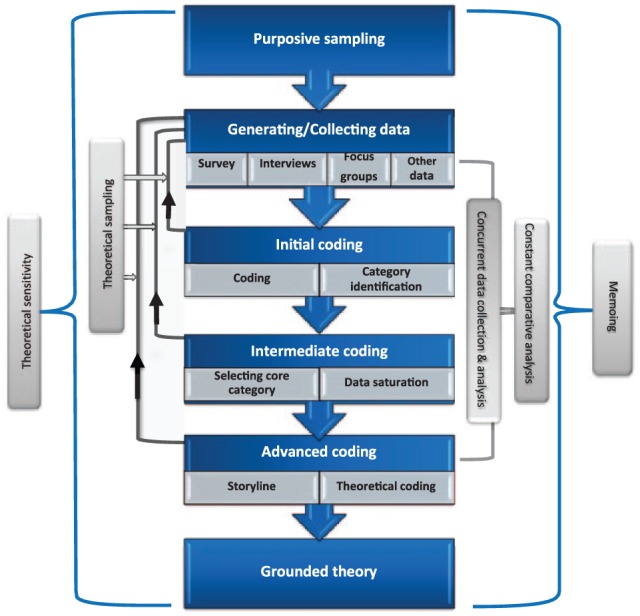
Background: Grounded theory is a well-known methodology employed in many research studies. Qualitative and quantitative data generation techniques can be used in a grounded theory study. Grounded theory sets out to discover or construct theory from data, systematically obtained and analysed using comparative analysis. While grounded theory is inherently flexible, it is a complex methodology. Thus, novice researchers strive to understand the discourse and the practical application of grounded theory concepts and processes. Objective: The aim of this article is to provide a contemporary research framework suitable to inform a grounded theory study. Result: This article provides an overview of grounded theory illustrated through a graphic representation of the processes and methods employed in conducting research using this methodology. The framework is presented as a diagrammatic representation of a research design and acts as a visual guide for the novice grounded theory researcher. Discussion: As grounded theory is not a linear process, the framework illustrates the interplay between the essential grounded theory methods and iterative and comparative actions involved. Each of the essential methods and processes that underpin grounded theory are defined in this article. Conclusion: Rather than an engagement in philosophical discussion or a debate of the different genres that can be used in grounded theory, this article illustrates how a framework for a research study design can be used to guide and inform the novice nurse researcher undertaking a study using grounded theory. Research findings and recommendations can contribute to policy or knowledge development, service provision and can reform thinking to initiate change in the substantive area of inquiry.
Overview
CoChat Summary
TL;DR
This article presents a contemporary, diagrammatic research design framework to help novice researchers visualise and apply the iterative methods and processes of grounded theory (GT). It defines the essential GT methods and processes and situates them within a non-linear, recursive design rather than debating philosophical genres.
Key findings
- GT is described as a structured yet flexible methodology appropriate when little is known about a phenomenon, aiming to produce or construct an explanatory theory grounded in data.
- Three distinct GT genres are identified: traditional/classic GT (Glaser), evolved GT (Strauss, Corbin and Clarke), and constructivist GT (Charmaz), distinguished by the researcher's philosophical position, use of literature, and approach to coding, analysis and theory development.
- Coding terminology differs by genre: traditional uses open, selective and theoretical coding; evolved uses open, axial and selective coding; constructivist uses initial, focused and theoretical coding (Table 1, adapted from Birks and Mills).
- The framework (Figure 1) depicts the interplay of purposive sampling, concurrent data generation/collection and analysis, constant comparative analysis, memoing, coding (initial, intermediate, advanced), theoretical sampling, theoretical sensitivity, and theoretical saturation, all directed toward an integrated substantive theory.
- Quality and rigour are related to three areas: the researcher's expertise, knowledge and research skills; methodological congruence with the research question; and procedural precision in the use of methods.
Methods
This is a methodological/discussion article, not an empirical study; no sample or dataset is analysed. It synthesises GT literature and prior works (notably Birks and Mills) to construct a graphic research design framework (Figure 1) and to define each essential GT method and process. The framework is presented as a visual guide for novice grounded theory researchers, illustrated with exemplars from other GT studies (Boxes 1–3).
Limitations
The paper states no formal limitations. Evident from the text: it deliberately avoids engagement in philosophical discussion or debate of the different GT genres, so it does not adjudicate between them; the framework is offered as a visual guide rather than an empirically tested model; and it is oriented specifically toward the novice nurse researcher, which may limit transferability to other disciplines or experienced researchers.
Model-written summary. Check it against the paper before relying on it.
Integrity signals
Registry
Cites
Statistics
Figures
Verification
Claims the paper makes
1 Valid · 4 Not valid · 49 Not checked · 18 Own results and interpretations
A statement the paper makes itself — it cites no source for it, so there is none to check. The quote shows it is in the paper.
In the paper
“As presented in Figure 1, initial purposive sampling directs the collection and/or generation of data.”
§ Grounded theory research: A design framework for novice researchers > Discussion > Purposive sampling
plainstates a cause- Asserted: passes — The authors put it forward as true.
- Checkable: passes — It can be checked against evidence.
- Load-bearing: passes — The paper’s conclusions depend on it.
- Based: passes — The paper gives a reason why it holds.
In the paper
“Constant comparative analysis generates increasingly more abstract concepts and theories through inductive processes.16”
§ Grounded theory research: A design framework for novice researchers > Discussion > Constant comparative analysis
What the sources say
- Not matchedcites [16] Charmaz K. Constructing grounded theory: a practical guide through qualitative analysis. Thousand Oaks, CA: SAGE, 2006.
Its entry has no title and year that we can search by.
plainstates a cause- Asserted: passes — The authors put it forward as true.
- Checkable: passes — It can be checked against evidence.
- Load-bearing: unclear — It is unclear whether the paper’s conclusions depend on it.
- Based: passes — The paper gives a reason why it holds.
- Not matched
In the paper
“Several analytic tools and techniques can be used to enhance theoretical sensitivity and increase the grounded theorist’s sensitivity to theoretical constructs in the data.28”
§ Grounded theory research: A design framework for novice researchers > Discussion > Theoretical sensitivity
What the sources say
- Not checked — no full text of the sourcecites [28] Corbin JM Strauss AL. Basics of qualitative research: techniques and procedures for developing grounded theory. 3rd ed. Thousand Oaks, CA: SAGE, 2008. source
plainstates a cause- Asserted: passes — The authors put it forward as true.
- Checkable: passes — It can be checked against evidence.
- Load-bearing: unclear — It is unclear whether the paper’s conclusions depend on it.
- Based: passes — The paper gives a reason why it holds.
In the paper
“Advanced coding that integrates extant theory adds further explanatory power to the findings.6”
§ Grounded theory research: A design framework for novice researchers > Discussion > Advanced coding
What the sources say
- Not matchedcites [6] Birks M Mills J. Grounded theory: a practical guide. 2nd ed. London: SAGE, 2015.
Its entry has no title and year that we can search by.
plainstates a cause- Asserted: passes — The authors put it forward as true.
- Checkable: passes — It can be checked against evidence.
- Load-bearing: unclear — It is unclear whether the paper’s conclusions depend on it.
- Based: passes — The paper gives a reason why it holds.
- Not matched
In the paper
“While interviews are a common method of generating data, data sources can include focus groups, questionnaires, surveys, transcripts, letters, government reports, documents, grey literature, music, artefacts, videos, blogs and memos.9”
§ Grounded theory research: A design framework for novice researchers > Discussion > Generating/collecting data
What the sources say
- Not checked — no full text of the sourcecites [9] Mills J Birks M Hoare KJ. Grounded theory. In: Mills J Birks M (eds) Qualitative methodology: a practical guide. London: SAGE, 2014, pp. 107– 121. source
plain- Asserted: passes — The authors put it forward as true.
- Checkable: passes — It can be checked against evidence.
- Load-bearing: unclear — It is unclear whether the paper’s conclusions depend on it.
- Based: passes — The paper gives a reason why it holds.
5 more claims
Create a free account to see all 72 claims and every source verdict.
- Probably not a substantial claim. 58
- It may state two separate claims as one. 17
Claims other papers make about this one
Each is checked against this paper’s own text: does it say what the citing paper says it does?
The cited source says what the claim attributes to it.
In the citing paper
“The epistemological and ontological differences principally address the proposition that theory is either discovered or co-constructed (Bryant, 2017), leading to opposing views on how the steps in the Grounded Theory method are understood (Bøttcher Berthelsen, 2018; Chun Tie, Birks and Francis, 2019; Tarozzi, 2020).”
From Application and challenges of using a Constructivist Grounded Theory methodology to address an undertheorized clinical challenge: A discussion paper (2024) · cites this paper as Chun Tie, Birks and Francis, 2019
The cited source says what the claim attributes to it.
In the citing paper
“Though the comparison of data, researchers emphasize consistencies, comprehend differences, and refine interviews, consistently comparing specific data points with others to establish categories (Bryant, 2017; Charmaz, 2014; Chun Tie et al., 2019).”
From Application and challenges of using a Constructivist Grounded Theory methodology to address an undertheorized clinical challenge: A discussion paper (2024) · cites this paper as Chun Tie et al., 2019
The cited source says what the claim attributes to it.
In the citing paper
“Nevertheless, this initial stage aims to deconstruct / fracture the data, allowing details to emerge (Bryant and Charmaz, 2019) to create the opportunity to identify both similarities and differences, pose analytical inquiries (Charmaz and Thornberg, 2021), and thereby establish to attain a more profound level of meaning (Chun Tie et al., 2019).”
From Application and challenges of using a Constructivist Grounded Theory methodology to address an undertheorized clinical challenge: A discussion paper (2024) · cites this paper as Chun Tie et al., 2019
Citations
Cites
The Discovery of Grounded Theory: Strategies for Qualitative Research.
Wagner, H. R., Glaser, B. G., & Strauss, A. L. (1968) · Social Forces · doi:10.2307/2575405 · Cited by 46,361
The Discovery of Grounded Theory; Strategies for Qualitative Research
Glaser, B. G., Strauss, A. L., & Strutzel, E. (1968) · Nursing Research · doi:10.1097/00006199-196807000-00014 · Cited by 39,449
(1998) · Sage eBooks · Cited by 38,631
Basics of Qualitative Research (3rd ed.): Techniques and Procedures for Developing Grounded Theory
Corbin, J., & Strauss, A. (2008) · SAGE · doi:10.4135/9781452230153 · Cited by 24,827
Basics of Qualitative Research: Grounded Theory Procedures and Techniques
Long, D. R., Strauss, A., & Corbin, J. (1993) · The Modern Language Journal · doi:10.2307/328955 · Cited by 17,576
Research Design: Qualitative, Quantitative, and Mixed Methods Approaches
Sloane-Seale, A. (2009) · Canadian Journal of University Continuing Education · doi:10.21225/d54s3d · Cited by 14,328
The Coding Manual for Qualitative Researchers
Lungu, M. (2022) · American Journal of Qualitative Research · doi:10.29333/ajqr/12085 · Cited by 10,826
Constructing grounded theory. A practical guide through qualitative analysis
Brink, E., Dellve, L., Hallberg, U., Abrahamsson, K. H., Klingberg, G., & Wentz, K. (2006) · International Journal of Qualitative Studies on Health and Well-being · doi:10.3402/qhw.v1i3.4932 · Cited by 6,862
(1978) · Medical Entomology and Zoology · Cited by 6,077
The Sage Handbook of Qualitative Research[1]
(2006) · Qualitative Research in Organizations and Management: An International Journal · doi:10.1108/17465640610666642 · Cited by 5,842
Research works printed but not linked: 13
- Crotty M. The foundation of social research: meaning and perspective in the research process. Thousand Oaks, CA: SAGE, 1998.
- Charmaz K. The power and potential of grounded theory. Med Sociol 2012; 6: 2– 15.
- Glaser BG. Basics of grounded theory analysis. Mill Valley, CA: Sociology Press, 1992.
- Ralph N Birks M Chapman Y. The methodological dynamism of grounded theory. Int J Qual Methods 2015; 14: 1–6.
- Bryant A Charmaz K. The Sage handbook of grounded theory. Thousand Oaks, CA: SAGE, 2007. · DOI · Paper page
- Charmaz K Bryant A. Grounded theory and credibility. In: Silverman D (ed.) Qualitative research. 3rd ed. London: SAGE, 2011, pp. 291– 309.
- Glaser BG Holton J. Remodeling grounded theory. Forum Qualitative Sozialforschung/Forum: Qualitative Social Research 2004; 5: 1– 22.
- Mackenzie N Knipe S. Research dilemmas: paradigms, methods and methodology. Issues Educ Res 2006; 16: 193– 205.
- Chamberlain-Salaun J. Consumers and the social world of health care: outsiders in the expert’s world: a grounded theory study. PhD Thesis, College of Health Care Sciences, James Cook University, Townsville, QLD, Australia, 2015, p. 198.
- Moghaddam A. Coding issues in grounded theory. Issues Educ Res 2006; 16: 53– 61.
- Evans LE. A novice researcher’s first walk through the maze of grounded theory: rationalization for classical grounded theory. Ground Theory Rev 2013; 14: 37–55.
- Glaser BG. The grounded theory perspective III: theoretical coding. Mill Valley, CA: Sociology Press, 2005.
- Baldwin A. Reconciling professional identity: a grounded theory study of nurse academics’ role modelling. PhD Thesis, College of Healthcare Sciences, James Cook University, Townsville, QLD, Australia, 2016, p. 246.
Cited by
Items 1,301–1,400 of 1,857
Researching Teaching in Higher Education: Grounded Theory Concepts
Ghodoosi, B., Torrisi‐Steele, G., & Dey, S. (2021) · Advances in knowledge acquisition, transfer, and management book series/Advances in knowledge acquisition, transfer and management book series · doi:10.4018/978-1-7998-7600-7.ch004 · Cited by 2
Perceptions of Asian American Representation in Entertainment Media
Owens, L. S. (2020) · The Research Repository @ WVU (West Virginia University) · doi:10.33915/etd.7736
Design of an Augmented Reality Health Activity Platform for Older Adults Living in Long-Term Care
Lefebvre, P. (2021) · uO Research (University of Ottawa) · doi:10.20381/ruor-26077 · Cited by 1
Morgan, R. (2020) · Spectrum Research Repository (Concordia University)
A conceptual framework for environmental service payments in South African plantation forests
Munarini, M. C. (2021) · SUNScholar (Stellenbosch University)
Villa, M. G. (2020) · Repository Technological University of Pereira (Technological University of Pereira)
Fantasy Animations and Children’s Imagination: A Qualitative Study
Khaleghipour, M. (2020) · doi:10.33422/2nd.fshconf.2020.09.174
Danquah, S., Donkoh, S., Boateng, K. A., et al. (2021) · Open Research Africa · doi:10.12688/aasopenres.13204.1
“A grounded theory (Chun Tie et al., 2019) and content analysis approach (Elo & Kyngäs, 2008) were employed in analyzing qualitative data.”
MethodHarding, S. (2020) · MOspace Institutional Repository (University of Missouri) · doi:10.32469/10355/79499
Reconciliation through metissage in higher education
Scott, B. (2021) · Cited by 6
A team coaching model for developing criticality in undergraduate students
Kostoulias, G. (2019) · Radar (Oxford Brookes University) · doi:10.24384/t1qn-1j60
Peremajaan Berbasis Masyarakat pada Kawasan Eks Lokalisasi Putat Jaya Surabaya
Indradjati, P. N., & Sari, W. N. (2021) · Jurnal Tataloka · doi:10.14710/tataloka.23.1.67-79
Patten, R. T. (2020) · FIU - Digital Commons (Florida International University) · doi:10.25148/etd.fidc009162
The Modern Slavery Act 2015: world leading or a missed opportunity to enhance victim protection?
Doostgharin, S. (2020) · London Met Repository (London Metropolitan University) · Cited by 1
Exploring Generational Differences in Black Perceptions of Indoor Plants
Gadsden, G. I. (2021) · Deep Blue (University of Michigan) · doi:10.7302/1041
Intrator, S. M., DeCou, E., Dodd, G., et al. (2021) · Smith ScholarWorks (Smith College)
Paramitadevi, Y. V., Jannah, N., & Mindara, G. P. (2021) · IOP Conference Series Earth and Environmental Science · doi:10.1088/1755-1315/802/1/012015 · Cited by 1
O’Connor, K. (2021) · Lancaster EPrints (Lancaster University)
Enhanced Shared Governance Improves the Collaborative Management of Protected Areas in Zimbabwe
Matipano, G., & Khumalo, R. (2021) · East African Journal of Environment and Natural Resources · doi:10.37284/eajenr.3.1.378
“It also involved data generation whereby the researchers jointly collect, code, and analyse the data and decides on the following data to collect and where to locate the data (Tie et al., 2019).”
MethodRusspatrick, S., Sæbø, J. I., Monteiro, E., Nicholson, B., & Sanner, T. A. (2021) · arXiv (Cornell University) · doi:10.48550/arxiv.2108.09720 · Cited by 8
“Next, we employed axial coding to cluster the concepts to derive the preconditions which were iteratively refined until they offered sufficient explanatory power over the observed phenomenon [20, 21, 24].”
MethodOpen-Innovation in Healthcare: an analysis of motivations, learning, and program outcomes
Wylie-Toal, B. (2021) · UWSpace (University of Waterloo)
What Women Want: A Qualitative Analysis of Women’s Motivation to Pursue Surgical Careers
Atkinson, S. (2021) · Canadian Journal of Career Development · doi:10.53379/cjcd.2021.119
Assessing innovation in comparative tender assessment in the road sector
Oad, P. K. (2021) · Queensland University of Technology · doi:10.5204/thesis.eprints.212035
Beyond the struggles: Using social-developmental lenses on the transition to clinical training
Atherley, A. (2021) · Research Publications (Maastricht University) · doi:10.26481/dis.20210927aa · Cited by 26
Land-based learning: Building bridges between Indigenous knowledge and Western science
Tahsin, T. (2021) · Mspace (University of Manitoba) · Cited by 4
Pollard, J. R. (2021) · Digital Commons (Liberty University)
A Thematic Analysis of Parenting Experiences of Women in Prison
Maedzenge, P. (2021) · ISU Red - Research and eData (Illinois State University) · doi:10.30707/etd2021.20211012065804493792.999973
Merced, K., Parameswaran, U., Dearden, S. E., et al. (2021) · Research Square · doi:10.21203/rs.3.rs-1028850/v1
Lindfors, A., & Branigan, H. (2021) · Reinvention an International Journal of Undergraduate Research · doi:10.31273/reinvention.v14i2.743
“This method is often utilised when little is known about the phenomenon (Chun Tie et al., 2019), which makes it appropriate for the current study.”
MethodParents, Pupils, Pedagogues, and Policies: A Rectangle of School Education for Immigrant’s Children
Murthy, V., Gaur, D., & Bhaduri, K. (2021) · Systemic Practice and Action Research · doi:10.1007/s11213-021-09582-9 · Cited by 1
Nicolas, M. (2021) · Dominican Scholar (Dominican University of California) · doi:10.33015/dominican.edu/2022.nurs.st.02
Management education: A barrier to critical management studies
Katumba, J., Maboke, P., Amaral, D. T., & van der Linde, W. (2021) · doi:10.4102/aosis.2021.bk322.05
Silesky, M. D., Milius, L., Ivarra, A., Cooper, M., & Bhakta, N. (2021) · American Journal of Health Promotion · doi:10.1177/08901171211061939 · Cited by 1
“Then, responses were further coded into child codes using grounded theory, whereby incidents are iteratively identified, coded, and refined into themes.(36) Grounded theory was employed as it allowed themes to organically develop out of the responses, rather than be entirely predetermined by the coder ahead of coding.”
MethodSchool Leadership Theory and Pactice in Times of COVID-19: Our Learnings from a National Webinar
Naicker, I., & Chikoko, V. (2021) · Alternation Interdisciplinary Journal for the Study of the Arts and Humanities in Southern Africa · doi:10.29086/2519-5476/2021/v28n1a2
Bergam, S. J., Sibaya, T., Ndlela, N., Kuzwayo, M., Fomo, M., Goldstein, M. H., Marconi, V. C., Haberer, J. E., Archary, M., & Zanoni, B. C. (2022) · Research Square · doi:10.21203/rs.3.rs-1415813/v1
Kristjansson-Nelson, K. (2022) · The Interactive Journal of Global Leadership and Learning · doi:10.55354/2692-3394.1034
Hagar International, U., & Wyatt, Z. (2022) · doi:10.52987/icsp.2022.005
“Therefore, GT becomes a flexible method that does not dictate the data collection methods or techniques used in a study but provides alternate vantage points through a constructivist perspective (Chun Tie et al., 2019).”
MethodGrowth potential of Indian comics among Varanasi high school students
Bose, S., & Singh, P. (2022) · International Journal of Health Sciences · doi:10.53730/ijhs.v6ns4.6115
Critical Pedagogy in a Chinese Transnational University: Challenges and Possibilities
Goodall, J. (2022) · Open Access Victoria University of Wellington | Te Herenga Waka (Figshare) · doi:10.26686/wgtn.19603288
Novice Teachers' Thinking Development from Practicum to Early Career
Hoang, T. (2020) · Open Access Victoria University of Wellington | Te Herenga Waka (Figshare) · doi:10.26686/wgtn.17144078
Women’s Independence in Strengthening the Economy in Makassar, South Sulawesi, Indonesia
Yuliani, Y. (2022) · Advances in Social Science, Education and Humanities Research/Advances in social science, education and humanities research · doi:10.2991/assehr.k.220402.025
“The theoretical basis is used as a guide so that the research focuses on the facts on the ground [20].”
BackgroundZhou, J., Lindley, J., Neves, C., Punwani, V., Giles, E. L., Leech, M. T., & Torda, A. J. (2022) · Research Square · doi:10.21203/rs.3.rs-1591412/v1
Nguyen, T.-B., Nguyễn, T. K. M., Lê, V. T. T., & Trần, T. P. H. (2022) · Can Tho University Journal of Science · doi:10.22144/ctu.jvn.2022.027
Rat, C., Meunier‐Beillard, N., Moulard, S., & Denis, F. (2022) · Research Square · doi:10.21203/rs.3.rs-1618523/v1
Sonification of Exosolar System Accretion Discs
Quinton, M., Mcgregor, I. P., & Benyon, D. (2021) · Proceedings of the ... International Conference on Auditory Display · doi:10.21785/icad2021.021
“Grounded theory was used to develop the sonification prototype without predetermined bias [33].”
MethodWilliams, M. (2021) · San José State University ScholarWorks (San Jose State University) · doi:10.31979/etd.cr87-83ew
E-Procurement Challenges & Supplier Enablement in California Counties
Aguila, J.-C. (2020) · San José State University ScholarWorks (San Jose State University) · doi:10.31979/etd.k4r4-t2ug · Cited by 1
Understanding and Predicting Software Developer Expertise in Stack Overflow and GitHub
Vadlamani, S. (2021) · Carleton University's Institutional Repository (MacOdrum Library, Carleton University) · doi:10.22215/etd/2021-14475
Toma, G., Carolan, A., Buckner‐Petty, S., et al. (2022) · Archives of Gynecology and Obstetrics · doi:10.1007/s00404-022-06633-x
Silver, N. A., Kierstead, E. C., Kostygina, G., et al. (2022) · doi:10.2196/preprints.40331
Communication, collaboration, and direct dialogue
Russell, G., Flores, D., & Champ, J. G. (2022) · doi:10.2737/rmrs-gtr-433
Turkish Girls: The Veil and a Sense of Belonging to Germany
Güner, P. B. (2022) · BUANA GENDER Jurnal Studi Gender dan Anak · doi:10.22515/bg.v7i1.4675
Blaber, C. (2022) · Queensland University of Technology · doi:10.5204/thesis.eprints.235130
Andreucci-Annunziata, P., Lín, S., & Urbina-Sánchez, B. (2022) · Liminales · doi:10.54255/lim.vol11.num21.669
Vargas-Hernández, J. G., & Vargas-González, O. C. (2022) · Springer eBooks · doi:10.1007/978-3-319-53121-2_64-2
Joyce, J. G. (2022) · ThinkIR: The University of Louisville's Institutional Repository (University of Louisville) · doi:10.18297/etd/3983
Angier, H. E., Wyte‐Lake, T., Williams, S. M., McCrimmon, S., Moreno, L., DeVoe, J. E., & Cohen, D. J. (2022) · Journal of Patient Experience · doi:10.1177/23743735221133654
MD., Sheppard, V. B., Abdelkarim, M., Abosamak, N. E., Ramadan, R., & Gal, T. S. (2022) · Research Square · doi:10.21203/rs.3.rs-2282898/v1
Exploring Infant Mortality Drivers in Alachua County Florida: A Qualitative Study
Seiler, K., & Wood, E. A. (2022) · UF Journal of Undergraduate Research · doi:10.32473/ufjur.24.130797
Handayani, N. N. L. (2022) · Jurnal Civics Media Kajian Kewarganegaraan · doi:10.21831/jc.v19i1.47492
“Qualitative research emphasizes data collection through observations, interviews, and documentation as well as presented qualitative descriptive (Chun Tie et al., 2019; J. W. Creswell, 2018; Denzin & Lincoln, 2005; Miles et al., 2014).”
MethodStudents’ Voices about Education Quality of a Bachelor Program in Pandemic Times
Martin, K. D. Á., & Granados, I. J. R. (2022) · Enletawa Journal · doi:10.19053/2011835x.14558
Obstetric Telephone Triage: Development & Evaluation
Engeltjes, B. (2022) · doi:10.5463/thesis.32
Vergara, M., Araya-Véliz, C., & Henríquez, F. J. H. (2023) · Límite · doi:10.4067/s0718-50652022000100218
Forsyth, G. (2022) · doi:10.34074/thes.5857 · Cited by 3
Using Innovation Stories From Digital Platforms to Explore What Motivates Innovation
Ninan, J., & Sergeeva, N. (2023) · SAGE Publications Ltd eBooks · doi:10.4135/9781529629774
Surgeon perspectives of three-dimensional endoscopy in pediatric otolaryngology: A qualitative studyPreprint
McNeely, B. D., Fitzpatrick, N., Leitmeyer, K., et al. (2023) · doi:10.22541/au.167579462.24309008/v1
Towards Circular Economy in the Built Environment: Overcoming Obsolescence Via Building AdaptationPreprint
Eliote, G. M., & Leite, F. L. (2023) · SSRN Electronic Journal · doi:10.2139/ssrn.4352965
A Tweet Is a Genre?: Developing Students’ Genre Awareness through the Genre-Translation Project
Sejdiu, A. (2023) · Open Journal of Social Sciences · doi:10.4236/jss.2023.112004
Mohammadi, V., Ardakan, M. A., & Manteghi, M. (2022) · IEEE International Conference on Engineering, Technology and Innovation (ICE/ITMC) · doi:10.1109/ice/itmc-iamot55089.2022.10033254 · Cited by 1
Narrativas culturales trans: Mediaciones legales, Instagram y el Síndrome del espejo
Valdivia, P., & Boegeholz, R.-A. (2022) · InMediaciones de la Comunicación · doi:10.18861/ic.2023.18.1.3382
Health Tourism: Entrepreneurial Strategy of Nursing and Medical Sciences
Amanjan, A., Saeidi, P., Azma, F., et al. (2022) · Payām-i naw. · doi:10.61186/jgbfnm.19.1.42
The Censorship Continues to Sail: The Relationship Between Political Ideology and Book Challenging
Nwokoji, U., & Sullivan, M. (2022) · Journal of Student Research · doi:10.47611/jsrhs.v11i3.2690
Ferraris, S. D. (2023) · SpringerBriefs in applied sciences and technology · doi:10.1007/978-3-031-24549-7_1
Neoliberalism and Kazakhstan's Emerging Higher Education Sysytem
Bayetova, N. (2021) · FIU - Digital Commons (Florida International University) · doi:10.25148/etd.fidc010191
Not by chance: Developing tabletop games to increase awareness of data science
Morgan, H. F. (2023) · Queensland University of Technology · doi:10.5204/thesis.eprints.239445 · Cited by 1
Nettleton, H. R. P., Masters, G. A., & Mason, M. M. (2023) · medRxiv · doi:10.1101/2023.05.23.23290379
Corruption risks of Hungarian municipalities: Quantitative and Qualitative Analyses
Hajdu, M. (2023) · CUB Ph.D. Dissertations (Corvinus University of Budapest) · doi:10.14267/phd.2023026 · Cited by 3
Prospective research view on the methodological framework and protocol for social nursing components
Kamberi, F., Sinaj, E., Subashi, B., & Sinanaj, G. (2022) · Medicus · doi:10.58944/hnew5560
Heading Towards Accountability: An Analysis of the Efficacy of Concussion Protocol
Rudolph, L. (2023) · Journal of Student Research · doi:10.47611/jsrhs.v12i2.4457
Vargas-Hernández, J. G., & Vargas-González, O. C. (2023) · Springer eBooks · doi:10.1007/978-3-031-28885-2_11
Chouraeshkenazi, M. (2023) · F1000Research · doi:10.12688/f1000research.132840.1 · Cited by 1
Methodology: Toward an Understanding of Social Media Addiction
Benavides, T. B. T., Castro, A. T. A., Marichalar, S. A. G., et al. (2023) · SpringerBriefs in business · doi:10.1007/978-3-031-33452-8_4
Ajjan, M. A., & Kozman, C. (2023) · Health Communication · doi:10.1080/10410236.2023.2229985 · Cited by 3
“Grounded theory is “appropriate when little is known about a phenomenon; the aim being to produce or construct an explanatory theory that uncovers a process inherent to the substantive area of inquiry” (Chun Tie et al., 2019, p. 20).”
ENTERING SHANGHAI FREE TRADE ZONE: FROM MALAYSIA’S BUSINESSMEN PERSPECTIVE
Foo, L. P., Chin, M.-Y., Ng, S. C., et al. (2023) · Advanced International Journal of Business Entrepreneurship and SMEs · doi:10.35631/aijbes.516001
Patients have great expectations, but there is more to do
Bailey, C. R. (2023) · Anaesthesia · doi:10.1111/anae.16105
-, D. M. A. A., -, D. S. D. G., -, C. N. G. C., et al. (2023) · International Journal For Multidisciplinary Research · doi:10.36948/ijfmr.2023.v05i04.5032
Revisiting Asymmetries in the Representation of Portuguese Women News Anchors
Lopes, B., Álvares, C., & Ávila, P. (2023) · Women s Studies · doi:10.1080/00497878.2023.2239414
Metadata
- Authors
- Chun Tie, Y., Birks, M., & Francis, K.
- Affiliations
- Nursing and Midwifery, College of Healthcare Sciences, James Cook University, Townsville, QLD, Australia
- James Cook University (AU)
- University of Tasmania (AU)
- Venue
- SAGE Open Medicine
- Publisher
- SAGE Publications
- Published
- 2019-01
- Volume
- 7
- Pages
- 2050312118822927-2050312118822927
- ISSN
- 2050-3121 (ISSN-L)
- PMC
- PMC6318722
- OpenAlex
- W2906994370
- Cited by
- 1,869
- References
- 29
- Citations by year
- 2026: 200 · 2025: 285 · 2024: 370 · 2023: 370 · 2022: 302 · 2021: 226 · 2020: 108 · 2019: 8
- FWCI
- 433.86
- Type
- journal article
- Language
- en
- Open access
- gold
- doi.org
- Licence
- cc-by-nc
- journals.sagepub.com/page/policies/text-and-data-mining-license (tdm)
- Locations
- SAGE Open Medicine (publishedVersion, cc-by-nc)
- Europe PMC (PubMed Central) (publishedVersion, cc-by-nc)
- PubMed Central (publishedVersion, cc-by-nc)
- PubMed (publishedVersion)
- UTAS Research Repository (acceptedVersion)
- ResearchOnline at James Cook University (James Cook University) (submittedVersion)
- DOAJ (DOAJ: Directory of Open Access Journals) (submittedVersion, cc-by-sa)
- Figshare (submittedVersion, cc-by-nc)
- Topics
- Social Sciences › Education › Qualitative Research Methods and Applications
- Health Sciences › Nursing › Research and Theory › Methodologies in Health Research and Practice
- Social Sciences › Education › Educational Research and Methods
- Keywords
- grounded theory, research design framework, novice researchers, nurse researchers, qualitative research methodology, comparative analysis
About these checks
Registry, retraction, Cites and statistics results are computed, not judged, with one exception: a printed reference that no index lists is read once by a model before it counts as a citation error. Claims are extracted by a model and kept only when their quote appears verbatim in the text; each cited source is then checked, with a model’s help, for whether it says what the claim relies on. Those verdicts can be wrong — read the claim’s quote and the cited source before relying on one.
The claim verdicts this report counts are experimental: their accuracy is not yet measured.
A language model drew the claims from the paper on 2026-10-10, under version 3 of the claim definition (model deepseek-v4.1-flash, prompt extract-v3).
A second model labelled each claim on 2026-10-10 (model jev-1.13-20260917, definition revision gold-guideline-v0.2).
Statistics and arithmetic are recomputed, not judged.
Confidence bands are shown only for fields calibrated on our annotated test set. None is calibrated yet, so no band is shown.
What counts as a claim ›How we measure confidence ›How we check this ›
Are you an author, or do you see a problem with this page? Request a review
Data sources
Bibliographic data: Semantic Scholar, OpenAlex, Crossref.
Contains information from the Semantic Scholar Academic Graph Datasets, made available under the ODC Attribution License (ODC-BY 1.0).
Semantic Scholar’s data is described in: Kinney, R., et al. (2023). The Semantic Scholar Open Data Platform. arXiv:2301.10140.
