

Grounded theory research: A design framework for novice researchers
Open accessThe DOI matches its Crossref record; 30 of the 33 references it cites were found in a registry or an index; 2 of the 69 sources its claims cite were checked for support.
Abstract
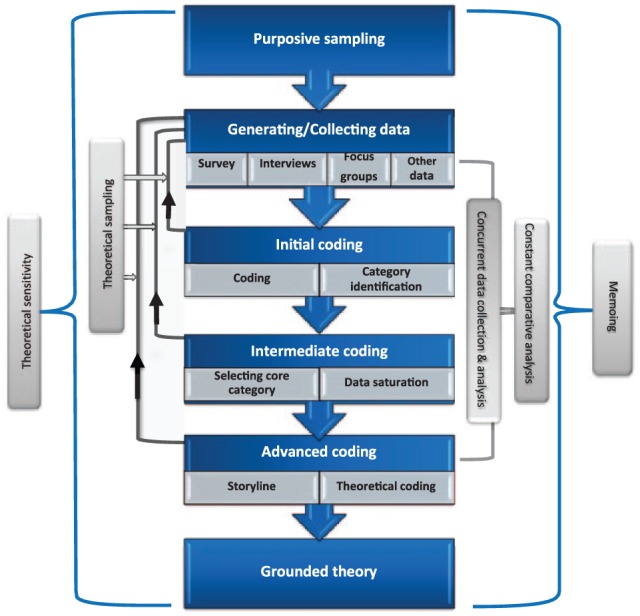
Background: Grounded theory is a well-known methodology employed in many research studies. Qualitative and quantitative data generation techniques can be used in a grounded theory study. Grounded theory sets out to discover or construct theory from data, systematically obtained and analysed using comparative analysis. While grounded theory is inherently flexible, it is a complex methodology. Thus, novice researchers strive to understand the discourse and the practical application of grounded theory concepts and processes. Objective: The aim of this article is to provide a contemporary research framework suitable to inform a grounded theory study. Result: This article provides an overview of grounded theory illustrated through a graphic representation of the processes and methods employed in conducting research using this methodology. The framework is presented as a diagrammatic representation of a research design and acts as a visual guide for the novice grounded theory researcher. Discussion: As grounded theory is not a linear process, the framework illustrates the interplay between the essential grounded theory methods and iterative and comparative actions involved. Each of the essential methods and processes that underpin grounded theory are defined in this article. Conclusion: Rather than an engagement in philosophical discussion or a debate of the different genres that can be used in grounded theory, this article illustrates how a framework for a research study design can be used to guide and inform the novice nurse researcher undertaking a study using grounded theory. Research findings and recommendations can contribute to policy or knowledge development, service provision and can reform thinking to initiate change in the substantive area of inquiry.
Overview
CoChat Summary
TL;DR
This article presents a contemporary, diagrammatic research design framework to help novice researchers visualise and apply the iterative methods and processes of grounded theory (GT). It defines the essential GT methods and processes and situates them within a non-linear, recursive design rather than debating philosophical genres.
Key findings
- GT is described as a structured yet flexible methodology appropriate when little is known about a phenomenon, aiming to produce or construct an explanatory theory grounded in data.
- Three distinct GT genres are identified: traditional/classic GT (Glaser), evolved GT (Strauss, Corbin and Clarke), and constructivist GT (Charmaz), distinguished by the researcher's philosophical position, use of literature, and approach to coding, analysis and theory development.
- Coding terminology differs by genre: traditional uses open, selective and theoretical coding; evolved uses open, axial and selective coding; constructivist uses initial, focused and theoretical coding (Table 1, adapted from Birks and Mills).
- The framework (Figure 1) depicts the interplay of purposive sampling, concurrent data generation/collection and analysis, constant comparative analysis, memoing, coding (initial, intermediate, advanced), theoretical sampling, theoretical sensitivity, and theoretical saturation, all directed toward an integrated substantive theory.
- Quality and rigour are related to three areas: the researcher's expertise, knowledge and research skills; methodological congruence with the research question; and procedural precision in the use of methods.
Methods
This is a methodological/discussion article, not an empirical study; no sample or dataset is analysed. It synthesises GT literature and prior works (notably Birks and Mills) to construct a graphic research design framework (Figure 1) and to define each essential GT method and process. The framework is presented as a visual guide for novice grounded theory researchers, illustrated with exemplars from other GT studies (Boxes 1–3).
Limitations
The paper states no formal limitations. Evident from the text: it deliberately avoids engagement in philosophical discussion or debate of the different GT genres, so it does not adjudicate between them; the framework is offered as a visual guide rather than an empirically tested model; and it is oriented specifically toward the novice nurse researcher, which may limit transferability to other disciplines or experienced researchers.
Model-written summary. Check it against the paper before relying on it.
Integrity signals
Registry
Cites
Statistics
Figures
Verification
Claims the paper makes
1 Valid · 4 Not valid · 49 Not checked · 18 Own results and interpretations
A statement the paper makes itself — it cites no source for it, so there is none to check. The quote shows it is in the paper.
In the paper
“As presented in Figure 1, initial purposive sampling directs the collection and/or generation of data.”
§ Grounded theory research: A design framework for novice researchers > Discussion > Purposive sampling
plainstates a cause- Asserted: passes — The authors put it forward as true.
- Checkable: passes — It can be checked against evidence.
- Load-bearing: passes — The paper’s conclusions depend on it.
- Based: passes — The paper gives a reason why it holds.
In the paper
“Constant comparative analysis generates increasingly more abstract concepts and theories through inductive processes.16”
§ Grounded theory research: A design framework for novice researchers > Discussion > Constant comparative analysis
What the sources say
- Not matchedcites [16] Charmaz K. Constructing grounded theory: a practical guide through qualitative analysis. Thousand Oaks, CA: SAGE, 2006.
Its entry has no title and year that we can search by.
plainstates a cause- Asserted: passes — The authors put it forward as true.
- Checkable: passes — It can be checked against evidence.
- Load-bearing: unclear — It is unclear whether the paper’s conclusions depend on it.
- Based: passes — The paper gives a reason why it holds.
- Not matched
In the paper
“Several analytic tools and techniques can be used to enhance theoretical sensitivity and increase the grounded theorist’s sensitivity to theoretical constructs in the data.28”
§ Grounded theory research: A design framework for novice researchers > Discussion > Theoretical sensitivity
What the sources say
- Not checked — no full text of the sourcecites [28] Corbin JM Strauss AL. Basics of qualitative research: techniques and procedures for developing grounded theory. 3rd ed. Thousand Oaks, CA: SAGE, 2008. source
plainstates a cause- Asserted: passes — The authors put it forward as true.
- Checkable: passes — It can be checked against evidence.
- Load-bearing: unclear — It is unclear whether the paper’s conclusions depend on it.
- Based: passes — The paper gives a reason why it holds.
In the paper
“Advanced coding that integrates extant theory adds further explanatory power to the findings.6”
§ Grounded theory research: A design framework for novice researchers > Discussion > Advanced coding
What the sources say
- Not matchedcites [6] Birks M Mills J. Grounded theory: a practical guide. 2nd ed. London: SAGE, 2015.
Its entry has no title and year that we can search by.
plainstates a cause- Asserted: passes — The authors put it forward as true.
- Checkable: passes — It can be checked against evidence.
- Load-bearing: unclear — It is unclear whether the paper’s conclusions depend on it.
- Based: passes — The paper gives a reason why it holds.
- Not matched
In the paper
“While interviews are a common method of generating data, data sources can include focus groups, questionnaires, surveys, transcripts, letters, government reports, documents, grey literature, music, artefacts, videos, blogs and memos.9”
§ Grounded theory research: A design framework for novice researchers > Discussion > Generating/collecting data
What the sources say
- Not checked — no full text of the sourcecites [9] Mills J Birks M Hoare KJ. Grounded theory. In: Mills J Birks M (eds) Qualitative methodology: a practical guide. London: SAGE, 2014, pp. 107– 121. source
plain- Asserted: passes — The authors put it forward as true.
- Checkable: passes — It can be checked against evidence.
- Load-bearing: unclear — It is unclear whether the paper’s conclusions depend on it.
- Based: passes — The paper gives a reason why it holds.
5 more claims
Create a free account to see all 72 claims and every source verdict.
- Probably not a substantial claim. 58
- It may state two separate claims as one. 17
Claims other papers make about this one
Each is checked against this paper’s own text: does it say what the citing paper says it does?
The cited source says what the claim attributes to it.
In the citing paper
“The epistemological and ontological differences principally address the proposition that theory is either discovered or co-constructed (Bryant, 2017), leading to opposing views on how the steps in the Grounded Theory method are understood (Bøttcher Berthelsen, 2018; Chun Tie, Birks and Francis, 2019; Tarozzi, 2020).”
From Application and challenges of using a Constructivist Grounded Theory methodology to address an undertheorized clinical challenge: A discussion paper (2024) · cites this paper as Chun Tie, Birks and Francis, 2019
The cited source says what the claim attributes to it.
In the citing paper
“Though the comparison of data, researchers emphasize consistencies, comprehend differences, and refine interviews, consistently comparing specific data points with others to establish categories (Bryant, 2017; Charmaz, 2014; Chun Tie et al., 2019).”
From Application and challenges of using a Constructivist Grounded Theory methodology to address an undertheorized clinical challenge: A discussion paper (2024) · cites this paper as Chun Tie et al., 2019
The cited source says what the claim attributes to it.
In the citing paper
“Nevertheless, this initial stage aims to deconstruct / fracture the data, allowing details to emerge (Bryant and Charmaz, 2019) to create the opportunity to identify both similarities and differences, pose analytical inquiries (Charmaz and Thornberg, 2021), and thereby establish to attain a more profound level of meaning (Chun Tie et al., 2019).”
From Application and challenges of using a Constructivist Grounded Theory methodology to address an undertheorized clinical challenge: A discussion paper (2024) · cites this paper as Chun Tie et al., 2019
Citations
Cites
The Discovery of Grounded Theory: Strategies for Qualitative Research.
Wagner, H. R., Glaser, B. G., & Strauss, A. L. (1968) · Social Forces · doi:10.2307/2575405 · Cited by 46,361
The Discovery of Grounded Theory; Strategies for Qualitative Research
Glaser, B. G., Strauss, A. L., & Strutzel, E. (1968) · Nursing Research · doi:10.1097/00006199-196807000-00014 · Cited by 39,449
(1998) · Sage eBooks · Cited by 38,631
Basics of Qualitative Research (3rd ed.): Techniques and Procedures for Developing Grounded Theory
Corbin, J., & Strauss, A. (2008) · SAGE · doi:10.4135/9781452230153 · Cited by 24,827
Basics of Qualitative Research: Grounded Theory Procedures and Techniques
Long, D. R., Strauss, A., & Corbin, J. (1993) · The Modern Language Journal · doi:10.2307/328955 · Cited by 17,576
Research Design: Qualitative, Quantitative, and Mixed Methods Approaches
Sloane-Seale, A. (2009) · Canadian Journal of University Continuing Education · doi:10.21225/d54s3d · Cited by 14,328
The Coding Manual for Qualitative Researchers
Lungu, M. (2022) · American Journal of Qualitative Research · doi:10.29333/ajqr/12085 · Cited by 10,826
Constructing grounded theory. A practical guide through qualitative analysis
Brink, E., Dellve, L., Hallberg, U., Abrahamsson, K. H., Klingberg, G., & Wentz, K. (2006) · International Journal of Qualitative Studies on Health and Well-being · doi:10.3402/qhw.v1i3.4932 · Cited by 6,862
(1978) · Medical Entomology and Zoology · Cited by 6,077
The Sage Handbook of Qualitative Research[1]
(2006) · Qualitative Research in Organizations and Management: An International Journal · doi:10.1108/17465640610666642 · Cited by 5,842
Research works printed but not linked: 13
- Crotty M. The foundation of social research: meaning and perspective in the research process. Thousand Oaks, CA: SAGE, 1998.
- Charmaz K. The power and potential of grounded theory. Med Sociol 2012; 6: 2– 15.
- Glaser BG. Basics of grounded theory analysis. Mill Valley, CA: Sociology Press, 1992.
- Ralph N Birks M Chapman Y. The methodological dynamism of grounded theory. Int J Qual Methods 2015; 14: 1–6.
- Bryant A Charmaz K. The Sage handbook of grounded theory. Thousand Oaks, CA: SAGE, 2007. · DOI · Paper page
- Charmaz K Bryant A. Grounded theory and credibility. In: Silverman D (ed.) Qualitative research. 3rd ed. London: SAGE, 2011, pp. 291– 309.
- Glaser BG Holton J. Remodeling grounded theory. Forum Qualitative Sozialforschung/Forum: Qualitative Social Research 2004; 5: 1– 22.
- Mackenzie N Knipe S. Research dilemmas: paradigms, methods and methodology. Issues Educ Res 2006; 16: 193– 205.
- Chamberlain-Salaun J. Consumers and the social world of health care: outsiders in the expert’s world: a grounded theory study. PhD Thesis, College of Health Care Sciences, James Cook University, Townsville, QLD, Australia, 2015, p. 198.
- Moghaddam A. Coding issues in grounded theory. Issues Educ Res 2006; 16: 53– 61.
- Evans LE. A novice researcher’s first walk through the maze of grounded theory: rationalization for classical grounded theory. Ground Theory Rev 2013; 14: 37–55.
- Glaser BG. The grounded theory perspective III: theoretical coding. Mill Valley, CA: Sociology Press, 2005.
- Baldwin A. Reconciling professional identity: a grounded theory study of nurse academics’ role modelling. PhD Thesis, College of Healthcare Sciences, James Cook University, Townsville, QLD, Australia, 2016, p. 246.
Cited by
Items 901–1,000 of 1,857
Empathy: How Can Technology Help Foster Its Increase Rather Than Decline in the 21st Century?
Knezek, G., Christensen, R. W., & Gibson, D. (2022) · Advances in analytics for learning and teaching · doi:10.1007/978-3-031-06333-6_4 · Cited by 8
On suicidal ideation: the need for inductive methodologies to advance the field
Marchionatti, L. E., & Magalhães, P. V. D. S. (2023) · Trends in Psychiatry and Psychotherapy · doi:10.47626/2237-6089-2023-0655 · Cited by 8
Entertainment Juncture of Two Castes: The identity and representation of Guqin and Guzheng
Jamal, S. A. A., & Bahar, A. A. S. (2022) · Environment-Behaviour Proceedings Journal · doi:10.21834/ebpj.v7isi9.4294 · Cited by 3
Smart Tourism Triggers Tourist Minds-Do you have the mind to mind it?
Shuxratovna, M. N., Kiran, P., & Erdogan, E. (2023) · Vallis Aurea (Journal of Sustainable Development and Innovation) · doi:10.2507/ijva.9.1.2.99 · Cited by 3
“You've Got a Friend in Me”: A Formal Understanding of the Critical Friend Agent
Wester, J., Brännström, A., Nieves, J. C., & van Berkel, N. (2023) · International Conference on Human-Agent Interaction (HAI) · doi:10.1145/3623809.3623957 · Cited by 3
“In line with Chun Tie et al., we deployed initial coding to identify concepts, similarities, and conceptual information in our collected data [23].”
BackgroundMethodInfluentialANXIETY AND AGGRESSION DURING SOCIAL DISTANCING IMPOSED BY THE COVID-19 PANDEMIC
Chiru, A. I., & Răban-Motounu, N. (2020) · CURRENT TRENDS IN NATURAL SCIENCES · doi:10.47068/ctns.2020.v9i18.024 · Cited by 2
Markert-Green, B. (2021) · Digital Commons - Andrews University (Andrews University) · doi:10.32597/dissertations/1748 · Cited by 4
Exploring biodiversity mental constructs of urban residents in an emerging South-East Asian countryPreprint
Nguyen, M., & Jones, T. (2021) · OSF Preprints (OSF Preprints) · doi:10.31219/osf.io/kyc4v · Cited by 3
A Formal Understanding of Computational Empathy in Interactive AgentsPreprint
Brännström, A., Wester, J., & Nieves, J. C. (2022) · SSRN Electronic Journal · doi:10.2139/ssrn.4138212 · Cited by 3
“The following section presents a literature study of prior work in CA-human interaction, analyzed through a Grounded Theory process (Chun Tie et al., 2019), on which we inform our definition of computational empathy.”
InfluentialChang, M., & Carhart, N. (2023) · medRxiv · doi:10.1101/2023.06.22.23291736 · Cited by 3
“Stage 2 detailed review will comprise of the phases of thematic analysis[24, 25] most commonly associated with the grounded theory[26, 27].”
BackgroundComplex Patient Perspectives on Evolving Diverticulitis TreatmentPreprint
Altman-Merino, A., Bonnet, K. R., Schlundt, D. G., Wrenn, J. O., Self, W. H., Gordon, E. J., & Hawkins, A. T. (2023) · medRxiv · doi:10.1101/2023.06.26.23291565 · Cited by 3
Developing a male-specific counselling curriculum for HIV treatment in MalawiPreprint
Mphande, M., Robson, I., Hubbard, J., Chikuse, E., Lungu, E., Phiri, K., Cornell, M., Phiri, S., Coates, T. J., & Dovel, K. L. (2023) · medRxiv · doi:10.1101/2023.08.08.23293583 · Cited by 2
B-OK: A Visual and Tactile Tool for HIV Treatment Adherence Support in a United States Urban CenterPreprint
Richterman, A. G., Klaiman, T. A., Palma, D., Ryu, E., Schmucker, L., Villarin, K., Grosso, G., Brady, K. A., Thirumurthy, H., & Buttenheim, A. M. (2024) · medRxiv · doi:10.1101/2024.02.28.24303498 · Cited by 3
Shukla, S., Pandey, B., Pandey, D. K., Mishra, B. P., & Khamparia, A. (2025) · Wiley eBooks · doi:10.1002/9781394280735.ch21 · Cited by 6
Final Considerations on Prototypes in Design Research
Ferraris, S. D. (2023) · SpringerBriefs in applied sciences and technology · doi:10.1007/978-3-031-24549-7_7 · Cited by 2
Considering Team Dynamics during Human Factors Work in Healthcare
Fuller, H. J. A., Maddox, K. D., Adams, K. A., et al. (2023) · Proceedings of the International Symposium on Human Factors and Ergonomics in Health Care · doi:10.1177/2327857923121036 · Cited by 2
“We spent much of the final half-day at the site performing initial data processing and coding activities, individually and as a group, utilizing methods based on grounded theory (Glaser & Strauss, 1967; Chun Tie et al., 2019).”
MethodAn Exploration of Support for Clinical Education Partners
George, D., Gallivan, S. P., Both, A., et al. (2024) · Journal of Physical Therapy Education · doi:10.1097/jte.0000000000000326 · Cited by 2
“A constructivist grounded theory qualitative research design 50,51 was used to explore the needs of CE faculty, as it allows a structured, yet fl exible,methodologytoexpandthebodyof knowledge 50,51 Survey instructions included an implied consent statement.”
MethodResultDigitalized Co-production of Emergency Response : Using Volunteers as First Responders
Alkusaibati, W. (2024) · Linköping studies in science and technology. Thesis · doi:10.3384/9789180756488 · Cited by 3
An Assessment of Integrated Pest Management Awareness in Heritage Institutions
Ioannou, N., & Ros, S. D. (2024) · Studies in Conservation · doi:10.1080/00393630.2024.2375152 · Cited by 2
Khoja, L., Zoulfikar, M., Hak, L., Yousif, S., Aljebori, M., Stiffler, M. J., Tariq, M., Burgard, S. A., Fleischer, N. L., Wallner, L. P., et al. (2024) · Cancers · doi:10.3390/cancers17010005 · Cited by 3
Dube, S., Asim, M., Gonzalez, J., Dala, G., Wright, M. L., Gray, M. J., Kahn, L. G., Jacobvitz, D. B., & Widen, E. M. (2025) · BMC Pregnancy and Childbirth · doi:10.1186/s12884-024-07011-y · Cited by 3
“The data were analyzed through inductive methods, specifically grounded theory [40, 41].”
Henriksson, M., Tikka, C., Juvonen-Posti, P., Virtanen, M., & Oksanen, T. (2025) · BMC Health Services Research · doi:10.1186/s12913-025-12238-2 · Cited by 5
Rahimian, A., Sadeghzadeh, K., Mohandes, S. R., et al. (2025) · Engineering Construction & Architectural Management · doi:10.1108/ecam-09-2023-0958 · Cited by 2
Desai, D., & Desai, A. (2025) · International Journal of Mathematical Engineering and Management Sciences · doi:10.33889/ijmems.2025.10.3.036 · Cited by 11
The Role of the Primary Care Transformation Lead: A Qualitative Case Study
Joshi, A., Brown, J. B., Dang, J., Elliott, J. B., Anphalagan, S., & Sibbald, S. L. (2025) · Journal of Primary Care & Community Health · doi:10.1177/21501319251327909 · Cited by 2
Challenges and Strategies of International Students Studying in the Hainan Free Trade Port
Ding, X., Zhang, S., Wang, F., & Diao, J. (2025) · SAGE Open · doi:10.1177/21582440251335743 · Cited by 7
“It involved a systematic process of data collection, coding, and analysis to generate concepts and theories that emerge from the data itself, thereby allowing researchers to expand the theoretical scope of their studies (Chun et al., 2019).”
Getting boxed in: How race and gang labeling shape solitary confinement use
Tublitz, R., Reiter, K., Augustine, D., Barragan, M., Chesnut, K., González, G., Pifer, N. A., & Strong, J. D. (2025) · Punishment & Society · doi:10.1177/14624745251344573 · Cited by 3
“Consistent with grounded theory, coders inductively explored how participants make meaning of their experiences (here: their gang status) (Charmaz, 2006; Chun et al., 2019).”
Coaching and mentoring to foster self-efficacy for early-stage survival-driven entrepreneurs
Cronje, J. P., Terblanche, N. H. D., & Theron-Wepener, M. (2025) · South African Journal of Business Management · doi:10.4102/sajbm.v56i1.4884 · Cited by 11
Algethami, A., Assad, F., Patsavellas, J., & Salonitis, K. (2025) · Administrative Sciences · doi:10.3390/admsci15070241 · Cited by 8
Postill, G., Dent, A., Dombroski, J. D., Verma, A. A., Myers, J., & Apramian, T. (2025) · PLOS Digital Health · doi:10.1371/journal.pdig.0000917 · Cited by 3
McCormick, E. M., Peterson, J. T., Santos, J. D. D., Flickinger, J., Xiao, R., Haas, R., & Zolkipli‐Cunningham, Z. (2025) · Therapeutic Advances in Chronic Disease · doi:10.1177/20406223251344763 · Cited by 3
Mostefai, M. N., Filho, S. R. P., Bonell, C. P., Young, H., Rizzo, A. J., & Meléndez‐Torres, G. J. (2025) · Child Abuse & Neglect · doi:10.1016/j.chiabu.2025.107629 · Cited by 4
Fan, X., & Pan, W. (2025) · Work Aging and Retirement · doi:10.1093/workar/waaf010 · Cited by 2
Carpenter, D., Menard, A., Isenberger, J., Stevens, G., & LaRock, L. (2025) · Critical Care Nurse · doi:10.4037/ccn2025799 · Cited by 2
Tong, X., Phakdeephirot, N., & Jiang, S. (2025) · Sustainability · doi:10.3390/su17198786 · Cited by 2
Grounded Theory and Phenomenology
Almusaed, A., Almssad, A., & Yitmen, İ. (2025) · Springer eBooks · doi:10.1007/978-3-031-97393-2_11 · Cited by 7
Cook, L., Prue, G., McLaughlin, S. B., & Mitchell, G. (2025) · Healthcare · doi:10.3390/healthcare13212779 · Cited by 5
“Coding will be carried out manually by the primary researcher (LC) and seeks to identify patterns in participants’ contributions and inform the development and later refinement of categories, concepts, and theories [54].”
Development and Validation of a Questionnaire Measuring Treatment Burden in Pediatric Asthma
Schmartz, S., Cros, P., Cisterne, C., Carsin, A., Perrin, T., Wanin, S., Masson, A., Menetrey, C., Roy, C., Poirault, C., et al. (2025) · The Journal of Allergy and Clinical Immunology In Practice · doi:10.1016/j.jaip.2025.12.021 · Cited by 2
Joshy, K. X., & Thakurta, R. (2026) · Journal of Systems and Information Technology · doi:10.1108/jsit-04-2025-0159 · Cited by 4
Zandee, D., Rotaru, K., Creed, A. S., & Zutshi, A. (2025) · Accounting Auditing & Accountability Journal · doi:10.1108/aaaj-07-2024-7253 · Cited by 6
Illegal urban wild meat supply chain characterization: A case study on zoonosis in Lusaka, Zambia
Mukanganwa, B. A., Mukuma, M., Shindano, J., & Moonga, H. B. (2026) · PLoS ONE · doi:10.1371/journal.pone.0342396 · Cited by 3
Harmuch, C., Laranjeira, C., Lima, A. L. S., Higarashi, I. H., Jaques, A. E., & Paiano, M. (2026) · Journal of Pediatric Nursing · doi:10.1016/j.pedn.2026.03.014 · Cited by 2
Beyeme, R. N., Thomas, P., & Schachtebeck, C. (2026) · African Journal of Hospitality Tourism and Leisure · doi:10.46222/ajhtl.19770720.728 · Cited by 2
Dong, D., Akkermans, J., & Khapova, S. N. (2026) · Career Development International · doi:10.1108/cdi-09-2025-0480 · Cited by 2
Jafarinezhad, O., Zhang, Q., Rezai, R., Noaeen, M., Shachak, A., Far, B. H., & Abad, Z. S. H. (2026) · Artificial Intelligence in Medicine · doi:10.1016/j.artmed.2026.103422 · Cited by 2
Khajoueinejad, Z., & Scott, S. (2026) · International Journal of Educational Technology in Higher Education · doi:10.1186/s41239-026-00608-7 · Cited by 4
“In GT, selective coding is a critical phase in which core constructs are integrated and refined to form a cohesive theoretical framework, building upon insights from open and axial coding (Chun Tie et al., 2019; Vollstedt & Rezat, 2019).”
Laney, E. K., Carruthers, L. A., Hall, M. E. L., & Anderson, T. L. (2021) · Journal of Psychology and Theology · doi:10.1177/0091647121990630 · Cited by 6
“As previously mentioned, the qualitative method of inquiry was utilized because of the complex individual and interpersonal qualities of identity and the other relevant topics in the study; grounded theory was chosen as the method of data analysis because it is one of the most useful methods of understanding the under…”
MethodRungwaraphong, P. (2021) · English Language Teaching Educational Journal · doi:10.12928/eltej.v4i1.3227 · Cited by 6
“As Vygotsky (1986) explained, human cognition initiates from social communication and involvement in social activities.”
BackgroundShipping managers’ information behavior during a pandemic crisis
Gerakoudi, K. (2021) · Maritime Business Review · doi:10.1108/mabr-10-2020-0062 · Cited by 2
How Facebook is used to promote ENDS products near four Big 10 universities: A qualitative analysis
Johannes, B. L., & Ortiz, S. E. (2022) · Journal of American College Health · doi:10.1080/07448481.2022.2027425 · Cited by 2
Kelly, L. E. S. (2022) · The Open Journal of Occupational Therapy · doi:10.15453/2168-6408.1967 · Cited by 2
The Male Domain-Digital Game-Based Learning for Human Papillomavirus Vaccination Among Young Males
Darville, G., Burns, J. C., Chavanduka, T., & Anderson‐Lewis, C. (2022) · Games for Health Journal · doi:10.1089/g4h.2021.0141 · Cited by 2
“21 Upon completing data analysis, themes were organized using a matrix chart, and quotes to support each theme were included.”
Lukianova, N. A., Fell, E. V., & Shavlokhova, A. A. (2022) · Perspectives of science and education · doi:10.32744/pse.2022.4.25 · Cited by 2
Dartey, A. F., Lasidji, B. N., Baku, E. A., Lotse, C. W., Kuug, A. K., & Dzansi, G. (2022) · SAGE Open Nursing · doi:10.1177/23779608221129130 · Cited by 3
“Saturation was reached when additional data did not lead to any new emergent themes (Chun Tie et al., 2019; Given, 2016).”
BackgroundHassan, E. A., Kowal, S., & Jamieson, K. (2022) · Proceedings of the Canadian Engineering Education Association (CEEA) · doi:10.24908/pceea.vi.15883 · Cited by 3
Berkemeyer, S., & Wehrmann, J. (2022) · Obesity Pillars · doi:10.1016/j.obpill.2022.100042 · Cited by 4
Kadakia, A., Preum, S. M., Bohm, A. R., & Fortuna, K. L. (2023) · International Joint Conference on Biomedical Engineering Systems and Technologies (BIOSTEC) · doi:10.5220/0011776500003414 · Cited by 2
“These groups were identified because they had not only the most content related to peer support but also relatively longer comment chains compared to other online public groups, allowing us to analyze full conversations rather than individual phrases.”
BackgroundKathuria, R., Awasthy, R., & Sharma, T. (2023) · Palgrave studies in workplace spirituality and fulfillment · doi:10.1007/978-3-031-06234-6_13 · Cited by 2
Antoniadou, V., & Hadjipanayis, A. (2023) · Orphanet Journal of Rare Diseases · doi:10.1186/s13023-023-02672-y · Cited by 4
Ecommerce Fraud Incident Response: A Grounded Theory Study
Dwight, J. (2023) · Interdisciplinary Journal of Information Knowledge and Management · doi:10.28945/5110 · Cited by 4
“Note : Steps of the Constructivist Grounded Theory Approach (adapted from Tie et al., 2019).”
BackgroundMethodInfluentialKurz, A. F., Kampik, T., Pufahl, L., & Weber, I. M. (2023) · Lecture notes in business information processing · doi:10.1007/978-3-031-34241-7_2 · Cited by 2
“In order to address the research questions, we apply the grounded theory (GT) research method [4], combined with the Delphi method [17].”
MethodInfluentialMaddox, K. D., Ercolini, D., Chumbler, N. R., Arnold, T., Adams, K. A., & Fuller, H. J. A. (2023) · Proceedings of the International Symposium on Human Factors and Ergonomics in Health Care · doi:10.1177/2327857923121040 · Cited by 2
“The team used a modified grounded theory approach (Chun Tie et al., 2019) to conduct thematic analysis of the interview data.”
MethodReal-world challenges to general surgery resident leadership development: a needs assessment
Torres-Landa, S. R., Moreno, K., Brasel, K. J., et al. (2023) · Global Surgical Education - Journal of the Association for Surgical Education · doi:10.1007/s44186-023-00140-6 · Cited by 2
Piersol, C. V., Martínez, J., Chew, F. M., Perry, B., & Leland, N. E. (2023) · The Gerontologist · doi:10.1093/geront/gnad102 · Cited by 7
Utilizing Filipino key informants to guide community outreach for cancer prevention in Hawai‘i
Willingham, M. L., Jr., Sy, A. U., Taafaki, M. R., Bodnar, R., Diaz, T. P., Somera, L. P., Porte, C. L., Ceria‐Ulep, C. D., Pingul, A., Bissell, J., et al. (2023) · Public Health Nursing · doi:10.1111/phn.13234 · Cited by 2
Bachynski, J. C., Duhn, L., Costa, I. G., et al. (2023) · New Trends in Qualitative Research · doi:10.36367/ntqr.16.2023.e789 · Cited by 2
Streaming forward: Adoption considerations for the major recorded music markets in CARICOM
Joseph, F. J. (2023) · Convergence The International Journal of Research into New Media Technologies · doi:10.1177/13548565231203983 · Cited by 3
When the clothes fit: Exploring the embodied transition to motherhood
DeLuca, J. R., & Bustad, J. J. (2023) · Fashion Style & Popular Culture · doi:10.1386/fspc_00213_1 · Cited by 2
Turgeon, N. J., Dolbec, K., On, F., Lash, E., Reed, E., Wallace, K., Fortune, A., & Wells, K. M. (2023) · Western Journal of Emergency Medicine · doi:10.5811/westjem.59797 · Cited by 4
“24 We selected this approach because of its compatibility with our goal of exploring individual narrative comments to understand the impact and attitudes of students toward the SDoH curriculum.”
MethodAbbas, A., Rice, H. E., Poenaru, D., & Samad, L. (2023) · World Journal of Surgery · doi:10.1007/s00268-023-07203-1 · Cited by 2
“We used a grounded theory approach to develop a definition of feasibility [23–25].”
MethodSadovnikova, A., Wong, M. D., Fine, J., et al. (2023) · Breastfeeding Medicine · doi:10.1089/bfm.2023.0137 · Cited by 2
Dugle, G., Antwi, J., & Quentin, W. (2023) · Systematic Reviews · doi:10.1186/s13643-023-02366-3 · Cited by 6
Fusdahl, P., Testad, I., Aarsland, D., & Braut, G. S. (2023) · SAGE Open · doi:10.1177/21582440231205980 · Cited by 3
“Memo writing is key to grounded theory (Chun Tie et al., 2019) and short memos was noted through the analytical process.”
BackgroundMethodBryant, C. L. (2023) · Springer eBooks · doi:10.1007/978-3-031-38534-6_5 · Cited by 2
Deveci, A. C., Gurnani, M., Wolfe-Wylie, M. C., et al. (2023) · Canadian Journal of Diabetes · doi:10.1016/j.jcjd.2023.11.004 · Cited by 2
Tanpoco, M. R., & Cordova, W. (2023) · E3S Web of Conferences · doi:10.1051/e3sconf/202346005026 · Cited by 2
“This method emphasizes gathering and analyzing data to construct theoretical frameworks based on empirical evidence (Chun Tie et al., 2019).”
MethodPusdekar, Y. A., Dixit, J. V., & Dani, A. P. (2023) · Journal of Family Medicine and Primary Care · doi:10.4103/jfmpc.jfmpc_353_23 · Cited by 2
“[19] Both coding up and coding down approach was utilised.”
MethodProfessional Life Phases of Teacher Educators: The Case of a Vietnam Institution
Nguyen, N. T. L. (2023) · SAGE Open · doi:10.1177/21582440231219077 · Cited by 6
“Additionally, it allows ongoing sampling responding to the collected data, which adds to categories emerged among random participants (Chun Tie et al., 2019).”
BackgroundStudent Feedback on Opt-in, Inclusive, Course-Integrated Study Groups
Agyare, B., Matsumoto, A., Patel, M., & Ranade, G. V. (2023) · IEEE Frontiers in Education Conference (FIE) · doi:10.1109/fie58773.2023.10343384 · Cited by 2
“Grounded theory coding, the process through which patterns are identified in the data, occurs in three stages: open, axial, and selective [49].”
BackgroundClarke, C. B., Berg, S., & Clarke, M. A. (2024) · Journal of Psychology and Theology · doi:10.1177/00916471231221106 · Cited by 2
“…coding process was executed by one of the authors and mostly followed a grounded theory approach, specifically the aspect of constant comparison, which meant that, after each interview, the data were coded and any comparisons between codes and previous interviews were noted (Chun Tie et al., 2019).”
"Putting my life into a story"
Lilly, J. M. (2024) · Journal for Social Action in Counseling & Psychology · doi:10.33043/jsacp.15.2.50-61 · Cited by 2
Exploring Differences in Planning between Students with and without Prior Experience in Programming
Parsons, R., Hao, Q., & Ding, L. (2024) · ASEE Annual Conference & Exposition · doi:10.18260/1-2--43601 · Cited by 3
“Grounded theory, in contrast to other qualitative data analysis techniques, utilizes the data collected to create a coding framework instead of starting off with a framework to begin with [20].”
MethodRuidiaz-Gómez, K. S., & Caballero, J. V. C. (2024) · Index de Enfermería · doi:10.58807/indexenferm20236524 · Cited by 2
Navigating Psychological Crises in Leadership Transitions
Samuel, A., & Tsapayi, E. T. (2023) · Management Dynamics in the Knowledge Economy · doi:10.2478/mdke-2023-0018 · Cited by 8
Lee, J. (2024) · Human Resource Development Review · doi:10.1177/15344843241247242 · Cited by 5
“While understanding epistemological positionality is important to adopt a particular method, yet it can also be a daunting task for novice researchers (Pistrang & Barker, 2012; Tie et al., 2019).”
BackgroundMethodInfluentialLau, K., Escudero, C., Lee, I., & Yu, C. H. Y. (2024) · Canadian Journal of Diabetes · doi:10.1016/j.jcjd.2024.04.008 · Cited by 5
Bouthillier, M. L., Veilleux, S., Loignon, J., Turcotte, M., Trudel, L., & Provencher, V. (2024) · BMC Nutrition · doi:10.1186/s40795-024-00889-z · Cited by 2
Ding, X., Gopannagari, M., Sun, K., Tao, A., Zhao, D., Varadhan, S., Hardy, B., Dalpiaz, D., Vogiatzis, C., Angrave, L., et al. (2024) · ASEE Annual Conference & Exposition · doi:10.18260/1-2--47360 · Cited by 6
“Grounded theory is a structured, yet flexible methodology to construct theory from the ground up, by systematically obtaining and analyzing data inductively and comparatively [10].”
BackgroundMethodMyers, C., Norton, H., Reynolds, B., Moore, J., Thompson, A., Rogers, K., & Flynn, T. (2024) · Medical Science Educator · doi:10.1007/s40670-024-02130-9 · Cited by 2
“This approach is consistent with grounded theory, a theoretical framework that allows patterns and themes to emerge from the data rather than imposing pre-conceived theories [15].”
Common Pitfalls to Avoid in Qualitative Submissions to JGME
Gottlieb‐Smith, R., Balmer, D. F., Yarris, L. M., & Sullivan, G. M. (2024) · Journal of Graduate Medical Education · doi:10.4300/jgme-d-24-00573.1 · Cited by 2
Raghunandan, S., & Moodley, R. (2024) · Journal of Couple & Relationship Therapy · doi:10.1080/15332691.2024.2391372 · Cited by 4
“This research adopted a grounded theory constant comparative analysis and inductive approach to data analytics (Chun Tie et al., 2019; Thomas, 2006).”
Yu, S., Hirsch, A. M., Zaslavsky, O., et al. (2024) · Public Health Nursing · doi:10.1111/phn.13396 · Cited by 2
Richterman, A. G., Klaiman, T. A., Connelly, R., Palma, D., Ryu, E., Schmucker, L., Villarin, K., Grosso, G., Brady, K. A., Thirumurthy, H., et al. (2024) · Global Implementation Research and Applications · doi:10.1007/s43477-024-00135-5 · Cited by 2
Michel, A. M., Yi, H., Amenta, J. N., Collins, N., Vaynrub, A., Umakanth, S., Anderson, G. L., Arnold, K., Law, C., Pruthi, S., et al. (2024) · BMC Medical Informatics and Decision Making · doi:10.1186/s12911-024-02691-0 · Cited by 3
Applying MAXQDA in a Grounded Theory Study: Evaluation of an Enterprise Education Research Project
Rizzo, A., Aquilina, R., & Falzon, R. (2024) · Lecture notes in networks and systems · doi:10.1007/978-3-031-65735-1_11 · Cited by 6
Plumbley, S., Taneja, S., Griggs, J. E., Rais, A. A., Curtis, L., Lyon, R., & On behalf of Air Ambulance Charity Kent Surrey Sussex, U. K. (2024) · BMC Health Services Research · doi:10.1186/s12913-024-11720-7 · Cited by 2
“Researchers may consider individual focus groups or interview-based methodologies [40] from a grounded theory methodology to inductively generate theory using qualitative data [41].”
Marcom, S. M., & Sorensen, M. (2024) · Journal of Cancer Survivorship · doi:10.1007/s11764-024-01688-y · Cited by 3
Paci, M., Quercioli, A., Natali, S., Bianchi, L., Buonandi, E., Rosiello, L., & Moretti, S. (2024) · Physiotherapy Theory and Practice · doi:10.1080/09593985.2024.2414242 · Cited by 3
“The initial coding phase, comprising open coding and category identification (Chun Tie, Birks, and Francis, 2019), was performed by two researchers (AQ and SN) independently, and a codebook was developed and discussed within the research group.”
Interstitial Cystitis Chatter: A Qualitative Evaluation of Bladder Instillation Online
Wong, R., Licari, L. C., Bologna, E., & Adelstein, S. A. (2024) · Urology · doi:10.1016/j.urology.2024.10.051 · Cited by 4
Chidwick, H., Tuyisenge, G., DiLiberto, D., & Schwartz, L. (2024) · PLOS Global Public Health · doi:10.1371/journal.pgph.0003877 · Cited by 5
Metadata
- Authors
- Chun Tie, Y., Birks, M., & Francis, K.
- Affiliations
- Nursing and Midwifery, College of Healthcare Sciences, James Cook University, Townsville, QLD, Australia
- James Cook University (AU)
- University of Tasmania (AU)
- Venue
- SAGE Open Medicine
- Publisher
- SAGE Publications
- Published
- 2019-01
- Volume
- 7
- Pages
- 2050312118822927-2050312118822927
- ISSN
- 2050-3121 (ISSN-L)
- PMC
- PMC6318722
- OpenAlex
- W2906994370
- Cited by
- 1,869
- References
- 29
- Citations by year
- 2026: 200 · 2025: 285 · 2024: 370 · 2023: 370 · 2022: 302 · 2021: 226 · 2020: 108 · 2019: 8
- FWCI
- 433.86
- Type
- journal article
- Language
- en
- Open access
- gold
- doi.org
- Licence
- cc-by-nc
- journals.sagepub.com/page/policies/text-and-data-mining-license (tdm)
- Locations
- SAGE Open Medicine (publishedVersion, cc-by-nc)
- Europe PMC (PubMed Central) (publishedVersion, cc-by-nc)
- PubMed Central (publishedVersion, cc-by-nc)
- PubMed (publishedVersion)
- UTAS Research Repository (acceptedVersion)
- ResearchOnline at James Cook University (James Cook University) (submittedVersion)
- DOAJ (DOAJ: Directory of Open Access Journals) (submittedVersion, cc-by-sa)
- Figshare (submittedVersion, cc-by-nc)
- Topics
- Social Sciences › Education › Qualitative Research Methods and Applications
- Health Sciences › Nursing › Research and Theory › Methodologies in Health Research and Practice
- Social Sciences › Education › Educational Research and Methods
- Keywords
- grounded theory, research design framework, novice researchers, nurse researchers, qualitative research methodology, comparative analysis
About these checks
Registry, retraction, Cites and statistics results are computed, not judged, with one exception: a printed reference that no index lists is read once by a model before it counts as a citation error. Claims are extracted by a model and kept only when their quote appears verbatim in the text; each cited source is then checked, with a model’s help, for whether it says what the claim relies on. Those verdicts can be wrong — read the claim’s quote and the cited source before relying on one.
The claim verdicts this report counts are experimental: their accuracy is not yet measured.
A language model drew the claims from the paper on 2026-10-10, under version 3 of the claim definition (model deepseek-v4.1-flash, prompt extract-v3).
A second model labelled each claim on 2026-10-10 (model jev-1.13-20260917, definition revision gold-guideline-v0.2).
Statistics and arithmetic are recomputed, not judged.
Confidence bands are shown only for fields calibrated on our annotated test set. None is calibrated yet, so no band is shown.
What counts as a claim ›How we measure confidence ›How we check this ›
Are you an author, or do you see a problem with this page? Request a review
Data sources
Bibliographic data: Semantic Scholar, OpenAlex, Crossref.
Contains information from the Semantic Scholar Academic Graph Datasets, made available under the ODC Attribution License (ODC-BY 1.0).
Semantic Scholar’s data is described in: Kinney, R., et al. (2023). The Semantic Scholar Open Data Platform. arXiv:2301.10140.
