

Grounded theory research: A design framework for novice researchers
Open accessThe DOI matches its Crossref record; 30 of the 33 references it cites were found in a registry or an index; 2 of the 69 sources its claims cite were checked for support.
Abstract
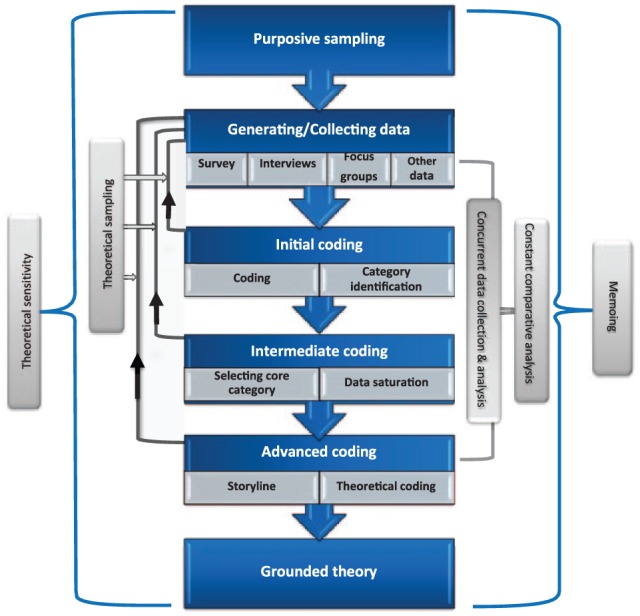
Background: Grounded theory is a well-known methodology employed in many research studies. Qualitative and quantitative data generation techniques can be used in a grounded theory study. Grounded theory sets out to discover or construct theory from data, systematically obtained and analysed using comparative analysis. While grounded theory is inherently flexible, it is a complex methodology. Thus, novice researchers strive to understand the discourse and the practical application of grounded theory concepts and processes. Objective: The aim of this article is to provide a contemporary research framework suitable to inform a grounded theory study. Result: This article provides an overview of grounded theory illustrated through a graphic representation of the processes and methods employed in conducting research using this methodology. The framework is presented as a diagrammatic representation of a research design and acts as a visual guide for the novice grounded theory researcher. Discussion: As grounded theory is not a linear process, the framework illustrates the interplay between the essential grounded theory methods and iterative and comparative actions involved. Each of the essential methods and processes that underpin grounded theory are defined in this article. Conclusion: Rather than an engagement in philosophical discussion or a debate of the different genres that can be used in grounded theory, this article illustrates how a framework for a research study design can be used to guide and inform the novice nurse researcher undertaking a study using grounded theory. Research findings and recommendations can contribute to policy or knowledge development, service provision and can reform thinking to initiate change in the substantive area of inquiry.
Overview
CoChat Summary
TL;DR
This article presents a contemporary, diagrammatic research design framework to help novice researchers visualise and apply the iterative methods and processes of grounded theory (GT). It defines the essential GT methods and processes and situates them within a non-linear, recursive design rather than debating philosophical genres.
Key findings
- GT is described as a structured yet flexible methodology appropriate when little is known about a phenomenon, aiming to produce or construct an explanatory theory grounded in data.
- Three distinct GT genres are identified: traditional/classic GT (Glaser), evolved GT (Strauss, Corbin and Clarke), and constructivist GT (Charmaz), distinguished by the researcher's philosophical position, use of literature, and approach to coding, analysis and theory development.
- Coding terminology differs by genre: traditional uses open, selective and theoretical coding; evolved uses open, axial and selective coding; constructivist uses initial, focused and theoretical coding (Table 1, adapted from Birks and Mills).
- The framework (Figure 1) depicts the interplay of purposive sampling, concurrent data generation/collection and analysis, constant comparative analysis, memoing, coding (initial, intermediate, advanced), theoretical sampling, theoretical sensitivity, and theoretical saturation, all directed toward an integrated substantive theory.
- Quality and rigour are related to three areas: the researcher's expertise, knowledge and research skills; methodological congruence with the research question; and procedural precision in the use of methods.
Methods
This is a methodological/discussion article, not an empirical study; no sample or dataset is analysed. It synthesises GT literature and prior works (notably Birks and Mills) to construct a graphic research design framework (Figure 1) and to define each essential GT method and process. The framework is presented as a visual guide for novice grounded theory researchers, illustrated with exemplars from other GT studies (Boxes 1–3).
Limitations
The paper states no formal limitations. Evident from the text: it deliberately avoids engagement in philosophical discussion or debate of the different GT genres, so it does not adjudicate between them; the framework is offered as a visual guide rather than an empirically tested model; and it is oriented specifically toward the novice nurse researcher, which may limit transferability to other disciplines or experienced researchers.
Model-written summary. Check it against the paper before relying on it.
Integrity signals
Registry
Cites
Statistics
Figures
Verification
Claims the paper makes
1 Valid · 4 Not valid · 49 Not checked · 18 Own results and interpretations
A statement the paper makes itself — it cites no source for it, so there is none to check. The quote shows it is in the paper.
In the paper
“As presented in Figure 1, initial purposive sampling directs the collection and/or generation of data.”
§ Grounded theory research: A design framework for novice researchers > Discussion > Purposive sampling
plainstates a cause- Asserted: passes — The authors put it forward as true.
- Checkable: passes — It can be checked against evidence.
- Load-bearing: passes — The paper’s conclusions depend on it.
- Based: passes — The paper gives a reason why it holds.
In the paper
“Constant comparative analysis generates increasingly more abstract concepts and theories through inductive processes.16”
§ Grounded theory research: A design framework for novice researchers > Discussion > Constant comparative analysis
What the sources say
- Not matchedcites [16] Charmaz K. Constructing grounded theory: a practical guide through qualitative analysis. Thousand Oaks, CA: SAGE, 2006.
Its entry has no title and year that we can search by.
plainstates a cause- Asserted: passes — The authors put it forward as true.
- Checkable: passes — It can be checked against evidence.
- Load-bearing: unclear — It is unclear whether the paper’s conclusions depend on it.
- Based: passes — The paper gives a reason why it holds.
- Not matched
In the paper
“Several analytic tools and techniques can be used to enhance theoretical sensitivity and increase the grounded theorist’s sensitivity to theoretical constructs in the data.28”
§ Grounded theory research: A design framework for novice researchers > Discussion > Theoretical sensitivity
What the sources say
- Not checked — no full text of the sourcecites [28] Corbin JM Strauss AL. Basics of qualitative research: techniques and procedures for developing grounded theory. 3rd ed. Thousand Oaks, CA: SAGE, 2008. source
plainstates a cause- Asserted: passes — The authors put it forward as true.
- Checkable: passes — It can be checked against evidence.
- Load-bearing: unclear — It is unclear whether the paper’s conclusions depend on it.
- Based: passes — The paper gives a reason why it holds.
In the paper
“Advanced coding that integrates extant theory adds further explanatory power to the findings.6”
§ Grounded theory research: A design framework for novice researchers > Discussion > Advanced coding
What the sources say
- Not matchedcites [6] Birks M Mills J. Grounded theory: a practical guide. 2nd ed. London: SAGE, 2015.
Its entry has no title and year that we can search by.
plainstates a cause- Asserted: passes — The authors put it forward as true.
- Checkable: passes — It can be checked against evidence.
- Load-bearing: unclear — It is unclear whether the paper’s conclusions depend on it.
- Based: passes — The paper gives a reason why it holds.
- Not matched
In the paper
“While interviews are a common method of generating data, data sources can include focus groups, questionnaires, surveys, transcripts, letters, government reports, documents, grey literature, music, artefacts, videos, blogs and memos.9”
§ Grounded theory research: A design framework for novice researchers > Discussion > Generating/collecting data
What the sources say
- Not checked — no full text of the sourcecites [9] Mills J Birks M Hoare KJ. Grounded theory. In: Mills J Birks M (eds) Qualitative methodology: a practical guide. London: SAGE, 2014, pp. 107– 121. source
plain- Asserted: passes — The authors put it forward as true.
- Checkable: passes — It can be checked against evidence.
- Load-bearing: unclear — It is unclear whether the paper’s conclusions depend on it.
- Based: passes — The paper gives a reason why it holds.
5 more claims
Create a free account to see all 72 claims and every source verdict.
- Probably not a substantial claim. 58
- It may state two separate claims as one. 17
Claims other papers make about this one
Each is checked against this paper’s own text: does it say what the citing paper says it does?
The cited source says what the claim attributes to it.
In the citing paper
“The epistemological and ontological differences principally address the proposition that theory is either discovered or co-constructed (Bryant, 2017), leading to opposing views on how the steps in the Grounded Theory method are understood (Bøttcher Berthelsen, 2018; Chun Tie, Birks and Francis, 2019; Tarozzi, 2020).”
From Application and challenges of using a Constructivist Grounded Theory methodology to address an undertheorized clinical challenge: A discussion paper (2024) · cites this paper as Chun Tie, Birks and Francis, 2019
The cited source says what the claim attributes to it.
In the citing paper
“Though the comparison of data, researchers emphasize consistencies, comprehend differences, and refine interviews, consistently comparing specific data points with others to establish categories (Bryant, 2017; Charmaz, 2014; Chun Tie et al., 2019).”
From Application and challenges of using a Constructivist Grounded Theory methodology to address an undertheorized clinical challenge: A discussion paper (2024) · cites this paper as Chun Tie et al., 2019
The cited source says what the claim attributes to it.
In the citing paper
“Nevertheless, this initial stage aims to deconstruct / fracture the data, allowing details to emerge (Bryant and Charmaz, 2019) to create the opportunity to identify both similarities and differences, pose analytical inquiries (Charmaz and Thornberg, 2021), and thereby establish to attain a more profound level of meaning (Chun Tie et al., 2019).”
From Application and challenges of using a Constructivist Grounded Theory methodology to address an undertheorized clinical challenge: A discussion paper (2024) · cites this paper as Chun Tie et al., 2019
Citations
Cites
The Discovery of Grounded Theory: Strategies for Qualitative Research.
Wagner, H. R., Glaser, B. G., & Strauss, A. L. (1968) · Social Forces · doi:10.2307/2575405 · Cited by 46,361
The Discovery of Grounded Theory; Strategies for Qualitative Research
Glaser, B. G., Strauss, A. L., & Strutzel, E. (1968) · Nursing Research · doi:10.1097/00006199-196807000-00014 · Cited by 39,449
(1998) · Sage eBooks · Cited by 38,631
Basics of Qualitative Research (3rd ed.): Techniques and Procedures for Developing Grounded Theory
Corbin, J., & Strauss, A. (2008) · SAGE · doi:10.4135/9781452230153 · Cited by 24,827
Basics of Qualitative Research: Grounded Theory Procedures and Techniques
Long, D. R., Strauss, A., & Corbin, J. (1993) · The Modern Language Journal · doi:10.2307/328955 · Cited by 17,576
Research Design: Qualitative, Quantitative, and Mixed Methods Approaches
Sloane-Seale, A. (2009) · Canadian Journal of University Continuing Education · doi:10.21225/d54s3d · Cited by 14,328
The Coding Manual for Qualitative Researchers
Lungu, M. (2022) · American Journal of Qualitative Research · doi:10.29333/ajqr/12085 · Cited by 10,826
Constructing grounded theory. A practical guide through qualitative analysis
Brink, E., Dellve, L., Hallberg, U., Abrahamsson, K. H., Klingberg, G., & Wentz, K. (2006) · International Journal of Qualitative Studies on Health and Well-being · doi:10.3402/qhw.v1i3.4932 · Cited by 6,862
(1978) · Medical Entomology and Zoology · Cited by 6,077
The Sage Handbook of Qualitative Research[1]
(2006) · Qualitative Research in Organizations and Management: An International Journal · doi:10.1108/17465640610666642 · Cited by 5,842
Research works printed but not linked: 13
- Crotty M. The foundation of social research: meaning and perspective in the research process. Thousand Oaks, CA: SAGE, 1998.
- Charmaz K. The power and potential of grounded theory. Med Sociol 2012; 6: 2– 15.
- Glaser BG. Basics of grounded theory analysis. Mill Valley, CA: Sociology Press, 1992.
- Ralph N Birks M Chapman Y. The methodological dynamism of grounded theory. Int J Qual Methods 2015; 14: 1–6.
- Bryant A Charmaz K. The Sage handbook of grounded theory. Thousand Oaks, CA: SAGE, 2007. · DOI · Paper page
- Charmaz K Bryant A. Grounded theory and credibility. In: Silverman D (ed.) Qualitative research. 3rd ed. London: SAGE, 2011, pp. 291– 309.
- Glaser BG Holton J. Remodeling grounded theory. Forum Qualitative Sozialforschung/Forum: Qualitative Social Research 2004; 5: 1– 22.
- Mackenzie N Knipe S. Research dilemmas: paradigms, methods and methodology. Issues Educ Res 2006; 16: 193– 205.
- Chamberlain-Salaun J. Consumers and the social world of health care: outsiders in the expert’s world: a grounded theory study. PhD Thesis, College of Health Care Sciences, James Cook University, Townsville, QLD, Australia, 2015, p. 198.
- Moghaddam A. Coding issues in grounded theory. Issues Educ Res 2006; 16: 53– 61.
- Evans LE. A novice researcher’s first walk through the maze of grounded theory: rationalization for classical grounded theory. Ground Theory Rev 2013; 14: 37–55.
- Glaser BG. The grounded theory perspective III: theoretical coding. Mill Valley, CA: Sociology Press, 2005.
- Baldwin A. Reconciling professional identity: a grounded theory study of nurse academics’ role modelling. PhD Thesis, College of Healthcare Sciences, James Cook University, Townsville, QLD, Australia, 2016, p. 246.
Cited by
Items 1,001–1,100 of 1,857
Lowe, P. L., Jakimowicz, S., Levett-Jones, T. L., et al. (2024) · Nurse Researcher · doi:10.7748/nr.2024.e1947 · Cited by 2
Colón‐López, A., Parish, A., & Zinski, A. (2024) · Medical Education Online · doi:10.1080/10872981.2024.2428170 · Cited by 3
“We apply CGT methods to explore medical students’ and faculty’s converging and differing opinions on preventing mistreatment behaviors and encouraging students to report mis-treatment events [32].”
Oyler, D. R., Miracle, D. K., Hesener, H., Stinson, L. K., Roberts, M. F., Matson, A. W., & Freeman, P. R. (2024) · Journal of the American Pharmacists Association · doi:10.1016/j.japh.2024.102308 · Cited by 2
Contributions for the Development of Personae: Method for Creating Persona Templates (MCPT)
Couto, F. A. P., & Malta, M. C. (2024) · Lecture notes in computer science · doi:10.1007/978-3-031-76803-3_1 · Cited by 2
Liu, J., Serrano, T. R., Nguyen, T., Newcomer, C. A., Wagner, J. P., & Comulada, W. S. (2024) · The Journal of Child Life Psychosocial Theory and Practice · doi:10.55591/001c.126782 · Cited by 8
Alipour, S., Minbashrazgah, M. M., Feiz, D., Zarei, A., & Sorooshian, S. (2024) · Journal of Sustainable Marketing · doi:10.51300/jsm-2024-129 · Cited by 5
Child with epilepsy in school environment – The development of a conceptual model
Brabcova, D. B., Kohout, J., Komzáková, M., Nohavová, A., & Tegelová, V. (2024) · Epilepsy & Behavior · doi:10.1016/j.yebeh.2024.110246 · Cited by 3
QUALITATIVE RESEARCH DESIGN IN EDUCATION: TOOLS, CHALLENGES, AND PRACTICAL IMPLICATIONS
Daněk, A., & URGOŠÍKOVÁ, M. (2024) · AD ALTA Journal of Interdisciplinary Research · doi:10.33543/j.1402.385389 · Cited by 6
Gauci, J., & Parascandalo, R. P. (2025) · European Journal of Midwifery · doi:10.18332/ejm/200073 · Cited by 2
Eche, I. J., Aronowitz, T. B., Broden, E. G., Merz, A. F., Vernadakis, A., Bullock, K., Wolfe, J., & Feraco, A. M. (2025) · Journal of Pain and Symptom Management · doi:10.1016/j.jpainsymman.2025.01.020 · Cited by 3
Wilt, J. K., & Thomson, M. D. (2025) · Journal of Cancer Education · doi:10.1007/s13187-025-02574-6 · Cited by 2
Adapting Psychiatric Approaches to the Needs of Vulnerable Populations: A Qualitative Analysis
Besson, P., Gagné, L., Bertulies‐Esposito, B., & Hudon, A. (2025) · European Journal of Investigation in Health Psychology and Education · doi:10.3390/ejihpe15030030 · Cited by 3
“After transcription of the recordings, themes were identified from the transcript using the grounded theory framework (Chun Tie et al., 2019).”
Bounabe, A., Ammare, S. E., & Janani, S. (2025) · Journal of Education and Health Promotion · doi:10.4103/jehp.jehp_1384_24 · Cited by 3
Asgharinajib, M., Feiz, D., Minbashrazgah, M. M., Zarei, A., & Sorooshian, S. (2025) · Climate Risk Management · doi:10.1016/j.crm.2025.100700 · Cited by 5
Jordan, M., Kiracho, E. E., Marton, T., et al. (2025) · Global Public Health · doi:10.1080/17441692.2025.2479660 · Cited by 2
“This approach focuses on developing theories based on emergent patterns and themes in the data and emphasises the co-construction of knowledge between researchers and interviewees within their social contexts (Chun Tie et al., 2019).”
Impacts of farm to school on children's perception of food
Leake, L. W., McClam, M., Howell, A., & Schreiber, K. (2025) · Food, Nutrition and Health. · doi:10.1007/s44403-025-00020-5 · Cited by 4
Adams, K. (2025) · Voluntary Sector Review · doi:10.1332/20408056y2025d000000037 · Cited by 2
Curado, C., & Gonçalves, T. (2025) · Knowledge management and organizational learning · doi:10.1007/978-3-031-80197-6_6 · Cited by 2
Bharati, R., Romero, D. R., Pozen, A., Sherry, J. M., Paudel, B., Adhikari, M., & Acharya, P. (2025) · PLOS Global Public Health · doi:10.1371/journal.pgph.0003492 · Cited by 12
Chopra, A., & Pandey, A. (2025) · Cogent Social Sciences · doi:10.1080/23311886.2025.2493793 · Cited by 4
“Thus, researchers collected and analyzed the data methodically using a continuous comparative approach to construct theories based on evidence (Chun Tie et al., 2019).”
A moving cause: travel notes towards pilgrimage as creative writing process
Boyd, E. R. (2025) · New Writing · doi:10.1080/14790726.2025.2489358 · Cited by 2
“Theory is not discovered, rather, theory is constructed by the researcher who views the world through their own particular lens’ (Chun Tie, Birks, and Francis 2019, par.”
A Collaborative Experiential Learning Model for Interprofessional Education in Pediatrics
Dough, A., Lane, D., Perry, K., Spencer, M. E., & Fergus, A. (2025) · Health Professions Education · doi:10.55890/2452-3011.1328 · Cited by 2
Surrenti, S., & Felice, M. D. (2025) · Frontiers in Sociology · doi:10.3389/fsoc.2025.1602858 · Cited by 3
“Grounded theory is the process of constructing hypotheses and theories by collecting and evaluating data from the study area (Chun Tie et al., 2019).”
Czeglédi, A. (2025) · Agricultural and Food Economics · doi:10.1186/s40100-025-00376-4 · Cited by 3
“Building on the data grouped by successes and challenges, I applied an analytical framework informed by grounded theory to develop abstract theoretical categories (Chun Tie et al. 2019) that helped classify different farm-to-table models.”
Wrobleski, A. C., & Burkhart, E. P. (2025) · Economic Botany · doi:10.1007/s12231-025-09651-3 · Cited by 3
“Codes were iteratively generated from the text, in this case, open-ended survey questions and semi-structured interview transcripts (Birks and Mills 2015; Chun Tie et al. 2019; Gla-ser and Strauss 1967).”
Silva, M. A. (2021) · Journal of Occupational Therapy Education · doi:10.26681/jote.2021.050111 · Cited by 2
“11 https://encompass.eku.edu/jote/vol5/iss1/11 DOI: 10.26681/jote.2021.050111 Chun Tie, Y., Birks, M., & Francis, K. (2019).”
InfluentialMarco conceptual para organizaciones saludables en el contexto ecuatoriano
Córdova-Cano, A., & Loor, I. (2021) · 593 Digital Publisher CEIT · doi:10.33386/593dp.2021.3.529 · Cited by 1
Kennedy, T. (2022) · Advances in Social Work · doi:10.18060/25335 · Cited by 3
A Grounded Theory Update on the Roswell UFO Incident
Randle, K. D. (2022) · Journal of Scientific Exploration · doi:10.31275/20222635 · Cited by 2
Mathematical Model for Nonlinear Budget Constraint: Economic Activities on Increased Budget
Mohajan, D., & Mohajan, H. K. (2023) · Studies in Social Science & Humanities · doi:10.56397/sssh.2023.05.03 · Cited by 11
Navarro-Gallinad, A., Meehan, A., & O’Sullivan, D. (2020) · Arrow@dit (Dublin Institute of Technology) · Cited by 2
Kibuku, R. N., Ochieng, D. O., & Wausi, A. N. (2021) · The Qualitative Report · doi:10.46743/2160-3715/2021.4739 · Cited by 5
“Theoretical coding is a later stage of analysis that involves collecting and analyzing more data in the light of the identified categories, which aims at checking/validating the emerging theory/framework/portrait/description against reality (Charmaz, 2014; Chun-Tie et al., 2019; Kalpokaite & Radivojevic, 2019).”
BackgroundMethodBashan, A., & Jacob, A. B. (2021) · American Journal of Management Science and Engineering · doi:10.11648/j.ajmse.20210604.14 · Cited by 3
“The latter was developed as an application of the grounded theory methodology and is an iterative, analytical process for data collection, identification, coding of incidents, and combining codes into categories [24, 28, 29].”
Becoming a Mother in the Shadow of COVID-19: A Grounded Theory Study
Aydın, R. (2021) · Journal of Psychosocial Nursing and Mental Health Services · doi:10.3928/02793695-20211119-01 · Cited by 3
Pagés, D., Lezama, J., & Olave, M. (2021) · Bolema Boletim de Educação Matemática · doi:10.1590/1980-4415v35n71a13 · Cited by 2
Artificial entrepreneurship and fallacy assumptions that inform enterprise development failure
Pretorius, M., Roux, I. L., Rosslyn-Smith, W., & Letsholo, R. (2021) · doi:10.4102/aosis.2021.bk322.07 · Cited by 2
Exploring the performance of shared-value banking at discovery bank: a leadership perspective
Omar, M. S., & Madzimure, J. (2022) · EUREKA Social and Humanities · doi:10.21303/2504-5571.2022.002330 · Cited by 2
Gandhi, P., Malone, L., Williams, S., Hall, C., Short, K., Benedict, K., & Toda, M. (2022) · BMC Public Health · doi:10.1186/s12889-022-13603-0 · Cited by 4
“Data analysis Using an approach informed by Grounded Theory [18], data were coded through an integrated deductive and inductive coding process and were analyzed using Nvivo12 (QSR International, United States) [19].”
MethodMahlangu, G., Zhou, M., & Matsika, C. (2022) · Advances in IT standards and standardization research (AISSR) book series/Advances in IT standards and standardization research series · doi:10.4018/978-1-6684-3901-2.ch001 · Cited by 2
Hassan, M. E., Doumat, G., Daher, D., Tannir, A. H. A., Hassan, B., Chidiac, C., Hariri, H., Hatab, T., Daher, A. A., Ezzedin, O., et al. (2022) · Frontiers in Reproductive Health · doi:10.3389/frph.2022.920461 · Cited by 7
“The methodological approach used is the framework method of interpretive research (14).”
MethodA guide to pedagogical research for scientists from a biological sciences background
Lacey, M. M., & Efthimiou, G. (2022) · Access Microbiology · doi:10.1099/acmi.0.000416 · Cited by 2
van Delft, E. T. A. M., Bos, R., Pennings, P., Hazes, M., Barreto, D. L., & Weel, A. E. A. M. (2022) · BMC Family Practice · doi:10.1186/s12875-022-01858-w · Cited by 2
“Study design Qualitative research using a constructivist grounded theory approach was chosen as we sought to understand patients’ and caregivers’ perspectives on our referral algorithm [27].”
MethodExploring Secondary Teachers’ Needs and Values in Culturally Responsive Teaching
Stevens, T., Gkountouna, O., & Lee, M. A. (2022) · ACM Conference on Computer Supported Cooperative Work (CSCW) · doi:10.1145/3500868.3559473 · Cited by 3
“Through iterative refinements of codes [33], we identified the following five dimensions of teachers’ needs and values in implementing CRT: (i) actionable items, (ii) community connections, (iii) transparency, (iv) social awareness, and (v) knowledge of neighborhood and institution.”
BackgroundOthman, M. K., Rahman, N. S. F. A., Ismail, A., et al. (2023) · Case Studies on Transport Policy · doi:10.1016/j.cstp.2023.101062 · Cited by 2
THE EFFECTS OF ŽIŽEKIAN READING OF VIOLENCE IN SHAKESPEARE’S HAMLET ON READERS
Iraji, B., & Far, H. R. (2023) · SocioEdu Sociological Education · doi:10.59098/socioedu.v4i2.1170 · Cited by 4
Li, C., Agyeiwaah, E., Imboden, A., & Lee, Y. M. (2023) · International Journal of Tourism Cities · doi:10.1108/ijtc-12-2022-0265 · Cited by 5
ACTUALIZING GENDER AND RACIAL DIVERSITY INCLUSION IN COMPUTING FIELDS
(2023) · Issues in Information Systems · doi:10.48009/4_iis_2023_120 · Cited by 7
Johnston, B. K., Darling, E., Malott, A. M., Thomas, L., & Murray‐Davis, B. (2023) · Canadian Journal of Midwifery Research and Practice · doi:10.22374/cjmrp.v22i2.14 · Cited by 2
Throne, R., El-Amin, A., & Houghton, L. (2021) · Advances in information quality and management · doi:10.4018/978-1-7998-8479-8.ch016 · Cited by 2
Academic hubris in the scholarly entrepreneurship discourse
Smit, M. M., & Pretorius, M. (2021) · doi:10.4102/aosis.2021.bk322.06 · Cited by 3
Telemedicine in The Context of Covid-19- A Qualitative Study of Cancer Patients and CliniciansPreprint
Kong, D. C. T., Chauhan, A., Leung, A. T. A., & Chin, M. T. M. (2021) · Research Square · doi:10.21203/rs.3.rs-149380/v1 · Cited by 2
Sekagya, Y. H. K., Muchunguzi, C., Unnikrishnan, P., & Mulogo, E. M. (2024) · medRxiv · doi:10.1101/2024.04.03.24304941 · Cited by 2
Meade, N., Ralston, A., Weser, V., Hieftje, K., Olezeski, C., & Marks, A. (2025) · Journal of Medical Extended Reality · doi:10.1089/jmedxr.2024.0040 · Cited by 2
“27 Participant attendance was collected for each participant in each group to analyze attendance rates and retention was de fi ned by attending fi ve or more group sessions.”
Min, M., Whitehead, A., Wells, C., & Akerson, V. (2023) · International Journal of Research in Education and Science · doi:10.46328/ijres.3068 · Cited by 1
“The constant comparative method is considered “a key element of grounded theory” and helps researchers code qualitative data and develop categories in a systematic and critical process of building a theory (Chun Tie et al., 2019, p. 2).”
Amarra, M. S., & Cayabyab, B. (2022) · The Journal of Community Health Management · doi:10.18231/j.jchm.2022.036 · Cited by 1
Diaz, T.-A. B., Esquer-Rochin, M., Gutiérrez-García, J. O., et al. (2023) · Journal of Medical Systems · doi:10.1007/s10916-023-01917-4 · Cited by 1
“Data collected from the interviews was analyzed using the grounded theory methodology [21] to develop business process models associated with patient care and monitoring.”
Experiences of discrimination and support among trans men and women partnered with cis men
Celemen, E. J., Scandurro, A. E., & Hoff, C. C. (2023) · Culture Health & Sexuality · doi:10.1080/13691058.2023.2180811 · Cited by 2
“Initial coding was informed by grounded theory and thematic analysis (Chun Tie, Birks, and Francis 2019).”
MethodAjeng, R. N., Rahman, M. M., Said, A. B., Ameenudeen, M., Goh, G.-M.-K.-C., Adenan, A. S., Daud, M. S. B., & Gahamat, M. F. (2023) · Universal Journal of Public Health · doi:10.13189/ujph.2023.110203 · Cited by 1
Malik, A., & Dixit, S. (2023) · Advances in religious and cultural studies (ARCS) book series · doi:10.4018/978-1-6684-6898-2.ch008 · Cited by 2
The role of board skepticism in strengthening nonprofit performance measurement and accountability
Bruni-Bossio, V., & Kaczur, M. (2023) · Nonprofit Management and Leadership · doi:10.1002/nml.21582 · Cited by 5
-Tram, V. P., Nguyen, N. M., Heatherley, S. V., Duy, K. V., Vu, B. H., Huong, G. P. T., Thu, H. N. T., Do, P. H., Thanh, T. T. T., Phuong, C. L., et al. (2023) · Wellcome Open Research · doi:10.12688/wellcomeopenres.19632.1 · Cited by 4
Mabulana, K., & Mukuna, K. R. (2024) · E-Journal of Humanities Arts and Social Sciences · doi:10.38159/ehass.202341217 · Cited by 4
'The talk' moments: Understanding neurodiverse workers through Reddit data
Kalantari, N., Wittman, S., & Motti, V. G. (2024) · ASEE Southeast Section Conference · doi:10.18260/1-2--44972 · Cited by 1
Schumacher, M. R., Karl, K. A., Stich, M. A., Dean, C. R., Lawson, S. R., & Hogan, J. L. (2024) · Journal of Manual & Manipulative Therapy · doi:10.1080/10669817.2024.2346957 · Cited by 2
“An iterative approach with an emergent design via the grounded theory framework was used focusing on collecting data and developing analytic ideas for the qualitative analysis [25].”
Shifman, H. P., Hatchett, J., Pai, R.-A. L., Safer, R., Gomel, R., Vyas, M. P., Li, M., Lai, J. C., & Wadhwani, S. I. (2024) · Journal of Pediatric Gastroenterology and Nutrition · doi:10.1002/jpn3.12287 · Cited by 1
Racial (In)Equity in South Los Angeles—Community Centered Experiences with COVID-19 Syndemics
Üsküp, D. K., Castellon‐Lopez, Y., Jolayemi, O., Branch, C. A., Adeyiga, O. B., & SHOPTAW, S. J. (2024) · Health Equity · doi:10.1089/heq.2023.0188 · Cited by 1
Michaud, M., Evans, M., Mendez, R., Zapanta, J., Tróchez, A., Mehta, K. M., Márquez-Magaña, L. M., & Parangan-Smith, A. (2024) · Integrative Medicine Reports · doi:10.1089/imr.2024.0009 · Cited by 1
“33 Codes were quanti fi ed to determine percent coverage within themes and rep-resentativeness across interviews.”
Asian Diaspora: Understanding Toronto Public Spaces Through Art and Performances
Lee, S. (2024) · Studies in Art Education · doi:10.1080/00393541.2024.2355058 · Cited by 1
“The data were cross-analyzed by type, timeline, category, and participant using comparative analysis techniques within qualitative methodology (Chun Tie et al., 2019; Glaser & Strauss, 1965).”
Ohta, R., Yakabe, T., Adachi, H., & Sano, C. (2024) · Cureus · doi:10.7759/cureus.67245 · Cited by 2
“The dialogues sparked broader conversations within the community, as one participant observed, "We started talking about these health topics at our local gatherings and realized that so many of us had questions that were never addressed before" (Participant 15).”
BackgroundMethodInfluentialFragmentation of Projects and the Symbolism of Development Aid in Northern Ghana
Bob-Milliar, G. K., & Alagidede, P. (2024) · VOLUNTAS International Journal of Voluntary and Nonprofit Organizations · doi:10.1007/s11266-024-00680-5 · Cited by 4
“We deployed a mixed method approach, under-pinned by the philosophy and procedure of ‘an adapted’ grounded theory practice (Chun Tie et al., 2019).”
Teaurere, R., & de Waegh, R. (2024) · Frontiers in Sustainable Tourism · doi:10.3389/frsut.2024.1425865 · Cited by 2
“A constant comparison method is where the analysis of qualitative data proceeds alongside and informs future data collection in an iterative process (Tie et al., 2019).”
MethodHughes, L., Shelley, B., & McPeake, J. M. (2024) · Nursing in Critical Care · doi:10.1111/nicc.13186 · Cited by 1
The Experiences of Iranian Middle and Lower Class Living in Inflationary Conditions
Baharluoei, M., Afrasiabi, H., Coutts, A. P., & Cieslik, K. (2024) · Forum for Social Economics · doi:10.1080/07360932.2024.2424340 · Cited by 1
“…obtained data and analyzes them using comparative analysis. the constructivist and the participants co-construct experience and meanings (chun tie et al., 2019). the grounded theory was used to explore the actions and processes of participants’ actions and processes in dealing with…”
Validación de un modelo de enseñanza musical para la educación en general
Porflitt, F., Jeldres, R., & Saavedra, A. K. B. (2024) · European Public & Social Innovation Review · doi:10.31637/epsir-2024-1050 · Cited by 3
Daftary, A. H., Lechuga-Peña, S., Crutchfield, J. M., & Sugrue, E. P. (2024) · Studies in Clinical Social Work Transforming Practice Education and Research · doi:10.1080/28376811.2024.2423688 · Cited by 2
Management Approaches to Intraluminal Thrombi in Acutely Symptomatic Carotid Stenosis
MacLean, D., Béland, B., Jewett, G., Bartolini, L., Campbell, D. J. T., Varma, M., Singh, R., Wong, J. H., Menon, B. K., & Ganesh, A. (2024) · Canadian Journal of Neurological Sciences / Journal Canadien des Sciences Neurologiques · doi:10.1017/cjn.2024.348 · Cited by 1
Njenga, K., & Salih, S. (2024) · International Journal of Business Ecosystem and Strategy (2687-2293) · doi:10.36096/ijbes.v6i4.577 · Cited by 3
“Moreover, qualitative research provides new ways of discovering new concepts and theories and is most appropriate when the study's goal is to describe a phenomenon using interviews or observation (Chun Tie, Birks, & Francis, 2019).”
Smits, M. L., Hermans, K., Boonen, A. E. R. C. H., Vonkeman, H. E., Webers, C., & van Tubergen, A. M. (2024) · Lara D. Veeken · doi:10.1093/rheumatology/keae650 · Cited by 1
Kamsickas, L., Stephens, J. E., Jackson, K., Heard‐Garris, N., Chang, V. Y., Schoeps, K., Bussolari, C. J., Vo, D. X., Moskowitz, J. T., & Duncan, L. G. (2024) · Discover Education · doi:10.1007/s44217-024-00370-w · Cited by 6
Herbert, N., Beckman, C., Vera, K., Coles, E., Kim, T. J., Cho, S., & Wong‐Parodi, G. (2025) · Environmental Research Health · doi:10.1088/2752-5309/ada84d · Cited by 6
“Research team members NH and CB conducted coding together following a constant comparative analysis approach [38], allowing for theories to emerge from the empirical data through an iterative coding process (open, axial, and selective coding) [34, 35].”
Pike, C., & Quinlan, E. (2025) · Psychiatry Psychology and Law · doi:10.1080/13218719.2024.2441789 · Cited by 6
“The study used a purposive sampling strategy to select participants, namely lawyers working in the legal assistance sector, who could speak to the research topic (Tie et al., 2019).”
Toews, B., & McCunn, L. J. (2025) · Journal of Criminal Justice · doi:10.1016/j.jcrimjus.2024.102349 · Cited by 1
Koob, C., Griffin, S. F., Stuenkel, M., Cartmell, K. B., & Sease, K. K. (2025) · Maternal and Child Health Journal · doi:10.1007/s10995-025-04040-7 · Cited by 3
B-OK: a visual and tactile tool for improving HIV mental models in a United States urban center
Richterman, A. G., Klaiman, T. A., Palma, D., Ryu, E., Schmucker, L., Villarin, K., Grosso, G., Brady, K. A., Thirumurthy, H., & Buttenheim, A. M. (2025) · AIDS Care · doi:10.1080/09540121.2025.2458643 · Cited by 4
“Our codebook was developed using an integrated analysis approach that identified major themes from the data (inductive coding) and a priori domains related to HIV pathogenesis, treatment and prevention (deductive coding) (Chun Tie et al., 2019).”
Deslippe, A. L., Bergeron, C., Wu, O. Y., & Cohen, T. R. (2025) · Nutrients · doi:10.3390/nu17040685 · Cited by 2
“Data were collected until saturation [30].”
InfluentialA Qualitative Analysis of Institutional Inequities During COVID
Allen, S., & Thompson, L. L. (2024) · 2022 IEEE Frontiers in Education Conference (FIE) · doi:10.1109/fie61694.2024.10892895 · Cited by 1
“We also used Grounded Theory which has the researcher develop theories or explanations based on the data instead of starting with pre-existing theories [11].”
Human Services Professionals’ Perceptions of Late-Life Cumulative Grief and Loss
Robinson, D. (2025) · Illness Crisis & Loss · doi:10.1177/10541373251326570 · Cited by 1
“Charmaz ’ s (2014) constructivist grounded theory (CGT) was used as framework for analysis and coding (see Chun Tie et al., 2019; Saldaña, 2016).”
Oumtanee, A., Numsang, P., Sananok, R., Kurat, S., Kraichan, S., Sarapoke, P., Wongchantra, K., & Savisit, W. (2025) · Asian Journal of Social Health and Behavior · doi:10.4103/shb.shb_299_24 · Cited by 1
Šklebar, J., Martinec, T., Škec, S., & Štorga, M. (2026) · Advanced Engineering Informatics · doi:10.1016/j.aei.2026.104805 · Cited by 5
The Experiences of Direct Support Professionals Working With Autistic Adults: An Exploratory Study
Colón, S. M. (2025) · Neurodiversity · doi:10.1177/27546330251338916 · Cited by 1
“The initial purpose of the study was exploratory, as the focus was on achieving an understanding of the challenges faced by DSPs, rather than imposing preconceived assumptions or hypotheses (Chun Tie et al., 2019).”
Malgas, R. R., Schwartz, D., Jilesen, B., et al. (2025) · South African Journal of Botany · doi:10.1016/j.sajb.2025.04.039 · Cited by 1
Barbosa, A. D. S., & de Albuquerque, N. B. C. (2025) · Cadernos EBAPE BR · doi:10.1590/1679-395120230154x · Cited by 2
Recovery factors and development of a grounded theory of recovery in type 1 disordered eating
Embick, R., & Stewart, R. (2025) · Diabetic Medicine · doi:10.1111/dme.70070 · Cited by 2
“24 We anticipated that this approach would uncover new insights and lead to a deeper understanding of the recovery process for the population in this study.”
InfluentialOvercoming Building Obsolescence via Adaptation: Perspectives from Building Owners and Contractors
Eliote, G. M., Rausch, C., & Leite, F. L. (2025) · Journal of Architectural Engineering · doi:10.1061/jaeied.aeeng-1877 · Cited by 1
A Systematic Review of Transitional Care Visits After Critical Illness
Isenberger, J., Carpenter, D., Menard, A., Stevens, G., & Hebert, D. (2025) · The Journal for Nurse Practitioners · doi:10.1016/j.nurpra.2025.105439 · Cited by 2
Chong, C. J., Makmor‐Bakry, M., Hatah, E., Tahir, N. A. M., Mustafa, N., Capule, F. R., & Hermansyah, A. (2025) · Journal of Diabetes Science and Technology · doi:10.1177/19322968251349851 · Cited by 2
Gerrard, S., & Thomson, G. (2025) · Health Care For Women International · doi:10.1080/07399332.2025.2519474 · Cited by 1
Beyond individual skills: cultivating competence synergies in Thai automotive production
Saicharoen, N., Ong, C. E., Lau, K. H., et al. (2025) · Employee Relations · doi:10.1108/er-07-2024-0379 · Cited by 1
Bergbusch, N. T., Lo, M., St‐Hilaire, A., Gibson, R. B., Jardine, T. D., Leonard, K., & Courtenay, S. C. (2025) · Environmental Management · doi:10.1007/s00267-025-02194-2 · Cited by 5
“Participant validation can occur as part of a grounded theory and thematic analysis process but is not a requirement (Corbin and Strauss 1990; Chun Tie et al. 2019; Braun and Clarke 2023).”
Influential
Metadata
- Authors
- Chun Tie, Y., Birks, M., & Francis, K.
- Affiliations
- Nursing and Midwifery, College of Healthcare Sciences, James Cook University, Townsville, QLD, Australia
- James Cook University (AU)
- University of Tasmania (AU)
- Venue
- SAGE Open Medicine
- Publisher
- SAGE Publications
- Published
- 2019-01
- Volume
- 7
- Pages
- 2050312118822927-2050312118822927
- ISSN
- 2050-3121 (ISSN-L)
- PMC
- PMC6318722
- OpenAlex
- W2906994370
- Cited by
- 1,869
- References
- 29
- Citations by year
- 2026: 200 · 2025: 285 · 2024: 370 · 2023: 370 · 2022: 302 · 2021: 226 · 2020: 108 · 2019: 8
- FWCI
- 433.86
- Type
- journal article
- Language
- en
- Open access
- gold
- doi.org
- Licence
- cc-by-nc
- journals.sagepub.com/page/policies/text-and-data-mining-license (tdm)
- Locations
- SAGE Open Medicine (publishedVersion, cc-by-nc)
- Europe PMC (PubMed Central) (publishedVersion, cc-by-nc)
- PubMed Central (publishedVersion, cc-by-nc)
- PubMed (publishedVersion)
- UTAS Research Repository (acceptedVersion)
- ResearchOnline at James Cook University (James Cook University) (submittedVersion)
- DOAJ (DOAJ: Directory of Open Access Journals) (submittedVersion, cc-by-sa)
- Figshare (submittedVersion, cc-by-nc)
- Topics
- Social Sciences › Education › Qualitative Research Methods and Applications
- Health Sciences › Nursing › Research and Theory › Methodologies in Health Research and Practice
- Social Sciences › Education › Educational Research and Methods
- Keywords
- grounded theory, research design framework, novice researchers, nurse researchers, qualitative research methodology, comparative analysis
About these checks
Registry, retraction, Cites and statistics results are computed, not judged, with one exception: a printed reference that no index lists is read once by a model before it counts as a citation error. Claims are extracted by a model and kept only when their quote appears verbatim in the text; each cited source is then checked, with a model’s help, for whether it says what the claim relies on. Those verdicts can be wrong — read the claim’s quote and the cited source before relying on one.
The claim verdicts this report counts are experimental: their accuracy is not yet measured.
A language model drew the claims from the paper on 2026-10-10, under version 3 of the claim definition (model deepseek-v4.1-flash, prompt extract-v3).
A second model labelled each claim on 2026-10-10 (model jev-1.13-20260917, definition revision gold-guideline-v0.2).
Statistics and arithmetic are recomputed, not judged.
Confidence bands are shown only for fields calibrated on our annotated test set. None is calibrated yet, so no band is shown.
What counts as a claim ›How we measure confidence ›How we check this ›
Are you an author, or do you see a problem with this page? Request a review
Data sources
Bibliographic data: Semantic Scholar, OpenAlex, Crossref.
Contains information from the Semantic Scholar Academic Graph Datasets, made available under the ODC Attribution License (ODC-BY 1.0).
Semantic Scholar’s data is described in: Kinney, R., et al. (2023). The Semantic Scholar Open Data Platform. arXiv:2301.10140.
