

Grounded theory research: A design framework for novice researchers
Open accessThe DOI matches its Crossref record; 30 of the 33 references it cites were found in a registry or an index; 2 of the 69 sources its claims cite were checked for support.
Abstract
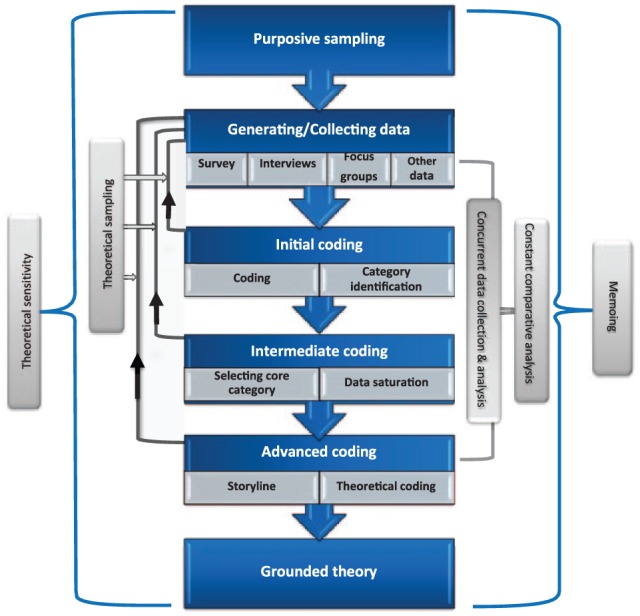
Background: Grounded theory is a well-known methodology employed in many research studies. Qualitative and quantitative data generation techniques can be used in a grounded theory study. Grounded theory sets out to discover or construct theory from data, systematically obtained and analysed using comparative analysis. While grounded theory is inherently flexible, it is a complex methodology. Thus, novice researchers strive to understand the discourse and the practical application of grounded theory concepts and processes. Objective: The aim of this article is to provide a contemporary research framework suitable to inform a grounded theory study. Result: This article provides an overview of grounded theory illustrated through a graphic representation of the processes and methods employed in conducting research using this methodology. The framework is presented as a diagrammatic representation of a research design and acts as a visual guide for the novice grounded theory researcher. Discussion: As grounded theory is not a linear process, the framework illustrates the interplay between the essential grounded theory methods and iterative and comparative actions involved. Each of the essential methods and processes that underpin grounded theory are defined in this article. Conclusion: Rather than an engagement in philosophical discussion or a debate of the different genres that can be used in grounded theory, this article illustrates how a framework for a research study design can be used to guide and inform the novice nurse researcher undertaking a study using grounded theory. Research findings and recommendations can contribute to policy or knowledge development, service provision and can reform thinking to initiate change in the substantive area of inquiry.
Overview
CoChat Summary
TL;DR
This article presents a contemporary, diagrammatic research design framework to help novice researchers visualise and apply the iterative methods and processes of grounded theory (GT). It defines the essential GT methods and processes and situates them within a non-linear, recursive design rather than debating philosophical genres.
Key findings
- GT is described as a structured yet flexible methodology appropriate when little is known about a phenomenon, aiming to produce or construct an explanatory theory grounded in data.
- Three distinct GT genres are identified: traditional/classic GT (Glaser), evolved GT (Strauss, Corbin and Clarke), and constructivist GT (Charmaz), distinguished by the researcher's philosophical position, use of literature, and approach to coding, analysis and theory development.
- Coding terminology differs by genre: traditional uses open, selective and theoretical coding; evolved uses open, axial and selective coding; constructivist uses initial, focused and theoretical coding (Table 1, adapted from Birks and Mills).
- The framework (Figure 1) depicts the interplay of purposive sampling, concurrent data generation/collection and analysis, constant comparative analysis, memoing, coding (initial, intermediate, advanced), theoretical sampling, theoretical sensitivity, and theoretical saturation, all directed toward an integrated substantive theory.
- Quality and rigour are related to three areas: the researcher's expertise, knowledge and research skills; methodological congruence with the research question; and procedural precision in the use of methods.
Methods
This is a methodological/discussion article, not an empirical study; no sample or dataset is analysed. It synthesises GT literature and prior works (notably Birks and Mills) to construct a graphic research design framework (Figure 1) and to define each essential GT method and process. The framework is presented as a visual guide for novice grounded theory researchers, illustrated with exemplars from other GT studies (Boxes 1–3).
Limitations
The paper states no formal limitations. Evident from the text: it deliberately avoids engagement in philosophical discussion or debate of the different GT genres, so it does not adjudicate between them; the framework is offered as a visual guide rather than an empirically tested model; and it is oriented specifically toward the novice nurse researcher, which may limit transferability to other disciplines or experienced researchers.
Model-written summary. Check it against the paper before relying on it.
Integrity signals
Registry
Cites
Statistics
Figures
Verification
Claims the paper makes
1 Valid · 4 Not valid · 49 Not checked · 18 Own results and interpretations
A statement the paper makes itself — it cites no source for it, so there is none to check. The quote shows it is in the paper.
In the paper
“As presented in Figure 1, initial purposive sampling directs the collection and/or generation of data.”
§ Grounded theory research: A design framework for novice researchers > Discussion > Purposive sampling
plainstates a cause- Asserted: passes — The authors put it forward as true.
- Checkable: passes — It can be checked against evidence.
- Load-bearing: passes — The paper’s conclusions depend on it.
- Based: passes — The paper gives a reason why it holds.
In the paper
“Constant comparative analysis generates increasingly more abstract concepts and theories through inductive processes.16”
§ Grounded theory research: A design framework for novice researchers > Discussion > Constant comparative analysis
What the sources say
- Not matchedcites [16] Charmaz K. Constructing grounded theory: a practical guide through qualitative analysis. Thousand Oaks, CA: SAGE, 2006.
Its entry has no title and year that we can search by.
plainstates a cause- Asserted: passes — The authors put it forward as true.
- Checkable: passes — It can be checked against evidence.
- Load-bearing: unclear — It is unclear whether the paper’s conclusions depend on it.
- Based: passes — The paper gives a reason why it holds.
- Not matched
In the paper
“Several analytic tools and techniques can be used to enhance theoretical sensitivity and increase the grounded theorist’s sensitivity to theoretical constructs in the data.28”
§ Grounded theory research: A design framework for novice researchers > Discussion > Theoretical sensitivity
What the sources say
- Not checked — no full text of the sourcecites [28] Corbin JM Strauss AL. Basics of qualitative research: techniques and procedures for developing grounded theory. 3rd ed. Thousand Oaks, CA: SAGE, 2008. source
plainstates a cause- Asserted: passes — The authors put it forward as true.
- Checkable: passes — It can be checked against evidence.
- Load-bearing: unclear — It is unclear whether the paper’s conclusions depend on it.
- Based: passes — The paper gives a reason why it holds.
In the paper
“Advanced coding that integrates extant theory adds further explanatory power to the findings.6”
§ Grounded theory research: A design framework for novice researchers > Discussion > Advanced coding
What the sources say
- Not matchedcites [6] Birks M Mills J. Grounded theory: a practical guide. 2nd ed. London: SAGE, 2015.
Its entry has no title and year that we can search by.
plainstates a cause- Asserted: passes — The authors put it forward as true.
- Checkable: passes — It can be checked against evidence.
- Load-bearing: unclear — It is unclear whether the paper’s conclusions depend on it.
- Based: passes — The paper gives a reason why it holds.
- Not matched
In the paper
“While interviews are a common method of generating data, data sources can include focus groups, questionnaires, surveys, transcripts, letters, government reports, documents, grey literature, music, artefacts, videos, blogs and memos.9”
§ Grounded theory research: A design framework for novice researchers > Discussion > Generating/collecting data
What the sources say
- Not checked — no full text of the sourcecites [9] Mills J Birks M Hoare KJ. Grounded theory. In: Mills J Birks M (eds) Qualitative methodology: a practical guide. London: SAGE, 2014, pp. 107– 121. source
plain- Asserted: passes — The authors put it forward as true.
- Checkable: passes — It can be checked against evidence.
- Load-bearing: unclear — It is unclear whether the paper’s conclusions depend on it.
- Based: passes — The paper gives a reason why it holds.
5 more claims
Create a free account to see all 72 claims and every source verdict.
- Probably not a substantial claim. 58
- It may state two separate claims as one. 17
Claims other papers make about this one
Each is checked against this paper’s own text: does it say what the citing paper says it does?
The cited source says what the claim attributes to it.
In the citing paper
“The epistemological and ontological differences principally address the proposition that theory is either discovered or co-constructed (Bryant, 2017), leading to opposing views on how the steps in the Grounded Theory method are understood (Bøttcher Berthelsen, 2018; Chun Tie, Birks and Francis, 2019; Tarozzi, 2020).”
From Application and challenges of using a Constructivist Grounded Theory methodology to address an undertheorized clinical challenge: A discussion paper (2024) · cites this paper as Chun Tie, Birks and Francis, 2019
The cited source says what the claim attributes to it.
In the citing paper
“Though the comparison of data, researchers emphasize consistencies, comprehend differences, and refine interviews, consistently comparing specific data points with others to establish categories (Bryant, 2017; Charmaz, 2014; Chun Tie et al., 2019).”
From Application and challenges of using a Constructivist Grounded Theory methodology to address an undertheorized clinical challenge: A discussion paper (2024) · cites this paper as Chun Tie et al., 2019
The cited source says what the claim attributes to it.
In the citing paper
“Nevertheless, this initial stage aims to deconstruct / fracture the data, allowing details to emerge (Bryant and Charmaz, 2019) to create the opportunity to identify both similarities and differences, pose analytical inquiries (Charmaz and Thornberg, 2021), and thereby establish to attain a more profound level of meaning (Chun Tie et al., 2019).”
From Application and challenges of using a Constructivist Grounded Theory methodology to address an undertheorized clinical challenge: A discussion paper (2024) · cites this paper as Chun Tie et al., 2019
Citations
Cites
The Discovery of Grounded Theory: Strategies for Qualitative Research.
Wagner, H. R., Glaser, B. G., & Strauss, A. L. (1968) · Social Forces · doi:10.2307/2575405 · Cited by 46,361
The Discovery of Grounded Theory; Strategies for Qualitative Research
Glaser, B. G., Strauss, A. L., & Strutzel, E. (1968) · Nursing Research · doi:10.1097/00006199-196807000-00014 · Cited by 39,449
(1998) · Sage eBooks · Cited by 38,631
Basics of Qualitative Research (3rd ed.): Techniques and Procedures for Developing Grounded Theory
Corbin, J., & Strauss, A. (2008) · SAGE · doi:10.4135/9781452230153 · Cited by 24,827
Basics of Qualitative Research: Grounded Theory Procedures and Techniques
Long, D. R., Strauss, A., & Corbin, J. (1993) · The Modern Language Journal · doi:10.2307/328955 · Cited by 17,576
Research Design: Qualitative, Quantitative, and Mixed Methods Approaches
Sloane-Seale, A. (2009) · Canadian Journal of University Continuing Education · doi:10.21225/d54s3d · Cited by 14,328
The Coding Manual for Qualitative Researchers
Lungu, M. (2022) · American Journal of Qualitative Research · doi:10.29333/ajqr/12085 · Cited by 10,826
Constructing grounded theory. A practical guide through qualitative analysis
Brink, E., Dellve, L., Hallberg, U., Abrahamsson, K. H., Klingberg, G., & Wentz, K. (2006) · International Journal of Qualitative Studies on Health and Well-being · doi:10.3402/qhw.v1i3.4932 · Cited by 6,862
(1978) · Medical Entomology and Zoology · Cited by 6,077
The Sage Handbook of Qualitative Research[1]
(2006) · Qualitative Research in Organizations and Management: An International Journal · doi:10.1108/17465640610666642 · Cited by 5,842
Research works printed but not linked: 13
- Crotty M. The foundation of social research: meaning and perspective in the research process. Thousand Oaks, CA: SAGE, 1998.
- Charmaz K. The power and potential of grounded theory. Med Sociol 2012; 6: 2– 15.
- Glaser BG. Basics of grounded theory analysis. Mill Valley, CA: Sociology Press, 1992.
- Ralph N Birks M Chapman Y. The methodological dynamism of grounded theory. Int J Qual Methods 2015; 14: 1–6.
- Bryant A Charmaz K. The Sage handbook of grounded theory. Thousand Oaks, CA: SAGE, 2007. · DOI · Paper page
- Charmaz K Bryant A. Grounded theory and credibility. In: Silverman D (ed.) Qualitative research. 3rd ed. London: SAGE, 2011, pp. 291– 309.
- Glaser BG Holton J. Remodeling grounded theory. Forum Qualitative Sozialforschung/Forum: Qualitative Social Research 2004; 5: 1– 22.
- Mackenzie N Knipe S. Research dilemmas: paradigms, methods and methodology. Issues Educ Res 2006; 16: 193– 205.
- Chamberlain-Salaun J. Consumers and the social world of health care: outsiders in the expert’s world: a grounded theory study. PhD Thesis, College of Health Care Sciences, James Cook University, Townsville, QLD, Australia, 2015, p. 198.
- Moghaddam A. Coding issues in grounded theory. Issues Educ Res 2006; 16: 53– 61.
- Evans LE. A novice researcher’s first walk through the maze of grounded theory: rationalization for classical grounded theory. Ground Theory Rev 2013; 14: 37–55.
- Glaser BG. The grounded theory perspective III: theoretical coding. Mill Valley, CA: Sociology Press, 2005.
- Baldwin A. Reconciling professional identity: a grounded theory study of nurse academics’ role modelling. PhD Thesis, College of Healthcare Sciences, James Cook University, Townsville, QLD, Australia, 2016, p. 246.
Cited by
Items 1,701–1,800 of 1,857
Noceda, A. V. G., Acierto, L. M. M., Bertiz, M. C. C., Dionisio, D. E. H., Laurito, C. B. L., Sanchez, G. A. T., & Loreche, A. M. (2023) · Figshare · doi:10.6084/m9.figshare.22626362
Fitzpatrick, N. K., Chachay, V., Sandra, C., Briskey, D. R., Jackman, S. R., Shore, A., & Bowtell, J. L. (2024) · Figshare · doi:10.6084/m9.figshare.26668017
Mota-Castillo, P. J., Unar-Munguía, M., Santos-Guzmán, A., et al. (2024) · Figshare · doi:10.6084/m9.figshare.26565414
Empoderamiento de los jóvenes en salud: una estructura teórica de las prácticas de alfabetización
Nascimento, M. M. D. S., Rosário, R., Galvão, D. M. P. G., da Silva, R. G. M., Soares, K. H. D., Leandro, V. C. C. A., Monteiro, E. M. L. M., & Barros, M. B. S. C. (2023) · Portuguese National Funding Agency for Science, Research and Technology (RCAAP Project by FCT) · doi:10.1590/1983-1447.2023.20220126.en
Keeley, R. G., Peterson-Ahmad, M. B., & Beecher, S. (2025) · Journal of the American Academy of Special Education Professionals · doi:10.64546/jaasep.578
Designing a Rhetorical Inquiry into the Security Council’s Whataboutery
Zavialov, D. (2025) · Springer eBooks · doi:10.1007/978-981-95-0413-8_3
Choudhury, A. A., & Luzón, O. (2025) · The Cognitive Behaviour Therapist · doi:10.1017/s1754470x25100317 · Cited by 2
“Thus, to minimise that risk, the first author wrote memos (Chun Tie et al ., 2019) throughout the study and reflected on her assumptions during data collection.”
The lived experiences of teachers working with young students with autism
Juarez, S. L. (2025) · Journal of the American Academy of Special Education Professionals · doi:10.64546/jaasep.591 · Cited by 1
Jaime, L. B. (2023) · Emerald Group Publishing Limited eBooks · doi:10.1108/979-8-88730-227-020251010
A Reflection on Organizational Adaptation & Higher Education in Iran: What Are the Building Blocks?
Tohidian, I., Abbaspour, A., & Taskoh, A. K. (2025) · Journal of Higher Education Policy And Leadership Studies · doi:10.61882/johepal.6.3.168
Raj, J. P., Balasubramanian, S., Nellikal, S., et al. (2025) · BMJ Open · doi:10.1136/bmjopen-2025-103591
Bordoloi, T., & Acharya, S. (2025) · Springer eBooks · doi:10.1007/978-981-95-1853-1_11
Ridley-Merriweather, K. E., Vogel, K., & Okoruwa, O. P. (2026) · Health Communication · doi:10.1080/10410236.2025.2609215 · Cited by 1
“When the coding and data collection process is concluded, researchers have developed theoretical ideas unique to their particular study (Chun Tie et al., 2019).”
InfluentialZheng, Y., Jing, X., Yuan, J., et al. (2026) · SSRN Electronic Journal · doi:10.2139/ssrn.6051135
Fattore, D., Abulkhair, O. A. M., Khorshid, O. M. R., et al. (2026) · Supportive Care in Cancer · doi:10.1007/s00520-025-10254-w
Time unbound: Nonlinear temporality and structural trauma in prison time
DeCaro, J. B. (2026) · Punishment & Society · doi:10.1177/14624745251410912
“I coded the oral history interviews using a grounded theory of qualitative coding to produce an adaptable list of 70 codes organized around the main themes of personal trauma, structural trauma, identity, trauma effects, and healing effects (e.g. Chun Tie et al., 2019).”
Muñoz-Helú, H., Núñez, P. D. P., Cruz-Morales, K. N., Zazueta-Beltrán, D. K., & Morales-Beltrán, R. A. (2026) · Sport Education and Society · doi:10.1080/13573322.2026.2613700 · Cited by 2
How do parents approach nighttime infant care? A grounded theory
Dooner, C., Ou, C. H. K., Kim, H., Marcellus, L., Henry-Dansereau, M., & Sidhu, J. (2026) · Frontiers in Sleep · doi:10.3389/frsle.2026.1669946 · Cited by 1
“Constructivist grounded theory methods were used to analyze the data (Charmaz, 2006; Chun Tie et al., 2019).”
Miller, A., Driscoll, P., & Brown, L. W. (2026) · Community Work & Family · doi:10.1080/13668803.2026.2619057
Sustainable Management Practice in the Textile Industry: Empowering the Designer Through Strategy
Watson, M., Marshall, B., & Watson, E. (2026) · Springer Proceedings in Materials · doi:10.1007/978-981-95-2953-7_19
AI-driven Collaborative Talent Management: Rethinking Leadership in Society 5.0
Chew, Y.-C., & Zainal, S. R. M. (2026) · Emerald Group Publishing Limited eBooks · doi:10.1108/978-1-83662-602-220261015
Technology-Facilitated Communications with Clients in Child Welfare Practice
Regehr, C., Mishna, F., Fallon, B., Billard, D., Schiffer, J., & Lefebvre, R. (2026) · Studies in Clinical Social Work Transforming Practice Education and Research · doi:10.1080/28376811.2026.2627305
Gibson, L., Richterman, A. G., RANDALL, A., Muruako, J., Uzwiak, B. A., FABIAN, E., Thirumurthy, H., & Roberto, C. A. (2026) · Social Science & Medicine · doi:10.1016/j.socscimed.2026.119068
“We used an integrated thematic analysis approach to identify themes deductively from a priori domains established based on the expertise of the study team and inductively based on participant responses (Chun Tie et al., 2019).”
‘Our babies are our gold’: The experiences of Aboriginal kinship carers in Western Australia
Jones, J., Moodie, S., Chenhall, R. D., Brook, J., Williams, R., Davis, K., Garlett, C., Gibberd, A. J., Banks, E., Harrap, B., et al. (2026) · Children and Youth Services Review · doi:10.1016/j.childyouth.2026.108827 · Cited by 1
Scaling Impact: Alternative Routes for Growth-Agnostic Sustainable Businesses
Hammannavar, S. (2026) · Responsible leadership and sustainable management · doi:10.1007/978-981-95-5929-9_14
Shroff, N., Jesudason, S., Grov, C., & Manze, M. G. (2026) · Women s Reproductive Health · doi:10.1080/23293691.2026.2623515
Brkić–Jovanović, N., Tankosić, B., Lukic, J., et al. (2026) · Nursing Reports · doi:10.3390/nursrep16020072
Resilience of IT Auditors in South African Banking Amidst COVID-19
Mabatha, N., & Nzama, L. (2026) · Springer proceedings in business and economics · doi:10.1007/978-3-032-13384-7_1
Zhang, D., Luo, S., Liu, Y., Zhang, X., Hu, Y., Shen, J., Yi, P., Zhao, K., & Liu, W. (2026) · Humanities and Social Sciences Communications · doi:10.1057/s41599-026-06738-7 · Cited by 5
Ruiz, L., Vergara, N., Pérez, J., & Velásquez, J. C. M. (2026) · Educación Médica · doi:10.1016/j.edumed.2026.101162
Simpson, R., Cohen, E., Posa, S., Wasilewski, M. B., Feinstein, A., Bayley, M. T., Robinson, L. L., Munce, S., Gray, C. S., & Kokorelias, K. M. (2026) · JMIR Rehabilitation and Assistive Technologies · doi:10.2196/80499
“Grounded theory as a qualitative methodology is used when the focus is on the process and the creation of theory or a conceptual framework [17,18,20].”
Simpson, K. B., Kheni, N. A., & Boateng, I. (2026) · Journal of Building Construction and Planning Research · doi:10.4236/jbcpr.2026.141003
Emotion Regulation in the Face of Guilt and Contradiction: A Model of Life-Role Paradox
Dorris, A., Ashkanasy, N. M., & Richardson, J. (2026) · Emerald Group Publishing Limited eBooks · doi:10.1108/s1746-979120260000020016
Building Data Models for Archaeology: The case of the TETRARCHs Storytelling Data Model
Fadioui, A. (2026) · Internet Archaeology · doi:10.11141/ia.71.1
In support of Grounded Theory Methodology in English for Academic Purposes researchPreprint
Bolster, A. (2026) · SSRN Electronic Journal · doi:10.2139/ssrn.6333911
He, X., Sun, X., Zhang, G., et al. (2026) · Scientific Reports · doi:10.1038/s41598-026-42386-2
Acuity, Diagnosis, and Community Factors in Virtual and In-Person Treatment: Qualitative Study
Cerrito, B., Connors, A., Fialk, A., Xiao, J., Usow, J., & Buono, F. D. (2026) · JMIR Human Factors · doi:10.2196/82863
“Reflexive thematic analysis, rooted in constructivist principles, then facilitated the identification and analysis of patterns across the data [20].”
Anantharaman, D., Liddle, J., Flynn, A., Vandemeulebroucke, T., King, C., Redman, B., Roache, K. E., Woodhouse, G., & Koh, W. Q. (2026) · International Journal of Qualitative Methods · doi:10.1177/16094069261434236
Li, M., Zhang, H., Shang, X., Zhao, Q., Feng, L., Hu, W., & Sun, X. (2026) · International Journal of Science Education · doi:10.1080/09500693.2026.2641832
Ma, J., Chen, C.-C., & Cheng, Y. F. (2026) · International Journal of Human-Computer Interaction · doi:10.1080/10447318.2026.2631663 · Cited by 1
Greens in Regulation: Biodiversity Strategy Implementation Across the Golf Industry
Howell, J. P., & Moore, J. (2026) · Business Strategy and the Environment · doi:10.1002/bse.70746 · Cited by 1
Sharpe, K., Peck, H. H., Marino, S. C., Jones, A. M., & McLeod, C. (2026) · Frontiers in Public Health · doi:10.3389/fpubh.2026.1768542 · Cited by 1
Rios, C. M., Silva, C., & Carvalho, L. (2026) · Environmental Innovation and Societal Transitions · doi:10.1016/j.eist.2026.101129 · Cited by 1
Towards Neuro-symbolic Classification of Abrasive Wear in Scanning Electron Microscopy
Brännström, A., Guerrero, E., Wojtowicz, M., et al. (2026) · Lecture notes in computer science · doi:10.1007/978-3-032-21540-6_19
Lin, C., & Xiong, S. (2026) · Frontiers in Digital Health · doi:10.3389/fdgth.2026.1762306 · Cited by 1
“Analysis of the collected data was conducted following the three-step process of Strauss and Corbin’s evolved grounded theory methodology (48), including open, axial, and selective coding, to construct a comprehensive framework of perceived risk in OHSs.”
Palkovitz, R. E., Shenk, M. K., & Burkhart, E. P. (2026) · Plants People Planet · doi:10.1002/ppp3.70202
School-Based Behavior Analysts: A Grounded Theory Study on How They See Their Roles
Layden, S. J., Lorio-Barsten, D. K., Holthaus, L. M., Hollins, N. A., Rhodes, L., Austin, K., & Berlin, K. L. (2026) · Journal of Positive Behavior Interventions · doi:10.1177/10983007251389273 · Cited by 1
Parental decision-making for infant spinal anesthesia – a qualitative study
Rosenblatt, A., Ballard, H. A., Froyshteter, A. B., et al. (2026) · BMC Anesthesiology · doi:10.1186/s12871-026-03792-1
“…collection of data and analysis, constant comparative techniques, analytic codes proceeding from the data, avoidance of a pre-existing hypothesis or theoretical structure, theory development advancing as each portion of data collection and analysis emerged, and the use of memo writing [16, 18, 19].”
How recruitment signals become memes: competitive intelligence dynamics in ten Chinese AI firms
Guan, H., & Jamil, R. (2026) · Future Business Journal · doi:10.1186/s43093-026-00793-x · Cited by 1
Holt, L., Corneli, A. L., Stevenson, E. L., Swartz, J. J., & Relf, M. V. (2026) · PLoS ONE · doi:10.1371/journal.pone.0343687
Wilkinson, H., & Minichiello, A. (2026) · Journal of Women and Minorities in Science and Engineering · doi:10.1615/jwomenminorscieneng.2026056610
A global juridicial approach to the invisibilisation of minorities discrimination
Boutier, I. (2023) · theses.fr (ABES) · doi:10.70675/39b2c6a0zbbdcz4fb3z92bfz814897fc1a40
Gonzalez, H., Hannon, M., & Tapinos, E. (2026) · Business Strategy and the Environment · doi:10.1002/bse.70817
How Do Teacher Candidates Develop Their Identities as Teachers? A Philippine Case Study
Vindollo, S. C., & de Guzman, A. B. (2026) · Springer international handbooks of education · doi:10.1007/978-981-95-2423-5_35
Becoming Well: A Grounded Theory of Wellness Continuity and Discontinuity Through Fitness Practices
Salvacion, A. J., & Baradillo, D. G. (2026) · Psychology and Education A Multidisciplinary Journal · doi:10.70838/pemj.541004
Wendland, J. (2026) · International Journal of Listening · doi:10.1080/10904018.2026.2660064 · Cited by 1
Graves, S. L. (2026) · School Psychology Review · doi:10.1080/2372966x.2026.2655106
Fabricius, C., Alvenfors, A., Lingström, P., Almståhl, A., & Bernson, J. M. (2026) · BMC Oral Health · doi:10.1186/s12903-026-08350-2
Krantz, D. (2026) · The Neurodiagnostic Journal · doi:10.1080/21646821.2026.2650237
“During the interviews, the researcher noted significant terms for further review and reflexive analysis (Campbell et al. 2021; Chun Tie et al. 2019).”
Bushell, M., Winata, T., Gillies, D. M., et al. (2026) · Journal of Applied Research in Intellectual Disabilities · doi:10.1111/jar.70231
“A constructivist grounded theory methodology was employed to enable the co-construction of the leaflet template with participants, grounded in their lived experiences, understandings, and preferences related to medicine use and information sharing (Chun Tie et al. 2019).”
A systemic and recursive process model of implementing strategic and transformative change
Penington, T., Gallage, N., & Ihalanayake, R. (2026) · Project Leadership and Society · doi:10.1016/j.plas.2026.100225
Chen, H. (., Wang, Y. (., & Wang, Y. (2026) · SSRN Electronic Journal · doi:10.2139/ssrn.6626344
Mahamid, S., Elias, H., & Sulimani‐Aidan, Y. (2026) · Child & Family Social Work · doi:10.1111/cfs.70203 · Cited by 1
Miller, S., Peng, Z., & Heo, R. (2026) · Communication Methods and Measures · doi:10.1080/19312458.2026.2652240
“Principles and assumptions that guide the collection, analysis, and interpretation of data vary based on a researcher’s stance (Braun & Clarke, 2019; Chun Tie et al., 2019; Braun et al., 2024).”
Weissblueth, E., Linder, I., & Hirsh, A. (2026) · Armed Forces & Society · doi:10.1177/0095327x261440138
Tasse, I., Sewera, S., Vepraskas, S., Kay, C., Pavlic, A., & Muntz, M. (2026) · Medical Science Educator · doi:10.1007/s40670-026-02741-4
“We then grouped these codes into more generalized themes using thematic analysis with an iterative approach [6 ].”
Heemskerk, S. C. M., Brus, I. M., de Groot, A., et al. (2026) · BMC Health Services Research · doi:10.1186/s12913-026-14489-z
“Open-ended responses were independently coded and categorized by two researchers, using a grounded theory approach [22].”
Fredericksen, R. J., Sibley, A. L., Lancaster, K. E., Jenkins, W. D., Mixson, L. S., Whitney, B. M., Ouellet, L. J., Friedmann, P. D., Korthuis, T., Delaney, J. A., et al. (2026) · Harm Reduction Journal · doi:10.1186/s12954-026-01460-8
“Upon retrieval of the data we developed a thematic coding scheme based on the principles of Grounded Theory analysis [25, 26] was reached.”
A Discourse Analysis on Humor Employed in Philippine TV Shows
Cruda, I., Tagalogon, A. M., Estrella, M., Matutino, R. M., & Billones, I. F. (2026) · Psychology and Education A Multidisciplinary Journal · doi:10.70838/pemj.550804
Basister, M. P., Petersson, J., & Baconguis, R. T. (2026) · Frontiers in Education · doi:10.3389/feduc.2026.1810233 · Cited by 3
Brown, C. R., Guell, C., & Murphy, M. M. (2026) · Nutrients · doi:10.3390/nu18091427 · Cited by 1
“With limited qualitative research on the topic and the study’s aim of understanding beliefs and perspectives, a qualitative research design was informed by grounded theory to uncover an explanatory process about the ways people see connections between diet, food systems, and mental health [41].”
Lowery, R., Wang, L., Prasad, R. K., & Gray, M. J. (2026) · Journal of Health Advocacy · doi:10.70440/001c.160296
Syed Ali Nawaid, A. L. A. M., & Adekunle, O. E. (2026) · European Business Review · doi:10.1108/ebr-11-2025-0432 · Cited by 1
Zheng, Y., Zhao, P., & He, C. (2026) · BMC Psychology · doi:10.1186/s40359-026-04642-y
“This involves first generating data, then inductively deriving concepts and constructing theories from it, making it suitable for exploratory research lacking established theoretical frameworks [7].”
Bapuji, S. B., Tan, J., Barclay, L., Divakar, R., Saar, E., Darmanin, B., Harding, P. A., Lennon, S., McDermott, G., Robertson, J., et al. (2026) · Physiotherapy Theory and Practice · doi:10.1080/09593985.2026.2667374
Kabanda, G. (2026) · Springer eBooks · doi:10.1007/978-981-95-8240-2_23
Giovannini-Green, Z. E., Mugford, G., & Philpott, D. (2026) · PLOS mental health · doi:10.1371/journal.pmen.0000612
Mekuria, A., & Bushisso, E. W. (2026) · Ampersand · doi:10.1016/j.amper.2026.100274
Resilience in people with severe mental illness and cancer, a qualitative study
Charlesworth, L., & Ashmore, R. (2026) · Supportive Care in Cancer · doi:10.1007/s00520-026-10772-1
Socio-technical Friction: An Emergent Grounded Theory of DevSecOps Challenges
Ferazza, F., & Mersinas, K. (2026) · Lecture notes in computer science · doi:10.1007/978-3-032-20018-1_22
Wei, S. T., Chen, K. Z., & Wang, T.-H. (2026) · International Conference on Educational and Information Technology · doi:10.1109/iceit68991.2026.11521597
Interprofessional learning in diverse Middle Eastern maternity teams
Mohan, S., Reagu, S. M., Lindow, S. W., & Abdullah, Q. K. (2026) · Journal of Interprofessional Care · doi:10.1080/13561820.2026.2667302
Mthembu, S., April, K. A., Erbil, C., & Özbilgin, M. F. (2026) · British Journal of Sociology · doi:10.1111/1468-4446.70128
“Analysis proceeded through the innovative and systematic strategy of simultaneous data collection and analysis characteristic of grounded theory approaches (Chun Tie et al. 2019).”
Defining Benevolent Childhood Experiences: Children's Perspectives
Rosenthal, A. N., Oppenheim‐Weller, S., & Mansbach‐Richardson, N. (2026) · Child Abuse Review · doi:10.1002/car.70132
Prehospital Trauma Care Challenges in Lima, Peru: A Mixed-Methods Review of Patient Perspectives
Dentice, A. D., VanDerWal, J. A., Zavala-Wong, G., et al. (2026) · Journal of Surgical Research · doi:10.1016/j.jss.2026.04.036
A Review of Wild Mushroom Harvesting Regulations on Public Lands in the United States
Wrobleski, A. C., & Burkhart, E. P. (2026) · Conservation · doi:10.3390/conservation6020064
Samal, J., Preetha, G. S., & Singh, H. (2026) · BMC Health Services Research · doi:10.1186/s12913-026-14797-4 · Cited by 1
“During this iterative process, the first author wrote the memos and maintained field notes during each interview to keep track of the conceptual developments [28].”
Leal, J. P., Gabinete, S. G., Ambos, M., et al. (2026) · Frontiers in Education · doi:10.3389/feduc.2026.1684991
Auguste, A., & CaSIDEC Study Group (2026) · JMIR Research Protocols · doi:10.2196/90930
Jones, J., Brook, J., Moodie, S., Chenhall, R. D., Williams, R., Garlett, C., Davis, K., Gibberd, A. J., Harrap, B., McNamara, B. J., et al. (2026) · Journal of Intellectual & Developmental Disability · doi:10.3109/13668250.2026.2668767
Cultural and linguistic correlates of autism in Jordan
Nasir, A. K., Masri, A. T., & Nasir, L. (2026) · BMC Psychology · doi:10.1186/s40359-026-04947-y
“We used grounded theory methodology to analyze the data [19, 42].”
Gezinski, L. B., Rizo, C. F., Fukushima, A. I., O’Brien, J., Violante, N., & Price, C. (2026) · Children and Youth Services Review · doi:10.1016/j.childyouth.2026.109101 · Cited by 1
Tun, H. M., Win, N. Z., Htut, H. N., & Lwin, N. N. (2026) · Discover Public Health · doi:10.1186/s12982-026-02326-x
Unseen Backyard Classrooms and Child Safeguarding in Zimbabwean Urban Areas
Chingwe, E., Mutseekwa, C., Zimuto, N. C., & Mawuye, E. P. (2026) · Educational Point · doi:10.71176/edup/18783
“Researchers adhered to the stages of Grounded Theory (GT) for data analysis, drawing upon the framework proposed by Chun Tie et al. (2019).”
Gray, D., & Kiely, J. (2026) · Frontiers in Sports and Active Living · doi:10.3389/fspor.2026.1827074
“Participants self-identified as meeting a strict criterion-based selection (128 – 131) and provided voluntary consent before completing the questionnaire.”
Sutton, K. M., & Hayes, J. W. (2026) · Research Square · doi:10.21203/rs.3.rs-9670113/v1
Montgomery-Stinson, T., Cuerrier, A., Pilgrim, L., Saunders, M., Andersen, G., Way, R. G., & Trant, A. J. (2026) · Botany · doi:10.1139/cjb-2025-0111
Gezinski, L. B., Richer, A., Dilanchian, A., Anasti, T., Dell, N. A., & Price, C. (2026) · Harm Reduction Journal · doi:10.1186/s12954-026-01471-5
“Individuals were analytic depth and richness are prioritized over statistical representation [43].”
Metadata
- Authors
- Chun Tie, Y., Birks, M., & Francis, K.
- Affiliations
- Nursing and Midwifery, College of Healthcare Sciences, James Cook University, Townsville, QLD, Australia
- James Cook University (AU)
- University of Tasmania (AU)
- Venue
- SAGE Open Medicine
- Publisher
- SAGE Publications
- Published
- 2019-01
- Volume
- 7
- Pages
- 2050312118822927-2050312118822927
- ISSN
- 2050-3121 (ISSN-L)
- PMC
- PMC6318722
- OpenAlex
- W2906994370
- Cited by
- 1,869
- References
- 29
- Citations by year
- 2026: 200 · 2025: 285 · 2024: 370 · 2023: 370 · 2022: 302 · 2021: 226 · 2020: 108 · 2019: 8
- FWCI
- 433.86
- Type
- journal article
- Language
- en
- Open access
- gold
- doi.org
- Licence
- cc-by-nc
- journals.sagepub.com/page/policies/text-and-data-mining-license (tdm)
- Locations
- SAGE Open Medicine (publishedVersion, cc-by-nc)
- Europe PMC (PubMed Central) (publishedVersion, cc-by-nc)
- PubMed Central (publishedVersion, cc-by-nc)
- PubMed (publishedVersion)
- UTAS Research Repository (acceptedVersion)
- ResearchOnline at James Cook University (James Cook University) (submittedVersion)
- DOAJ (DOAJ: Directory of Open Access Journals) (submittedVersion, cc-by-sa)
- Figshare (submittedVersion, cc-by-nc)
- Topics
- Social Sciences › Education › Qualitative Research Methods and Applications
- Health Sciences › Nursing › Research and Theory › Methodologies in Health Research and Practice
- Social Sciences › Education › Educational Research and Methods
- Keywords
- grounded theory, research design framework, novice researchers, nurse researchers, qualitative research methodology, comparative analysis
About these checks
Registry, retraction, Cites and statistics results are computed, not judged, with one exception: a printed reference that no index lists is read once by a model before it counts as a citation error. Claims are extracted by a model and kept only when their quote appears verbatim in the text; each cited source is then checked, with a model’s help, for whether it says what the claim relies on. Those verdicts can be wrong — read the claim’s quote and the cited source before relying on one.
The claim verdicts this report counts are experimental: their accuracy is not yet measured.
A language model drew the claims from the paper on 2026-10-10, under version 3 of the claim definition (model deepseek-v4.1-flash, prompt extract-v3).
A second model labelled each claim on 2026-10-10 (model jev-1.13-20260917, definition revision gold-guideline-v0.2).
Statistics and arithmetic are recomputed, not judged.
Confidence bands are shown only for fields calibrated on our annotated test set. None is calibrated yet, so no band is shown.
What counts as a claim ›How we measure confidence ›How we check this ›
Are you an author, or do you see a problem with this page? Request a review
Data sources
Bibliographic data: Semantic Scholar, OpenAlex, Crossref.
Contains information from the Semantic Scholar Academic Graph Datasets, made available under the ODC Attribution License (ODC-BY 1.0).
Semantic Scholar’s data is described in: Kinney, R., et al. (2023). The Semantic Scholar Open Data Platform. arXiv:2301.10140.
