

Grounded theory research: A design framework for novice researchers
Open accessThe DOI matches its Crossref record; 30 of the 33 references it cites were found in a registry or an index; 2 of the 69 sources its claims cite were checked for support.
Abstract
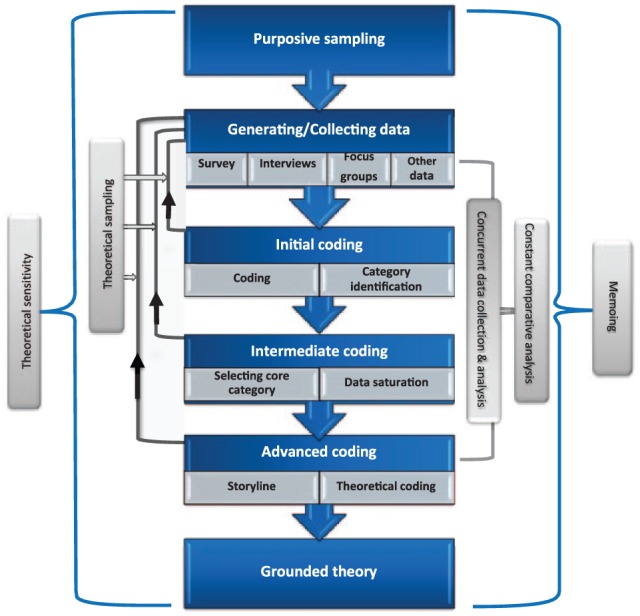
Background: Grounded theory is a well-known methodology employed in many research studies. Qualitative and quantitative data generation techniques can be used in a grounded theory study. Grounded theory sets out to discover or construct theory from data, systematically obtained and analysed using comparative analysis. While grounded theory is inherently flexible, it is a complex methodology. Thus, novice researchers strive to understand the discourse and the practical application of grounded theory concepts and processes. Objective: The aim of this article is to provide a contemporary research framework suitable to inform a grounded theory study. Result: This article provides an overview of grounded theory illustrated through a graphic representation of the processes and methods employed in conducting research using this methodology. The framework is presented as a diagrammatic representation of a research design and acts as a visual guide for the novice grounded theory researcher. Discussion: As grounded theory is not a linear process, the framework illustrates the interplay between the essential grounded theory methods and iterative and comparative actions involved. Each of the essential methods and processes that underpin grounded theory are defined in this article. Conclusion: Rather than an engagement in philosophical discussion or a debate of the different genres that can be used in grounded theory, this article illustrates how a framework for a research study design can be used to guide and inform the novice nurse researcher undertaking a study using grounded theory. Research findings and recommendations can contribute to policy or knowledge development, service provision and can reform thinking to initiate change in the substantive area of inquiry.
Overview
CoChat Summary
TL;DR
This article presents a contemporary, diagrammatic research design framework to help novice researchers visualise and apply the iterative methods and processes of grounded theory (GT). It defines the essential GT methods and processes and situates them within a non-linear, recursive design rather than debating philosophical genres.
Key findings
- GT is described as a structured yet flexible methodology appropriate when little is known about a phenomenon, aiming to produce or construct an explanatory theory grounded in data.
- Three distinct GT genres are identified: traditional/classic GT (Glaser), evolved GT (Strauss, Corbin and Clarke), and constructivist GT (Charmaz), distinguished by the researcher's philosophical position, use of literature, and approach to coding, analysis and theory development.
- Coding terminology differs by genre: traditional uses open, selective and theoretical coding; evolved uses open, axial and selective coding; constructivist uses initial, focused and theoretical coding (Table 1, adapted from Birks and Mills).
- The framework (Figure 1) depicts the interplay of purposive sampling, concurrent data generation/collection and analysis, constant comparative analysis, memoing, coding (initial, intermediate, advanced), theoretical sampling, theoretical sensitivity, and theoretical saturation, all directed toward an integrated substantive theory.
- Quality and rigour are related to three areas: the researcher's expertise, knowledge and research skills; methodological congruence with the research question; and procedural precision in the use of methods.
Methods
This is a methodological/discussion article, not an empirical study; no sample or dataset is analysed. It synthesises GT literature and prior works (notably Birks and Mills) to construct a graphic research design framework (Figure 1) and to define each essential GT method and process. The framework is presented as a visual guide for novice grounded theory researchers, illustrated with exemplars from other GT studies (Boxes 1–3).
Limitations
The paper states no formal limitations. Evident from the text: it deliberately avoids engagement in philosophical discussion or debate of the different GT genres, so it does not adjudicate between them; the framework is offered as a visual guide rather than an empirically tested model; and it is oriented specifically toward the novice nurse researcher, which may limit transferability to other disciplines or experienced researchers.
Model-written summary. Check it against the paper before relying on it.
Integrity signals
Registry
Cites
Statistics
Figures
Verification
Claims the paper makes
1 Valid · 4 Not valid · 49 Not checked · 18 Own results and interpretations
A statement the paper makes itself — it cites no source for it, so there is none to check. The quote shows it is in the paper.
In the paper
“As presented in Figure 1, initial purposive sampling directs the collection and/or generation of data.”
§ Grounded theory research: A design framework for novice researchers > Discussion > Purposive sampling
plainstates a cause- Asserted: passes — The authors put it forward as true.
- Checkable: passes — It can be checked against evidence.
- Load-bearing: passes — The paper’s conclusions depend on it.
- Based: passes — The paper gives a reason why it holds.
In the paper
“Constant comparative analysis generates increasingly more abstract concepts and theories through inductive processes.16”
§ Grounded theory research: A design framework for novice researchers > Discussion > Constant comparative analysis
What the sources say
- Not matchedcites [16] Charmaz K. Constructing grounded theory: a practical guide through qualitative analysis. Thousand Oaks, CA: SAGE, 2006.
Its entry has no title and year that we can search by.
plainstates a cause- Asserted: passes — The authors put it forward as true.
- Checkable: passes — It can be checked against evidence.
- Load-bearing: unclear — It is unclear whether the paper’s conclusions depend on it.
- Based: passes — The paper gives a reason why it holds.
- Not matched
In the paper
“Several analytic tools and techniques can be used to enhance theoretical sensitivity and increase the grounded theorist’s sensitivity to theoretical constructs in the data.28”
§ Grounded theory research: A design framework for novice researchers > Discussion > Theoretical sensitivity
What the sources say
- Not checked — no full text of the sourcecites [28] Corbin JM Strauss AL. Basics of qualitative research: techniques and procedures for developing grounded theory. 3rd ed. Thousand Oaks, CA: SAGE, 2008. source
plainstates a cause- Asserted: passes — The authors put it forward as true.
- Checkable: passes — It can be checked against evidence.
- Load-bearing: unclear — It is unclear whether the paper’s conclusions depend on it.
- Based: passes — The paper gives a reason why it holds.
In the paper
“Advanced coding that integrates extant theory adds further explanatory power to the findings.6”
§ Grounded theory research: A design framework for novice researchers > Discussion > Advanced coding
What the sources say
- Not matchedcites [6] Birks M Mills J. Grounded theory: a practical guide. 2nd ed. London: SAGE, 2015.
Its entry has no title and year that we can search by.
plainstates a cause- Asserted: passes — The authors put it forward as true.
- Checkable: passes — It can be checked against evidence.
- Load-bearing: unclear — It is unclear whether the paper’s conclusions depend on it.
- Based: passes — The paper gives a reason why it holds.
- Not matched
In the paper
“While interviews are a common method of generating data, data sources can include focus groups, questionnaires, surveys, transcripts, letters, government reports, documents, grey literature, music, artefacts, videos, blogs and memos.9”
§ Grounded theory research: A design framework for novice researchers > Discussion > Generating/collecting data
What the sources say
- Not checked — no full text of the sourcecites [9] Mills J Birks M Hoare KJ. Grounded theory. In: Mills J Birks M (eds) Qualitative methodology: a practical guide. London: SAGE, 2014, pp. 107– 121. source
plain- Asserted: passes — The authors put it forward as true.
- Checkable: passes — It can be checked against evidence.
- Load-bearing: unclear — It is unclear whether the paper’s conclusions depend on it.
- Based: passes — The paper gives a reason why it holds.
5 more claims
Create a free account to see all 72 claims and every source verdict.
- Probably not a substantial claim. 58
- It may state two separate claims as one. 17
Claims other papers make about this one
Each is checked against this paper’s own text: does it say what the citing paper says it does?
The cited source says what the claim attributes to it.
In the citing paper
“The epistemological and ontological differences principally address the proposition that theory is either discovered or co-constructed (Bryant, 2017), leading to opposing views on how the steps in the Grounded Theory method are understood (Bøttcher Berthelsen, 2018; Chun Tie, Birks and Francis, 2019; Tarozzi, 2020).”
From Application and challenges of using a Constructivist Grounded Theory methodology to address an undertheorized clinical challenge: A discussion paper (2024) · cites this paper as Chun Tie, Birks and Francis, 2019
The cited source says what the claim attributes to it.
In the citing paper
“Though the comparison of data, researchers emphasize consistencies, comprehend differences, and refine interviews, consistently comparing specific data points with others to establish categories (Bryant, 2017; Charmaz, 2014; Chun Tie et al., 2019).”
From Application and challenges of using a Constructivist Grounded Theory methodology to address an undertheorized clinical challenge: A discussion paper (2024) · cites this paper as Chun Tie et al., 2019
The cited source says what the claim attributes to it.
In the citing paper
“Nevertheless, this initial stage aims to deconstruct / fracture the data, allowing details to emerge (Bryant and Charmaz, 2019) to create the opportunity to identify both similarities and differences, pose analytical inquiries (Charmaz and Thornberg, 2021), and thereby establish to attain a more profound level of meaning (Chun Tie et al., 2019).”
From Application and challenges of using a Constructivist Grounded Theory methodology to address an undertheorized clinical challenge: A discussion paper (2024) · cites this paper as Chun Tie et al., 2019
Citations
Cites
The Discovery of Grounded Theory: Strategies for Qualitative Research.
Wagner, H. R., Glaser, B. G., & Strauss, A. L. (1968) · Social Forces · doi:10.2307/2575405 · Cited by 46,361
The Discovery of Grounded Theory; Strategies for Qualitative Research
Glaser, B. G., Strauss, A. L., & Strutzel, E. (1968) · Nursing Research · doi:10.1097/00006199-196807000-00014 · Cited by 39,449
(1998) · Sage eBooks · Cited by 38,631
Basics of Qualitative Research (3rd ed.): Techniques and Procedures for Developing Grounded Theory
Corbin, J., & Strauss, A. (2008) · SAGE · doi:10.4135/9781452230153 · Cited by 24,827
Basics of Qualitative Research: Grounded Theory Procedures and Techniques
Long, D. R., Strauss, A., & Corbin, J. (1993) · The Modern Language Journal · doi:10.2307/328955 · Cited by 17,576
Research Design: Qualitative, Quantitative, and Mixed Methods Approaches
Sloane-Seale, A. (2009) · Canadian Journal of University Continuing Education · doi:10.21225/d54s3d · Cited by 14,328
The Coding Manual for Qualitative Researchers
Lungu, M. (2022) · American Journal of Qualitative Research · doi:10.29333/ajqr/12085 · Cited by 10,826
Constructing grounded theory. A practical guide through qualitative analysis
Brink, E., Dellve, L., Hallberg, U., Abrahamsson, K. H., Klingberg, G., & Wentz, K. (2006) · International Journal of Qualitative Studies on Health and Well-being · doi:10.3402/qhw.v1i3.4932 · Cited by 6,862
(1978) · Medical Entomology and Zoology · Cited by 6,077
The Sage Handbook of Qualitative Research[1]
(2006) · Qualitative Research in Organizations and Management: An International Journal · doi:10.1108/17465640610666642 · Cited by 5,842
Research works printed but not linked: 13
- Crotty M. The foundation of social research: meaning and perspective in the research process. Thousand Oaks, CA: SAGE, 1998.
- Charmaz K. The power and potential of grounded theory. Med Sociol 2012; 6: 2– 15.
- Glaser BG. Basics of grounded theory analysis. Mill Valley, CA: Sociology Press, 1992.
- Ralph N Birks M Chapman Y. The methodological dynamism of grounded theory. Int J Qual Methods 2015; 14: 1–6.
- Bryant A Charmaz K. The Sage handbook of grounded theory. Thousand Oaks, CA: SAGE, 2007. · DOI · Paper page
- Charmaz K Bryant A. Grounded theory and credibility. In: Silverman D (ed.) Qualitative research. 3rd ed. London: SAGE, 2011, pp. 291– 309.
- Glaser BG Holton J. Remodeling grounded theory. Forum Qualitative Sozialforschung/Forum: Qualitative Social Research 2004; 5: 1– 22.
- Mackenzie N Knipe S. Research dilemmas: paradigms, methods and methodology. Issues Educ Res 2006; 16: 193– 205.
- Chamberlain-Salaun J. Consumers and the social world of health care: outsiders in the expert’s world: a grounded theory study. PhD Thesis, College of Health Care Sciences, James Cook University, Townsville, QLD, Australia, 2015, p. 198.
- Moghaddam A. Coding issues in grounded theory. Issues Educ Res 2006; 16: 53– 61.
- Evans LE. A novice researcher’s first walk through the maze of grounded theory: rationalization for classical grounded theory. Ground Theory Rev 2013; 14: 37–55.
- Glaser BG. The grounded theory perspective III: theoretical coding. Mill Valley, CA: Sociology Press, 2005.
- Baldwin A. Reconciling professional identity: a grounded theory study of nurse academics’ role modelling. PhD Thesis, College of Healthcare Sciences, James Cook University, Townsville, QLD, Australia, 2016, p. 246.
Cited by
Items 1,801–1,857 of 1,857
Cheng, T., Yu, D., Qiu, X., Li, G., & 温泽淮 (2026) · Journal of Evidence-Based Medicine · doi:10.1111/jebm.70156
Wang, L. (2026) · ACM Interactive Health Conference · doi:10.1145/3786579.3801805
A framework for sexual and reproductive health assessment in intimate partner violence agencies
Grace, J., & Elias-Lambert, N. (2026) · Qualitative Social Work · doi:10.1177/14733250261446594
“In grounded theory methodology, data analysis traditionally culminates in the generation of a formal theory grounded in the participant data (Birks and Mills, 2015; Chun Tie et al., 2019).”
Sakakihara, T., Richmond, J., & Saito, Y. (2026) · Public Health · doi:10.1016/j.puhe.2026.106395
“We Take the Whip and Work”: Matrix of Racialized and Gendered Work in Cybersecurity
Borzoo, S., Banerjee, R., & Mashatan, A. (2026) · Sociological Inquiry · doi:10.1111/soin.70060
Capítulo 3: Modelos Integrados de Calidad para la Mejora de Procesos Industriales
Áñez, A. E. P., Brunett, G. A. H., Aguayo, A. C. V., Ramos, I. D. R. B., & Aguilar, D. A. P. (2026) · doi:10.59899/avan-inge-c3
Ahmadi, M., Kocatürk, T., Piadeh, F., Hasan, A., & Hosseini, M. R. (2026) · Engineering Construction & Architectural Management · doi:10.1108/ecam-05-2025-0742 · Cited by 3
“This approach is particularly suitable for examining emerging phenomena where theoretical frameworks are still developing, as it allows researchers to iteratively analyse diverse data sources and construct explanatory concepts grounded in practice (Chun Tie et al ., 2019).”
Kyung, S., Min, Y., Min, B.-A., Kim, Y., & Kim, J. (2026) · JMIR Pediatrics and Parenting · doi:10.2196/86364
“They were further tailored using prequestionnaire responses and revised in response to ongoing analysis, consistent with the GT methodology [53].”
The missing link: developing intellectual capital through corporate heritage practices
Fraboni, P. F. L., Pizzichini, L., Borin, E., & Vrontis, D. (2026) · Journal of Intellectual Capital · doi:10.1108/jic-07-2025-0281
Rodriguez, A. K., Kuo, J. L.-S., Hack, G. O., & Sonke, J. K. (2026) · Community Health Equity Research & Policy · doi:10.1177/2752535x261466527
Golemo, P., Peachey, K., Lower, T., & Castrillón, C. I. M. (2026) · Australian Journal of Rural Health · doi:10.1111/ajr.70231
Ozola-Cīrule, I., & Martinsone, B. (2026) · Methods in Psychology · doi:10.1016/j.metip.2026.100274 · Cited by 1
War Memories of Nepali Women: Experiences from the Battlefield
Dahal, C. (2026) · Peace Studies · doi:10.3390/peacestud1030009
“This step provided an adequate foundation for theoretical sensitivity: “the ability to know when you identify a data segment that is important to your theory” (Chun Tie et al., 2019, p. 6).”
Asgharinajib, M., Feiz, D., & Sorooshian, S. (2026) · Competitiveness Review An International Business Journal incorporating Journal of Global Competitiveness · doi:10.1108/cr-01-2026-0026
Organizational GenAI Culture: Catalysts and Constraints for Crisis READINESS
Shivers, B. N., Flaker, L., Kirkpatrick, K., Rachwalski, A., Wang, Y., Jin, Y., Anton, A., Ravazzani, S., van der Meer, T. G. L. A., & Coombs, W. T. (2026) · Journal of Contingencies and Crisis Management · doi:10.1111/1468-5973.70190 · Cited by 2
Riggle, A., Page, A., Roesch, E. A., Michie, M., & Darrah, R. J. (2026) · Therapeutic Advances in Respiratory Disease · doi:10.1177/17534666261469021
Sema, D. B., Neba, W. T., & Ubanako, V. N. (2026) · EPASA MOTO · doi:10.67305/9xv4az66
Golmohammadi, E., Jalali, S. H., Nekooeezadeh, M., et al. (2026) · Journal of Business Strategy · doi:10.1108/jbs-02-2026-0038
Guzmán, C. E. V., Rosenkranz, S. J., Martinez, C., Layman, K. A., & Darney, B. G. (2026) · International Journal of Environmental Research and Public Health · doi:10.3390/ijerph23080992
Atwood, K. A., Sangpukdee, A., Hoffman, R. K., et al. (2026) · Journal of Substance Use and Addiction Treatment · doi:10.1016/j.josat.2026.210073
Asiedu, G. B., Kaninjing, E. T., Ogunsanya, M. E., Francis, D., Voorhis, K. V., Heppner, W. L., Dickey, S. L., Taylor, A., Mijena, J. B., Phd, G. D., et al. (2026) · Journal of Racial and Ethnic Health Disparities · doi:10.1007/s40615-026-03139-z
Ong, D. P., Jr., & Madayag, J. (2026) · AI and Ethics · doi:10.1007/s43681-026-01263-4
From Crayons to Career Education: Practices and Perspectives of Elementary Educators
Sneed, C., Franck, K., & Barry, A. A. (2026) · Journal of Human Sciences and Extension · doi:10.55533/2325-5226.1614
Sun, S., Zhao, S., Yuan, S., et al. (2026) · BMC Palliative Care · doi:10.1186/s12904-026-02275-x
“This study adopted a Straussian grounded theory approach to data analysis [15, 16].”
Chegamila, Z. A., & Masika, G. M. (2026) · International Journal of Africa Nursing Sciences · doi:10.1016/j.ijans.2026.101157
Wang, H., Sun, X., & Ran, B. (2026) · Governance · doi:10.1111/gove.70149
Henckens, N. F. T., Pawlak, M. E., Wanten, S. A. C., Weng, Y. C., van Ee, I., Arents, B. W. M., Witkamp, L., de Bruin-Weller, M. S., Baerveldt, E. M., Seyger, M. M. B., et al. (2026) · Journal of Dermatological Treatment · doi:10.1080/09546634.2026.2703354 · Cited by 1
Framing Climate Change in Children’s Picture Books: A Qualitative Study of Authors and Illustrators
Shelford, T. (2026) · Environmental Communication · doi:10.1080/17524032.2026.2716354
Varzeshnejad, M., Nabizadeh‐Gharghozar, Z., Feyzi, A., Nourian, M., & Valizadeh, L. (2026) · SAGE Open Nursing · doi:10.1177/23779608261478229
“Data collection continued until data saturation was achieved, defined as the point at which no new concepts or categories emerged from subsequent interviews (Chun Tie et al., 2019).”
Thomas, M. (2025) · Digital Commons - DU (University of Denver) · doi:10.56902/etdcrp.2025.212
Huang, Y., Williams, N. F., Rumrill, S. P., & Smedema, S. M. (2026) · Rehabilitation Counseling Bulletin · doi:10.1177/00343552261478245 · Cited by 1
Mbangeleli, N. B. A., Proches, C. G., & Kanyangale, M. (2026) · Acta Commercii · doi:10.4102/ac.v26i1.1643
Langen, T. A., Voss, M. A., Closson, D. L., Olds, C. P., Jackson, S. G., & Welsh, R. (2026) · Conservation Science and Practice · doi:10.1111/csp2.70397
Authority of Religious Leaders And Formation of Political Opinion in Bakalan Village
Fauzi, A. M. (2026) · Wasathiyah Journal of Political Islam and Society · doi:10.64595/wasathiyah.v1n1.p73-88
Mihiret, G. T., Wondmu, K. S., Baye, F., Minale, M., Yechale, M., Melesse, M. F., Melesse, Y. D., Haimanot, A. B., Adebabay, A. A., & Amha, H. (2026) · Obstetrics and Gynecology International · doi:10.1155/ogi/1739878
Early grower perceptions and likely acceptance of RNAi ‐based biopesticides in Australia
Tardin, R., Clifton, J., & Ashworth, P. (2026) · Pest Management Science · doi:10.1002/ps.71239
What happens in police disciplinary decision-making? A grounded theory study of the Korean police
Jang, J. (2026) · Policing & Society · doi:10.1080/10439463.2026.2726918
Cole, K., Gilchrist, H., & Driscoll, T. (2026) · SSRN Electronic Journal · doi:10.2139/ssrn.7404662
Implementing a milestone-based unessay assignment in an undergraduate information literacy course
Bochenek, A., Hayes, A. M., & LeGrand, S. (2026) · The Journal of Academic Librarianship · doi:10.1016/j.acalib.2026.103335
Fletcher, E. C., Lee, B. H., Hancock, S. D., & Ford, D. Y. (2026) · The Urban Review · doi:10.1007/s11256-026-00860-1
“We began with the familiarization of data through a simultaneous process of data collection, categorization, and purposive sampling (Chun Tie et al., 2019; Mohajan & Mohajan, 2023).”
Pontius, E., Lewis, R., Peixotto, S., & Connor-Crouch, P. (2026) · International Journal of Environmental Research and Public Health · doi:10.3390/ijerph23091189
Jacobson, S. I., Weiss, R., & Reid, S. (2026) · Education for Primary Care · doi:10.1080/14739879.2026.2718208
More than a moment: Evolving decisions among eligible volunteers in phase 1 COVID-19 vaccine trials
Halperin, B. A., Selig, B. M., Condran, B. R., Davis, A. J., Whittle, C. A., Langley, J. M., & Halperin, S. A. (2026) · Human Vaccines & Immunotherapeutics · doi:10.1080/21645515.2026.2724632
“35,49 Strategies included reflexive memoing and field notes, 30,39 investigator triangulation, 42 methods triangulation by comparing analysis of interview transcripts using modified grounded theory with patient journey mapping, 42,50 member-checking using patient journey maps, 51,52 and adherence…”
Christen, P., Carnegie, A. C., Oloko, O. K., Eggo, R. M., Knight, G. M., Liu, Y., & Prem, K. (2026) · Epidemics · doi:10.1016/j.epidem.2026.100946
Bertilsson, O., & Goldenberg, M. A. (2026) · SCHOLE A Journal of Leisure Studies and Recreation Education · doi:10.1080/1937156x.2026.2733205
Fielding, C., Brand, S., Bramley, L., Taal, M. W., Sorrell, C., Selby, N. M., & Buchanan, H. (2026) · Journal of research in nursing · doi:10.1177/17449871261466773
“Constant comparison analysis (CCA) and intensive interviewing were used to add depth to the analysis (Charmaz, 2014; Chun Tie et al., 2019).”
InfluentialChen, X., Wang, J., Duan, B. Y., Hu, X., & Zhang, Z. (2026) · Research Square · doi:10.21203/rs.3.rs-8922431/v1
Rodriguez, P., Kikerkov, E., Emmott, N., et al. (2026) · Journal of Clinical and Translational Science · doi:10.1017/cts.2026.10820
“The research team conducted deductive data coding in Microsoft Word and Excel (Microsoft Corporation) and constant comparative analysis via the grounded theory approach [8].”
Riepl, J., & Küttner, M. (2026) · De Gruyter eBooks · doi:10.1515/9783112218792-002
Slotkin, R., Calderon, D. G., Malca, J., Cabrera, D. M., Benites, C. M., Garcia, P. J., & Hsieh, E. (2026) · PLOS Global Public Health · doi:10.1371/journal.pgph.0006608
Guiding Process Harmonization: A Classification Scheme for Differences Between BPMN Models
Biermanns, M., Rebmann, A., & Rehse, J.-R. (2026) · Lecture notes in computer science · doi:10.1007/978-3-032-37777-7_38
Alipour, S., Rastgar, A. A., & Sorooshian, S. (2026) · Frontiers in Psychology · doi:10.3389/fpsyg.2026.1777210
Cross-Boundary Practices within the Construction Industry: The Case of the Quantity Surveyors
Parameswaran, A., Atapattu, A. M. D. S., Kulatunga, U., & Aathithan, V. (2026) · Journal of Legal Affairs and Dispute Resolution in Engineering and Construction · doi:10.1061/jladah.ladr-1637
Understanding the Concept of Fluency in Stuttering: A Grounded-Theory Study
Roman, A. B., Constantino, C. D., & Turner, J. E. (2026) · American Journal of Speech-Language Pathology · doi:10.1044/2026_ajslp-26-00280
Davenport, M., Calloway, A., Barnes, D., Afriyie, T., Hawkins, M., & Mitchell, N. (2026) · Sleep Health · doi:10.1016/j.sleh.2026.09.005
Cognitive Strategies, Sensitivity, Prejudice, and Elements of Inclusion among Social Workers
Nieli, M., Sammarro, M., & D’Urso, G. (2026) · Psychological Studies · doi:10.1007/s12646-026-00901-5
Metadata
- Authors
- Chun Tie, Y., Birks, M., & Francis, K.
- Affiliations
- Nursing and Midwifery, College of Healthcare Sciences, James Cook University, Townsville, QLD, Australia
- James Cook University (AU)
- University of Tasmania (AU)
- Venue
- SAGE Open Medicine
- Publisher
- SAGE Publications
- Published
- 2019-01
- Volume
- 7
- Pages
- 2050312118822927-2050312118822927
- ISSN
- 2050-3121 (ISSN-L)
- PMC
- PMC6318722
- OpenAlex
- W2906994370
- Cited by
- 1,869
- References
- 29
- Citations by year
- 2026: 200 · 2025: 285 · 2024: 370 · 2023: 370 · 2022: 302 · 2021: 226 · 2020: 108 · 2019: 8
- FWCI
- 433.86
- Type
- journal article
- Language
- en
- Open access
- gold
- doi.org
- Licence
- cc-by-nc
- journals.sagepub.com/page/policies/text-and-data-mining-license (tdm)
- Locations
- SAGE Open Medicine (publishedVersion, cc-by-nc)
- Europe PMC (PubMed Central) (publishedVersion, cc-by-nc)
- PubMed Central (publishedVersion, cc-by-nc)
- PubMed (publishedVersion)
- UTAS Research Repository (acceptedVersion)
- ResearchOnline at James Cook University (James Cook University) (submittedVersion)
- DOAJ (DOAJ: Directory of Open Access Journals) (submittedVersion, cc-by-sa)
- Figshare (submittedVersion, cc-by-nc)
- Topics
- Social Sciences › Education › Qualitative Research Methods and Applications
- Health Sciences › Nursing › Research and Theory › Methodologies in Health Research and Practice
- Social Sciences › Education › Educational Research and Methods
- Keywords
- grounded theory, research design framework, novice researchers, nurse researchers, qualitative research methodology, comparative analysis
About these checks
Registry, retraction, Cites and statistics results are computed, not judged, with one exception: a printed reference that no index lists is read once by a model before it counts as a citation error. Claims are extracted by a model and kept only when their quote appears verbatim in the text; each cited source is then checked, with a model’s help, for whether it says what the claim relies on. Those verdicts can be wrong — read the claim’s quote and the cited source before relying on one.
The claim verdicts this report counts are experimental: their accuracy is not yet measured.
A language model drew the claims from the paper on 2026-10-10, under version 3 of the claim definition (model deepseek-v4.1-flash, prompt extract-v3).
A second model labelled each claim on 2026-10-10 (model jev-1.13-20260917, definition revision gold-guideline-v0.2).
Statistics and arithmetic are recomputed, not judged.
Confidence bands are shown only for fields calibrated on our annotated test set. None is calibrated yet, so no band is shown.
What counts as a claim ›How we measure confidence ›How we check this ›
Are you an author, or do you see a problem with this page? Request a review
Data sources
Bibliographic data: Semantic Scholar, OpenAlex, Crossref.
Contains information from the Semantic Scholar Academic Graph Datasets, made available under the ODC Attribution License (ODC-BY 1.0).
Semantic Scholar’s data is described in: Kinney, R., et al. (2023). The Semantic Scholar Open Data Platform. arXiv:2301.10140.
