

Grounded theory research: A design framework for novice researchers
Open accessThe DOI matches its Crossref record; 30 of the 33 references it cites were found in a registry or an index; 2 of the 69 sources its claims cite were checked for support.
Abstract
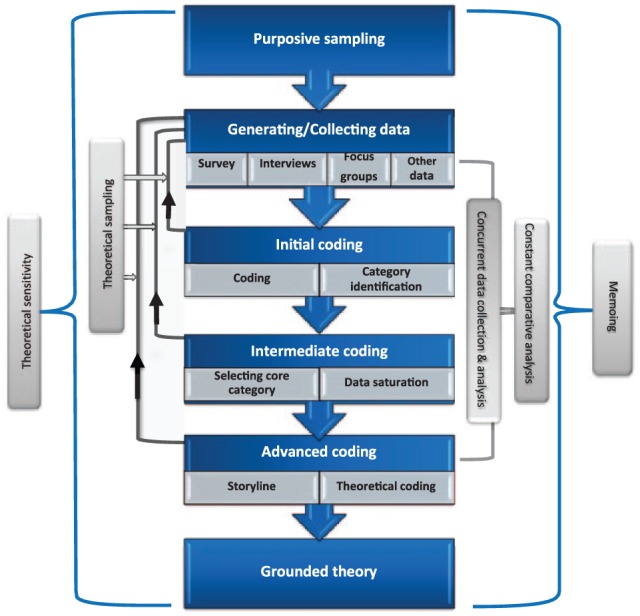
Background: Grounded theory is a well-known methodology employed in many research studies. Qualitative and quantitative data generation techniques can be used in a grounded theory study. Grounded theory sets out to discover or construct theory from data, systematically obtained and analysed using comparative analysis. While grounded theory is inherently flexible, it is a complex methodology. Thus, novice researchers strive to understand the discourse and the practical application of grounded theory concepts and processes. Objective: The aim of this article is to provide a contemporary research framework suitable to inform a grounded theory study. Result: This article provides an overview of grounded theory illustrated through a graphic representation of the processes and methods employed in conducting research using this methodology. The framework is presented as a diagrammatic representation of a research design and acts as a visual guide for the novice grounded theory researcher. Discussion: As grounded theory is not a linear process, the framework illustrates the interplay between the essential grounded theory methods and iterative and comparative actions involved. Each of the essential methods and processes that underpin grounded theory are defined in this article. Conclusion: Rather than an engagement in philosophical discussion or a debate of the different genres that can be used in grounded theory, this article illustrates how a framework for a research study design can be used to guide and inform the novice nurse researcher undertaking a study using grounded theory. Research findings and recommendations can contribute to policy or knowledge development, service provision and can reform thinking to initiate change in the substantive area of inquiry.
Overview
CoChat Summary
TL;DR
This article presents a contemporary, diagrammatic research design framework to help novice researchers visualise and apply the iterative methods and processes of grounded theory (GT). It defines the essential GT methods and processes and situates them within a non-linear, recursive design rather than debating philosophical genres.
Key findings
- GT is described as a structured yet flexible methodology appropriate when little is known about a phenomenon, aiming to produce or construct an explanatory theory grounded in data.
- Three distinct GT genres are identified: traditional/classic GT (Glaser), evolved GT (Strauss, Corbin and Clarke), and constructivist GT (Charmaz), distinguished by the researcher's philosophical position, use of literature, and approach to coding, analysis and theory development.
- Coding terminology differs by genre: traditional uses open, selective and theoretical coding; evolved uses open, axial and selective coding; constructivist uses initial, focused and theoretical coding (Table 1, adapted from Birks and Mills).
- The framework (Figure 1) depicts the interplay of purposive sampling, concurrent data generation/collection and analysis, constant comparative analysis, memoing, coding (initial, intermediate, advanced), theoretical sampling, theoretical sensitivity, and theoretical saturation, all directed toward an integrated substantive theory.
- Quality and rigour are related to three areas: the researcher's expertise, knowledge and research skills; methodological congruence with the research question; and procedural precision in the use of methods.
Methods
This is a methodological/discussion article, not an empirical study; no sample or dataset is analysed. It synthesises GT literature and prior works (notably Birks and Mills) to construct a graphic research design framework (Figure 1) and to define each essential GT method and process. The framework is presented as a visual guide for novice grounded theory researchers, illustrated with exemplars from other GT studies (Boxes 1–3).
Limitations
The paper states no formal limitations. Evident from the text: it deliberately avoids engagement in philosophical discussion or debate of the different GT genres, so it does not adjudicate between them; the framework is offered as a visual guide rather than an empirically tested model; and it is oriented specifically toward the novice nurse researcher, which may limit transferability to other disciplines or experienced researchers.
Model-written summary. Check it against the paper before relying on it.
Integrity signals
Registry
Cites
Statistics
Figures
Verification
Claims the paper makes
1 Valid · 4 Not valid · 49 Not checked · 18 Own results and interpretations
A statement the paper makes itself — it cites no source for it, so there is none to check. The quote shows it is in the paper.
In the paper
“As presented in Figure 1, initial purposive sampling directs the collection and/or generation of data.”
§ Grounded theory research: A design framework for novice researchers > Discussion > Purposive sampling
plainstates a cause- Asserted: passes — The authors put it forward as true.
- Checkable: passes — It can be checked against evidence.
- Load-bearing: passes — The paper’s conclusions depend on it.
- Based: passes — The paper gives a reason why it holds.
In the paper
“Constant comparative analysis generates increasingly more abstract concepts and theories through inductive processes.16”
§ Grounded theory research: A design framework for novice researchers > Discussion > Constant comparative analysis
What the sources say
- Not matchedcites [16] Charmaz K. Constructing grounded theory: a practical guide through qualitative analysis. Thousand Oaks, CA: SAGE, 2006.
Its entry has no title and year that we can search by.
plainstates a cause- Asserted: passes — The authors put it forward as true.
- Checkable: passes — It can be checked against evidence.
- Load-bearing: unclear — It is unclear whether the paper’s conclusions depend on it.
- Based: passes — The paper gives a reason why it holds.
- Not matched
In the paper
“Several analytic tools and techniques can be used to enhance theoretical sensitivity and increase the grounded theorist’s sensitivity to theoretical constructs in the data.28”
§ Grounded theory research: A design framework for novice researchers > Discussion > Theoretical sensitivity
What the sources say
- Not checked — no full text of the sourcecites [28] Corbin JM Strauss AL. Basics of qualitative research: techniques and procedures for developing grounded theory. 3rd ed. Thousand Oaks, CA: SAGE, 2008. source
plainstates a cause- Asserted: passes — The authors put it forward as true.
- Checkable: passes — It can be checked against evidence.
- Load-bearing: unclear — It is unclear whether the paper’s conclusions depend on it.
- Based: passes — The paper gives a reason why it holds.
In the paper
“Advanced coding that integrates extant theory adds further explanatory power to the findings.6”
§ Grounded theory research: A design framework for novice researchers > Discussion > Advanced coding
What the sources say
- Not matchedcites [6] Birks M Mills J. Grounded theory: a practical guide. 2nd ed. London: SAGE, 2015.
Its entry has no title and year that we can search by.
plainstates a cause- Asserted: passes — The authors put it forward as true.
- Checkable: passes — It can be checked against evidence.
- Load-bearing: unclear — It is unclear whether the paper’s conclusions depend on it.
- Based: passes — The paper gives a reason why it holds.
- Not matched
In the paper
“While interviews are a common method of generating data, data sources can include focus groups, questionnaires, surveys, transcripts, letters, government reports, documents, grey literature, music, artefacts, videos, blogs and memos.9”
§ Grounded theory research: A design framework for novice researchers > Discussion > Generating/collecting data
What the sources say
- Not checked — no full text of the sourcecites [9] Mills J Birks M Hoare KJ. Grounded theory. In: Mills J Birks M (eds) Qualitative methodology: a practical guide. London: SAGE, 2014, pp. 107– 121. source
plain- Asserted: passes — The authors put it forward as true.
- Checkable: passes — It can be checked against evidence.
- Load-bearing: unclear — It is unclear whether the paper’s conclusions depend on it.
- Based: passes — The paper gives a reason why it holds.
5 more claims
Create a free account to see all 72 claims and every source verdict.
- Probably not a substantial claim. 58
- It may state two separate claims as one. 17
Claims other papers make about this one
Each is checked against this paper’s own text: does it say what the citing paper says it does?
The cited source says what the claim attributes to it.
In the citing paper
“The epistemological and ontological differences principally address the proposition that theory is either discovered or co-constructed (Bryant, 2017), leading to opposing views on how the steps in the Grounded Theory method are understood (Bøttcher Berthelsen, 2018; Chun Tie, Birks and Francis, 2019; Tarozzi, 2020).”
From Application and challenges of using a Constructivist Grounded Theory methodology to address an undertheorized clinical challenge: A discussion paper (2024) · cites this paper as Chun Tie, Birks and Francis, 2019
The cited source says what the claim attributes to it.
In the citing paper
“Though the comparison of data, researchers emphasize consistencies, comprehend differences, and refine interviews, consistently comparing specific data points with others to establish categories (Bryant, 2017; Charmaz, 2014; Chun Tie et al., 2019).”
From Application and challenges of using a Constructivist Grounded Theory methodology to address an undertheorized clinical challenge: A discussion paper (2024) · cites this paper as Chun Tie et al., 2019
The cited source says what the claim attributes to it.
In the citing paper
“Nevertheless, this initial stage aims to deconstruct / fracture the data, allowing details to emerge (Bryant and Charmaz, 2019) to create the opportunity to identify both similarities and differences, pose analytical inquiries (Charmaz and Thornberg, 2021), and thereby establish to attain a more profound level of meaning (Chun Tie et al., 2019).”
From Application and challenges of using a Constructivist Grounded Theory methodology to address an undertheorized clinical challenge: A discussion paper (2024) · cites this paper as Chun Tie et al., 2019
Citations
Cites
The Discovery of Grounded Theory: Strategies for Qualitative Research.
Wagner, H. R., Glaser, B. G., & Strauss, A. L. (1968) · Social Forces · doi:10.2307/2575405 · Cited by 46,361
The Discovery of Grounded Theory; Strategies for Qualitative Research
Glaser, B. G., Strauss, A. L., & Strutzel, E. (1968) · Nursing Research · doi:10.1097/00006199-196807000-00014 · Cited by 39,449
(1998) · Sage eBooks · Cited by 38,631
Basics of Qualitative Research (3rd ed.): Techniques and Procedures for Developing Grounded Theory
Corbin, J., & Strauss, A. (2008) · SAGE · doi:10.4135/9781452230153 · Cited by 24,827
Basics of Qualitative Research: Grounded Theory Procedures and Techniques
Long, D. R., Strauss, A., & Corbin, J. (1993) · The Modern Language Journal · doi:10.2307/328955 · Cited by 17,576
Research Design: Qualitative, Quantitative, and Mixed Methods Approaches
Sloane-Seale, A. (2009) · Canadian Journal of University Continuing Education · doi:10.21225/d54s3d · Cited by 14,328
The Coding Manual for Qualitative Researchers
Lungu, M. (2022) · American Journal of Qualitative Research · doi:10.29333/ajqr/12085 · Cited by 10,826
Constructing grounded theory. A practical guide through qualitative analysis
Brink, E., Dellve, L., Hallberg, U., Abrahamsson, K. H., Klingberg, G., & Wentz, K. (2006) · International Journal of Qualitative Studies on Health and Well-being · doi:10.3402/qhw.v1i3.4932 · Cited by 6,862
(1978) · Medical Entomology and Zoology · Cited by 6,077
The Sage Handbook of Qualitative Research[1]
(2006) · Qualitative Research in Organizations and Management: An International Journal · doi:10.1108/17465640610666642 · Cited by 5,842
Research works printed but not linked: 13
- Crotty M. The foundation of social research: meaning and perspective in the research process. Thousand Oaks, CA: SAGE, 1998.
- Charmaz K. The power and potential of grounded theory. Med Sociol 2012; 6: 2– 15.
- Glaser BG. Basics of grounded theory analysis. Mill Valley, CA: Sociology Press, 1992.
- Ralph N Birks M Chapman Y. The methodological dynamism of grounded theory. Int J Qual Methods 2015; 14: 1–6.
- Bryant A Charmaz K. The Sage handbook of grounded theory. Thousand Oaks, CA: SAGE, 2007. · DOI · Paper page
- Charmaz K Bryant A. Grounded theory and credibility. In: Silverman D (ed.) Qualitative research. 3rd ed. London: SAGE, 2011, pp. 291– 309.
- Glaser BG Holton J. Remodeling grounded theory. Forum Qualitative Sozialforschung/Forum: Qualitative Social Research 2004; 5: 1– 22.
- Mackenzie N Knipe S. Research dilemmas: paradigms, methods and methodology. Issues Educ Res 2006; 16: 193– 205.
- Chamberlain-Salaun J. Consumers and the social world of health care: outsiders in the expert’s world: a grounded theory study. PhD Thesis, College of Health Care Sciences, James Cook University, Townsville, QLD, Australia, 2015, p. 198.
- Moghaddam A. Coding issues in grounded theory. Issues Educ Res 2006; 16: 53– 61.
- Evans LE. A novice researcher’s first walk through the maze of grounded theory: rationalization for classical grounded theory. Ground Theory Rev 2013; 14: 37–55.
- Glaser BG. The grounded theory perspective III: theoretical coding. Mill Valley, CA: Sociology Press, 2005.
- Baldwin A. Reconciling professional identity: a grounded theory study of nurse academics’ role modelling. PhD Thesis, College of Healthcare Sciences, James Cook University, Townsville, QLD, Australia, 2016, p. 246.
Cited by
Items 301–400 of 1,857
Paramedic-delivered teleconsultations: a grounded theory study
Armour, R., Helmer, J. S., & Tallon, J. M. (2021) · Canadian Journal of Emergency Medicine · doi:10.1007/s43678-021-00224-6 · Cited by 13
“Grounded theory was employed in this project as given the paucity of available literature it is hoped moving beyond a superficial analysis of responses will assist in guiding future research across various settings [15, 16].”
MethodKalantari, N., Liao, D., & Motti, V. G. (2021) · IEEE International Conference on Big Data (BigData) · doi:10.1109/bigdata52589.2021.9671740 · Cited by 22
Ramazan, F., Aarts, S., & Widdowfield, M. (2022) · Radiography · doi:10.1016/j.radi.2022.02.003 · Cited by 18
Cooper, L., Gong, Y., Dezube, A. R., Mazzola, E., Deeb, A. L., DuMontier, C., Jaklitsch, M. T., & Frain, L. N. (2022) · Journal of Surgical Oncology · doi:10.1002/jso.26866 · Cited by 20
Paalvast, O., Nauta, M., Koelle, M., Geerdink, J., Vijlbrief, O., Hegeman, J. H., & Seifert, C. (2022) · Artificial Intelligence in Medicine · doi:10.1016/j.artmed.2022.102281 · Cited by 13
Adopting VR in the Classroom: Perceptions of bilingual and ESL education pre-service teachers
Figueroa, J., Huffman, L. F., Lozada, V. A., & Rosa-Dávila, E. (2022) · EDMETIC · doi:10.21071/edmetic.v11i1.13610 · Cited by 22
“Humans and records are entangled”: empathic engagement and emotional response in archivists
Regehr, C., Duff, W. M., Aton, H., & Sato, C. (2022) · Archival Science · doi:10.1007/s10502-022-09392-5 · Cited by 22
Best Practices for Case Studies in Construction Engineering and Management Research
Araújo, L. G., & Lucko, G. (2022) · Journal of Construction Engineering and Management · doi:10.1061/(asce)co.1943-7862.0002312 · Cited by 13
Moabi, P. S., & Mtshali, N. (2022) · Curationis · doi:10.4102/curationis.v45i1.2260 · Cited by 13
“The end product of the study is to http://www.curationis.org.za Open Access construct a theory from the results, which will be published later in a separate article (Corbin & Strauss 2015:105; Tie et al. 2019:1).”
BackgroundMethodDeterminant factors of innovation management in the manufacturing industry of Pichincha, Ecuador
Ibujés-Villacís, J., & Franco-Crespo, A. A. (2022) · Journal of technology management & innovation · doi:10.4067/s0718-27242022000100050 · Cited by 23
Abarghuie, F. A., Javadi, R., Mirabi, E., & Okulicz‐Kozaryn, A. (2022) · Cities · doi:10.1016/j.cities.2022.104022 · Cited by 12
Chen, L., Li, H., & Tian, S. (2022) · Sustainability · doi:10.3390/su142114511 · Cited by 13
Come Roll with Me: An Interprofessional Experience to Promote Disability Awareness
Parish, A., Carver, C. H., Lein, D. H., Wylie, E., Byrd, W. A., Pirlo, O. J., & Brooks, W. S. (2022) · Teaching and Learning in Medicine · doi:10.1080/10401334.2022.2148107 · Cited by 13
Discovery of Insulin is a Great Achievement for the Diabetes Patients
Mohajan, D., & Mohajan, H. K. (2023) · Studies in Social Science & Humanities · doi:10.56397/sssh.2023.08.02 · Cited by 26
Schiff, D. M., Muftu, S., MacMillan, K. D. L., Work, E. C., Hoeppner, B. B., Greenfield, S. F., Schwartz, L. N., Chaiyachati, B. H., Wilens, T. E., & Bernstein, J. (2023) · Journal of Addiction Medicine · doi:10.1097/adm.0000000000001242 · Cited by 17
Early Maternal Caregiving: A Conceptualization of Maternal Compassion Preoccupation
Chasson, M., & Ben‐Ari, O. T. –. (2020) · Qualitative Health Research · doi:10.1177/1049732320908570 · Cited by 12
“We performed the analysis in three stages following Strauss and Corbin (1990), in an iterative process involving constant comparative analysis through inductive and deductive thinking (Chun Tie et al., 2019).”
MethodSharma, A., Apte, A. A., Rajappa, M., Vaz, M., Vaswani, V. R., Goenka, S., Malhotra, S., Sangoram, R., Lakshminarayanan, S., Jayaram, S., et al. (2022) · Wellcome Open Research · doi:10.12688/wellcomeopenres.17968.1 · Cited by 19
Pantiris, P., Pallis, P. L., Chountalas, P. T., & Dasaklis, T. K. (2025) · Logistics · doi:10.3390/logistics9030113 · Cited by 37
Stigma in Early-Stage Lung Cancer
Bédard, S., Sasewich, H., Culling, J., Turner, S. R., Pellizzari, J., Johnson, S. T., & Bédard, E. L. R. (2022) · Annals of Behavioral Medicine · doi:10.1093/abm/kaac021 · Cited by 16
Simulation-based education model for under-resourced nursing education institutions in Lesotho
Moabi, P. S., & Mtshali, G. N. (2022) · Health SA Gesondheid · doi:10.4102/hsag.v27i0.1889 · Cited by 20
“This is where the researchers moved back and forth when identifying similarities among and differences between emerging categories (Corbin & Strauss 2015; Tie et al. 2019).”
BackgroundMethodInfluentialRelational coding: Enhancing the transparency and trustworthiness of grounded theory research
Rawhani, C. (2023) · Methodological Innovations · doi:10.1177/20597991221144566 · Cited by 28
“Seeking to depart from research as verification, they pivoted towards theorising as their focus instead and paved the way for questioning the assumed exclusive validity of quantitative research (Chun Tie et al., 2019; Glaser and Strauss, 1967; Timonen et al., 2018).”
BackgroundWellbeing and School Improvement: A Scoping Review
McNeven, S., Main, K., & McKay, L. (2023) · Leadership and Policy in Schools · doi:10.1080/15700763.2023.2183512 · Cited by 19
“We first undertook initial coding of the full text of each article, inductively identifying as much potential conceptual content as possible (Chun Tie, Birks, & Francis, 2019).”
“That Line Just Kept Moving”: Motivations and Experiences of People Who Use Methamphetamine
Fockele, C. E., Morse, S. C., van Draanen, J., Leyde, S. E., Banta‐Green, C. J., Huynh, L., Zatzick, A., & Whiteside, L. (2023) · Western Journal of Emergency Medicine · doi:10.5811/westjem.2022.12.58396 · Cited by 16
Khan, N. D., Khan, J. A., Li, J., et al. (2024) · PeerJ Computer Science · doi:10.7717/peerj-cs.2115 · Cited by 12
“Its purpose is to develop a novel theory from data samples by systematically analyzing them through comparative analysis, as evident in various studies ( Ullah et al., 2023 ; Chun Tie, Birks & Francis, 2019 ).”
MethodBianchi, M., Rossettini, G., Cerritelli, F., & Esteves, J. E. (2025) · Chiropractic & Manual Therapies · doi:10.1186/s12998-025-00574-3 · Cited by 14
Chooset, N., & Sukhabot, S. (2025) · Cogent Business & Management · doi:10.1080/23311975.2025.2480748 · Cited by 25
“…marketing in thai sMes. the study adopts the straussian approach developed by corbin and strauss, (1990), incorporating research processes from tie et al. (2019) and thurlow (2020), as illustrated in Figure 1. all participants provided written informed consent prior to participating in the…”
Safari, Y., Khatony, A., Khodamoradi, E., & Rezaei, M. (2020) · Journal of Education and Health Promotion · doi:10.4103/jehp.jehp_172_20 · Cited by 12
“Grounded theory sets out to discover or construct theory from data, systematically obtained and analyzed using comparative analysis.[28] This qualitative study was conducted on all medical interns of Kermanshah University of Medical Sciences.”
MethodPharmacy Students’ Perception of an Elective Course on Evidence-based Learning Strategies
de la Peña, I., Knecht, K. T., & Gavaza, P. (2020) · American Journal of Pharmaceutical Education · doi:10.5688/ajpe8232 · Cited by 14
“The responses to open-ended questions and the written assignment were analyzed using an inductive, grounded theory-based approach.(29) The quantitative data were inputted into Excel, and uploaded to IBM SPSS, version 25 (SPSS Inc.”
MethodLordos, A., Ioannou, M., Rutembesa, E., Christoforou, S., Anastasiou, E., & Björgvinsson, Þ. (2021) · PubMed Central · Cited by 33
Jang, S. H. (2021) · Journal of American College Health · doi:10.1080/07448481.2021.1947833 · Cited by 14
Monetary Incentivization of Crowds by Platforms
Konhäusner, P., Frias, M. M. C., & Dabija, D. (2021) · Információs Társadalom · doi:10.22503/inftars.xxi.2021.2.7 · Cited by 12
Teachers and Inclusive Practices Against Bullying: A Qualitative Study
D’Urso, G., Fazzari, E., Marca, L. L., & Simonelli, C. (2022) · Journal of Child and Family Studies · doi:10.1007/s10826-022-02393-z · Cited by 22
“In line with the Grounded Theory perspective (Chun Tie et al., 2019), a thematic analysis was carried out without a predetermined coding scheme.”
MethodHalimi, S. N., Rowett, D. S., Whitfield, K., & Luetsch, K. (2022) · Research in Social and Administrative Pharmacy · doi:10.1016/j.sapharm.2022.10.012 · Cited by 16
Structural and Spatial Minimal Requirement Efficacy of Emergency Shelters for Different Emergencies
Beatini, V., Rajanayagam, H., & Poologanathan, K. (2022) · Buildings · doi:10.3390/buildings13010032 · Cited by 16
A humanistic-care factors application hierarchical design-model for intelligent elderly products
Zhou, Z., Wang, L., Ye, R., & Yue, H. (2023) · Heliyon · doi:10.1016/j.heliyon.2023.e13734 · Cited by 14
“In the process, researchers are required to have an open mind, put aside personal prejudices and existing research opinions, comprehensively capture the key information in the data, constantly compare the phenomena in the data, and gradually abstract and name some common phenomena [35].”
BackgroundRafieifar, M., Potocky, M., Huang, H., Beaulaurier, R. L., & Lorenzini, S. B. (2023) · International Journal of Environmental Research and Public Health · doi:10.3390/ijerph20054496 · Cited by 13
Saeidnia, H. R., Kozak, M., Ausloos, M., Lund, B. D., Ghorbi, A., & Mohammadzadeh, Z. (2023) · Informatics in Medicine Unlocked · doi:10.1016/j.imu.2023.101310 · Cited by 16
McKenzie, K., Martin, R. E., Metcalfe, D., et al. (2020) · Journal of Applied Research in Intellectual Disabilities · doi:10.1111/jar.12778 · Cited by 12
Maternal Mediation in the Context of Fathers' Incarceration and Reentry
Arditti, J. A., McGregor, C. M., Dennison, S. M., Johnson, S., & Besemer, K. (2020) · Family Relations · doi:10.1111/fare.12526 · Cited by 14
Perceived predictors of quality of life in patients with end-stage renal disease on dialysis
Mbeje, P., & Mtshali, G. N. (2021) · Curationis · doi:10.4102/curationis.v44i1.2251 · Cited by 15
“In-patients who were admitted to the renal ward were used for focus group interviews (Chun Tie et al. 2019).”
MethodTeam and Group Dynamics in Organizations: Effect on Productivity and Performance
Oyefusi, F. (2022) · Journal of Human Resource and Sustainability Studies · doi:10.4236/jhrss.2022.101008 · Cited by 12
Circular textiles innovation during COVID-19: not the silver lining some had hoped for
Sugg, B. (2022) · Journal of Fashion Marketing and Management · doi:10.1108/jfmm-07-2021-0180 · Cited by 15
Rountree, V., Baldwin, E., & Hanlon, J. W. (2021) · Journal of Environmental Studies and Sciences · doi:10.1007/s13412-021-00726-w · Cited by 15
A mixed-methods evaluation on the efficacy and perceptions of needleless connector disinfectants
Roberts, S. C., Hendrix, C., Edwards, L. M., et al. (2022) · Infection Control and Hospital Epidemiology · doi:10.1017/ice.2022.72 · Cited by 11
“A qualitative assessment of the most common themes for favorable or unfavorable opinions for each product identified 3 major themes: (1) the inherent product characteristics, (2) use of the product, and (3) maintenance of the product (Supplementary Table online).”
Atherley, A., Teunissen, P. W., Hegazi, I., Hu, W. C. Y., & Dolmans, D. H. J. M. (2022) · Medical Education · doi:10.1111/medu.14998 · Cited by 14
Narrative Inquiry, Phenomenology, and Grounded Theory in Qualitative Research
Islam, M. R., & Akhter, M. S. (2022) · Springer eBooks · doi:10.1007/978-981-19-5441-2_8 · Cited by 19
He, C., Xu, J., & Zhou, L. (2023) · Learned Publishing · doi:10.1002/leap.1540 · Cited by 17
“As a ‘variables sociology’ paradigm approach in social sciences, grounded theory sets out to discover or construct related theories from systematically obtained and analysed empirical materials (Chun Tie et al., 2019).”
BackgroundStout, N. L., Harrington, S., Perry, A. M., Alappattu, M. J., Pfab, V., Stewart, B., & Manes, M. R. (2023) · Journal of Cancer Survivorship · doi:10.1007/s11764-023-01374-5 · Cited by 16
Asiimwe, J. B., Nagendrappa, P. B., Atukunda, E. C., Nambozi, G., Tolo, C. U., Ogwang, P. E., & Kamatenesi, M. M. (2023) · PLOS Global Public Health · doi:10.1371/journal.pgph.0001764 · Cited by 12
Okrant, E., Reif, S., & Horgan, C. M. (2023) · Substance Abuse Treatment Prevention and Policy · doi:10.1186/s13011-023-00560-z · Cited by 13
“4, then coded to identify unique concepts using inductive grounded theory [44].”
BackgroundEdelmann, C. M., Boen, F., Stouten, J., Broek, G. V., & Fransen, K. (2023) · Leadership · doi:10.1177/17427150231200033 · Cited by 24
“More speci fi cally, the aim of GT as a methodology is to produce knowledge i.e. grounded in data (i.e., participants ’ own perceptions) in the absence of any speci fi c hypotheses by the researchers (Chun Tie et al., 2019; Hannah et al., 2008).”
MethodCeasar, R. C., Ladi‐Seyedian, S., Escobar, D., et al. (2024) · The Journal of Sexual Medicine · doi:10.1093/jsxmed/qdae025 · Cited by 11
Codeveloping theories of change for improved community-based violence intervention evaluation
Schleimer, J. P., Lyons, V. H., Smith, D., Ali, F., Averett, L., Baugh, M., Benson, L. R., Colon, J., Cook, J., Davis, D., et al. (2024) · The Journal of Trauma: Injury, Infection, and Critical Care · doi:10.1097/ta.0000000000004277 · Cited by 13
“…grounding the work in community partners' lived experience and expertise, and iteratively (re)constructing the theory as information was received, 45,46 although we did not engage in traditional line-by-line coding because we did not record and transcribe conversations (to promote open…”
Social Constructivist Meta-Ethnography - – A Framework Construction
Soundy, A. (2024) · International Journal of Qualitative Methods · doi:10.1177/16094069241244863 · Cited by 17
Koponen, J. P., Metsola, J., Salin, L., & Keränen, J. (2024) · Industrial Marketing Management · doi:10.1016/j.indmarman.2024.05.003 · Cited by 16
Owuor, P. M., Miller, J. D., Kanugula, S. S., Yeam, J., Collins, S. M., Obure, V., Arunga, T. O., Otieno, P. A., Olack, B., Butler, L., et al. (2024) · Heliyon · doi:10.1016/j.heliyon.2024.e32058 · Cited by 13
“Thematic [42] and grounded theory frameworks [43] guided data analysis.”
MethodTraldi, R., Asprooth, L., Usher, E. M., Floress, K. M., Arbuckle, J. G., Baskerville, M., Church, S. P., Genskow, K., Harden, S. C., Maynard, E., et al. (2024) · Agriculture and Human Values · doi:10.1007/s10460-024-10570-7 · Cited by 15
“Open and axial coding as defined by grounded the - ory (Corbin and Strauss 1990) took place through an iterative process in steps 1–3, while step 4 incorporated axial and selective coding (Miller and Salkind 2002; Tie et al. 2019).”
Conceptualising trust and collaboration among stakeholders in MaaS ecosystems
Kandanaarachchi, T. B., Nelson, J. D., & Ho, C. Q. (2024) · Transport Policy · doi:10.1016/j.tranpol.2024.08.009 · Cited by 22
Theophanous, R. G., Tupetz, A., Ragsdale, L. C., Krishnan, P., Vigue, R., Herman, C., White, J., Staton, C. A., & Eucker, S. A. (2024) · PLoS ONE · doi:10.1371/journal.pone.0310404 · Cited by 15
Patten, Y. A. (2024) · Nurse Education Today · doi:10.1016/j.nedt.2024.106514 · Cited by 18
How do teachers perceive meaningful leadership? Overview of a qualitative exploration
Göçen, A. (2021) · Journal of Pedagogical Research · doi:10.33902/jpr.2021066866 · Cited by 14
Abbaszadeh, A., Borhani, F., Ajri-khamesloo, F., Afshar, P. F., Tabatabaeifar, S. M., & Khameslou, M. A. (2021) · International Emergency Nursing · doi:10.1016/j.ienj.2021.101066 · Cited by 15
Theoretical sampling process in a Straussian Grounded Theory study
Barreto, M. D. S., Simon, B. S., Marquete, V. F., de Souza, R. R., Girardon-Perlini, N. M. O., & Marcon, S. S. (2021) · Revista da Escola de Enfermagem da USP · doi:10.1590/1980-220x-reeusp-2021-0212 · Cited by 11
Shadman, S., Hanafiah, M. M., Chin, C. M. M., Yap, E. H., & Sakundarini, N. (2021) · Sustainability · doi:10.3390/su132112027 · Cited by 14
“This is also known as the constant comparative analysis [46] where new concepts are produced by comparing occurrences in one category to other events and categories inside the framework on a regular basis.”
BackgroundHill, M. G., Smith, E., & Mills, B. (2021) · Australian and New Zealand Journal of Public Health · doi:10.1111/1753-6405.13188 · Cited by 12
Defining success in open source hardware development projects: a survey of practitioners
Antoniou, R., Bonvoisin, J., Hsing, P., Dekoninck, E. A., & Defazio, D. (2022) · Design Science · doi:10.1017/dsj.2021.30 · Cited by 17
“Initial coding involved basic fracturing of the data, intermediate coding involved grouping of the codes and transformation into themes, while advanced coding involved abstracting the highest-level themes, that is, characteristics (Chun Tie, Birks & Francis 2019).”
Gillespie, K. M., Branjerdporn, G., Tighe, K., Carrasco, Á., & Baird, K. M. (2022) · Journal of Psychiatric and Mental Health Nursing · doi:10.1111/jpm.12875 · Cited by 12
McNamara, B. C., Joudeh, L., Corbetta-Rastelli, C. M., Orlando, M. S., & Kerns, J. (2022) · Sexual & Reproductive Healthcare · doi:10.1016/j.srhc.2022.100784 · Cited by 11
Analysis of network public opinion on COVID-19 epidemic based on the WSR theory
Yang, K., Zhu, J., Li, Y., Lin, Y., Huang, X. M., & Li, Y. (2023) · Frontiers in Public Health · doi:10.3389/fpubh.2022.1104031 · Cited by 11
Demystifying the Engagement Process: A BoP Perspective Toward Social Media Engagement
Tuli, N., Kumar, H., Srivastava, R., & Gupta, P. (2023) · Journal of International Consumer Marketing · doi:10.1080/08961530.2023.2169216 · Cited by 12
“The interviews were taken in 3 phases until data saturation was achieved by conducting 26 interviews in total (Chun Tie, Birks, and Francis 2019).”
MethodFamilies of Grounded Theory: A Theoretical Structure for Novel Researchers
Mohajan, D., & Mohajan, H. K. (2023) · Studies in Social Science & Humanities · doi:10.56397/sssh.2023.03.08 · Cited by 41
Understanding birthing preferences of women in Benin City, Nigeria: a qualitative study
Eluobaju, D., Okonofua, F. E., Weine, S. M., & Goba, G. K. (2023) · BMJ Open · doi:10.1136/bmjopen-2021-054603 · Cited by 17
The Research Question in Hermeneutic Phenomenology and Grounded Theory Research
Bertomeu, P. F., & Esteban, M. P. S. (2023) · The Qualitative Report · doi:10.46743/2160-3715/2023.5715 · Cited by 33
“Grounded theory is a structured yet flexible methodology (Chun et al., 2019).”
BackgroundBronze Diabetes: A Common Genetic Disorder Due to Systemic Iron Overload
Mohajan, D., & Mohajan, H. K. (2023) · Journal of Innovations in Medical Research · doi:10.56397/jimr/2023.08.01 · Cited by 15
Weckend, M., McCullough, K., Duffield, C. M., Bayes, S. J., & Davison, C. (2023) · Women and Birth · doi:10.1016/j.wombi.2023.10.003 · Cited by 15
“CGT is an excellent starting point methodology when little is known about a phenomenon or where little consensus exists [25,26], which is applicable to the relatively unexplored topic of physiological plateaus during childbirth [16].”
BackgroundColón‐López, V., Sánchez-Cabrera, Y., Soto‐Salgado, M., et al. (2025) · BMC Public Health · doi:10.1186/s12889-025-22772-7 · Cited by 11
“We used a modified grounded theory approach for data collection and analysis [25] To ensure the transparency and quality of qualitative research reporting, we used the Consolidated Criteria for Reporting Qualitative Research (COREQ) to guide the development of this report.”
Keane, L., Negin, J., Latu, N., Reece, L. J., Bauman, A. E., & Richards, J. A. (2019) · Sport in Society · doi:10.1080/17430437.2019.1678590 · Cited by 16
“However, we were informed by the grounded theory research framework (Chun Tie, Birks, and Francis 2019), which is useful to guide research in Tongan SfD, as it is most useful to apply to research questions with limited existing evidence (Howell 2000, 2004, 2013; Boadu and Sorour 2015).”
MethodDing, A., Patel, J. P., & Auyeung, V. (2020) · Complementary Therapies in Clinical Practice · doi:10.1016/j.ctcp.2020.101139 · Cited by 12
Roesler, A., Marshall, S., Rahimi‐Ardabili, H., Duve, E., Abbott, K. A., Blumfield, M., Cassettari, T., & Fayet‐Moore, F. (2020) · Nutrition & Dietetics · doi:10.1111/1747-0080.12645 · Cited by 11
Nguyen, M.-H. (2023) · Thesis Commons (OSF Preprints) · doi:10.31237/osf.io/z2hjv · Cited by 10
Voss, M., Swart, O., Abel, L., & Mahtani, K. R. (2020) · Health Policy and Planning · doi:10.1093/heapol/czaa075 · Cited by 11
Ken-Giami, I., Simandjuntak, S., Yang, Y., & Coats, A. V. (2022) · Sustainability · doi:10.3390/su14095407 · Cited by 16
Grief and Trauma in the Archives
Regehr, C., Duff, W. M., Aton, H., & Sato, C. (2023) · Journal of Loss and Trauma · doi:10.1080/15325024.2022.2164143 · Cited by 15
“Charmaz (2000, 2014) proposed an adaptation to grounded theory, constructivist grounded theory (CGT), in which data and meaning are coconstructed through the relationship between the researchers and participants (Birks & Mills, 2015; Kathy Charmaz, 2017; Chun Tie et al., 2019).”
MethodPerry, H. B., Valdez, M., Blanco, S., Llanque, R., Martin, S., Lambden, J. P., Gregg, C., Leach, K., Olivas, E. T., Muffoletto, B., et al. (2023) · International Journal for Equity in Health · doi:10.1186/s12939-022-01754-w · Cited by 10
“The analysis used both Grounded Theory [17] and codification based on the identification of the specific facilitators and impediments to women’s empowerment.”
MethodAn institutional perspective on application programming interface development and integration
Ofoeda, J., Boateng, R., & Effah, J. K. (2023) · Information Technology and People · doi:10.1108/itp-11-2022-0826 · Cited by 14
Dayao, J. K., Duffy, C. E. L., Cristiano, A. M., Kallenberg, G., & Linke, S. (2024) · Family Medicine and Community Health · doi:10.1136/fmch-2023-002608 · Cited by 17
“23 Finally, advanced codes from the previous synthesis were generated to develop theoretical codes from the identified theme categories.”
MethodImplementation approach in legal research
Hamzani, A. I., Widyastuti, T. V., Khasanah, N., & Rusli, M. H. M. (2024) · International Journal of Advances in Applied Sciences · doi:10.11591/ijaas.v13.i2.pp380-388 · Cited by 67
“Not only by legal regulations, but even the ideal side of the law in the future is by the variant approach used [1].”
BackgroundMcRae, S. M. (2024) · Elementa Science of the Anthropocene · doi:10.1525/elementa.2022.00136 · Cited by 16
Wang, Y., & Lotfi, M. (2024) · Business Ethics the Environment & Responsibility · doi:10.1111/beer.12722 · Cited by 15
Natafgi, N., Parris, K., Walker, E., Gartner, T., Coffin, J., Mitcham, A., Ferrer, L. S., Patel, M. K., Wymbs, H., & Kennedy, A. B. (2024) · Health Expectations · doi:10.1111/hex.70094 · Cited by 11
Mendiolaza, M., Ogundipe, T., Arroyave, J. S., Adeonigbagbe, O., Gorbenko, K. O., & Keefer, L. (2024) · Frontiers in Psychology · doi:10.3389/fpsyg.2024.1486401 · Cited by 13
King, R., Downer, T., Lord, B., Flanagan, B., & Oprescu, F. (2025) · Research in Nursing & Health · doi:10.1002/nur.22468 · Cited by 21
Optimizing Compliance: Comparative Study of Data Laws and Privacy Frameworks
Rocha, L. D., & Canedo, E. D. (2025) · Journal of Internet Services and Applications · doi:10.5753/jisa.2025.5247 · Cited by 13
Grounded theory in management research: through the lens of gender-based pay disparity
Goyal, P., Bhattacharya, S., & Gandhi, A. V. (2021) · Journal of Advances in Management Research · doi:10.1108/jamr-10-2020-0298 · Cited by 13
Genna, C., Thekkan, K. R., Geremia, C., Furia, M. D., Campana, A., Dall’Oglio, I., Tiozzo, E., & Gawronski, O. (2022) · Journal of Clinical Nursing · doi:10.1111/jocn.16502 · Cited by 11
Pullman, J., Santangelo, P., Molloy, L., & Campbell, S. J. (2022) · International Journal of Mental Health Nursing · doi:10.1111/inm.13079 · Cited by 15
Safi, A. G., Kalaji, M., Avery, R. J., Niederdeppe, J., Mathios, A., Dorf, M. C., & Byrne, S. E. (2023) · Health Communication · doi:10.1080/10410236.2023.2170092 · Cited by 11
“This approach is particularly well suited for formative work when little is known about the topic under investigation (Chun Tie et al., 2019).”
BackgroundDispensing mifepristone for medical abortion in Canada: Pharmacists’ experiences of the first year
Zusman, E. Z., Munro, S. B., Norman, W. V., & Soon, J. A. (2023) · Canadian Pharmacists Journal / Revue des Pharmaciens du Canada · doi:10.1177/17151635231176270 · Cited by 14
Physical pain among Indigenous Peoples in Canada: a scoping review
Bailey, N. G. N., Knott, R., Grenier, G., Craig, K. D., & Kramer, J. L. K. (2023) · Canadian Journal of Anesthesia/Journal canadien d anesthésie · doi:10.1007/s12630-023-02461-y · Cited by 13
How Stories in the Media Can Be Meaningful in Children’s Lives
de Leeuw, R. N. H., Weijers, A., Ahle, A.-M., & Daalmans, S. (2023) · Media Psychology · doi:10.1080/15213269.2023.2247322 · Cited by 15
“Gathering of the data and the analysis alternated (Chun Tie et al., 2019; Patton, 2014), which enabled it to constantly compare the answers of the children and inductively gain new insights.”
Method
Metadata
- Authors
- Chun Tie, Y., Birks, M., & Francis, K.
- Affiliations
- Nursing and Midwifery, College of Healthcare Sciences, James Cook University, Townsville, QLD, Australia
- James Cook University (AU)
- University of Tasmania (AU)
- Venue
- SAGE Open Medicine
- Publisher
- SAGE Publications
- Published
- 2019-01
- Volume
- 7
- Pages
- 2050312118822927-2050312118822927
- ISSN
- 2050-3121 (ISSN-L)
- PMC
- PMC6318722
- OpenAlex
- W2906994370
- Cited by
- 1,869
- References
- 29
- Citations by year
- 2026: 200 · 2025: 285 · 2024: 370 · 2023: 370 · 2022: 302 · 2021: 226 · 2020: 108 · 2019: 8
- FWCI
- 433.86
- Type
- journal article
- Language
- en
- Open access
- gold
- doi.org
- Licence
- cc-by-nc
- journals.sagepub.com/page/policies/text-and-data-mining-license (tdm)
- Locations
- SAGE Open Medicine (publishedVersion, cc-by-nc)
- Europe PMC (PubMed Central) (publishedVersion, cc-by-nc)
- PubMed Central (publishedVersion, cc-by-nc)
- PubMed (publishedVersion)
- UTAS Research Repository (acceptedVersion)
- ResearchOnline at James Cook University (James Cook University) (submittedVersion)
- DOAJ (DOAJ: Directory of Open Access Journals) (submittedVersion, cc-by-sa)
- Figshare (submittedVersion, cc-by-nc)
- Topics
- Social Sciences › Education › Qualitative Research Methods and Applications
- Health Sciences › Nursing › Research and Theory › Methodologies in Health Research and Practice
- Social Sciences › Education › Educational Research and Methods
- Keywords
- grounded theory, research design framework, novice researchers, nurse researchers, qualitative research methodology, comparative analysis
About these checks
Registry, retraction, Cites and statistics results are computed, not judged, with one exception: a printed reference that no index lists is read once by a model before it counts as a citation error. Claims are extracted by a model and kept only when their quote appears verbatim in the text; each cited source is then checked, with a model’s help, for whether it says what the claim relies on. Those verdicts can be wrong — read the claim’s quote and the cited source before relying on one.
The claim verdicts this report counts are experimental: their accuracy is not yet measured.
A language model drew the claims from the paper on 2026-10-10, under version 3 of the claim definition (model deepseek-v4.1-flash, prompt extract-v3).
A second model labelled each claim on 2026-10-10 (model jev-1.13-20260917, definition revision gold-guideline-v0.2).
Statistics and arithmetic are recomputed, not judged.
Confidence bands are shown only for fields calibrated on our annotated test set. None is calibrated yet, so no band is shown.
What counts as a claim ›How we measure confidence ›How we check this ›
Are you an author, or do you see a problem with this page? Request a review
Data sources
Bibliographic data: Semantic Scholar, OpenAlex, Crossref.
Contains information from the Semantic Scholar Academic Graph Datasets, made available under the ODC Attribution License (ODC-BY 1.0).
Semantic Scholar’s data is described in: Kinney, R., et al. (2023). The Semantic Scholar Open Data Platform. arXiv:2301.10140.
