

Grounded theory research: A design framework for novice researchers
Open accessThe DOI matches its Crossref record; 30 of the 33 references it cites were found in a registry or an index; 2 of the 69 sources its claims cite were checked for support.
Abstract
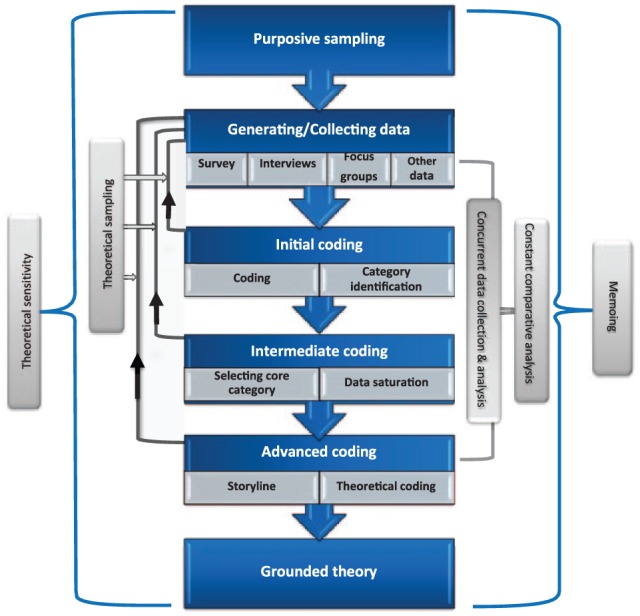
Background: Grounded theory is a well-known methodology employed in many research studies. Qualitative and quantitative data generation techniques can be used in a grounded theory study. Grounded theory sets out to discover or construct theory from data, systematically obtained and analysed using comparative analysis. While grounded theory is inherently flexible, it is a complex methodology. Thus, novice researchers strive to understand the discourse and the practical application of grounded theory concepts and processes. Objective: The aim of this article is to provide a contemporary research framework suitable to inform a grounded theory study. Result: This article provides an overview of grounded theory illustrated through a graphic representation of the processes and methods employed in conducting research using this methodology. The framework is presented as a diagrammatic representation of a research design and acts as a visual guide for the novice grounded theory researcher. Discussion: As grounded theory is not a linear process, the framework illustrates the interplay between the essential grounded theory methods and iterative and comparative actions involved. Each of the essential methods and processes that underpin grounded theory are defined in this article. Conclusion: Rather than an engagement in philosophical discussion or a debate of the different genres that can be used in grounded theory, this article illustrates how a framework for a research study design can be used to guide and inform the novice nurse researcher undertaking a study using grounded theory. Research findings and recommendations can contribute to policy or knowledge development, service provision and can reform thinking to initiate change in the substantive area of inquiry.
Overview
CoChat Summary
TL;DR
This article presents a contemporary, diagrammatic research design framework to help novice researchers visualise and apply the iterative methods and processes of grounded theory (GT). It defines the essential GT methods and processes and situates them within a non-linear, recursive design rather than debating philosophical genres.
Key findings
- GT is described as a structured yet flexible methodology appropriate when little is known about a phenomenon, aiming to produce or construct an explanatory theory grounded in data.
- Three distinct GT genres are identified: traditional/classic GT (Glaser), evolved GT (Strauss, Corbin and Clarke), and constructivist GT (Charmaz), distinguished by the researcher's philosophical position, use of literature, and approach to coding, analysis and theory development.
- Coding terminology differs by genre: traditional uses open, selective and theoretical coding; evolved uses open, axial and selective coding; constructivist uses initial, focused and theoretical coding (Table 1, adapted from Birks and Mills).
- The framework (Figure 1) depicts the interplay of purposive sampling, concurrent data generation/collection and analysis, constant comparative analysis, memoing, coding (initial, intermediate, advanced), theoretical sampling, theoretical sensitivity, and theoretical saturation, all directed toward an integrated substantive theory.
- Quality and rigour are related to three areas: the researcher's expertise, knowledge and research skills; methodological congruence with the research question; and procedural precision in the use of methods.
Methods
This is a methodological/discussion article, not an empirical study; no sample or dataset is analysed. It synthesises GT literature and prior works (notably Birks and Mills) to construct a graphic research design framework (Figure 1) and to define each essential GT method and process. The framework is presented as a visual guide for novice grounded theory researchers, illustrated with exemplars from other GT studies (Boxes 1–3).
Limitations
The paper states no formal limitations. Evident from the text: it deliberately avoids engagement in philosophical discussion or debate of the different GT genres, so it does not adjudicate between them; the framework is offered as a visual guide rather than an empirically tested model; and it is oriented specifically toward the novice nurse researcher, which may limit transferability to other disciplines or experienced researchers.
Model-written summary. Check it against the paper before relying on it.
Integrity signals
Registry
Cites
Statistics
Figures
Verification
Claims the paper makes
1 Valid · 4 Not valid · 49 Not checked · 18 Own results and interpretations
A statement the paper makes itself — it cites no source for it, so there is none to check. The quote shows it is in the paper.
In the paper
“As presented in Figure 1, initial purposive sampling directs the collection and/or generation of data.”
§ Grounded theory research: A design framework for novice researchers > Discussion > Purposive sampling
plainstates a cause- Asserted: passes — The authors put it forward as true.
- Checkable: passes — It can be checked against evidence.
- Load-bearing: passes — The paper’s conclusions depend on it.
- Based: passes — The paper gives a reason why it holds.
In the paper
“Constant comparative analysis generates increasingly more abstract concepts and theories through inductive processes.16”
§ Grounded theory research: A design framework for novice researchers > Discussion > Constant comparative analysis
What the sources say
- Not matchedcites [16] Charmaz K. Constructing grounded theory: a practical guide through qualitative analysis. Thousand Oaks, CA: SAGE, 2006.
Its entry has no title and year that we can search by.
plainstates a cause- Asserted: passes — The authors put it forward as true.
- Checkable: passes — It can be checked against evidence.
- Load-bearing: unclear — It is unclear whether the paper’s conclusions depend on it.
- Based: passes — The paper gives a reason why it holds.
- Not matched
In the paper
“Several analytic tools and techniques can be used to enhance theoretical sensitivity and increase the grounded theorist’s sensitivity to theoretical constructs in the data.28”
§ Grounded theory research: A design framework for novice researchers > Discussion > Theoretical sensitivity
What the sources say
- Not checked — no full text of the sourcecites [28] Corbin JM Strauss AL. Basics of qualitative research: techniques and procedures for developing grounded theory. 3rd ed. Thousand Oaks, CA: SAGE, 2008. source
plainstates a cause- Asserted: passes — The authors put it forward as true.
- Checkable: passes — It can be checked against evidence.
- Load-bearing: unclear — It is unclear whether the paper’s conclusions depend on it.
- Based: passes — The paper gives a reason why it holds.
In the paper
“Advanced coding that integrates extant theory adds further explanatory power to the findings.6”
§ Grounded theory research: A design framework for novice researchers > Discussion > Advanced coding
What the sources say
- Not matchedcites [6] Birks M Mills J. Grounded theory: a practical guide. 2nd ed. London: SAGE, 2015.
Its entry has no title and year that we can search by.
plainstates a cause- Asserted: passes — The authors put it forward as true.
- Checkable: passes — It can be checked against evidence.
- Load-bearing: unclear — It is unclear whether the paper’s conclusions depend on it.
- Based: passes — The paper gives a reason why it holds.
- Not matched
In the paper
“While interviews are a common method of generating data, data sources can include focus groups, questionnaires, surveys, transcripts, letters, government reports, documents, grey literature, music, artefacts, videos, blogs and memos.9”
§ Grounded theory research: A design framework for novice researchers > Discussion > Generating/collecting data
What the sources say
- Not checked — no full text of the sourcecites [9] Mills J Birks M Hoare KJ. Grounded theory. In: Mills J Birks M (eds) Qualitative methodology: a practical guide. London: SAGE, 2014, pp. 107– 121. source
plain- Asserted: passes — The authors put it forward as true.
- Checkable: passes — It can be checked against evidence.
- Load-bearing: unclear — It is unclear whether the paper’s conclusions depend on it.
- Based: passes — The paper gives a reason why it holds.
5 more claims
Create a free account to see all 72 claims and every source verdict.
- Probably not a substantial claim. 58
- It may state two separate claims as one. 17
Claims other papers make about this one
Each is checked against this paper’s own text: does it say what the citing paper says it does?
The cited source says what the claim attributes to it.
In the citing paper
“The epistemological and ontological differences principally address the proposition that theory is either discovered or co-constructed (Bryant, 2017), leading to opposing views on how the steps in the Grounded Theory method are understood (Bøttcher Berthelsen, 2018; Chun Tie, Birks and Francis, 2019; Tarozzi, 2020).”
From Application and challenges of using a Constructivist Grounded Theory methodology to address an undertheorized clinical challenge: A discussion paper (2024) · cites this paper as Chun Tie, Birks and Francis, 2019
The cited source says what the claim attributes to it.
In the citing paper
“Though the comparison of data, researchers emphasize consistencies, comprehend differences, and refine interviews, consistently comparing specific data points with others to establish categories (Bryant, 2017; Charmaz, 2014; Chun Tie et al., 2019).”
From Application and challenges of using a Constructivist Grounded Theory methodology to address an undertheorized clinical challenge: A discussion paper (2024) · cites this paper as Chun Tie et al., 2019
The cited source says what the claim attributes to it.
In the citing paper
“Nevertheless, this initial stage aims to deconstruct / fracture the data, allowing details to emerge (Bryant and Charmaz, 2019) to create the opportunity to identify both similarities and differences, pose analytical inquiries (Charmaz and Thornberg, 2021), and thereby establish to attain a more profound level of meaning (Chun Tie et al., 2019).”
From Application and challenges of using a Constructivist Grounded Theory methodology to address an undertheorized clinical challenge: A discussion paper (2024) · cites this paper as Chun Tie et al., 2019
Citations
Cites
The Discovery of Grounded Theory: Strategies for Qualitative Research.
Wagner, H. R., Glaser, B. G., & Strauss, A. L. (1968) · Social Forces · doi:10.2307/2575405 · Cited by 46,361
The Discovery of Grounded Theory; Strategies for Qualitative Research
Glaser, B. G., Strauss, A. L., & Strutzel, E. (1968) · Nursing Research · doi:10.1097/00006199-196807000-00014 · Cited by 39,449
(1998) · Sage eBooks · Cited by 38,631
Basics of Qualitative Research (3rd ed.): Techniques and Procedures for Developing Grounded Theory
Corbin, J., & Strauss, A. (2008) · SAGE · doi:10.4135/9781452230153 · Cited by 24,827
Basics of Qualitative Research: Grounded Theory Procedures and Techniques
Long, D. R., Strauss, A., & Corbin, J. (1993) · The Modern Language Journal · doi:10.2307/328955 · Cited by 17,576
Research Design: Qualitative, Quantitative, and Mixed Methods Approaches
Sloane-Seale, A. (2009) · Canadian Journal of University Continuing Education · doi:10.21225/d54s3d · Cited by 14,328
The Coding Manual for Qualitative Researchers
Lungu, M. (2022) · American Journal of Qualitative Research · doi:10.29333/ajqr/12085 · Cited by 10,826
Constructing grounded theory. A practical guide through qualitative analysis
Brink, E., Dellve, L., Hallberg, U., Abrahamsson, K. H., Klingberg, G., & Wentz, K. (2006) · International Journal of Qualitative Studies on Health and Well-being · doi:10.3402/qhw.v1i3.4932 · Cited by 6,862
(1978) · Medical Entomology and Zoology · Cited by 6,077
The Sage Handbook of Qualitative Research[1]
(2006) · Qualitative Research in Organizations and Management: An International Journal · doi:10.1108/17465640610666642 · Cited by 5,842
Research works printed but not linked: 13
- Crotty M. The foundation of social research: meaning and perspective in the research process. Thousand Oaks, CA: SAGE, 1998.
- Charmaz K. The power and potential of grounded theory. Med Sociol 2012; 6: 2– 15.
- Glaser BG. Basics of grounded theory analysis. Mill Valley, CA: Sociology Press, 1992.
- Ralph N Birks M Chapman Y. The methodological dynamism of grounded theory. Int J Qual Methods 2015; 14: 1–6.
- Bryant A Charmaz K. The Sage handbook of grounded theory. Thousand Oaks, CA: SAGE, 2007. · DOI · Paper page
- Charmaz K Bryant A. Grounded theory and credibility. In: Silverman D (ed.) Qualitative research. 3rd ed. London: SAGE, 2011, pp. 291– 309.
- Glaser BG Holton J. Remodeling grounded theory. Forum Qualitative Sozialforschung/Forum: Qualitative Social Research 2004; 5: 1– 22.
- Mackenzie N Knipe S. Research dilemmas: paradigms, methods and methodology. Issues Educ Res 2006; 16: 193– 205.
- Chamberlain-Salaun J. Consumers and the social world of health care: outsiders in the expert’s world: a grounded theory study. PhD Thesis, College of Health Care Sciences, James Cook University, Townsville, QLD, Australia, 2015, p. 198.
- Moghaddam A. Coding issues in grounded theory. Issues Educ Res 2006; 16: 53– 61.
- Evans LE. A novice researcher’s first walk through the maze of grounded theory: rationalization for classical grounded theory. Ground Theory Rev 2013; 14: 37–55.
- Glaser BG. The grounded theory perspective III: theoretical coding. Mill Valley, CA: Sociology Press, 2005.
- Baldwin A. Reconciling professional identity: a grounded theory study of nurse academics’ role modelling. PhD Thesis, College of Healthcare Sciences, James Cook University, Townsville, QLD, Australia, 2016, p. 246.
Cited by
Items 401–500 of 1,857
Deering, K., Wagstaff, C., Williams, J., Bermingham, I., & Pawson, C. (2023) · International Journal of Mental Health Nursing · doi:10.1111/inm.13245 · Cited by 15
The Effort of Caring: The Caregivers’ Perspective of Dual Sensory Impairment
Dunsmore, M. E., Schneider, J. M., McKenzie, H. A., & Gillespie, J. (2020) · Frontiers in Education · doi:10.3389/feduc.2020.572201 · Cited by 12
Zion, M., & Cohen, H. (2021) · Sustainability · doi:10.3390/su13041939 · Cited by 17
“Qualitative data analysis was performed according to the grounded theory approach [48].”
MethodBarr, M. L., Martin, C., Luecking, C. T., & Cardarelli, K. (2021) · Nutrients · doi:10.3390/nu13113929 · Cited by 10
“Multiple investigators reviewed focus group transcripts using a grounded theory approach [40].”
MethodRylee, T. L., & Cavanagh, S. J. (2022) · Health Services and Outcomes Research Methodology · doi:10.1007/s10742-022-00270-2 · Cited by 13
The effects of urbanisation on food security in Africa: An overview and synthesis of the literature
Ngcamu, B. S. (2022) · Environmental & Socio-economic Studies · doi:10.2478/environ-2022-0010 · Cited by 15
Straussian Grounded Theory: An Evolved Variant in Qualitative Research
Mohajan, D., & Mohajan, H. K. (2023) · Studies in Social Science & Humanities · doi:10.56397/sssh.2023.02.06 · Cited by 32
Dopelt, K., Asna, N., Amoyal, M., & Bashkin, O. (2023) · Healthcare · doi:10.3390/healthcare11131831 · Cited by 15
Pfisterer, K. J., Amelard, R., Boger, J. N., Keller, H., Chung, A. G., & Wong, A. M. (2022) · JMIR Aging · doi:10.2196/37590 · Cited by 9
“Qualitative results from interviews and workshops with end users illuminated the following user needs, which, guided by grounded theory [17], were translated into design requirements for application within the LTC context.”
BackgroundPlanning toward sustainable food systems: An exploratory assessment of local U.S. food system plans
Karetny, J., Hoy, C. W., Usher, K. M., Clark, J. K., & Conroy, M. M. (2022) · Journal of Agriculture Food Systems and Community Development · doi:10.5304/jafscd.2022.114.008 · Cited by 12
Gruss, R. J., Quesenberry, J., Kim, E., Abrahams, A. S., & Ractham, P. (2023) · Journal of Hospitality & Tourism Research · doi:10.1177/10963480221143042 · Cited by 10
“•• The researcher should approach the data iteratively, developing codes and refining them (Chun Tie et al., 2019).”
Richterman, A. G., Ghadimi, F., Teitelman, A. M., Moore, K., Acri, T., North, H., Lopez, K., Ou, V., Pelt, A. E. V., & Momplaisir, F. M. (2023) · AIDS and Behavior · doi:10.1007/s10461-023-04060-w · Cited by 9
“We used an integrated analysis approach to develop a coding structure including major themes from modified grounded theory and domains selected a priori from CFIR [30, 31].”
MethodMueller, K. E., Puymbroeck, M. V., Crowe, B. M., & Davis, N. J. (2023) · Canadian Journal on Aging / La Revue canadienne du vieillissement · doi:10.1017/s0714980823000284 · Cited by 9
“…used to analyse data collected from residents in an ALH in a rural town in the southeastern U.S. Strauss and Corbin ’ s Grounded Theory approach guided this qualitative study to allow for theories, frameworks, and models to emerge from the data (Strauss & Corbin, 1990; Tie, Birks, & Francis, 2019).”
MethodBeidler, L. B., Fichtenberg, C., & Fraze, T. (2023) · Journal of General Internal Medicine · doi:10.1007/s11606-023-08308-y · Cited by 8
de Soet, R., Nooteboom, L. A., Bansema, C. H., van Ewijk, H., Nijland, L., & Vermeiren, R. R. J. M. (2023) · Children and Youth Services Review · doi:10.1016/j.childyouth.2023.107155 · Cited by 11
Nafees, Z., Ferreira, J., Guadagno, E., Wray, J., Anderzén‐Carlsson, A., & Poenaru, D. (2024) · Journal of Pediatric Surgery · doi:10.1016/j.jpedsurg.2024.01.030 · Cited by 11
Spencer, B. M. (2024) · International Journal of Qualitative Studies in Education · doi:10.1080/09518398.2024.2318321 · Cited by 13
“To examine the data, I undertook a grounded theoretical research approach, defined as a social science research methodology wherein researchers can generate new theories or constructs that develop from analyzing the data via comparison analysis (Tie et al., 2019).”
Lyu, X., Sun, X.-Y., Lee, L., et al. (2024) · BMC Nursing · doi:10.1186/s12912-024-01896-y · Cited by 9
“Constructivist grounded theory is based on interpretivist, subjectivist assumptions; its methodological underpinnings focus on how participants construct meaning in relation to the area of inquiry, and a constructivist co-constructs experience and meanings with participants [16].”
BackgroundMetzger, T., Nguyen, N. D., Le, H., Havo, D., Ngo, K., Lee, S., Nguyen, T. Q., Nguyen, Q., Tran, L., Tong, N., et al. (2024) · Frontiers in Public Health · doi:10.3389/fpubh.2024.1387494 · Cited by 15
Kilima, S. P., Mubyazi, G. M., Moolla, A., Ntinginya, N. E., Sabi, I., Mwanyonga, S. P., & Evans, D. H. (2024) · Frontiers in Health Services · doi:10.3389/frhs.2024.1273739 · Cited by 21
Impact of liminality and rituals on professional identity formation in physician training
Hong, J., Chu, C., Tsai, D. F., Liao, E., & Yeh, H. (2024) · Medical Education · doi:10.1111/medu.15483 · Cited by 10
Sangwan, R. K., Kansara, D., Matoria, S., Haider, A., Khetan, M., Singh, V., Thakor, M., Huda, R. K., & Babu, B. V. (2024) · Frontiers in Public Health · doi:10.3389/fpubh.2024.1446606 · Cited by 18
Afzal, H., Deshpande, S., & Carlini, J. (2025) · Social Marketing Quarterly · doi:10.1177/15245004241309932 · Cited by 12
“After conducting the thematic analysis, we took a grounded theory approach (Chun Tie et al., 2019) to link the extracted concepts with theories in the literature about social psychology to make sense of the theoretical correlates of SLPs ’ choice and use.”
Ning, B., Omar, R., & Ye, Y. (2025) · Qualitative Research Journal · doi:10.1108/qrj-09-2024-0193 · Cited by 13
Xie, Y., Arman, S. M., & Su, C. (2025) · Electronic Commerce Research and Applications · doi:10.1016/j.elerap.2025.101489 · Cited by 16
Núñez, P. D. P., & Carter, T. F. (2025) · Sport Education and Society · doi:10.1080/13573322.2025.2480117 · Cited by 13
“These patterns were then interpreted and organised by the researchers using both inductive reasoning and theoretical guidance (Chun Tie et al., 2019; Glaser & Strauss, 2017).”
Understanding the role of the animal in animal-assisted therapy: A qualitative study
Dixon, D., Jones, C. R., & Green, R. (2025) · Complementary Therapies in Clinical Practice · doi:10.1016/j.ctcp.2025.101983 · Cited by 18
Wu, R., Wang, X., Nie, Y., Lv, P., & Luo, X. (2025) · Behavioral Sciences · doi:10.3390/bs15091169 · Cited by 18
“This method enables researchers to derive new theories or refine existing ones from complex empirical data, thereby uncovering the deeper logic and influencing factors underlying a given phenomenon (Chun Tie et al., 2019).”
Fusionando la realidad aumentada en la educación bilingüe y ESL: Percepciones de futuros maestros
Figueroa, J., Huffman, L. F., & Rosa-Dávila, E. (2021) · Innoeduca International Journal of Technology and Educational Innovation · doi:10.24310/innoeduca.2021.v7i1.9823 · Cited by 8
Research methods in linguistics: An overview
Obeyd, S. (2021) · Studies in Linguistics Culture and FLT · doi:10.46687/silc.2021.v09i01.004 · Cited by 9
“The principal aim of the method is to create a new theory framed on the basis of empirical data or as Creswell points out “the intent of a grounded theory study is to move beyond description and to generate or discover a theory, an abstract analytical schema of a process (2007, p. 59). The question of the validity of…”
Perera, S., O’Callaghan, C. C., Ugalde, A., Santin, O., Beer, C., Prue, G., Lane, K., Hanna, G. G., & Schofield, P. E. (2021) · BMJ Open · doi:10.1136/bmjopen-2021-055026 · Cited by 12
Blockchain for requirements traceability: A qualitative approach
Demi, S., Sánchez‐Gordón, M., & Kristiansen, M. (2022) · Journal of Software Evolution and Process · doi:10.1002/smr.2493 · Cited by 12
Conscientious objection as structural violence in the voluntary termination of pregnancy in Chile
Montero, A., Ramírez-Pereira, M., Robledo, P., Casas, L., Vivaldi, L., & González, D. (2022) · Frontiers in Psychology · doi:10.3389/fpsyg.2022.1007025 · Cited by 13
Wiggins, B. E. (2022) · Discourse & Society · doi:10.1177/09579265221136731 · Cited by 13
“…Glaser and Strauss (1967), this investigation benefits from the incorporation of the sociological perspective symbolic interactionism (Clarke, 2005) which ‘addresses the subjective meaning people place on objects, behaviors or events based on what they believe is true’ (Chun Tie et al., 2019: 2).”
BackgroundMethodFilipe, R. P., Heath, A. C., & McCullen, N. (2022) · Sustainability · doi:10.3390/su142315950 · Cited by 15
Stretched kinship: Queer female university students negotiating family and identity
Boyd, A., & Wei, J. (2023) · Sexualities · doi:10.1177/13634607231152598 · Cited by 14
“The interview data were coded through an interpretive approach (Chun Tie et al., 2019) and processed using NVivo for thematic analysis to ‘ capture complex, messy, and contradictory relationships ’ in the data (Damayanthi, 2019: 2).”
Applying complexity theory perspective to knowledge management in the innovation context
Pacheco, C., & D., B. P. G. (2023) · VINE Journal of Information and Knowledge Management Systems · doi:10.1108/vjikms-08-2022-0279 · Cited by 22
Qualitative Analysis of the Experiences and Perspectives of Autistic Speech-Language Pathologists
Oates, M., & Bean, A. (2023) · American Journal of Speech-Language Pathology · doi:10.1044/2023_ajslp-22-00399 · Cited by 12
Cuykx, I., Decorte, P., Teunissen, L., Vandebosch, H., den Bulck, H. V., Pabian, S., Royen, K. V., & Backer, C. J. S. D. (2023) · Food Culture & Society · doi:10.1080/15528014.2023.2263705 · Cited by 14
“Consequently, they compared and combined their findings into core categories (intermediate coding) to develop a preliminary codebook (Chun Tie, Birks, and Francis 2019).”
InfluentialLim, Y., Ninan, J., Nooteboom, S. G., & Hertogh, M. J. C. M. (2023) · Resilient Cities and Structures · doi:10.1016/j.rcns.2023.10.001 · Cited by 9
Alam, R., & Nayak, D. (2024) · Human Dimensions of Wildlife · doi:10.1080/10871209.2024.2303364 · Cited by 12
“The first step is to use the purposive sampling for data collection, followed by initial coding, intermediate coding, advance coding, and then finally, generation of theory from the data (Tie et al., 2019).”
Health Management of Working Pregnant Nurses: A grounded theory study
Hino, M., Takashima, R., & Yano, R. (2024) · Nursing Open · doi:10.1002/nop2.2158 · Cited by 9
“Constant comparative analysis and theoretical sampling in grounded theory set it apart from a purely descriptive analysis, and combining them enhanced the level of data analysis (Chun Tie et al., 2019 ).”
BackgroundCui, P., You, Z., Shi, Q., & Feng, L. (2024) · Buildings · doi:10.3390/buildings14092838 · Cited by 9
Banazadeh, M., Khanjari, S., Naddaf, A., & Oskouie, F. H. (2020) · Journal of Evaluation in Clinical Practice · doi:10.1111/jep.13492 · Cited by 11
Rajoo, Y., Wong, J., Raj, I. S., & Kennedy, G. A. (2020) · BMC Psychology · doi:10.1186/s40359-020-00502-5 · Cited by 12
Berenbaum, R. L. J., Tziraki, C., Baum, R., Rosen, A., Reback, T., Abikhzer, J., Naparstek, D., & Ben‐David, B. M. (2020) · Frontiers in Computer Science · doi:10.3389/fcomp.2020.536880 · Cited by 10
“Qualitative Data Analysis Subjective observations and quotation data from MBW game screen subjective evaluation form, was collected on an Excel document and analyzed using grounded theory (Chun-Tie et al., 2019).”
MethodKnox, K., Stanley, J., Hendrix, J. A., Hillerstrom, H., Dunn, T., Achenbach, J., Chicoine, B. A., Lai, F., Lott, I. T., Stanojevic, S., et al. (2021) · Journal of Patient-Reported Outcomes · doi:10.1186/s41687-020-00278-7 · Cited by 10
“Grounded Theory, an approach that applies inductive reasoning to systematically acquired data [47], was used to conceptualize the symptoms most meaningful to adults living with DS-AD and their caregivers.”
MethodHall, T. L., Ortiz, C. B., Peña-Jackson, G., Fultineer, C., Werner, K., & Sunshine, J. E. (2021) · Journal of patient-centered research and reviews · doi:10.17294/2330-0698.1770 · Cited by 10
Appel, L., Appel, E., Kisonas, E., Pasat, Z., Mozeson, K., Vemulakonda, J., & Sheng, L. Q. (2021) · Frontiers in Virtual Reality · doi:10.3389/frvir.2021.720523 · Cited by 10
Seangrung, R., Tempeetikul, T., Pannarunothai, S., & Sakdanuwatwong, S. (2021) · BMC Anesthesiology · doi:10.1186/s12871-021-01501-8 · Cited by 10
“Statistical analysis The modified grounded theory was used to guide the coding and analyzing of transcription [22, 23].”
MethodZhou, S., Li, K., Ogihara, A., & Wang, X. (2022) · Digital Health · doi:10.1177/20552076221102246 · Cited by 14
“This study used grounded theory to analyze interview data.(27) Grounded theory enables researchers to develop a theory to explain the phenomena.”
MethodJones, T., Silverman, T. B., Guzman, A., McGuinness, J. E., Trivedi, M. S., Kukafka, R., & Crew, K. D. (2022) · BMC Medical Informatics and Decision Making · doi:10.1186/s12911-022-01954-y · Cited by 12
Flory, J., Guelce, D., Goytia, C. N., Li, J., Min, J. Y., Mushlin, A. I., Orloff, J. N., & Mayer, V. (2022) · Journal of General Internal Medicine · doi:10.1007/s11606-022-07838-1 · Cited by 9
Understanding maternal food choice for preschool children across urban–rural settings in Vietnam
Duong, C., Jenkins, M., Pyo, E., Nguyen, P. H., Huynh, T. T. T., Nguyen‐Viet, H., Young, M. F., & Ramakrishnan, U. (2022) · Maternal and Child Nutrition · doi:10.1111/mcn.13435 · Cited by 12
“Thematic analysis using the inductive (data‐ driven) approach was used to identify patterns and nuances based on participants' experiences (Braun & Clarke; Chun Tie et al., 2019).”
MethodCarlisle, E. M., Shinkunas, L. A., Ruba, E., Klipowicz, C. J., Lieberman, M. T., Hoffman, R. M., & Reisinger, H. S. (2022) · Health Expectations · doi:10.1111/hex.13686 · Cited by 9
“We conducted semi‐structured interviews to broadly explore parents' experiences and preferences towards decision‐making in three emergent paediatric surgical settings at a university‐based children's hospital.(9,10) The study was approved by the University of Iowa Institutional Review Board (#201905811) and is reporte…”
MethodLund, S. B., Malmedal, W., Mosqueda, L. A., & Skolbekken, J. (2024) · BMC Geriatrics · doi:10.1186/s12877-024-04920-7 · Cited by 14
“After initial sampling and data analysis of FG discussions, we purposely conducted individual interviews to see if this enrichened and deepened the emergent sub-categories [43, 44].”
MethodAlayande, B. T., Forbes, C., KingPriest, P. T., et al. (2024) · BMC Medical Education · doi:10.1186/s12909-024-05550-8 · Cited by 9
“Qualitative analysis was carried out using a grounded theory qualitative approach and a constructivist research paradigm and a convergent (parallel) design [19].”
MethodOrganizing Chaos: Iterative Professional Identity Formation Through the Lens of Mask Making
Stephens, M. B., Bowen, J. L., McGinley, E. L., & Rainey, P. (2020) · PRiMER · doi:10.22454/primer.2020.705788 · Cited by 10
Ferucci, E. D., Choromanski, T. L., Arnold, R. I., Richards, J. K., & Jessen, C. M. (2021) · Telemedicine Journal and e-Health · doi:10.1089/tmj.2021.0175 · Cited by 9
“We used a grounded theory approach, 16 given the limited amount of qualitative data from our previous study.”
Marini, S., Messina, R., Masini, A., Scognamiglio, F., Caravita, I., Leccese, V., Soldà, G., Parma, D., Bertini, V., Scheier, L. M., et al. (2023) · Behavioral Sciences · doi:10.3390/bs13020114 · Cited by 14
“Consolidating the various themes that run through a focus group discussion requires some type of overarching framework [20].”
BackgroundMedication management strategies by family caregivers of children with special healthcare needs
Min, E. E., Wheeler, H., Hennessy, C., & Abebe, E. (2023) · Child Care Health and Development · doi:10.1111/cch.13102 · Cited by 10
Evaluating the Role of Mentorship in Career Advancement: A Survey of Women in Academic Hand Surgery
Sharif‐Askary, B., Abdou, S. A., Charipova, K., Sears, E. D., & Giladi, A. M. (2023) · The Journal Of Hand Surgery · doi:10.1016/j.jhsa.2022.12.015 · Cited by 11
Development of the Music Therapy in Transition to Long-Term Care Model
Schneible, B. K., Beer, L. E., McDermott, O., Mulhorn, K. A., Shim, M., & Bradt, J. (2023) · Journal of Music Therapy · doi:10.1093/jmt/thad012 · Cited by 9
Quality of care during rural care transitions: a qualitative study on structural conditions
Byberg, I., Näppä, U., & Häggström, M. (2023) · BMC Nursing · doi:10.1186/s12912-023-01423-5 · Cited by 12
“Sampling was initially purposive and later developed into theoretical by adding new participants and questions following the grounded theory method used in the primary study [52, 53].”
MethodDasaklis, T. K., Kopanaki, E., Chountalas, P. T., Rachaniotis, N. P., Voutsinas, T. G., Giannakis, K., & Chondrokoukis, G. P. (2024) · Logistics · doi:10.3390/logistics8010030 · Cited by 21
“[34] provides a practical guide to grounded theory’s methodologies, making it more accessible for beginners.”
BackgroundMedical secretaries’ fears and opportunities in an increasingly digitalised workplace environment
Qvarfordt, M., Lagrosen, S. O., & Nilsson, L. (2024) · Journal of Health Organization and Management · doi:10.1108/jhom-04-2023-0127 · Cited by 15
“Consistent with the grounded theory employed in this study, the selection of methods evolved incrementally as data collection advanced, resulting in a study design that did not adhere strictly to a linear pattern (Chun Tie et al. , 2019).”
MethodRichterman, A. G., O’Brien, C., Ghadimi, F., Sumners, E., Ford, A., Houston, N., Tate, S., Aitcheson, N., Nkwihoreze, H., Jemmott, J. B., et al. (2024) · AIDS Care · doi:10.1080/09540121.2024.2372715 · Cited by 9
“We developed a codebook for the individual interviews using an integrated analysis approach in which themes were identi fi ed deductively and inductively (Chun Tie et al., 2019).”
Kids in limbo: War, uncertainty, and the school experiences of Ukrainian refugee students in Poland
Franczak, I. B., & Lutz, A. (2024) · Sociological Forum · doi:10.1111/socf.13022 · Cited by 8
Drivers and barriers of voluntary sustainability initiatives in mining raw materials for batteries
Severiano, B. M., Northey, S., & Giurco, D. (2024) · The Extractive Industries and Society · doi:10.1016/j.exis.2024.101552 · Cited by 18
Hearn, K. P., & Fagerholm, N. (2025) · Landscape Ecology · doi:10.1007/s10980-025-02083-3 · Cited by 12
Tang, Y., & Curtis, A. (2025) · Higher Education Research & Development · doi:10.1080/07294360.2025.2527396 · Cited by 12
“Rather than following a linear path, the process is iterative and comparative, where data are systematically compared to refine categories and properties until theoretical saturation is achieved (Chun Tie et al., 2019).”
InfluentialA qualitative study of patient’s perceptions of two cardiac rehabilitation models
Nascimento, I. D. O., Assis, M. G., Ghisi, G. L. D. M., & Britto, R. R. (2021) · Brazilian Journal of Physical Therapy · doi:10.1016/j.bjpt.2021.02.004 · Cited by 13
van Iersel, T. P., Tutuhatunewa, E. D., Kaman, I., Twigt, B. A., Vorrink, S., van den Bekerom, M. P. J., & van Deurzen, D. F. P. (2022) · Shoulder & Elbow · doi:10.1177/17585732221122363 · Cited by 8
Biswas, S., Podder, D., Jha, S. S., Kathuria, P., & Paul, B. (2022) · Journal of Education and Health Promotion · doi:10.4103/jehp.jehp_1296_21 · Cited by 8
Extracting a Definition and Taxonomy for Audio Augmented Reality (AAR) Using Grounded Theory
Dam, A., Siddiqui, A., Leclerq, C., & Jeon, M. (2022) · Proceedings of the Human Factors and Ergonomics Society Annual Meeting · doi:10.1177/1071181322661434 · Cited by 12
“Given the novel nature of this work, we hope to generate a theoretical understanding of Audio Augmented Reality (AAR) from data that are systematically generated and analyzed using comparative analysis (Tie et al., 2019).”
MethodAcharya, V., Rajendran, A., & Prabhu, N. K. P. (2023) · Journal of Applied Research in Higher Education · doi:10.1108/jarhe-10-2022-0330 · Cited by 13
Warren, R., Young, L., Carlisle, K., Heslop, I., & Glass, B. D. (2023) · Exploratory Research in Clinical and Social Pharmacy · doi:10.1016/j.rcsop.2023.100279 · Cited by 14
“The process of data analysis was guided by grounded theory methodology.(15,16) Interpretive thematic analysis was used to find common patterns of meaning,(25) with analysis commencing in the transcribing process allowing the development of deep familiarity with the data.”
BackgroundMethodSomerville, K., Rowell, T., Stadulis, R. E., Bell, D., & Neal-Barnett, A. M. (2023) · Women s Health · doi:10.1177/17455057231185405 · Cited by 10
Football and the video assistant referee: A grounded theory approach
Pashaie, S., Dickson, G., Abdavi, F., Azarin, Y. B., Golmohammadi, H., Zheng, J., & Habibpour, R. (2023) · Proceedings of the Institution of Mechanical Engineers Part P Journal of Sports Engineering and Technology · doi:10.1177/17543371231213739 · Cited by 13
Saraiya, T. C., Helpinstill, S., Gray, D., Hien, D. A., Brady, K. T., Hood, C. O., & Back, S. E. (2024) · Journal of Substance Use and Addiction Treatment · doi:10.1016/j.josat.2024.209344 · Cited by 10
He, Y., Chaiyachati, B. H., Matone, M., Bastos, S., Kallem, S., Mehta, A. D., & Wood, J. N. (2024) · Child Abuse & Neglect · doi:10.1016/j.chiabu.2024.106798 · Cited by 10
Breakthrough Knowledge Synthesis in the Age of Google
Brown, R. B. (2020) · Philosophies · doi:10.3390/philosophies5010004 · Cited by 13
Lien, C.-T., Huang, S., Chen, Y. H., & Cheng, W. (2020) · Nursing Open · doi:10.1002/nop2.684 · Cited by 8
“We applied theoretical sampling to identify and follow clues from the analysis, fill gaps, clarify uncertainties, check hunches and test interpretations as the study progresses (Chun Tie et al., 2019).”
MethodSchool principals making sense of a national reform agenda: the case of Sierra Leone
Taylor-Pearce, M., Carrol, B., & Bindi, G. (2021) · International Journal of Leadership in Education · doi:10.1080/13603124.2021.1889684 · Cited by 6
Amini, R., Shahboulaghi, F. M., Tabrizi, K. N., & Forouzan, A. S. (2021) · Salmand · doi:10.32598/sija.16.2.3052.1 · Cited by 9
Teh, P., Adebanjo, D., & Kong, D. (2021) · Heliyon · doi:10.1016/j.heliyon.2021.e08189 · Cited by 9
van Huizen, N., Waardenburg, T., Overdevest, N., van Dijk, J., Staal, W., & van der Voort, M. (2022) · Proceedings of DRS · doi:10.21606/drs.2022.432 · Cited by 11
Critical Components of Airport Business Model Framework: Evidence from Thailand
Chutiphongdech, T., & Vongsaroj, R. (2022) · Sustainability · doi:10.3390/su14148347 · Cited by 14
Rania, N., Coppola, I., Brucci, M., & Pinna, L. (2022) · Current Psychology · doi:10.1007/s12144-022-03635-5 · Cited by 10
“…by Charmaz (2014) subsequently takes up the theory and develops it further: the open coding of the data leads to the identification of the most significant codes, through an analytical process, which helps to identify recurring concepts and similarities in the data (Chun Tie et al., 2019).”
Bui, T. N. T., Hotham, E. D., Loughhead, M., McMillan, S. S., Procter, N. G., Poole, K., & Suppiah, V. (2022) · Health & Social Care in the Community · doi:10.1111/hsc.14029 · Cited by 11
“The study followed the grounded theory approach (Chun Tie et al., 2019; Walker & Myrick, 2006), with two focus groups being conducted in 2020 and data analysed prior to additional focus groups being conducted in 2021.”
MethodHofstetter, L., Tinhof, V., Mayfurth, H., Kurnikowski, A., Rathkolb, V., Reindl‐Schwaighofer, R., Traugott, M. T., Omid, S., Zoufaly, A., Tong, A., et al. (2022) · BMJ Open · doi:10.1136/bmjopen-2022-062176 · Cited by 11
Practical Implications of Online Learning with Nurses During Coronavirus Disease 2019
Christoffers, C., Bano, S., & Gorz, M. (2022) · Nursing Clinics of North America · doi:10.1016/j.cnur.2022.10.007 · Cited by 8
Fong, V. C., Shim, J., Yoon, A., Lee, B. S., & Iarocci, G. (2022) · Autism · doi:10.1177/13623613221133961 · Cited by 11
“Initial coding involved fracturing and breaking down the data into smaller components to facilitate comparisons both within and across transcripts (Chun Tie et al., 2019).”
BackgroundFortune, M., & Oncescu, J. (2022) · Leisure/Loisir · doi:10.1080/14927713.2022.2159862 · Cited by 11
“Therefore, the grounded theory coding technique guided by Chun Tie et al. (2019) was used to help make sense of the data and create broad groups and connections (Thorne, 2008).”
MethodNightingale, R., Kirk, S. A., Swallow, V. M., & McHugh, G. A. (2022) · Health Expectations · doi:10.1111/hex.13693 · Cited by 8
“Grounded theory is useful in exploratory research, as it aims to construct a theory that offers in‐depth understanding and explains the phenomenon being studied.(26)”
BackgroundRuby, E., McDonald, S. D., Berger, H. M., Melamed, N., Li, J., Darling, E., Barrett, J. F. R., Ray, J. G., Geary, M. P., & Murray‐Davis, B. (2023) · Health Expectations · doi:10.1111/hex.13708 · Cited by 10
“In keeping with grounded theory, as described by Corbin and Strauss, data analysis began at the same time as data collection, to make use of the iterative process of constant comparison.(20,21)”
MethodFighting Misinformation: Where Are We and Where to Go?
Nguyen, H., Ogbadu‐Oladapo, L., Ali, I., Chen, H., & Chen, J. (2023) · Lecture notes in computer science · doi:10.1007/978-3-031-28035-1_27 · Cited by 10
Taiwo, A. O., Chinyio, E., Hewson, H., & Agberotimi, S. F. (2023) · The European Journal of Counselling Psychology · doi:10.46853/001c.91127 · Cited by 15
“The design framework for grounded theory for novice researchers suggested by Chun Tie et al. (2019) has informed the grounded theory concepts and processes adopted in this study as we acknowledge the complexity surrounding grounded theory methodology.”
Approaches to reviewing the literature in grounded theory: a framework
Deering, K., & Williams, J. (2020) · Nurse Researcher · doi:10.7748/nr.2020.e1752 · Cited by 37
Bayne, A., Dullabh, P., Skillman, M., Ubri, P., Rotondo, C., Zainulbhai, S., Frosch, D. L., & Devers, K. J. (2020) · Journal of Comparative Effectiveness Research · doi:10.2217/cer-2019-0203 · Cited by 8
Metadata
- Authors
- Chun Tie, Y., Birks, M., & Francis, K.
- Affiliations
- Nursing and Midwifery, College of Healthcare Sciences, James Cook University, Townsville, QLD, Australia
- James Cook University (AU)
- University of Tasmania (AU)
- Venue
- SAGE Open Medicine
- Publisher
- SAGE Publications
- Published
- 2019-01
- Volume
- 7
- Pages
- 2050312118822927-2050312118822927
- ISSN
- 2050-3121 (ISSN-L)
- PMC
- PMC6318722
- OpenAlex
- W2906994370
- Cited by
- 1,869
- References
- 29
- Citations by year
- 2026: 200 · 2025: 285 · 2024: 370 · 2023: 370 · 2022: 302 · 2021: 226 · 2020: 108 · 2019: 8
- FWCI
- 433.86
- Type
- journal article
- Language
- en
- Open access
- gold
- doi.org
- Licence
- cc-by-nc
- journals.sagepub.com/page/policies/text-and-data-mining-license (tdm)
- Locations
- SAGE Open Medicine (publishedVersion, cc-by-nc)
- Europe PMC (PubMed Central) (publishedVersion, cc-by-nc)
- PubMed Central (publishedVersion, cc-by-nc)
- PubMed (publishedVersion)
- UTAS Research Repository (acceptedVersion)
- ResearchOnline at James Cook University (James Cook University) (submittedVersion)
- DOAJ (DOAJ: Directory of Open Access Journals) (submittedVersion, cc-by-sa)
- Figshare (submittedVersion, cc-by-nc)
- Topics
- Social Sciences › Education › Qualitative Research Methods and Applications
- Health Sciences › Nursing › Research and Theory › Methodologies in Health Research and Practice
- Social Sciences › Education › Educational Research and Methods
- Keywords
- grounded theory, research design framework, novice researchers, nurse researchers, qualitative research methodology, comparative analysis
About these checks
Registry, retraction, Cites and statistics results are computed, not judged, with one exception: a printed reference that no index lists is read once by a model before it counts as a citation error. Claims are extracted by a model and kept only when their quote appears verbatim in the text; each cited source is then checked, with a model’s help, for whether it says what the claim relies on. Those verdicts can be wrong — read the claim’s quote and the cited source before relying on one.
The claim verdicts this report counts are experimental: their accuracy is not yet measured.
A language model drew the claims from the paper on 2026-10-10, under version 3 of the claim definition (model deepseek-v4.1-flash, prompt extract-v3).
A second model labelled each claim on 2026-10-10 (model jev-1.13-20260917, definition revision gold-guideline-v0.2).
Statistics and arithmetic are recomputed, not judged.
Confidence bands are shown only for fields calibrated on our annotated test set. None is calibrated yet, so no band is shown.
What counts as a claim ›How we measure confidence ›How we check this ›
Are you an author, or do you see a problem with this page? Request a review
Data sources
Bibliographic data: Semantic Scholar, OpenAlex, Crossref.
Contains information from the Semantic Scholar Academic Graph Datasets, made available under the ODC Attribution License (ODC-BY 1.0).
Semantic Scholar’s data is described in: Kinney, R., et al. (2023). The Semantic Scholar Open Data Platform. arXiv:2301.10140.
