

Grounded theory research: A design framework for novice researchers
Open accessThe DOI matches its Crossref record; 30 of the 33 references it cites were found in a registry or an index; 2 of the 69 sources its claims cite were checked for support.
Abstract
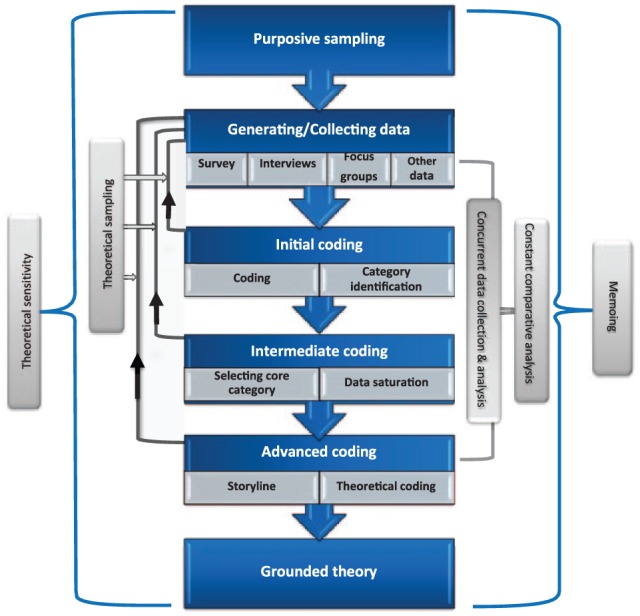
Background: Grounded theory is a well-known methodology employed in many research studies. Qualitative and quantitative data generation techniques can be used in a grounded theory study. Grounded theory sets out to discover or construct theory from data, systematically obtained and analysed using comparative analysis. While grounded theory is inherently flexible, it is a complex methodology. Thus, novice researchers strive to understand the discourse and the practical application of grounded theory concepts and processes. Objective: The aim of this article is to provide a contemporary research framework suitable to inform a grounded theory study. Result: This article provides an overview of grounded theory illustrated through a graphic representation of the processes and methods employed in conducting research using this methodology. The framework is presented as a diagrammatic representation of a research design and acts as a visual guide for the novice grounded theory researcher. Discussion: As grounded theory is not a linear process, the framework illustrates the interplay between the essential grounded theory methods and iterative and comparative actions involved. Each of the essential methods and processes that underpin grounded theory are defined in this article. Conclusion: Rather than an engagement in philosophical discussion or a debate of the different genres that can be used in grounded theory, this article illustrates how a framework for a research study design can be used to guide and inform the novice nurse researcher undertaking a study using grounded theory. Research findings and recommendations can contribute to policy or knowledge development, service provision and can reform thinking to initiate change in the substantive area of inquiry.
Overview
CoChat Summary
TL;DR
This article presents a contemporary, diagrammatic research design framework to help novice researchers visualise and apply the iterative methods and processes of grounded theory (GT). It defines the essential GT methods and processes and situates them within a non-linear, recursive design rather than debating philosophical genres.
Key findings
- GT is described as a structured yet flexible methodology appropriate when little is known about a phenomenon, aiming to produce or construct an explanatory theory grounded in data.
- Three distinct GT genres are identified: traditional/classic GT (Glaser), evolved GT (Strauss, Corbin and Clarke), and constructivist GT (Charmaz), distinguished by the researcher's philosophical position, use of literature, and approach to coding, analysis and theory development.
- Coding terminology differs by genre: traditional uses open, selective and theoretical coding; evolved uses open, axial and selective coding; constructivist uses initial, focused and theoretical coding (Table 1, adapted from Birks and Mills).
- The framework (Figure 1) depicts the interplay of purposive sampling, concurrent data generation/collection and analysis, constant comparative analysis, memoing, coding (initial, intermediate, advanced), theoretical sampling, theoretical sensitivity, and theoretical saturation, all directed toward an integrated substantive theory.
- Quality and rigour are related to three areas: the researcher's expertise, knowledge and research skills; methodological congruence with the research question; and procedural precision in the use of methods.
Methods
This is a methodological/discussion article, not an empirical study; no sample or dataset is analysed. It synthesises GT literature and prior works (notably Birks and Mills) to construct a graphic research design framework (Figure 1) and to define each essential GT method and process. The framework is presented as a visual guide for novice grounded theory researchers, illustrated with exemplars from other GT studies (Boxes 1–3).
Limitations
The paper states no formal limitations. Evident from the text: it deliberately avoids engagement in philosophical discussion or debate of the different GT genres, so it does not adjudicate between them; the framework is offered as a visual guide rather than an empirically tested model; and it is oriented specifically toward the novice nurse researcher, which may limit transferability to other disciplines or experienced researchers.
Model-written summary. Check it against the paper before relying on it.
Integrity signals
Registry
Cites
Statistics
Figures
Verification
Claims the paper makes
1 Valid · 4 Not valid · 49 Not checked · 18 Own results and interpretations
A statement the paper makes itself — it cites no source for it, so there is none to check. The quote shows it is in the paper.
In the paper
“As presented in Figure 1, initial purposive sampling directs the collection and/or generation of data.”
§ Grounded theory research: A design framework for novice researchers > Discussion > Purposive sampling
plainstates a cause- Asserted: passes — The authors put it forward as true.
- Checkable: passes — It can be checked against evidence.
- Load-bearing: passes — The paper’s conclusions depend on it.
- Based: passes — The paper gives a reason why it holds.
In the paper
“Constant comparative analysis generates increasingly more abstract concepts and theories through inductive processes.16”
§ Grounded theory research: A design framework for novice researchers > Discussion > Constant comparative analysis
What the sources say
- Not matchedcites [16] Charmaz K. Constructing grounded theory: a practical guide through qualitative analysis. Thousand Oaks, CA: SAGE, 2006.
Its entry has no title and year that we can search by.
plainstates a cause- Asserted: passes — The authors put it forward as true.
- Checkable: passes — It can be checked against evidence.
- Load-bearing: unclear — It is unclear whether the paper’s conclusions depend on it.
- Based: passes — The paper gives a reason why it holds.
- Not matched
In the paper
“Several analytic tools and techniques can be used to enhance theoretical sensitivity and increase the grounded theorist’s sensitivity to theoretical constructs in the data.28”
§ Grounded theory research: A design framework for novice researchers > Discussion > Theoretical sensitivity
What the sources say
- Not checked — no full text of the sourcecites [28] Corbin JM Strauss AL. Basics of qualitative research: techniques and procedures for developing grounded theory. 3rd ed. Thousand Oaks, CA: SAGE, 2008. source
plainstates a cause- Asserted: passes — The authors put it forward as true.
- Checkable: passes — It can be checked against evidence.
- Load-bearing: unclear — It is unclear whether the paper’s conclusions depend on it.
- Based: passes — The paper gives a reason why it holds.
In the paper
“Advanced coding that integrates extant theory adds further explanatory power to the findings.6”
§ Grounded theory research: A design framework for novice researchers > Discussion > Advanced coding
What the sources say
- Not matchedcites [6] Birks M Mills J. Grounded theory: a practical guide. 2nd ed. London: SAGE, 2015.
Its entry has no title and year that we can search by.
plainstates a cause- Asserted: passes — The authors put it forward as true.
- Checkable: passes — It can be checked against evidence.
- Load-bearing: unclear — It is unclear whether the paper’s conclusions depend on it.
- Based: passes — The paper gives a reason why it holds.
- Not matched
In the paper
“While interviews are a common method of generating data, data sources can include focus groups, questionnaires, surveys, transcripts, letters, government reports, documents, grey literature, music, artefacts, videos, blogs and memos.9”
§ Grounded theory research: A design framework for novice researchers > Discussion > Generating/collecting data
What the sources say
- Not checked — no full text of the sourcecites [9] Mills J Birks M Hoare KJ. Grounded theory. In: Mills J Birks M (eds) Qualitative methodology: a practical guide. London: SAGE, 2014, pp. 107– 121. source
plain- Asserted: passes — The authors put it forward as true.
- Checkable: passes — It can be checked against evidence.
- Load-bearing: unclear — It is unclear whether the paper’s conclusions depend on it.
- Based: passes — The paper gives a reason why it holds.
5 more claims
Create a free account to see all 72 claims and every source verdict.
- Probably not a substantial claim. 58
- It may state two separate claims as one. 17
Claims other papers make about this one
Each is checked against this paper’s own text: does it say what the citing paper says it does?
The cited source says what the claim attributes to it.
In the citing paper
“The epistemological and ontological differences principally address the proposition that theory is either discovered or co-constructed (Bryant, 2017), leading to opposing views on how the steps in the Grounded Theory method are understood (Bøttcher Berthelsen, 2018; Chun Tie, Birks and Francis, 2019; Tarozzi, 2020).”
From Application and challenges of using a Constructivist Grounded Theory methodology to address an undertheorized clinical challenge: A discussion paper (2024) · cites this paper as Chun Tie, Birks and Francis, 2019
The cited source says what the claim attributes to it.
In the citing paper
“Though the comparison of data, researchers emphasize consistencies, comprehend differences, and refine interviews, consistently comparing specific data points with others to establish categories (Bryant, 2017; Charmaz, 2014; Chun Tie et al., 2019).”
From Application and challenges of using a Constructivist Grounded Theory methodology to address an undertheorized clinical challenge: A discussion paper (2024) · cites this paper as Chun Tie et al., 2019
The cited source says what the claim attributes to it.
In the citing paper
“Nevertheless, this initial stage aims to deconstruct / fracture the data, allowing details to emerge (Bryant and Charmaz, 2019) to create the opportunity to identify both similarities and differences, pose analytical inquiries (Charmaz and Thornberg, 2021), and thereby establish to attain a more profound level of meaning (Chun Tie et al., 2019).”
From Application and challenges of using a Constructivist Grounded Theory methodology to address an undertheorized clinical challenge: A discussion paper (2024) · cites this paper as Chun Tie et al., 2019
Citations
Cites
The Discovery of Grounded Theory: Strategies for Qualitative Research.
Wagner, H. R., Glaser, B. G., & Strauss, A. L. (1968) · Social Forces · doi:10.2307/2575405 · Cited by 46,361
The Discovery of Grounded Theory; Strategies for Qualitative Research
Glaser, B. G., Strauss, A. L., & Strutzel, E. (1968) · Nursing Research · doi:10.1097/00006199-196807000-00014 · Cited by 39,449
(1998) · Sage eBooks · Cited by 38,631
Basics of Qualitative Research (3rd ed.): Techniques and Procedures for Developing Grounded Theory
Corbin, J., & Strauss, A. (2008) · SAGE · doi:10.4135/9781452230153 · Cited by 24,827
Basics of Qualitative Research: Grounded Theory Procedures and Techniques
Long, D. R., Strauss, A., & Corbin, J. (1993) · The Modern Language Journal · doi:10.2307/328955 · Cited by 17,576
Research Design: Qualitative, Quantitative, and Mixed Methods Approaches
Sloane-Seale, A. (2009) · Canadian Journal of University Continuing Education · doi:10.21225/d54s3d · Cited by 14,328
The Coding Manual for Qualitative Researchers
Lungu, M. (2022) · American Journal of Qualitative Research · doi:10.29333/ajqr/12085 · Cited by 10,826
Constructing grounded theory. A practical guide through qualitative analysis
Brink, E., Dellve, L., Hallberg, U., Abrahamsson, K. H., Klingberg, G., & Wentz, K. (2006) · International Journal of Qualitative Studies on Health and Well-being · doi:10.3402/qhw.v1i3.4932 · Cited by 6,862
(1978) · Medical Entomology and Zoology · Cited by 6,077
The Sage Handbook of Qualitative Research[1]
(2006) · Qualitative Research in Organizations and Management: An International Journal · doi:10.1108/17465640610666642 · Cited by 5,842
Research works printed but not linked: 13
- Crotty M. The foundation of social research: meaning and perspective in the research process. Thousand Oaks, CA: SAGE, 1998.
- Charmaz K. The power and potential of grounded theory. Med Sociol 2012; 6: 2– 15.
- Glaser BG. Basics of grounded theory analysis. Mill Valley, CA: Sociology Press, 1992.
- Ralph N Birks M Chapman Y. The methodological dynamism of grounded theory. Int J Qual Methods 2015; 14: 1–6.
- Bryant A Charmaz K. The Sage handbook of grounded theory. Thousand Oaks, CA: SAGE, 2007. · DOI · Paper page
- Charmaz K Bryant A. Grounded theory and credibility. In: Silverman D (ed.) Qualitative research. 3rd ed. London: SAGE, 2011, pp. 291– 309.
- Glaser BG Holton J. Remodeling grounded theory. Forum Qualitative Sozialforschung/Forum: Qualitative Social Research 2004; 5: 1– 22.
- Mackenzie N Knipe S. Research dilemmas: paradigms, methods and methodology. Issues Educ Res 2006; 16: 193– 205.
- Chamberlain-Salaun J. Consumers and the social world of health care: outsiders in the expert’s world: a grounded theory study. PhD Thesis, College of Health Care Sciences, James Cook University, Townsville, QLD, Australia, 2015, p. 198.
- Moghaddam A. Coding issues in grounded theory. Issues Educ Res 2006; 16: 53– 61.
- Evans LE. A novice researcher’s first walk through the maze of grounded theory: rationalization for classical grounded theory. Ground Theory Rev 2013; 14: 37–55.
- Glaser BG. The grounded theory perspective III: theoretical coding. Mill Valley, CA: Sociology Press, 2005.
- Baldwin A. Reconciling professional identity: a grounded theory study of nurse academics’ role modelling. PhD Thesis, College of Healthcare Sciences, James Cook University, Townsville, QLD, Australia, 2016, p. 246.
Cited by
Items 101–200 of 1,857
Oldfield, K., Evans, S., Braithwaite, I. E., & Newton‐Howes, G. (2021) · Drugs Education Prevention and Policy · doi:10.1080/09687637.2021.1901855 · Cited by 31
“We undertook an iterative comparative analysis to code and categorize data, revisiting the primary literature from the literature search until data saturation occurred (Chun Tie et al., 2019).”
MethodSupply chain control towers: Technology push or market pull—An assessment tool
Patsavellas, J., Kaur, R., & Salonitis, K. (2021) · IET Collaborative Intelligent Manufacturing · doi:10.1049/cim2.12040 · Cited by 43
Implementation of telepsychiatry in Kenya: acceptability study
Kaigwa, L. W. C., Njenga, F. G., Ongeri, L., Nguithi, A., Mugane, M., Mbugua, G., Anundo, J., Kimari, Z., & Onono, M. A. (2022) · BJPsych Open · doi:10.1192/bjo.2022.53 · Cited by 31
Pride or Rainbow-Washing? Exploring LGBTQ+ Advertising from the Vested Stakeholder Perspective
Schopper, T., Berbers, A., & Vogelgsang, L. (2024) · Journal of Advertising · doi:10.1080/00913367.2024.2317147 · Cited by 53
Maxim, R. I., & Arnedo-Moreno, J. (2025) · JMIR Serious Games · doi:10.2196/54075 · Cited by 58
“Therefore, the general goal of a framework design is to create solutions from preexisting components (analysis phase), to describe the critical decomposition problems, and to deliver a concrete example, not abstract (design and test phases) [8,9].”
Liu, J., Mansoor, Y., Johar, J., Kim, S., Sidiqi, A. M., & Kapoor, V. (2020) · Social Science & Medicine · doi:10.1016/j.socscimed.2020.113243 · Cited by 34
Sahu, B., Babu, G. R., Gurav, K., Karthik, M., Deepa, R., Lobo, E., John, D. A., Oakley, L., Oteng‐Ntim, E., Nadal, I. P., et al. (2021) · BMC Health Services Research · doi:10.1186/s12913-021-06077-0 · Cited by 30
An optimistic outlook on the use of evidence syntheses to inform environmental decision‐making
Thomas‐Walters, L., Nyboer, E. A., Taylor, J. J., Rytwinski, T., Lane, J. F., Young, N., Bennett, J., Nguyen, V. M., Harron, N., Aitken, S. M., et al. (2021) · Conservation Science and Practice · doi:10.1111/csp2.426 · Cited by 33
Edward, A., Campbell, B. A., Manase, F., & Appel, L. J. (2021) · BMC Health Services Research · doi:10.1186/s12913-021-06858-7 · Cited by 47
“As the study was designed as an exploratory research in a specific semi-urban location, it did not include all the elements, but followed the general principles of a grounded theory approach [35, 36].”
Narrative shapes innovation: a study on multiple innovations in the UK construction industry
Ninan, J., Sergeeva, N., & Winch, G. (2022) · Construction Management and Economics · doi:10.1080/01446193.2022.2037144 · Cited by 36
“While open coding fractures the data, axial coding allows theory to emerge from data as the researcher investigates “what is really going on” in the data (Tie et al. 2019).”
BackgroundLahai, M., Theobald, S., Wurie, H. R., Lakoh, S., Erah, P. O., Samai, M. H., & Raven, J. (2022) · BMC Health Services Research · doi:10.1186/s12913-022-08606-x · Cited by 37
“The interviews were analyzed using the grounded theory approach [24].”
MethodΜαγρίζος, Σ., Roumpi, D., & Rizomyliotis, I. (2023) · International Journal of Contemporary Hospitality Management · doi:10.1108/ijchm-04-2022-0536 · Cited by 37
Naughton, B. D., Dopson, S., & Iakovleva, T. A. (2023) · Journal of Responsible Innovation · doi:10.1080/23299460.2023.2211870 · Cited by 34
Robin, L., Robin, K., Camerlenghi, E., Ireland, L., & Ryan‐Colton, E. (2022) · Ecological Management & Restoration · doi:10.1111/emr.12528 · Cited by 35
Bellman, R., Mohebbi, S., Nobahar, N., et al. (2021) · Journal of the American Pharmacists Association · doi:10.1016/j.japh.2021.08.001 · Cited by 28
Hotel food waste in Cyprus: An exploratory case study of hotels in Limassol
Demetriou, P. (2022) · Cogent Social Sciences · doi:10.1080/23311886.2022.2026556 · Cited by 45
“According to Tie et al. (2019), grounded theory research involves purposive sampling, data collection, coding and analysis.”
BackgroundMethodInfluentialUnpacking Ambiguity in Building Requirements to Support Automated Compliance Checking
Zhang, Z., Ma, L., & Nisbet, N. (2023) · Journal of Management in Engineering · doi:10.1061/jmenea.meeng-5359 · Cited by 27
Jong, C. L. K., & Ganzaroli, A. (2024) · VOLUNTAS International Journal of Voluntary and Nonprofit Organizations · doi:10.1007/s11266-023-00597-5 · Cited by 52
“During the interviews, memo writing took place to detail out the thought process of coding by creating new codes, collapsing codes, merging codes, separating codes, and identifying relationships between the codes (Chun Tie et al., 2019).”
Chamberlain, C., Gee, G., Gartland, D., Mensah, F. K., Mares, S. P., Clark, Y., Ralph, N., Atkinson, C., Hirvonen, T., McLachlan, H., et al. (2020) · Frontiers in Psychology · doi:10.3389/fpsyg.2020.02014 · Cited by 29
Charlson, J., & Dimka, N. (2021) · Construction Innovation · doi:10.1108/ci-10-2019-0108 · Cited by 27
“Theoretical sampling generated data focused on gaps and advanced the iterative process until theoretical saturation was reached (Chun Tie et al., 2019).”
BackgroundEsaryk, E. E., Moffat, L. F., Ritchie, L. D., & Martinez, S. M. (2022) · Journal of Nutrition Education and Behavior · doi:10.1016/j.jneb.2022.02.008 · Cited by 33
Zimbudzi, E., Lo, C., Robinson, T., Ranasinha, S., Teede, H. J., Usherwood, T. P., Polkinghorne, K. R., Kerr, P. G., Fulcher, G. R., Gallagher, M., et al. (2019) · PLoS ONE · doi:10.1371/journal.pone.0219685 · Cited by 31
Wormdahl, I., Husum, T. L., Kjus, S. H. H., Rugkåsa, J., Hatling, T., & Rise, M. B. (2021) · Frontiers in Psychiatry · doi:10.3389/fpsyt.2021.708175 · Cited by 27
“Data Analysis The analysis was inspired by grounded theory (18).”
MethodMotivators of Participation and Non-Participation in Youth Environmental Protests
Feldman, H. R. (2021) · Frontiers in Political Science · doi:10.3389/fpos.2021.662687 · Cited by 39
Herath, T. C., Herath, H. S. B., & Cullum, D. (2022) · Information Systems Frontiers · doi:10.1007/s10796-022-10246-9 · Cited by 45
“Chun Tie et al. (2019) also present a view that theory is not discovered; rather, theory is constructed by the researcher who views the world through their own particular lens.”
BackgroundMethodInfluentialAbukari, A. S., Acheampong, A. K., & Aziato, L. (2022) · BMC Health Services Research · doi:10.1186/s12913-022-08425-0 · Cited by 26
“The initial codes were kept close to the participants’ words, all in a bit to ensure methodological rigour [26].”
BackgroundOliveira, J., Murphy, T. H., Vaughn, G., Elfahim, S., & Carpenter, R. E. (2024) · New Horizons in Adult Education and Human Resource Development · doi:10.1177/19394225241287032 · Cited by 44
“…they compared and contrasted their experiences, explored differences, and collaboratively identified key phrases and concepts (i.e., process codes; Chun Tie et al., 2019) within the data; (3) after the guiding facilitator tabled the process codes, they were reviewed by each participant and…”
Rania, N., Coppola, I., & Pinna, L. (2021) · The Qualitative Report · doi:10.46743/2160-3715/2021.4863 · Cited by 41
Natural language processing (NLP) aided qualitative method in health research
Cheligeer, C., Yang, L., Nandi, T., Doktorchik, C. T. A., Quan, H., Zeng, Y., & Singh, S. (2022) · Journal of Integrated Design and Process Science · doi:10.3233/jid-220013 · Cited by 31
“The nature of coding is to identify concepts, and similarities in the data (Chun Tie et al., 2019).”
The Instrumentality of Public-Private Partnerships for Achieving Sustainable Development Goals
Ma, M., Wang, N., Mu, W., & Zhang, L. (2022) · Sustainability · doi:10.3390/su142113756 · Cited by 40
“Coding is an analytical process used to identify concepts, similarities and concept reproduction in the data [39].”
MethodChamberlain, C., Clark, Y., Hokke, S., Hampton, A., Atkinson, C., Andrews, S., & for the HPNF investigator group (2021) · Primary Health Care Research & Development · doi:10.1017/s1463423621000463 · Cited by 27
“The research team explored perspectives of Aboriginal and Torres Strait Islander parents regarding trauma-integrated support needs in recovery from complex trauma, and systematically and iteratively generated a theoretical supposition (Chun Tie et al. , 2019).”
Adolescent Perceptions of Menstruation on Twitter: Opportunities for Advocacy and Education
Davies, S., Langer, M. D., Klein, A. Z., Gonzalez‐Hernandez, G., & Dowshen, N. (2022) · Journal of Adolescent Health · doi:10.1016/j.jadohealth.2022.01.224 · Cited by 31
Gender Gap: A Qualitative Study of Women and Leadership Acquisition in Anesthesiology
Basile, E. R., Byrd, H., Powell-Williams, M., Gutierrez, J. J. P., & Riveros-Perez, E. (2022) · Anesthesia & Analgesia · doi:10.1213/ane.0000000000006073 · Cited by 30
Alavi, N. M., Nabizadeh‐Gharghozar, Z., & Ajorpaz, N. M. (2022) · BMC Medical Education · doi:10.1186/s12909-022-03553-x · Cited by 24
“Theoretical saturation ensues when new data analysis does not provide additional material to existing theoretical categories, and the categories are sufficiently explained [29].”
BackgroundSosik, K., & Osypchuk, O. (2023) · Sustainability · doi:10.3390/su151310568 · Cited by 32
Savva, K.-V., Kawka, M., Vadhwana, B., Penumaka, R. R., Patton, I., Khan, K., Perrott, C., Das, S., Giot, M., Mavroveli, S., et al. (2023) · BMC Medicine · doi:10.1186/s12916-023-03075-3 · Cited by 25
Kumar, A. D., Aikens, R. C., Hom, J., Shieh, L. Y., Chiang, J., Morales, D., Saini, D., Musen, M. A., Baiocchi, M., Altman, R. B., et al. (2020) · Journal of the American Medical Informatics Association · doi:10.1093/jamia/ocaa190 · Cited by 27
“Participants were also asked the following open-ended questions: “in which clinical scenarios would this system be most useful?” and “in which clinical scenarios would this system be least useful?” All open-ended responses were qualitatively coded and analyzed using thematic analysis.(40,41)”
MethodAn Analysis of Micro-scale Conflict in Collaborative Governance
Ulibarrí, N. (2023) · Journal of Public Administration Research and Theory · doi:10.1093/jopart/muad025 · Cited by 31
Tripathy, S., Acharya, S. P., Sahoo, A. K., Mitra, J. K., Goel, K., Ahmad, S. R., & Hansdah, U. (2020) · Journal of Patient-Reported Outcomes · doi:10.1186/s41687-020-00229-2 · Cited by 26
Caring for Families Impacted by Opioid Use: A Qualitative Analysis of Integrated Program Designs
Schiff, D. M., Partridge, S., Gummadi, N. H., Gray, J. R., Stulac, S. N., Costello, E., Wachman, E. M., Jones, H. E., Greenfield, S. F., Taveras, E. M., et al. (2021) · Academic Pediatrics · doi:10.1016/j.acap.2021.04.016 · Cited by 28
Taliercio, V. L., Snyder, A. M., Biggs, A. M., Kean, J. T., Hess, R., Duffin, K. C., Cizik, A. M., & Secrest, A. M. (2021) · Quality of Life Research · doi:10.1007/s11136-021-03030-w · Cited by 23
Bastani, P., Sadeghkhani, O., Ravangard, R., Rezaei, R., Bikine, P., & Mehralian, G. (2021) · Journal of Pharmaceutical Policy and Practice · doi:10.1186/s40545-021-00399-4 · Cited by 27
“Symbolic interactionism addresses the subjective meaning people place on objects, behaviors or events based on what they believe is true [21].”
BackgroundGreen, B. D., McClelland, J. A., Semciw, A. I., et al. (2022) · Figshare · doi:10.26181/21086980.v1 · Cited by 23
Padda, H., Wemette, M., Safi, A. G., et al. (2021) · Preventive Veterinary Medicine · doi:10.1016/j.prevetmed.2021.105428 · Cited by 23
“…a codebook, applying the codebook systematically to the data (possibly with the use of tools such as NVivo, Atlas.ti) so that quotes associated with the codes can be pulled, compared and analyzed more thoroughly for patterns and themes to inform the inquiry (Chapman et al., 2015; Tie et al., 2019).”
Basic Concepts of Diabetics Mellitus for the Welfare of General Patients
Mohajan, D., & Mohajan, H. K. (2023) · Studies in Social Science & Humanities · doi:10.56397/sssh.2023.06.03 · Cited by 51
Gokgoz, C., Demirci, A. D., & Kabukçuoğlu, K. (2021) · Research in Developmental Disabilities · doi:10.1016/j.ridd.2021.103907 · Cited by 33
Park, L. G., Ng, F., & Handley, M. A. (2023) · PEC Innovation · doi:10.1016/j.pecinn.2023.100209 · Cited by 30
A Formal Understanding of Computational Empathy in Interactive Agents
Brännström, A., Wester, J., & Nieves, J. C. (2022) · Cognitive Systems Research · doi:10.1016/j.cogsys.2023.101203 · Cited by 34
Classic grounded theory: identifying the main concern
Connor, J., Flenady, T., Massey, D. L., & Dwyer, T. (2024) · Research in Nursing & Health · doi:10.1002/nur.22381 · Cited by 40
Intersex students, sex-based relational learning & isolation
Henningham, M., & Jones, T. M. (2021) · Sex Education · doi:10.1080/14681811.2021.1873123 · Cited by 32
“Once this has been completed, the process moved to a phase of theoretical sampling (Chun Tie, Birks, and Francis 2019) or focused coding (Charmaz and Bryant 2011).”
MethodDevelopment of video animations to encourage patient-driven deprescribing: A Team Alice Study
Stoll, J. A., Ranahan, M. E., Richbart, M., Brennan-Taylor, M. K., Taylor, J. S., Brady, L., Cal, J., Baumgartner, A. D., Wahler, R. G., & Singh, R. K. P. G. (2021) · Patient Education and Counseling · doi:10.1016/j.pec.2021.03.041 · Cited by 22
Narayanan, M., Ordynans, J. G., Wang, A. Y., McCluskey, M. S., Elivert, N., Shields, A. L., & Ferrell, A. C. (2021) · Education and Urban Society · doi:10.1177/00131245211062528 · Cited by 65
“Grounded theory is a set of methodological and analytical practices that allow theories to be constructed from the data (Chun Tie et al., 2019); it is designed to prevent biases from shaping conclusions and foreground the subjective perceptions of participants (Charmaz, 2006).”
BackgroundCardarelli, K., DeWitt, E., Gillespie, R., Hogg‐Graham, R., Norman‐Burgdolf, H., & Mullins, J. T. (2021) · International Journal of Environmental Research and Public Health · doi:10.3390/ijerph182312792 · Cited by 23
“Multiple investigators reviewed the transcripts using a Grounded Theory Approach [21] to establish patterns in the data.”
MethodReview of studies of blockchain technology effects on the shipping industry
Gerakoudi, K. (2022) · Journal of Shipping and Trade · doi:10.1186/s41072-021-00105-2 · Cited by 23
“This research method can be applied through both qualitative and quantitative methods with a focus on creating a data-based theory (Chun Tie et al. 2019).”
MethodComfort With Telehealth Among Residents of an Underserved Urban Area
Bagchi, A. D., Damas, K., de Noguera, N. S., Melamed, B., Menifield, C. E., Baveja, A., Weber, P. F., & Swaminathan, S. (2022) · Journal of Primary Care & Community Health · doi:10.1177/21501319221119692 · Cited by 23
Mota-Castillo, P. J., Unar‐Munguía, M., Santos‐Guzmán, A., et al. (2023) · Globalization and Health · doi:10.1186/s12992-023-00908-x · Cited by 22
“Subsequently, for the analysis, we followed the steps of the grounded theory [33], which consists of building theories, concepts, hypotheses, and propositions, with the data as the starting point.”
MethodUnderstanding the perceived conservation benefits of shark-marine tourism in the Global South
Siddiqi, A., Bergseth, B. J., Diedrich, A., & Chin, A. (2024) · Marine Policy · doi:10.1016/j.marpol.2023.105995 · Cited by 29
Oral Hypoglycaemic Agents: Non-Insulin Medications for Type 2 Diabetes Patients
Mohajan, D., & Mohajan, H. K. (2024) · Innovation in Science and Technology · doi:10.56397/ist.2024.01.04 · Cited by 48
Christodoulou, I., Rizomyliotis, I., Κonstantoulaki, K., Alfiero, S., Hasanago, S., & Paolone, F. (2024) · Business Ethics the Environment & Responsibility · doi:10.1111/beer.12681 · Cited by 44
“The qualities of grounded theory rely on three distinct elements (1) the researchers's expertise, knowledge, and research skills (2) methodological congruence with the research question and (3) procedural precision in the use of methods (Tie et al., 2019).”
Debnath, R., Bardhan, R., Darby, S. J., Mohaddes, K., Sunikka, M. M., Coelho, A. C. V., & Isah, A. (2021) · Energy Research & Social Science · doi:10.1016/j.erss.2020.101892 · Cited by 24
COVID-19 Pandemic Impact on Substance Misuse: A Social Media Listening, Mixed Method Analysis
Arillotta, D., Guirguis, A., Corkery, J., Scherbaum, N., & Schifano, F. (2021) · Brain Sciences · doi:10.3390/brainsci11070907 · Cited by 28
“First, the current approach was adopted whilst considering both the empirical phenomenology model [135] and grounded theory principles [136,137], although one could argue the investigation was not fully in line with these approaches.”
MethodSnodgrass, J. G., Clements, K. R., Nixon, W. C., Ortega, C., Lauth, S., & Anderson, M. (2020) · Field Methods · doi:10.1177/1525822x20939749 · Cited by 34
“In grounded theory, this represented another defragmenting process—a form of selective coding in Strauss and Corbin’s terminology (Chun Tie et al. 2019:4)—in the way that we produced a discursive set of theoretical propositions that linked key individual themes and cultural models theme sets…”
BackgroundChukwu, E., Gilroy, S., Addaquay, K., Jones, N. N., Karimu, V. G., Garg, L., & Dickson, K. (2021) · JMIR Formative Research · doi:10.2196/23874 · Cited by 23
Jackson, J., Almos, H., Karibian, N., Lieb, C., Butts‐Wilmsmeyer, C. J., & Aranda, M. L. (2022) · Journal of Microbiology and Biology Education · doi:10.1128/jmbe.00233-21 · Cited by 24
Analysis on risk factors related delay in PCPs
Zhao, Y., Chen, W., Yang, Z., Li, Z., & Yong, W. (2022) · Engineering Construction & Architectural Management · doi:10.1108/ecam-12-2021-1119 · Cited by 31
Impact of the COVID-19 Pandemic on Canadian Social Connections: A Thematic Analysis
Lowe, C. T., Rafiq, M., MacKay, L. J., Letourneau, N. L., Ng, C. F., Keown-Gerrard, J., Gilbert, T., & Ross, K. M. (2022) · Journal of Social and Personal Relationships · doi:10.1177/02654075221113365 · Cited by 27
Burkinshaw, K., Tsourtos, G., & Cations, M. (2022) · International Journal of Geriatric Psychiatry · doi:10.1002/gps.5859 · Cited by 22
“Recruitment continued until theoretical saturation, whereby no new themes were being generated from the data.(17) The first author is an experienced occupational therapist who has worked in clinical services for people with YOD.”
BackgroundMethodInfluentialLee, Y. J., Kazungu, R., Liu, C., Kim, R., van der Velde, N., Taylor, C., Walsh, A., Asasira, M., Katongole, I., Hatfield-King, J., et al. (2022) · BMC Psychiatry · doi:10.1186/s12888-022-04441-w · Cited by 32
Atik, E., Schückes, M., & Apolinário-Hagen, J. (2022) · JMIR Mental Health · doi:10.2196/36806 · Cited by 22
Ponderal Index: An Important Anthropometric Indicator for Physical Growth
Mohajan, D., & Mohajan, H. K. (2023) · Journal of Innovations in Medical Research · doi:10.56397/jimr/2023.06.03 · Cited by 21
Eva, C., Harris, J., Bodle, K. A., Foley, D., Hunter, B. H., & Nichols, N. (2023) · Australian Journal of Social Issues · doi:10.1002/ajs4.292 · Cited by 24
Examining Tourism Resilience Practices as Basis for a Post-Covid 19 Recovery in the Philippines
Baraero-Era, J. S., & del Rosario, J. (2020) · Asean Journal on Hospitality and Tourism · doi:10.5614/ajht.2020.18.1.01 · Cited by 24
Gholamrezai, S., Aliabadi, V., & Ataei, P. (2021) · Journal of Environmental Planning and Management · doi:10.1080/09640568.2021.1875998 · Cited by 21
“One of the defining characteristics of GT is that it aims to generate a theory that is grounded in the data (Chun Tie, Birks, and Francis 2019).”
BackgroundHolmes, R. S., Wirka, K. A., Catherino, A. B., et al. (2021) · F&S Reports · doi:10.1016/j.xfre.2021.04.006 · Cited by 20
Edwards, J. G., Barry, M., Essam, D., Elsayed, M. O. K., Abdulkarim, M., Elhossein, B. M. A., Mohammed, Z. H. A., Elnogomi, A., Elfaki, A. S. E., ElSayed, A., et al. (2021) · Global Health Research and Policy · doi:10.1186/s41256-021-00222-2 · Cited by 24
Stolper, H., van Doesum, K. T. M., & Steketee, M. (2022) · Frontiers in Psychiatry · doi:10.3389/fpsyt.2022.781556 · Cited by 25
Landeghem, E. V., Dielen, S., Semaan, A. T., Rotsaert, A., Vanhamel, J., Masquillier, C., Wouters, E., Wouters, K., Vuylsteke, B., Reyniers, T., et al. (2023) · BMC Public Health · doi:10.1186/s12889-023-15540-y · Cited by 21
“We analysed transcripts inductively, by applying a grounded theory approach [24, 25] using constant comparison methods across the collected data until data saturation was reached.”
MethodChanging the Underlying Conditions Relevant to Workplace Bullying through Organisational Redesign
Li, Y., Tuckey, M. R., Neall, A. M., Rose, A., & Wilson, L. (2023) · International Journal of Environmental Research and Public Health · doi:10.3390/ijerph20054373 · Cited by 20
Institutional barriers to vehicle-to-grid implementation in Europe
Eijk, M. W. V., Annema, J. A., van der Koogh, M., & Lukszo, Z. (2025) · Renewable and Sustainable Energy Reviews · doi:10.1016/j.rser.2025.115653 · Cited by 26
Ahmad, M. M., Becerra, B. J., Hernandez, D., et al. (2020) · International Journal of Environmental Research and Public Health · doi:10.3390/ijerph17103527 · Cited by 19
“Grounded theory has been modified over the years from traditional, to evolved, to constructivist [13].”
BackgroundVidaurreta, M., López‐Dicastillo, O., Serrano‐Monzó, I., Belintxon, M., Bermejo‐Martins, E., & Mujika, A. (2021) · Nursing and Health Sciences · doi:10.1111/nhs.12906 · Cited by 24
Telepresence with Hologram Effect: Technological Ecosystem for Distance Education
Ramirez-Lopez, C. V., Castano, L., Aldape, P., & Tejeda, S. (2021) · Sustainability · doi:10.3390/su132414006 · Cited by 19
Health Beliefs and Barriers to Healthcare of Rohingya Refugees
Haider, S., Maheen, A., Ansari, M., & Stolley, M. R. (2022) · Journal of Racial and Ethnic Health Disparities · doi:10.1007/s40615-022-01342-2 · Cited by 25
Aging in Chinatowns: the Meaning of Place and Aging Experience for Older Immigrants
Chen, X. S., Hu, Y., Xu, Q., & Xie, Y. (2022) · Journal of Cross-Cultural Gerontology · doi:10.1007/s10823-022-09463-1 · Cited by 24
“It’s loving yourself for you”: Happiness in trans and nonbinary adults.
Tebbe, E. A., Bell, H. L., Cassidy, K., Lindner, S., Wilson, E., & Budge, S. L. (2022) · Psychology of Sexual Orientation and Gender Diversity · doi:10.1037/sgd0000613 · Cited by 26
Breast cancer, alcohol, and phosphate toxicity
Brown, R. B., Bigelow, P., Dubin, J. A., & Neiterman, E. (2023) · Journal of Applied Toxicology · doi:10.1002/jat.4504 · Cited by 22
“Grounded theory (GT) was originally developed in 1967 by sociologists Glaser and Strauss to bring a higher standard of quality and rigor to qualitative research (Chun Tie et al., 2019).”
BackgroundMethodInfluentialDavies, S., Darien, K., Bazyar, F., Biddle, J., Brown, B., Christman, C., Saurman, M., Wood, S. M., Thomas, D., & Dowshen, N. (2023) · Journal of Pediatric and Adolescent Gynecology · doi:10.1016/j.jpag.2023.07.010 · Cited by 23
Czarniecka‐Skubina, E., Gutkowska, K., & Hamułka, J. (2023) · Nutrients · doi:10.3390/nu15234930 · Cited by 39
“Individuals are encouraged by a moderator to speak freely and engage in a discussion on specific topics according to a moderation scenario developed in advance and tested in a pilot study [23–26].”
BackgroundMethodRacine, N., Chow, C., Hamwi, L., Bucsea, O., Cheng, C., Du, H., Fabrizi, L., Jasim, S., Johannsson, L., Jones, L., et al. (2024) · JMIR AI · doi:10.2196/51535 · Cited by 19
“Using a grounded theory approach [23], the goal of the qualitative interviews was to generate detailed knowledge about HCPs’ and parents’ understandings and perceptions of the use of AI in the NICU to assist with infant pain assessment and management.”
MethodLearning from the Experts: Stimulating Student Engagement in Small-group Active Learning
Grijpma, J. W., Ramdas, S., Broeksma, L., Meeter, M., Kusurkar, R. A., & de la Croix, A. (2024) · Perspectives on Medical Education · doi:10.5334/pme.1245 · Cited by 52
Jiang, Y., Ampaw, E. M., Asante, D., Wu, H., & Essilfie, G. (2024) · Environment Development and Sustainability · doi:10.1007/s10668-024-05024-3 · Cited by 28
Malau‐Aduli, B. S., Smith, A. M., Young, L., Gupta, T. S., & Hays, R. (2020) · PLoS ONE · doi:10.1371/journal.pone.0234620 · Cited by 19
“Coding was the analytical process used to identify concepts, compare similarities and differences in the data and to develop a theory that explains the data [23, 24].”
BackgroundMethodDance Improvisation and Motor Creativity in Children: Teachers’ Conceptions
Biasutti, M., & Habe, K. (2020) · Creativity Research Journal · doi:10.1080/10400419.2020.1833576 · Cited by 22
All-digital training course in neurophysiology: lessons learned from the COVID-19 pandemic
Duszenko, M., Fröhlich, N. T., Kaupp, A., & Garaschuk, O. (2022) · BMC Medical Education · doi:10.1186/s12909-021-03062-3 · Cited by 21
“We applied the grounded theory approach [7, 8], using the following data analysis algorithm: initial coding was performed independently by three different researchers.”
MethodKim, J. P., Ryan, K., Kasun, M., Hogg, J., Dunn, L. B., & Roberts, L. W. (2023) · JMIR AI · doi:10.2196/47449 · Cited by 20
Perceived Implications of Compensation Structure for Academic Surgical Practice: A Qualitative Study
Finn, C. B., Syvyk, S., Bergmark, R. W., Yeo, H., Waljee, J. F., Wick, E. C., & Kelz, R. R. (2023) · JAMA Surgery · doi:10.1001/jamasurg.2023.4669 · Cited by 19
Gedecho, E. K., & Kim, S. (2024) · Tourism Management Perspectives · doi:10.1016/j.tmp.2024.101289 · Cited by 24
Understanding Transmedia Music on YouTube through Disney Storytelling
Vizcaíno-Verdú, A., Aguaded, I., & Pulido, P. C. (2021) · Sustainability · doi:10.3390/su13073667 · Cited by 31
Augmented reality for ESL/EFL and bilingual education: an international comparison
Huertas-Abril, C. A., Figueroa, J., Parra, M. E. G., Rosa-Dávila, E., & Huffman, L. F. (2021) · Educación XX1 · doi:10.5944/educxx1.28103 · Cited by 39
“Grounded Theory sets out to discover or construct theory from systematically obtained data and analyzed using comparative analysis (Chun Tie et al., 2019).”
MethodTHE IMPACT OF DATA ON THE ROLE OF DESIGNERS AND THEIR PROCESS
Lu, J., Ortega, A. G., Gonçalves, M., & Bourgeois, J. (2021) · Proceedings of the Design Society · doi:10.1017/pds.2021.563 · Cited by 28
Metadata
- Authors
- Chun Tie, Y., Birks, M., & Francis, K.
- Affiliations
- Nursing and Midwifery, College of Healthcare Sciences, James Cook University, Townsville, QLD, Australia
- James Cook University (AU)
- University of Tasmania (AU)
- Venue
- SAGE Open Medicine
- Publisher
- SAGE Publications
- Published
- 2019-01
- Volume
- 7
- Pages
- 2050312118822927-2050312118822927
- ISSN
- 2050-3121 (ISSN-L)
- PMC
- PMC6318722
- OpenAlex
- W2906994370
- Cited by
- 1,869
- References
- 29
- Citations by year
- 2026: 200 · 2025: 285 · 2024: 370 · 2023: 370 · 2022: 302 · 2021: 226 · 2020: 108 · 2019: 8
- FWCI
- 433.86
- Type
- journal article
- Language
- en
- Open access
- gold
- doi.org
- Licence
- cc-by-nc
- journals.sagepub.com/page/policies/text-and-data-mining-license (tdm)
- Locations
- SAGE Open Medicine (publishedVersion, cc-by-nc)
- Europe PMC (PubMed Central) (publishedVersion, cc-by-nc)
- PubMed Central (publishedVersion, cc-by-nc)
- PubMed (publishedVersion)
- UTAS Research Repository (acceptedVersion)
- ResearchOnline at James Cook University (James Cook University) (submittedVersion)
- DOAJ (DOAJ: Directory of Open Access Journals) (submittedVersion, cc-by-sa)
- Figshare (submittedVersion, cc-by-nc)
- Topics
- Social Sciences › Education › Qualitative Research Methods and Applications
- Health Sciences › Nursing › Research and Theory › Methodologies in Health Research and Practice
- Social Sciences › Education › Educational Research and Methods
- Keywords
- grounded theory, research design framework, novice researchers, nurse researchers, qualitative research methodology, comparative analysis
About these checks
Registry, retraction, Cites and statistics results are computed, not judged, with one exception: a printed reference that no index lists is read once by a model before it counts as a citation error. Claims are extracted by a model and kept only when their quote appears verbatim in the text; each cited source is then checked, with a model’s help, for whether it says what the claim relies on. Those verdicts can be wrong — read the claim’s quote and the cited source before relying on one.
The claim verdicts this report counts are experimental: their accuracy is not yet measured.
A language model drew the claims from the paper on 2026-10-10, under version 3 of the claim definition (model deepseek-v4.1-flash, prompt extract-v3).
A second model labelled each claim on 2026-10-10 (model jev-1.13-20260917, definition revision gold-guideline-v0.2).
Statistics and arithmetic are recomputed, not judged.
Confidence bands are shown only for fields calibrated on our annotated test set. None is calibrated yet, so no band is shown.
What counts as a claim ›How we measure confidence ›How we check this ›
Are you an author, or do you see a problem with this page? Request a review
Data sources
Bibliographic data: Semantic Scholar, OpenAlex, Crossref.
Contains information from the Semantic Scholar Academic Graph Datasets, made available under the ODC Attribution License (ODC-BY 1.0).
Semantic Scholar’s data is described in: Kinney, R., et al. (2023). The Semantic Scholar Open Data Platform. arXiv:2301.10140.
