

Grounded theory research: A design framework for novice researchers
Open accessThe DOI matches its Crossref record; 30 of the 33 references it cites were found in a registry or an index; 2 of the 69 sources its claims cite were checked for support.
Abstract
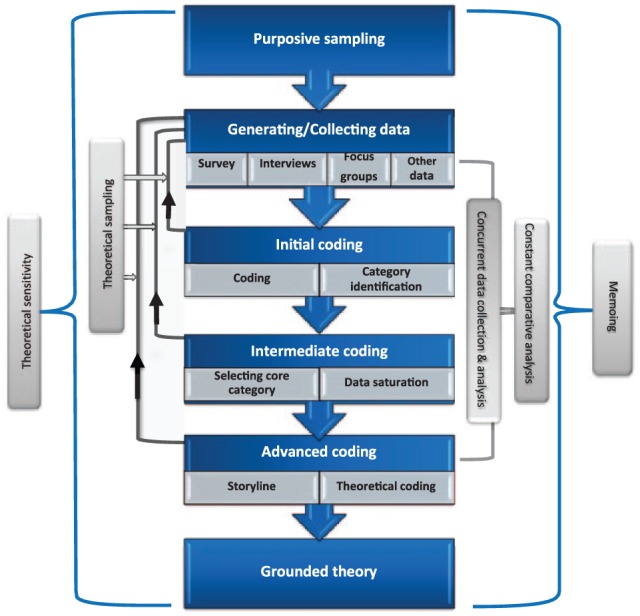
Background: Grounded theory is a well-known methodology employed in many research studies. Qualitative and quantitative data generation techniques can be used in a grounded theory study. Grounded theory sets out to discover or construct theory from data, systematically obtained and analysed using comparative analysis. While grounded theory is inherently flexible, it is a complex methodology. Thus, novice researchers strive to understand the discourse and the practical application of grounded theory concepts and processes. Objective: The aim of this article is to provide a contemporary research framework suitable to inform a grounded theory study. Result: This article provides an overview of grounded theory illustrated through a graphic representation of the processes and methods employed in conducting research using this methodology. The framework is presented as a diagrammatic representation of a research design and acts as a visual guide for the novice grounded theory researcher. Discussion: As grounded theory is not a linear process, the framework illustrates the interplay between the essential grounded theory methods and iterative and comparative actions involved. Each of the essential methods and processes that underpin grounded theory are defined in this article. Conclusion: Rather than an engagement in philosophical discussion or a debate of the different genres that can be used in grounded theory, this article illustrates how a framework for a research study design can be used to guide and inform the novice nurse researcher undertaking a study using grounded theory. Research findings and recommendations can contribute to policy or knowledge development, service provision and can reform thinking to initiate change in the substantive area of inquiry.
Overview
CoChat Summary
TL;DR
This article presents a contemporary, diagrammatic research design framework to help novice researchers visualise and apply the iterative methods and processes of grounded theory (GT). It defines the essential GT methods and processes and situates them within a non-linear, recursive design rather than debating philosophical genres.
Key findings
- GT is described as a structured yet flexible methodology appropriate when little is known about a phenomenon, aiming to produce or construct an explanatory theory grounded in data.
- Three distinct GT genres are identified: traditional/classic GT (Glaser), evolved GT (Strauss, Corbin and Clarke), and constructivist GT (Charmaz), distinguished by the researcher's philosophical position, use of literature, and approach to coding, analysis and theory development.
- Coding terminology differs by genre: traditional uses open, selective and theoretical coding; evolved uses open, axial and selective coding; constructivist uses initial, focused and theoretical coding (Table 1, adapted from Birks and Mills).
- The framework (Figure 1) depicts the interplay of purposive sampling, concurrent data generation/collection and analysis, constant comparative analysis, memoing, coding (initial, intermediate, advanced), theoretical sampling, theoretical sensitivity, and theoretical saturation, all directed toward an integrated substantive theory.
- Quality and rigour are related to three areas: the researcher's expertise, knowledge and research skills; methodological congruence with the research question; and procedural precision in the use of methods.
Methods
This is a methodological/discussion article, not an empirical study; no sample or dataset is analysed. It synthesises GT literature and prior works (notably Birks and Mills) to construct a graphic research design framework (Figure 1) and to define each essential GT method and process. The framework is presented as a visual guide for novice grounded theory researchers, illustrated with exemplars from other GT studies (Boxes 1–3).
Limitations
The paper states no formal limitations. Evident from the text: it deliberately avoids engagement in philosophical discussion or debate of the different GT genres, so it does not adjudicate between them; the framework is offered as a visual guide rather than an empirically tested model; and it is oriented specifically toward the novice nurse researcher, which may limit transferability to other disciplines or experienced researchers.
Model-written summary. Check it against the paper before relying on it.
Integrity signals
Registry
Cites
Statistics
Figures
Verification
Claims the paper makes
1 Valid · 4 Not valid · 49 Not checked · 18 Own results and interpretations
A statement the paper makes itself — it cites no source for it, so there is none to check. The quote shows it is in the paper.
In the paper
“As presented in Figure 1, initial purposive sampling directs the collection and/or generation of data.”
§ Grounded theory research: A design framework for novice researchers > Discussion > Purposive sampling
plainstates a cause- Asserted: passes — The authors put it forward as true.
- Checkable: passes — It can be checked against evidence.
- Load-bearing: passes — The paper’s conclusions depend on it.
- Based: passes — The paper gives a reason why it holds.
In the paper
“Constant comparative analysis generates increasingly more abstract concepts and theories through inductive processes.16”
§ Grounded theory research: A design framework for novice researchers > Discussion > Constant comparative analysis
What the sources say
- Not matchedcites [16] Charmaz K. Constructing grounded theory: a practical guide through qualitative analysis. Thousand Oaks, CA: SAGE, 2006.
Its entry has no title and year that we can search by.
plainstates a cause- Asserted: passes — The authors put it forward as true.
- Checkable: passes — It can be checked against evidence.
- Load-bearing: unclear — It is unclear whether the paper’s conclusions depend on it.
- Based: passes — The paper gives a reason why it holds.
- Not matched
In the paper
“Several analytic tools and techniques can be used to enhance theoretical sensitivity and increase the grounded theorist’s sensitivity to theoretical constructs in the data.28”
§ Grounded theory research: A design framework for novice researchers > Discussion > Theoretical sensitivity
What the sources say
- Not checked — no full text of the sourcecites [28] Corbin JM Strauss AL. Basics of qualitative research: techniques and procedures for developing grounded theory. 3rd ed. Thousand Oaks, CA: SAGE, 2008. source
plainstates a cause- Asserted: passes — The authors put it forward as true.
- Checkable: passes — It can be checked against evidence.
- Load-bearing: unclear — It is unclear whether the paper’s conclusions depend on it.
- Based: passes — The paper gives a reason why it holds.
In the paper
“Advanced coding that integrates extant theory adds further explanatory power to the findings.6”
§ Grounded theory research: A design framework for novice researchers > Discussion > Advanced coding
What the sources say
- Not matchedcites [6] Birks M Mills J. Grounded theory: a practical guide. 2nd ed. London: SAGE, 2015.
Its entry has no title and year that we can search by.
plainstates a cause- Asserted: passes — The authors put it forward as true.
- Checkable: passes — It can be checked against evidence.
- Load-bearing: unclear — It is unclear whether the paper’s conclusions depend on it.
- Based: passes — The paper gives a reason why it holds.
- Not matched
In the paper
“While interviews are a common method of generating data, data sources can include focus groups, questionnaires, surveys, transcripts, letters, government reports, documents, grey literature, music, artefacts, videos, blogs and memos.9”
§ Grounded theory research: A design framework for novice researchers > Discussion > Generating/collecting data
What the sources say
- Not checked — no full text of the sourcecites [9] Mills J Birks M Hoare KJ. Grounded theory. In: Mills J Birks M (eds) Qualitative methodology: a practical guide. London: SAGE, 2014, pp. 107– 121. source
plain- Asserted: passes — The authors put it forward as true.
- Checkable: passes — It can be checked against evidence.
- Load-bearing: unclear — It is unclear whether the paper’s conclusions depend on it.
- Based: passes — The paper gives a reason why it holds.
5 more claims
Create a free account to see all 72 claims and every source verdict.
- Probably not a substantial claim. 58
- It may state two separate claims as one. 17
Claims other papers make about this one
Each is checked against this paper’s own text: does it say what the citing paper says it does?
The cited source says what the claim attributes to it.
In the citing paper
“The epistemological and ontological differences principally address the proposition that theory is either discovered or co-constructed (Bryant, 2017), leading to opposing views on how the steps in the Grounded Theory method are understood (Bøttcher Berthelsen, 2018; Chun Tie, Birks and Francis, 2019; Tarozzi, 2020).”
From Application and challenges of using a Constructivist Grounded Theory methodology to address an undertheorized clinical challenge: A discussion paper (2024) · cites this paper as Chun Tie, Birks and Francis, 2019
The cited source says what the claim attributes to it.
In the citing paper
“Though the comparison of data, researchers emphasize consistencies, comprehend differences, and refine interviews, consistently comparing specific data points with others to establish categories (Bryant, 2017; Charmaz, 2014; Chun Tie et al., 2019).”
From Application and challenges of using a Constructivist Grounded Theory methodology to address an undertheorized clinical challenge: A discussion paper (2024) · cites this paper as Chun Tie et al., 2019
The cited source says what the claim attributes to it.
In the citing paper
“Nevertheless, this initial stage aims to deconstruct / fracture the data, allowing details to emerge (Bryant and Charmaz, 2019) to create the opportunity to identify both similarities and differences, pose analytical inquiries (Charmaz and Thornberg, 2021), and thereby establish to attain a more profound level of meaning (Chun Tie et al., 2019).”
From Application and challenges of using a Constructivist Grounded Theory methodology to address an undertheorized clinical challenge: A discussion paper (2024) · cites this paper as Chun Tie et al., 2019
Citations
Cites
The Discovery of Grounded Theory: Strategies for Qualitative Research.
Wagner, H. R., Glaser, B. G., & Strauss, A. L. (1968) · Social Forces · doi:10.2307/2575405 · Cited by 46,361
The Discovery of Grounded Theory; Strategies for Qualitative Research
Glaser, B. G., Strauss, A. L., & Strutzel, E. (1968) · Nursing Research · doi:10.1097/00006199-196807000-00014 · Cited by 39,449
(1998) · Sage eBooks · Cited by 38,631
Basics of Qualitative Research (3rd ed.): Techniques and Procedures for Developing Grounded Theory
Corbin, J., & Strauss, A. (2008) · SAGE · doi:10.4135/9781452230153 · Cited by 24,827
Basics of Qualitative Research: Grounded Theory Procedures and Techniques
Long, D. R., Strauss, A., & Corbin, J. (1993) · The Modern Language Journal · doi:10.2307/328955 · Cited by 17,576
Research Design: Qualitative, Quantitative, and Mixed Methods Approaches
Sloane-Seale, A. (2009) · Canadian Journal of University Continuing Education · doi:10.21225/d54s3d · Cited by 14,328
The Coding Manual for Qualitative Researchers
Lungu, M. (2022) · American Journal of Qualitative Research · doi:10.29333/ajqr/12085 · Cited by 10,826
Constructing grounded theory. A practical guide through qualitative analysis
Brink, E., Dellve, L., Hallberg, U., Abrahamsson, K. H., Klingberg, G., & Wentz, K. (2006) · International Journal of Qualitative Studies on Health and Well-being · doi:10.3402/qhw.v1i3.4932 · Cited by 6,862
(1978) · Medical Entomology and Zoology · Cited by 6,077
The Sage Handbook of Qualitative Research[1]
(2006) · Qualitative Research in Organizations and Management: An International Journal · doi:10.1108/17465640610666642 · Cited by 5,842
Research works printed but not linked: 13
- Crotty M. The foundation of social research: meaning and perspective in the research process. Thousand Oaks, CA: SAGE, 1998.
- Charmaz K. The power and potential of grounded theory. Med Sociol 2012; 6: 2– 15.
- Glaser BG. Basics of grounded theory analysis. Mill Valley, CA: Sociology Press, 1992.
- Ralph N Birks M Chapman Y. The methodological dynamism of grounded theory. Int J Qual Methods 2015; 14: 1–6.
- Bryant A Charmaz K. The Sage handbook of grounded theory. Thousand Oaks, CA: SAGE, 2007. · DOI · Paper page
- Charmaz K Bryant A. Grounded theory and credibility. In: Silverman D (ed.) Qualitative research. 3rd ed. London: SAGE, 2011, pp. 291– 309.
- Glaser BG Holton J. Remodeling grounded theory. Forum Qualitative Sozialforschung/Forum: Qualitative Social Research 2004; 5: 1– 22.
- Mackenzie N Knipe S. Research dilemmas: paradigms, methods and methodology. Issues Educ Res 2006; 16: 193– 205.
- Chamberlain-Salaun J. Consumers and the social world of health care: outsiders in the expert’s world: a grounded theory study. PhD Thesis, College of Health Care Sciences, James Cook University, Townsville, QLD, Australia, 2015, p. 198.
- Moghaddam A. Coding issues in grounded theory. Issues Educ Res 2006; 16: 53– 61.
- Evans LE. A novice researcher’s first walk through the maze of grounded theory: rationalization for classical grounded theory. Ground Theory Rev 2013; 14: 37–55.
- Glaser BG. The grounded theory perspective III: theoretical coding. Mill Valley, CA: Sociology Press, 2005.
- Baldwin A. Reconciling professional identity: a grounded theory study of nurse academics’ role modelling. PhD Thesis, College of Healthcare Sciences, James Cook University, Townsville, QLD, Australia, 2016, p. 246.
Cited by
Items 701–800 of 1,857
McGowan, D., Morley, C., Hansen, E., Shaw, K. A.-M., & Winzenberg, T. M. (2025) · Health Expectations · doi:10.1111/hex.70436 · Cited by 4
Barriers to environmental policy implementation: stakeholder perceptions in the context of Ireland
Augustenborg, C. A., Lentz, P., & Pender, A. (2025) · Journal of Environmental Policy & Planning · doi:10.1080/1523908x.2025.2585944 · Cited by 4
“Our approach followed the constant comparative method (Chun Tie et al., 2019), adapted to our applied policy context.”
Mukanganwa, B. A., Mukuma, M., Shindano, J., & Moonga, H. B. (2025) · CABI One Health · doi:10.1079/cabionehealth.2025.0035 · Cited by 6
From ambition to impact? Assessing the quality of local circular economy plans
de Bantel, E. I., Bouillass, G., Yannou, B., & Janković, M. (2025) · Sustainable Cities and Society · doi:10.1016/j.scs.2025.107016 · Cited by 6
‘We are not the ones to blame’. Gamblers’ and providers’ appraisal of self-exclusion in Germany
Kraus, L., Bickl, A. M., Sedlacek, L., et al. (2023) · BMC Public Health · doi:10.1186/s12889-023-15117-9 · Cited by 4
“Data analysis For elaborating and contrasting the interests of the different actors, a grounded theory approach to conceptualize the data was used [23, 24].”
MethodChasson, M., Ben‐Ari, O. T. –., & Erel‐Brodsky, H. (2023) · Feminism & Psychology · doi:10.1177/09593535231192181 · Cited by 5
“In the next stage, following Strauss and Corbin (1990), grounded theory analysis was implemented in an iterative process through inductive and deductive thinking (Chun Tie et al., 2019).”
MethodRochette, C., Mériade, L., & Cassière, F. (2023) · MethodsX · doi:10.1016/j.mex.2023.102439 · Cited by 8
“The intermediate stages of coding in grounded theory, called axial or focused coding, build on open coding and generate a more refined set of key categories [ 28 , 29 ].”
BackgroundBansema, C. H., Vermeiren, R. R. J. M., Nijland, L., de Soet, R., Roeleveld, J., van Ewijk, H., & Nooteboom, L. A. (2023) · European Child & Adolescent Psychiatry · doi:10.1007/s00787-023-02325-2 · Cited by 4
Yang, A., & McDonnell, L. (2024) · Journal of Microbiology and Biology Education · doi:10.1128/jmbe.00197-23 · Cited by 7
“An iterative and grounded theory approach (21) was used to developing coding rubrics and code responses to the questions asking students to define ownership and to explain how ownership influenced their writing.”
MethodPike, C., & Rebar, A. L. (2024) · Psychiatry Psychology and Law · doi:10.1080/13218719.2024.2343783 · Cited by 6
“The study used a purposive sampling strategy to select participants that can speak to the research topic (Tie et al., 2019).”
MethodResultInfluentialFraboni, P. F. L., Sabatini, A., Marcone, M. R., & Temperini, V. (2024) · British Food Journal · doi:10.1108/bfj-03-2023-0208 · Cited by 5
Caregiver and Care Team Perceptions of Online Collaborative Care Planning for CMC
Moore, C., Adams, S. L., Beatty, M., Dharmaraj, B. G., Desai, A. D., Bartlett, L., Culbert, E., Cohen, E., Stinson, J., & Orkin, J. (2024) · PEDIATRICS · doi:10.1542/peds.2024-065884 · Cited by 5
“Do they think I’m good enough?”: General practitioners’ experiences when treating doctor-patients
Hutton, C. J., Kay, M. P., Round, P., & Barton, C. (2024) · BMC Family Practice · doi:10.1186/s12875-024-02592-1 · Cited by 6
“Grounded theory uses abductive reasoning which begins with an examination of the data, and the formation of a number of hypotheses that are then proved or disproved during the process of analysis [15].”
BackgroundUnder the covert norm: a qualitative study on the role of residency culture in burnout
Armas-Neira, M., Jaimes-Jiménez, I., Turnbull, B., Vargas-Lara, A., López-Covarrubias, A., Negrete-Meléndez, J., Mimiaga-Morales, M., de Oca-Mayagoitia, S. I. M., & de Arellano, L. E. M.-R. (2025) · Social Psychiatry and Psychiatric Epidemiology · doi:10.1007/s00127-025-02856-w · Cited by 5
“A grounded theory design was appropriate for further exploring each participant’s experience and facilitating a detailed analysis of risk fac - tors, expressions, and social interactions within a popula - tion with a high prevalence of burnout [27].”
Haunted by Horace? Twilight tours, guides and the revival of the Gothic
Skinner, J. (2025) · Tourism Geographies · doi:10.1080/14616688.2025.2462780 · Cited by 4
“…field research approximates what anthropologist Wulff (2002) refers to as ‘yo-yo fieldwork’, an immersive engagement that like grounded theory (cf. chun tie, Birks & Francis, 2019) caters for multiple periods of reflection and iteration. the advantages of this methodological pluralism over an…”
The Application of Classic Grounded Theory in Nursing Studies: A Qualitative Systematic Review
Connor, J., Flenady, T., Dwyer, T., & Massey, D. L. (2025) · Journal of Advanced Nursing · doi:10.1111/jan.17022 · Cited by 5
“When deciding on a GT approach for research, Classic GT is considered the best positioned methodology to generate a theory explaining participants' behaviours (Chun Tie et al. 2019).”
Research methodologies in genetic counseling: Grounded theory
Fishler, K. P., & Carmichael, N. E. (2025) · Journal of Genetic Counseling · doi:10.1002/jgc4.70060 · Cited by 11
Karavadra, B., Semlyen, J. K., Morris, E., & Thorpe, G. (2025) · BMC Women s Health · doi:10.1186/s12905-025-03869-y · Cited by 5
“Initial coding is used in CGT to identify, compare, label and connect ‘incidents’ (Tie et al., 2019) – words or phrases that appear meaningful within the data.”
Oakley-Girvan, I. A., Watterson, J., Jones, C., Houghton, L. C., Gibbons, M., Gokal, K., & Magsamen‐Conrad, K. (2021) · JMIR Research Protocols · doi:10.2196/28147 · Cited by 5
“The interviews will be recorded and transcribed, and the data will be inductively coded following grounded theory [29].”
MethodZazzera, A., Ferrara, L., & Tozzi, V. D. (2021) · Journal of Integrated Care · doi:10.1108/jica-05-2021-0026 · Cited by 10
Pollock, L. D., & Augusto, D. (2021) · The Police Journal Theory Practice and Principles · doi:10.1177/0032258x211044708 · Cited by 7
Spencer, B. M., Artis, S., Shavers, M. C., & LeSure, S. (2021) · Journal of Women and Minorities in Science and Engineering · doi:10.1615/jwomenminorscieneng.2021035465 · Cited by 6
A Pedagogy of Metacognition for Reading Classrooms
Öztürk, N. (2022) · International Journal of Education and Literacy Studies · doi:10.7575/aiac.ijels.v.10n.1p.162 · Cited by 14
“…of the author’s doctoral dissertation study. the data (literature) were collected via document analysis method, they were analyzed via the grounded theory which aims to produce and/or construct an explanatory framework to uncover a process inherent to the area of inquiry (Chun Tie et al., 2019).”
BackgroundMethodInfluentialBichkoff, H., Niño, R. H., Hemmerling, A., Ho, K. S. K., Huancas, C. G., Burke, A., Guzman, V., Allen, R., Coe, L., Salazar, E., et al. (2022) · Journal of Racial and Ethnic Health Disparities · doi:10.1007/s40615-022-01310-w · Cited by 5
Cuidar de idosos durante a pandemia da COVID-19: a experiência de cuidadores familiares
Rezende, C. D. P., do Nascimento, M. M. G., de França, A. P., Santos, A. S. D. A., Oliveira, I. V., & de Oliveira, D. R. (2022) · Revista gaúcha de enfermagem · doi:10.1590/1983-1447.2022.20210038.pt · Cited by 5
Rat, C., Meunier‐Beillard, N., Moulard, S., & Denis, F. (2022) · Healthcare · doi:10.3390/healthcare10091644 · Cited by 4
“Starting from the realities of the field and the participants’ discourse, the inductive approach was favoured, in accordance with the requirements of grounded theory [30].”
MethodEvaluating Student Learning: Community-Based Nursing Education as Action to Address Inequities
Clark, K. M. (2022) · Journal of Nursing Education · doi:10.3928/01484834-20220705-07 · Cited by 7
Lubuzo, B., Hlongwana, K. W., & Ginindza, T. G. (2022) · International Journal of Environmental Research and Public Health · doi:10.3390/ijerph192113871 · Cited by 6
“Concurrent data generation and analysis are fundamental for general qualitative research and GT research design [81].”
BackgroundMethodDeveloping a Data Classification Framework
Barzilai, G., & Ferraris, S. D. (2023) · SpringerBriefs in applied sciences and technology · doi:10.1007/978-3-031-24549-7_2 · Cited by 10
Margeviča-Grīnberga, I., Lake, S., Pīgozne, T., Siirilä, J., & Surikova, S. (2023) · Aula Abierta · doi:10.17811/rifie.52.1.2023.61-70 · Cited by 5
Prehospital Recognition and Management of Pediatric Sepsis: A Qualitative Assessment
Kadish, C. B., Lloyd, J., Adelgais, K., Ward, C. E., Lo, C. B., Truelove, A. J., & Leonard, J. C. (2023) · Prehospital Emergency Care · doi:10.1080/10903127.2023.2210217 · Cited by 5
Chheda-Kothary, A., Rios, D. A., Smith, K. S., Reyna, A., Zhang, C., & Smith, B. A. (2023) · International ACM SIGACCESS Conference on Computers and Accessibility (ASSETS) · doi:10.1145/3597638.3614490 · Cited by 7
“We used thematic coding [36] and a grounded theory approach [35] to analyze the qualitative results of our data.”
MethodThe Invisible Labor of Authoring Dialogue for Teleoperated Socially Assistive Robots
Elbeleidy, S., Reddy, E. A., & Williams, T. (2023) · IEEE RO-MAN · doi:10.1109/ro-man57019.2023.10309399 · Cited by 7
“Grounded theory is an appropriate method for providing explanations for underlying processes that occur in a largely unknown context [71].”
MethodSuh, C. K., Huliganga, A., Collymore, J., Desai, N., Mora, M., & Hatchett, L. (2024) · American Journal of Health Promotion · doi:10.1177/08901171241233094 · Cited by 4
Shanbhag, P. R., Yogesh Pai, P., Pattusamy, M., Kidiyoor, G., & Prabhu, N. K. P. (2024) · Journal of Consumer Marketing · doi:10.1108/jcm-11-2022-5705 · Cited by 5
Vagedes, R., Franz, B. A., Kerr, A. M., Wymbs, F. A., Smith, C., Rodgers, A., Nandyal, S., Strawhun, D., Kropf, K., & Casapulla, S. L. (2024) · PRiMER · doi:10.22454/primer.2024.463730 · Cited by 4
Thabane, A., McKechnie, T., Arora, V., Calic, G., Busse, J. W., Sonnadara, R., & Bhandari, M. (2024) · BMJ Open · doi:10.1136/bmjopen-2023-081367 · Cited by 8
“28 The data were processed and stored in Microsoft Word.”
MethodCole, S., & Duffy, R. (2024) · Journal of Professional Capital and Community · doi:10.1108/jpcc-04-2023-0028 · Cited by 11
Perceptions and Experiences of Psychotherapy Among Forced Migrants With Limited English Proficiency
Lay, C. S., Lyons, H. Z., Cuppari, V., Kennedy-Dunn, C., Wadia, L., Johnson, A. J., & Kirkhart, M. W. (2024) · The Counseling Psychologist · doi:10.1177/00110000241240165 · Cited by 6
“The themes identi fi ed in initial coding were compared by the team to develop a core category during focused coding (Chun Tie et al., 2019; Fassinger, 2005).”
BackgroundMethodInfluentialPercepción docente sobre el fenómeno de la neuroeducación en una institución pública de Colombia
Hoyos, C. F. E. (2024) · Voces y Silencios Revista Latinoamericana de Educación · doi:10.18175/vys15.1.2024.4 · Cited by 7
Farrell, S., Mills, T. A., & Lavender, T. (2024) · Sexual & Reproductive Healthcare · doi:10.1016/j.srhc.2024.100978 · Cited by 4
Teaching Residents Patient-Centered Communication: A Call for Standardized Programming
Newcomb, A. B., Vahdat, Y., Appelbaum, R. D., Kopecky, K. E., & Dort, J. M. (2024) · Journal of surgical education · doi:10.1016/j.jsurg.2024.103301 · Cited by 4
HyFlex Course Design in Community Colleges: Instructors’ Challenges, Strategies, and Supports
Barr, T., & Luo, T. (2024) · Community College Journal of Research and Practice · doi:10.1080/10668926.2024.2415709 · Cited by 8
“Participants were recruited in this study via purposive sampling (Tie et al., 2019).”
Aznar-Huerta, A., Moreno‐Poyato, A. R., Vila, G. C., Abril, T. V., & Leyva‐Moral, J. M. (2024) · Healthcare · doi:10.3390/healthcare12222233 · Cited by 9
“…theoretical saturation was achieved; (c) Explanatory power: the concept effectively clarified variations in the data and provided meaningful insights into the phenomenon under study; (d) Relevance: the concept was firmly grounded in participants’ experiences and addressed their main concerns [31].”
Sims-Rhodes, N., Cornwell, H., Barena, E., Dubre, V., Elliott, K. S., Nabulsi, E. H., Yuen, N., Sass, S. M., Miller, A., Tiruneh, Y. M., et al. (2024) · Journal of Multidisciplinary Healthcare · doi:10.2147/jmdh.s472060 · Cited by 4
An empirical analysis of factors affecting the commercial adoption of autonomous trucks
Mondy, C., Enz, M. G., & Rust, D. L. (2025) · Transportation Research Interdisciplinary Perspectives · doi:10.1016/j.trip.2025.101327 · Cited by 4
“While Glaser and Strauss (1999) did not directly address validity concepts, researchers such as Charmaz (1996) and Chun Tie (2019) discussed methods of ensuring academic rigor.”
Lawrence, D., Stubbings, D. R., Watt, A. A., & Mercer, J. (2025) · Issues in Mental Health Nursing · doi:10.1080/01612840.2025.2451161 · Cited by 5
“In line with grounded theory (Chun Tie et al., 2019), theoretical sampling was used during the later rounds of recruitment to recruit participants based on their potential to contribute to the emerging codes and themes and ensure heterogeneity in the data (Breckenridge & Jones, 2009).”
InfluentialSmits, M. L., Webers, C., van Dooren, M., et al. (2025) · Rheumatology International · doi:10.1007/s00296-025-05795-6 · Cited by 4
Thaker, S., & Heitmayer, M. (2025) · Journal of Humanistic Psychology · doi:10.1177/00221678251331141 · Cited by 5
Family Separation Planning Among Undocumented Latina Immigrant Parents With U.S. Citizen Children
Rafieifar, M., Beaulaurier, R. L., & Huang, H. (2025) · Families in Society The Journal of Contemporary Social Services · doi:10.1177/10443894251326960 · Cited by 7
“In later phases of the analysis, major codes were reexamined, relationships between them were explored, and emerging themes were developed (Tie et al., 2019).”
Examining the Socioeconomic Impact of Digital Integration on Handicraft Entrepreneurs
Saxena, G., & Yadav, U. S. (2025) · India studies in business and economics · doi:10.1007/978-981-96-4313-4_7 · Cited by 4
Puffer, K. A., & Pence, K. G. (2020) · Sustainability · doi:10.3390/su12198071 · Cited by 5
Community-Engaged Research to Address Health Disparities of Indigenous Women With Disabilities
Williamson, H. J., Armin, J. S., Stakely, E., Nasimi, B., Joseph, D. H., Meyers, J., & Baldwin, J. A. (2020) · Annals of International Occupational Therapy · doi:10.3928/24761222-20201202-02 · Cited by 4
“A uthor M anuscript A uthor M anuscript A uthor M anuscript A uthor M anuscript background and expertise (Chun Tie et al., 2019).”
BackgroundMethodLandholder perceptions of revegetation on the Atherton Tablelands, far North Queensland
Vos, A., & Davies, K. (2020) · Ecological Management & Restoration · doi:10.1111/emr.12438 · Cited by 4
Yacoubian, T. B., Al‐Thani, D., & Aupetit, M. J. M. (2021) · IEEE Access · doi:10.1109/access.2021.3063468 · Cited by 4
“Similar to the initial open coding stage of the Grounded Theory approach, we have used these heuristics developed by Forsell and Johansson [7] and Väätäjä and colleagues [44] to categorize and present the usability topics suggested by the users during the evaluation sessions [41].”
MethodDelgado-García, K., & Loor, I. (2021) · 593 Digital Publisher CEIT · doi:10.33386/593dp.2021.3.530 · Cited by 4
“Los datos fueron analizados usando teoría fundamentada (Chun-Tie et al., 2019; Strauss & Corbin, 1994), lo que permite identificar los temas clave y sus descripciones a partir de la interpretación y organización de datos, los que fueron relacionados y conceptualizados.”
BackgroundSylvetsky, A. C., Blake, E. F., Visek, A. J., Halberg, S. E., Comstock, K., Essel, K. D., Dietz, W. H., & Sacheck, J. M. (2021) · Contemporary Clinical Trials Communications · doi:10.1016/j.conctc.2021.100791 · Cited by 4
“One research team member (KC) coded the post-intervention interview transcripts using an inductive approach informed by grounded theory [23].”
MethodSonification of Planetary Orbits in Asteroid Belts
Quinton, M., Mcgregor, I. P., & Benyon, D. (2021) · Audio Mostly Conference (AM) · doi:10.1145/3478384.3478390 · Cited by 4
“Grounded Theory was used to gather data in order to guarantee the flexibility needed to develop the sonification prototype with minimal partiality [26].”
MethodA case study on inter-organisational technology transfer in the defence industry
Bezuidenhout, S., & Bean, W. L. (2021) · Journal of Global Operations and Strategic Sourcing · doi:10.1108/jgoss-10-2020-0058 · Cited by 6
Understanding Polarizing Community Perspectives on Harm Reduction Strategies
Creasy, S. L., Thompson, J. R., Mair, C., & Burke, J. G. (2021) · PubMed Central · doi:10.13023/jah.0304.07 · Cited by 4
“23 Three study team members, including the PI, research assistant, and graduate student researcher, all of whom have extensive qualitative research experience, met weekly to develop the codebook.”
Julier, R., & Benfield, J. K. (2022) · International Journal of Language & Communication Disorders · doi:10.1111/1460-6984.12698 · Cited by 4
An Evidence-Based Study of Diabetes Prevention and Management with NLP and Deep Learning
Vidyadharan, V., Hamdan, M., & Zalzala, A. M. S. (2021) · IEEE Symposium Series on Computational Intelligence (SSCI) · doi:10.1109/ssci50451.2021.9660000 · Cited by 4
“Beyond Just a Supplement”: Administrators' Visions for the Future of Virtual Primary Care Services
Fraze, T., Beidler, L. B., Marchis, E. H. D., Gottlieb, L. M., & Potter, M. B. (2022) · The Journal of the American Board of Family Medicine · doi:10.3122/jabfm.2022.03.210479 · Cited by 3
Impact of COVID-19 on Texas Rural Transit Districts with Emphasis on their Older Adult Riders
Dinhobl, M., Fasanando, S., Dudensing, R. M., et al. (2022) · Transportation Research Record Journal of the Transportation Research Board · doi:10.1177/03611981221097400 · Cited by 4
Mushonga, S. (2022) · Alcoholism Treatment Quarterly · doi:10.1080/07347324.2022.2101905 · Cited by 7
“Subsequently, codes were further compared and modified before moving to other transcripts and were then grouped into similar codes to form tentative themes (Chun Tie et al., 2019).”
BackgroundMethodCaring for elderly people during the COVID-19 pandemic: the experience of family caregivers
Rezende, C. D. P., do Nascimento, M. M. G., de França, A. P., Santos, A. S. D. A., Oliveira, I. V., & de Oliveira, D. R. (2022) · Revista gaúcha de enfermagem · doi:10.1590/1983-1447.2022.20210038.en · Cited by 4
“The grounded theory makes it possible to extract data from several sources (10) .”
BackgroundBrusco, N. K., Morris, M. E., Foster, S., et al. (2022) · Topics in Stroke Rehabilitation · doi:10.1080/10749357.2022.2141819 · Cited by 4
Wu, S. J., & Roberts, J. D. (2022) · Cities & Health · doi:10.1080/23748834.2022.2133573 · Cited by 4
“A grounded theory analysis (Chun Tie et al .”
Caulfield, M. E., Vanek, S. J., Meza, K., Huaraca, J., Loayza, J. L., Palomino, S., Olivera, E., Ccanto, R., de Scurrah, M. M., Vigil, L., et al. (2022) · Experimental Agriculture · doi:10.1017/s0014479722000357 · Cited by 5
“Interviews were transcribed into Spanish and were analysed using a grounded theory approach (Tie et al., 2019) with the quantitative data analysis from the RHoMIS surveys providing the basis for exploration of relationships between rural households and their participation in the improved fallows participatory research.”
MethodKelley, E. W. (2022) · Journal of Chemical Education · doi:10.1021/acs.jchemed.2c00809 · Cited by 5
Agustina, E., Saripudin, D., Yulifar, L., & Supriatna, E. (2023) · International Journal of Learning Teaching and Educational Research · doi:10.26803/ijlter.22.1.17 · Cited by 22
Mapping opportunity structure: exploring Dalit-led litigation on manual scavenging
Kahle, A., & Kumbhare, S. (2023) · Legal Pluralism and Critical Social Analysis · doi:10.1080/27706869.2023.2181526 · Cited by 11
Harray, A. J., Roberts, A., Crosby, N. E., Shoneye, C. L., & Bebbington, K. R. (2023) · Nutrients · doi:10.3390/nu15071666 · Cited by 5
“This was used to construct meaning from participants’ stories and develop a theory around decisions and influences around using lower CHO diets [14].”
MethodFischer, A., Aguayo, G., Oustric, P., Morin, L., Larche, J., Benoy, C., & Fagherazzi, G. (2023) · JMIR Research Protocols · doi:10.2196/46103 · Cited by 4
“The coding process will be iterative and based on grounded theory [37].”
Chu, V., Zayhowski, K., Collin, C.-R. R., & Carmichael, N. E. (2023) · Journal of Genetic Counseling · doi:10.1002/jgc4.1724 · Cited by 6
“The data were analyzed using a constant-comparative approach: As data were collected from each interview and coded, it was compared with previous codes and the codebook updated (Chun Tie et al., 2019).”
MethodRawshdeh, M., Keathley-Herring, H., Obeidat, S., Athamneh, R. A., Rababah, M., & Furterer, S. L. (2023) · Engineering Management Journal · doi:10.1080/10429247.2023.2210493 · Cited by 9
Herath, T., Perera, M. N., & Kasturiratne, A. (2023) · BMJ Open · doi:10.1136/bmjopen-2022-067464 · Cited by 4
Kuppanda, P., & Jenkins, J. (2023) · Qualitative Health Research · doi:10.1177/10497323231192379 · Cited by 6
“This method comprises initial coding followed by focused coding and theoretical coding, respectively (Chun Tie et al., 2019).”
MethodMosca, C. G., & Kruger, J. (2023) · African Journal of Emergency Medicine · doi:10.1016/j.afjem.2023.09.003 · Cited by 4
“Interviews were facilitated through the use of a semi-structured interview protocol that was adaptive in response to the preliminary findings of the initial interviews as well as the responses shared by participants during the interviews [16,17,19,20].”
BackgroundMethodInfluentialBoyce, M. R. (2024) · Oxford Open Infrastructure and Health · doi:10.1093/ooih/ouae001 · Cited by 4
Cardarelli, K., DeWitt, E., Gillespie, R., et al. (2024) · International Journal of Environmental Research and Public Health · doi:10.3390/ijerph21050594 · Cited by 4
“A Grounded Theory approach [19] was utilized as three investigators (K.M.”
MethodThe DHSmart model for smart product-service system (smart PSS): dynamic, data-driven, human-centred
Mirshafiee, N., Han, J., & Ahmed‐Kristensen, S. (2024) · Proceedings of the Design Society · doi:10.1017/pds.2024.217 · Cited by 5
“This iterative process aligns with GT principles (Chun Tie et al., 2019; Glaser and Strauss, 1967).”
BackgroundMethodInfluentialAtteneder, H., & Rodríguez-Amat, J. R. (2024) · Media and Communication · doi:10.17645/mac.8193 · Cited by 10
Organizational Readiness to Change: Quality Improvement in Family Medicine Residency
Crittendon, D. R., Cunningham, A., Payton, C., Mills, G. D., Kelly, S., LaNoue, M. D., & Arenson, C. A. (2020) · PRiMER · doi:10.22454/primer.2020.441200 · Cited by 5
Chongo, M., Lavoie, J. G., Mignone, J., Caron, N. R., Harder, H. G., & Chase, R. (2020) · Frontiers in Public Health · doi:10.3389/fpubh.2020.569733 · Cited by 6
Muthamia, E., Mbugua, S. M., Mungai, M., et al. (2022) · Open Research Africa · doi:10.12688/aasopenres.13323.1 · Cited by 4
Fraze, T., Beidler, L. B., & Gottlieb, L. M. (2022) · Population Health Management · doi:10.1089/pop.2021.0306 · Cited by 5
E-Learners’ Challenges and Coping Strategies in Interactive and Collaborative e-Learning in Kenya
Kibuku, R. N., Ochieng, D. O., & Wausi, A. N. (2020) · Journal of Education and Training Studies · doi:10.11114/jets.v8i11.5004 · Cited by 5
Patient satisfaction with telemedicine in the Philippines during the COVID-19 pandemicPreprint
Noceda, A. V. G., Acierto, L. M. M., Bertiz, M. C. C., Dionisio, D. E. H., Laurito, C. B. L., Sanchez, G. A. T., & Amit, A. M. L. (2022) · medRxiv · doi:10.1101/2022.05.21.22274939 · Cited by 4
“patterns from the qualitative data focusing on experiences and satisfaction with telemedicine services , 164 guided by the principles of grounded theory (22).”
MethodKonadu, A. B., Iwuozo, E. U., Sunkwa-Mills, G., et al. (2024) · BDJ Open · doi:10.1038/s41405-024-00238-z · Cited by 3
“The hospitals are Korle Bu Teaching Hospital (KBTH) in Accra, Ghana, and Benue State University Teaching Hospital (BSUTH) in Makurdi, Benue State, Nigeria.”
BackgroundInfluentialWhitehorne-Smith, P., Lalwani, K., Martin, R., Mitchell, G., Milbourn, B. T., Abel, W., & Burns, S. K. (2024) · PLoS ONE · doi:10.1371/journal.pone.0309678 · Cited by 6
Mahamid, S., Elias, H., & Sulimani‐Aidan, Y. (2025) · Emerging Adulthood · doi:10.1177/21676968251339687 · Cited by 5
“We applied a three-stage analysis process (Corbin & Strauss, 2015), involving constant comparative analysis through iterative inductive and deductive thinking (Chun Tie et al., 2019).”
Barten, M., de Geus, Y., Hartog, J., et al. (2025) · Animals · doi:10.3390/ani15111651 · Cited by 3
“The quality of a grounded theory is based on three principles: firstly, the researcher’s expertise, knowledge, and research skills; secondly, the methodological congruence with the research question; and, finally, procedural precision in the use of the method [30].”
Research Designs and Methodologies
Khan, U. S., & Jain, P. R. (2025) · Springer eBooks · doi:10.1007/978-981-96-5154-2_2 · Cited by 3
Comulada, W. S., McQueen, C., & Lang, C. M. (2025) · Frontiers in Public Health · doi:10.3389/fpubh.2025.1577076 · Cited by 4
Lin, H.-C. K., Lu, R.-S., & Wang, T.-H. (2025) · Sustainability · doi:10.3390/su17157020 · Cited by 9
Recognizing and Combating Bullying: A Qualitative Study of Teachers’ Perspectives
Bordi, C., Klocek, A., Kollerová, L., & D’Urso, G. (2025) · World Futures · doi:10.1080/02604027.2025.2557047 · Cited by 3
“The interview transcripts underwent line-by-line examination using thematic analysis, following the Grounded Theory approach (Chun Tie et al., 2019; Savin-Baden & Howell-Major, 2013), without a predetermined theoretical framework.”
Müller, P. O., Schwarzer, U., Collins, D., Frey, R., & Spörri, J. (2025) · Frontiers in Sports and Active Living · doi:10.3389/fspor.2025.1633943 · Cited by 6
Xiao, J., & Xu, J. X. (2025) · Sport in Society · doi:10.1080/17430437.2025.2560183 · Cited by 4
“Grounded theory provides a structured framework for generating theoretical insights directly from the data (Chun Tie, Birks, and Francis 2019).”
InfluentialWang, K., Deng, J., Ko, M. Y., Liu, C. Z., Zhang, W., & Hui, K.-K. P. (2025) · Global Advances in Integrative Medicine and Health · doi:10.1177/27536130251371019 · Cited by 4
Metadata
- Authors
- Chun Tie, Y., Birks, M., & Francis, K.
- Affiliations
- Nursing and Midwifery, College of Healthcare Sciences, James Cook University, Townsville, QLD, Australia
- James Cook University (AU)
- University of Tasmania (AU)
- Venue
- SAGE Open Medicine
- Publisher
- SAGE Publications
- Published
- 2019-01
- Volume
- 7
- Pages
- 2050312118822927-2050312118822927
- ISSN
- 2050-3121 (ISSN-L)
- PMC
- PMC6318722
- OpenAlex
- W2906994370
- Cited by
- 1,869
- References
- 29
- Citations by year
- 2026: 200 · 2025: 285 · 2024: 370 · 2023: 370 · 2022: 302 · 2021: 226 · 2020: 108 · 2019: 8
- FWCI
- 433.86
- Type
- journal article
- Language
- en
- Open access
- gold
- doi.org
- Licence
- cc-by-nc
- journals.sagepub.com/page/policies/text-and-data-mining-license (tdm)
- Locations
- SAGE Open Medicine (publishedVersion, cc-by-nc)
- Europe PMC (PubMed Central) (publishedVersion, cc-by-nc)
- PubMed Central (publishedVersion, cc-by-nc)
- PubMed (publishedVersion)
- UTAS Research Repository (acceptedVersion)
- ResearchOnline at James Cook University (James Cook University) (submittedVersion)
- DOAJ (DOAJ: Directory of Open Access Journals) (submittedVersion, cc-by-sa)
- Figshare (submittedVersion, cc-by-nc)
- Topics
- Social Sciences › Education › Qualitative Research Methods and Applications
- Health Sciences › Nursing › Research and Theory › Methodologies in Health Research and Practice
- Social Sciences › Education › Educational Research and Methods
- Keywords
- grounded theory, research design framework, novice researchers, nurse researchers, qualitative research methodology, comparative analysis
About these checks
Registry, retraction, Cites and statistics results are computed, not judged, with one exception: a printed reference that no index lists is read once by a model before it counts as a citation error. Claims are extracted by a model and kept only when their quote appears verbatim in the text; each cited source is then checked, with a model’s help, for whether it says what the claim relies on. Those verdicts can be wrong — read the claim’s quote and the cited source before relying on one.
The claim verdicts this report counts are experimental: their accuracy is not yet measured.
A language model drew the claims from the paper on 2026-10-10, under version 3 of the claim definition (model deepseek-v4.1-flash, prompt extract-v3).
A second model labelled each claim on 2026-10-10 (model jev-1.13-20260917, definition revision gold-guideline-v0.2).
Statistics and arithmetic are recomputed, not judged.
Confidence bands are shown only for fields calibrated on our annotated test set. None is calibrated yet, so no band is shown.
What counts as a claim ›How we measure confidence ›How we check this ›
Are you an author, or do you see a problem with this page? Request a review
Data sources
Bibliographic data: Semantic Scholar, OpenAlex, Crossref.
Contains information from the Semantic Scholar Academic Graph Datasets, made available under the ODC Attribution License (ODC-BY 1.0).
Semantic Scholar’s data is described in: Kinney, R., et al. (2023). The Semantic Scholar Open Data Platform. arXiv:2301.10140.
