

Grounded theory research: A design framework for novice researchers
Open accessThe DOI matches its Crossref record; 30 of the 33 references it cites were found in a registry or an index; 2 of the 69 sources its claims cite were checked for support.
Abstract
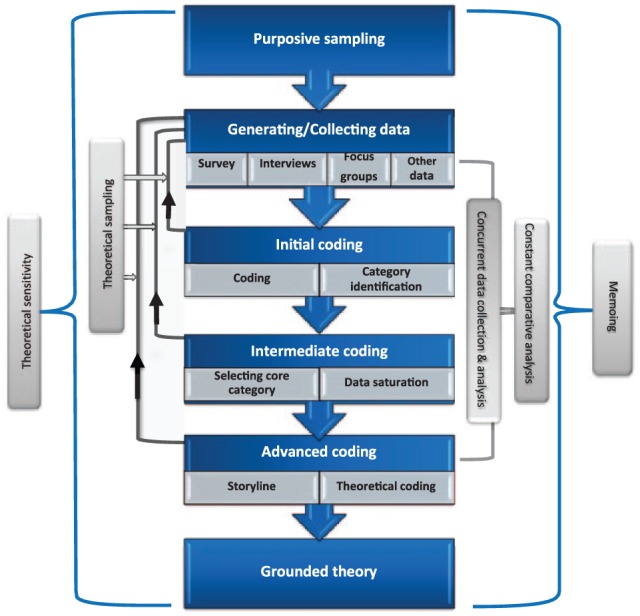
Background: Grounded theory is a well-known methodology employed in many research studies. Qualitative and quantitative data generation techniques can be used in a grounded theory study. Grounded theory sets out to discover or construct theory from data, systematically obtained and analysed using comparative analysis. While grounded theory is inherently flexible, it is a complex methodology. Thus, novice researchers strive to understand the discourse and the practical application of grounded theory concepts and processes. Objective: The aim of this article is to provide a contemporary research framework suitable to inform a grounded theory study. Result: This article provides an overview of grounded theory illustrated through a graphic representation of the processes and methods employed in conducting research using this methodology. The framework is presented as a diagrammatic representation of a research design and acts as a visual guide for the novice grounded theory researcher. Discussion: As grounded theory is not a linear process, the framework illustrates the interplay between the essential grounded theory methods and iterative and comparative actions involved. Each of the essential methods and processes that underpin grounded theory are defined in this article. Conclusion: Rather than an engagement in philosophical discussion or a debate of the different genres that can be used in grounded theory, this article illustrates how a framework for a research study design can be used to guide and inform the novice nurse researcher undertaking a study using grounded theory. Research findings and recommendations can contribute to policy or knowledge development, service provision and can reform thinking to initiate change in the substantive area of inquiry.
Overview
CoChat Summary
TL;DR
This article presents a contemporary, diagrammatic research design framework to help novice researchers visualise and apply the iterative methods and processes of grounded theory (GT). It defines the essential GT methods and processes and situates them within a non-linear, recursive design rather than debating philosophical genres.
Key findings
- GT is described as a structured yet flexible methodology appropriate when little is known about a phenomenon, aiming to produce or construct an explanatory theory grounded in data.
- Three distinct GT genres are identified: traditional/classic GT (Glaser), evolved GT (Strauss, Corbin and Clarke), and constructivist GT (Charmaz), distinguished by the researcher's philosophical position, use of literature, and approach to coding, analysis and theory development.
- Coding terminology differs by genre: traditional uses open, selective and theoretical coding; evolved uses open, axial and selective coding; constructivist uses initial, focused and theoretical coding (Table 1, adapted from Birks and Mills).
- The framework (Figure 1) depicts the interplay of purposive sampling, concurrent data generation/collection and analysis, constant comparative analysis, memoing, coding (initial, intermediate, advanced), theoretical sampling, theoretical sensitivity, and theoretical saturation, all directed toward an integrated substantive theory.
- Quality and rigour are related to three areas: the researcher's expertise, knowledge and research skills; methodological congruence with the research question; and procedural precision in the use of methods.
Methods
This is a methodological/discussion article, not an empirical study; no sample or dataset is analysed. It synthesises GT literature and prior works (notably Birks and Mills) to construct a graphic research design framework (Figure 1) and to define each essential GT method and process. The framework is presented as a visual guide for novice grounded theory researchers, illustrated with exemplars from other GT studies (Boxes 1–3).
Limitations
The paper states no formal limitations. Evident from the text: it deliberately avoids engagement in philosophical discussion or debate of the different GT genres, so it does not adjudicate between them; the framework is offered as a visual guide rather than an empirically tested model; and it is oriented specifically toward the novice nurse researcher, which may limit transferability to other disciplines or experienced researchers.
Model-written summary. Check it against the paper before relying on it.
Integrity signals
Registry
Cites
Statistics
Figures
Verification
Claims the paper makes
1 Valid · 4 Not valid · 49 Not checked · 18 Own results and interpretations
A statement the paper makes itself — it cites no source for it, so there is none to check. The quote shows it is in the paper.
In the paper
“As presented in Figure 1, initial purposive sampling directs the collection and/or generation of data.”
§ Grounded theory research: A design framework for novice researchers > Discussion > Purposive sampling
plainstates a cause- Asserted: passes — The authors put it forward as true.
- Checkable: passes — It can be checked against evidence.
- Load-bearing: passes — The paper’s conclusions depend on it.
- Based: passes — The paper gives a reason why it holds.
In the paper
“Constant comparative analysis generates increasingly more abstract concepts and theories through inductive processes.16”
§ Grounded theory research: A design framework for novice researchers > Discussion > Constant comparative analysis
What the sources say
- Not matchedcites [16] Charmaz K. Constructing grounded theory: a practical guide through qualitative analysis. Thousand Oaks, CA: SAGE, 2006.
Its entry has no title and year that we can search by.
plainstates a cause- Asserted: passes — The authors put it forward as true.
- Checkable: passes — It can be checked against evidence.
- Load-bearing: unclear — It is unclear whether the paper’s conclusions depend on it.
- Based: passes — The paper gives a reason why it holds.
- Not matched
In the paper
“Several analytic tools and techniques can be used to enhance theoretical sensitivity and increase the grounded theorist’s sensitivity to theoretical constructs in the data.28”
§ Grounded theory research: A design framework for novice researchers > Discussion > Theoretical sensitivity
What the sources say
- Not checked — no full text of the sourcecites [28] Corbin JM Strauss AL. Basics of qualitative research: techniques and procedures for developing grounded theory. 3rd ed. Thousand Oaks, CA: SAGE, 2008. source
plainstates a cause- Asserted: passes — The authors put it forward as true.
- Checkable: passes — It can be checked against evidence.
- Load-bearing: unclear — It is unclear whether the paper’s conclusions depend on it.
- Based: passes — The paper gives a reason why it holds.
In the paper
“Advanced coding that integrates extant theory adds further explanatory power to the findings.6”
§ Grounded theory research: A design framework for novice researchers > Discussion > Advanced coding
What the sources say
- Not matchedcites [6] Birks M Mills J. Grounded theory: a practical guide. 2nd ed. London: SAGE, 2015.
Its entry has no title and year that we can search by.
plainstates a cause- Asserted: passes — The authors put it forward as true.
- Checkable: passes — It can be checked against evidence.
- Load-bearing: unclear — It is unclear whether the paper’s conclusions depend on it.
- Based: passes — The paper gives a reason why it holds.
- Not matched
In the paper
“While interviews are a common method of generating data, data sources can include focus groups, questionnaires, surveys, transcripts, letters, government reports, documents, grey literature, music, artefacts, videos, blogs and memos.9”
§ Grounded theory research: A design framework for novice researchers > Discussion > Generating/collecting data
What the sources say
- Not checked — no full text of the sourcecites [9] Mills J Birks M Hoare KJ. Grounded theory. In: Mills J Birks M (eds) Qualitative methodology: a practical guide. London: SAGE, 2014, pp. 107– 121. source
plain- Asserted: passes — The authors put it forward as true.
- Checkable: passes — It can be checked against evidence.
- Load-bearing: unclear — It is unclear whether the paper’s conclusions depend on it.
- Based: passes — The paper gives a reason why it holds.
5 more claims
Create a free account to see all 72 claims and every source verdict.
- Probably not a substantial claim. 58
- It may state two separate claims as one. 17
Claims other papers make about this one
Each is checked against this paper’s own text: does it say what the citing paper says it does?
The cited source says what the claim attributes to it.
In the citing paper
“The epistemological and ontological differences principally address the proposition that theory is either discovered or co-constructed (Bryant, 2017), leading to opposing views on how the steps in the Grounded Theory method are understood (Bøttcher Berthelsen, 2018; Chun Tie, Birks and Francis, 2019; Tarozzi, 2020).”
From Application and challenges of using a Constructivist Grounded Theory methodology to address an undertheorized clinical challenge: A discussion paper (2024) · cites this paper as Chun Tie, Birks and Francis, 2019
The cited source says what the claim attributes to it.
In the citing paper
“Though the comparison of data, researchers emphasize consistencies, comprehend differences, and refine interviews, consistently comparing specific data points with others to establish categories (Bryant, 2017; Charmaz, 2014; Chun Tie et al., 2019).”
From Application and challenges of using a Constructivist Grounded Theory methodology to address an undertheorized clinical challenge: A discussion paper (2024) · cites this paper as Chun Tie et al., 2019
The cited source says what the claim attributes to it.
In the citing paper
“Nevertheless, this initial stage aims to deconstruct / fracture the data, allowing details to emerge (Bryant and Charmaz, 2019) to create the opportunity to identify both similarities and differences, pose analytical inquiries (Charmaz and Thornberg, 2021), and thereby establish to attain a more profound level of meaning (Chun Tie et al., 2019).”
From Application and challenges of using a Constructivist Grounded Theory methodology to address an undertheorized clinical challenge: A discussion paper (2024) · cites this paper as Chun Tie et al., 2019
Citations
Cites
The Discovery of Grounded Theory: Strategies for Qualitative Research.
Wagner, H. R., Glaser, B. G., & Strauss, A. L. (1968) · Social Forces · doi:10.2307/2575405 · Cited by 46,361
The Discovery of Grounded Theory; Strategies for Qualitative Research
Glaser, B. G., Strauss, A. L., & Strutzel, E. (1968) · Nursing Research · doi:10.1097/00006199-196807000-00014 · Cited by 39,449
(1998) · Sage eBooks · Cited by 38,631
Basics of Qualitative Research (3rd ed.): Techniques and Procedures for Developing Grounded Theory
Corbin, J., & Strauss, A. (2008) · SAGE · doi:10.4135/9781452230153 · Cited by 24,827
Basics of Qualitative Research: Grounded Theory Procedures and Techniques
Long, D. R., Strauss, A., & Corbin, J. (1993) · The Modern Language Journal · doi:10.2307/328955 · Cited by 17,576
Research Design: Qualitative, Quantitative, and Mixed Methods Approaches
Sloane-Seale, A. (2009) · Canadian Journal of University Continuing Education · doi:10.21225/d54s3d · Cited by 14,328
The Coding Manual for Qualitative Researchers
Lungu, M. (2022) · American Journal of Qualitative Research · doi:10.29333/ajqr/12085 · Cited by 10,826
Constructing grounded theory. A practical guide through qualitative analysis
Brink, E., Dellve, L., Hallberg, U., Abrahamsson, K. H., Klingberg, G., & Wentz, K. (2006) · International Journal of Qualitative Studies on Health and Well-being · doi:10.3402/qhw.v1i3.4932 · Cited by 6,862
(1978) · Medical Entomology and Zoology · Cited by 6,077
The Sage Handbook of Qualitative Research[1]
(2006) · Qualitative Research in Organizations and Management: An International Journal · doi:10.1108/17465640610666642 · Cited by 5,842
Research works printed but not linked: 13
- Crotty M. The foundation of social research: meaning and perspective in the research process. Thousand Oaks, CA: SAGE, 1998.
- Charmaz K. The power and potential of grounded theory. Med Sociol 2012; 6: 2– 15.
- Glaser BG. Basics of grounded theory analysis. Mill Valley, CA: Sociology Press, 1992.
- Ralph N Birks M Chapman Y. The methodological dynamism of grounded theory. Int J Qual Methods 2015; 14: 1–6.
- Bryant A Charmaz K. The Sage handbook of grounded theory. Thousand Oaks, CA: SAGE, 2007. · DOI · Paper page
- Charmaz K Bryant A. Grounded theory and credibility. In: Silverman D (ed.) Qualitative research. 3rd ed. London: SAGE, 2011, pp. 291– 309.
- Glaser BG Holton J. Remodeling grounded theory. Forum Qualitative Sozialforschung/Forum: Qualitative Social Research 2004; 5: 1– 22.
- Mackenzie N Knipe S. Research dilemmas: paradigms, methods and methodology. Issues Educ Res 2006; 16: 193– 205.
- Chamberlain-Salaun J. Consumers and the social world of health care: outsiders in the expert’s world: a grounded theory study. PhD Thesis, College of Health Care Sciences, James Cook University, Townsville, QLD, Australia, 2015, p. 198.
- Moghaddam A. Coding issues in grounded theory. Issues Educ Res 2006; 16: 53– 61.
- Evans LE. A novice researcher’s first walk through the maze of grounded theory: rationalization for classical grounded theory. Ground Theory Rev 2013; 14: 37–55.
- Glaser BG. The grounded theory perspective III: theoretical coding. Mill Valley, CA: Sociology Press, 2005.
- Baldwin A. Reconciling professional identity: a grounded theory study of nurse academics’ role modelling. PhD Thesis, College of Healthcare Sciences, James Cook University, Townsville, QLD, Australia, 2016, p. 246.
Cited by
Items 801–900 of 1,857
Data-driven Bayesian networks for risk scenario mapping of Falls from height accidents
Li, J., & Wang, T. (2025) · PLoS ONE · doi:10.1371/journal.pone.0334611 · Cited by 7
Rong, T., Ristevski, E., & Carroll, M. T. C. (2025) · Social Science & Medicine · doi:10.1016/j.socscimed.2025.118703 · Cited by 5
Gezinski, L. B., Richer, A., Dilanchian, A., Preble, K. M., Anasti, T., Dell, N. A., & Price, C. (2025) · Behavioral Medicine · doi:10.1080/08964289.2025.2590433 · Cited by 4
Research on influencing factors and correlation pathways of rural teachers’ retention in China
Chen, F., Li, Y.-J., & Tie-fang, L. (2026) · Frontiers in Psychology · doi:10.3389/fpsyg.2025.1728628 · Cited by 5
Gezinski, L. B., Richer, A., Dilanchian, A., Siantz, E., Dell, N. A., Anasti, T., Preble, K. M., & Price, C. (2026) · Journal of Substance Use and Addiction Treatment · doi:10.1016/j.josat.2026.209925 · Cited by 3
Saleha, N., Andreswari, D., Aprilatutini, T., Nurlaili, N., & Komala, E. P. E. (2023) · Iranian Journal of Nursing and Midwifery Research · doi:10.4103/ijnmr.ijnmr_390_21 · Cited by 4
“This research used a qualitative grounded theory method (Glaser and Strauss, 1967).[10] This research was conducted from July to December 2021 in Bengkulu City.”
MethodOncescu, J., Fortune, M., Fisher, L., Sweatman, M., & Frigault, J. S. (2023) · Annals of Leisure Research · doi:10.1080/11745398.2023.2250477 · Cited by 4
“Specifically, we used the constant comparative analysis method, borrowed from grounded theory, as it was flexible in nature and was designed to support novice researchers (Chun Tie, Birks, and Francis 2019).”
InfluentialVincenti, V. B., & Maurya, R. K. (2023) · Victims & Offenders · doi:10.1080/15564886.2023.2265348 · Cited by 3
“Although using a theoretical framework is considered deductive reasoning, all grounded theory investigations, including traditional and CGT, involve both inductive and deductive reasoning (Chun Tie et al., 2019).”
Lloyd-Sherlock, P. G., de Carvalho, P. F., Giacomin, K. C., & Sempé, L. (2023) · The Lancet Regional Health - Americas · doi:10.1016/j.lana.2023.100619 · Cited by 10
An Evaluation of a Tailored Peer Mediation Program for Incarcerated Women in Italy
Coppola, I., & Rania, N. (2023) · Crime & Delinquency · doi:10.1177/00111287231207837 · Cited by 3
“…writings produced by the participants in the focus groups and the reflective diaries were analyzed from the perspective of Charmaz’s (2014) constructivist grounded theory, which is based on Glaser and Strauss’s (1956) grounded theory and has been extended by other authors (Chun Tie et al., 2019).”
Factors influencing caregiver buy-in to early intervention physical therapy
Fergus, A., Wyker, C., Heyl, N., Lewis, T., & Hartsook, K. (2024) · Journal of Pediatric Rehabilitation Medicine · doi:10.3233/prm-230025 · Cited by 6
“Consistent with the constructivist grounded theory approach, this iterative comparative analysis was utilized to enhance theoretical sensitivity [30, 31].”
MethodWork in Progress: Undergraduate Student Perceptions of Macroethical Issues in Aerospace Engineering
Strehl, E. A., Ennis, M., Johnson, A. W., & Bowen, C. L. (2024) · ASEE Annual Conference & Exposition · doi:10.18260/1-2--44383 · Cited by 3
Ruby, E., McDonald, S. D., Berger, H. M., Melamed, N., Li, J., Darling, E., Geary, M. P., Barrett, J. F. R., & Murray‐Davis, B. (2024) · Health Education & Behavior · doi:10.1177/10901981241232651 · Cited by 5
“In keeping with grounded theory, data analysis began at the same time as data collection, to make use of the iterative process of constant comparison and adaptation to the participant’s responses (Chun Tie et al., 2019; Corbin & Strauss, 1990).”
MethodNaik, N. S. (2024) · SAGE Open · doi:10.1177/21582440241242204 · Cited by 5
Codevelopment of a model of care for adults living with cystic fibrosis‐related diabetes
Kumar, S., Pallin, M., & Soldatos, G. (2024) · Pediatric Pulmonology · doi:10.1002/ppul.27047 · Cited by 3
“20 Using an inductive approach informed by grounded theory methodology, 21 problem areas were identified.”
Cuykx, I., Lochs, C., Royen, K. V., Vandebosch, H., den Bulck, H. V., Pabian, S., & Backer, C. J. S. D. (2024) · British Food Journal · doi:10.1108/bfj-05-2023-0382 · Cited by 16
Variability in complex product/system design: case study in automotive industry
Lameh, J., Dubray, A., & Janković, M. (2024) · Proceedings of the Design Society · doi:10.1017/pds.2024.266 · Cited by 5
“Result analysis has been done using the grounded theory (Chun Tie et al., 2019) and is consequently organised by different themes (challenges that have been identified by interviews but also cross referenced with the literature review pertaining to these issues).”
MethodWork–Life Balance of Faculty in Professional Physical Therapist Education: A Mixed-Methods Study
Andrea, C. M., Flores, M., & Wilford, K. F. (2024) · Journal of Physical Therapy Education · doi:10.1097/jte.0000000000000346 · Cited by 5
“19,20 Analysis included an iterative process of independent open coding and paired collaboration until preliminary themes emerged.”
Barriers Experienced by First Nations Deaf People in the Justice System
Elder, B. C., Soldatić, K., Schwartz, M. A., Barney, J., Howard, D., & McGee, P. (2024) · The Journal of Deaf Studies and Deaf Education · doi:10.1093/jdsade/enae021 · Cited by 12
Beyond Gates and Metal Detectors
Watchers, S., Fowler, B., & Smith, J. D. (2024) · Sports Innovation Journal · doi:10.18060/26908 · Cited by 3
“The grounded theory permits the theory to arise from the data before data gathering (Tie et al., 2019).”
BackgroundMui, B., Lawless, M., Timmer, B. H. B., Gopinath, B., Tang, D., Venning, A., May, D., Muzaffar, J., Bidargaddi, N. P., & Shekhawat, G. S. (2024) · Speech Language and Hearing · doi:10.1080/2050571x.2024.2372171 · Cited by 3
“Grounded theory was utilized in this study to derive theories from systematic analysis of the data in an inductive approach (Chun Tie, Birks, & Francis, 2019).”
Harder, M. B.-D., Harinck, F., van der Doef, M., van der Toorn, J., & Gebhardt, W. A. (2024) · Business Ethics and Leadership · doi:10.61093/bel.8(2).1-19.2024 · Cited by 5
Denissen, J. J. P. M., van der Geest, I. C. M., van Hinte, G., Desar, I. M. E., van der Wees, P. J., & Koenders, N. (2024) · Disability and Rehabilitation · doi:10.1080/09638288.2024.2393440 · Cited by 4
“This approach co-constructs meaning with participants [17], which does not require the researcher to be distant, and allows to construct, rather than discover [18].”
Altman-Merino, A., Bonnet, K. R., Schlundt, D. G., Wrenn, J. O., Self, W. H., Gordon, E. J., & Hawkins, A. T. (2024) · Annals of Surgery Open · doi:10.1097/as9.0000000000000476 · Cited by 5
Ireland, J. F., Palmer, M., Ofterdinger, U., & Comte, J. (2024) · Renewable and Sustainable Energy Reviews · doi:10.1016/j.rser.2024.114909 · Cited by 6
From the Screen to the Streets: Technology-Facilitated Violence Against Public Health Professionals
Regehr, K., Regehr, C., Goel, V., Sato, C., Lyons, K. A., & Rudzicz, F. (2024) · Journal of Loss and Trauma · doi:10.1080/15325024.2024.2406509 · Cited by 3
“CGT asserts that data and meaning, rather than emerging as an objective truth, are co-constructed through the relationship between the researchers and the participants (Birks & Mills, 2015; Charmaz, 2017; Chun Tie et al., 2019).”
InfluentialKurz, A. F., Kampik, T., Pufahl, L., & Weber, I. M. (2024) · Software & Systems Modeling · doi:10.1007/s10270-024-01229-2 · Cited by 5
“Analysis Based on the data from both cohorts, we condensed the knowledge along relevant axes (see Sect.4), in the GT stage of intermediate coding [8].”
InfluentialElliott, A., Bauer, J. D., McDonald, C. E., & Gibson, S. (2024) · International Journal of Obesity · doi:10.1038/s41366-024-01697-y · Cited by 4
“Constructivist grounded theory is underpinned by a paradigm of constructivism where the researcher co-constructs theory through their interactions with participants and data [29, 30, 34].”
InfluentialPerepelkin, J. P., Hantjidis, P., Robison, K., & Halpape, K. (2025) · Journal of Affective Disorders Reports · doi:10.1016/j.jadr.2025.100886 · Cited by 6
Owuor, P. M., Obondo, D., Nyagol, H., Orero, W. O., Owuor, J., Odhiambo, S. A., Boateng, G. O., & Onyango, E. O. (2025) · Global Public Health · doi:10.1080/17441692.2025.2489717 · Cited by 4
“Analysis : We used the thematic analysis guided by the theoretical framework and grounded theory to identify patterns and emerging themes (Chun Tie et al., 2019).”
Mendiolaza, M., Vicioso, C., Siddiqui, W., Lingineni, K., Gorbenko, K. O., Agarwal, P., & Keefer, L. (2025) · BMC Gastroenterology · doi:10.1186/s12876-025-03971-3 · Cited by 3
“The thematic analysis methodology integrated aspects of the Grounded Theory [20] incorporating open coding to generate conceptual codes, followed by axial and selective coding.”
Semaska, N., Nolan, R. D., & Shah, S. (2025) · American Journal of Kidney Diseases · doi:10.1053/j.ajkd.2025.07.007 · Cited by 4
Sonification of an exoplanetary atmosphere
Quinton, M., Mcgregor, I. P., & Benyon, D. (2020) · Audio Mostly Conference (AM) · doi:10.1145/3411109.3411117 · Cited by 7
“To overcome such restrictions techniques like Grounded theory, use the data as the foundation to build the required thesis [17] which is a suitable method to design a Task-based sonification.”
MethodMethods in Practice: Grounded Theory in Media Arts Education Research
Kristjansson-Nelson, K. (2020) · The Interactive Journal of Global Leadership and Learning · doi:10.55354/2692-3394.1002 · Cited by 3
Ojwang, F. (2020) · Sociology Study · doi:10.17265/2159-5526/2020.06.002 · Cited by 8
Tezak, A. L., Weidner, A. E., Clouse, K., Pal, T., & Cragun, D. L. (2021) · Human Organization · doi:10.17730/1938-3525-80.3.203 · Cited by 3
Factors Influencing Faculty Publication Performance: A Grounded Theory Analysis
(2021) · British Journal of Arts and Humanities · doi:10.34104/bjah.02101710176 · Cited by 3
‘Comfortably Numb’: Explorations of Embodiment and Recovery in an Ethnography of Operating Theatres
Ewart, L., & Blackman, S. (2022) · Rehabilitation in Practice · doi:10.1007/978-981-16-8317-6_14 · Cited by 2
Rönnberg, L., Melin‐Johansson, C., Hellzèn, O., Nilsson, U. G., & Häggström, M. (2022) · BMC Nursing · doi:10.1186/s12912-022-00817-1 · Cited by 6
“The questions were designed to seek additional information to reach saturation in the development of categories, provide insight in what might be missing, and to highlight gaps in the data to further develop the analysis and creation of categories and main concerns [19].”
BackgroundQi, G. Y., & Wang, Y. (2022) · The JALT CALL Journal · doi:10.29140/jaltcall.v18n1.569 · Cited by 7
“The second round of coding involved constant comparisons of these key concepts and re-grouping and linking them to larger themes (Tie et al. , 2019), resulting in inter-rater reliability kappa of 0.90.”
BackgroundInfluentialTemezhnikova, O. (2022) · The Qualitative Report · doi:10.46743/2160-3715/2022.5128 · Cited by 3
“The next level of analysis is focused coding; I looked at the original categories extracted from the five improvisational fragments and grouped them into 13 categories based on their similarity, as described by Charmaz (2014), Chun-Tie et al. (2019), and Kalpokaite and Radivojevic (2019).”
Eve, Z., & Parry, S. L. (2022) · SAGE Publications Ltd eBooks · doi:10.4135/9781529798357 · Cited by 3
“This is particularly true when conducting research with traditionally underresearched or “hard-to-reach” groups (Chun Tie et al., 2019).”
BackgroundDavis, A. E., Vivrette, R. L., Carter, T., Eberhardt, C., Edwards, S., Connors, K., & Reavis, K. (2022) · Clinical Practice in Pediatric Psychology · doi:10.1037/cpp0000393 · Cited by 4
“Using a constant comparative method, themes and codes evolved and were re fi ned based on input from ongoing data collection (Chun Tie et al., 2019).”
Chen, C., Chitose, A., Kusadokoro, M., Bao, L., & Nie, H. (2022) · Frontiers in Sustainable Food Systems · doi:10.3389/fsufs.2022.769649 · Cited by 4
“During the data analysis, interpretation, and theory development, we followed the principles of grounded theory to analyze the judgments using four steps: open coding, axial coding, selective coding, and saturation testing (Chen et al., 2018; Tie et al., 2019;Wang et al., 2020); (Figure 3).”
MethodImplementation of a Novel Pediatric Behavioral Health Integration Initiative
Safon, C. B., Estela, M. G., Rosenberg, J., Feinberg, E., Drainoni, M., Morris, A., Durham, M. P., Bair‐Merritt, M. H., & Sheldrick, R. C. (2022) · The Journal of Behavioral Health Services & Research · doi:10.1007/s11414-022-09803-6 · Cited by 3
Ray, S. E., Boudewyns, V., Davis, C. N., Tzeng, J., Srivastava, I., Oguntimein, O., Conti, D. S., & Feibus, K. B. (2022) · International Journal of COPD · doi:10.2147/copd.s362696 · Cited by 4
Burman, C., Diaz, A. M., Leslie, A., et al. (2022) · Health Promotion Journal of Australia · doi:10.1002/hpja.690 · Cited by 3
Effective DevSecOps Implementation: A Systematic Literature Review
Anjaria, D., & Kulkarni, M. S. (2022) · Cardiometry · doi:10.18137/cardiometry.2022.24.410417 · Cited by 9
Saliya, C. A. (2022) · Springer eBooks · doi:10.1007/978-981-19-3780-4_20 · Cited by 5
A Critical Analysis on the Transfer of Learning Technologies in Higher Education Curriculum Design
Howah, K., & Gide, E. (2022) · International Conference on Information Technology Based Higher Education and Training (ITHET) · doi:10.1109/ithet56107.2022.10031884 · Cited by 4
“One study used a grounded research methodology with data collected in the form of detailed coded observations typical of that methodology [31, 32].”
MethodOktaria, K., Agustina, R., Aliyah, J., et al. (2022) · Jurnal Pendidikan Sains dan Komputer · doi:10.47709/jpsk.v3i01.1957 · Cited by 3
Mbonane, T. P., Mathee, A., Swart, A., & Naicker, N. (2022) · doi:10.3390/iech2022-12466 · Cited by 3
Samari, D., Martini, H. A., Leihy, D. P., & Groot, S. (2023) · International Journal on Homelessness · doi:10.5206/ijoh.2022.2.13552 · Cited by 7
What does it take to make a wrong decision? A qualitative study from Pakistan’s health sector
Khan, M. S., & Shaikh, B. T. (2023) · Dialogues in Health · doi:10.1016/j.dialog.2023.100127 · Cited by 3
The theory of technological response and progress in chaos
Ozcan, S., & Sarıtas, O. (2023) · foresight · doi:10.1108/fs-11-2022-0138 · Cited by 3
Orighoye, O., Apekey, T. A., & Maynard, M. J. (2023) · Sustainability · doi:10.3390/su15107850 · Cited by 7
Using Plan, Do, Study, Act Cycles to Improve a Maternal Self-Care Intervention With Audience Input
Hobbs, S., Bellows, L. L., Coatsworth, J. D., & Johnson, S. L. (2023) · Health Promotion Practice · doi:10.1177/15248399231177305 · Cited by 4
“A constant comparative process (Chun Tie et al., 2019) was used to assess summaries, and intercoder reliability was determined via verbal consensus among the coders.”
“There must be something good”: Fair balance and ad appeal of marijuana brands’ website
Rhee, S., & Jung, W. S. (2023) · International Journal of Drug Policy · doi:10.1016/j.drugpo.2023.104116 · Cited by 5
Considerations for a Planned Democratizing Data Framework for Valid and Trusted Data
Takang, T. M., & Amaechi, A. O. (2023) · Journal of Data Analysis and Information Processing · doi:10.4236/jdaip.2023.113013 · Cited by 5
Ramírez-Pereira, M., Figueredo-Borda, N., Opazo-Morales, E., et al. (2023) · Enfermería Cuidados Humanizados · doi:10.22235/ech.v12i2.3108 · Cited by 3
Klopstock, T., Mercimek‐Andrews, S., Jurecka, A., et al. (2023) · Orphanet Journal of Rare Diseases · doi:10.1186/s13023-023-02869-1 · Cited by 3
“For open-field questions, grounded theory analyses were performed [12] using both initial and focused coding approaches.”
MethodJaiswal, J., Griffin, M., LoSchiavo, C. E., et al. (2023) · Substance Use & Misuse · doi:10.1080/10826084.2023.2257308 · Cited by 3
Social Workers, Regulation, and Social Justice: Tensions in Canadian Social Work
Rice, I. G. (2023) · International Journal of Social Work Values and Ethics · doi:10.55521/10-020-208 · Cited by 3
Causes and Consequences of Iranian Elite Athletes’ International Migrations
Salimi, M., Khodaparast, M., & Nikou, P. S. (2023) · Physical Culture and Sport Studies and Research · doi:10.2478/pcssr-2024-0004 · Cited by 5
Fu, H., Ma, M., & Zhu, X. (2023) · Problems and Perspectives in Management · doi:10.21511/ppm.21(4).2023.33 · Cited by 3
“Theme coding is one of the main methods of ab-stracting concepts from text and a common guide to grounder theory (Chun Tie et al., 2019).”
MethodZabeen, S., Eades, A., Paolucci, O., Modderman, R. S., Tonkin, C., Dole, K., Lowah, G., Annesley, K., Kent, J., Coccetti, E., et al. (2023) · First Nations Health and Wellbeing - The Lowitja Journal · doi:10.1016/j.fnhli.2023.100001 · Cited by 4
COVID-19 and Psychological Distress in Africa: Communitarian Perspectives
Ndasauka, Y. (2023) · Routledge eBooks · doi:10.4324/9781003425861 · Cited by 5
Performance management process changes on the work identity of employees during COVID-19
Clayton, K., & Braine, R. T. D. (2023) · SA Journal of Industrial Psychology · doi:10.4102/sajip.v49i0.2090 · Cited by 5
Bradley, S. (2023) · Journal of Cultural Geography · doi:10.1080/08873631.2023.2295583 · Cited by 7
“Interview responses were coded using a grounded theory methodology, which requires that theory be developed inductively from collected data (Chun Tie, Birks, and Francis 2019).”
MethodMorankar, S., Abraham, G., Shroff, Z. C., et al. (2024) · Health Research Policy and Systems · doi:10.1186/s12961-023-01091-6 · Cited by 3
Huffer, D. (2024) · Journal of Computer Applications in Archaeology · doi:10.5334/jcaa.137 · Cited by 3
DiClemente-Bosco, K., Binyungu, A., Shabani, C., Pellowski, J. A., Operario, D., Nugent, N. R., & Harrison, A. D. (2024) · Global Public Health · doi:10.1080/17441692.2024.2314106 · Cited by 9
“In line with the study’s CBPR approach, data analysis used a modified-grounded theory approach to create an inductive, broad representation of African refugee women’s mental health as experienced by this community (Chun Tie et al., 2019; Strauss & Corbin, 1997).”
InfluentialPostill, G., Halpin, M., Zanin, C., & Ritter, C. (2024) · BMJ Open · doi:10.1136/bmjopen-2023-075567 · Cited by 3
“Hands off”: responsibilizing low-income citizens through fee assistance programs
Fortune, M., & Oncescu, J. (2024) · Managing Sport and Leisure · doi:10.1080/23750472.2024.2332673 · Cited by 3
“This process included “reviewing categories and identifying which ones can be sub-sumed beneath other categories and then properties or dimensions of the developed categories are refined” (Chun Tie et al., 2019, p. 5).”
Sheedy, A. D. (2024) · Australian journal of advanced nursing · doi:10.37464/2024.411.1065 · Cited by 3
Exploring the barriers to innovation adoption in the UK construction industry
White, K.-M., & Clarkson, P. J. (2024) · Proceedings of the Design Society · doi:10.1017/pds.2024.250 · Cited by 7
“Given the exploratory nature of the study, grounded theory was chosen for the coding rationale as it allows for the data to generate theory (Chun Tie et al., 2019) and Atlas.ti was used to visualise and store the coded data.”
MethodRania, N., Lacqua, D., & Coppola, I. (2024) · European Journal of Social Work · doi:10.1080/13691457.2024.2350468 · Cited by 3
“In constructing codes, categories, and macro categories, the researchers employed an analytical approach, identifying recurring concepts and similarities among the data to define codes and categories (Chun Tie et al., 2019).”
Leek, A. E., Keren, N., Blumenthal, D. J., Irwin, W., & Musolino, S. V. (2024) · Health Physics · doi:10.1097/hp.0000000000001809 · Cited by 4
“Moreover, as the aspects of these elements evolve, they, in turn, guide the ongoing data collection process (Chun Tie et al. 2019).”
BackgroundThe Challenges Experienced by ICU Nurses in Kuwait during the COVID-19 Pandemic
Haddad, A. A., Arber, A., Cox, A., & Gallagher, A. M. (2024) · International Journal of Nursing Studies Advances · doi:10.1016/j.ijnsa.2024.100226 · Cited by 3
Ihesie, A., Chukwuogo, O., Eneogu, R. A., et al. (2024) · Tropical Medicine and Infectious Disease · doi:10.3390/tropicalmed9120301 · Cited by 3
“…during the qualitative analysis because it enabled the formulation of a new, process-oriented theory that takes into account the actual experiences of both HCWs and TB contacts as well as enhanced development of practical ideas for enhancing TPT uptake and completion in healthcare settings [14].”
Sithaldeen, R. (2024) · Journal of Student Affairs in Africa · doi:10.24085/jsaa.v12i2.5452 · Cited by 4
“Chun Tie et al. (2019) provide a comprehensive, practical framework for novice researchers so that they can conduct grounded theory research.”
InfluentialKramer, J. M., Beasley, J. B., Caoili, A., Kalb, L. G., Goode, T. D., & Urquilla, M. P. (2025) · Journal of Mental Health Research in Intellectual Disabilities · doi:10.1080/19315864.2025.2459413 · Cited by 3
“Selective coding is the application of abstract and conceptual codes generated from previously identified concepts (i.e., from the memos and framework) that integrate the data back into a cohesive whole (Chun Tie et al., 2019).”
Chełstowska, A., Osypchuk, O., & Sosik, K. (2025) · Sustainability · doi:10.3390/su17062651 · Cited by 3
Leave as Fast as You Can: Using Generative AI to Automate and Accelerate Hospital Discharge Reports
Omeñaca, A. T., Rocabruna, E. L., Sloan, J., Catta-Preta, M. C., Picó, J. F. I., Alvarez, J. C. A., Solis, T. A., Gil, E. L., Vinaixa, X. S., Villegas, D. V., et al. (2025) · Computers · doi:10.3390/computers14060210 · Cited by 6
Iranian model of decision making to use surrogacy: A grounded theory Study
Golboni, F., Jalali, A., Dinmohammadi, M., Taghizadeh, Z., Nouri, P., & Salahsoor, M. R. (2020) · Health Care For Women International · doi:10.1080/07399332.2020.1758107 · Cited by 5
Li, S., Bai, Y., Jiao, J., Degen, A. A., Zhang, T., Wang, W., Ding, L., Long, R., Peng, Z., Dang, Z., et al. (2021) · Food Control · doi:10.1016/j.foodcont.2021.108372 · Cited by 5
Fragoso, O. D., Alcántar, G. M. L. R., & González, G. R. (2021) · Social Sciences · doi:10.3390/socsci10100390 · Cited by 5
“Regarding the stages of CGT, various authors (Charmaz et al. 2017; Chun Tie et al. 2019; O’Connor et al. 2018) agree that, despite the epistemological and ontological differences of the method, these remain essentially constant.”
BackgroundAwuzie, B. O., Mcwari, Z. P., Chigangacha, P. S., Aigbavboa, C. O., Haupt, T. C., & Obi, L. I. (2022) · Journal of Engineering Design and Technology · doi:10.1108/jedt-11-2021-0640 · Cited by 3
Caring for People We Know: An Unrecognized Risk for Burnout?
Morris, S. E., Revette, A. C., Brandoff, D. E., et al. (2022) · Journal of Palliative Medicine · doi:10.1089/jpm.2022.0331 · Cited by 3
‘I left feeling different about myself’: What students learn on their first practice placement
Grant, T., Gossman, P., Thomas, Y., Berragan, E., & Frank, H. (2022) · British Journal of Occupational Therapy · doi:10.1177/03080226221125394 · Cited by 6
Matteson, C. L., Czaja, C. A., Kronman, M. P., Ziniel, S. I., Parker, S. K., & Dodson, D. S. (2022) · Antimicrobial Stewardship & Healthcare Epidemiology · doi:10.1017/ash.2022.24 · Cited by 3
Academic-Practice Collaborations in Automation and Control: Keys for Success
Serbezov, A., Rhinehart, R. R., Goupil, P., & Anisi, D. A. (2022) · IFAC-PapersOnLine · doi:10.1016/j.ifacol.2022.09.297 · Cited by 5
“In general, funding sources differ significantly across countries and continents, due to local rules, policies, and business practices.”
Wilkinson-Stokes, M., Kellermeier, M., & Whitfield, S. (2023) · Paramedicine · doi:10.1177/27536386231178961 · Cited by 4
Exploring Child Welfare Practices to Care for Children with Prenatal Substance Exposure.
Wang, K., Richards, T., Kopiec, K., Newburg-Rinn, S., & Bertrand, J. (2023) · PubMed · Cited by 3
Neiseh, F., Dalvandi, A., Tabrizi, K. N., Shahboulaghi, F. M., Fallahi‐Khoshknab, M., & Shemshadi, H. (2020) · Journal of Evolution of Medical and Dental Sciences · doi:10.14260/jemds/2020/300 · Cited by 5
Colwill, J. P., Sherman, M., Siedlecki, S. L., Burchill, C. N., & Siegmund, L. A. (2020) · Applied Nursing Research · doi:10.1016/j.apnr.2020.151390 · Cited by 3
Filho, S. Á., Ávila, J. S., Mrugalska, B., de Souza, N. F., de Carvalho, A. P. M. G., & Gonçalves, L. R. (2021) · International Journal of Environmental Research and Public Health · doi:10.3390/ijerph18158078 · Cited by 3
“, when new information was not added to the categories even with further analysis [25].”
BackgroundInfluentialCritical management studies in South Africa: Directions and contexts
Callaghan, C. W., Crous, F., Eccles, N. S., Katumba, J., Roux, I. L., Letsholo, R., Maboke, P., Nukunah, C., Pretorius, M., Rosslyn-Smith, W., et al. (2021) · doi:10.4102/aosis.2021.bk322 · Cited by 4
Barakat, M. M., Thiab, S. H., Thiab, S., et al. (2022) · American Journal of Men s Health · doi:10.1177/15579883221074855 · Cited by 3
“…Jordan; then, these records were translated into English language, checked for clarity and accuracy, uploaded to NVivo12 (qualitative data analysis software; QSR International Pty Ltd. Version 12) for coding, then analyzed thematically using modified grounded theory methods (Chun Tie et al., 2019).”
MethodRobert, Á. O., Larry, T. C., Cabrera, G. C. H., et al. (2022) · Revista Ecuatoriana de Ciencia Tecnología e Innovación en Salud Pública · doi:10.31790/inspilip.v6i1.273 · Cited by 3
Metadata
- Authors
- Chun Tie, Y., Birks, M., & Francis, K.
- Affiliations
- Nursing and Midwifery, College of Healthcare Sciences, James Cook University, Townsville, QLD, Australia
- James Cook University (AU)
- University of Tasmania (AU)
- Venue
- SAGE Open Medicine
- Publisher
- SAGE Publications
- Published
- 2019-01
- Volume
- 7
- Pages
- 2050312118822927-2050312118822927
- ISSN
- 2050-3121 (ISSN-L)
- PMC
- PMC6318722
- OpenAlex
- W2906994370
- Cited by
- 1,869
- References
- 29
- Citations by year
- 2026: 200 · 2025: 285 · 2024: 370 · 2023: 370 · 2022: 302 · 2021: 226 · 2020: 108 · 2019: 8
- FWCI
- 433.86
- Type
- journal article
- Language
- en
- Open access
- gold
- doi.org
- Licence
- cc-by-nc
- journals.sagepub.com/page/policies/text-and-data-mining-license (tdm)
- Locations
- SAGE Open Medicine (publishedVersion, cc-by-nc)
- Europe PMC (PubMed Central) (publishedVersion, cc-by-nc)
- PubMed Central (publishedVersion, cc-by-nc)
- PubMed (publishedVersion)
- UTAS Research Repository (acceptedVersion)
- ResearchOnline at James Cook University (James Cook University) (submittedVersion)
- DOAJ (DOAJ: Directory of Open Access Journals) (submittedVersion, cc-by-sa)
- Figshare (submittedVersion, cc-by-nc)
- Topics
- Social Sciences › Education › Qualitative Research Methods and Applications
- Health Sciences › Nursing › Research and Theory › Methodologies in Health Research and Practice
- Social Sciences › Education › Educational Research and Methods
- Keywords
- grounded theory, research design framework, novice researchers, nurse researchers, qualitative research methodology, comparative analysis
About these checks
Registry, retraction, Cites and statistics results are computed, not judged, with one exception: a printed reference that no index lists is read once by a model before it counts as a citation error. Claims are extracted by a model and kept only when their quote appears verbatim in the text; each cited source is then checked, with a model’s help, for whether it says what the claim relies on. Those verdicts can be wrong — read the claim’s quote and the cited source before relying on one.
The claim verdicts this report counts are experimental: their accuracy is not yet measured.
A language model drew the claims from the paper on 2026-10-10, under version 3 of the claim definition (model deepseek-v4.1-flash, prompt extract-v3).
A second model labelled each claim on 2026-10-10 (model jev-1.13-20260917, definition revision gold-guideline-v0.2).
Statistics and arithmetic are recomputed, not judged.
Confidence bands are shown only for fields calibrated on our annotated test set. None is calibrated yet, so no band is shown.
What counts as a claim ›How we measure confidence ›How we check this ›
Are you an author, or do you see a problem with this page? Request a review
Data sources
Bibliographic data: Semantic Scholar, OpenAlex, Crossref.
Contains information from the Semantic Scholar Academic Graph Datasets, made available under the ODC Attribution License (ODC-BY 1.0).
Semantic Scholar’s data is described in: Kinney, R., et al. (2023). The Semantic Scholar Open Data Platform. arXiv:2301.10140.
