

Grounded theory research: A design framework for novice researchers
Open accessThe DOI matches its Crossref record; 30 of the 33 references it cites were found in a registry or an index; 2 of the 69 sources its claims cite were checked for support.
Abstract
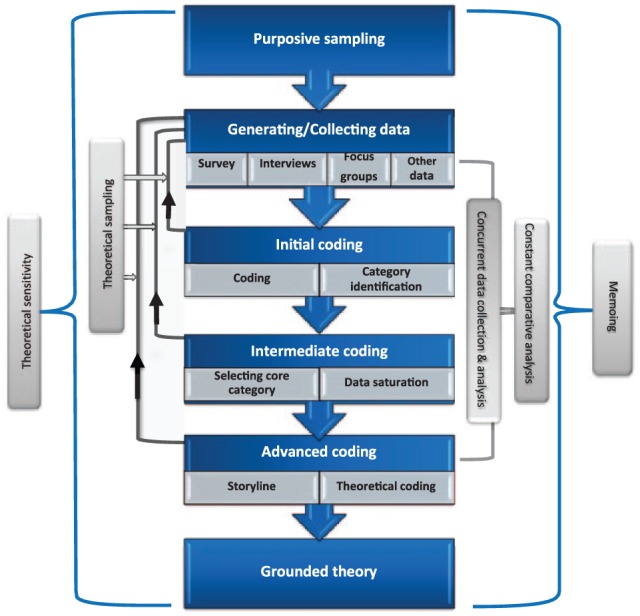
Background: Grounded theory is a well-known methodology employed in many research studies. Qualitative and quantitative data generation techniques can be used in a grounded theory study. Grounded theory sets out to discover or construct theory from data, systematically obtained and analysed using comparative analysis. While grounded theory is inherently flexible, it is a complex methodology. Thus, novice researchers strive to understand the discourse and the practical application of grounded theory concepts and processes. Objective: The aim of this article is to provide a contemporary research framework suitable to inform a grounded theory study. Result: This article provides an overview of grounded theory illustrated through a graphic representation of the processes and methods employed in conducting research using this methodology. The framework is presented as a diagrammatic representation of a research design and acts as a visual guide for the novice grounded theory researcher. Discussion: As grounded theory is not a linear process, the framework illustrates the interplay between the essential grounded theory methods and iterative and comparative actions involved. Each of the essential methods and processes that underpin grounded theory are defined in this article. Conclusion: Rather than an engagement in philosophical discussion or a debate of the different genres that can be used in grounded theory, this article illustrates how a framework for a research study design can be used to guide and inform the novice nurse researcher undertaking a study using grounded theory. Research findings and recommendations can contribute to policy or knowledge development, service provision and can reform thinking to initiate change in the substantive area of inquiry.
Overview
CoChat Summary
TL;DR
This article presents a contemporary, diagrammatic research design framework to help novice researchers visualise and apply the iterative methods and processes of grounded theory (GT). It defines the essential GT methods and processes and situates them within a non-linear, recursive design rather than debating philosophical genres.
Key findings
- GT is described as a structured yet flexible methodology appropriate when little is known about a phenomenon, aiming to produce or construct an explanatory theory grounded in data.
- Three distinct GT genres are identified: traditional/classic GT (Glaser), evolved GT (Strauss, Corbin and Clarke), and constructivist GT (Charmaz), distinguished by the researcher's philosophical position, use of literature, and approach to coding, analysis and theory development.
- Coding terminology differs by genre: traditional uses open, selective and theoretical coding; evolved uses open, axial and selective coding; constructivist uses initial, focused and theoretical coding (Table 1, adapted from Birks and Mills).
- The framework (Figure 1) depicts the interplay of purposive sampling, concurrent data generation/collection and analysis, constant comparative analysis, memoing, coding (initial, intermediate, advanced), theoretical sampling, theoretical sensitivity, and theoretical saturation, all directed toward an integrated substantive theory.
- Quality and rigour are related to three areas: the researcher's expertise, knowledge and research skills; methodological congruence with the research question; and procedural precision in the use of methods.
Methods
This is a methodological/discussion article, not an empirical study; no sample or dataset is analysed. It synthesises GT literature and prior works (notably Birks and Mills) to construct a graphic research design framework (Figure 1) and to define each essential GT method and process. The framework is presented as a visual guide for novice grounded theory researchers, illustrated with exemplars from other GT studies (Boxes 1–3).
Limitations
The paper states no formal limitations. Evident from the text: it deliberately avoids engagement in philosophical discussion or debate of the different GT genres, so it does not adjudicate between them; the framework is offered as a visual guide rather than an empirically tested model; and it is oriented specifically toward the novice nurse researcher, which may limit transferability to other disciplines or experienced researchers.
Model-written summary. Check it against the paper before relying on it.
Integrity signals
Registry
Cites
Statistics
Figures
Verification
Claims the paper makes
1 Valid · 4 Not valid · 49 Not checked · 18 Own results and interpretations
A statement the paper makes itself — it cites no source for it, so there is none to check. The quote shows it is in the paper.
In the paper
“As presented in Figure 1, initial purposive sampling directs the collection and/or generation of data.”
§ Grounded theory research: A design framework for novice researchers > Discussion > Purposive sampling
plainstates a cause- Asserted: passes — The authors put it forward as true.
- Checkable: passes — It can be checked against evidence.
- Load-bearing: passes — The paper’s conclusions depend on it.
- Based: passes — The paper gives a reason why it holds.
In the paper
“Constant comparative analysis generates increasingly more abstract concepts and theories through inductive processes.16”
§ Grounded theory research: A design framework for novice researchers > Discussion > Constant comparative analysis
What the sources say
- Not matchedcites [16] Charmaz K. Constructing grounded theory: a practical guide through qualitative analysis. Thousand Oaks, CA: SAGE, 2006.
Its entry has no title and year that we can search by.
plainstates a cause- Asserted: passes — The authors put it forward as true.
- Checkable: passes — It can be checked against evidence.
- Load-bearing: unclear — It is unclear whether the paper’s conclusions depend on it.
- Based: passes — The paper gives a reason why it holds.
- Not matched
In the paper
“Several analytic tools and techniques can be used to enhance theoretical sensitivity and increase the grounded theorist’s sensitivity to theoretical constructs in the data.28”
§ Grounded theory research: A design framework for novice researchers > Discussion > Theoretical sensitivity
What the sources say
- Not checked — no full text of the sourcecites [28] Corbin JM Strauss AL. Basics of qualitative research: techniques and procedures for developing grounded theory. 3rd ed. Thousand Oaks, CA: SAGE, 2008. source
plainstates a cause- Asserted: passes — The authors put it forward as true.
- Checkable: passes — It can be checked against evidence.
- Load-bearing: unclear — It is unclear whether the paper’s conclusions depend on it.
- Based: passes — The paper gives a reason why it holds.
In the paper
“Advanced coding that integrates extant theory adds further explanatory power to the findings.6”
§ Grounded theory research: A design framework for novice researchers > Discussion > Advanced coding
What the sources say
- Not matchedcites [6] Birks M Mills J. Grounded theory: a practical guide. 2nd ed. London: SAGE, 2015.
Its entry has no title and year that we can search by.
plainstates a cause- Asserted: passes — The authors put it forward as true.
- Checkable: passes — It can be checked against evidence.
- Load-bearing: unclear — It is unclear whether the paper’s conclusions depend on it.
- Based: passes — The paper gives a reason why it holds.
- Not matched
In the paper
“While interviews are a common method of generating data, data sources can include focus groups, questionnaires, surveys, transcripts, letters, government reports, documents, grey literature, music, artefacts, videos, blogs and memos.9”
§ Grounded theory research: A design framework for novice researchers > Discussion > Generating/collecting data
What the sources say
- Not checked — no full text of the sourcecites [9] Mills J Birks M Hoare KJ. Grounded theory. In: Mills J Birks M (eds) Qualitative methodology: a practical guide. London: SAGE, 2014, pp. 107– 121. source
plain- Asserted: passes — The authors put it forward as true.
- Checkable: passes — It can be checked against evidence.
- Load-bearing: unclear — It is unclear whether the paper’s conclusions depend on it.
- Based: passes — The paper gives a reason why it holds.
5 more claims
Create a free account to see all 72 claims and every source verdict.
- Probably not a substantial claim. 58
- It may state two separate claims as one. 17
Claims other papers make about this one
Each is checked against this paper’s own text: does it say what the citing paper says it does?
The cited source says what the claim attributes to it.
In the citing paper
“The epistemological and ontological differences principally address the proposition that theory is either discovered or co-constructed (Bryant, 2017), leading to opposing views on how the steps in the Grounded Theory method are understood (Bøttcher Berthelsen, 2018; Chun Tie, Birks and Francis, 2019; Tarozzi, 2020).”
From Application and challenges of using a Constructivist Grounded Theory methodology to address an undertheorized clinical challenge: A discussion paper (2024) · cites this paper as Chun Tie, Birks and Francis, 2019
The cited source says what the claim attributes to it.
In the citing paper
“Though the comparison of data, researchers emphasize consistencies, comprehend differences, and refine interviews, consistently comparing specific data points with others to establish categories (Bryant, 2017; Charmaz, 2014; Chun Tie et al., 2019).”
From Application and challenges of using a Constructivist Grounded Theory methodology to address an undertheorized clinical challenge: A discussion paper (2024) · cites this paper as Chun Tie et al., 2019
The cited source says what the claim attributes to it.
In the citing paper
“Nevertheless, this initial stage aims to deconstruct / fracture the data, allowing details to emerge (Bryant and Charmaz, 2019) to create the opportunity to identify both similarities and differences, pose analytical inquiries (Charmaz and Thornberg, 2021), and thereby establish to attain a more profound level of meaning (Chun Tie et al., 2019).”
From Application and challenges of using a Constructivist Grounded Theory methodology to address an undertheorized clinical challenge: A discussion paper (2024) · cites this paper as Chun Tie et al., 2019
Citations
Cites
The Discovery of Grounded Theory: Strategies for Qualitative Research.
Wagner, H. R., Glaser, B. G., & Strauss, A. L. (1968) · Social Forces · doi:10.2307/2575405 · Cited by 46,361
The Discovery of Grounded Theory; Strategies for Qualitative Research
Glaser, B. G., Strauss, A. L., & Strutzel, E. (1968) · Nursing Research · doi:10.1097/00006199-196807000-00014 · Cited by 39,449
(1998) · Sage eBooks · Cited by 38,631
Basics of Qualitative Research (3rd ed.): Techniques and Procedures for Developing Grounded Theory
Corbin, J., & Strauss, A. (2008) · SAGE · doi:10.4135/9781452230153 · Cited by 24,827
Basics of Qualitative Research: Grounded Theory Procedures and Techniques
Long, D. R., Strauss, A., & Corbin, J. (1993) · The Modern Language Journal · doi:10.2307/328955 · Cited by 17,576
Research Design: Qualitative, Quantitative, and Mixed Methods Approaches
Sloane-Seale, A. (2009) · Canadian Journal of University Continuing Education · doi:10.21225/d54s3d · Cited by 14,328
The Coding Manual for Qualitative Researchers
Lungu, M. (2022) · American Journal of Qualitative Research · doi:10.29333/ajqr/12085 · Cited by 10,826
Constructing grounded theory. A practical guide through qualitative analysis
Brink, E., Dellve, L., Hallberg, U., Abrahamsson, K. H., Klingberg, G., & Wentz, K. (2006) · International Journal of Qualitative Studies on Health and Well-being · doi:10.3402/qhw.v1i3.4932 · Cited by 6,862
(1978) · Medical Entomology and Zoology · Cited by 6,077
The Sage Handbook of Qualitative Research[1]
(2006) · Qualitative Research in Organizations and Management: An International Journal · doi:10.1108/17465640610666642 · Cited by 5,842
Research works printed but not linked: 13
- Crotty M. The foundation of social research: meaning and perspective in the research process. Thousand Oaks, CA: SAGE, 1998.
- Charmaz K. The power and potential of grounded theory. Med Sociol 2012; 6: 2– 15.
- Glaser BG. Basics of grounded theory analysis. Mill Valley, CA: Sociology Press, 1992.
- Ralph N Birks M Chapman Y. The methodological dynamism of grounded theory. Int J Qual Methods 2015; 14: 1–6.
- Bryant A Charmaz K. The Sage handbook of grounded theory. Thousand Oaks, CA: SAGE, 2007. · DOI · Paper page
- Charmaz K Bryant A. Grounded theory and credibility. In: Silverman D (ed.) Qualitative research. 3rd ed. London: SAGE, 2011, pp. 291– 309.
- Glaser BG Holton J. Remodeling grounded theory. Forum Qualitative Sozialforschung/Forum: Qualitative Social Research 2004; 5: 1– 22.
- Mackenzie N Knipe S. Research dilemmas: paradigms, methods and methodology. Issues Educ Res 2006; 16: 193– 205.
- Chamberlain-Salaun J. Consumers and the social world of health care: outsiders in the expert’s world: a grounded theory study. PhD Thesis, College of Health Care Sciences, James Cook University, Townsville, QLD, Australia, 2015, p. 198.
- Moghaddam A. Coding issues in grounded theory. Issues Educ Res 2006; 16: 53– 61.
- Evans LE. A novice researcher’s first walk through the maze of grounded theory: rationalization for classical grounded theory. Ground Theory Rev 2013; 14: 37–55.
- Glaser BG. The grounded theory perspective III: theoretical coding. Mill Valley, CA: Sociology Press, 2005.
- Baldwin A. Reconciling professional identity: a grounded theory study of nurse academics’ role modelling. PhD Thesis, College of Healthcare Sciences, James Cook University, Townsville, QLD, Australia, 2016, p. 246.
Cited by
Items 601–700 of 1,857
Local understandings and global challenges: exploring sense of place in sustainability transitions
Balestreri, C., Kurucz, E. C., McIlwraith, T. F., et al. (2023) · Ecology and Society · doi:10.5751/es-13895-280133 · Cited by 6
The impact of building digital culture on employees' engagement in the ICT sector
Sherin, H. E. R. (2022) · i-manager’s Journal on Management · doi:10.26634/jmgt.17.1.18964 · Cited by 14
de Zwart, L., Koenders, N., Steenbruggen, R. A., der Sanden, M. W. G. N., & Hoogeboom, T. J. (2023) · BMJ Open · doi:10.1136/bmjopen-2022-069368 · Cited by 7
Exploring the processes of evidence-informed decision-making in applied sport psychology
Winter, M. E., Freeman, P., Griffin, M., Soundy, A., & Maynard, I. W. (2023) · Journal of Applied Sport Psychology · doi:10.1080/10413200.2023.2286950 · Cited by 10
“Secondly, during coding of the transcripts, I applied analytical tools of questioning and memo writing to recognize and develop elements of data that had relevance for the emerging theory (Tie et al., 2019).”
MethodØverhaug, O. M. S., Laue, J., Vis, S. A., & Risør, M. B. (2024) · BMC Family Practice · doi:10.1186/s12875-024-02269-9 · Cited by 10
“…situations from different parts of the data corpus in order to differentiate and nuance the emerging categories (constant comparative analysis) [28, 34]. and examining and elaborating on an issue’s or situation’s meaning by relating it to existing literature or experience (theoretical comparative…”
BackgroundAad, S. S. (2024) · Online Learning · doi:10.24059/olj.v28i1.3911 · Cited by 11
“According to grounded theory, the sample size of the interviews is flexible (Chun Tie et al., 2019).”
BackgroundTransitional Care in Patients With Hirschsprung Disease: Those Left Behind
Thompson, D. S., Davidson, J., Ford, K., Loukogeorgakis, S., Eaton, S. D., Blackburn, S., & Curry, J. (2024) · Diseases of the Colon & Rectum · doi:10.1097/dcr.0000000000003208 · Cited by 6
Partington, J., Brook, J., & McKeown, E. (2024) · The Journal of Mental Health Training Education and Practice · doi:10.1108/jmhtep-09-2023-0085 · Cited by 6
Wyse, J. J. B., Ono, S. S., Kabat, M., & True, G. (2020) · Healthcare · doi:10.1016/j.hjdsi.2020.100441 · Cited by 6
Stern, M., Redwine, L. S., Lozano, S. S., Rancourt, D., Rodriguez, C. S., Gray, H. L., Lock, S., & Bailey, R. (2020) · Contemporary Clinical Trials · doi:10.1016/j.cct.2020.106243 · Cited by 7
Shadman, S., Chin, C. M. M., Sakundarini, N., Yap, E. H., & Velautham, S. (2021) · IOP Conference Series Materials Science and Engineering · doi:10.1088/1757-899x/1092/1/012032 · Cited by 8
“This is also known as the constant comparative analysis [18] where new concepts are generated through constant comparison of incidents in a category with other incidents and further categories with other categories.”
BackgroundMethodConstruction safety in media: an overview of its interpretation and strategic use
Ninan, J. (2021) · International Journal of Construction Management · doi:10.1080/15623599.2021.1946898 · Cited by 6
“The codes were abstracted to a higher level (Chun-Tie et al. 2019) such that the findings of the work can be translated to other contexts.”
BackgroundStigma Attached to Smoking Pregnant Women: A Qualitative Insight in the General French Population
Loyal, D., Sutter‐Dallay, A., Auriacombe, M., Serre, F., Calcagni, N., & Rascle, N. (2021) · Nicotine & Tobacco Research · doi:10.1093/ntr/ntab190 · Cited by 10
Minen, M. T., Kaplan, K., Akter, S., Khanns, D., Ostendorf, T., Rheaume, C. E., Friedman, S., & Wells, R. E. (2021) · Neurology · doi:10.1212/wnl.0000000000013259 · Cited by 6
“Internship/fellowship (13) Formalized hospital/private practice program (volunteering/ shadowing) (11) Research mentor/PI network or professional background (8) College student organization/club (6)”
BackgroundCross-Generational Understandings of Ageism and Its Perceived Impacts on Personal-Public Health
Mayo, D. M., Meuser, T. M., Robnett, R. H., Webster, M., & Woolard, C. E. (2021) · Journal of Gerontological Social Work · doi:10.1080/01634372.2021.2019865 · Cited by 8
“We employed an evolved approach beginning with open coding, followed by axial coding (i.e., categorization of related themes), and ending with selective coding (i.e., creation of a narrative) (see, Chun Tie et al., 2019).”
MethodLi, Y., Zhang, M., Liu, J., Su, B., Lin, X., Liang, Y., Bao, Y., Yang, S., & Zhang, J. (2022) · Agriculture · doi:10.3390/agriculture12050648 · Cited by 6
Vestal, L. E., Schmidt, A. M., Dougherty, N. L., Sherby, M. R., Newland, J. G., Mueller, N. B., & for the COMPASS‐T Study Group (2022) · Journal of School Health · doi:10.1111/josh.13262 · Cited by 5
Mureşan, R., & Sălcudean, M. (2022) · Journalism Studies · doi:10.1080/1461670x.2022.2150262 · Cited by 10
“The analytical process was inductive, based on the grounded theory (Chun Tie, Birks, and Francis 2019), with concepts outlining themselves progressively along with the interpretative analysis of empirical data gathered through the interviews.”
MethodThe Impact of COVID-19 on Transportation of Adults With Visual Impairments
Zebehazy, K. T., Rosenblum, L. P., & Thompson, K. M. (2022) · Journal of Visual Impairment & Blindness · doi:10.1177/0145482x221143143 · Cited by 6
“…constant comparison technique emerged from Grounded Theory, the constant comparison analysis (also called constant comparison inquiry) is used more widely as a process in which researchers seek out details and find relationships between emerging themes (Butler-Kisber, 2018; Chun Tie et al., 2019).”
MethodLearners’ Perspectives on Learning Programming from Interactive Computer Tutors in a MOOC
Shen, R., & Lee, M. J. (2020) · IEEE Symposium on Visual Languages and Human-Centric Computing (VL/HCC) · doi:10.1109/vl/hcc50065.2020.9127270 · Cited by 6
What Do We Know About the Mental Health of Porn Performers? A Systematic Literature ReviewPreprint
Jarke, H. (2022) · doi:10.31234/osf.io/a5tnb · Cited by 6
What is in a chosen name? An exploratory study on the renaming experiences of transgender people
Pamfile, D., Bourquin, C., Michaud, L., Brovelli, S., Pécoud, P., & Stiefel, F. (2024) · International Journal of Transgender Health · doi:10.1080/26895269.2023.2301318 · Cited by 6
Ali, Y., Wright, N., Charnock, D., Henshaw, H., Morris, H., & Hoare, D. J. (2024) · Ear and Hearing · doi:10.1097/aud.0000000000001459 · Cited by 10
Huber, E., Harju, E., Stark, E., Fringer, A., & Preusse-Bleuler, B. (2024) · JMIR Research Protocols · doi:10.2196/53090 · Cited by 4
Low, L., Barcenilla‐Wong, A., Laver, K., Yates, M. W., Gibson, C. E., Shen, S., Hall, D. V., Brodaty, H., Pond, D. C., Comans, T. A., et al. (2024) · Aging & Mental Health · doi:10.1080/13607863.2024.2430537 · Cited by 5
“…theories and literature as well as interviews, in contrast to grounded theory which typically constructs a model from one set of qualitative data (Chun Tie et al., 2019), or psychological theory development methods which have tended towards theories which are testable using statistical modelling…”
Møller, F. A., Persson, M. L., Engholm, E. L., Jensen, P. H. K., Væggemose, U., & Gehrt, T. B. (2025) · BMC Health Services Research · doi:10.1186/s12913-025-12448-8 · Cited by 5
“This approach allowed us to identify consistencies and divergences, enabling ongoing refinement of themes throughout the process [28].”
The Life Impact Burn Recovery Evaluation (LIBRE) Profile: Historical Overview and Future Directions
Ryan, C. M., Schneider, J. C., Ni, P., Slavin, M. D., Acton, A., Vasudevan, A., Sosa-Ebert, A. G., & Kazis, L. E. (2025) · European Burn Journal · doi:10.3390/ebj6020023 · Cited by 5
Louzado-Feliciano, P., Santiago, K. M., Paule, L., Rivera, G., Solle, N. S., Miric, M., Pérez-Then, E. N., & Caban-Martinez, A. J. (2021) · Journal of Occupational and Environmental Medicine · doi:10.1097/jom.0000000000002466 · Cited by 9
“We used qualitative methods to document DR firefighters work-related cancer risk perceptions and characterize attitudes and behaviors toward cancer prevention practices.(22,23) AJCM, PLF, and KMS conducted focus group discussions (June 2019) with firefighters across three different fire brigades located in the capital…”
MethodCovid-19 customer experiences of self-service technology across pharmacies in South Africa
Thaba, S. C., Jacobs, L. L., & Laby, A. I. (2023) · Cogent Social Sciences · doi:10.1080/23311886.2022.2157539 · Cited by 7
“According to Chun Tie et al. (2019) grounded theory study, qualitative and quantitative data collection procedures can be utilised to establish, uncover, or construct a theory from systematically collected and comparative-analysed data.”
van den Heuvel, L. M., Woudstra, A. J., van der Hout, S., Jans, S. M. P. J., Wiersma, T., Dondorp, W., Birnie, E., Lakeman, P., Henneman, L., Plantinga, M., et al. (2023) · Family Practice · doi:10.1093/fampra/cmad011 · Cited by 7
Tan, J. Y., Ratliff, G. A., Lund, I., Adams, S., Auerswald, C. L., & Lightfoot, M. A. (2023) · Youth & Society · doi:10.1177/0044118x231183729 · Cited by 7
“The research team conducted initial, open coding of interviews through which they identified prominent conceptual categories in the data and developed a codebook (Chun Tie et al., 2019).”
MethodInfluentialNamoos, A. M., Sheppard, V. B., Abdelkarim, M., Abosamak, N. E., Ramadan, R., Albayati, A., & Gal, T. S. (2023) · Journal of Religion and Health · doi:10.1007/s10943-023-01886-5 · Cited by 6
“The data analysis process followed the steps outlined in the Strauss and Corbin variation of Grounded Theory (Chun Tie et al., 2019).”
Xu, Y. (2023) · Graduate Student Journal of Psychology · doi:10.52214/gsjp.v21i.11845 · Cited by 12
“Throughout the coding process, we consistently wrote memos capturing emerging ideas, potential hypotheses, and connections (Tie et al., 2019).”
MethodExploring spiritual values in forest management practices in the Netherlands
de Pater, C., Verschuuren, B., Greil, S., & Wals, A. E. J. (2024) · Trees Forests and People · doi:10.1016/j.tfp.2024.100522 · Cited by 10
Harrison, S., Potter, S., Prasanna, R., Doyle, E. E. H., & Johnston, D. M. (2024) · International Journal of Disaster Risk Reduction · doi:10.1016/j.ijdrr.2024.104395 · Cited by 10
Factors influencing patient decision-making to undergo shoulder arthroplasty
Davies, A. R., Sabharwal, S., Reilly, P., Sankey, R. A., Griffiths, D., & Archer, S. (2024) · Bone & Joint Open · doi:10.1302/2633-1462.57.bjo-2024-0009.r1 · Cited by 5
Negotiated authenticity: An ethnographic study by an onlyfans girl
Benjamin, M. (2024) · Sexualities · doi:10.1177/13634607241293595 · Cited by 10
“Grounded theory emphasizes the primacy of the data in constructing a theory via an inductive analysis procedure (Chun Tie et al., 2019).”
Cole, R., Bowling, C., Ren, X. Y., & Vojta, L. (2024) · Medical Teacher · doi:10.1080/0142159x.2024.2438787 · Cited by 6
Javadi, S. K. H. S., & Nouri, A. (2025) · Patient Education and Counseling · doi:10.1016/j.pec.2025.108673 · Cited by 9
Zoonosis and the law: a case study of legal game meat regulation and control in Zambia
Mukanganwa, B. A., Sukmawati, F. A., & Erasmus, S. W. (2025) · Frontiers in Conservation Science · doi:10.3389/fcosc.2025.1541179 · Cited by 6
Midwifery care of non-vaccinating families — Insights from the Byron Shire
Helps, C., Barclay, L. M., Carter, S. M., & Leask, J. (2020) · Women and Birth · doi:10.1016/j.wombi.2020.08.007 · Cited by 5
Acromegaly and the information gap: patient perceptions of the journey from primary to tertiary care
Pak, H. Y. V., Lansdown, A., Taylor, P. N., et al. (2020) · Endocrine Connections · doi:10.1530/ec-20-0335 · Cited by 5
Brocious, H., Demientieff, L. X., & Erisman, M. C. (2021) · Journal of Human Behavior in the Social Environment · doi:10.1080/10911359.2020.1846652 · Cited by 6
“…the transcripts are deconstructed; 3) Intermediate coding, where researchers look for evidence of saturation and codes are examined for more theoretical ideas; and 4) Advanced coding, which is “used to produce a theory that is grounded in the data and has explanatory power” (Chun Tie et al., 2019).”
InfluentialSimilä, W. A., Nøst, T. H., Helland, I. B., & Rø, T. B. (2021) · BMJ Open · doi:10.1136/bmjopen-2021-051094 · Cited by 9
Sutton, L., Bell, E. M., Every‐Palmer, S., Weatherall, M., & Skirrow, P. M. (2022) · JMIR Research Protocols · doi:10.2196/35936 · Cited by 7
“The PI will independently read and code the transcripts, the codes will be examined, and by an iterative process, the codes will be condensed into similar themes [69].”
BackgroundMethod“There’s a Lot of Like, Contradicting Stuff”—Views on Healthy Living during Pregnancy and Postpartum
McNamara, J., Mena, N. Z., Wright, A., & Barr, M. L. (2022) · International Journal of Environmental Research and Public Health · doi:10.3390/ijerph19105849 · Cited by 7
“A directed and deductive content analysis approach was utilized as our primary analytic technique [33], using SCT constructs as a guide to identify factors that influence pregnancy and postpartum healthy dietary practices.”
MethodObayemi, J. E., Card, E. B., Shirima, O., Premkumar, A., Massawe, H., & Sheth, N. P. (2022) · Global Health Research and Policy · doi:10.1186/s41256-022-00265-z · Cited by 5
Inclusion Capital: How Police Officers Are Included in Their Workplaces
Linklater, K. (2022) · Societies · doi:10.3390/soc12050128 · Cited by 9
“The transcripts of this second round of interviews were also coded line by line, with the hypotheses being further analysed through constant comparative analyses in accordance with grounded theory methods [90].”
BackgroundMethodStruggling to counter school segregation- a typology of local initiatives in Sweden
Trumberg, A., Arneback, E., Bergh, A., & Jämte, J. (2022) · Scandinavian Journal of Educational Research · doi:10.1080/00313831.2022.2127877 · Cited by 13
“The answers were coded through a thematic analysis, in which we utilized a constant comparative logic (Tie et al., 2019).”
MethodKhalil, C., Berdahl, C. T., Simon, K. M., Uphold, H. S., Ghandehari, S., Durra, O., Glenn, C., Kim, L. Y., Yumul, R., & Milam, A. J. (2022) · Journal of Occupational and Environmental Medicine · doi:10.1097/jom.0000000000002626 · Cited by 6
“The analysis started as soon as we collected the data from the first focus group as concurrent data collection and analysis is central to grounded theory research.(23) This iterative process of selecting, collecting, and analyzing the data allowed us to constantly compare the generated themes.”
MethodHafeez, S., & Raja, M. M. A. (2022) · Reviews of Management Sciences · doi:10.53909/rms.04.02.0184 · Cited by 7
Liberating an EFL teacher as an activist teacher professional identity in MA TESOL classrooms
Alzhrani, N. (2023) · Asian-Pacific Journal of Second and Foreign Language Education · doi:10.1186/s40862-022-00172-3 · Cited by 9
Husseiny, F. A. A., & Youness, H. (2023) · QScience Connect · doi:10.5339/connect.2023.spt.4 · Cited by 7
Double-Edged Network Effects on Disclosing Traumatic Experiences Among Korean “Comfort Women”
Kim, E., & Shin, E. K. (2023) · Journal of Interpersonal Violence · doi:10.1177/08862605221148218 · Cited by 8
“Next, we utilized grounded theory which is known to be conducive to investigate understudied research areas and to study populations whose experiences constructed the understanding of self and reality (Birks & Mills, 2015; Bryant & Charmaz, 2007; Charmaz, 1990; Chun Tie et al., 2019).”
MethodPhysician Approaches to Antithrombotic Therapies for Recently Symptomatic Carotid Stenosis
Ganesh, A., Béland, B., Jewett, G., Campbell, D. J. T., Varma, M., Singh, R., Sultan, A. S. A., Wong, J. H., & Menon, B. K. (2023) · Canadian Journal of Neurological Sciences / Journal Canadien des Sciences Neurologiques · doi:10.1017/cjn.2023.28 · Cited by 5
“15 Opinions and perceptions relating to the choice of antithrombotic regimens were identified and categorized according to conventional qualitative content analysis, 15,16 a method of interpreting interview data with the goal of describing phenomena of interest.”
MethodRolf, L., Vestal, L. E., Moore, A. C., Dougherty, N. L., Mueller, N. L., & Newland, J. G. (2023) · Frontiers in Public Health · doi:10.3389/fpubh.2023.1096240 · Cited by 7
Challenges to Food Charity Resilience During the COVID-19 Pandemic
Bradley, S. (2023) · Journal of Hunger & Environmental Nutrition · doi:10.1080/19320248.2023.2201172 · Cited by 5
Mendez, R., Velazquez, E., Gimenez, A., Michaud, M., Mendez, J., Wong, M., Quesada, J., Márquez-Magaña, L. M., & Samayoa, C. (2023) · Journal of Racial and Ethnic Health Disparities · doi:10.1007/s40615-023-01642-1 · Cited by 6
Sung, V., Ching, T. Y. C., Smith, L., Marnane, V., Saetre-Turner, M., King, A., Beswick, R., Iseli, C., & Carew, P. (2023) · Frontiers in Pediatrics · doi:10.3389/fped.2023.1197739 · Cited by 7
Vergara, F. A., Fischer, A., Seuring, T., de Beaufort, C. E., Fagherazzi, G., & Aguayo, G. (2023) · BMJ Open · doi:10.1136/bmjopen-2022-068264 · Cited by 8
Smith, P. D., Weatherspoon, D. J., Bailey, T. R., et al. (2023) · International Journal of Environmental Research and Public Health · doi:10.3390/ijerph20196859 · Cited by 5
Johnson, C. D., Green, B. N., Agaoglu, M., Amorin-Woods, L., Brown, R., Byfield, D. C., Clum, G. W., Crespo-Rivera, W., Silva, K. L. D., Dane, D., et al. (2023) · Journal of Chiropractic Humanities · doi:10.1016/j.echu.2023.08.001 · Cited by 7
Tu, J.-C., Luo, S.-C., Huang, P.-C., & Zhang, X. (2023) · Environment Development and Sustainability · doi:10.1007/s10668-023-04131-x · Cited by 6
“Grounded theory emphasizes the systematic collection and coding of research data and is a method of theory induction from phenomena, generating new theoretical frameworks through an iterative and evolving process (Chun Tie et al., 2019).”
Chen, B., Zhu, H., Fu, H., Han, Q., & Chen, L. (2024) · BMC Nursing · doi:10.1186/s12912-024-01710-9 · Cited by 7
Minen, M. T., George, A. S., Lebowitz, N., Katara, A., & Snyder, I. (2024) · Frontiers in Neurology · doi:10.3389/fneur.2023.1270555 · Cited by 9
Value Identification and Its Creation Mechanism of Digital Transformation at Enterprises
Li, S., Aman, A. B., Fernandez, D., Sanusi, S., Dong, S., Fan, Y., & Liao, Z. (2024) · IEEE Access · doi:10.1109/access.2024.3388290 · Cited by 9
“…GT is applied by repeatedly extracting information based on experience and a wealth of materials, including literature, reports, documents, interview sources, network data, and so forth, it can, to a large extent, ensure the authenticity, integrity, and coverage of the research outcome [12], [64].”
MethodSafety-Seeking Behaviors and Anxiety Maintenance in People With Aphasia: A Viewpoint
Jewell, C. C., & Harnish, S. M. (2024) · American Journal of Speech-Language Pathology · doi:10.1044/2024_ajslp-23-00419 · Cited by 5
Malik, H., Bhandari, S., Fonseca, E. L., Bonaccorsi, C., & Lee, D. T. (2024) · Designing Interactive Systems Conference · doi:10.1145/3643834.3661566 · Cited by 9
Acute and Critical Care Nurses’ Roles in Mass Shootings: An Integrative Review
Carpenter, D., Menard, A., Isenberger, J., et al. (2024) · Critical Care Nurse · doi:10.4037/ccn2024192 · Cited by 5
Mader, E. M., Clements, N., Lehane, Á., Gangloff‐Kaufmann, J., Crans, S. C., Horton, C., & Safi, A. G. (2024) · Journal of Medical Entomology · doi:10.1093/jme/tjae144 · Cited by 6
“…data were analyzed following a hybrid approach of qualitative methods informed by grounded theory as described by Birks and Mills and reflexive thematic analysis as described by Braun and Clarke (Braun and Clarke 2012, 2021, 2022, Noble and Mitchell 2016, Tie et al. 2019, Birks and Mills 2023).”
Ko, Y. K., Kagaya, W., Omondi, P., Musyoka, K. B., Okai, T., Chan, C. W., Kongere, J., Opiyo, V., Oginga, J., Mbugua, S. M., et al. (2025) · BMJ Open · doi:10.1136/bmjopen-2024-087832 · Cited by 7
“The distance of 400 m was chosen as the spillover effect appears to attenuate at this distance based on previous reports.”
Online religious counseling for older adults
Okun, ., & Nimrod, G. (2020) · Cyberpsychology Journal of Psychosocial Research on Cyberspace · doi:10.5817/cp2020-4-7 · Cited by 8
“In this sense, therefore, GT is a “structured, yet flexible methodology” (Tie et al., 2019, p. 2).”
BackgroundMethodHow Can We Help Alleviate the Financial Concerns of Non-Directed (Altruistic) Living Kidney Donors?
Maghen, A., Mendoza, G., Vargas, G. B., Connor, S. E., Nassiri, S., Kwan, L. C., Wood, E. L., Lalezari, J., Friedman, S. R., Waterman, A. D., et al. (2020) · Progress in Transplantation · doi:10.1177/1526924820978589 · Cited by 6
Reupert, A. E., Maybery, D. J., Bartholomew, C., Cuff, R., Matar, J., Pettenuzzo, L., & Foster, K. (2021) · Social Psychiatry and Psychiatric Epidemiology · doi:10.1007/s00127-021-02082-0 · Cited by 7
“Following GT principles, the present study commenced with purposive sampling, followed by concurrent data collection and analysis, in conjunction with constant comparative analysis, theoretical sampling, peer debriefing, and memoing [25].”
MethodThompson, C., & O’Brien, K. S. (2022) · Health Promotion International · doi:10.1093/heapro/daab198 · Cited by 6
“Once collected, the qualitative data were interpreted using grounded theory formulated by Glaser and Strauss, and further developed by such scholars as Kathy Charmaz (Glaser, 1992; Corbin and Strauss, 2008; Charmaz, 2014; Costello, 2015; Chung Tie et al., 2019; Thompson, 2020).”
MethodFalk, R., Topstad, D., & Lee, L. J. (2022) · World Journal of Surgery · doi:10.1007/s00268-022-06524-x · Cited by 5
Social Inclusion and Exclusion Places: The Point of View of Young Adults
Rania, N., Coppola, I., & Pinna, L. (2022) · The Qualitative Report · doi:10.46743/2160-3715/2022.5335 · Cited by 7
Well-Being in Anesthesiology Graduate Medical Education
Lisann‐Goldman, L., Cowart, C. R., Lin, H., Orlando, B. S., & Mahoney, B. P. (2022) · Anesthesiology Clinics · doi:10.1016/j.anclin.2022.01.011 · Cited by 5
Birze, A., Regehr, C., & Regehr, K. (2022) · International Review of Victimology · doi:10.1177/02697580221112436 · Cited by 7
“CGT asserts that data and meaning are co-constructed through the relationship between the researchers and the participants (Birks and Mills, 2015; Charmaz, 2017; Chun Tie et al., 2019).”
BackgroundHudon, A., Léveillé, N., Sanchez-Schicharew, K., Dellazizzo, L., Phraxayavong, K., & Dumais, A. (2022) · Annals of Medicine · doi:10.1080/07853890.2022.2121852 · Cited by 6
Дмитриевич, Л. Г., & Константинович, Ш. Д. (2022) · Measuring Business Excellence · doi:10.1108/mbe-02-2022-0028 · Cited by 6
Lyngbye, M. C., & Møller, A. K. (2023) · Designs for Learning · doi:10.16993/dfl.201 · Cited by 7
Kayiira, A., Xiong, S., Zaake, D., Kambugu, J., Gomez‐Lobo, V., Wabinga, H., & Ghebre, R. G. (2023) · Journal of Adolescent and Young Adult Oncology · doi:10.1089/jayao.2022.0127 · Cited by 5
“27,28 Using the interview data as the starting point enabled an inductive understanding of the concepts surrounding inadequate attention to future fertility among childhood cancer survivors, through the lens of the parents or guardians.”
Morse, S. C., Fockele, C. E., Huynh, L., Zatzick, A., & Whiteside, L. (2023) · International Journal of Emergency Medicine · doi:10.1186/s12245-023-00505-0 · Cited by 6
“A grounded theory approach guided the initial process, and a constant comparative analysis process was used to code the interviews [47].”
MethodResearch on online inclusive education in Taiwan in the era of COVID-19
Hsieh, C. (2023) · International Journal of Inclusive Education · doi:10.1080/13603116.2023.2216230 · Cited by 7
“Qualitative and quantitative data generation techniques can be used in a grounded theory study (Tie, Birks, and Francis 2019).”
Picelli, S., Danielis, M., & Zanotti, R. (2023) · Vaccines · doi:10.3390/vaccines11071239 · Cited by 5
“This was a qualitative study that involved the methodological approach of grounded theory [23], an inductive method that aims to generate a theory that is grounded in data.”
MethodDickson, A., McKay, F. H., Zinga, J., & van der Pligt, P. (2023) · Journal of Human Nutrition and Dietetics · doi:10.1111/jhn.13233 · Cited by 7
Kvalitativno pedagoško raziskovanje
Krmac, N., & Cencič, M. (2023) · doi:10.26493/978-961-293-312-8 · Cited by 20
The coronavirus disease 2019 infodemic: a concept analysis
Choi, S. (2024) · Frontiers in Public Health · doi:10.3389/fpubh.2024.1362009 · Cited by 11
“Interviews were conducted to explore the experiences of healthcare professionals in medical settings until theoretical data saturation was reached (23).”
BackgroundInvestigating faculty perspectives on written qualifying exams in physics
Basir, S., & Burkholder, E. W. (2024) · Physical Review Physics Education Research · doi:10.1103/physrevphyseducres.20.010139 · Cited by 6
Keutchafo, E. L. W., Kerr, J., Baloyi, O. B., & Duma, S. E. (2022) · Global Qualitative Nursing Research · doi:10.1177/23333936221098751 · Cited by 7
“…older adults, two middle unit managers, and one nurse assistant were also recruited following preliminary data analysis to identify and follow clues from the initial analysis, clarify uncertainties, fill gaps, check hunches, and test interpretations as the study progressed (Chun Tie et al., 2019).”
BackgroundVail, E. A., & Lane-Fall, M. B. (2022) · Anesthesia & Analgesia · doi:10.1213/ane.0000000000006241 · Cited by 5
The development process of the right team in early stage start-ups
Glaveckaitė, Ž. (2020) · Journal of Entrepreneurship and Sustainability Issues · doi:10.9770/jesi.2020.8.1(70 · Cited by 4
The "Tau" of Science - How to Measure, Study, and Integrate Quantitative and Qualitative KnowledgePreprint
Fanelli, D. (2022) · MetArXiv (OSF Preprints) · doi:10.31222/osf.io/67sak · Cited by 5
Saeidnia, H. R., Kozak, M., Ausloos, M., et al. (2023) · Research Square · doi:10.21203/rs.3.rs-2872449/v1 · Cited by 5
Bam, L., Breugem, T., Joachim, M., et al. (2024) · SSRN Electronic Journal · doi:10.2139/ssrn.4654811 · Cited by 5
Vidal-Cuéllar, C. L., Chicmana-Zapata, V., Arotoma‐Rojas, I., Meza, G., Ford, J. D., Ferruchi, H. R., De-La-Cruz, E., Lancha-Rucoba, G., Borjas-Cavero, D. B., Loarte, S., et al. (2024) · BMJ Global Health · doi:10.1136/bmjgh-2023-014391 · Cited by 15
“Figure 1 Map to show the two locations where this study was conducted in the Peruvian Amazon.”
Feldman, M. A., Agoston, A. M., Burnside, A. N., Emerson, N. D., Mudd, E., Koehn, K. Z., & Gallanis, L. E. (2025) · Journal of Clinical Psychology in Medical Settings · doi:10.1007/s10880-024-10010-y · Cited by 4
“Qualitative responses were thematically coded and summarized per constructivist grounded theory (Chun Tie et al., 2019).”
Kent-Nye, F. E., Sheen, K. S., Burgess, K., Oza, M., Magee, L. A., Jurković, D., & Silverio, S. A. (2025) · BMC Public Health · doi:10.1186/s12889-024-20882-2 · Cited by 4
“Third, lower-order themes or ‘super-categories’ were developed by merging and re-arranging focused codes, and these super-categories were then sorted, organised, and grouped into higher-order themes; thus, transforming basic data into more abstract concepts and allowing a theory to emerge [61].”
Student engagement with mathematics learning supports twelve years on
Deacon, L., & Fhloinn, E. N. (2025) · International Journal of Mathematical Education in Science and Technology · doi:10.1080/0020739x.2025.2487664 · Cited by 4
“The qualitative data were analysed using Grounded Theory analysis (Chun Tie et al., 2019).”
Metadata
- Authors
- Chun Tie, Y., Birks, M., & Francis, K.
- Affiliations
- Nursing and Midwifery, College of Healthcare Sciences, James Cook University, Townsville, QLD, Australia
- James Cook University (AU)
- University of Tasmania (AU)
- Venue
- SAGE Open Medicine
- Publisher
- SAGE Publications
- Published
- 2019-01
- Volume
- 7
- Pages
- 2050312118822927-2050312118822927
- ISSN
- 2050-3121 (ISSN-L)
- PMC
- PMC6318722
- OpenAlex
- W2906994370
- Cited by
- 1,869
- References
- 29
- Citations by year
- 2026: 200 · 2025: 285 · 2024: 370 · 2023: 370 · 2022: 302 · 2021: 226 · 2020: 108 · 2019: 8
- FWCI
- 433.86
- Type
- journal article
- Language
- en
- Open access
- gold
- doi.org
- Licence
- cc-by-nc
- journals.sagepub.com/page/policies/text-and-data-mining-license (tdm)
- Locations
- SAGE Open Medicine (publishedVersion, cc-by-nc)
- Europe PMC (PubMed Central) (publishedVersion, cc-by-nc)
- PubMed Central (publishedVersion, cc-by-nc)
- PubMed (publishedVersion)
- UTAS Research Repository (acceptedVersion)
- ResearchOnline at James Cook University (James Cook University) (submittedVersion)
- DOAJ (DOAJ: Directory of Open Access Journals) (submittedVersion, cc-by-sa)
- Figshare (submittedVersion, cc-by-nc)
- Topics
- Social Sciences › Education › Qualitative Research Methods and Applications
- Health Sciences › Nursing › Research and Theory › Methodologies in Health Research and Practice
- Social Sciences › Education › Educational Research and Methods
- Keywords
- grounded theory, research design framework, novice researchers, nurse researchers, qualitative research methodology, comparative analysis
About these checks
Registry, retraction, Cites and statistics results are computed, not judged, with one exception: a printed reference that no index lists is read once by a model before it counts as a citation error. Claims are extracted by a model and kept only when their quote appears verbatim in the text; each cited source is then checked, with a model’s help, for whether it says what the claim relies on. Those verdicts can be wrong — read the claim’s quote and the cited source before relying on one.
The claim verdicts this report counts are experimental: their accuracy is not yet measured.
A language model drew the claims from the paper on 2026-10-10, under version 3 of the claim definition (model deepseek-v4.1-flash, prompt extract-v3).
A second model labelled each claim on 2026-10-10 (model jev-1.13-20260917, definition revision gold-guideline-v0.2).
Statistics and arithmetic are recomputed, not judged.
Confidence bands are shown only for fields calibrated on our annotated test set. None is calibrated yet, so no band is shown.
What counts as a claim ›How we measure confidence ›How we check this ›
Are you an author, or do you see a problem with this page? Request a review
Data sources
Bibliographic data: Semantic Scholar, OpenAlex, Crossref.
Contains information from the Semantic Scholar Academic Graph Datasets, made available under the ODC Attribution License (ODC-BY 1.0).
Semantic Scholar’s data is described in: Kinney, R., et al. (2023). The Semantic Scholar Open Data Platform. arXiv:2301.10140.
