

Grounded theory research: A design framework for novice researchers
Open accessThe DOI matches its Crossref record; 30 of the 33 references it cites were found in a registry or an index; 2 of the 69 sources its claims cite were checked for support.
Abstract
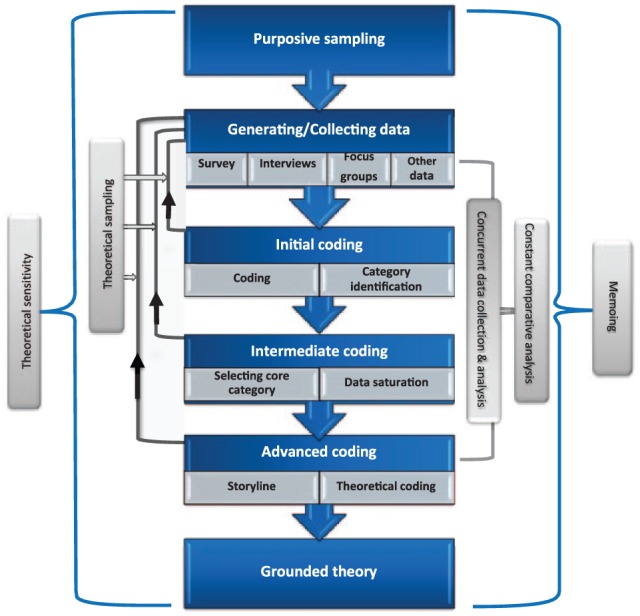
Background: Grounded theory is a well-known methodology employed in many research studies. Qualitative and quantitative data generation techniques can be used in a grounded theory study. Grounded theory sets out to discover or construct theory from data, systematically obtained and analysed using comparative analysis. While grounded theory is inherently flexible, it is a complex methodology. Thus, novice researchers strive to understand the discourse and the practical application of grounded theory concepts and processes. Objective: The aim of this article is to provide a contemporary research framework suitable to inform a grounded theory study. Result: This article provides an overview of grounded theory illustrated through a graphic representation of the processes and methods employed in conducting research using this methodology. The framework is presented as a diagrammatic representation of a research design and acts as a visual guide for the novice grounded theory researcher. Discussion: As grounded theory is not a linear process, the framework illustrates the interplay between the essential grounded theory methods and iterative and comparative actions involved. Each of the essential methods and processes that underpin grounded theory are defined in this article. Conclusion: Rather than an engagement in philosophical discussion or a debate of the different genres that can be used in grounded theory, this article illustrates how a framework for a research study design can be used to guide and inform the novice nurse researcher undertaking a study using grounded theory. Research findings and recommendations can contribute to policy or knowledge development, service provision and can reform thinking to initiate change in the substantive area of inquiry.
Overview
CoChat Summary
TL;DR
This article presents a contemporary, diagrammatic research design framework to help novice researchers visualise and apply the iterative methods and processes of grounded theory (GT). It defines the essential GT methods and processes and situates them within a non-linear, recursive design rather than debating philosophical genres.
Key findings
- GT is described as a structured yet flexible methodology appropriate when little is known about a phenomenon, aiming to produce or construct an explanatory theory grounded in data.
- Three distinct GT genres are identified: traditional/classic GT (Glaser), evolved GT (Strauss, Corbin and Clarke), and constructivist GT (Charmaz), distinguished by the researcher's philosophical position, use of literature, and approach to coding, analysis and theory development.
- Coding terminology differs by genre: traditional uses open, selective and theoretical coding; evolved uses open, axial and selective coding; constructivist uses initial, focused and theoretical coding (Table 1, adapted from Birks and Mills).
- The framework (Figure 1) depicts the interplay of purposive sampling, concurrent data generation/collection and analysis, constant comparative analysis, memoing, coding (initial, intermediate, advanced), theoretical sampling, theoretical sensitivity, and theoretical saturation, all directed toward an integrated substantive theory.
- Quality and rigour are related to three areas: the researcher's expertise, knowledge and research skills; methodological congruence with the research question; and procedural precision in the use of methods.
Methods
This is a methodological/discussion article, not an empirical study; no sample or dataset is analysed. It synthesises GT literature and prior works (notably Birks and Mills) to construct a graphic research design framework (Figure 1) and to define each essential GT method and process. The framework is presented as a visual guide for novice grounded theory researchers, illustrated with exemplars from other GT studies (Boxes 1–3).
Limitations
The paper states no formal limitations. Evident from the text: it deliberately avoids engagement in philosophical discussion or debate of the different GT genres, so it does not adjudicate between them; the framework is offered as a visual guide rather than an empirically tested model; and it is oriented specifically toward the novice nurse researcher, which may limit transferability to other disciplines or experienced researchers.
Model-written summary. Check it against the paper before relying on it.
Integrity signals
Registry
Cites
Statistics
Figures
Verification
Claims the paper makes
1 Valid · 4 Not valid · 49 Not checked · 18 Own results and interpretations
A statement the paper makes itself — it cites no source for it, so there is none to check. The quote shows it is in the paper.
In the paper
“As presented in Figure 1, initial purposive sampling directs the collection and/or generation of data.”
§ Grounded theory research: A design framework for novice researchers > Discussion > Purposive sampling
plainstates a cause- Asserted: passes — The authors put it forward as true.
- Checkable: passes — It can be checked against evidence.
- Load-bearing: passes — The paper’s conclusions depend on it.
- Based: passes — The paper gives a reason why it holds.
In the paper
“Constant comparative analysis generates increasingly more abstract concepts and theories through inductive processes.16”
§ Grounded theory research: A design framework for novice researchers > Discussion > Constant comparative analysis
What the sources say
- Not matchedcites [16] Charmaz K. Constructing grounded theory: a practical guide through qualitative analysis. Thousand Oaks, CA: SAGE, 2006.
Its entry has no title and year that we can search by.
plainstates a cause- Asserted: passes — The authors put it forward as true.
- Checkable: passes — It can be checked against evidence.
- Load-bearing: unclear — It is unclear whether the paper’s conclusions depend on it.
- Based: passes — The paper gives a reason why it holds.
- Not matched
In the paper
“Several analytic tools and techniques can be used to enhance theoretical sensitivity and increase the grounded theorist’s sensitivity to theoretical constructs in the data.28”
§ Grounded theory research: A design framework for novice researchers > Discussion > Theoretical sensitivity
What the sources say
- Not checked — no full text of the sourcecites [28] Corbin JM Strauss AL. Basics of qualitative research: techniques and procedures for developing grounded theory. 3rd ed. Thousand Oaks, CA: SAGE, 2008. source
plainstates a cause- Asserted: passes — The authors put it forward as true.
- Checkable: passes — It can be checked against evidence.
- Load-bearing: unclear — It is unclear whether the paper’s conclusions depend on it.
- Based: passes — The paper gives a reason why it holds.
In the paper
“Advanced coding that integrates extant theory adds further explanatory power to the findings.6”
§ Grounded theory research: A design framework for novice researchers > Discussion > Advanced coding
What the sources say
- Not matchedcites [6] Birks M Mills J. Grounded theory: a practical guide. 2nd ed. London: SAGE, 2015.
Its entry has no title and year that we can search by.
plainstates a cause- Asserted: passes — The authors put it forward as true.
- Checkable: passes — It can be checked against evidence.
- Load-bearing: unclear — It is unclear whether the paper’s conclusions depend on it.
- Based: passes — The paper gives a reason why it holds.
- Not matched
In the paper
“While interviews are a common method of generating data, data sources can include focus groups, questionnaires, surveys, transcripts, letters, government reports, documents, grey literature, music, artefacts, videos, blogs and memos.9”
§ Grounded theory research: A design framework for novice researchers > Discussion > Generating/collecting data
What the sources say
- Not checked — no full text of the sourcecites [9] Mills J Birks M Hoare KJ. Grounded theory. In: Mills J Birks M (eds) Qualitative methodology: a practical guide. London: SAGE, 2014, pp. 107– 121. source
plain- Asserted: passes — The authors put it forward as true.
- Checkable: passes — It can be checked against evidence.
- Load-bearing: unclear — It is unclear whether the paper’s conclusions depend on it.
- Based: passes — The paper gives a reason why it holds.
5 more claims
Create a free account to see all 72 claims and every source verdict.
- Probably not a substantial claim. 58
- It may state two separate claims as one. 17
Claims other papers make about this one
Each is checked against this paper’s own text: does it say what the citing paper says it does?
The cited source says what the claim attributes to it.
In the citing paper
“The epistemological and ontological differences principally address the proposition that theory is either discovered or co-constructed (Bryant, 2017), leading to opposing views on how the steps in the Grounded Theory method are understood (Bøttcher Berthelsen, 2018; Chun Tie, Birks and Francis, 2019; Tarozzi, 2020).”
From Application and challenges of using a Constructivist Grounded Theory methodology to address an undertheorized clinical challenge: A discussion paper (2024) · cites this paper as Chun Tie, Birks and Francis, 2019
The cited source says what the claim attributes to it.
In the citing paper
“Though the comparison of data, researchers emphasize consistencies, comprehend differences, and refine interviews, consistently comparing specific data points with others to establish categories (Bryant, 2017; Charmaz, 2014; Chun Tie et al., 2019).”
From Application and challenges of using a Constructivist Grounded Theory methodology to address an undertheorized clinical challenge: A discussion paper (2024) · cites this paper as Chun Tie et al., 2019
The cited source says what the claim attributes to it.
In the citing paper
“Nevertheless, this initial stage aims to deconstruct / fracture the data, allowing details to emerge (Bryant and Charmaz, 2019) to create the opportunity to identify both similarities and differences, pose analytical inquiries (Charmaz and Thornberg, 2021), and thereby establish to attain a more profound level of meaning (Chun Tie et al., 2019).”
From Application and challenges of using a Constructivist Grounded Theory methodology to address an undertheorized clinical challenge: A discussion paper (2024) · cites this paper as Chun Tie et al., 2019
Citations
Cites
The Discovery of Grounded Theory: Strategies for Qualitative Research.
Wagner, H. R., Glaser, B. G., & Strauss, A. L. (1968) · Social Forces · doi:10.2307/2575405 · Cited by 46,361
The Discovery of Grounded Theory; Strategies for Qualitative Research
Glaser, B. G., Strauss, A. L., & Strutzel, E. (1968) · Nursing Research · doi:10.1097/00006199-196807000-00014 · Cited by 39,449
(1998) · Sage eBooks · Cited by 38,631
Basics of Qualitative Research (3rd ed.): Techniques and Procedures for Developing Grounded Theory
Corbin, J., & Strauss, A. (2008) · SAGE · doi:10.4135/9781452230153 · Cited by 24,827
Basics of Qualitative Research: Grounded Theory Procedures and Techniques
Long, D. R., Strauss, A., & Corbin, J. (1993) · The Modern Language Journal · doi:10.2307/328955 · Cited by 17,576
Research Design: Qualitative, Quantitative, and Mixed Methods Approaches
Sloane-Seale, A. (2009) · Canadian Journal of University Continuing Education · doi:10.21225/d54s3d · Cited by 14,328
The Coding Manual for Qualitative Researchers
Lungu, M. (2022) · American Journal of Qualitative Research · doi:10.29333/ajqr/12085 · Cited by 10,826
Constructing grounded theory. A practical guide through qualitative analysis
Brink, E., Dellve, L., Hallberg, U., Abrahamsson, K. H., Klingberg, G., & Wentz, K. (2006) · International Journal of Qualitative Studies on Health and Well-being · doi:10.3402/qhw.v1i3.4932 · Cited by 6,862
(1978) · Medical Entomology and Zoology · Cited by 6,077
The Sage Handbook of Qualitative Research[1]
(2006) · Qualitative Research in Organizations and Management: An International Journal · doi:10.1108/17465640610666642 · Cited by 5,842
Research works printed but not linked: 13
- Crotty M. The foundation of social research: meaning and perspective in the research process. Thousand Oaks, CA: SAGE, 1998.
- Charmaz K. The power and potential of grounded theory. Med Sociol 2012; 6: 2– 15.
- Glaser BG. Basics of grounded theory analysis. Mill Valley, CA: Sociology Press, 1992.
- Ralph N Birks M Chapman Y. The methodological dynamism of grounded theory. Int J Qual Methods 2015; 14: 1–6.
- Bryant A Charmaz K. The Sage handbook of grounded theory. Thousand Oaks, CA: SAGE, 2007. · DOI · Paper page
- Charmaz K Bryant A. Grounded theory and credibility. In: Silverman D (ed.) Qualitative research. 3rd ed. London: SAGE, 2011, pp. 291– 309.
- Glaser BG Holton J. Remodeling grounded theory. Forum Qualitative Sozialforschung/Forum: Qualitative Social Research 2004; 5: 1– 22.
- Mackenzie N Knipe S. Research dilemmas: paradigms, methods and methodology. Issues Educ Res 2006; 16: 193– 205.
- Chamberlain-Salaun J. Consumers and the social world of health care: outsiders in the expert’s world: a grounded theory study. PhD Thesis, College of Health Care Sciences, James Cook University, Townsville, QLD, Australia, 2015, p. 198.
- Moghaddam A. Coding issues in grounded theory. Issues Educ Res 2006; 16: 53– 61.
- Evans LE. A novice researcher’s first walk through the maze of grounded theory: rationalization for classical grounded theory. Ground Theory Rev 2013; 14: 37–55.
- Glaser BG. The grounded theory perspective III: theoretical coding. Mill Valley, CA: Sociology Press, 2005.
- Baldwin A. Reconciling professional identity: a grounded theory study of nurse academics’ role modelling. PhD Thesis, College of Healthcare Sciences, James Cook University, Townsville, QLD, Australia, 2016, p. 246.
Cited by
Items 201–300 of 1,857
What Is Clinical Evidence in Speech-Language Pathology? A Scoping Review
Brannick, S. F., Wolford, G. W., Wolford, L. L., Effron, K., & Buckler, J. (2022) · American Journal of Speech-Language Pathology · doi:10.1044/2022_ajslp-22-00203 · Cited by 25
“The process of mapping the data aligned with grounded theory methodology (Chun Tie et al., 2019).”
MethodPrioritization of used aircraft acquisition criteria: A fuzzy best–worst method (BWM)-based approach
Gao, F., Wang, W., Bi, C., Bi, W., & Zhang, A. (2023) · Journal of Air Transport Management · doi:10.1016/j.jairtraman.2023.102359 · Cited by 19
Fitzsimon, J. P., Patel, K., Peixoto, C., & Belanger, C. (2023) · BMC Health Services Research · doi:10.1186/s12913-023-09599-x · Cited by 24
“Following coding of the transcripts, the authors met to ensure consistency in coding of quotes, as well as conduct thematic analysis to identify and define themes in the data [31].”
MethodTaxonomy and definition of audio augmented reality (AAR): A grounded theory study
Dam, A., Siddiqui, A., Leclercq, C., & Jeon, M. (2023) · International Journal of Human-Computer Studies · doi:10.1016/j.ijhcs.2023.103179 · Cited by 27
Aldhobaib, M. A. (2024) · Higher Education · doi:10.1007/s10734-024-01182-5 · Cited by 33
“The findings of this study are organised into three key themes, which are driven by the study questions and what is suggested by the grounded theory approach (Chun Tie et al., 2019; Strauss & Corbin, 1998).”
InfluentialThe ideal L2 self versus ability beliefs: are they really distinct?
Al‐Hoorie, A. H., McClelland, N., Resnik, P., Hiver, P. V., & Botes, E. (2024) · Journal of Multilingual and Multicultural Development · doi:10.1080/01434632.2024.2401103 · Cited by 26
“In thematic analysis, statements are first listed in the original wording, and then subsequently grouped into categories or ‘themes’ representing abstract concepts in the discourse (Chun Tie, Birks, and Francis 2019).”
Saraiya, T. C., Swarbrick, M. A., Franklin, L., Kass, S., Campbell, A. N. C., & Hien, D. A. (2020) · Journal of Substance Abuse Treatment · doi:10.1016/j.jsat.2020.01.011 · Cited by 20
Sunkwa-Mills, G., Rawal, L. B., Enweronu-Laryea, C. C., Aberese-Ako, M., Senah, K. A., & Tersbøl, B. P. (2020) · Health Policy and Planning · doi:10.1093/heapol/czaa102 · Cited by 22
“Grounded theory allows the results to be ‘grounded’ to the data collected (Glaser et al. , 1968; Chun Tie et al. , 2019).”
Alhassan, R. K. (2020) · BMC Medical Education · doi:10.1186/s12909-020-02380-2 · Cited by 25
Saju, R., Castellon‐Lopez, Y., Turk, N., Moin, T., Mangione, C. M., Norris, K. C., VU, A. V., Maranon, R., Fu, J., Cheng, F., et al. (2022) · Journal of General Internal Medicine · doi:10.1007/s11606-022-07521-5 · Cited by 20
“We used grounded theory, which helps develop theories from existing data while conducting comparative analysis, as our guiding framework.(25) Two researchers independently analyzed and coded each transcript and any 3716 Saju et al.”
MethodBraun, P., Atik, E., Guthardt, L., Apolinário-Hagen, J., & Schückes, M. (2023) · JMIR Formative Research · doi:10.2196/45970 · Cited by 17
“The transcripts were coded based on grounded theory, a systematic data analysis methodology that focuses on inductively developing abstract theoretical conceptions from empirical data [50,51].”
MethodArrigoni, A., Rossettini, G., Palese, A., Thacker, M. A., & Esteves, J. E. (2024) · Musculoskeletal Science and Practice · doi:10.1016/j.msksp.2024.103164 · Cited by 25
Making Online Communities ‘Better’: A Taxonomy of Community Values on Reddit
Weld, G., Zhang, A. X., & Althoff, T. (2024) · Proceedings of the International AAAI Conference on Web and Social Media · doi:10.1609/icwsm.v18i1.31413 · Cited by 71
“Then, using a grounded theory approach [17, 29], a team of 5 researchers worked together to iteratively categorize the remaining 292 idea units using an inductive coding method [56, 63].”
MethodTyokighir, D., Hervey, A. M., Schunn, C., Clifford, D. R., & Ahlers-Schmidt, C. (2022) · Kansas Journal of Medicine · doi:10.17161/kjm.vol15.15853 · Cited by 18
Birze, A., Regehr, K., & Regehr, C. (2022) · Journal of Interpersonal Violence · doi:10.1177/08862605221090571 · Cited by 27
“That is, CGT asserts that data and meaning, rather than emerging as an objective truth, are co-constructed through the relationship between the researchers and the participants (Birks & Mills, 2015; Charmaz, 2017; Chun Tie et al., 2019).”
BackgroundZhang, J., Zilundu, P. L. M., Fu, R., Zheng, X., Zhou, L., & Guo, G. (2022) · Anatomical Sciences Education · doi:10.1002/ase.2208 · Cited by 19
Wijngaarden, Y. (2022) · Human Relations · doi:10.1177/00187267221121277 · Cited by 32
“In line with the extant literature (e.g. Brown, 2017; Garrett et al., 2017; Vidaillet and Bousalham, 2018), this research takes a qualitative approach in order to understand how workers in collective workplaces ‘construct meaning in relation to the area of inquiry’ (Chun Tie et al., 2019: 2).”
ResultHlavin, C. A., Sebastiani, R. S., Scherer, R., Kenkre, T. S., Bernardi, K., Reed, D. A., Ahmed, B. H., & Courcoulas, A. P. (2023) · Obesity Surgery · doi:10.1007/s11695-023-06761-6 · Cited by 24
Lee, K., Lee, N., & Lee, T. J. (2023) · Tourism Management Perspectives · doi:10.1016/j.tmp.2023.101145 · Cited by 28
Fuller, P., Kennedy, S., Ball, M., Duffie, H., Gainey, M., Luo, Q., Joseph, A., Carbonell, A. M., & Cha, J. S. (2024) · Applied Ergonomics · doi:10.1016/j.apergo.2024.104403 · Cited by 25
Zhao, J., Hong, Y., & Yang, F. (2024) · Process Safety and Environmental Protection · doi:10.1016/j.psep.2024.10.046 · Cited by 17
Cardarelli, K., DeWitt, E., Gillespie, R., Norman‐Burgdolf, H., Jones, N. D., & Mullins, J. T. (2020) · Preventing Chronic Disease · doi:10.5888/pcd17.200340 · Cited by 24
Psychosocial stress and trauma during the COVID‐19 pandemic: Evidence from Bangladesh
Hossain, I., Mehedi, N., Ahmad, I., Ali, I., & Azman, A. (2021) · Asian Social Work and Policy Review · doi:10.1111/aswp.12227 · Cited by 20
“The grounded theory approach determines or constructs theory from data, which are systematically obtained and analyzed using comparative analysis (Chun Tie et al., 2019).”
MethodToward a sustainability assessment framework of research impacts: Contributions of a business school
Findler, F. (2021) · Sustainable Development · doi:10.1002/sd.2218 · Cited by 31
DiClemente-Bosco, K., Neville, S. E., Berent, J. M., Farrar, J., Mishra, T., Abdi, A., Beardslee, W. R., Creswell, J. W., & Betancourt, T. S. (2022) · Transcultural Psychiatry · doi:10.1177/13634615221111627 · Cited by 18
“The authors discussed the results from each research question, iteratively building a storyline that connected the relevant findings into one cohesive, novel argument (Chun Tie et al., 2019).”
BackgroundPatient and provider experiences using a site-to-site telehealth model for medication abortion
Ruggiero, S. P., Seymour, J. W., Thompson, T., Kohn, J. E., Snow, J. L., Grossman, D., & Fix, L. (2022) · mHealth · doi:10.21037/mhealth-22-12 · Cited by 20
(2023) · doi:10.2196/preprints.45970 · Cited by 17
The future of sports tourism in the light of the COVID-19 pandemic – Developing a new paradigm model
Pashaie, S., & Perić, M. (2023) · Journal of Tourism Futures · doi:10.1108/jtf-09-2022-0236 · Cited by 27
African American Nurses' Perspectives on Genomic Medicine Research
Hendricks‐Sturrup, R., Edgar, L. M., Johnson-Glover, T., & Lu, C. Y. (2021) · The AMA Journal of Ethic · doi:10.1001/amajethics.2021.240 · Cited by 16
Torres-Landa, S. R., Moreno, K., Brasel, K. J., & Rogers, D. A. (2021) · Journal of surgical education · doi:10.1016/j.jsurg.2021.07.017 · Cited by 22
Achieving academic promotion: The role of work environment, role conflict, and life balance
Bowering, E., & Reed, M. J. (2021) · Canadian Journal of Higher Education · doi:10.47678/cjhe.v51i4.188917 · Cited by 22
“We relied on Grounded Theory methodology to construct theory from data (Isaacs, 2014; Khan, 2014; Lingard et al., 2008; Tie et al., 2019).”
Hung, Y., Leung, S., Chiu, S. P., Li, P., Kan, A. C. O., Lo, C., Wong, S. Z., Luk, S., Lai, C. C., Helali, A. E., et al. (2022) · Cancer Medicine · doi:10.1002/cam4.5046 · Cited by 22
The role of pay-for-performance in reducing healthcare disparities: A narrative literature review
Conway, A., & Satin, D. J. (2022) · Preventive Medicine · doi:10.1016/j.ypmed.2022.107274 · Cited by 16
Cadman, R., Snook, J., & Bailey, M. (2022) · Regional Environmental Change · doi:10.1007/s10113-022-01983-3 · Cited by 23
Echolalia as defined by parent communication partners
Cohn, E. G., McVilly, K., & Harrison, M. (2023) · Autism & Developmental Language Impairments · doi:10.1177/23969415231151846 · Cited by 17
“…checking of incidents, both between and within incidents, is what Glaser and Strauss (1967) term as ‘constant comparative analysis’, and is a centrepiece that separates grounded theory from other qualitative approaches (Charmaz, 2000; Glaser & Strauss, 1967; Mills et al., 2006; Tie et al., 2019).”
BackgroundCarmichael, J. H., Kalagher, K. M., Reznek, M. A., & Modi, P. (2023) · Western Journal of Emergency Medicine · doi:10.5811/westjem.58406 · Cited by 22
Ahmed, W., Ali, S., Asghar, M., et al. (2023) · SAGE Open · doi:10.1177/21582440231203477 · Cited by 16
“Finally, the categories created and the relationships found between them are used as the basis for developing a new theory (Chun Tie et al., 2019; Morse et al., 2009).”
BackgroundIdentifying Issues and Priorities in Reporting Back Environmental Health Data
Lebow-Skelley, E., Yelton, S., Janssen, B., Erdei, E., & Pearson, M. A. (2020) · International Journal of Environmental Research and Public Health · doi:10.3390/ijerph17186742 · Cited by 16
“In accordance with grounded theory and qualitative content analysis [15,17,18,26], we interpret the distinct themes,”
MethodSchrag, R. V., Wood, L., Hairston, D., & Jones, C. (2020) · Journal of Interpersonal Violence · doi:10.1177/0886260520967162 · Cited by 23
“Chun Tie, Y., Birks, M., & Francis, K. (2019).”
MethodHsu, R. L. (2021) · Sustainability · doi:10.3390/su13052577 · Cited by 18
An Exploratory Study of the Community Impacts of Service-Learning
Lau, K. H., Chan, M. Y. L., Yeung, C. L. S., et al. (2021) · Metropolitan Universities · doi:10.18060/25482 · Cited by 16
LGBTQ Qualitative and Mixed Methods Research in Counseling Psychology: A Content Analysis
Abreu, R. L., Townsend, D., Mitchell, Y., Ward, J., Audette, L. M., & Gonzalez, K. A. (2022) · The Counseling Psychologist · doi:10.1177/00110000221092481 · Cited by 24
“This qualitative methodology includes several distinct approaches, such as traditional grounded theory, evolved grounded theory, and constructivist grounded theory (Chun Tie et al., 2019).”
MethodBobbink, P., Larkin, P., & Probst, S. (2024) · International Journal of Nursing Studies Advances · doi:10.1016/j.ijnsa.2024.100199 · Cited by 15
Zurba, M., Suchet‐Pearson, S., Bullock, R. C. L., Castillo, A. R., Chang, K., Archer, R., Enns, E., Sherpa, P. D., Batzin, R., Munguia, O., et al. (2024) · Environmental Science & Policy · doi:10.1016/j.envsci.2024.103864 · Cited by 18
We are ready for halal tourism, aren’t we? Exploring readiness of non-Muslim perspective in Thailand
Dabamona, S. A., Chompupor, P., & Ghuangpeng, S. (2024) · Journal of Islamic marketing · doi:10.1108/jima-10-2023-0337 · Cited by 15
Edwards, R., Cragg, B., Dunn, S., & Peterson, W. E. (2021) · Midwifery · doi:10.1016/j.midw.2021.102945 · Cited by 15
Charmant, W. M., van der Wees, P. J., Staal, J. B., van Cingel, R. E. H., Sieben, J. M., & de Bie, R. A. (2021) · BMC Sports Science Medicine and Rehabilitation · doi:10.1186/s13102-021-00348-3 · Cited by 20
“During advanced coding, categories were combined into overarching themes [19].”
BackgroundMethodInfluentialWhat do users want from transit? Qualitative analysis of current and potential users' perceptions
Eldeeb, G., Sears, S., & Mohamed, M. (2023) · Transportation Research Part A Policy and Practice · doi:10.1016/j.tra.2023.103649 · Cited by 15
Kozato, A., Shikino, K., Matsuyama, Y., Hayashi, M., Kondo, S., Uchida, S., Stanyon, M., & Ito, S. (2023) · BMC Medical Education · doi:10.1186/s12909-023-04257-6 · Cited by 20
Salikutluk, V., Koert, D., & Jäkel, F. (2023) · Frontiers in artificial intelligence and applications · doi:10.3233/faia230081 · Cited by 22
“4 (a) summarizes the brainstormed with the tool.”
BackgroundExploring Food-Based Cultural Practices to Address Food Insecurity in Rural Appalachia
Batey, L., DeWitt, E., Brewer, D. P., Cardarelli, K., & Norman‐Burgdolf, H. (2023) · Health Education & Behavior · doi:10.1177/10901981231175360 · Cited by 16
“Investigators reviewed the transcripts and conducted thematic analysis using a grounded theory approach (Chun Tie et al., 2019).”
MethodGomaa, S., López, A., Slamon, R., Smith, R. M., Telushi, E., Lapitan, E., Nightingale, G., Miller, S., & Wen, K. (2023) · Supportive Care in Cancer · doi:10.1007/s00520-023-08170-y · Cited by 18
A framework to characterize and classify soundscape design practices based on grounded theory
Moshona, C. C., Fiebig, A., Aletta, F., et al. (2024) · Noise Mapping · doi:10.1515/noise-2024-0002 · Cited by 15
Germain, N., Jémus-Gonzalez, E., Couture, V., Côté, É., Morin, M., Toulouse-Fournier, A., Bert, L., Giguère, R., Sinha, S., Sourial, N., et al. (2024) · BMC Geriatrics · doi:10.1186/s12877-024-05388-1 · Cited by 15
“We first used a hypothetico-deductive framework, in which we used an existing model of patient experiences of care transitions [21] to capture and systematically analyze the perspectives of caregivers as told through open-ended response data [29, 30].”
MethodAli, F., Russell, C., Lo, M., Bonn, M., Bardwell, G., Boyd, J., Hyshka, E., & Rehm, J. T. (2024) · Harm Reduction Journal · doi:10.1186/s12954-024-01108-5 · Cited by 18
Rahimi, S. A., Shrivastava, R., Brown-Johnson, A., Caïdor, P., Davies, T. C., Janati, A. I., Talla, P. K., Madathil, S. A., Willie, B. M., & Emami, E. (2024) · Journal of Medical Internet Research · doi:10.2196/63356 · Cited by 22
Critical types of knowledge loss in military organisations
Singh, M. K., & Gupta, V. (2020) · VINE Journal of Information and Knowledge Management Systems · doi:10.1108/vjikms-09-2019-0152 · Cited by 25
Barrios-Anderson, A., Wu, E., Liu, D. D., Snead, J., Lee, D. J., Robbins, J., Aguirre, J., Tang, O. Y., Garcia, C. M., Pucci, F. G., et al. (2021) · Surgical Neurology International · doi:10.25259/sni_742_2021 · Cited by 17
“Surgical Neurology International • 2021 • 12(490) | 2 Surgical Neurology International • 2021 • 12(490) | 3 to assess survey response data.[5] Both reviewers discussed the coding and results for free-response to the survey to identify conceptual recurrences or patterns in the data.”
BackgroundUnfinished Paths—From Blockchain to Sustainability in Supply Chains
Köhler, S., Pizzol, M., & Sarkis, J. (2021) · Frontiers in Blockchain · doi:10.3389/fbloc.2021.720347 · Cited by 22
“In theoretical sampling researchers move back and forth between sampling, data collection, and analysis until data saturation is reached or no new information is collected with new interviews (Tie et al., 2019).”
BackgroundReuse of building materials—the perspective of Swedish clients
Ericsson, F., Mjörnell, K., & Janson, U. (2024) · Cleaner Engineering and Technology · doi:10.1016/j.clet.2024.100848 · Cited by 15
Wells, I., & Giacco, D. (2024) · BJPsych Advances · doi:10.1192/bja.2024.66 · Cited by 23
A Systematic Review on The Definition of Children’s Number Sense in the Primary School Years
Ghazali, M., Mohamed, R., & Mustafa, Z. (2021) · Eurasia Journal of Mathematics Science and Technology Education · doi:10.29333/ejmste/10871 · Cited by 28
DeMoulin, D., Jacobs, S., Nam, Y.-S., Harding, A. B., Moskowitz, A. F., Shi, Y., & Kim, H. S. (2022) · Journal of Occupational and Environmental Medicine · doi:10.1097/jom.0000000000002680 · Cited by 20
“Thematic analysis based on the grounded theory method was used to summarize participant comments.(22) Three coders (D.”
MethodMusic teachers’ self-reported views of creativity in the context of their work
Schiavio, A., van der Schyff, D., Philippe, R. A., & Biasutti, M. (2022) · Arts and Humanities in Higher Education · doi:10.1177/14740222221125640 · Cited by 27
“This process begun with a purposive sampling (see Charmaz and Bryant, 2011; Chun Tie et al., 2019), where sets of data (e.g. responses to given items) were selected to offer initial answers to the research questions reported above.”
MethodNowakowski, E., Dayananda, S., Morgan, M., Jarvis, O., Altamirano, V., LaSorda, K. R., Krans, E. E., & Lim, G. (2023) · Addiction · doi:10.1111/add.16134 · Cited by 19
King, R., Oprescu, F., Lord, B., Flanagan, B., & Downer, T. (2023) · Paramedicine · doi:10.1177/27536386231163721 · Cited by 19
A qualitative exploration of fear of cancer recurrence in caregivers
Banks, H., Webb, K., Sharpe, L., & Shaw, J. (2023) · Psycho-Oncology · doi:10.1002/pon.6149 · Cited by 14
“Semi‐structured telephone interviews were conducted using a constant comparative methodology.(19) All interviews were audio‐ recorded and transcribed verbatim.”
MethodTenzer, M., & Schofield, J. (2023) · Cambridge Archaeological Journal · doi:10.1017/s0959774323000203 · Cited by 22
“This means that each topic is a combination of keywords which have a speci fi c importance (weight) contributing to the weightage of each topic.”
Hennenberg, J., Hecking, M., Sterz, F. R., Hassemer, S., Kropiunigg, U., Debus, S. E., Stastka, K., & Löffler‐Stastka, H. (2023) · International Journal of Environmental Research and Public Health · doi:10.3390/ijerph20146386 · Cited by 18
Barriers and Facilitators to Clinical Practice Development in Men and Women Surgeons
Finn, C. B., Syvyk, S., Bakillah, E., Brown, D. E., Mesiti, A. M., Highet, A., Bergmark, R. W., Yeo, H., Waljee, J. F., Wick, E. C., et al. (2023) · JAMA Surgery · doi:10.1001/jamasurg.2023.5125 · Cited by 16
Hossain, S., Moll, S. E., Tompa, E., & Gewurtz, R. E. (2021) · Work · doi:10.3233/wor-213459 · Cited by 19
Severely stigmatised skin neglected tropical diseases: a protocol for social science engagement
Zaman, S., Nahar, P., MacGregor, H., et al. (2020) · Transactions of the Royal Society of Tropical Medicine and Hygiene · doi:10.1093/trstmh/traa141 · Cited by 14
Antoine, A., Fitchett, G. A., Marin, D. B., Sharma, V., Garman, A. N., Haythorn, T., White, K. B., Greene, A., & Cadge, W. (2020) · Journal of Health Care Chaplaincy · doi:10.1080/08854726.2020.1861535 · Cited by 20
The experience of becoming a mother following successful in vitro fertilization: A grounded theory
Boz, İ., Teskereci, G., & Akgün, M. (2021) · Journal of Advanced Nursing · doi:10.1111/jan.14958 · Cited by 18
Virtual Guest Speakers in Textile and Apparel Courses: Student Experiences and Expectations
Jablon-Roberts, S., & McCracken, A. (2022) · Clothing and Textiles Research Journal · doi:10.1177/0887302x221075765 · Cited by 16
“Grounded theory was originally formulated to deal in a rigorous but flexible way with qualitative data, particularly when there are no preconceived hypotheses about what the resulting data may show (Charmaz & Thornberg, 2021; Chun Tie et al., 2019).”
MethodKhan, A. U., Qu, X., & Madzikanda, B. (2022) · Creativity and Innovation Management · doi:10.1111/caim.12501 · Cited by 17
Robaey, Z., Asveld, L., Sinha, K. M., Wubben, E. F. M., & Osseweijer, P. (2022) · Cleaner and Circular Bioeconomy · doi:10.1016/j.clcb.2022.100032 · Cited by 18
Johnson, C. A. (2023) · Frontiers in Communication · doi:10.3389/fcomm.2023.1089335 · Cited by 14
“Grounded theory allowed me to focus on listening to women’s stories and examine how whisper networks create social relationships, group behaviors, and social processes (Chun et al., 2019).”
BackgroundHu, C., Hu, X., & Liu, H. (2024) · International Journal of Tourism Research · doi:10.1002/jtr.2704 · Cited by 17
Silver, N. A., Kierstead, E. C., Kostygina, G., Tran, H., Briggs, J., Emery, S., & Schillo, B. (2022) · Journal of Medical Internet Research · doi:10.2196/40331 · Cited by 13
Sustainable development in general practice
Legrand, J., Aubin-Auger, I., Bary, L. D., Fossembas, É., Baruch, D., & Malmartel, A. (2023) · Family Practice · doi:10.1093/fampra/cmad003 · Cited by 16
Gabay, M., & Oravițan, M. (2022) · Timisoara Physical Education and Rehabilitation Journal · doi:10.2478/tperj-2022-0013 · Cited by 16
An investigation of self-injury in female adolescents: a qualitative study
Vafaei, T., Samavi, S. A., Whisenhunt, J. L., & Najarpourian, S. (2023) · Quality & Quantity · doi:10.1007/s11135-023-01632-9 · Cited by 26
“Using Grounded Theory (Chun et al. 2019), the researcher was able to gain understanding of participants’ lived experience of self-injury and generate a theory/model through which to conceptualize their experience.”
MethodSpiritual values in forest management plans in British Columbia and the Netherlands
de Pater, C., Verschuuren, B., Elands, B. H. M., van Hal, I., & Turnhout, E. (2023) · Forest Policy and Economics · doi:10.1016/j.forpol.2023.102955 · Cited by 22
Lai, E. R., Rukavina, N., Wisco, J. J., & Zumwalt, A. (2023) · Anatomical Sciences Education · doi:10.1002/ase.2281 · Cited by 20
Using grounded theory to develop a theory of change for a violence intervention program
Voith, L. A., Russell, K. N., Lee, H., Atwell, M. S., McKinney, S. J., Thomas, T. J., & Barksdale, E. M. (2023) · Evaluation and Program Planning · doi:10.1016/j.evalprogplan.2023.102303 · Cited by 17
Mohammadi, M. (2023) · Research and Practice in Technology Enhanced Learning · doi:10.58459/rptel.2024.19004 · Cited by 41
Doğan, A. L., & Wood, D. R. (2023) · ACM SIGCAS/SIGCHI Conference on Computing and Sustainable Societies (COMPASS) · doi:10.1145/3588001.3609368 · Cited by 16
“Interview analysis started as an inductive method primarily using grounded theory, not unusual in HCI-related research [11, 12, 36], but themes were not emerging and the interviews were too disparate.”
MethodSaghafi, E., Andås, C. A., Bernson, J. M., & Kjeller, G. (2023) · BMC Oral Health · doi:10.1186/s12903-023-03366-4 · Cited by 13
“Content analysis was the base of the analysis method in this study, and the method’s condensing procedure provided a concrete basis for compilation of slightly diverging reports of similar expressions, while the determination of saturation provided effectiveness in recruitment and analysis [29, 42].”
BackgroundMethodInfluentialShrestha, R. P., Jirakiattikul, S., & Shrestha, M. (2023) · Energy Research & Social Science · doi:10.1016/j.erss.2023.103268 · Cited by 14
Regehr, C., Regehr, K., Goel, V., Sato, C., Lyons, K. A., & Rudzicz, F. (2023) · BMJ Public Health · doi:10.1136/bmjph-2023-000444 · Cited by 17
McGowan, D., Morley, C., Hansen, E., Shaw, K. A.-M., & Winzenberg, T. M. (2024) · BMC Health Services Research · doi:10.1186/s12913-024-10788-5 · Cited by 20
A systematic conceptual review of financial access
Birkenmaier, J. M., & Huang, J. X. (2024) · Journal of Consumer Affairs · doi:10.1111/joca.12574 · Cited by 16
Kelly, J. F., Levy, S., & Matlack, M. P. (2024) · Journal of Substance Use and Addiction Treatment · doi:10.1016/j.josat.2024.209337 · Cited by 17
Ogunyemi, A. O., Balogun, M. R., Ojo, A. E., Welch, S. B., Onasanya, O. O., Yesufu, V. O., Omotayo, A. T., & Hirschhorn, L. R. (2024) · PLoS ONE · doi:10.1371/journal.pone.0288574 · Cited by 22
“This study used a grounded theory approach to investigate the research [27].”
MethodUsing Grounded Theory Method in Social Media Studies: A Scoping Review
Galea, G., Mainey, L., & Chugh, R. (2025) · International Journal of Qualitative Methods · doi:10.1177/16094069251328155 · Cited by 18
“First, as a well-established exploratory approach (Chun Tie et al., 2019) with a considered approach to controversial research topics with secrets and silences (Charmaz, 2014), GT shows great promise in mapping the uncharted social territory of SM.”
Hendricks‐Sturrup, R., Cerminara, K. L., & Lu, C. Y. (2020) · Journal of Personalized Medicine · doi:10.3390/jpm10040264 · Cited by 13
“A grounded theory approach was also used to conduct inductive coding and a qualitative analysis of 75 comments from interview transcripts [23].”
BackgroundMethodInfluentialHow Do Healthcare Executives Understand and Make Decisions about Spiritual Care Provision?
Antoine, A., Fitchett, G. A., Sharma, V., Marin, D. B., Garman, A. N., Haythorn, T., White, K. B., & Cadge, W. (2021) · Southern Medical Journal · doi:10.14423/smj.0000000000001230 · Cited by 29
“ti Scientific Software Development GmbH, Berlin, Germany) and analyzed inductively following the principles of grounded theory.(33) Initial codes were developed by two researchers and then refined through subsequent processes of writing and analysis.”
MethodConceptualising valuation quality in practice: a valuer perspective
Amidu, A., Levy, D. S., & Bolomope, M. T. (2021) · Journal of Property Research · doi:10.1080/09599916.2021.1930108 · Cited by 13
“Other pieces of data are then compared with the first piece of data obtained earlier in order to generate a theory that is integrated and close to the data (Chun Tie et al., 2019).”
MethodGrannell, A., le Roux, C. W., & McGillicuddy, D. (2021) · Qualitative Health Research · doi:10.1177/10497323211040767 · Cited by 17
Metadata
- Authors
- Chun Tie, Y., Birks, M., & Francis, K.
- Affiliations
- Nursing and Midwifery, College of Healthcare Sciences, James Cook University, Townsville, QLD, Australia
- James Cook University (AU)
- University of Tasmania (AU)
- Venue
- SAGE Open Medicine
- Publisher
- SAGE Publications
- Published
- 2019-01
- Volume
- 7
- Pages
- 2050312118822927-2050312118822927
- ISSN
- 2050-3121 (ISSN-L)
- PMC
- PMC6318722
- OpenAlex
- W2906994370
- Cited by
- 1,869
- References
- 29
- Citations by year
- 2026: 200 · 2025: 285 · 2024: 370 · 2023: 370 · 2022: 302 · 2021: 226 · 2020: 108 · 2019: 8
- FWCI
- 433.86
- Type
- journal article
- Language
- en
- Open access
- gold
- doi.org
- Licence
- cc-by-nc
- journals.sagepub.com/page/policies/text-and-data-mining-license (tdm)
- Locations
- SAGE Open Medicine (publishedVersion, cc-by-nc)
- Europe PMC (PubMed Central) (publishedVersion, cc-by-nc)
- PubMed Central (publishedVersion, cc-by-nc)
- PubMed (publishedVersion)
- UTAS Research Repository (acceptedVersion)
- ResearchOnline at James Cook University (James Cook University) (submittedVersion)
- DOAJ (DOAJ: Directory of Open Access Journals) (submittedVersion, cc-by-sa)
- Figshare (submittedVersion, cc-by-nc)
- Topics
- Social Sciences › Education › Qualitative Research Methods and Applications
- Health Sciences › Nursing › Research and Theory › Methodologies in Health Research and Practice
- Social Sciences › Education › Educational Research and Methods
- Keywords
- grounded theory, research design framework, novice researchers, nurse researchers, qualitative research methodology, comparative analysis
About these checks
Registry, retraction, Cites and statistics results are computed, not judged, with one exception: a printed reference that no index lists is read once by a model before it counts as a citation error. Claims are extracted by a model and kept only when their quote appears verbatim in the text; each cited source is then checked, with a model’s help, for whether it says what the claim relies on. Those verdicts can be wrong — read the claim’s quote and the cited source before relying on one.
The claim verdicts this report counts are experimental: their accuracy is not yet measured.
A language model drew the claims from the paper on 2026-10-10, under version 3 of the claim definition (model deepseek-v4.1-flash, prompt extract-v3).
A second model labelled each claim on 2026-10-10 (model jev-1.13-20260917, definition revision gold-guideline-v0.2).
Statistics and arithmetic are recomputed, not judged.
Confidence bands are shown only for fields calibrated on our annotated test set. None is calibrated yet, so no band is shown.
What counts as a claim ›How we measure confidence ›How we check this ›
Are you an author, or do you see a problem with this page? Request a review
Data sources
Bibliographic data: Semantic Scholar, OpenAlex, Crossref.
Contains information from the Semantic Scholar Academic Graph Datasets, made available under the ODC Attribution License (ODC-BY 1.0).
Semantic Scholar’s data is described in: Kinney, R., et al. (2023). The Semantic Scholar Open Data Platform. arXiv:2301.10140.
