

Grounded theory research: A design framework for novice researchers
Open accessThe DOI matches its Crossref record; 30 of the 33 references it cites were found in a registry or an index; 2 of the 69 sources its claims cite were checked for support.
Abstract
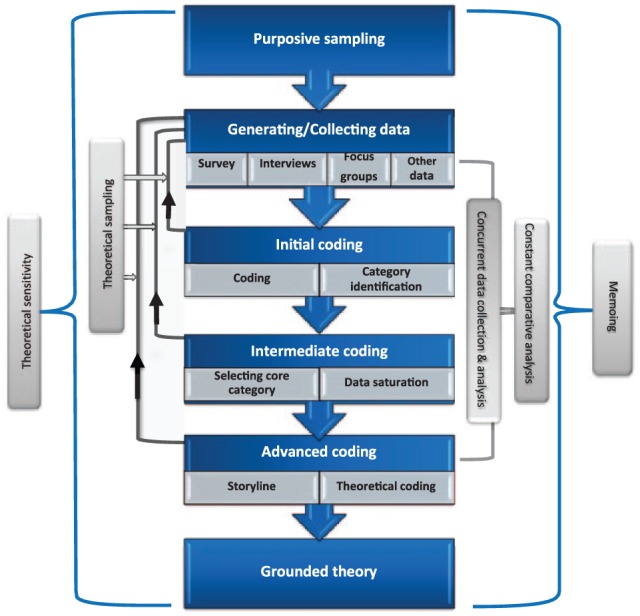
Background: Grounded theory is a well-known methodology employed in many research studies. Qualitative and quantitative data generation techniques can be used in a grounded theory study. Grounded theory sets out to discover or construct theory from data, systematically obtained and analysed using comparative analysis. While grounded theory is inherently flexible, it is a complex methodology. Thus, novice researchers strive to understand the discourse and the practical application of grounded theory concepts and processes. Objective: The aim of this article is to provide a contemporary research framework suitable to inform a grounded theory study. Result: This article provides an overview of grounded theory illustrated through a graphic representation of the processes and methods employed in conducting research using this methodology. The framework is presented as a diagrammatic representation of a research design and acts as a visual guide for the novice grounded theory researcher. Discussion: As grounded theory is not a linear process, the framework illustrates the interplay between the essential grounded theory methods and iterative and comparative actions involved. Each of the essential methods and processes that underpin grounded theory are defined in this article. Conclusion: Rather than an engagement in philosophical discussion or a debate of the different genres that can be used in grounded theory, this article illustrates how a framework for a research study design can be used to guide and inform the novice nurse researcher undertaking a study using grounded theory. Research findings and recommendations can contribute to policy or knowledge development, service provision and can reform thinking to initiate change in the substantive area of inquiry.
Overview
CoChat Summary
TL;DR
This article presents a contemporary, diagrammatic research design framework to help novice researchers visualise and apply the iterative methods and processes of grounded theory (GT). It defines the essential GT methods and processes and situates them within a non-linear, recursive design rather than debating philosophical genres.
Key findings
- GT is described as a structured yet flexible methodology appropriate when little is known about a phenomenon, aiming to produce or construct an explanatory theory grounded in data.
- Three distinct GT genres are identified: traditional/classic GT (Glaser), evolved GT (Strauss, Corbin and Clarke), and constructivist GT (Charmaz), distinguished by the researcher's philosophical position, use of literature, and approach to coding, analysis and theory development.
- Coding terminology differs by genre: traditional uses open, selective and theoretical coding; evolved uses open, axial and selective coding; constructivist uses initial, focused and theoretical coding (Table 1, adapted from Birks and Mills).
- The framework (Figure 1) depicts the interplay of purposive sampling, concurrent data generation/collection and analysis, constant comparative analysis, memoing, coding (initial, intermediate, advanced), theoretical sampling, theoretical sensitivity, and theoretical saturation, all directed toward an integrated substantive theory.
- Quality and rigour are related to three areas: the researcher's expertise, knowledge and research skills; methodological congruence with the research question; and procedural precision in the use of methods.
Methods
This is a methodological/discussion article, not an empirical study; no sample or dataset is analysed. It synthesises GT literature and prior works (notably Birks and Mills) to construct a graphic research design framework (Figure 1) and to define each essential GT method and process. The framework is presented as a visual guide for novice grounded theory researchers, illustrated with exemplars from other GT studies (Boxes 1–3).
Limitations
The paper states no formal limitations. Evident from the text: it deliberately avoids engagement in philosophical discussion or debate of the different GT genres, so it does not adjudicate between them; the framework is offered as a visual guide rather than an empirically tested model; and it is oriented specifically toward the novice nurse researcher, which may limit transferability to other disciplines or experienced researchers.
Model-written summary. Check it against the paper before relying on it.
Integrity signals
Registry
Cites
Statistics
Figures
Verification
Claims the paper makes
1 Valid · 4 Not valid · 49 Not checked · 18 Own results and interpretations
A statement the paper makes itself — it cites no source for it, so there is none to check. The quote shows it is in the paper.
In the paper
“As presented in Figure 1, initial purposive sampling directs the collection and/or generation of data.”
§ Grounded theory research: A design framework for novice researchers > Discussion > Purposive sampling
plainstates a cause- Asserted: passes — The authors put it forward as true.
- Checkable: passes — It can be checked against evidence.
- Load-bearing: passes — The paper’s conclusions depend on it.
- Based: passes — The paper gives a reason why it holds.
In the paper
“Constant comparative analysis generates increasingly more abstract concepts and theories through inductive processes.16”
§ Grounded theory research: A design framework for novice researchers > Discussion > Constant comparative analysis
What the sources say
- Not matchedcites [16] Charmaz K. Constructing grounded theory: a practical guide through qualitative analysis. Thousand Oaks, CA: SAGE, 2006.
Its entry has no title and year that we can search by.
plainstates a cause- Asserted: passes — The authors put it forward as true.
- Checkable: passes — It can be checked against evidence.
- Load-bearing: unclear — It is unclear whether the paper’s conclusions depend on it.
- Based: passes — The paper gives a reason why it holds.
- Not matched
In the paper
“Several analytic tools and techniques can be used to enhance theoretical sensitivity and increase the grounded theorist’s sensitivity to theoretical constructs in the data.28”
§ Grounded theory research: A design framework for novice researchers > Discussion > Theoretical sensitivity
What the sources say
- Not checked — no full text of the sourcecites [28] Corbin JM Strauss AL. Basics of qualitative research: techniques and procedures for developing grounded theory. 3rd ed. Thousand Oaks, CA: SAGE, 2008. source
plainstates a cause- Asserted: passes — The authors put it forward as true.
- Checkable: passes — It can be checked against evidence.
- Load-bearing: unclear — It is unclear whether the paper’s conclusions depend on it.
- Based: passes — The paper gives a reason why it holds.
In the paper
“Advanced coding that integrates extant theory adds further explanatory power to the findings.6”
§ Grounded theory research: A design framework for novice researchers > Discussion > Advanced coding
What the sources say
- Not matchedcites [6] Birks M Mills J. Grounded theory: a practical guide. 2nd ed. London: SAGE, 2015.
Its entry has no title and year that we can search by.
plainstates a cause- Asserted: passes — The authors put it forward as true.
- Checkable: passes — It can be checked against evidence.
- Load-bearing: unclear — It is unclear whether the paper’s conclusions depend on it.
- Based: passes — The paper gives a reason why it holds.
- Not matched
In the paper
“While interviews are a common method of generating data, data sources can include focus groups, questionnaires, surveys, transcripts, letters, government reports, documents, grey literature, music, artefacts, videos, blogs and memos.9”
§ Grounded theory research: A design framework for novice researchers > Discussion > Generating/collecting data
What the sources say
- Not checked — no full text of the sourcecites [9] Mills J Birks M Hoare KJ. Grounded theory. In: Mills J Birks M (eds) Qualitative methodology: a practical guide. London: SAGE, 2014, pp. 107– 121. source
plain- Asserted: passes — The authors put it forward as true.
- Checkable: passes — It can be checked against evidence.
- Load-bearing: unclear — It is unclear whether the paper’s conclusions depend on it.
- Based: passes — The paper gives a reason why it holds.
5 more claims
Create a free account to see all 72 claims and every source verdict.
- Probably not a substantial claim. 58
- It may state two separate claims as one. 17
Claims other papers make about this one
Each is checked against this paper’s own text: does it say what the citing paper says it does?
The cited source says what the claim attributes to it.
In the citing paper
“The epistemological and ontological differences principally address the proposition that theory is either discovered or co-constructed (Bryant, 2017), leading to opposing views on how the steps in the Grounded Theory method are understood (Bøttcher Berthelsen, 2018; Chun Tie, Birks and Francis, 2019; Tarozzi, 2020).”
From Application and challenges of using a Constructivist Grounded Theory methodology to address an undertheorized clinical challenge: A discussion paper (2024) · cites this paper as Chun Tie, Birks and Francis, 2019
The cited source says what the claim attributes to it.
In the citing paper
“Though the comparison of data, researchers emphasize consistencies, comprehend differences, and refine interviews, consistently comparing specific data points with others to establish categories (Bryant, 2017; Charmaz, 2014; Chun Tie et al., 2019).”
From Application and challenges of using a Constructivist Grounded Theory methodology to address an undertheorized clinical challenge: A discussion paper (2024) · cites this paper as Chun Tie et al., 2019
The cited source says what the claim attributes to it.
In the citing paper
“Nevertheless, this initial stage aims to deconstruct / fracture the data, allowing details to emerge (Bryant and Charmaz, 2019) to create the opportunity to identify both similarities and differences, pose analytical inquiries (Charmaz and Thornberg, 2021), and thereby establish to attain a more profound level of meaning (Chun Tie et al., 2019).”
From Application and challenges of using a Constructivist Grounded Theory methodology to address an undertheorized clinical challenge: A discussion paper (2024) · cites this paper as Chun Tie et al., 2019
Citations
Cites
The Discovery of Grounded Theory: Strategies for Qualitative Research.
Wagner, H. R., Glaser, B. G., & Strauss, A. L. (1968) · Social Forces · doi:10.2307/2575405 · Cited by 46,361
The Discovery of Grounded Theory; Strategies for Qualitative Research
Glaser, B. G., Strauss, A. L., & Strutzel, E. (1968) · Nursing Research · doi:10.1097/00006199-196807000-00014 · Cited by 39,449
(1998) · Sage eBooks · Cited by 38,631
Basics of Qualitative Research (3rd ed.): Techniques and Procedures for Developing Grounded Theory
Corbin, J., & Strauss, A. (2008) · SAGE · doi:10.4135/9781452230153 · Cited by 24,827
Basics of Qualitative Research: Grounded Theory Procedures and Techniques
Long, D. R., Strauss, A., & Corbin, J. (1993) · The Modern Language Journal · doi:10.2307/328955 · Cited by 17,576
Research Design: Qualitative, Quantitative, and Mixed Methods Approaches
Sloane-Seale, A. (2009) · Canadian Journal of University Continuing Education · doi:10.21225/d54s3d · Cited by 14,328
The Coding Manual for Qualitative Researchers
Lungu, M. (2022) · American Journal of Qualitative Research · doi:10.29333/ajqr/12085 · Cited by 10,826
Constructing grounded theory. A practical guide through qualitative analysis
Brink, E., Dellve, L., Hallberg, U., Abrahamsson, K. H., Klingberg, G., & Wentz, K. (2006) · International Journal of Qualitative Studies on Health and Well-being · doi:10.3402/qhw.v1i3.4932 · Cited by 6,862
(1978) · Medical Entomology and Zoology · Cited by 6,077
The Sage Handbook of Qualitative Research[1]
(2006) · Qualitative Research in Organizations and Management: An International Journal · doi:10.1108/17465640610666642 · Cited by 5,842
Research works printed but not linked: 13
- Crotty M. The foundation of social research: meaning and perspective in the research process. Thousand Oaks, CA: SAGE, 1998.
- Charmaz K. The power and potential of grounded theory. Med Sociol 2012; 6: 2– 15.
- Glaser BG. Basics of grounded theory analysis. Mill Valley, CA: Sociology Press, 1992.
- Ralph N Birks M Chapman Y. The methodological dynamism of grounded theory. Int J Qual Methods 2015; 14: 1–6.
- Bryant A Charmaz K. The Sage handbook of grounded theory. Thousand Oaks, CA: SAGE, 2007. · DOI · Paper page
- Charmaz K Bryant A. Grounded theory and credibility. In: Silverman D (ed.) Qualitative research. 3rd ed. London: SAGE, 2011, pp. 291– 309.
- Glaser BG Holton J. Remodeling grounded theory. Forum Qualitative Sozialforschung/Forum: Qualitative Social Research 2004; 5: 1– 22.
- Mackenzie N Knipe S. Research dilemmas: paradigms, methods and methodology. Issues Educ Res 2006; 16: 193– 205.
- Chamberlain-Salaun J. Consumers and the social world of health care: outsiders in the expert’s world: a grounded theory study. PhD Thesis, College of Health Care Sciences, James Cook University, Townsville, QLD, Australia, 2015, p. 198.
- Moghaddam A. Coding issues in grounded theory. Issues Educ Res 2006; 16: 53– 61.
- Evans LE. A novice researcher’s first walk through the maze of grounded theory: rationalization for classical grounded theory. Ground Theory Rev 2013; 14: 37–55.
- Glaser BG. The grounded theory perspective III: theoretical coding. Mill Valley, CA: Sociology Press, 2005.
- Baldwin A. Reconciling professional identity: a grounded theory study of nurse academics’ role modelling. PhD Thesis, College of Healthcare Sciences, James Cook University, Townsville, QLD, Australia, 2016, p. 246.
Cited by
Items 501–600 of 1,857
The Context: COVID-19, Global Development Agendas and Tourism
Nhamo, G., Dube, K., & Chikodzi, D. (2020) · Springer eBooks · doi:10.1007/978-3-030-56231-1_1 · Cited by 8
Realising the goals of event leveraging: The tourism and hospitality SME perspective
Lee, I. S., Huang, S. S., & Padovan, D. (2021) · Journal of Hospitality and Tourism Management · doi:10.1016/j.jhtm.2021.09.018 · Cited by 20
Artificial Intelligence and Applications
(2024) · doi:10.5121/csit.2024.1401 · Cited by 8
Factors influencing data saturation in qualitative studiesPreprint
Mwita, K. (2024) · SSRN Electronic Journal · doi:10.2139/ssrn.4889752 · Cited by 24
Deslippe, A. L., Bergeron, C., Wu, O. Y., Hernandez, K. J., Comtois-Rousseau, E., & Cohen, T. R. (2025) · Current Developments in Nutrition · doi:10.1016/j.cdnut.2024.104525 · Cited by 8
Research spotlight: constructivist grounded theory
Barrett, D. (2023) · Evidence Based Nursing · doi:10.1136/ebnurs-2023-103747 · Cited by 10
Organisational practices and social inclusion: Inclusionary place‐making in the library
Kerr, R., & Hopkins, N. (2024) · Journal of Community & Applied Social Psychology · doi:10.1002/casp.2801 · Cited by 11
Anatomy outreach: A conceptual model of shared purposes and processes
Dueñas, A. N., Tiffin, P. A., & Finn, G. M. (2024) · Anatomical Sciences Education · doi:10.1002/ase.2478 · Cited by 7
“38,39 More specifically, this work draws on the constructivist 40 and ‘lite’ 41 forms of GT. Compared to the traditional and evolved formats of GT, 42-44 the constructivist and ‘lite’ formats transform the atheoretical original GT methodology to one that employs rigor to explore phenomena, while…”
Datafication of Care: Security and Privacy Issues with Health Technology for People with Diabetes
Bertolazzi, A., Marzęda-Młynarska, K., Kięczkowska, J. M., & Zanier, M. L. (2024) · Societies · doi:10.3390/soc14090163 · Cited by 11
Karami, A., Qiao, Z., Zhang, X., Kharrazi, H. H. K., Bozorgi, P., & Bozorgi, A. (2024) · Big Data and Cognitive Computing · doi:10.3390/bdcc8100130 · Cited by 11
Rich, T. L., Silva, M. A., O’Donnell, F., Theis-Mahon, N. R., Marth, L. A., & Saylor, E. P. (2024) · Disability and Rehabilitation · doi:10.1080/09638288.2024.2417771 · Cited by 8
“These categories then informed the development of the general themes inherent in the data [16,17].”
Gillespie, A., Abu-Rubieh, Z., Coll, L., Matti, M., Allaf, C., Seff, I., & Stark, L. (2024) · International Journal of Qualitative Studies on Health and Well-Being · doi:10.1080/17482631.2024.2431183 · Cited by 13
“Finally, the team reviewed coded excerpts using a grounded theory approach with constant comparative analysis (Chun Tie et al., 2019).”
Understanding belongingness at work: the self in a relational context
Zimmerman, N., Kuntz, J., & Wright, S. (2025) · International journal of organizational analysis · doi:10.1108/ijoa-10-2024-4880 · Cited by 11
Chang, D., Chen, Q., & Lin, A. M. Y. (2025) · Linguistics and Education · doi:10.1016/j.linged.2025.101403 · Cited by 17
Community Health Empowerment in the Chinese Cultural Context: A Hybrid Concept Analysis
Zhang, A., Zhou, C., Wang, S., et al. (2025) · Asian Nursing Research · doi:10.1016/j.anr.2025.03.012 · Cited by 7
Hirsch, L. S., Hwang, D., Johns, M., & Isbister, K. (2025) · Designing Interactive Systems Conference · doi:10.1145/3715336.3735695 · Cited by 14
Sedda, L., Wrench, E., Moore, T. C., Wolfe, K., Tangena, J.-A. A., & Brown, H. E. (2025) · One Health · doi:10.1016/j.onehlt.2025.101133 · Cited by 8
“We used grounded theory approach to group data into categories and themes [11], using both deductive and inductive coding.”
User–Designer Cognitive Synergy: Enhancing Age-Friendly Rural Public Space Design
Zhang, Z., Zhan, Z., & Li, Y. (2025) · Buildings · doi:10.3390/buildings15173078 · Cited by 7
Métis Women’s Experiences in Canadian Higher Education
Scott, B. (2021) · Genealogy · doi:10.3390/genealogy5020049 · Cited by 7
Effective DevSecOps Implementation: A Systematic Literature Review
Anjaria, D. M., & Kulkarni, M. S. (2021) · Revista Gestão Inovação e Tecnologias · doi:10.47059/revistageintec.v11i4.2514 · Cited by 9
The power‐structure model of non‐profit governance
Bruni-Bossio, V., & Kaczur, M. (2021) · Corporate Governance An International Review · doi:10.1111/corg.12417 · Cited by 16
Li, H., & Wen, K.-H. (2022) · Sustainability · doi:10.3390/su14074022 · Cited by 8
Badrfam, R., Qorbani, M., & Zandifar, A. (2022) · Frontiers in Psychiatry · doi:10.3389/fpsyt.2022.1045683 · Cited by 11
“This method deals with the discovery or creation of theory from data that has been systematically obtained and subjected to comparative analysis (39).”
MethodInfant Safe Sleep in the District of Columbia: Better for Both
Howard, M. B., Parrish, B. T., Singletary, J., & Jarvis, L. R. (2022) · Health Promotion Practice · doi:10.1177/15248399221131834 · Cited by 8
“The principles of grounded theory were used to identify and explore perceived barriers and facilitators of adherence to safe sleep recommendations (Chun Tie et al., 2019).”
BackgroundSaulius, T., & Малинаускас, Р. К. (2023) · Healthcare · doi:10.3390/healthcare11060803 · Cited by 11
Mannakkara, S., Elkhidir, E., & Matiu, A. (2023) · Disaster risk reduction · doi:10.1007/978-3-031-26143-5_17 · Cited by 9
Hoffman, S. J., & Fredkove, W. M. (2023) · Advances in Nursing Science · doi:10.1097/ans.0000000000000506 · Cited by 9
Bourke, S. L., McKenna, L., Cooper, S. J., & Lam, L. (2024) · Nurse Education Today · doi:10.1016/j.nedt.2024.106183 · Cited by 19
Changes in Outcomes Expectations During the Cochlear Implant Evaluation Process
Fabie, J. E., Shannon, C. M., Chidarala, S., Schvartz‐Leyzac, K. C., Camposeo, E. L., Dubno, J. R., & McRackan, T. R. (2024) · Ear and Hearing · doi:10.1097/aud.0000000000001577 · Cited by 7
Studying a women’s collective from a politics of commoning perspective: the case of Skouries, Greece
Rigkos‐Zitthen, I., & Kapitsinis, N. (2024) · Journal of Cultural Geography · doi:10.1080/08873631.2024.2411928 · Cited by 10
“Through learning from the ground approach, we aim to enrich the existing theoretical canvas around commons and commoning with knowledge emerging from place (Chun Tie, Birks, and Francis 2019).”
Fitzpatrick, M., & Leavy, A. (2025) · International Journal of Mathematical Education in Science and Technology · doi:10.1080/0020739x.2025.2472260 · Cited by 15
“The constant comparative technique adopted in this study aided the identification of consistencies and differences within and between each participants’ data corpus, with the aim of continually refining concepts and theoretically relevant categories (Chun Tie et al., 2019).”
Mapping theoretical approaches: a scoping review of data analytics in higher education
Ncube, M. M., & Ngulube, P. (2025) · Discover Education · doi:10.1007/s44217-025-00647-8 · Cited by 14
“As such, while grounded theory can be a powerful tool for exploring and understanding complex phenomena within data analytics education, its primary purpose is theory generation, not theory testing or prediction [61–64].”
Ramaiya, A., Wheeler, J., Stones, W. R., Fine, S. L., & Blum, R. W. (2025) · Journal of Adolescent Health · doi:10.1016/j.jadohealth.2024.03.006 · Cited by 11
Uncovering Ethical Dilemmas in International Service-Learning: A Grounded Theory
Dholakia, K. H., Willgens, A. M., Rubertone, P. P., & Ebaugh, D. (2021) · Journal of Physical Therapy Education · doi:10.1097/jte.0000000000000179 · Cited by 8
“Data were analyzed using Charmaz’ 3-tier coding process: initial, focused, and theoretical.(45,47) Initial codes were assigned to define a segment of the data, which progressed to focused coding to synthesize concepts.”
MethodGalani, M., Hailey, D. M., Tibben, W. J., & Letsholo, K. J. (2021) · Health Policy and Technology · doi:10.1016/j.hlpt.2021.03.001 · Cited by 8
Qarni, A. A. A., Al-Nasser, S., Alzahem, A., & Mohamed, T. A. (2021) · Advances in Medical Education and Practice · doi:10.2147/amep.s300266 · Cited by 8
“The constructivist grounded theory with the inductive approach was followed for analysis as described by Kathy Charmaz.27,28 The analysis was ongoing throughout the data collection period and continued afterward.”
MethodMohamud, A., Qureshi, Z. P., de Wildt, G., & Jones, L. L. (2021) · Qualitative Health Research · doi:10.1177/10497323211015967 · Cited by 13
“Analysis was conducted through open coding, axial coding, and selective coding with the constant comparative method used alongside this to construct accurate codes (Chun Tie et al., 2019; Corbin & Strauss, 2014).”
MethodSangster, A. J. (2021) · Accounting Historians Journal · doi:10.2308/aahj-2021-022 · Cited by 7
Gaba, F., Oxley, S. G., Liu, X., Yang, X., Chandrasekaran, D., Kalsi, J., Antoniou, A. C., Side, L. E., Sanderson, S. C., Waller, J., et al. (2022) · Diagnostics · doi:10.3390/diagnostics12051028 · Cited by 8
Bawono, M., Gautama, I., Bandur, A., & Alamsjah, F. (2022) · WSEAS Transactions on Information Science and Applications archive · doi:10.37394/23209.2022.19.8 · Cited by 14
“…transformation is something that provides a competitive advantage for companies and from research conducted that Digital Transformation has a positive and significant impact on the Innovation Business, and Digital Business Innovation has a positive and significant impact on Firm Performance [30].”
Sibling Issues in Disability: A Thematic Analysis of Sibling, Parent & Expert Perspectives
Jajodia, P., & Roy, P. (2022) · International Journal of Disability Development and Education · doi:10.1080/1034912x.2022.2060948 · Cited by 18
Fortune, M., Oncescu, J., Fisher, L., & Sweatman, M. (2022) · Leisure/Loisir · doi:10.1080/14927713.2022.2054460 · Cited by 9
“Next, the authors initiated intermediate coding, which ‘begins to transform basic data into more abstract concepts’ (Chun Tie et al., 2019, p. 5).”
BackgroundMethodChuah, C. P. T., Honey, A., & Arblaster, K. (2022) · Australian Occupational Therapy Journal · doi:10.1111/1440-1630.12821 · Cited by 7
“This process of simultaneous data collection and analysis allowed authors to modify the interview guide, enabled continuous refinement of emerging codes and concepts, and allowed authors to ascertain when data saturation occurred (Chun Tie et al., 2019).”
BackgroundMethodPerceived barriers to the movement of goods in Canada: A grounded theory investigation
Sears, S., Moataz, M., Ferguson, M., Razavi, S., & Páez, A. (2022) · Transportation Research Part A Policy and Practice · doi:10.1016/j.tra.2022.05.011 · Cited by 12
Rose, T. L., Rice, C. M., Alfaro-Laganse, C., Maxwell, C., Kadi, R. E., Luzius-Vanin, C., Fisher, M., Lebrun, S., Ruxton, J., Bobier, D., et al. (2022) · Culture Studies ↔ Critical Methodologies · doi:10.1177/15327086221098200 · Cited by 7
“…the significance of heterogeneity in understanding and reaching these populations (Jones et al., 2021; Vrkljan et al., 2021), we formulated Direct[Message] around a community-based approach reflective of a socialconstructivist grounded theory methodology (Chun Tie et al., 2019; Sebastian, 2019).”
MethodHealth Crises and Media Discourses in Sub-Saharan Africa
Dralega, C. A., & Napakol, A. (2022) · Springer eBooks · doi:10.1007/978-3-030-95100-9 · Cited by 11
Morales, Y., Smyth, E., Zubiago, J., Bearnot, B. I., & Wurcel, A. G. (2022) · Open Forum Infectious Diseases · doi:10.1093/ofid/ofac364 · Cited by 7
“Two semi-structured interview guides—1 for patient interviews and another for clinicians—were developed and piloted with key stakeholders prior to research initiation (Supplementary Materials) [23].”
BackgroundDesign your life: user-initiated design of technology to empower autistic young adults
Waardenburg, T., van Huizen, N., van Dijk, J., Dortmans, K., Magnée, M. J. C. M., Staal, W., Teunisse, J., & van der Voort, M. C. (2022) · Journal of Enabling Technologies · doi:10.1108/jet-11-2021-0064 · Cited by 7
Mosca, C. G., & Kruger, J. (2022) · African Journal of Emergency Medicine · doi:10.1016/j.afjem.2022.11.001 · Cited by 7
Understanding and addressing populations whose prior experience has led to mistrust in healthcare
Even, D., & Shvarts, S. (2023) · Israel Journal of Health Policy Research · doi:10.1186/s13584-023-00565-w · Cited by 8
Puffer, K. A., Brooks, R., & Davis, E. (2023) · Religions · doi:10.3390/rel14050629 · Cited by 14
Baccon, W. C., Salci, M. A., Carreira, L., Gallo, A. M., Marques, F. R. D. M., Paiano, M., Baldissera, V. D. A., & Laranjeira, C. (2023) · International Journal of Environmental Research and Public Health · doi:10.3390/ijerph20156488 · Cited by 9
“This approach aims to understand how individuals interact regarding the phenomenon and focuses on an interpretive understanding of the subjects’ meanings [29,30].”
BackgroundQi, Y., Li, L., & Kong, F. (2023) · Buildings · doi:10.3390/buildings13112801 · Cited by 10
Czarniecka‐Skubina, E., Hamułka, J., & Gutkowska, K. (2023) · Nutrients · doi:10.3390/nu16010129 · Cited by 12
“The material obtained in FGI was analyzed according to the principles of grounded theory, with an emphasis on discovering recurring and visible themes that resonated throughout the discussions [34].”
MethodEl-Gabri, D., Barcenas, L. K., Meier, B. J., Mvungi, M., Haglund, M. M., Gerardo, C. J., Vissoci, J. R. N., & Staton, C. A. (2020) · PLoS ONE · doi:10.1371/journal.pone.0230662 · Cited by 8
“Constant comparative analysis, a process in grounded theory used for category development [15], led to focus group questions (appendix A) about community drinking behavior and what is appropriate and acceptable behavior when deciding to or seeing someone drink and drive.”
BackgroundMissed nursing education: Findings from a qualitative study
Palese, A., Cracina, A., Marini, E., Caruzzo, D., Fabris, S., Mansutti, I., Mattiussi, E., Morandini, M., Moreale, R., Venturini, M., et al. (2020) · Journal of Advanced Nursing · doi:10.1111/jan.14533 · Cited by 9
Feldman, H. (2021) · Canadian Journal of Family and Youth / Le Journal Canadien de Famille et de la Jeunesse · doi:10.29173/cjfy29600 · Cited by 7
“(e.g. story, video, photo, meme, etc.) The third step involved “intermediate coding” (Tie et al., 2019).”
BackgroundHearn, K. P., & Álvarez‐Mozos, J. (2021) · Sustainability · doi:10.3390/su132413962 · Cited by 9
Weaving disciplines to conceptualize a regenerative food system
El-Sayed, S., & Cloutier, S. A. (2022) · Journal of Agriculture Food Systems and Community Development · doi:10.5304/jafscd.2022.112.003 · Cited by 13
“Another limitation has been using emergent grounded theory methods, and we acknowledge having not reached saturation (Tie et al., 2019).”
BackgroundMethodFoley, J., Hassett, A., & Williams, E. P. (2024) · The Police Journal Theory Practice and Principles · doi:10.1177/0032258x241228491 · Cited by 6
“GT has been described as a fl exible but structured methodology which is appropriate for research when little is known about particular social processes or behaviours of groups (Chun Tie et al., 2019).”
Moodie, S., Jones, J., Chenhall, R. D., Williams, R., Garlett, C., Gibberd, A. J., O’Donnell, M., McAullay, D. R., McNamara, B. J., & Eades, S. (2024) · Frontiers in Public Health · doi:10.3389/fpubh.2024.1392208 · Cited by 8
Yalcin, E., & Hopkins, N. (2024) · British Journal of Social Psychology · doi:10.1111/bjso.12796 · Cited by 11
“Grounded Theory can be approached differently (Chun Tie et al., 2019), with some approaches being more sensitive to the ways in which ‘we construct our grounded theories through our past and present involvements and interactions with people, perspectives, and research practices’ (Charmaz, 2006,…”
DeTore, N. R., Balogun‐Mwangi, O., Eberlin, E. S., Dokholyan, K. N., Rizzo, A., & Holt, D. J. (2024) · Journal of Medical Extended Reality · doi:10.1089/jmxr.2024.0016 · Cited by 12
“Transcrip-tions were then independently reviewed and coded for themes using a grounded theory approach 37,38 by two independent coders (one PhD-level psychologist and one master ’ s-level researcher) trained in analyzing qualitative data.”
Exploring the Responsibilities, Boundaries, and Well-Being of Teachers in the Philippines
Tan, L. D. C., & Urdan, T. (2025) · Psychology International · doi:10.3390/psycholint7010014 · Cited by 11
“This coding scheme was developed using a grounded theory framework (Chun Tie et al., 2019), following an iterative pattern of development and modifications.”
Qian, J., Shi, L., & Law, R. (2025) · International Journal of Hospitality Management · doi:10.1016/j.ijhm.2025.104161 · Cited by 12
Brown, H. E., Wrench, E., Wolfe, K., Moore, T. C., Tangena, J.-A. A., & Sedda, L. (2025) · Parasites & Vectors · doi:10.1186/s13071-025-06751-w · Cited by 8
Soileau, M. J., Kumar, R., Parab, A., Brion, T., White, K., Yan, C. H., Shah, M. B., Kukreja, P., Facheris, M., Shewale, A. R., et al. (2025) · Journal of Neurology · doi:10.1007/s00415-025-13123-y · Cited by 8
Parental Decision-Making for Surgery and Anesthesia in Young Children
Rosenblatt, A., Kremer, M., Paun, O., Swanson, B. A., Hamilton, R., & Schwartz, A. (2021) · Western Journal of Nursing Research · doi:10.1177/01939459211021622 · Cited by 6
“Procedures outlined by Charmaz (2014) were used to structure this research including these components: simultaneous collection of data and analysis, construction of analytic codes proceed from the data as opposed to a preconceived hypothesis, use of constant comparative techniques, theory development advancing as each…”
MethodValverde, K. D., McCormick, E. M., & Falk, M. J. (2022) · JIMD Reports · doi:10.1002/jmd2.12316 · Cited by 6
“Meetings between researchers (KDV and EMM) were held regularly to determine if new categories were emerging or if saturation had been reached.(14) After the seventh interview (n = 14 study participants), no new themes were emerging, suggesting that saturation was reached, and recruitment was suspended (Figure 1).”
BackgroundHarris, M. P. J., Palmedo, P. C., & Fleary, S. A. (2022) · Journal of American College Health · doi:10.1080/07448481.2022.2129977 · Cited by 6
Yao, Q. (2023) · Integrative Psychological and Behavioral Science · doi:10.1007/s12124-023-09792-x · Cited by 15
Xiao, H., Chang, M., Torres, A., Flores, G., & Lau, M. (2023) · Journal of Pediatric and Adolescent Gynecology · doi:10.1016/j.jpag.2023.07.004 · Cited by 11
King, N., Wiley, M., Rose, A., & Fergus, A. (2023) · Physical & Occupational Therapy In Pediatrics · doi:10.1080/01942638.2023.2228898 · Cited by 6
“…constructivist grounded theory approach, this iterative comparative analysis was utilized to enhance theoretical sensitivity (Birks & Mills, 2015; Chun Tie et al., 2019) The two researchers (AR, NK) resolved coding discrepancies and identified quotes that did not fit into the preliminary codes…”
MethodA Model of How Students Engineer Test Cases With Feedback
Shin, A. M., & Kazerouni, A. M. (2024) · ACM Transactions on Computing Education · doi:10.1145/3628604 · Cited by 10
Johnston, B. K., Darling, E., Malott, A. M., Thomas, L., & Murray‐Davis, B. (2024) · Heliyon · doi:10.1016/j.heliyon.2024.e27512 · Cited by 6
Sulfonylureas: A Widely Used Oral Anti-Hyperglycaemic Medication for Type 2 Diabetes Management
Mohajan, D., & Mohajan, H. K. (2024) · Journal of Innovations in Medical Research · doi:10.56397/jimr/2024.03.02 · Cited by 21
“The research design is a plan of the researchers to develop research area that is reinforced by philosophy, methodology, and method (Tie et al., 2019).”
MethodAcademic Librarians’ Contribution to Information Literacy Instruction and Learning
Mullins, K., & Boyd-Byrnes, M. K. (2024) · College & Research Libraries · doi:10.5860/crl.85.3.423 · Cited by 21
Qualitative research: Defining features and guiding principles
Alam, M. S., & Asmawi, A. (2024) · Forum for Education Studies · doi:10.59400/fes.v2i2.1262 · Cited by 6
“Along the way of addressing the above-mentioned challenges, novice researchers most definitely can benefit from scholarly guiding and informing resources (e.g. books and papers) created by experts that seek to enhance novices’ understanding of research [20 – 23].”
BackgroundPark, J., Torosis, M., Kim, J.-H., & Ackerman, A. L. (2024) · BMC Family Practice · doi:10.1186/s12875-024-02477-3 · Cited by 11
Fredericksen, R. J., Mixson, L. S., Estadt, A. T., Leichtling, G. J., Bresett, J., Zule, W. A., Walters, S. M., Friedmann, P. D., Romo, E., Whitney, B. M., et al. (2024) · Journal of Substance Use and Addiction Treatment · doi:10.1016/j.josat.2024.209453 · Cited by 6
The Perspectives of Individuals with Chronic Stroke on Motor Recovery: A Qualitative Analysis
Cain, A., Winstein, C. J., & Demers, M. (2024) · Healthcare · doi:10.3390/healthcare12151523 · Cited by 9
“We used a qualitative grounded theory design [23] to construct theory related to post-stroke motor behavior and recovery from the analyzed data.”
MethodRahimi‐Ardabili, H., Magrabi, F., Sanderson, B. J., Schuler, T., & Coiera, E. W. (2024) · BMC Health Services Research · doi:10.1186/s12913-024-11499-7 · Cited by 8
“An axial coding approach was taken, looking at connections between categories in terms of causation, strategies, consequences, context, and related conditions [29].”
MethodDriving Mechanisms of the Integration of Ecological Farms and Rural Tourism: A Mixed Method Study
Xiao, X., Xiang, P., Wang, H., & Xia, M. (2025) · Agriculture · doi:10.3390/agriculture15070764 · Cited by 12
Explaining the Process of Spiritual healing of Critically-ill Patients: A Grounded Theory Study
Rafii, F., Eisavi, M., & Safarabadi, M. (2020) · Ethiopian Journal of Health Sciences · doi:10.4314/ejhs.v30i4.13 · Cited by 11
“According to Corbin and Strauss (2008) grounded theory is a qualitative research methodology used to investigate the social processes involved in human interactions, and the structure and the process leading to them (16-17).”
MethodIntegrating AR and VR in Teacher Education: What Pre-service Teachers Perceive
Figueroa, J., & Huffman, L. F. (2020) · Frontiers in Education Technology · doi:10.22158/fet.v3n4p5 · Cited by 6
“According to Chun Tie, Birks, and Francis (2019), Grounded Theory sets out to discover or construct theory from data, systematically obtained and analyzed using comparative analysis.”
MethodEffective tutoring in mathematics learning support: the student perspective
Fitzmaurice, O., & Bhaird, C. M. A. (2021) · International Journal of Mathematical Education in Science and Technology · doi:10.1080/0020739x.2021.1957167 · Cited by 8
“As a research methodology, the aim is to uncover and extract theory from data which has been systematically collected and analysed (Chun Tie et al., 2019).”
BackgroundNarratives underlying research in African river basin management
Kleinschroth, F., Lumosi, C. K., Bantider, A., Anteneh, Y., & van Bers, C. (2021) · Sustainability Science · doi:10.1007/s11625-021-01044-4 · Cited by 6
How do adolescents navigate COVID-19 information, and why does it matter?
Ramaiya, A., Dintrans, P. V., Chipeta, E. K., López, J. V., Maddaleno, M., Zuo, X., Mafuta, E. M., Lulebo, A., Green, J., Richardson, L., et al. (2021) · Journal of Global Health · doi:10.7189/jogh.11.03110 · Cited by 7
Ganesh, A., Béland, B., Jewett, G., Campbell, D. J. T., Varma, M., Singh, R., Sultan, A. S. A., Wong, J. H., & Menon, B. K. (2022) · Stroke Vascular and Interventional Neurology · doi:10.1161/svin.121.000127 · Cited by 9
“According to recommended practice in qualitative inquiry, 32 we designed an interview guide which was guided by established frameworks in this area 33,34 to ensure that the questions asked covered the pertinent and relevant topical areas.”
Rell, J., Home, R. A., Bähler, C., Oehen, B., Vaarst, M., Wunsch, N., Kaske, M., & Walkenhorst, M. (2022) · Animal Production Science · doi:10.1071/an20690 · Cited by 8
Patient Pathways During Acute in-Hospital Stroke Treatment: A Qualitative Multi-Method Study
Busetto, L., Hoffmann, J., Stang, C., Amiri, H., Şeker, F., Purrucker, J. C., Ringleb, P. A., Nagel, S., Bendszus, M., Wick, W., et al. (2022) · International Journal of Integrated Care · doi:10.5334/ijic.5657 · Cited by 6
Banerjee, S., Patnaik, J., Bhowmick, B., & Dan, P. K. (2022) · International Journal of Innovation and Technology Management · doi:10.1142/s0219877022500158 · Cited by 6
Farris, K. B., Cadwallader, T., Farley, J. F., Gatwood, K. S., Mackler, E. R., & Gatwood, J. D. (2022) · Exploratory Research in Clinical and Social Pharmacy · doi:10.1016/j.rcsop.2022.100163 · Cited by 10
“In grounded theory, three phases of data analysis are used including open, axial, and selective coding.(33) Memoing will be used to consider codes and concepts.”
MethodBanawis, M., Mah, G., Mohsin, R., et al. (2022) · Journal of the American Pharmacists Association · doi:10.1016/j.japh.2022.10.028 · Cited by 6
Nelson, N. R., & Rhoney, D. H. (2022) · American Journal of Pharmaceutical Education · doi:10.5688/ajpe8975 · Cited by 8
“The adapted grounded theory methodology comprised 4 components: purposive sampling, data collection, coding, and literature analysis.(14) This study was deemed exempt by the institutional review board at the University of North Carolina.”
MethodGallagher, S. (2022) · Journal of medical imaging and radiation sciences · doi:10.1016/j.jmir.2022.10.198 · Cited by 6
Li, M., Shen, J., Wang, X., Qiu, C., Xiao-yan, L., & Ren, L. (2024) · International Journal of Nursing Knowledge · doi:10.1111/2047-3095.12408 · Cited by 11
“By means of continuous comparison, descriptive codes were appended to the text fragments of each codex for initial coding,whichwasthendividedintobroadsubject-orientedcategories, and all text fragments belonging to the same category were compared (Chun Tie et al., 2019).”
Perceptions and Practices in School Social Worker-Teacher Interprofessional Collaboration
Gherardi, S. A., Knox, K., Stoner, A., et al. (2022) · International Journal of School Social Work · doi:10.4148/2161-4148.1085 · Cited by 6
“…utilized three stages of coding: 1) Open coding which constructs initial categories from the data, 2) axial coding which clusters the categories established in open coding, and 3) selective coding which generates theory by interpreting the relationships among axial codes (Chun Tie et al., 2019).”
MethodHobman, A., Levack, W., Jones, B. H., Ingham, T. R., Fingleton, J., Weatherall, M., McNaughton, A., & McNaughton, H. (2023) · International Journal of COPD · doi:10.2147/copd.s393645 · Cited by 6
Reducing risks in complex care transitions in rural areas: a grounded theory
Byberg, I., Näppä, U., Rönning, H., & Häggström, M. (2023) · International Journal of Qualitative Studies on Health and Well-Being · doi:10.1080/17482631.2023.2185964 · Cited by 10
“The memos which helped the analysis and directed following theoretical sampling are, according to Chun Tie et al. (2019), highly important to the quality of a Grounded Theory study.”
MethodResultInfluential
Metadata
- Authors
- Chun Tie, Y., Birks, M., & Francis, K.
- Affiliations
- Nursing and Midwifery, College of Healthcare Sciences, James Cook University, Townsville, QLD, Australia
- James Cook University (AU)
- University of Tasmania (AU)
- Venue
- SAGE Open Medicine
- Publisher
- SAGE Publications
- Published
- 2019-01
- Volume
- 7
- Pages
- 2050312118822927-2050312118822927
- ISSN
- 2050-3121 (ISSN-L)
- PMC
- PMC6318722
- OpenAlex
- W2906994370
- Cited by
- 1,869
- References
- 29
- Citations by year
- 2026: 200 · 2025: 285 · 2024: 370 · 2023: 370 · 2022: 302 · 2021: 226 · 2020: 108 · 2019: 8
- FWCI
- 433.86
- Type
- journal article
- Language
- en
- Open access
- gold
- doi.org
- Licence
- cc-by-nc
- journals.sagepub.com/page/policies/text-and-data-mining-license (tdm)
- Locations
- SAGE Open Medicine (publishedVersion, cc-by-nc)
- Europe PMC (PubMed Central) (publishedVersion, cc-by-nc)
- PubMed Central (publishedVersion, cc-by-nc)
- PubMed (publishedVersion)
- UTAS Research Repository (acceptedVersion)
- ResearchOnline at James Cook University (James Cook University) (submittedVersion)
- DOAJ (DOAJ: Directory of Open Access Journals) (submittedVersion, cc-by-sa)
- Figshare (submittedVersion, cc-by-nc)
- Topics
- Social Sciences › Education › Qualitative Research Methods and Applications
- Health Sciences › Nursing › Research and Theory › Methodologies in Health Research and Practice
- Social Sciences › Education › Educational Research and Methods
- Keywords
- grounded theory, research design framework, novice researchers, nurse researchers, qualitative research methodology, comparative analysis
About these checks
Registry, retraction, Cites and statistics results are computed, not judged, with one exception: a printed reference that no index lists is read once by a model before it counts as a citation error. Claims are extracted by a model and kept only when their quote appears verbatim in the text; each cited source is then checked, with a model’s help, for whether it says what the claim relies on. Those verdicts can be wrong — read the claim’s quote and the cited source before relying on one.
The claim verdicts this report counts are experimental: their accuracy is not yet measured.
A language model drew the claims from the paper on 2026-10-10, under version 3 of the claim definition (model deepseek-v4.1-flash, prompt extract-v3).
A second model labelled each claim on 2026-10-10 (model jev-1.13-20260917, definition revision gold-guideline-v0.2).
Statistics and arithmetic are recomputed, not judged.
Confidence bands are shown only for fields calibrated on our annotated test set. None is calibrated yet, so no band is shown.
What counts as a claim ›How we measure confidence ›How we check this ›
Are you an author, or do you see a problem with this page? Request a review
Data sources
Bibliographic data: Semantic Scholar, OpenAlex, Crossref.
Contains information from the Semantic Scholar Academic Graph Datasets, made available under the ODC Attribution License (ODC-BY 1.0).
Semantic Scholar’s data is described in: Kinney, R., et al. (2023). The Semantic Scholar Open Data Platform. arXiv:2301.10140.
