

Bridging Sectors and Disciplines to Gain a Critical Understanding of the Eco-Social Determinants of Health Inequities: The ESDHI-EU Conference
Open accessThe DOI matches its Crossref record; 123 of the 124 references it cites were found in a registry or an index; 27 of the 113 sources its claims cite were checked for support.
Abstract
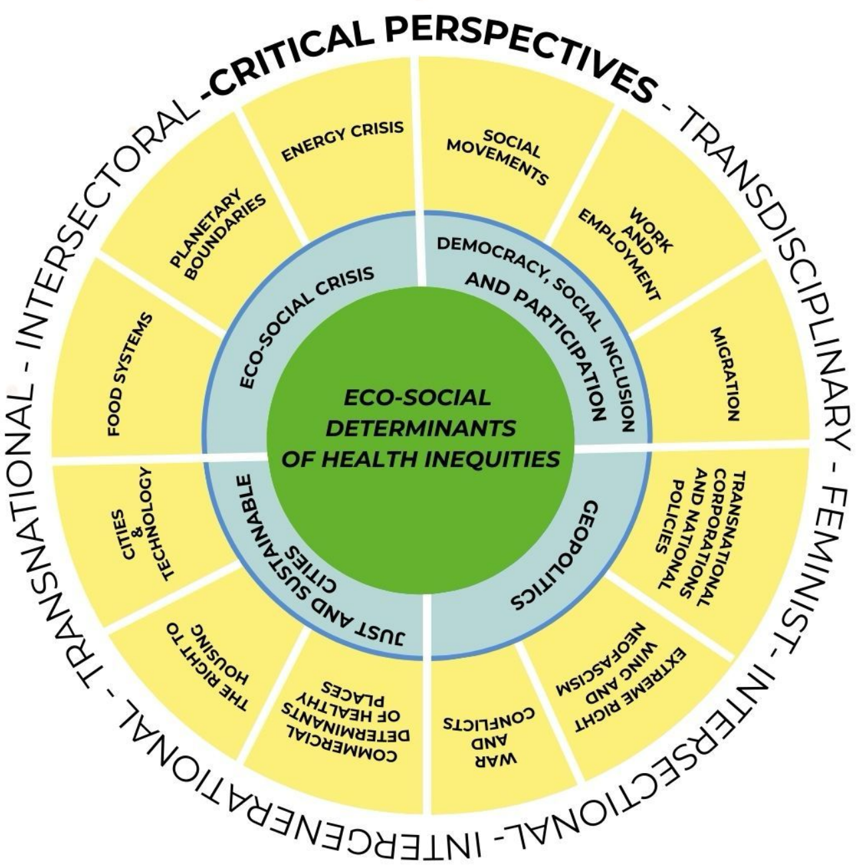
The current eco-social crisis is driven by an unsustainable socioeconomic model based on continued economic growth that exceeds planetary limits. Groups experiencing disadvantages are being disproportionately affected, further deepening global, regional, and local health inequities. Understanding the simultaneous ecological and social crises through a comprehensive approach across disciplines and sectors-including citizen participation-is essential for driving transformative change and paradigm shifts. Achieving genuine ecological sustainability, social justice, and health equity is critical for transitioning towards a new social-ecological paradigm in research and policy. This requires transformative research and policymaking in key areas-eco-social crisis; democracy, social inclusion and participation; geopolitics; and equitable, sustainable cities-all of which represent pressing challenges within this global crisis, and serve as thematic axes for the European conference Rethinking the Eco-Social Determinants of Health Inequities through the Transdisciplinary and Intersectoral Lens (ESDHI-EU), which will be held in Barcelona, Spain, on May 22-23, 2025, and will explore the root causes of health inequities from a transdisciplinary, intersectoral, and transnational perspective.
Overview
CoChat Summary
## TL;DR
This paper is a conference report/overview arguing that health inequities are driven by interconnected eco-social, political, and urban systems and that they require transdisciplinary, intersectoral, and transnational responses. It frames the ESDHI-EU conference (May 22–23, 2025) around four themes: eco-social crisis, democracy/social inclusion/participation, geopolitics, and just and sustainable cities.
## Key findings
- The paper states that the current eco-social crisis is driven by an unsustainable socioeconomic model based on continued economic growth that exceeds planetary limits, and that disadvantaged groups are disproportionately affected.
- It reports that six of the nine planetary boundaries have already been exceeded, and that current extinction rates have surged approximately 1,000 times faster than those reported before the industrial revolution.
- It states that more than half of the global population lives in cities and that this proportion is expected to exceed 70% by 2070.
- It gives several equity-related figures, including that approximately two billion workers worldwide have precarious jobs that lack social protection, and that the global migrant population reached 281 million in 2020.
## Methods
- The article is a report/position-style conference paper, not an empirical study.
- It synthesizes prior literature and policy sources to build a conceptual discussion of eco-social determinants of health inequities.
- It organizes the discussion around four conference workshop themes: eco-social crisis; democracy, social inclusion, and participation; geopolitics; and just and sustainable cities.
## Limitations
- The paper does not present a primary study design, sample, data collection, or statistical analysis; this is evident from the text.
- It is a conceptual and narrative overview centered on a conference, so its claims are not tested with new empirical data; this is evident from the text.
- Not stated in the paper.
Model-written summary. Check it against the paper before relying on it.
Integrity signals
Registry
Cites
Statistics
Figures


Verification
Claims the paper makes
18 Valid · 9 Not valid · 61 Not checked · 21 Own results and interpretations
Every source the paper cites for this claim was checked and supports it.
In the paper
“In this context, the structural determinants of health-underlying structures and mechanisms that establish, maintain, or eliminate hierarchical advantages within social groups regarding health-reflect these power dynamics.”
What the sources say
- Supportedcites [9] 9. Thimm-Kaiser M, Benzekri A, Guilamo-Ramos V. Conceptualizing the Mechanisms of Social Determinants of Health: A Heuristic Framework to Inform Future source
The section “SDOH Are Underlying Causes of Health Inequities” (page not available in our copy) describes health inequities as arising from social stratification based on wealth, power, and prestige. “Underlying Factors” describes policies, norms, and unjust social processes as shaping interactions among groups and institutions that affect health. Together, these passages support the paraphrase that structural determinants reflect power dynamics. (LLM, conf=0.86)
- Supportedcites [10] matched to “A novel conceptual model and heuristic tool to strengthen understanding and capacities for health inequalities research” (2020) source
The Introduction describes structural determinants as upstream social mechanisms embedded in hierarchies of power and access to resources. The Results section also says these determinants exert influence and power at intermediary levels, supporting the claim that they reflect power dynamics. (LLM, conf=0.92)
plainstates an association- Asserted: passes — The authors put it forward as true.
- Checkable: passes — It can be checked against evidence.
- Load-bearing: passes — The paper’s conclusions depend on it.
- Based: passes — The paper gives a reason why it holds.
- Supported
Every source the paper cites for this claim was checked and supports it.
In the paper
“Various power mechanisms, including economic and knowledge-based ones, serve as channels for power inequity (6).”
What the sources say
- Supportedcites [6] 6. McCartney G, Dickie E, Escobar O, Collins C. Health inequalities, fundamental causes and power: towards the practice of good theory. Sociol Health Illn . 2021;43(1):2039. doi:10.1111/1467-9566.13181 source
The ‘Operationalising concepts and theories of power to explain health inequalities’ section and Table 1 identify economic and knowledge as sources of power and describe how each operates. The Discussion links unequal economic power and other forms of power to inequalities, supporting the citing sentence’s paraphrase. Page numbers are not provided in the supplied passages. (LLM, conf=0.91)
plainstates a cause- Asserted: passes — The authors put it forward as true.
- Checkable: passes — It can be checked against evidence.
- Load-bearing: passes — The paper’s conclusions depend on it.
- Based: passes — The paper gives a reason why it holds.
- Supported
Every source the paper cites for this claim was checked and supports it.
In the paper
“In this regard, health inequities manifest broader systems of inequity shaped by sociopolitical power dynamics that systematically benefit elite groups over others.”
What the sources say
- Supportedcites [6] 6. McCartney G, Dickie E, Escobar O, Collins C. Health inequalities, fundamental causes and power: towards the practice of good theory. Sociol Health Illn . 2021;43(1):2039. doi:10.1111/1467-9566.13181 source
The Discussion (page not provided) describes health inequalities as arising from entrenched economic power imbalances and says more powerful groups can oppress or exploit others. The paper uses “health inequalities” for the unfair, systematic differences meant here; its Introduction notes that terminology varies. (LLM, conf=0.90)
plainstates a cause- Asserted: passes — The authors put it forward as true.
- Checkable: unclear — It is unclear whether it could be checked against evidence.
- Load-bearing: passes — The paper’s conclusions depend on it.
- Based: passes — The paper gives a reason why it holds.
- Supported
The cited sources that could be checked couldn’t confirm or dispute this claim.
In the paper
“Given that the economy functions as a subsystem within the finite biosphere, achieving real sustainable growth under these conditions remains highly improbable, if not impossible (48).”
What the sources say
- Could not verifycites [48] matched to “The 2021 report of the Lancet Countdown on health and climate change: code red for a healthy future” (2021) sourceExperimental — accuracy not yet measured
Section 4: economics and finance discusses a low-carbon transition and recommends a green recovery rather than business-as-usual growth. It does not address whether the economy is a subsystem of a finite biosphere or whether sustainable growth is improbable or impossible. Searches for those concepts and for green growth found no passage making the attributed claim; page numbers were not available in our copy. (LLM, conf=0.76)
hedged- Asserted: passes — The authors put it forward as true.
- Checkable: unclear — It is unclear whether it could be checked against evidence.
- Load-bearing: unclear — It is unclear whether the paper’s conclusions depend on it.
- Based: passes — The paper gives a reason why it holds.
- Could not verify
The cited sources support only part of this claim — read each source’s verdict below.
In the paper
“One of these key aspects is access to affordable, appropriate housing, which is becoming increasingly challenging for urban populations facing precarious housing conditions (133-135).”
What the sources say
- Not checked — no full text of the sourcecites [133] matched to “The ‘double precarity’ of employment insecurity and unaffordable housing and its impact on mental health” (2019) source
- Not matchedcites [134]
The reference list we hold has no entry [134].
- Partly supportedcites [135] matched to “Examining Psychosocial and Economic Barriers to Green Space Access for Racialised Individuals and Families: A Narrative Literature Review of the Evidence to Date” (2022) sourceExperimental — accuracy not yet measured
Section 1.7 (Gentrification; page unavailable) says BIPOC individuals and families may be unable to afford newly developed areas, supporting a narrower point about affordability. The paper does not establish a worsening lack of affordable, appropriate housing for urban populations generally or address precarious housing conditions. (LLM, conf=0.78)
plain- Asserted: passes — The authors put it forward as true.
- Checkable: passes — It can be checked against evidence.
- Load-bearing: unclear — It is unclear whether the paper’s conclusions depend on it.
- Based: passes — The paper gives a reason why it holds.
19 more claims · 1 with their cited sources checked
Create a free account to see all 109 claims and to verify the 23 references still open.
- Probably not a substantial claim. 64
- It may state two separate claims as one. 44
Citations
Cites
Food in the Anthropocene: the EAT–Lancet Commission on healthy diets from sustainable food systems
Willett, W., Rockström, J., Loken, B., Springmann, M., Lang, T., Vermeulen, S., Garnett, T., Tilman, D., DeClerck, F., Wood, A., et al. (2019) · The Lancet · doi:10.1016/s0140-6736(18)31788-4 · Cited by 10,880 · cited 2×
“52,59 Rooted in unsustainable and inequitable socioecological dynamics, the industrial agri-food model is a key driver of planetary health crises.”
Selections from the prison notebooks
Gramsci, A. (2020) · The Applied Theatre Reader · doi:10.4324/9780429355363-27 · Cited by 9,750
Planetary Boundaries: Exploring the Safe Operating Space for Humanity
Rockström, J., Steffen, W., Noone, K., Persson, Å., Chapin, F. S. I., Lambin, E., Lenton, T. M., Scheffer, M., Folke, C., Schellnhuber, H. J., et al. (2009) · Ecology and Society · doi:10.5751/es-03180-140232 · Cited by 7,187 · cited 1×
“54,55 Gupta and colleagues proposed the safe and just Earth system boundaries (ESBs) conceptual framework to promote a healthy planet that articulates the notion of Earth-system justice.”
World Urbanization Prospects: The 1996 Revision
Brockerhoff, M., & Nations, U. (1998) · Population and Development Review · doi:10.2307/2808041 · Cited by 5,881
Earth beyond six of nine planetary boundaries
Richardson, K., Steffen, W., Lucht, W., Bendtsen, J., Cornell, S. E., Donges, J. F., Drüke, M., Fetzer, I., Bala, G., von Bloh, W., et al. (2023) · Science Advances · doi:10.1126/sciadv.adh2458 · Cited by 3,311 · cited 1×
“54,55 Gupta and colleagues proposed the safe and just Earth system boundaries (ESBs) conceptual framework to promote a healthy planet that articulates the notion of Earth-system justice.”
The Global Syndemic of Obesity, Undernutrition, and Climate Change: The Lancet Commission report
Swinburn, B. A., Kraak, V. I., Allender, S., Atkins, V. J., Baker, P. I., Bogard, J. R., Brinsden, H., Calvillo, A., De Schutter, O., Devarajan, R., et al. (2019) · The Lancet · doi:10.1016/s0140-6736(18)32822-8 · Cited by 3,081
Whitmee, S., Haines, A., Beyrer, C., Boltz, F., Capon, A. G., de Souza Dias, B. F., Ezeh, A., Frumkin, H., Gong, P., Head, P., et al. (2015) · The Lancet · doi:10.1016/s0140-6736(15)60901-1 · Cited by 2,998 · cited 1×
“123,124 130 Numerous aspects of urban development pose signi fi cant challenges to public and planetary health.”
Transdisciplinary research in sustainability science: Practice, principles, and challenges
Lang, D. J., Wiek, A., Bergmann, M., Stauffacher, M., Martens, P., Moll, P., Swilling, M., & Thomas, C. J. (2012) · Sustainability Science · doi:10.1007/s11625-011-0149-x · Cited by 2,925 · cited 1×
“22,23 Planetary health offers a unique framework that underscores the necessity of integrating knowledge across the interconnected environment, health, and society.”
A Conceptual Framework for Action on the Social Determinants of Health
UNSPECIFIED (2010) · University Libraries (University of Maryland) · doi:10.13016/17cr-aqb9 · Cited by 2,325
The Concepts and Principles of Equity and Health
Whitehead, M. (1992) · International Journal of Health Services · doi:10.2190/986l-lhq6-2vte-yrrn · Cited by 2,284 · cited 1×
“5 In this regard, health inequities manifest broader systems of inequity shaped by sociopolitical power dynamics that systematically bene fi t elite groups over others.”
The 2021 report of the Lancet Countdown on health and climate change: code red for a healthy future
Romanello, M., McGushin, A., Di Napoli, C., Drummond, P., Hughes, N., Jamart, L., Kennard, H., Lampard, P., Solano Rodriguez, B., Arnell, N., et al. (2021) · The Lancet · doi:10.1016/s0140-6736(21)01787-6 · Cited by 1,603
Precarious Employment: Understanding an Emerging Social Determinant of Health
Benach, J., Vives, A., Amable, M., Vanroelen, C., Tarafa, G., & Muntaner, C. (2014) · Annual Review of Public Health · doi:10.1146/annurev-publhealth-032013-182500 · Cited by 1,354
Self-citationThe UCL–Lancet Commission on Migration and Health: the health of a world on the move
Abubakar, I., Aldridge, R. W., Devakumar, D., Orcutt, M., Burns, R., Barreto, M. L., Dhavan, P., Fouad, F. M., Groce, N., Guo, Y., et al. (2018) · The Lancet · doi:10.1016/s0140-6736(18)32114-7 · Cited by 941
Romanello, M., Walawender, M., Hsu, S.-C., Moskeland, A., Palmeiro-Silva, Y., Scamman, D., Ali, Z., Ameli, N., Angelova, D., Ayeb-Karlsson, S., et al. (2024) · The Lancet · doi:10.1016/s0140-6736(24)01822-1 · Cited by 897
Democracy and the “Washington consensus”
Williamson, J. (1993) · World Development · doi:10.1016/0305-750x(93)90046-c · Cited by 874 · cited 2×
“…of international organizations such as the International Monetary Fund and the World Trade Organization, 106 supported by the Washington Consensus, 107,108 a set of neoliberal policies or free-market prescriptions implemented in Latin America in the 1950s, which caused the liberalization,…”
The commercial determinants of health
Kickbusch, I., Allen, L., & Franz, C. (2016) · The Lancet Global Health · doi:10.1016/s2214-109x(16)30217-0 · Cited by 782
Defining and conceptualising the commercial determinants of health
Gilmore, A. B., Fabbri, A., Baum, F., Bertscher, A., Bondy, K., Chang, H.-J., Demaio, S., Erzse, A., Freudenberg, N., Friel, S., et al. (2023) · The Lancet · doi:10.1016/s0140-6736(23)00013-2 · Cited by 758 · cited 5×
“143 – 145 In urban places, the high density of outlets selling ultra-processed foods, tobacco, and alcohol, combined with pervasive advertising, signi fi - cantly exacerbates health risks, fueling the rise of noncom-municable diseases, including diabetes, obesity, and cardiovascular conditions.”
InfluentialEmerging human infectious diseases and the links to global food production
Rohr, J. R., Barrett, C. B., Civitello, D. J., Craft, M. E., Delius, B., DeLeo, G. A., Hudson, P. J., Jouanard, N., Nguyen, K. H., Ostfeld, R. S., et al. (2019) · Nature Sustainability · doi:10.1038/s41893-019-0293-3 · Cited by 722 · cited 1×
“51,60 Indeed, the dominant food system model struggles to equitably provide healthy diets, 59 as half of the world ’ s population faces hunger, food insecurity, or malnutrition, highlighting its dysfunction.”
(1949) · American Journal of International Law · doi:10.2307/2213979 · Cited by 664
Providing decent living with minimum energy: A global scenario
Millward-Hopkins, J., Steinberger, J. K., Rao, N. D., & Oswald, Y. (2020) · Global Environmental Change · doi:10.1016/j.gloenvcha.2020.102168 · Cited by 558
Building Resilience to Climate Change in Informal Settlements
Satterthwaite, D., Archer, D., Colenbrander, S., Dodman, D., Hardoy, J., Mitlin, D., & Patel, S. (2020) · One Earth · doi:10.1016/j.oneear.2020.02.002 · Cited by 547
Housing as a determinant of health equity: A conceptual model
Swope, C. B., & Hernández, D. (2019) · Social Science & Medicine · doi:10.1016/j.socscimed.2019.112571 · Cited by 545 · cited 1×
“131 Another key aspect is promoting healthier commercial practices while tackling those that harm public health and the environment.”
2 A Short History of the Washington Consensus
Williamson, J. (2008) · The Washington Consensus Reconsidered · doi:10.1093/acprof:oso/9780199534081.003.0002 · Cited by 535
A systematic review of a digital twin city: A new pattern of urban governance toward smart cities
Deng, T., Zhang, K., & Shen, Z.-J. (. (2021) · Journal of Management Science and Engineering · doi:10.1016/j.jmse.2021.03.003 · Cited by 532
Anguelovski, I., Connolly, J. J. T., Masip, L., & Pearsall, H. (2018) · Urban Geography · doi:10.1080/02723638.2017.1349987 · Cited by 521
A taxonomy of interdisciplinarity
Klein, J. T. (2010) · Cited by 501
Green gentrification in European and North American cities
Anguelovski, I., Connolly, J. J. T., Cole, H., Garcia-Lamarca, M., Triguero-Mas, M., Baró, F., Martin, N., Conesa, D., Shokry, G., del Pulgar, C. P., et al. (2022) · Nature Communications · doi:10.1038/s41467-022-31572-1 · Cited by 471
The global urban housing affordability crisis
Wetzstein, S. (2017) · Urban Studies · doi:10.1177/0042098017711649 · Cited by 468 · cited 1×
“132 This primarily affects racialized, young, and lower income households 31 and impacts individuals ’ experiences and health in diverse ways.”
What does degrowth mean? A few points of clarification
Hickel, J. (2021) · Globalizations · doi:10.1080/14747731.2020.1812222 · Cited by 401 · cited 2×
“46 Given that the economy functions as a subsystem within the fi nite bio-sphere, achieving real sustainable growth under these conditions remains highly improbable, if not impossible.”
Alderwick, H., Hutchings, A., Briggs, A., & Mays, N. (2021) · BMC Public Health · doi:10.1186/s12889-021-10630-1 · Cited by 386
Smart cities survey: Technologies, application domains and challenges for the cities of the future
Sánchez-Corcuera, R., Nuñez-Marcos, A., Sesma-Solance, J., Bilbao-Jayo, A., Mulero, R., Zulaika, U., Azkune, G., & Almeida, A. (2019) · International Journal of Distributed Sensor Networks · doi:10.1177/1550147719853984 · Cited by 331
Amorim-Maia, A. T., Anguelovski, I., Chu, E., & Connolly, J. (2022) · Urban Climate · doi:10.1016/j.uclim.2021.101053 · Cited by 328
Rethinking Care Ethics: On the Promise and Potential of an Intersectional Analysis
HANKIVSKY, O. (2014) · American Political Science Review · doi:10.1017/s0003055414000094 · Cited by 287 · cited 1×
“14 Intersectionality is key for understanding, confronting, and transforming the entrenched, interlocking power inequalities.”
Vives, A., Amable, M., Ferrer, M., Moncada, S., Llorens, C., Muntaner, C., Benavides, F. G., & Benach, J. (2010) · Occupational and Environmental Medicine · doi:10.1136/oem.2009.048967 · Cited by 285 · cited 1×
“53 Long working hours, night shifts, and irregular schedules signi fi cantly adversely affect workers ’ health, 78 as does the gender pay gap, racial discrimination in wages, and lower earnings for differently abled individuals.”
Self-citationPost-growth: the science of wellbeing within planetary boundaries
Kallis, G., Hickel, J., O’Neill, D. W., Jackson, T., Victor, P. A., Raworth, K., Schor, J. B., Steinberger, J. K., & Ürge-Vorsatz, D. (2025) · The Lancet Planetary Health · doi:10.1016/s2542-5196(24)00310-3 · Cited by 261 · cited 1×
“58 Thus, addressing Earth-system justice requires moving beyond technical or regulatory fi xes to a comprehensive and transformative critique of economic systems perpetuating ecological breakdown.”
Benach, J., Vives, A., Tarafa, G., Delclos, C., & Muntaner, C. (2016) · International Journal of Epidemiology · doi:10.1093/ije/dyv342 · Cited by 237
Self-citationUrban Systems and Other Settlements
Change, I. P. O. C. (2023) · Cambridge University Press eBooks · doi:10.1017/9781009157926.010 · Cited by 234
Hickel, J., O’Neill, D. W., Fanning, A. L., & Zoomkawala, H. (2022) · The Lancet Planetary Health · doi:10.1016/s2542-5196(22)00044-4 · Cited by 229 · cited 4×
“45 A growing body of critical literature addresses the limitations of the growth paradigm, which was highlighted by the Club of Rome as early as the 1970s.”
InfluentialCommercial determinants of health: future directions
Friel, S., Collin, J., Daube, M., Depoux, A., Freudenberg, N., Gilmore, A. B., Johns, P., Laar, A., Marten, R., McKee, M., et al. (2023) · The Lancet · doi:10.1016/s0140-6736(23)00011-9 · Cited by 204
Brock, A., Sovacool, B. K., & Hook, A. (2021) · Annals of the American Association of Geographers · doi:10.1080/24694452.2020.1856638 · Cited by 199
Gupta, J., Bai, X., Liverman, D. M., Rockström, J., Qin, D., Stewart-Koster, B., Rocha, J. C., Jacobson, L., Abrams, J. F., Andersen, L. S., et al. (2024) · The Lancet Planetary Health · doi:10.1016/s2542-5196(24)00042-1 · Cited by 197 · cited 2×
“12 For this reason, creating dialog spaces that facilitate knowledge exchange across diverse disciplines, sectors, and approaches is essential for successfully understanding and addressing the ESDHI.”
Transdisciplinarity as a discipline and a way of being: complementarities and creative tensions
Rigolot, C. (2020) · Humanities and Social Sciences Communications · doi:10.1057/s41599-020-00598-5 · Cited by 194 · cited 1×
“22,23 Planetary health offers a unique framework that underscores the necessity of integrating knowledge across the interconnected environment, health, and society.”
Giles‐Corti, B., Moudon, A. V., Lowe, M., Cerin, E., Boeing, G., Frumkin, H., Salvo, D., Foster, S. A., Kleeman, A., Bekessy, S. A., et al. (2022) · The Lancet Global Health · doi:10.1016/s2214-109x(22)00066-3 · Cited by 193
The Difference That Power Makes: Intersectionality and Participatory Democracy
Hill Collins, P. (2017) · Investigaciones Feministas · doi:10.5209/infe.54888 · Cited by 192
Scholz, R. W., & Steiner, G. (2015) · Sustainability Science · doi:10.1007/s11625-015-0327-3 · Cited by 192
Determining the health benefits of green space: Does gentrification matter?
Cole, H. V. S., Triguero-Mas, M., Connolly, J. J. T., & Anguelovski, I. (2019) · Health & Place · doi:10.1016/j.healthplace.2019.02.001 · Cited by 191
Measuring Collaboration and Transdisciplinary Integration in Team Science
Mâsse, L. C., Moser, R. P., Stokols, D., Taylor, B. K., Marcus, S. E., Morgan, G. D., Hall, K. L., Croyle, R. T., & Trochim, W. M. (2008) · American Journal of Preventive Medicine · doi:10.1016/j.amepre.2008.05.020 · Cited by 181
Decent living gaps and energy needs around the world
Kikstra, J. S., Mastrucci, A., Min, J., Riahi, K., & Rao, N. D. (2021) · Environmental Research Letters · doi:10.1088/1748-9326/ac1c27 · Cited by 163
Transforming cities for sustainability: A health perspective
Crane, M., Lloyd, S., Haines, A., Ding, D., Hutchinson, E., Belesova, K., Davies, M., Osrin, D., Zimmermann, N., Capon, A., et al. (2021) · Environment International · doi:10.1016/j.envint.2020.106366 · Cited by 162
Organized violence 1989–2023, and the prevalence of organized crime groups
Davies, S., Engström, G., Pettersson, T., & Öberg, M. (2024) · Journal of Peace Research · doi:10.1177/00223433241262912 · Cited by 161
Kuruvilla, S., Hinton, R., Boerma, T., Bunney, R., Casamitjana, N., Cortez, R., Fracassi, P., Franz-Vasdeki, J., Helldén, D., McManus, J., et al. (2018) · BMJ · doi:10.1136/bmj.k4771 · Cited by 153 · cited 2×
“34 It also involves identifying the roles and priorities of each sector.”
Keeping the global consumption within the planetary boundaries
Tian, P., Zhong, H., Chen, X., Feng, K., Sun, L., Zhang, N., Shao, X., Liu, Y., & Hubacek, K. (2024) · Nature · doi:10.1038/s41586-024-08154-w · Cited by 142 · cited 1×
“57 Capitalism ’ s structural dependence on pro fi t-driven expansion accelerates the overshoot of these boundaries, undermining both biophysical stability and equi-table resource distribution.”
Weimann, A., & Oni, T. (2019) · International Journal of Environmental Research and Public Health · doi:10.3390/ijerph16193608 · Cited by 130
Existing climate mitigation scenarios perpetuate colonial inequalities
Hickel, J., & Slamersak, A. (2022) · The Lancet Planetary Health · doi:10.1016/s2542-5196(22)00092-4 · Cited by 127 · cited 2×
“56 As Hickel emphasized, this crisis is fundamentally rooted in capitalism ’ s imperative for relentless growth.”
Broadbent, P., Thomson, R., Kopasker, D., McCartney, G., Meier, P., Richiardi, M., McKee, M., & Katikireddi, S. V. (2023) · The Lancet Regional Health - Europe · doi:10.1016/j.lanepe.2023.100585 · Cited by 121
Towe, V. L., Leviton, L., Chandra, A., Sloan, J. C., Tait, M., & Orleans, T. (2016) · Health Affairs · doi:10.1377/hlthaff.2016.0604 · Cited by 121
Smart cities and urban inequality
Caragliu, A., & Bo, C. D. (2021) · Regional Studies · doi:10.1080/00343404.2021.1984421 · Cited by 117
THIMM‐KAISER, M., BENZEKRI, A., & GUILAMO‐RAMOS, V. (2023) · The Milbank Quarterly · doi:10.1111/1468-0009.12642 · Cited by 114 · cited 1×
“9,10 While scienti fi c and political approaches have offered valuable insights, they are often con fi ned to narrow, overly speci fi c analyses and sector-speci fi c interventions.”
Bentley, R., Baker, E., & Aitken, Z. (2019) · Social Science & Medicine · doi:10.1016/j.socscimed.2019.02.008 · Cited by 113 · cited 2×
“133,137,138 Living in damp housing poses signi fi cant health risks; for example, there is a wealth of evidence on the associations between household dampness and mold, as well as respiratory conditions in children.”
The Role of Social Determinants of Health in Promoting Health Equality: A Narrative Review
Chelak, K., & Chakole, S. (2023) · Cureus · doi:10.7759/cureus.33425 · Cited by 113 · cited 1×
“7 Gramsci explains that the ruling class sus-tains itself by maintaining hegemony, disseminating ruling ideas throughout society, and fostering legitimacy and consent.”
Why it's time for Doughnut Economics
Raworth, K. (2017) · IPPR Progressive Review · doi:10.1111/newe.12058 · Cited by 113
The Mental Health Effects of Housing Tenure: Causal or Compositional?
Baker, E., Bentley, R., & Mason, K. (2013) · Urban Studies · doi:10.1177/0042098012446992 · Cited by 113
Health inequalities, fundamental causes and power: towards the practice of good theory
McCartney, G., Dickie, E., Escobar, O., & Collins, C. (2021) · Sociology of Health & Illness · doi:10.1111/1467-9566.13181 · Cited by 110 · cited 1×
“6 Economic power, for instance, manifests in multiple ways, often reinforcing existing social hierarchies.”
Emissions savings from equitable energy demand reduction
Büchs, M., Cass, N., Mullen, C., Lucas, K., & Ivanova, D. (2023) · Nature Energy · doi:10.1038/s41560-023-01283-y · Cited by 87 · cited 1×
“65 For example, the energy consumed annually for transporting fossil fuels across continents accounts for approximately 10 percent of the world ’ s total energy use.”
Making transdisciplinarity happen: Phase 0, or before the beginning
Horcea-Milcu, A.-I., Leventon, J., & Lang, D. J. (2022) · Environmental Science & Policy · doi:10.1016/j.envsci.2022.05.019 · Cited by 81 · cited 1×
“20,21 Amidst unparalleled global crises, transdisciplinarity is gaining recognition as a valuable approach to knowledge production and decision-making.”
Learning from intersectoral action beyond health: a meta-narrative review
Mondal, S., Van Belle, S., & Maioni, A. (2021) · Health Policy and Planning · doi:10.1093/heapol/czaa163 · Cited by 77
Two Scenarios for Sustainable Welfare: A Framework for an Eco-Social Contract
Gough, I. (2022) · Social Policy and Society · doi:10.1017/s1474746421000701 · Cited by 73 · cited 1×
“38 Hence, collaborative efforts must be based on democratic debate and public participation.”
Buttazzoni, A. N., Veenhof, M., & Minaker, L. M. (2020) · International Journal of Environmental Research and Public Health · doi:10.3390/ijerph17072325 · Cited by 71
The determinants of planetary health
Redvers, N. (2021) · The Lancet Planetary Health · doi:10.1016/s2542-5196(21)00008-5 · Cited by 65
An umbrella review of intersectoral and multisectoral approaches to health policy
Amri, M., Chatur, A., & O'Campo, P. (2022) · Social Science & Medicine · doi:10.1016/j.socscimed.2022.115469 · Cited by 61 · cited 1×
“25,27 The fi rst World Health Organization (WHO) International Conference on Health Promotion in Ottawa in 1986 presented the Ottawa Charter for Action to achieve “ Health for All.”
Agro-food systems and environment: Sustaining the unsustainable
Araújo, R. G., Chavez-Santoscoy, R. A., Parra-Saldívar, R., Melchor-Martínez, E. M., & Iqbal, H. M. N. (2023) · Current Opinion in Environmental Science & Health · doi:10.1016/j.coesh.2022.100413 · Cited by 60
Alexiou, A., Mason, K., Fahy, K., Taylor-Robinson, D. C., & Barr, B. (2021) · International Journal of Housing Policy · doi:10.1080/19491247.2021.2002660 · Cited by 59
Robinson, T., Robertson, N., Curtis, F., Darko, N., & Jones, C. R. (2022) · International Journal of Environmental Research and Public Health · doi:10.3390/ijerph20010745 · Cited by 58 · cited 1×
“135 Unaffordable housing reduces disposable income for essentials such as heating and food among lower income households, exacer-bating health inequities.”
Merz, S., Jaehn, P., Mena, E., Pöge, K., Strasser, S., Saß, A.-C., Rommel, A., Bolte, G., & Holmberg, C. (2023) · Critical Public Health · doi:10.1080/09581596.2021.1951668 · Cited by 56
Clasen, T., & Smith, K. R. (2019) · Environmental Health Perspectives · doi:10.1289/ehp4752 · Cited by 54
Biodiversity loss due to more than climate change
Dobson, A., Rowe, Z., Berger, J., Wholey, P., & Caro, T. (2021) · Science · doi:10.1126/science.abm6216 · Cited by 51
Schlembach, R. (2018) · Social Movement Studies · doi:10.1080/14742837.2018.1480934 · Cited by 50 · cited 1×
“84 The rights to peaceful protest and free expression remain unprotected in many countries, and the labeling of nonviolent protests as terrorism has recently intensi fi ed in the Global North.”
La salud de las personas adultas afectadas por un proceso de desahucio
Muñoz, J. B., Solano, M. B., Rodríguez, I. M., Daponte, A., Espinosa, C. E., Sánchez-Cantalejo, C., Usera, I. G., Ortega, H. R., Mata, J. L., Fernández‐Santaella, M. C., et al. (2015) · Gaceta Sanitaria · doi:10.1016/j.gaceta.2015.10.002 · Cited by 48
(2023) · doi:10.1186/s12889-022-14960-6 · Cited by 47
Self-citationTowards ‘smart cities’ as ‘healthy cities’: health equity in a digital age
Mouton, M., Ducey, A., Green, J., Hardcastle, L. E., Hoffman, S. J., Leslie, M., & Rock, M. J. (2019) · Canadian Journal of Public Health · doi:10.17269/s41997-019-00177-5 · Cited by 45
McDaid, D., & Park, A. (2016) · London School of Economics and Political Science Research Online (London School of Economics and Political Science) · Cited by 44
Food systems, nutrition, health and the environment
Dangour, A. D., Mace, G., & Shankar, B. (2017) · The Lancet Planetary Health · doi:10.1016/s2542-5196(17)30004-9 · Cited by 40 · cited 2×
“52,59 Rooted in unsustainable and inequitable socioecological dynamics, the industrial agri-food model is a key driver of planetary health crises.”
Calderón-Villarreal, A., Terry, B., Friedman, J., González-Olachea, S. A., Chavez, A., Díaz López, M., Pacheco Bufanda, L., Martinez, C., Medina Ponce, S. E., Cázares-Adame, R., et al. (2022) · Social Science & Medicine · doi:10.1016/j.socscimed.2022.115044 · Cited by 40
The risks of invisibilization of populations and places in environment-migration research
Borderon, M., Best, K. B., Bailey, K., Hopping, D. L., Dove, M., & Cervantes de Blois, C. L. (2021) · Humanities and Social Sciences Communications · doi:10.1057/s41599-021-00999-0 · Cited by 38
Do green neighbourhoods promote urban health justice?
Anguelovski, I., Cole, H., Connolly, J., & Triguero-Mas, M. (2018) · The Lancet Public Health · doi:10.1016/s2468-2667(18)30096-3 · Cited by 37
Understanding geopolitical determinants of health
Persaud, A., Bhugra, D., Valsraj, K., & Bhavsar, V. (2021) · Bulletin of the World Health Organization · doi:10.2471/blt.20.254904 · Cited by 35 · cited 1×
“101 In a globalized world, transnational corporations can play a decisive role in shaping national policies, often exerting undue in fl uence on governments to maintain deregulated markets, exploit natural resources, and weaken environmental protection.”
Aronczyk, M. (2023) · Nations and Nationalism · doi:10.1111/nana.12942 · Cited by 34
Achieving health for all requires action on the economic and commercial determinants of health
Ghebreyesus, T. A. (2023) · The Lancet · doi:10.1016/s0140-6736(23)00574-3 · Cited by 32
Hammer, A. (2019) · Review of International Political Economy · doi:10.1080/09692290.2018.1554537 · Cited by 32 · cited 1×
“53 Exploiting natural resources to drive industrial food production and energy depletes the planet ’ s fi nite resources and accelerates environmental degradation, fueling increased pollution, biodiversity loss, and climate change.”
The Need for a Transdisciplinary, Global Health Framework
Picard, M., Sabiston, C. M., & McNamara, J. K. (2011) · The Journal of Alternative and Complementary Medicine · doi:10.1089/acm.2010.0149 · Cited by 28 · cited 1×
“20,21 Amidst unparalleled global crises, transdisciplinarity is gaining recognition as a valuable approach to knowledge production and decision-making.”
Trowbridge, J., Tan, J. Y., Hussain, S., Osman, A. E. B., & Di Ruggiero, E. (2022) · International Journal of Public Health · doi:10.3389/ijph.2022.1604351 · Cited by 26 · cited 2×
“31 A systematic approach is necessary to identify interactions between different sectors to address the current eco-social crisis.”
Makki, M., Butt, F. A., Akash, S. A., Petrova, K., & Naeem, S. A. (2024) · Alternatives Global Local Political · doi:10.1177/03043754241291728 · Cited by 26
Climate change, health, and discrimination: action towards racial justice
Deivanayagam, T. A., Selvarajah, S., Hickel, J., Guinto, R. R., de Morais Sato, P., Bonifacio, J., English, S., Huq, M., Issa, R., Mulindwa, H., et al. (2023) · The Lancet · doi:10.1016/s0140-6736(22)02182-1 · Cited by 25
Distributive food systems to build just and liveable futures
Moragues‐Faus, A. (2020) · Agriculture and Human Values · doi:10.1007/s10460-020-10087-9 · Cited by 25
Birss, M. (2017) · NACLA Report on the Americas · doi:10.1080/10714839.2017.1373958 · Cited by 24
Achieving health equity: democracy matters
Hanefeld, J., Reeves, A., Brown, C., & Östlin, P. (2019) · The Lancet · doi:10.1016/s0140-6736(19)32128-2 · Cited by 23
Securitizing migration in times of crisis: private actors and the provision of (in)security
Gifra, L. P. (2024) · Cogent Social Sciences · doi:10.1080/23311886.2023.2296601 · Cited by 22
Right-wing Populism vs. Climate Capitalism: Climate Change Governance Under Scrutiny
Gomes, M. V. P., & Böhm, S. (2023) · Oxford University Press eBooks · doi:10.1093/oso/9780192894335.003.0012 · Cited by 21
Healthy Urbanism: Designing and Planning Equitable, Sustainable and Inclusive Places
Pineo, H. (2022) · Planning, Environment, Cities · doi:10.1007/978-981-16-9647-3 · Cited by 20
Invisible and unequal: Unincorporated community status as a structural determinant of health
Gomez-Vidal, C., & Gomez, A. M. (2021) · Social Science & Medicine · doi:10.1016/j.socscimed.2021.114292 · Cited by 18
Pham, L. T., Kumar, P., Dahana, W. D., & Nguyen, D. H. (2023) · Journal of Global Health · doi:10.7189/jogh.13.03007 · Cited by 16
Towards a practice framework for transdisciplinary collaboration in planetary health
Wardani, J., Bos, J. J. (., Ramirez-Lovering, D., & Capon, A. G. (2024) · Global Sustainability · doi:10.1017/sus.2024.6 · Cited by 16 · cited 1×
“24 As these factors interact in complex and unexpected ways, a transdisciplinary and intersectoral approach is needed to better understand the causes, connections, and effects of determinants, processes, and mechanisms.”
Routledge Handbook of Latin America and the Environment
(2023) · doi:10.4324/9780429344428 · Cited by 16
Cash-Gibson, L., Harris, M., Guerra, G., & Benach, J. (2020) · Health Research Policy and Systems · doi:10.1186/s12961-020-00559-z · Cited by 15 · cited 1×
“9,10 While scienti fi c and political approaches have offered valuable insights, they are often con fi ned to narrow, overly speci fi c analyses and sector-speci fi c interventions.”
Self-citationBettini, G., & Casaglia, A. (2024) · Geoforum · doi:10.1016/j.geoforum.2024.104079 · Cited by 15
Newman, J., Mukherjee, A., & Hoole, C. (2023) · Journal of Environmental Policy & Planning · doi:10.1080/1523908x.2023.2297793 · Cited by 15
Struggles for Health: An Emancipatory Approach in the Era of Neoliberal Globalization
Sengupta, A., Bodini, C., & Franco, S. (2018) · Development · doi:10.1057/s41301-018-0196-z · Cited by 12 · cited 1×
“105 This hegemonic project has been facilitated by the global power and in fl uence of international organizations such as the International Monetary Fund and the World Trade Organization, 106 supported by the Washington Consensus, 107,108 a set of neoliberal policies or free-market prescriptions…”
Tracking migration and health inequities
Vidal, E. M., & Wickramage, K. P. (2024) · Bulletin of the World Health Organization · doi:10.2471/blt.23.290776 · Cited by 11
Wilson, M. G., Nidumolu, A., Berditchevskaia, I., Gauvin, F.-P., Abelson, J., & Lavis, J. N. (2020) · Journal of Health Services Research & Policy · doi:10.1177/1355819619872221 · Cited by 7 · cited 1×
“40 Scienti fi c evidence is generated through formal and rigorous research processes that adhere to established methodological standards.”
Smart cities: health and safety for all
Ahmed, F., Ahmed, N., Heitmueller, A., Gray, M., & Atun, R. A. (2017) · The Lancet Public Health · doi:10.1016/s2468-2667(17)30156-1 · Cited by 6
Transdisciplinary Research (Transdisciplinarity)
Arnold, M. (2020) · Encyclopedia of Creativity, Invention, Innovation and Entrepreneurship · doi:10.1007/978-3-319-15347-6_337 · Cited by 5 · cited 2×
“18 Transdisciplinary approaches are increasingly recognized as essential for addressing today ’ s socioecological crisis, given that global challenges — such as climate change, environmental degradation, and pandemics — are profoundly inter-connected and demand systemic and integrative solutions.”
Latin America Since the 1990s: Deindustrialization, Reprimarization and Policy Space Restrictions
Ahumada, J. M. (2019) · Springer eBooks · doi:10.1007/978-3-030-10743-7_3 · Cited by 5
Visser, B., & Pali, B. (2025) · Justice, Power and Resistance · doi:10.1332/26352338y2024d000000030 · Cited by 4
The Anthropocene as framed by the far right
Bailey, D., & Turner, J. (2023) · IPPR Progressive Review · doi:10.1111/newe.12329 · Cited by 4
The LSE Undergraduate political review
(2016) · Cited by 3
The rise of ecofascism: climate change and the far right
Farhan, A. (2024) · International Affairs · doi:10.1093/ia/iiad314 · Cited by 3
Marginality, Migration and Education
(2020) · doi:10.1007/978-3-030-60873-6 · Cited by 2
Shekhawat, S., Mahapatra, D. A., & Re, E. C. D. (2018) · Women and Borders · doi:10.5040/9781350989801.0005
Research works printed but not linked: 13
- 3. . 3. WHO Commission on Social Determinants of Health, World Health
- 5. For Peer Review Organization. Closing the Gap in a Generation: Health Equity through Action on the Social Determinants of Health: Commission on Social Determinants of Health Final Report . World Health Organization; 2008.
- First International Conference on Health Promotion Ottawa 21 November 1986. Accessed April 2 2025. https://www.who.int/teams/health-promotion/enhanced-wellbeing/first-global-conference.
- WHO. Jakarta Declaration on Leading Health Promotion into the 21st Century; 1997. https://www.who.int/teams/health-promotion/enhanced-wellbeing/fourth-global-conference/jakarta-declaration.
- Wrong DH. Problems in defining power. In: Power. Routledge; 1995:1-20.
- Daly H. Growthism: Its ecological, economic and ethical limits. Real-World Econ Rev. 2019;87:9–22.
- Marmot M World Health Organization UCL Institute of Health Equity eds. Review of Social Determinants and the Health Divide in the WHO European Region: Final Report. World Health Organization Regional Office for Europe; 2014.
- Marmot M Allen J Goldblatt P Boyce T Morrison J. Marmot Review 10 Years On. Institute of Health Equity UCL; 2020. Accessed January 24 2024. https://www.instituteofhealthequity.org/resources-reports/marmot-review-10-years-on/the-marmot-review-10-years-on-full-report.pdf.
- Fonteneau B Neamtan N Wanyama F Morais LP de Poorter M. In support of the First edition of the Social and Solidarity Economy Academy 25 −29th October 2010 ITC ILO Turin Italy.
- Environmental Movement - an overview | ScienceDirect Topics. Accessed February 13 2025. https://www.sciencedirect.com/topics/computer-science/environmental-movement.
- Hujo K, Carter M. Crises of Inequality: Shifting Power for a New Eco-Social Contract. UNRISD; 2022.
- United Nations. General Assembly. Universal Declaration of Human Rights. Vol 3381. Department of State, United States of America; 1949.
- Washburn D, Sindhu U, Balaouras S, Dines RA, Hayes N, Nelson LE. Helping CIOs understand “smart city” initiatives. Growth. 2009;17(2):1–17.
Cited by
Health & nature: a critical review of historical perspectives to support narratives for change
Amengual-Moreno, M., Cash‐Gibson, L., Vivas, L., Martínez‐Herrera, E., Gómez, A. A., Pericàs, J. M., & Benach, J. (2025) · International Journal for Equity in Health · doi:10.1186/s12939-025-02550-y · Cited by 7
Self-citationFossil Health: Deconstructing the Health and Energy Relationship to Reimagine a Viable Future
Vivas, L., Cash‐Gibson, L., & Chiabai, A. (2026) · International Journal of Social Determinants of Health and Health Services · doi:10.1177/27551938261419437 · Cited by 4
Self-citationPrecarious Work and Mental Health: Research and Policy
Ruisoto, P., Muntané, F., Muntaner, C., & Benach, J. (2026) · Handbook series in occupational health sciences · doi:10.1007/978-3-031-88856-4_34-1
Self-citation
Metadata
- Authors
- Morrison, J., Tumas, N., Moreno Mattar, O., Gutiérrez-Zamora Navarro, M., Pericas, J. M., Martínez Herrera, E., Cash-Gibson, L., Caroz Armayones, J. M., Ruisoto, P., Zografos, C., Rodríguez Labajos, B., Vergés Vega, P., Londoño, Á., Bautista, M., Karaguesian, C., Nuñez, D., Muntané, F., Jiménez, H., Vivas, L., Velásquez, L., Hsu, P.-Y., Muntaner, C., Benach, J., & Ribbons, A.
- Affiliations
- Universitat Pompeu Fabra (ES)
- Consejo Nacional de Investigaciones Científicas y Técnicas (AR)
- JHU-UPF Public Policy Center (JHU-UPF PPC), Universitat Pompeu Fabra (UPF) — UPF Barcelona School of Management (UPF-BSM), Barcelona, Spain
- Vall d'Hebron University Hospital- VHIR, Barcelona, Spain
- Universidad Pública de Navarra (UPNA) (ES)
- Department of Political and Social Sciences, Universitat Pompeu Fabra, Barcelona, Spain
- Corresponding author
- Morrison, Joana
- ORCID
- Venue
- International Journal of Social Determinants of Health and Health Services
- Publisher
- SAGE Publications
- Published
- 2025-05-21
- Volume
- 55
- Issue
- 4
- Pages
- 388-401
- ISSN
- 2755-1938 (ISSN-L)
- 2755-1946
- OpenAlex
- W4410554660
- Cited by
- 4
- References
- 124
- Citations by year
- 2026: 3 · 2025: 1
- FWCI
- 4.46
- Type
- journal article
- Language
- en
- Update notices
- correction (2025-07-15)
- Open access
- green
- hdl.handle.net
- Licence
- cc-by-nc-sa
- journals.sagepub.com/page/policies/text-and-data-mining-license (tdm)
- Locations
- International Journal of Social Determinants of Health and Health Services (publishedVersion)
- PubMed (publishedVersion)
- Conicet (publishedVersion, cc-by-nc-sa)
- Academica-e (Universidad Pública de Navarra) (submittedVersion)
- Funders
- EU4H-2023-PJ action (grant agreement N° 101161285)
- Topics
- Social Sciences › Health › Public Health and Social Inequalities
- Health Sciences › Medicine › Public Health, Environmental and Occupational Health › Public Health Policies and Education
- Physical Sciences › Environmental Science › Health, Toxicology and Mutagenesis › Climate Change and Health Impacts
- Keywords
- health disparities, transdisciplinary research, intersectoral collaboration, social justice, environmental sustainability, citizen participation, social inclusion, geopolitics, sustainable cities, transformative change, health policy
- MeSH terms
- Health Equity, Health Inequities, Congresses as Topic, Humans, Social Justice, Spain, Health Status Disparities, Social Determinants of Health
About these checks
Registry, retraction, Cites and statistics results are computed, not judged, with one exception: a printed reference that no index lists is read once by a model before it counts as a citation error. Claims are extracted by a model and kept only when their quote appears verbatim in the text; each cited source is then checked, with a model’s help, for whether it says what the claim relies on. Those verdicts can be wrong — read the claim’s quote and the cited source before relying on one.
The claim verdicts this report counts are experimental: their accuracy is not yet measured.
A language model drew the claims from the paper on 2026-10-10, under version 3 of the claim definition (model deepseek-v4.1-flash, prompt extract-v3).
A second model labelled each claim on 2026-10-10 (model jev-1.13-20260917, definition revision gold-guideline-v0.2).
Cited sources are checked with a language model’s help (gpt-6-sol).
Statistics and arithmetic are recomputed, not judged.
Confidence bands are shown only for fields calibrated on our annotated test set. None is calibrated yet, so no band is shown.
What counts as a claim ›How we measure confidence ›How we check this ›
Are you an author, or do you see a problem with this page? Request a review
Data sources
Bibliographic data: Semantic Scholar, OpenAlex, Crossref.
Contains information from the Semantic Scholar Academic Graph Datasets, made available under the ODC Attribution License (ODC-BY 1.0).
Semantic Scholar’s data is described in: Kinney, R., et al. (2023). The Semantic Scholar Open Data Platform. arXiv:2301.10140.
