

Perceived barriers and facilitators to mental health help-seeking in young people: a systematic review
Open accessThe DOI matches its Crossref record; 50 of the 51 references it cites were found in a registry or an index, and 1 are not checked yet.
Abstract
BACKGROUND: Adolescents and young adults frequently experience mental disorders, yet tend not to seek help. This systematic review aims to summarise reported barriers and facilitators of help-seeking in young people using both qualitative research from surveys, focus groups, and interviews and quantitative data from published surveys. It extends previous reviews through its systematic research methodology and by the inclusion of published studies describing what young people themselves perceive are the barriers and facilitators to help-seeking for common mental health problems. METHODS: Twenty two published studies of perceived barriers or facilitators in adolescents or young adults were identified through searches of PubMed, PsycInfo, and the Cochrane database. A thematic analysis was undertaken on the results reported in the qualitative literature and quantitative literature. RESULTS: Fifteen qualitative and seven quantitative studies were identified. Young people perceived stigma and embarrassment, problems recognising symptoms (poor mental health literacy), and a preference for self-reliance as the most important barriers to help-seeking. Facilitators were comparatively under-researched. However, there was evidence that young people perceived positive past experiences, and social support and encouragement from others as aids to the help-seeking process. CONCLUSIONS: Strategies for improving help-seeking by adolescents and young adults should focus on improving mental health literacy, reducing stigma, and taking into account the desire of young people for self-reliance.
Overview
The claims and statistics of this paper haven’t been checked yet.
Free: it reads the open-access text and checks the first 5 claims that cite a source we can check. Create a free account to check every claim.
Integrity signals
Registry
Cites
Statistics
Figures
Verification
Claims the paper makes
The claims and statistics of this paper haven’t been checked yet.
Free: it reads the open-access text and checks the first 5 claims that cite a source we can check. Create a free account to check every claim.
Claims other papers make about this one
Each is checked against this paper’s own text: does it say what the citing paper says it does?
The cited source doesn’t support the claim as written.
In the citing paper
“A previous systematic review demonstrated that a low level of MHL is the main barrier to seeking assistance [11].”
From Mental health literacy intervention on help-seeking in athletes: a systematic review (2020) · cites this paper as [11]
Checked by a reasoning model — may be wrong.
Experimental — accuracy not yet measuredThe source backs part of the claim, not all of it — or backs it for a different population, condition or comparison.
In the citing paper
“Despite this, the extant literature has extensively examined many barriers and facilitators impacting young people seeking help and has increased understanding on a range of personal, social, cultural, and service factors (Doan et al. 2020; Gulliver et al. 2010; Goodwin et al. 2016; Michelmore and Hindley 2012; Nam et al. 2010; Radez et al. 2021; Roth ì and Leavey 2006; Rowe et al. 2014).”
From "You Have the Choice of Whether You're Going to Get Help or Attempt Suicide": Exploring the Process and Impact of Mental Health Help-Seeking with Young People (16–25 Years) (2025) · cites this paper as Gulliver et al. 2010
Experimental — accuracy not yet measuredThe source backs part of the claim, not all of it — or backs it for a different population, condition or comparison.
In the citing paper
“In addition to the issue of low levels of MHL, high levels of stigma are recognised as another barrier influencing help-seeking in elite sport [11].”
From Mental health literacy intervention on help-seeking in athletes: a systematic review (2020) · cites this paper as [11]
Experimental — accuracy not yet measuredThe source backs part of the claim, not all of it — or backs it for a different population, condition or comparison.
In the citing paper
“In addition, existing face-to-face services pose significant barriers for young people [10-16] largely due to access, availability, and high costs of these services [17], as well as the reluctance of young people to seek professional help due to stigma and embarrassment [18-20].”
From Do online mental health services improve help-seeking for young people? A systematic review (2014) · cites this paper as [13]
Experimental — accuracy not yet measuredThe source backs part of the claim, not all of it — or backs it for a different population, condition or comparison.
In the citing paper
“Meeting these needs is challenging, as men (particularly younger men) tend not to seek professional help for distress (Gulliver, Griffiths, & Christensen, 2010;Oliver et al., 2005;Rickwood, Deane, & Wilson, 2007).”
From e-TC: Development and pilot testing of a web-based intervention to reduce anxiety and depression in survivors of testicular cancer (2017) · cites this paper as Gulliver, Griffiths, & Christensen, 2010
Experimental — accuracy not yet measured
19 more claims about this paper
Create a free account to see every claim other papers make about this one.
Self-check
Percentages, sums and reported differences re-computed from the paper’s own numbers.
The self-check needs the paper’s full text.
Citations
Cites
Preferred Reporting Items for Systematic Reviews and Meta-Analyses: the PRISMA statement
Moher, D., Liberati, A., Tetzlaff, J., Altman, D. G., & for the PRISMA Group (2009) · BMJ · doi:10.1136/bmj.b2535 · Cited by 83,823
Preferred reporting items for systematic reviews and meta-analyses: the PRISMA Statement.
(2009) · PubMed Central · Cited by 44,859
Kessler, R. C., Chiu, W. T., Demler, O., & Walters, E. E. (2005) · Archives of General Psychiatry · doi:10.1001/archpsyc.62.6.617 · Cited by 12,052
(2021) · Handbook of Research Methods for Marketing Management · doi:10.4337/9781788976954.00014 · Cited by 4,009
Young People’s Help-Seeking for Mental Health Problems
Rickwood, D., Deane, F. P., Wilson, C. J., & Ciarrochi, J. (2005) · Australian e-Journal for the Advancement of Mental Health · doi:10.5172/jamh.4.3.218 · Cited by 1,619
When and how do young people seek professional help for mental health problems?
Rickwood, D. J., Deane, F. P., & Wilson, C. J. (2007) · Medical Journal of Australia · doi:10.5694/j.1326-5377.2007.tb01334.x · Cited by 1,195
Help-Seeking and Access to Mental Health Care in a University Student Population
Eisenberg, D., Golberstein, E., & Gollust, S. E. (2007) · Medical Care · doi:10.1097/mlr.0b013e31803bb4c1 · Cited by 1,131 · cited 1×
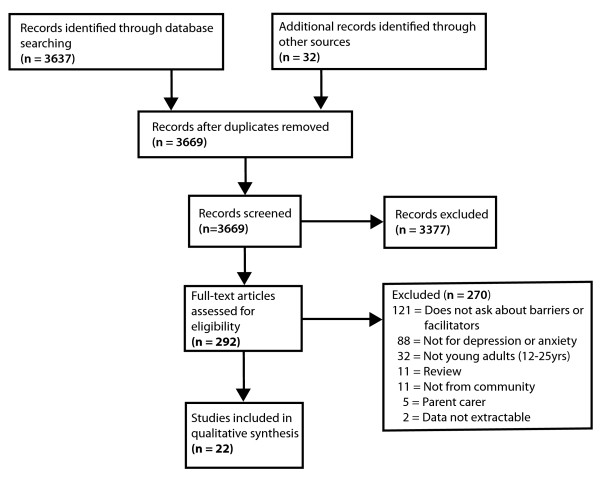
“This process resulted in a total of 22 relevant studies [20-41] for inclusion into the review.”
Background(2006) · Why Science Matters · doi:10.1002/9780470773994.ch8 · Cited by 1,014
Sawyer, M. G., Arney, F. M., Baghurst, P. A., Clark, J. J., Graetz, B. W., Kosky, R. J., Nurcombe, B., Patton, G. C., Prior, M. R., Raphael, B., et al. (2001) · Australian & New Zealand Journal of Psychiatry · doi:10.1046/j.1440-1614.2001.00964.x · Cited by 826
International Journal of Adolescent Medicine and Health
(2011) · International Journal of Adolescent Medicine and Health · doi:10.1515/ijamh · Cited by 686
Research works printed but not linked: 1
- Australian Bureau of Statistics Australian Bureau of Statistics. Canberra 2004-05 National Health Survey: Summary of Results 2006
Cited by
Items 301–400 of 1,047
Jabir, A. I., Lin, X., Martinengo, L., Sharp, G., Theng, Y.-L., & Tudor Car, L. (2024) · Journal of Medical Internet Research · doi:10.2196/48168 · Cited by 66
Shen, S., Qi, W., Zeng, J., Shujie, L. I., Liu, X., Zhu, X., Dong, C., Wang, B., Shi, Y., Yao, J., et al. (2025) · Journal of Medical Internet Research · doi:10.2196/77066 · Cited by 119
Eskin, M., Kujan, O., Voracek, M., Shaheen, A. A., Carta, M. G., Sun, J., Flood, C., Poyrazlı, Ş., Janghorbani, M., Yoshimasu, K., et al. (2016) · Scandinavian Journal of Psychology · doi:10.1111/sjop.12318 · Cited by 77
DeBate, R. D., Gatto, A., & Rafal, G. (2018) · American Journal of Men s Health · doi:10.1177/1557988318773656 · Cited by 91
Gaiha, S. M., Salisbury, T. T., Usmani, S., Koschorke, M., Raman, U., & Petticrew, M. (2021) · BMC Psychiatry · doi:10.1186/s12888-021-03350-8 · Cited by 66
Rickwood, D., Webb, M., Kennedy, V., & Telford, N. (2016) · JMIR Mental Health · doi:10.2196/mental.5988 · Cited by 66
“They include: stigma (which includes embarrassment and concern about what others think); negative attitudes to and poor past experiences of treatment; problems recognizing symptoms; lack of awareness of available services; confidentiality concerns; and a preference for self-reliance or drawing on nonprofessional suppo…”
BackgroundMaiuolo, M., Deane, F. P., & Ciarrochi, J. (2019) · Journal of Youth and Adolescence · doi:10.1007/s10964-019-00994-4 · Cited by 66
The Determinants of Mental Health Literacy among Young Adolescents in Malaysia
Singh, S., Zaki, R. A., Farid, N. D. N., & Kaur, K. (2022) · International Journal of Environmental Research and Public Health · doi:10.3390/ijerph19063242 · Cited by 97
Non-professional-help-seeking among young people with depression: a qualitative study
Martínez-Hernáez, A., DiGiacomo, S. M., Carceller-Maicas, N., Correa-Urquiza, M., & Martorell-Poveda, M. A. (2014) · BMC Psychiatry · doi:10.1186/1471-244x-14-124 · Cited by 66
Wang, C., Do, K. A., Frese, K. M., & Zheng, L. (2018) · School Mental Health · doi:10.1007/s12310-018-9285-0 · Cited by 86
Mental health literacy among residents in Shanghai.
(2013) · PubMed Central · doi:10.3969/j.issn.1002-0829.2013.04.004 · Cited by 66
Barriers on access to and use of adolescent health services in Ghana
Abuosi, A. A., & Anaba, E. A. (2019) · Journal of Health Research · doi:10.1108/jhr-10-2018-0119 · Cited by 84
Digital interventions for substance use disorders in young people: rapid review
Monarque, M., Sabetti, J., & Ferrari, M. (2023) · Substance Abuse Treatment Prevention and Policy · doi:10.1186/s13011-023-00518-1 · Cited by 85
Spence, S. H., Zubrick, S. R., & Lawrence, D. (2018) · Australian & New Zealand Journal of Psychiatry · doi:10.1177/0004867417741981 · Cited by 65
Hurley, D., Allen, M. S., Swann, C., Okely, A. D., & Vella, S. A. (2018) · Journal of Child and Family Studies · doi:10.1007/s10826-018-1071-y · Cited by 78
Parikh, R., Michelson, D., Sapru, M., Sahu, R., Singh, A., Cuijpers, P., & Patel, V. (2019) · Global Mental Health · doi:10.1017/gmh.2019.16 · Cited by 65
A Smartphone App for Adolescents With Sleep Disturbance: Development of the Sleep Ninja
Werner-Seidler, A., O'Dea, B., Shand, F., Johnston, L., Frayne, A., Fogarty, A. S., & Christensen, H. (2017) · JMIR Mental Health · doi:10.2196/mental.7614 · Cited by 64
“The lack of automated digital programs available for use by young people is particularly surprising, given that delivering treatment digitally may have particular appeal to young people who have a preference for management of their own symptoms and problems, without the input of health professionals [25].”
BackgroundSelf-citationApplying the Health Belief Model to assess prevention services among young adults
Luquis, R. R., & Kensinger, W. S. (2018) · International Journal of Health Promotion and Education · doi:10.1080/14635240.2018.1549958 · Cited by 97
Thomson, K., Richardson, C. G., Gadermann, A., Emerson, S. D., Shoveller, J., & Guhn, M. (2019) · JAMA Network Open · doi:10.1001/jamanetworkopen.2018.6694 · Cited by 80
Quenneville, A. F., Badoud, D., Nicastro, R., Jermann, F., Favre, S., Küng, A., Euler, S., Perroud, N. A., & Richard-Lepouriel, H. (2019) · Journal of Affective Disorders · doi:10.1016/j.jad.2019.10.053 · Cited by 72
Kornfield, R., Zhang, R., Nicholas, J., Schueller, S. M., Cambo, S. A., Mohr, D. C., & Reddy, M. (2020) · Proceedings of the 2020 CHI Conference on Human Factors in Computing Systems · doi:10.1145/3313831.3376309 · Cited by 64
“Many individuals with depression express openness to engage with digital mental health tools, given their convenience, self-pacing, and reduced stigma concerns relative to face-to-face treatment [36,43,52,97].”
BackgroundEngaging male students with mental health support: a qualitative focus group study
Sagar-Ouriaghli, I., Brown, J. S. L., Tailor, V., & Godfrey, E. L. (2020) · BMC Public Health · doi:10.1186/s12889-020-09269-1 · Cited by 98
Bertuzzi, V., Fratini, G., Tarquinio, C., Cannistrà, F., Granese, V., Giusti, E. M., Castelnuovo, G., & Pietrabissa, G. (2021) · Frontiers in Psychology · doi:10.3389/fpsyg.2021.721382 · Cited by 95
Treatment patterns and short‐term outcomes in an early intervention youth mental health service
Cross, S. P. M., Hermens, D. F., & Hickie, I. B. (2016) · Early Intervention in Psychiatry · doi:10.1111/eip.12191 · Cited by 65
Picco, L., Abdin, E., Chong, S. A., Pang, S., Vaingankar, J. A., Sagayadevan, V., Kwok, K. W., & Subramaniam, M. (2016) · Psychiatric Services · doi:10.1176/appi.ps.201500442 · Cited by 64
Cultural misconceptions and public stigma against mental illness among Lebanese university students
Rayan, A., & Fawaz, M. A. (2017) · Perspectives In Psychiatric Care · doi:10.1111/ppc.12232 · Cited by 74
Rickwood, D., & Bradford (2012) · Psychology Research and Behavior Management · doi:10.2147/prbm.s23357 · Cited by 62
Beames, J. R., Johnston, L., O’Dea, B., Torok, M. H., Boydell, K., Christensen, H. M., & Werner‐Seidler, A. (2020) · International Journal of School & Educational Psychology · doi:10.1080/21683603.2020.1838367 · Cited by 100
Self-citationUpton, E. L., Clare, P. J., Aiken, A., Boland, V. C., Torres, C. D., Bruno, R., Hutchinson, D. M., Kypri, K., Mattick, R. P., MCBRIDE, N. T., et al. (2021) · Psychological Medicine · doi:10.1017/s0033291721001963 · Cited by 67
Swartz, K., Musci, R. J., Beaudry, M. B., Heley, K., Miller, L., Alfes, C., Townsend, L., Thornicroft, G., & Wilcox, H. C. (2017) · American Journal of Public Health · doi:10.2105/ajph.2017.304088 · Cited by 63
Litwiller, F., White, C. M., Hamilton-Hinch, B., & Gilbert, R. W. (2018) · Leisure Sciences · doi:10.1080/01490400.2018.1483851 · Cited by 80
Cohen, K. A., & Schleider, J. L. (2022) · Internet Interventions · doi:10.1016/j.invent.2022.100496 · Cited by 62
Kruzan, K. P., Meyerhoff, J., Nguyen, T., Reddy, M. C., Mohr, D. C., & Kornfield, R. (2022) · CHI Conference on Human Factors in Computing Systems · doi:10.1145/3491102.3501976 · Cited by 75
Qing, W., Zhang, W., & An, S. (2023) · Internet Interventions · doi:10.1016/j.invent.2023.100690 · Cited by 87
Crisp, D. A., Griffiths, K. M., Mackinnon, A. J., Bennett, K., & Christensen, H. M. (2014) · Psychiatry Research · doi:10.1016/j.psychres.2014.01.041 · Cited by 78
Self-citationOjio, Y., Yonehara, H., Taneichi, S., Yamasaki, S., Ando, S., Togo, F., Nishida, A., & Sasaki, T. (2015) · Psychiatry and Clinical Neurosciences · doi:10.1111/pcn.12320 · Cited by 62
Carr, W., Wei, Y., Kutcher, S., & Heffernan, A. (2017) · Canadian Journal of School Psychology · doi:10.1177/0829573516688596 · Cited by 87
Mental health literacy intervention on help-seeking in athletes: a systematic review
Bu, D., Chung, P.-K., Zhang, C.-Q., Liu, J., & Wang, X. (2020) · International Journal of Environmental Research and Public Health · doi:10.3390/ijerph17197263 · Cited by 61
Rossetto, A., Jorm, A. F., & Reavley, N. J. (2016) · Psychiatry Research · doi:10.1016/j.psychres.2016.04.037 · Cited by 61
“are concerned about how their illness will be perceived by others (Gulliver et al., 2010).”
BackgroundVersteeg, M., & Kappe, R. F. (2021) · Frontiers in Public Health · doi:10.3389/fpubh.2021.737223 · Cited by 82
Baffsky, R., Ivers, R., Cullen, P., Wang, J., McGillivray, L., & Torok, M. (2023) · Prevention Science · doi:10.1007/s11121-022-01434-9 · Cited by 60
D’Avanzo, B., Barbato, A., Erzegovesi, S., Lampertico, L., Rapisarda, F., & Valsecchi, L. (2012) · Clinical Practice and Epidemiology in Mental Health · doi:10.2174/1745017901208010047 · Cited by 68
Transforming youth mental health: a Canadian perspective
Iyer, S. N., Boksa, P., Lal, S., Shah, J., Marandola, G., Jordan, G., Doyle, M., Joober, R., & Malla, A. K. (2015) · Irish Journal of Psychological Medicine · doi:10.1017/ipm.2014.89 · Cited by 61
Psychological interventions that target sleep reduce pain catastrophizing in knee osteoarthritis
Lerman, S. F., Finan, P. H., Smith, M. T., & Haythornthwaite, J. A. (2017) · Pain · doi:10.1097/j.pain.0000000000001023 · Cited by 62
Clark, L. H., Hudson, J. L., Dunstan, D. A., & Clark, G. I. (2018) · Australian Journal of Psychology · doi:10.1111/ajpy.12191 · Cited by 60
“A systematic review by Gulliver et al. (2010) reported the barriers and facilitators to mental health help-seeking in young adults (aged 12–25 years).”
BackgroundMethodInfluentialChanging Behavior Using Social Cognitive Theory
Łuszczyńska, A., & Schwarzer, R. (2020) · Cambridge University Press eBooks · doi:10.1017/9781108677318.003 · Cited by 105
Understanding Mental Health App Use Among Community College Students: Web-Based Survey Study
Borghouts, J. W., Eikey, E. V., Mark, G. J., Leon, C. D., Schueller, S. M., Schneider, M. L., Stadnick, N. A., Zheng, K., Mukamel, D. B., & Sorkin, D. H. (2021) · Journal of Medical Internet Research · doi:10.2196/27745 · Cited by 70
Hamblen, J. L., Grubaugh, A. L., Davidson, T. M., Borkman, A. L., Bunnell, B. E., & Ruggiero, K. J. (2019) · Telemedicine and e-Health · doi:10.1089/tmj.2017.0305 · Cited by 59
Student perspectives on mental health support and services in the UK
Batchelor, R., Pitman, E., Sharpington, A., Stock, M., & Cage, E. (2020) · Journal of Further and Higher Education · doi:10.1080/0309877x.2019.1579896 · Cited by 59
Ojio, Y., Mori, R., Matsumoto, K., Nemoto, T., Sumiyoshi, T., Fujita, H., Morimoto, T., Nishizono‐Maher, A., Fuji, C., & Mizuno, M. (2021) · Early Intervention in Psychiatry · doi:10.1111/eip.12959 · Cited by 59
Gin, L. E., Scott, R. A., Pfeiffer, L. D., Zheng, Y., Cooper, K. M., & Brownell, S. E. (2021) · AJP Advances in Physiology Education · doi:10.1152/advan.00119.2020 · Cited by 66
Devkota, G., Basnet, P., Thapa, B. K., & Subedi, M. S. (2021) · PLoS ONE · doi:10.1371/journal.pone.0250694 · Cited by 72
Teepe, G. W., Fonseca, A. D., Kleim, B., Jacobson, N. C., Salamanca-Sanabria, A., Car, L. T., Fleisch, E., & Kowatsch, T. (2021) · Journal of Medical Internet Research · doi:10.2196/29412 · Cited by 74
Barriers and facilitators to mental health care: A systematic review in Pakistan
Choudhry, F. R., Khan, N., & Munawar, K. (2021) · International Journal of Mental Health · doi:10.1080/00207411.2021.1941563 · Cited by 91
Mental Health Education, Awareness and Stigma Regarding Mental Illness Among College Students
Shim, Y. R., Eaker, R., & Park, J. (2022) · JOURNAL OF MENTAL HEALTH AND CLINICAL PSYCHOLOGY · doi:10.29245/2578-2959/2022/2.1258 · Cited by 119
Wright, C. J., Wilson, S., Hammer, J. H., Hargis, L., Miller, M. E., & Usher, E. L. (2023) · Journal of Engineering Education · doi:10.1002/jee.20551 · Cited by 73
BackUp: Development and evaluation of a smart-phone application for coping with suicidal crises
Pauwels, K., Aerts, S., Muijzers, E., Jaegere, E. D., van Heeringen, K., & Portzky, G. (2017) · PLoS ONE · doi:10.1371/journal.pone.0178144 · Cited by 67
Iorfino, F., Davenport, T. A., Ospina‐Pinillos, L., Hermens, D. F., Cross, S. P. M., Burns, J. M., & Hickie, I. B. (2017) · Journal of Medical Internet Research · doi:10.2196/jmir.7897 · Cited by 65
Help-Seeking Behaviors of Transition-Aged Youth for Mental Health Concerns: Qualitative Study
Stunden, C., Zasada, J., VanHeerwaarden, N., Hollenberg, E., Abi-Jaoudé, A., Chaim, G., Cleverley, K., Henderson, J., Johnson, A., Levinson, A., et al. (2020) · Journal of Medical Internet Research · doi:10.2196/18514 · Cited by 58
Lynch, L., Moorhead, A., Long, M., & Hawthorne-Steele, I. (2023) · Journal of Child and Family Studies · doi:10.1007/s10826-022-02498-5 · Cited by 58
Stigma on mental illness in the Arab world: beyond the socio-cultural barriers
Merhej, R. (2019) · International Journal of Human Rights in Healthcare · doi:10.1108/ijhrh-03-2019-0025 · Cited by 76
Halladay, J. E., BENNETT, K. J., Weist, M. D., Boyle, M., Manion, I. G., Campo, M., & Georgiades, K. (2020) · Journal of School Psychology · doi:10.1016/j.jsp.2020.05.003 · Cited by 81
Sheikhan, N. Y., Henderson, J. L., Halsall, T., Daley, M., Brownell, S., Shah, J. L., Iyer, S. N., & Hawke, L. D. (2023) · BMC Health Services Research · doi:10.1186/s12913-023-09075-6 · Cited by 83
Nazari, A., Garmaroudi, G., Foroushani, A. R., & Hosseinnia, M. (2023) · BMC Psychiatry · doi:10.1186/s12888-023-05143-7 · Cited by 81
Fleming, T. M., Dixon, R. S., & Merry, S. N. (2012) · Advances in Mental Health · doi:10.5172/jamh.2011.10.2.195 · Cited by 57
Rickhi, B., Kania-Richmond, A., Moritz, S., Cohen, J., Paccagnan, P., Dennis, C., Liu, M., Malhotra, S., Steele, P., & Toews, J. (2015) · BMC Complementary and Alternative Medicine · doi:10.1186/s12906-015-0968-x · Cited by 57
Campos, L., Dias, P., Palha, F., Duarte, A., & Veiga, E. (2016) · Universitas Psychologica · doi:10.11144/javeriana.upsy15-2.dppq · Cited by 78
Wei, Y., McGrath, P. J., Hayden, J. A., & Kutcher, S. (2017) · Epidemiology and Psychiatric Sciences · doi:10.1017/s2045796017000178 · Cited by 100
Barrable, A., Παπαδάτου-Παστού, Μ., & Tzotzoli, P. (2018) · International Journal of Mental Health Systems · doi:10.1186/s13033-018-0233-z · Cited by 88
The psychological consequences of violence against people with disabilities
Dembo, R. S., Mitra, M., & McKee, M. M. (2018) · Disability and health journal · doi:10.1016/j.dhjo.2018.01.006 · Cited by 72
Dennehy, R., Meaney, S., Cronin, M., & Arensman, E. (2020) · Children and Youth Services Review · doi:10.1016/j.childyouth.2020.104872 · Cited by 55
Parents' Role in Adolescent Depression Care: Primary Care Provider Perspectives
Radović, A., Reynolds, K. A., McCauley, H. L., Sucato, G. S., Stein, B. D., & Miller, E. P. (2015) · The Journal of Pediatrics · doi:10.1016/j.jpeds.2015.05.049 · Cited by 67
Quin, D., Hemphill, S. A., & Heerde, J. A. (2017) · Social Psychology of Education · doi:10.1007/s11218-017-9401-2 · Cited by 83
Kam, B., Mendoza, H., & Masuda, A. (2018) · International Journal for the Advancement of Counselling · doi:10.1007/s10447-018-9365-8 · Cited by 76
Han, J., Batterham, P. J., Calear, A. L., & Ma, J. S. (2018) · Psychiatry Research · doi:10.1016/j.psychres.2018.10.080 · Cited by 68
The Influence of Interactions with Dogs on Affect, Anxiety, and Arousal in Children
Crossman, M. K., Kazdin, A. E., Matijczak, A., Kitt, E. R., & Santos, L. R. (2018) · Journal of Clinical Child & Adolescent Psychology · doi:10.1080/15374416.2018.1520119 · Cited by 75
Cerea, S., Ghisi, M., Bottesi, G., Manoli, T., Carraro, E., & Doron, G. (2020) · Behavior Therapy · doi:10.1016/j.beth.2020.04.002 · Cited by 61
Navarro, P., Bambling, M., Sheffield, J., & Edirippulige, S. (2019) · JMIR Mental Health · doi:10.2196/13152 · Cited by 55
“Several barriers to mental health help seeking have been identified for young people including knowledge-based barriers related to mental health literacy and service awareness; structural barriers related to service accessibility and affordability; and sociocognitive barriers related to beliefs about the nature of men…”
Tomczyk, S., Schmidt, S., Muehlan, H., Stolzenburg, S., & Schomerus, G. (2019) · The Journal of Behavioral Health Services & Research · doi:10.1007/s11414-019-09662-8 · Cited by 68
Barrow, E., & Thomas, G. (2022) · Educational Psychology in Practice · doi:10.1080/02667363.2022.2051441 · Cited by 96
Wickersham, A., Barack, T., Cross, L., & Downs, J. M. (2022) · Journal of Medical Internet Research · doi:10.2196/29842 · Cited by 78
Kornfield, R., Meyerhoff, J., Studd, H., Bhattacharjee, A., Williams, J. J., Reddy, M. C., & Mohr, D. C. (2022) · CHI Conference on Human Factors in Computing Systems · doi:10.1145/3491102.3502046 · Cited by 73
Goetz, C. J., Mushquash, C. J., & Maranzan, K. A. (2022) · Psychiatric Services · doi:10.1176/appi.ps.202100503 · Cited by 79
Ma, K. K. Y., Burn, A., & Anderson, J. (2022) · Child and Adolescent Mental Health · doi:10.1111/camh.12609 · Cited by 96
Ross, A. M., Hart, L. M., Jorm, A. F., Kelly, C. M., & Kitchener, B. A. (2012) · Early Intervention in Psychiatry · doi:10.1111/j.1751-7893.2011.00331.x · Cited by 55
Wexler, L., White, J., & Trainor, B. (2014) · Critical Public Health · doi:10.1080/09581596.2014.904039 · Cited by 48
Predictors of Mental Health Service Use by Young Adults: A Systematic Review
Li, W., Dorstyn, D., & Denson, L. A. (2016) · Psychiatric Services · doi:10.1176/appi.ps.201500280 · Cited by 70
Hurley, D., Swann, C., Allen, M. S., Okely, A. D., & Vella, S. A. (2017) · Qualitative Research in Sport Exercise and Health · doi:10.1080/2159676x.2016.1275751 · Cited by 66
Perceived needs for mental health care and barriers to treatment across age groups
Forbes, M. K., Crome, E., Sunderland, M., & Wuthrich, V. M. (2016) · Aging & Mental Health · doi:10.1080/13607863.2016.1193121 · Cited by 60
Kresovich, A., & Noar, S. M. (2020) · Journal of Health Communication · doi:10.1080/10810730.2020.1818148 · Cited by 62
Depression and Help-Seeking Intention Among Young Adults: The Theory of Planned Behavior
Zorrilla, M. M., Modeste, N., Gleason, P. C., Sealy, D.-A., Banta, J. E., & Trieu, S. L. (2019) · American Journal of Health Education · doi:10.1080/19325037.2019.1616014 · Cited by 53
“Recognition of a mental disorder is generally the first step in the help-seeking process.(14,15) Early recognition of depression in young adults may lead to appropriate helpseeking for themselves.”
BackgroundNilsén, P., Svedberg, P., Nygren, J., Frideros, M., Johansson, J., & Schueller, S. M. (2022) · Implementation Research and Practice · doi:10.1177/26334895221112033 · Cited by 79
Mental Health Technologies: Designing With Consumers
Orlowski, S., Matthews, B., Bidargaddi, N., Jones, G., Lawn, S., Venning, A., & Collin, P. (2016) · JMIR Human Factors · doi:10.2196/humanfactors.4336 · Cited by 52
The Stigma of Mental Illness as a Barrier to Self Labeling as Having a Mental Illness
Stolzenburg, S., Freitag, S., Evans-Lacko, S., Muehlan, H., Schmidt, S., & Schomerus, G. (2017) · Journal of Nervous & Mental Disease · doi:10.1097/nmd.0000000000000756 · Cited by 53
Warner, L. M., & French, D. (2020) · Cambridge University Press eBooks · doi:10.1017/9781108677318.032 · Cited by 79
Brown, J. S. L., Blackshaw, E., Stahl, D., Fennelly, L., McKeague, L., Sclare, I., & Michelson, D. (2019) · Journal of Adolescence · doi:10.1016/j.adolescence.2018.11.009 · Cited by 52
Reasons and determinants of help-seeking in people with a subclinical depression
van Zoonen, K., Kleiboer, A., Beekman, A. T. F., Smit, J. H., Boerema, A. M., & Cuijpers, P. (2015) · Journal of Affective Disorders · doi:10.1016/j.jad.2014.10.062 · Cited by 52
Providing Meaningful Care: Learning From the Experiences of Suicidal Young Men
Jordan, J., McKenna, H., Keeney, S., Cutcliffe, J., Stevenson, C., Slater, P., & McGowan, I. (2012) · Qualitative Health Research · doi:10.1177/1049732312450367 · Cited by 52
Lemon, C. A., Huckvale, K., Carswell, K., & Torous, J. B. (2020) · International Journal of Technology Assessment in Health Care · doi:10.1017/s0266462319003507 · Cited by 62
Yang, J., Li, Y., Gao, R., Chen, H., & Yang, Z. (2023) · BMC Psychiatry · doi:10.1186/s12888-023-05458-5 · Cited by 74
Metadata
- Authors
- Gulliver, A., Griffiths, K. M., & Christensen, H.
- Affiliations
- Australian National University (AU)
- Corresponding author
- Gulliver, Amelia
- Venue
- BMC Psychiatry
- Published
- 2010-12
- Volume
- 10
- Issue
- 1
- Pages
- 113-113
- ISSN
- 1471-244X (ISSN-L)
- PMC
- PMC3022639
- OpenAlex
- W2107750653
- Semantic Scholar
- f95edcc0bd6116b085c3f189a000be87dd3d6115
- Cited by
- 3,292
- References
- 51
- Citations by year
- 2026: 301 · 2025: 323 · 2024: 301 · 2023: 299 · 2022: 306 · 2021: 318 · 2020: 363 · 2019: 238 · 2018: 221 · 2017: 170 · 2016: 147 · 2015: 111 · 2014: 90 · 2013: 48 · 2012: 42
- FWCI
- 4.00
- Type
- journal article
- Language
- en
- Open access
- gold
- doi.org
- Licence
- cc-by
- creativecommons.org/licenses/by/2.0 (tdm)
- Locations
- BMC Psychiatry (publishedVersion, cc-by)
- Europe PMC (PubMed Central) (publishedVersion, cc-by)
- PubMed Central (publishedVersion, cc-by)
- PubMed (publishedVersion)
- DOAJ (DOAJ: Directory of Open Access Journals) (submittedVersion)
- ANU Open Research (Australian National University) (submittedVersion, cc-by)
- Funders
- Australian National University
- Australian Institute of Sport
- National Health and Medical Research Council (525413, 525411)
- Topics
- Health Sciences › Medicine › Psychiatry and Mental health › Mental Health Treatment and Access
- Social Sciences › Psychology › Clinical Psychology › Suicide and Self-Harm Studies
- Social Sciences › Psychology › Clinical Psychology › Psychology and Mental Health
- Keywords
- help-seeking, mental health help-seeking, adolescents, young adults, perceived barriers, perceived facilitators, mental health literacy, stigma, self-reliance, social support, common mental disorders
- MeSH terms
- Adolescent, Adult, Mental Disorders, Data Collection, Female, Health Services Accessibility, Humans, Male, Mental Health Services, Patient Acceptance of Health Care, Qualitative Research, Young Adult
About these checks
Registry, retraction, Cites and statistics results are computed, not judged, with one exception: a printed reference that no index lists is read once by a model before it counts as a citation error. Claims are extracted by a model and kept only when their quote appears verbatim in the text; each cited source is then checked, with a model’s help, for whether it says what the claim relies on. Those verdicts can be wrong — read the claim’s quote and the cited source before relying on one.
Statistics and arithmetic are recomputed, not judged.
Confidence bands are shown only for fields calibrated on our annotated test set. None is calibrated yet, so no band is shown.
What counts as a claim ›How we measure confidence ›How we check this ›
Are you an author, or do you see a problem with this page? Request a review
Data sources
Bibliographic data: Semantic Scholar, OpenAlex, Crossref.
Contains information from the Semantic Scholar Academic Graph Datasets, made available under the ODC Attribution License (ODC-BY 1.0).
Semantic Scholar’s data is described in: Kinney, R., et al. (2023). The Semantic Scholar Open Data Platform. arXiv:2301.10140.
