

Perceived barriers and facilitators to mental health help-seeking in young people: a systematic review
Open accessThe DOI matches its Crossref record; 50 of the 51 references it cites were found in a registry or an index, and 1 are not checked yet.
Abstract
BACKGROUND: Adolescents and young adults frequently experience mental disorders, yet tend not to seek help. This systematic review aims to summarise reported barriers and facilitators of help-seeking in young people using both qualitative research from surveys, focus groups, and interviews and quantitative data from published surveys. It extends previous reviews through its systematic research methodology and by the inclusion of published studies describing what young people themselves perceive are the barriers and facilitators to help-seeking for common mental health problems. METHODS: Twenty two published studies of perceived barriers or facilitators in adolescents or young adults were identified through searches of PubMed, PsycInfo, and the Cochrane database. A thematic analysis was undertaken on the results reported in the qualitative literature and quantitative literature. RESULTS: Fifteen qualitative and seven quantitative studies were identified. Young people perceived stigma and embarrassment, problems recognising symptoms (poor mental health literacy), and a preference for self-reliance as the most important barriers to help-seeking. Facilitators were comparatively under-researched. However, there was evidence that young people perceived positive past experiences, and social support and encouragement from others as aids to the help-seeking process. CONCLUSIONS: Strategies for improving help-seeking by adolescents and young adults should focus on improving mental health literacy, reducing stigma, and taking into account the desire of young people for self-reliance.
Overview
The claims and statistics of this paper haven’t been checked yet.
Free: it reads the open-access text and checks the first 5 claims that cite a source we can check. Create a free account to check every claim.
Integrity signals
Registry
Cites
Statistics
Figures
Verification
Claims the paper makes
The claims and statistics of this paper haven’t been checked yet.
Free: it reads the open-access text and checks the first 5 claims that cite a source we can check. Create a free account to check every claim.
Claims other papers make about this one
Each is checked against this paper’s own text: does it say what the citing paper says it does?
The cited source doesn’t support the claim as written.
In the citing paper
“A previous systematic review demonstrated that a low level of MHL is the main barrier to seeking assistance [11].”
From Mental health literacy intervention on help-seeking in athletes: a systematic review (2020) · cites this paper as [11]
Checked by a reasoning model — may be wrong.
Experimental — accuracy not yet measuredThe source backs part of the claim, not all of it — or backs it for a different population, condition or comparison.
In the citing paper
“Despite this, the extant literature has extensively examined many barriers and facilitators impacting young people seeking help and has increased understanding on a range of personal, social, cultural, and service factors (Doan et al. 2020; Gulliver et al. 2010; Goodwin et al. 2016; Michelmore and Hindley 2012; Nam et al. 2010; Radez et al. 2021; Roth ì and Leavey 2006; Rowe et al. 2014).”
From "You Have the Choice of Whether You're Going to Get Help or Attempt Suicide": Exploring the Process and Impact of Mental Health Help-Seeking with Young People (16–25 Years) (2025) · cites this paper as Gulliver et al. 2010
Experimental — accuracy not yet measuredThe source backs part of the claim, not all of it — or backs it for a different population, condition or comparison.
In the citing paper
“In addition to the issue of low levels of MHL, high levels of stigma are recognised as another barrier influencing help-seeking in elite sport [11].”
From Mental health literacy intervention on help-seeking in athletes: a systematic review (2020) · cites this paper as [11]
Experimental — accuracy not yet measuredThe source backs part of the claim, not all of it — or backs it for a different population, condition or comparison.
In the citing paper
“In addition, existing face-to-face services pose significant barriers for young people [10-16] largely due to access, availability, and high costs of these services [17], as well as the reluctance of young people to seek professional help due to stigma and embarrassment [18-20].”
From Do online mental health services improve help-seeking for young people? A systematic review (2014) · cites this paper as [13]
Experimental — accuracy not yet measuredThe source backs part of the claim, not all of it — or backs it for a different population, condition or comparison.
In the citing paper
“Meeting these needs is challenging, as men (particularly younger men) tend not to seek professional help for distress (Gulliver, Griffiths, & Christensen, 2010;Oliver et al., 2005;Rickwood, Deane, & Wilson, 2007).”
From e-TC: Development and pilot testing of a web-based intervention to reduce anxiety and depression in survivors of testicular cancer (2017) · cites this paper as Gulliver, Griffiths, & Christensen, 2010
Experimental — accuracy not yet measured
19 more claims about this paper
Create a free account to see every claim other papers make about this one.
Self-check
Percentages, sums and reported differences re-computed from the paper’s own numbers.
The self-check needs the paper’s full text.
Citations
Cites
Preferred Reporting Items for Systematic Reviews and Meta-Analyses: the PRISMA statement
Moher, D., Liberati, A., Tetzlaff, J., Altman, D. G., & for the PRISMA Group (2009) · BMJ · doi:10.1136/bmj.b2535 · Cited by 83,823
Preferred reporting items for systematic reviews and meta-analyses: the PRISMA Statement.
(2009) · PubMed Central · Cited by 44,859
Kessler, R. C., Chiu, W. T., Demler, O., & Walters, E. E. (2005) · Archives of General Psychiatry · doi:10.1001/archpsyc.62.6.617 · Cited by 12,052
(2021) · Handbook of Research Methods for Marketing Management · doi:10.4337/9781788976954.00014 · Cited by 4,009
Young People’s Help-Seeking for Mental Health Problems
Rickwood, D., Deane, F. P., Wilson, C. J., & Ciarrochi, J. (2005) · Australian e-Journal for the Advancement of Mental Health · doi:10.5172/jamh.4.3.218 · Cited by 1,619
When and how do young people seek professional help for mental health problems?
Rickwood, D. J., Deane, F. P., & Wilson, C. J. (2007) · Medical Journal of Australia · doi:10.5694/j.1326-5377.2007.tb01334.x · Cited by 1,195
Help-Seeking and Access to Mental Health Care in a University Student Population
Eisenberg, D., Golberstein, E., & Gollust, S. E. (2007) · Medical Care · doi:10.1097/mlr.0b013e31803bb4c1 · Cited by 1,131 · cited 1×
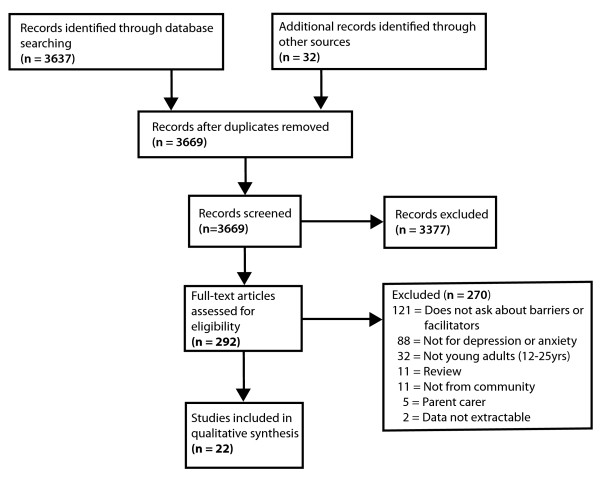
“This process resulted in a total of 22 relevant studies [20-41] for inclusion into the review.”
Background(2006) · Why Science Matters · doi:10.1002/9780470773994.ch8 · Cited by 1,014
Sawyer, M. G., Arney, F. M., Baghurst, P. A., Clark, J. J., Graetz, B. W., Kosky, R. J., Nurcombe, B., Patton, G. C., Prior, M. R., Raphael, B., et al. (2001) · Australian & New Zealand Journal of Psychiatry · doi:10.1046/j.1440-1614.2001.00964.x · Cited by 826
International Journal of Adolescent Medicine and Health
(2011) · International Journal of Adolescent Medicine and Health · doi:10.1515/ijamh · Cited by 686
Research works printed but not linked: 1
- Australian Bureau of Statistics Australian Bureau of Statistics. Canberra 2004-05 National Health Survey: Summary of Results 2006
Cited by
Items 701–800 of 1,047
Gendered and racialized social expectations, barriers, and delayed breast cancer diagnosis
Kim, S. J., Glassgow, A. E., Watson, K. S., Molina, Y., & Calhoun, E. A. (2018) · Cancer · doi:10.1002/cncr.31636 · Cited by 38
Clough, B. A., Nazareth, S. M., & Casey, L. M. (2020) · British Journal of Guidance & Counselling · doi:10.1080/03069885.2019.1673312 · Cited by 30
“A systematic review conducted by Gulliver, Griffiths, and Christensen (2010) identified that perceived barriers to help-seeking include stigma and embarrassment, problems recognising symptoms (i.e. low levels of mental health literacy), and a preference for self-reliance.”
BackgroundRadomski, A. D., Bagnell, A., Curtis, S., Hartling, L., & Newton, A. S. (2020) · JMIR Mental Health · doi:10.2196/15795 · Cited by 30
“Consistent with the literature, Breathe respondents described difficulty remembering to work on the program [29,52], concerns with privacy and stigma (eg, others knowing about or judging their help seeking) [30,71,72], time constraints, and conflicting commitments [31,73-75], and delaying or avoiding tasks they found…”
LARS&LISA: a universal school-based cognitive-behavioral program to prevent adolescent depression
Pössel, P., Smith, E., & Alexander, O. (2018) · Psicologia Reflexão e Crítica · doi:10.1186/s41155-018-0104-1 · Cited by 42
Randomized Controlled Trial of a Mindfulness Mobile Application for Ruminative Adolescents
Hilt, L. M., Swords, C. M., & Webb, C. A. (2023) · Journal of Clinical Child & Adolescent Psychology · doi:10.1080/15374416.2022.2158840 · Cited by 39
Simkiss, N. J., Gray, N. S., Kemp, A. H., Dunne, C., & Snowden, R. J. (2023) · BMC Public Health · doi:10.1186/s12889-023-15922-2 · Cited by 49
Kerber, A., Beintner, I., Burchert, S., & Knaevelsrud, C. (2023) · JMIR Mental Health · doi:10.2196/45068 · Cited by 39
Scoping Review: Digital Mental Health Interventions for Children and Adolescents Affected by War
Danese, A., Martsenkovskyi, D., Remberk, B., Khalil, M. Y., Diggins, E., Keiller, E., Masood, S., Awah, I., Barbui, C., Beer, R., et al. (2024) · Journal of the American Academy of Child & Adolescent Psychiatry · doi:10.1016/j.jaac.2024.02.017 · Cited by 68
Manole, A., Cârciumaru, R., Brînzaș, R., & Manole, F. (2024) · Information · doi:10.3390/info16010011 · Cited by 44
Lueck, J. A. (2017) · Journal of Health Communication · doi:10.1080/10810730.2017.1324538 · Cited by 34
Cruwys, T., An, S., Chang, M. X., & Lee, H. (2018) · Psychiatry Research · doi:10.1016/j.psychres.2018.03.039 · Cited by 40
Evaluation of Mental Health First Aid skills in an Australian university population
Ashoorian, D. M., Albrecht, K., Baxter, C., Giftakis, E., Clifford, R. M., Greenwell-Barnden, J. N., & Wylde, T. J. (2018) · Early Intervention in Psychiatry · doi:10.1111/eip.12742 · Cited by 36
Evaluation of a Social Media Strategy to Promote Mental Health Literacy and Help-Seeking in Youth
Halsall, T., Garinger, C., Dixon, K., & Forneris, T. (2019) · Journal of Consumer Health on the Internet · doi:10.1080/15398285.2019.1571301 · Cited by 56
Toscos, T., Coupe, A., Flanagan, M., Drouin, M. A., Carpenter, M., Reining, L. E., Roebuck, A. E., & Mirro, M. J. (2019) · JMIR Mental Health · doi:10.2196/13230 · Cited by 41
Changing Behavior Using the Health Belief Model and Protection Motivation Theory
Orbell, S., Zahid, H., & Henderson, C. J. (2020) · Cambridge University Press eBooks · doi:10.1017/9781108677318.004 · Cited by 40
Mahsoon, A. N., Sharif, L., Banakhar, M. A., Alasmee, N., Almowallad, E., Jabali, R., Bahamil, A., & Assur, S. (2020) · International Journal of Environmental Research and Public Health · doi:10.3390/ijerph17155615 · Cited by 38
Bourke, M., Patten, R. K., Dash, S. R., Pascoe, M. C., Craike, M. J., Firth, J., Bailey, A. P., Jacka, F. N., & Parker, A. G. (2021) · Journal of Adolescent Health · doi:10.1016/j.jadohealth.2021.08.005 · Cited by 35
Lai, K. Y. C., Hung, S., Lee, H. W. S., & Leung, P. W. L. (2022) · Frontiers in Psychiatry · doi:10.3389/fpsyt.2022.866323 · Cited by 48
Barriers to seeking mental health services among adolescents in military families.
Becker, S. J., Swenson, R. R., Esposito-Smythers, C. L., Cataldo, A. M., & Spirito, A. (2014) · Professional Psychology Research and Practice · doi:10.1037/a0036120 · Cited by 41
Griffiths, K. M., Bennett, K., Walker, J., Goldsmid, S., & Bennett, A. (2016) · Internet Interventions · doi:10.1016/j.invent.2016.09.004 · Cited by 30
Self-citationA review of web-based support systems for students in higher education
Παπαδάτου-Παστού, Μ., Goozée, R., Payne, E., Barrable, A., & Tzotzoli, P. (2017) · International Journal of Mental Health Systems · doi:10.1186/s13033-017-0165-z · Cited by 39
Guest, R., Tran, Y., Gopinath, B., Cameron, I. D., & Craig, A. (2016) · Injury · doi:10.1016/j.injury.2016.09.006 · Cited by 29
Reducing the Mental Health–Related Stigma of Social Work Students: A Cluster RCT
Rubio-Valera, M., Aznar‐Lou, I., Vives-Collet, M., Fernández, A., Gil‐Girbau, M., & Serrano‐Blanco, A. (2016) · Research on Social Work Practice · doi:10.1177/1049731516641492 · Cited by 38
Sælid, G. A., & Nordahl, H. M. (2016) · Cognitive Behaviour Therapy · doi:10.1080/16506073.2016.1233453 · Cited by 43
Straszewski, T., & Siegel, J. T. (2018) · Applied Psychology Health and Well-Being · doi:10.1111/aphw.12122 · Cited by 36
Stapley, E., Demkowicz, O., Eisenstadt, M., Wolpert, M., & Deighton, J. (2019) · The Journal of Early Adolescence · doi:10.1177/0272431619858420 · Cited by 47
Wang, C., Marsico, K. F., & Do, K. A. (2020) · School Mental Health · doi:10.1007/s12310-020-09362-1 · Cited by 35
Anxiety Specific Mental Health Stigma and Help-Seeking in Adolescent Males
Clark, L. H., Hudson, J. L., & Haider, T. (2020) · Journal of Child and Family Studies · doi:10.1007/s10826-019-01686-0 · Cited by 36
Potterton, R., Austin, A., Allen, K. L., Lawrence, V. C., & Schmidt, U. H. (2020) · Journal of Eating Disorders · doi:10.1186/s40337-020-00320-5 · Cited by 41
Stige, S. H., Barca, T. B., Lavik, K. O., & Moltu, C. (2021) · Frontiers in Psychology · doi:10.3389/fpsyg.2021.633663 · Cited by 48
Acceptability and Preliminary Effects of a Mindfulness Mobile Application for Ruminative Adolescents
Hilt, L. M., & Swords, C. M. (2021) · Behavior Therapy · doi:10.1016/j.beth.2021.03.004 · Cited by 32
Kim, H. C. (2021) · International Journal of Mental Health · doi:10.1080/00207411.2021.1965397 · Cited by 47
Silfee, V., Williams, K. R., Leber, B. D., Kogan, J. N., Nikolajski, C., Szigethy, E., & Serio, C. D. (2021) · JMIR Formative Research · doi:10.2196/28538 · Cited by 33
der Hallen, R. V., & Godor, B. P. (2022) · Psychiatry Research · doi:10.1016/j.psychres.2022.114541 · Cited by 35
Professional and informal mental health support reported by Canadians aged 15 to 24.
Findlay, L., & Sunderland, A. (2014) · PubMed · Cited by 53
Help seeking among adolescents in foster care: A qualitative study
Johnson, E., & Menna, R. (2017) · Children and Youth Services Review · doi:10.1016/j.childyouth.2017.03.002 · Cited by 39
Teen Mental Health First Aid for years 7–9: a description of the program and an initial evaluation
Hart, L., Bond, K. S., Morgan, A. J., Rossetto, A., Cottrill, F. A., Kelly, C. M., & Jorm, A. F. (2019) · International Journal of Mental Health Systems · doi:10.1186/s13033-019-0325-4 · Cited by 39
Mental health professional perspectives on health data sharing: Mixed methods study
Grando, A., Ivanova, J., Hiestand, M., Soni, H., Murcko, A. C., Saks, M. J., Kaufman, D. R., Whitfield, M. J., Dye, C., Chern, D., et al. (2020) · Health Informatics Journal · doi:10.1177/1460458219893848 · Cited by 31
Cohen, K. A., Dobias, M., Morris, R. R., & Schleider, J. L. (2022) · PsyArXiv (OSF Preprints) · doi:10.1016/j.jbct.2022.12.001 · Cited by 38
Hao, Y., Wu, Q., Luo, X., Chen, S., Qi, C., Long, J., Xiong, Y., Liao, Y., & Liu, T. (2020) · Frontiers in Psychiatry · doi:10.3389/fpsyt.2020.507969 · Cited by 39
Özdemir, Ö., Kaya, Y., & Adagide, S. (2023) · Journal of Caring Sciences · doi:10.34172/jcs.2023.33094 · Cited by 33
Hoffman, B. D., Oppert, M. L., & Owen, M. S. (2024) · Computers in Human Behavior Artificial Humans · doi:10.1016/j.chbah.2024.100086 · Cited by 56
Wanniarachchi, V. U., Greenhalgh, C., Choi, A., & Warren, J. (2025) · Frontiers in Digital Health · doi:10.3389/fdgth.2025.1500220 · Cited by 46
Wang, Y., Li, X., Zhang, Q., Yeung, D., & Wu, Y. (2025) · JMIR mHealth and uHealth · doi:10.2196/63806 · Cited by 35
Burnett‐Zeigler, I., Lee, Y., & Bohnert, K. M. (2017) · The Journal of Behavioral Health Services & Research · doi:10.1007/s11414-017-9557-8 · Cited by 34
Collegian help seeking: the role of self-compassion and self-coldness
Dschaak, Z. A., Spiker, D. A., Berney, E. C., Miller, M. E., & Hammer, J. H. (2019) · Journal of Mental Health · doi:10.1080/09638237.2019.1677873 · Cited by 39
Changing Behavior by Changing Environments
Marteau, T. M., Fletcher, P. C., Hollands, G. J., & Munafo, M. R. (2020) · Cambridge University Press eBooks · doi:10.1017/9781108677318.014 · Cited by 35
Bruen, A. J., Wall, A., Haines‐Delmont, A., & Perkins, E. (2020) · JMIR Mental Health · doi:10.2196/18407 · Cited by 34
Liu, J., Xu, K.-K., Zhu, G.-L., Zhang, Q.-Q., & Li, X. (2020) · World Journal of Psychiatry · doi:10.5498/wjp.v10.i11.272 · Cited by 29
Conditions for mental health in education: Towards relational practice
Billington, T., Gibson, S., Fogg, P., Lahmar, J., & Cameron, H. (2021) · British Educational Research Journal · doi:10.1002/berj.3755 · Cited by 41
Jankowski, S. E., Yanos, P. T., Dixon, L. B., & Amsalem, D. (2022) · Schizophrenia Bulletin · doi:10.1093/schbul/sbac143 · Cited by 33
Screening for mental health risk in high schools: The development of the Youth RADAR.
Burns, J. R., & Rapee, R. M. (2016) · Psychological Assessment · doi:10.1037/pas0000237 · Cited by 30
Bassilios, B., Telford, N., Rickwood, D., Spittal, M. J., & Pirkis, J. (2017) · International Journal of Mental Health Systems · doi:10.1186/s13033-017-0125-7 · Cited by 28
Valibhoy, M., Szwarc, J., & Kaplan, I. (2017) · International Journal of Human Rights in Healthcare · doi:10.1108/ijhrh-07-2016-0010 · Cited by 31
Hantzi, A., Anagnostopoulos, F., & Alexiou, E. (2018) · Journal of Clinical Psychology in Medical Settings · doi:10.1007/s10880-018-9573-8 · Cited by 37
Hay, P., Ghabrial, B., Mannan, H. R., Conti, J., González‐Chica, D. A., Stocks, N. P., Heriseanu, A. I., & Touyz, S. W. (2019) · International Journal of Eating Disorders · doi:10.1002/eat.23174 · Cited by 33
Attitudes toward Health-Seeking Behaviors of College Students in Ukraine
Burlaka, V., Churakova, I., Aavik, O. A., Staller, K. M., & Delva, J. (2014) · International Journal of Mental Health and Addiction · doi:10.1007/s11469-014-9483-4 · Cited by 27
Vusio, F., Thompson, A., Birchwood, M., & Clarke, L. (2020) · European Child & Adolescent Psychiatry · doi:10.1007/s00787-019-01420-7 · Cited by 27
Struthers, A., Charette, C., Bapuji, S. B., Winters, S., Ye, X., Metge, C., Kreindler, S., Raynard, M., Lemaire, J., Synyshyn, M., et al. (2015) · Canadian Journal of Community Mental Health · doi:10.7870/cjcmh-2015-006 · Cited by 27
The Use of Sensors to Detect Anxiety for In-the-Moment Intervention: Scoping Review
Dobson, R., Li, L. L., Garner, K., Tane, T., McCool, J. P., & Whittaker, R. (2023) · JMIR Mental Health · doi:10.2196/42611 · Cited by 33
Mental health symptoms in German elite athletes: a network analysis
Geiger, S., Jahre, L. M., Aufderlandwehr, J., Krakowczyk, J. B., Esser, A. J., Mühlbauer, T., Skoda, E., Teufel, M., & Bäuerle, A. (2023) · Frontiers in Psychology · doi:10.3389/fpsyg.2023.1243804 · Cited by 32
Mental health message appeals and audience engagement: Evidence from Australia
Yap, J. E., Zubcevic‐Basic, N., Johnson, L. W., & Lodewyckx, M. A. (2017) · Health Promotion International · doi:10.1093/heapro/dax062 · Cited by 33
Bücker, L., Schnakenberg, P., Karyotaki, E., Moritz, S., & Westermann, S. (2019) · Journal of Medical Internet Research · doi:10.2196/14240 · Cited by 27
Punukollu, M., Burns, C., & Marques, M. (2019) · International Journal of Adolescence and Youth · doi:10.1080/02673843.2019.1674167 · Cited by 38
Guajardo, M. G. U., Kelly, C., Bond, K. S., Thomson, R. J., & Slewa‐Younan, S. (2019) · International Journal of Mental Health Systems · doi:10.1186/s13033-019-0329-0 · Cited by 34
Bashir, M. B. A., Mohamed, S. O. A., Nkfusai, C. N., Bede, F., Oladimeji, O., Tsoka-Gwegweni, J. M., & Cumber, S. N. (2020) · Pan African Medical Journal · doi:10.11604/pamj.2020.35.87.17512 · Cited by 34
NeMoyer, A., Cruz-Gonzalez, M. A., Álvarez, K., Kessler, R. C., Sampson, N. A., Green, J. G., & Alegria, M. M. (2020) · Ethnicity and Health · doi:10.1080/13557858.2020.1814999 · Cited by 34
Danese, A., McLaughlin, K. A., Samara, M. M., & Stover, C. S. (2020) · BMJ · doi:10.1136/bmj.m3073 · Cited by 71
Kaess, M., Schnyder, N., Michel, C., Brunner, R. M., Carli, V., Sarchiapone, M., Hoven, C. W., Wasserman, C., Apter, A., Balázs, J., et al. (2020) · European Child & Adolescent Psychiatry · doi:10.1007/s00787-020-01681-7 · Cited by 30
Stoyanov, S., Zelenko, O., Staneva, A., Kavanagh, D., Smith, C., Sade, G. J., Cheers, J., & Hides, L. (2021) · JMIR mHealth and uHealth · doi:10.2196/21085 · Cited by 26
Wong, E. C., Collins, R. L., McBain, R. K., Breslau, J. A., Burnam, M. A., Cefalu, M. S., & Röth, E. (2021) · Psychiatric Services · doi:10.1176/appi.ps.201900630 · Cited by 50
Mental health help seeking in young people and carers in out of home care: A systematic review
Powell, K., Huxley, E., & Townsend, M. L. (2021) · Children and Youth Services Review · doi:10.1016/j.childyouth.2021.106088 · Cited by 37
Bonsaksen, T., Chiu, V., Leung, J., Schoultz, M., Thygesen, H., Price, D., Ruffolo, M. C., & Geirdal, A. Ø. (2022) · Healthcare · doi:10.3390/healthcare10060996 · Cited by 40
Bantjes, J. R. (2022) · PLoS Medicine · doi:10.1371/journal.pmed.1004008 · Cited by 27
Bizzotto, N., Marciano, L., de Bruijn, G., & Schulz, P. J. (2023) · Journal of Medical Internet Research · doi:10.2196/36964 · Cited by 32
Crutzen, R., Bosma, H., Havas, J., & Feron, F. (2014) · BMC Research Notes · doi:10.1186/1756-0500-7-824 · Cited by 27
A School Nurse-Delivered Intervention for Anxious Children: An Open Trial
Muggeo, M. A., Stewart, C. E., Drake, K. L., & Ginsburg, G. S. (2017) · School Mental Health · doi:10.1007/s12310-017-9211-x · Cited by 49
Saraf, G., Chandra, P. S., Desai, G., & Rao, G. N. (2018) · Indian Journal of Psychological Medicine · doi:10.4103/ijpsym.ijpsym_108_18 · Cited by 31
Chen, R. Y., Feltes, J. R., Tzeng, W. S., Lu, Z. Y., Pan, M., Zhao, N., Talkin, R., Javaherian, K., Glowinski, A., & Ross, W. (2017) · JMIR Research Protocols · doi:10.2196/resprot.7245 · Cited by 26
“Because depressive adolescents are often reluctant to seek help from social networks, text-based interventions and crisis hotlines have emerged as highly utilized platforms for patients [36].”
Kelson, J. N., Lam, M. K., Keep, M., & Campbell, A. J. (2017) · Journal of Technology in Human Services · doi:10.1080/15228835.2017.1309311 · Cited by 25
Povey, J., Sweet, M., Nagel, T., Lowell, A., Shand, F., Vigona, J., & Dingwall, K. M. (2022) · JMIR Formative Research · doi:10.2196/28342 · Cited by 26
Loos, S., Walia, N., Becker, T., & Puschner, B. (2018) · Child and Adolescent Psychiatry and Mental Health · doi:10.1186/s13034-018-0249-9 · Cited by 26
Nakash, O., Lambez, T., Cohen, M., & Nagar, M. (2019) · Mental Health, Religion & Culture · doi:10.1080/13674676.2018.1489377 · Cited by 26
“These findings are consistent with previous studies (Gulliver et al., 2010) and highlight the importance of structural barriers to care that affect all prospective clients in a similar manner.”
ResultKoutra, K., Pantelaiou, V., & Mavroeides, G. (2024) · Psychology International · doi:10.3390/psycholint6020035 · Cited by 58
Cox, J. A., Mills, L., Hermens, D. F., Read, G. J. M., & Salmon, P. M. (2024) · Adolescent Research Review · doi:10.1007/s40894-024-00241-3 · Cited by 43
Stigmatization and self-perception of youth with attention deficit/hyperactivity disorder
Bussing, R., & Metha (2013) · Patient Intelligence · doi:10.2147/pi.s18811 · Cited by 45
Cross, S. P. M., Hermens, D. F., Scott, J., Salvador‐Carulla, L., & Hickie, I. B. (2017) · Early Intervention in Psychiatry · doi:10.1111/eip.12319 · Cited by 26
Gonsalves, P. P., Hodgson, E. S., Michelson, D., Pal, S., Naslund, J. A., Sharma, R., & Patel, V. (2019) · BMJ Open · doi:10.1136/bmjopen-2018-028244 · Cited by 29
Papadatou-Pastou, M., Campbell-Thompson, L., Barley, E., Haddad, M., Lafarge, C., McKeown, E., Simeonov, L., & Tzotzoli, P. (2019) · International Journal of Mental Health Systems · doi:10.1186/s13033-019-0308-5 · Cited by 26
Ntini, I., Vadlin, S., Olofsdotter, S., Ramklint, M., Nilsson, K. W., Engström, I., & Sonnby, K. (2020) · Nordic Journal of Psychiatry · doi:10.1080/08039488.2020.1733077 · Cited by 33
Design, Implementation, and Evaluation of Behavior Change Interventions: A Ten-Task Guide
Abraham, C., & Denford, S. (2020) · Cambridge University Press eBooks · doi:10.1017/9781108677318.019 · Cited by 36
Changing Behavior Using the Reflective-Impulsive Model
Deutsch, R., & Strack, F. (2020) · Cambridge University Press eBooks · doi:10.1017/9781108677318.012 · Cited by 37
Batterham, P. J., Calear, A. L., Farrer, L. M., Gulliver, A., & Kurz, E. (2021) · Journal of Medical Internet Research · doi:10.2196/22698 · Cited by 28
Self-citationInfluences on adolescent help-seeking for mental health problems
Pearson, S., & Hyde, C. (2021) · Journal of Psychologists and Counsellors in Schools · doi:10.1017/jgc.2020.28 · Cited by 26
Eijgermans, D. G. M., Fang, Y., Jansen, D. E. M. C., Bramer, W. M., Raat, H., & Jansen, W. (2021) · Children and Youth Services Review · doi:10.1016/j.childyouth.2021.106288 · Cited by 32
Yu, M., Cheng, S., Fung, K. P.-L., Wong, J. P., & Jia, C.-X. (2022) · International Journal of Environmental Research and Public Health · doi:10.3390/ijerph19020864 · Cited by 26
The Effectiveness of Mental Health Literacy Curriculum among Undergraduate Public Health Students
Lai, H.-J., Lien, Y., Chen, K., & Lin, Y. (2022) · International Journal of Environmental Research and Public Health · doi:10.3390/ijerph19095269 · Cited by 38
Developmentally appropriate mental health literacy content for school-aged children and adolescents
Kågström, A., Juríková, L., & Guerrero, Z. (2023) · Cambridge Prisms Global Mental Health · doi:10.1017/gmh.2023.16 · Cited by 46
Mental Health Literacy and Help-Giving Responses in Irish Adolescents
Byrne, S. J., Swords, L., & Nixon, E. (2015) · Journal of Adolescent Research · doi:10.1177/0743558415569731 · Cited by 42
Metadata
- Authors
- Gulliver, A., Griffiths, K. M., & Christensen, H.
- Affiliations
- Australian National University (AU)
- Corresponding author
- Gulliver, Amelia
- Venue
- BMC Psychiatry
- Published
- 2010-12
- Volume
- 10
- Issue
- 1
- Pages
- 113-113
- ISSN
- 1471-244X (ISSN-L)
- PMC
- PMC3022639
- OpenAlex
- W2107750653
- Semantic Scholar
- f95edcc0bd6116b085c3f189a000be87dd3d6115
- Cited by
- 3,292
- References
- 51
- Citations by year
- 2026: 301 · 2025: 323 · 2024: 301 · 2023: 299 · 2022: 306 · 2021: 318 · 2020: 363 · 2019: 238 · 2018: 221 · 2017: 170 · 2016: 147 · 2015: 111 · 2014: 90 · 2013: 48 · 2012: 42
- FWCI
- 4.00
- Type
- journal article
- Language
- en
- Open access
- gold
- doi.org
- Licence
- cc-by
- creativecommons.org/licenses/by/2.0 (tdm)
- Locations
- BMC Psychiatry (publishedVersion, cc-by)
- Europe PMC (PubMed Central) (publishedVersion, cc-by)
- PubMed Central (publishedVersion, cc-by)
- PubMed (publishedVersion)
- DOAJ (DOAJ: Directory of Open Access Journals) (submittedVersion)
- ANU Open Research (Australian National University) (submittedVersion, cc-by)
- Funders
- Australian National University
- Australian Institute of Sport
- National Health and Medical Research Council (525413, 525411)
- Topics
- Health Sciences › Medicine › Psychiatry and Mental health › Mental Health Treatment and Access
- Social Sciences › Psychology › Clinical Psychology › Suicide and Self-Harm Studies
- Social Sciences › Psychology › Clinical Psychology › Psychology and Mental Health
- Keywords
- help-seeking, mental health help-seeking, adolescents, young adults, perceived barriers, perceived facilitators, mental health literacy, stigma, self-reliance, social support, common mental disorders
- MeSH terms
- Adolescent, Adult, Mental Disorders, Data Collection, Female, Health Services Accessibility, Humans, Male, Mental Health Services, Patient Acceptance of Health Care, Qualitative Research, Young Adult
About these checks
Registry, retraction, Cites and statistics results are computed, not judged, with one exception: a printed reference that no index lists is read once by a model before it counts as a citation error. Claims are extracted by a model and kept only when their quote appears verbatim in the text; each cited source is then checked, with a model’s help, for whether it says what the claim relies on. Those verdicts can be wrong — read the claim’s quote and the cited source before relying on one.
Statistics and arithmetic are recomputed, not judged.
Confidence bands are shown only for fields calibrated on our annotated test set. None is calibrated yet, so no band is shown.
What counts as a claim ›How we measure confidence ›How we check this ›
Are you an author, or do you see a problem with this page? Request a review
Data sources
Bibliographic data: Semantic Scholar, OpenAlex, Crossref.
Contains information from the Semantic Scholar Academic Graph Datasets, made available under the ODC Attribution License (ODC-BY 1.0).
Semantic Scholar’s data is described in: Kinney, R., et al. (2023). The Semantic Scholar Open Data Platform. arXiv:2301.10140.
