

Perceived barriers and facilitators to mental health help-seeking in young people: a systematic review
Open accessThe DOI matches its Crossref record; 50 of the 51 references it cites were found in a registry or an index, and 1 are not checked yet.
Abstract
BACKGROUND: Adolescents and young adults frequently experience mental disorders, yet tend not to seek help. This systematic review aims to summarise reported barriers and facilitators of help-seeking in young people using both qualitative research from surveys, focus groups, and interviews and quantitative data from published surveys. It extends previous reviews through its systematic research methodology and by the inclusion of published studies describing what young people themselves perceive are the barriers and facilitators to help-seeking for common mental health problems. METHODS: Twenty two published studies of perceived barriers or facilitators in adolescents or young adults were identified through searches of PubMed, PsycInfo, and the Cochrane database. A thematic analysis was undertaken on the results reported in the qualitative literature and quantitative literature. RESULTS: Fifteen qualitative and seven quantitative studies were identified. Young people perceived stigma and embarrassment, problems recognising symptoms (poor mental health literacy), and a preference for self-reliance as the most important barriers to help-seeking. Facilitators were comparatively under-researched. However, there was evidence that young people perceived positive past experiences, and social support and encouragement from others as aids to the help-seeking process. CONCLUSIONS: Strategies for improving help-seeking by adolescents and young adults should focus on improving mental health literacy, reducing stigma, and taking into account the desire of young people for self-reliance.
Overview
The claims and statistics of this paper haven’t been checked yet.
Free: it reads the open-access text and checks the first 5 claims that cite a source we can check. Create a free account to check every claim.
Integrity signals
Registry
Cites
Statistics
Figures
Verification
Claims the paper makes
The claims and statistics of this paper haven’t been checked yet.
Free: it reads the open-access text and checks the first 5 claims that cite a source we can check. Create a free account to check every claim.
Claims other papers make about this one
Each is checked against this paper’s own text: does it say what the citing paper says it does?
The cited source doesn’t support the claim as written.
In the citing paper
“A previous systematic review demonstrated that a low level of MHL is the main barrier to seeking assistance [11].”
From Mental health literacy intervention on help-seeking in athletes: a systematic review (2020) · cites this paper as [11]
Checked by a reasoning model — may be wrong.
Experimental — accuracy not yet measuredThe source backs part of the claim, not all of it — or backs it for a different population, condition or comparison.
In the citing paper
“Despite this, the extant literature has extensively examined many barriers and facilitators impacting young people seeking help and has increased understanding on a range of personal, social, cultural, and service factors (Doan et al. 2020; Gulliver et al. 2010; Goodwin et al. 2016; Michelmore and Hindley 2012; Nam et al. 2010; Radez et al. 2021; Roth ì and Leavey 2006; Rowe et al. 2014).”
From "You Have the Choice of Whether You're Going to Get Help or Attempt Suicide": Exploring the Process and Impact of Mental Health Help-Seeking with Young People (16–25 Years) (2025) · cites this paper as Gulliver et al. 2010
Experimental — accuracy not yet measuredThe source backs part of the claim, not all of it — or backs it for a different population, condition or comparison.
In the citing paper
“In addition to the issue of low levels of MHL, high levels of stigma are recognised as another barrier influencing help-seeking in elite sport [11].”
From Mental health literacy intervention on help-seeking in athletes: a systematic review (2020) · cites this paper as [11]
Experimental — accuracy not yet measuredThe source backs part of the claim, not all of it — or backs it for a different population, condition or comparison.
In the citing paper
“In addition, existing face-to-face services pose significant barriers for young people [10-16] largely due to access, availability, and high costs of these services [17], as well as the reluctance of young people to seek professional help due to stigma and embarrassment [18-20].”
From Do online mental health services improve help-seeking for young people? A systematic review (2014) · cites this paper as [13]
Experimental — accuracy not yet measuredThe source backs part of the claim, not all of it — or backs it for a different population, condition or comparison.
In the citing paper
“Meeting these needs is challenging, as men (particularly younger men) tend not to seek professional help for distress (Gulliver, Griffiths, & Christensen, 2010;Oliver et al., 2005;Rickwood, Deane, & Wilson, 2007).”
From e-TC: Development and pilot testing of a web-based intervention to reduce anxiety and depression in survivors of testicular cancer (2017) · cites this paper as Gulliver, Griffiths, & Christensen, 2010
Experimental — accuracy not yet measured
19 more claims about this paper
Create a free account to see every claim other papers make about this one.
Self-check
Percentages, sums and reported differences re-computed from the paper’s own numbers.
The self-check needs the paper’s full text.
Citations
Cites
Preferred Reporting Items for Systematic Reviews and Meta-Analyses: the PRISMA statement
Moher, D., Liberati, A., Tetzlaff, J., Altman, D. G., & for the PRISMA Group (2009) · BMJ · doi:10.1136/bmj.b2535 · Cited by 83,823
Preferred reporting items for systematic reviews and meta-analyses: the PRISMA Statement.
(2009) · PubMed Central · Cited by 44,859
Kessler, R. C., Chiu, W. T., Demler, O., & Walters, E. E. (2005) · Archives of General Psychiatry · doi:10.1001/archpsyc.62.6.617 · Cited by 12,052
(2021) · Handbook of Research Methods for Marketing Management · doi:10.4337/9781788976954.00014 · Cited by 4,009
Young People’s Help-Seeking for Mental Health Problems
Rickwood, D., Deane, F. P., Wilson, C. J., & Ciarrochi, J. (2005) · Australian e-Journal for the Advancement of Mental Health · doi:10.5172/jamh.4.3.218 · Cited by 1,619
When and how do young people seek professional help for mental health problems?
Rickwood, D. J., Deane, F. P., & Wilson, C. J. (2007) · Medical Journal of Australia · doi:10.5694/j.1326-5377.2007.tb01334.x · Cited by 1,195
Help-Seeking and Access to Mental Health Care in a University Student Population
Eisenberg, D., Golberstein, E., & Gollust, S. E. (2007) · Medical Care · doi:10.1097/mlr.0b013e31803bb4c1 · Cited by 1,131 · cited 1×
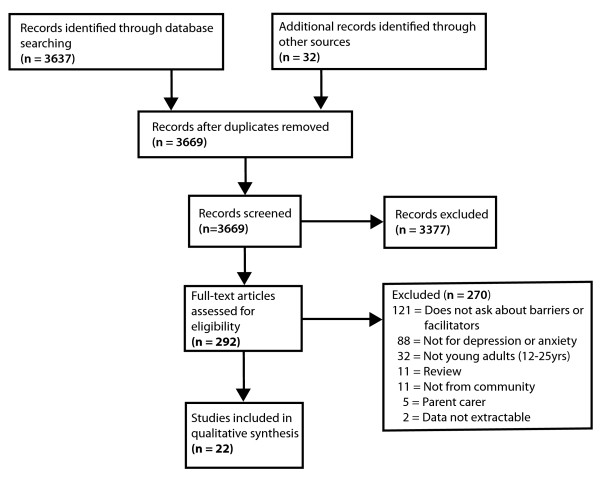
“This process resulted in a total of 22 relevant studies [20-41] for inclusion into the review.”
Background(2006) · Why Science Matters · doi:10.1002/9780470773994.ch8 · Cited by 1,014
Sawyer, M. G., Arney, F. M., Baghurst, P. A., Clark, J. J., Graetz, B. W., Kosky, R. J., Nurcombe, B., Patton, G. C., Prior, M. R., Raphael, B., et al. (2001) · Australian & New Zealand Journal of Psychiatry · doi:10.1046/j.1440-1614.2001.00964.x · Cited by 826
International Journal of Adolescent Medicine and Health
(2011) · International Journal of Adolescent Medicine and Health · doi:10.1515/ijamh · Cited by 686
Research works printed but not linked: 1
- Australian Bureau of Statistics Australian Bureau of Statistics. Canberra 2004-05 National Health Survey: Summary of Results 2006
Cited by
Items 601–700 of 1,047
Reducing the stigma of mental illness: Current approaches and future directions.
Casados, A. T. (2017) · Clinical Psychology Science and Practice · doi:10.1111/cpsp.12206 · Cited by 57
Radović, A., Gmelin, T. A., Hua, J., Long, C. E., Stein, B. D., & Miller, E. P. (2018) · JMIR Mental Health · doi:10.2196/mental.9441 · Cited by 38
Wang, C., Cramer, K. M., Cheng, H., & Do, K. A. (2019) · School Mental Health · doi:10.1007/s12310-019-09325-1 · Cited by 45
Help-Seeking Attitudes of University Students in Turkey
Çebi, E., & Demir, A. (2019) · International Journal for the Advancement of Counselling · doi:10.1007/s10447-019-09385-7 · Cited by 53
Le, L. K.-D., Sanci, L., Chatterton, M. L., Kauer, S., Buhagiar, K., & Mihalopoulos, C. (2019) · Journal of Medical Internet Research · doi:10.2196/13065 · Cited by 35
Changing Behavior Using Integrated Theories
Hagger, M. S., & Hamilton, K. (2020) · Cambridge University Press eBooks · doi:10.1017/9781108677318.015 · Cited by 51
Liu, F., Du, J., Zhou, D. Q., & Huang, B. (2020) · Assessing Writing · doi:10.1016/j.asw.2020.100482 · Cited by 47
Theurel, A., & Witt, A. (2022) · Creative Education · doi:10.4236/ce.2022.132025 · Cited by 41
Liu, L., Hay, P., & Conti, J. (2022) · BMC Psychiatry · doi:10.1186/s12888-022-03890-7 · Cited by 37
Issac, A., Nayak, S. G., Yesodharan, R., & Sequira, L. (2022) · Archives of Psychiatric Nursing · doi:10.1016/j.apnu.2022.09.001 · Cited by 47
Giovenco, D., Shook‐Sa, B. E., Hutson, B., Buchanan, L., Fisher, E. B., & Pettifor, A. E. (2022) · PLoS ONE · doi:10.1371/journal.pone.0279485 · Cited by 52
Integration of Depression and Primary Care: Barriers to Adoption
Grazier, K. L., Smith, J., Song, J. Y., & Smiley, M. L. (2013) · Journal of Primary Care & Community Health · doi:10.1177/2150131913491290 · Cited by 40
Nunes, M., Walker, J. R., Syed, T., Jong, M. D., Stewart, D. W., Provencher, M. D., Swinson, R. P., Ferrari, J., & Furer, P. (2014) · Canadian Psychology/Psychologie canadienne · doi:10.1037/a0036476 · Cited by 56
Gijzen, M. W. M., Creemers, D. H. M., Rasing, S. P. A., Smit, F., & Engels, R. C. M. E. (2018) · BMC Psychiatry · doi:10.1186/s12888-018-1710-2 · Cited by 35
Howell, A. N., Rheingold, A. A., Uhde, T. W., & Guille, C. (2019) · Cognitive Behaviour Therapy · doi:10.1080/16506073.2018.1533575 · Cited by 35
Systematic Review of Digital Interventions for Adolescent and Young Adult Women's Body Image
Mahon, C., & Seekis, V. (2022) · Frontiers in Global Women's Health · doi:10.3389/fgwh.2022.832805 · Cited by 34
“For example, digital technology can reach individuals living in remote areas (3) or those who would otherwise not seek help for fear of stigmatization (4) and can provide easily accessible service in a time efficient way.”
BackgroundChallenges associated with mental health management: Barriers and consequences
Mohamed Ibrahim, O. H., Ibrahim, R. M., Al-Tameemi, N. K., & Riley, K. (2020) · Saudi Pharmaceutical Journal · doi:10.1016/j.jsps.2020.06.018 · Cited by 34
“In addition, a systemic review of 20 research papers regarding the same issue found that feeling embarrassed, difficulty to identify the symptoms and preference for self-dependence were the significant obstacles (Gulliver et al., 2010).”
Gubi, E., Sjöqvist, H., Viksten-Assel, K., Bäärnhielm, S., Dalman, C., & Hollander, A.-C. (2022) · Social Psychiatry and Psychiatric Epidemiology · doi:10.1007/s00127-021-02145-2 · Cited by 34
“Certain barriers are prevalent regardless of migration background, such as a preference for self-reliance, perceived stigma, and problems recognizing symptoms [13], while others are specific to migrant and ethnic minority populations.”
BackgroundMacPhee, J., Modi, K., Gorman, S. E., Roy, N., Riba, E. B., Cusumano, D., Dunkle, J. H., Komrosky, N., Schwartz, V., Eisenberg, D., et al. (2021) · NAM Perspectives · doi:10.31478/202106b · Cited by 81
Young Adult Outcomes Associated With Adolescent Suicidality: A Meta-analysis
Cantor, N., Kingsbury, M. K., Warner, E. A., Landry, H., Clayborne, Z. M., Islam, R., & Colman, I. (2023) · PEDIATRICS · doi:10.1542/peds.2022-058113 · Cited by 40
Understanding and Improving Athlete Mental Health: A Social Identity Approach
Stevens, M. R., Cruwys, T., OLIVE, L. S., & Rice, S. (2024) · Sports Medicine · doi:10.1007/s40279-024-01996-4 · Cited by 58
Vicary, E., Kapadia, D., Bee, P., Bennion, M., & Brooks, H. L. (2024) · Journal of Mental Health · doi:10.1080/09638237.2024.2408237 · Cited by 69
Jones, N., Keeling, M., Thandi, G., & Greenberg, N. L. (2015) · Social Psychiatry and Psychiatric Epidemiology · doi:10.1007/s00127-015-1118-y · Cited by 40
Coates, D., & Howe, D. J. (2014) · Children and Youth Services Review · doi:10.1016/j.childyouth.2014.09.012 · Cited by 47
The Importance of Social Cues for Discretionary Health Services Utilization: The Case of Infertility
Greil, A. L., Shreffler, K. M., Johnson, K. M., McQuillan, J., & Slauson‐Blevins, K. S. (2012) · Sociological Inquiry · doi:10.1111/soin.12000 · Cited by 37
MacKinnon, N., & Colman, I. (2016) · The Canadian Journal of Psychiatry · doi:10.1177/0706743716667417 · Cited by 34
Hanley, T., Erşahin, Z., Sefi, A., & Hebron, J. (2016) · Journal of Psychologists and Counsellors in Schools · doi:10.1017/jgc.2016.20 · Cited by 41
Brown, R. L., Moloney, M., & Brown, J. (2017) · Journal of Community Psychology · doi:10.1002/jcop.21933 · Cited by 46
Untying the Gordian knot: remediation problems in medical schools that need remediation
Bennion, L. D., Durning, S. J., LaRochelle, J. S., Yoon, M. H., Schreiber-Gregory, D. N., Reamy, B. V., & Torre, D. M. (2018) · BMC Medical Education · doi:10.1186/s12909-018-1219-x · Cited by 43
Casañas, R., Arfuch, V.-M., Castellví, P., Gil, J.-J., Torres, M., Pujol, A., Castells, G., Teixidó, M., San-Emeterio, M. T., Sampietro, H. M., et al. (2018) · BMC Public Health · doi:10.1186/s12889-018-5855-1 · Cited by 34
A systematic scoping review of adolescent mental health treatment using mobile apps
Gindidis, S., Stewart, S., & Roodenburg, J. (2019) · Advances in Mental Health · doi:10.1080/18387357.2018.1523680 · Cited by 33
Colonio-Salazar, F. B., Sipiyaruk, K., White, S., & Gallagher, J. E. (2019) · BDJ · doi:10.1038/s41415-019-0485-2 · Cited by 41
Hayes, D., Moore, A., Stapley, E., Humphrey, N., Mansfield, R., Santos, J., Ashworth, E., Patalay, P., Bonin, E., Evans-Lacko, S. E., et al. (2019) · BMJ Open · doi:10.1136/bmjopen-2019-029044 · Cited by 49
Ming, Z.-J., & Chen, Z. (2019) · Advances in Psychological Science · doi:10.3724/sp.j.1042.2020.00001 · Cited by 38
Rasing, S. P. A., Stikkelbroek, Y. A. J., & Bodden, D. H. M. (2019) · International Journal of Environmental Research and Public Health · doi:10.3390/ijerph17010153 · Cited by 36
Maloney, C. A., Abel, W., & McLeod, H. J. (2020) · Internet Interventions · doi:10.1016/j.invent.2020.100325 · Cited by 46
Public perceptions of adult ADHD: Indications of stigma?
Godfrey, E., Fuermaier, A. B. M., Tucha, L., Butzbach, M., Weisbrod, M., Aschenbrenner, S., & Tucha, O. M. (2020) · Journal of Neural Transmission · doi:10.1007/s00702-020-02279-8 · Cited by 55
da Conceição, V., Rothes, I., & Gusmão, R. (2021) · Frontiers in Psychiatry · doi:10.3389/fpsyt.2021.783776 · Cited by 46
Kornfield, R., Stamatis, C. A., Bhattacharjee, A., Pang, B., Nguyen, T., Williams, J. J., Kumar, H., Popowski, S., Beltzer, M., Karr, C. J., et al. (2023) · Internet Interventions · doi:10.1016/j.invent.2023.100667 · Cited by 33
“…provider shortages, and transportation challenges, whereas attitudinal barriers include stigma, preferences for self-management, and beliefs that one's mental health condition is not severe enough to warrant treatment or that treatment will not help (Gulliver et al., 2010; Mehra et al., 2021).”
BackgroundHui, A., Wong, P. W.-C., & Fu, K.-W. (2015) · JMIR Mental Health · doi:10.2196/mental.3649 · Cited by 33
“According to the findings of a systematic review of 22 studies [10], mental health literacy is listed as one of the important factors for strengthening help-seeking intentions for mental disorders among adolescents.”
Evaluating quality in adolescent mental health services: a systematic review
Quinlan-Davidson, M., Roberts, K. J. S., Devakumar, D., Sawyer, S. M., Cortez, R. A., & Kiss, L. (2021) · BMJ Open · doi:10.1136/bmjopen-2020-044929 · Cited by 45
Lockwood, J., Williams, L., Martin, J. L., Rathee, M., & Hill, C. (2022) · JMIR Mental Health · doi:10.2196/29008 · Cited by 35
Palmer, R., Smith, B. J., Kite, J., & Phongsavan, P. (2024) · Health Promotion International · doi:10.1093/heapro/daae024 · Cited by 53
Unmet need for mental health care among adolescents in Asia and Europe
Mori, Y., Sourander, A., Mishina, K. E., Ståhlberg, T., Klomek, A. B., Kolaitis, G. A., Kaneko, H., Li, L., Huong, M. N., Praharaj, S. K., et al. (2024) · European Child & Adolescent Psychiatry · doi:10.1007/s00787-024-02472-0 · Cited by 45
Newlove‐Delgado, T., Moore, D. A., Ukoumunne, O. C., Stein, K., & Ford, T. J. (2015) · The Journal of Mental Health Training Education and Practice · doi:10.1108/jmhtep-02-2015-0007 · Cited by 44
Xu, Z., Müller, M., Heekeren, K., Theodoridou, A., Dvorsky, D. N., Metzler, S., Brabban, A., Corrigan, P. W., Walitza, S., Rössler, W., et al. (2015) · European Archives of Psychiatry and Clinical Neuroscience · doi:10.1007/s00406-015-0576-2 · Cited by 40
Prioritizing young people's emotional health support needs via participatory research
Kendal, S., Milnes, L. J., Welsby, H., Pryjmachuk, S., & Co‐Researchers’ Group (2017) · Journal of Psychiatric and Mental Health Nursing · doi:10.1111/jpm.12373 · Cited by 45
Fargas, M., & McSherry, D. (2017) · The British Journal of Social Work · doi:10.1093/bjsw/bcx062 · Cited by 44
Wadman, R., Webster, L. A. D., Mawn, L., & Stain, H. J. (2018) · Mental Health & Prevention · doi:10.1016/j.mhp.2018.11.003 · Cited by 42
Shannon, S., Breslin, G., Haughey, T. J., Sarju, N., Neill, D., Lawlor, M. P., & Leavey, G. (2019) · Mental Health & Prevention · doi:10.1016/j.mhp.2019.01.006 · Cited by 50
Chang, S. S. H., Abdin, E., Shafie, S., Sambasivam, R., Vaingankar, J. A., Ma, S., Chong, S. A., & Subramaniam, M. (2019) · Journal of Anxiety Disorders · doi:10.1016/j.janxdis.2019.102106 · Cited by 43
Peculiarities of health literacy in people with mental disorders: A cross-sectional study
Mantell, P. K., Baumeister, A., Christ, H., Ruhrmann, S., & Woopen, C. (2019) · International Journal of Social Psychiatry · doi:10.1177/0020764019873683 · Cited by 40
McEnery, C., Lim, M. H., Knowles, A., Rice, S., Gleeson, J., Howell, S., Russon, P., Miles, C., D'Alfonso, S., & Alvarez‐Jimenez, M. (2021) · Early Intervention in Psychiatry · doi:10.1111/eip.12912 · Cited by 32
Is Individualism Suicidogenic? Findings From a Multinational Study of Young Adults From 12 Countries
Eskin, M., Tran, U. S., Carta, M. G., Poyrazlı, Ş., Flood, C., Mechri, A., Shaheen, A. A., Janghorbani, M., Khader, Y. S., Yoshimasu, K., et al. (2020) · Frontiers in Psychiatry · doi:10.3389/fpsyt.2020.00259 · Cited by 45
Pile, V., Smith, P. A., Leamy, M. C., Oliver, A., Blackwell, S. E., Meiser‐Stedman, R., Dunn, B. D., Holmes, E. A., & Lau, J. Y. F. (2020) · Cognitive Therapy and Research · doi:10.1007/s10608-020-10130-3 · Cited by 36
Connected Mental Health: Systematic Mapping Study
(2020) · doi:10.2196/19950 · Cited by 33
Seven, Ü. S., Stoll, M., Dubbert, D., Kohls, C., Werner, P., & Kalbe, E. (2020) · International Journal of Environmental Research and Public Health · doi:10.3390/ijerph18010081 · Cited by 43
Franzoi, I. G., D’Ovidio, F., Costa, G., d’Errico, A., & Granieri, A. (2021) · International Journal of Environmental Research and Public Health · doi:10.3390/ijerph18126403 · Cited by 42
COVID-19 Specific Risk Markers for Intimate Partner Violence Perpetration
Spencer, C. M., Gimarc, C., & Durtschi, J. A. (2021) · Journal of Family Violence · doi:10.1007/s10896-021-00335-9 · Cited by 43
Mutiso, V. N., Pike, K., Musyimi, C. W., Rebello, T. J., Tele, A., Gitonga, I., Thornicroft, G., & Ndetei, D. M. (2019) · Epidemiology and Psychiatric Sciences · doi:10.1017/s2045796018000264 · Cited by 30
“Stigma and discrimination can have a negative impact on help-seeking behaviour, treatment adherence and the recovery of people with mental disorders (Perlick et al. 2001; Barney et al. 2006; Gulliver et al. 2010).”
BackgroundEskin, M., Schild, A., Öncü, B., Stieger, S., & Voracek, M. (2015) · Death Studies · doi:10.1080/07481187.2015.1037971 · Cited by 32
Is e-health the answer to gaps in adolescent mental health service provision?
O’Dea, B., Calear, A. L., & Perry, Y. (2015) · Current Opinion in Psychiatry · doi:10.1097/yco.0000000000000170 · Cited by 32
Meyerhoff, J., Kornfield, R., Mohr, D. C., & Reddy, M. C. (2022) · Proceedings of the ACM on Human-Computer Interaction · doi:10.1145/3555203 · Cited by 47
Bennett, H., Allitt, B., & Hanna, F. S. (2023) · Frontiers in Public Health · doi:10.3389/fpubh.2023.1065784 · Cited by 42
Discrimination, stigma and mental health: what’s next?
Torales, J. C., Aveiro-Róbalo, T. R., Ríos-González, C. M., Barrios, I., Almirón‐Santacruz, J., González, I., Caycho‐Rodríguez, T., Castaldelli-Maia, J. M., & Ventriglio, A. (2023) · International Review of Psychiatry · doi:10.1080/09540261.2023.2186218 · Cited by 54
Evaluating Generative AI Psychotherapy Chatbots Used by Youth: Cross-Sectional Study
Sobowale, K., Humphrey, D. K., & Zhao, S. Y. (2025) · JMIR Mental Health · doi:10.2196/79838 · Cited by 52
Watsford, C., & Rickwood, D. (2014) · Clinical Psychologist · doi:10.1111/cp.12034 · Cited by 32
Exploring e-Mental Health Preferences of Generation Y
Mar, M. Y., Neilson, E. K., Torchalla, I., Werker, G. R., Laing, A., & Krausz, M. (2014) · Journal of Technology in Human Services · doi:10.1080/15228835.2014.943457 · Cited by 32
Stigma and suicidal ideation among young people at risk of psychosis after one year
Xu, Z., Mayer, B., Müller, M., Heekeren, K., Theodoridou, A., Dvorsky, D. N., Metzler, S., Oexle, N., Walitza, S., Rössler, W., et al. (2016) · Psychiatry Research · doi:10.1016/j.psychres.2016.06.041 · Cited by 37
The Hero’s Journey: A Mudmap for Change
Williams, C. (2017) · Journal of Humanistic Psychology · doi:10.1177/0022167817705499 · Cited by 54
van Rosmalen-Nooijens, K. A. W. L., Wong, S. L. F., Prins, J. B., & Lagro‐Janssen, A. L. M. (2017) · Journal of Medical Internet Research · doi:10.2196/jmir.6004 · Cited by 36
Factors associated with mental health consultation in South Korea
Jang, J., Lee, S. A., Kim, W., Choi, Y. S., & Park, E. (2018) · BMC Psychiatry · doi:10.1186/s12888-018-1592-3 · Cited by 41
Adolescents’ Views on Seeking Help for Emotional and Behavioral Problems: A Focus Group Study
van den Toren, S. J., van Grieken, A., Lugtenberg, M., Boelens, M., & Raat, H. (2019) · International Journal of Environmental Research and Public Health · doi:10.3390/ijerph17010191 · Cited by 49
Srivastava, P., Mehta, M., Sagar, R., & Ambekar, A. (2020) · Asian Journal of Psychiatry · doi:10.1016/j.ajp.2020.101970 · Cited by 40
Theimer, K., Mii, A. E., Sonnen, E., McCoy, K., Meidlinger, K., Biles, B., Huit, T. Z., Flood, M. F., & Hansen, D. J. (2020) · Aggression and Violent Behavior · doi:10.1016/j.avb.2020.101418 · Cited by 40
Choi, B., Kim, H., & Huh, J. (2021) · JMIR Formative Research · doi:10.2196/31944 · Cited by 59
Leong, Q. Y., Sridhar, S., Blasiak, A., Tadeo, X., Yeo, G., Remus, A., & Ho, D. (2022) · Journal of Medical Internet Research · doi:10.2196/27388 · Cited by 40
Skeen, S., Tomlinson, M., Macedo, A., Croome, N., & Sherr, L. (2014) · AIDS Care · doi:10.1080/09540121.2014.906559 · Cited by 38
Hassett, A., & Isbister, C. (2017) · Sage Open · doi:10.1177/2158244017745112 · Cited by 31
Lattie, E. G., Ho, J., Sargent, E., Tomasino, K. N., Smith, J. D., Brown, C. H., & Mohr, D. C. (2017) · Internet Interventions · doi:10.1016/j.invent.2017.02.003 · Cited by 31
“While universal interventions (including those delivered in school settings) are often expected to have low rates of completion due to many people being offered the intervention who do not need it, we recognize the lack of access that many adolescents face in seeking mental health care (Gulliver et al., 2010), and tha…”
BackgroundChanging Behavior Using the Transtheoretical Model
DiClemente, C. C., & Graydon, M. M. (2020) · Cambridge University Press eBooks · doi:10.1017/9781108677318.010 · Cited by 38
Docksey, A. E., Gray, N. S., Davies, H. B., Simkiss, N. J., & Snowden, R. J. (2022) · Health Psychology Research · doi:10.52965/001c.35630 · Cited by 47
Yao, Z.-Y., Wang, T., Yu, Y.-K., Li, R., Sang, X., Yi-na, F., Gong, X.-J., Sun, W., Liu, J. J. W., Wong, J. P., et al. (2023) · Journal of Affective Disorders · doi:10.1016/j.jad.2023.07.050 · Cited by 47
Increasing knowledge about depression in adolescents: effects of an information booklet
Schiller, Y., Schulte‐Körne, G., Eberle-Sejari, R., Maier, B. G., & Allgaier, A. (2013) · Social Psychiatry and Psychiatric Epidemiology · doi:10.1007/s00127-013-0706-y · Cited by 42
Spence, R., Owens, M., & Goodyer, I. M. (2016) · BMC Research Notes · doi:10.1186/s13104-016-2227-8 · Cited by 42
Services Wanted? Understanding the Non-take-up of Social Support at the Local Level
Reijnders, M. A. W., Schalk, J., & Steen, T. P. S. (2018) · VOLUNTAS International Journal of Voluntary and Nonprofit Organizations · doi:10.1007/s11266-018-00060-w · Cited by 49
Coates, D., Saleeba, C., & Howe, D. J. (2018) · Community Mental Health Journal · doi:10.1007/s10597-018-0270-8 · Cited by 33
Ho, G. W. K., Bressington, D. T., Leung, S. F., Lam, K. K. C., Leung, A. Y. M., Molassiotis, A., Ligot, J., Ranoco, C., Sophal, C., & Valimaki, M. A. (2018) · Social Psychiatry and Psychiatric Epidemiology · doi:10.1007/s00127-018-1538-6 · Cited by 36
Improving Moderator Responsiveness in Online Peer Support Through Automated Triage
Milne, D., McCabe, K., & Calvo, R. A. (2018) · Journal of Medical Internet Research · doi:10.2196/11410 · Cited by 35
Coleman-Fountain, E., Buckley, C., & Beresford, B. (2020) · British Journal of General Practice · doi:10.3399/bjgp20x709421 · Cited by 31
Chen, S., Chang, W., & Stuart, H. L. (2020) · BMC Psychology · doi:10.1186/s40359-020-00446-w · Cited by 44
Kahl, B. L., Miller, H. M., Cairns, K., Giniunas, H., & Nicholas, M. (2020) · JMIR Mental Health · doi:10.2196/21280 · Cited by 31
Classifying depression using blood biomarkers: A large population study
Lin, Z., Lawrence, W. R., Huang, Y., Lin, Q., & Gao, Y. (2021) · Journal of Psychiatric Research · doi:10.1016/j.jpsychires.2021.05.070 · Cited by 32
Wong, S. M. Y., Ip, C. H., Hui, C. L. M., Suen, Y. N., Wong, C. S. M., Chang, W. C., Chan, S. K. W., Lee, E. H. M., Lui, S. S. Y., Chan, K. T., et al. (2022) · Psychological Medicine · doi:10.1017/s0033291722001519 · Cited by 41
Babbage, C. M., Jackson, G. M., Davies, E. B., & Nixon, E. (2022) · JMIR Mental Health · doi:10.2196/25716 · Cited by 44
Sit, M., Elliott, S. A., Wright, K. S., Scott, S. D., & Hartling, L. (2022) · Youth & Society · doi:10.1177/0044118x221129642 · Cited by 47
Ruppel, E. K., & McKinley, C. J. (2015) · Cyberpsychology Behavior and Social Networking · doi:10.1089/cyber.2014.0652 · Cited by 34
Empowerment of young people who have a parent living with dementia: a social model perspective
Hutchinson, K., Roberts, C., Daly, M. G., Bulsara, C., & Kurrle, S. E. (2015) · International Psychogeriatrics · doi:10.1017/s1041610215001714 · Cited by 40
A grounded theory of bisexual individuals’ experiences of help seeking.
MacKay, J. M., Robinson, M., Pinder, S., & Ross, L. E. (2016) · American Journal of Orthopsychiatry · doi:10.1037/ort0000184 · Cited by 34
Mental disorders in Australian 4- to 17- year olds: Parent-reported need for help
Johnson, S. E., Lawrence, D. M., Sawyer, M., & Zubrick, S. R. (2017) · Australian & New Zealand Journal of Psychiatry · doi:10.1177/0004867417706032 · Cited by 33
Metadata
- Authors
- Gulliver, A., Griffiths, K. M., & Christensen, H.
- Affiliations
- Australian National University (AU)
- Corresponding author
- Gulliver, Amelia
- Venue
- BMC Psychiatry
- Published
- 2010-12
- Volume
- 10
- Issue
- 1
- Pages
- 113-113
- ISSN
- 1471-244X (ISSN-L)
- PMC
- PMC3022639
- OpenAlex
- W2107750653
- Semantic Scholar
- f95edcc0bd6116b085c3f189a000be87dd3d6115
- Cited by
- 3,292
- References
- 51
- Citations by year
- 2026: 301 · 2025: 323 · 2024: 301 · 2023: 299 · 2022: 306 · 2021: 318 · 2020: 363 · 2019: 238 · 2018: 221 · 2017: 170 · 2016: 147 · 2015: 111 · 2014: 90 · 2013: 48 · 2012: 42
- FWCI
- 4.00
- Type
- journal article
- Language
- en
- Open access
- gold
- doi.org
- Licence
- cc-by
- creativecommons.org/licenses/by/2.0 (tdm)
- Locations
- BMC Psychiatry (publishedVersion, cc-by)
- Europe PMC (PubMed Central) (publishedVersion, cc-by)
- PubMed Central (publishedVersion, cc-by)
- PubMed (publishedVersion)
- DOAJ (DOAJ: Directory of Open Access Journals) (submittedVersion)
- ANU Open Research (Australian National University) (submittedVersion, cc-by)
- Funders
- Australian National University
- Australian Institute of Sport
- National Health and Medical Research Council (525413, 525411)
- Topics
- Health Sciences › Medicine › Psychiatry and Mental health › Mental Health Treatment and Access
- Social Sciences › Psychology › Clinical Psychology › Suicide and Self-Harm Studies
- Social Sciences › Psychology › Clinical Psychology › Psychology and Mental Health
- Keywords
- help-seeking, mental health help-seeking, adolescents, young adults, perceived barriers, perceived facilitators, mental health literacy, stigma, self-reliance, social support, common mental disorders
- MeSH terms
- Adolescent, Adult, Mental Disorders, Data Collection, Female, Health Services Accessibility, Humans, Male, Mental Health Services, Patient Acceptance of Health Care, Qualitative Research, Young Adult
About these checks
Registry, retraction, Cites and statistics results are computed, not judged, with one exception: a printed reference that no index lists is read once by a model before it counts as a citation error. Claims are extracted by a model and kept only when their quote appears verbatim in the text; each cited source is then checked, with a model’s help, for whether it says what the claim relies on. Those verdicts can be wrong — read the claim’s quote and the cited source before relying on one.
Statistics and arithmetic are recomputed, not judged.
Confidence bands are shown only for fields calibrated on our annotated test set. None is calibrated yet, so no band is shown.
What counts as a claim ›How we measure confidence ›How we check this ›
Are you an author, or do you see a problem with this page? Request a review
Data sources
Bibliographic data: Semantic Scholar, OpenAlex, Crossref.
Contains information from the Semantic Scholar Academic Graph Datasets, made available under the ODC Attribution License (ODC-BY 1.0).
Semantic Scholar’s data is described in: Kinney, R., et al. (2023). The Semantic Scholar Open Data Platform. arXiv:2301.10140.
