

Perceived barriers and facilitators to mental health help-seeking in young people: a systematic review
Open accessThe DOI matches its Crossref record; 50 of the 51 references it cites were found in a registry or an index, and 1 are not checked yet.
Abstract
BACKGROUND: Adolescents and young adults frequently experience mental disorders, yet tend not to seek help. This systematic review aims to summarise reported barriers and facilitators of help-seeking in young people using both qualitative research from surveys, focus groups, and interviews and quantitative data from published surveys. It extends previous reviews through its systematic research methodology and by the inclusion of published studies describing what young people themselves perceive are the barriers and facilitators to help-seeking for common mental health problems. METHODS: Twenty two published studies of perceived barriers or facilitators in adolescents or young adults were identified through searches of PubMed, PsycInfo, and the Cochrane database. A thematic analysis was undertaken on the results reported in the qualitative literature and quantitative literature. RESULTS: Fifteen qualitative and seven quantitative studies were identified. Young people perceived stigma and embarrassment, problems recognising symptoms (poor mental health literacy), and a preference for self-reliance as the most important barriers to help-seeking. Facilitators were comparatively under-researched. However, there was evidence that young people perceived positive past experiences, and social support and encouragement from others as aids to the help-seeking process. CONCLUSIONS: Strategies for improving help-seeking by adolescents and young adults should focus on improving mental health literacy, reducing stigma, and taking into account the desire of young people for self-reliance.
Overview
The claims and statistics of this paper haven’t been checked yet.
Free: it reads the open-access text and checks the first 5 claims that cite a source we can check. Create a free account to check every claim.
Integrity signals
Registry
Cites
Statistics
Figures
Verification
Claims the paper makes
The claims and statistics of this paper haven’t been checked yet.
Free: it reads the open-access text and checks the first 5 claims that cite a source we can check. Create a free account to check every claim.
Claims other papers make about this one
Each is checked against this paper’s own text: does it say what the citing paper says it does?
The cited source doesn’t support the claim as written.
In the citing paper
“A previous systematic review demonstrated that a low level of MHL is the main barrier to seeking assistance [11].”
From Mental health literacy intervention on help-seeking in athletes: a systematic review (2020) · cites this paper as [11]
Checked by a reasoning model — may be wrong.
Experimental — accuracy not yet measuredThe source backs part of the claim, not all of it — or backs it for a different population, condition or comparison.
In the citing paper
“Despite this, the extant literature has extensively examined many barriers and facilitators impacting young people seeking help and has increased understanding on a range of personal, social, cultural, and service factors (Doan et al. 2020; Gulliver et al. 2010; Goodwin et al. 2016; Michelmore and Hindley 2012; Nam et al. 2010; Radez et al. 2021; Roth ì and Leavey 2006; Rowe et al. 2014).”
From "You Have the Choice of Whether You're Going to Get Help or Attempt Suicide": Exploring the Process and Impact of Mental Health Help-Seeking with Young People (16–25 Years) (2025) · cites this paper as Gulliver et al. 2010
Experimental — accuracy not yet measuredThe source backs part of the claim, not all of it — or backs it for a different population, condition or comparison.
In the citing paper
“In addition to the issue of low levels of MHL, high levels of stigma are recognised as another barrier influencing help-seeking in elite sport [11].”
From Mental health literacy intervention on help-seeking in athletes: a systematic review (2020) · cites this paper as [11]
Experimental — accuracy not yet measuredThe source backs part of the claim, not all of it — or backs it for a different population, condition or comparison.
In the citing paper
“In addition, existing face-to-face services pose significant barriers for young people [10-16] largely due to access, availability, and high costs of these services [17], as well as the reluctance of young people to seek professional help due to stigma and embarrassment [18-20].”
From Do online mental health services improve help-seeking for young people? A systematic review (2014) · cites this paper as [13]
Experimental — accuracy not yet measuredThe source backs part of the claim, not all of it — or backs it for a different population, condition or comparison.
In the citing paper
“Meeting these needs is challenging, as men (particularly younger men) tend not to seek professional help for distress (Gulliver, Griffiths, & Christensen, 2010;Oliver et al., 2005;Rickwood, Deane, & Wilson, 2007).”
From e-TC: Development and pilot testing of a web-based intervention to reduce anxiety and depression in survivors of testicular cancer (2017) · cites this paper as Gulliver, Griffiths, & Christensen, 2010
Experimental — accuracy not yet measured
19 more claims about this paper
Create a free account to see every claim other papers make about this one.
Self-check
Percentages, sums and reported differences re-computed from the paper’s own numbers.
The self-check needs the paper’s full text.
Citations
Cites
Preferred Reporting Items for Systematic Reviews and Meta-Analyses: the PRISMA statement
Moher, D., Liberati, A., Tetzlaff, J., Altman, D. G., & for the PRISMA Group (2009) · BMJ · doi:10.1136/bmj.b2535 · Cited by 83,823
Preferred reporting items for systematic reviews and meta-analyses: the PRISMA Statement.
(2009) · PubMed Central · Cited by 44,859
Kessler, R. C., Chiu, W. T., Demler, O., & Walters, E. E. (2005) · Archives of General Psychiatry · doi:10.1001/archpsyc.62.6.617 · Cited by 12,052
(2021) · Handbook of Research Methods for Marketing Management · doi:10.4337/9781788976954.00014 · Cited by 4,009
Young People’s Help-Seeking for Mental Health Problems
Rickwood, D., Deane, F. P., Wilson, C. J., & Ciarrochi, J. (2005) · Australian e-Journal for the Advancement of Mental Health · doi:10.5172/jamh.4.3.218 · Cited by 1,619
When and how do young people seek professional help for mental health problems?
Rickwood, D. J., Deane, F. P., & Wilson, C. J. (2007) · Medical Journal of Australia · doi:10.5694/j.1326-5377.2007.tb01334.x · Cited by 1,195
Help-Seeking and Access to Mental Health Care in a University Student Population
Eisenberg, D., Golberstein, E., & Gollust, S. E. (2007) · Medical Care · doi:10.1097/mlr.0b013e31803bb4c1 · Cited by 1,131 · cited 1×
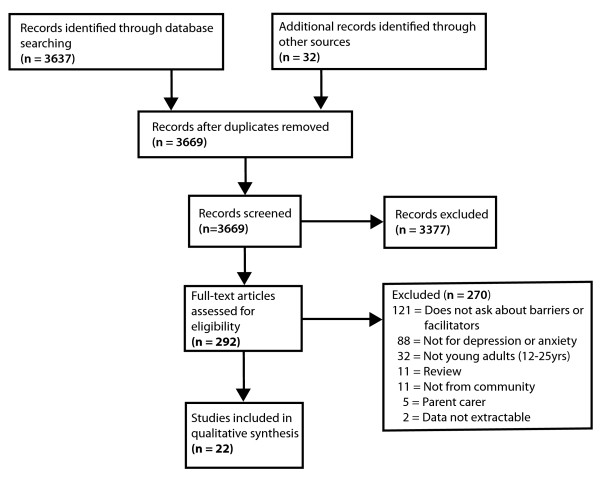
“This process resulted in a total of 22 relevant studies [20-41] for inclusion into the review.”
Background(2006) · Why Science Matters · doi:10.1002/9780470773994.ch8 · Cited by 1,014
Sawyer, M. G., Arney, F. M., Baghurst, P. A., Clark, J. J., Graetz, B. W., Kosky, R. J., Nurcombe, B., Patton, G. C., Prior, M. R., Raphael, B., et al. (2001) · Australian & New Zealand Journal of Psychiatry · doi:10.1046/j.1440-1614.2001.00964.x · Cited by 826
International Journal of Adolescent Medicine and Health
(2011) · International Journal of Adolescent Medicine and Health · doi:10.1515/ijamh · Cited by 686
Research works printed but not linked: 1
- Australian Bureau of Statistics Australian Bureau of Statistics. Canberra 2004-05 National Health Survey: Summary of Results 2006
Cited by
Items 201–300 of 1,047
Cosh, S., McNeil, D. G., Jeffreys, A., Clark, L. A., & Tully, P. J. (2023) · Psychology of sport and exercise · doi:10.1016/j.psychsport.2023.102586 · Cited by 137
Supporting family engagement with child and adolescent mental health services: A scoping review
Waid, J., & Kelly, M. (2020) · Health & Social Care in the Community · doi:10.1111/hsc.12947 · Cited by 106
Designing Mental Health Technologies that Support the Social Ecosystem of College Students
Lattie, E. G., Kornfield, R., Ringland, K. E., Zhang, R., Winquist, N., & Reddy, M. (2020) · Proceedings of the 2020 CHI Conference on Human Factors in Computing Systems · doi:10.1145/3313831.3376362 · Cited by 86
Mental health help-seeking behaviours in young adults
Mitchell, C., McMillan, B., & Hagan, T. (2017) · British Journal of General Practice · doi:10.3399/bjgp17x688453 · Cited by 87
Batterham, P. J., Christensen, H., Mackinnon, A. J., Gosling, J. A., Thorndike, F. P., Ritterband, L. M., Glozier, N., & Griffiths, K. M. (2017) · BJPsych Open · doi:10.1192/bjpo.bp.117.005231 · Cited by 85
Self-citationKaess, M., Edinger, A., Fischer-Waldschmidt, G., Parzer, P., Brunner, R., & Resch, F. (2020) · European Child & Adolescent Psychiatry · doi:10.1007/s00787-019-01399-1 · Cited by 85
Gibson, K. L., Cartwright, C., Kerrisk, K., Campbell, J., & Seymour, F. W. (2015) · Journal of Child and Family Studies · doi:10.1007/s10826-015-0292-6 · Cited by 121
Adolescent trust and primary care: Help‐seeking for emotional and psychological difficulties
Corry, D. A. S., & Leavey, G. (2017) · Journal of Adolescence · doi:10.1016/j.adolescence.2016.11.003 · Cited by 85
Risk-behaviour screening for identifying adolescents with mental health problems in Europe
Kaess, M., Brunner, R. M., Parzer, P., Carli, V., Apter, A., Balázs, J., Bobes, J., Coman, H. G., Cosman, D. C. M., Cotter, P., et al. (2013) · European Child & Adolescent Psychiatry · doi:10.1007/s00787-013-0490-y · Cited by 100
Patafio, B., Miller, P., Baldwin, R., Taylor, N., & Hyder, S. (2021) · Early Intervention in Psychiatry · doi:10.1111/eip.13109 · Cited by 84
Morthorst, B., Krogh, J., Erlangsen, A., Alberdi, F., & Nordentoft, M. (2012) · BMJ · doi:10.1136/bmj.e4972 · Cited by 84
Guo, S., Nguyen, H., Weiss, B., Ngo, V. K., & Lau, A. S. (2015) · Journal of Counseling Psychology · doi:10.1037/cou0000094 · Cited by 84
“When young people do seek help, they tend to reach out to members of their informal social network with whom they are close, such as family and peers (Gulliver et al., 2010; Wilson et al., 2007) rather than seeking help from more formal sources (e.g., counselors; family physician).”
BackgroundHansson, L., Lexén, A., & Holmén, J. (2017) · Social Psychiatry and Psychiatric Epidemiology · doi:10.1007/s00127-017-1385-x · Cited by 84
Gaddis, S. M., Ramirez, D., & Hernandez, E. L. (2018) · Social Science & Medicine · doi:10.1016/j.socscimed.2017.11.029 · Cited by 84
Help-Seeking Measures and Their Use in Adolescents: A Systematic Review
Divin, N., Harper, P., Curran, E., Corry, D., & Leavey, G. (2018) · Adolescent Research Review · doi:10.1007/s40894-017-0078-8 · Cited by 83
“Barriers to informal help-seeking have also been identified such as fearing negative judgment from friends and family (Gulliver et al. 2010).”
BackgroundSeidler, Z. E., Rice, S. M., Dhillon, H. M., Cotton, S. M., Telford, N. R., McEachran, J., & Rickwood, D. J. (2020) · Psychiatric Services · doi:10.1176/appi.ps.201900491 · Cited by 83
Bundock, K., Chan, C., & Hewitt, O. M. (2018) · Trauma Violence & Abuse · doi:10.1177/1524838018770412 · Cited by 113
Linden, B., Boyes, R., & Stuart, H. L. (2021) · BMC Public Health · doi:10.1186/s12889-021-10622-1 · Cited by 124
Addressing Mental Health Stigma among Young Adolescents: Evaluation of a Youth-Led Approach
Bulanda, J. J., Bruhn, C., Byro-Johnson, T., & Zentmyer, M. (2014) · Health & Social Work · doi:10.1093/hsw/hlu008 · Cited by 83
Pilot evaluation of the Sleep Ninja: A smartphone application for adolescent insomnia symptoms
Werner-Seidler, A., Wong, Q., Johnston, L., O’Dea, B., Torok, M., & Christensen, H. (2019) · BMJ Open · doi:10.1136/bmjopen-2018-026502 · Cited by 82
“This preference may in part be explained by the fact that young people are reluctant to seek help for psychological issues, for reasons that include stigma and a preference to manage the problem themselves.(20) Sleep is typically less stigmatised than disorders like depression, suggesting that targetting sleep it may…”
BackgroundSelf-citationApplying the Policy Ecology Framework to Philadelphia’s Behavioral Health Transformation Efforts
Powell, B. J., Beidas, R. S., Rubin, R. M., Stewart, R. E., Wolk, C. B., Matlin, S. L., Weaver, S., Hurford, M. O., Evans, A. C., Hadley, T. R., et al. (2016) · Administration and Policy in Mental Health and Mental Health Services Research · doi:10.1007/s10488-016-0733-6 · Cited by 82
Mental illness stigma and disclosure in college students
Corrigan, P. W., Kosyluk, K. A., Markowitz, F., Brown, R. L., Conlon, B., Rees, J., Rosenberg, J., Ellefson, S., & Al-Khouja, M. (2016) · Journal of Mental Health · doi:10.3109/09638237.2015.1101056 · Cited by 82
Unmet need for professional mental health care among adolescents with high psychological distress
Sheppard, R., Deane, F. P., & Ciarrochi, J. (2018) · Australian & New Zealand Journal of Psychiatry · doi:10.1177/0004867417707818 · Cited by 73
Liu, X., Guo, Y.-X., & Xu, Y. (2023) · World Journal of Clinical Cases · doi:10.12998/wjcc.v11.i7.1442 · Cited by 115
Picco, L., Abdin, E., Pang, S., Vaingankar, J. A., Jeyagurunathan, A., Chong, S. A., & Subramaniam, M. (2018) · Epidemiology and Psychiatric Sciences · doi:10.1017/s2045796016000998 · Cited by 81
Social Work and Social Media: Online Help-Seeking and the Mental Well-Being of Adolescent Males
Best, P., Manktelow, R., & Taylor, B. J. (2016) · British Journal of Social Work · doi:10.1093/bjsw/bcu130 · Cited by 80
Comeau, J., Georgiades, K., Duncan, L., Wang, L., Boyle, M. H., & 2014 Ontario Child Health Study Team (2019) · The Canadian Journal of Psychiatry · doi:10.1177/0706743719830035 · Cited by 80
Achilles, M. R., Anderson, M., Li, S. H., Subotic-Kerry, M., Parker, B., & O’Dea, B. (2020) · DIGITAL HEALTH · doi:10.1177/2055207620926064 · Cited by 80
Karing, C. (2021) · Journal of Affective Disorders Reports · doi:10.1016/j.jadr.2021.100174 · Cited by 107
Autonomy versus support: self-reliance and help-seeking for mental health problems in young people
Ishikawa, A., Rickwood, D., Bariola, E., & Bhullar, N. (2022) · Social Psychiatry and Psychiatric Epidemiology · doi:10.1007/s00127-022-02361-4 · Cited by 109
Mental Health Help-Seeking Intentions and Preferences of Rural Chinese Adults
Yu, Y., Liu, Z.-W., Hu, M., Liu, H.-M., Yang, J. P., Zhou, L., & Xiao, S.-Y. (2015) · PLOS ONE · doi:10.1371/journal.pone.0141889 · Cited by 79
“As a result, those with higher perceived social support always exhibited more positive attitudes towards mental health help-seeking and were more likely to seek help and get help for mental health problems [23,32].”
BackgroundResultInfluentialYoung people's priorities for support on social media: “It takes trust to talk about these issues”
Gibson, K. L., & Trnka, S. H. (2019) · Computers in Human Behavior · doi:10.1016/j.chb.2019.08.030 · Cited by 101
Labouliere, C., Kleinman, M., & Gould, M. (2015) · International Journal of Environmental Research and Public Health · doi:10.3390/ijerph120403741 · Cited by 79
“result in supportive interactions [21,49] or consultation with formal mental health treatment or emergency services if symptoms become too severe [5].”
BackgroundThe specificity of public stigma: A comparison of suicide and depression-related stigma
Sheehan, L. L., Dubke, R. E., & Corrigan, P. W. (2017) · Psychiatry Research · doi:10.1016/j.psychres.2017.06.015 · Cited by 98
Smartphone Applications for Mental Health
Radovic, A., Vona, P. L., Santostefano, A. M., Ciaravino, S., Miller, E., & Stein, B. D. (2016) · Cyberpsychology, Behavior, and Social Networking · doi:10.1089/cyber.2015.0619 · Cited by 78
Clinical and Ethical Considerations for Delivering Couple and Family Therapy via Telehealth
Wrape, E. R., & McGinn, M. M. (2019) · Journal of Marital and Family Therapy · doi:10.1111/jmft.12319 · Cited by 78
Shahwan, S., Lau, J. H., Goh, C. M. J., Ong, W. J., Tan, G. T. H., Kwok, K. W., Samari, E., Lee, Y. Y., Teh, W. L., Seet, V. A. L., et al. (2020) · BMC Psychiatry · doi:10.1186/s12888-020-02960-y · Cited by 146
Morgan, B. E., & Simmons, L. K. (2021) · Frontiers in Education · doi:10.3389/feduc.2021.642632 · Cited by 108
Fekih‐Romdhane, F., Jahrami, H., Stambouli, M., Alhuwailah, A., Helmy, M. S., Shuwiekh, H. A. M., Lemine, C. M. F. M., RADWAN, E. S., Saquib, J., Saquib, N., et al. (2022) · Social Psychiatry and Psychiatric Epidemiology · doi:10.1007/s00127-022-02403-x · Cited by 104
Stigma Toward Substance Dependence: Causes, Consequences, and Potential Interventions
Krendl, A. C., & Perry, B. L. (2023) · Gothic.net · doi:10.1177/15291006231198193 · Cited by 110
Recognition of mental disorders among a multiracial population in Southeast Asia
Chong, S. A., Abdin, E., Picco, L., Pang, S., Jeyagurunathan, A., Vaingankar, J. A., Kwok, K. W., & Subramaniam, M. (2016) · BMC Psychiatry · doi:10.1186/s12888-016-0837-2 · Cited by 78
Young construction workers: substance use, mental health, and workplace psychosocial factors
Pidd, K., Duraisingam, V., ROCHE, A. M., & Trifonoff, A. (2017) · Advances in Dual Diagnosis · doi:10.1108/add-08-2017-0013 · Cited by 91
Developing a roadmap for the translation of e-mental health services for depression
Batterham, P. J., Sunderland, M., Calear, A. L., Davey, C. G., Christensen, H., Teesson, M., Kay-Lambkin, F., Andrews, G., Mitchell, P. B., Herrman, H., et al. (2015) · Australian & New Zealand Journal of Psychiatry · doi:10.1177/0004867415582054 · Cited by 77
“For consumers, reluctance to use these services may stem from the stigma of depression (Gulliver et al., 2010), stigma of seeking help (Schomerus and Angermeyer, 2008), low mental health literacy and poor symptom recognition (Jorm et al.”
BackgroundSelf-citationO'Keeffe, S., Martin, P., & Midgley, N. (2020) · Psychotherapy · doi:10.1037/pst0000279 · Cited by 75
Clark, L. H., Hudson, J. L., Rapee, R. M., & Grasby, K. L. (2020) · Journal of Anxiety Disorders · doi:10.1016/j.janxdis.2020.102292 · Cited by 102
Slack, H. R., & Priestley, M. J. (2022) · Assessment & Evaluation in Higher Education · doi:10.1080/02602938.2022.2076804 · Cited by 105
Rodwin, A. H., Shimizu, R., Travis, R., James, K. J., Banya, M., & Munson, M. R. (2023) · Child and Adolescent Social Work Journal · doi:10.1007/s10560-022-00893-x · Cited by 76
Milić, J., Škrlec, I., Milić Vranješ, I., Podgornjak, M., & Heffer, M. (2019) · International Review of Psychiatry · doi:10.1080/09540261.2019.1594647 · Cited by 76
Factors Influencing Health Knowledge and Behaviors among the Elderly in Rural China
He, Z., Cheng, Z., Shao, T., Liu, C., Shao, P., Bishwajit, G., Da, F., & Feng, Z. (2016) · International Journal of Environmental Research and Public Health · doi:10.3390/ijerph13100975 · Cited by 107
Sheikh, A., Payne-Cook, C., Lisk, S. C., Carter, B., & Brown, J. S. L. (2024) · European Child & Adolescent Psychiatry · doi:10.1007/s00787-024-02520-9 · Cited by 112
Dockery, L., Jeffery, D., Schauman, O., Williams, P., Farrelly, S., Bonnington, O., Gabbidon, J., Lassman, F., Szmukler, G., Thornicroft, G., et al. (2015) · Psychiatry Research · doi:10.1016/j.psychres.2015.05.044 · Cited by 76
Christensen, H., Reynolds, J., & Griffiths, K. M. (2011) · Early Intervention in Psychiatry · doi:10.1111/j.1751-7893.2010.00242.x · Cited by 76
Self-citationEPA Guidance on Building Trust in Mental Health Services
Gäebel, W., Muijen, M., Baumann, A., Bhugra, D., Wasserman, D., van der Gaag, R. J., Heun, R., & Zielasek, J. (2014) · European Psychiatry · doi:10.1016/j.eurpsy.2014.01.001 · Cited by 86
Perry-Young, L., Owen, G. J., Kelly, S., & Owens, C. V. (2016) · Dementia · doi:10.1177/1471301215626889 · Cited by 93
Zhang, R., E. Ringland, K., Paan, M., C. Mohr, D., & Reddy, M. (2021) · Proceedings of the 2021 CHI Conference on Human Factors in Computing Systems · doi:10.1145/3411764.3445771 · Cited by 71
Samari, E., Teh, W. L., Roystonn, K., Devi, F., Cetty, L., Shahwan, S., & Subramaniam, M. (2022) · BMC Psychiatry · doi:10.1186/s12888-022-03754-0 · Cited by 118
Rowlands, I. J., Loxton, D., Dobson, A., & Mishra, G. D. (2015) · Journal of Medical Internet Research · doi:10.2196/jmir.4048 · Cited by 73
McDermott, E. (2015) · Health: An Interdisciplinary Journal for the Social Study of Health, Illness and Medicine · doi:10.1177/1363459314557967 · Cited by 74
Mitten, N., Preyde, M., Lewis, S. P., Vanderkooy, J., & Heintzman, J. D. (2015) · Social Work in Mental Health · doi:10.1080/15332985.2015.1080783 · Cited by 92
Adolescents' and parents' views of Child and Adolescent Mental Health Services ( CAMHS ) in I reland
Coyne, I., McNamara, N., Healy, M., Gower, C., Sarkar, M., & McNicholas, F. (2015) · Journal of Psychiatric and Mental Health Nursing · doi:10.1111/jpm.12215 · Cited by 101
Depression and suicide among medical practitioners in Australia
Bailey, E., Robinson, J., & McGorry, P. D. (2018) · Internal Medicine Journal · doi:10.1111/imj.13717 · Cited by 78
The high cost of unpaid care by young people:health and economic impacts of providing unpaid care
Brimblecombe, N., Knapp, M. R. J., King, D., Stevens, M., & Cartagena‐Farias, J. (2020) · BMC Public Health · doi:10.1186/s12889-020-09166-7 · Cited by 74
Peer‐based interventions targeting suicide prevention: A scoping review
Bowersox, N. W., Jagusch, J., Garlick, J., Chen, J. I., & Pfeiffer, P. N. (2021) · American Journal of Community Psychology · doi:10.1002/ajcp.12510 · Cited by 91
Ferrie, J., Miller, H., & Hunter, S. C. (2020) · Children and Youth Services Review · doi:10.1016/j.childyouth.2020.104961 · Cited by 73
Franklin, C., Kim, J. S., Beretvas, S. N., Zhang, A., Guz, S., Park, S., Montgomery, K. L., Chung, S., & Maynard, B. R. (2017) · Clinical Child and Family Psychology Review · doi:10.1007/s10567-017-0235-4 · Cited by 97
Zaman, N., Mujahid, K., Ahmed, F., Mahmud, S., Naeem, H., Riaz, U., Ullah, U., & Cox, B. M. (2022) · BMC Psychiatry · doi:10.1186/s12888-022-04202-9 · Cited by 96
Rickwood, D., McEachran, J., Saw, A., Telford, N., Trethowan, J., & McGorry, P. (2023) · PLOS ONE · doi:10.1371/journal.pone.0282040 · Cited by 73
Davies, E. B., Beever, E., & Glazebrook, C. (2018) · BMC Medical Education · doi:10.1186/s12909-018-1154-x · Cited by 73
Haugland, B. S. M., Haaland, V. Ø., Baste, V., Bjaastad, J. F., Hoffart, A., Rapee, R. M., Raknes, S., Himle, J. A., Husabø, E. B., & Wergeland, G. J. (2020) · Journal of the American Academy of Child & Adolescent Psychiatry · doi:10.1016/j.jaac.2019.12.003 · Cited by 107
Chandra, P. S., Sowmya, H. R., Mehrotra, S., & Duggal, M. (2014) · Asian Journal of Psychiatry · doi:10.1016/j.ajp.2014.06.008 · Cited by 72
O'Daffer, A., Colt, S. F., Wasil, A. R., & Lau, N. (2022) · JMIR Mental Health · doi:10.2196/40924 · Cited by 72
Babajide, A., Ortin, A., Wei, C., Mufson, L., & Duarte, C. S. (2020) · The Journal of Behavioral Health Services & Research · doi:10.1007/s11414-019-09670-8 · Cited by 71
Field, S., Abrahams, Z., & Honikman, S. (2020) · African Journal of Primary Health Care & Family Medicine · doi:10.4102/phcfm.v12i1.2279 · Cited by 77
School-based interventions targeting stigma of mental illness: systematic review
Mellor, C. (2014) · The Psychiatric Bulletin · doi:10.1192/pb.bp.112.041723 · Cited by 71
Stjerneklar, S., Hougaard, E., McLellan, L. F., & Thastum, M. (2019) · PLOS ONE · doi:10.1371/journal.pone.0222485 · Cited by 71
“Among the most frequently mentioned help-seeking barriers for adolescents are perceived social stigma [12, 16], concerns about privacy and confidentiality [12], preference for self-reliance [17, 18], and worries concerning treatment costs, transportation or waiting times [19].”
BackgroundHickie, I. B., Davenport, T. A., Burns, J. M., Milton, A. C., Ospina‐Pinillos, L., Whittle, L., Ricci, C. S., McLoughlin, L. T., Mendoza, J., Cross, S. P., et al. (2019) · Medical Journal of Australia · doi:10.5694/mja2.50349 · Cited by 70
Building a mental health literacy model and verbal scale for children: Results of a Delphi study
Bale, J., Grové, C., & Costello, S. (2019) · Children and Youth Services Review · doi:10.1016/j.childyouth.2019.104667 · Cited by 84
Understanding Students’ Mental Well-Being Challenges on a University Campus: Interview Study
Park, S. Y., Andalibi, N., Zou, Y., Ambulkar, S. S., & Huh, J. (2020) · JMIR Formative Research · doi:10.2196/15962 · Cited by 119
Calear, A. L., Batterham, P. J., Torok, M. H., & McCallum, S. M. (2020) · European Child & Adolescent Psychiatry · doi:10.1007/s00787-020-01512-9 · Cited by 92
Gee, B., Reynolds, S. A., Carroll, B., Orchard, F., Clarke, T., Martin, D., Wilson, J., & Pass, L. (2020) · Journal of Child Psychology and Psychiatry · doi:10.1111/jcpp.13209 · Cited by 81
Šedivy, N. Z., Podlogar, T., Kerr, D., & Leo, D. D. (2017) · Health & Place · doi:10.1016/j.healthplace.2017.09.004 · Cited by 84
Training the next generation of counseling psychologists in the practice of telepsychology
McCord, C., Saenz, J. J., Armstrong, T. W., & Elliott, T. R. (2015) · Counselling Psychology Quarterly · doi:10.1080/09515070.2015.1053433 · Cited by 77
Hernáez, Á. M., Maicas, N. C., DiGiacomo, S. M., & Ariste, S. (2016) · Child and Adolescent Psychiatry and Mental Health · doi:10.1186/s13034-015-0088-x · Cited by 110
Hendrickx, G., Roeck, V. D., Maras, A., Dieleman, G. C., Gerritsen, S. E., Purper‐Ouakil, D., Russet, F., Schepker, R., Signorini, G., Singh, S. P., et al. (2020) · BJPsych Bulletin · doi:10.1192/bjb.2019.85 · Cited by 81
Bach‐Mortensen, A. M., & Verboom, B. (2020) · Research Synthesis Methods · doi:10.1002/jrsm.1447 · Cited by 69
Is There an App for That? A Review of Popular Apps for Depression, Anxiety, and Well-Being
Wasil, A. R., Palermo, E. H., Lorenzo‐Luaces, L., & DeRubeis, R. J. (2021) · Cognitive and Behavioral Practice · doi:10.1016/j.cbpra.2021.07.001 · Cited by 103
Zhong, Y., Chen, Y., Su, X., Wang, M., Li, Q., Shao, Z., & Sun, L. (2024) · General Psychiatry · doi:10.1136/gpsych-2023-101255 · Cited by 107
Rice, S. M., Telford, N. R., Rickwood, D. J., & Parker, A. G. (2018) · Journal of Mental Health · doi:10.1080/09638237.2016.1276528 · Cited by 69
Gardner, B., Rebar, A. L., & Lally, P. J. (2020) · Cambridge University Press eBooks · doi:10.1017/9781108677318.041 · Cited by 82
eHealth and mHealth psychosocial interventions for youths with chronic illnesses: systematic review
Lau, N., Waldbaum, S., Parigoris, R., O'Daffer, A., Walsh, C., Colt, S. F., Yi-Frazier, J. P., Palermo, T. M., McCauley, E., & Rosenberg, A. R. (2020) · JMIR Pediatrics and Parenting · doi:10.2196/22329 · Cited by 68
“Additionally, young people endorse reluctance to seek psychological services due to social stigma, discomfort discussing personal problems, and a preference for self-help [16,17,19,21].”
BackgroundGulliver, A., Farrer, L., Bennett, K., Ali, K., Hellsing, A., Katruss, N., & Griffiths, K. M. (2018) · Journal of Mental Health · doi:10.1080/09638237.2018.1466042 · Cited by 68
“Given stigma is a significant barrier to seeking help in young people (Gulliver et al., 2010), it is critical to ensure that students feel safe to seek assistance from teaching staff regarding mental health problems.”
BackgroundSelf-citationEffects of education and social contact on mental health-related stigma among high-school students
Lanfredi, M., Macis, A., Ferrari, C., Rillosi, L., Ughi, E. C., Fanetti, A., Younis, N., Cadei, L., Gallizioli, C., Uggeri, G., et al. (2019) · Psychiatry Research · doi:10.1016/j.psychres.2019.112581 · Cited by 92
Cunningham, C. E., Walker, J. R., Eastwood, J. D., Westra, H., Rimas, H., Chen, Y., Marcus, M., Swinson, R. P., Bracken, K., & The Mobilizing Minds Research Group (2014) · Journal of Health Communication · doi:10.1080/10810730.2013.811324 · Cited by 68
Yap, M. B. H., Reavley, N. J., & Jorm, A. F. (2013) · Psychiatry Research · doi:10.1016/j.psychres.2013.08.029 · Cited by 95
Dean, S., Britt, E., Bell, E., Stanley, J., & Collings, S. (2016) · Psychological Medicine · doi:10.1017/s0033291716000568 · Cited by 68
Determinants of access to health care for depression in 49 countries: A multilevel analysis
Araya, R., Zitko, P., Markkula, N., Rai, D., & Jones, K. (2018) · Journal of Affective Disorders · doi:10.1016/j.jad.2018.02.092 · Cited by 68
Dewa, L. H., Lavelle, M., Pickles, K., Kalorkoti, C., Jaques, J., Pappa, S., & Aylin, P. P. (2019) · PLoS ONE · doi:10.1371/journal.pone.0222655 · Cited by 79
Positive mental health and mental health stigma: A qualitative study assessing student attitudes
Vidourek, R. A., & Burbage, M. (2019) · Mental Health & Prevention · doi:10.1016/j.mhp.2018.11.006 · Cited by 67
MacDonald, K., Ferrari, M., Fainman-Adelman, N., & Iyer, S. N. (2020) · Social Psychiatry and Psychiatric Epidemiology · doi:10.1007/s00127-020-01976-9 · Cited by 91
Mental health literacy and quality of life in Iran: a cross-sectional study
Jafari, A., Nejatian, M., Momeniyan, V., Barsalani, F. R., & Tehrani, H. (2021) · BMC Psychiatry · doi:10.1186/s12888-021-03507-5 · Cited by 104
Metadata
- Authors
- Gulliver, A., Griffiths, K. M., & Christensen, H.
- Affiliations
- Australian National University (AU)
- Corresponding author
- Gulliver, Amelia
- Venue
- BMC Psychiatry
- Published
- 2010-12
- Volume
- 10
- Issue
- 1
- Pages
- 113-113
- ISSN
- 1471-244X (ISSN-L)
- PMC
- PMC3022639
- OpenAlex
- W2107750653
- Semantic Scholar
- f95edcc0bd6116b085c3f189a000be87dd3d6115
- Cited by
- 3,292
- References
- 51
- Citations by year
- 2026: 301 · 2025: 323 · 2024: 301 · 2023: 299 · 2022: 306 · 2021: 318 · 2020: 363 · 2019: 238 · 2018: 221 · 2017: 170 · 2016: 147 · 2015: 111 · 2014: 90 · 2013: 48 · 2012: 42
- FWCI
- 4.00
- Type
- journal article
- Language
- en
- Open access
- gold
- doi.org
- Licence
- cc-by
- creativecommons.org/licenses/by/2.0 (tdm)
- Locations
- BMC Psychiatry (publishedVersion, cc-by)
- Europe PMC (PubMed Central) (publishedVersion, cc-by)
- PubMed Central (publishedVersion, cc-by)
- PubMed (publishedVersion)
- DOAJ (DOAJ: Directory of Open Access Journals) (submittedVersion)
- ANU Open Research (Australian National University) (submittedVersion, cc-by)
- Funders
- Australian National University
- Australian Institute of Sport
- National Health and Medical Research Council (525413, 525411)
- Topics
- Health Sciences › Medicine › Psychiatry and Mental health › Mental Health Treatment and Access
- Social Sciences › Psychology › Clinical Psychology › Suicide and Self-Harm Studies
- Social Sciences › Psychology › Clinical Psychology › Psychology and Mental Health
- Keywords
- help-seeking, mental health help-seeking, adolescents, young adults, perceived barriers, perceived facilitators, mental health literacy, stigma, self-reliance, social support, common mental disorders
- MeSH terms
- Adolescent, Adult, Mental Disorders, Data Collection, Female, Health Services Accessibility, Humans, Male, Mental Health Services, Patient Acceptance of Health Care, Qualitative Research, Young Adult
About these checks
Registry, retraction, Cites and statistics results are computed, not judged, with one exception: a printed reference that no index lists is read once by a model before it counts as a citation error. Claims are extracted by a model and kept only when their quote appears verbatim in the text; each cited source is then checked, with a model’s help, for whether it says what the claim relies on. Those verdicts can be wrong — read the claim’s quote and the cited source before relying on one.
Statistics and arithmetic are recomputed, not judged.
Confidence bands are shown only for fields calibrated on our annotated test set. None is calibrated yet, so no band is shown.
What counts as a claim ›How we measure confidence ›How we check this ›
Are you an author, or do you see a problem with this page? Request a review
Data sources
Bibliographic data: Semantic Scholar, OpenAlex, Crossref.
Contains information from the Semantic Scholar Academic Graph Datasets, made available under the ODC Attribution License (ODC-BY 1.0).
Semantic Scholar’s data is described in: Kinney, R., et al. (2023). The Semantic Scholar Open Data Platform. arXiv:2301.10140.
