

Perceived barriers and facilitators to mental health help-seeking in young people: a systematic review
Open accessThe DOI matches its Crossref record; 50 of the 51 references it cites were found in a registry or an index, and 1 are not checked yet.
Abstract
BACKGROUND: Adolescents and young adults frequently experience mental disorders, yet tend not to seek help. This systematic review aims to summarise reported barriers and facilitators of help-seeking in young people using both qualitative research from surveys, focus groups, and interviews and quantitative data from published surveys. It extends previous reviews through its systematic research methodology and by the inclusion of published studies describing what young people themselves perceive are the barriers and facilitators to help-seeking for common mental health problems. METHODS: Twenty two published studies of perceived barriers or facilitators in adolescents or young adults were identified through searches of PubMed, PsycInfo, and the Cochrane database. A thematic analysis was undertaken on the results reported in the qualitative literature and quantitative literature. RESULTS: Fifteen qualitative and seven quantitative studies were identified. Young people perceived stigma and embarrassment, problems recognising symptoms (poor mental health literacy), and a preference for self-reliance as the most important barriers to help-seeking. Facilitators were comparatively under-researched. However, there was evidence that young people perceived positive past experiences, and social support and encouragement from others as aids to the help-seeking process. CONCLUSIONS: Strategies for improving help-seeking by adolescents and young adults should focus on improving mental health literacy, reducing stigma, and taking into account the desire of young people for self-reliance.
Overview
The claims and statistics of this paper haven’t been checked yet.
Free: it reads the open-access text and checks the first 5 claims that cite a source we can check. Create a free account to check every claim.
Integrity signals
Registry
Cites
Statistics
Figures
Verification
Claims the paper makes
The claims and statistics of this paper haven’t been checked yet.
Free: it reads the open-access text and checks the first 5 claims that cite a source we can check. Create a free account to check every claim.
Claims other papers make about this one
Each is checked against this paper’s own text: does it say what the citing paper says it does?
The cited source doesn’t support the claim as written.
In the citing paper
“A previous systematic review demonstrated that a low level of MHL is the main barrier to seeking assistance [11].”
From Mental health literacy intervention on help-seeking in athletes: a systematic review (2020) · cites this paper as [11]
Checked by a reasoning model — may be wrong.
Experimental — accuracy not yet measuredThe source backs part of the claim, not all of it — or backs it for a different population, condition or comparison.
In the citing paper
“Despite this, the extant literature has extensively examined many barriers and facilitators impacting young people seeking help and has increased understanding on a range of personal, social, cultural, and service factors (Doan et al. 2020; Gulliver et al. 2010; Goodwin et al. 2016; Michelmore and Hindley 2012; Nam et al. 2010; Radez et al. 2021; Roth ì and Leavey 2006; Rowe et al. 2014).”
From "You Have the Choice of Whether You're Going to Get Help or Attempt Suicide": Exploring the Process and Impact of Mental Health Help-Seeking with Young People (16–25 Years) (2025) · cites this paper as Gulliver et al. 2010
Experimental — accuracy not yet measuredThe source backs part of the claim, not all of it — or backs it for a different population, condition or comparison.
In the citing paper
“In addition to the issue of low levels of MHL, high levels of stigma are recognised as another barrier influencing help-seeking in elite sport [11].”
From Mental health literacy intervention on help-seeking in athletes: a systematic review (2020) · cites this paper as [11]
Experimental — accuracy not yet measuredThe source backs part of the claim, not all of it — or backs it for a different population, condition or comparison.
In the citing paper
“In addition, existing face-to-face services pose significant barriers for young people [10-16] largely due to access, availability, and high costs of these services [17], as well as the reluctance of young people to seek professional help due to stigma and embarrassment [18-20].”
From Do online mental health services improve help-seeking for young people? A systematic review (2014) · cites this paper as [13]
Experimental — accuracy not yet measuredThe source backs part of the claim, not all of it — or backs it for a different population, condition or comparison.
In the citing paper
“Meeting these needs is challenging, as men (particularly younger men) tend not to seek professional help for distress (Gulliver, Griffiths, & Christensen, 2010;Oliver et al., 2005;Rickwood, Deane, & Wilson, 2007).”
From e-TC: Development and pilot testing of a web-based intervention to reduce anxiety and depression in survivors of testicular cancer (2017) · cites this paper as Gulliver, Griffiths, & Christensen, 2010
Experimental — accuracy not yet measured
19 more claims about this paper
Create a free account to see every claim other papers make about this one.
Self-check
Percentages, sums and reported differences re-computed from the paper’s own numbers.
The self-check needs the paper’s full text.
Citations
Cites
Preferred Reporting Items for Systematic Reviews and Meta-Analyses: the PRISMA statement
Moher, D., Liberati, A., Tetzlaff, J., Altman, D. G., & for the PRISMA Group (2009) · BMJ · doi:10.1136/bmj.b2535 · Cited by 83,823
Preferred reporting items for systematic reviews and meta-analyses: the PRISMA Statement.
(2009) · PubMed Central · Cited by 44,859
Kessler, R. C., Chiu, W. T., Demler, O., & Walters, E. E. (2005) · Archives of General Psychiatry · doi:10.1001/archpsyc.62.6.617 · Cited by 12,052
(2021) · Handbook of Research Methods for Marketing Management · doi:10.4337/9781788976954.00014 · Cited by 4,009
Young People’s Help-Seeking for Mental Health Problems
Rickwood, D., Deane, F. P., Wilson, C. J., & Ciarrochi, J. (2005) · Australian e-Journal for the Advancement of Mental Health · doi:10.5172/jamh.4.3.218 · Cited by 1,619
When and how do young people seek professional help for mental health problems?
Rickwood, D. J., Deane, F. P., & Wilson, C. J. (2007) · Medical Journal of Australia · doi:10.5694/j.1326-5377.2007.tb01334.x · Cited by 1,195
Help-Seeking and Access to Mental Health Care in a University Student Population
Eisenberg, D., Golberstein, E., & Gollust, S. E. (2007) · Medical Care · doi:10.1097/mlr.0b013e31803bb4c1 · Cited by 1,131 · cited 1×
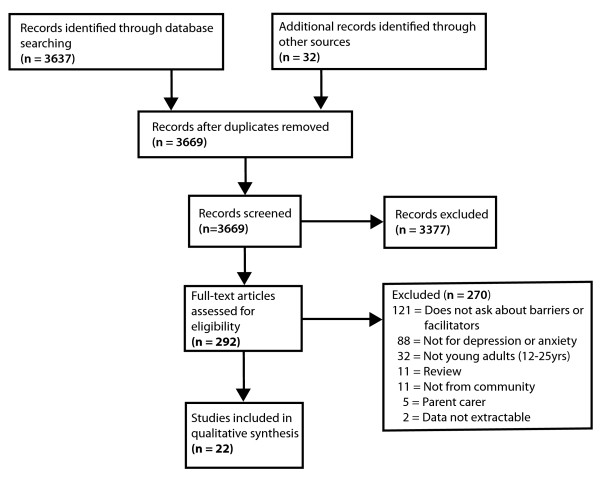
“This process resulted in a total of 22 relevant studies [20-41] for inclusion into the review.”
Background(2006) · Why Science Matters · doi:10.1002/9780470773994.ch8 · Cited by 1,014
Sawyer, M. G., Arney, F. M., Baghurst, P. A., Clark, J. J., Graetz, B. W., Kosky, R. J., Nurcombe, B., Patton, G. C., Prior, M. R., Raphael, B., et al. (2001) · Australian & New Zealand Journal of Psychiatry · doi:10.1046/j.1440-1614.2001.00964.x · Cited by 826
International Journal of Adolescent Medicine and Health
(2011) · International Journal of Adolescent Medicine and Health · doi:10.1515/ijamh · Cited by 686
Research works printed but not linked: 1
- Australian Bureau of Statistics Australian Bureau of Statistics. Canberra 2004-05 National Health Survey: Summary of Results 2006
Cited by
Items 101–200 of 1,047
The influence of psychological symptoms on mental health literacy of college students.
Kim, J. E., Saw, A., & Zane, N. (2015) · American Journal of Orthopsychiatry · doi:10.1037/ort0000074 · Cited by 147
High School Dropouts in Emerging Adulthood: Substance Use, Mental Health Problems, and Crime
Maynard, B. R., Salas‐Wright, C. P., & Vaughn, M. G. (2014) · Community Mental Health Journal · doi:10.1007/s10597-014-9760-5 · Cited by 201
Men's help seeking: Examination of differences across community size, education, and income.
Hammer, J. H., Vogel, D. L., & Heimerdinger-Edwards, S. R. (2013) · Psychology of Men & Masculinity · doi:10.1037/a0026813 · Cited by 147
Changing Behavior Using the Model of Action Phases
Keller, L., Gollwitzer, P. M., & Sheeran, P. (2020) · The Handbook of Behavior Change · doi:10.1017/9781108677318.006 · Cited by 147
An evaluation of a peer support intervention for student mental health
Byrom, N. (2018) · Journal of Mental Health · doi:10.1080/09638237.2018.1437605 · Cited by 145
Wiedermann, C. J., Barbieri, V., Plagg, B., Marino, P., Piccoliori, G., & Engl, A. (2023) · Healthcare · doi:10.3390/healthcare11101423 · Cited by 256
Stigma of mental illness and help-seeking intention in university students
Lally, J., ó Conghaile, A., Quigley, S., Bainbridge, E., & McDonald, C. (2013) · The Psychiatrist · doi:10.1192/pb.bp.112.041483 · Cited by 143
Chisholm, K., Patterson, P., Torgerson, C., Turner, E., Jenkinson, D., & Birchwood, M. (2016) · BMJ Open · doi:10.1136/bmjopen-2015-009435 · Cited by 143
Social-Ecological Barriers to Access to Healthcare for Adolescents: A Scoping Review
Garney, W. R., Wilson, K. L., Ajayi, K. V., Panjwani, S., Love, S. M., Flores, S. A., Garcia, K., & Esquivel, C. H. (2021) · International Journal of Environmental Research and Public Health · doi:10.3390/ijerph18084138 · Cited by 178
What makes mental health and substance use services youth friendly? A scoping review of literature
Hawke, L. D., Mehra, K., Settipani, C., Relihan, J., Darnay, K., Chaim, G., & Henderson, J. (2019) · BMC Health Services Research · doi:10.1186/s12913-019-4066-5 · Cited by 139
Yap, M. B. H., Reavley, N. J., & Jorm, A. F. (2012) · Journal of Affective Disorders · doi:10.1016/j.jad.2012.11.014 · Cited by 161
Scholten, H., & Granic, I. (2019) · Journal of Medical Internet Research · doi:10.2196/11528 · Cited by 138
“Mental health researchers and clinicians often assume that young people, especially those who are emotionally vulnerable, do not know when they are suffering and are incapable of asking for the kind of help they need [7,78,79].”
Evaluation of an mHealth App (DeStressify) on University Students’ Mental Health: Pilot Trial
Lee, R. A., & Jung, M. E. (2018) · JMIR Mental Health · doi:10.2196/mental.8324 · Cited by 138
“Another notable barrier to seeking mental health aid is stigma [17-19], which may be perpetuated or endorsed by others or internalized by the individual [20].”
BackgroundTay, J. L., Tay, Y. F., & Klainin-Yobas, P. (2018) · Archives of Psychiatric Nursing · doi:10.1016/j.apnu.2018.04.007 · Cited by 138
Reavley, N. J., Morgan, A. J., & Jorm, A. F. (2014) · Australian & New Zealand Journal of Psychiatry · doi:10.1177/0004867413491157 · Cited by 138
A Review of Effective Youth Engagement Strategies for Mental Health and Substance Use Interventions
Dunne, T., Bishop, L. D., Avery, S., & D’Arcy, S. (2017) · Journal of Adolescent Health · doi:10.1016/j.jadohealth.2016.11.019 · Cited by 168
Hagen, B. N. M., Albright, A., Sargeant, J., Winder, C. B., Harper, S. L., O’Sullivan, T. L., & Jones-Bitton, A. (2019) · PLOS ONE · doi:10.1371/journal.pone.0225661 · Cited by 138
Lindow, J. C., Hughes, J. L., South, C., Minhajuddin, A., Gutierrez, L., Bannister, E., Trivedi, M. H., & Byerly, M. J. (2020) · Journal of Adolescent Health · doi:10.1016/j.jadohealth.2020.01.006 · Cited by 138
Barriers and Facilitators to Accessing Mental Healthcare in Canada for Black Youth: A Scoping Review
Fante-Coleman, T., & Jackson-Best, F. (2020) · Adolescent Research Review · doi:10.1007/s40894-020-00133-2 · Cited by 171
How a moderated online discussion forum facilitates support for young people with eating disorders
Kendal, S., Kirk, S., Elvey, R., Catchpole, R., & Pryjmachuk, S. (2017) · Health Expectations · doi:10.1111/hex.12439 · Cited by 134
Nearchou, F. A., Bird, N., Costello, A., Duggan, S., Gilroy, J., Long, R., McHugh, L., & Hennessy, E. (2018) · Journal of Adolescence · doi:10.1016/j.adolescence.2018.05.003 · Cited by 135
Mass quarantine and mental health during COVID-19: A meta-analysis
Jin, Y., Sun, T., Zheng, P., & An, J. (2021) · Journal of Affective Disorders · doi:10.1016/j.jad.2021.08.067 · Cited by 135
Elshaikh, U. A. M., Sheik, R., Saeed, R. K. M., Chivese, T., & Hassan, D. A. (2023) · BMC Geriatrics · doi:10.1186/s12877-023-04229-x · Cited by 194
Logging into therapy: Adolescent perceptions of online therapies for mental health problems
Sweeney, G. M., Donovan, C. L., March, S., & Forbes, Y. (2019) · Internet Interventions · doi:10.1016/j.invent.2016.12.001 · Cited by 128
Promotion of Mental Health Literacy in Adolescents: A Scoping Review
Nobre, J. R., Oliveira, A. P., Monteiro, F., Sequeira, C., & Ferré‐Grau, C. (2021) · International Journal of Environmental Research and Public Health · doi:10.3390/ijerph18189500 · Cited by 190
Attitudes and Beliefs About Treatment Among College Students With Untreated Mental Health Problems
Eisenberg, D., Speer, N., & Hunt, J. B. (2012) · Psychiatric Services · doi:10.1176/appi.ps.201100250 · Cited by 128
Chatbots to Support Young Adults’ Mental Health: An Exploratory Study of Acceptability
Koulouri, T., Macredie, R. D., & Olakitan, D. (2022) · ACM Transactions on Interactive Intelligent Systems · doi:10.1145/3485874 · Cited by 127
Hansson, L., & Markström, U. (2014) · BMC Psychiatry · doi:10.1186/1471-244x-14-55 · Cited by 127
“It is also a major barrier to help seeking [5] causing delays, dropout and non-adherence in treatment [6,7].”
Krause, A. E., Dimmock, J. A., Rebar, A. L., & Jackson, B. (2021) · Frontiers in Psychology · doi:10.3389/fpsyg.2020.631033 · Cited by 155
Jones, H. E., Manze, M. G., Ngo, V. K., Lamberson, P., & Freudenberg, N. (2021) · Journal of Urban Health · doi:10.1007/s11524-020-00506-x · Cited by 152
‘teen Mental Health First Aid’: a description of the program and an initial evaluation
Hart, L. M., Mason, R. J., Kelly, C. M., Cvetkovski, S., & Jorm, A. F. (2016) · International Journal of Mental Health Systems · doi:10.1186/s13033-016-0034-1 · Cited by 118
Halladay, J. E., Dawdy, J. L., McNamara, I. F., Chen, A. J., Vitoroulis, I., McInnes, N., & Munn, C. (2019) · Mindfulness · doi:10.1007/s12671-018-0979-z · Cited by 124
Hästbacka, E., Nygård, M., & Nyqvist, F. (2016) · Alter · doi:10.1016/j.alter.2016.02.002 · Cited by 148
A systematic review of mental health outcome measures for young people aged 12 to 25 years
Kwan, B., & Rickwood, D. J. (2015) · BMC Psychiatry · doi:10.1186/s12888-015-0664-x · Cited by 119
Hadfield, H., & Wittkowski, A. (2017) · Journal of Midwifery & Women's Health · doi:10.1111/jmwh.12669 · Cited by 120
McCloud, T., Jones, R., Lewis, G., Bell, V., & Tsakanikos, E. (2020) · JMIR mHealth and uHealth · doi:10.2196/15418 · Cited by 118
Cadigan, J. M., Lee, C. M., & Larimer, M. E. (2019) · Prevention Science · doi:10.1007/s11121-018-0875-8 · Cited by 117
Mackenzie, C. S., Heath, P. J., Vogel, D. L., & Chekay, R. (2019) · Journal of Clinical Psychology · doi:10.1002/jclp.22845 · Cited by 168
Edge, S., Newbold, K. B., & McKeary, M. (2014) · Social Science & Medicine · doi:10.1016/j.socscimed.2014.07.025 · Cited by 161
Liang, S., Chen, R., Liu, L., Li, X., Chen, J., Tang, S., & Zhao, J. (2020) · Frontiers in Psychology · doi:10.3389/fpsyg.2020.02231 · Cited by 135
Flemming, K., McCaughan, D., Angus, K., & Graham, H. M. (2014) · Journal of Advanced Nursing · doi:10.1111/jan.12580 · Cited by 135
Wilson, C. J., Rickwood, D. J., Bushnell, J. A., Caputi, P., & Thomas, S. J. (2011) · Advances in Mental Health · doi:10.5172/jamh.2011.10.1.29 · Cited by 116
Phillipson, L., Magee, C., Jones, S., Reis, S., & Skaldzien, E. (2015) · Aging & Mental Health · doi:10.1080/13607863.2014.995588 · Cited by 115
Socially Assistive Robots as Mental Health Interventions for Children: A Scoping Review
Kabacińska, K., Prescott, T. J., & Robillard, J. M. (2021) · International Journal of Social Robotics · doi:10.1007/s12369-020-00679-0 · Cited by 113
McDermott, E., Hughes, E., & Rawlings, V. (2018) · Culture, Health & Sexuality · doi:10.1080/13691058.2017.1335435 · Cited by 113
Gilbey, D., Morgan, H., Lin, A., & Perry, Y. (2020) · Journal of Medical Internet Research · doi:10.2196/20158 · Cited by 112
“Young people in the general population face many barriers to help seeking, including inadequate resources and lack of accessibility, desire for self-reliance, and anticipated stigma for reporting certain health difficulties such as mental illnesses or HIV [15,16].”
BackgroundInfluentialBarnett, P., Arundell, L.-L., Saunders, R., Matthews, H., & Pilling, S. (2021) · Journal of Affective Disorders · doi:10.1016/j.jad.2020.10.060 · Cited by 109
Colucci, E., Szwarc, J., Minas, H., Paxton, G., & Guerra, C. (2012) · International Journal of Culture and Mental Health · doi:10.1080/17542863.2012.713371 · Cited by 123
Zhao, R., Amanvermez, Y., Pei, J., Castro‐Ramirez, F., Rapsey, C., Garcia, C., Ebert, D. D., Haro, J. M., Fodor, L. A., David, O. A., et al. (2025) · Journal of Child Psychology and Psychiatry · doi:10.1111/jcpp.14145 · Cited by 110
“…previous systematic reviews examined barriers to mental health help-seeking among college students, but only listed barriers reported by students in the studies (Gulliver, Griffiths, & Christensen, 2010; Lui, Sagar-Ouriaghli, & Brown, 2022), without estimating a pooled proportion for each barrier.”
Hart, L. M., Morgan, A. J., Rossetto, A., Kelly, C. M., Mackinnon, A., & Jorm, A. F. (2018) · Australian & New Zealand Journal of Psychiatry · doi:10.1177/0004867417753552 · Cited by 109
A Systematic Review of Parent and Caregiver Mental Health Literacy
Hurley, D., Swann, C., Allen, M. S., Ferguson, H., & Vella, S. A. (2019) · Community Mental Health Journal · doi:10.1007/s10597-019-00454-0 · Cited by 147
Changing Behavior Using the Health Action Process Approach
Schwarzer, R., & Hamilton, K. (2020) · The Handbook of Behavior Change · doi:10.1017/9781108677318.007 · Cited by 102
Radez, J., Reardon, T., Creswell, C., Orchard, F., & Waite, P. (2022) · European Child & Adolescent Psychiatry · doi:10.1007/s00787-020-01707-0 · Cited by 109
Veteran help-seeking behaviour for mental health issues: a systematic review
Randles, R., & Finnegan, A. P. (2021) · BMJ Military Health · doi:10.1136/bmjmilitary-2021-001903 · Cited by 147
Mental Health Problems among Young People—A Scoping Review of Help-Seeking
Westberg, K. H., Nyholm, M., Nygren, J. M., & Svedberg, P. (2022) · International Journal of Environmental Research and Public Health · doi:10.3390/ijerph19031430 · Cited by 108
“Previous reviews have, for example, shown past positive experiences and outcomes of help-seeking and positive contacts with support professionals to be facilitators for seeking help [4,8].”
ResultGronholm, P. C., Nye, E., & Michelson, D. (2018) · Journal of Affective Disorders · doi:10.1016/j.jad.2018.07.023 · Cited by 107
Understanding the public’s profile of mental health literacy in China: a nationwide study
Huang, D., Yang, L. H., & Pescosolido, B. A. (2019) · BMC Psychiatry · doi:10.1186/s12888-018-1980-8 · Cited by 130
Changes in attitudes toward seeking mental health services: A 40-year cross-temporal meta-analysis
Mackenzie, C. S., Erickson, J., Deane, F. P., & Wright, M. (2014) · Clinical Psychology Review · doi:10.1016/j.cpr.2013.12.001 · Cited by 107
Malla, A., Iyer, S., Shah, J., Joober, R., Boksa, P., Lal, S., Fuhrer, R., Andersson, N., Abdel‐Baki, A., Hutt‐MacLeod, D., et al. (2019) · Early Intervention in Psychiatry · doi:10.1111/eip.12772 · Cited by 107
Wang, S., Li, Q., Lu, J., Ran, H., Che, Y., Fang, D., Liang, X., Sun, H., Chen, L., Peng, J., et al. (2023) · JAMA Network Open · doi:10.1001/jamanetworkopen.2023.38174 · Cited by 106
Lawlor, A., & Kirakowski, J. (2014) · Computers in Human Behavior · doi:10.1016/j.chb.2013.11.015 · Cited by 143
Thorn, P., Hill, N. T., Lamblin, M., Teh, Z., Battersby-Coulter, R., Rice, S., Bendall, S., Gibson, K. L., Finlay, S. M., Blandon, R., et al. (2020) · JMIR Mental Health · doi:10.2196/17520 · Cited by 106
Alvarez-Jimenez, M., Rice, S., D'Alfonso, S., Leicester, S., Bendall, S., Pryor, I., Russon, P., McEnery, C., Santesteban-Echarri, O., Da Costa, G., et al. (2020) · Journal of Medical Internet Research · doi:10.2196/17155 · Cited by 106
“…access among young people include low help-seeking due to fear of stigma and embarrassment, confidentiality concerns, negative prior experiences of treatment, poor mental health literacy, lack of knowledge of available resources, a preference for self-reliance, and social isolation [11-13].”
BackgroundYoung people's views of UK mental health services
Plaistow, J., Masson, K., Koch, D., Wilson, J., Stark, R. M., Jones, P. B., & Lennox, B. R. (2014) · Early Intervention in Psychiatry · doi:10.1111/eip.12060 · Cited by 106
Ebert, D. D., Franke, M., Kählke, F., Küchler, A., Bruffaerts, R., Mortier, P., Karyotaki, E., Alonso, J., Cuijpers, P., Berking, M., et al. (2019) · International Journal of Methods in Psychiatric Research · doi:10.1002/mpr.1754 · Cited by 105
Minding the treatment gap: results of the Singapore Mental Health Study
Subramaniam, M., Abdin, E., Vaingankar, J. A., Shafie, S., Chua, H. C., Tan, W. M., Tan, K. B., Verma, S., Heng, D., & Chong, S. A. (2020) · Social Psychiatry and Psychiatric Epidemiology · doi:10.1007/s00127-019-01748-0 · Cited by 105
Renwick, L., Pedley, R., Johnston, I., Bell, V., Lovell, K., Bee, P., & Brooks, H. L. (2022) · European Child & Adolescent Psychiatry · doi:10.1007/s00787-022-01997-6 · Cited by 153
Tindall, L., Mikocka‐Walus, A., McMillan, D., Wright, B., Hewitt, C., & Gascoyne, S. (2017) · Psychology and Psychotherapy: Theory, Research and Practice · doi:10.1111/papt.12121 · Cited by 103
Kearns, M., Muldoon, O. T., Msetfi, R. M., & Surgenor, P. W. G. (2015) · Frontiers in Psychology · doi:10.3389/fpsyg.2015.01462 · Cited by 100
Help-Seeking for Dementia: A Systematic Review of the Literature
Werner, P., Goldstein, D., Karpas, D. S., Chan, L., & Lai, C. (2014) · Alzheimer Disease & Associated Disorders · doi:10.1097/wad.0000000000000065 · Cited by 102
Domhardt, M., Steubl, L., & Baumeister, H. (2020) · Zeitschrift für Kinder- und Jugendpsychiatrie und Psychotherapie · doi:10.1024/1422-4917/a000625 · Cited by 101
Using peer support groups to enhance community integration of veterans in transition.
Drebing, C. E., Reilly, E., Henze, K. T., Kelly, M., Russo, A., Smolinsky, J., Gorman, J., & Penk, W. E. (2018) · Psychological Services · doi:10.1037/ser0000178 · Cited by 101
McCloughen, A., Foster, K., Huws-Thomas, M. V., & Delgado, C. (2012) · International Journal of Mental Health Nursing · doi:10.1111/j.1447-0349.2011.00796.x · Cited by 115
Leech, T., Dorstyn, D., Taylor, A., & Li, W. (2021) · Children and Youth Services Review · doi:10.1016/j.childyouth.2021.106073 · Cited by 100
Doll, C. M., Michel, C., Rosen, M., Osman, N., Schimmelmann, B. G., & Schultze-Lutter, F. (2021) · BMC Psychiatry · doi:10.1186/s12888-021-03435-4 · Cited by 99
Naslund, J. A., Gonsalves, P. P., Gruebner, O., Pendse, S. R., Smith, S. L., Sharma, A., & Raviola, G. (2019) · Current Treatment Options in Psychiatry · doi:10.1007/s40501-019-00186-8 · Cited by 99
A mobile app–based intervention for depression: end-user and expert usability testing study
Fuller-Tyszkiewicz, M., Richardson, B., Klein, B., Skouteris, H., Christensen, H., Austin, D., Castle, D., Mihalopoulos, C., O'Donnell, R., Arulkadacham, L., et al. (2018) · JMIR Mental Health · doi:10.2196/mental.9445 · Cited by 98
“Unfortunately, many adolescents and young adults are reluctant to seek help for their depressive symptoms [7], citing barriers such as cost, access to help, lack of anonymity, and perceived stigma of mental illness [8,9].”
BackgroundSelf-citationChallenging the Stigma of Mental Illness Among College Students
Kosyluk, K. A., Al‐Khouja, M., Bink, A. B., Buchholz, B. A., Ellefson, S. E., Fokuo, J. K., Goldberg, D., Kraus, D. J., León, A., Michaels, P., et al. (2016) · Journal of Adolescent Health · doi:10.1016/j.jadohealth.2016.05.005 · Cited by 136
Resilience of Emerging Adults After Adverse Childhood Experiences: A Qualitative Systematic Review
Leung, D. Y. L., Chan, A. C. Y., & Ho, G. W. K. (2020) · Trauma Violence & Abuse · doi:10.1177/1524838020933865 · Cited by 135
Serrano-Ripoll, M. J., Zamanillo-Campos, R., Fiol-DeRoque, M. A., Castro, A., & Ricci-Cabello, I. (2022) · JMIR mHealth and uHealth · doi:10.2196/29621 · Cited by 96
“Several barriers that limit the acceptability and adherence to traditional, face-to-face psychotherapy have been described, including the low self-perceived need for treatment, low mental health literacy, high self-reliance, and fear of stigmatization [22,23].”
BackgroundHansson, L., Stjernswärd, S., & Svensson, B. (2016) · Acta Psychiatrica Scandinavica · doi:10.1111/acps.12609 · Cited by 95
Lui, J. C., Sagar-Ouriaghli, I., & Brown, J. S. L. (2024) · Journal of American College Health · doi:10.1080/07448481.2022.2119859 · Cited by 102
Halladay, J., Scherer, J., MacKillop, J., Woock, R., Petker, T., Linton, V., & Munn, C. (2019) · Drug and Alcohol Dependence · doi:10.1016/j.drugalcdep.2019.107565 · Cited by 94
Association between Sexual Satisfaction and Depression and Anxiety in Adolescents and Young Adults
Carcedo, R. J., Fernández-Rouco, N., Fernández‐Fuertes, A. A., & Martínez, J. L. (2020) · International Journal of Environmental Research and Public Health · doi:10.3390/ijerph17030841 · Cited by 125
Wozney, L., Huguet, A., Bennett, K., Radomski, A. D., Hartling, L., Dyson, M., McGrath, P. J., & Newton, A. S. (2017) · Journal of Medical Internet Research · doi:10.2196/jmir.7573 · Cited by 93
“The reasons may include a lack of trained deliverers, inconvenient service times and locations, the social stigma associated with mental illness, discomfort discussing mental health problems, or a preference for self-help options [9,10].”
DeLuca, J. S. (2019) · Adolescent Research Review · doi:10.1007/s40894-018-0106-3 · Cited by 114
Lindqvist, K., Mechler, J., Carlbring, P., Lilliengren, P., Falkenström, F., Andersson, G., Johansson, R., Edbrooke-Childs, J., Dahl, H.-S. J., Lindert Bergsten, K., et al. (2020) · Journal of Medical Internet Research · doi:10.2196/18047 · Cited by 93
Parents’ experience of seeking help for children with mental health problems
Boulter, E., & Rickwood, D. (2013) · Advances in Mental Health · doi:10.5172/jamh.2013.11.2.131 · Cited by 93
Thornicroft, C., Wyllie, A., Thornicroft, G., & Mehta, N. (2014) · Australian & New Zealand Journal of Psychiatry · doi:10.1177/0004867413512687 · Cited by 92
Obstacles to Help-Seeking for Sexual Offenders: Implications for Prevention of Sexual Abuse
Levenson, J. S., Willis, G. M., & Vicencio, C. P. (2017) · Journal of Child Sexual Abuse · doi:10.1080/10538712.2016.1276116 · Cited by 92
Umubyeyi, A., Mogren, I., Ntaganira, J., & Krantz, G. (2016) · Social Psychiatry and Psychiatric Epidemiology · doi:10.1007/s00127-015-1130-2 · Cited by 91
Persson, S., Hagquist, C., & Michelson, D. (2017) · Clinical Child Psychology and Psychiatry · doi:10.1177/1359104516656722 · Cited by 91
Barriers to accessing support for mental health issues at university
Cage, E., Stock, M., Sharpington, A., Pitman, E., & Batchelor, R. (2018) · Studies in Higher Education · doi:10.1080/03075079.2018.1544237 · Cited by 130
Shahmalak, U., Blakemore, A., Waheed, M. W., & Waheed, W. (2019) · International Journal of Mental Health Systems · doi:10.1186/s13033-019-0320-9 · Cited by 90
Topooco, N., Byléhn, S., Dahlström Nysäter, E., Holmlund, J., Lindegaard, J., Johansson, S., Åberg, L., Bergman Nordgren, L., Zetterqvist, M., & Andersson, G. (2019) · Journal of Medical Internet Research · doi:10.2196/13393 · Cited by 90
Reavley, N. J., & Jorm, A. F. (2011) · Australian & New Zealand Journal of Psychiatry · doi:10.3109/00048674.2011.614215 · Cited by 91
Eigenhuis, E., Waumans, R. C., Muntingh, A. D. T., Westerman, M. J., van Meijel, M., Batelaan, N. M., & van Balkom, A. J. L. M. (2021) · PLOS ONE · doi:10.1371/journal.pone.0247516 · Cited by 90
Depression, anxiety, and stress among students, faculty, and staff
Meeks, K., Peak, A. S., & Dreihaus, A. (2021) · Journal of American College Health · doi:10.1080/07448481.2021.1891913 · Cited by 90
Mental Health Apps: Innovations, Risks and Ethical Considerations
Giota, K. G., & Kleftaras, G. (2014) · E-Health Telecommunication Systems and Networks · doi:10.4236/etsn.2014.33003 · Cited by 89
Wasil, A. R., Gillespie, S., Patel, R., Petre, A., Venturo-Conerly, K. E., Shingleton, R. M., Weisz, J. R., & DeRubeis, R. J. (2020) · Journal of Consulting and Clinical Psychology · doi:10.1037/ccp0000604 · Cited by 86
Metadata
- Authors
- Gulliver, A., Griffiths, K. M., & Christensen, H.
- Affiliations
- Australian National University (AU)
- Corresponding author
- Gulliver, Amelia
- Venue
- BMC Psychiatry
- Published
- 2010-12
- Volume
- 10
- Issue
- 1
- Pages
- 113-113
- ISSN
- 1471-244X (ISSN-L)
- PMC
- PMC3022639
- OpenAlex
- W2107750653
- Semantic Scholar
- f95edcc0bd6116b085c3f189a000be87dd3d6115
- Cited by
- 3,292
- References
- 51
- Citations by year
- 2026: 301 · 2025: 323 · 2024: 301 · 2023: 299 · 2022: 306 · 2021: 318 · 2020: 363 · 2019: 238 · 2018: 221 · 2017: 170 · 2016: 147 · 2015: 111 · 2014: 90 · 2013: 48 · 2012: 42
- FWCI
- 4.00
- Type
- journal article
- Language
- en
- Open access
- gold
- doi.org
- Licence
- cc-by
- creativecommons.org/licenses/by/2.0 (tdm)
- Locations
- BMC Psychiatry (publishedVersion, cc-by)
- Europe PMC (PubMed Central) (publishedVersion, cc-by)
- PubMed Central (publishedVersion, cc-by)
- PubMed (publishedVersion)
- DOAJ (DOAJ: Directory of Open Access Journals) (submittedVersion)
- ANU Open Research (Australian National University) (submittedVersion, cc-by)
- Funders
- Australian National University
- Australian Institute of Sport
- National Health and Medical Research Council (525413, 525411)
- Topics
- Health Sciences › Medicine › Psychiatry and Mental health › Mental Health Treatment and Access
- Social Sciences › Psychology › Clinical Psychology › Suicide and Self-Harm Studies
- Social Sciences › Psychology › Clinical Psychology › Psychology and Mental Health
- Keywords
- help-seeking, mental health help-seeking, adolescents, young adults, perceived barriers, perceived facilitators, mental health literacy, stigma, self-reliance, social support, common mental disorders
- MeSH terms
- Adolescent, Adult, Mental Disorders, Data Collection, Female, Health Services Accessibility, Humans, Male, Mental Health Services, Patient Acceptance of Health Care, Qualitative Research, Young Adult
About these checks
Registry, retraction, Cites and statistics results are computed, not judged, with one exception: a printed reference that no index lists is read once by a model before it counts as a citation error. Claims are extracted by a model and kept only when their quote appears verbatim in the text; each cited source is then checked, with a model’s help, for whether it says what the claim relies on. Those verdicts can be wrong — read the claim’s quote and the cited source before relying on one.
Statistics and arithmetic are recomputed, not judged.
Confidence bands are shown only for fields calibrated on our annotated test set. None is calibrated yet, so no band is shown.
What counts as a claim ›How we measure confidence ›How we check this ›
Are you an author, or do you see a problem with this page? Request a review
Data sources
Bibliographic data: Semantic Scholar, OpenAlex, Crossref.
Contains information from the Semantic Scholar Academic Graph Datasets, made available under the ODC Attribution License (ODC-BY 1.0).
Semantic Scholar’s data is described in: Kinney, R., et al. (2023). The Semantic Scholar Open Data Platform. arXiv:2301.10140.
