

Perceived barriers and facilitators to mental health help-seeking in young people: a systematic review
Open accessThe DOI matches its Crossref record; 50 of the 51 references it cites were found in a registry or an index, and 1 are not checked yet.
Abstract
BACKGROUND: Adolescents and young adults frequently experience mental disorders, yet tend not to seek help. This systematic review aims to summarise reported barriers and facilitators of help-seeking in young people using both qualitative research from surveys, focus groups, and interviews and quantitative data from published surveys. It extends previous reviews through its systematic research methodology and by the inclusion of published studies describing what young people themselves perceive are the barriers and facilitators to help-seeking for common mental health problems. METHODS: Twenty two published studies of perceived barriers or facilitators in adolescents or young adults were identified through searches of PubMed, PsycInfo, and the Cochrane database. A thematic analysis was undertaken on the results reported in the qualitative literature and quantitative literature. RESULTS: Fifteen qualitative and seven quantitative studies were identified. Young people perceived stigma and embarrassment, problems recognising symptoms (poor mental health literacy), and a preference for self-reliance as the most important barriers to help-seeking. Facilitators were comparatively under-researched. However, there was evidence that young people perceived positive past experiences, and social support and encouragement from others as aids to the help-seeking process. CONCLUSIONS: Strategies for improving help-seeking by adolescents and young adults should focus on improving mental health literacy, reducing stigma, and taking into account the desire of young people for self-reliance.
Overview
The claims and statistics of this paper haven’t been checked yet.
Free: it reads the open-access text and checks the first 5 claims that cite a source we can check. Create a free account to check every claim.
Integrity signals
Registry
Cites
Statistics
Figures
Verification
Claims the paper makes
The claims and statistics of this paper haven’t been checked yet.
Free: it reads the open-access text and checks the first 5 claims that cite a source we can check. Create a free account to check every claim.
Claims other papers make about this one
Each is checked against this paper’s own text: does it say what the citing paper says it does?
The cited source doesn’t support the claim as written.
In the citing paper
“A previous systematic review demonstrated that a low level of MHL is the main barrier to seeking assistance [11].”
From Mental health literacy intervention on help-seeking in athletes: a systematic review (2020) · cites this paper as [11]
Checked by a reasoning model — may be wrong.
Experimental — accuracy not yet measuredThe source backs part of the claim, not all of it — or backs it for a different population, condition or comparison.
In the citing paper
“Despite this, the extant literature has extensively examined many barriers and facilitators impacting young people seeking help and has increased understanding on a range of personal, social, cultural, and service factors (Doan et al. 2020; Gulliver et al. 2010; Goodwin et al. 2016; Michelmore and Hindley 2012; Nam et al. 2010; Radez et al. 2021; Roth ì and Leavey 2006; Rowe et al. 2014).”
From "You Have the Choice of Whether You're Going to Get Help or Attempt Suicide": Exploring the Process and Impact of Mental Health Help-Seeking with Young People (16–25 Years) (2025) · cites this paper as Gulliver et al. 2010
Experimental — accuracy not yet measuredThe source backs part of the claim, not all of it — or backs it for a different population, condition or comparison.
In the citing paper
“In addition to the issue of low levels of MHL, high levels of stigma are recognised as another barrier influencing help-seeking in elite sport [11].”
From Mental health literacy intervention on help-seeking in athletes: a systematic review (2020) · cites this paper as [11]
Experimental — accuracy not yet measuredThe source backs part of the claim, not all of it — or backs it for a different population, condition or comparison.
In the citing paper
“In addition, existing face-to-face services pose significant barriers for young people [10-16] largely due to access, availability, and high costs of these services [17], as well as the reluctance of young people to seek professional help due to stigma and embarrassment [18-20].”
From Do online mental health services improve help-seeking for young people? A systematic review (2014) · cites this paper as [13]
Experimental — accuracy not yet measuredThe source backs part of the claim, not all of it — or backs it for a different population, condition or comparison.
In the citing paper
“Meeting these needs is challenging, as men (particularly younger men) tend not to seek professional help for distress (Gulliver, Griffiths, & Christensen, 2010;Oliver et al., 2005;Rickwood, Deane, & Wilson, 2007).”
From e-TC: Development and pilot testing of a web-based intervention to reduce anxiety and depression in survivors of testicular cancer (2017) · cites this paper as Gulliver, Griffiths, & Christensen, 2010
Experimental — accuracy not yet measured
19 more claims about this paper
Create a free account to see every claim other papers make about this one.
Self-check
Percentages, sums and reported differences re-computed from the paper’s own numbers.
The self-check needs the paper’s full text.
Citations
Cites
Preferred Reporting Items for Systematic Reviews and Meta-Analyses: the PRISMA statement
Moher, D., Liberati, A., Tetzlaff, J., Altman, D. G., & for the PRISMA Group (2009) · BMJ · doi:10.1136/bmj.b2535 · Cited by 83,823
Preferred reporting items for systematic reviews and meta-analyses: the PRISMA Statement.
(2009) · PubMed Central · Cited by 44,859
Kessler, R. C., Chiu, W. T., Demler, O., & Walters, E. E. (2005) · Archives of General Psychiatry · doi:10.1001/archpsyc.62.6.617 · Cited by 12,052
(2021) · Handbook of Research Methods for Marketing Management · doi:10.4337/9781788976954.00014 · Cited by 4,009
Young People’s Help-Seeking for Mental Health Problems
Rickwood, D., Deane, F. P., Wilson, C. J., & Ciarrochi, J. (2005) · Australian e-Journal for the Advancement of Mental Health · doi:10.5172/jamh.4.3.218 · Cited by 1,619
When and how do young people seek professional help for mental health problems?
Rickwood, D. J., Deane, F. P., & Wilson, C. J. (2007) · Medical Journal of Australia · doi:10.5694/j.1326-5377.2007.tb01334.x · Cited by 1,195
Help-Seeking and Access to Mental Health Care in a University Student Population
Eisenberg, D., Golberstein, E., & Gollust, S. E. (2007) · Medical Care · doi:10.1097/mlr.0b013e31803bb4c1 · Cited by 1,131 · cited 1×
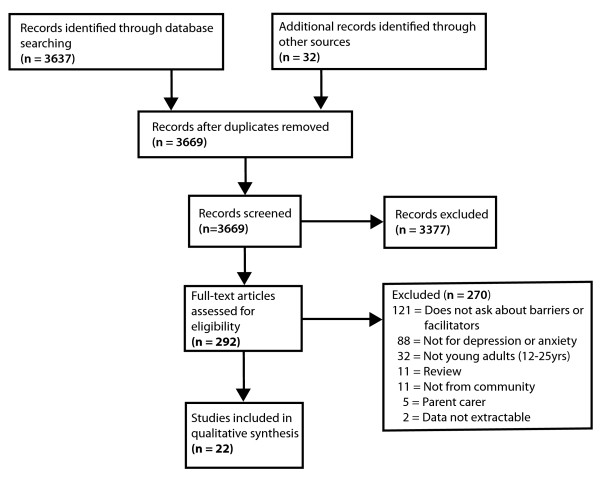
“This process resulted in a total of 22 relevant studies [20-41] for inclusion into the review.”
Background(2006) · Why Science Matters · doi:10.1002/9780470773994.ch8 · Cited by 1,014
Sawyer, M. G., Arney, F. M., Baghurst, P. A., Clark, J. J., Graetz, B. W., Kosky, R. J., Nurcombe, B., Patton, G. C., Prior, M. R., Raphael, B., et al. (2001) · Australian & New Zealand Journal of Psychiatry · doi:10.1046/j.1440-1614.2001.00964.x · Cited by 826
International Journal of Adolescent Medicine and Health
(2011) · International Journal of Adolescent Medicine and Health · doi:10.1515/ijamh · Cited by 686
Research works printed but not linked: 1
- Australian Bureau of Statistics Australian Bureau of Statistics. Canberra 2004-05 National Health Survey: Summary of Results 2006
Cited by
Items 1,001–1,047 of 1,047
Miller, I., Peake, E., Strauss, G., Vierra, E., Koepsell, X., Shalchi, B., Padmanabhan, A., & Lake, J. (2023) · JMIR Formative Research · doi:10.2196/43260 · Cited by 19
“Consequently, up to 60% to 80% of adolescents and young adults with depression do not receive appropriate or timely treatment [16].”
BackgroundFasciano, K. M., Souza, P. M., Braun, I. M., & Trevino, K. M. (2015) · Journal of Adolescent and Young Adult Oncology · doi:10.1089/jayao.2014.0035 · Cited by 19
Self-Management Among Chinese People With Schizophrenia and Their Caregivers: A Qualitative Study
Zou, H., Li, Z., Nolan, M. T., Wang, H., & Hu, L. (2012) · Archives of Psychiatric Nursing · doi:10.1016/j.apnu.2012.10.002 · Cited by 25
Vulnerable Young People’s Experiences of Child and Adolescent Mental Health Services
Davison, J., Zamperoni, V., & Stain, H. J. (2017) · Mental Health Review Journal · doi:10.1108/mhrj-09-2016-0016 · Cited by 17
Hoyt, M. A., Wang, A. W.-T., Ceja, R. C., Cheavens, J. S., Daneshvar, M. A., Feldman, D. R., Funt, S. A., & Nelson, C. J. (2023) · Annals of Behavioral Medicine · doi:10.1093/abm/kaad010 · Cited by 17
Hurd, D., Herrera, M., Brant, J. M., Coombs, N. C., & Arzubi, E. (2019) · Journal of Child and Adolescent Psychopharmacology · doi:10.1089/cap.2018.0063 · Cited by 16
Hutchinson, R., King, N., & Majumder, P. (2022) · International Journal of Social Psychiatry · doi:10.1177/00207640211057727 · Cited by 16
Crumb, L., Crowe, A., Averett, P., Harris, J. A., & Dart, C. (2021) · Emerging Adulthood · doi:10.1177/2167696819852563 · Cited by 16
Grosselli, L., Knappe, S., Baumgärtel, J., Lewitzka, U., & Hoyer, J. (2024) · BMC Public Health · doi:10.1186/s12889-023-17557-9 · Cited by 16
Lynch, L., Moorhead, A., Long, M., & Hawthorne-Steele, I. (2024) · Community Mental Health Journal · doi:10.1007/s10597-024-01237-y · Cited by 15
“As such, early intervention in mental health is a healthcare topic of global priority (WHO, 2023) and increasing understanding in help-seeking behaviour, specifically, how to engage and facilitate young people to access interventions is a critical topic (Goodwin et al., 2016; Gulliver et al., 2010).”
BackgroundLee, Y. P., Ngaiman, N. K. B., Poon, L. Y., Abdul Jalil, H. B., Yap, M. H., Abdin, E., Subramaniam, M., Lee, H., & Verma, S. K. (2019) · Frontiers in Psychiatry · doi:10.3389/fpsyt.2019.00422 · Cited by 15
Ikwuka, U., Galbraith, N., Manktelow, K., Chen-Wilson, J., Oyebode, F., Muomah, R. C., & Igboaka, A. (2016) · Journal of Health Care for the Poor and Underserved · doi:10.1353/hpu.2016.0025 · Cited by 14
Women's Knowledge of Postpartum Anxiety Disorders, Depression, and Cognitive Behavioral Therapy
Ponzini, G. T., Snider, M. D. H., Evey, K. J., & Steinman, S. A. (2021) · Journal of Nervous & Mental Disease · doi:10.1097/nmd.0000000000001315 · Cited by 14
Subotic-Kerry, M., King, C., O'Moore, K., Achilles, M., & O'Dea, B. (2018) · JMIR Human Factors · doi:10.2196/humanfactors.8913 · Cited by 14
“The sense of anonymity of online care somewhat overcomes issues relating to stigma and embarrassment about seeking help for mental health problems, which has previously been identified as the most prominent barrier to help-seeking in young people [37].”
Aardoom, J. J., Dingemans, A. E., Spinhoven, P., Roijen, L. H.-V., & Van Furth, E. F. (2013) · Trials · doi:10.1186/1745-6215-14-340 · Cited by 13
“Suggested reasons for this treatment gap include stigma, embarrassment, lack of recognition of symptoms, and preference for self-reliance [2,3].”
BackgroundSmith, S., Paparo, J., & Wootton, B. M. (2021) · Clinical Psychologist · doi:10.1080/13284207.2021.1892453 · Cited by 13
Richter, R. K., Anderson, J. C., Miller, E., Bonomi, A. E., De Genna, N. M., Feinstein, Z., Kass, G., Lampe, K., Mathier, A., & Chugani, C. D. (2021) · Qualitative Health Research · doi:10.1177/1049732321998054 · Cited by 13
O’Reilly, A., Barry, J., Neary, M.-L., Lane, S., & O’Keeffe, L. (2016) · Advances in School Mental Health Promotion · doi:10.1080/1754730x.2016.1154794 · Cited by 13
“…to be a key obstacle to seeking help for mental health concerns among young people in the general population and that many young people do not have appropriate mental health knowledge (Dooley & Fitzgerald, 2012; Gulliver et al., 2010; Hartman et al., 2013; Rose et al., 2007; youngMinds, 2010).”
BackgroundYouth Perspectives on Seeking Psychotherapy: A Concurrent Mixed Methods Study.
(2021) · PubMed Central · Cited by 13
Langley, E. L., Clark, G., Murray, C., & Wootton, B. M. (2021) · Australian Psychologist · doi:10.1080/00050067.2021.1893598 · Cited by 13
Editorial: Factors influencing user engagement with digital mental health interventions
Borghouts, J., Pretorius, C., Ayobi, A., Abdullah, S., & Eikey, E. V. (2023) · Frontiers in Digital Health · doi:10.3389/fdgth.2023.1197301 · Cited by 12
Watsford, C., & Rickwood, D. (2013) · Advances in Mental Health · doi:10.5172/jamh.2013.12.1.75 · Cited by 12
“This may be particularly important for younger clients, who have less experience of therapy, and who need to be reassured that they are in safe hands and that they can trust the therapist, as this has been identified as a facilitator of help-seeking behaviours (Gulliver et al., 2010).”
BackgroundHelp-Seeking Experiences of Youth with Suicidal Ideations
Neilson, E. K., Mar, M. Y., Torchalla, I., Werker, G. R., Laing, A., & Krausz, M. (2014) · Journal of Patient Experience · doi:10.1177/237437431400100205 · Cited by 12
Ishay, G. H., Zisman‐Ilani, Y., & Roe, D. (2023) · Early Intervention in Psychiatry · doi:10.1111/eip.13347 · Cited by 12
“Also, treatment adherence, continuity of care and health outcomes have been linked to positive patient experiences (Doyle et al., 2013), which also suggests the value of their routine assessment in youth mental health services (Gulliver et al., 2010).”
BackgroundSuka, M., Yamauchi, T., & Yanagisawa, H. (2019) · Environmental Health and Preventive Medicine · doi:10.1186/s12199-019-0786-8 · Cited by 11
Shafran, R., Gyani, A., Rostron, J., Allen, S., Myles-Hooton, P., Allcott-Watson, H., & Rose, S. (2019) · Behavioural and Cognitive Psychotherapy · doi:10.1017/s1352465818000498 · Cited by 10
Kirk, M. A., Pirbaglou, M., Weerasekera, R., & Ritvo, P. (2022) · International Journal of Mental Health · doi:10.1080/00207411.2021.1959807 · Cited by 10
Rith-Najarian, L. R., Chorpita, B. F., Gong-Guy, E., Hammons, H. R., & Chavira, D. A. (2022) · Journal of American College Health · doi:10.1080/07448481.2020.1869749 · Cited by 9
“Compared with face-to-face options, online-delivery offers easier accessibility (regarding time and location), privacy, lower cost, and allowance for self-reliance, all benefits which are particularly important to address common help-seeking barriers among young adults.(17,18) In terms of implementation benefits, onli…”
BackgroundThe alongside digital wellness program for youth: longitudinal pre-post outcomes study
Cohen, K., Rapoport, A., Friis, E., Hill, S., Feldman, S., & Schleider, J. (2025) · JMIR Formative Research · doi:10.2196/73180 · Cited by 9
Lau, N., Palermo, T. M., Zhou, C., Badillo, I., Hong, S., Aalfs, H., Yi-Frazier, J. P., McCauley, E., Chow, E. J., Weiner, B. J., et al. (2024) · JMIR Research Protocols · doi:10.2196/57950 · Cited by 9
Rasing, S. P. A., Stikkelbroek, Y. A. J., Riper, H., Dekovic, M., Nauta, M. H., Dirksen, C. D., Creemers, D. H. M., & Bodden, D. H. M. (2019) · JMIR Research Protocols · doi:10.2196/13434 · Cited by 8
Williams, A. J., Cleare, S., Borschmann, R., Tench, C. R., Gross, J., Hollis, C., Chapman-Nisar, A., Naeche, N., Townsend, E., & Slovak, P. (2024) · BMJ Open · doi:10.1136/bmjopen-2023-079801 · Cited by 8
Kerber, A., Beintner, I., Burchert, S., & Knaevelsrud, C. (2021) · BMJ Open · doi:10.1136/bmjopen-2021-049688 · Cited by 7
Portelli, P., & Eldred, C. (2017) · Computers in Human Behavior · doi:10.1016/j.chb.2017.07.034 · Cited by 7
Lynch, L., Moorhead, A., Long, M., & Steele, I. H. (2025) · Children and Youth Services Review · doi:10.1016/j.childyouth.2025.108248 · Cited by 7
Psychologists’ motivations for integrating apps into therapy with secondary school-aged young people
Gindidis, S., Stewart, S. E., & Roodenburg, J. (2020) · Journal of Psychologists and Counsellors in Schools · doi:10.1017/jgc.2019.22 · Cited by 6
Lynch, L., Moorhead, A., Long, M., & Steele, I. H. (2025) · Journal of Child & Adolescent Trauma · doi:10.1007/s40653-024-00650-5 · Cited by 5
“…have identified multifarious personal, social, cultural, and service factors that can act as barriers or facilitators to mental healthcare (Goodwin et al., 2016; Gulliver et al., 2010; Michelmore & Hindley, 2012; Nam et al., 2010; Radez et al., 2021; Rothì & Leavey, 2006; Rowe et al., 2014).”
Influential(2018) · Digital Commons - University of South Florida (University of South Florida) · Cited by 4
Teckchandani, T. A., Shields, R. E., Andrews, K. L., Maguire, K. Q., Jamshidi, L., Nisbet, J., Afifi, T. O., Lix, L. M., Stewart, S. H., Sauer-Zavala, S., et al. (2024) · Frontiers in Psychiatry · doi:10.3389/fpsyt.2024.1297953 · Cited by 3
THE DETERMINANTS OF MENTAL HEALTH LITERACY AMONG YOUNG ADOLESCENTS IN SOUTH OF JORDAN
Alsaraireh, F., Al-Oran, H., Althnaibat, H., & Leimoon, H. (2023) · ASEAN Journal of Psychiatry · doi:10.54615/2231-7805.47295 · Cited by 3
Sørensen, N. M., Skaarnes, H., Mathiasen, K., Thastum, M., & Lomholt, J. J. (2025) · JMIR Formative Research · doi:10.2196/66966 · Cited by 3
Voice Assistant-Based Cognitive Behavioral Therapy for Test Anxiety in Students
Striegl, J., Loitsch, C., & Weber, G. (2023) · Lecture notes in computer science · doi:10.1007/978-3-031-35602-5_28 · Cited by 2
Li, M., Patel, J., Ibrahim, S., & Katapally, T. R. (2025) · doi:10.1101/2025.08.20.25334071 · Cited by 2
“…as CBT, is often associated with stigma, particularly among children and youth (Sheikhan et al., 2023), who may hesitate to seek mental health care due to societal perceptions and potential judgment from peers and family (Aguirre Velasco et al., 2020; Gulliver et al., 2010; Radez et al., 2021).”
Why do some Mexicans with psychosis risk symptoms seek mental health care and others do not?
Domínguez, T., Puebla, D. P., Fresán, A., Sheinbaum, T., Nieto, L., Robles, R., López, S. R., de la Fuente-Sandoval, C., Lara Muñoz, M. D. C., Barrantes-Vidal, N., et al. (2024) · Psychiatry Research · doi:10.1016/j.psychres.2024.116199 · Cited by 1
Lynch, L., Moorhead, A., Long, M., & Hawthorne-Steele, I. (2025) · Social Sciences · doi:10.3390/socsci14090529 · Cited by 1
“…impacting young people seeking help and has increased understanding on a range of personal, social, cultural, and service factors (Doan et al. 2020; Gulliver et al. 2010; Goodwin et al. 2016; Michelmore and Hindley 2012; Nam et al. 2010; Radez et al. 2021; Roth ì and Leavey 2006; Rowe et al. 2014).”
Lukas, C. (2025) · arXiv · doi:10.48550/arxiv.2502.00005 · Cited by 1
Payne (2016) · doi:10.3978/j.issn.2306-9740.2016.02.02
Metadata
- Authors
- Gulliver, A., Griffiths, K. M., & Christensen, H.
- Affiliations
- Australian National University (AU)
- Corresponding author
- Gulliver, Amelia
- Venue
- BMC Psychiatry
- Published
- 2010-12
- Volume
- 10
- Issue
- 1
- Pages
- 113-113
- ISSN
- 1471-244X (ISSN-L)
- PMC
- PMC3022639
- OpenAlex
- W2107750653
- Semantic Scholar
- f95edcc0bd6116b085c3f189a000be87dd3d6115
- Cited by
- 3,292
- References
- 51
- Citations by year
- 2026: 301 · 2025: 323 · 2024: 301 · 2023: 299 · 2022: 306 · 2021: 318 · 2020: 363 · 2019: 238 · 2018: 221 · 2017: 170 · 2016: 147 · 2015: 111 · 2014: 90 · 2013: 48 · 2012: 42
- FWCI
- 4.00
- Type
- journal article
- Language
- en
- Open access
- gold
- doi.org
- Licence
- cc-by
- creativecommons.org/licenses/by/2.0 (tdm)
- Locations
- BMC Psychiatry (publishedVersion, cc-by)
- Europe PMC (PubMed Central) (publishedVersion, cc-by)
- PubMed Central (publishedVersion, cc-by)
- PubMed (publishedVersion)
- DOAJ (DOAJ: Directory of Open Access Journals) (submittedVersion)
- ANU Open Research (Australian National University) (submittedVersion, cc-by)
- Funders
- Australian National University
- Australian Institute of Sport
- National Health and Medical Research Council (525413, 525411)
- Topics
- Health Sciences › Medicine › Psychiatry and Mental health › Mental Health Treatment and Access
- Social Sciences › Psychology › Clinical Psychology › Suicide and Self-Harm Studies
- Social Sciences › Psychology › Clinical Psychology › Psychology and Mental Health
- Keywords
- help-seeking, mental health help-seeking, adolescents, young adults, perceived barriers, perceived facilitators, mental health literacy, stigma, self-reliance, social support, common mental disorders
- MeSH terms
- Adolescent, Adult, Mental Disorders, Data Collection, Female, Health Services Accessibility, Humans, Male, Mental Health Services, Patient Acceptance of Health Care, Qualitative Research, Young Adult
About these checks
Registry, retraction, Cites and statistics results are computed, not judged, with one exception: a printed reference that no index lists is read once by a model before it counts as a citation error. Claims are extracted by a model and kept only when their quote appears verbatim in the text; each cited source is then checked, with a model’s help, for whether it says what the claim relies on. Those verdicts can be wrong — read the claim’s quote and the cited source before relying on one.
Statistics and arithmetic are recomputed, not judged.
Confidence bands are shown only for fields calibrated on our annotated test set. None is calibrated yet, so no band is shown.
What counts as a claim ›How we measure confidence ›How we check this ›
Are you an author, or do you see a problem with this page? Request a review
Data sources
Bibliographic data: Semantic Scholar, OpenAlex, Crossref.
Contains information from the Semantic Scholar Academic Graph Datasets, made available under the ODC Attribution License (ODC-BY 1.0).
Semantic Scholar’s data is described in: Kinney, R., et al. (2023). The Semantic Scholar Open Data Platform. arXiv:2301.10140.
