

Perceived barriers and facilitators to mental health help-seeking in young people: a systematic review
Open accessThe DOI matches its Crossref record; 50 of the 51 references it cites were found in a registry or an index, and 1 are not checked yet.
Abstract
BACKGROUND: Adolescents and young adults frequently experience mental disorders, yet tend not to seek help. This systematic review aims to summarise reported barriers and facilitators of help-seeking in young people using both qualitative research from surveys, focus groups, and interviews and quantitative data from published surveys. It extends previous reviews through its systematic research methodology and by the inclusion of published studies describing what young people themselves perceive are the barriers and facilitators to help-seeking for common mental health problems. METHODS: Twenty two published studies of perceived barriers or facilitators in adolescents or young adults were identified through searches of PubMed, PsycInfo, and the Cochrane database. A thematic analysis was undertaken on the results reported in the qualitative literature and quantitative literature. RESULTS: Fifteen qualitative and seven quantitative studies were identified. Young people perceived stigma and embarrassment, problems recognising symptoms (poor mental health literacy), and a preference for self-reliance as the most important barriers to help-seeking. Facilitators were comparatively under-researched. However, there was evidence that young people perceived positive past experiences, and social support and encouragement from others as aids to the help-seeking process. CONCLUSIONS: Strategies for improving help-seeking by adolescents and young adults should focus on improving mental health literacy, reducing stigma, and taking into account the desire of young people for self-reliance.
Overview
The claims and statistics of this paper haven’t been checked yet.
Free: it reads the open-access text and checks the first 5 claims that cite a source we can check. Create a free account to check every claim.
Integrity signals
Registry
Cites
Statistics
Figures
Verification
Claims the paper makes
The claims and statistics of this paper haven’t been checked yet.
Free: it reads the open-access text and checks the first 5 claims that cite a source we can check. Create a free account to check every claim.
Claims other papers make about this one
Each is checked against this paper’s own text: does it say what the citing paper says it does?
The cited source doesn’t support the claim as written.
In the citing paper
“A previous systematic review demonstrated that a low level of MHL is the main barrier to seeking assistance [11].”
From Mental health literacy intervention on help-seeking in athletes: a systematic review (2020) · cites this paper as [11]
Checked by a reasoning model — may be wrong.
Experimental — accuracy not yet measuredThe source backs part of the claim, not all of it — or backs it for a different population, condition or comparison.
In the citing paper
“Despite this, the extant literature has extensively examined many barriers and facilitators impacting young people seeking help and has increased understanding on a range of personal, social, cultural, and service factors (Doan et al. 2020; Gulliver et al. 2010; Goodwin et al. 2016; Michelmore and Hindley 2012; Nam et al. 2010; Radez et al. 2021; Roth ì and Leavey 2006; Rowe et al. 2014).”
From "You Have the Choice of Whether You're Going to Get Help or Attempt Suicide": Exploring the Process and Impact of Mental Health Help-Seeking with Young People (16–25 Years) (2025) · cites this paper as Gulliver et al. 2010
Experimental — accuracy not yet measuredThe source backs part of the claim, not all of it — or backs it for a different population, condition or comparison.
In the citing paper
“In addition to the issue of low levels of MHL, high levels of stigma are recognised as another barrier influencing help-seeking in elite sport [11].”
From Mental health literacy intervention on help-seeking in athletes: a systematic review (2020) · cites this paper as [11]
Experimental — accuracy not yet measuredThe source backs part of the claim, not all of it — or backs it for a different population, condition or comparison.
In the citing paper
“In addition, existing face-to-face services pose significant barriers for young people [10-16] largely due to access, availability, and high costs of these services [17], as well as the reluctance of young people to seek professional help due to stigma and embarrassment [18-20].”
From Do online mental health services improve help-seeking for young people? A systematic review (2014) · cites this paper as [13]
Experimental — accuracy not yet measuredThe source backs part of the claim, not all of it — or backs it for a different population, condition or comparison.
In the citing paper
“Meeting these needs is challenging, as men (particularly younger men) tend not to seek professional help for distress (Gulliver, Griffiths, & Christensen, 2010;Oliver et al., 2005;Rickwood, Deane, & Wilson, 2007).”
From e-TC: Development and pilot testing of a web-based intervention to reduce anxiety and depression in survivors of testicular cancer (2017) · cites this paper as Gulliver, Griffiths, & Christensen, 2010
Experimental — accuracy not yet measured
19 more claims about this paper
Create a free account to see every claim other papers make about this one.
Self-check
Percentages, sums and reported differences re-computed from the paper’s own numbers.
The self-check needs the paper’s full text.
Citations
Cites
Preferred Reporting Items for Systematic Reviews and Meta-Analyses: the PRISMA statement
Moher, D., Liberati, A., Tetzlaff, J., Altman, D. G., & for the PRISMA Group (2009) · BMJ · doi:10.1136/bmj.b2535 · Cited by 83,823
Preferred reporting items for systematic reviews and meta-analyses: the PRISMA Statement.
(2009) · PubMed Central · Cited by 44,859
Kessler, R. C., Chiu, W. T., Demler, O., & Walters, E. E. (2005) · Archives of General Psychiatry · doi:10.1001/archpsyc.62.6.617 · Cited by 12,052
(2021) · Handbook of Research Methods for Marketing Management · doi:10.4337/9781788976954.00014 · Cited by 4,009
Young People’s Help-Seeking for Mental Health Problems
Rickwood, D., Deane, F. P., Wilson, C. J., & Ciarrochi, J. (2005) · Australian e-Journal for the Advancement of Mental Health · doi:10.5172/jamh.4.3.218 · Cited by 1,619
When and how do young people seek professional help for mental health problems?
Rickwood, D. J., Deane, F. P., & Wilson, C. J. (2007) · Medical Journal of Australia · doi:10.5694/j.1326-5377.2007.tb01334.x · Cited by 1,195
Help-Seeking and Access to Mental Health Care in a University Student Population
Eisenberg, D., Golberstein, E., & Gollust, S. E. (2007) · Medical Care · doi:10.1097/mlr.0b013e31803bb4c1 · Cited by 1,131 · cited 1×
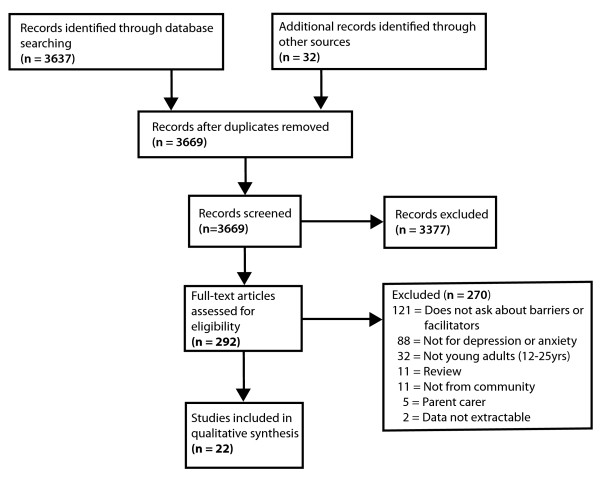
“This process resulted in a total of 22 relevant studies [20-41] for inclusion into the review.”
Background(2006) · Why Science Matters · doi:10.1002/9780470773994.ch8 · Cited by 1,014
Sawyer, M. G., Arney, F. M., Baghurst, P. A., Clark, J. J., Graetz, B. W., Kosky, R. J., Nurcombe, B., Patton, G. C., Prior, M. R., Raphael, B., et al. (2001) · Australian & New Zealand Journal of Psychiatry · doi:10.1046/j.1440-1614.2001.00964.x · Cited by 826
International Journal of Adolescent Medicine and Health
(2011) · International Journal of Adolescent Medicine and Health · doi:10.1515/ijamh · Cited by 686
Research works printed but not linked: 1
- Australian Bureau of Statistics Australian Bureau of Statistics. Canberra 2004-05 National Health Survey: Summary of Results 2006
Cited by
Items 501–600 of 1,047
Brimblecombe, N., Knapp, M., Murguia, S., Mbeah‐Bankas, H., Crane, S., Harris, A., Evans‐Lacko, S., Ardino, V., Iemmi, V., & King, D. (2017) · Early Intervention in Psychiatry · doi:10.1111/eip.12261 · Cited by 42
Moll, S. E., Zanhour, M., Patten, S. B., Stuart, H. L., & MacDermid, J. C. (2017) · Journal of Occupational Rehabilitation · doi:10.1007/s10926-017-9695-0 · Cited by 45
Cotter, P., Kaess, M., Corcoran, P. E., Parzer, P., Brunner, R. M., Keeley, H., Carli, V., Wasserman, C., Hoven, C. W., Sarchiapone, M., et al. (2015) · Social Psychiatry and Psychiatric Epidemiology · doi:10.1007/s00127-015-1016-3 · Cited by 54
Wadman, R., Clarke, D. D., Sayal, K. S., Vostanis, P., Armstrong, M., Harroe, C., Majumder, P., & Townsend, E. (2016) · Journal of Health Psychology · doi:10.1177/1359105316631405 · Cited by 59
Microinterventions produce immediate but not lasting benefits in mood and distress
Elefant, A. B., Contreras, O., Muñoz, R. F., Bunge, E. L., & Leykin, Y. (2017) · Internet Interventions · doi:10.1016/j.invent.2017.08.004 · Cited by 51
Yang, J., Lopez Cervera, R., Tye, S. J., Ekker, S. C., & Pierret, C. (2018) · Journal of Translational Medicine · doi:10.1186/s12967-018-1459-x · Cited by 41
“Effective help-seeking remains low, and attitudinal barriers—particularly stigma and inadequate mental health literacy—are commonplace [3].”
BackgroundFernet, M., Hébert, M., Couture, S., & Brodeur, G. (2019) · Child Abuse & Neglect · doi:10.1016/j.chiabu.2019.01.019 · Cited by 41
Stewart, G., Kamata, A., Miles, R., Grandoit, E., Mandelbaum, F., Quinn, C., & Rabin, L. (2019) · Journal of Affective Disorders · doi:10.1016/j.jad.2019.07.058 · Cited by 40
Wang, Q., Ren, L., Wang, W., Xu, W., & Wang, Y. (2019) · BMC Psychiatry · doi:10.1186/s12888-019-2353-7 · Cited by 42
Yamaguchi, S., Ojio, Y., Foo, J. C., Michigami, E., Usami, S., Fuyama, T., Onuma, K., Oshima, N., Ando, S., Togo, F., et al. (2020) · Journal of Adolescence · doi:10.1016/j.adolescence.2020.05.002 · Cited by 61
Fawole, O. A., Reed, M. V., Harris, J. G., Hersh, A. O., Rodriguez, M. M., Onel, K. B., LAWSON, E. F., Rubinstein, T. B., Ardalan, K., Morgan, E. M., et al. (2021) · Pediatric Rheumatology · doi:10.1186/s12969-021-00503-7 · Cited by 43
Lee, J. E., Goh, M. L., & Yeo, S. F. (2023) · Heliyon · doi:10.1016/j.heliyon.2023.e14512 · Cited by 102
Bell, I., Arnold, C., Gilbertson, T., D’Alfonso, S., Castagnini, E., Chen, N. A., Nicholas, J., O’Sullivan, S., Valentine, L., & Álvarez‐Jiménez, M. (2023) · Journal of Medical Internet Research · doi:10.2196/47860 · Cited by 45
Gagnon, M. M., Gelinas, B. L., & Friesen, L. N. (2017) · Journal of Adolescent Research · doi:10.1177/0743558415605383 · Cited by 40
Gardner, A., Filia, K., Killackey, E. J., & Cotton, S. (2018) · Australian & New Zealand Journal of Psychiatry · doi:10.1177/0004867418804065 · Cited by 50
Morgiève, M., Genty, C., Azé, J., Dubois, J., Leboyer, M., Vaïva, G., Berrouiguet, S., & Courtet, P. (2020) · JMIR mhealth and uhealth · doi:10.2196/15741 · Cited by 52
Sagar-Ouriaghli, I., Godfrey, E. L., Graham, S., & Brown, J. S. L. (2020) · International Journal of Environmental Research and Public Health · doi:10.3390/ijerph17144965 · Cited by 63
Burchert, S., Kerber, A., Zimmermann, J., & Knaevelsrud, C. (2021) · PLoS ONE · doi:10.1371/journal.pone.0244955 · Cited by 48
Li, S. H., Achilles, M. R., Spanos, S., Habak, S., Werner-Seidler, A., & O’Dea, B. (2022) · The Cognitive Behaviour Therapist · doi:10.1017/s1754470x22000095 · Cited by 39
“Barriers related to accessibility, stigma, negative beliefs about treatment and a preference for autonomy significantly impact young people’s abilities to seek help for their mental health (Aguirre Velasco et al., 2020; Gulliver et al., 2010; Radez et al., 2021).”
BackgroundHow well do older adults recognise mental illness? A literature review
Malkin, G., Hayat, T., Amichai‐Hamburger, Y., Ben‐David, B. M., Regev, T., & Nakash, O. (2019) · Psychogeriatrics · doi:10.1111/psyg.12427 · Cited by 45
Anttila, M., Sittichai, R., Katajisto, J., & Välimäki, M. (2019) · International Journal of Environmental Research and Public Health · doi:10.3390/ijerph16142473 · Cited by 39
A content analysis of YouTube depression personal account videos and their comments
Gaus, Q., Jolliff, A. F., & Moreno, M. (2021) · Computers in Human Behavior Reports · doi:10.1016/j.chbr.2020.100050 · Cited by 38
Islam, M. I., Yunus, F., Isha, S., Kabir, E., Khanam, R., & Martiniuk, A. (2022) · Scientific Reports · doi:10.1038/s41598-022-09352-0 · Cited by 35
Gonsalves, P. P., Nair, R., Roy, M., Pal, S., & Michelson, D. (2023) · Administration and Policy in Mental Health and Mental Health Services Research · doi:10.1007/s10488-023-01253-2 · Cited by 58
Wang, L., Panagiotoglou, D., Min, J. E., DeBeck, K., Milloy, M., Kerr, T. H., Hayashi, K., & Nosyk, B. (2016) · Drug and Alcohol Dependence · doi:10.1016/j.drugalcdep.2016.08.631 · Cited by 47
Predicting help-seeking behavior: The impact of knowing someone close who has sought help
Disabato, D. J., Short, J. L., Lameira, D. M., Bagley, K., & Wong, S. J. (2018) · Journal of American College Health · doi:10.1080/07448481.2018.1440568 · Cited by 46
Vélez‐Grau, C. (2018) · Health Promotion International · doi:10.1093/heapro/day043 · Cited by 52
Ecological Momentary Assessment and Mood Disorders in Children and Adolescents: a Systematic Review
Baltasar-Tello, I., Miguélez‐Fernández, C., Peñuelas‐Calvo, I., & Carballo, J. J. (2018) · Current Psychiatry Reports · doi:10.1007/s11920-018-0913-z · Cited by 43
Horsfield, P., Stolzenburg, S., Hahm, S., Tomczyk, S., Muehlan, H., Schmidt, S., & Schomerus, G. (2019) · Social Psychiatry and Psychiatric Epidemiology · doi:10.1007/s00127-019-01787-7 · Cited by 56
Mok, K., Chen, N. A., Torok, M. H., McGillivray, L., Zbukvic, I., & Shand, F. (2020) · Advances in Mental Health · doi:10.1080/18387357.2020.1770109 · Cited by 46
Planning and Implementation Intention Interventions
Rhodes, R. E., Grant, S. J., & de Bruijn, G. (2020) · Cambridge University Press eBooks · doi:10.1017/9781108677318.039 · Cited by 49
Attitudes and Persuasive Communication Interventions
Hamilton, K., & Johnson, B. T. (2020) · Cambridge University Press eBooks · doi:10.1017/9781108677318.031 · Cited by 61
Changing Behavior Using Habit Theory
Orbell, S., & Verplanken, B. (2020) · Cambridge University Press eBooks · doi:10.1017/9781108677318.013 · Cited by 66
Fekih‐Romdhane, F., Chebbi, O., Sassi, H., & Cheour, M. (2020) · Early Intervention in Psychiatry · doi:10.1111/eip.13080 · Cited by 44
Ahorsu, D. K., Sánchez-Vidaña, D. I., Lipardo, D., Shah, P., González, P. C., Shende, S., Gurung, S., Venkatesan, H., Duongthipthewa, A., Ansari, T. Q., et al. (2021) · International Journal of Mental Health Systems · doi:10.1186/s13033-020-00432-0 · Cited by 63
The iBerry study: a longitudinal cohort study of adolescents at high risk of psychopathology
Mil, N. H. G., Bouter, D. C., Hoogendijk, W. J. G., van Jaarsveld, S. F. L. M., Tiemeier, H. W., Mulder, C. L., & Roza, S. J. (2021) · European Journal of Epidemiology · doi:10.1007/s10654-021-00740-w · Cited by 42
Nester, M. S., Hawkins, S. L., & Brand, B. L. (2022) · European Journal of Psychotraumatology · doi:10.1080/20008198.2022.2031594 · Cited by 39
Sharpe, H., Ford, T. J., Lereya, S. T., Owen, C., Viner, R., & Wolpert, M. (2016) · Child and Adolescent Mental Health · doi:10.1111/camh.12166 · Cited by 70
Wozney, L., Baxter, P., & Newton, A. S. (2015) · BMC Pediatrics · doi:10.1186/s12887-015-0534-1 · Cited by 38
“Adolescents have also been found to be reluctant to seek professional treatment [7] due to strong beliefs that they should cope alone [8], low mental-health literacy [9], and inadequate social or interpersonal skills [10].”
BackgroundEllis, L. A., McCabe, K. L., Rahilly, K. A., Nicholas, M. A., Davenport, T. A., Burns, J. M., & Hickie, I. B. (2014) · Clinical Investigation · doi:10.4155/cli.14.61 · Cited by 38
Wagner, V., Bertrand, K., Flores-Aranda, J., Acier, D., Brunelle, N., Landry, M., & Brochu, S. (2017) · Qualitative Health Research · doi:10.1177/1049732316679372 · Cited by 38
“with the desire to change expressed by some young substance users, it may be advisable to provide tools to help reinforcing with self-control, self-reliance, selfefficacy abilities, and to offer programs improving mental health literacy and reducing stigma associated with drug misuse and help-seeking behavior (Gullive…”
BackgroundInfluentialStjerneklar, S., Hougaard, E., & Thastum, M. (2019) · Internet Interventions · doi:10.1016/j.invent.2019.01.003 · Cited by 38
Dambi, J. M., Norman, C., Doukani, A., Potgieter, S., Turner, J., Musesengwa, R., Verhey, R., & Chibanda, D. (2022) · JMIR Mental Health · doi:10.2196/37968 · Cited by 46
Halsall, T., Daley, M., Hawke, L. D., Henderson, J. L., & Matheson, K. (2022) · BMC Health Services Research · doi:10.1186/s12913-022-08743-3 · Cited by 47
Wu, Y., Fenfen, E., Wang, Y., Xu, M., Liu, S., Zhou, L., Song, G., Shang, X., Yang, C., Yang, K., et al. (2023) · Internet Interventions · doi:10.1016/j.invent.2023.100673 · Cited by 50
Rossetto, A., Jorm, A. F., & Reavley, N. J. (2014) · SAGE Open · doi:10.1177/2158244014537502 · Cited by 47
Self-harm prevalence and ideation in a community sample of cis, trans and other youth
Butler, C., Joiner, R., Bradley, R., Bowles, M., Bowes, A., Russell, C., & Roberts, V. (2019) · International Journal of Transgenderism · doi:10.1080/15532739.2019.1614130 · Cited by 34
Kenny, R., Fitzgerald, A., Segurado, R., & Dooley, B. (2020) · Health Informatics Journal · doi:10.1177/1460458219884195 · Cited by 38
Changing Behavior: A Theory- and Evidence-Based Approach
Hagger, M. S., Cameron, L. D., Hamilton, K., Hankonen, N. E., & Lintunen, T. (2020) · Cambridge University Press eBooks · doi:10.1017/9781108677318.001 · Cited by 63
Association between delirium in the intensive care unit and subsequent neuropsychiatric disorders
Brown, K. N., Soo, A., Faris, P., Patten, S. B., Fiest, K. M., & Stelfox, H. T. (2020) · Critical Care · doi:10.1186/s13054-020-03193-x · Cited by 42
Tuijnman, A., Kleinjan, M., Olthof, M., Hoogendoorn, E., Granic, I., & Engels, R. C. M. E. (2022) · JMIR Mental Health · doi:10.2196/26615 · Cited by 46
Hubbard, G., Macmillan, I., Canny, A., Forbat, L., Neal, R. D., O’Carroll, R. E., Haw, S. J., & Kyle, R. G. (2014) · BMC Public Health · doi:10.1186/1471-2458-14-1117 · Cited by 41
Dietvorst, E., Aukes, M. A., Legerstee, J. S., Vreeker, A., Hrehovcsik, M. M., Keijsers, L., & Hillegers, M. H. J. (2022) · JMIR Formative Research · doi:10.2196/29832 · Cited by 35
Geirhos, A., Domhardt, M., Lunkenheimer, F., Temming, S., Holl, R. W., Minden, K., Warschburger, P., Meissner, T., Mueller-Stierlin, A. S., & Baumeister, H. (2022) · BMC Pediatrics · doi:10.1186/s12887-022-03134-3 · Cited by 37
“Some of the known barriers to help-seeking in AYA are self-reliance, lack of perceived confidentiality and trust in the potential source of help, or lack of knowledge about symptoms of mental disorders [84].”
BackgroundSeo, H. Y., Song, G. Y., Ku, J. W., Park, H. Y., Myung, W., Kim, H. J., Baek, C. H., Lee, N., Sohn, J. H., Yoo, H. J., et al. (2022) · BMC Psychiatry · doi:10.1186/s12888-022-03969-1 · Cited by 43
TikTok and teen mental health: an analysis of user-generated content and engagement
Lau, N., Srinakarin, K., Aalfs, H., Zhao, X. Y., & Palermo, T. M. (2024) · Journal of Pediatric Psychology · doi:10.1093/jpepsy/jsae039 · Cited by 65
Royen, K. V., Poels, K., & Vandebosch, H. (2016) · Cyberpsychology Behavior and Social Networking · doi:10.1089/cyber.2015.0168 · Cited by 47
Perceived Barriers and Enablers of Help-Seeking for Substance Use Problems During Adolescence
Berridge, B. J., McCann, T. V., Cheetham, A., & Lubman, D. I. (2017) · Health Promotion Practice · doi:10.1177/1524839917691944 · Cited by 45
Leveraging the Web and Social Media to Promote Access to Care Among Suicidal Individuals
Notredame, C.-É., Grandgenèvre, P., Pauwels, N., Morgiève, M., Wathelet, M., Vaïva, G., & Séguin, M. (2018) · Frontiers in Psychology · doi:10.3389/fpsyg.2018.01338 · Cited by 43
Hurley, D., Allen, M. S., Swann, C., & Vella, S. A. (2020) · Child Psychiatry & Human Development · doi:10.1007/s10578-020-00998-3 · Cited by 45
Barriers to access to mental health services among Colombia outpatients
Campo‐Arias, A., Ospino, G. A. C., & Herazo, E. (2020) · International Journal of Social Psychiatry · doi:10.1177/0020764020925105 · Cited by 45
Tarrant, M., Haslam, C., Carter, M., Calitri, R., & Haslam, S. A. (2020) · Cambridge University Press eBooks · doi:10.1017/9781108677318.044 · Cited by 43
Jacobson, N. C., Yom‐Tov, E., Lekkas, D., Heinz, M. V., Liu, L., & Barr, P. J. (2020) · Journal of Psychiatric Research · doi:10.1016/j.jpsychires.2020.11.010 · Cited by 41
Fikretoglu, D., Sharp, M., Adler, A. B., Bélanger, S. A. H., Benassi, H. P., Bennett, C., Bryant, R. A., Busuttil, W., Cramm, H. A., Fear, N. T., et al. (2021) · Clinical Psychology Review · doi:10.1016/j.cpr.2021.102100 · Cited by 48
Heiniger, L. E., Smith, A. B., Olver, I., Grimison, P., Klein, B., Wootten, A., Abbott, J.-A. M., Price, M. A., McJannett, M., Tran, B., et al. (2017) · European Journal of Cancer Care · doi:10.1111/ecc.12698 · Cited by 32
Lubman, D. I., Berridge, B. J., Blee, F., Jorm, A. F., Wilson, C. J., Allen, N. B., McKay-Brown, L., Proimos, J., Cheetham, A., & Wolfe, R. (2016) · Trials · doi:10.1186/s13063-016-1510-2 · Cited by 36
Stjerneklar, S., Hougaard, E., Nielsen, A. D., Gaardsvig, M. M., & Thastum, M. (2018) · Internet Interventions · doi:10.1016/j.invent.2018.01.001 · Cited by 36
“…most frequently mentioned barriers for adolescents to seek treatment are perceived social stigma and fear of peer rejection (Collins et al., 2004; Gulliver et al., 2010; Rickwood et al., 2005; Booth et al., 2004; Jaycox et al., 2006), preference for self-reliance (Rickwood et al., 2007; Rickwood…”
BackgroundDigitally-delivered cognitive-behavioural therapy for youth insomnia: A systematic review
Werner-Seidler, A., Johnston, L., & Christensen, H. (2018) · Internet Interventions · doi:10.1016/j.invent.2018.01.007 · Cited by 36
“Moreover, young people may be particularly well suited to digital programs because they are generally reluctant to seek professional help (Gulliver et al., 2010), are more comfortable with technology than any previous generation (Younes et al., 2015) and may therefore be more likely to engage with…”
BackgroundSelf-citationHylton, E., Malley, A., & Ironson, G. H. (2019) · The Arts in Psychotherapy · doi:10.1016/j.aip.2019.101586 · Cited by 60
Doan, N., Patte, K. A., Ferro, M. A., & Leatherdale, S. T. (2020) · International Journal of Environmental Research and Public Health · doi:10.3390/ijerph17197128 · Cited by 36
“These findings are consistent with previous research that indicated that a preference for self-reliance and concerns regarding confidentiality are significant barriers to adolescents seeking help for their mental health concerns in the school setting [4,38,39].”
BackgroundResultd'Halluin, A., Costa, M., Morgiève, M., & Sebbane, D. (2023) · Journal of Medical Internet Research · doi:10.2196/43102 · Cited by 44
Yap, M. B. H., Reavley, N. J., & Jorm, A. F. (2011) · Journal of Affective Disorders · doi:10.1016/j.jad.2011.11.006 · Cited by 41
Glasheen, K., Campbell, M. A., & Shochet, I. M. (2013) · Australian Journal of Guidance and Counselling · doi:10.1017/jgc.2013.15 · Cited by 59
Davies, E. B., Wardlaw, J., Morriss, R. K., & Glazebrook, C. (2016) · BMC Public Health · doi:10.1186/s12889-016-2887-2 · Cited by 51
Grace, B., Richardson, N., & Carroll, P. (2016) · American Journal of Men s Health · doi:10.1177/1557988316634088 · Cited by 38
Conditional Disclosure on Pathways to Care: Coping Preferences of Young People at Risk of Psychosis
Gronholm, P. C., Thornicroft, G., Laurens, K. R., & Evans-Lacko, S. (2017) · Qualitative Health Research · doi:10.1177/1049732316680337 · Cited by 36
Olivari, C., & Guzmán‐González, M. (2017) · Revista chilena de pediatría · doi:10.4067/s0370-41062017000300003 · Cited by 36
Watson, J. C. (2017) · Professional School Counseling · doi:10.5330/1096-2409-21.1.108 · Cited by 52
Schnyder, N., Michel, C., Panczak, R., Ochsenbein, S., Schimmelmann, B., & Schultze‐Lutter, F. (2018) · European Psychiatry · doi:10.1016/j.eurpsy.2017.12.027 · Cited by 39
A narrative literature review of child-focused mental health literacy attributes and scales
Bale, J., Grové, C., & Costello, S. (2018) · Mental Health & Prevention · doi:10.1016/j.mhp.2018.09.003 · Cited by 43
Paton, K., & Hiscock, H. (2019) · PLoS ONE · doi:10.1371/journal.pone.0214821 · Cited by 42
Mental health literacy of maternal and paternal postnatal (postpartum) depression in British adults
Swami, V., Barron, D. S., Smith, L., & Furnham, A. F. (2019) · Journal of Mental Health · doi:10.1080/09638237.2019.1608932 · Cited by 46
Han, J., Torok, M. H., Gale, N., Wong, Q. J. J., Werner‐Seidler, A., Hetrick, S. E., & Christensen, H. M. (2019) · JMIR Mental Health · doi:10.2196/14191 · Cited by 43
Self-citationEdwards, J., Thind, A., Stranges, S., Chiu, M., & Anderson, K. K. (2020) · Acta Psychiatrica Scandinavica · doi:10.1111/acps.13143 · Cited by 46
Ghadirian, L., & Sayarifard, A. (2019) · International Journal of Preventive Medicine · doi:10.4103/ijpvm.ijpvm_166_18 · Cited by 39
Fear of Detection and Efficacy of Prevention: Using Construal Level to Encourage Health Behaviors
Achar, C., Agrawal, N., & Hsieh, M. (2020) · Journal of Marketing Research · doi:10.1177/0022243720912443 · Cited by 43
Cronin, T. J., Pepping, C. A., Halford, W. K., & Lyons, A. (2020) · Journal of Homosexuality · doi:10.1080/00918369.2020.1804264 · Cited by 44
Demkowicz, O., Ashworth, E., Mansfield, R., Stapley, E., Miles, H., Hayes, D., Burrell, K., Moore, A., & Deighton, J. (2020) · Child and Adolescent Psychiatry and Mental Health · doi:10.1186/s13034-020-00341-7 · Cited by 42
‘Are You OK?’ Students’ Trust in a Chatbot Providing Support Opportunities
Pesonen, J. A. (2021) · Lecture notes in computer science · doi:10.1007/978-3-030-77943-6_13 · Cited by 69
Depression literacy of undergraduates in a non-western developing context: the case of Sri Lanka
Amarasuriya, S. D., Jorm, A. F., & Reavley, N. J. (2015) · BMC Research Notes · doi:10.1186/s13104-015-1589-7 · Cited by 41
Barriers and facilitators on the pathway to mental health care among 12-25 year olds
Leijdesdorff, S. M. J., Klaassen, R. M. C., Wairata, D.-J., Rosema, S., van Amelsvoort, T., & Popma, A. (2021) · International Journal of Qualitative Studies on Health and Well-Being · doi:10.1080/17482631.2021.1963110 · Cited by 46
Topooco, N., Fowler, L. A., Fitzsimmons‐Craft, E. E., DePietro, B., Vázquez, M. M., Firebaugh, M., Ceglarek, P. J. D., Monterubio, G. E., Newman, M. G., Eisenberg, D., et al. (2022) · Internet Interventions · doi:10.1016/j.invent.2022.100528 · Cited by 69
Barriers to Seeking Psychotherapy for Mental Health Problems in Adolescents: a mixed method study
Pfeiffer, S., & In‐Albon, T. (2022) · Journal of Child and Family Studies · doi:10.1007/s10826-022-02364-4 · Cited by 51
Nature-Based Meditation, Rumination and Mental Wellbeing
Owens, M., & Bunce, H. L. I. (2022) · International Journal of Environmental Research and Public Health · doi:10.3390/ijerph19159118 · Cited by 43
Mental health treatment and access for emerging adults in Canada: a systematic review
Murray, J. K., & Knudson, S. (2023) · Frontiers in Public Health · doi:10.3389/fpubh.2023.1088999 · Cited by 35
Allgaier, A., Schiller, Y., & Schulte‐Körne, G. (2011) · Kindheit und Entwicklung · doi:10.1026/0942-5403/a000062 · Cited by 37
Examining changes in substance use and conduct problems among treatment‐seeking adolescents
Lewis, S. F. (2012) · Child and Adolescent Mental Health · doi:10.1111/j.1475-3588.2012.00657.x · Cited by 38
Dueweke, A. R., & Bridges, A. J. (2017) · Stigma and Health · doi:10.1037/sah0000038 · Cited by 43
What steps to take? How to approach concerning anxiety in youth.
Kendall, P. C., Makover, H. B., Swan, A. J., Carper, M. M., Mercado, R., Kagan, E. R., & Crawford, E. A. (2016) · Clinical Psychology Science and Practice · doi:10.1111/cpsp.12156 · Cited by 36
Students' Reports of Severe Violence in School as a Tool for Early Detection and Prevention
Yablon, Y. B. (2017) · Child Development · doi:10.1111/cdev.12679 · Cited by 41
Metadata
- Authors
- Gulliver, A., Griffiths, K. M., & Christensen, H.
- Affiliations
- Australian National University (AU)
- Corresponding author
- Gulliver, Amelia
- Venue
- BMC Psychiatry
- Published
- 2010-12
- Volume
- 10
- Issue
- 1
- Pages
- 113-113
- ISSN
- 1471-244X (ISSN-L)
- PMC
- PMC3022639
- OpenAlex
- W2107750653
- Semantic Scholar
- f95edcc0bd6116b085c3f189a000be87dd3d6115
- Cited by
- 3,292
- References
- 51
- Citations by year
- 2026: 301 · 2025: 323 · 2024: 301 · 2023: 299 · 2022: 306 · 2021: 318 · 2020: 363 · 2019: 238 · 2018: 221 · 2017: 170 · 2016: 147 · 2015: 111 · 2014: 90 · 2013: 48 · 2012: 42
- FWCI
- 4.00
- Type
- journal article
- Language
- en
- Open access
- gold
- doi.org
- Licence
- cc-by
- creativecommons.org/licenses/by/2.0 (tdm)
- Locations
- BMC Psychiatry (publishedVersion, cc-by)
- Europe PMC (PubMed Central) (publishedVersion, cc-by)
- PubMed Central (publishedVersion, cc-by)
- PubMed (publishedVersion)
- DOAJ (DOAJ: Directory of Open Access Journals) (submittedVersion)
- ANU Open Research (Australian National University) (submittedVersion, cc-by)
- Funders
- Australian National University
- Australian Institute of Sport
- National Health and Medical Research Council (525413, 525411)
- Topics
- Health Sciences › Medicine › Psychiatry and Mental health › Mental Health Treatment and Access
- Social Sciences › Psychology › Clinical Psychology › Suicide and Self-Harm Studies
- Social Sciences › Psychology › Clinical Psychology › Psychology and Mental Health
- Keywords
- help-seeking, mental health help-seeking, adolescents, young adults, perceived barriers, perceived facilitators, mental health literacy, stigma, self-reliance, social support, common mental disorders
- MeSH terms
- Adolescent, Adult, Mental Disorders, Data Collection, Female, Health Services Accessibility, Humans, Male, Mental Health Services, Patient Acceptance of Health Care, Qualitative Research, Young Adult
About these checks
Registry, retraction, Cites and statistics results are computed, not judged, with one exception: a printed reference that no index lists is read once by a model before it counts as a citation error. Claims are extracted by a model and kept only when their quote appears verbatim in the text; each cited source is then checked, with a model’s help, for whether it says what the claim relies on. Those verdicts can be wrong — read the claim’s quote and the cited source before relying on one.
Statistics and arithmetic are recomputed, not judged.
Confidence bands are shown only for fields calibrated on our annotated test set. None is calibrated yet, so no band is shown.
What counts as a claim ›How we measure confidence ›How we check this ›
Are you an author, or do you see a problem with this page? Request a review
Data sources
Bibliographic data: Semantic Scholar, OpenAlex, Crossref.
Contains information from the Semantic Scholar Academic Graph Datasets, made available under the ODC Attribution License (ODC-BY 1.0).
Semantic Scholar’s data is described in: Kinney, R., et al. (2023). The Semantic Scholar Open Data Platform. arXiv:2301.10140.
