

Perceived barriers and facilitators to mental health help-seeking in young people: a systematic review
Open accessThe DOI matches its Crossref record; 50 of the 51 references it cites were found in a registry or an index, and 1 are not checked yet.
Abstract
BACKGROUND: Adolescents and young adults frequently experience mental disorders, yet tend not to seek help. This systematic review aims to summarise reported barriers and facilitators of help-seeking in young people using both qualitative research from surveys, focus groups, and interviews and quantitative data from published surveys. It extends previous reviews through its systematic research methodology and by the inclusion of published studies describing what young people themselves perceive are the barriers and facilitators to help-seeking for common mental health problems. METHODS: Twenty two published studies of perceived barriers or facilitators in adolescents or young adults were identified through searches of PubMed, PsycInfo, and the Cochrane database. A thematic analysis was undertaken on the results reported in the qualitative literature and quantitative literature. RESULTS: Fifteen qualitative and seven quantitative studies were identified. Young people perceived stigma and embarrassment, problems recognising symptoms (poor mental health literacy), and a preference for self-reliance as the most important barriers to help-seeking. Facilitators were comparatively under-researched. However, there was evidence that young people perceived positive past experiences, and social support and encouragement from others as aids to the help-seeking process. CONCLUSIONS: Strategies for improving help-seeking by adolescents and young adults should focus on improving mental health literacy, reducing stigma, and taking into account the desire of young people for self-reliance.
Overview
The claims and statistics of this paper haven’t been checked yet.
Free: it reads the open-access text and checks the first 5 claims that cite a source we can check. Create a free account to check every claim.
Integrity signals
Registry
Cites
Statistics
Figures
Verification
Claims the paper makes
The claims and statistics of this paper haven’t been checked yet.
Free: it reads the open-access text and checks the first 5 claims that cite a source we can check. Create a free account to check every claim.
Claims other papers make about this one
Each is checked against this paper’s own text: does it say what the citing paper says it does?
The cited source doesn’t support the claim as written.
In the citing paper
“A previous systematic review demonstrated that a low level of MHL is the main barrier to seeking assistance [11].”
From Mental health literacy intervention on help-seeking in athletes: a systematic review (2020) · cites this paper as [11]
Checked by a reasoning model — may be wrong.
Experimental — accuracy not yet measuredThe source backs part of the claim, not all of it — or backs it for a different population, condition or comparison.
In the citing paper
“Despite this, the extant literature has extensively examined many barriers and facilitators impacting young people seeking help and has increased understanding on a range of personal, social, cultural, and service factors (Doan et al. 2020; Gulliver et al. 2010; Goodwin et al. 2016; Michelmore and Hindley 2012; Nam et al. 2010; Radez et al. 2021; Roth ì and Leavey 2006; Rowe et al. 2014).”
From "You Have the Choice of Whether You're Going to Get Help or Attempt Suicide": Exploring the Process and Impact of Mental Health Help-Seeking with Young People (16–25 Years) (2025) · cites this paper as Gulliver et al. 2010
Experimental — accuracy not yet measuredThe source backs part of the claim, not all of it — or backs it for a different population, condition or comparison.
In the citing paper
“In addition to the issue of low levels of MHL, high levels of stigma are recognised as another barrier influencing help-seeking in elite sport [11].”
From Mental health literacy intervention on help-seeking in athletes: a systematic review (2020) · cites this paper as [11]
Experimental — accuracy not yet measuredThe source backs part of the claim, not all of it — or backs it for a different population, condition or comparison.
In the citing paper
“In addition, existing face-to-face services pose significant barriers for young people [10-16] largely due to access, availability, and high costs of these services [17], as well as the reluctance of young people to seek professional help due to stigma and embarrassment [18-20].”
From Do online mental health services improve help-seeking for young people? A systematic review (2014) · cites this paper as [13]
Experimental — accuracy not yet measuredThe source backs part of the claim, not all of it — or backs it for a different population, condition or comparison.
In the citing paper
“Meeting these needs is challenging, as men (particularly younger men) tend not to seek professional help for distress (Gulliver, Griffiths, & Christensen, 2010;Oliver et al., 2005;Rickwood, Deane, & Wilson, 2007).”
From e-TC: Development and pilot testing of a web-based intervention to reduce anxiety and depression in survivors of testicular cancer (2017) · cites this paper as Gulliver, Griffiths, & Christensen, 2010
Experimental — accuracy not yet measured
19 more claims about this paper
Create a free account to see every claim other papers make about this one.
Self-check
Percentages, sums and reported differences re-computed from the paper’s own numbers.
The self-check needs the paper’s full text.
Citations
Cites
Preferred Reporting Items for Systematic Reviews and Meta-Analyses: the PRISMA statement
Moher, D., Liberati, A., Tetzlaff, J., Altman, D. G., & for the PRISMA Group (2009) · BMJ · doi:10.1136/bmj.b2535 · Cited by 83,823
Preferred reporting items for systematic reviews and meta-analyses: the PRISMA Statement.
(2009) · PubMed Central · Cited by 44,859
Kessler, R. C., Chiu, W. T., Demler, O., & Walters, E. E. (2005) · Archives of General Psychiatry · doi:10.1001/archpsyc.62.6.617 · Cited by 12,052
(2021) · Handbook of Research Methods for Marketing Management · doi:10.4337/9781788976954.00014 · Cited by 4,009
Young People’s Help-Seeking for Mental Health Problems
Rickwood, D., Deane, F. P., Wilson, C. J., & Ciarrochi, J. (2005) · Australian e-Journal for the Advancement of Mental Health · doi:10.5172/jamh.4.3.218 · Cited by 1,619
When and how do young people seek professional help for mental health problems?
Rickwood, D. J., Deane, F. P., & Wilson, C. J. (2007) · Medical Journal of Australia · doi:10.5694/j.1326-5377.2007.tb01334.x · Cited by 1,195
Help-Seeking and Access to Mental Health Care in a University Student Population
Eisenberg, D., Golberstein, E., & Gollust, S. E. (2007) · Medical Care · doi:10.1097/mlr.0b013e31803bb4c1 · Cited by 1,131 · cited 1×
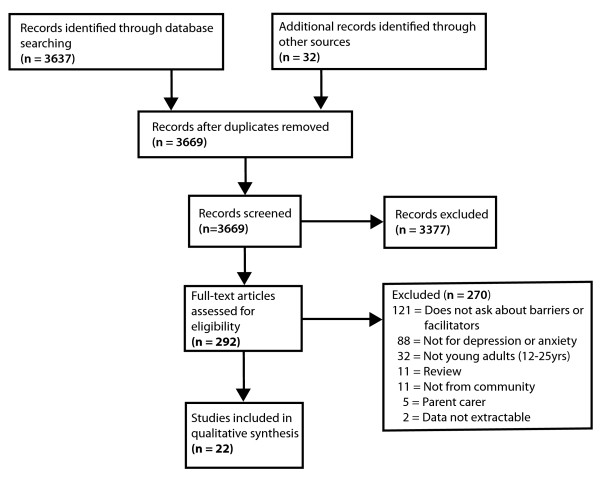
“This process resulted in a total of 22 relevant studies [20-41] for inclusion into the review.”
Background(2006) · Why Science Matters · doi:10.1002/9780470773994.ch8 · Cited by 1,014
Sawyer, M. G., Arney, F. M., Baghurst, P. A., Clark, J. J., Graetz, B. W., Kosky, R. J., Nurcombe, B., Patton, G. C., Prior, M. R., Raphael, B., et al. (2001) · Australian & New Zealand Journal of Psychiatry · doi:10.1046/j.1440-1614.2001.00964.x · Cited by 826
International Journal of Adolescent Medicine and Health
(2011) · International Journal of Adolescent Medicine and Health · doi:10.1515/ijamh · Cited by 686
Research works printed but not linked: 1
- Australian Bureau of Statistics Australian Bureau of Statistics. Canberra 2004-05 National Health Survey: Summary of Results 2006
Cited by
Items 401–500 of 1,047
Deasy, C., Coughlan, B., Pironom, J., Jourdan, D., & McNamara, P. (2016) · Irish Educational Studies · doi:10.1080/03323315.2016.1146157 · Cited by 76
Treatment seeking for eating disorders: Results from a nationally representative study
Bohrer, B. K., Carroll, I. A., Forbush, K. T., & Chen, P. (2017) · International Journal of Eating Disorders · doi:10.1002/eat.22785 · Cited by 51
Palacios, J. E., Richards, D., Palmer, R., Coudray, C., Hofmann, S. G., Palmieri, P. A., & Frazier, P. (2018) · JMIR Mental Health · doi:10.2196/11467 · Cited by 52
Schnyder, N., Lawrence, D., Panczak, R., Sawyer, M. G., Whiteford, H. A., Burgess, P. M., & Harris, M. G. (2020) · Epidemiology and Psychiatric Sciences · doi:10.1017/s2045796019000568 · Cited by 41
Cerea, S., Ghisi, M., Bottesi, G., Carraro, E., Broggio, D., & Doron, G. (2020) · Journal of Affective Disorders · doi:10.1016/j.jad.2020.07.043 · Cited by 56
Yang, X., Hu, J., Zhang, B., Ding, H., Hu, D., & Li, H. (2024) · Frontiers in Psychology · doi:10.3389/fpsyg.2024.1356435 · Cited by 111
Care-Seeking Pattern among Persons with Depression and Anxiety: A Population-Based Study in Sweden
Wallerblad, A., Möller, J., & Forsell, Y. (2012) · International Journal of Family Medicine · doi:10.1155/2012/895425 · Cited by 55
Gebreegziabher, Y., Girma, E., & Tesfaye, M. (2019) · PLOS ONE · doi:10.1371/journal.pone.0212657 · Cited by 50
the ProHEAD Consortium, Eschenbeck, H., Lehner, L., Hofmann, H., Bauer, S., Becker, K., Diestelkamp, S., Kaess, M., Moessner, M., Rummel-Kluge, C., et al. (2019) · Trials · doi:10.1186/s13063-018-3159-5 · Cited by 51
Zheng, K., Abraham, C. M., Bruzzese, J., & Smaldone, A. M. (2020) · Journal of Pediatric Health Care · doi:10.1016/j.pedhc.2020.01.008 · Cited by 70
Cohen, K. A., Stiles-Shields, C., Winquist, N., & Lattie, E. G. (2021) · The Journal of Behavioral Health Services & Research · doi:10.1007/s11414-020-09746-w · Cited by 51
Lattie, E., Cohen, K. A., Winquist, N., & Mohr, D. C. (2020) · JMIR Mental Health · doi:10.2196/21075 · Cited by 50
Cronin, T. J., Pepping, C. A., Halford, W. K., & Lyons, A. (2021) · Australian Psychologist · doi:10.1080/00050067.2021.1890981 · Cited by 60
Kurki, M., Gilbert, S., Mishina, K. E., Lempinen, L., Luntamo, T., Hinkka‐Yli‐Salomäki, S., Sinokki, A., Upadhyaya, S., Wei, Y., & Sourander, A. (2021) · BMC Medical Education · doi:10.1186/s12909-021-02990-4 · Cited by 65
Campos, L., Dias, P., Costa, M., Rabin, L. A., Miles, R. T., Lestari, S., Feraihan, R., Pant, N., Sriwichai, N., Boonchieng, W., et al. (2022) · BMC Psychiatry · doi:10.1186/s12888-022-04308-0 · Cited by 81
Lai, E. S. Y., Kwok, C.-L., Wong, P. W. C., Fu, K.-W., Law, Y.-W., & Yip, P. S. F. (2016) · PLOS ONE · doi:10.1371/journal.pone.0149854 · Cited by 50
Hall, B. J., Xiong, P., Guo, X., Sou, E. K. L., Chou, U. I., & Shen, Z. (2018) · Psychiatry Research · doi:10.1016/j.psychres.2018.09.060 · Cited by 49
Büchter, R. B., & Messer, M. (2017) · German medical science · doi:10.3205/000248 · Cited by 78
Mindsets of Addiction: Implications for Treatment Intentions
Burnette, J. L., Forsyth, R. B., Desmarais, S. L., & Hoyt, C. L. (2019) · Journal of Social and Clinical Psychology · doi:10.1521/jscp.2019.38.5.367 · Cited by 60
Changing Behavior Using Ecological Models
Salmon, J., Hesketh, K. D., Arundell, L., Downing, K. L., & Biddle, S. (2020) · Cambridge University Press eBooks · doi:10.1017/9781108677318.017 · Cited by 90
Cohen, A., Ianovski, L. E., Frenkiel, S., Hier, M., Zeitouni, A., Kost, K., Mlynarek, A., Richardson, K., Black, M., MacDonald, C., et al. (2018) · Psycho-Oncology · doi:10.1002/pon.4889 · Cited by 47
Howard, K. A., Griffiths, K. M., McKetin, R., & Ma, J. (2018) · Journal of Child & Adolescent Mental Health · doi:10.2989/17280583.2018.1467323 · Cited by 49
Self-citationQualitative evaluation of a sports-based mental health literacy program for adolescent males
Wynters, R., Liddle, S. K., Swann, C., Schweickle, M. J., & Vella, S. A. (2021) · Psychology of sport and exercise · doi:10.1016/j.psychsport.2021.101989 · Cited by 50
da Conceição, V., Rothes, I., & Gusmão, R. (2022) · PLoS ONE · doi:10.1371/journal.pone.0263622 · Cited by 61
de Almeida, R. S., Trigueiro, M. J., Portugal, P., de Sousa, S., Simões-Silva, V., Campos, F., SILVA, M. E. I. E., & Marques, A. J. (2023) · International Journal of Environmental Research and Public Health · doi:10.3390/ijerph20043318 · Cited by 70
Werlen, L., Puhan, M. A., Landolt, M. A., & Mohler‐Kuo, M. (2020) · BMC Public Health · doi:10.1186/s12889-020-09577-6 · Cited by 57
Povey, J., Sweet, M., Nagel, T., Mills, P. P. J. R., Stassi, C. P., Puruntatameri, A. M. A., Lowell, A., Shand, F., & Dingwall, K. (2020) · Internet Interventions · doi:10.1016/j.invent.2020.100318 · Cited by 48
Núñez, D., Arias, V. B., Méndez-Bustos, P., & Fresno, A. (2018) · Comprehensive Psychiatry · doi:10.1016/j.comppsych.2018.11.002 · Cited by 56
Nostalgia promotes help seeking by fostering social connectedness.
Juhl, J., Wildschut, T., Sedikides, C., Xiong, X., & Zhou, X. (2021) · Emotion · doi:10.1037/emo0000720 · Cited by 48
Children and Adolescents’ Attitudes Toward Seeking Help From Professional Mental Health Providers
Mauro, J. D., & Williams, D. J. (2012) · International Journal for the Advancement of Counselling · doi:10.1007/s10447-012-9172-6 · Cited by 61
Younes, N., Chollet, A., Menard, E., & Melchior, M. (2015) · Journal of Medical Internet Research · doi:10.2196/jmir.4254 · Cited by 48
Ravindran, A. V., Herrera, A., da Silva, T. L., Henderson, J., Castrillo, M. E., & Kutcher, S. (2018) · Global Mental Health · doi:10.1017/gmh.2017.27 · Cited by 48
Developing young men’s wellbeing through community and school-based programs: A systematic review
Gwyther, K., Swann, R., Casey, K., Purcell, R., & Rice, S. (2019) · PLoS ONE · doi:10.1371/journal.pone.0216955 · Cited by 67
Breslin, G., Haughey, T., O’Brien, W., Caulfield, L., Robertson, A., & Lawlor, M. (2018) · Journal of Clinical Sport Psychology · doi:10.1123/jcsp.2016-0039 · Cited by 47
Help-seeking for mental health concerns: review of Indian research and emergent insights
Sanghvi, P. B., & Mehrotra, S. (2021) · Journal of Health Research · doi:10.1108/jhr-02-2020-0040 · Cited by 62
Financial shame spirals: How shame intensifies financial hardship
Gladstone, J. J., Jachimowicz, J., Greenberg, A. E., & Galinsky, A. D. (2021) · Organizational Behavior and Human Decision Processes · doi:10.1016/j.obhdp.2021.06.002 · Cited by 61
Ding, K., Wang, S., Xu, W., Lin, L., Liao, D., Chen, H., Tan, W., Huang, J., Hou, C., & Jia, F. (2022) · Asia-Pacific Psychiatry · doi:10.1111/appy.12520 · Cited by 60
Daugelat, M., Pruccoli, J., Schag, K., & Giel, K. E. (2023) · European Eating Disorders Review · doi:10.1002/erv.2999 · Cited by 56
Oruche, U. M., Downs, S., Holloway, E., Draucker, C., & Aalsma, M. (2014) · Journal of Psychiatric and Mental Health Nursing · doi:10.1111/jpm.12076 · Cited by 47
Mental health literacy in korean older adults: A cross‐sectional survey
Kim, Y. S., Lee, H. Y., Lee, M. H., Simms, T., & Park, B. H. (2017) · Journal of Psychiatric and Mental Health Nursing · doi:10.1111/jpm.12395 · Cited by 60
Learning From Elite Athletes’ Experience of Depression
Lebrun, F., MacNamara, Á., Rodgers, S., & Collins, D. J. (2018) · Frontiers in Psychology · doi:10.3389/fpsyg.2018.02062 · Cited by 73
Pollock, N. J., Healey, G., Jong, M., Valcour, J. E., & Mulay, S. (2018) · BMC Public Health · doi:10.1186/s12889-018-6224-9 · Cited by 60
Kaess, M., Koenig, J., Bauer, S., Moessner, M., Fischer-Waldschmidt, G., Mattern, M., Herpertz, S. C., Resch, F., Brown, R. C., In‐Albon, T., et al. (2019) · Trials · doi:10.1186/s13063-019-3501-6 · Cited by 63
Self-reported mental health and mental illness among university music students in the United States
Koops, L. H., & Kuebel, C. R. (2019) · Research Studies in Music Education · doi:10.1177/1321103x19863265 · Cited by 64
Cavazos‐Rehg, P. A., Min, C. J., Fitzsimmons‐Craft, E. E., Savoy, B., Kaiser, N., Riordan, R., Krauss, M. J., Costello, S. J., & Wilfley, D. E. (2020) · Internet Interventions · doi:10.1016/j.invent.2020.100328 · Cited by 54
Wong, K. T. C., Chan, C. S., Chan, M. Y. H., Wong, C. L. H., Cheng, Q., Xiong, C., & Yip, P. S. F. (2021) · Journal of Affective Disorders · doi:10.1016/j.jad.2021.05.056 · Cited by 54
Mental health literacy in Ghana: Implications for religiosity, education and stigmatization
Adu, P., Jurcik, T., & Grigoryev, D. S. (2021) · Transcultural Psychiatry · doi:10.1177/13634615211022177 · Cited by 56
Werner‐Seidler, A., Huckvale, K., Larsen, M. E., Calear, A. L., Maston, K., Johnston, L., Torok, M. H., O’Dea, B., Batterham, P. J., Schweizer, S., et al. (2020) · Trials · doi:10.1186/s13063-019-3901-7 · Cited by 62
Self-citationPlace, V., Nabb, B., Gubi, E., Assel, K., Åhlén, J., Hagström, A., Bäärnhielm, S., Dalman, C., & Hollander, A.-C. (2021) · BMJ Open · doi:10.1136/bmjopen-2020-045923 · Cited by 47
Pinto, M. D., Greenblatt, A. M., Hickman, R. L., Rice, H. M., Thomas, T. L., & Clochesy, J. M. (2016) · Perspectives in Psychiatric Care · doi:10.1111/ppc.12112 · Cited by 46
Tomczyk, S., Muehlan, H., Freitag, S., Stolzenburg, S., Schomerus, G., & Schmidt, S. (2018) · Journal of Affective Disorders · doi:10.1016/j.jad.2018.05.059 · Cited by 46
Plateau, C. R., Arcelus, J., & Meyer, C. (2017) · European Eating Disorders Review · doi:10.1002/erv.2561 · Cited by 56
Barriers to Universal Mental Health Screening in Schools: The Perspective of School Psychologists
Burns, J. R., & Rapee, R. M. (2021) · Journal of Applied School Psychology · doi:10.1080/15377903.2021.1941470 · Cited by 57
Explainable depression symptom detection in social media
Bao, E., Pérez, A., & Parapar, J. (2024) · Health Information Science and Systems · doi:10.1007/s13755-024-00303-9 · Cited by 46
“However, due to the stigma associated with depression, more than 60% of individuals with the condition do not seek professional support [5].”
BackgroundNine-Year Follow-up of a Home-Visitation Program: A Randomized Trial
Fergusson, D. M., Boden, J. M., & Horwood, L. J. (2013) · PEDIATRICS · doi:10.1542/peds.2012-1612 · Cited by 52
Rugema, L., Krantz, G., Mogren, I., Ntaganira, J., & Persson, M. (2015) · BMC Psychiatry · doi:10.1186/s12888-015-0699-z · Cited by 65
Helping older adults to help themselves: the role of mental health literacy in family members
White, M., & Casey, L. M. (2016) · Aging & Mental Health · doi:10.1080/13607863.2016.1206513 · Cited by 60
Gair, S., & Baglow, L. (2018) · Aotearoa New Zealand Social Work · doi:10.11157/anzswj-vol30iss1id470 · Cited by 59
Elkington, K. S., Lee, J. G., Brooks, C., Watkins, J., & Wasserman, G. A. (2020) · Journal of Substance Abuse Treatment · doi:10.1016/j.jsat.2020.01.008 · Cited by 47
Shen, Y., Zhang, Y., Chan, B. S. M., Meng, F., Yang, T., Luo, X., & Huang, C. (2020) · BMC Psychiatry · doi:10.1186/s12888-020-02555-7 · Cited by 53
Burnett-Zeigler, I. E., Satyshur, M. D., Hong, S., Yang, A., T. Moskowitz, J., & Wisner, K. L. (2016) · Complementary Therapies in Clinical Practice · doi:10.1016/j.ctcp.2016.08.007 · Cited by 45
Werlen, L., Gjukaj, D., Mohler-Kuo, M., & Puhan, M. A. (2020) · Epidemiology and Psychiatric Sciences · doi:10.1017/s2045796019000544 · Cited by 45
Efficacy of digital health interventions in youth with chronic medical conditions: A meta-analysis
Domhardt, M., Schröder, A., Geirhos, A., Steubl, L., & Baumeister, H. (2021) · Internet Interventions · doi:10.1016/j.invent.2021.100373 · Cited by 45
“, 2014), high economic costs (Mojtabai, 2005), or stigma threat (Gulliver et al., 2010).”
BackgroundLynch, L., Moorhead, A., Long, M., & Hawthorne-Steele, I. (2021) · Youth & Society · doi:10.1177/0044118x20902786 · Cited by 44
Global research activity on mental health literacy
Sweileh, W. M. (2021) · Middle East Current Psychiatry · doi:10.1186/s43045-021-00125-5 · Cited by 60
Yu, Y., Hu, M., Liu, Z.-W., Liu, H.-M., Yang, J. P., Zhou, L., & Xiao, S.-Y. (2016) · BMC Psychiatry · doi:10.1186/s12888-016-0802-0 · Cited by 45
Correlates of Postpartum Depression in First Time Mothers Without Previous Psychiatric Contact
Sylvén, S. M., Thomopoulos, T. P., Kollia, N., Jonsson, M., & Skalkidou, A. (2017) · European Psychiatry · doi:10.1016/j.eurpsy.2016.07.003 · Cited by 44
Patalay, P., Annis, J., Sharpe, H., Newman, R., Main, D., Ragunathan, T., Parkes, M., & Rose‐Clarke, K. (2017) · Prevention Science · doi:10.1007/s11121-017-0840-y · Cited by 53
Langley, E. L., Wootton, B. M., & Grieve, R. (2018) · Australian Psychologist · doi:10.1111/ap.12334 · Cited by 45
Stigma, grief and depressive symptoms in help-seeking people bereaved through suicide
Scocco, P., Preti, A., Totaro, S., Corrigan, P. W., & Castriotta, C. (2018) · Journal of Affective Disorders · doi:10.1016/j.jad.2018.10.098 · Cited by 63
Changing Behavior Using Self-Determination Theory
Hagger, M. S., Hankonen, N. E., Chatzisarantis, N. L. D., & Ryan, R. M. (2020) · Cambridge University Press eBooks · doi:10.1017/9781108677318.008 · Cited by 87
Is big data the new stethoscope? Perils of digital phenotyping to address mental illness
Tekin, Ş. (2021) · Philosophy & Technology · doi:10.1007/s13347-020-00395-7 · Cited by 44
Turuba, R., Amarasekera, A., Howard, A. M., Brockmann, V., Tallon, C., Irving, S., Mathias, S., Henderson, J., Marchand, K., & Barbic, S. (2022) · Substance Abuse Treatment, Prevention, and Policy · doi:10.1186/s13011-022-00456-4 · Cited by 44
Ferrari, M., Sabetti, J., McIlwaine, S. V., Fazeli, S., Sadati, S. M. H., Shah, J. L., Archie, S., Boydell, K., Lal, S., Henderson, J. L., et al. (2022) · Frontiers in Digital Health · doi:10.3389/fdgth.2022.814248 · Cited by 65
Dombou, C., Omonaiye, O., Fraser, S., Cénat, J. M., Fournier, K., & Yaya, S. (2023) · PLoS ONE · doi:10.1371/journal.pone.0287162 · Cited by 71
Hard-to-reach: the NDIS, disability, and socio-economic disadvantage
Cortese, C., Hui, F., Nikidehaghani, M., & Chapple, S. (2020) · Disability & Society · doi:10.1080/09687599.2020.1782173 · Cited by 49
O’Dea, B., Subotic-Kerry, M., KING, C. A., Mackinnon, A. J., Achilles, M. R., Anderson, M., Parker, B., Werner‐Seidler, A., Torok, M. H., Cockayne, N. L., et al. (2021) · The Lancet Regional Health - Western Pacific · doi:10.1016/j.lanwpc.2021.100178 · Cited by 57
Self-citationDomhardt, M., Messner, E.-M., Eder, A.-S., Engler, S., Sander, L. B., Baumeister, H., & Terhorst, Y. (2021) · Child and Adolescent Psychiatry and Mental Health · doi:10.1186/s13034-021-00401-6 · Cited by 43
Eilert, N., Wogan, R., Leen, A., & Richards, D. (2022) · JMIR Pediatrics and Parenting · doi:10.2196/33551 · Cited by 43
“Additional personal barriers to young people receiving care can involve location-based or finance-based inaccessibility of services, feelings of embarrassment and perceived stigma, desire to be more self-reliant, and difficulties in recognizing mental health concerns [16].”
BackgroundLitvin, S., Saunders, R., Jefferies, P., Seely, H., Pössel, P., & Lüttke, S. (2023) · JMIR Mental Health · doi:10.2196/47285 · Cited by 43
Amarasuriya, S. D., Jorm, A. F., & Reavley, N. J. (2015) · BMC Psychiatry · doi:10.1186/s12888-015-0658-8 · Cited by 48
Help-seeking experiences of bereaved adolescents: A qualitative study
Andriessen, K., Lobb, E. A., Mowll, J., Dudley, M. J., Draper, B., & Mitchell, P. B. (2018) · Death Studies · doi:10.1080/07481187.2018.1426657 · Cited by 58
El bienestar subjetivo, psicológico y social como predictores de la salud mental en ecuatorianos
Moreta-Herrera, R., López-Calle, C., Gordón-Villalba, P., Ochoa, W. O., & González, I. G. (2018) · Actualidades en Psicología · doi:10.15517/ap.v32i124.31989 · Cited by 21
Ospina-Pinillos, L., Davenport, T., Iorfino, F., Tickell, A., Cross, S., Scott, E. M., & Hickie, I. B. (2018) · Journal of Medical Internet Research · doi:10.2196/jmir.9966 · Cited by 42
Nersessova, K. S., Jurcik, T., & Hulsey, T. L. (2019) · International Journal of Social Psychiatry · doi:10.1177/0020764019850220 · Cited by 52
Russell, C., Neufeld, M., Sabioni, P., Varatharajan, T., Ali, F., Miles, S. J., Henderson, J. L., Fischer, B., & Rehm, J. T. (2019) · PLoS ONE · doi:10.1371/journal.pone.0225548 · Cited by 52
Online Indicated Preventive Mental Health Interventions for Youth: A Scoping Review
van Doorn, M., Nijhuis, L. A., Egeler, M. D., Daams, J. G., Popma, A., van Amelsvoort, T., McEnery, C., Gleeson, J. F., Öry, F. G., Avis, K. A., et al. (2021) · Frontiers in Psychiatry · doi:10.3389/fpsyt.2021.580843 · Cited by 43
“Only one in three young people seek help for their mental health problems (19, 20), and most individuals present to services at a much later stage (21–23).”
BackgroundEilert, N., Wogan, R., Leen, A., & Richards, D. (2021) · doi:10.2196/preprints.33551 · Cited by 43
Werner‐Seidler, A., Li, S. H., Spanos, S., Johnston, L., O'Dea, B., Torok, M., Ritterband, L., Newby, J. M., Mackinnon, A. J., & Christensen, H. (2023) · Journal of Child Psychology and Psychiatry · doi:10.1111/jcpp.13795 · Cited by 42
Self-citationRewriting stories of trauma through peer‐to‐peer mentoring for and by at‐risk young people
Douglas, L. J., Jackson, D. W., Woods, C., & Usher, K. J. (2019) · International Journal of Mental Health Nursing · doi:10.1111/inm.12579 · Cited by 47
Kruzan, K. P., Fitzsimmons‐Craft, E. E., Dobias, M., Schleider, J. L., & Pratap, A. (2022) · Procedia Computer Science · doi:10.1016/j.procs.2022.09.081 · Cited by 49
Yasui, M., Pottick, K. J., & Chen, Y. (2017) · Clinical Child and Family Psychology Review · doi:10.1007/s10567-017-0229-2 · Cited by 47
Ojio, Y., Foo, J. C., Usami, S., Fuyama, T., Ashikawa, M., Ohnuma, K., Oshima, N., Ando, S., Togo, F., & Sasaki, T. (2018) · Early Intervention in Psychiatry · doi:10.1111/eip.12746 · Cited by 48
Kamara, J. K., Akombi-Inyang, B. J., Agho, K., & Renzaho, A. M. N. (2018) · International Journal of Environmental Research and Public Health · doi:10.3390/ijerph15112375 · Cited by 48
Acceptability of screening for mental health difficulties in primary schools: a survey of UK parents
Soneson, E., Childs‐Fegredo, J., Anderson, J., Štochl, J., Fazel, M. S., Ford, T. J., Humphrey, A., Jones, P. B., & Howarth, E. (2018) · BMC Public Health · doi:10.1186/s12889-018-6279-7 · Cited by 48
Chatterton, M. L., Rapee, R. M., Catchpool, M., Lyneham, H. J., Wuthrich, V., Hudson, J. L., Kangas, M., & Mihalopoulos, C. (2019) · Australian & New Zealand Journal of Psychiatry · doi:10.1177/0004867418823272 · Cited by 42
van der Windt, M., van der Kleij, R. M., Snoek, K. M., Willemsen, S. P., Dykgraaf, R. H. M., Laven, J. S. E., Schoenmakers, S., & Steegers-Theunissen, R. P. M. (2020) · Journal of Medical Internet Research · doi:10.2196/19378 · Cited by 42
The role of prosocial attitudes and academic achievement in peer networks in higher education
Brouwer, J., & Engels, M. (2021) · European Journal of Psychology of Education · doi:10.1007/s10212-020-00526-w · Cited by 57
Kotera, Y., Kaluževičiūtė, G., Lloyd, C. E. M., Edwards, A., & Ozaki, A. (2021) · International Journal of Environmental Research and Public Health · doi:10.3390/ijerph181910295 · Cited by 61
21-Day Stress Detox: Open Trial of a Universal Well-Being Chatbot for Young Adults
Williams, R., Hopkins, S., Frampton, C., Holt-Quick, C., Merry, S. N., & Stasiak, K. (2021) · Social Sciences · doi:10.3390/socsci10110416 · Cited by 42
Metadata
- Authors
- Gulliver, A., Griffiths, K. M., & Christensen, H.
- Affiliations
- Australian National University (AU)
- Corresponding author
- Gulliver, Amelia
- Venue
- BMC Psychiatry
- Published
- 2010-12
- Volume
- 10
- Issue
- 1
- Pages
- 113-113
- ISSN
- 1471-244X (ISSN-L)
- PMC
- PMC3022639
- OpenAlex
- W2107750653
- Semantic Scholar
- f95edcc0bd6116b085c3f189a000be87dd3d6115
- Cited by
- 3,292
- References
- 51
- Citations by year
- 2026: 301 · 2025: 323 · 2024: 301 · 2023: 299 · 2022: 306 · 2021: 318 · 2020: 363 · 2019: 238 · 2018: 221 · 2017: 170 · 2016: 147 · 2015: 111 · 2014: 90 · 2013: 48 · 2012: 42
- FWCI
- 4.00
- Type
- journal article
- Language
- en
- Open access
- gold
- doi.org
- Licence
- cc-by
- creativecommons.org/licenses/by/2.0 (tdm)
- Locations
- BMC Psychiatry (publishedVersion, cc-by)
- Europe PMC (PubMed Central) (publishedVersion, cc-by)
- PubMed Central (publishedVersion, cc-by)
- PubMed (publishedVersion)
- DOAJ (DOAJ: Directory of Open Access Journals) (submittedVersion)
- ANU Open Research (Australian National University) (submittedVersion, cc-by)
- Funders
- Australian National University
- Australian Institute of Sport
- National Health and Medical Research Council (525413, 525411)
- Topics
- Health Sciences › Medicine › Psychiatry and Mental health › Mental Health Treatment and Access
- Social Sciences › Psychology › Clinical Psychology › Suicide and Self-Harm Studies
- Social Sciences › Psychology › Clinical Psychology › Psychology and Mental Health
- Keywords
- help-seeking, mental health help-seeking, adolescents, young adults, perceived barriers, perceived facilitators, mental health literacy, stigma, self-reliance, social support, common mental disorders
- MeSH terms
- Adolescent, Adult, Mental Disorders, Data Collection, Female, Health Services Accessibility, Humans, Male, Mental Health Services, Patient Acceptance of Health Care, Qualitative Research, Young Adult
About these checks
Registry, retraction, Cites and statistics results are computed, not judged, with one exception: a printed reference that no index lists is read once by a model before it counts as a citation error. Claims are extracted by a model and kept only when their quote appears verbatim in the text; each cited source is then checked, with a model’s help, for whether it says what the claim relies on. Those verdicts can be wrong — read the claim’s quote and the cited source before relying on one.
Statistics and arithmetic are recomputed, not judged.
Confidence bands are shown only for fields calibrated on our annotated test set. None is calibrated yet, so no band is shown.
What counts as a claim ›How we measure confidence ›How we check this ›
Are you an author, or do you see a problem with this page? Request a review
Data sources
Bibliographic data: Semantic Scholar, OpenAlex, Crossref.
Contains information from the Semantic Scholar Academic Graph Datasets, made available under the ODC Attribution License (ODC-BY 1.0).
Semantic Scholar’s data is described in: Kinney, R., et al. (2023). The Semantic Scholar Open Data Platform. arXiv:2301.10140.
