

Positive psychology interventions: a meta-analysis of randomized controlled studies
Open accessThe DOI matches its Crossref record; 109 of the 115 references it cites were found in a registry or an index; 10 of the 22 sources its claims cite were checked for support.
Abstract
BACKGROUND: The use of positive psychological interventions may be considered as a complementary strategy in mental health promotion and treatment. The present article constitutes a meta-analytical study of the effectiveness of positive psychology interventions for the general public and for individuals with specific psychosocial problems. METHODS: We conducted a systematic literature search using PubMed, PsychInfo, the Cochrane register, and manual searches. Forty articles, describing 39 studies, totaling 6,139 participants, met the criteria for inclusion. The outcome measures used were subjective well-being, psychological well-being and depression. Positive psychology interventions included self-help interventions, group training and individual therapy. RESULTS: The standardized mean difference was 0.34 for subjective well-being, 0.20 for psychological well-being and 0.23 for depression indicating small effects for positive psychology interventions. At follow-up from three to six months, effect sizes are small, but still significant for subjective well-being and psychological well-being, indicating that effects are fairly sustainable. Heterogeneity was rather high, due to the wide diversity of the studies included. Several variables moderated the impact on depression: Interventions were more effective if they were of longer duration, if recruitment was conducted via referral or hospital, if interventions were delivered to people with certain psychosocial problems and on an individual basis, and if the study design was of low quality. Moreover, indications for publication bias were found, and the quality of the studies varied considerably. CONCLUSIONS: The results of this meta-analysis show that positive psychology interventions can be effective in the enhancement of subjective well-being and psychological well-being, as well as in helping to reduce depressive symptoms. Additional high-quality peer-reviewed studies in diverse (clinical) populations are needed to strengthen the evidence-base for positive psychology interventions.
Overview
CoChat Summary
## TL;DR
This meta-analysis of 39 randomized studies (40 articles; 6,139 participants) found that positive psychology interventions had small but significant benefits for subjective well-being, psychological well-being, and depressive symptoms. Effects were somewhat sustained at 3–6 months for well-being outcomes, but study heterogeneity and publication bias were notable.
## Key findings
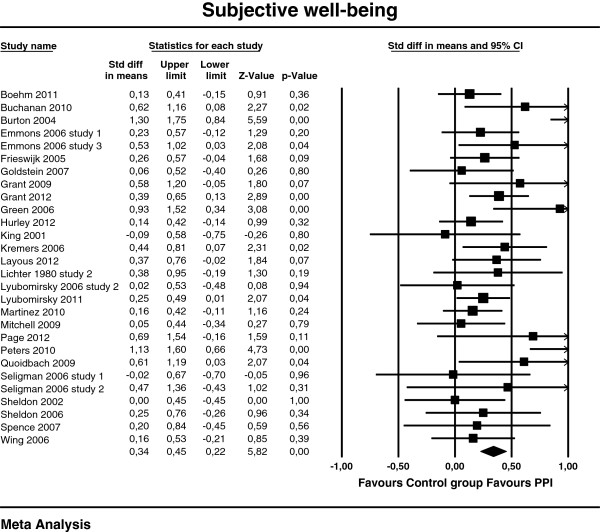
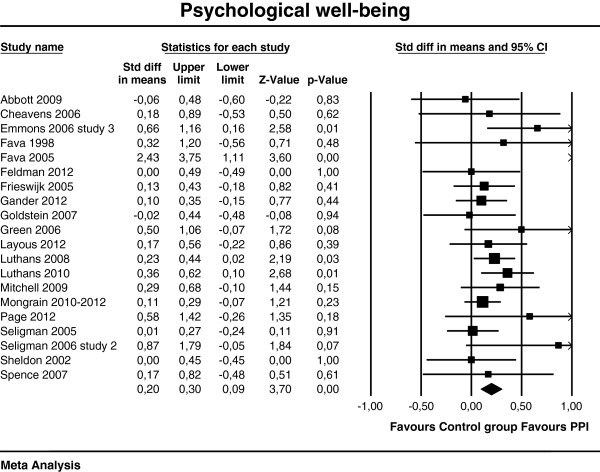
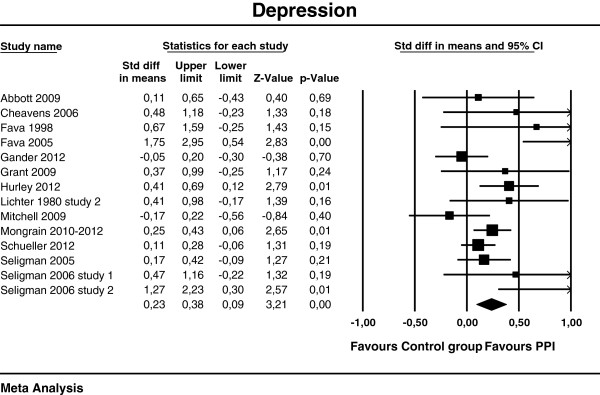
- Across all included studies, the pooled standardized mean differences were 0.34 for subjective well-being, 0.20 for psychological well-being, and 0.23 for depression, which the authors describe as small effects.
- At follow-up of 3–6 months (10 studies), effects remained significant for subjective well-being (d = 0.22, 95% CI [0.05, 0.38], p<.01) and psychological well-being (d = 0.16, 95% CI [0.02, 0.30], p=.03), but not for depression (d = 0.17, 95% CI [-0.06, 0.39], p=.15).
- Heterogeneity was moderate for subjective well-being (I² = 49.5%) and depression (I² = 47.0%), and low for psychological well-being (I² = 29.0%); effect sizes ranged from below 0 to as high as 2.4.
- For depression, larger effects were associated with longer duration, individual delivery, referral/hospital recruitment, inclusion of people with specific psychosocial problems, and lower study quality.
## Methods
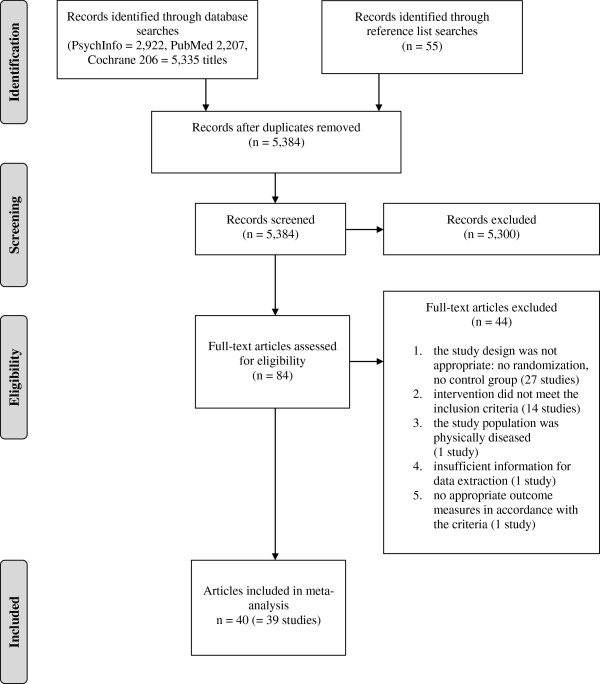
- Systematic review and meta-analysis of randomized controlled studies of positive psychology interventions, using PubMed, PsychInfo, the Cochrane Central Register of Controlled Trials, manual searches, and reference checking, covering 1998 to November 2012.
- Included 40 articles describing 39 studies with 6,139 participants; intervention formats included self-help, group training, and individual therapy.
- Main analysis used Cohen’s d under a random-effects model for three outcomes: subjective well-being, psychological well-being, and depression, with subgroup analyses and checks for heterogeneity and publication bias.
## Limitations
- The paper states that study quality was not high: no study met all quality criteria, randomization was often unclear, intention-to-treat analysis was rare (3/39 studies), and none reported an adequate power analysis.
- The authors note that heterogeneity was rather high because the included studies were diverse, and that the follow-up findings should be treated with caution because of the small number of studies and high attrition rates at follow-up.
- The text makes evident that publication bias is a limitation: funnel plots were asymmetric, fail-safe numbers were below the required thresholds, and Egger’s test suggested bias for psychological well-being and depression.
Model-written summary. Check it against the paper before relying on it.
Integrity signals
Registry
Cites
Statistics
Figures
Verification
Claims the paper makes
8 Valid · 2 Not valid · 9 Not checked · 90 Own results and interpretations
The cited sources that could be checked couldn’t confirm or dispute this claim.
In the paper
“First, the meta-analysis included both randomized studies and quasi-experimental studies.”
§ Positive psychology interventions: a meta-analysis of randomized controlled studies > Background
What the sources say
- Could not verifycites Sin and Lyubomirsky (2009) matched to “Enhancing well-being and alleviating depressive symptoms with positive psychology interventions: a practice-friendly meta-analysis” (2009) sourceExperimental — accuracy not yet measured
The Literature Search section requires included studies to have a comparison group, and Data Recorded distinguishes self-selected from non-self-selected participants. Neither passage establishes whether the meta-analysis included both randomized and quasi-experimental studies; searches for those design terms and for random assignment found no decisive passage. Page numbers were unavailable in our copy. (LLM, conf=0.72)
plain- Asserted: passes — The authors put it forward as true.
- Checkable: passes — It can be checked against evidence.
- Load-bearing: unclear — It is unclear whether the paper’s conclusions depend on it.
- Based: passes — The paper gives a reason why it holds.
- Could not verify
The cited sources support only part of this claim — read each source’s verdict below.
In the paper
“Their results show that PPIs can indeed be effective in enhancing well-being (r = 0.29, standardized mean difference Cohen’s d = 0.61) and help to reduce depressive symptom levels in clinical populations (r = 0.31, Cohen’s d = 0.65).”
§ Positive psychology interventions: a meta-analysis of randomized controlled studies > Background
What the sources say
- Partly supportedcites Sin and Lyubomirsky (2009) matched to “Enhancing well-being and alleviating depressive symptoms with positive psychology interventions: a practice-friendly meta-analysis” (2009) sourceExperimental — accuracy not yet measured
The Depression section reports that PPIs reduced depressive symptoms across 25 studies, with a mean effect of r = .31. The Participant Moderators section distinguishes depressed from nondepressed participants, so .31 is not an estimate specifically for clinical populations. The paper reports the effect as r, not as Cohen’s d = .65. (LLM, conf=0.87)
plainstates a cause- Asserted: passes — The authors put it forward as true.
- Checkable: passes — It can be checked against evidence.
- Load-bearing: unclear — It is unclear whether the paper’s conclusions depend on it.
- Based: passes — The paper gives a reason why it holds.
- Partly supported
Every source the paper cites for this claim was checked and supports it.
In the paper
“Their results show that PPIs can indeed be effective in enhancing well-being (r = 0.29, standardized mean difference Cohen’s d = 0.61) and help to reduce depressive symptom levels in clinical populations (r = 0.31, Cohen’s d = 0.65).”
§ Positive psychology interventions: a meta-analysis of randomized controlled studies > Background
What the sources say
- Supportedcites Sin and Lyubomirsky (2009) matched to “Enhancing well-being and alleviating depressive symptoms with positive psychology interventions: a practice-friendly meta-analysis” (2009) source
The Well-Being section reports that PPIs significantly improved well-being across 49 studies, with a mean r of .29. The paper reports r rather than Cohen’s d; converting .29 to d gives approximately .61, so the cited figures are consistent. (LLM, conf=0.90)
plainstates a cause- Asserted: passes — The authors put it forward as true.
- Checkable: passes — It can be checked against evidence.
- Load-bearing: passes — The paper’s conclusions depend on it.
- Based: passes — The paper gives a reason why it holds.
- Supported
Every source the paper cites for this claim was checked and supports it.
In the paper
“Second, study quality was not addressed as a potential effect moderator.”
§ Positive psychology interventions: a meta-analysis of randomized controlled studies > Background
What the sources say
- Supportedcites Sin and Lyubomirsky (2009) matched to “Enhancing well-being and alleviating depressive symptoms with positive psychology interventions: a practice-friendly meta-analysis” (2009) source
The Data Recorded section lists the variables coded for moderator analysis: participant characteristics, intervention format and duration, and comparison-group type. It does not include study quality, and the Methodological Moderators section discusses those methodological variables rather than study quality. Page numbers are unavailable in our copy. (LLM, conf=0.88)
plain- Asserted: passes — The authors put it forward as true.
- Checkable: passes — It can be checked against evidence.
- Load-bearing: unclear — It is unclear whether the paper’s conclusions depend on it.
- Based: passes — The paper gives a reason why it holds.
- Supported
Every source the paper cites for this claim was checked and supports it.
In the paper
“Remarkably, effect sizes in the current meta-analysis are around 0.3 points lower than the effect sizes in the meta-analysis by Sin and Lyubomirsky (2009) [37].”
§ Positive psychology interventions: a meta-analysis of randomized controlled studies > Discussion > Main findings
What the sources say
- Supportedcites Sin and Lyubomirsky (2009) [37] matched to “Enhancing well-being and alleviating depressive symptoms with positive psychology interventions: a practice-friendly meta-analysis” (2009) source
The Well-Being and Depression results report mean effect sizes of r = .29 and r = .31, respectively, establishing the values attributed to Sin and Lyubomirsky’s meta-analysis. The difference from the current meta-analysis is the citing authors’ comparison, not a finding this source could report. (LLM, conf=0.88)
plain- Asserted: passes — The authors put it forward as true.
- Checkable: passes — It can be checked against evidence.
- Load-bearing: passes — The paper’s conclusions depend on it.
- Based: passes — The paper gives a reason why it holds.
- Supported
70 more claims · 1 with their cited sources checked
Create a free account to see all 109 claims and to verify the 1 reference still open.
- Probably not a substantial claim. 14
- It may state two separate claims as one. 23
Claims other papers make about this one
Each is checked against this paper’s own text: does it say what the citing paper says it does?
The source backs part of the claim, not all of it — or backs it for a different population, condition or comparison.
In the citing paper
“In contrast to complex multicomponent health behavior or psychology interventions, PP exercises are simple, can be delivered remotely (e.g., by phone), and require minimal training of providers [34, 41, 42].”
From Positive Psychological Interventions for Patients with Type 2 Diabetes: Rationale, Theoretical Model, and Intervention Development (2015) · cites this paper as [41]
Experimental — accuracy not yet measuredThe source backs part of the claim, not all of it — or backs it for a different population, condition or comparison.
In the citing paper
“Studies supporting the efficacy of positive activity interventions (PAIs) have been primarily conducted in unselected (non-clinical) community samples and examined single positive activities in isolation (for a meta-analysis, see66, 67).”
From Upregulating the positive affect system in anxiety and depression: Outcomes of a positive activity intervention: Taylor et al. (2017) · cites this paper as [67]
Experimental — accuracy not yet measuredThe source backs part of the claim, not all of it — or backs it for a different population, condition or comparison.
In the citing paper
“Two meta-analyses of PPIs for depression and well-being found that these interventions have small to moderate effects in enhancing well-being and decreasing depressive symptoms and that effects are stronger for individual vs. group formats [30, 31].”
From Skills to Enhance Positivity in adolescents at risk for suicide: Protocol for a randomized controlled trial (2023) · cites this paper as [31]
Experimental — accuracy not yet measuredThe source backs part of the claim, not all of it — or backs it for a different population, condition or comparison.
In the citing paper
“Bolier and Abello (Bolier et al., 2013) reviewed digital PPIs and found that the majority of the included studies showed improvement in well-being or reduction of distress in the intervention group, compared to the control group.”
From Strength Back – A qualitative study on the co-creation of a positive psychology digital health intervention for spinal surgery patients (2023) · cites this paper as Bolier et al., 2013
Experimental — accuracy not yet measuredThe source backs part of the claim, not all of it — or backs it for a different population, condition or comparison.
In the citing paper
“PPIs may support patients to notice and savour positive experiences (Bolier et al., 2013). This may strengthen their commitment to value-based action.”
From Strength Back – A qualitative study on the co-creation of a positive psychology digital health intervention for spinal surgery patients (2023) · cites this paper as Bolier et al., 2013
Experimental — accuracy not yet measured
24 more claims about this paper
Create a free account to see every claim other papers make about this one.
Statistics recomputed
Every reported test result, recomputed from its test statistic and degrees of freedom. A result shows as not adding up only once an independent check has confirmed it.
- Consistentz = 6.43reported p < .01 · recomputed p < .001
“Z=6.43, p < .01”
- Consistentz = 4.18reported p < .01 · recomputed p < .001
“Z=4.18, p < .01”
- Consistentz = 3.33reported p < .01 · recomputed p < .001
“Z=3.33, p < .01”
Self-check
Percentages, sums and reported differences re-computed from the paper’s own numbers.
Self-check results appear here once an independent check has confirmed them.
Citations
Cites
Preferred Reporting Items for Systematic Reviews and Meta-Analyses: the PRISMA statement
Moher, D., Liberati, A., Tetzlaff, J., Altman, D. G., & for the PRISMA Group (2009) · BMJ · doi:10.1136/bmj.b2535 · Cited by 83,823
Preferred Reporting Items for Systematic Reviews and Meta-Analyses: The PRISMA Statement
Moher, D., Liberati, A., Tetzlaff, J., Altman, D. G., & The PRISMA Group (2009) · PLoS Medicine · doi:10.1371/journal.pmed.1000097 · Cited by 64,042 · cited 1×
“For the reporting of the results of this meta-analysis, we applied Preferred Reporting Items for Systematic Reviews and Meta-Analyses (PRISMA) guidelines [50].”
Measuring inconsistency in meta-analyses
Higgins, J. P. T., Thompson, S. G., Deeks, J. J., & Altman, D. G. (2003) · BMJ · doi:10.1136/bmj.327.7414.557 · Cited by 63,139 · cited 1×
“A value of 0% indicates an absence of dispersion, and larger values show increasing levels of heterogeneity where 25% can be considered as low, 50% as moderate and 75% as a high level of heterogeneity [46].”
Preferred reporting items for systematic reviews and meta-analyses: the PRISMA Statement.
(2009) · PubMed Central · Cited by 44,859
Cochrane Handbook for Systematic Reviews of Interventions: Cochrane Book Series
(2008) · doi:10.1002/9780470712184 · Cited by 25,048
Preferred Reporting Items for Systematic Reviews and Meta-Analyses: The PRISMA Statement
Moher, D., Liberati, A., Tetzlaff, J., & Altman, D. G. (2009) · Journal of Clinical Epidemiology · doi:10.1016/j.jclinepi.2009.06.005 · Cited by 19,575
Happiness is everything, or is it? Explorations on the meaning of psychological well-being.
Ryff, C. D. (1989) · Journal of Personality and Social Psychology · doi:10.1037/0022-3514.57.6.1069 · Cited by 14,847 · cited 1×
“Psychological well-being focuses on the optimal functioning of the individual and includes concepts such as mastery, hope and purpose in life [13,14].”
Borenstein, M., Hedges, L. V., Higgins, J. P. T., & Rothstein, H. R. (2009) · doi:10.1002/9780470743386 · Cited by 14,225
Duval, S., & Tweedie, R. (2000) · Biometrics · doi:10.1111/j.0006-341x.2000.00455.x · Cited by 14,099 · cited 1×
“If asymmetry is found in the funnel plot, the Trim and Fill method adjusts the pooled effect size for the outcomes of missing studies [49].”
Subjective well-being: Three decades of progress.
Diener, E., Suh, E. M., Lucas, R. E., & Smith, H. L. (1999) · Psychological Bulletin · doi:10.1037/0033-2909.125.2.276 · Cited by 12,910 · cited 2×
“Although the basic concepts of well-being, happiness and human flourishing have been studied for some decades [12,25-27], there was a lack of evidence-based interventions [24].”
Research works printed but not linked: 3
- Rupke SJ Blecke D Renfrow M Cognitive Therapy for Depression Am Fam Physician 2006 73 83 86 16417069
- Veenhoven R Gezond geluk: Effecten van geluk op gezondheid en wat dat kan betekenen voor de preventieve gezondheidszorg (Healthy happiness: effect of happiness on health and what this could mean for preventive public health) 2006 Rotterdam: Erasmus Universiteit
- Lamers S Bolier L Westerhof GJ Smit F Bohlmeijer E The impact of emotional well-being on long-term recovery and survival in physical illness: a meta-analysis J Behav Med 2012 5 538 547 21918889 PMC3439612 · DOI · Paper page
Cited by
Items 1,101–1,200 of 2,037
Successful Aging and Positive Psychology: Two Empirically Related Perspectives
Izal, M., Nuevo, R., & Montorio, I. (2019) · OBM Geriatrics · doi:10.21926/obm.geriatr.1904094 · Cited by 5
Chugani, C. D., Mazza, J. J., Fuhrman, B. J., Talis, J., Murphy, C., Miller, E., & Coulter, R. W. S. (2023) · Journal of Behavioral and Cognitive Therapy · doi:10.1016/j.jbct.2022.09.001 · Cited by 5
Yin, J., Yue, C., Chen, X., & Tang, L. (2022) · International Journal of Sport and Exercise Psychology · doi:10.1080/1612197x.2022.2098354 · Cited by 5
“Hence, only standard mean differences between Tai chi group versus comparison group yielding effect sizes greater or smaller than ±2.5 were considered to be outliers (Bolier et al., 2013; Carr et al., 2021).”
BackgroundInfluentialShrivastava, A., Azhar, H., & Hyland, L. (2022) · Teaching of Psychology · doi:10.1177/00986283221106689 · Cited by 10
Happiness and Health: An Intricate Relationship
Kar, N. (2023) · Springer eBooks · doi:10.1007/978-981-99-3493-5_9 · Cited by 9
Ginis, K. A. M., Sinden, A. R., Bonaccio, S., Labbé, D., Guertin, C., Gellatly, I. R., Koch, L. C., Mortenson, W. B., Routhier, F., Basham, C. A., et al. (2023) · Archives of Physical Medicine and Rehabilitation · doi:10.1016/j.apmr.2023.08.004 · Cited by 5
Bergmann, J. (2023) · Studien zur Migrations- und Integrationspolitik · doi:10.1007/978-3-658-42298-1 · Cited by 13
Letcher, P., Greenwood, C. J., McAnally, H. M., Belsky, J., Macdonald, J. A., Spry, E., Thomson, K., O’Connor, M., Sligo, J. L., Youssef, G. J., et al. (2022) · Child Development · doi:10.1111/cdev.13839 · Cited by 6
“…competencies showing benefits well into the 30s (Kosterman et al., 2019); and that programs run beyond education settings that seek to promote positive emotions and behaviors (Bolier et al., 2013) and those that target both mental distress and wellbeing are also efficacious (Gloster et al., 2020).”
BackgroundYen, S., Suazo, N., Doerr, J., Macrynikola, N., Villarreal, L. S., Sodano, S., O’Brien, K. H. M., Wolff, J. C., Breault, C., Gibb, B. E., et al. (2023) · PLoS ONE · doi:10.1371/journal.pone.0287285 · Cited by 5
ter Avest, M. J., Greven, C. U., Huijbers, M. J., Wilderjans, T. F., Speckens, A. E. M., & Spinhoven, P. (2020) · Mindfulness · doi:10.1007/s12671-020-01453-z · Cited by 6
“…Watson et al. 1988) and positive affect is suggested to improve well-being and reduce depressive symptoms and risk of relapse/recurrence depression (Bolier et al. 2013; Khazanov and Ruscio 2016; Sin and Lyubomirsky 2009), developing one’s level of mindfulness could lead to decreases in negative…”
BackgroundFeig, E. H., Healy, B. C., Celano, C. M., Nikrahan, G. R., Moskowitz, J. T., & Huffman, J. C. (2019) · International Journal of Wellbeing · doi:10.5502/ijw.v9i2.795 · Cited by 8
“In healthy individuals, these interventions have consistently improved psychological wellbeing and reduced symptoms of depression (Bolier et al., 2013).”
BackgroundWell-being and Cognitive Resilience to Dementia-related NeuropathologyPreprint
Willroth, E. C., James, B. D., Graham, E. K., Kapasi, A., Bennett, D. A., & Mroczek, D. K. (2022) · doi:10.31234/osf.io/sbh85 · Cited by 5
Engberg, E., Ray, C., Määttä, S., Figueiredo, R. A. D. O., Leppänen, M. H., Pajulahti, R., Koivusilta, L. K., Korkalo, L., Nissinen, K., Vepsäläinen, H., et al. (2021) · Journal of Happiness Studies · doi:10.1007/s10902-021-00459-1 · Cited by 8
(2023) · doi:10.2196/preprints.46603 · Cited by 5
van der Vaart, L., & den Broeck, A. V. (2019) · Springer eBooks · doi:10.1007/978-3-030-20583-6_3 · Cited by 6
Improving the Health Care Sector with a Happiness-Based Approach
Weiss, L., Kedzia, S., Francissen, A., & Westerhof, G. J. (2014) · Happiness studies book series · doi:10.1007/978-3-319-06459-8_4 · Cited by 5
Self-citationPerformance Habits: A Framework Proposal
Laborde, S., Kauschke, D., Hosang, T. J., Javelle, F., & Mosley, E. (2020) · Frontiers in Psychology · doi:10.3389/fpsyg.2020.01815 · Cited by 8
“Among the interventions that have been used to promote psychological well-being (Bolier et al., 2013; Ryff, 2014), several methods could be turned into habits to improve performance, such as meditation (Tang, 2014; Chan et al.”
MethodThe effectiveness of positive psychological coaching at work: a systematic review
Zuberbühler, J. P., Corbu, A., Christensen, M., & Salanova, M. (2024) · Coaching An International Journal of Theory Research and Practice · doi:10.1080/17521882.2023.2300822 · Cited by 10
“The identi fi cation, development, and use of personal strengths can be trained, for example, by participating in positive psychological interventions in which evidence-based activities are applied to boost well-being (Bolier et al., 2013; Carr et al., 2021; Lomas et al., 2014).”
Effects of Positive Psychotherapy for People with Psychosis: A Systematic Review and Meta-Analysis
Choi, H., Shin, S., & Lee, G. (2023) · Issues in Mental Health Nursing · doi:10.1080/01612840.2023.2174218 · Cited by 8
“Meta-analysis of the effects of positive psychotherapy has been conducted mainly on depressed people (Bolier et al., 2013; Pan et al., 2022).”
BackgroundAsghar, M., Minichiello, A., & Iqbal, A. (2024) · ASEE Annual Conference & Exposition · doi:10.18260/1-2--43963 · Cited by 5
Bamberg, E., & Vincent‐Höper, S. (2022) · Springer eBooks · doi:10.1007/978-3-030-81938-5_34 · Cited by 5
Écija, C., Catalá, P., Furlong, L. V., Pastor-Mira, M. D. L. Á., & Peñacoba, C. (2022) · Pain Management Nursing · doi:10.1016/j.pmn.2022.05.007 · Cited by 8
Passmore, H., Lumber, R., Niemiec, R. M., & Sofen, L. I. (2025) · Journal of Happiness Studies · doi:10.1007/s10902-025-00900-9 · Cited by 10
A New Lens on Improving Physical Health with Psychological Interventions: A Systematic Review
Paddon, L., & Kampman, H. (2023) · Journal of Happiness and Health · doi:10.47602/johah.v3i2.46 · Cited by 9
“…in the literature between terms positive psychology interventions and positive psychological interventions (e.g., see Sin & Lyubomirsky, 2009: Bolier et al., 2013; Schueller et al., 2014), and earlier meta-analyses that had some challenges around clear definitions and subsequently excluded…”
BackgroundInfluentialTurner, E. H., & Mueller, C. W. (2021) · Administration and Policy in Mental Health and Mental Health Services Research · doi:10.1007/s10488-021-01121-x · Cited by 9
Muller‐Dugic, J., Beckers, P., & Braakman, M. H. (2024) · International Journal of Migration Health and Social Care · doi:10.1108/ijmhsc-07-2022-0074 · Cited by 4
Le, C. M., Huynh, V.-S., Luu, K., Ho, Q. V., Nguyen, V. T. L., & Tran-Chi, V.-L. (2024) · International Journal of Mental Health Promotion · doi:10.32604/ijmhp.2024.050961 · Cited by 22
“Seeking help for emotional challenges has been seen as a pathway to restoring motivation, strengthening coping skills, boosting mental resilience, and promoting happiness [32].”
InfluentialTrinh, C. D., Girard, R., Schick, M. R., & Spillane, N. S. (2023) · Journal of Substance Use and Addiction Treatment · doi:10.1016/j.josat.2023.209241 · Cited by 7
Zhang, S., Zhang, H., Qiu, Z., & Tang, H. (2017) · Biomedical Research-tokyo · Cited by 12
Pozitif Psikolojiye Dayalı Kariyer Danışmanlığı Grup Uygulamasının Etkililiğinin İncelenmesi
Önal, A. A., & Yeşilyaprak, B. (2020) · Opus uluslararası toplum araştırmaları dergisi · doi:10.26466/opus.666871 · Cited by 5
Stevenson, J. (2024) · Child Protection and Practice · doi:10.1016/j.chipro.2024.100009 · Cited by 9
Longitudinal Multivariate Profiling of Well-Being Among Chinese Freshmen
Yu, S., He, Z. Z., & Zhang, F. (2023) · Applied Research in Quality of Life · doi:10.1007/s11482-023-10242-4 · Cited by 6
“Introducing activities or workshops based on positive psychology (e.g., Bolier et al., 2013; Sin & Lyubomirsky, 2009) may be helpful.”
A novel health behaviour intervention to promote adherence in kidney failure
Celano, C. M., Zambrano, J., Harnedy, L. E., Arroyo‐Ariza, D., Carrillo, A., Chung, W., Massey, C. N., Cohen‐Bucay, A., & Huffman, J. C. (2022) · Journal of Renal Care · doi:10.1111/jorc.12435 · Cited by 5
Positive psychotherapy for psychosis in Hong Kong: A randomized controlled trial
Chu, M. H.-W., Lau, B. S. Y., Leung, J. S. Y., Chan, S. C., Tang, B., Lau, C. K. S., Newby, C., Chiu, R. L. P., Lo, W. T.-L., Schrank, B., et al. (2022) · Schizophrenia Research · doi:10.1016/j.schres.2021.12.044 · Cited by 9
Health Coaching as an Intervention for Picky Eaters
Matthews, S. M. (2020) · American Journal of Lifestyle Medicine · doi:10.1177/1559827620943821 · Cited by 5
Servant Leadership in Sport: Theory and Practice
Sullivan, G. S. (2019) · Palgrave studies in workplace spirituality and fulfillment · doi:10.1007/978-3-030-11248-6_1 · Cited by 6
Güler, K. G., Keskin, S. G., & Terzi, M. (2024) · Public Health Nursing · doi:10.1111/phn.13389 · Cited by 8
Slade, M., Oades, L. G., & Jarden, A. (2017) · Cambridge University Press eBooks · doi:10.1017/9781316339275.002 · Cited by 9
Schotanus-Dijkstra, M., Drossaert, C. H. C., & Bohlmeijer, E. T. (2019) · International Journal of Applied Positive Psychology · doi:10.1007/s41042-018-00013-0 · Cited by 6
Self-citationDrugs and suicidal behavior: a call for positive, broad and preventive interventions
Roglio, V. S., & Kessler, F. H. P. (2019) · Brazilian Journal of Psychiatry · doi:10.1590/1516-4446-2019-0633 · Cited by 5
Khalili, D., Khalili, N., & Jafari, E. (2022) · Depression Research and Treatment · doi:10.1155/2022/8446611 · Cited by 12
Foo, J. J., Chew, K. H., Lim, P., Tay, J., & Ka, C. M. H. (2024) · Journal of Ageing and Longevity · doi:10.3390/jal4040027 · Cited by 9
“Furthermore, a closer look at past studies on psychological interventions found that a minimum frequency of four weeks is necessary for any intervention to be effective [35].”
van den Bogaard, D., Soenens, B., BRENNING, K. M., Hees, V. V., Vrijders, B., Bradt, L., Luyten, P., & Vansteenkiste, M. (2025) · Motivation and Emotion · doi:10.1007/s11031-025-10149-7 · Cited by 9
MindMax: Using videogames and sport to engage young men and improve wellbeing
Mitchell, J., Vella, K., Johnson, D. M., Peever, N., Cheng, V. W. S., Davenport, T. A., Burns, J. M., Hickie, I. B., Kyle, A., Hedley, B., et al. (2017) · QUT ePrints (Queensland University of Technology) · Cited by 5
Yap, A. U., Wee, K. K., Loh, J. Y., Marpaung, C. D., & Natu, V. P. (2024) · CRANIO® · doi:10.1080/08869634.2024.2322595 · Cited by 8
“Studies had shown their efficacy in improving mental well-being and quality of life, in addition to reducing mental distress and pain/somatic symptoms [59–62].”
Worker Well-Being: A Continuous Improvement Framework
Walsh, L. C., Montemayor-Dominguez, M., Horton, C. J., Boz, S. G., & Lyubomirsky, S. (2023) · Applied Research in Quality of Life · doi:10.1007/s11482-023-10217-5 · Cited by 10
“Although several meta-analyses suggest that these interventions improve individual well-being (e.g., Bolier et al., 2013; Carr et al., 2023; Sin and Lyubomirsky, 2009), a recent critique highlighted that most PAI studies are underpowered and lack pre-reg-istered hypotheses (Folk & Dunn, 2023).”
BackgroundAn integrated framework for academic staff well-being: Positive and relational lenses
Zwane, N. C. (2025) · SA Journal of Human Resource Management · doi:10.4102/sajhrm.v23i0.3032 · Cited by 9
Miklósi, M., Vajsz, K., Oláh, S., Nagy, V., & Szabó, B. (2024) · BMC Psychiatry · doi:10.1186/s12888-024-06156-6 · Cited by 6
“For improving personal strengths, many positive psychology interventions have been developed, and their effectiveness in increasing well-being and reducing stress, anxiety and depression has been supported by several meta-analyses [4–10].”
BackgroundMental health and meaning in life in Chinese military personnel: a cross-lagged analysis
Liu, B., Zou, M., Bao, H., Xu, X., Liu, X., Zhang, B., Yang, Q., & Li, F. (2024) · BMC Psychology · doi:10.1186/s40359-024-01932-1 · Cited by 6
“Numerous studies have demonstrated the importance of subjective well-being for several outcomes such as mental health [17], disease recovery [18], health behavior [19], vocational success [20], and survival [21].”
BackgroundGutiérrez, L., Catalá, P., Écija, C., Marín‐Morales, D., & Peñacoba, C. (2023) · International Journal of Environmental Research and Public Health · doi:10.3390/ijerph20032115 · Cited by 8
“, neuroticism), with the intention of exerting a positive effect on perceived well-being or quality of life [51].”
BackgroundHeilmayr, D., & Miller, T. J. (2020) · Ecopsychology · doi:10.1089/eco.2019.0074 · Cited by 9
“Given positive psychology’s strong experimental support for interventions (for meta-analysis see Bolier et al., 2013), this study shows that spending time in nature is just as good for healthand well-being aspreviouslyestablished interventions.”
López-Linares, S., León, A. G., & Sánchez‐Álvarez, N. (2023) · Terapia psicológica · doi:10.4067/s0718-48082023000100111 · Cited by 17
Stelter, R. L., Stump, K. N., Rhodes, J. E., & Kupersmidt, J. B. (2023) · Journal of Community Psychology · doi:10.1002/jcop.23017 · Cited by 8
“…at cognitions such as the positive future self, optimism, setting personal goals, and using personal strengths have shown that these cognitions are malleable and can, in turn, impact behavioral outcomes and psychological well ‐ being (e.g., Bolier et al., 2013; Oyserman et al., 2002, 2006).”
BackgroundEinerson, J., Lundstrom, L. K., Allen, B., Sefandonakis, A., & Terrill, A. L. (2022) · Disability and Rehabilitation · doi:10.1080/09638288.2022.2102256 · Cited by 10
Urbanowicz, A. M., Shankland, R., Rance, J. Y., Bennett, P. D., & Gauchet, A. (2024) · The Family Journal · doi:10.1177/10664807241286809 · Cited by 7
Litchfield, I. J., Greenfield, S., Harper, L., & the FAB(V) Trial team (2021) · Rheumatology Advances in Practice · doi:10.1093/rap/rkab075 · Cited by 5
Chen, S., Zhao, W.-W., Cheng, Y., Bian, C., Yan, S.-R., & Zhang, Y. (2024) · Journal of Mental Health · doi:10.1080/09638237.2024.2332810 · Cited by 6
Positive Psychology Model of Mental Function and Behavior
Rashid, T., Summers, R. F., & Seligman, M. E. P. (2023) · Springer eBooks · doi:10.1007/978-3-030-42825-9_28-1 · Cited by 5
Lucciarini, E., Carr, A., Bressoud, N., Boniwell, I., Audrin, C., Gay, P., & Burel, N. (2025) · Educational Psychology Review · doi:10.1007/s10648-025-10033-3 · Cited by 15
Burzynska-Tatjewska, B., & Stolarski, M. (2022) · International Journal of Environmental Research and Public Health · doi:10.3390/ijerph191912964 · Cited by 8
“Online studies carried out on adult populations provided evidence that online positive interventions remain effective [32,33].”
BackgroundApplying Emotional Regulation Strategies to Manage Climate Distress
Ibrahim, M. (2024) · IntechOpen eBooks · doi:10.5772/intechopen.1007813 · Cited by 10
Abdulla, A. (2023) · International Journal of Wellbeing · doi:10.5502/ijw.v13i3.2799 · Cited by 5
“2 Brief Positive Psychology Interventions and the Moderating Effects of Personality Meta-analytic research suggests that positive psychology interventions (PPIs) have small-tomoderate positive effects on various aspects of wellbeing (Bolier et al., 2013; van Agteren et al., 2021).”
BackgroundLee, A., Fung, W. K., Chung, K. K. H., Datu, J. A. D., & Cheung, R. Y. M. (2024) · Psychology in the Schools · doi:10.1002/pits.23346 · Cited by 5
L’efficacité des interventions favorisant le bonheur : une synthèse
Cobb, A. M., Stone, B. M., Parks, A. C., & Julió, L. (2017) · Revue québécoise de psychologie · doi:10.7202/1040074ar · Cited by 4
Basurrah, A. A., O’Sullivan, D., & Chan, J. (2020) · Middle East Journal of Positive Psychology · Cited by 6
Jiang, M., Yin, Z., Li, S., Chen, X., & Gu, J. (2017) · Western Journal of Nursing Research · doi:10.1177/0193945917690733 · Cited by 5
“This result is consistent with that of the study conducted by Lei, Jiang, Yin, Ding, and Pan (2014) and Bolier et al. (2013).”
ResultSekizawa, Y., & Yoshitake, N. (2015) · RePEc: Research Papers in Economics · Cited by 8
Clinical Applications of Well‐Being Therapy
Ruini, C., & Fava, G. A. (2015) · Wiley eBooks · doi:10.1002/9781118996874.ch28 · Cited by 8
Muro, A., Tejada‐Gallardo, C., Illa, J., Gomà‐i‐Freixanet, M., Méndez-Ulrich, J. L., Chellew, K., Sanz, A., & Cladellas, R. (2023) · School Mental Health · doi:10.1007/s12310-023-09613-x · Cited by 4
“…positive feelings, cognitions, and behaviors, while promoting positive human functioning and well-being on multiple levels including the personal, social, cultural, and global aspects of life (Bolier et al., 2013; Seligman & Csikszentmihalyi, 2000; Sin & Lyubomirsky, 2009; Vázquez & Hervás, 2008).”
BackgroundResultZeykani, M., & Nikmanesh, Z. (2018) · Jundishapur Journal of Chronic Disease Care · doi:10.5812/jjcdc.60809 · Cited by 4
“Results of a study conducted by Bolier, Haverman, Westerhof, Riper, Smit, and Bohlmeijer revealed that positive psychotherapy interventions enhanced mental and psychological well-being and reduced symptoms of depression (18).”
ResultEditorial: Positive Psychology in Everyday Life
Pocinho, M. M. F. D. D., Garcês, S. F., & Popa, D. (2022) · Frontiers in Psychology · doi:10.3389/fpsyg.2022.913569 · Cited by 4
“From the benefits of positive psychology interventions in improving wellbeing and diminishing depression, anxiety or stress (Boiler et al., 2013; Carr et al., 2020), to contributing to employees’ performance and productivity (Kour et al.”
BackgroundFrom theory to practice: a participatory HR-led training programme for employee wellbeing
Shekhar, A., Saurombe, M. D., & Joseph, R. M. (2025) · Frontiers in Organizational Psychology · doi:10.3389/forgp.2025.1624518 · Cited by 9
Interest consistency can buffer the effect of COVID-19 fear on psychological distressPreprint
Masuyama, A., Kubo, T., Sugawara, D., et al. (2020) · doi:10.31234/osf.io/ygz37 · Cited by 4
Wu, F., Shi, K., He, Z., & Liu, J. (2025) · BMC Psychology · doi:10.1186/s40359-025-03290-y · Cited by 10
“Meanwhile, a meta-analysis conducted by further confirmed that positive psychology interventions can reduce psychological stress, diminish symptoms of depression, and significantly improve subjective well-being [38].”
The effect of positive psychotherapy in test anxiety among Zahedan students with hemophilia
Heydari, M. G., Shirazi, M., & Sanagouyemoharer, G. R. (2018) · Research in Psychotherapy Psychopathology Process and Outcome · doi:10.4081/ripppo.2018.307 · Cited by 8
“Although several studies investigated the effectiveness of positive psychotherapy in reducing test anxiety (Bagana, Raciu, & Lupu, 2011; Bolier et al., 2013) there are few attempts to manage psychological complications and psychological treatment even in hemophiliac adolescents (Caldwell, Leveque,…”
BackgroundSarı, T., Demirbağ, T., & Çalışkan, S. (2025) · Adversity and Resilience Science · doi:10.1007/s42844-025-00164-5 · Cited by 8
“Second is the acquisition of positive psychology skills such as gratitude, mindfulness, self-compassion, which have proven to be effective on well-being domains (Bolier et al., 2013).”
Bendig, E., SCHMITT, A. J., Wittenberg, A., Kulzer, B., Hermanns, N., Moshagen, M., & Baumeister, H. (2022) · BMJ Open · doi:10.1136/bmjopen-2021-059336 · Cited by 5
Lin, C. Y., Lee, M.-Y., Kao, S., Lu, L., & Chung, A. (2023) · Educational Gerontology · doi:10.1080/03601277.2022.2163356 · Cited by 9
“Previous studies have indicated that positive activities produce positive affective experiences that can enhance older adults’ SWB (Bolier et al., 2013; Lyubomirsky et al., 2005; SalcesCubero et al., 2019; Sheldon & Lyubomirsky, 2006; Walsh, 2011).”
BackgroundWhy does happiness matter? Understanding the relation between positive emotion and health outcomes
Barreto, S. M. (2017) · Social Science & Medicine · doi:10.1016/j.socscimed.2017.08.029 · Cited by 5
Editorial: Positive Organizational Interventions: Contemporary Theories, Approaches and Applications
van Zyl, L. E., & Rothmann, S. (2020) · Frontiers in Psychology · doi:10.3389/fpsyg.2020.607053 · Cited by 8
“, 2020), that reported effect sizes are usually small (Bolier et al., 2013) and that the effectiveness of POIs are highly dependent upon contextual factors (Parks and Schueller, 2014; Wong and Roy, 2018).”
BackgroundScarcity and Mental Health—Multiple Mediators of Sleep Quality and Life Satisfaction
Liu, N., Zhang, Y., & Wang, J. (2024) · International Journal of Mental Health Promotion · doi:10.32604/ijmhp.2024.049334 · Cited by 4
“Implementing effective interventions at the individual level [87], the group level and the societal level is and is necessary [88,89].”
BackgroundYotsidi, V. (2020) · Psychology the Journal of the Hellenic Psychological Society · doi:10.12681/psy_hps.25363 · Cited by 5
“First of all, the evidence with regard to the effectiveness of PPIs on mental health stemmed mainly from intervention studies with non-clinical samples, though overall findings show beneficial effects on increasing happiness as well as relieving depressive symptoms (Bolier et al., 2013).”
BackgroundMethodResultInfluentialMeaning-Centered Men’s Groups (MCMG) for the Transition to Retirement
Heisel, M. J., & The Meaning-Centered Men’s Group Project Team (2018) · Advances in mental health and addiction · doi:10.1007/978-3-030-03225-8_10 · Cited by 7
Misuraca, G. O., Francis, L. M., Mansour, K. A., Greenwood, C. J., Olsson, C. A., & Macdonald, J. A. (2024) · International Journal of Social Psychiatry · doi:10.1177/00207640241263245 · Cited by 7
“Such approaches have had success in reduction of depressive symptoms and may be particularly effective when they focus on existentially-oriented strengths such as psychological wellbeing (Bolier et al., 2013).”
BackgroundMarks, R. (2021) · Journal Of Aging Research And Healthcare · doi:10.14302/issn.2474-7785.jarh-21-3979 · Cited by 7
Manchaiah, V. K. C., Beukes, E. W., Andersson, G., Bateman, E. M., Swanepoel, D. W., Uhler, K. M., & Vinay (2024) · Clinics and Practice · doi:10.3390/clinpract14040130 · Cited by 5
Positive Narrative Therapy for an Unspecified Eating Disorder: A Child Case Report
Vescovelli, F., Albieri, E., & Ruini, C. (2017) · Clinical Case Studies · doi:10.1177/1534650117698799 · Cited by 8
“In fact, despite the growth of positive psychology and the availability of positive interventions, only a few of them are targeted at clinical populations (Bolier et al., 2013).”
BackgroundEcheverría, G., Samith, B., von Schultzendorff, A., Pinto, V., Martínez, X., Sara, D., Calzada, M., Pacheco, J., Plaza, G., Scott, F., et al. (2023) · Contemporary Clinical Trials Communications · doi:10.1016/j.conctc.2023.101167 · Cited by 4
Bolzoni, M. B., González‐Carrasco, M., Canal, D. J., & Lluch-Canut, M. (2022) · Frontiers in Psychology · doi:10.3389/fpsyg.2022.857598 · Cited by 6
“Various interventions to improve PMH exist in a variety of modalities, including individual, group and online formats, but targeting the general population (Bolier et al., 2013; Teixeira et al., 2019; Eisenstadt et al., 2021).”
BackgroundEspinosa, R., Valiente, C., Contreras, A., Trucharte, A., Paredes, B., & Peinado, V. (2022) · Current Psychology · doi:10.1007/s12144-021-02625-3 · Cited by 5
“Positive Psychological Interventions (PPIs) offer one of the most promising ways to meet this objective and are effective in enhancing well-being and reducing distress in the general population (Bolier et al., 2013; Sin & Lyubomirsky, 2009) as well as in clinical samples (Chakhssi et al.”
BackgroundNombela, E., Marchena, C., Duque, A., & Chaves, C. (2025) · General Hospital Psychiatry · doi:10.1016/j.genhosppsych.2025.01.006 · Cited by 6
Porter, E. F., Jessen, M., Coleman, J. J., Sinha, S., Devor, N. G., Sauer-Zavala, S. E., Levitt, H. M., Tao, K. W., Zanarini, M. C., Farchione, T. J., et al. (2023) · Counselling Psychology Quarterly · doi:10.1080/09515070.2023.2225033 · Cited by 7
“Indeed, empirical support for the use of targeted interventions, like PPIs and virtue-based therapies, provide evidence that further inquiry regarding how to integrate flourishing into psychotherapy is warranted.”
InfluentialThe Power and Pitfalls of Positive Psychology: Navigating Critiques and Criticisms
Alexander, K. D., Harris, T. P., & Rottinghaus, P. J. (2024) · International Journal of Applied Positive Psychology · doi:10.1007/s41042-024-00168-z · Cited by 9
“Since positive psychology’s introduction, there have been consistent findings demonstrating that well-being can be increased as a result of positive psychology interventions (see Bolier et al., 2013; Sin & Lyubomksky, 2009 for meta-analyses).”
Sepahvand, F., Rezaei, F., Sahraei, Q., & Beiranvand, M. (2023) · Journal of Research and Health · doi:10.32598/jrh.13.2.2043.1 · Cited by 4
Laure, T., Engels, R. C. M. E., Remmerswaal, D., Spruijt-Metz, D., Konigorski, S., & Boffo, M. (2023) · JMIR Research Protocols · doi:10.2196/46603 · Cited by 4
“…meta-analyses have shown that positive psychology interventions targeting feelings of gratitude, savoring of experiences and sensations, and hope and meaning lead to improved well-being and reduced depressive and anxiety symptoms in both general populations and those considered vulnerable [73-75].”
BackgroundVan Der Horst, A. Y., Bohlmeijer, E. T., Schreurs, K. M. G., & Kelders, S. M. (2023) · Frontiers in Psychology · doi:10.3389/fpsyg.2023.1117357 · Cited by 4
“Moreover, they can be effective: Bolier and Abello (Bolier et al., 2013) reviewed digital PPIs and found that the majority of the included studies showed improvement in well-being or reduction of distress in the intervention group, compared to the control group.”
BackgroundInfluentialSelf-citationMorgan, W. J. (2019) · ProQuest LLC eBooks · Cited by 11
Łaguna, M., Kędra, M., & Mazur‐Socha, Z. (2021) · Frontiers in Psychology · doi:10.3389/fpsyg.2021.661336 · Cited by 4
“, 2018), and they have significant and sustainable effects on subjective well-being (Sin and Lyubomirsky, 2009; Bolier et al., 2013; Hendriks et al., 2020).”
BackgroundResultKaczmarek, L. D. (2020) · Springer eBooks · doi:10.1007/978-3-319-24612-3_522 · Cited by 5
Metadata
- Authors
- Bolier, L., Haverman, M., Westerhof, G. J., Riper, H., Smit, F., & Bohlmeijer, E.
- Affiliations
- Trimbos Institute (NL)
- University of Twente (NL)
- Leuphana University of Lüneburg (DE)
- Corresponding author
- Bolier, Linda
- Venue
- BMC Public Health
- Published
- 2013-02-08
- Volume
- 13
- Issue
- 1
- Pages
- 119-119
- ISSN
- 1471-2458 (ISSN-L)
- PMC
- PMC3599475
- OpenAlex
- W2120582212
- Semantic Scholar
- 45fd44e9cff6334f80a54b3d327ced46d9b2d444
- Cited by
- 1,996
- References
- 115
- Citations by year
- 2026: 97 · 2025: 134 · 2024: 155 · 2023: 197 · 2022: 190 · 2021: 208 · 2020: 231 · 2019: 201 · 2018: 182 · 2017: 153 · 2016: 117 · 2015: 76 · 2014: 40 · 2013: 12
- FWCI
- 10.79
- Type
- journal article
- Language
- en
- Open access
- gold
- doi.org
- Licence
- Locations
- BMC Public Health (publishedVersion, cc-by)
- Europe PMC (PubMed Central) (publishedVersion, cc-by)
- PubMed Central (publishedVersion, cc-by)
- PubMed (publishedVersion)
- Pure Amsterdam UMC (publishedVersion, other-oa)
- Amsterdam UMC (VU Amsterdam) - Institutional Repository (publishedVersion, other-oa)
- Multilingual Matters (Channel View Publications) (acceptedVersion, cc-by)
- University of Twente Research Information (acceptedVersion, cc-by)
- Data Archiving and Networked Services (DANS) (submittedVersion, other-oa)
- Digital Academic REpository of VU University Amsterdam (Vrije Universiteit Amsterdam) (submittedVersion)
- VU Research Portal (submittedVersion, other-oa)
- University of Twente Research Information (submittedVersion, cc-by)
- Topics
- Social Sciences › Psychology › Social Psychology › Psychological Well-being and Life Satisfaction
- Social Sciences › Psychology › Clinical Psychology › Mindfulness and Compassion Interventions
- Social Sciences › Psychology › Applied Psychology › Optimism, Hope, and Well-being
- Keywords
- positive psychology interventions, subjective well-being, psychological well-being, depression, self-help intervention, group training, individual psychotherapy, mental health promotion, intervention effectiveness, publication bias, study quality
- MeSH terms
- Depression, Health Promotion, Humans, Psychotherapy, Randomized Controlled Trials as Topic, Treatment Outcome
About these checks
Registry, retraction, Cites and statistics results are computed, not judged, with one exception: a printed reference that no index lists is read once by a model before it counts as a citation error. Claims are extracted by a model and kept only when their quote appears verbatim in the text; each cited source is then checked, with a model’s help, for whether it says what the claim relies on. Those verdicts can be wrong — read the claim’s quote and the cited source before relying on one.
The claim verdicts this report counts are experimental: their accuracy is not yet measured.
A language model drew the claims from the paper on 2026-10-10, under version 3 of the claim definition (model deepseek-v4.1-flash, prompt extract-v3).
A second model labelled each claim on 2026-10-10 (model jev-1.13-20260917, definition revision gold-guideline-v0.2).
Cited sources are checked with a language model’s help (gpt-6-sol).
Statistics and arithmetic are recomputed, not judged.
Confidence bands are shown only for fields calibrated on our annotated test set. None is calibrated yet, so no band is shown.
What counts as a claim ›How we measure confidence ›How we check this ›
Are you an author, or do you see a problem with this page? Request a review
Data sources
Bibliographic data: Semantic Scholar, OpenAlex, Crossref.
Contains information from the Semantic Scholar Academic Graph Datasets, made available under the ODC Attribution License (ODC-BY 1.0).
Semantic Scholar’s data is described in: Kinney, R., et al. (2023). The Semantic Scholar Open Data Platform. arXiv:2301.10140.
