

Positive psychology interventions: a meta-analysis of randomized controlled studies
Open accessThe DOI matches its Crossref record; 109 of the 115 references it cites were found in a registry or an index; 10 of the 22 sources its claims cite were checked for support.
Abstract
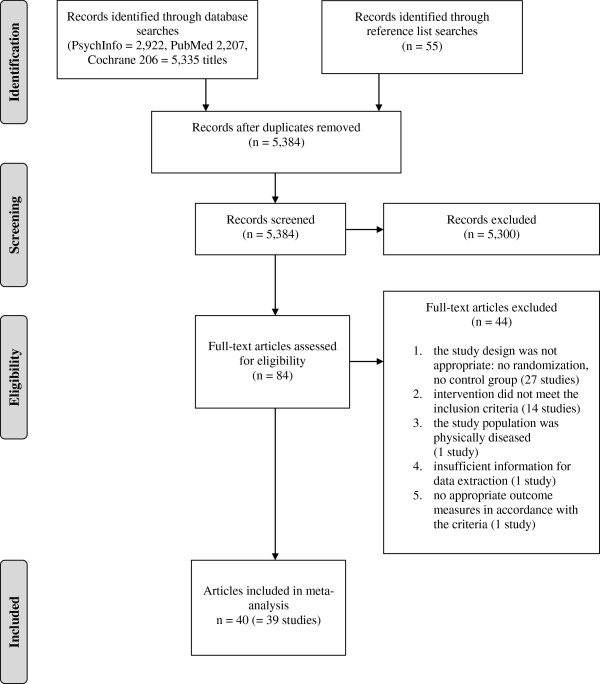
BACKGROUND: The use of positive psychological interventions may be considered as a complementary strategy in mental health promotion and treatment. The present article constitutes a meta-analytical study of the effectiveness of positive psychology interventions for the general public and for individuals with specific psychosocial problems. METHODS: We conducted a systematic literature search using PubMed, PsychInfo, the Cochrane register, and manual searches. Forty articles, describing 39 studies, totaling 6,139 participants, met the criteria for inclusion. The outcome measures used were subjective well-being, psychological well-being and depression. Positive psychology interventions included self-help interventions, group training and individual therapy. RESULTS: The standardized mean difference was 0.34 for subjective well-being, 0.20 for psychological well-being and 0.23 for depression indicating small effects for positive psychology interventions. At follow-up from three to six months, effect sizes are small, but still significant for subjective well-being and psychological well-being, indicating that effects are fairly sustainable. Heterogeneity was rather high, due to the wide diversity of the studies included. Several variables moderated the impact on depression: Interventions were more effective if they were of longer duration, if recruitment was conducted via referral or hospital, if interventions were delivered to people with certain psychosocial problems and on an individual basis, and if the study design was of low quality. Moreover, indications for publication bias were found, and the quality of the studies varied considerably. CONCLUSIONS: The results of this meta-analysis show that positive psychology interventions can be effective in the enhancement of subjective well-being and psychological well-being, as well as in helping to reduce depressive symptoms. Additional high-quality peer-reviewed studies in diverse (clinical) populations are needed to strengthen the evidence-base for positive psychology interventions.
Overview
CoChat Summary
## TL;DR
This meta-analysis of 39 randomized studies (40 articles; 6,139 participants) found that positive psychology interventions had small but significant benefits for subjective well-being, psychological well-being, and depressive symptoms. Effects were somewhat sustained at 3–6 months for well-being outcomes, but study heterogeneity and publication bias were notable.
## Key findings
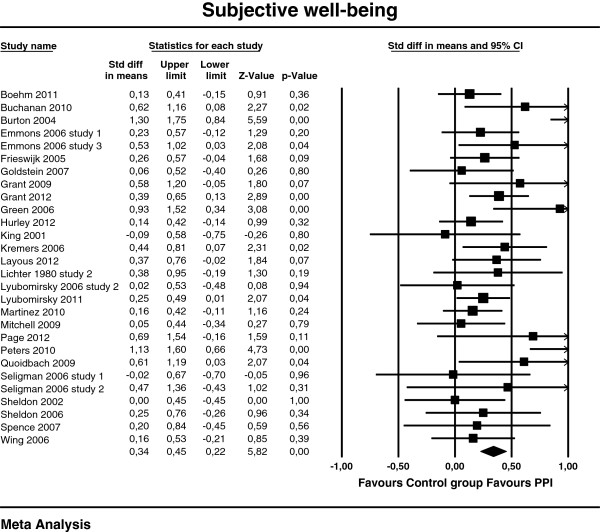
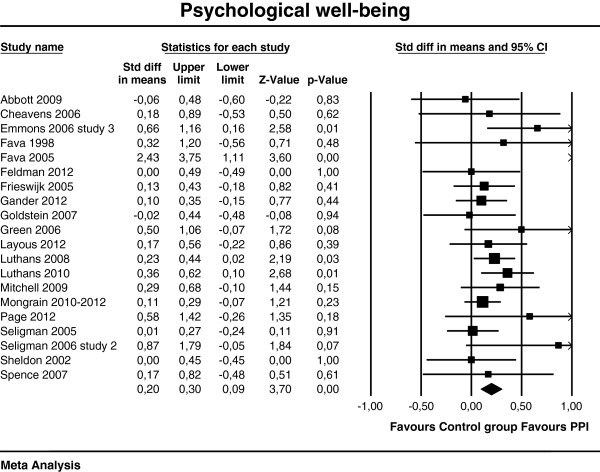
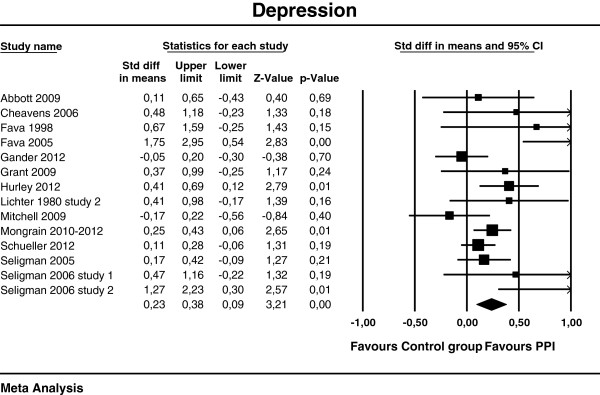
- Across all included studies, the pooled standardized mean differences were 0.34 for subjective well-being, 0.20 for psychological well-being, and 0.23 for depression, which the authors describe as small effects.
- At follow-up of 3–6 months (10 studies), effects remained significant for subjective well-being (d = 0.22, 95% CI [0.05, 0.38], p<.01) and psychological well-being (d = 0.16, 95% CI [0.02, 0.30], p=.03), but not for depression (d = 0.17, 95% CI [-0.06, 0.39], p=.15).
- Heterogeneity was moderate for subjective well-being (I² = 49.5%) and depression (I² = 47.0%), and low for psychological well-being (I² = 29.0%); effect sizes ranged from below 0 to as high as 2.4.
- For depression, larger effects were associated with longer duration, individual delivery, referral/hospital recruitment, inclusion of people with specific psychosocial problems, and lower study quality.
## Methods
- Systematic review and meta-analysis of randomized controlled studies of positive psychology interventions, using PubMed, PsychInfo, the Cochrane Central Register of Controlled Trials, manual searches, and reference checking, covering 1998 to November 2012.
- Included 40 articles describing 39 studies with 6,139 participants; intervention formats included self-help, group training, and individual therapy.
- Main analysis used Cohen’s d under a random-effects model for three outcomes: subjective well-being, psychological well-being, and depression, with subgroup analyses and checks for heterogeneity and publication bias.
## Limitations
- The paper states that study quality was not high: no study met all quality criteria, randomization was often unclear, intention-to-treat analysis was rare (3/39 studies), and none reported an adequate power analysis.
- The authors note that heterogeneity was rather high because the included studies were diverse, and that the follow-up findings should be treated with caution because of the small number of studies and high attrition rates at follow-up.
- The text makes evident that publication bias is a limitation: funnel plots were asymmetric, fail-safe numbers were below the required thresholds, and Egger’s test suggested bias for psychological well-being and depression.
Model-written summary. Check it against the paper before relying on it.
Integrity signals
Registry
Cites
Statistics
Figures
Verification
Claims the paper makes
8 Valid · 2 Not valid · 9 Not checked · 90 Own results and interpretations
The cited sources that could be checked couldn’t confirm or dispute this claim.
In the paper
“First, the meta-analysis included both randomized studies and quasi-experimental studies.”
§ Positive psychology interventions: a meta-analysis of randomized controlled studies > Background
What the sources say
- Could not verifycites Sin and Lyubomirsky (2009) matched to “Enhancing well-being and alleviating depressive symptoms with positive psychology interventions: a practice-friendly meta-analysis” (2009) sourceExperimental — accuracy not yet measured
The Literature Search section requires included studies to have a comparison group, and Data Recorded distinguishes self-selected from non-self-selected participants. Neither passage establishes whether the meta-analysis included both randomized and quasi-experimental studies; searches for those design terms and for random assignment found no decisive passage. Page numbers were unavailable in our copy. (LLM, conf=0.72)
plain- Asserted: passes — The authors put it forward as true.
- Checkable: passes — It can be checked against evidence.
- Load-bearing: unclear — It is unclear whether the paper’s conclusions depend on it.
- Based: passes — The paper gives a reason why it holds.
- Could not verify
The cited sources support only part of this claim — read each source’s verdict below.
In the paper
“Their results show that PPIs can indeed be effective in enhancing well-being (r = 0.29, standardized mean difference Cohen’s d = 0.61) and help to reduce depressive symptom levels in clinical populations (r = 0.31, Cohen’s d = 0.65).”
§ Positive psychology interventions: a meta-analysis of randomized controlled studies > Background
What the sources say
- Partly supportedcites Sin and Lyubomirsky (2009) matched to “Enhancing well-being and alleviating depressive symptoms with positive psychology interventions: a practice-friendly meta-analysis” (2009) sourceExperimental — accuracy not yet measured
The Depression section reports that PPIs reduced depressive symptoms across 25 studies, with a mean effect of r = .31. The Participant Moderators section distinguishes depressed from nondepressed participants, so .31 is not an estimate specifically for clinical populations. The paper reports the effect as r, not as Cohen’s d = .65. (LLM, conf=0.87)
plainstates a cause- Asserted: passes — The authors put it forward as true.
- Checkable: passes — It can be checked against evidence.
- Load-bearing: unclear — It is unclear whether the paper’s conclusions depend on it.
- Based: passes — The paper gives a reason why it holds.
- Partly supported
Every source the paper cites for this claim was checked and supports it.
In the paper
“Their results show that PPIs can indeed be effective in enhancing well-being (r = 0.29, standardized mean difference Cohen’s d = 0.61) and help to reduce depressive symptom levels in clinical populations (r = 0.31, Cohen’s d = 0.65).”
§ Positive psychology interventions: a meta-analysis of randomized controlled studies > Background
What the sources say
- Supportedcites Sin and Lyubomirsky (2009) matched to “Enhancing well-being and alleviating depressive symptoms with positive psychology interventions: a practice-friendly meta-analysis” (2009) source
The Well-Being section reports that PPIs significantly improved well-being across 49 studies, with a mean r of .29. The paper reports r rather than Cohen’s d; converting .29 to d gives approximately .61, so the cited figures are consistent. (LLM, conf=0.90)
plainstates a cause- Asserted: passes — The authors put it forward as true.
- Checkable: passes — It can be checked against evidence.
- Load-bearing: passes — The paper’s conclusions depend on it.
- Based: passes — The paper gives a reason why it holds.
- Supported
Every source the paper cites for this claim was checked and supports it.
In the paper
“Second, study quality was not addressed as a potential effect moderator.”
§ Positive psychology interventions: a meta-analysis of randomized controlled studies > Background
What the sources say
- Supportedcites Sin and Lyubomirsky (2009) matched to “Enhancing well-being and alleviating depressive symptoms with positive psychology interventions: a practice-friendly meta-analysis” (2009) source
The Data Recorded section lists the variables coded for moderator analysis: participant characteristics, intervention format and duration, and comparison-group type. It does not include study quality, and the Methodological Moderators section discusses those methodological variables rather than study quality. Page numbers are unavailable in our copy. (LLM, conf=0.88)
plain- Asserted: passes — The authors put it forward as true.
- Checkable: passes — It can be checked against evidence.
- Load-bearing: unclear — It is unclear whether the paper’s conclusions depend on it.
- Based: passes — The paper gives a reason why it holds.
- Supported
Every source the paper cites for this claim was checked and supports it.
In the paper
“Remarkably, effect sizes in the current meta-analysis are around 0.3 points lower than the effect sizes in the meta-analysis by Sin and Lyubomirsky (2009) [37].”
§ Positive psychology interventions: a meta-analysis of randomized controlled studies > Discussion > Main findings
What the sources say
- Supportedcites Sin and Lyubomirsky (2009) [37] matched to “Enhancing well-being and alleviating depressive symptoms with positive psychology interventions: a practice-friendly meta-analysis” (2009) source
The Well-Being and Depression results report mean effect sizes of r = .29 and r = .31, respectively, establishing the values attributed to Sin and Lyubomirsky’s meta-analysis. The difference from the current meta-analysis is the citing authors’ comparison, not a finding this source could report. (LLM, conf=0.88)
plain- Asserted: passes — The authors put it forward as true.
- Checkable: passes — It can be checked against evidence.
- Load-bearing: passes — The paper’s conclusions depend on it.
- Based: passes — The paper gives a reason why it holds.
- Supported
70 more claims · 1 with their cited sources checked
Create a free account to see all 109 claims and to verify the 1 reference still open.
- Probably not a substantial claim. 14
- It may state two separate claims as one. 23
Claims other papers make about this one
Each is checked against this paper’s own text: does it say what the citing paper says it does?
The source backs part of the claim, not all of it — or backs it for a different population, condition or comparison.
In the citing paper
“In contrast to complex multicomponent health behavior or psychology interventions, PP exercises are simple, can be delivered remotely (e.g., by phone), and require minimal training of providers [34, 41, 42].”
From Positive Psychological Interventions for Patients with Type 2 Diabetes: Rationale, Theoretical Model, and Intervention Development (2015) · cites this paper as [41]
Experimental — accuracy not yet measuredThe source backs part of the claim, not all of it — or backs it for a different population, condition or comparison.
In the citing paper
“Studies supporting the efficacy of positive activity interventions (PAIs) have been primarily conducted in unselected (non-clinical) community samples and examined single positive activities in isolation (for a meta-analysis, see66, 67).”
From Upregulating the positive affect system in anxiety and depression: Outcomes of a positive activity intervention: Taylor et al. (2017) · cites this paper as [67]
Experimental — accuracy not yet measuredThe source backs part of the claim, not all of it — or backs it for a different population, condition or comparison.
In the citing paper
“Two meta-analyses of PPIs for depression and well-being found that these interventions have small to moderate effects in enhancing well-being and decreasing depressive symptoms and that effects are stronger for individual vs. group formats [30, 31].”
From Skills to Enhance Positivity in adolescents at risk for suicide: Protocol for a randomized controlled trial (2023) · cites this paper as [31]
Experimental — accuracy not yet measuredThe source backs part of the claim, not all of it — or backs it for a different population, condition or comparison.
In the citing paper
“Bolier and Abello (Bolier et al., 2013) reviewed digital PPIs and found that the majority of the included studies showed improvement in well-being or reduction of distress in the intervention group, compared to the control group.”
From Strength Back – A qualitative study on the co-creation of a positive psychology digital health intervention for spinal surgery patients (2023) · cites this paper as Bolier et al., 2013
Experimental — accuracy not yet measuredThe source backs part of the claim, not all of it — or backs it for a different population, condition or comparison.
In the citing paper
“PPIs may support patients to notice and savour positive experiences (Bolier et al., 2013). This may strengthen their commitment to value-based action.”
From Strength Back – A qualitative study on the co-creation of a positive psychology digital health intervention for spinal surgery patients (2023) · cites this paper as Bolier et al., 2013
Experimental — accuracy not yet measured
24 more claims about this paper
Create a free account to see every claim other papers make about this one.
Statistics recomputed
Every reported test result, recomputed from its test statistic and degrees of freedom. A result shows as not adding up only once an independent check has confirmed it.
- Consistentz = 6.43reported p < .01 · recomputed p < .001
“Z=6.43, p < .01”
- Consistentz = 4.18reported p < .01 · recomputed p < .001
“Z=4.18, p < .01”
- Consistentz = 3.33reported p < .01 · recomputed p < .001
“Z=3.33, p < .01”
Self-check
Percentages, sums and reported differences re-computed from the paper’s own numbers.
Self-check results appear here once an independent check has confirmed them.
Citations
Cites
Preferred Reporting Items for Systematic Reviews and Meta-Analyses: the PRISMA statement
Moher, D., Liberati, A., Tetzlaff, J., Altman, D. G., & for the PRISMA Group (2009) · BMJ · doi:10.1136/bmj.b2535 · Cited by 83,823
Preferred Reporting Items for Systematic Reviews and Meta-Analyses: The PRISMA Statement
Moher, D., Liberati, A., Tetzlaff, J., Altman, D. G., & The PRISMA Group (2009) · PLoS Medicine · doi:10.1371/journal.pmed.1000097 · Cited by 64,042 · cited 1×
“For the reporting of the results of this meta-analysis, we applied Preferred Reporting Items for Systematic Reviews and Meta-Analyses (PRISMA) guidelines [50].”
Measuring inconsistency in meta-analyses
Higgins, J. P. T., Thompson, S. G., Deeks, J. J., & Altman, D. G. (2003) · BMJ · doi:10.1136/bmj.327.7414.557 · Cited by 63,139 · cited 1×
“A value of 0% indicates an absence of dispersion, and larger values show increasing levels of heterogeneity where 25% can be considered as low, 50% as moderate and 75% as a high level of heterogeneity [46].”
Preferred reporting items for systematic reviews and meta-analyses: the PRISMA Statement.
(2009) · PubMed Central · Cited by 44,859
Cochrane Handbook for Systematic Reviews of Interventions: Cochrane Book Series
(2008) · doi:10.1002/9780470712184 · Cited by 25,048
Preferred Reporting Items for Systematic Reviews and Meta-Analyses: The PRISMA Statement
Moher, D., Liberati, A., Tetzlaff, J., & Altman, D. G. (2009) · Journal of Clinical Epidemiology · doi:10.1016/j.jclinepi.2009.06.005 · Cited by 19,575
Happiness is everything, or is it? Explorations on the meaning of psychological well-being.
Ryff, C. D. (1989) · Journal of Personality and Social Psychology · doi:10.1037/0022-3514.57.6.1069 · Cited by 14,847 · cited 1×
“Psychological well-being focuses on the optimal functioning of the individual and includes concepts such as mastery, hope and purpose in life [13,14].”
Borenstein, M., Hedges, L. V., Higgins, J. P. T., & Rothstein, H. R. (2009) · doi:10.1002/9780470743386 · Cited by 14,225
Duval, S., & Tweedie, R. (2000) · Biometrics · doi:10.1111/j.0006-341x.2000.00455.x · Cited by 14,099 · cited 1×
“If asymmetry is found in the funnel plot, the Trim and Fill method adjusts the pooled effect size for the outcomes of missing studies [49].”
Subjective well-being: Three decades of progress.
Diener, E., Suh, E. M., Lucas, R. E., & Smith, H. L. (1999) · Psychological Bulletin · doi:10.1037/0033-2909.125.2.276 · Cited by 12,910 · cited 2×
“Although the basic concepts of well-being, happiness and human flourishing have been studied for some decades [12,25-27], there was a lack of evidence-based interventions [24].”
Research works printed but not linked: 3
- Rupke SJ Blecke D Renfrow M Cognitive Therapy for Depression Am Fam Physician 2006 73 83 86 16417069
- Veenhoven R Gezond geluk: Effecten van geluk op gezondheid en wat dat kan betekenen voor de preventieve gezondheidszorg (Healthy happiness: effect of happiness on health and what this could mean for preventive public health) 2006 Rotterdam: Erasmus Universiteit
- Lamers S Bolier L Westerhof GJ Smit F Bohlmeijer E The impact of emotional well-being on long-term recovery and survival in physical illness: a meta-analysis J Behav Med 2012 5 538 547 21918889 PMC3439612 · DOI · Paper page
Cited by
Items 1,201–1,300 of 2,037
Ortega‐Maldonado, A. (2018) · Tesis Doctorals en Xarxa (Consorci de Serveis Universitaris de Catalunya) · doi:10.6035/14109.2018.559135 · Cited by 8
Yu, H. X., Huang, Y., Jiang, J., Liu, Q., Hu, J., Tan, W., Deng, J., & Wang, X. (2025) · Frontiers in Psychiatry · doi:10.3389/fpsyt.2025.1515028 · Cited by 4
“With the trend in contemporary healthcare, positive psychology has gradually attracted widespread attention due to its safety, ef fi cacy, few side effects, and patient acceptance, and it is being increasingly applied in the clinical treatment of various mental disorders (21, 95).”
van der Horst, A., Meijer, L., van Os - Medendorp, H., Jukema, J. S., Bohlmeijer, E., Schreurs, K. M., & Kelders, S. (2024) · JMIR Formative Research · doi:10.2196/54600 · Cited by 4
“Information on the psychological content of the intervention before inclusion and tailoring the content and dose of the intervention to individual patients might further improve acceptance of the PP exercises, as suggested by previous research [70-72].”
ResultSelf-citationPiette, J. D., Hampstead, B. M., Marinec, N. S., Chen, J., & Roberts, J. S. (2023) · Alzheimer Disease & Associated Disorders · doi:10.1097/wad.0000000000000572 · Cited by 4
Worth, P. (2020) · International Review of Psychiatry · doi:10.1080/09540261.2020.1814222 · Cited by 5
Processus de réalisation des buts personnels et bien-être subjectif : synthèse et applications
Julió, L. (2017) · Revue québécoise de psychologie · doi:10.7202/1040772ar · Cited by 9
Lee, H.-W., & Shin, J.-T. (2017) · Korean Journal of Sport Science · doi:10.24985/kjss.2017.28.4.1020 · Cited by 7
Intervenciones psicológicas positivas para adultos mayores en Brasil
Durgante, H. B., Mezejewski, L. W., Sá, C. N. E., & Dell’Aglio, D. D. (2019) · Ciencias Psicológicas · doi:10.22235/cp.v13i1.1813 · Cited by 6
The science and practice of positive psychology: from a bold vision to PERMA+4
Donaldson, S. I., Gaffaney, J., & Cabrera, V. (2022) · Elsevier eBooks · doi:10.1016/b978-0-323-91497-0.00129-6 · Cited by 5
Dreer, B. (2020) · Verlag Julius Klinkhardt eBooks · doi:10.35468/5821_11 · Cited by 5
The Impact of the Aussie Optimism Program on the Emotional Coping of 5- to 6-Year-Old Children
Oorloff, S., Rooney, R. M., Baughman, N., Kane, R. T., McDevitt, M., & Bryant, A. (2021) · Frontiers in Psychology · doi:10.3389/fpsyg.2021.570518 · Cited by 6
Positive Psychotherapy with a Pulse: Achieving Depth through Dialogue
Pugh, M., & Salter, C. (2020) · International Journal of Applied Positive Psychology · doi:10.1007/s41042-020-00046-4 · Cited by 5
Warlick, C. A., Nelson, J., Krieshok, T. S., & Frey, B. B. (2018) · Translational Issues in Psychological Science · doi:10.1037/tps0000166 · Cited by 6
Positive Psychology Interventions in Patients with Depression: A Review
Jain, M., Pradhan, M., Kar, S. K., & Kumar, P. (2023) · Mind and Society · doi:10.56011/mind-mri-122-20236 · Cited by 5
“Another meta-analysis of 40 articles by Bolier et al. (2013), which included 6,139 participants, revealed that interventions based on positive psychological therapy might effectively improve both the psychological and subjective well-being of people.”
BackgroundPrydz, M. B., Bjørndal, L. D., Czajkowski, N. O., Røysamb, E., & Nes, R. B. (2025) · Behaviour Research and Therapy · doi:10.1016/j.brat.2025.104781 · Cited by 6
Suemith-Fajardo, A., Taylor, A. M., & Roberts, R. (2025) · The Journal of Positive Psychology · doi:10.1080/17439760.2025.2542224 · Cited by 4
“Consistent with prior meta-analyses focused on adults, our findings suggest that PPTs can improve well-being, foster positive emotions, and reduce psychological distress (Bolier et al., 2013; Chakhssi et al., 2018).”
Promoting Kindness Through the Positive Theatrical Arts: Assessing Kuwait’s Boomerang Programme
Lambert, L., Joshanloo, M., Warren, M. A., Christiani, K. D., Lomas, T., Cody, B. L., Sabah, I. A., Chalabi, A. E., & Kruchlik, G. (2023) · Psychological Studies · doi:10.1007/s12646-022-00706-2 · Cited by 4
“…(0.210, 0.256 and 0.269) are comparable to those found in prior positive psychological intervention meta-analyses, which had Cohen’s d s ranging from 0.20 to 0.34 (Bolier et al., 2013), although others found effect sizes to be smaller (average r = 0.10) but still significant (White et al., 2019).”
InfluentialTrimpop, L. F., Bielinski, L. L., Berger, T., & Willutzki, U. (2023) · JMIR Research Protocols · doi:10.2196/41413 · Cited by 5
“Although most research on resilience and resources has a compensation focus, aiming to create new resources and building up new strengths [26], the personal model of resilience (PMR) is a CAP intervention that was developed by Padesky and Mooney [27] from a cognitive perspective.”
Increasing Happiness by Well-Being Therapy
Ruini, C., & Fava, G. A. (2014) · Elsevier eBooks · doi:10.1016/b978-0-12-411478-4.00008-4 · Cited by 7
Fox, J. M., Harvey, D. J., Pons, C. N., Chen, Y., Rahman, S., Ryan, M. J., Randhawa, J., Weakley, A. M., Chan, M. L., Schmitter‐Edgecombe, M., et al. (2025) · International Psychogeriatrics · doi:10.1016/j.inpsyc.2025.100066 · Cited by 7
“To combat the impact of negative affect, it may be important to address not only mood symptoms but other factors, such as loneliness, social isolation, and anger, which may contribute to maintaining the negative affect [55–57].”
Dreisoerner, A., Ferrandina, C., Schulz, P., Nater, U. M., & Junker, N. M. (2023) · Journal of Contextual Behavioral Science · doi:10.1016/j.jcbs.2023.08.001 · Cited by 5
Furchtlehner, L. M., Fischer, E., Schuster, R., & Laireiter, A. (2024) · Journal of Happiness Studies · doi:10.1007/s10902-024-00806-y · Cited by 12
“This process increases well-being and resilience whilst alleviating depression (Boilier et al., 2013; Sin & Lyubomirsky, 2009).”
Toprak, B., & Sarı, T. (2023) · Discover Psychology · doi:10.1007/s44202-023-00099-x · Cited by 4
“Positive psychology methods are now more frequently used to enhance psychological well-being [7, 12].”
MethodEUDAIMONIA AND EUDAIMONIC WELL-BEING BEHAVIORS
der Kinderen, S. (2023) · doi:10.5463/thesis.347 · Cited by 6
Samus, A., Dickinson, K. J. M., Freeman, C., & van Heezik, Y. (2024) · People and Nature · doi:10.1002/pan3.10735 · Cited by 13
Eilertsen, M., Hansen, T., Bidonde, J., Reneflot, A., Nilsen, T. S., Czajkowski, N. O., & Nes, R. B. (2025) · International Journal of Applied Positive Psychology · doi:10.1007/s41042-025-00258-6 · Cited by 10
“Several systematic reviews and meta-analyses have assessed the impact of PPIs on well-being and mental health (Bolier et al., 2013; Carr et al., 2021; Chakhssi et al., 2018; Hendriks et al., 2018, 2020; Sin & Lyubomirsky, 2009; Weiss et al., 2016).”
Sourander, A., Ishikawa, S., Stahlberg, T. H., Kishida, K., Mori, Y., Matsubara, K., Zhang, X., Hida, N., Korpilahti-Leino, T., Ristkari, T., et al. (2024) · Frontiers in Psychiatry · doi:10.3389/fpsyt.2023.1334282 · Cited by 13
Tomczyk, S., & Ewert, C. (2025) · Applied Psychology Health and Well-Being · doi:10.1111/aphw.70006 · Cited by 5
Small but Certain Happiness in Daily Life: Structure and Relation with Well-Being
Miwa, K. (2025) · Journal of Happiness Studies · doi:10.1007/s10902-025-00896-2 · Cited by 4
“From a positive psychology perspective, interventions such as counting bless-ings, practicing kindness, setting personal goals, expressing gratitude, and using personal strengths are effective (Bolier et al., 2013).”
Passmore, H., Sabine, S., & Yang, Y. (2025) · The Journal of Positive Psychology · doi:10.1080/17439760.2025.2569079 · Cited by 7
“Only a few nature-based interventions exist in the form of a PPI, that is, a brief, self-administered, practical exercise or activity (Bolier et al., 2013).”
Well-Being at Work: Applying Dynamics of Affect in Positive Psychological Interventions
Sosnowska, J., & Griep, Y. (2019) · Springer eBooks · doi:10.1007/978-3-030-20583-6_14 · Cited by 4
Predictors of subjective well-being among individuals with severe psychiatric conditions
Caballero, R., Valiente, C., & Espinosa, R. (2021) · Comprehensive Psychiatry · doi:10.1016/j.comppsych.2021.152266 · Cited by 4
The Potential of Positive Psychology in Advancing Whole Health
Cramer, H. (2024) · Journal of Integrative and Complementary Medicine · doi:10.1089/jicm.2024.0297 · Cited by 5
Cougle, J. R., Hom, M. A., & Matheny, N. L. (2017) · Wiley eBooks · doi:10.1002/9781118877142.ch2 · Cited by 4
Well-Being and Health in Kidney Failure: A Scoping Review
Zambrano, J., Romero, P. M., Longley, R. M., Huffman, J. C., Cohen‐Bucay, A., & Celano, C. M. (2022) · Journal of the Academy of Consultation-Liaison Psychiatry · doi:10.1016/j.jaclp.2022.02.008 · Cited by 6
Siriaraya, P., Tanaka, R., She, W. J., Jain, R., Schok, M., Ruiter, M. D., Desmet, P., & Nakajima, S. (2024) · Interacting with Computers · doi:10.1093/iwc/iwae014 · Cited by 5
Meyer, H. H., Thompson, M. F., Gunawan, T., Schwandt, M. L., Ramchandani, V. A., Diazgranados, N., & Luk, J. W. (2025) · Alcoholism Clinical and Experimental Research · doi:10.1111/acer.70158 · Cited by 7
Ghanem, M. B., & Yoon, J. (2022) · CHI Conference Extended Abstracts on Human Factors in Computing Systems (CHI EA) · doi:10.1145/3491101.3519743 · Cited by 3
“PPIs are tools devised to nurture users’ positive thoughts, behaviors, and feelings [3].”
BackgroundProfessional Psychology Associations in the GCC: Positive Institutions Whose Time Has Come
Schuilenberg, S.-J., Warren, M. A., Crookes, A. E., Serkal, A. A., Donaldson, S. I., & McBride, D. L. (2016) · Middle East Journal of Positive Psychology · Cited by 3
Bayesian Evidence Synthesis for the common effect modelPreprint
Nikolakopoulos, S., Edmar, B. A., & Ntzoufras, I. (2021) · arXiv (Cornell University) · doi:10.48550/arxiv.2103.13236 · Cited by 6
Impact of a Resilience Programme on Pupil Anxiety, Depression and Mental Toughness
Barrington, N., Hancock, R., & Clough, P. (2019) · Middle East Journal of Positive Psychology · Cited by 13
Strengths Based Character Education for the Elderly: A Quasi-Experimental Study
Freitas, E. R., Barbosa, A. J. G., & Neufeld, C. B. (2021) · Psicologia Teoria e Pesquisa · doi:10.1590/0102.3772e372120 · Cited by 4
Strength-centered therapy: a positive and culturally flexible therapeutic approach
Li, P. F. J., & Wong, Y. J. (2021) · Asia Pacific Journal of Counselling and Psychotherapy · doi:10.1080/21507686.2021.1925313 · Cited by 4
“Although positive psychological clinical interventions have shown effectiveness in enhancing psychological functioning in Western contexts (Bolier et al., 2013), scholars have called for culturally appropriate positive therapies for clients of diverse cultures (Lopez et al., 2002).”
BackgroundJie, Z., Roslan, S. B., Muhamad, M. M., Khambari, M. N. M., & Zaremohzzabieh, Z. (2021) · Journal of Educational and Social Research · doi:10.36941/jesr-2021-0131 · Cited by 4
Partnering Evidence-Based Coaching and Positive Psychology
Green, S., & O’Connor, S. (2017) · Springer eBooks · doi:10.1007/978-3-319-56889-8_12 · Cited by 3
Psychology, Soft Skills, or Cash? Evidence on Marginal Investments
Lang, M., Soule, E., & Tinsley, C. H. (2023) · Economic Development and Cultural Change · doi:10.1086/727787 · Cited by 3
Naruse, S. M., & Moss, M. C. (2019) · Health · doi:10.4236/health.2019.1112122 · Cited by 4
“Although positive psychology has been globally advancing evidential studies in wellbeing [3], the focus has been strongly on an individual approach [4] [5].”
BackgroundBest possible future self writing: Effects on well-being, self-regulation, and related processes
Bean, M. R. (2019) · Sheffield Hallam University · doi:10.7190/shu-thesis-00193 · Cited by 3
Kaubisch, S., Kloek, M., Primbs, R., Iglhaut, L., Piechaczek, C., Keim, P., Feldmann, L., Schulte‐Körne, G., & Greimel, E. (2025) · Internet Interventions · doi:10.1016/j.invent.2025.100872 · Cited by 4
“This is supported by findings that guided PPIs are more effective than unguided self-help PPIs in enhancing well-being and alleviating distress in both clinical and non-clinical samples (Bolier et al., 2013; Chakhssi et al., 2018; Sin and Lyubomirsky, 2009).”
InfluentialMayer, C., & Oosthuizen, R. M. (2019) · Springer eBooks · doi:10.1007/978-3-030-20020-6_16 · Cited by 5
Valiente, C., Espinosa, R., Contreras, A., Trucharte, A., Peinado, V., Lozano, B., Nieto, J., & Cerezo, E. (2023) · Journal of Happiness Studies · doi:10.1007/s10902-023-00702-x · Cited by 3
“…and demonstrated efficacy in increasing well-being, happiness, and life satisfaction in the non-clinical population (Bergsma et al., 2020; Bolier et al., 2013; Sin & Lyubomirsky, 2009; Valiente et al., 2020), as well as in clinical population (Chakhssi et al., 2018; Geerling et al.,…”
Söderlund, J., Simonsen, J., Alanko, K., & Fagerlund, Å. (2023) · International Journal of Applied Positive Psychology · doi:10.1007/s41042-023-00119-0 · Cited by 9
“…from positive psychology and positive psychology interventions (PPIs) is starting to accrue (Turner et al., 2021; Sin and Lyubomirsky, 2009; Boiler et al., 2013; Quinlan et al., 2012; Donaldson et al., 2014; Ghielen et al., 2018), we still know little about the mechanisms behind the…”
Nakamura, J. S., Oh, J., VanderWeele, T. J., & Kim, E. S. (2022) · PLoS ONE · doi:10.1371/journal.pone.0277222 · Cited by 4
Does a Brief Mindfulness Training Enhance Heartfulness in Students? Results of a Pilot Study
Rudaz, M., Ledermann, T., Twohig, M. P., & Levin, M. E. (2019) · OBM Integrative and Complementary Medicine · doi:10.21926/obm.icm.1904059 · Cited by 3
“For instance, practices form positive psychology such as counting your blessings or expressing gratitude [37] could be added and combined with mindfulness and compassion.”
BackgroundGhalandoz, P. M., & Sardary, B. (2020) · Applied Issues in Quarterly Journal of Islamic Education · doi:10.29252/qaiie.5.2.115 · Cited by 4
Future Perspectives on Psychological Ownership in Multi-cultural Contexts
van Zyl, L. E., Olckers, C., & van der Vaart, L. (2017) · Springer eBooks · doi:10.1007/978-3-319-70247-6_16 · Cited by 3
Ham, L., Tang, B., Kohli, M., Jeste, D. V., Grant, I., & Moore, D. J. (2022) · AIDS and Behavior · doi:10.1007/s10461-022-03798-z · Cited by 3
Farhane‐Medina, N. Z., Castillo‐Mayén, R., Luque, B., Rubio, S. J., Gutiérrez‐Domingo, T., Cuadrado, E., Arenas, A., & Tabernero, C. (2022) · Healthcare · doi:10.3390/healthcare10091640 · Cited by 4
“However, health and positive psychology have promoted an alternative approach that places positive emotions as the axis of change in these interventions [17].”
BackgroundEffectiveness of cognitive behaviour therapy in combination with savoring in moderate depression
Priyanka, P., Punia, V., Singh, R., & Sindhu, B. (2022) · International Journal of Health Sciences · doi:10.53730/ijhs.v6ns1.6352 · Cited by 3
Turner, E. H., & Mueller, C. W. (2025) · Community Mental Health Journal · doi:10.1007/s10597-024-01445-6 · Cited by 6
“…interventions designed to enhance well-being by eliciting positive feelings, cognitions or behaviors) suggest small to medium effect sizes in various populations (Bolier et al., 2013; Carr et al., 2021; Chakhssi et al., 2018; Donaldson et al., 2014; Sin & Lyubomirsky, 2009; Staudt et al., 2001).”
Jafari, M., Basharpour, S., Bazazorde, M., & Hajlo, N. (2022) · Psychological Studies · doi:10.1007/s12646-022-00673-8 · Cited by 3
“According to a recent meta-analysis, positive psychology has shown its reliable and durable efficiency on enhancing well-being and reducing a broad range of clinical symptoms among patients (Bolier et al., 2013).”
BackgroundZhang, W., Leung, R. Y. F., Mak, K. K., Ge, H., Kwok, T. T. O., Tso, R. V.-Y., Wang, A., Ma, H., & Wong, J. Y. H. (2026) · JMIR Formative Research · doi:10.2196/85060 · Cited by 5
“Bolier et al [64] recommend at least 4 weeks and preferably more than 8 weeks; Sin and Lyubomirsky [65] likewise report greater gains with relatively longer durations.”
Petrovič, F., Murgaš, F., Tirpáková, A., Hubálovská, M., Molnár, G., Králik, R., Zozuľak, J., Nagy, E., Nocoń, M., & Balogh, Z. (2025) · Sustainable Futures · doi:10.1016/j.sftr.2025.101214 · Cited by 6
People with Special Needs and Career Development Based on Strength
Drobnič, J. (2022) · Center for Educational Policy Studies Journal · doi:10.26529/cepsj.1381 · Cited by 15
Banerjee, M., & Giri, V. N. (2025) · IIMB Management Review · doi:10.1016/j.iimb.2025.100572 · Cited by 6
Sood, S., & Sharma, A. (2020) · Research Square · doi:10.21203/rs.3.rs-100641/v2 · Cited by 4
Kaczmarek, L. D. (2017) · Springer eBooks · doi:10.1007/978-3-319-28099-8_522-1 · Cited by 4
Koçyiğit, B., Ceco, G., Deniz, M. E., & Satıcı, S. A. (2024) · Personality and Individual Differences · doi:10.1016/j.paid.2024.112629 · Cited by 8
AlHugail, M. A., & AlAteeq, D. A. (2025) · Healthcare · doi:10.3390/healthcare13151925 · Cited by 3
“There is no consensus yet on the ideal duration, although interventions usually last 4 to 8 weeks [27].”
Coaching as the Missing Ingredient in the Application and Training of Positive Psychological Science
Atad, O. I., Smith, W., & Green, S. (2021) · Springer eBooks · doi:10.1007/978-3-030-79952-6_3 · Cited by 3
The “PsychoŻak” program – an example of using positive concepts of mental health in practice
Sokołowska, E., Kluczyńska, S., Zabłocka‐Żytka, L., et al. (2018) · Psychiatria Polska · doi:10.12740/pp/76732 · Cited by 3
Positive Journal Writing Across Multicultural Contexts: A Protocol for Practice
Hayes, M., & van Zyl, L. E. (2019) · Springer eBooks · doi:10.1007/978-3-030-20020-6_19 · Cited by 4
Chen, P., Tung, H., Wu, Y., & Sie, J. (2026) · Applied Psychology Health and Well-Being · doi:10.1111/aphw.70134 · Cited by 4
“Similarly, the duration of interventions was not a significant moderator, though prior meta-analyses have found that longer programs, typically lasting at least 4 weeks, may yield stronger effects on depression (Bolier et al., 2013) and trends toward improved well-being (Sin & Lyubomirsky, 2009).”
Sood, S., & Sharma, A. (2020) · Research Square · doi:10.21203/rs.3.rs-100641/v1 · Cited by 4
“Bolier et al. (2013) suggested that positive psychology interventions could be effective in reducing psychological distress and enhancing subjective well-being among the general population.”
BackgroundKrysinska, K. E. (2018) · Advances in mental health and addiction · doi:10.1007/978-3-030-03225-8_5 · Cited by 4
The impact of working with core qualities on primary school pupils’ self-concept
Ruit, P., Geldens, J., Popeijus, H. L., & van Veen, K. (2021) · International Journal of Educational Research Open · doi:10.1016/j.ijedro.2021.100083 · Cited by 5
A Local Community Course That Raises Mental Wellbeing and Pro-Sociality
Krekel, C., Neve, J.-E. D., Fancourt, D. E., & Layard, R. (2020) · London School of Economics and Political Science Research Online (London School of Economics and Political Science) · Cited by 6
Ogden, L. P. (2021) · Qualitative Health Research · doi:10.1177/1049732321992047 · Cited by 4
“Positive psychology interventions have growing evidence supporting their effectiveness for broad swaths of the general public and for those with specific psychosocial problems (Bolier et al., 2013; Donaldson et al., 2014), for improving mood and building personal resources (Cohn & Fredrickson, 2010), and for enhancing…”
BackgroundThe Handbook of Wellness Medicine
Snellings, J. E. (2021) · Family Medicine · doi:10.22454/fammed.2021.204951 · Cited by 3
Schwarz, M., Müller, L. G., & Schmitz, B. (2024) · International Journal of Workplace Health Management · doi:10.1108/ijwhm-02-2024-0030 · Cited by 4
Hong, J., Ruacho, H. C., Zeng, X., & Franklin, C. (2025) · Community Mental Health Journal · doi:10.1007/s10597-025-01463-y · Cited by 7
“Studies were categorized as high (meeting five or six criteria), medium (meeting three or four criteria), or low (meeting two or fewer criteria) (Bolier et al., 2013).”
Application of psychosocial strengths to predict employment satisfaction
Phillips, B. N., Fleming, A. R., Hakun, J. G., & Southwick, J. D. (2018) · Journal of Vocational Rehabilitation · doi:10.3233/jvr-180975 · Cited by 3
“Regarding formalized interventions, both PsyCap and happiness have proven amenable to change through the use of relatively brief formal intervention, the effects of which have been shown to last over time (Bolier et al., 2013).”
Fortalezas Humanas y Bienestar Biopsicosocial: Revisión sistemática
Bruna, M. M. O., Cardenal, V., & Ortiz‐Tallo, M. (2016) · Escritos de Psicología / Psychological Writings · doi:10.24310/espsiescpsi.v9i3.13212 · Cited by 42
nasiri, G., Najafi, M., Talepasand, S., Hosseini, S. M., & semnan (2019) · journal of counseling research · doi:10.29252/jcr.18.70.105 · Cited by 6
Positive psychological functioning: An enduring asset for healthy aging.
Kubzansky, L. D., & Boehm, J. K. (2016) · American Psychological Association eBooks · doi:10.1037/14857-009 · Cited by 3
Sørensen, E. R., Rasmussen, I. S., Overbeck, G., Siersma, V., Appel, C. L., & Wilson, P. (2023) · BMC Family Practice · doi:10.1186/s12875-023-02130-5 · Cited by 4
“Positive psychological interventions have been shown to improve SWB and help reduce depressive symptoms [31], which can make them a relevant tool in a population-based approach.”
MethodEffectiveness of Gratitude Therapy in Diabetes Management: A Qualitative Study
Makhmur, S., & Rath, S. (2023) · Health Psychology Research · doi:10.52965/001c.88400 · Cited by 5
Dobignies, M., Larochette, C., Andreotti, E., Millequant-Gourari, F., de Linares, J. G., Lefebvre, L., Cassagnaud, P., Pasquier, F., & Antoine, P. (2025) · International Journal of Qualitative Studies on Health and Well-Being · doi:10.1080/17482631.2025.2494349 · Cited by 3
“In work conducted in general or clinical populations, the main results have highlighted the benefits of PPIs for well-being (Bolier et al., 2013; Hendriks et al., 2020; Hone et al., 2015; Page & Vella-Brodrick, 2013; Sin & Lyubomirsky, 2009) and the development of positive feelings, behaviours, and…”
Between-Level Incongruences in Human Positivity
Yu, S. (2023) · Perspectives on Psychological Science · doi:10.1177/17456916231190824 · Cited by 4
“Nonetheless, it is typical for intervention studies to make the somewhat under-qualified (or overgeneralized) claim that they have shown effects on simply well-being and/or performance (e.g., Bolier et al., 2013).”
Campbell, K. A., Healy, B. C., Celano, C. M., Albanese, A. M., Millstein, R. A., & Huffman, J. C. (2018) · Journal of Psychosomatic Research · doi:10.1016/j.jpsychores.2018.06.006 · Cited by 4
“Positive psychology (PP) interventions utilize deliberate completion of activities to promote well-being, and in healthy populations have been well-accepted and associated with improved mood and positive affect [12].”
BackgroundSolanes, A., Albajes‐Eizagirre, A., Fullana, M. A., Fortea, L., Fusar‐Poli, P., Torrent, C., Solé, B., Bonnín, C. D. M., Shin, J. I., Vieta, E., et al. (2021) · Revista de Psiquiatría y Salud Mental (English Edition) · doi:10.1016/j.rpsmen.2021.02.001 · Cited by 4
Warlick, C. A., Huffman, J. M., Poquiz, J. L., Moffitt-Carney, K. M., Krieshok, T. S., DeLong, L. B., Schellenger, B., Leonard, J., & Nelson, J. (2020) · Journal of Mental Health Counseling · doi:10.17744/mehc.42.4.05 · Cited by 5
Kotsoni, A., Kanellakis, K., & Stalikas, A. (2019) · Psychology · doi:10.4236/psych.2020.111002 · Cited by 8
“Most evidence regarding the effectiveness of PPIs comes from studies with non-clinical samples (Bolier et al., 2013; Sin & Lyubomirsky, 2009), but there are some initial studies exploring the effectiveness of PPIs in clinical populations (Chakhssi, Kraiss, Sommers-Spijkerman, & Bohlmeijer, 2018).”
BackgroundMethodInfluentialCognitive and physical age gaps in relation to mild cognitive impairment and behavioral phenotypes
Yu, J., Ng, T. K. S., & Mahendran, R. (2023) · GeroScience · doi:10.1007/s11357-023-00864-9 · Cited by 3
“In particular, it will be useful to look into the well-being and psychological-related factors, since these are largely amendable to a vast range of psychosocial and psychoeducational interventions [13].”
Building Recovery‐Oriented Service Systems Through Positive Psychology
Resnick, S. G., & Leddy, M. A. (2015) · Wiley eBooks · doi:10.1002/9781118996874.ch40 · Cited by 3
Bergsma, A., Buijt, I., & Veenhoven, R. (2022) · Vide Leaf, Hyderabad eBooks · doi:10.37247/papsy2ed.2.2022.12 · Cited by 3
Miller, R. W., & Duncan, E. (2015) · Counselling Psychology Review · doi:10.53841/bpscpr.2015.30.3.36 · Cited by 3
The Effects of Sympathy Module and Psychological Capital on Job Satisfaction and Happiness
Kim, H., Kim, M., Um, M., Hur, S., & Nam, S.-K. (2017) · Korean Journal of Industrial and Organizational Psychology · doi:10.24230/kjiop.v30i2.247-273 · Cited by 4
Metadata
- Authors
- Bolier, L., Haverman, M., Westerhof, G. J., Riper, H., Smit, F., & Bohlmeijer, E.
- Affiliations
- Trimbos Institute (NL)
- University of Twente (NL)
- Leuphana University of Lüneburg (DE)
- Corresponding author
- Bolier, Linda
- Venue
- BMC Public Health
- Published
- 2013-02-08
- Volume
- 13
- Issue
- 1
- Pages
- 119-119
- ISSN
- 1471-2458 (ISSN-L)
- PMC
- PMC3599475
- OpenAlex
- W2120582212
- Semantic Scholar
- 45fd44e9cff6334f80a54b3d327ced46d9b2d444
- Cited by
- 1,996
- References
- 115
- Citations by year
- 2026: 97 · 2025: 134 · 2024: 155 · 2023: 197 · 2022: 190 · 2021: 208 · 2020: 231 · 2019: 201 · 2018: 182 · 2017: 153 · 2016: 117 · 2015: 76 · 2014: 40 · 2013: 12
- FWCI
- 10.79
- Type
- journal article
- Language
- en
- Open access
- gold
- doi.org
- Licence
- Locations
- BMC Public Health (publishedVersion, cc-by)
- Europe PMC (PubMed Central) (publishedVersion, cc-by)
- PubMed Central (publishedVersion, cc-by)
- PubMed (publishedVersion)
- Pure Amsterdam UMC (publishedVersion, other-oa)
- Amsterdam UMC (VU Amsterdam) - Institutional Repository (publishedVersion, other-oa)
- Multilingual Matters (Channel View Publications) (acceptedVersion, cc-by)
- University of Twente Research Information (acceptedVersion, cc-by)
- Data Archiving and Networked Services (DANS) (submittedVersion, other-oa)
- Digital Academic REpository of VU University Amsterdam (Vrije Universiteit Amsterdam) (submittedVersion)
- VU Research Portal (submittedVersion, other-oa)
- University of Twente Research Information (submittedVersion, cc-by)
- Topics
- Social Sciences › Psychology › Social Psychology › Psychological Well-being and Life Satisfaction
- Social Sciences › Psychology › Clinical Psychology › Mindfulness and Compassion Interventions
- Social Sciences › Psychology › Applied Psychology › Optimism, Hope, and Well-being
- Keywords
- positive psychology interventions, subjective well-being, psychological well-being, depression, self-help intervention, group training, individual psychotherapy, mental health promotion, intervention effectiveness, publication bias, study quality
- MeSH terms
- Depression, Health Promotion, Humans, Psychotherapy, Randomized Controlled Trials as Topic, Treatment Outcome
About these checks
Registry, retraction, Cites and statistics results are computed, not judged, with one exception: a printed reference that no index lists is read once by a model before it counts as a citation error. Claims are extracted by a model and kept only when their quote appears verbatim in the text; each cited source is then checked, with a model’s help, for whether it says what the claim relies on. Those verdicts can be wrong — read the claim’s quote and the cited source before relying on one.
The claim verdicts this report counts are experimental: their accuracy is not yet measured.
A language model drew the claims from the paper on 2026-10-10, under version 3 of the claim definition (model deepseek-v4.1-flash, prompt extract-v3).
A second model labelled each claim on 2026-10-10 (model jev-1.13-20260917, definition revision gold-guideline-v0.2).
Cited sources are checked with a language model’s help (gpt-6-sol).
Statistics and arithmetic are recomputed, not judged.
Confidence bands are shown only for fields calibrated on our annotated test set. None is calibrated yet, so no band is shown.
What counts as a claim ›How we measure confidence ›How we check this ›
Are you an author, or do you see a problem with this page? Request a review
Data sources
Bibliographic data: Semantic Scholar, OpenAlex, Crossref.
Contains information from the Semantic Scholar Academic Graph Datasets, made available under the ODC Attribution License (ODC-BY 1.0).
Semantic Scholar’s data is described in: Kinney, R., et al. (2023). The Semantic Scholar Open Data Platform. arXiv:2301.10140.
