

Positive psychology interventions: a meta-analysis of randomized controlled studies
Open accessThe DOI matches its Crossref record; 109 of the 115 references it cites were found in a registry or an index; 10 of the 22 sources its claims cite were checked for support.
Abstract
BACKGROUND: The use of positive psychological interventions may be considered as a complementary strategy in mental health promotion and treatment. The present article constitutes a meta-analytical study of the effectiveness of positive psychology interventions for the general public and for individuals with specific psychosocial problems. METHODS: We conducted a systematic literature search using PubMed, PsychInfo, the Cochrane register, and manual searches. Forty articles, describing 39 studies, totaling 6,139 participants, met the criteria for inclusion. The outcome measures used were subjective well-being, psychological well-being and depression. Positive psychology interventions included self-help interventions, group training and individual therapy. RESULTS: The standardized mean difference was 0.34 for subjective well-being, 0.20 for psychological well-being and 0.23 for depression indicating small effects for positive psychology interventions. At follow-up from three to six months, effect sizes are small, but still significant for subjective well-being and psychological well-being, indicating that effects are fairly sustainable. Heterogeneity was rather high, due to the wide diversity of the studies included. Several variables moderated the impact on depression: Interventions were more effective if they were of longer duration, if recruitment was conducted via referral or hospital, if interventions were delivered to people with certain psychosocial problems and on an individual basis, and if the study design was of low quality. Moreover, indications for publication bias were found, and the quality of the studies varied considerably. CONCLUSIONS: The results of this meta-analysis show that positive psychology interventions can be effective in the enhancement of subjective well-being and psychological well-being, as well as in helping to reduce depressive symptoms. Additional high-quality peer-reviewed studies in diverse (clinical) populations are needed to strengthen the evidence-base for positive psychology interventions.
Overview
CoChat Summary
## TL;DR
This meta-analysis of 39 randomized studies (40 articles; 6,139 participants) found that positive psychology interventions had small but significant benefits for subjective well-being, psychological well-being, and depressive symptoms. Effects were somewhat sustained at 3–6 months for well-being outcomes, but study heterogeneity and publication bias were notable.
## Key findings
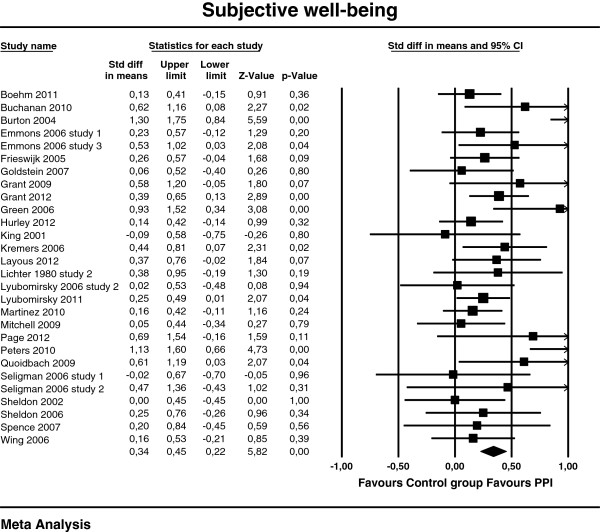
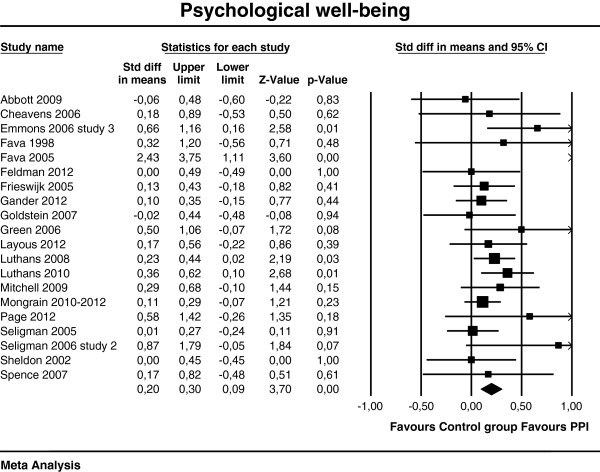
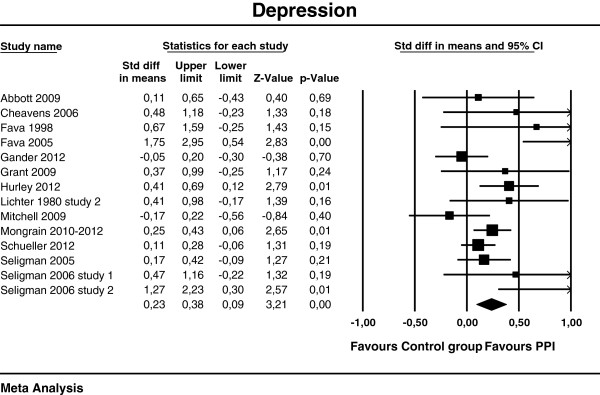
- Across all included studies, the pooled standardized mean differences were 0.34 for subjective well-being, 0.20 for psychological well-being, and 0.23 for depression, which the authors describe as small effects.
- At follow-up of 3–6 months (10 studies), effects remained significant for subjective well-being (d = 0.22, 95% CI [0.05, 0.38], p<.01) and psychological well-being (d = 0.16, 95% CI [0.02, 0.30], p=.03), but not for depression (d = 0.17, 95% CI [-0.06, 0.39], p=.15).
- Heterogeneity was moderate for subjective well-being (I² = 49.5%) and depression (I² = 47.0%), and low for psychological well-being (I² = 29.0%); effect sizes ranged from below 0 to as high as 2.4.
- For depression, larger effects were associated with longer duration, individual delivery, referral/hospital recruitment, inclusion of people with specific psychosocial problems, and lower study quality.
## Methods
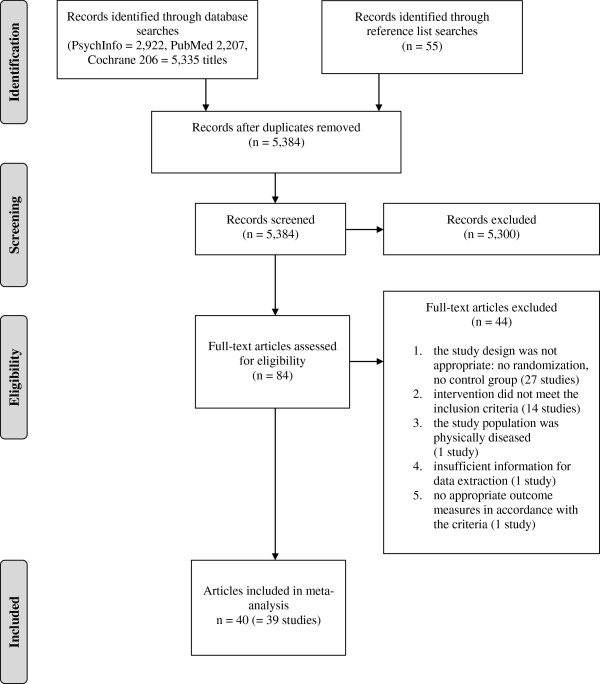
- Systematic review and meta-analysis of randomized controlled studies of positive psychology interventions, using PubMed, PsychInfo, the Cochrane Central Register of Controlled Trials, manual searches, and reference checking, covering 1998 to November 2012.
- Included 40 articles describing 39 studies with 6,139 participants; intervention formats included self-help, group training, and individual therapy.
- Main analysis used Cohen’s d under a random-effects model for three outcomes: subjective well-being, psychological well-being, and depression, with subgroup analyses and checks for heterogeneity and publication bias.
## Limitations
- The paper states that study quality was not high: no study met all quality criteria, randomization was often unclear, intention-to-treat analysis was rare (3/39 studies), and none reported an adequate power analysis.
- The authors note that heterogeneity was rather high because the included studies were diverse, and that the follow-up findings should be treated with caution because of the small number of studies and high attrition rates at follow-up.
- The text makes evident that publication bias is a limitation: funnel plots were asymmetric, fail-safe numbers were below the required thresholds, and Egger’s test suggested bias for psychological well-being and depression.
Model-written summary. Check it against the paper before relying on it.
Integrity signals
Registry
Cites
Statistics
Figures
Verification
Claims the paper makes
8 Valid · 2 Not valid · 9 Not checked · 90 Own results and interpretations
The cited sources that could be checked couldn’t confirm or dispute this claim.
In the paper
“First, the meta-analysis included both randomized studies and quasi-experimental studies.”
§ Positive psychology interventions: a meta-analysis of randomized controlled studies > Background
What the sources say
- Could not verifycites Sin and Lyubomirsky (2009) matched to “Enhancing well-being and alleviating depressive symptoms with positive psychology interventions: a practice-friendly meta-analysis” (2009) sourceExperimental — accuracy not yet measured
The Literature Search section requires included studies to have a comparison group, and Data Recorded distinguishes self-selected from non-self-selected participants. Neither passage establishes whether the meta-analysis included both randomized and quasi-experimental studies; searches for those design terms and for random assignment found no decisive passage. Page numbers were unavailable in our copy. (LLM, conf=0.72)
plain- Asserted: passes — The authors put it forward as true.
- Checkable: passes — It can be checked against evidence.
- Load-bearing: unclear — It is unclear whether the paper’s conclusions depend on it.
- Based: passes — The paper gives a reason why it holds.
- Could not verify
The cited sources support only part of this claim — read each source’s verdict below.
In the paper
“Their results show that PPIs can indeed be effective in enhancing well-being (r = 0.29, standardized mean difference Cohen’s d = 0.61) and help to reduce depressive symptom levels in clinical populations (r = 0.31, Cohen’s d = 0.65).”
§ Positive psychology interventions: a meta-analysis of randomized controlled studies > Background
What the sources say
- Partly supportedcites Sin and Lyubomirsky (2009) matched to “Enhancing well-being and alleviating depressive symptoms with positive psychology interventions: a practice-friendly meta-analysis” (2009) sourceExperimental — accuracy not yet measured
The Depression section reports that PPIs reduced depressive symptoms across 25 studies, with a mean effect of r = .31. The Participant Moderators section distinguishes depressed from nondepressed participants, so .31 is not an estimate specifically for clinical populations. The paper reports the effect as r, not as Cohen’s d = .65. (LLM, conf=0.87)
plainstates a cause- Asserted: passes — The authors put it forward as true.
- Checkable: passes — It can be checked against evidence.
- Load-bearing: unclear — It is unclear whether the paper’s conclusions depend on it.
- Based: passes — The paper gives a reason why it holds.
- Partly supported
Every source the paper cites for this claim was checked and supports it.
In the paper
“Their results show that PPIs can indeed be effective in enhancing well-being (r = 0.29, standardized mean difference Cohen’s d = 0.61) and help to reduce depressive symptom levels in clinical populations (r = 0.31, Cohen’s d = 0.65).”
§ Positive psychology interventions: a meta-analysis of randomized controlled studies > Background
What the sources say
- Supportedcites Sin and Lyubomirsky (2009) matched to “Enhancing well-being and alleviating depressive symptoms with positive psychology interventions: a practice-friendly meta-analysis” (2009) source
The Well-Being section reports that PPIs significantly improved well-being across 49 studies, with a mean r of .29. The paper reports r rather than Cohen’s d; converting .29 to d gives approximately .61, so the cited figures are consistent. (LLM, conf=0.90)
plainstates a cause- Asserted: passes — The authors put it forward as true.
- Checkable: passes — It can be checked against evidence.
- Load-bearing: passes — The paper’s conclusions depend on it.
- Based: passes — The paper gives a reason why it holds.
- Supported
Every source the paper cites for this claim was checked and supports it.
In the paper
“Second, study quality was not addressed as a potential effect moderator.”
§ Positive psychology interventions: a meta-analysis of randomized controlled studies > Background
What the sources say
- Supportedcites Sin and Lyubomirsky (2009) matched to “Enhancing well-being and alleviating depressive symptoms with positive psychology interventions: a practice-friendly meta-analysis” (2009) source
The Data Recorded section lists the variables coded for moderator analysis: participant characteristics, intervention format and duration, and comparison-group type. It does not include study quality, and the Methodological Moderators section discusses those methodological variables rather than study quality. Page numbers are unavailable in our copy. (LLM, conf=0.88)
plain- Asserted: passes — The authors put it forward as true.
- Checkable: passes — It can be checked against evidence.
- Load-bearing: unclear — It is unclear whether the paper’s conclusions depend on it.
- Based: passes — The paper gives a reason why it holds.
- Supported
Every source the paper cites for this claim was checked and supports it.
In the paper
“Remarkably, effect sizes in the current meta-analysis are around 0.3 points lower than the effect sizes in the meta-analysis by Sin and Lyubomirsky (2009) [37].”
§ Positive psychology interventions: a meta-analysis of randomized controlled studies > Discussion > Main findings
What the sources say
- Supportedcites Sin and Lyubomirsky (2009) [37] matched to “Enhancing well-being and alleviating depressive symptoms with positive psychology interventions: a practice-friendly meta-analysis” (2009) source
The Well-Being and Depression results report mean effect sizes of r = .29 and r = .31, respectively, establishing the values attributed to Sin and Lyubomirsky’s meta-analysis. The difference from the current meta-analysis is the citing authors’ comparison, not a finding this source could report. (LLM, conf=0.88)
plain- Asserted: passes — The authors put it forward as true.
- Checkable: passes — It can be checked against evidence.
- Load-bearing: passes — The paper’s conclusions depend on it.
- Based: passes — The paper gives a reason why it holds.
- Supported
70 more claims · 1 with their cited sources checked
Create a free account to see all 109 claims and to verify the 1 reference still open.
- Probably not a substantial claim. 14
- It may state two separate claims as one. 23
Claims other papers make about this one
Each is checked against this paper’s own text: does it say what the citing paper says it does?
The source backs part of the claim, not all of it — or backs it for a different population, condition or comparison.
In the citing paper
“In contrast to complex multicomponent health behavior or psychology interventions, PP exercises are simple, can be delivered remotely (e.g., by phone), and require minimal training of providers [34, 41, 42].”
From Positive Psychological Interventions for Patients with Type 2 Diabetes: Rationale, Theoretical Model, and Intervention Development (2015) · cites this paper as [41]
Experimental — accuracy not yet measuredThe source backs part of the claim, not all of it — or backs it for a different population, condition or comparison.
In the citing paper
“Studies supporting the efficacy of positive activity interventions (PAIs) have been primarily conducted in unselected (non-clinical) community samples and examined single positive activities in isolation (for a meta-analysis, see66, 67).”
From Upregulating the positive affect system in anxiety and depression: Outcomes of a positive activity intervention: Taylor et al. (2017) · cites this paper as [67]
Experimental — accuracy not yet measuredThe source backs part of the claim, not all of it — or backs it for a different population, condition or comparison.
In the citing paper
“Two meta-analyses of PPIs for depression and well-being found that these interventions have small to moderate effects in enhancing well-being and decreasing depressive symptoms and that effects are stronger for individual vs. group formats [30, 31].”
From Skills to Enhance Positivity in adolescents at risk for suicide: Protocol for a randomized controlled trial (2023) · cites this paper as [31]
Experimental — accuracy not yet measuredThe source backs part of the claim, not all of it — or backs it for a different population, condition or comparison.
In the citing paper
“Bolier and Abello (Bolier et al., 2013) reviewed digital PPIs and found that the majority of the included studies showed improvement in well-being or reduction of distress in the intervention group, compared to the control group.”
From Strength Back – A qualitative study on the co-creation of a positive psychology digital health intervention for spinal surgery patients (2023) · cites this paper as Bolier et al., 2013
Experimental — accuracy not yet measuredThe source backs part of the claim, not all of it — or backs it for a different population, condition or comparison.
In the citing paper
“PPIs may support patients to notice and savour positive experiences (Bolier et al., 2013). This may strengthen their commitment to value-based action.”
From Strength Back – A qualitative study on the co-creation of a positive psychology digital health intervention for spinal surgery patients (2023) · cites this paper as Bolier et al., 2013
Experimental — accuracy not yet measured
24 more claims about this paper
Create a free account to see every claim other papers make about this one.
Statistics recomputed
Every reported test result, recomputed from its test statistic and degrees of freedom. A result shows as not adding up only once an independent check has confirmed it.
- Consistentz = 6.43reported p < .01 · recomputed p < .001
“Z=6.43, p < .01”
- Consistentz = 4.18reported p < .01 · recomputed p < .001
“Z=4.18, p < .01”
- Consistentz = 3.33reported p < .01 · recomputed p < .001
“Z=3.33, p < .01”
Self-check
Percentages, sums and reported differences re-computed from the paper’s own numbers.
Self-check results appear here once an independent check has confirmed them.
Citations
Cites
Preferred Reporting Items for Systematic Reviews and Meta-Analyses: the PRISMA statement
Moher, D., Liberati, A., Tetzlaff, J., Altman, D. G., & for the PRISMA Group (2009) · BMJ · doi:10.1136/bmj.b2535 · Cited by 83,823
Preferred Reporting Items for Systematic Reviews and Meta-Analyses: The PRISMA Statement
Moher, D., Liberati, A., Tetzlaff, J., Altman, D. G., & The PRISMA Group (2009) · PLoS Medicine · doi:10.1371/journal.pmed.1000097 · Cited by 64,042 · cited 1×
“For the reporting of the results of this meta-analysis, we applied Preferred Reporting Items for Systematic Reviews and Meta-Analyses (PRISMA) guidelines [50].”
Measuring inconsistency in meta-analyses
Higgins, J. P. T., Thompson, S. G., Deeks, J. J., & Altman, D. G. (2003) · BMJ · doi:10.1136/bmj.327.7414.557 · Cited by 63,139 · cited 1×
“A value of 0% indicates an absence of dispersion, and larger values show increasing levels of heterogeneity where 25% can be considered as low, 50% as moderate and 75% as a high level of heterogeneity [46].”
Preferred reporting items for systematic reviews and meta-analyses: the PRISMA Statement.
(2009) · PubMed Central · Cited by 44,859
Cochrane Handbook for Systematic Reviews of Interventions: Cochrane Book Series
(2008) · doi:10.1002/9780470712184 · Cited by 25,048
Preferred Reporting Items for Systematic Reviews and Meta-Analyses: The PRISMA Statement
Moher, D., Liberati, A., Tetzlaff, J., & Altman, D. G. (2009) · Journal of Clinical Epidemiology · doi:10.1016/j.jclinepi.2009.06.005 · Cited by 19,575
Happiness is everything, or is it? Explorations on the meaning of psychological well-being.
Ryff, C. D. (1989) · Journal of Personality and Social Psychology · doi:10.1037/0022-3514.57.6.1069 · Cited by 14,847 · cited 1×
“Psychological well-being focuses on the optimal functioning of the individual and includes concepts such as mastery, hope and purpose in life [13,14].”
Borenstein, M., Hedges, L. V., Higgins, J. P. T., & Rothstein, H. R. (2009) · doi:10.1002/9780470743386 · Cited by 14,225
Duval, S., & Tweedie, R. (2000) · Biometrics · doi:10.1111/j.0006-341x.2000.00455.x · Cited by 14,099 · cited 1×
“If asymmetry is found in the funnel plot, the Trim and Fill method adjusts the pooled effect size for the outcomes of missing studies [49].”
Subjective well-being: Three decades of progress.
Diener, E., Suh, E. M., Lucas, R. E., & Smith, H. L. (1999) · Psychological Bulletin · doi:10.1037/0033-2909.125.2.276 · Cited by 12,910 · cited 2×
“Although the basic concepts of well-being, happiness and human flourishing have been studied for some decades [12,25-27], there was a lack of evidence-based interventions [24].”
Research works printed but not linked: 3
- Rupke SJ Blecke D Renfrow M Cognitive Therapy for Depression Am Fam Physician 2006 73 83 86 16417069
- Veenhoven R Gezond geluk: Effecten van geluk op gezondheid en wat dat kan betekenen voor de preventieve gezondheidszorg (Healthy happiness: effect of happiness on health and what this could mean for preventive public health) 2006 Rotterdam: Erasmus Universiteit
- Lamers S Bolier L Westerhof GJ Smit F Bohlmeijer E The impact of emotional well-being on long-term recovery and survival in physical illness: a meta-analysis J Behav Med 2012 5 538 547 21918889 PMC3439612 · DOI · Paper page
Cited by
Items 1,501–1,600 of 2,037
Emotional Intelligence and Its Role in Sustaining Fulfillment in Life
Sax, H. C., & Gewertz, B. L. (2020) · Cambridge University Press eBooks · doi:10.1017/9781108650182.038 · Cited by 1
Yuan, J., Dong, M., Lam, W., & Liao, Q. (2025) · British Journal of Health Psychology · doi:10.1111/bjhp.12808
“A previous systematic review demonstrated that positive psychology activities, such as envisioning the future, emphasizing social connections and expressing gratitude, can significantly increase participants' positive affect (Bolier et al., 2013).”
Positive Education in Primary Schools
McFaul, C. (2024) · Emerald Group Publishing Limited eBooks · doi:10.1108/978-1-83753-156-120241002 · Cited by 2
Choi, J., Choi, Y.-L., & Choi, K. (2025) · International Journal of Mental Health Promotion · doi:10.32604/ijmhp.2025.068306 · Cited by 2
“A meta-analysis of randomized controlled studies demonstrated that such interventions significantly enhance optimism and subjective well-being, offering a foundation for long-term flourishing [55].”
Exploración de las Teorías de Inteligencia Emocional y su Relevancia en la Educación
Kuzdra, R. I. (2023) · Krínein Revista de Educación · doi:10.59318/krinein_2023.22.00.0035 · Cited by 1
“En lugar de considerar las emociones simplemente como respuestas pasivas, la psicología positiva reconoce que las emociones pueden ser herramientas acti-vas para el florecimiento humano (Bolier et al ., 2013; Fernán-dez-Berrocal y Ruiz Aranda, 2008).”
BackgroundI can thrive!: Fostering well-being in adolescent girls via the unified approach
Mills, J. L. (2017) · JMU Scholoraly Commons (James Madison University) · Cited by 2
Wang, T., Song, X., Lin, W., Meng, Y., & Li, Y. (2024) · Research Square · doi:10.21203/rs.3.rs-5437733/v1 · Cited by 2
Saeidi, Z. H. A., & Birashk, B. (2019) · International Journal of Sciences: Basic and Applied Research · doi:10.13140/rg.2.2.30926.23362 · Cited by 1
Predicting role of positive orientation on psychological distress: Non-clinical and clinical samples
Xieraili, X., Lim, H. S., Singaram, N., Sam, J. M., & Wan, P. M. (2024) · Current Psychology · doi:10.1007/s12144-024-06555-8 · Cited by 1
“According to the meta-analysis conducted by Bolier et al. (2013), positive psychology interventions such as optimism and gratitude exercises (Boehm, 2011), writing about positive experiences (Burton, 2004), thinking about positive life experiences (Lyubomir-sky 2006), individual positive…”
Potzel, A. L., Fritsche, A., Fritsche, L., Müssig, K., van Gemert, T., Seißler, J., & Lechner, A. (2019) · Diabetes aktuell · doi:10.1055/a-0873-5594 · Cited by 2
Hernández, R., Chen, J., Kwon, S., Martinez, L., Martínez, Á., Alemañy, G. M., Romero, D., Addington, E. L., Huffman, J. C., & Moskowitz, J. T. (2025) · Journal of Happiness Studies · doi:10.1007/s10902-024-00854-4 · Cited by 2
“Strengths-based trials in non-Hispanic White adults have shown promise in improving symptoms of depression and enhancing psychological well-being, including increased life satisfaction, positive affect, and emotional vitality (Bolier et al., 2013; Sin & Lyubomirsky, 2009).”
Bartali, V., Brandl, L., Karreman, J., & van Velsen, L. (2022) · Research Square · doi:10.21203/rs.3.rs-1994721/v1 · Cited by 1
The Role of Aesthetics in Wellness
Mikhail, A. A., & Ngor, A. (2020) · Cambridge University Press eBooks · doi:10.1017/9781108650182.032 · Cited by 3
Burrowes, S., Gerace, A., Benveniste, T., Burke, K. J., Kelly, D., & Raymond, I. J. (2024) · Future in Educational Research · doi:10.1002/fer3.63 · Cited by 1
PROBLEMS ENCOUNTERED BY THE BARANGAY FRONT LINERS ON THE ONSET OF THE COVID-19 PANDEMIC
Ayeo-eo, S. P., PAET, E., & Repoyo, L. (2022) · International Journal of Education Humanities and Social Science · doi:10.54922/ijehss.2022.0344 · Cited by 1
Positive Psychotherapy: What Is It and Why Do We Need It?
Rashid, T., & Seligman, M. (2018) · Oxford University Press eBooks · doi:10.1093/med-psych/9780195325386.003.0001 · Cited by 1
Dominguez-Rodriguez, A., Sanz-Gomez, S., González Ramírez, L. P., Herdoiza-Arroyo, P. E., Trevino Garcia, L. E., de la Rosa-Gómez, A., González-Cantero, J. O., Macias-Aguinaga, V., Arenas Landgrave, P., & Chávez-Valdez, S. M. (2024) · JMIR Formative Research · doi:10.2196/53767 · Cited by 1
“Similarly, based on a meta-analysis [19], positive psychological interventions were found to effectively improve subjective and psychological well-being and reduce depressive symptoms.”
BackgroundAllergic, Infectious, and Immunological Processes
Riaz, O., Orimaye, S. O., Al-Khateeb, T., Sodeke, P. O., Awujoola, A. O., & Goodkin, K. (2020) · Cambridge University Press eBooks · doi:10.1017/9781108650182.012 · Cited by 2
Contribution to Desistance Research and Practice from Positive Psychology
Woldgabreal, Y., & Day, A. (2022) · Wiley eBooks · doi:10.1002/9781119166504.ch3 · Cited by 1
The Development and Validation of the Social Recovery Measure
Marino, C. “. (2000) · doi:10.15760/etd.2921 · Cited by 1
Huggard, P., & Huggard, J. (2019) · Springer eBooks · doi:10.1007/978-3-319-77740-5_44 · Cited by 1
Signature Strengths: A Positive Psychology Intervention with Informal Caregivers
MacDougall, M. (2017) · IRL - University of Missouri, St. Louis (University of Missouri–St. Louis) · Cited by 2
Qi, Y. (2025) · Psycho-Oncologie · doi:10.18282/po3658 · Cited by 1
Strengthening the heart by means of a gratitude intervention?
Schwerdtfeger, A. R., Traunmüller, C., Weber, B., & Rominger, C. (2025) · The Journal of Positive Psychology · doi:10.1080/17439760.2025.2574048 · Cited by 2
“…be noted though in this respect that while previous meta-analyses quantified the effect of positive psychology interventions on measures of well-being as mediate in size ( r = .29; Sin & Lyubomirsky, 2009), more recent evidence seems much more fragile (Bolier et al., 2013; White et al., 2019).”
Be Your Best You: An Evaluation of a Positive Psychology Intervention Programme in Greece
Kotsoni, A., Mertika, A., & Stalikas, A. (2020) · Psychology · doi:10.4236/psych.2020.117067 · Cited by 2
Positive Psychology and the Field of Addiction: A Proposal for a Culturally Relevant Framework
Crookes, A. E. (2018) · Middle East Journal of Positive Psychology · Cited by 2
Beyond resilience: Promotive and protective traits that facilitate recovery during crisisPreprint
Tee, E. Y. J., Shah, R. I. A. B. R. R., Thomas, K. S., Ng, S. L., & Phoo, E. Y. M. (2021) · PsyArXiv (OSF Preprints) · doi:10.31234/osf.io/p2h35 · Cited by 3
Juwara, K., & Menon, R. B. (2023) · IEEE Technology & Engineering Management Conference - Asia Pacific (TEMSCON-ASPAC) · doi:10.1109/temscon-aspac59527.2023.10531491 · Cited by 1
How Positive Psychology Can Augment Leadership Through the Therapeutic Alliance
Duncan, A. R., & McKinney, M. (2025) · MedEdPORTAL · doi:10.15766/mep_2374-8265.11510 · Cited by 2
Mori, Y., Ståhlberg, T., Zhang, X., Mishina, K. E., Herkama, S., Korpilahti-Leino, T., Ristkari, T., Kanasuo, M., Siirtola, S., Närhi, V. M., et al. (2025) · Children · doi:10.3390/children12091251 · Cited by 7
“Research has shown the effectiveness of these interventions in improving various skills such as coping, help seeking, social, academic performance, and overall psychological well-being [14–16].”
Fritz, J., Stochl, J., Goodyer, I., Van Harmelen, A.-L., & Wilkinson, P. O. (2020) · doi:10.31219/osf.io/k7as3 · Cited by 13
Lee, N. N.-C., & Lawrence, K. (2026) · American International Journal of Social Science · doi:10.30845/aijss.v15p1
Session One: Positive Introduction and Gratitude Journal
Rashid, T., & Seligman, M. E. P. (2018) · Oxford University Press eBooks · doi:10.1093/med-psych/9780195325386.003.0007 · Cited by 1
Rhee, J., Kwon, S.-H., Yook, D.-W., et al. (2021) · Korean Journal of Sport Science · doi:10.24985/kjss.2021.32.4.613 · Cited by 1
“대학 아이스하키 팀을 위한 긍정 심리 개입 프로그램 개발 시 요구분석으로부터 활용한 구성 요인 상호작용, 강점 활용, 인간관계, 긍정심리 등은 선행연구에서 개입 후 나타난 효과와 관련성이 높았다(Bolier et al., 2013; Chen, 2013; Donaldson et al., 2019; Gabana, 2019; Winslow et al., 2017).”
SDT, PERMA and Autonomy Supportive Behaviors
Sullivan, G. S. (2019) · Palgrave studies in workplace spirituality and fulfillment · doi:10.1007/978-3-030-11248-6_17 · Cited by 2
Piechaczek, C., Primbs, R., Comanns, P.-M., Feldmann, L., Greimel, E., & Schulte‐Körne, G. (2021) · Nervenheilkunde · doi:10.1055/a-1389-8629 · Cited by 2
Psychological foundations of decision-making in the field of financial activity
Владимирович, Г. М., Chernikova, M. N., Vetrova, T. V., Kosnikov, S. N., Grigoriev, A. V., & Krekova, M. M. (2021) · Linguistics and Culture Review · doi:10.21744/lingcure.v5n1.1658 · Cited by 1
“In this regard, each person needs to develop and implement their own strategy of financial self-discipline, which will allow them to plan both financial receipts and costs carefully (Bolier et al., 2013).”
BackgroundFlückiger, C., Münder, T., Re, A. C. D., & Solomonov, N. (2023) · Oxford University Press eBooks · doi:10.1093/oso/9780197611012.003.0016 · Cited by 1
Jeslin, G. N., Thirumalai, J., & Ramalingam, V. (2026) · Journal of Prevention & Intervention in the Community · doi:10.1080/10852352.2026.2632989 · Cited by 3
Kivikoski, J., Dice, T. F., Haegele, J. A., & Rehfuss, M. C. (2026) · Journal of Military Veteran and Family Health · doi:10.3138/jmvfh-2025-0040 · Cited by 1
Understanding Well-Being: An Interdisciplinary Synthesis
Li, H., & Shen, G. (2026) · Springer eBooks · doi:10.1007/978-981-95-4937-5_2 · Cited by 1
Cebulske, L., Montero‐Zamora, P., Saba, V. C., McLaurin, N., Wang, T., Welsh, A. M., Tanaka, H., & Steinhardt, M. A. (2025) · Health Behavior Research · doi:10.4148/2572-1836.1275 · Cited by 1
Viljoen, J. (2014) · Boloka Institutional Repository (North-west University) · Cited by 5
Corno, G., Molinari, G., Espinoza, M., Etchemendy, E., Herrero, R., Carrillo, A., & Baños, R. (2019) · Springer eBooks · doi:10.1007/978-3-030-20311-5_12 · Cited by 1
Iwahara, A., Shimai, S., Fujiwara, K., Hatta, T., Hatta, J., Kato, K., & Hatta, T. (2020) · Journal of Human Environmental Studies · doi:10.4189/shes.18.171
Strevens, C., & Lai, Y. (2023) · Springer eBooks · doi:10.1007/978-3-031-27654-5_10 · Cited by 1
Positive Psychotherapy Inventory
Rashid, T., & Seligman, M. (2018) · Oxford University Press eBooks · doi:10.1093/med-psych/9780195325386.005.0003 · Cited by 1
Przybylko, G., Morton, D. P., Kent, L. M., Morton, J. K., Hinze, J. S., Beamish, P., & Renfrew, M. E. (2019) · Research Square · doi:10.21203/rs.3.rs-22666/v1 · Cited by 2
“[14] Over the past few decades, numerous evidence-based strategies for improving mental health and emotional wellness have emerged in the literature underpinning the disciplines of “Lifestyle Medicine” and “Positive Psychology”.”
BackgroundPERSPECTIVES IN ADAPTIVE COPING: THE RETRAINING EXPERIENCES OF IMMIGRANT PROFESSIONALS IN CANADA
Busic, T. (2017) · TSpace (University of Toronto) · Cited by 4
Combining PPI Domains and Targeting Cognitive Mechanisms: A Failed Proof-of-Concept for PPI Research
Stone, B. M., & Gilbert, D. G. (2023) · International Journal of Applied Positive Psychology · doi:10.1007/s41042-023-00118-1 · Cited by 1
“…of PPI interven - tions that found that multiple domains of interventions demonstrate small to medium effect sizes on well-being, such as processing positive past events, Cohen’s d = 0.25, optimism, d = 0.36, and strengths identification and novel utilization, d = 0.20 (Bolier et al., 2013).”
InfluentialPositive Psychology Coaching Protocols: Creating Competitive Advantage for Leader Development
Gray, S. W. (2018) · Cited by 2
Adult Development and Positive Psychology Coaching
Pannell, B. (2021) · Springer eBooks · doi:10.1007/978-3-030-79952-6_19 · Cited by 1
Troppmann, K. M., & Troppmann, C. (2016) · Success in academic surgery · doi:10.1007/978-3-319-43952-5_14 · Cited by 4
Negative treatment of self in socially anxious clients
Capaldi, K., & Elliott, R. (2023) · Person-Centered & Experiential Psychotherapies · doi:10.1080/14779757.2023.2201937 · Cited by 1
“Although evidence supports the effectiveness of these self-help methods (e.g. Bolier et al., 2013), the misconception that one might circumvent emotional pain through actively concealing or overlooking negative treatment of self was the inspiration for this study.”
MethodMoran, J., Blasi, Z. D., & Setti, A. (2019) · Springer eBooks · doi:10.1007/978-3-030-20311-5_6 · Cited by 1
Phillips, T. W. A. (2015) · Digital Collections of Colorado (Colorado State University) · Cited by 1
Moderating Role of Social Connectedness on Forgiveness and Subjective Happiness Among Adults
Khizar, U., Nawaz, D., Haroon, M., & Mubarak, H. (2021) · iRASD Journal of Economics · doi:10.52131/joe.2021.0302.0040 · Cited by 6
“By considering all these aspects, positive psychology researchers have assessed psychological wellbeing of an individual (Auyeung & Mo, 2019; Bolier et al., 2013; Haktanir, Lenz, Can, & Watson, 2016; Hendriks, Schotanus-Dijkstra, Hassankhan, De Jong, & Bohlmeijer, 2020; Jianjun et al., 2021;…”
BackgroundFreedman, M. E., Weber, K. M., Yohannes, T., Cohen, M. H., & Moskowitz, J. T. (2023) · AIDS Care · doi:10.1080/09540121.2023.2221423 · Cited by 1
“Recent research has begun to examine the impact of positive psychological interventions among those with mental health disorders and found improvements in psychological well-being (Bolier et al., 2013; Carr et al., 2020; Chakhssi et al., 2018).”
BackgroundIntricacies of AI-Enhanced Mood Tracking for Personalized Well-Being
Karthikeyan, C. (2024) · Advances in business strategy and competitive advantage book series · doi:10.4018/979-8-3693-3498-0.ch011 · Cited by 1
Yang, F., Lin, J., Chen, R., Gao, C., Cui, M., & Yin, K. (2024) · International Journal of Mental Health Promotion · doi:10.32604/ijmhp.2024.049922 · Cited by 1
Wellbeing and Recovery in the Emergency Services: How Do We Care for Those Who Care for Us?
Hamling, K., & Jarden, A. (2017) · Cambridge University Press eBooks · doi:10.1017/9781316339275.014 · Cited by 2
Owens, R. L. (2022) · Plenum series on human exceptionality · doi:10.1007/978-3-030-97208-0_16 · Cited by 2
Nakada, T., Kurotani, K., Seino, S., Kozawa, T., Murota, S., Eto, M., Shimasawa, J., Shimizu, Y., Tsurugano, S., Katsukawa, F., et al. (2026) · Geriatrics · doi:10.3390/geriatrics11020027 · Cited by 1
“The sample size was determined through several steps, as follows: first, a previous review by Bolier et al. indicated that positive psychology interventions showed an effect size of 0.34 for SWB [28].”
InfluentialHope and behavioural weight loss: Pathways lead to greater weight loss than agency or goals
Medlin, A. R., Sinclair, K. L., & Hawkins, M. A. W. (2025) · British Journal of Health Psychology · doi:10.1111/bjhp.12801
“…al., 2011; Boehm & Kubzansky, 2012), and improved pulmonary function (Kubzansky et al., 2002), as well as improved feelings of pain intensity for those with chronic pain (Müller et al., 2016) and decreased depressive symptoms in clinical populations (Bolier et al., 2013; Sin & Lyubomirsky, 2009).”
Akhter, S., Kumar, T., & Shaheen, M. (2026) · Frontiers in Psychology · doi:10.3389/fpsyg.2026.1813612 · Cited by 3
“Second, intervention-focused meta-analyses—most prominently Sin and Lyubomirsky (2009), Bolier et al. (2013), Hendriks et al. (2019), and Carr et al. (2021) have evaluated the efficacy of positive psychology interventions broadly, yet their primary focus is outcome-level efficacy rather than a…”
Psicología Positiva: ¿Mito genial o asalto a la razón?
López, J. A. P., & Álvarez, J. F. L. (2024) · doi:10.22402/ed.leed.978.607.59503.4.1 · Cited by 1
Evolution of Human Intelligence: Psychological Science for a Better WorldPreprint
Dayathilake, K. L. S. (2021) · PsyArXiv (OSF Preprints) · doi:10.31234/osf.io/m3yrj · Cited by 1
Versluis, Y., Bol, Y., Peeters, F. P. M. L., & Bouwmeester, S. (2025) · British Journal of Guidance and Counselling · doi:10.1080/03069885.2025.2484222 · Cited by 2
“Over time, this builds useful skills, and psychological and social resources to focus on personal values and relations, thereby supporting positive mental health (Bolier et al., 2013; Neff et al., 2007a, 2007b; Zessin et al., 2015).”
Wellness Interventions in Patients Living with Chronic Medical Conditions
Steiner, A. J., Aguilar-Hernandez, L., Pizano, D. R., Dascal, J., & IsHak, W. W. (2020) · Cambridge University Press eBooks · doi:10.1017/9781108650182.014 · Cited by 2
Interventions Based On Positive Psychology for Suicide Prevention: A Systematic Review
Pons, P., Mira, A. E., Díaz‐García, A., García‐Palacios, A., & Baños, R. (2025) · Journal of Happiness Studies · doi:10.1007/s10902-025-00993-2 · Cited by 2
“PPIs consist of practical, application-oriented activities that explicitly promote positive emotional experiences and fosters strengths, flourishing, and other positive psychological resources (Bolier et al., 2013; Ng & Ong, 2022).”
Roche, L. (2019) · ATLAANZ Journal · doi:10.26473/atlaanz.2019.1/002 · Cited by 2
Gene-Environment Interplay for Well-Being
van de Weijer, M. P. (2023) · doi:10.5463/thesis.236 · Cited by 1
Counseling and Psychotherapy Within and Across Faith Traditions
McMinn, M. R., Neff, M. A., Snow, K. N., & Schollars, N. A. (2024) · Oxford University Press eBooks · doi:10.1093/oxfordhb/9780190905538.013.16 · Cited by 1
Bitzen, L., Hahn, S., & Pilger, S. (2024) · Edition Centaurus - Perspektiven sozialer Arbeit in Theorie und Praxis · doi:10.1007/978-3-658-44110-4_18 · Cited by 1
Kehoe, M. (2017) · Research Bank (Australian Catholic University) · doi:10.26199/5b878613ba294 · Cited by 4
“This has important implications for mental health promotion and public health because these practices can offer accessible and non-stigmatising approaches (Bolier et al., 2013).”
BackgroundRubio-Escobar, E., Vélez, C. C., & Nieto, M. Á. P. (2025) · General Hospital Psychiatry · doi:10.1016/j.genhosppsych.2025.07.012 · Cited by 2
Noguchi, T., Yorozu, T., Hashizume, S., Kawakami, T., Nishimoto, Y., & Hosokawa, K. (2024) · Asian Journal of Occupational Therapy · doi:10.11596/asiajot.20.1 · Cited by 1
Positive Psychology and Healthy Lifestyles for Health and Happiness
Lianov, L. S. (2023) · IntechOpen eBooks · doi:10.5772/intechopen.107518 · Cited by 2
The Relationship between Savoring and Psychological Health: The Mediating Effect of Rumination
Heo, J. S., Joo, H. W., & Hyun, M. H. (2016) · Korean Journal of Stress Research · doi:10.17547/kjsr.2016.24.4.303 · Cited by 1
“…접근에서 더 나아 가 삶의 긍정적인 측면을 한층 더 강화시켜주는 것이 정신병 리의 치료, 회복 및 재발 방지에 유의한 효과가 있을 것이라 기대하였으며, 많은 연구들이 이를 검증해 오고 있다 (Ramana et al., 1995; Thunedborg et al., 1995; Fava, 1996; Labbate et al., 1997; Fava, 1999; Lyumbomirsky et al., 2005; Lyumbomirsky, 2008; Sin et al., 2009; Wood et al., 2010; Dunn, 2012;…”
Looking at the bowl of fruit or focussing on the apples? Reply to the comments of Schueller et al.
Bolier, L., Haverman, M., Westerhof, G. J., Riper, H., Smit, F., & Bohlmeijer, E. (2014) · International Journal of Wellbeing · doi:10.5502/ijw.v4i1.6 · Cited by 1
“…& University of Twente Copyright belongs to the author(s) www.internationaljournalofwellbeing.org 99 further clarify some aspects of the design and the choices we made in our meta-analysis "Positive psychology interventions: A meta-analysis of randomized controlled studies" (Bolier et al., 2013).”
BackgroundSelf-citationPositive Psychology Model of Mental Function and Behavior
Rashid, T., Summers, R. F., & Seligman, M. E. P. (2023) · Springer eBooks · doi:10.1007/978-3-030-42825-9_28-2 · Cited by 2
Sasaki, N., Sawada, U., Ogawa, S., Takeno, H., Shimazu, T., Tsutsumi, A., & Imamura, K. (2025) · Scientific Reports · doi:10.1038/s41598-025-11206-4 · Cited by 1
“SD: standard deviation. functioning (e.g., purpose in life, resilience) typically require more intensive or longer-duration programs, often including interactive exercises, personalized feedback, or guided practice 44,45 .”
Salces-Cubero, I. M., Fernández, E. R., & Martínez, A. R. O. (2025) · Journal of Happiness Studies · doi:10.1007/s10902-025-00938-9 · Cited by 1
“Empirical research has indicated that the results obtained from this type of program do not usually persist in the long term (Ramírez et al., 2014; Sutipan et al., 2017), even in other participating populations (Bolier et al., 2013; Seligman et al., 2005).”
Duthely, L. M. (2017) · Clinical Psychiatry · doi:10.21767/2471-9854.100041 · Cited by 1
“Meta-analyses have demonstrated that the PP approach works to increase well-being [4].”
BackgroundDevelopment and evaluation of the Flourish Diabetes Programme
Kruger, S., Deacon, E., van Rensburg, E., & Segal, D. (2025) · Health SA Gesondheid · doi:10.4102/hsag.v30i0.2923 · Cited by 1
“The duration of the programme is 7 weeks, in line with previous positive psychology interventions, which usually last 4 to 8 weeks (Bolier et al. 2013).”
Melchert, T. P. (2020) · Cambridge University Press eBooks · doi:10.1017/9781108650182.004 · Cited by 1
Reproductive System: Pregnancy and Postpartum Wellness
Ogunyemi, D. (2020) · Cambridge University Press eBooks · doi:10.1017/9781108650182.011 · Cited by 1
Brauer, K. (2025) · International Journal of Applied Positive Psychology · doi:10.1007/s41042-025-00241-1 · Cited by 1
“Typically, effect sizes of positive psychology interventions are of small to medium size (Donaldson et al., 2019; Bolier et al., 2013; Kirca et al., 2023; van Agteren et al., 2021; Vásquez-Pailaqueo et al., 2025), with Cohen’s d effect sizes between 0.20 and 0.40, which has made the experi - mental…”
InfluentialPsychosocial factors influencing flourishing in experienced veterinarians: A longitudinal study
McArthur, M. L., Gartley, E. G. N., Jarden, A., Hazel, S. J., Hebart, M. L., Matthew, S. M., & Iasiello, M. P. (2025) · Veterinary Record · doi:10.1002/vetr.6019 · Cited by 1
Running a weight-management programme with a psychological focus within a lymphoedema service
Lawrence, P. (2022) · British Journal of Nursing · doi:10.12968/bjon.2022.31.3.114 · Cited by 1
Due, J. L., Burgin, E. E., Dorais, S., Gutiérrez, D., Prosek, E. A., Blount, L., Foster, C. E., Jabs, K. T., Alicea, P., Parker, B., et al. (2025) · Counseling Outcome Research and Evaluation · doi:10.1080/21501378.2025.2530382 · Cited by 1
Positive-Empathy-Oriented Interventions and Well-Being of Students in Higher Education Institutions
Surum, J. (2025) · Springer eBooks · doi:10.1007/978-3-031-88793-2_15 · Cited by 1
Metadata
- Authors
- Bolier, L., Haverman, M., Westerhof, G. J., Riper, H., Smit, F., & Bohlmeijer, E.
- Affiliations
- Trimbos Institute (NL)
- University of Twente (NL)
- Leuphana University of Lüneburg (DE)
- Corresponding author
- Bolier, Linda
- Venue
- BMC Public Health
- Published
- 2013-02-08
- Volume
- 13
- Issue
- 1
- Pages
- 119-119
- ISSN
- 1471-2458 (ISSN-L)
- PMC
- PMC3599475
- OpenAlex
- W2120582212
- Semantic Scholar
- 45fd44e9cff6334f80a54b3d327ced46d9b2d444
- Cited by
- 1,996
- References
- 115
- Citations by year
- 2026: 97 · 2025: 134 · 2024: 155 · 2023: 197 · 2022: 190 · 2021: 208 · 2020: 231 · 2019: 201 · 2018: 182 · 2017: 153 · 2016: 117 · 2015: 76 · 2014: 40 · 2013: 12
- FWCI
- 10.79
- Type
- journal article
- Language
- en
- Open access
- gold
- doi.org
- Licence
- Locations
- BMC Public Health (publishedVersion, cc-by)
- Europe PMC (PubMed Central) (publishedVersion, cc-by)
- PubMed Central (publishedVersion, cc-by)
- PubMed (publishedVersion)
- Pure Amsterdam UMC (publishedVersion, other-oa)
- Amsterdam UMC (VU Amsterdam) - Institutional Repository (publishedVersion, other-oa)
- Multilingual Matters (Channel View Publications) (acceptedVersion, cc-by)
- University of Twente Research Information (acceptedVersion, cc-by)
- Data Archiving and Networked Services (DANS) (submittedVersion, other-oa)
- Digital Academic REpository of VU University Amsterdam (Vrije Universiteit Amsterdam) (submittedVersion)
- VU Research Portal (submittedVersion, other-oa)
- University of Twente Research Information (submittedVersion, cc-by)
- Topics
- Social Sciences › Psychology › Social Psychology › Psychological Well-being and Life Satisfaction
- Social Sciences › Psychology › Clinical Psychology › Mindfulness and Compassion Interventions
- Social Sciences › Psychology › Applied Psychology › Optimism, Hope, and Well-being
- Keywords
- positive psychology interventions, subjective well-being, psychological well-being, depression, self-help intervention, group training, individual psychotherapy, mental health promotion, intervention effectiveness, publication bias, study quality
- MeSH terms
- Depression, Health Promotion, Humans, Psychotherapy, Randomized Controlled Trials as Topic, Treatment Outcome
About these checks
Registry, retraction, Cites and statistics results are computed, not judged, with one exception: a printed reference that no index lists is read once by a model before it counts as a citation error. Claims are extracted by a model and kept only when their quote appears verbatim in the text; each cited source is then checked, with a model’s help, for whether it says what the claim relies on. Those verdicts can be wrong — read the claim’s quote and the cited source before relying on one.
The claim verdicts this report counts are experimental: their accuracy is not yet measured.
A language model drew the claims from the paper on 2026-10-10, under version 3 of the claim definition (model deepseek-v4.1-flash, prompt extract-v3).
A second model labelled each claim on 2026-10-10 (model jev-1.13-20260917, definition revision gold-guideline-v0.2).
Cited sources are checked with a language model’s help (gpt-6-sol).
Statistics and arithmetic are recomputed, not judged.
Confidence bands are shown only for fields calibrated on our annotated test set. None is calibrated yet, so no band is shown.
What counts as a claim ›How we measure confidence ›How we check this ›
Are you an author, or do you see a problem with this page? Request a review
Data sources
Bibliographic data: Semantic Scholar, OpenAlex, Crossref.
Contains information from the Semantic Scholar Academic Graph Datasets, made available under the ODC Attribution License (ODC-BY 1.0).
Semantic Scholar’s data is described in: Kinney, R., et al. (2023). The Semantic Scholar Open Data Platform. arXiv:2301.10140.
