

Positive psychology interventions: a meta-analysis of randomized controlled studies
Open accessThe DOI matches its Crossref record; 109 of the 115 references it cites were found in a registry or an index; 10 of the 22 sources its claims cite were checked for support.
Abstract
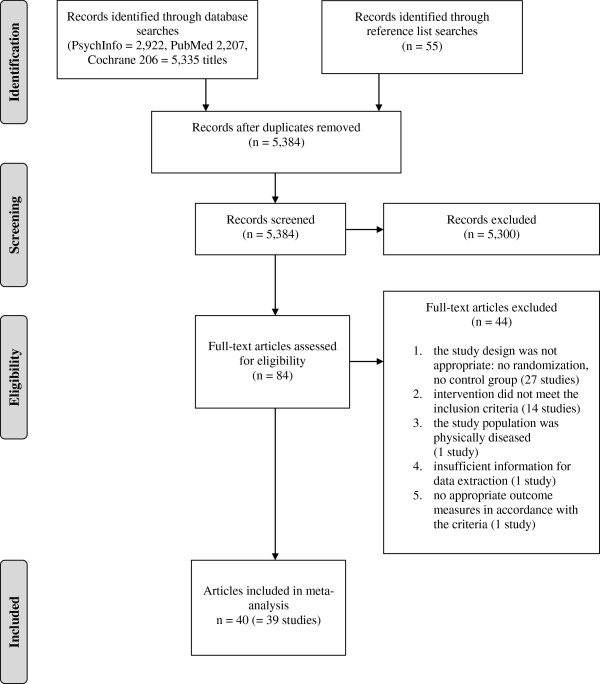
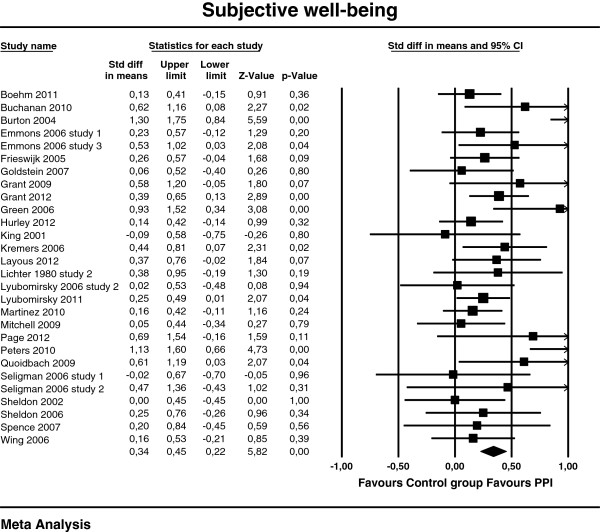
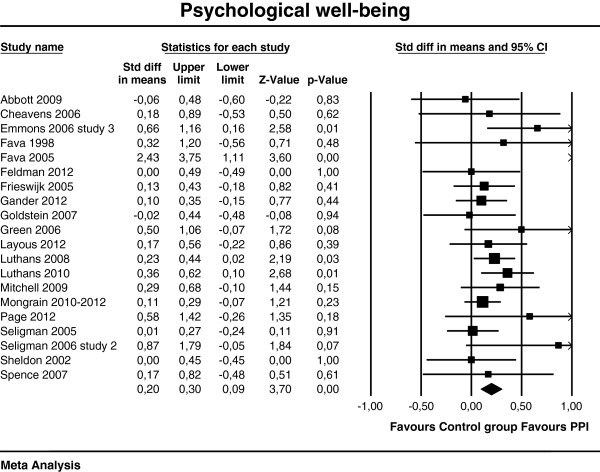
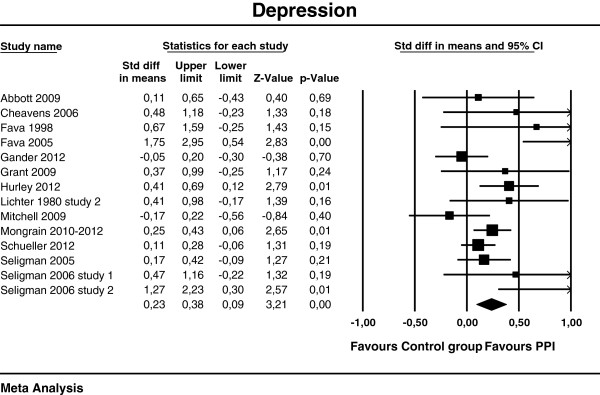
BACKGROUND: The use of positive psychological interventions may be considered as a complementary strategy in mental health promotion and treatment. The present article constitutes a meta-analytical study of the effectiveness of positive psychology interventions for the general public and for individuals with specific psychosocial problems. METHODS: We conducted a systematic literature search using PubMed, PsychInfo, the Cochrane register, and manual searches. Forty articles, describing 39 studies, totaling 6,139 participants, met the criteria for inclusion. The outcome measures used were subjective well-being, psychological well-being and depression. Positive psychology interventions included self-help interventions, group training and individual therapy. RESULTS: The standardized mean difference was 0.34 for subjective well-being, 0.20 for psychological well-being and 0.23 for depression indicating small effects for positive psychology interventions. At follow-up from three to six months, effect sizes are small, but still significant for subjective well-being and psychological well-being, indicating that effects are fairly sustainable. Heterogeneity was rather high, due to the wide diversity of the studies included. Several variables moderated the impact on depression: Interventions were more effective if they were of longer duration, if recruitment was conducted via referral or hospital, if interventions were delivered to people with certain psychosocial problems and on an individual basis, and if the study design was of low quality. Moreover, indications for publication bias were found, and the quality of the studies varied considerably. CONCLUSIONS: The results of this meta-analysis show that positive psychology interventions can be effective in the enhancement of subjective well-being and psychological well-being, as well as in helping to reduce depressive symptoms. Additional high-quality peer-reviewed studies in diverse (clinical) populations are needed to strengthen the evidence-base for positive psychology interventions.
Overview
CoChat Summary
## TL;DR
This meta-analysis of 39 randomized studies (40 articles; 6,139 participants) found that positive psychology interventions had small but significant benefits for subjective well-being, psychological well-being, and depressive symptoms. Effects were somewhat sustained at 3–6 months for well-being outcomes, but study heterogeneity and publication bias were notable.
## Key findings
- Across all included studies, the pooled standardized mean differences were 0.34 for subjective well-being, 0.20 for psychological well-being, and 0.23 for depression, which the authors describe as small effects.
- At follow-up of 3–6 months (10 studies), effects remained significant for subjective well-being (d = 0.22, 95% CI [0.05, 0.38], p<.01) and psychological well-being (d = 0.16, 95% CI [0.02, 0.30], p=.03), but not for depression (d = 0.17, 95% CI [-0.06, 0.39], p=.15).
- Heterogeneity was moderate for subjective well-being (I² = 49.5%) and depression (I² = 47.0%), and low for psychological well-being (I² = 29.0%); effect sizes ranged from below 0 to as high as 2.4.
- For depression, larger effects were associated with longer duration, individual delivery, referral/hospital recruitment, inclusion of people with specific psychosocial problems, and lower study quality.
## Methods
- Systematic review and meta-analysis of randomized controlled studies of positive psychology interventions, using PubMed, PsychInfo, the Cochrane Central Register of Controlled Trials, manual searches, and reference checking, covering 1998 to November 2012.
- Included 40 articles describing 39 studies with 6,139 participants; intervention formats included self-help, group training, and individual therapy.
- Main analysis used Cohen’s d under a random-effects model for three outcomes: subjective well-being, psychological well-being, and depression, with subgroup analyses and checks for heterogeneity and publication bias.
## Limitations
- The paper states that study quality was not high: no study met all quality criteria, randomization was often unclear, intention-to-treat analysis was rare (3/39 studies), and none reported an adequate power analysis.
- The authors note that heterogeneity was rather high because the included studies were diverse, and that the follow-up findings should be treated with caution because of the small number of studies and high attrition rates at follow-up.
- The text makes evident that publication bias is a limitation: funnel plots were asymmetric, fail-safe numbers were below the required thresholds, and Egger’s test suggested bias for psychological well-being and depression.
Model-written summary. Check it against the paper before relying on it.
Integrity signals
Registry
Cites
Statistics
Figures
Verification
Claims the paper makes
8 Valid · 2 Not valid · 9 Not checked · 90 Own results and interpretations
The cited sources that could be checked couldn’t confirm or dispute this claim.
In the paper
“First, the meta-analysis included both randomized studies and quasi-experimental studies.”
§ Positive psychology interventions: a meta-analysis of randomized controlled studies > Background
What the sources say
- Could not verifycites Sin and Lyubomirsky (2009) matched to “Enhancing well-being and alleviating depressive symptoms with positive psychology interventions: a practice-friendly meta-analysis” (2009) sourceExperimental — accuracy not yet measured
The Literature Search section requires included studies to have a comparison group, and Data Recorded distinguishes self-selected from non-self-selected participants. Neither passage establishes whether the meta-analysis included both randomized and quasi-experimental studies; searches for those design terms and for random assignment found no decisive passage. Page numbers were unavailable in our copy. (LLM, conf=0.72)
plain- Asserted: passes — The authors put it forward as true.
- Checkable: passes — It can be checked against evidence.
- Load-bearing: unclear — It is unclear whether the paper’s conclusions depend on it.
- Based: passes — The paper gives a reason why it holds.
- Could not verify
The cited sources support only part of this claim — read each source’s verdict below.
In the paper
“Their results show that PPIs can indeed be effective in enhancing well-being (r = 0.29, standardized mean difference Cohen’s d = 0.61) and help to reduce depressive symptom levels in clinical populations (r = 0.31, Cohen’s d = 0.65).”
§ Positive psychology interventions: a meta-analysis of randomized controlled studies > Background
What the sources say
- Partly supportedcites Sin and Lyubomirsky (2009) matched to “Enhancing well-being and alleviating depressive symptoms with positive psychology interventions: a practice-friendly meta-analysis” (2009) sourceExperimental — accuracy not yet measured
The Depression section reports that PPIs reduced depressive symptoms across 25 studies, with a mean effect of r = .31. The Participant Moderators section distinguishes depressed from nondepressed participants, so .31 is not an estimate specifically for clinical populations. The paper reports the effect as r, not as Cohen’s d = .65. (LLM, conf=0.87)
plainstates a cause- Asserted: passes — The authors put it forward as true.
- Checkable: passes — It can be checked against evidence.
- Load-bearing: unclear — It is unclear whether the paper’s conclusions depend on it.
- Based: passes — The paper gives a reason why it holds.
- Partly supported
Every source the paper cites for this claim was checked and supports it.
In the paper
“Their results show that PPIs can indeed be effective in enhancing well-being (r = 0.29, standardized mean difference Cohen’s d = 0.61) and help to reduce depressive symptom levels in clinical populations (r = 0.31, Cohen’s d = 0.65).”
§ Positive psychology interventions: a meta-analysis of randomized controlled studies > Background
What the sources say
- Supportedcites Sin and Lyubomirsky (2009) matched to “Enhancing well-being and alleviating depressive symptoms with positive psychology interventions: a practice-friendly meta-analysis” (2009) source
The Well-Being section reports that PPIs significantly improved well-being across 49 studies, with a mean r of .29. The paper reports r rather than Cohen’s d; converting .29 to d gives approximately .61, so the cited figures are consistent. (LLM, conf=0.90)
plainstates a cause- Asserted: passes — The authors put it forward as true.
- Checkable: passes — It can be checked against evidence.
- Load-bearing: passes — The paper’s conclusions depend on it.
- Based: passes — The paper gives a reason why it holds.
- Supported
Every source the paper cites for this claim was checked and supports it.
In the paper
“Second, study quality was not addressed as a potential effect moderator.”
§ Positive psychology interventions: a meta-analysis of randomized controlled studies > Background
What the sources say
- Supportedcites Sin and Lyubomirsky (2009) matched to “Enhancing well-being and alleviating depressive symptoms with positive psychology interventions: a practice-friendly meta-analysis” (2009) source
The Data Recorded section lists the variables coded for moderator analysis: participant characteristics, intervention format and duration, and comparison-group type. It does not include study quality, and the Methodological Moderators section discusses those methodological variables rather than study quality. Page numbers are unavailable in our copy. (LLM, conf=0.88)
plain- Asserted: passes — The authors put it forward as true.
- Checkable: passes — It can be checked against evidence.
- Load-bearing: unclear — It is unclear whether the paper’s conclusions depend on it.
- Based: passes — The paper gives a reason why it holds.
- Supported
Every source the paper cites for this claim was checked and supports it.
In the paper
“Remarkably, effect sizes in the current meta-analysis are around 0.3 points lower than the effect sizes in the meta-analysis by Sin and Lyubomirsky (2009) [37].”
§ Positive psychology interventions: a meta-analysis of randomized controlled studies > Discussion > Main findings
What the sources say
- Supportedcites Sin and Lyubomirsky (2009) [37] matched to “Enhancing well-being and alleviating depressive symptoms with positive psychology interventions: a practice-friendly meta-analysis” (2009) source
The Well-Being and Depression results report mean effect sizes of r = .29 and r = .31, respectively, establishing the values attributed to Sin and Lyubomirsky’s meta-analysis. The difference from the current meta-analysis is the citing authors’ comparison, not a finding this source could report. (LLM, conf=0.88)
plain- Asserted: passes — The authors put it forward as true.
- Checkable: passes — It can be checked against evidence.
- Load-bearing: passes — The paper’s conclusions depend on it.
- Based: passes — The paper gives a reason why it holds.
- Supported
70 more claims · 1 with their cited sources checked
Create a free account to see all 109 claims and to verify the 1 reference still open.
- Probably not a substantial claim. 14
- It may state two separate claims as one. 23
Claims other papers make about this one
Each is checked against this paper’s own text: does it say what the citing paper says it does?
The source backs part of the claim, not all of it — or backs it for a different population, condition or comparison.
In the citing paper
“In contrast to complex multicomponent health behavior or psychology interventions, PP exercises are simple, can be delivered remotely (e.g., by phone), and require minimal training of providers [34, 41, 42].”
From Positive Psychological Interventions for Patients with Type 2 Diabetes: Rationale, Theoretical Model, and Intervention Development (2015) · cites this paper as [41]
Experimental — accuracy not yet measuredThe source backs part of the claim, not all of it — or backs it for a different population, condition or comparison.
In the citing paper
“Studies supporting the efficacy of positive activity interventions (PAIs) have been primarily conducted in unselected (non-clinical) community samples and examined single positive activities in isolation (for a meta-analysis, see66, 67).”
From Upregulating the positive affect system in anxiety and depression: Outcomes of a positive activity intervention: Taylor et al. (2017) · cites this paper as [67]
Experimental — accuracy not yet measuredThe source backs part of the claim, not all of it — or backs it for a different population, condition or comparison.
In the citing paper
“Two meta-analyses of PPIs for depression and well-being found that these interventions have small to moderate effects in enhancing well-being and decreasing depressive symptoms and that effects are stronger for individual vs. group formats [30, 31].”
From Skills to Enhance Positivity in adolescents at risk for suicide: Protocol for a randomized controlled trial (2023) · cites this paper as [31]
Experimental — accuracy not yet measuredThe source backs part of the claim, not all of it — or backs it for a different population, condition or comparison.
In the citing paper
“Bolier and Abello (Bolier et al., 2013) reviewed digital PPIs and found that the majority of the included studies showed improvement in well-being or reduction of distress in the intervention group, compared to the control group.”
From Strength Back – A qualitative study on the co-creation of a positive psychology digital health intervention for spinal surgery patients (2023) · cites this paper as Bolier et al., 2013
Experimental — accuracy not yet measuredThe source backs part of the claim, not all of it — or backs it for a different population, condition or comparison.
In the citing paper
“PPIs may support patients to notice and savour positive experiences (Bolier et al., 2013). This may strengthen their commitment to value-based action.”
From Strength Back – A qualitative study on the co-creation of a positive psychology digital health intervention for spinal surgery patients (2023) · cites this paper as Bolier et al., 2013
Experimental — accuracy not yet measured
24 more claims about this paper
Create a free account to see every claim other papers make about this one.
Statistics recomputed
Every reported test result, recomputed from its test statistic and degrees of freedom. A result shows as not adding up only once an independent check has confirmed it.
- Consistentz = 6.43reported p < .01 · recomputed p < .001
“Z=6.43, p < .01”
- Consistentz = 4.18reported p < .01 · recomputed p < .001
“Z=4.18, p < .01”
- Consistentz = 3.33reported p < .01 · recomputed p < .001
“Z=3.33, p < .01”
Self-check
Percentages, sums and reported differences re-computed from the paper’s own numbers.
Self-check results appear here once an independent check has confirmed them.
Citations
Cites
Preferred Reporting Items for Systematic Reviews and Meta-Analyses: the PRISMA statement
Moher, D., Liberati, A., Tetzlaff, J., Altman, D. G., & for the PRISMA Group (2009) · BMJ · doi:10.1136/bmj.b2535 · Cited by 83,823
Preferred Reporting Items for Systematic Reviews and Meta-Analyses: The PRISMA Statement
Moher, D., Liberati, A., Tetzlaff, J., Altman, D. G., & The PRISMA Group (2009) · PLoS Medicine · doi:10.1371/journal.pmed.1000097 · Cited by 64,042 · cited 1×
“For the reporting of the results of this meta-analysis, we applied Preferred Reporting Items for Systematic Reviews and Meta-Analyses (PRISMA) guidelines [50].”
Measuring inconsistency in meta-analyses
Higgins, J. P. T., Thompson, S. G., Deeks, J. J., & Altman, D. G. (2003) · BMJ · doi:10.1136/bmj.327.7414.557 · Cited by 63,139 · cited 1×
“A value of 0% indicates an absence of dispersion, and larger values show increasing levels of heterogeneity where 25% can be considered as low, 50% as moderate and 75% as a high level of heterogeneity [46].”
Preferred reporting items for systematic reviews and meta-analyses: the PRISMA Statement.
(2009) · PubMed Central · Cited by 44,859
Cochrane Handbook for Systematic Reviews of Interventions: Cochrane Book Series
(2008) · doi:10.1002/9780470712184 · Cited by 25,048
Preferred Reporting Items for Systematic Reviews and Meta-Analyses: The PRISMA Statement
Moher, D., Liberati, A., Tetzlaff, J., & Altman, D. G. (2009) · Journal of Clinical Epidemiology · doi:10.1016/j.jclinepi.2009.06.005 · Cited by 19,575
Happiness is everything, or is it? Explorations on the meaning of psychological well-being.
Ryff, C. D. (1989) · Journal of Personality and Social Psychology · doi:10.1037/0022-3514.57.6.1069 · Cited by 14,847 · cited 1×
“Psychological well-being focuses on the optimal functioning of the individual and includes concepts such as mastery, hope and purpose in life [13,14].”
Borenstein, M., Hedges, L. V., Higgins, J. P. T., & Rothstein, H. R. (2009) · doi:10.1002/9780470743386 · Cited by 14,225
Duval, S., & Tweedie, R. (2000) · Biometrics · doi:10.1111/j.0006-341x.2000.00455.x · Cited by 14,099 · cited 1×
“If asymmetry is found in the funnel plot, the Trim and Fill method adjusts the pooled effect size for the outcomes of missing studies [49].”
Subjective well-being: Three decades of progress.
Diener, E., Suh, E. M., Lucas, R. E., & Smith, H. L. (1999) · Psychological Bulletin · doi:10.1037/0033-2909.125.2.276 · Cited by 12,910 · cited 2×
“Although the basic concepts of well-being, happiness and human flourishing have been studied for some decades [12,25-27], there was a lack of evidence-based interventions [24].”
Research works printed but not linked: 3
- Rupke SJ Blecke D Renfrow M Cognitive Therapy for Depression Am Fam Physician 2006 73 83 86 16417069
- Veenhoven R Gezond geluk: Effecten van geluk op gezondheid en wat dat kan betekenen voor de preventieve gezondheidszorg (Healthy happiness: effect of happiness on health and what this could mean for preventive public health) 2006 Rotterdam: Erasmus Universiteit
- Lamers S Bolier L Westerhof GJ Smit F Bohlmeijer E The impact of emotional well-being on long-term recovery and survival in physical illness: a meta-analysis J Behav Med 2012 5 538 547 21918889 PMC3439612 · DOI · Paper page
Cited by
Items 1,701–1,800 of 2,037
Hayashi, J., Ito, K., Manabe, M., Watanabe, Y., Nakayama, M., Uchida, Y., Wakamiya, S., & Aramaki, E. (2026) · JMIR Formative Research · doi:10.2196/99992
Massey, C. N., Millstein, R. A., Feig, E. H., Chung, W., Huffman, J. C., Henneman, I., Bidgood, M., Cors, X., Sarma, A. A., Amonoo, H. L., et al. (2026) · JMIR Research Protocols · doi:10.2196/preprints.107722
Introduction: Advantages of Using the Concept Art-of-Living
Schmitz, B. (2016) · Social indicators research series · doi:10.1007/978-3-319-45324-8_1
Walsund, K., Masterson, D., Carlén, K., Nikšić, I., Emmesjö, L., Mårtensson, S. K., Bank, S. E. S., Lundin, A., Kalckert, A., Maivorsdotter, N., et al. (2026) · doi:10.2196/preprints.113343
Saeidi, Z. H. A., & Birashk, B. (2019) · International Journal of Sciences: Basic and Applied Research
Madva, E. N., Huffman, J. C., Murray, H. B., McGranaghan, E., Bidgood, M., Gan, J. Y., Wasserman, B., Feig, E. H., Healy, B. C., Staller, K. D., et al. (2026) · JMIR Research Protocols · doi:10.2196/98352
“Across both healthy and chronically ill populations, these interventions have demonstrated promising improvements in well-being [17,18], reductions in perceived stress and depressive symptoms [17,18], greater adherence to health-related behaviors [36-44], and improvements in specific clinical…”
(2020) · Elsevier eBooks · doi:10.1016/b978-2-294-76661-9.00032-5
Klinika za psihijatriju, K. R., Jasminka, A., Frančišković, T., & Fakultet zdravstvenih studija, S. U. R. (2024) · Psihoterapija · doi:10.24869/psihei.2023.3
Wellness Interventions for Chronicity and Disability
Klimowicz, A., Schussel, L., & IsHak, W. W. (2020) · Cambridge University Press eBooks · doi:10.1017/9781108650182.044
Richeux, N. (2020) · theses.fr (ABES) · doi:10.70675/8a6e659dze6a7z4d24zbf15zba1cae7bf427 · Cited by 3
Wellness and the Genito-Urinary System
EILBER, K. S., & Lee, U. J. (2020) · Cambridge University Press eBooks · doi:10.1017/9781108650182.010
Az áramlat-élmény vizsgálata társas helyzetben
Magyaródi, T. (2016) · Eötvös Loránd Tudományegyetem · doi:10.15476/elte.2016.045 · Cited by 6
Supporting Families and Children in Hospitals
(17413780), N. A. W., (17413784), J. M. P., (17413787), H. C., & (17413790), R. K. (2018) · Hamad bin Khalifa University Press (HBKU Press) eBooks · doi:10.5339/9789999999992
Addressing the Need for Anger Management in Young People: Using Positive Psychology Interventions
Heasley, T. (2019) · Advances in educational marketing, administration, and leadership book series · doi:10.4018/978-1-7998-0319-5.ch003
Cooper, L. (2023) · Sheffield Hallam University · doi:10.7190/shu-thesis-00530
Martinez, L. R. (2024) · MOspace Institutional Repository (University of Missouri) · doi:10.32469/10355/105905
MAMGAIN, P., GUPTA, R., Anjum, R., et al. (2023) · Vidhyayana · doi:10.58213/rj336570
A Review on Effects of Positive Psychology Interventions on Depression
Ye, C. (2022) · Advances in Social Science, Education and Humanities Research/Advances in social science, education and humanities research · doi:10.2991/978-2-494069-89-3_201 · Cited by 1
Wellness in Cancer and Neoplastic Diseases
Bashmi, L., & IsHak, W. W. (2020) · Cambridge University Press eBooks · doi:10.1017/9781108650182.018
Session Four: A Better Version of Me
Rashid, T., & Seligman, M. E. P. (2018) · Oxford University Press eBooks · doi:10.1093/med-psych/9780195325386.003.0010
Positive building in educational environments: an added value to the positive education
Ansaroudi, E. N., Gharehbaglou, M., & Ansaroudi, F. N. (2025) · The Educational and Developmental Psychologist · doi:10.1080/20590776.2025.2584816
“Interventions based on positive psychology considerably improve psychological and subjective well-being and lessen symptoms of depression (Bolier et al., 2013).”
Happiness: Perspectives from Positive Psychology
Worth, P., & Smith, M. D. (2023) · Springer eBooks · doi:10.1007/978-981-99-3493-5_12
de Manincor, & Michael, J. (2017) · Cited by 2
Machado, T. (2015) · Presses universitaires de Rennes eBooks · doi:10.4000/books.pur.61751
Carr, A. (2023) · Springer eBooks · doi:10.1007/978-3-031-17299-1_2218
Sleep, Rest, and Relaxation in Improving Wellness
Ngor, A., & IsHak, W. W. (2020) · Cambridge University Press eBooks · doi:10.1017/9781108650182.026
The Biopsychosocial Assessment
Somjee, L., & Esbitt, S. A. (2020) · Cambridge University Press eBooks · doi:10.1017/9781108650182.003 · Cited by 1
Lambert, L., & O’Hara, L. (2019) · Springer eBooks · doi:10.1007/978-3-030-13921-6_14
Schotanus-Dijkstra, M. (2016) · doi:10.3990/1.9789036542234 · Cited by 2
Gkintoni, E., & Vantarakis, A. (2026) · Journal of Personalized Medicine · doi:10.3390/jpm16040215
Fassnacht, D., Ali, K., van Agteren, J., Iasiello, M., Mavrangelos, T., Furber, G., & Kyrios, M. (2022) · doi:10.2196/preprints.37292
Wellbeing begins with "we" not "me" psychosocial benefits of gratitude interventions
O’Connell, B. H. (2016) · University of Limerick Institutional Repository (University of Limerick) · doi:10.34961/7943
Rashid, T., & Seligman, M. (2018) · Oxford University Press eBooks · doi:10.1093/med-psych/9780195325386.002.0003
Kan, S., Li, X., Chen, N., & Zhang, Y. (2026) · Medicine · doi:10.1097/md.0000000000048780 · Cited by 1
Hameleers, R. J. M. G., Terlouw, A. J., Laan, R., et al. (2022) · Research Square · doi:10.21203/rs.3.rs-2317703/v1
CİHAN, S., & Buzlu, S. (2026) · Seminars in Oncology Nursing · doi:10.1016/j.soncn.2026.152296
Yekanizad, A., Bahrami, G. G. M., & Soleimannezhad, A. (2019)
Devi, S., & Patra, S. (2023) · Advances in psychology, mental health, and behavioral studies (APMHBS) book series · doi:10.4018/978-1-6684-9983-2.ch012
Neurological and Neurosurgical Disorders and Wellness
Ding, K., & Yang, I. (2020) · Cambridge University Press eBooks · doi:10.1017/9781108650182.007
Compassion Fatigue Prevalence in an Urban Trauma Center
Wijdenes, K. L. (2015) · UA Campus Repository (The University of Arizona)
The Personalized Wellness Life Plan
IsHak, W. W., Bart, R., Gohar, Y., Lorea, N., Eskander, L., Chang, T., Cohen, S., Furman, K., Nayyar, P. P., & DeBonis, K. (2020) · Cambridge University Press eBooks · doi:10.1017/9781108650182.050
Developing Purpose, Meaning, and Achievements
Vilhauer, J. S. (2020) · Cambridge University Press eBooks · doi:10.1017/9781108650182.041
Layous, K., Kushlev, K., Heintzelman, S. J., Wetchler, E., & Simon-Thomas, E. R. (2026) · The Journal of Positive Psychology · doi:10.1080/17439760.2026.2660669
Brief psychological interventions to increase wellbeing
Vázquez, C., Contreras, A., Trucharte, A., García‐Rubio, C., & de la Muela, P. (2026) · Elsevier eBooks · doi:10.1016/b978-0-443-27346-9.00018-2
Den störungsorientierten Blick erweitern
Frank, R. (2017) · Springer eBooks · doi:10.1007/978-3-662-53471-7_1
Giving Positive Psychology Interventions Depth: A Jungian Approach
du Toit, D. H., & du Toit, S. (2019) · Springer eBooks · doi:10.1007/978-3-030-20583-6_17
Positive psychotherapy in acquired brain injury rehabilitation (PoPsTAR)
Evans, J., & Cullen, B. (2015) · The Neuropsychologist · doi:10.53841/bpsneur.2015.1.1.13
Molinari, G. (2017) · Tesis Doctorals en Xarxa (Consorci de Serveis Universitaris de Catalunya) · doi:10.6035/14023.2017.338337
Exploring Models of Care and the Perceived Impact in an Offender Rehabilitation Program
Carolan, C., O’Flynn, A., & Guerin, S. (2021) · International Journal of Offender Therapy and Comparative Criminology · doi:10.1177/0306624x211049201 · Cited by 3
“The theory behind the use of positive psychology in community integration and recidivism suggests that promoting positive traits, human strengths, wellbeing or optimal functioning can help individuals find meaning and purpose to their lives (Bolier et al., 2013). For example, Shuker and Newton (2008) concluded from th…”
BackgroundUses: From the Placebo Effect to Positive Psychology
Andrade, G. E. (2025) · Springer eBooks · doi:10.1007/978-3-031-89665-1_4
Toward a Framework for Positive Health
Prendergast, K. M. (2016) · Tuwhera (Auckland University of Technology) · Cited by 1
Meta-analysis of the efficacy of best possible self : a positive psychology intervention
Fong, K. W. (2020) · DR-NTU (Nanyang Technological University) · doi:10.32657/10356/141392
Global Perspectives on Positive Psychology
Donaldson, S. I., Heshmati, S., & Donaldson, S. I. (2022) · doi:10.1002/9781119771418.ch13
Bibliometric Analysis of Psychological Literature Based on Web of Science Data
Chao, C. (2018) · International Conference on Education, Economics and Management Research (ICEEMR) · doi:10.2991/iceemr-18.2018.133
Hu, Y., Zhao, R., Yuege, L., Han, K., & Chang, S. (2024) · Research Square · doi:10.21203/rs.3.rs-3830814/v1
Hernández, J. M. (2024) · Revista de Psicología Clínica con Niños y Adolescentes · doi:10.21134/rpcna.2024.11.1.6 · Cited by 2
Rashid, T., & Seligman, M. E. P. (2018) · Oxford University Press eBooks · doi:10.1093/med-psych/9780195325386.003.0014
The Concept of Wellness in Psychiatric and Substance-Use Disorders
Awad, A. G. (2020) · Cambridge University Press eBooks · doi:10.1017/9781108650182.006
Tran-Huu, S. F. (2025) · Psychology and Behavioral Sciences · doi:10.11648/j.pbs.20251406.12
Schulz, E. K. (2018) · International Journal of Studies in Nursing · doi:10.20849/ijsn.v3i1.280
“Positive psychology, in contrast, has been found to support health (Bolier et al., 2013; Kok, et al., 2013).”
ResultWellness in Endocrine and Metabolic Disorders
Clevenger, S., Eskander, L., Lin, T. Y., & IsHak, W. W. (2020) · Cambridge University Press eBooks · doi:10.1017/9781108650182.013
Wijnen, B. F. M., Have, M. T., Bolier, L., Thielen, F. W. F., Tuithof, M., Luik, A. I., Smit, F., & Shields‐Zeeman, L. (2025) · Public Health · doi:10.1016/j.puhe.2025.106095
Self-citationLysne, P., Palit, S., Morais, C. A., DeMonte, L., Lakdawala, M., Sibille, K., & Bartley, E. (2020) · Research Square · doi:10.21203/rs.3.rs-52943/v1
“All activities were selected due to strong empirical evidence supporting their use (42-45), ease of completion, and applicability to the targeted resilience constructs.”
BackgroundWang, G. (2020) · SMU Scholar (Southern Methodist University)
The Role of Leisure, Recreation, and Play in Health and Well-Being
Payne, L. L., & An, J. (2020) · Cambridge University Press eBooks · doi:10.1017/9781108650182.048 · Cited by 2
De relatie tussen depressie en positieve affectregulatie in een klinische populatie
van Woerkom, M. L. (2015) · Utrecht University Repository (Utrecht University)
Smith, M. E. (2020) · SMU Scholar (Southern Methodist University) · Cited by 2
Individualised Digital Positive Psychology Interventions: A Human-Centred Approach to Well-Being
Sharvani, P. A. L., & Ghosh, S. (2026) · IGI Global eBooks · doi:10.4018/979-8-2600-3085-1.ch002
Влияние позитивных психологических интервенций на субъективное благополучие подростков
Zelikson, D. I. (2015) · Российский психологический журнал · doi:10.21702/rpj.2015.3.3 · Cited by 3
Siddaway, A. P. (2017) · Stirling Online Research Repository (University of Stirling)
Online Appendix of Positive Clinical Psychology Resources
Rashid, T., & Seligman, M. (2018) · Oxford University Press eBooks · doi:10.1093/med-psych/9780195325386.005.0006
Session Five: Open and Closed Memories
Rashid, T., & Seligman, M. E. P. (2018) · Oxford University Press eBooks · doi:10.1093/med-psych/9780195325386.003.0011
Hu, Y., Jiang, X., Mao, F.-Y., Zhang, J., Liu, L., Gu, J., Wu, Q. F., & Wu, Y. (2021) · Research Square · doi:10.21203/rs.3.rs-654231/v1
To Study the Happiness of Undergraduate Students of Indore District (M.P)
Raghuwanshi, M. (2019) · International Journal for Research in Applied Science and Engineering Technology · doi:10.22214/ijraset.2019.4204
Hesari, N. K., Dehkordi, M. A., Pasandideh, A., Fattahzadeh, M. F., Nami, F., & Mohammadzadeh, A. (2024) · American Journal of Applied Psychology · doi:10.11648/j.ajap.20241306.13
Fire messaging: a qualitative exploration of how adults teach children about firePreprint
Horsley, F. K., Birrell, E., Gouldthorp, G., et al. (2023) · doi:10.31219/osf.io/zpw65
Cardiovascular and Pulmonary Wellness
IsHak, W. W., & Herrera, N. (2020) · Cambridge University Press eBooks · doi:10.1017/9781108650182.008
Huggard, P., & Huggard, J. (2018) · Springer eBooks · doi:10.1007/978-3-319-31738-0_44-1 · Cited by 1
Dunaievska, T. (2026) · AISI Journal of Sensory Integration and Child Development · doi:10.68388/aisi-jsi.v1i2-3.05 · Cited by 4
Zimmermann, M. V. (2023) · Krínein Revista de Educación · doi:10.59318/krinein_2023.22.00.0055
Pogrebtsova, E. (2016) · The Atrium (University of Guelph)
The Effect of Positive Psychology Group Training on Nurses' Job Motivation
Mohammadi, K. G., Hajibabaee, F., Esmaeili, M., Arkhlo, M. A., & Haghani, S. (2025) · Journal of Nursing and Midwifery Sciences · doi:10.5812/jnms-163055
Ristic, C., & Cseh, G. (2025) · The Ethnographic Edge · doi:10.24135/ee.v8i1.296
“A meta-analysis of the efficacy of Positive Psychology interventions evidenced that they are effective at improving subjective and psychological well-being (Boiler et al., 2013).”
IsHak, W. W. (2020) · Cambridge University Press eBooks · doi:10.1017/9781108650182.053
Psychological Bases of Positive Mental Health
Segal, D. L., Qualls, S. H., & Smyer, M. A. (2017) · Wiley eBooks · doi:10.1002/9781119133186.ch3
Positive Psychology: An Innovative Approach for Managing Well-Being at the Workplace
Ranjana Dureja, P. D. (2025) · doi:10.52783/eel.v15i2.2966
Metadata
- Authors
- Bolier, L., Haverman, M., Westerhof, G. J., Riper, H., Smit, F., & Bohlmeijer, E.
- Affiliations
- Trimbos Institute (NL)
- University of Twente (NL)
- Leuphana University of Lüneburg (DE)
- Corresponding author
- Bolier, Linda
- Venue
- BMC Public Health
- Published
- 2013-02-08
- Volume
- 13
- Issue
- 1
- Pages
- 119-119
- ISSN
- 1471-2458 (ISSN-L)
- PMC
- PMC3599475
- OpenAlex
- W2120582212
- Semantic Scholar
- 45fd44e9cff6334f80a54b3d327ced46d9b2d444
- Cited by
- 1,996
- References
- 115
- Citations by year
- 2026: 97 · 2025: 134 · 2024: 155 · 2023: 197 · 2022: 190 · 2021: 208 · 2020: 231 · 2019: 201 · 2018: 182 · 2017: 153 · 2016: 117 · 2015: 76 · 2014: 40 · 2013: 12
- FWCI
- 10.79
- Type
- journal article
- Language
- en
- Open access
- gold
- doi.org
- Licence
- Locations
- BMC Public Health (publishedVersion, cc-by)
- Europe PMC (PubMed Central) (publishedVersion, cc-by)
- PubMed Central (publishedVersion, cc-by)
- PubMed (publishedVersion)
- Pure Amsterdam UMC (publishedVersion, other-oa)
- Amsterdam UMC (VU Amsterdam) - Institutional Repository (publishedVersion, other-oa)
- Multilingual Matters (Channel View Publications) (acceptedVersion, cc-by)
- University of Twente Research Information (acceptedVersion, cc-by)
- Data Archiving and Networked Services (DANS) (submittedVersion, other-oa)
- Digital Academic REpository of VU University Amsterdam (Vrije Universiteit Amsterdam) (submittedVersion)
- VU Research Portal (submittedVersion, other-oa)
- University of Twente Research Information (submittedVersion, cc-by)
- Topics
- Social Sciences › Psychology › Social Psychology › Psychological Well-being and Life Satisfaction
- Social Sciences › Psychology › Clinical Psychology › Mindfulness and Compassion Interventions
- Social Sciences › Psychology › Applied Psychology › Optimism, Hope, and Well-being
- Keywords
- positive psychology interventions, subjective well-being, psychological well-being, depression, self-help intervention, group training, individual psychotherapy, mental health promotion, intervention effectiveness, publication bias, study quality
- MeSH terms
- Depression, Health Promotion, Humans, Psychotherapy, Randomized Controlled Trials as Topic, Treatment Outcome
About these checks
Registry, retraction, Cites and statistics results are computed, not judged, with one exception: a printed reference that no index lists is read once by a model before it counts as a citation error. Claims are extracted by a model and kept only when their quote appears verbatim in the text; each cited source is then checked, with a model’s help, for whether it says what the claim relies on. Those verdicts can be wrong — read the claim’s quote and the cited source before relying on one.
The claim verdicts this report counts are experimental: their accuracy is not yet measured.
A language model drew the claims from the paper on 2026-10-10, under version 3 of the claim definition (model deepseek-v4.1-flash, prompt extract-v3).
A second model labelled each claim on 2026-10-10 (model jev-1.13-20260917, definition revision gold-guideline-v0.2).
Cited sources are checked with a language model’s help (gpt-6-sol).
Statistics and arithmetic are recomputed, not judged.
Confidence bands are shown only for fields calibrated on our annotated test set. None is calibrated yet, so no band is shown.
What counts as a claim ›How we measure confidence ›How we check this ›
Are you an author, or do you see a problem with this page? Request a review
Data sources
Bibliographic data: Semantic Scholar, OpenAlex, Crossref.
Contains information from the Semantic Scholar Academic Graph Datasets, made available under the ODC Attribution License (ODC-BY 1.0).
Semantic Scholar’s data is described in: Kinney, R., et al. (2023). The Semantic Scholar Open Data Platform. arXiv:2301.10140.
