

Positive psychology interventions: a meta-analysis of randomized controlled studies
Open accessThe DOI matches its Crossref record; 109 of the 115 references it cites were found in a registry or an index; 10 of the 22 sources its claims cite were checked for support.
Abstract
BACKGROUND: The use of positive psychological interventions may be considered as a complementary strategy in mental health promotion and treatment. The present article constitutes a meta-analytical study of the effectiveness of positive psychology interventions for the general public and for individuals with specific psychosocial problems. METHODS: We conducted a systematic literature search using PubMed, PsychInfo, the Cochrane register, and manual searches. Forty articles, describing 39 studies, totaling 6,139 participants, met the criteria for inclusion. The outcome measures used were subjective well-being, psychological well-being and depression. Positive psychology interventions included self-help interventions, group training and individual therapy. RESULTS: The standardized mean difference was 0.34 for subjective well-being, 0.20 for psychological well-being and 0.23 for depression indicating small effects for positive psychology interventions. At follow-up from three to six months, effect sizes are small, but still significant for subjective well-being and psychological well-being, indicating that effects are fairly sustainable. Heterogeneity was rather high, due to the wide diversity of the studies included. Several variables moderated the impact on depression: Interventions were more effective if they were of longer duration, if recruitment was conducted via referral or hospital, if interventions were delivered to people with certain psychosocial problems and on an individual basis, and if the study design was of low quality. Moreover, indications for publication bias were found, and the quality of the studies varied considerably. CONCLUSIONS: The results of this meta-analysis show that positive psychology interventions can be effective in the enhancement of subjective well-being and psychological well-being, as well as in helping to reduce depressive symptoms. Additional high-quality peer-reviewed studies in diverse (clinical) populations are needed to strengthen the evidence-base for positive psychology interventions.
Overview
CoChat Summary
## TL;DR
This meta-analysis of 39 randomized studies (40 articles; 6,139 participants) found that positive psychology interventions had small but significant benefits for subjective well-being, psychological well-being, and depressive symptoms. Effects were somewhat sustained at 3–6 months for well-being outcomes, but study heterogeneity and publication bias were notable.
## Key findings
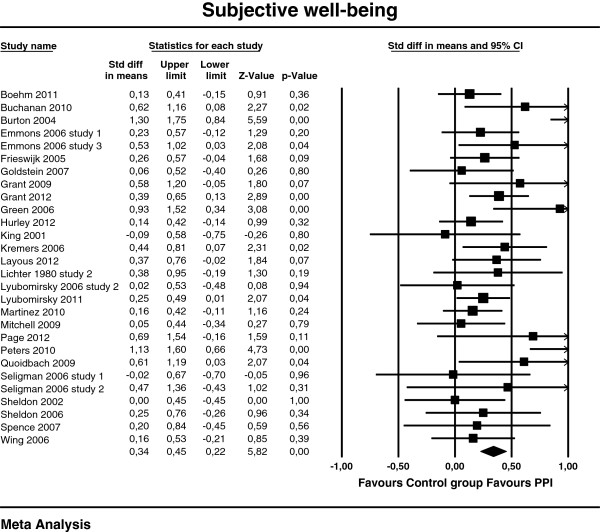
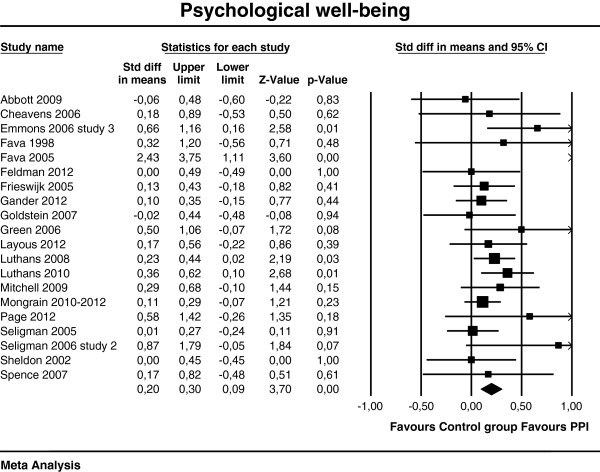
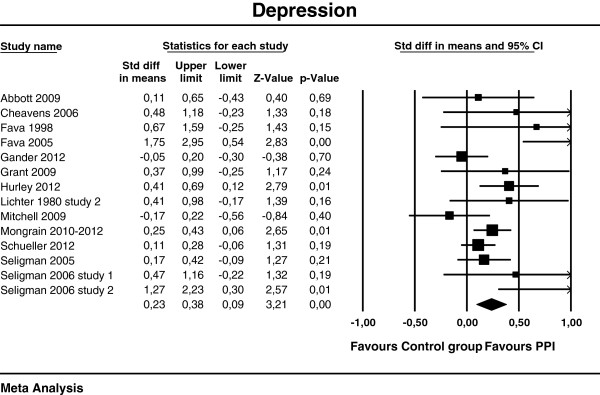
- Across all included studies, the pooled standardized mean differences were 0.34 for subjective well-being, 0.20 for psychological well-being, and 0.23 for depression, which the authors describe as small effects.
- At follow-up of 3–6 months (10 studies), effects remained significant for subjective well-being (d = 0.22, 95% CI [0.05, 0.38], p<.01) and psychological well-being (d = 0.16, 95% CI [0.02, 0.30], p=.03), but not for depression (d = 0.17, 95% CI [-0.06, 0.39], p=.15).
- Heterogeneity was moderate for subjective well-being (I² = 49.5%) and depression (I² = 47.0%), and low for psychological well-being (I² = 29.0%); effect sizes ranged from below 0 to as high as 2.4.
- For depression, larger effects were associated with longer duration, individual delivery, referral/hospital recruitment, inclusion of people with specific psychosocial problems, and lower study quality.
## Methods
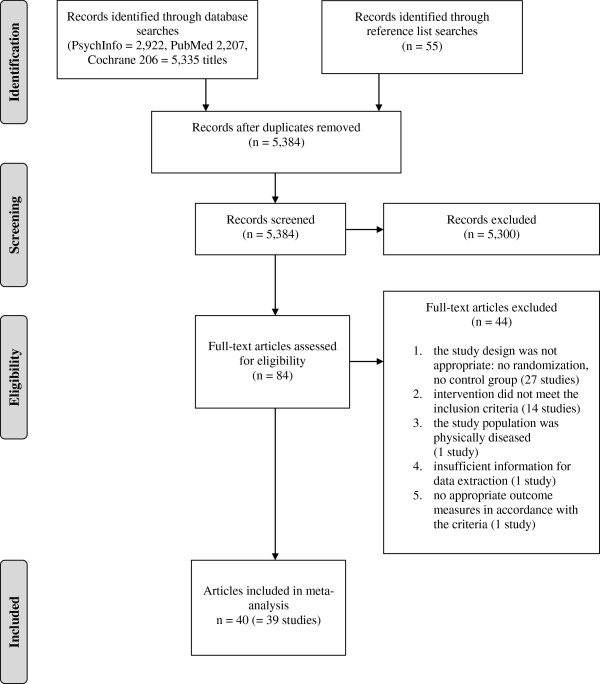
- Systematic review and meta-analysis of randomized controlled studies of positive psychology interventions, using PubMed, PsychInfo, the Cochrane Central Register of Controlled Trials, manual searches, and reference checking, covering 1998 to November 2012.
- Included 40 articles describing 39 studies with 6,139 participants; intervention formats included self-help, group training, and individual therapy.
- Main analysis used Cohen’s d under a random-effects model for three outcomes: subjective well-being, psychological well-being, and depression, with subgroup analyses and checks for heterogeneity and publication bias.
## Limitations
- The paper states that study quality was not high: no study met all quality criteria, randomization was often unclear, intention-to-treat analysis was rare (3/39 studies), and none reported an adequate power analysis.
- The authors note that heterogeneity was rather high because the included studies were diverse, and that the follow-up findings should be treated with caution because of the small number of studies and high attrition rates at follow-up.
- The text makes evident that publication bias is a limitation: funnel plots were asymmetric, fail-safe numbers were below the required thresholds, and Egger’s test suggested bias for psychological well-being and depression.
Model-written summary. Check it against the paper before relying on it.
Integrity signals
Registry
Cites
Statistics
Figures
Verification
Claims the paper makes
8 Valid · 2 Not valid · 9 Not checked · 90 Own results and interpretations
The cited sources that could be checked couldn’t confirm or dispute this claim.
In the paper
“First, the meta-analysis included both randomized studies and quasi-experimental studies.”
§ Positive psychology interventions: a meta-analysis of randomized controlled studies > Background
What the sources say
- Could not verifycites Sin and Lyubomirsky (2009) matched to “Enhancing well-being and alleviating depressive symptoms with positive psychology interventions: a practice-friendly meta-analysis” (2009) sourceExperimental — accuracy not yet measured
The Literature Search section requires included studies to have a comparison group, and Data Recorded distinguishes self-selected from non-self-selected participants. Neither passage establishes whether the meta-analysis included both randomized and quasi-experimental studies; searches for those design terms and for random assignment found no decisive passage. Page numbers were unavailable in our copy. (LLM, conf=0.72)
plain- Asserted: passes — The authors put it forward as true.
- Checkable: passes — It can be checked against evidence.
- Load-bearing: unclear — It is unclear whether the paper’s conclusions depend on it.
- Based: passes — The paper gives a reason why it holds.
- Could not verify
The cited sources support only part of this claim — read each source’s verdict below.
In the paper
“Their results show that PPIs can indeed be effective in enhancing well-being (r = 0.29, standardized mean difference Cohen’s d = 0.61) and help to reduce depressive symptom levels in clinical populations (r = 0.31, Cohen’s d = 0.65).”
§ Positive psychology interventions: a meta-analysis of randomized controlled studies > Background
What the sources say
- Partly supportedcites Sin and Lyubomirsky (2009) matched to “Enhancing well-being and alleviating depressive symptoms with positive psychology interventions: a practice-friendly meta-analysis” (2009) sourceExperimental — accuracy not yet measured
The Depression section reports that PPIs reduced depressive symptoms across 25 studies, with a mean effect of r = .31. The Participant Moderators section distinguishes depressed from nondepressed participants, so .31 is not an estimate specifically for clinical populations. The paper reports the effect as r, not as Cohen’s d = .65. (LLM, conf=0.87)
plainstates a cause- Asserted: passes — The authors put it forward as true.
- Checkable: passes — It can be checked against evidence.
- Load-bearing: unclear — It is unclear whether the paper’s conclusions depend on it.
- Based: passes — The paper gives a reason why it holds.
- Partly supported
Every source the paper cites for this claim was checked and supports it.
In the paper
“Their results show that PPIs can indeed be effective in enhancing well-being (r = 0.29, standardized mean difference Cohen’s d = 0.61) and help to reduce depressive symptom levels in clinical populations (r = 0.31, Cohen’s d = 0.65).”
§ Positive psychology interventions: a meta-analysis of randomized controlled studies > Background
What the sources say
- Supportedcites Sin and Lyubomirsky (2009) matched to “Enhancing well-being and alleviating depressive symptoms with positive psychology interventions: a practice-friendly meta-analysis” (2009) source
The Well-Being section reports that PPIs significantly improved well-being across 49 studies, with a mean r of .29. The paper reports r rather than Cohen’s d; converting .29 to d gives approximately .61, so the cited figures are consistent. (LLM, conf=0.90)
plainstates a cause- Asserted: passes — The authors put it forward as true.
- Checkable: passes — It can be checked against evidence.
- Load-bearing: passes — The paper’s conclusions depend on it.
- Based: passes — The paper gives a reason why it holds.
- Supported
Every source the paper cites for this claim was checked and supports it.
In the paper
“Second, study quality was not addressed as a potential effect moderator.”
§ Positive psychology interventions: a meta-analysis of randomized controlled studies > Background
What the sources say
- Supportedcites Sin and Lyubomirsky (2009) matched to “Enhancing well-being and alleviating depressive symptoms with positive psychology interventions: a practice-friendly meta-analysis” (2009) source
The Data Recorded section lists the variables coded for moderator analysis: participant characteristics, intervention format and duration, and comparison-group type. It does not include study quality, and the Methodological Moderators section discusses those methodological variables rather than study quality. Page numbers are unavailable in our copy. (LLM, conf=0.88)
plain- Asserted: passes — The authors put it forward as true.
- Checkable: passes — It can be checked against evidence.
- Load-bearing: unclear — It is unclear whether the paper’s conclusions depend on it.
- Based: passes — The paper gives a reason why it holds.
- Supported
Every source the paper cites for this claim was checked and supports it.
In the paper
“Remarkably, effect sizes in the current meta-analysis are around 0.3 points lower than the effect sizes in the meta-analysis by Sin and Lyubomirsky (2009) [37].”
§ Positive psychology interventions: a meta-analysis of randomized controlled studies > Discussion > Main findings
What the sources say
- Supportedcites Sin and Lyubomirsky (2009) [37] matched to “Enhancing well-being and alleviating depressive symptoms with positive psychology interventions: a practice-friendly meta-analysis” (2009) source
The Well-Being and Depression results report mean effect sizes of r = .29 and r = .31, respectively, establishing the values attributed to Sin and Lyubomirsky’s meta-analysis. The difference from the current meta-analysis is the citing authors’ comparison, not a finding this source could report. (LLM, conf=0.88)
plain- Asserted: passes — The authors put it forward as true.
- Checkable: passes — It can be checked against evidence.
- Load-bearing: passes — The paper’s conclusions depend on it.
- Based: passes — The paper gives a reason why it holds.
- Supported
70 more claims · 1 with their cited sources checked
Create a free account to see all 109 claims and to verify the 1 reference still open.
- Probably not a substantial claim. 14
- It may state two separate claims as one. 23
Claims other papers make about this one
Each is checked against this paper’s own text: does it say what the citing paper says it does?
The source backs part of the claim, not all of it — or backs it for a different population, condition or comparison.
In the citing paper
“In contrast to complex multicomponent health behavior or psychology interventions, PP exercises are simple, can be delivered remotely (e.g., by phone), and require minimal training of providers [34, 41, 42].”
From Positive Psychological Interventions for Patients with Type 2 Diabetes: Rationale, Theoretical Model, and Intervention Development (2015) · cites this paper as [41]
Experimental — accuracy not yet measuredThe source backs part of the claim, not all of it — or backs it for a different population, condition or comparison.
In the citing paper
“Studies supporting the efficacy of positive activity interventions (PAIs) have been primarily conducted in unselected (non-clinical) community samples and examined single positive activities in isolation (for a meta-analysis, see66, 67).”
From Upregulating the positive affect system in anxiety and depression: Outcomes of a positive activity intervention: Taylor et al. (2017) · cites this paper as [67]
Experimental — accuracy not yet measuredThe source backs part of the claim, not all of it — or backs it for a different population, condition or comparison.
In the citing paper
“Two meta-analyses of PPIs for depression and well-being found that these interventions have small to moderate effects in enhancing well-being and decreasing depressive symptoms and that effects are stronger for individual vs. group formats [30, 31].”
From Skills to Enhance Positivity in adolescents at risk for suicide: Protocol for a randomized controlled trial (2023) · cites this paper as [31]
Experimental — accuracy not yet measuredThe source backs part of the claim, not all of it — or backs it for a different population, condition or comparison.
In the citing paper
“Bolier and Abello (Bolier et al., 2013) reviewed digital PPIs and found that the majority of the included studies showed improvement in well-being or reduction of distress in the intervention group, compared to the control group.”
From Strength Back – A qualitative study on the co-creation of a positive psychology digital health intervention for spinal surgery patients (2023) · cites this paper as Bolier et al., 2013
Experimental — accuracy not yet measuredThe source backs part of the claim, not all of it — or backs it for a different population, condition or comparison.
In the citing paper
“PPIs may support patients to notice and savour positive experiences (Bolier et al., 2013). This may strengthen their commitment to value-based action.”
From Strength Back – A qualitative study on the co-creation of a positive psychology digital health intervention for spinal surgery patients (2023) · cites this paper as Bolier et al., 2013
Experimental — accuracy not yet measured
24 more claims about this paper
Create a free account to see every claim other papers make about this one.
Statistics recomputed
Every reported test result, recomputed from its test statistic and degrees of freedom. A result shows as not adding up only once an independent check has confirmed it.
- Consistentz = 6.43reported p < .01 · recomputed p < .001
“Z=6.43, p < .01”
- Consistentz = 4.18reported p < .01 · recomputed p < .001
“Z=4.18, p < .01”
- Consistentz = 3.33reported p < .01 · recomputed p < .001
“Z=3.33, p < .01”
Self-check
Percentages, sums and reported differences re-computed from the paper’s own numbers.
Self-check results appear here once an independent check has confirmed them.
Citations
Cites
Preferred Reporting Items for Systematic Reviews and Meta-Analyses: the PRISMA statement
Moher, D., Liberati, A., Tetzlaff, J., Altman, D. G., & for the PRISMA Group (2009) · BMJ · doi:10.1136/bmj.b2535 · Cited by 83,823
Preferred Reporting Items for Systematic Reviews and Meta-Analyses: The PRISMA Statement
Moher, D., Liberati, A., Tetzlaff, J., Altman, D. G., & The PRISMA Group (2009) · PLoS Medicine · doi:10.1371/journal.pmed.1000097 · Cited by 64,042 · cited 1×
“For the reporting of the results of this meta-analysis, we applied Preferred Reporting Items for Systematic Reviews and Meta-Analyses (PRISMA) guidelines [50].”
Measuring inconsistency in meta-analyses
Higgins, J. P. T., Thompson, S. G., Deeks, J. J., & Altman, D. G. (2003) · BMJ · doi:10.1136/bmj.327.7414.557 · Cited by 63,139 · cited 1×
“A value of 0% indicates an absence of dispersion, and larger values show increasing levels of heterogeneity where 25% can be considered as low, 50% as moderate and 75% as a high level of heterogeneity [46].”
Preferred reporting items for systematic reviews and meta-analyses: the PRISMA Statement.
(2009) · PubMed Central · Cited by 44,859
Cochrane Handbook for Systematic Reviews of Interventions: Cochrane Book Series
(2008) · doi:10.1002/9780470712184 · Cited by 25,048
Preferred Reporting Items for Systematic Reviews and Meta-Analyses: The PRISMA Statement
Moher, D., Liberati, A., Tetzlaff, J., & Altman, D. G. (2009) · Journal of Clinical Epidemiology · doi:10.1016/j.jclinepi.2009.06.005 · Cited by 19,575
Happiness is everything, or is it? Explorations on the meaning of psychological well-being.
Ryff, C. D. (1989) · Journal of Personality and Social Psychology · doi:10.1037/0022-3514.57.6.1069 · Cited by 14,847 · cited 1×
“Psychological well-being focuses on the optimal functioning of the individual and includes concepts such as mastery, hope and purpose in life [13,14].”
Borenstein, M., Hedges, L. V., Higgins, J. P. T., & Rothstein, H. R. (2009) · doi:10.1002/9780470743386 · Cited by 14,225
Duval, S., & Tweedie, R. (2000) · Biometrics · doi:10.1111/j.0006-341x.2000.00455.x · Cited by 14,099 · cited 1×
“If asymmetry is found in the funnel plot, the Trim and Fill method adjusts the pooled effect size for the outcomes of missing studies [49].”
Subjective well-being: Three decades of progress.
Diener, E., Suh, E. M., Lucas, R. E., & Smith, H. L. (1999) · Psychological Bulletin · doi:10.1037/0033-2909.125.2.276 · Cited by 12,910 · cited 2×
“Although the basic concepts of well-being, happiness and human flourishing have been studied for some decades [12,25-27], there was a lack of evidence-based interventions [24].”
Research works printed but not linked: 3
- Rupke SJ Blecke D Renfrow M Cognitive Therapy for Depression Am Fam Physician 2006 73 83 86 16417069
- Veenhoven R Gezond geluk: Effecten van geluk op gezondheid en wat dat kan betekenen voor de preventieve gezondheidszorg (Healthy happiness: effect of happiness on health and what this could mean for preventive public health) 2006 Rotterdam: Erasmus Universiteit
- Lamers S Bolier L Westerhof GJ Smit F Bohlmeijer E The impact of emotional well-being on long-term recovery and survival in physical illness: a meta-analysis J Behav Med 2012 5 538 547 21918889 PMC3439612 · DOI · Paper page
Cited by
Items 1,901–2,000 of 2,037
The effect of a positive psychology intervention on adolescents' depression, hope, and optimism
ÇEVİK, Ö., & Tanhan, F. (2026) · Acta Psychologica · doi:10.1016/j.actpsy.2026.106724 · Cited by 1
Andonian, C., Beckmann, J., Freiberger, A., & Huber, M. (2024) · Springer eBooks · doi:10.1007/978-3-031-32046-0_7-1
Exkurs: Die Sicht auf das Positive und Stärkende
Lackner, R. (2021) · Springer eBooks · doi:10.1007/978-3-662-62482-1_18
Meiring, L., van Eeden, R., & Fadiji, A. W. (2026) · SA Journal of Human Resource Management · doi:10.4102/sajhrm.v24i0.3486
Muller, M. K., Wigman, J. T. W., Booij, S. H., van den Berg, D. P. G., Schoevers, R. A., Staines, L., van der Tuin, S., & Morosan, L. (2026) · Psychological Medicine · doi:10.1017/s0033291726105558
“…strengths, enhance well-being, and foster social engagement (within the positive psychology framework) could be a promising avenue to reduce risk in these early stages (Bolier et al., 2013; Chakhssi, Kraiss, Sommers-Spijkerman, & Bohlmeijer, 2018; Hendriks et al., 2020; Valiente et al., 2020).”
Hoppe, A., & Michel, A. (2022) · Springer eBooks · doi:10.1007/978-3-658-28651-4_4
Gasser-Müller, P., & Braune‐Krickau, K. (2026) · Zürcher Hochschule für Angewandte Wissenschaften digital collection (Zurich University of Applied Sciences) · doi:10.21256/zhaw-37031
Larochette, C. (2020) · theses.fr (ABES) · doi:10.70675/3d8105acz6ee0z43a6z8debz132ec6a6d579 · Cited by 1
Konzeptioneller Hintergrund & zugrundeliegende Interventionsansätze
Tran-Huu, S. F. (2025) · Springer eBooks · doi:10.1007/978-3-658-46965-8_3
A mixed-methods look at college student well-being during COVID-19: the power of positive psychology
Alexander, K. (2022) · MOspace Institutional Repository (University of Missouri) · doi:10.32469/10355/93942
Excursus: The View of the Positive and Strengthening
Lackner, R. (2024) · Springer eBooks · doi:10.1007/978-3-662-67480-2_18
Campion, J. (2018) · Cambridge University Press eBooks · doi:10.1017/9781911623038.026
Positive Interventions and Theoretical Assumptions
Rashid, T., & Seligman, M. (2018) · Oxford University Press eBooks · doi:10.1093/med-psych/9780195325386.003.0002 · Cited by 1
New Technologies and Interventions to Improve the Mental Health of People with Diabetes
Adeel, A., Kannangara, C. S., Bharaj, H., Basu, A., & Green, B. (2023) · Lecture notes in networks and systems · doi:10.1007/978-3-031-37164-6_53
Tomlin, L., Budden, T., Simpson, A., Kingdon, T., Gucciardi, D. F., Jeftic, I., Dimmock, J. A., Norsworthy, C., Borelli, J. L., Brophy‐Herb, H. E., et al. (2026) · Teaching and Teacher Education · doi:10.1016/j.tate.2026.105810 · Cited by 2
The Science & Practice of Positive Psychology WHITE PAPER
Langley, S., & Francis, S. (2016) · Cited by 3
Early-Life Contributors to Child Well-Being
Lifschitz, C. H., & Lin, W. (2019) · Annals of Nutrition and Metabolism · doi:10.1159/000499153
Mental Illness through the Lens of Mindfulness
Dobkin, P. L., & Monshat, K. (2020) · Oxford University Press eBooks · doi:10.1093/oxfordhb/9780198808640.013.33
Crăciun, I. C. (2023) · Springer eBooks · doi:10.1007/978-3-031-24449-0_13
Network Analysis of Art Therapy Participation Willingness in Older Adults
吕, 延. (2026) · Advances in Psychology · doi:10.12677/ap.2026.169432
The Landscape of Positive Psychology in Foreign Language Teaching: A Bibliometric Analysis
Azad, M. T. (2025) · IGI Global eBooks · doi:10.4018/979-8-3373-2449-4.ch012
Family Relations, Friendships, and Love
Alsup, S., Weisbaum, E., Vogel, T., & Siegel, D. J. (2020) · Cambridge University Press eBooks · doi:10.1017/9781108650182.047 · Cited by 2
Sites of meaning-making: Places of attachment afford psychological meaning
Krause, A. N., Wienk, M. N. A., Baldwin, M. W., Titova, L., Passmore, H., Webster, G. D., & Westgate, E. C. (2026) · Journal of Environmental Psychology · doi:10.1016/j.jenvp.2026.102958 · Cited by 3
Positive Psychological Coaching: An investigation on its efficacy in the workplace
Corbu, A., & Corbu, A. (2023) · Tesis Doctorals en Xarxa (Consorci de Serveis Universitaris de Catalunya) · doi:10.6035/14109.2023.486784
Young, J. H. (2016) · Wiley eBooks · doi:10.1002/9781118938003.refs
Enhancing EFL Writing Performance Through Differentiated Positive Psychology Interventions
Ariyanti, A., Setiawan, S., Munir, A., Suhartono, S., & Anam, S. (2024) · Advances in educational technologies and instructional design book series · doi:10.4018/979-8-3693-6497-0.ch008
Sessions, Practices, and the Therapeutic Process
Rashid, T., & Seligman, M. (2018) · Oxford University Press eBooks · doi:10.1093/med-psych/9780195325386.003.0006
Ogden, L. P. (2023) · Journal of Psychosocial Rehabilitation and Mental Health · doi:10.1007/s40737-023-00373-0 · Cited by 1
“Evidence shows that PPIs effectively enhance mood, character strengths, wellbeing, and address symptoms of depression and anxiety (Bolier et al., 2013; Carr et al., 2021; Donaldson et al., 2014; Cohn & Fredrickson, 2010; Pan et al., 2022).”
Vescovelli, F. (2020) · Online Journal of Complementary & Alternative Medicine · doi:10.33552/ojcam.2019.03.000569
“Further, there has been an increased focus on implementing positive interventions in clinical settings and in combination with existing psychotherapeutic strategies, such as cognitive behavioural therapy [27,28].”
BackgroundRashid, T., & Seligman, M. E. P. (2018) · Oxford University Press eBooks · doi:10.1093/med-psych/9780195325386.003.0012
Hu, Y., Wu, X. C., Yang, Y., Su, F., Li, M., & Wang, D. (2026) · Psychotherapy Research · doi:10.1080/10503307.2026.2689626 · Cited by 1
Hoppe, A., & Michel, A. (2021) · Springer eBooks · doi:10.1007/978-3-658-28654-5_4-1
Wellness management and positive psychology app for smartphone platforms.
Στρατάκη, Ε., & Strataki, E. (2017)
More than Leisure: Artistic Performance and the Well-being of Vietnamese Lecturers
Tran, N. B. C., Phương, H. Y., & Nguyễn, M. T. (2025) · F1000Research · doi:10.12688/f1000research.171806.1
Positive Psychologie und Lebenskunst im klinischen Kontext
Lang, J., Georg, M., Groetsch, L., Ahrens, K., & Wuttke, A. (2017) · Springer eBooks · doi:10.1007/978-3-662-55251-3_12 · Cited by 1
Food for thought: The role of ethical eating in mental health
Pande, P. (2019)
Șușnea, I., Pecheanu, E., Cocu, A., & Simona, S. (2024) · doi:10.31234/osf.io/knscf
Sunding, B. A. (2015) · Journal of Psychology & Clinical Psychiatry · doi:10.15406/jpcpy.2015.02.00084 · Cited by 2
“During the last decade, positive psychologists have widely researched human strengths such as resiliency, positive emotions such as happiness and concepts such as life satisfaction [20-22].”
BackgroundRoss, C. (2016) · Open Access Victoria University of Wellington | Te Herenga Waka (Figshare) · doi:10.26686/wgtn.17019263 · Cited by 2
Positive psychology's role in the training of health professionals: Looking into the future
Marujo, H. Á. (2023) · Elsevier eBooks · doi:10.1016/b978-0-443-15248-1.00011-4 · Cited by 2
Akhter, S., Kumar, T., & Shaheen, M. (2026) · Frontiers in Psychology · doi:10.3389/fpsyg.2026.1812638 · Cited by 3
A Control Theory Approach to Understanding the Dynamics of Cognitive Wellbeing
Șușnea, I., Pecheanu, E., Cocu, A., Iacobescu, P., Tudorie, C., & Susnea, S. (2025) · Social Sciences · doi:10.3390/socsci14030158
Wohlbefinden, Leistungsfähigkeit und mentale Gesundheit von Lehrenden und Studierenden
Mörth, M., & Wiechert, J. (2025) · Zeitschrift für Hochschulentwicklung · doi:10.21240/zfhe/20-1/15
Miller, G. (2020) · Wiley eBooks · doi:10.1002/9781394258987.refs
Happiness strategies among Arab university students in the United Arab Emirates
Lambert, L., & Pasha-Zaidi, N. (2014) · Cited by 33
Ramos, S. D. A., Cunanan, A. L. P., Arcega, P. A. S., & Bernardo, A. B. I. (2026) · Substance Use & Addiction Journal · doi:10.1177/29767342261490083
Session Two: Character Strengths and Signature Strengths
Rashid, T., & Seligman, M. E. P. (2018) · Oxford University Press eBooks · doi:10.1093/med-psych/9780195325386.003.0008
Session Fifteen: Meaning and Purpose
Rashid, T., & Seligman, M. E. P. (2018) · Oxford University Press eBooks · doi:10.1093/med-psych/9780195325386.003.0021
Carr, A. (2020) · Springer eBooks · doi:10.1007/978-3-319-69909-7_2218-2
Minorities and Culture: Positive Psychiatry and Psychology Perspectives
Duncan, G. N., Japa, K., McKnight, S., & Gogineni, R. R. (2025) · Springer eBooks · doi:10.1007/978-3-031-94645-5_20
Gueta, T. Y., Lamash, L., & Stern, A. (2026) · Frontiers in Public Health · doi:10.3389/fpubh.2025.1713205
“Addressing how adolescents perceive their diagnosis and engage in relationships may guide more tailored interventions to strengthen social-emotional resources and foster adaptive identity development (68, 69).”
Lehrpersonen im Fokus: Ansätze für die Förderung von Gesundheit und Leistungsmotivation
Schoch, S., & Keller, R. (2024) · BzL - Beiträge zur Lehrerinnen- und Lehrerbildung · doi:10.36950/bzl.42.1.2024.10365 · Cited by 3
Positive Psychology Interventions for Enhancing Well-being
Shabila, B. (2026) · RESEARCH HUB International Multidisciplinary Research Journal · doi:10.31305/rhimrj.2026.v13n09.004
Rathi, M., & Basu, J. (2026) · Indian Journal of Private Psychiatry · doi:10.5005/jp-journals-10067-0200
Ogle, R. R. (2019) · FIU - Digital Commons (Florida International University) · doi:10.25148/etd.fidc007707
Rashid, T., & Seligman, M. (2018) · Oxford University Press eBooks · doi:10.1093/med-psych/9780195325386.002.0006
Holzrichter, T., & Santer, M. (2023) · Springer eBooks · doi:10.1007/978-3-662-63257-4_7
Afifi, S. Y., Fekry, M., Sallam, A., Alghamdi, A. S. S., Almuqahwi, M. S. A., & Ali, M. I. (2026) · Middle East Current Psychiatry · doi:10.1186/s43045-026-00635-0
Robles, V. A. G. (2019) · Tesis Doctorals en Xarxa (Consorci de Serveis Universitaris de Catalunya) · doi:10.6035/14109.2019.233592
Pauscik, M., & Lantheaume, S. (2019) · In Press eBooks · doi:10.3917/pres.lanth.2019.01.0048
Smoking cessation using positive psychology intervention
Shimai, S. (2016) · The Japanese Journal of Health Psychology · doi:10.11560/jahp.28.special_issue_103
Rashid, T., & Seligman, M. (2018) · Oxford University Press eBooks · doi:10.1093/med-psych/9780195325386.005.0002
Martin, F., Glover, S.-L., van Even, S., & Turner, A. (2026) · doi:10.2196/preprints.77434
Louy, C., Sweet, C., Pollock, G. A., de Zagon, C., Louy, Z., Weiss, J. M., & Maher, D. P. (2020) · Cambridge University Press eBooks · doi:10.1017/9781108650182.017
Exploring the role of eudemonic wellbeing in motivating health behavior: A brief experimental studyPreprint
Marrero, A., Wyland, C. L., & Wilson, M. J. (2021) · Research Square · doi:10.21203/rs.3.rs-173404/v1
Anderson, N. A., Huguenel, B. M., Bohnert, A., & Conley, C. S. (2021) · Journal of College Orientation Transition and Retention · doi:10.24926/jcotr.v28i1.3597
“, 2010; Leary & DeRosier, 2012) and positive affect is associated with higher quality of life, greater well-being, and lower levels of depression (Besser & Zeigler-Hill, 2014; Bolier et al., 2013; Schiffrin & Nelson, 2010).”
BackgroundInfluentialThe Digital Five Ways to Wellbeing Intervention: Long-Term Change in Life Satisfaction
Prydz, M. B., Røysamb, E., Czajkowski, N. O., & Nes, R. B. (2026) · Applied Research in Quality of Life · doi:10.1007/s11482-026-10628-0
“Interventions rooted in positive psychology (positive psychology interventions, PPI) have shown to effectively enhance wellbeing (Bolier et al., 2013; Carr et al., 2020; Hendriks et al., 2019; Sin & Lyubomirsky, 2009), with effects lasting up to 7.5 months (Carr et al., 2024).”
InfluentialScreening and Assessment Methods for Wellness
Greenberg, J. M., Castillo, E. G., IsHak, W. W., & Wells, K. B. (2020) · Cambridge University Press eBooks · doi:10.1017/9781108650182.002
Coenen, T., Maerevoet, M., Chen, S., Brouwer, M. D., Hoecke, S. V., Koster, E. H. W., Abeele, M. V., & Bombeke, K. (2025) · JMIR mhealth and uhealth · doi:10.2196/67141 · Cited by 5
“Researchers provided ample empirical support in favor of positive psychology practices alleviating depressive symptoms and enhancing well-being [106-109].”
Lunov, V., & Rozhkova, I. (2025) · Наукові інновації та передові технології · doi:10.52058/2786-5274-2025-6(46)-1821-1837
Greenway, T. S., Nelson, J. M., Wingate, D., Granic, I., Woodiwiss, C., Moriarty, G., & Schnitker, S. A. (2026) · International Journal of Applied Positive Psychology · doi:10.1007/s41042-026-00272-2
“Indeed, though many effective positive psychology interventions have been identified (Bolier et al., 2013), an implementation gap still exists (Skolarus & Williams, 2024).”
How generative AI reshapes gratitude interventions: Benefits and risks
Zeng, P.-Y., Chang, K.-Y., Lin, K.-Y., & Yeh, S. (2026) · Computers in Human Behavior Artificial Humans · doi:10.1016/j.chbah.2026.100333
Suicide and Youth: Positive Psychology Perspective
Banerjee, T., & Reddy, K. J. (2023) · Springer eBooks · doi:10.1007/978-981-99-4969-4_19
Turner, J., Roberts, R., Chen, J., & Proeve, M. J. (2025) · Australian Journal of Education · doi:10.1177/00049441251344371 · Cited by 1
“For instance, there is evidence to suggest that interventions that utilise positive psychology principles are effective in lowering levels of anxiety and depression in adolescents (Bolier et al., 2013; Carr et al., 2021).”
Ruit, P. (2021) · University of Groningen research database (University of Groningen / Centre for Information Technology) · doi:10.33612/diss.181608974 · Cited by 1
Gasser-Müller, P., & Braune‐Krickau, K. (2026) · Schweizerische Zeitschrift für Heilpädagogik/Schweizerische Zeitschrift für Heilpädagogik · doi:10.57161/z2026-06-07
Varay, C., & Baeza‐Velasco, C. (2025) · Psychologie Française · doi:10.1016/j.psfr.2025.01.002
Varay, C., & Baeza‐Velasco, C. (2024) · International Journal of Applied Positive Psychology · doi:10.1007/s41042-024-00165-2 · Cited by 1
“While research has abundantly demonstrated the effectiveness of these interventions (Bolier et al., 2013; Sin & Lyubomirsky, 2009), understanding the factors related to mental well-being remains largely unexplored (Rusk & Waters, 2015).”
Cognitive and physical age-gaps in relation to mild cognitive impairment and behavioral phenotypesPreprint
Yu, J., Ng, T. K. S., & Mahendran, R. (2023) · Research Square · doi:10.21203/rs.3.rs-2437986/v2
Marin, K., Tobia, G., Bakhoum, A., Naghdechi, L., Korouri, S., & IsHak, W. W. (2020) · Cambridge University Press eBooks · doi:10.1017/9781108650182.027 · Cited by 1
Tezanos, K. M., Macrynikola, N., Villareal, L., Doerr, J., Suazo, N., Whiteley, L., & Yen, S. (2026) · PLoS ONE · doi:10.1371/journal.pone.0350008
Positive psychology interventions in sports: A systematic review
Riedl, N. R., Geisen, M., & Klatt, S. (2026) · Performance Enhancement & Health · doi:10.1016/j.peh.2026.100436 · Cited by 1
Psychology, Skills, or Cash? Evidence from Women's Workshops in RwandaPreprint
Lang, M., Soule, E., & Tinsley, C. H. (2022) · SSRN Electronic Journal · doi:10.2139/ssrn.4062717
Work, Love, Play, and Joie de Vivre
Groningen, N. V., IsHak, W. W., Ganjian, S., Ong, M. K., & Slusser, W. M. (2020) · Cambridge University Press eBooks · doi:10.1017/9781108650182.045
Utayde, M. F., Wilson, K. A., MacDonald, S. E., Park, H. J., Stevens, S. M., Maffly‐Kipp, J., Peters, B. R., & MacNamara, A. (2026) · Journal of Affective Disorders · doi:10.1016/j.jad.2026.121219
A Bayesian framework for happiness, health, and psychological well-being
Mauro, F. (2026) · Frontiers in Psychology · doi:10.3389/fpsyg.2026.1778763
“…and quality of life, not only symptoms, with medium average effects and durable follow-up outcomes; common factors (e.g., alliance, goal consensus) explain much of this benefit, and specific methods refine it (Cuijpers et al., 2021; Bolier et al., 2013; Wampold and Imel, 2015; Hofmann et al., 2012).”
Peculiarities of consultative and therapeutic process in positive psychology
Danylchenko, T. V. (2021) · Scientific Herald of Sivershchyna Series Education Social and Behavioural Sciences · doi:10.32755/sjeducation.2021.02.060
Session Twelve: Positive Relationships
Rashid, T., & Seligman, M. E. P. (2018) · Oxford University Press eBooks · doi:10.1093/med-psych/9780195325386.003.0018
Albieri, E. (2014) · AMS Dottorato Institutional Doctoral Theses Repository (University of Bologna) · doi:10.6092/unibo/amsdottorato/6405
Vandy, J. F. (2023) · World Journal of Advanced Research and Reviews · doi:10.30574/wjarr.2023.18.1.0564
Efetividade de intervenção psicológica positiva on-line para profissionais na pandemia de covid-19
Durgante, H. B., Mariuzzi, J., Schmidt, B., Girelli, T. P., Fernandes, J. R., Marquez, M. F., & Dell’Aglio, D. D. (2025) · Avances en Psicología Latinoamericana · doi:10.12804/revistas.urosario.edu.co/apl/a.11652
“…este estudo tem caráter inovador ao introduzir a aplicação de abordagens da terapia cognitivo-comportamental (Knapp & Beck, 2008), com ênfase na redução da doença, ampliando o modo de atuação por meio de dinâmicas e técnicas alicerçadas em perspectivas da psicologia positiva (Bolier et al .”
Stinson, D. A., & Swann, W. B. (2017) · Emerald Group Publishing Limited eBooks · doi:10.1108/978-1-64113-004-220251010 · Cited by 2
Pérez, J. G. (2016) · doi:10.3990/1.9789036542258 · Cited by 26
Anderson, L. (2019) · University of Minnesota Digital Conservancy (University of Minnesota) · Cited by 1
Metadata
- Authors
- Bolier, L., Haverman, M., Westerhof, G. J., Riper, H., Smit, F., & Bohlmeijer, E.
- Affiliations
- Trimbos Institute (NL)
- University of Twente (NL)
- Leuphana University of Lüneburg (DE)
- Corresponding author
- Bolier, Linda
- Venue
- BMC Public Health
- Published
- 2013-02-08
- Volume
- 13
- Issue
- 1
- Pages
- 119-119
- ISSN
- 1471-2458 (ISSN-L)
- PMC
- PMC3599475
- OpenAlex
- W2120582212
- Semantic Scholar
- 45fd44e9cff6334f80a54b3d327ced46d9b2d444
- Cited by
- 1,996
- References
- 115
- Citations by year
- 2026: 97 · 2025: 134 · 2024: 155 · 2023: 197 · 2022: 190 · 2021: 208 · 2020: 231 · 2019: 201 · 2018: 182 · 2017: 153 · 2016: 117 · 2015: 76 · 2014: 40 · 2013: 12
- FWCI
- 10.79
- Type
- journal article
- Language
- en
- Open access
- gold
- doi.org
- Licence
- Locations
- BMC Public Health (publishedVersion, cc-by)
- Europe PMC (PubMed Central) (publishedVersion, cc-by)
- PubMed Central (publishedVersion, cc-by)
- PubMed (publishedVersion)
- Pure Amsterdam UMC (publishedVersion, other-oa)
- Amsterdam UMC (VU Amsterdam) - Institutional Repository (publishedVersion, other-oa)
- Multilingual Matters (Channel View Publications) (acceptedVersion, cc-by)
- University of Twente Research Information (acceptedVersion, cc-by)
- Data Archiving and Networked Services (DANS) (submittedVersion, other-oa)
- Digital Academic REpository of VU University Amsterdam (Vrije Universiteit Amsterdam) (submittedVersion)
- VU Research Portal (submittedVersion, other-oa)
- University of Twente Research Information (submittedVersion, cc-by)
- Topics
- Social Sciences › Psychology › Social Psychology › Psychological Well-being and Life Satisfaction
- Social Sciences › Psychology › Clinical Psychology › Mindfulness and Compassion Interventions
- Social Sciences › Psychology › Applied Psychology › Optimism, Hope, and Well-being
- Keywords
- positive psychology interventions, subjective well-being, psychological well-being, depression, self-help intervention, group training, individual psychotherapy, mental health promotion, intervention effectiveness, publication bias, study quality
- MeSH terms
- Depression, Health Promotion, Humans, Psychotherapy, Randomized Controlled Trials as Topic, Treatment Outcome
About these checks
Registry, retraction, Cites and statistics results are computed, not judged, with one exception: a printed reference that no index lists is read once by a model before it counts as a citation error. Claims are extracted by a model and kept only when their quote appears verbatim in the text; each cited source is then checked, with a model’s help, for whether it says what the claim relies on. Those verdicts can be wrong — read the claim’s quote and the cited source before relying on one.
The claim verdicts this report counts are experimental: their accuracy is not yet measured.
A language model drew the claims from the paper on 2026-10-10, under version 3 of the claim definition (model deepseek-v4.1-flash, prompt extract-v3).
A second model labelled each claim on 2026-10-10 (model jev-1.13-20260917, definition revision gold-guideline-v0.2).
Cited sources are checked with a language model’s help (gpt-6-sol).
Statistics and arithmetic are recomputed, not judged.
Confidence bands are shown only for fields calibrated on our annotated test set. None is calibrated yet, so no band is shown.
What counts as a claim ›How we measure confidence ›How we check this ›
Are you an author, or do you see a problem with this page? Request a review
Data sources
Bibliographic data: Semantic Scholar, OpenAlex, Crossref.
Contains information from the Semantic Scholar Academic Graph Datasets, made available under the ODC Attribution License (ODC-BY 1.0).
Semantic Scholar’s data is described in: Kinney, R., et al. (2023). The Semantic Scholar Open Data Platform. arXiv:2301.10140.
