

Positive psychology interventions: a meta-analysis of randomized controlled studies
Open accessThe DOI matches its Crossref record; 109 of the 115 references it cites were found in a registry or an index; 10 of the 22 sources its claims cite were checked for support.
Abstract
BACKGROUND: The use of positive psychological interventions may be considered as a complementary strategy in mental health promotion and treatment. The present article constitutes a meta-analytical study of the effectiveness of positive psychology interventions for the general public and for individuals with specific psychosocial problems. METHODS: We conducted a systematic literature search using PubMed, PsychInfo, the Cochrane register, and manual searches. Forty articles, describing 39 studies, totaling 6,139 participants, met the criteria for inclusion. The outcome measures used were subjective well-being, psychological well-being and depression. Positive psychology interventions included self-help interventions, group training and individual therapy. RESULTS: The standardized mean difference was 0.34 for subjective well-being, 0.20 for psychological well-being and 0.23 for depression indicating small effects for positive psychology interventions. At follow-up from three to six months, effect sizes are small, but still significant for subjective well-being and psychological well-being, indicating that effects are fairly sustainable. Heterogeneity was rather high, due to the wide diversity of the studies included. Several variables moderated the impact on depression: Interventions were more effective if they were of longer duration, if recruitment was conducted via referral or hospital, if interventions were delivered to people with certain psychosocial problems and on an individual basis, and if the study design was of low quality. Moreover, indications for publication bias were found, and the quality of the studies varied considerably. CONCLUSIONS: The results of this meta-analysis show that positive psychology interventions can be effective in the enhancement of subjective well-being and psychological well-being, as well as in helping to reduce depressive symptoms. Additional high-quality peer-reviewed studies in diverse (clinical) populations are needed to strengthen the evidence-base for positive psychology interventions.
Overview
CoChat Summary
## TL;DR
This meta-analysis of 39 randomized studies (40 articles; 6,139 participants) found that positive psychology interventions had small but significant benefits for subjective well-being, psychological well-being, and depressive symptoms. Effects were somewhat sustained at 3–6 months for well-being outcomes, but study heterogeneity and publication bias were notable.
## Key findings
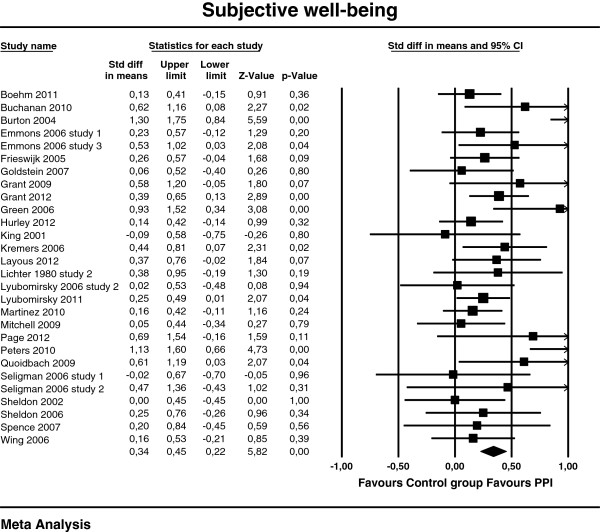
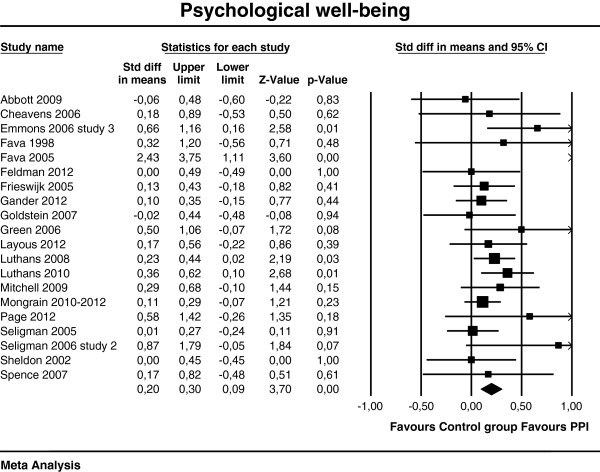
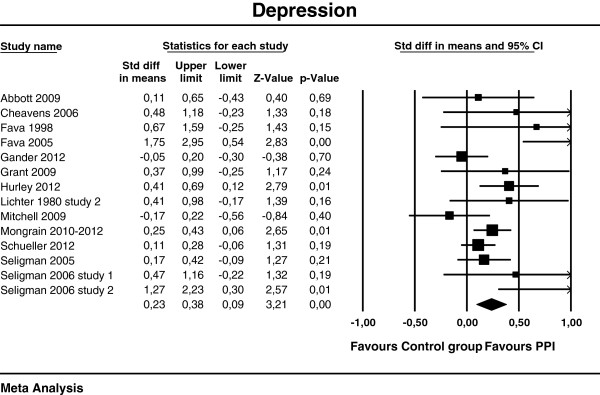
- Across all included studies, the pooled standardized mean differences were 0.34 for subjective well-being, 0.20 for psychological well-being, and 0.23 for depression, which the authors describe as small effects.
- At follow-up of 3–6 months (10 studies), effects remained significant for subjective well-being (d = 0.22, 95% CI [0.05, 0.38], p<.01) and psychological well-being (d = 0.16, 95% CI [0.02, 0.30], p=.03), but not for depression (d = 0.17, 95% CI [-0.06, 0.39], p=.15).
- Heterogeneity was moderate for subjective well-being (I² = 49.5%) and depression (I² = 47.0%), and low for psychological well-being (I² = 29.0%); effect sizes ranged from below 0 to as high as 2.4.
- For depression, larger effects were associated with longer duration, individual delivery, referral/hospital recruitment, inclusion of people with specific psychosocial problems, and lower study quality.
## Methods
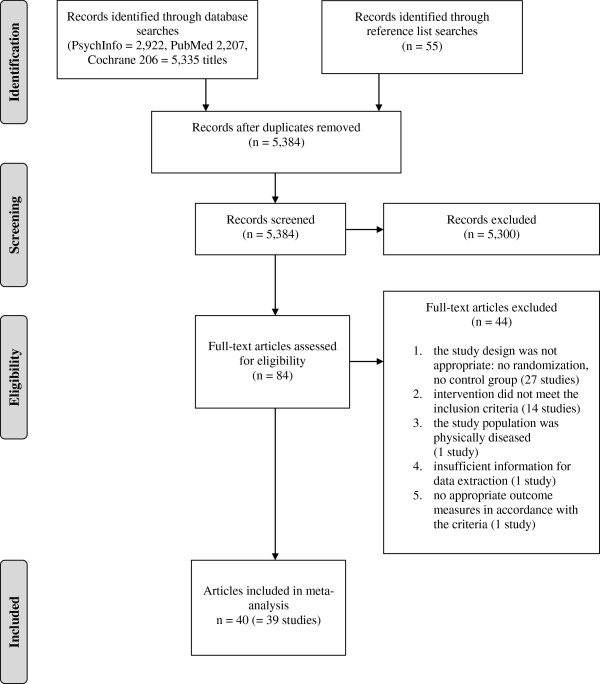
- Systematic review and meta-analysis of randomized controlled studies of positive psychology interventions, using PubMed, PsychInfo, the Cochrane Central Register of Controlled Trials, manual searches, and reference checking, covering 1998 to November 2012.
- Included 40 articles describing 39 studies with 6,139 participants; intervention formats included self-help, group training, and individual therapy.
- Main analysis used Cohen’s d under a random-effects model for three outcomes: subjective well-being, psychological well-being, and depression, with subgroup analyses and checks for heterogeneity and publication bias.
## Limitations
- The paper states that study quality was not high: no study met all quality criteria, randomization was often unclear, intention-to-treat analysis was rare (3/39 studies), and none reported an adequate power analysis.
- The authors note that heterogeneity was rather high because the included studies were diverse, and that the follow-up findings should be treated with caution because of the small number of studies and high attrition rates at follow-up.
- The text makes evident that publication bias is a limitation: funnel plots were asymmetric, fail-safe numbers were below the required thresholds, and Egger’s test suggested bias for psychological well-being and depression.
Model-written summary. Check it against the paper before relying on it.
Integrity signals
Registry
Cites
Statistics
Figures
Verification
Claims the paper makes
8 Valid · 2 Not valid · 9 Not checked · 90 Own results and interpretations
The cited sources that could be checked couldn’t confirm or dispute this claim.
In the paper
“First, the meta-analysis included both randomized studies and quasi-experimental studies.”
§ Positive psychology interventions: a meta-analysis of randomized controlled studies > Background
What the sources say
- Could not verifycites Sin and Lyubomirsky (2009) matched to “Enhancing well-being and alleviating depressive symptoms with positive psychology interventions: a practice-friendly meta-analysis” (2009) sourceExperimental — accuracy not yet measured
The Literature Search section requires included studies to have a comparison group, and Data Recorded distinguishes self-selected from non-self-selected participants. Neither passage establishes whether the meta-analysis included both randomized and quasi-experimental studies; searches for those design terms and for random assignment found no decisive passage. Page numbers were unavailable in our copy. (LLM, conf=0.72)
plain- Asserted: passes — The authors put it forward as true.
- Checkable: passes — It can be checked against evidence.
- Load-bearing: unclear — It is unclear whether the paper’s conclusions depend on it.
- Based: passes — The paper gives a reason why it holds.
- Could not verify
The cited sources support only part of this claim — read each source’s verdict below.
In the paper
“Their results show that PPIs can indeed be effective in enhancing well-being (r = 0.29, standardized mean difference Cohen’s d = 0.61) and help to reduce depressive symptom levels in clinical populations (r = 0.31, Cohen’s d = 0.65).”
§ Positive psychology interventions: a meta-analysis of randomized controlled studies > Background
What the sources say
- Partly supportedcites Sin and Lyubomirsky (2009) matched to “Enhancing well-being and alleviating depressive symptoms with positive psychology interventions: a practice-friendly meta-analysis” (2009) sourceExperimental — accuracy not yet measured
The Depression section reports that PPIs reduced depressive symptoms across 25 studies, with a mean effect of r = .31. The Participant Moderators section distinguishes depressed from nondepressed participants, so .31 is not an estimate specifically for clinical populations. The paper reports the effect as r, not as Cohen’s d = .65. (LLM, conf=0.87)
plainstates a cause- Asserted: passes — The authors put it forward as true.
- Checkable: passes — It can be checked against evidence.
- Load-bearing: unclear — It is unclear whether the paper’s conclusions depend on it.
- Based: passes — The paper gives a reason why it holds.
- Partly supported
Every source the paper cites for this claim was checked and supports it.
In the paper
“Their results show that PPIs can indeed be effective in enhancing well-being (r = 0.29, standardized mean difference Cohen’s d = 0.61) and help to reduce depressive symptom levels in clinical populations (r = 0.31, Cohen’s d = 0.65).”
§ Positive psychology interventions: a meta-analysis of randomized controlled studies > Background
What the sources say
- Supportedcites Sin and Lyubomirsky (2009) matched to “Enhancing well-being and alleviating depressive symptoms with positive psychology interventions: a practice-friendly meta-analysis” (2009) source
The Well-Being section reports that PPIs significantly improved well-being across 49 studies, with a mean r of .29. The paper reports r rather than Cohen’s d; converting .29 to d gives approximately .61, so the cited figures are consistent. (LLM, conf=0.90)
plainstates a cause- Asserted: passes — The authors put it forward as true.
- Checkable: passes — It can be checked against evidence.
- Load-bearing: passes — The paper’s conclusions depend on it.
- Based: passes — The paper gives a reason why it holds.
- Supported
Every source the paper cites for this claim was checked and supports it.
In the paper
“Second, study quality was not addressed as a potential effect moderator.”
§ Positive psychology interventions: a meta-analysis of randomized controlled studies > Background
What the sources say
- Supportedcites Sin and Lyubomirsky (2009) matched to “Enhancing well-being and alleviating depressive symptoms with positive psychology interventions: a practice-friendly meta-analysis” (2009) source
The Data Recorded section lists the variables coded for moderator analysis: participant characteristics, intervention format and duration, and comparison-group type. It does not include study quality, and the Methodological Moderators section discusses those methodological variables rather than study quality. Page numbers are unavailable in our copy. (LLM, conf=0.88)
plain- Asserted: passes — The authors put it forward as true.
- Checkable: passes — It can be checked against evidence.
- Load-bearing: unclear — It is unclear whether the paper’s conclusions depend on it.
- Based: passes — The paper gives a reason why it holds.
- Supported
Every source the paper cites for this claim was checked and supports it.
In the paper
“Remarkably, effect sizes in the current meta-analysis are around 0.3 points lower than the effect sizes in the meta-analysis by Sin and Lyubomirsky (2009) [37].”
§ Positive psychology interventions: a meta-analysis of randomized controlled studies > Discussion > Main findings
What the sources say
- Supportedcites Sin and Lyubomirsky (2009) [37] matched to “Enhancing well-being and alleviating depressive symptoms with positive psychology interventions: a practice-friendly meta-analysis” (2009) source
The Well-Being and Depression results report mean effect sizes of r = .29 and r = .31, respectively, establishing the values attributed to Sin and Lyubomirsky’s meta-analysis. The difference from the current meta-analysis is the citing authors’ comparison, not a finding this source could report. (LLM, conf=0.88)
plain- Asserted: passes — The authors put it forward as true.
- Checkable: passes — It can be checked against evidence.
- Load-bearing: passes — The paper’s conclusions depend on it.
- Based: passes — The paper gives a reason why it holds.
- Supported
70 more claims · 1 with their cited sources checked
Create a free account to see all 109 claims and to verify the 1 reference still open.
- Probably not a substantial claim. 14
- It may state two separate claims as one. 23
Claims other papers make about this one
Each is checked against this paper’s own text: does it say what the citing paper says it does?
The source backs part of the claim, not all of it — or backs it for a different population, condition or comparison.
In the citing paper
“In contrast to complex multicomponent health behavior or psychology interventions, PP exercises are simple, can be delivered remotely (e.g., by phone), and require minimal training of providers [34, 41, 42].”
From Positive Psychological Interventions for Patients with Type 2 Diabetes: Rationale, Theoretical Model, and Intervention Development (2015) · cites this paper as [41]
Experimental — accuracy not yet measuredThe source backs part of the claim, not all of it — or backs it for a different population, condition or comparison.
In the citing paper
“Studies supporting the efficacy of positive activity interventions (PAIs) have been primarily conducted in unselected (non-clinical) community samples and examined single positive activities in isolation (for a meta-analysis, see66, 67).”
From Upregulating the positive affect system in anxiety and depression: Outcomes of a positive activity intervention: Taylor et al. (2017) · cites this paper as [67]
Experimental — accuracy not yet measuredThe source backs part of the claim, not all of it — or backs it for a different population, condition or comparison.
In the citing paper
“Two meta-analyses of PPIs for depression and well-being found that these interventions have small to moderate effects in enhancing well-being and decreasing depressive symptoms and that effects are stronger for individual vs. group formats [30, 31].”
From Skills to Enhance Positivity in adolescents at risk for suicide: Protocol for a randomized controlled trial (2023) · cites this paper as [31]
Experimental — accuracy not yet measuredThe source backs part of the claim, not all of it — or backs it for a different population, condition or comparison.
In the citing paper
“Bolier and Abello (Bolier et al., 2013) reviewed digital PPIs and found that the majority of the included studies showed improvement in well-being or reduction of distress in the intervention group, compared to the control group.”
From Strength Back – A qualitative study on the co-creation of a positive psychology digital health intervention for spinal surgery patients (2023) · cites this paper as Bolier et al., 2013
Experimental — accuracy not yet measuredThe source backs part of the claim, not all of it — or backs it for a different population, condition or comparison.
In the citing paper
“PPIs may support patients to notice and savour positive experiences (Bolier et al., 2013). This may strengthen their commitment to value-based action.”
From Strength Back – A qualitative study on the co-creation of a positive psychology digital health intervention for spinal surgery patients (2023) · cites this paper as Bolier et al., 2013
Experimental — accuracy not yet measured
24 more claims about this paper
Create a free account to see every claim other papers make about this one.
Statistics recomputed
Every reported test result, recomputed from its test statistic and degrees of freedom. A result shows as not adding up only once an independent check has confirmed it.
- Consistentz = 6.43reported p < .01 · recomputed p < .001
“Z=6.43, p < .01”
- Consistentz = 4.18reported p < .01 · recomputed p < .001
“Z=4.18, p < .01”
- Consistentz = 3.33reported p < .01 · recomputed p < .001
“Z=3.33, p < .01”
Self-check
Percentages, sums and reported differences re-computed from the paper’s own numbers.
Self-check results appear here once an independent check has confirmed them.
Citations
Cites
Preferred Reporting Items for Systematic Reviews and Meta-Analyses: the PRISMA statement
Moher, D., Liberati, A., Tetzlaff, J., Altman, D. G., & for the PRISMA Group (2009) · BMJ · doi:10.1136/bmj.b2535 · Cited by 83,823
Preferred Reporting Items for Systematic Reviews and Meta-Analyses: The PRISMA Statement
Moher, D., Liberati, A., Tetzlaff, J., Altman, D. G., & The PRISMA Group (2009) · PLoS Medicine · doi:10.1371/journal.pmed.1000097 · Cited by 64,042 · cited 1×
“For the reporting of the results of this meta-analysis, we applied Preferred Reporting Items for Systematic Reviews and Meta-Analyses (PRISMA) guidelines [50].”
Measuring inconsistency in meta-analyses
Higgins, J. P. T., Thompson, S. G., Deeks, J. J., & Altman, D. G. (2003) · BMJ · doi:10.1136/bmj.327.7414.557 · Cited by 63,139 · cited 1×
“A value of 0% indicates an absence of dispersion, and larger values show increasing levels of heterogeneity where 25% can be considered as low, 50% as moderate and 75% as a high level of heterogeneity [46].”
Preferred reporting items for systematic reviews and meta-analyses: the PRISMA Statement.
(2009) · PubMed Central · Cited by 44,859
Cochrane Handbook for Systematic Reviews of Interventions: Cochrane Book Series
(2008) · doi:10.1002/9780470712184 · Cited by 25,048
Preferred Reporting Items for Systematic Reviews and Meta-Analyses: The PRISMA Statement
Moher, D., Liberati, A., Tetzlaff, J., & Altman, D. G. (2009) · Journal of Clinical Epidemiology · doi:10.1016/j.jclinepi.2009.06.005 · Cited by 19,575
Happiness is everything, or is it? Explorations on the meaning of psychological well-being.
Ryff, C. D. (1989) · Journal of Personality and Social Psychology · doi:10.1037/0022-3514.57.6.1069 · Cited by 14,847 · cited 1×
“Psychological well-being focuses on the optimal functioning of the individual and includes concepts such as mastery, hope and purpose in life [13,14].”
Borenstein, M., Hedges, L. V., Higgins, J. P. T., & Rothstein, H. R. (2009) · doi:10.1002/9780470743386 · Cited by 14,225
Duval, S., & Tweedie, R. (2000) · Biometrics · doi:10.1111/j.0006-341x.2000.00455.x · Cited by 14,099 · cited 1×
“If asymmetry is found in the funnel plot, the Trim and Fill method adjusts the pooled effect size for the outcomes of missing studies [49].”
Subjective well-being: Three decades of progress.
Diener, E., Suh, E. M., Lucas, R. E., & Smith, H. L. (1999) · Psychological Bulletin · doi:10.1037/0033-2909.125.2.276 · Cited by 12,910 · cited 2×
“Although the basic concepts of well-being, happiness and human flourishing have been studied for some decades [12,25-27], there was a lack of evidence-based interventions [24].”
Research works printed but not linked: 3
- Rupke SJ Blecke D Renfrow M Cognitive Therapy for Depression Am Fam Physician 2006 73 83 86 16417069
- Veenhoven R Gezond geluk: Effecten van geluk op gezondheid en wat dat kan betekenen voor de preventieve gezondheidszorg (Healthy happiness: effect of happiness on health and what this could mean for preventive public health) 2006 Rotterdam: Erasmus Universiteit
- Lamers S Bolier L Westerhof GJ Smit F Bohlmeijer E The impact of emotional well-being on long-term recovery and survival in physical illness: a meta-analysis J Behav Med 2012 5 538 547 21918889 PMC3439612 · DOI · Paper page
Cited by
Items 1,801–1,900 of 2,037
Pavani, J. (2018) · theses.fr (ABES) · doi:10.70675/16f34d7fz712dz43fbzbefdz3377aaaad9bc · Cited by 2
López, R. M., Sierra, J., Carballo, K. B., et al. (2022) · Revista Científica de la Escuela Universitaria de las Ciencias de la Salud · doi:10.5377/rceucs.v9i9.16183
Ordikhani, S., Heydarpour, S., Jaberghaderi, N., & Salari, N. (2026) · Health Science Reports · doi:10.1002/hsr2.72214
A Happier Balance: Positive Interventions for Intentional Well-Being in Psychotherapy
Tomasulo, D. J. (2020) · IGI Global eBooks · doi:10.4018/978-1-7998-3432-8.ch097 · Cited by 1
Allen, S. F. (2017) · Northumbria Research Link (Northumbria University)
Self-Care of Health Professionals in a Palliative Care Environment
Huggard, P., & Huggard, J. (2024) · Springer eBooks · doi:10.1007/978-3-319-31738-0_44-2
Mays, A. M., Whiteman, E., & Rosen, S. L. (2020) · Cambridge University Press eBooks · doi:10.1017/9781108650182.015
دياب, إ. ع. ا. م. (2022) · المجلة التربوية لکلية التربية بسوهاج · doi:10.21608/edusohag.2022.257380
Grol, M. (2014) · Ghent University Academic Bibliography (Ghent University)
Llena, C. (2019) · theses.fr (ABES) · doi:10.70675/8e2fc035z30e9z4d13zb173z9122cc7c0534 · Cited by 5
The Process of Valuing and Subjective Well-Being for Trainees
Grumet, R., Fitzpatrick, M. R., Yildirim, L., Ananng, B., & Knoll, M. L. (2018) · Graduate Student Journal of Psychology · doi:10.52214/gsjp.v17i.10917
Subjective Well-Being: Measurement
Bhatnagar, T. (2023) · Springer eBooks · doi:10.1007/978-981-99-6526-7_3
Enhancing Positive Psychology Coaching Practice
Sharp, T. J. (2018) · Springer eBooks · doi:10.1007/978-3-319-74067-6_5
Kleijburg, A., Klein, F., Wijnen, B. F. M., Lokkerbol, J., ten Klooster, P. M., Bohlmeijer, E. T., & Kraiss, J. T. (2025) · Journal of Affective Disorders · doi:10.1016/j.jad.2025.02.112
Self-citationPupi, V., Mangialavori, S., & Fave, A. D. (2026) · Journal of Happiness Studies · doi:10.1007/s10902-026-01038-y
“…groups, as they are grounded in a preventive approach aimed at enhancing positive emotions, thoughts, and behaviors through practices easily integrated into daily life (Bolier et al., 2013; Carr et al., 2021 ; Sin & Lyubomirsky, 2009; Tejada-Gallardo et al., 2020 ; Van Zyl & Rothmann, 2019 ).”
Connection, Compassion, and Community
Hedrick, R., & Jones, K. (2020) · Cambridge University Press eBooks · doi:10.1017/9781108650182.043
Exercise, Dance, Tai Chi, Pilates, and Alexander Technique
Altug, Z. (2020) · Cambridge University Press eBooks · doi:10.1017/9781108650182.025
Herbener, A. B., Bohn, A., & Pfattheicher, S. (2024) · Collabra Psychology · doi:10.1525/collabra.121246
Hobbs, C., Jelbert, S. A., Santos, L., et al. (2021) · doi:10.31234/osf.io/f92gn
Lee, A., Datu, J. A. D., & Chung, K. K. H. (2026) · Early Education and Development · doi:10.1080/10409289.2026.2683650
“…studies (Datu et al., 2022; Lee, Datu, et al., 2023; Lee, Fung, Chung, Datu, et al., 2024), positive psychological interventions, and meta-analyses (Bolier et al., 2013; Carr et al., 2020; Hendriks et al., 2020), by the research team, which included six faculty staff with the background of early…”
Informing the Structure of Subjective Well-Being Using Preregistered Intervention Studies
Busseri, M. A. (2025) · Journal of Happiness Studies · doi:10.1007/s10902-025-00892-6 · Cited by 1
“However, conclusions from such reviews concerning specific interventions differ depending on inclusion criteria (Bolier et al., 2013; Sin & Lyubomirsky, 2009; Weiss et al., 2016).”
Özen, Y., & Avşaroğlu, S. (2024) · Akademisyen Kitabevi eBooks · doi:10.37609/akya.3373
Chaudhry, M., Gordon, A., Tadros, E., Sun, C., Tobia, G., & IsHak, W. W. (2020) · Cambridge University Press eBooks · doi:10.1017/9781108650182.019
Strebel, A., Tantik, M. A. S., & Braun, O. L. (2023) · Springer eBooks · doi:10.1007/978-3-662-65454-5_13 · Cited by 1
Lundy, J. (2020) · Cambridge University Press eBooks · doi:10.1017/9781108650182.022
Gomes, E. C. V. V., Silva, N., & Guimarães, L. A. M. (2026) · Revista Brasileira de Segurança Pública · doi:10.31060/rbsp.2026.v20.n2.2097 · Cited by 1
A path to flourishing: the role of emotion regulation in adolescent wellbeing and positive education
Morrish, L. (2018) · Minerva Access (University of Melbourne)
Bhattarai, M., Yuki, S., & Bajracharya, S. (2026) · Archives of Physical Medicine and Rehabilitation · doi:10.1016/j.apmr.2026.07.018
Lai, Y.-J., Sangpara, J., Wankrathok, S., Cu, C., Yu, S.-C., Patel, A., Chen, H., Zhang, Y., Shen, J., & Wang, Y. (2026) · Frontiers in Psychology · doi:10.3389/fpsyg.2026.1778010
Ren, L., Wang, L., Wang, M. W., & Zhu, W. (2026) · Psycho-Oncologie · doi:10.18282/po3713
Flourishing Interventions as Universal Prevention for Youths
Oh, H. Y., Zhou, E., & Sweeney, C. (2025) · Psychiatric Services · doi:10.1176/appi.ps.20250275
Asrar, S., Chandradasa, M., Amarasekera, S., Paric, A., Sumanasiri, S., Ravindran, N., Williams, S., & Ravindran, A. V. (2025) · BMC Public Health · doi:10.1186/s12889-025-25752-z · Cited by 2
“Several meta-analyses and systematic reviews have demonstrated the benefits of nurturing character strengths, with many school-based programs demonstrating good efficacy and participant engagement [16–19].”
Aloka, P. J. O., & Mmapatji, T. B. (2025) · Springer eBooks · doi:10.1007/978-3-031-88793-2_10
Torres, N., & Pozo, M. D. R. H. (2023) · CES Psicología · doi:10.21615/cesp.7062
Khalid, A., Felfernig, M., Purra, A., Ramirez, F. E., Alshamsi, M., & Dwedari, Z. (2022) · Abu Dhabi International Petroleum Exhibition & Conference (ADIPEC) · doi:10.2118/210788-ms · Cited by 1
Dambi, J. M., Cowan, F. M., Martin, F., Sibanda, S., Simms, V. M., Willis, N., Bernays, S., & Mavhu, W. M. (2023) · medRxiv · doi:10.1101/2023.07.17.23292789
Passmore, H. (2019) · cIRcle (University of British Columbia) · doi:10.14288/1.0380859
Positive Psychology Model of Mental Function and Behavior
Rashid, T., Summers, R. F., & Seligman, M. E. P. (2024) · Springer eBooks · doi:10.1007/978-3-030-51366-5_28 · Cited by 1
The Centrality of Character Strengths and How to Use Them in Positive Psychotherapy
Rashid, T., & Seligman, M. (2018) · Oxford University Press eBooks · doi:10.1093/med-psych/9780195325386.003.0004
Temple, J. (2019) · University of Liverpool · doi:10.17638/03033174
Gastrointestinal System and Wellness
Robbins, L., & Feldman, E. J. (2020) · Cambridge University Press eBooks · doi:10.1017/9781108650182.009
Stone, B. M., & Gilbert, D. G. (2025) · Journal of Psychopathology and Behavioral Assessment · doi:10.1007/s10862-025-10195-y
“…interventions; Thoma-son & Moghaddam, 2021), the seemingly most universal (i.e., not specific to weight or disabilities) way to directly elicit a positive self-appraisal is through character strengths interventions or self-affirmations (Gander et al., 2012; Bolier et al., 2013; Howell, 2017).”
Positive Psychology Interventions: A Review of Effectiveness
Sridharan, A., Chavan, N., Bapat, S., Sharma, A., & Sreelakshmi, K. (2024) · doi:10.52783/eel.v14i2.1500
Grand manuel de psychologie positive
Shankland, R., Cherrier, M., & Tachon, G. (2021) · Dunod eBooks · doi:10.3917/dunod.marti.2021.02.0413 · Cited by 1
The More Depressed One is, the More HonestPreprint
Jing, X., Chen, Z., Liang, S., Wu, F., Zhao, C., Li, Y., Sui, H., & Shen, X. (2024) · SSRN Electronic Journal · doi:10.2139/ssrn.4677109
Stiles, B. J., İmamoğlu, A., Halverson, T. F., Browne, J., Meyer-Kalos, P., Perkins, D. O., & Penn, D. L. (2025) · British Journal of Clinical Psychology · doi:10.1111/bjc.12548
Abudurexiti, K., & Franchin, L. (2026) · Frontiers in Developmental Psychology · doi:10.3389/fdpys.2026.1765528
What Does Positive Psychology Mean to the People of India?
Lahiri, A. (2024) · Advances in psychology, mental health, and behavioral studies (APMHBS) book series · doi:10.4018/979-8-3693-2651-0.ch011
PSICOTERAPIA POSITIVA: Uma prática baseada em evidências?
Borges, V. F. (2026) · Psicologia e Saúde em Debate · doi:10.22289/2446-922x.v12a1a12
Wellness in Children and Adolescents
Zanko, C., & Stuber, M. L. (2020) · Cambridge University Press eBooks · doi:10.1017/9781108650182.016
Bai, Y., Lu, M., & Chen, J. (2026) · Children and Youth Services Review · doi:10.1016/j.childyouth.2026.109084 · Cited by 1
Mindfulness, Meditation, and Yoga
Budd, K. (2020) · Cambridge University Press eBooks · doi:10.1017/9781108650182.028
A Happier Balance: Positive Interventions for Intentional Well-Being in Psychotherapy
Tomasulo, D. J. (2018) · Advances in psychology, mental health, and behavioral studies (APMHBS) book series · doi:10.4018/978-1-5225-5918-4.ch005
The Best Possible Self Intervention: Evidence for Its Efficacy in Multi-cultural Contexts
Molinari, G., Enrique, Á., Dragomir-Davis, M., & Botella, C. (2019) · Springer eBooks · doi:10.1007/978-3-030-20311-5_11
Pharmaceuticals and Alternatives for Wellness
Parisi, T., Heath, B., Wen, R. Y., & IsHak, W. W. (2020) · Cambridge University Press eBooks · doi:10.1017/9781108650182.024
Self-Care of Health Professionals in a Palliative Care Environment
Huggard, P., & Huggard, J. (2024) · Springer eBooks · doi:10.1007/978-3-031-48991-4_44
Wiley, E. D. (2019) · EngagedScholarship @ Cleveland State University (Cleveland State University) · Cited by 1
Corman, M. (2020) · theses.fr (ABES) · doi:10.70675/74a76275z07abz47d6zb249z4ba89cead767
de Carvalho, M. M., Vale-Dias, M. D. L., Keyes, C. L. M., & Bohlmeijer, E. T. (2026) · Jornal de Investigação Médica · doi:10.29073/jim.v5i2.957
Self-citationDehghani, A., Makaremnia, S., Rahmanian, A., Parviniannasab, A. M., & Bijani, M. (2023) · Neuropsychiatria i Neuropsychologia · doi:10.5114/nan.2023.129077
Wetchler, E., Heintzelman, S. J., Kushlev, K., Layous, K., & Simon-Thomas, E. R. (2026) · The Journal of Positive Psychology · doi:10.1080/17439760.2026.2619645
Eco-anxiété, changement climatique et santé mentale
Heeren, A. (2024) · Carrefour des psychothérapies · doi:10.3917/dbu.heere.2024.01.0201
The Impact of Three Good Things on the Subjective Well-Being of Vocational College Students
张, 玲. (2025) · Advances in Education · doi:10.12677/ae.2025.15112123
Wellness and Whole-Person Care
Hutchinson, T. A., & Hutchinson, N. (2020) · Cambridge University Press eBooks · doi:10.1017/9781108650182.049
Ahmadi, N., Sasangohar, F., Jones-wood, S., Moskowitz, J. T., & Phillips, R. (2025) · doi:10.2196/preprints.90531
Obschonka, M., Fritsch, M., & Stuetzer, M. (2021) · Edward Elgar Publishing eBooks · doi:10.4337/9781788973380.00013
Viewing art as a pathway to psychological well‐being and physical health
Stellar, J. E., Priewe, S., Lidhar, N. K., & Martin, L. (2026) · Applied Psychology Health and Well-Being · doi:10.1111/aphw.70131 · Cited by 6
“…focus on reshaping individuals' perceptions and interpretations of their world (e.g. mindfulness practices and cognitive behavioural therapy; Bolier et al., 2013; Weiss et al., 2016), others aim to modify the physical environment (e.g. spending time in nature, exposure to certain spectrums…”
The positive affect regulation in an online transdiagnostic protocol for emotional disorders
Díaz‐García, A. (2018) · Tesis Doctorals en Xarxa (Consorci de Serveis Universitaris de Catalunya) · doi:10.6035/14109.2018.549984
Session Nine: Hope and Optimism
Rashid, T., & Seligman, M. E. P. (2018) · Oxford University Press eBooks · doi:10.1093/med-psych/9780195325386.003.0015
Rashid, T., & Seligman, M. (2018) · Oxford University Press eBooks · doi:10.1093/med-psych/9780195325386.002.0007
Giovannetti, A. M., Pöttgen, J., & Pakenham, K. I. (2025) · Oxford University Press eBooks · doi:10.1093/oxfordhb/9780197525456.013.0015
Liebe kennt kein Alter: Förderung romantischer Beziehungen im mittleren und höheren Alter
Crăciun, I. C. (2023) · Springer eBooks · doi:10.1007/978-3-031-44679-5_11
Vision Quest: Recreating the Mountaineering Experience through Digital Media
Emory, D. (2016) · Advances in psychology, mental health, and behavioral studies (APMHBS) book series · doi:10.4018/978-1-4666-9891-8.ch007
A Stress-Diathesis Model of Depression: Examining Self-Compassion and Savoring
Ford, J. K. (2015) · Cited by 1
Hemşirelik Araştırmalarında Pozitif Psikoterapinin Kullanımı: Bibliyometrik Bir Analiz
Güler, K. G. (2025) · Gümüşhane Üniversitesi Sağlık Bilimleri Dergisi · doi:10.37989/gumussagbil.1611568
Chen, X., Wang, Y., Chen, L., Liu, Y., Wang, X., Huang, L., Wang, M., & Li, M. Y. (2026) · Brain Science Advances · doi:10.26599/bsa.2026.905014
“To date, limited empirical work has simultaneously examined neurotic personality, cognitive emotion regulation strategies, anxiety, and depression, with the majority of prior research concentrating on middle school and undergraduate populations [30].”
Scaria, L., & Devassy, S. M. (2025) · Research on Social Work Practice · doi:10.1177/10497315251352832
“Strategiesofcognitivebehav-ioral therapy (Wenzel, 2017), and positive psychology strategies (Bolier et al., 2013) were used to develop the care plan.”
Relaxation #amp; Mindfulness Practices
Rashid, T., & Seligman, M. (2018) · Oxford University Press eBooks · doi:10.1093/med-psych/9780195325386.005.0001
Demographic and psychological factors in type 2 diabetes risk and progression
Panagi, L. (2020) · UCL Discovery (University College London) · doi:10.13140/rg.2.2.10768.93444 · Cited by 1
Levenskunst in de medische psychologie
Westerhof, G. J. (2013) · Tijdschrift voor Psychotherapie · doi:10.1007/s12485-013-0058-9
Self-citationThe Effectiveness of Positive Psychology Group Training on Nurses’ Happiness: A Clinical Trial
Mohammadi, K. G., Hajibabaee, F., Esmaeili, M., Arkhlo, M. A., & Haghani, S. (2025) · Nursing and Midwifery Journal · doi:10.61882/unmf.23.3.10
“[24] Seligman et al. have demonstrated that training in positive psychology interventions can enhance happiness, positive emotions, and a meaningful and committed life.”
Groppe, M., & Dörrstein, F. (2025) · Transportation research procedia · doi:10.1016/j.trpro.2025.05.003
Session Thirteen: Positive Communication
Rashid, T., & Seligman, M. E. P. (2018) · Oxford University Press eBooks · doi:10.1093/med-psych/9780195325386.003.0019
Muller‐Dugic, J., Beckers, P., & Braakman, M. H. (2023) · International Migration · doi:10.1111/imig.13163
Geerling, B. (2023) · University of Twente Research Information · doi:10.3990/1.9789464693157
Andonian, C., Beckmann, J., Freiberger, A., & Huber, M. (2025) · Springer eBooks · doi:10.1007/978-3-031-73363-5_7
Effects of Mental Fitness Positive Psychology Program for Improvement of Adjustment to Military Life
김민순, Young-gun, K., & Kim, H. J. (2017) · Korean Journal of Industrial and Organizational Psychology · doi:10.24230/ksiop.30.2.201705.275
Adibsereshki, N., Nejad, F. N., Jafari, P., Basakha, M., & Yarandi, R. B. (2026) · F1000Research · doi:10.12688/f1000research.187813.1
Effects of Mental Fitness Positive Psychology Program for Improvement of Adjustment to Military Life
Kim, M., Kim, H., & Ko, Y.-G. (2017) · Korean Journal of Industrial and Organizational Psychology · doi:10.24230/kjiop.v30i2.275-298
Evidence-based, data-driven, human-centered—new perspectives of positive psychology in the workplace
Lorenz, T., & Kortsch, T. (2025) · Gruppe Interaktion Organisation Zeitschrift für Angewandte Organisationspsychologie (GIO) · doi:10.1007/s11612-025-00816-1
“…emphasis on human strengths, positive emotions, and thriving, positive psychology interventions have been shown to enhance outcomes such as happiness, engagement, and productivity, while reducing stress, anxiety, and depressive symptoms (Bolier et al. 2013; Mey-ers et al. 2013; Carr et al. 2021).”
The Impact of Positive Psychological Intervention on English Teaching
Lei, Y. (2024) · Journal of Contemporary Educational Research · doi:10.26689/jcer.v8i4.6670
New Frontier: Positive Economic Psychology
Hart, R., & Hart, D. (2025) · Open Psychology · doi:10.1515/psych-2025-0004 · Cited by 11
“Theoretical research and reviews, such as Fredrickson ’ s (2001) Broaden-and-Build Theory of Positive Emotions, and Bolier et al. ’ s (2013) review of positive interventions, as well as policy papers like Diener ’ s (2000) proposal for a national happiness index, contribute to developing conceptual…”
Matsuzawa, A., Moriyama, Y., Wakui, T., Ochi, M., & Takahashi, H. (2025) · Archives of Gerontology and Geriatrics Plus · doi:10.1016/j.aggp.2025.100162
Metadata
- Authors
- Bolier, L., Haverman, M., Westerhof, G. J., Riper, H., Smit, F., & Bohlmeijer, E.
- Affiliations
- Trimbos Institute (NL)
- University of Twente (NL)
- Leuphana University of Lüneburg (DE)
- Corresponding author
- Bolier, Linda
- Venue
- BMC Public Health
- Published
- 2013-02-08
- Volume
- 13
- Issue
- 1
- Pages
- 119-119
- ISSN
- 1471-2458 (ISSN-L)
- PMC
- PMC3599475
- OpenAlex
- W2120582212
- Semantic Scholar
- 45fd44e9cff6334f80a54b3d327ced46d9b2d444
- Cited by
- 1,996
- References
- 115
- Citations by year
- 2026: 97 · 2025: 134 · 2024: 155 · 2023: 197 · 2022: 190 · 2021: 208 · 2020: 231 · 2019: 201 · 2018: 182 · 2017: 153 · 2016: 117 · 2015: 76 · 2014: 40 · 2013: 12
- FWCI
- 10.79
- Type
- journal article
- Language
- en
- Open access
- gold
- doi.org
- Licence
- Locations
- BMC Public Health (publishedVersion, cc-by)
- Europe PMC (PubMed Central) (publishedVersion, cc-by)
- PubMed Central (publishedVersion, cc-by)
- PubMed (publishedVersion)
- Pure Amsterdam UMC (publishedVersion, other-oa)
- Amsterdam UMC (VU Amsterdam) - Institutional Repository (publishedVersion, other-oa)
- Multilingual Matters (Channel View Publications) (acceptedVersion, cc-by)
- University of Twente Research Information (acceptedVersion, cc-by)
- Data Archiving and Networked Services (DANS) (submittedVersion, other-oa)
- Digital Academic REpository of VU University Amsterdam (Vrije Universiteit Amsterdam) (submittedVersion)
- VU Research Portal (submittedVersion, other-oa)
- University of Twente Research Information (submittedVersion, cc-by)
- Topics
- Social Sciences › Psychology › Social Psychology › Psychological Well-being and Life Satisfaction
- Social Sciences › Psychology › Clinical Psychology › Mindfulness and Compassion Interventions
- Social Sciences › Psychology › Applied Psychology › Optimism, Hope, and Well-being
- Keywords
- positive psychology interventions, subjective well-being, psychological well-being, depression, self-help intervention, group training, individual psychotherapy, mental health promotion, intervention effectiveness, publication bias, study quality
- MeSH terms
- Depression, Health Promotion, Humans, Psychotherapy, Randomized Controlled Trials as Topic, Treatment Outcome
About these checks
Registry, retraction, Cites and statistics results are computed, not judged, with one exception: a printed reference that no index lists is read once by a model before it counts as a citation error. Claims are extracted by a model and kept only when their quote appears verbatim in the text; each cited source is then checked, with a model’s help, for whether it says what the claim relies on. Those verdicts can be wrong — read the claim’s quote and the cited source before relying on one.
The claim verdicts this report counts are experimental: their accuracy is not yet measured.
A language model drew the claims from the paper on 2026-10-10, under version 3 of the claim definition (model deepseek-v4.1-flash, prompt extract-v3).
A second model labelled each claim on 2026-10-10 (model jev-1.13-20260917, definition revision gold-guideline-v0.2).
Cited sources are checked with a language model’s help (gpt-6-sol).
Statistics and arithmetic are recomputed, not judged.
Confidence bands are shown only for fields calibrated on our annotated test set. None is calibrated yet, so no band is shown.
What counts as a claim ›How we measure confidence ›How we check this ›
Are you an author, or do you see a problem with this page? Request a review
Data sources
Bibliographic data: Semantic Scholar, OpenAlex, Crossref.
Contains information from the Semantic Scholar Academic Graph Datasets, made available under the ODC Attribution License (ODC-BY 1.0).
Semantic Scholar’s data is described in: Kinney, R., et al. (2023). The Semantic Scholar Open Data Platform. arXiv:2301.10140.
