

Control strategies for active lower extremity prosthetics and orthotics: a review
Open accessThe DOI matches its Crossref record; 235 of the 235 references it cites were found in a registry or an index.
Abstract
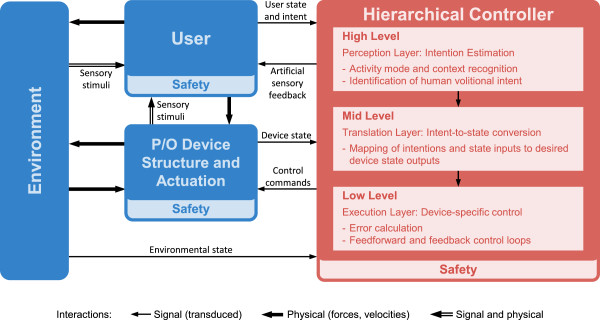
: Technological advancements have led to the development of numerous wearable robotic devices for the physical assistance and restoration of human locomotion. While many challenges remain with respect to the mechanical design of such devices, it is at least equally challenging and important to develop strategies to control them in concert with the intentions of the user.This work reviews the state-of-the-art techniques for controlling portable active lower limb prosthetic and orthotic (P/O) devices in the context of locomotive activities of daily living (ADL), and considers how these can be interfaced with the user's sensory-motor control system. This review underscores the practical challenges and opportunities associated with P/O control, which can be used to accelerate future developments in this field. Furthermore, this work provides a classification scheme for the comparison of the various control strategies.As a novel contribution, a general framework for the control of portable gait-assistance devices is proposed. This framework accounts for the physical and informatic interactions between the controller, the user, the environment, and the mechanical device itself. Such a treatment of P/Os--not as independent devices, but as actors within an ecosystem--is suggested to be necessary to structure the next generation of intelligent and multifunctional controllers.Each element of the proposed framework is discussed with respect to the role that it plays in the assistance of locomotion, along with how its states can be sensed as inputs to the controller. The reviewed controllers are shown to fit within different levels of a hierarchical scheme, which loosely resembles the structure and functionality of the nominal human central nervous system (CNS). Active and passive safety mechanisms are considered to be central aspects underlying all of P/O design and control, and are shown to be critical for regulatory approval of such devices for real-world use.The works discussed herein provide evidence that, while we are getting ever closer, significant challenges still exist for the development of controllers for portable powered P/O devices that can seamlessly integrate with the user's neuromusculoskeletal system and are practical for use in locomotive ADL.
Overview
The claims and statistics of this paper haven’t been checked yet.
Free: it reads the open-access text and checks the first 5 claims that cite a source we can check. Create a free account to check every claim.
Integrity signals
Registry
Cites
Statistics
Figures
Verification
Claims the paper makes
The claims and statistics of this paper haven’t been checked yet.
Free: it reads the open-access text and checks the first 5 claims that cite a source we can check. Create a free account to check every claim.
Claims other papers make about this one
Each is checked against this paper’s own text: does it say what the citing paper says it does?
The cited source says what the claim attributes to it.
In the citing paper
“Additional shortcomings include their limited environmental feedback, power supply, and failure to autonomously respond appropriately to external (possibly dangerous) stimuli.[24]”
From Flexible Electronics and Devices as Human–Machine Interfaces for Medical Robotics (2022) · cites this paper as [24]
The cited source says what the claim attributes to it.
In the citing paper
“Thus, the vast number of studies on different interface locations and various probing devices to record electrophysiological signals have established the foundation of user-communication with prosthetics.[24,286,287]”
From Flexible Electronics and Devices as Human–Machine Interfaces for Medical Robotics (2022) · cites this paper as [24]
Self-check
Percentages, sums and reported differences re-computed from the paper’s own numbers.
The self-check needs the paper’s full text.
Citations
Cites
Impedance Control: An Approach to Manipulation: Part I—Theory
Hogan, N. (1985) · Journal of Dynamic Systems, Measurement, and Control · doi:10.1115/1.3140702 · Cited by 3,673 · cited 1×
“Impedance is defined as the transfer function between an input flow and a n output effort [202].”
BackgroundFalls in older people: epidemiology, risk factors and strategies for prevention
Rubenstein, L. Z. (2006) · Age and Ageing · doi:10.1093/ageing/afl084 · Cited by 3,287 · cited 2×
“The risks are also not limited to physical harm, but may a lso include social, emotional, and psychological effects [38,39].”
BackgroundEstimating the Prevalence of Limb Loss in the United States: 2005 to 2050
Ziegler-Graham, K., MacKenzie, E. J., Ephraim, P. L., Travison, T. G., & Brookmeyer, R. (2008) · Archives of Physical Medicine and Rehabilitation · doi:10.1016/j.apmr.2007.11.005 · Cited by 2,816 · cited 1×
“stroke [6], spinal cord injury [7], Parkinson’s disease [8], and lower limb amputations [9]) can likewise be expected.”
Reach and grasp by people with tetraplegia using a neurally controlled robotic arm
Hochberg, L. R., Bacher, D., Jarosiewicz, B., Masse, N. Y., Simeral, J. D., Vogel, J., Haddadin, S., Liu, J., Cash, S. S., van der Smagt, P., et al. (2012) · Nature · doi:10.1038/nature11076 · Cited by 2,719 · cited 1×
“Intracortical electrode arrays have been successfully demonstrated to allow control of multi-degree-of-freedom reach and grasp movements with robotic arms in tetraplegic subjects [55,56],”
High-performance neuroprosthetic control by an individual with tetraplegia
Collinger, J. L., Wodlinger, B., Downey, J. E., Wang, W., Tyler-Kabara, E. C., Weber, D. J., McMorland, A. J., Velliste, M., Boninger, M. L., & Schwartz, A. B. (2013) · The Lancet · doi:10.1016/s0140-6736(12)61816-9 · Cited by 1,848 · cited 1×
“Intracortical electrode arrays have been successfully demonstrated to allow control of multi-degree-of-freedom reach and grasp movements with robotic arms in tetraplegic subjects [55,56],”
Incidence of Parkinson's Disease: Variation by Age, Gender, and Race/Ethnicity
Van Den Eeden, S. K. (2003) · American Journal of Epidemiology · doi:10.1093/aje/kwg068 · Cited by 1,747 · cited 1×
“stroke [6], spinal cord injury [7], Parkinson’s disease [8], and lower limb amputations [9]) can lik ew se be expected.”
BackgroundAugmented visual, auditory, haptic, and multimodal feedback in motor learning: A review
Sigrist, R., Rauter, G., Riener, R., & Wolf, P. (2013) · Psychonomic Bulletin & Review · doi:10.3758/s13423-012-0333-8 · Cited by 1,416 · cited 1×
“Auditory cues can vary in stereo balance, pitch, timbre and volume [89], and therefore may transmit rich information via speakers or headphones.”
Self-citationLower Extremity Exoskeletons and Active Orthoses: Challenges and State-of-the-Art
Dollar, A. M., & Herr, H. (2008) · IEEE Transactions on Robotics · doi:10.1109/tro.2008.915453 · Cited by 1,327 · cited 1×
“Several related review papers have been published in recent years that comprehensively establish the state-ofthe-art in portable and active lower limb prosthetics, orthotics and exoskeletons, mostly in terms of the design and hardware realization [10-15].”
Design and Evaluation of the LOPES Exoskeleton Robot for Interactive Gait Rehabilitation
Veneman, J. F., Kruidhof, R., Hekman, E. E. G., Ekkelenkamp, R., Van Asseldonk, E. H. F., & van der Kooij, H. (2007) · IEEE Transactions on Neural Systems and Rehabilitation Engineering · doi:10.1109/tnsre.2007.903919 · Cited by 1,280 · cited 2×
“This would exclude treadmill-based gait training orthoses such as the LOPES [19] and the Lokomat (Hocoma AG, Volketswil, Switzerland), which were among the classes of devices discussed in the review of Marchal-Crespo and Reinkensmeyer [20].”
Review of control strategies for robotic movement training after neurologic injury
Marchal-Crespo, L., & Reinkensmeyer, D. J. (2009) · Journal of NeuroEngineering and Rehabilitation · doi:10.1186/1743-0003-6-20 · Cited by 1,182
Research works printed but not linked: 9
- Donath M. Proportional EMG control for above-knee prosthesis, MIT. Department of Mechanical Engineering, Masters Thesis; 1974. http://hdl. handle.net/1721.1/13775.
- Zambarbieri D, Schmid M, Magnaghi M, Vermi G, Macellari V, Fadda A. Biofeedback techniques for rehabilitation of the lower-limb prosthetic subject. In: Proc. VII Medicon. Lemesos, Cyprus: MEDICON; 1998. p. 1-5.
- Kawamura J, Sueda O, Harada K, Nishihara K, Isobe S. Sensory feedback systems for the lower-limb prosthesis. J Osaka Rosai Hospital 1981;5: 104-12.
- Webb G. Providing real-time biofeedback for amputee gait retraining using labview. In: NI days worldwide graphical system design conference. London, UK: National Instruments; 2011.
- Grimes DL. An active multimode above knee prosthesis controller, PhD thesis, Massachusetts Institute of Technology. Dept. of Mechanical Engineering; 1979. http://hdl.handle.net/1721.1/15998.
- Gancet J, Ilzkovitz M, Cheron G, Ivanenko Y, van der Kooij H, van der Helm F, et al. MINDWALKER: A brain controlled lower limbs exoskeleton for rehabilitation. Potential applications to space In: Workshop EA, editor. 11th Symposium on advanced space technologies in robotics and automation. Noordwijk, NL: European Space Agency; 2011. p. 12-14.
- Goffer A. Enhanced safety of gait in powered exoskeletons. Dynamic walking conference abstract -available online. Argo Medical Technologies, ReWalk 2014. http://dynamicwalking.org/ocs/index.php/ dw2014/dw2014/paper/viewFile/17/10.
- Huang GT. Wearable robots. Technol Rev. 2004;1:70-3.
- Li YD, Hsiao-Wecksler ET. Gait mode recognition and control for a portable-powered ankle-foot orthosis. In: Rehabilitation robotics (ICORR), 2013 IEEE international conference on; 2013. p. 1-8. doi:10.1109/ICORR.2013.6650373. · DOI · Paper page
Cited by
Items 901–1,000 of 1,000
Preliminary Evaluation of a Wearable Thruster for Arresting Backwards Falls
Finn-Henry, M., Brenes, J. L., Baimyshev, A., & Goldfarb, M. T. (2023) · Proceedings - IEEE International Conference on Robotics and Automation/Proceedings · doi:10.1109/icra48891.2023.10160518 · Cited by 1
Learning Predictive Models for Ergonomic Control of Prosthetic DevicesPreprint
Clark, G., Campbell, J., & Amor, H. B. (2020) · arXiv (Cornell University) · doi:10.48550/arxiv.2011.07005 · Cited by 2
“However, user-adaptation and ergonomy still remains a major challenge [9].”
BackgroundMiao, Y., Wang, S., Wang, X., Zhang, Y., & Gavrilov, A. I. (2023) · SSRN Electronic Journal · doi:10.2139/ssrn.4580454 · Cited by 1
Hossain, M. S. B., Guo, Z., Sui, N., & Choi, H. Y. (2023) · doi:10.36227/techrxiv.24302926.v1 · Cited by 1
A Review on Bio-Inspired Control Strategies for Wearable Robotic DevicesPreprint
Almeida, J. F., & Santos, C. P. (2024) · SSRN Electronic Journal · doi:10.2139/ssrn.4895828 · Cited by 1
Chen, L., Majdi, A., Asamoah, B., & Laughlin, M. M. (2024) · bioRxiv (Cold Spring Harbor Laboratory) · doi:10.1101/2024.12.20.629687 · Cited by 1
Kim, K., Sonego, V., Strohmer, B., Chang, B., Liu, X., Yonza, A. K. I., Kucharz, K., Asiminas, A., Lind, B. L., Tao, L., et al. (2025) · bioRxiv (Cold Spring Harbor Laboratory) · doi:10.1101/2025.06.25.661479 · Cited by 1
Electromyogram and Inertial Sensor Signal Processing in Locomotion and Transition Classification
Joshi, D., & Hahn, M. E. (2016) · Advances in bioinformatics and biomedical engineering book series · doi:10.4018/978-1-5225-0660-7.ch009
Adaptive control for wearable robots in human-centered rehabilitation tasks
Rajasekaran, V. (2015) · UPCommons institutional repository (Universitat Politècnica de Catalunya) · doi:10.5821/dissertation-2117-96044 · Cited by 4
“[81] proposed a generalised hierarchical framework for both orthotic and prosthetic devices.”
BackgroundBoatwright, W. A. (2015) · NCSU Libraries Repository (North Carolina State University Libraries)
Wu, P. (2016) · International Conference on Inventive Computation Technologies (ICICT) · doi:10.1109/inventive.2016.7823249
Legal Frame of Non-Social Robots
Fosch‐Villaronga, E. (2016) · University of Twente Research Information
CONTROL OF A POWERED ANKLE-FOOT PROSTHESIS: FROM PERCEPTION TO IMPEDANCE MODULATION
Ribeiro, G. A. (2017) · Digital Commons - Michigan Tech (Michigan Technological University) · doi:10.37099/mtu.dc.etdr/405
“To do so, many prostheses controllers rely on user intention and the environment perception to control the prosthesis actuators [1].”
BackgroundEEG and EMG Sensorimotor Measurements to Assess Proprioception Following ACL Reconstruction
Northrup, T. F. (2018) · University of New Hampshire Scholars Repository (University of New Hampshire at Manchester)
Keleş, A. D., & Yücesoy, C. A. (2017) · National Biomedical Engineering Meeting · doi:10.1109/biyomut.2017.8478881
“sensör ve gömülü yazılım teknolojilerindeki ilerlemeler, gerçek insan ayağı ile aynı boyut ve ağırlıkta, enerji kullanımı açısından aktif robotik cihazların geliştirilmesinin önünü açmıştır [2, 3, 4, 5].”
Quasi-Static Modelling of a Redundant Knee Prosthesis
Heins, S., Flynn, L., Geeroms, J., Lefeber, D., & Ronsse, R. (2018) · IEEE/RAS-EMBS International Conference on Biomedical Robotics and Biomechatronics (BioRob) · doi:10.1109/biorob.2018.8487632
“When this compliance is explicit and thus relies on an impedance law, this means that the associated controller framework requires a middle level layer guaranteeing proper torque tracking [24].”
BackgroundMethodAdaptive Controllers for Assistive Robotic Devices
Koller, J. R. (2017) · Deep Blue (University of Michigan)
Capacitive Sensing Based Knee-Angle Continuous Estimation by BP Neural Networks
Xu, D., & Wang, Q. (2019) · Lecture notes in computer science · doi:10.1007/978-3-030-27526-6_6
ESTIMATION OF MULTI-DIRECTIONAL ANKLE IMPEDANCE AS A FUNCTION OF LOWER EXTREMITY MUSCLE ACTIVATION
Knop, L. N. (2019) · Digital Commons - Michigan Tech (Michigan Technological University) · doi:10.37099/mtu.dc.etdr/879
“The use of conventional passive prostheses provides a simple and relatively lowcost solution to recover lost mobility; however, the amount of metabolic energy required by a transtibial amputee using a passive prosthesis increases up to 30% when compared to a healthy person walking at the same speed [8], [9].”
BackgroundMethodNeuromechanical and Environment Aware Machine Learning Tool for Human Locomotion Intent Recognition
Carvalho, S. P., Figueiredo, J., & Santos, C. P. (2019) · World Congress on Medical Physics and Biomedical Engineering, September 7 - 12, 2009, Munich, Germany · doi:10.1007/978-3-030-31635-8_240
“Secondly, to tune the assistance to the patient’s locomotion intention by monitoring the human-robotic interface through wearable sensors [3], [4].”
BackgroundA Multi-Task Mode Control Method for Powered Knee-Ankle Prosthesis
Peng, F., Hu, T., & Zhang, C. (2019) · International Conference on Advanced Mechatronic Systems · doi:10.1109/icamechs.2019.8861687
Schrade, S. O., Devittori, G., Easthope, C. A., Shirota, C., Lambercy, O., & Gassert, R. (2019) · arXiv (Cornell University) · doi:10.48550/arxiv.1911.04316 · Cited by 1
“ch Walking over uneven ground is a difficult task for exoskeleton users, as exoskeletons typically follow a pre-programmed trajectory with their legs [4].”
Self-citationProgress and Challenges of Neuroscience and Brain-inspired Artificial Intelligence
Wang, L., & Alexander, C. A. (2020) · Neuroscience International · doi:10.3844/amjnsp.2020.1.9
Past, present and future of kinesiology
Uygur, F. (2020) · Elsevier eBooks · doi:10.1016/b978-0-12-812162-7.00001-1
CONTROL OF ACTIVE ORTHOSIS BY EMG SIGNALS
Rõbak, D., Musalimov, V., & Penkov, I. (2017) · Innovations Technology Governance Globalization
Kriging for prosthesis control
Dhir, N. (2020) · Elsevier eBooks · doi:10.1016/b978-0-12-817450-0.00004-3
SVM for Decoding the Human Activity Mode from sEMG Signals
Kalani, H., Tahamipour-Z., S. M., Kardan, I., Akbarzadeh, A., Ebrahimi, A., & Sede, R. (2019) · RSI International Conference on Robotics and Mechatronics (ICRoM) · doi:10.1109/icrom48714.2019.9071845 · Cited by 1
“EMG sensors are extensively used in the study of motions and forces of human muscles [31-37], evaluation and control of exoskeletons [7, 12, 17, 38-41] and control of other robotic devices [42-45].”
BackgroundMethodInfluentialControl and assessment of transhumeral prosthetic system
Alshammary, N. A. (2017)
Classification of hand-related real and imaginary motor activity with fNIRS
Hramov, A. E., Grubov, V., & Badarin, A. (2020) · Scientific School Dynamics of Complex Networks and their Applications (DCNA) · doi:10.1109/dcnair50402.2020.9216914
“One of the goals of such systems is to improve the quality of life for post-traumatic and post-stroke patients and to aid in neurorehabilitation [12]–[14] or to control prostheses and exoskeletons [15].”
BackgroundTrip Recovery in Lower-Limb Prostheses using Reachable Sets of Predicted Human MotionPreprint
Danforth, S. M., Holmes, P., & Vasudevan, R. (2020) · arXiv (Cornell University) · doi:10.48550/arxiv.2010.11228
“A mid-level controller then converts this estimated intent into a desired trajectory for a low-level controller to track [5].”
BackgroundActive Prosthesis of Human Hand
Ali, A., Zaheer, M., Safdar, M. M. S., Azhar, U., Huzaifa, A., & Abbas, T. (2020) · International Symposium on Recent Advances in Electrical Engineering (RAEE) · doi:10.1109/raeecs50817.2020.9265856
“Some examples of active prosthetic devices include switch-control based [4], EEG based [5] and EMG based prosthetic limbs [6].”
BackgroundSensor-Based Adaptive Control and Optimization of Lower-Limb Prosthesis.
Atri, R. (2019) · FIU - Digital Commons (Florida International University) · doi:10.25148/etd.fidc008834
Stimulus interaction in transcutaneous electrical stimulation
Dupan, S. S. G., Jabban, L., Metcalfe, B., & Nazarpour, K. (2021) · Elsevier eBooks · doi:10.1016/b978-0-12-822828-9.00014-9
SimBionics: Neuromechanical Simulation and Sensory Feedback for the Control of Bionic Legs
Gonzalez-Vargas, J. E., Sartori, M., Dosen, S. S., van der Kooij, H., & Rietman, J. S. (2021) · Biosystems & biorobotics · doi:10.1007/978-3-030-69547-7_44
Scale Force Control of a Robot Bearing Augmentation Exoskeleton
Lang, L., Hui, P., Xiao, J., Lu, H., & Zhou, Z. (2021) · International Conference on Advanced Robotics and Mechatronics (ICARM) · doi:10.1109/icarm52023.2021.9536125
Initial Results of Lower Limb Exoskeleton Therapy with Human Gait Analysis for a Paraplegic Patient
Tóth, L., Schiffer, Á., Pinczker, V., Muller, P., Büki, A., & Maróti, P. (2021) · Advances in intelligent systems and computing · doi:10.1007/978-3-030-88976-0_20 · Cited by 1
Learning a Shared Model for Motorized Prosthetic Joints to Predict Ankle-Joint MotionPreprint
Dey, S., Boughorbel, S., & Schilling, A. F. (2021) · arXiv (Cornell University) · doi:10.48550/arxiv.2111.07419 · Cited by 2
“The control of active prostheses is commonly implemented using a multilevel control approach Varol et al. [2010]; Tucker et al. [2015].”
Neurophysiological Support of Motor Control in “Hybrid” Postures. Literature Review
Бабанов, Н. Д., & Birukova, E. A. (2021) · Neuroscience and Behavioral Physiology · doi:10.1007/s11055-021-01176-1
“The problem of evaluating the direct infl uence of robotic devices on subjects’ central nervous systems, in particular the supraspinal level of regulation of movements [Tucker et al., 2015] remains unresolved.”
BackgroundAssistance Robotics and Biosensors
Torres, F., Úbeda, A., & Puente, S. T. (2018) · MDPI eBooks · doi:10.3390/books978-3-03897-395-9
Kouzbary, M. A., Kouzbary, H. A., Tham, L. K., Liu, J., Shasmin, H. N., Arifin, N., & Osman, N. A. A. (2022) · World Congress on Medical Physics and Biomedical Engineering, September 7 - 12, 2009, Munich, Germany · doi:10.1007/978-3-030-90724-2_3 · Cited by 2
Electromyogram and Inertial Sensor Signal Processing in Locomotion and Transition Classification
Joshi, D., & Hahn, M. E. (2019) · IGI Global eBooks · doi:10.4018/978-1-7998-1204-3.ch041
Arunamithra, J., Saravanan, R., & Babu, R. V. (2022) · International Journal of Health Sciences · doi:10.53730/ijhs.v6ns1.7779
Rabe, K. G., & Fey, N. P. (2022) · Proceedings - IEEE International Conference on Robotics and Automation/Proceedings · doi:10.1109/icra46639.2022.9812035
A Data-Driven and Personalized Symmetry Controller for Robotic Ankle-Foot ProsthesesPreprint
Prasanna, C., Realmuto, J. D., Anderson, A., Rombokas, E., & Klute, G. K. (2022) · doi:10.36227/techrxiv.20483946.v1
A Data-Driven and Personalized Symmetry Controller for Robotic Ankle-Foot ProsthesesPreprint
Prasanna, C., Realmuto, J. D., Anderson, A., Rombokas, E., & Klute, G. K. (2022) · doi:10.36227/techrxiv.20483946
Wearable Lower Limb Neuroprosthesis: System Architecture and Control Tuning
Carvalho, S. P., Figueiredo, J., & Santos, C. P. (2022) · Lecture notes in networks and systems · doi:10.1007/978-3-031-15226-9_52
Finite-State Machine for Level-Ground Walking Control of an Ankle-Foot Orthosis
Vughuma, J. T., & Verlinden, O. (2022) · Proceedings of the World Congress on Electrical Engineering and Computer Systems and Science · doi:10.11159/icbes22.117
“It has a central role in the first decisions making considering the interaction between the controller, the user, the environment, and the mechanical device itself [13].”
BackgroundBrain-Machine Interfaces for Upper and Lower Limb Prostheses
Brantley, J. A., Paek, A. Y., Steele, A. G., & Contreras-Vidal, J. L. (2022) · Handbook of Neuroengineering · doi:10.1007/978-981-15-2848-4_35-2 · Cited by 3
Shared Autonomy Locomotion Synthesis with Virtual Wearable Robotic DevicesPreprint
Hodossy, B. K., & Farina, D. (2022) · doi:10.36227/techrxiv.21617973.v1
Design and simulation analysis of a human rehabilitation lower limb exoskeleton robot
Duan, S., Gao, J., & Shuang, H. (2022) · International Conference on Control and Intelligent Robotics (ICCIR) · doi:10.1145/3548608.3559185 · Cited by 1
“Exoskeleton robots has the potential to greatly improve the mobility of paraplegic patients, so as to improve their activities of daily living [4-8].”
BackgroundShu, T., Shallal, C., Chun, E., Shah, A., Bu, A., Levine, D., Yeon, S. H., Carney, M. E., Song, H., Hsieh, T., et al. (2022) · IEEE/RAS-EMBS International Conference on Biomedical Robotics and Biomechatronics (BioRob) · doi:10.1109/biorob52689.2022.9925293
Does joint impedance improve dynamic leg simulations with explicit and implicit solvers?Preprint
Bahdasariants, S., Barela, A. M. F., Gritsenko, V., Bacca, O., Barela, J. Â., & Yakovenko, S. (2023) · bioRxiv (Cold Spring Harbor Laboratory) · doi:10.1101/2023.02.09.527805
Brain-Machine Interfaces for Upper and Lower Limb Prostheses
Brantley, J. A., Paek, A. Y., Steele, A. G., & Contreras-Vidal, J. L. (2023) · Handbook of Neuroengineering · doi:10.1007/978-981-16-5540-1_35
Gurve, D. (2023) · doi:10.32920/23393165 · Cited by 1
A supervisory controller intended to arrest dynamic falls with a wearable cold-gas thruster
Baimyshev, A., Finn-Henry, M., & Goldfarb, M. T. (2023) · Wearable Technologies · doi:10.1017/wtc.2023.18
“…use of lower-limb exoskeletal devices to facilitate balance, which could potentially preclude the initiation of falls (e.g., Vallery et al., 2012; Tucker et al., 2015; Ugurlu et al., 2015; Wang et al., 2015; Yan et al., 2015; Di et al., 2016; Huynh et al., 2018; Zhang et al., 2018; Fasola et…”
BackgroundHuang, Y., Wang, X., Liang, D., Xiong, J., Xie, A., & Gu, J. J. (2023) · WRC Symposium on Advanced Robotics and Automation (WRC SARA) · doi:10.1109/wrcsara60131.2023.10261834
Hossain, M. S. B., Guo, Z., Sui, N., & Choi, H. Y. (2023) · doi:10.36227/techrxiv.24302926
Realizing Upper Extremity Bionic Limbs: Leveraging Neuroprosthetic Control Strategies
Kumar, N. G., Chestek, C. A., Cederna, P. S., & Kung, T. A. (2023) · Plastic & Reconstructive Surgery · doi:10.1097/prs.0000000000011183
“50 The ideal neural interface would be able to reliably record efferent peripheral nerve action potentials and stimulate afferent signals in real time with high specificity and selectivity.”
Design and control of active lower limb prosthesis with sensorial frame
Hernández, I., & Yu, W. (2023) · Proceedings of the Institution of Mechanical Engineers Part I Journal of Systems and Control Engineering · doi:10.1177/09596518231204054
“…low-power microcontrollers and integrated circuit-based inertial measurement units 3 enable the development of robotic devices, 4 which help restore human locomotion as in Tucker et al. 5 Novel methods such as teleoperation, 6 electrical stimulation, 7 and neural decoding 8–10 have been developed.”
BackgroundAlawad, N. A., Humaidi, A. J., & Al-Araji, A. S. (2023) · Journal of Engineering Management and Information Technology · doi:10.61552/jemit.2023.02.003
Assistance control strategy for upper-limb rehabilitation robot based on motion trend
Zhang, H., Song, T., & Zhang, L. (2023) · Mechanical sciences · doi:10.5194/ms-14-503-2023
“robots (Proietti et al., 2016; Babaiasl et al., 2016; Tucker et al., 2015 .”
High-level control architecture of lower limb exoskeleton: A review
Zhou, H. (2023) · Theoretical and Natural Science · doi:10.54254/2753-8818/18/20230304
Echo-based dynamic trajectory generation for customised unilateral exoskeleton applications
Guez, A., Dhawan, S., & Vaidyanathan, R. (2023) · IEEE International Conference on Robotics and Biomimetics (ROBIO) · doi:10.1109/robio58561.2023.10354675
“There have been many studies that focus on predicting gait trajectory based on the subject’s muscle activity [18], [19].”
BackgroundDevelopment and Analysis of Biomaterial Based on Calcium Sulfate Hemihydrate and Epoxy Resin
Arshad, S., Aijaz, H., Rizwan, M., Khan, T., & Haque, M. Z. U. (2024) · Sir Syed University Research Journal of Engineering & Technology · doi:10.33317/ssurj.570
Numerical simulation and design of a prosthetic leg
Saif, A., Reddy, C. S. S., Negi, S., & Garg, S. (2024) · AIP conference proceedings · doi:10.1063/5.0195151
Singh, M., Saif, A., Reddy, C. S. S., Nath, A., Akhil, M., Raj, R. K., & Ganesan, D. P. (2024) · AIP conference proceedings · doi:10.1063/5.0192762
Development of a Control System for a Biomechanical Prosthetic
Montaleza, B. E. F., Calle-Sigüencia, J., Sacoto, M. A. R., & de Córdova-Arteaga, M. E. F. (2024) · Lecture notes in networks and systems · doi:10.1007/978-3-031-51982-6_10
Advancing Back-Support Exoskeleton Control: A Biomechanical Approach
Tabasi, S. A. (2024) · doi:10.5463/thesis.612
Introduction to Healthy and Post-Stroke Gait and Robotic Gait Assistance
Millán, J. S. L. (2024) · Springer theses · doi:10.1007/978-3-031-57616-4_1
Self-citationPersonalized Control Method of Lower Limb Prosthesis with Variable Speeds
Sun, L., Ma, H., An, H., Wei, Q., & Gao, J. (2023) · International Conference on Robotics, Automation and Artificial Intelligence (RAAI) · doi:10.1109/raai59955.2023.10601207
“The control mechanism of a prosthesis is typically structured in three layers [1].”
BackgroundVerification Method of Intelligent Prosthetic Algorithm Based on Anthropomorphic Walking Robot
An, H., Sun, L., Ma, H., & Wei, Q. (2023) · International Conference on Robotics, Automation and Artificial Intelligence (RAAI) · doi:10.1109/raai59955.2023.10601210
“In order to carry out various activities in a natural and safe way[3], active prosthetics need highly complex control strategies to produce the required force under different motion states, especially the one with multiple controllable joints.”
BackgroundAutomatic lower limb rehabilitation device
Vinoth, A. M. G., Kiruthika, R., Abishitha, T. R., Harisudha, P. M., & Aarthi, P. (2024) · i-manager’s Journal on Embedded Systems · doi:10.26634/jes.12.2.20848
CPG Human Motion Phase Recognition Algorithm for a Hip Exoskeleton with VSA Actuator
Li, J., Jiang, F., Zhang, L., Wang, X., Duan, J., Wei, B., Wang, X., Ma, N., & Zhang, Y. (2024) · Journal of Signal and Information Processing · doi:10.4236/jsip.2024.152002
Enhancing Control Strategies for Hand Exoskeletons Through Modeling and Electromyogram-based Control
Abas, N. B., Ganasegaran, K., Ghani, N. M. A., Kassim, A. M., & Abas, M. A. (2024) · International Joint Conference on Neural Networks (IJCNN) · doi:10.1109/ijcnn60899.2024.10651023
H-PhIEx A: A Compact SEA-Based Hand Exoskeleton with Active Metacarpophalangeal Joints
Capitani, S. L., Peperoni, E., Kuang, L., Fiumalbi, T., Baldoni, A., Dell’Agnello, F., Creatini, I., Taglione, E., Vitiello, N., Trigili, E., et al. (2024) · IEEE/RAS-EMBS International Conference on Biomedical Robotics and Biomechatronics (BioRob) · doi:10.1109/biorob60516.2024.10719750
“5) has been designed with a hierarchical structure [22] comprising (i) a high-level control layer that implements the direct kinematic and kineto-static models and a biofeedback-based trigger for the mobilization of the fingers (ii) a middle-level control layer, implementing an admittance control…”
Pericu, V., Vassallo, C., Zinni, G., Hinterlang, W., Lencioni, T., Ferrarin, M., Jonsdottir, J., Michieli, L. D., Semprini, M., Maludrottu, S., et al. (2024) · IEEE/RAS-EMBS International Conference on Biomedical Robotics and Biomechatronics (BioRob) · doi:10.1109/biorob60516.2024.10719842
“Such approaches require many tunable parameters [16], which are tailored for specific trajectories subject to spatiotemporal gait parameters [16] and may be challenging to use [17].”
BackgroundIntent-Driven Gait Synthesis for Simulated Assistive Technology
Hodossy, B. K., & Farina, D. (2025) · Biosystems & biorobotics · doi:10.1007/978-3-031-85000-4_15
Exoskeletons for the rehabilitation of temporomandibular disorders: a comprehensive review
Müller, P.-O., Sader, R. A., & von Stryk, O. (2025) · Frontiers in Robotics and AI · doi:10.3389/frobt.2025.1492275 · Cited by 2
Dario, P., Ciuti, G., Chiurazzi, M., Amram, D., Trigili, E., Crea, S., Vitiello, N., Masiero, F., Lanotte, F., Controzzi, M., et al. (2025) · Springer eBooks · doi:10.1007/978-3-319-77267-7_2
Design and Development of Prosthesis for Ultrashort Knee Stump
Nasir, M. F., Tariq, M., Nazeer, H., Naseer, N., & Iabal, H. (2024) · International Multi-Topic Conference · doi:10.1109/inmic64792.2024.11004349
“In particular, the proposed system utilizes vacuum-assisted suspension (VAS) technology [5], [6], which employs the utilization of a negative pressure environment within the socket to provide greater stability between the residual limb and prosthetic device.”
Driving Sustainability and Equality Through Collaborative Robotics
Scoccia, C., Fischer, C., Terlizzi, S., Tonelli, S., & Lettera, G. (2025) · Mechanisms and machine science · doi:10.1007/978-3-031-91151-4_63 · Cited by 1
Estimation and Prediction of CoM With Terrain Feature Embedding During Walking
Xian, H., Xiong, J., Zhang, Y., Chen, X., Fu, C., & Leng, Y. (2025) · IEEE Transactions on Automation Science and Engineering · doi:10.1109/tase.2025.3570875
“In addition, CoM can indicate the intent behind human locomotion [10].”
Leopaldi, M., Paltrinieri, M., Tabucol, J., Zucchelli, A., & Brugo, T. M. (2025) · IEEE Access · doi:10.1109/access.2025.3580867
Evaluation of Selective Attention with Auditory Steady-State Response Using AM2 Tones
Castillo-Guerrero, J. M., Molina-Vidal, D. A., Cevallos-Larrea, P., & Tierra-Criollo, C. J. (2025) · World Congress on Medical Physics and Biomedical Engineering, September 7 - 12, 2009, Munich, Germany · doi:10.1007/978-3-031-93646-3_107
Real-Time Control of Ankle Orthosis Assistance Using a Locomotion Mode Prediction Tool
Moreira, L., Figueiredo, J., & Santos, C. P. (2025) · IEEE Transactions on Medical Robotics and Bionics · doi:10.1109/tmrb.2025.3604135
“The SmartOs system features a non-centralized architecture structured as a modular and hierarchical framework, organized into high, mid-, and low-levels, as proposed in [20] (Fig.”
Unsupervised Domain Adaptation for Gait State Estimation
Medrano, R. L., Thomas, G. C., & Rouse, E. J. (2025) · Proceedings - IEEE International Conference on Robotics and Automation/Proceedings · doi:10.1109/icra55743.2025.11128510
“…years, machine learning classifiers have emerged as an alternative solution to the development of explicit gait models for exoskeleton control, with the ability to detect intended tasks based on patterns in exoskeleton sensor signals and apply task-specific controllers [10], [15], [19], [24]–[30].”
A controller generation platform for supernumerary robotic leg: Pilot Design and Simulation
Zhao, J., Zhou, Y., Meng, L., Li, X., & Zheng, E. (2025) · IEEE/ASME International Conference on Advanced Intelligent Mechatronics · doi:10.1109/aim64088.2025.11175774
An Approach to Enhancing Adaptive Muscle Recruitment and Movement Patterns in Human BiomechanicsPreprint
Kusumba, J. D., & Rajchandar, K. (2025) · Research Square · doi:10.21203/rs.3.rs-7686876/v1
Automating the Lower Limb Gait Cycle for Transfemoral Amputee Prosthetics
Bandara, B., Hapugaskumbura, A., Karunarathne, P., Jayasinghe, R., Gajanayake, S., Dissanayake, P., & Kuruppu, S. (2025) · Moratuwa Engineering Research Conference (MERCon) · doi:10.1109/mercon67903.2025.11217062
“Concurrently, gait studies and biomechanical modeling have become essential tools for understanding the forces and motion patterns involved in natural walking, with motion capture systems and electromyography (EMG) providing critical insight into user needs [12], [13].”
Ferhat, M., Bey, O., Pasini, K., Oukhellou, L., & Mohammed, S. (2025) · IFAC-PapersOnLine · doi:10.1016/j.ifacol.2025.10.204
Quazi, I. N., Shasmin, H. N., Arifin, N., Razak, N. A. A., & Osman, N. A. A. (2025) · Proceedings of the Institution of Mechanical Engineers Part H Journal of Engineering in Medicine · doi:10.1177/09544119251391399
Enhancing Multi-Task Motion Planning Based on Improved DMPs for Lower Limb Prostheses
An, H., Huang, Y., Nie, Y., & Ma, H. (2025) · IEEE/RSJ International Conference on Intelligent Robots and Systems (IROS) · doi:10.1109/iros60139.2025.11246699
“Predominantly, there are two main control paradigms for powered prostheses[2]: the discrete control paradigm and the continuous control paradigm.”
Comparative study of HD-EMG electrode setups for Smart Mechatronic Ankle-Foot Orthoses development
Mirkov, M., Strbac, M. D., & Vujaklija, I. (2025) · Annual International Conference of the IEEE Engineering in Medicine and Biology Society (EMBC) · doi:10.1109/embc58623.2025.11252730
“To address these limitations, a systematic approach to sensor configuration is essential—one that considers both the physical and functional demands of AFOs in real-world applications [6], [7], [8].”
High-level locomotion intent estimation from electromyography and body posture
Hodossy, B. K., & Farina, D. (2025) · Journal of Neural Engineering · doi:10.1088/1741-2552/ae2804 · Cited by 1
“A wide range of options are available in the literature for representing HL locomotion intent, and each of them may have multiple variants [12, 13].”
InfluentialNedergård, H., Arumugam, A., Sandlund, M., Bråndal, A., & Häger, C. K. (2021) · Figshare · doi:10.6084/m9.figshare.14442973
Intelligent Gait Mode Detection in Wearable Robots
Ghafoori, M., & Moosavian, S. A. A. (2024) · RSI International Conference on Robotics and Mechatronics (ICRoM) · doi:10.1109/icrom64545.2024.10903618
“However, the latency was a critical challenge for these methods [13].”
Nedergård, H., Arumugam, A., Sandlund, M., Bråndal, A., & Häger, C. K. (2021) · Figshare · doi:10.6084/m9.figshare.14442982
Nedergård, H., Arumugam, A., Sandlund, M., Bråndal, A., & Häger, C. K. (2021) · Figshare · doi:10.6084/m9.figshare.14442976
Metadata
- Authors
- Tucker, M. R., Olivier, J., Pagel, A., Bleuler, H., Bouri, M., Lambercy, O., Millán, J. D. R., Riener, R., Vallery, H., & Gassert, R.
- Affiliations
- ETH Zurich (CH)
- École Polytechnique Fédérale de Lausanne (CH)
- University of Zurich (CH)
- Corresponding author
- Tucker, Michael R
- ORCID
- Venue
- Journal of NeuroEngineering and Rehabilitation
- Published
- 2015
- Volume
- 12
- Issue
- 1
- Pages
- 1
- ISSN
- 1743-0003 (ISSN-L)
- PMC
- PMC4326520
- OpenAlex
- W2142114107
- Semantic Scholar
- 7fe25a0498cd3ccd98db0d8da50730c68d174d68
- Cited by
- 1,047
- References
- 232
- Citations by year
- 2026: 42 · 2025: 69 · 2024: 72 · 2023: 119 · 2022: 102 · 2021: 161 · 2020: 116 · 2019: 108 · 2018: 92 · 2017: 85 · 2016: 61 · 2015: 20
- FWCI
- 6.63
- Type
- journal article
- Language
- en
- Open access
- gold
- doi.org
- Licence
- cc-by
- Locations
- Journal of NeuroEngineering and Rehabilitation (publishedVersion, cc-by)
- Europe PMC (PubMed Central) (publishedVersion, cc-by)
- PubMed Central (publishedVersion, cc-by)
- PubMed (publishedVersion)
- Zurich Open Repository and Archive (University of Zurich) (acceptedVersion, cc-by)
- Repository for Publications and Research Data (ETH Zurich) (submittedVersion, cc-by)
- Infoscience (Ecole Polytechnique Fédérale de Lausanne) (submittedVersion)
- Infoscience (Ecole Polytechnique Fédérale de Lausanne) (submittedVersion, cc-by-nc-nd)
- Research Repository (Delft University of Technology) (submittedVersion, cc-by)
- Zurich Open Repository and Archive (University of Zurich) (submittedVersion, cc-by)
- Data Archiving and Networked Services (DANS) (submittedVersion, other-oa)
- ETH Zürich Research Collection (cc-by)
- Zurich Open Repository and Archive (University of Zurich)
- Funders
- National Science Foundation
- Schweizerischer Nationalfonds zur Förderung der Wissenschaftlichen Forschung
- Topics
- Physical Sciences › Engineering › Biomedical Engineering › Prosthetics and Rehabilitation Robotics
- Physical Sciences › Engineering › Biomedical Engineering › Muscle activation and electromyography studies
- Physical Sciences › Engineering › Control and Systems Engineering › Robotic Locomotion and Control
- Keywords
- orthoses, wearable robotic devices, gait assistance, control strategy, activities of daily living, sensorimotor control, hierarchical control architecture, safety mechanisms, regulatory approval
- MeSH terms
- Activities of Daily Living, Electromyography, Gait, Humans, Locomotion, Orthotic Devices, Prosthesis Design, Prostheses and Implants, Lower Extremity
About these checks
Registry, retraction, Cites and statistics results are computed, not judged, with one exception: a printed reference that no index lists is read once by a model before it counts as a citation error. Claims are extracted by a model and kept only when their quote appears verbatim in the text; each cited source is then checked, with a model’s help, for whether it says what the claim relies on. Those verdicts can be wrong — read the claim’s quote and the cited source before relying on one.
Statistics and arithmetic are recomputed, not judged.
Confidence bands are shown only for fields calibrated on our annotated test set. None is calibrated yet, so no band is shown.
What counts as a claim ›How we measure confidence ›How we check this ›
Are you an author, or do you see a problem with this page? Request a review
Data sources
Bibliographic data: Semantic Scholar, OpenAlex, Crossref.
Contains information from the Semantic Scholar Academic Graph Datasets, made available under the ODC Attribution License (ODC-BY 1.0).
Semantic Scholar’s data is described in: Kinney, R., et al. (2023). The Semantic Scholar Open Data Platform. arXiv:2301.10140.
