

Composition of the adult digestive tract bacterial microbiome based on seven mouth surfaces, tonsils, throat and stool samples
Open accessThe DOI matches its Crossref record; 104 of the 104 references it cites were found in a registry or an index.
Abstract
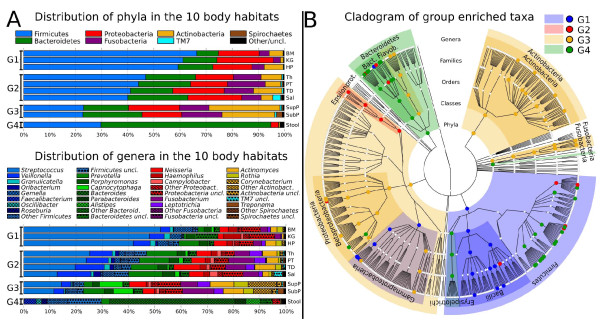
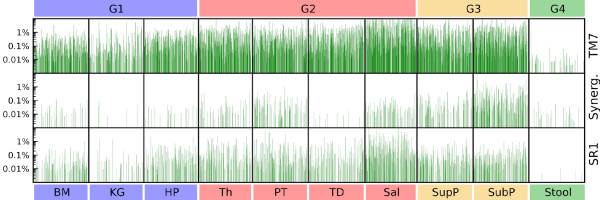
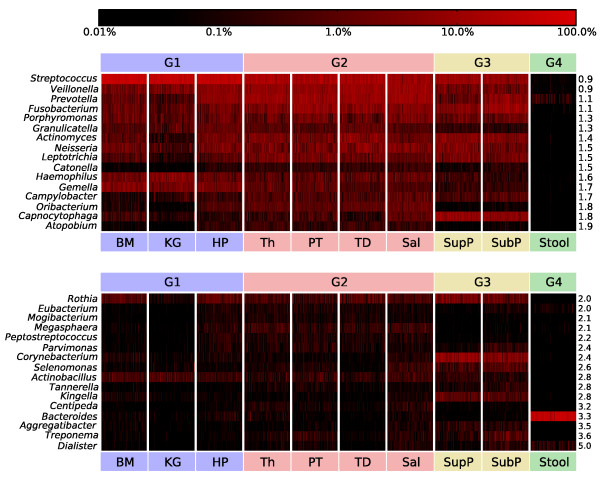
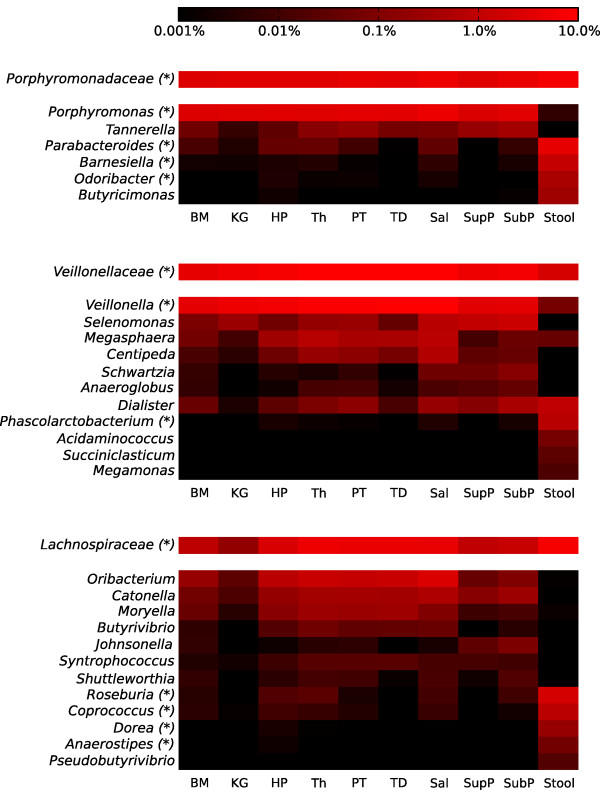
Background: To understand the relationship between our bacterial microbiome and health, it is essential to define the microbiome in the absence of disease. The digestive tract includes diverse habitats and hosts the human body's greatest bacterial density. We describe the bacterial community composition of ten digestive tract sites from more than 200 normal adults enrolled in the Human Microbiome Project, and metagenomically determined metabolic potentials of four representative sites. Results: The microbiota of these diverse habitats formed four groups based on similar community compositions: buccal mucosa, keratinized gingiva, hard palate; saliva, tongue, tonsils, throat; sub- and supra-gingival plaques; and stool. Phyla initially identified from environmental samples were detected throughout this population, primarily TM7, SR1, and Synergistetes. Genera with pathogenic members were well-represented among this disease-free cohort. Tooth-associated communities were distinct, but not entirely dissimilar, from other oral surfaces. The Porphyromonadaceae, Veillonellaceae and Lachnospiraceae families were common to all sites, but the distributions of their genera varied significantly. Most metabolic processes were distributed widely throughout the digestive tract microbiota, with variations in metagenomic abundance between body habitats. These included shifts in sugar transporter types between the supragingival plaque, other oral surfaces, and stool; hydrogen and hydrogen sulfide production were also differentially distributed. Conclusions: The microbiomes of ten digestive tract sites separated into four types based on composition. A core set of metabolic pathways was present across these diverse digestive tract habitats. These data provide a critical baseline for future studies investigating local and systemic diseases affecting human health.
Overview
The claims and statistics of this paper haven’t been checked yet.
Free: it reads the open-access text and checks the first 5 claims that cite a source we can check. Create a free account to check every claim.
Integrity signals
Registry
Cites
Statistics
Figures
Verification
Claims the paper makes
The claims and statistics of this paper haven’t been checked yet.
Free: it reads the open-access text and checks the first 5 claims that cite a source we can check. Create a free account to check every claim.
Claims other papers make about this one
Each is checked against this paper’s own text: does it say what the citing paper says it does?
The source backs part of the claim, not all of it — or backs it for a different population, condition or comparison.
In the citing paper
“The oropharynx, which is lined with a non-keratinized stratified squamous epithelium, has more diverse bacterial communities than the nasopharynx41, which are characterized by streptococcal species, Neisseria spp., Rothia spp. and anaerobes, including Veillonella spp., Prevotella spp. and Leptotrichia spp.39,41,51,52.”
From The microbiota of the respiratory tract: gatekeeper to respiratory health (2017) · cites this paper as [51]
Experimental — accuracy not yet measuredThe source backs part of the claim, not all of it — or backs it for a different population, condition or comparison.
In the citing paper
“Up to 80% of oral bacteria are dominated by about 200 species in the Phyla Firmicutes (esp. Streptococcus, Veillonella, Granulicatella, Gemella spp.) and Proteobacteria (esp. Neisseria, Haemophilus spp.), with contributions from Bacteroidetes, Actinobacteria and Fusobacteria totaling upwards of 95% of all identified oral microbiota (Figure 2)[171–177].”
From Enterosalivary nitrate metabolism and the microbiome: Intersection of microbial metabolism, nitric oxide and diet in cardiac and pulmonary vascular health (2017) · cites this paper as [173]
Experimental — accuracy not yet measuredThe cited source says what the claim attributes to it.
In the citing paper
“Further diversity exists between the varied micro-ecologies of the mouth[174,178], such as the tooth surface, gingiva, hard and soft palate, and even regionally on the tongue (Figure 2)[173,176,179].”
From Enterosalivary nitrate metabolism and the microbiome: Intersection of microbial metabolism, nitric oxide and diet in cardiac and pulmonary vascular health (2017) · cites this paper as [173]
In the citing paper
“Ecological conditions vary immensely along both the length of the GI tract as well as in cross-section from lumen to the mucosal brush-border[173,267,308,309].”
From Enterosalivary nitrate metabolism and the microbiome: Intersection of microbial metabolism, nitric oxide and diet in cardiac and pulmonary vascular health (2017) · cites this paper as [173]
Self-check
Percentages, sums and reported differences re-computed from the paper’s own numbers.
The self-check needs the paper’s full text.
Citations
Cites
Schloss, P. D., Westcott, S. L., Ryabin, T., Hall, J. R., Hartmann, M., Hollister, E. B., Lesniewski, R. A., Oakley, B. B., Parks, D. H., Robinson, C. J., et al. (2009) · Applied and Environmental Microbiology · doi:10.1128/aem.01541-09 · Cited by 19,549
Metagenomic biomarker discovery and explanation
Segata, N., Izard, J., Waldron, L., Gevers, D., Miropolsky, L., Garrett, W. S., & Huttenhower, C. (2011) · Genome Biology · doi:10.1186/gb-2011-12-6-r60 · Cited by 16,192 · cited 11×
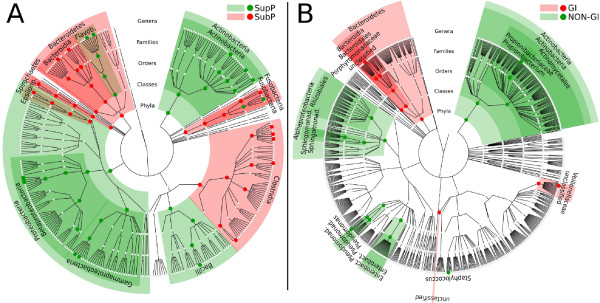
“Clades showing a statistically significant difference (by LEfSe) specifically between oral and stool samples are indiocated with asterisks.”
MethodInfluentialSelf-citationSIMPSON, E. H. (1949) · Nature · doi:10.1038/163688a0 · Cited by 14,164
Structure, function and diversity of the healthy human microbiome
The Human Microbiome Project Consortium (2012) · Nature · doi:10.1038/nature11234 · Cited by 11,726
Self-citationAn Ordination of the Upland Forest Communities of Southern Wisconsin
Bray, J. R., & Curtis, J. T. (1957) · Ecological Monographs · doi:10.2307/1942268 · Cited by 11,716 · cited 2×
“For assessing bacterial community structure similarities between different samples and body sites, we compared the relative abundances of every pair of samples in our dataset using the Bray-Curtis measure of beta diversity [31].”
MethodA human gut microbial gene catalogue established by metagenomic sequencing
MetaHIT Consortium, Qin, J., Li, R., Raes, J., Arumugam, M., Burgdorf, K. S., Manichanh, C., Nielsen, T., Pons, N., Levenez, F., et al. (2010) · Nature · doi:10.1038/nature08821 · Cited by 11,624 · cited 1×
“Previous studies of the healthy adult digestive tract microbiota have typically included less than 20 individuals [11-21] and the studies with over 100 individuals have most often focused on a single body site [22-26].”
BackgroundHuman gut microbes associated with obesity
Ley, R. E., Turnbaugh, P. J., Klein, S., & Gordon, J. I. (2006) · Nature · doi:10.1038/4441022a · Cited by 8,785 · cited 20×
“For example, using endoscopic biopsies from just two subjects, Wang et al. [77] reported 49% of 16S rRNA gene clones were from the Firmicutes and 27.7% were from Bacteroidetes.”
ResultInfluentialDiversity of the Human Intestinal Microbial Flora
Eckburg, P. B., Bik, E. M., Bernstein, C. N., Purdom, E., Dethlefsen, L., Sargent, M., Gill, S. R., Nelson, K. E., & Relman, D. A. (2005) · Science · doi:10.1126/science.1110591 · Cited by 7,913
A core gut microbiome in obese and lean twins
Turnbaugh, P. J., Hamady, M., Yatsunenko, T., Cantarel, B. L., Duncan, A., Ley, R. E., Sogin, M. L., Jones, W. J., Roe, B. A., Affourtit, J. P., et al. (2009) · Nature · doi:10.1038/nature07540 · Cited by 7,823 · cited 2×
“In a study of stool from 154 adult women (twins and their mothers), Firmicutes had a mean relative abundance of >60% using several different methods to assess the 16S rRNA gene content of stool [24].”
BackgroundMethodEnterotypes of the human gut microbiome
MetaHIT Consortium (additional members), Arumugam, M., Raes, J., Pelletier, E., Le Paslier, D., Yamada, T., Mende, D. R., Fernandes, G. R., Tap, J., Bruls, T., et al. (2011) · Nature · doi:10.1038/nature09944 · Cited by 7,548 · cited 2×
“By surveying the HMP population, these results can be further integrated into other currently ongoing studies of the cohort’s core microbiome [9] or enterotype structure [25], if any.”
BackgroundResult
Research works printed but not linked: 1
- NIH Human Microbiome Project - Core Microbiome Sampling Protocol A (HMP-A). http://www.ncbi.nlm.nih.gov/projects/gap/cgi-bin/study.cgi?study_id=phs000228.v3.p1
Cited by
Items 101–200 of 1,000
Duran-Pinedo, A. E., & Frias-Lopez, J. (2015) · Microbes and Infection · doi:10.1016/j.micinf.2015.03.014 · Cited by 187
“Taxonomic composition of the oral microbiomes between healthy subjects can differ significantly, even though their oral cavity is perfectly healthy [43].”
Koch, C. D., Gladwin, M. T., Freeman, B. A., Lundberg, J. O., Weitzberg, E., & Morris, A. (2017) · Free Radical Biology and Medicine · doi:10.1016/j.freeradbiomed.2016.12.015 · Cited by 186
Can oral infection be a risk factor for Alzheimer's disease?
Olsen, I., & Singhrao, S. K. (2015) · Journal of Oral Microbiology · doi:10.3402/jom.v7.29143 · Cited by 180
“variation in the microbiota in different oral sites (84, 87).”
BackgroundEffects of Antibiotics upon the Gut Microbiome: A Review of the Literature
Konstantinidis, T., Tsigalou, C., Karvelas, A., Stavropoulou, E., Voidarou, C., & Bezirtzoglou, E. (2020) · Biomedicines · doi:10.3390/biomedicines8110502 · Cited by 163
Betel nut chewing, oral premalignant lesions, and the oral microbiome
Hernandez, B. Y., Zhu, X., Goodman, M. T., Gatewood, R., Mendiola, P., Quinata, K., & Paulino, Y. C. (2017) · PLOS ONE · doi:10.1371/journal.pone.0172196 · Cited by 173
Vesty, A., Biswas, K., Taylor, M. W., Gear, K., & Douglas, R. G. (2017) · PLOS ONE · doi:10.1371/journal.pone.0169877 · Cited by 165
Bacterial profiles of saliva in relation to diet, lifestyle factors, and socioeconomic status
Belstrøm, D., Holmstrup, P., Nielsen, C. H., Kirkby, N., Twetman, S., Heitmann, B. L., Klepac-Ceraj, V., Paster, B. J., & Fiehn, N.-E. (2014) · Journal of Oral Microbiology · doi:10.3402/jom.v6.23609 · Cited by 166
“A few studies have investigated the bacterial composition of saliva in oral health (5, 23 25) and verified that a salivary bacterial profile resembles that of the throat, tonsils, and dorsum of the tongue (26).”
BackgroundBrennan, C. A., Clay, S. L., Lavoie, S. L., Bae, S., Lang, J. K., Fonseca-Pereira, D., Rosinski, K. G., Ou, N., Glickman, J. N., & Garrett, W. S. (2021) · Gut Microbes · doi:10.1080/19490976.2021.1987780 · Cited by 161
Gomez-Arango, L. F., Barrett, H. L., McIntyre, H. D., Callaway, L. K., Morrison, M., & Nitert, M. D. (2017) · Scientific Reports · doi:10.1038/s41598-017-03066-4 · Cited by 168
Krog, M. C., Hugerth, L. W., Fransson, E., Bashir, Z., Andersen, A. N., Edfeldt, G., Engstrand, L. G., Schuppe‐Koistinen, I., & Nielsen, H. S. (2022) · Human Reproduction · doi:10.1093/humrep/deac094 · Cited by 166
“Body site is by far the most prominent feature separating micro-biome samples (Costello et al. , 2009; Segata et al. , 2012; Zhou et al. , 2013; Lloyd-Price et al. , 2017).”
Temporal Stability of the Salivary Microbiota in Oral Health
Belstrøm, D., Holmstrup, P., Bardow, A., Kokaras, A., Fiehn, N.-E., & Paster, B. J. (2016) · PLOS ONE · doi:10.1371/journal.pone.0147472 · Cited by 151
“The composition of the salivary microbiota in oral health has been shown mostly comparable with that of the dorsum of the tongue, the throat and the tonsils, and is believed to constitute a mixture of bacteria shed from various oral surfaces [20].”
BackgroundResultThe Role of the Intestine in the Development of Hyperuricemia
Yin, H., Liu, N., & Chen, J. (2022) · Frontiers in Immunology · doi:10.3389/fimmu.2022.845684 · Cited by 176
Crosstalk between Vaginal Microbiome and Female Health: A review
Gupta, S., Kakkar, V., & Bhushan, I. (2019) · Microbial Pathogenesis · doi:10.1016/j.micpath.2019.103696 · Cited by 168
Dysbiosis, malnutrition and enhanced gut-lung axis contribute to age-related respiratory diseases
Saint‐Criq, V., Lugo‐Villarino, G., & Thomas, M. (2020) · Ageing Research Reviews · doi:10.1016/j.arr.2020.101235 · Cited by 166
Ross, E. M., Moate, P. J., Marett, L. C., Cocks, B. G., & Hayes, B. J. (2013) · PLoS ONE · doi:10.1371/journal.pone.0073056 · Cited by 139
“A number of studies have explored the complexity of the human microbiome by sequencing metagenomes from all over the human body [4–9], and some from other species with examples including representatives of carnivores [10–12], omnivores [13–15] and herbivores [16–22].”
BackgroundGhensi, P., Manghi, P., Zolfo, M., Armanini, F., Pasolli, E., Bolzan, M., Bertelle, A., Dell’Acqua, F., Dellasega, E., Waldner, R., et al. (2020) · npj Biofilms and Microbiomes · doi:10.1038/s41522-020-00155-7 · Cited by 150
Self-citationFusobacterium nucleatum secretes amyloid‐like FadA to enhance pathogenicity
Meng, Q., Gao, Q., Mehrazarin, S., Tangwanichgapong, K., Wang, Y., Huang, Y., Pan, Y., Robinson, S., Liu, Z., Zangiabadi, A., et al. (2021) · EMBO reports · doi:10.15252/embr.202152891 · Cited by 152
“Outside the oral cavity, Fn is absent or infrequently detected under healthy conditions (Segata et al, 2012).”
Bittinger, K., Charlson, E. S., Loy, E., Shirley, D. J., Haas, A. R., Laughlin, A., Yi, Y., Wu, G. D., Lewis, J. D., Frank, I., et al. (2014) · Genome Biology · doi:10.1186/preaccept-1218610333125217 · Cited by 145
“A previously published study also showed an altered bacterial microbiome in lingual samples from HIV+ subjects [35], an oral cavity surface that closely resembles saliva [36].”
BackgroundZhao, L., Zhang, X., Zhou, Y., Fu, K., Lau, H. C.-H., Chun, T. W.-Y., Cheung, A. H. K., Coker, O. O., Wei, H., Wu, W. K. K., et al. (2022) · Oncogene · doi:10.1038/s41388-022-02395-7 · Cited by 153
“In general, microbial communities in the oral cavity and gut are well-segregated due to the physical distance between these two regions, while the gastric acidity also limits the growth and further migration of translocated oral commensal microbes [25].”
BackgroundSantonocito, S., Giudice, A., Polizzi, A., Troiano, G., Merlo, E. M., Sclafani, R., Grosso, G., & Isola, G. (2022) · Nutrients · doi:10.3390/nu14122426 · Cited by 144
Mukherjee, A., Chettri, B., Langpoklakpam, J. S., Basak, P., Prasad, A., Mukherjee, A. K., Bhattacharyya, M., Singh, A. K., & Chattopadhyay, D. (2017) · Scientific Reports · doi:10.1038/s41598-017-01126-3 · Cited by 154
The microbiome: An emerging key player in aging and longevity
Kim, M., & Benayoun, B. A. (2020) · Translational Medicine of Aging · doi:10.1016/j.tma.2020.07.004 · Cited by 143
Jiang, B., Liang, X., Chen, Y., Ma, T., Liu, L., Li, J., Jiang, R., Chen, T., Zhang, X., & Li, S. (2012) · Scientific Reports · doi:10.1038/srep00936 · Cited by 149
Oral Microbiota and Alzheimer’s Disease: Do All Roads Lead to Rome?
Sureda, A., Daglia, M., Argüelles Castilla, S., Sanadgol, N., Fazel Nabavi, S., Khan, H., Belwal, T., Jeandet, P., Marchese, A., Pistollato, F., et al. (2020) · Pharmacological Research · doi:10.1016/j.phrs.2019.104582 · Cited by 143
Bacteriophage and their potential roles in the human oral cavity
Edlund, A., Santiago-Rodríguez, T. M., Boehm, T. K., & Pride, D. T. (2015) · Journal of Oral Microbiology · doi:10.3402/jom.v7.27423 · Cited by 153
Exploring and Understanding the Biochemical Diversity of the Human Microbiota
Koppel, N., & Balskus, E. P. (2016) · Cell chemical biology · doi:10.1016/j.chembiol.2015.12.008 · Cited by 154
The Oral Microbiota Changes in Orthodontic Patients and Effects on Oral Health: An Overview
Contaldo, M., Lucchese, A., Lajolo, C., Rupe, C., Di Stasio, D., Romano, A., Petruzzi, M., & Serpico, R. (2021) · Journal of Clinical Medicine · doi:10.3390/jcm10040780 · Cited by 130
“By definition, the oral microbiota is the collection of more than 600 microbial species—eukaryotes, archaea, bacteria, fungi, and viruses—living in specific ecological niches of the mouth [18,19], 169 of which constitute the indigenous “core oral microbiome”, whose species are qualitatively and quantitatively housed i…”
BackgroundNotting, F., Pirovano, W., Sybesma, W., & Kort, R. (2023) · Gut Microbiome · doi:10.1017/gmb.2023.14 · Cited by 152
“Coprococcus spp. reside in the human colon as obligate anaerobic bacteria and have been isolated from oral samples of 45% of healthy adult subjects (Segata et al., 2012).”
BackgroundAcquisition and Adaptation of Ultra-small Parasitic Reduced Genome Bacteria to Mammalian Hosts
McLean, J. S., Bor, B., Kerns, K. A., Liu, Q., To, T. T., Solden, L., Hendrickson, E. L., Wrighton, K., Shi, W., & He, X. (2020) · Cell Reports · doi:10.1016/j.celrep.2020.107939 · Cited by 144
Host-microbiome interactions regarding peri-implantitis and dental implant loss
Alves, C. H., Russi, K. L., Rocha, N. C., Bastos, F., Darrieux, M., Parisotto, T. M., & Girardello, R. (2022) · Journal of Translational Medicine · doi:10.1186/s12967-022-03636-9 · Cited by 150
“is typically restricted to the gingival and subgingival tissue [5].”
BackgroundHu, Y.-L., Pang, W., Huang, Y., Zhang, Y., & Zhang, C. (2018) · Frontiers in Cellular and Infection Microbiology · doi:10.3389/fcimb.2018.00433 · Cited by 146
Alterations in the Colonic Microbiota in Response to Osmotic Diarrhea
Gorkiewicz, G., Thallinger, G. G., Trajanoski, S., Lackner, S., Stocker, G., Hinterleitner, T., Gülly, C., & Högenauer, C. (2013) · PLoS ONE · doi:10.1371/journal.pone.0055817 · Cited by 130
“with #10 reads) prior to statistical assessment would be a reasonable strategy that might increase accuracy of analysis but could also lead to loss of relevant information [57–61].”
BackgroundTargeting gut microbiota for precision medicine: Focusing on the efficacy and toxicity of drugs
Feng, W., Liu, J., Ao, H., Yue, S., & Peng, C. (2020) · Theranostics · doi:10.7150/thno.47289 · Cited by 121
“Although some studies have demonstrated that the function of gut microbiota tends to be much more stable in individuals in comparison with the composition of gut microbiota [98,101], evidence from other studies supports the opposite result, in that the function of gut microbiota at the metatranscriptomic (RNA) level i…”
ResultKönönen, E., & Gürsoy, U. K. (2022) · Frontiers in Microbiology · doi:10.3389/fmicb.2021.798763 · Cited by 157
Metagenome-genome-wide association studies reveal human genetic impact on the oral microbiome
Liu, X., Tong, X., Zhu, J., Tian, L., Jie, Z., Zou, Y., Lin, X., Liang, H., Li, W., Ju, Y., et al. (2021) · Cell Discovery · doi:10.1038/s41421-021-00356-0 · Cited by 140
Microbiomic differences in tumor and paired-normal tissue in head and neck squamous cell carcinomas
Wang, H., Funchain, P., Bebek, G., Altemus, J., Zhang, H., Niazi, F., Peterson, C., Lee, W. T., Burkey, B. B., & Eng, C. (2017) · Genome Medicine · doi:10.1186/s13073-017-0405-5 · Cited by 125
“found in their study of over 200 healthy adults that the adult digestive tract microbiome differed according to location of sampling; group 1 (G1) sites (buccal mucosa, keratinized gingiva, and hard palate) had increased relative abundance of Firmicutes and decreased relative abundance of other phyla as compared to gr…”
BackgroundThe human salivary microbiome exhibits temporal stability in bacterial diversity
Cameron, S. J. S., Huws, S. A., Hegarty, M. J., Smith, D. P. M., & Mur, L. A. J. (2015) · FEMS Microbiology Ecology · doi:10.1093/femsec/fiv091 · Cited by 125
Belstrøm, D., Constancias, F., Liu, Y., Yang, L., Drautz-Moses, D. I., Schuster, S. C., Kohli, G. S., Jakobsen, T. H., Holmstrup, P., & Givskov, M. (2017) · npj Biofilms and Microbiomes · doi:10.1038/s41522-017-0031-4 · Cited by 125
“The salivary microbiota has been reported to primarily consist of bacteria shed from the tongue, throat and tonsils.(16) The turnover time of the salivary microbiota is extremely high due to continuous swallowing.”
BackgroundGall, A., Fero, J., McCoy, C., Claywell, B. C., Sanchez, C. A., Blount, P. L., Li, X., Vaughan, T. L., Matsen, F. A., Reid, B. J., et al. (2015) · PLOS ONE · doi:10.1371/journal.pone.0129055 · Cited by 126
“non-keratinized squamous epithelium and gingival plaque) have been suggested to be shaped by localized environmental factors [26].”
BackgroundByrd, K. M., & Gulati, A. (2021) · Frontiers in Immunology · doi:10.3389/fimmu.2021.620124 · Cited by 133
Gene editing and genetic engineering approaches for advanced probiotics: A review
Yadav, R., Kumar, V., Baweja, M., & Shukla, P. (2018) · Critical Reviews in Food Science and Nutrition · doi:10.1080/10408398.2016.1274877 · Cited by 116
“But with the help of several projects such as human microbiome project, it has become easier to access GIT environment (Segata et al., 2012).”
BackgroundLucas López, R., Grande Burgos, M. J., Gálvez, A., & Pérez Pulido, R. (2017) · APMIS · doi:10.1111/apm.12609 · Cited by 115
“short-chain fatty acid production and at low concentrations is involved in regulating host inflammatory responses (64).”
BackgroundInchingolo, A. D., Malcangi, G., Semjonova, A., Inchingolo, A. M., Patano, A., Coloccia, G., Ceci, S., Marinelli, G., Pede, C. D., Ciocia, A. M., et al. (2022) · Children · doi:10.3390/children9071014 · Cited by 146
“The OM is heterogeneous and complex, comprising more than 700 families of microorganisms [13].”
BackgroundBizzarro, S., Loos, B. G., Laine, M. L., Crielaard, W., & Zaura, E. (2013) · Journal of Clinical Periodontology · doi:10.1111/jcpe.12087 · Cited by 118
Rajpoot, M., Sharma, A. K., Sharma, A. K., & Gupta, G. K. (2018) · Seminars in Cancer Biology · doi:10.1016/j.semcancer.2018.02.003 · Cited by 124
Yolken, R. H., Jones-Brando, L., Dunigan, D. D., Kannan, G., Dickerson, F., Severance, E., Sabunciyan, S., Talbot, C. C., Prandovszky, E., Gurnon, J. R., et al. (2014) · Proceedings of the National Academy of Sciences · doi:10.1073/pnas.1418895111 · Cited by 117
“For the purposes of calculating odds ratios, a low performance on the RBANS tests was defined as less than or equal to 80 and low performance on the other tests as performance below the 25th percentile (4, 5).”
Stimulated and unstimulated saliva samples have significantly different bacterial profiles
Gomar‐Vercher, S., Simón‐Soro, Á., Almerich‐Silla, J. M., & Mira, Á. (2018) · PLoS ONE · doi:10.1371/journal.pone.0198021 · Cited by 128
Balan, P., Chong, Y. S., Umashankar, S., Swarup, S., Loke, W. M., López, V., He, H. G., & Seneviratne, C. J. (2018) · Frontiers in Microbiology · doi:10.3389/fmicb.2018.02360 · Cited by 121
“, Rothia aeria, Granulicatella adiacens and SR1 sp (Bik et al., 2010; Segata et al., 2012; Tsuzukibashi et al., 2017).”
BackgroundHuman oral microbiome dysbiosis as a novel non-invasive biomarker in detection of colorectal cancer
Zhang, S., Kong, C., Yang, Y. P., Cai, S., Li, X., Cai, G., & Ma, Y. (2020) · Theranostics · doi:10.7150/thno.49515 · Cited by 127
“The lower gastrointestinal tract is inoculated every day by approximately 1011 bacteria from the oral cavity, which can be detected in the oral and fecal microbiota of approximately 45% tested individuals [9].”
BackgroundTongue microbiota and oral health status in community-dwelling elderly adults.
Asakawa, M., Takeshita, T., Furuta, M., Kageyama, S., Takeuchi, K., Hata, J., Ninomiya, T., & Yamashita, Y. (2018) · mSphere · doi:10.1128/msphere.00332-18 · Cited by 113
Microbiota and their role in the pathogenesis of oral mucositis
Vanhoecke, B. W. A., Ryck, T. D., Stringer, A. M., de Wiele, T. V., & Keefe, D. M. K. (2014) · Oral Diseases · doi:10.1111/odi.12224 · Cited by 124
The Oral and Gut Bacterial Microbiomes: Similarities, Differences, and Connections
Maki, K. A., Kazmi, N., Barb, J. J., & Ames, N. J. (2020) · Biological Research For Nursing · doi:10.1177/1099800420941606 · Cited by 120
“Despite the variance in alpha diversity across oral sites, in the studies that used the inverse Simpson index or the Shannon diversity index (Li et al., 2012; Segata et al., 2012; Stearns et al., 2011; Vasapolli et al., 2019), the alpha diversity of Maki et al.”
BackgroundMethodResultInfluentialYang, I., Eibach, D., Kops, F., Brenneke, B., Woltemate, S., Schulze, J., Bleich, A., Gruber, A. D., Muthupalani, S., Fox, J. G., et al. (2013) · PLoS ONE · doi:10.1371/journal.pone.0070783 · Cited by 104
“In addition to the three Lachnospiraceae OTUs classified only to family level; the OTUs included Bacteroides intestinalis and an OTU of the genus Oscillibacter, which are both constituents of a healthy gut microbiota in humans [42,43].”
BackgroundComposition and immunological significance of the upper respiratory tract microbiota
Schenck, L. P., Surette, M. G., & Bowdish, D. M. E. (2016) · FEBS Letters · doi:10.1002/1873-3468.12455 · Cited by 122
“that there were three major niches in the mouth: the gingiva, buccal mucosa and hard palate; saliva, tongue, tonsils and throat; and the sub- and supra-gingival plaques [32].”
Zhong, D., Brower–Sinning, R., Firek, B., & Morowitz, M. J. (2014) · Journal of Pediatric Surgery · doi:10.1016/j.jpedsurg.2013.06.026 · Cited by 116
Rational identification of diet-derived postbiotics for improving intestinal microbiota function
Klemashevich, C. L., Wu, C., Howsmon, D. P., Alaniz, R. C., Lee, K., & Jayaraman, A. (2013) · Current Opinion in Biotechnology · doi:10.1016/j.copbio.2013.10.006 · Cited by 120
Community Interactions of Oral Streptococci
Jakubovics, N. S., Yassin, S. A., & Rickard, A. H. (2014) · Advances in Applied Microbiology · doi:10.1016/b978-0-12-800261-2.00002-5 · Cited by 107
Jakubovics, N. S. (2015) · Journal of Molecular Biology · doi:10.1016/j.jmb.2015.09.022 · Cited by 107
Dual Transcriptomic Profiling of Host and Microbiota during Health and Disease in Pediatric Asthma
Pérez-Losada, M., Castro-Nallar, E., Bendall, M. L., Freishtat, R. J., & Crandall, K. A. (2015) · PLOS ONE · doi:10.1371/journal.pone.0131819 · Cited by 104
“This reinforces the idea of a “common mucosal response” [65], and suggests that either these functions play a common role in gastrointestinal-lung human diseases or that oral and gut microbial communities share members or exchange metabolites across mucosae [66].”
BackgroundChen, B., Zhao, Y., Li, S., Yang, L., Wang, H., Wang, T., Shi, B., Gai, Z., Heng, X., Zhang, C., et al. (2018) · Scientific Reports · doi:10.1038/s41598-018-35473-6 · Cited by 117
Ye, F., Shen, H., Li, Z., Meng, F., Li, L., Yang, J., Chen, Y., Bo, X., Zhang, X., & Ni, M. (2016) · PLoS ONE · doi:10.1371/journal.pone.0150519 · Cited by 114
“These five genera that were found to be decreased in bile are often identified in the human oral cavity, stomach, and duodenum [17, 27], implying that the biliary environment might impose higher survival and selective pressures upon these bacteria.”
BackgroundInfluence of periodontal treatment on subgingival and salivary microbiotas
Belstrøm, D., Grande, M. A., Sembler‐Møller, M. L., Kirkby, N. S., Cotton, S. L., Paster, B. J., & Holmstrup, P. (2018) · Journal of Periodontology · doi:10.1002/jper.17-0377 · Cited by 105
Yamazaki, K. (2023) · Japanese Dental Science Review · doi:10.1016/j.jdsr.2023.08.003 · Cited by 141
“The oral cavity harbors a microbiota with a diversity and abundance comparable to those found in the large intestine [1].”
BackgroundThe human oral metaproteome reveals potential biomarkers for caries disease
Belda‐Ferre, P., Williamson, J., Simón‐Soro, Á., Artacho, A., Jensen, O. N., & Mira, A. (2015) · PROTEOMICS · doi:10.1002/pmic.201400600 · Cited by 101
Circadian oscillations of microbial and functional composition in the human salivary microbiome
Takayasu, L., Suda, W., Takanashi, K., Iioka, E., Kurokawa, R., Shindo, C., Hattori, Y., Yamashita, N., Nishijima, S., Oshima, K., et al. (2017) · DNA Research · doi:10.1093/dnares/dsx001 · Cited by 117
Relationship between oral and gut microbiota in elderly people
Iwauchi, M., Horigome, A., Ishikawa, K., Mikuni, A., Nakano, M., Xiao, J., Odamaki, T., & Hironaka, S. (2019) · Immunity Inflammation and Disease · doi:10.1002/iid3.266 · Cited by 116
Sun, Y., Meng, Y., Ou, Z., Li, Y., Zhang, M., Chen, Y., Zhang, Z., Chen, X., Mu, P., Norbäck, D., et al. (2022) · Environment International · doi:10.1016/j.envint.2022.107137 · Cited by 110
Pueyo, J. M., López, J. B., Soriano, À., Mondejar, P. L., Marco, F., Cantón, R., Bou, G., del Castillo, J. M. G., Garrido, E. M., Perea, J. R. A., et al. (2018) · PubMed Central · Cited by 117
Sims, T. T., Colbert, L. E., Zheng, J., Delgado Medrano, A. Y., Hoffman, K. L., Ramondetta, L., Jazaeri, A., Jhingran, A., Schmeler, K. M., Daniel, C. R., et al. (2019) · Gynecologic Oncology · doi:10.1016/j.ygyno.2019.09.002 · Cited by 100
A Maternal Gluten-Free Diet Reduces Inflammation and Diabetes Incidence in the Offspring of NOD Mice
Hansen, C. H. F., Krych, Ł., Buschard, K., Metzdorff, S. B., Nellemann, C., Hansen, L. H., Nielsen, D. S., Frøkiær, H., Skov, S., & Hansen, A. K. (2014) · Diabetes · doi:10.2337/db13-1612 · Cited by 107
“Not much is known about the role of TM7 in mammalian health and disease, but in humans it is mainly associated with the oral cavity, where it has been associated with periodontitis (36,37).”
BackgroundLiao, C., Rolling, T., Djuković, A., Fei, T., Mishra, V., Liu, H., Lindberg, C., Dai, L., Zhai, B., Peled, J. U., et al. (2024) · Nature Microbiology · doi:10.1038/s41564-024-01680-3 · Cited by 103
“4 and Supplementary Note 3).”
InfluentialGalimanas, V. B., Hall, M. W., Singh, N., Lynch, M. D. J., Goldberg, M. B., Tenenbaum, H. C., Cvitkovitch, D. G., Neufeld, J. D., & Senadheera, D. B. (2014) · Microbiome · doi:10.1186/2049-2618-2-32 · Cited by 104
“Tooth surfaces are colonized by different consortia depending on the distinct anatomical site and gingival surfaces [31,32].”
Romano, A., Stasio, D. D., Petruzzi, M., Fiori, F., Lajolo, C., Santarelli, A., Lucchese, A., Serpico, R., & Contaldo, M. (2021) · Cancers · doi:10.3390/cancers13122864 · Cited by 111
“Furthermore, in recent years, the study of the oral microbiome [12] has brought to light the role of poor oral hygiene and oral dysbiosis [13,14] in the mechanisms responsible for aggravating and/or triggering both oral and extraoral neoplasms and diseases [15–17], due to the carcinogenic potential of various fungi an…”
BackgroundMaturation of Oral Microbiota in Children with or without Dental Caries
Lif Holgerson, P., Öhman, C., Rönnlund, A., & Johansson, I. (2015) · PLOS ONE · doi:10.1371/journal.pone.0128534 · Cited by 97
“The microbiota of the oral cavity and other parts of the gastro-intestinal (GI) tract develops from virtual sterility at birth into one of the most heavily colonized parts of the human body [1,2,3,4], but with distinct bacterial communities at the various anatomical niches [5].”
BackgroundBelstrøm, D., Paster, B. J., Fiehn, N.-E., Bardow, A., & Holmstrup, P. (2016) · Journal of Oral Microbiology · doi:10.3402/jom.v8.30170 · Cited by 93
Individuality, Stability, and Variability of the Plaque Microbiome
Utter, D. R., Mark Welch, J. L., & Borisy, G. G. (2016) · Frontiers in Microbiology · doi:10.3389/fmicb.2016.00564 · Cited by 93
“Stahringer et al. (2012) analyzed saliva from 82 individuals, found no systematic change in beta diversity over 5- and 10-year intervals, and concluded that the salivary microbiome showed long-term stability.”
BackgroundSegata, N., Baldini, F., Pompon, J., Garrett, W. S., Truong, D. T., Dabiré, R. K., Diabaté, A., Levashina, E. A., & Catteruccia, F. (2016) · Scientific Reports · doi:10.1038/srep24207 · Cited by 97
Self-citationProfiling of Oral Bacterial Communities
Wade, W. G., & Prosdocimi, E. M. (2020) · Journal of Dental Research · doi:10.1177/0022034520914594 · Cited by 105
“Saliva was once thought to represent all of the bacteria found on oral surfaces, but it is actually strongly biased toward the tongue and palate communities (Segata et al. 2012).”
BackgroundKageyama, S., Takeshita, T., Asakawa, M., Shibata, Y., Takeuchi, K., Yamanaka, W., & Yamashita, Y. (2017) · PLOS ONE · doi:10.1371/journal.pone.0174782 · Cited by 88
Mucosal and salivary microbiota associated with recurrent aphthous stomatitis
Kim, Y.-J., Choi, Y. S., Baek, K. J., Yoon, S.-H., Park, H. K., & Choi, Y. (2016) · BMC Microbiology · doi:10.1186/s12866-016-0673-z · Cited by 95
Uncovering oral Neisseria tropism and persistence using metagenomic sequencing
Donati, C., Zolfo, M., Albanese, D., Truong, D. T., Asnicar, F., Iebba, V., Cavalieri, D., Jousson, O., Filippo, C. D., Huttenhower, C., et al. (2016) · Nature Microbiology · doi:10.1038/nmicrobiol.2016.70 · Cited by 101
Self-citationBioinformatic Approaches Reveal Metagenomic Characterization of Soil Microbial Community
Xu, Z., Hansen, M. A., Hansen, L. H., Jacquiod, S., & Sørensen, S. J. (2014) · PLoS ONE · doi:10.1371/journal.pone.0093445 · Cited by 99
“In addition, Firmicutes and Bacteroidetes, which are the two major phyla dominating the human microbiome [37,38], were not frequently present in the soil microbial communities.”
The role of the gut microbiome and diet in the pathogenesis of non-alcoholic fatty liver disease
Jennison, E., & Byrne, C. D. (2021) · Clinical and Molecular Hepatology · doi:10.3350/cmh.2020.0129 · Cited by 88
“Figure 1 shows the proportions of the phylum, class and genus of bacteria commonly found in the health gut.(8,12,14-16)”
BackgroundOral biofilms revisited: A novel host tissue of bacteriological origin
Darveau, R. P., & Curtis, M. A. (2021) · Periodontology 2000 · doi:10.1111/prd.12374 · Cited by 105
Microbial metabolites in the pathogenesis of periodontal diseases: a narrative review
Basic, A., & Dahlén, G. (2023) · Frontiers in Oral Health · doi:10.3389/froh.2023.1210200 · Cited by 99
“, complex compositions, strong microbial interactions, and the degradation of nutrients (24).”
BackgroundRibeiro, A. A., Azcárate-Peril, M. A., Cadenas, M. B., Butz, N., Paster, B. J., Chen, T., Bair, E., & Arnold, R. R. (2017) · PLoS ONE · doi:10.1371/journal.pone.0180621 · Cited by 100
The oral microbiota and cardiometabolic health: A comprehensive review and emerging insights
Li, Y. H., Zhu, M., Liu, Y., Luo, B., Cui, J., Huang, L., Chen, K., & Liu, Y. (2022) · Frontiers in Immunology · doi:10.3389/fimmu.2022.1010368 · Cited by 99
“Studies have found that theremaybe anoverlapof approximately 45% between the oral and gut microbiotas (77), and the oral microbiota may lead to gut dysbiosis via oral-gut microbiota transfer or through other pathways (Figure 1).”
BackgroundAccetto, T., & Avguštin, G. (2015) · Systematic and Applied Microbiology · doi:10.1016/j.syapm.2015.07.007 · Cited by 105
Next-generation sequencing technologies and their impact on microbial genomics
Forde, B. M., & O’Toole, P. W. (2013) · Briefings in Functional Genomics · doi:10.1093/bfgp/els062 · Cited by 109
“However, there is much greater interindividual variation at lower taxonomic levels [68–70].”
BackgroundAnalyzing the Human Microbiome: A “How To” guide for Physicians
Tyler, A. D., Smith, M. I., & Silverberg, M. S. (2014) · American Journal of Gastroenterology · doi:10.1038/ajg.2014.73 · Cited by 81
Gut microbiome of Moroccan colorectal cancer patients
Allali, I., Boukhatem, N., Bouguenouch, L., Hardi, H., Boudouaya, H. A., Cadenas, M. B., Ouldim, K., Amzazi, S., Azcárate-Peril, M. A., & Ghazal, H. (2018) · Medical Microbiology and Immunology · doi:10.1007/s00430-018-0542-5 · Cited by 94
“Fusobacterium is a rare inhabitant of the colon [54], but a well-known pathogen of the mouth, responsible for periodontitis and inflammation [55, 56].”
BackgroundChen, H., Liu, Y., Zhang, M., Wang, G., Qi, Z., Bridgewater, L., Zhao, L., Tang, Z., & Pang, X. (2015) · Scientific Reports · doi:10.1038/srep09053 · Cited by 88
van der Post, S., Subramani, D. B., Bäckström, M., Johansson, M. E. V., Vester-Christensen, M. B., Mandel, U., Bennett, E. P., Clausen, H., Dahlén, G., Sroka, A., et al. (2013) · Journal of Biological Chemistry · doi:10.1074/jbc.m113.459479 · Cited by 89
“gingivalis are represented among the colon microbiota (28, 37).”
BackgroundBelstrøm, D., Sembler‐Møller, M. L., Grande, M. A., Kirkby, N. S., Cotton, S. L., Paster, B. J., & Holmstrup, P. (2017) · PLoS ONE · doi:10.1371/journal.pone.0182992 · Cited by 89
“PLOS ONE | https://doi.org/10.1371/journal.pone.0182992 August 11, 2017 4 / 11 Saliva is as proficient as pooled subgingival plaque samples to screen for periopathogens Major differences in mean levels of the 20 predominant bacterial genera and 25 predominant bacterial species were observed in saliva compared to poole…”
BackgroundInfluentialThe oral-gut microbiota axis: a link in cardiometabolic diseases
Xu, Q., Wang, W., Li, Y., Cui, J., Zhu, M., Liu, Y., & Liu, Y. (2025) · npj Biofilms and Microbiomes · doi:10.1038/s41522-025-00646-5 · Cited by 93
Knox, N., Forbes, J. D., Peterson, C.-L., Domselaar, G. V., & Bernstein, C. N. (2019) · The American Journal of Gastroenterology · doi:10.14309/ajg.0000000000000305 · Cited by 95
Qi, Y., Zang, S., Wei, J., Yu, H.-C., Yang, Z., Wu, H., Kang, Y., Tao, H., Yang, M., Jin, L., et al. (2020) · Genomics · doi:10.1016/j.ygeno.2020.09.063 · Cited by 94
Microbiome epidemiology and association studies in human health
VanEvery, H., Franzosa, E. A., Nguyen, L. H., & Huttenhower, C. (2022) · Nature Reviews Genetics · doi:10.1038/s41576-022-00529-x · Cited by 94
Self-citationJaswal, V., Palanivelu, J., & Chidambaram, R. (2018) · Biochemistry and Biophysics Reports · doi:10.1016/j.bbrep.2018.04.008 · Cited by 88
“A Human Microbiome Project (HMP) has been established by NIH to characterise the mammalian microbiota [56].”
BackgroundCattaneo, C., Riso, P., Laureati, M., Gargari, G., & Pagliarini, E. (2019) · Nutrients · doi:10.3390/nu11051167 · Cited by 87
“Since it has been found that oral cavity and stool bacteria overlapped in nearly half (45%) of the subjects in recent studies [65,66], it is possible to hypothesize that dietary habits could affect both oral and gut microbiota in a similar way.”
Background
Metadata
- Authors
- Segata, N., Haake, S. K., Mannon, P., Lemon, K. P., Waldron, L., Gevers, D., Huttenhower, C., & Izard, J.
- Affiliations
- Harvard University (US)
- University of California, Los Angeles (US)
- University of Alabama at Birmingham (US)
- Boston Children's Hospital (US)
- Broad Institute (US)
- Corresponding author
- Izard, Jacques
- ORCID
- Venue
- Genome Biology
- Published
- 2012-06-14
- Volume
- 13
- Issue
- 6
- Pages
- R42-R42
- ISSN
- 1465-6906 (ISSN-L)
- 1474-760X
- PMC
- PMC3446314
- OpenAlex
- W2170196186
- Cited by
- 1,076
- References
- 104
- Citations by year
- 2026: 57 · 2025: 77 · 2024: 108 · 2023: 85 · 2022: 103 · 2021: 123 · 2020: 120 · 2019: 64 · 2018: 61 · 2017: 66 · 2016: 52 · 2015: 51 · 2014: 59 · 2013: 40 · 2012: 9
- FWCI
- 20.46
- Type
- journal article
- Language
- en
- Open access
- gold
- doi.org
- Licence
- cc-by
- creativecommons.org/licenses/by/2.0/ (tdm)
- creativecommons.org/licenses/by/2.0/ (vor)
- Locations
- Genome biology (publishedVersion, cc-by)
- PubMed Central (publishedVersion, cc-by)
- PubMed (publishedVersion)
- Institutional Research Information System (Università degli Studi di Trento) (submittedVersion, cc-by)
- CUNY Academic Works (City University of New York) (submittedVersion, cc-by)
- Digital Access to Scholarship at Harvard (DASH) (Harvard University) (submittedVersion, cc-by)
- Lincoln (University of Nebraska) (submittedVersion)
- eScholarship (California Digital Library) (submittedVersion)
- Funders
- National Science Foundation (1053486)
- National Institutes of Health (DBI-1053486)
- National Human Genome Research Institute (HG005969, U54HG004969, R01HG005969, HG004969)
- National Cancer Institute (R21CA139193, CA139193)
- National Institute of Dental and Craniofacial Research (DE020298, P30DE020751, R01DE021574, DE021574, RC1DE020298, DE020751)
- Army Research Office (W911NF-11-1-0473, W911NF, W911NF-11)
- Topics
- Life Sciences › Biochemistry, Genetics and Molecular Biology › Molecular Biology › Gut microbiota and health
- Health Sciences › Dentistry › Periodontics › Oral microbiology and periodontitis research
- Physical Sciences › Environmental Science › Ecology › Microbial Community Ecology and Physiology
- Keywords
- human gut microbiome, oral microbiota, buccal mucosa, gingival plaque, tongue microbiota, tonsil, saliva, stool microbiome, Porphyromonadaceae, Veillonellaceae, Lachnospiraceae, hydrogen sulfide production, sugar transporters, core metabolic pathways, healthy adults
- MeSH terms
- Adolescent, Adult, Feces, Female, Humans, Male, Mouth, Pharynx, Phylogeny, RNA, Ribosomal, 16S, Saliva, Palatine Tonsil, Bacterial Typing Techniques, Genes, rRNA, Actinobacteria, Bacteroidetes, Veillonellaceae, Metagenome, Young Adult, Biota
About these checks
Registry, retraction, Cites and statistics results are computed, not judged, with one exception: a printed reference that no index lists is read once by a model before it counts as a citation error. Claims are extracted by a model and kept only when their quote appears verbatim in the text; each cited source is then checked, with a model’s help, for whether it says what the claim relies on. Those verdicts can be wrong — read the claim’s quote and the cited source before relying on one.
Statistics and arithmetic are recomputed, not judged.
Confidence bands are shown only for fields calibrated on our annotated test set. None is calibrated yet, so no band is shown.
What counts as a claim ›How we measure confidence ›How we check this ›
Are you an author, or do you see a problem with this page? Request a review
Data sources
Bibliographic data: Semantic Scholar, OpenAlex, Crossref.
Contains information from the Semantic Scholar Academic Graph Datasets, made available under the ODC Attribution License (ODC-BY 1.0).
Semantic Scholar’s data is described in: Kinney, R., et al. (2023). The Semantic Scholar Open Data Platform. arXiv:2301.10140.
