

Composition of the adult digestive tract bacterial microbiome based on seven mouth surfaces, tonsils, throat and stool samples
Open accessThe DOI matches its Crossref record; 104 of the 104 references it cites were found in a registry or an index.
Abstract
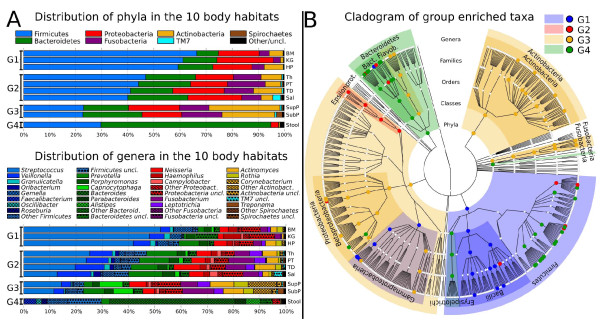
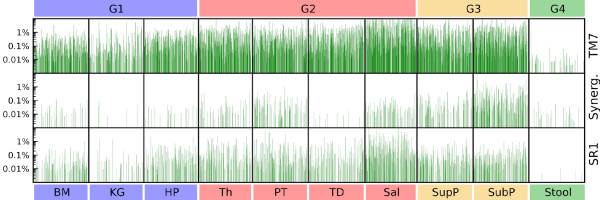
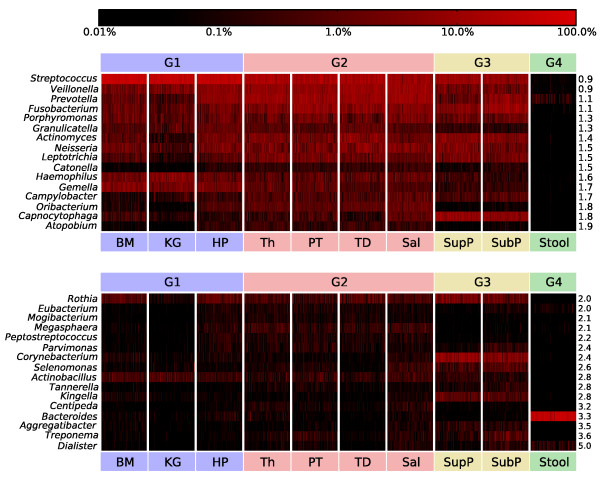
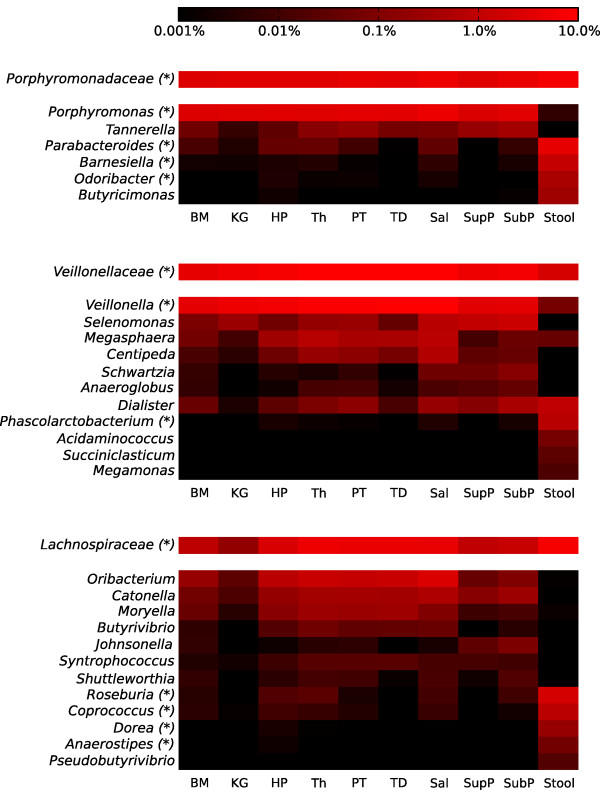
Background: To understand the relationship between our bacterial microbiome and health, it is essential to define the microbiome in the absence of disease. The digestive tract includes diverse habitats and hosts the human body's greatest bacterial density. We describe the bacterial community composition of ten digestive tract sites from more than 200 normal adults enrolled in the Human Microbiome Project, and metagenomically determined metabolic potentials of four representative sites. Results: The microbiota of these diverse habitats formed four groups based on similar community compositions: buccal mucosa, keratinized gingiva, hard palate; saliva, tongue, tonsils, throat; sub- and supra-gingival plaques; and stool. Phyla initially identified from environmental samples were detected throughout this population, primarily TM7, SR1, and Synergistetes. Genera with pathogenic members were well-represented among this disease-free cohort. Tooth-associated communities were distinct, but not entirely dissimilar, from other oral surfaces. The Porphyromonadaceae, Veillonellaceae and Lachnospiraceae families were common to all sites, but the distributions of their genera varied significantly. Most metabolic processes were distributed widely throughout the digestive tract microbiota, with variations in metagenomic abundance between body habitats. These included shifts in sugar transporter types between the supragingival plaque, other oral surfaces, and stool; hydrogen and hydrogen sulfide production were also differentially distributed. Conclusions: The microbiomes of ten digestive tract sites separated into four types based on composition. A core set of metabolic pathways was present across these diverse digestive tract habitats. These data provide a critical baseline for future studies investigating local and systemic diseases affecting human health.
Overview
The claims and statistics of this paper haven’t been checked yet.
Free: it reads the open-access text and checks the first 5 claims that cite a source we can check. Create a free account to check every claim.
Integrity signals
Registry
Cites
Statistics
Figures
Verification
Claims the paper makes
The claims and statistics of this paper haven’t been checked yet.
Free: it reads the open-access text and checks the first 5 claims that cite a source we can check. Create a free account to check every claim.
Claims other papers make about this one
Each is checked against this paper’s own text: does it say what the citing paper says it does?
The source backs part of the claim, not all of it — or backs it for a different population, condition or comparison.
In the citing paper
“The oropharynx, which is lined with a non-keratinized stratified squamous epithelium, has more diverse bacterial communities than the nasopharynx41, which are characterized by streptococcal species, Neisseria spp., Rothia spp. and anaerobes, including Veillonella spp., Prevotella spp. and Leptotrichia spp.39,41,51,52.”
From The microbiota of the respiratory tract: gatekeeper to respiratory health (2017) · cites this paper as [51]
Experimental — accuracy not yet measuredThe source backs part of the claim, not all of it — or backs it for a different population, condition or comparison.
In the citing paper
“Up to 80% of oral bacteria are dominated by about 200 species in the Phyla Firmicutes (esp. Streptococcus, Veillonella, Granulicatella, Gemella spp.) and Proteobacteria (esp. Neisseria, Haemophilus spp.), with contributions from Bacteroidetes, Actinobacteria and Fusobacteria totaling upwards of 95% of all identified oral microbiota (Figure 2)[171–177].”
From Enterosalivary nitrate metabolism and the microbiome: Intersection of microbial metabolism, nitric oxide and diet in cardiac and pulmonary vascular health (2017) · cites this paper as [173]
Experimental — accuracy not yet measuredThe cited source says what the claim attributes to it.
In the citing paper
“Further diversity exists between the varied micro-ecologies of the mouth[174,178], such as the tooth surface, gingiva, hard and soft palate, and even regionally on the tongue (Figure 2)[173,176,179].”
From Enterosalivary nitrate metabolism and the microbiome: Intersection of microbial metabolism, nitric oxide and diet in cardiac and pulmonary vascular health (2017) · cites this paper as [173]
In the citing paper
“Ecological conditions vary immensely along both the length of the GI tract as well as in cross-section from lumen to the mucosal brush-border[173,267,308,309].”
From Enterosalivary nitrate metabolism and the microbiome: Intersection of microbial metabolism, nitric oxide and diet in cardiac and pulmonary vascular health (2017) · cites this paper as [173]
Self-check
Percentages, sums and reported differences re-computed from the paper’s own numbers.
The self-check needs the paper’s full text.
Citations
Cites
Schloss, P. D., Westcott, S. L., Ryabin, T., Hall, J. R., Hartmann, M., Hollister, E. B., Lesniewski, R. A., Oakley, B. B., Parks, D. H., Robinson, C. J., et al. (2009) · Applied and Environmental Microbiology · doi:10.1128/aem.01541-09 · Cited by 19,549
Metagenomic biomarker discovery and explanation
Segata, N., Izard, J., Waldron, L., Gevers, D., Miropolsky, L., Garrett, W. S., & Huttenhower, C. (2011) · Genome Biology · doi:10.1186/gb-2011-12-6-r60 · Cited by 16,192 · cited 11×
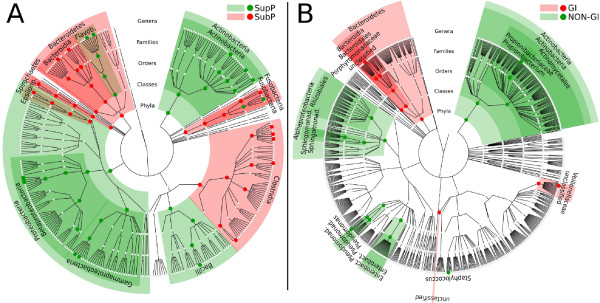
“Clades showing a statistically significant difference (by LEfSe) specifically between oral and stool samples are indiocated with asterisks.”
MethodInfluentialSelf-citationSIMPSON, E. H. (1949) · Nature · doi:10.1038/163688a0 · Cited by 14,164
Structure, function and diversity of the healthy human microbiome
The Human Microbiome Project Consortium (2012) · Nature · doi:10.1038/nature11234 · Cited by 11,726
Self-citationAn Ordination of the Upland Forest Communities of Southern Wisconsin
Bray, J. R., & Curtis, J. T. (1957) · Ecological Monographs · doi:10.2307/1942268 · Cited by 11,716 · cited 2×
“For assessing bacterial community structure similarities between different samples and body sites, we compared the relative abundances of every pair of samples in our dataset using the Bray-Curtis measure of beta diversity [31].”
MethodA human gut microbial gene catalogue established by metagenomic sequencing
MetaHIT Consortium, Qin, J., Li, R., Raes, J., Arumugam, M., Burgdorf, K. S., Manichanh, C., Nielsen, T., Pons, N., Levenez, F., et al. (2010) · Nature · doi:10.1038/nature08821 · Cited by 11,624 · cited 1×
“Previous studies of the healthy adult digestive tract microbiota have typically included less than 20 individuals [11-21] and the studies with over 100 individuals have most often focused on a single body site [22-26].”
BackgroundHuman gut microbes associated with obesity
Ley, R. E., Turnbaugh, P. J., Klein, S., & Gordon, J. I. (2006) · Nature · doi:10.1038/4441022a · Cited by 8,785 · cited 20×
“For example, using endoscopic biopsies from just two subjects, Wang et al. [77] reported 49% of 16S rRNA gene clones were from the Firmicutes and 27.7% were from Bacteroidetes.”
ResultInfluentialDiversity of the Human Intestinal Microbial Flora
Eckburg, P. B., Bik, E. M., Bernstein, C. N., Purdom, E., Dethlefsen, L., Sargent, M., Gill, S. R., Nelson, K. E., & Relman, D. A. (2005) · Science · doi:10.1126/science.1110591 · Cited by 7,913
A core gut microbiome in obese and lean twins
Turnbaugh, P. J., Hamady, M., Yatsunenko, T., Cantarel, B. L., Duncan, A., Ley, R. E., Sogin, M. L., Jones, W. J., Roe, B. A., Affourtit, J. P., et al. (2009) · Nature · doi:10.1038/nature07540 · Cited by 7,823 · cited 2×
“In a study of stool from 154 adult women (twins and their mothers), Firmicutes had a mean relative abundance of >60% using several different methods to assess the 16S rRNA gene content of stool [24].”
BackgroundMethodEnterotypes of the human gut microbiome
MetaHIT Consortium (additional members), Arumugam, M., Raes, J., Pelletier, E., Le Paslier, D., Yamada, T., Mende, D. R., Fernandes, G. R., Tap, J., Bruls, T., et al. (2011) · Nature · doi:10.1038/nature09944 · Cited by 7,548 · cited 2×
“By surveying the HMP population, these results can be further integrated into other currently ongoing studies of the cohort’s core microbiome [9] or enterotype structure [25], if any.”
BackgroundResultPruesse, E., Quast, C., Knittel, K., Fuchs, B. M., Ludwig, W., Peplies, J., & Glockner, F. O. (2007) · Nucleic Acids Research · doi:10.1093/nar/gkm864 · Cited by 6,668 · cited 1×
“Any sequences not aligning against the appropriate subset of the SILVA database [102] were removed, as were chimeric sequences.”
MethodDe Filippo, C., Cavalieri, D., Di Paola, M., Ramazzotti, M., Poullet, J. B., Massart, S., Collini, S., Pieraccini, G., & Lionetti, P. (2010) · Proceedings of the National Academy of Sciences · doi:10.1073/pnas.1005963107 · Cited by 5,579
Microbial complexes in subgingival plaque
Socransky, S. S., Haffajee, A. D., Cugini, M. A., Smith, C., & Kent, R. L. (1998) · Journal of Clinical Periodontology · doi:10.1111/j.1600-051x.1998.tb02419.x · Cited by 5,050 · cited 1×
“Similarly, in the periodontal subgingival habitat, ecological shifts in redox potential facilitate the emergence of anaerobic pathogenic microbes such as the porphyromonads, which are prevalent but in low abundance in the nondiseased state [97,98].”
BackgroundDiarrheagenic Escherichia coli
Nataro, J. P., & Kaper, J. B. (1998) · Clinical Microbiology Reviews · doi:10.1128/cmr.11.1.142 · Cited by 5,006
The Ribosomal Database Project: improved alignments and new tools for rRNA analysis
Cole, J. R., Wang, Q., Cardenas, E., Fish, J., Chai, B., Farris, R. J., Kulam-Syed-Mohideen, A. S., McGarrell, D. M., Marsh, T., Garrity, G. M., et al. (2009) · Nucleic Acids Research · doi:10.1093/nar/gkn879 · Cited by 4,762 · cited 11×
“This enzyme for iron utilization is most often found in members of the Methylococcaceae family [57], but these were again not detectable in this study due to their absence from the RDP 16S rRNA database (see Materials and methods).”
BackgroundMethodInfluentialFrank, D. N., St. Amand, A. L., Feldman, R. A., Boedeker, E. C., Harpaz, N., & Pace, N. R. (2007) · Proceedings of the National Academy of Sciences · doi:10.1073/pnas.0706625104 · Cited by 4,611 · cited 20×
“For example, using endoscopic biopsies from just two subjects, Wang et al. [77] reported 49% of 16S rRNA gene clones were from the Firmicutes and 27.7% were from Bacteroidetes.”
ResultInfluentialSokol, H., Pigneur, B., Watterlot, L., Lakhdari, O., Bermúdez-Humarán, L. G., Gratadoux, J.-J., Blugeon, S., Bridonneau, C., Furet, J.-P., Corthier, G., et al. (2008) · Proceedings of the National Academy of Sciences · doi:10.1073/pnas.0804812105 · Cited by 4,413
Evolution of mammals and their gut microbes
Ley, R. E., Hamady, M., Lozupone, C., Turnbaugh, P. J., Ramey, R. R., Bircher, J. S., Schlegel, M. L., Tucker, T. A., Schrenzel, M. D., Knight, R., et al. (2008) · Science · doi:10.1126/science.1155725 · Cited by 3,747 · cited 20×
“For example, using endoscopic biopsies from just two subjects, Wang et al. [77] reported 49% of 16S rRNA gene clones were from the Firmicutes and 27.7% were from Bacteroidetes.”
ResultInfluentialDewhirst, F. E., Chen, T., Izard, J., Paster, B. J., Tanner, A. C. R., Yu, W.-H., Lakshmanan, A., & Wade, W. G. (2010) · Journal of Bacteriology · doi:10.1128/jb.00542-10 · Cited by 3,352
Self-citationBacterial Community Variation in Human Body Habitats Across Space and Time
Costello, E. K., Lauber, C. L., Hamady, M., Fierer, N., Gordon, J. I., & Knight, R. (2009) · Science · doi:10.1126/science.1177486 · Cited by 3,231 · cited 2×
“The increased throughput, the improved sensitivity of assays and the improvements in next generation sequencing technologies have enabled cataloging of microbial community membership and structure [12,19,27] as well as the metagenomic gene pool present in each community in large numbers of samples from large numbers o…”
BackgroundDefining the normal bacterial flora of the oral cavity
Aas, J. A., Paster, B. J., Stokes, L. N., Olsen, I., & Dewhirst, F. E. (2005) · Journal of Clinical Microbiology · doi:10.1128/jcm.43.11.5721-5732.2005 · Cited by 3,092
The Effect of Diet on the Human Gut Microbiome: A Metagenomic Analysis in Humanized Gnotobiotic Mice
Turnbaugh, P. J., Ridaura, V. K., Faith, J. J., Rey, F. E., Knight, R., & Gordon, J. I. (2009) · Science Translational Medicine · doi:10.1126/scitranslmed.3000322 · Cited by 3,058 · cited 2×
“The increased throughput, the improved sensitivity of assays and the improvements in next generation sequencing technologies have enabled cataloging of microbial community membership and structure [12,19,27] as well as the metagenomic gene pool present in each community in large numbers of samples from large numbers o…”
BackgroundA framework for human microbiome research
The Human Microbiome Project Consortium (2012) · Nature · doi:10.1038/nature11209 · Cited by 2,650
Self-citationSuccession of microbial consortia in the developing infant gut microbiome
Koenig, J. E., Spor, A., Scalfone, N., Fricker, A. D., Stombaugh, J., Knight, R., Angenent, L. T., & Ley, R. E. (2011) · Proceedings of the National Academy of Sciences · doi:10.1073/pnas.1000081107 · Cited by 2,540
MICROBIAL ECOLOGY OF THE GASTROINTESTINAL TRACT
Savage, D. C. (1977) · Annual Review of Microbiology · doi:10.1146/annurev.mi.31.100177.000543 · Cited by 2,436 · cited 2×
“Although existing data indicate that mucosa-associated communities below the pharynx may have distinct microbiomes, these sites were not included, as sampling would have required invasive procedures [16,17,28].”
BackgroundKEGG for representation and analysis of molecular networks involving diseases and drugs
Kanehisa, M., Goto, S., Furumichi, M., Tanabe, M., & Hirakawa, M. (2010) · Nucleic Acids Research · doi:10.1093/nar/gkp896 · Cited by 2,322
Reducing the Effects of PCR Amplification and Sequencing Artifacts on 16S rRNA-Based Studies
Schloss, P. D., Gevers, D., & Westcott, S. L. (2011) · PLoS ONE · doi:10.1371/journal.pone.0027310 · Cited by 2,112 · cited 1×
“Specifically, the downloadable packaged datasets are the 16S rRNA gene dataset [105], phylotype-classification of the 16S rRNA gene dataset [106,107], Human Microbiome Illumina whole genome shotgun reads [108], and the metabolic reconstruction tables [109].”
MethodSelf-citationAkkermansia muciniphila gen. nov., sp. nov., a human intestinal mucin-degrading bacterium
Derrien, M., Vaughan, E. E., Plugge, C. M., & de Vos, W. M. (2004) · International Journal of Systematic and Evolutionary Microbiology · doi:10.1099/ijs.0.02873-0 · Cited by 2,094 · cited 4×
“Bacterial phyla originally thought to be exclusively environmental have recently been observed to possess human host-associated membership [33-36].”
BackgroundInfluentialThe NIH Human Microbiome Project
The NIH HMP Working Group, Peterson, J., Garges, S., Giovanni, M., McInnes, P., Wang, L., Schloss, J. A., Bonazzi, V., McEwen, J. E., Wetterstrand, K. A., et al. (2009) · Genome Research · doi:10.1101/gr.096651.109 · Cited by 2,066 · cited 2×
“The Human Microbiome Project (HMP) established by the National Institutes of Health aims to characterize the microbiome of a large cohort of normal adult subjects [9], providing an unprecedented survey of the microbiome.”
BackgroundHuman gut microbiota in obesity and after gastric bypass
Zhang, H., DiBaise, J. K., Zuccolo, A., Kudrna, D., Braidotti, M., Yu, Y., Parameswaran, P., Crowell, M. D., Wing, R., Rittmann, B. E., et al. (2009) · Proceedings of the National Academy of Sciences · doi:10.1073/pnas.0812600106 · Cited by 1,880 · cited 1×
“Both cultivation and molecular techniques demonstrate an overlap in the oral, pharyngeal, esophageal and intestinal microbiomes [12,27,28,75,80-85].”
BackgroundComposition, variability, and temporal stability of the intestinal microbiota of the elderly
Claesson, M. J., Cusack, S., O'Sullivan, O., Greene-Diniz, R., de Weerd, H., Flannery, E., Marchesi, J. R., Falush, D., Dinan, T., Fitzgerald, G., et al. (2011) · Proceedings of the National Academy of Sciences · doi:10.1073/pnas.1000097107 · Cited by 1,754 · cited 2×
“Finally, a recently published study of fecal microbiota in 161 older subjects (≥65 years) corroborate our findings, namely a Bacteroidetes-dominant distribution (57%) compared to Firmicutes (40%) [26].”
BackgroundResultDental biofilms: difficult therapeutic targets
SOCRANSKY, S. S., & HAFFAJEE, A. D. (2002) · Periodontology 2000 · doi:10.1034/j.1600-0757.2002.280102.x · Cited by 1,273 · cited 1×
“An estimated 10(11) bacterial cells per day flow from the mouth to the stomach [78,79].”
BackgroundMolecular analysis of the bacterial microbiota in the human stomach
Bik, E. M., Eckburg, P. B., Gill, S. R., Nelson, K. E., Purdom, E. A., Francois, F., Perez-Perez, G., Blaser, M. J., & Relman, D. A. (2006) · Proceedings of the National Academy of Sciences · doi:10.1073/pnas.0506655103 · Cited by 1,158
Dowd, S. E., Callaway, T. R., Wolcott, R. D., Sun, Y., McKeehan, T., Hagevoort, R. G., & Edrington, T. S. (2008) · BMC Microbiology · doi:10.1186/1471-2180-8-125 · Cited by 1,121
Dysbiosis of the faecal microbiota in patients with Crohn’s disease and their unaffected relatives
Joossens, M., Huys, G., Cnockaert, M., De Preter, V., Verbeke, K., Rutgeerts, P., Vandamme, P., & Vermeire, S. (2011) · Gut · doi:10.1136/gut.2010.223263 · Cited by 1,063
Metabolic Reconstruction for Metagenomic Data and Its Application to the Human Microbiome
Abubucker, S., Segata, N., Goll, J., Schubert, A. M., Izard, J., Cantarel, B. L., Rodriguez-Mueller, B., Zucker, J., Thiagarajan, M., Henrissat, B., et al. (2012) · PLoS Computational Biology · doi:10.1371/journal.pcbi.1002358 · Cited by 1,056
Self-citationCreely, S. J., McTernan, P. G., Kusminski, C. M., Fisher, F. M., Da Silva, N. F., Khanolkar, M., Evans, M., Harte, A. L., & Kumar, S. (2007) · American Journal of Physiology-Endocrinology and Metabolism · doi:10.1152/ajpendo.00302.2006 · Cited by 1,043 · cited 1×
“In disease, with breach of the mucosal barrier, commensal bacteria can become a chronic inflammatory stimulus to adjacent tissues [2,3] as well as a source of immune perturbation in conditions such as atherosclerosis, type 2 diabetes, non-alcoholic fatty liver disease, obesity and inflammatory bowel disease [4-8].”
BackgroundComparative Analysis of Human Gut Microbiota by Barcoded Pyrosequencing
Andersson, A. F., Lindberg, M., Jakobsson, H., Bäckhed, F., Nyrén, P., & Engstrand, L. (2008) · PLoS ONE · doi:10.1371/journal.pone.0002836 · Cited by 1,038
Towards the human intestinal microbiota phylogenetic core
Tap, J., Mondot, S., Levenez, F., Pelletier, E., Caron, C., Furet, J., Ugarte, E., Muñoz‐Tamayo, R., Paslier, D. L. E., Nalin, R., et al. (2009) · Environmental Microbiology · doi:10.1111/j.1462-2920.2009.01982.x · Cited by 927
Comparative metagenomics revealed commonly enriched gene sets in human gut microbiomes
Kurokawa, K., Itoh, T., Kuwahara, T., Oshima, K., Toh, H., Toyoda, A., Takami, H., Morita, H., Sharma, V. K., Srivastava, T. P., et al. (2007) · DNA Research · doi:10.1093/dnares/dsm018 · Cited by 869 · cited 2×
“Many previous studies of adult American populations have observed the reverse, a preponderance of Firmicutes [15,71-73], and similar observations have been reported in geographically diverse populations [74,75] and in infant gut microbiome colonization investigations [76].”
BackgroundResultObesity and the human microbiome
Ley, R. E. (2010) · Current Opinion in Gastroenterology · doi:10.1097/mog.0b013e328333d751 · Cited by 770 · cited 1×
“In disease, with breach of the mucosal barrier, commensal bacteria can become a chronic inflammatory stimulus to adjacent tissues [2,3] as well as a source of immune perturbation in conditions such as atherosclerosis, type 2 diabetes, non-alcoholic fatty liver disease, obesity and inflammatory bowel disease [4-8].”
BackgroundTHE COLONIC EPITHELIUM IN ULCERATIVE COLITIS: AN ENERGY-DEFICIENCY DISEASE?
Roediger, W. E. W. (1980) · The Lancet · doi:10.1016/s0140-6736(80)91934-0 · Cited by 719
Tlaskalová-Hogenová, H., Štěpánková, R., Kozáková, H., Hudcovic, T., Vannucci, L., Tučková, L., Rossmann, P., Hrnčíř, T., Kverka, M., Zákostelská, Z., et al. (2011) · Cellular & Molecular Immunology · doi:10.1038/cmi.2010.67 · Cited by 693
Oral Biofilm Architecture on Natural Teeth
Zijnge, V., van Leeuwen, M. B. M., Degener, J. E., Abbas, F., Thurnheer, T., Gmür, R., & M. Harmsen, H. J. (2010) · PLoS ONE · doi:10.1371/journal.pone.0009321 · Cited by 689 · cited 1×
“The Synergistetes phylum, for example, has only recently been described in detailed association with the human oral cavity [36,92], and is still considered potentially environmental due to its common occurrence in, for example, bioreactors [93,94].”
BackgroundA Parsimony Approach to Biological Pathway Reconstruction/Inference for Genomes and Metagenomes
Ye, Y., & Doak, T. G. (2009) · PLoS Computational Biology · doi:10.1371/journal.pcbi.1000465 · Cited by 686 · cited 1×
“Pathway information was then recovered by assigning KO gene families to KEGG modules (representing small pathways of approximately 5 to 20 genes) using a combination of MinPath [104], filtering of pathways not consistent with the BLAST-derived taxonomic composition of the community, and gap filling of likely missing e…”
MethodPyrosequencing analysis of the oral microflora of healthy adults
Keijser, B. J. F., Zaura, E., Huse, S. M., van der Vossen, J. M. B. M., Schuren, F. H. J., Montijn, R. C., ten Cate, J. M., & Crielaard, W. (2008) · Journal of Dental Research · doi:10.1177/154405910808701104 · Cited by 669 · cited 1×
“The oral microbiome as revealed in this investigation was generally consistent with earlier studies [11,13,14,22,66,67].”
ResultBacterial diversity in the oral cavity of 10 healthy individuals
Bik, E. M., Long, C. D., Armitage, G. C., Loomer, P., Emerson, J., Mongodin, E. F., Nelson, K. E., Gill, S. R., Fraser-Liggett, C. M., & Relman, D. A. (2010) · The ISME Journal · doi:10.1038/ismej.2010.30 · Cited by 651
Imperfect vaccines and the evolution of pathogen virulence
Gandon, S., Mackinnon, M. J., Nee, S., & Read, A. F. (2001) · Nature · doi:10.1038/414751a · Cited by 630 · cited 1×
“These data suggest, rather than a complete absence of pathogenic organisms from the normal microbiota, the possibility of low-level carriage of potential pathogens [68-70].”
BackgroundNew Bacterial Species Associated with Chronic Periodontitis
Kumar, P. S., Griffen, A. L., Barton, J. A., Paster, B. J., Moeschberger, M. L., & Leys, E. J. (2003) · Journal of Dental Research · doi:10.1177/154405910308200503 · Cited by 541 · cited 1×
“Several ‘environmental’ phyla observed in human microbiota [33,91] appear to be strongly host-associated in this study.”
BackgroundDuan, K., Dammel, C., Stein, J., Rabin, H., & Surette, M. G. (2003) · Molecular Microbiology · doi:10.1046/j.1365-2958.2003.03803.x · Cited by 509 · cited 3×
“Duan K, Dammel C, Stein J, Rabin H, Surette MG: Modulation of Pseudomonas aeruginosa gene expression by host microflora through interspecies communication.”
BackgroundBacterial biota in the human distal esophagus
Pei, Z., Bini, E. J., Yang, L., Zhou, M., Francois, F., & Blaser, M. J. (2004) · Proceedings of the National Academy of Sciences · doi:10.1073/pnas.0306398101 · Cited by 501
Pathways of acetate, propionate, and butyrate formation by the human fecal microbial flora
Miller, T. L., & Wolin, M. J. (1996) · Applied and Environmental Microbiology · doi:10.1128/aem.62.5.1589-1592.1996 · Cited by 481
Global diversity in the human salivary microbiome
Nasidze, I., Li, J., Quinque, D., Tang, K., & Stoneking, M. (2009) · Genome Research · doi:10.1101/gr.084616.108 · Cited by 466 · cited 2×
“The oral microbiome as revealed in this investigation was generally consistent with earlier studies [11,13,14,22,66,67].”
BackgroundResultExacerbations in cystic fibrosis {middle dot} 1: Epidemiology and pathogenesis
Goss, C. H., & Burns, J. L. (2007) · Thorax · doi:10.1136/thx.2006.060889 · Cited by 445
Disordered Microbial Communities in the Upper Respiratory Tract of Cigarette Smokers
Charlson, E. S., Chen, J., Custers-Allen, R., Bittinger, K., Li, H., Sinha, R., Hwang, J., Bushman, F. D., & Collman, R. G. (2010) · PLoS ONE · doi:10.1371/journal.pone.0015216 · Cited by 437 · cited 1×
“Previous studies of the healthy adult digestive tract microbiota have typically included less than 20 individuals [11-21] and the studies with over 100 individuals have most often focused on a single body site [22-26].”
BackgroundLenski, R. E., & May, R. M. (1994) · Journal of Theoretical Biology · doi:10.1006/jtbi.1994.1146 · Cited by 404 · cited 1×
“These data suggest, rather than a complete absence of pathogenic organisms from the normal microbiota, the possibility of low-level carriage of potential pathogens [68-70].”
BackgroundSchloss, P. D. (2010) · PLoS Computational Biology · doi:10.1371/journal.pcbi.1000844 · Cited by 392
Ott, S. J., El Mokhtari, N. E., Musfeldt, M., Hellmig, S., Freitag, S., Rehman, A., Kühbacher, T., Nikolaus, S., Namsolleck, P., Blaut, M., et al. (2006) · Circulation · doi:10.1161/circulationaha.105.579979 · Cited by 391 · cited 1×
“In disease, with breach of the mucosal barrier, commensal bacteria can become a chronic inflammatory stimulus to adjacent tissues [2,3] as well as a source of immune perturbation in conditions such as atherosclerosis, type 2 diabetes, non-alcoholic fatty liver disease, obesity and inflammatory bowel disease [4-8].”
BackgroundEpidemiology of Helicobacter pylori Infection and Public Health Implications
Goh, K., Chan, W., Shiota, S., & Yamaoka, Y. (2011) · Helicobacter · doi:10.1111/j.1523-5378.2011.00874.x · Cited by 381
Evidence That Hydrogen Sulfide Is a Genotoxic Agent
Attene-Ramos, M. S., Wagner, E. D., Plewa, M. J., & Gaskins, H. R. (2006) · Molecular Cancer Research · doi:10.1158/1541-7786.mcr-05-0126 · Cited by 363 · cited 1×
“Hydrogen sulfide gas is involved in regulation of the host response at low concentrations and in host-cell toxicity and inhibition of short chain fatty acid production, specifically in the colon, at high concentrations [60-65].”
BackgroundHold, G. L., Schwiertz, A., Aminov, R. I., Blaut, M., & Flint, H. J. (2003) · Applied and Environmental Microbiology · doi:10.1128/aem.69.7.4320-4324.2003 · Cited by 350
Mechanisms, diagnosis and management of hepatic encephalopathy
Prakash, R., & Mullen, K. D. (2010) · Nature Reviews Gastroenterology & Hepatology · doi:10.1038/nrgastro.2010.116 · Cited by 324 · cited 1×
“In fact, targeting the colonic microbiome with antibiotics has been shown to be a successful therapy in acquired diseases of hyperammonemia such as encephalopathy complicating hepatic insufficiency [53].”
BackgroundMicrobiota of health, gingivitis, and initial periodontitis
Tanner, A., Maiden, M. F. J., Macuch, P. J., Murray, L. L., & Kent, R. L. (1998) · Journal of Clinical Periodontology · doi:10.1111/j.1600-051x.1998.tb02414.x · Cited by 322 · cited 1×
“In disease, with breach of the mucosal barrier, commensal bacteria can become a chronic inflammatory stimulus to adjacent tissues [2,3] as well as a source of immune perturbation in conditions such as atherosclerosis, type 2 diabetes, non-alcoholic fatty liver disease, obesity and inflammatory bowel disease [4-8].”
BackgroundComparative analyses of the bacterial microbiota of the human nostril and oropharynx
Lemon, K. P., Klepac-Ceraj, V., Schiffer, H. K., Brodie, E. L., Lynch, S. V., & Kolter, R. (2010) · mBio · doi:10.1128/mbio.00129-10 · Cited by 322
Self-citationKumar, P. S., Leys, E. J., Bryk, J. M., Martinez, F. J., Moeschberger, M. L., & Griffen, A. L. (2006) · Journal of Clinical Microbiology · doi:10.1128/jcm.00317-06 · Cited by 318
Roediger, W. E. W., Duncan, A., Kapaniris, O., & Millard, S. (1993) · Gastroenterology · doi:10.1016/0016-5085(93)91016-b · Cited by 317 · cited 1×
“Hydrogen sulfide gas is involved in regulation of the host response at low concentrations and in host-cell toxicity and inhibition of short chain fatty acid production, specifically in the colon, at high concentrations [60-65].”
BackgroundMetagenomic study of the oral microbiota by Illumina high-throughput sequencing
Lazarevic, V., Whiteson, K., Huse, S., Hernandez, D., Farinelli, L., Østerås, M., Schrenzel, J., & François, P. (2009) · Journal of Microbiological Methods · doi:10.1016/j.mimet.2009.09.012 · Cited by 313 · cited 1×
“The oral microbiome as revealed in this investigation was generally consistent with earlier studies [11,13,14,22,66,67].”
ResultSibley, C. D., Parkins, M. D., Rabin, H. R., Duan, K., Norgaard, J. C., & Surette, M. G. (2008) · Proceedings of the National Academy of Sciences · doi:10.1073/pnas.0804326105 · Cited by 312 · cited 1×
“A few examples of this from the polymicrobial airway infections of cystic fibrosis follow: one of the earliest cystic fibrosis pulmonary pathogens is Haemophilus influenzae, a common colonizer of the upper aerodigestive tract [88]; members of the Streptococcus milleri group were recently implicated as cystic fibrosis…”
BackgroundOvercoming the Heme Paradox: Heme Toxicity and Tolerance in Bacterial Pathogens
Anzaldi, L. L., & Skaar, E. P. (2010) · Infection and Immunity · doi:10.1128/iai.00613-10 · Cited by 295
Armitage, G. C., Dickinson, W. R., Jenderseck, R. S., Levine, S. M., & Chambers, D. W. (1982) · Journal of Periodontology · doi:10.1902/jop.1982.53.9.550 · Cited by 285 · cited 1×
“Among the Spirochetes, Treponema species are associated with periodontal and endodontic diseases [37,38] and were present in at least one of the upper digestive tract sites of 96% of this disease-free population (and in all the nine oral sites of 6.”
BackgroundPussinen, P. J., Tuomisto, K., Jousilahti, P., Havulinna, A. S., Sundvall, J., & Salomaa, V. (2007) · Arteriosclerosis, Thrombosis, and Vascular Biology · doi:10.1161/atvbaha.106.138743 · Cited by 265
Martinez-Medina, M., Aldeguer, X., Gonzalez-Huix, F., Acero, D., & Garcia-Gil, J. L. (2006) · Inflammatory Bowel Diseases · doi:10.1097/01.mib.0000235828.09305.0c · Cited by 263
Plant Cell Wall Breakdown by Anaerobic Microorganisms from the Mammalian Digestive Tract
Flint, H. J., & Bayer, E. A. (2008) · Annals of the New York Academy of Sciences · doi:10.1196/annals.1419.022 · Cited by 251
Hydrogen sulfide enhances ulcer healing in rats
Wallace, J. L., Dicay, M., McKnight, W., & Martin, G. R. (2007) · The FASEB Journal · doi:10.1096/fj.07-8669com · Cited by 236 · cited 1×
“Hydrogen sulfide gas is involved in regulation of the host response at low concentrations and in host-cell toxicity and inhibition of short chain fatty acid production, specifically in the colon, at high concentrations [60-65].”
BackgroundClonal Analysis of the Microbiota of Severe Early Childhood Caries
Kanasi, E., Dewhirst, F. E., Chalmers, N. I., Kent, Jr., Moore, A., Hughes, C. V., Pradhan, N., Loo, C. Y., & Tanner, A. C. R. (2010) · Caries Research · doi:10.1159/000320158 · Cited by 235
Wang, X., Heazlewood, S. P., Krause, D. O., & Florin, T. H. J. (2003) · Journal of Applied Microbiology · doi:10.1046/j.1365-2672.2003.02005.x · Cited by 235
Brinig, M. M., Lepp, P. W., Ouverney, C. C., Armitage, G. C., & Relman, D. A. (2003) · Applied and Environmental Microbiology · doi:10.1128/aem.69.3.1687-1694.2003 · Cited by 221
Sulphide as an inhibitor and electron donor for the cytochrome c oxidase system
Nicholls, P., & Kim, J.-K. (1982) · Canadian Journal of Biochemistry · doi:10.1139/o82-076 · Cited by 212 · cited 1×
“Hydrogen sulfide gas is involved in regulation of the host response at low concentrations and in host-cell toxicity and inhibition of short chain fatty acid production, specifically in the colon, at high concentrations [60-65].”
BackgroundThe Coevolution of Virulence: Tolerance in Perspective
Little, T. J., Shuker, D. M., Colegrave, N., Day, T., & Graham, A. L. (2010) · PLoS Pathogens · doi:10.1371/journal.ppat.1001006 · Cited by 204
Phototargeting Oral Black-Pigmented Bacteria
Soukos, N. S., Som, S., Abernethy, A. D., Ruggiero, K., Dunham, J., Lee, C., Doukas, A. G., & Goodson, J. M. (2005) · Antimicrobial Agents and Chemotherapy · doi:10.1128/aac.49.4.1391-1396.2005 · Cited by 200
Oxidation Reduction Potential of Developing Plaque, Periodontal Pockets and Gingival Sulci
Kenney, E. B., & Ash, M. M. (1969) · Journal of Periodontology-Periodontics · doi:10.1902/jop.1969.40.11.630 · Cited by 169
Changes in endotoxin levels in T2DM subjects on anti-diabetic therapies
Al-Attas, O. S., Al-Daghri, N. M., Al-Rubeaan, K., da Silva, N. F., Sabico, S. L., Kumar, S., McTernan, P. G., & Harte, A. L. (2009) · Cardiovascular Diabetology · doi:10.1186/1475-2840-8-20 · Cited by 145
Victivallis vadensis gen. nov., sp. nov., a sugar-fermenting anaerobe from human faeces
Zoetendal, E. G., Plugge, C. M., Akkermans, A. D. L., & de Vos, W. M. (2003) · International Journal of Systematic and Evolutionary Microbiology · doi:10.1099/ijs.0.02362-0 · Cited by 145 · cited 4×
“Bacterial phyla originally thought to be exclusively environmental have recently been observed to possess human host-associated membership [33-36].”
BackgroundInfluentialEpidemiology of Helicobacter pylori infection and Public Health Implications
Ford, A. C., & Axon, A. T. R. (2010) · Helicobacter · doi:10.1111/j.1523-5378.2010.00779.x · Cited by 134
Physiological Approaches to the Control of Oral Biofilms
Marsh, P. D., & Bradshaw, D. J. (1997) · Advances in Dental Research · doi:10.1177/08959374970110010901 · Cited by 132 · cited 2×
“A classic example of this is the frequent ingestion of fermentable sugars that leads to increases in the mutans streptococci, etiological agents of dental caries [97].”
BackgroundDownes, J., Vartoukian, S. R., Dewhirst, F. E., Izard, J., Chen, T., Yu, W.-H., Sutcliffe, I. C., & Wade, W. G. (2009) · INTERNATIONAL JOURNAL OF SYSTEMATIC AND EVOLUTIONARY MICROBIOLOGY · doi:10.1099/ijs.0.000364-0 · Cited by 129
Self-citationOral cavity as natural reservoir for intestinal lactobacilli
Bello, F. D., & Hertel, C. (2005) · Systematic and Applied Microbiology · doi:10.1016/j.syapm.2005.07.002 · Cited by 127
Hydrogen mediates suppression of colon inflammation induced by dextran sodium sulfate
Kajiya, M., Silva, M. J. B., Sato, K., Ouhara, K., & Kawai, T. (2009) · Biochemical and Biophysical Research Communications · doi:10.1016/j.bbrc.2009.05.117 · Cited by 127
Seville, L. A., Patterson, A. J., Scott, K. P., Mullany, P., Quail, M. A., Parkhill, J., Ready, D., Wilson, M., Spratt, D., & Roberts, A. P. (2009) · Microbial Drug Resistance · doi:10.1089/mdr.2009.0916 · Cited by 125 · cited 1×
“Both cultivation and molecular techniques demonstrate an overlap in the oral, pharyngeal, esophageal and intestinal microbiomes [12,27,28,75,80-85].”
BackgroundBacteriology of humans: an ecological perspective
(2008) · Choice Reviews Online · doi:10.5860/choice.46-2078 · Cited by 122
Acceleration of Purine Degradation by Periodontal Diseases
Barnes, V. M., Teles, R., Trivedi, H. M., Devizio, W., Xu, T., Mitchell, M. W., Milburn, M. V., & Guo, L. (2009) · Journal of Dental Research · doi:10.1177/0022034509341967 · Cited by 120
The Isolation of Bifidobacteria from Occlusal Carious Lesions in Children and Adults
Mantzourani, M., Gilbert, S. C., Sulong, H. N. H., Sheehy, E. C., Tank, S., Fenlon, M., & Beighton, D. (2009) · Caries Research · doi:10.1159/000222659 · Cited by 115 · cited 1×
“Bifidobacteriaceae, implicated in the formation of caries [39,40], were very rare at all oral sites (means <0.”
BackgroundGodon, J., Morinière, J., Moletta, M., Gaillac, M., Bru, V., & Delgènes, J. (2005) · Environmental Microbiology · doi:10.1111/j.1462-2920.2004.00693.x · Cited by 113
Intra-individual diversity and similarity of salivary and faecal microbiota
Maukonen, J., Mättö, J., Suihko, M.-L., & Saarela, M. (2008) · Journal of Medical Microbiology · doi:10.1099/jmm.0.47352-0 · Cited by 110 · cited 1×
“Both cultivation and molecular techniques demonstrate an overlap in the oral, pharyngeal, esophageal and intestinal microbiomes [12,27,28,75,80-85].”
BackgroundRemschmidt, H., & Schmidt, M. H. (2001) · Springer eBooks · doi:10.1007/978-3-642-59519-6_47 · Cited by 109
Sakamoto, M., Huang, Y., Ohnishi, M., Umeda, M., Ishikawa, I., & Benno, Y. (2004) · Journal of Medical Microbiology · doi:10.1099/jmm.0.45576-0 · Cited by 101
Xie, G., Chain, P. S. G., Lo, C. ‐., Liu, K. ‐., Gans, J., Merritt, J., & Qi, F. (2010) · Molecular Oral Microbiology · doi:10.1111/j.2041-1014.2010.00587.x · Cited by 97
A Bacteriologic Census of Human Saliva
Richardson, R. L., & Jones, M. (1958) · Journal of Dental Research · doi:10.1177/00220345580370041701 · Cited by 82 · cited 1×
“An estimated 10(11) bacterial cells per day flow from the mouth to the stomach [78,79].”
BackgroundKumar, A. G., Nagesh, N., Prabhakar, T., & SEKARAN, G. (2007) · Bioresource Technology · doi:10.1016/j.biortech.2007.05.001 · Cited by 62 · cited 1×
“The Synergistetes phylum, for example, has only recently been described in detailed association with the human oral cavity [36,92], and is still considered potentially environmental due to its common occurrence in, for example, bioreactors [93,94].”
BackgroundKarlsen, O. A., Ramsevik, L., Bruseth, L. J., Larsen, Ø., Brenner, A. K., Berven, F. S., Jensen, H. B., & Lillehaug, J. R. (2005) · FEBS Journal · doi:10.1111/j.1742-4658.2005.04663.x · Cited by 46
Potentiation by sulfide of hydrogen peroxide-induced killing of Escherichia coli
Berglin, E. H., & Carlsson, J. (1985) · Infection and Immunity · doi:10.1128/iai.49.3.538-543.1985 · Cited by 35
Hydrogen-dependent organisms from the human gingival crevice resembling Vibrio succinogenes
Helderman, W. H. V. P., & Rosman, I. (1976) · Antonie van Leeuwenhoek · doi:10.1007/bf00399454 · Cited by 21
Cavrini, F., Pirani, C., Foschi, F., Montebugnoli, L., Sambri, V., & Prati, C. (2008) · PubMed · Cited by 19
National Museums and Galleries in Britain
(1949) · Nature · doi:10.1038/163001a0 · Cited by 12
Research works printed but not linked: 1
- NIH Human Microbiome Project - Core Microbiome Sampling Protocol A (HMP-A). http://www.ncbi.nlm.nih.gov/projects/gap/cgi-bin/study.cgi?study_id=phs000228.v3.p1
Cited by
Structure, function and diversity of the healthy human microbiome
The Human Microbiome Project Consortium (2012) · Nature · doi:10.1038/nature11234 · Cited by 11,726
Self-citationPredictive functional profiling of microbial communities using 16S rRNA marker gene sequences
Langille, M. G. I., Zaneveld, J., Caporaso, J. G., McDonald, D., Knights, D., Reyes, J. A., Clemente, J. C., Burkepile, D. E., Vega Thurber, R. L., Knight, R., et al. (2013) · Nature Biotechnology · doi:10.1038/nbt.2676 · Cited by 9,116
“Previous culture-based studies had detected higher frequencies of aerobic bacteria in the supragingival plaque relative to subgingival plaque 38 , and an analysis of HMP 16S rRNA sequences detected taxonomic differences between these two sites 39 .”
ResultSelf-citationMicrobiota in health and diseases
Hou, K., Wu, Z.-X., Chen, X.-Y., Wang, J.-Q., Zhang, D., Xiao, C., Zhu, D., Koya, J. B., Wei, L., Li, J., et al. (2022) · Signal Transduction and Targeted Therapy · doi:10.1038/s41392-022-00974-4 · Cited by 3,171
“The oral cavity can be further divided into multiple habitats of microbiota, including saliva, tongue, tooth surfaces, gums, buccal mucosa, palate, and subgingival/supragingival plaque, which may exhibit substantial and rapid changes in composition and activity, owing to the factors such as changes in pH, gene mutatio…”
BackgroundWaste Not, Want Not: Why Rarefying Microbiome Data Is Inadmissible
McMurdie, P. J., & Holmes, S. (2014) · PLoS Computational Biology · doi:10.1371/journal.pcbi.1003531 · Cited by 2,921
“…of “rarefying to even sampling depth” as a standard normalization procedure appears to explain why rarefied counts are also used in studies that attempt to detect differential abundance of OTUs between prede-fined classes of samples [33–37], in addition to studies that use proportions directly [38].”
Kostic, A. D., Chun, E., Robertson, L., Glickman, J. N., Gallini, C. A., Michaud, M., Clancy, T. E., Chung, D. C., Lochhead, P., Hold, G. L., et al. (2013) · Cell Host & Microbe · doi:10.1016/j.chom.2013.07.007 · Cited by 2,718
“Our results demonstrate that Fusobacterium spp., rare gut microbiome constituents in the healthy human population (Segata et al., 2012), are found at increased abundance in the stool of patients with adenomas and colorectal cancer, and are enriched in adenomas and adenocarcinomas relative to…”
BackgroundResult
Metadata
- Authors
- Segata, N., Haake, S. K., Mannon, P., Lemon, K. P., Waldron, L., Gevers, D., Huttenhower, C., & Izard, J.
- Affiliations
- Harvard University (US)
- University of California, Los Angeles (US)
- University of Alabama at Birmingham (US)
- Boston Children's Hospital (US)
- Broad Institute (US)
- Corresponding author
- Izard, Jacques
- ORCID
- Venue
- Genome Biology
- Published
- 2012-06-14
- Volume
- 13
- Issue
- 6
- Pages
- R42-R42
- ISSN
- 1465-6906 (ISSN-L)
- 1474-760X
- PMC
- PMC3446314
- OpenAlex
- W2170196186
- Cited by
- 1,076
- References
- 104
- Citations by year
- 2026: 57 · 2025: 77 · 2024: 108 · 2023: 85 · 2022: 103 · 2021: 123 · 2020: 120 · 2019: 64 · 2018: 61 · 2017: 66 · 2016: 52 · 2015: 51 · 2014: 59 · 2013: 40 · 2012: 9
- FWCI
- 20.46
- Type
- journal article
- Language
- en
- Open access
- gold
- doi.org
- Licence
- cc-by
- creativecommons.org/licenses/by/2.0/ (tdm)
- creativecommons.org/licenses/by/2.0/ (vor)
- Locations
- Genome biology (publishedVersion, cc-by)
- PubMed Central (publishedVersion, cc-by)
- PubMed (publishedVersion)
- Institutional Research Information System (Università degli Studi di Trento) (submittedVersion, cc-by)
- CUNY Academic Works (City University of New York) (submittedVersion, cc-by)
- Digital Access to Scholarship at Harvard (DASH) (Harvard University) (submittedVersion, cc-by)
- Lincoln (University of Nebraska) (submittedVersion)
- eScholarship (California Digital Library) (submittedVersion)
- Funders
- National Science Foundation (1053486)
- National Institutes of Health (DBI-1053486)
- National Human Genome Research Institute (HG005969, U54HG004969, R01HG005969, HG004969)
- National Cancer Institute (R21CA139193, CA139193)
- National Institute of Dental and Craniofacial Research (DE020298, P30DE020751, R01DE021574, DE021574, RC1DE020298, DE020751)
- Army Research Office (W911NF-11-1-0473, W911NF, W911NF-11)
- Topics
- Life Sciences › Biochemistry, Genetics and Molecular Biology › Molecular Biology › Gut microbiota and health
- Health Sciences › Dentistry › Periodontics › Oral microbiology and periodontitis research
- Physical Sciences › Environmental Science › Ecology › Microbial Community Ecology and Physiology
- Keywords
- human gut microbiome, oral microbiota, buccal mucosa, gingival plaque, tongue microbiota, tonsil, saliva, stool microbiome, Porphyromonadaceae, Veillonellaceae, Lachnospiraceae, hydrogen sulfide production, sugar transporters, core metabolic pathways, healthy adults
- MeSH terms
- Adolescent, Adult, Feces, Female, Humans, Male, Mouth, Pharynx, Phylogeny, RNA, Ribosomal, 16S, Saliva, Palatine Tonsil, Bacterial Typing Techniques, Genes, rRNA, Actinobacteria, Bacteroidetes, Veillonellaceae, Metagenome, Young Adult, Biota
About these checks
Registry, retraction, Cites and statistics results are computed, not judged, with one exception: a printed reference that no index lists is read once by a model before it counts as a citation error. Claims are extracted by a model and kept only when their quote appears verbatim in the text; each cited source is then checked, with a model’s help, for whether it says what the claim relies on. Those verdicts can be wrong — read the claim’s quote and the cited source before relying on one.
Statistics and arithmetic are recomputed, not judged.
Confidence bands are shown only for fields calibrated on our annotated test set. None is calibrated yet, so no band is shown.
What counts as a claim ›How we measure confidence ›How we check this ›
Are you an author, or do you see a problem with this page? Request a review
Data sources
Bibliographic data: Semantic Scholar, OpenAlex, Crossref.
Contains information from the Semantic Scholar Academic Graph Datasets, made available under the ODC Attribution License (ODC-BY 1.0).
Semantic Scholar’s data is described in: Kinney, R., et al. (2023). The Semantic Scholar Open Data Platform. arXiv:2301.10140.
