

The DOI matches its Crossref record; 57 of the 58 references it cites were found in a registry or an index.
Host lifestyle affects human microbiota on daily timescales
Open accessAbstract
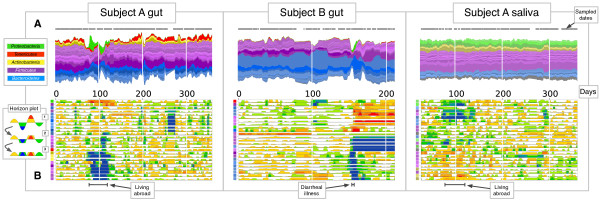
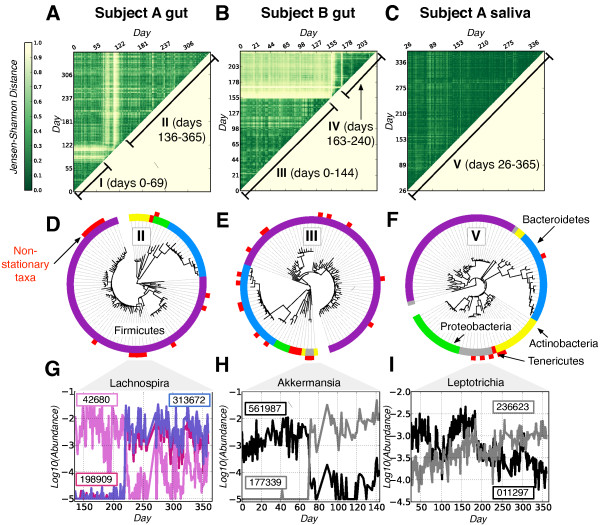
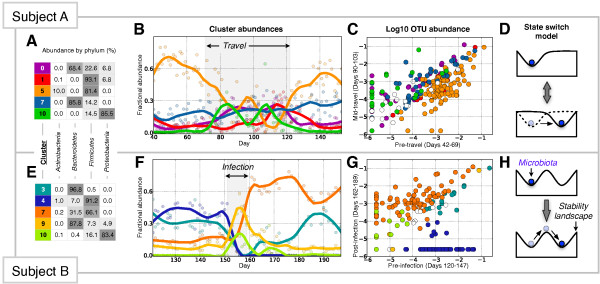
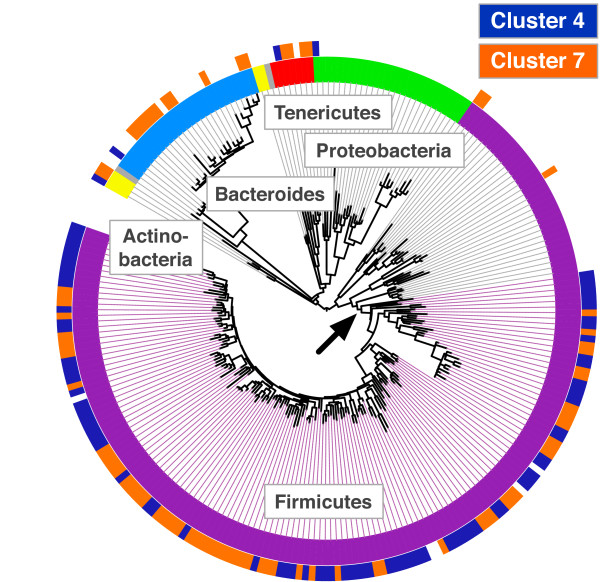
BACKGROUND: Disturbance to human microbiota may underlie several pathologies. Yet, we lack a comprehensive understanding of how lifestyle affects the dynamics of human-associated microbial communities. RESULTS: Here, we link over 10,000 longitudinal measurements of human wellness and action to the daily gut and salivary microbiota dynamics of two individuals over the course of one year. These time series show overall microbial communities to be stable for months. However, rare events in each subjects’ life rapidly and broadly impacted microbiota dynamics. Travel from the developed to the developing world in one subject led to a nearly two-fold increase in the Bacteroidetes to Firmicutes ratio, which reversed upon return. Enteric infection in the other subject resulted in the permanent decline of most gut bacterial taxa, which were replaced by genetically similar species. Still, even during periods of overall community stability, the dynamics of select microbial taxa could be associated with specific host behaviors. Most prominently, changes in host fiber intake positively correlated with next-day abundance changes among 15% of gut microbiota members. CONCLUSIONS: Our findings suggest that although human-associated microbial communities are generally stable, they can be quickly and profoundly altered by common human actions and experiences.
Overview
The claims and statistics of this paper haven’t been checked yet.
Run the check — free, no account needed. It reads the open-access text and checks the sources it cites.
Integrity signals
Registry
Cites
Statistics
Figures
Verification
Claims the paper makes
The claims and statistics of this paper haven’t been checked yet.
Run the check — free, no account needed. It reads the open-access text and checks the sources it cites.
Claims other papers make about this one
Each is checked against this paper’s own text: does it say what the citing paper says it does?
The source backs part of the claim, not all of it — or backs it for a different population, condition or comparison.
In the citing paper
“Short-term, dramatic dietary interventions have demonstrated the ability to alter microbiota diversity quickly in humans [5].”
From Effect of Diet on the Gut Microbiota: Rethinking Intervention Duration (2019) · cites this paper as [5]
Experimental — accuracy not yet measuredIn the citing paper
“Likewise, mouse models have indicated that manipulation of macronutrient intake can consistently shift the composition of the gut microbiota within the span of a day [5,6,18,19].”
From Effect of Diet on the Gut Microbiota: Rethinking Intervention Duration (2019) · cites this paper as [5]
In the citing paper
“One longitudinal study involving daily gut microbiota investigations of two individuals over the course of a year found that changes in fibre intake are positively correlated with a change in abundance of 15% of the microbial community the following day [5].”
From Effect of Diet on the Gut Microbiota: Rethinking Intervention Duration (2019) · cites this paper as [5]
Self-check
Percentages, sums and reported differences re-computed from the paper’s own numbers.
The self-check needs the paper’s full text.
Citations
Cites
QIIME allows analysis of high-throughput community sequencing data
Caporaso, J. G., Kuczynski, J., Stombaugh, J., Bittinger, K., Bushman, F. D., Costello, E. K., Fierer, N., Peña, A. G., Goodrich, J. K., Gordon, J. I., et al. (2010) · Nature Methods · doi:10.1038/nmeth.f.303 · Cited by 34,887
Search and clustering orders of magnitude faster than BLAST
Edgar, R. C. (2010) · Bioinformatics · doi:10.1093/bioinformatics/btq461 · Cited by 21,098
An obesity-associated gut microbiome with increased capacity for energy harvest
Turnbaugh, P. J., Ley, R. E., Mahowald, M. A., Magrini, V., Mardis, E. R., & Gordon, J. I. (2006) · Nature · doi:10.1038/nature05414 · Cited by 12,444
Greengenes, a Chimera-Checked 16S rRNA Gene Database and Workbench Compatible with ARB
DeSantis, T. Z., Hugenholtz, P., Larsen, N., Rojas, M., Brodie, E. L., Keller, K., Huber, T., Dalevi, D., Hu, P., & Andersen, G. L. (2006) · Applied and Environmental Microbiology · doi:10.1128/aem.03006-05 · Cited by 10,891
Diet rapidly and reproducibly alters the human gut microbiome
David, L. A., Maurice, C. F., Carmody, R. N., Gootenberg, D. B., Button, J. E., Wolfe, B. E., Ling, A. V., Devlin, A. S., Varma, Y., Fischbach, M. A., et al. (2014) · Nature · doi:10.1038/nature12820 · Cited by 10,100
Self-citationGlobal patterns of 16S rRNA diversity at a depth of millions of sequences per sample
Caporaso, J. G., Lauber, C. L., Walters, W. A., Berg-Lyons, D., Lozupone, C., Turnbaugh, P. J., Fierer, N., & Knight, R. D. (2010) · Proceedings of the National Academy of Sciences · doi:10.1073/pnas.1000080107 · Cited by 9,944
Human gut microbes associated with obesity
Ley, R. E., Turnbaugh, P. J., Klein, S., & Gordon, J. I. (2006) · Nature · doi:10.1038/4441022a · Cited by 8,785
Human gut microbiome viewed across age and geography
Yatsunenko, T., Rey, F. E., Manary, M. J., Trehan, I., Dominguez-Bello, M. G., Contreras, M., Magris, M., Hidalgo, G., Baldassano, R. N., Anokhin, A. P., et al. (2012) · Nature · doi:10.1038/nature11053 · Cited by 7,815
Statsmodels: Econometric and Statistical Modeling with Python
Seabold, S., & Perktold, J. (2010) · Proceedings of the Python in Science Conferences · doi:10.25080/majora-92bf1922-011 · Cited by 6,968
Linking long-term dietary patterns with gut microbial enterotypes
Wu, G. D., Chen, J., Hoffmann, C., Bittinger, K., Chen, Y.-Y., Keilbaugh, S. A., Bewtra, M., Knights, D., Walters, W. A., Knight, R., et al. (2011) · Science · doi:10.1126/science.1208344 · Cited by 6,513
Cited by
Sorted by citations
Items 801–900 of 951
Milk bioactives may manipulate microbes to mediate parent-offspring
Allen-Blevins, R., Sela, D. A., & Hinde, K. (2015)
Prävention der Resistenzentwicklung in Krankenhaus, Arztpraxis und in der Veterinärmedizin
Meyer, E. (2015) · Springer eBooks · doi:10.1007/978-3-662-48069-4_6
Gibson, T. E. (2016) · Proceedings of the ... American Control Conference/Proceedings of the American Control Conference · doi:10.1109/acc.2016.7526831
“The most important developments in the human microbiome have come via the analysis of large cohorts across body sites (gut, mouth, vagina, skin, etc) [34] and longitudinal studies where fecal samples have been collected on a daily scale [12,14].”
BackgroundStatistical Tools for Data Analysis
Gibbons, S. M. (2015) · Springer protocols handbooks/Springer protocols · doi:10.1007/8623_2015_50
The development of a microbiome reference that spans thousands of individuals
McDonald, D. T. (2015) · CU Scholar (University of Colorado Boulder)
The Intestinal Microbiome, the Immune System and Spondyloarthropathy
Costello, M., & Brown, M. A. (2017) · Springer eBooks · doi:10.1007/978-3-319-42252-7_8
Canani, R. B., Gilbert, J. A., & Nagler‐Anderson, C. (2015)
Alterations in Gut Microbiota and Post-Traumatic Osteoarthritis
Hernandez, C. J. (2016)
The Gut Microbiome and Its Marriage to the Immune System: Can We Change It All?
Untersmayr, E. (2017) · Birkhäuser advances in infectious diseases · doi:10.1007/978-3-319-69968-4_10
Lemurs on a sinking raft? : The ballast of anthropogenic disturbances
de Winter, I. I. (2018) · doi:10.18174/449281
Latent Space Temporal Model of Microbial Abundance to Predict Domination and BacteremiaPreprint
Zhong, R., Joseph, T., Xavier, J. B., & Pe’er, I. (2018) · arXiv (Cornell University) · doi:10.48550/arxiv.1808.10795
“Nonetheless, the complex interactions between host, environment, and external perturbations are just beginning to be understood [2, 4].”
BackgroundA mikrobiom szerepe egészségünk megőrzésében és egyes betegségekben
Nistiar, F., Rácz, O., Lukačínová, A., Kolesár, J., & Fodor, B. (2015) · The publications of the MultiScience - XXIX. MicroCAD International Scientific Conference · doi:10.26649/musci.2015.110
Sheng, N., Esberg, A., Mårell, L., Johansson, E., Källestål, C., & Strömberg, N. (2019) · bioRxiv (Cold Spring Harbor Laboratory) · doi:10.1101/514265
“mutans adhesin types and oral, gut, and other microbiomes colonize their niches in a stable fashion over time, though quantitative fluctuations occur in response to antibiotic treatment, traveling, breast feeding, and unknown factors [7,21-23].”
BackgroundImataki, O., Kubo, H., Uemura, M., & Kadowaki, N. (2019) · Journal of Hematopoietic Cell Transplantation · doi:10.7889/hct-18-012
Campbell, T. (2019) · Open Scholarship Institutional Repository (Washington University in St. Louis) · doi:10.7936/40cv-kv20
“Gut microbial communities are generally stable, but they can be altered in accordance with several factors including host lifestyle [140, 143-151], host species [141, 142, 152], and geography [153-155].”
BackgroundMicrobial Forensics: Detection and Characterization in the Twenty-first Century
Warmbrod, K. L., Montague, M. G., & Connell, N. D. (2020) · Springer eBooks · doi:10.1007/978-3-030-28285-1_16
The Microbiome and the Public’s Health
Stein, M. D., & Galea, S. (2020) · doi:10.1093/oso/9780197510384.003.0017
Development and dynamics of the normal gut microbiota
Olsson, L. M. (2020) · Gothenburg University Publications Electronic Archive (Gothenburg University)
Kazemian, N., Ramezankhani, M., Sehgal, A., Khalid, F. M., Kalkhoran, A. H. Z., Narayan, A., Wong, G. K., Kao, D. H., & Pakpour, S. (2020) · bioRxiv (Cold Spring Harbor Laboratory) · doi:10.1101/2020.05.27.120386
“Despite long-term stability and plasticity of healthy and low to moderately disturbed gut 176 systems (36), severely damaged gut ecosystems are not self-renewing; therefore, FMT can help 177”
BackgroundJurado, C. (2020) · ERA: Education and Research Archive (University of Alberta) · doi:10.7939/r3-vy9d-ne19
Impact of antibiotics and dietary fibre on gut bacterial diversity: an in vitro approach
Johnson, L. P. (2017) · Spiral (Imperial College London) · doi:10.25560/80499
Dietary changes and lifestyle shifts affect the gut microbiomes of giant pandasPreprint
Jin, L., Yang, S., Li, C., Wu, D., He, Y., Li, B., Zhang, G., Xiong, Y., Wei, R., Guo, L., et al. (2020) · doi:10.22541/au.158505225.57347715
Trait Evolution in Microbial CommunitiesPreprint
Zhao, L., Ridenhour, B. J., & Remien, C. H. (2020) · bioRxiv (Cold Spring Harbor Laboratory) · doi:10.1101/2020.12.15.422935
“For example, the human gut microbiome can experience temporary reversible changes in species abundances without large gain or loss of bacterial species when a person travels between developed and developing countries, whereas enteric infection can lead to permanent decline and replacement of species [9].”
BackgroundTransparency is key to ethical vaccine research—Response
Guerrini, C. J., Sherkow, J. S., Meyer, M. N., & Zettler, P. J. (2020) · Science · doi:10.1126/science.abf4883
Wild, J., & Wenzel, P. (2021) · Journal of Molecular Medicine · doi:10.1007/s00109-020-02019-1
Yao, X. Y. (2020) · Current Trends On Biotechnology & Microbiology Open Access Publishers · doi:10.32474/ctbm.2020.01.000125
MEASuRing symptoms in Irritable Bowel Syndrome
Vork, L. (2021) · Research Publications (Maastricht University) · doi:10.26481/dis.20210409lv
Irrazábal, T. (2018) · TSpace (University of Toronto)
Las armas de la villa de Pinto
Couto, F. G. (2005) · Anales del Instituto de Estudios Históricos del Sur de Madrid "Jiménez de Gregorio"
The Impact of Gut Microbiota on the Immune Response to Vaccination
Bajoria, V., Szczelkun, A., Dinse, T., van Overveld, F. J., & Rijkers, G. T. (2021) · Elsevier eBooks · doi:10.1016/b978-0-12-819265-8.00051-6 · Cited by 1
Modulating gut microbial metabolism in heart failure: Opportunities and challenges
Tang, W. H. W., & Chaikijurajai, T. (2021) · EBioMedicine · doi:10.1016/j.ebiom.2021.103573
“Short term changes in gut microbial composition and function following dietary interventions have previously been shown to occur within days to weeks [10].”
BackgroundUsing causality and correlation analysis to decipher microbial interactions in activated sludgePreprint
Cai, W., Han, X., & Yao, H. (2021) · bioRxiv (Cold Spring Harbor Laboratory) · doi:10.1101/2021.09.26.461882
“Additionally, David et al. (2014), when analyzing the effect of host lifestyle on human microbiota, relied on the autocorrelated process of time series (David et al., 2014), which demonstrated that OTUs variation complied with the time series model.”
BackgroundMultivariate statistical monitoring system for microbial population dynamics
Ishiya, K., & Aburatani, S. (2021) · Physical Biology · doi:10.1088/1478-3975/ac3ad6
Beneficial microbes from human and animal intestines
Fernández-Ciganda, S., Fraga, M., & Zunino, P. (2022) · Elsevier eBooks · doi:10.1016/b978-0-323-85170-1.00008-7
Morris, J. (2018) · Faculty Opinions – Post-Publication Peer Review of the Biomedical Literature · doi:10.3410/f.726993863.793551603
Islamic Sunni perspectives on the ethics of precision medicine
Suleman, M. (2022) · Oxford University Press eBooks · doi:10.1093/oso/9780198863465.003.0017
Personalized medicine and disorders of consciousness
Fins, J. J. (2022) · Oxford University Press eBooks · doi:10.1093/oso/9780198863465.003.0010
The revolution of personalized medicine is already upon us in rare diseases
Austin, C. P. (2022) · Oxford University Press eBooks · doi:10.1093/oso/9780198863465.003.0009
Gender and personalized medicine
Legato, M. J. (2022) · Oxford University Press eBooks · doi:10.1093/oso/9780198863465.003.0011
Personalized medicine and genetic newborn screening
Brusa, M., & Dickenson, D. L. (2022) · Oxford University Press eBooks · doi:10.1093/oso/9780198863465.003.0008
Genetics, genetic profiles, and Jewish law
Weissinger, Y., & Barilan, Y. M. (2022) · Oxford University Press eBooks · doi:10.1093/oso/9780198863465.003.0018
Precision and persons in medicine
Barilan, Y. M., & Brusa, M. (2022) · Oxford University Press eBooks · doi:10.1093/oso/9780198863465.003.0001
(2014) · Nature · doi:10.1038/512009d
Borenstein, E., & Muller, E. (2019) · Faculty Opinions – Post-Publication Peer Review of the Biomedical Literature · doi:10.3410/f.732223689.793566912
Prevention and Control of Cardiovascular Diseases by Beneficial Use of Islamic Lifestyle
Khorasgani, M. R. (2019) · Online Journal of Cardiology Research & Reports · doi:10.33552/ojcrr.2019.01.000516
Quigley, E. M. M. (2020) · Faculty Opinions – Post-Publication Peer Review of the Biomedical Literature · doi:10.3410/f.731115520.793569663
Whiteley, M., & Cornforth, D. M. (2017) · Faculty Opinions – Post-Publication Peer Review of the Biomedical Literature · doi:10.3410/f.731119619.793538544
Faculty Opinions recommendation of Age and mothers: potent influences of children's skin microbiota.
Piguet, V. (2020) · Faculty Opinions – Post-Publication Peer Review of the Biomedical Literature · doi:10.3410/f.736444132.793569298
Probiotics in gastrointestinal surgery
Rosa, C. D. O. B., Bressan, J., Bernardes, A. L., Cruz, B. C. D. S., Dias, M. D. M. E., Pereira, M. D. F. A., Milagro, F. I., & Pelúzio, M. D. C. G. (2022) · Elsevier eBooks · doi:10.1016/b978-0-323-89908-6.00016-9
Impact of the gut microbiome on human health and diseases
Banik, S. P., Sehgal, S., Ghosh, R. B., & Das, A. (2022) · Elsevier eBooks · doi:10.1016/b978-0-12-822238-6.00026-1 · Cited by 1
Impact of indigenous microbiota in gut inflammatory disorders
Arifa, R. D. D. N., de Brito, C. B., Batista, R. R. A., Fagundes, M., Souza, D. G., & Fagundes, C. T. (2022) · Elsevier eBooks · doi:10.1016/b978-0-323-91313-3.00011-8
Bundgaard‐Nielsen, C. (2021) · VBN Forskningsportal (Aalborg Universitet) · doi:10.54337/aau466210133
Single-Cell Genomics for Uncovering Relationships between Bacteriophages and Their Hosts
Džunková, M. (2022) · IntechOpen eBooks · doi:10.5772/intechopen.108118
Gut microbes predominantly act as symbiotic partners rather than raw nutrientsPreprint
Soares, N. F. D. S., Quagliariello, A., Yigitturk, S., & Martino, M. E. (2023) · bioRxiv (Cold Spring Harbor Laboratory) · doi:10.1101/2023.02.08.527620
Zeamer, A. L., Salive, M.-C., An, X., House, S. L., Beaudoin, F. L., Stevens, J. S., Zeng, D., Neylan, T. C., Clifford, G. D., Linnstaedt, S. D., et al. (2023) · medRxiv · doi:10.1101/2023.03.01.23286577
Prävention der Resistenzentwicklung in Krankenhaus, Arztpraxis und Veterinärmedizin
Schulz-Stübner, S. (2023) · Springer eBooks · doi:10.1007/978-3-662-65708-9_2
Correlation between dysbiosis and incidence of gastrointestinal cancers
Sabri, N. A. (2022) · doi:10.52768/jjgastro/1102
“One longitudinal study involving daily gut microbiota investigations of two individuals over the course of a year found that changes in fibre intake are positively correlated with a change in abundance of 15% of the microbial community the following day [57].”
Hinkosa, J. (2023) · Journal of Business and Economic Development · doi:10.11648/j.jbed.20230803.13
“, (2014) [6] mentioned, asset utilization, and customer satisfaction include, the 5 rights; right quality, right quantity, right place, right time, and right price as an important SCM practice.”
BackgroundDECODING MICROBIOME DYSBIOSIS THROUGH METAGENOMIC ALPHA DIVERSITY
Hodzhev, Y., Tsafarova, B., Tolchkov, V., Youroukova, V., Ivanova, S., Kostadinov, D., Yanev, N. A., & Panaiotov, S. (2024) · PROBLEMS of Infectious and Parasitic Diseases · doi:10.58395/fmx7px98
“The composition of microbiome may naturally fluctuate due to factors such as diet, sleep, stress, and other environmental factors [22].”
BackgroundThe gut microbiome in the onset and progression of Inflammatory Bowel Diseases
Klaassen, M. A. Y. (2024) · University of Groningen research database (University of Groningen / Centre for Information Technology) · doi:10.33612/diss.909058157
Resilience of Stochastic Microbial CommunitiesPreprint
Phan, T. A., Ridenhour, B. J., & Remien, C. H. (2024) · SSRN Electronic Journal · doi:10.2139/ssrn.4774112
Wang, Y., Ye, J., Ju, F., Liu, L., Boyd, J. A., Deng, Y., Parks, D. H., Jiang, X., Yin, X., Woodcroft, B. J., et al. (2021) · Figshare · doi:10.6084/m9.figshare.16756018
Hoang, T., Kim, M. J., Park, J. W., Jeong, S., Lee, J., & Shin, A. (2022) · Figshare · doi:10.6084/m9.figshare.20070840
Resilience of a stochastic generalized Lotka-Volterra model for microbiome studiesPreprint
Phan, T. A., Ridenhour, B. J., & Remien, C. H. (2024) · SSRN Electronic Journal · doi:10.2139/ssrn.4769799
Vartanian, M., Endres, K. J., Lee, Y. T., Friedrich, S., Meemken, M.-T., Schamarek, I., Rohde‐Zimmermann, K., Schürfeld, R., Eisenberg, L., Hilbert, A., et al. (2024) · Research Square · doi:10.21203/rs.3.rs-4256926/v1
Barilan, Y. M. (2022) · Oxford University Press eBooks · doi:10.1093/oso/9780198863465.002.0005
Barilan, Y. M., Brusa, M., & Ciechanover, A. J. (2022) · Oxford University Press eBooks · doi:10.1093/oso/9780198863465.002.0006
Barilan, Y. M., Brusa, M., & Ciechanover, A. J. (2022) · Oxford University Press eBooks · doi:10.1093/oso/9780198863465.002.0003
Network impact of a single-time-point microbial sample
Ezra, S., & Bashan, A. (2024) · PLoS ONE · doi:10.1371/journal.pone.0301683
“Furthermore, in most cases, the added value of collecting more than one sample from a patient might be limited, since the microbiome is mostly stable over time and changes mainly after strong perturbations such as antibiotic treatment, severe hunger or excessive alcohol consumption [23–25].”
Association between gastrointestinal disorders and migraine: an integrative review
Kanazawa, C. C., Malgarin, J. S., & Esmanhotto, B. B. (2024) · Headache Medicine/Revista Headache Medicine · doi:10.48208/headachemed.2024.13
An optimised approach to evaluate variability in gut health markers in healthy adultsPreprint
Krüger, K., Myeonghyun, Y., van der Wielen, N., Kok, D. E. G., Hooiveld, G. J. E. J., Keshtkar, S., Bruin, M. D.-D., Balvers, M. G. J., Grootte-Bromhaar, M., Mudde, K., et al. (2024) · bioRxiv (Cold Spring Harbor Laboratory) · doi:10.1101/2024.07.25.604267
“A longitudinal study suggested that faecal microbiota is generally stable over one year, but can undergo rapid and profound changes due to factors like traveling [50].”
BackgroundNon-invasive ventilation restores the gut microbiota in rats with acute heart failure
Jiang, H., Liu, S., Chang, C. D., Shang, Y., Geng, J., & Chen, Q. (2024) · Heliyon · doi:10.1016/j.heliyon.2024.e35239
“Such alternative states are frequently observed in gut microbiota after pathogen invasion [56], antibiotic treatments [57], and dietary interventions [58].”
BackgroundMohammadi, T., & Mohebalizadeh, M. (2023) · Springer eBooks · doi:10.1007/978-3-030-80962-1_373-1
Microbiome-Based Therapeutics for the Management of Cancer
Munir, M. U., Javed, I., Butt, M. H., Khan, Y. H., Salman, M., Rehman, Z. U., Khan, F. U., Shamsi, S. S., & Mallhi, T. H. (2024) · Springer eBooks · doi:10.1007/978-981-97-3790-1_14
Gut microbiota changes and enteric therapies in critically ill patients: a narrative review
Ojima, M., Shimizu, K., & Ogura, H. (2024) · Journal of the Japanese Society of Intensive Care Medicine · doi:10.3918/jsicm.31_566
Microbiome and colorectal cancer drug resistance
Miya, T. V., Belancio, V. P., & Dlamini, Z. (2024) · Elsevier eBooks · doi:10.1016/b978-0-443-33475-7.00016-0
Ronan, V. (2025) · Frontiers in Pediatrics · doi:10.3389/fped.2024.1499330
Mixing microbiomes in vitro reveals rules of community assembly
Mitchell, A. H., & Lieberman, T. D. (2025) · Proceedings of the National Academy of Sciences · doi:10.1073/pnas.2502663122
“While an attractive explanation for individuality is that colonization can only occur in early life, it is now clear that individuals acquire new species and strains throughout life ( 6 , 7 ).”
Leekitcharoenphon, P., Bortolaia, V., Tornblom, V. K. W., Siriphap, A., Suthienkul, O., Borthong, J., Chonsin, K., Møller, F. D., Avot, B. J. P., Otani, S., et al. (2025) · Infection Genetics and Evolution · doi:10.1016/j.meegid.2025.105765
Recycling Plant-Based Foods for Microbiome-Targeted Personalized Nutrition
Betoret, E., Betoret, N., & Gosalbes, M. J. (2025) · The microbiomes of humans, animals, plants, and the environment · doi:10.1007/978-3-031-93902-0_3
The Role of the Microbiome in Surgical Diseases and Their Management
Thomas, R. M. (2025) · Success in academic surgery · doi:10.1007/978-3-031-83034-1_18
Metadata
- Authors
- David, L. A., Materna, A. C., Friedman, J., Campos-Baptista, M. I., Blackburn, M. C., Perrotta, A., Erdman, S. E., & Alm, E. J.
- Affiliations
- Harvard University (US)
- Qiagen (Denmark) (DK)
- Massachusetts Institute of Technology (US)
- École Polytechnique Fédérale de Lausanne (CH)
- Broad Institute (US)
- Corresponding author
- Alm, Eric J
- Venue
- Genome biology
- Published
- 2014-07-25
- Volume
- 15
- Issue
- 7
- Pages
- R89-R89
- ISSN
- 1465-6906 (ISSN-L)
- 1474-760X
- PMC
- PMC4405912
- OpenAlex
- W2103088074
- Cited by
- 950
- References
- 58
- Citations by year
- 2026: 27 · 2025: 60 · 2024: 74 · 2023: 80 · 2022: 117 · 2021: 95 · 2020: 105 · 2019: 85 · 2018: 85 · 2017: 98 · 2016: 65 · 2015: 52 · 2014: 5
- FWCI
- 30.09
- Type
- journal article
- Language
- en
- Update notices
- correction (2016-05-31)
- Open access
- gold
- doi.org
- Locations
- Genome biology (publishedVersion, cc-by)
- PubMed Central (publishedVersion, cc-by)
- PubMed (publishedVersion)
- DSpace@MIT (Massachusetts Institute of Technology) (submittedVersion, cc-by)
- DSpace@MIT (Massachusetts Institute of Technology) (submittedVersion, cc-by-nc)
- Infoscience (Ecole Polytechnique Fédérale de Lausanne) (submittedVersion)
- Infoscience (Ecole Polytechnique Fédérale de Lausanne) (submittedVersion, cc-by-nc-nd)
- Funders
- National Science Foundation (0821391)
- Topics
- Life Sciences › Biochemistry, Genetics and Molecular Biology › Molecular Biology › Gut microbiota and health
- Health Sciences › Dentistry › Periodontics › Oral microbiology and periodontitis research
- Physical Sciences › Environmental Science › Ecology › Microbial Community Ecology and Physiology
- Keywords
- human microbiota, gut microbiota, salivary microbiota, host lifestyle, microbiota dynamics, daily fluctuations, microbial community stability, Firmicutes/Bacteroidetes ratio, gastrointestinal infections, dietary fiber intake, host behavior
- MeSH terms
- Bacteria, Bacterial Infections, Developing Countries, Feces, Humans, Life Style, Longitudinal Studies, Male, Phylogeny, Saliva, Genetic Variation, Sequence Analysis, DNA, Developed Countries, High-Throughput Nucleotide Sequencing, Microbiota
About these checks
Registry, retraction, Cites and statistics results are computed, not judged, with one exception: a printed reference that no index lists is read once by a model before it counts as a citation error. Claims are extracted by a model and kept only when their quote appears verbatim in the text; each cited source is then checked, with a model’s help, for whether it says what the claim relies on. Those verdicts can be wrong — read the claim’s quote and the cited source before relying on one.
Statistics and arithmetic are recomputed, not judged.
Confidence bands are shown only for fields calibrated on our annotated test set. None is calibrated yet, so no band is shown.
What counts as a claim ›How we measure confidence ›How we check this ›
Are you an author, or do you see a problem with this page? Request a review
