

The DOI matches its Crossref record; 57 of the 58 references it cites were found in a registry or an index.
Host lifestyle affects human microbiota on daily timescales
Open accessAbstract
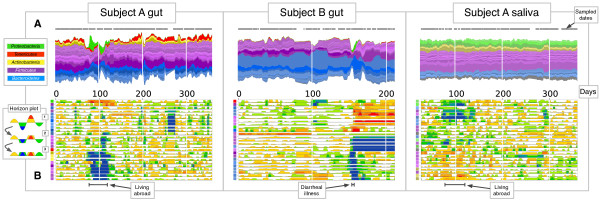
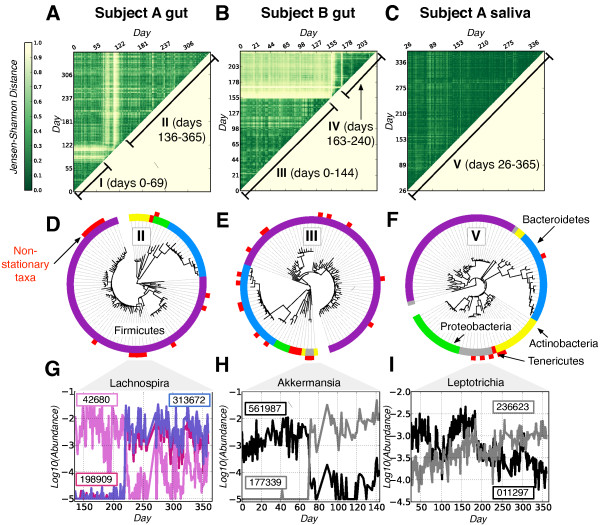
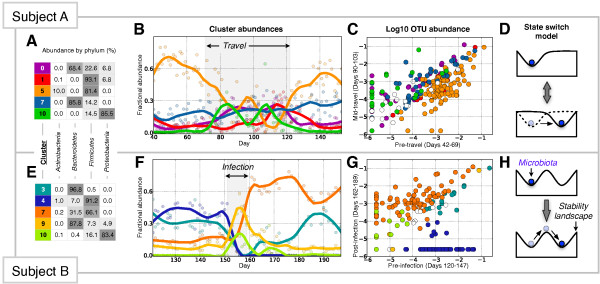
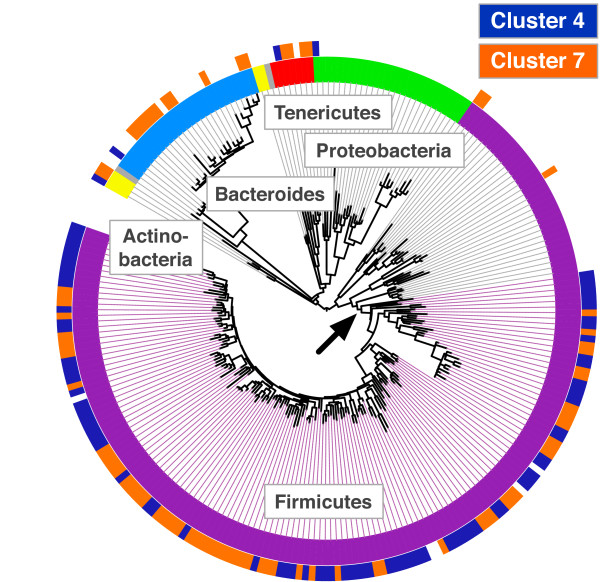
BACKGROUND: Disturbance to human microbiota may underlie several pathologies. Yet, we lack a comprehensive understanding of how lifestyle affects the dynamics of human-associated microbial communities. RESULTS: Here, we link over 10,000 longitudinal measurements of human wellness and action to the daily gut and salivary microbiota dynamics of two individuals over the course of one year. These time series show overall microbial communities to be stable for months. However, rare events in each subjects’ life rapidly and broadly impacted microbiota dynamics. Travel from the developed to the developing world in one subject led to a nearly two-fold increase in the Bacteroidetes to Firmicutes ratio, which reversed upon return. Enteric infection in the other subject resulted in the permanent decline of most gut bacterial taxa, which were replaced by genetically similar species. Still, even during periods of overall community stability, the dynamics of select microbial taxa could be associated with specific host behaviors. Most prominently, changes in host fiber intake positively correlated with next-day abundance changes among 15% of gut microbiota members. CONCLUSIONS: Our findings suggest that although human-associated microbial communities are generally stable, they can be quickly and profoundly altered by common human actions and experiences.
Overview
The claims and statistics of this paper haven’t been checked yet.
Run the check — free, no account needed. It reads the open-access text and checks the sources it cites.
Integrity signals
Registry
Cites
Statistics
Figures
Verification
Claims the paper makes
The claims and statistics of this paper haven’t been checked yet.
Run the check — free, no account needed. It reads the open-access text and checks the sources it cites.
Claims other papers make about this one
Each is checked against this paper’s own text: does it say what the citing paper says it does?
The source backs part of the claim, not all of it — or backs it for a different population, condition or comparison.
In the citing paper
“Short-term, dramatic dietary interventions have demonstrated the ability to alter microbiota diversity quickly in humans [5].”
From Effect of Diet on the Gut Microbiota: Rethinking Intervention Duration (2019) · cites this paper as [5]
Experimental — accuracy not yet measuredIn the citing paper
“Likewise, mouse models have indicated that manipulation of macronutrient intake can consistently shift the composition of the gut microbiota within the span of a day [5,6,18,19].”
From Effect of Diet on the Gut Microbiota: Rethinking Intervention Duration (2019) · cites this paper as [5]
In the citing paper
“One longitudinal study involving daily gut microbiota investigations of two individuals over the course of a year found that changes in fibre intake are positively correlated with a change in abundance of 15% of the microbial community the following day [5].”
From Effect of Diet on the Gut Microbiota: Rethinking Intervention Duration (2019) · cites this paper as [5]
Self-check
Percentages, sums and reported differences re-computed from the paper’s own numbers.
The self-check needs the paper’s full text.
Citations
Cites
QIIME allows analysis of high-throughput community sequencing data
Caporaso, J. G., Kuczynski, J., Stombaugh, J., Bittinger, K., Bushman, F. D., Costello, E. K., Fierer, N., Peña, A. G., Goodrich, J. K., Gordon, J. I., et al. (2010) · Nature Methods · doi:10.1038/nmeth.f.303 · Cited by 34,887
Search and clustering orders of magnitude faster than BLAST
Edgar, R. C. (2010) · Bioinformatics · doi:10.1093/bioinformatics/btq461 · Cited by 21,098
An obesity-associated gut microbiome with increased capacity for energy harvest
Turnbaugh, P. J., Ley, R. E., Mahowald, M. A., Magrini, V., Mardis, E. R., & Gordon, J. I. (2006) · Nature · doi:10.1038/nature05414 · Cited by 12,444
Greengenes, a Chimera-Checked 16S rRNA Gene Database and Workbench Compatible with ARB
DeSantis, T. Z., Hugenholtz, P., Larsen, N., Rojas, M., Brodie, E. L., Keller, K., Huber, T., Dalevi, D., Hu, P., & Andersen, G. L. (2006) · Applied and Environmental Microbiology · doi:10.1128/aem.03006-05 · Cited by 10,891
Diet rapidly and reproducibly alters the human gut microbiome
David, L. A., Maurice, C. F., Carmody, R. N., Gootenberg, D. B., Button, J. E., Wolfe, B. E., Ling, A. V., Devlin, A. S., Varma, Y., Fischbach, M. A., et al. (2014) · Nature · doi:10.1038/nature12820 · Cited by 10,100
Self-citationGlobal patterns of 16S rRNA diversity at a depth of millions of sequences per sample
Caporaso, J. G., Lauber, C. L., Walters, W. A., Berg-Lyons, D., Lozupone, C., Turnbaugh, P. J., Fierer, N., & Knight, R. D. (2010) · Proceedings of the National Academy of Sciences · doi:10.1073/pnas.1000080107 · Cited by 9,944
Human gut microbes associated with obesity
Ley, R. E., Turnbaugh, P. J., Klein, S., & Gordon, J. I. (2006) · Nature · doi:10.1038/4441022a · Cited by 8,785
Human gut microbiome viewed across age and geography
Yatsunenko, T., Rey, F. E., Manary, M. J., Trehan, I., Dominguez-Bello, M. G., Contreras, M., Magris, M., Hidalgo, G., Baldassano, R. N., Anokhin, A. P., et al. (2012) · Nature · doi:10.1038/nature11053 · Cited by 7,815
Statsmodels: Econometric and Statistical Modeling with Python
Seabold, S., & Perktold, J. (2010) · Proceedings of the Python in Science Conferences · doi:10.25080/majora-92bf1922-011 · Cited by 6,968
Linking long-term dietary patterns with gut microbial enterotypes
Wu, G. D., Chen, J., Hoffmann, C., Bittinger, K., Chen, Y.-Y., Keilbaugh, S. A., Bewtra, M., Knights, D., Walters, W. A., Knight, R., et al. (2011) · Science · doi:10.1126/science.1208344 · Cited by 6,513
Cited by
Sorted by citations
Items 101–200 of 951
Trosvik, P., & de Muinck, E. J. (2015) · Microbiome · doi:10.1186/s40168-015-0107-4 · Cited by 167
“Conclusions Although the time series data compiled in the two studies [4, 5] that supplied data for our analyses are impressive in terms of temporal scope and sampling frequency, they produced data for only four individuals.”
BackgroundMethodInfluentialHuman Skin, Oral, and Gut Microbiomes Predict Chronological Age
Huang, S., Haiminen, N., Carrieri, A.-P., Hu, R., Jiang, L., Parida, L., Russell, B., Allaband, C., Zarrinpar, A., Vázquez-Baeza, Y., et al. (2020) · mSystems · doi:10.1128/msystems.00630-19 · Cited by 167
Leung, M. H. Y., & Lee, P. K. H. (2016) · Microbiome · doi:10.1186/s40168-016-0165-2 · Cited by 163
“[108] reveal the changes in GMs of one individual, who relocated from an urban Western setting to a developing nation and subsequently adopted new dietary habits.”
BackgroundA Guide to Diet-Microbiome Study Design
Johnson, A. J., Zheng, J. J., Kang, J. W., Saboe, A., Knights, D., & Zivkovic, A. M. (2020) · Frontiers in Nutrition · doi:10.3389/fnut.2020.00079 · Cited by 168
“In instances where researchers recognize the need to collect more finely resolved dietary information, it is common in the microbiome literature to read about techniques that use researcher-developed food questionnaires, independently created app-based collection methods (16, 48), and consumer-facing tools for nutrien…”
BackgroundThe Central Role of Interbacterial Antagonism in Bacterial Life
Peterson, S. B., Bertolli, S. K., & Mougous, J. D. (2020) · Current Biology · doi:10.1016/j.cub.2020.06.103 · Cited by 162
“Yet in the absence of perturbances, gut microbial communities are remarkably stable [81], raising the question as to how and when antagonistic mechanisms might be employed in this environment.”
Gut Microbiota in Colorectal Cancer: Biological Role and Therapeutic Opportunities
Pandey, H., Tang, D. W. T., Wong, S. H., & Lal, D. (2023) · Cancers · doi:10.3390/cancers15030866 · Cited by 171
“Diet is the major determinant of gut microbiota [407], and changes in diet are accompanied by changes in the fecal microbiota within a few days of diet change [28,408].”
BackgroundModelling microbiome recovery after antibiotics using a stability landscape framework
Shaw, L. P., Bassam, H., Barnes, C. P., Walker, A. S., Klein, N. J., & Balloux, F. (2019) · The ISME Journal · doi:10.1038/s41396-019-0392-1 · Cited by 158
Leung, M. H. Y., Wilkins, D. E., & Lee, P. K. H. (2015) · Scientific Reports · doi:10.1038/srep11845 · Cited by 158
Diet, Gut Microbiota, and Vitamins D + A in Multiple Sclerosis
Riccio, P., & Rossano, R. (2017) · Neurotherapeutics · doi:10.1007/s13311-017-0581-4 · Cited by 164
How the microbiome challenges our concept of self
Rees, T., Bosch, T. C. G., & Douglas, A. E. (2018) · PLoS Biology · doi:10.1371/journal.pbio.2005358 · Cited by 152
Sodium in the microenvironment regulates immune responses and tissue homeostasis
Müller, D. N., Wilck, N., Haase, S., Kleinewietfeld, M., & Linker, R. A. (2019) · Nature Reviews Immunology · doi:10.1038/s41577-018-0113-4 · Cited by 149
Martino, M. E., Joncour, P., Leenay, R. T., Gervais, H., Shah, M., Hughes, S., Gillet, B., Beisel, C. L., & Leulier, F. (2018) · Cell Host & Microbe · doi:10.1016/j.chom.2018.06.001 · Cited by 146
Modularity and predicted functions of the global sponge-microbiome network
Lurgi, M., Thomas, T., Wemheuer, B., Webster, N. S., & Montoya, J. M. (2019) · Nature Communications · doi:10.1038/s41467-019-08925-4 · Cited by 158
Diet in Parkinson’s Disease: Critical Role for the Microbiome
Jackson, A., Forsyth, C. B., Shaikh, M., Voigt, R. M., Engen, P. A., Ramirez, V., & Keshavarzian, A. (2019) · Frontiers in Neurology · doi:10.3389/fneur.2019.01245 · Cited by 145
“Indeed, microbiota communities from subjects consuming a Mediterranean diet are enriched in SCFA-producing bacteria (10, 87, 89, 271).”
BackgroundTrait-based community assembly and succession of the infant gut microbiome
Guittar, J. L., Shade, A. L., & Litchman, E. (2019) · Nature Communications · doi:10.1038/s41467-019-08377-w · Cited by 145
Surface-modified bacteria: synthesis, functionalization and biomedical applications
Lin, S., Wu, F. Q., Zhang, Y., Chen, H., Guo, H., Chen, Y., & Liu, J. (2023) · Chemical Society Reviews · doi:10.1039/d3cs00369h · Cited by 147
Knackstedt, R. W., Knackstedt, T., & Gatherwright, J. R. (2019) · Experimental Dermatology · doi:10.1111/exd.14032 · Cited by 156
Remodeling of the gut microbiome during Ramadan-associated intermittent fasting
Su, J., Wang, Y., Zhang, X., Ma, M., Xie, Z., Pan, Q., Ma, Z., & Peppelenbosch, M. P. (2020) · American Journal of Clinical Nutrition · doi:10.1093/ajcn/nqaa388 · Cited by 143
“Further confidence in these data was bolstered by the observation that Bray– Curtis PCA of the non–intermittent fasting control group of the middle-aged cohort showed that microbiome composition did not change in the study period (Supplementary Figure 5), also in agreement with the notion that gut microbiomes tend to…”
ResultAdaptation of the Gut Microbiota to Modern Dietary Sugars and Sweeteners
Rienzi, S. C. D., & Britton, R. A. (2019) · Advances in Nutrition · doi:10.1093/advances/nmz118 · Cited by 141
Bile Acids and Microbiota: Multifaceted and Versatile Regulators of the Liver–Gut Axis
Grüner, N., & Mattner, J. (2021) · International Journal of Molecular Sciences · doi:10.3390/ijms22031397 · Cited by 144
Gawalko, M. M., Agbaedeng, T. A., Saljic, A., Müller, D. N., Wilck, N., Schnabel, R. B., Penders, J., Rienstra, M., Gelder, I. C. V., Jespersen, T., et al. (2021) · Cardiovascular Research · doi:10.1093/cvr/cvab292 · Cited by 148
The role of tissue‐specific microbiota in initial establishment success of P acific oysters
Lokmer, A., Küenzel, S., Baines, J. F., & Wegner, K. M. (2015) · Environmental Microbiology · doi:10.1111/1462-2920.13163 · Cited by 150
Evolution of the gut microbiome following acute HIV-1 infection
Rocafort, M., Noguera-Julián, M., Rivera, J., Pastor, L., Guillén, Y., Langhorst, J., Parera, M., Mandomando, I., Carrillo, J., Urrea, V., et al. (2019) · Microbiome · doi:10.1186/s40168-019-0687-5 · Cited by 137
How bile acids and the microbiota interact to shape host immunity
Lee, M. H., Nuccio, S.-P., Mohanty, I., Hagey, L. R., Dorrestein, P. C., Chu, H., & Raffatellu, M. (2024) · Nature Reviews Immunology · doi:10.1038/s41577-024-01057-x · Cited by 143
“Bile-acid-inducing diets led to rapid microbial blooms in the human gut 131 and a shift of the microbiota towards more bile-resistant Gram-negative taxa such as Bilophila wadsworthia , Alistipes putredinis , Bacteroides spp. and Enter-obacteriaceae such as E. coli 93,132,133 .”
The role of the skin and gut microbiome in psoriatic disease
Yan, D., Issa, N., Afifi, L., Jeon, C., Chang, H.-W., & Liao, W. (2017) · Current Dermatology Reports · doi:10.1007/s13671-017-0178-5 · Cited by 135
The role of the microbiome in the neurobiology of social behaviour
Sarkar, A., Harty, S., Johnson, K. V. ‐., Moeller, A. H., Carmody, R. N., Lehto, S. M., Erdman, S. E., Dunbar, R. I. M., & Burnet, P. W. J. (2020) · Biological Reviews · doi:10.1111/brv.12603 · Cited by 135
“In particular, the microbiome is extremely sensitive to the host’s diet (Wu et al., 2011; David et al., 2014a, 2014b; Carmody et al., 2015, 2019; Sonnenburg et al., 2016), with diet-induced changes becoming detectable in the microbiome even a day later in some instances (Wu et al., 2011; David et…”
BackgroundRuiz, V. E., Battaglia, T., Kurtz, Z. D., Bijnens, L., Ou, A., Engstrand, I., Zheng, X., Iizumi, T., Mullins, B. J., Müller, C. L., et al. (2017) · Nature Communications · doi:10.1038/s41467-017-00531-6 · Cited by 137
The microbiome and its potential as a cancer preventive intervention
Bultman, S. J. (2016) · Seminars in Oncology · doi:10.1053/j.seminoncol.2015.09.001 · Cited by 134
“However, certain gut microbiota, including strains of Lactobacilli and Bifidobacteria used in probiotics, can conjugate linoleic acid [73].”
InfluentialShaw, L. P., Ribeiro, A. L. R., Levine, A. P., Pontikos, N., Balloux, F., Segal, A. W., Roberts, A. P., & Smith, A. M. (2017) · mBio · doi:10.1128/mbio.01237-17 · Cited by 134
“periods of months (21) to a year (22), and we see similar strain-level variation between”
BackgroundDynamic Distribution of Gut Microbiota in Goats at Different Ages and Health States
Wang, Y., Zhang, H., Zhu, L. F., Xu, Y., Liu, N., Sun, X., Hu, L., Huang, H., Wei, K., & Zhu, R. (2018) · Frontiers in Microbiology · doi:10.3389/fmicb.2018.02509 · Cited by 132
“Several studies indicate that the GM of mammals were normally influenced by genotype or gender during development and reached stability at maturity (Poroyko et al., 2011; David et al., 2014; Zhao et al., 2015).”
BackgroundRethinking gut microbiome residency and the Enterobacteriaceae in healthy human adults
Martinson, J. N. V., Pinkham, N. V., Peters, G. W., Cho, H., Heng, J., Rauch, M., Broadaway, S. C., & Walk, S. T. (2019) · The ISME Journal · doi:10.1038/s41396-019-0435-7 · Cited by 130
“Two previous longitudinal 16S rRNA sequencing studies of healthy human adults [6, 7] both considered two individuals for between 6 and 15 months.”
BackgroundGenotypic and Phenotypic Diversity among Human Isolates of Akkermansia muciniphila
Becken, B., Davey, L., Middleton, D. R., Mueller, K. D., Sharma, A., Holmes, Z. C., Dallow, E., Remick, B., Barton, G. M., David, L. A., et al. (2021) · mBio · doi:10.1128/mbio.00478-21 · Cited by 125
“of Akkermansia has been previously documented in densely sampled individuals (58).”
BackgroundCampbell, T., Sun, X., Patel, V. H., Sanz, C., Morgan, D., & Dantas, G. A. (2020) · The ISME Journal · doi:10.1038/s41396-020-0634-2 · Cited by 134
Turroni, S., Rampelli, S., Biagi, E., Consolandi, C., Severgnini, M., Peano, C., Quercia, S., Soverini, M., Carbonero, F. G., Bianconi, G., et al. (2017) · Microbiome · doi:10.1186/s40168-017-0256-8 · Cited by 131
“As already observed in free-living subjects [5], even under isolation conditions, steady states are formed mainly through relative abundance variations in autochthonous rather than allochthonous microbes, indicative of dynamic microbiota responses of “adaptive” rather than “innovative” nature [4].”
BackgroundInfluentialDefining the human gut host–phage network through single-cell viral tagging
Džunková, M., Low, S. J., Daly, J. N., Deng, L., Rinke, C., & Hugenholtz, P. (2019) · Nature Microbiology · doi:10.1038/s41564-019-0526-2 · Cited by 134
Acharya, D., & Mukhopadhyay, A. (2024) · Briefings in Functional Genomics · doi:10.1093/bfgp/elae013 · Cited by 148
Two dynamic regimes in the human gut microbiome
Gibbons, S. M., Kearney, S. M., Smillie, C. S., & Alm, E. J. (2017) · PLoS Computational Biology · doi:10.1371/journal.pcbi.1005364 · Cited by 127
“Moreover, although we did not identify strong correlations between the set of dietary variables measured for the DB time series and the DB gut community, these dietary variables showed little-to-no autocorrelation structure (S3 Fig; and see Additional File A8 in David et al., 2014) [10].”
BackgroundMethodInfluentialGut microbiota and obesity: Concepts relevant to clinical care
Dao, M. C., & Clément, K. (2017) · European Journal of Internal Medicine · doi:10.1016/j.ejim.2017.10.005 · Cited by 138
“While even short term dietary interventions lead to compositional changes in the gut microbiota [65], it is becoming increasingly clear that long term dietary habits and microbiota composition prior to a dietary or CR intervention impact the individual's response [10,41,47].”
BackgroundModeling metabolism of the human gut microbiome
Magnúsdóttir, S., & Thiele, I. (2018) · Current Opinion in Biotechnology · doi:10.1016/j.copbio.2017.12.005 · Cited by 127
Berry, D., Kuzyk, O., Rauch, I., Heider, S., Schwab, C., Hainzl, E., Decker, T., Müller, M. M., Strobl, B., Schleper, C., et al. (2015) · Frontiers in Microbiology · doi:10.3389/fmicb.2015.01408 · Cited by 133
Integrating the microbiome as a resource in the forensics toolkit
Clarke, T. H., Gomez, A. M., Singh, H., Nelson, K. E., & Brinkac, L. M. (2017) · Forensic Science International Genetics · doi:10.1016/j.fsigen.2017.06.008 · Cited by 135
Exploring the gut microbiota: lifestyle choices, disease associations, and personal genomics
Matute, S. P., & Iyavoo, S. (2023) · Frontiers in Nutrition · doi:10.3389/fnut.2023.1225120 · Cited by 143
“A disturbance of the equilibrium caused, for example, by traveling, has been linked to gut microbial changes likely caused by jet lag and sleep loss which impact the diurnal rhythms, and, consequently, the composition and function of gut microbes (153, 154).”
BackgroundCommunity profiling of the urinary microbiota: considerations for low-biomass samples
Karstens, L., Asquith, M. J., Caruso, V. G., Rosenbaum, J. T., Fair, D. A., Braun, J. G., Gregory, W. T., Nardos, R., & McWeeney, S. K. (2018) · Nature Reviews Urology · doi:10.1038/s41585-018-0104-z · Cited by 127
Klimenko, N. S., Tyakht, A. V., Popenko, A. S., Vasiliev, A. S., Altukhov, I. A., Ischenko, D. S., Shashkova, T. I., Efimova, D. A., Nikogosov, D. A., Osipenko, D. A., et al. (2018) · Nutrients · doi:10.3390/nu10050576 · Cited by 123
“, American Gut [18] or μBiome [19]) to the high-frequency sampling of personal microbiota [20,21].”
BackgroundThe Gut Microbiota of Wild Mice
Weldon, L., Abolins, S., Lenzi, L., Bourne, C., Riley, E. M., & Viney, M. (2015) · PLoS ONE · doi:10.1371/journal.pone.0134643 · Cited by 125
Stachler, E. N., & Bibby, K. J. (2014) · Environmental Science & Technology Letters · doi:10.1021/ez500266s · Cited by 122
Saliva and tooth biofilm bacterial microbiota in adolescents in a low caries community
Eriksson, L., Holgerson, P. L., & Johansson, I. (2017) · Scientific Reports · doi:10.1038/s41598-017-06221-z · Cited by 86
Seekatz, A. M., Rao, K. K., Santhosh, K., & Young, V. B. (2016) · Genome Medicine · doi:10.1186/s13073-016-0298-8 · Cited by 120
“Combined with the inherent variability already present in the human microbiota [22, 32], generalizing all patients with CDI in one group is not ideal.”
BackgroundHughes, R. L., Kable, M. E., Marco, M., & Keim, N. L. (2019) · Advances in Nutrition · doi:10.1093/advances/nmz049 · Cited by 117
“For example, 1 study has shown that 75–88% of taxa detected in 2 individuals remained present for several months at a time, but that specific taxa such as Clostridium, Ruminococcus, Faecalibacterium prausnitzii, Eubacterium rectale, Eggerthella, Blautia, and Bifidobacteriales can fluctuate in response to daily variati…”
BackgroundResultInfluentialThe Influence of the Microbiome on Allergic Sensitization to Food
Plunkett, C. H., & Nagler‐Anderson, C. (2017) · The Journal of Immunology · doi:10.4049/jimmunol.1601266 · Cited by 118
“We do know that, in adults, the microbiota can be readily altered, even on daily timescales, by changes in components of the diet, particularly fiber (4, 15, 110).”
BackgroundThe role of topical probiotics on wound healing: A review of animal and human studies
Knackstedt, R. W., Knackstedt, T., & Gatherwright, J. R. (2020) · International Wound Journal · doi:10.1111/iwj.13451 · Cited by 125
What Is a Host? Incorporating the Microbiota into the Damage-Response Framework
Casadevall, A., & Pirofski, L. (2014) · Infection and Immunity · doi:10.1128/iai.02627-14 · Cited by 115
“In humans, a bout of Salmonella infection was temporally associated with a disruption in the gut microbiota (35).”
BackgroundThe ecology of human microbiota: dynamics and diversity in health and disease
Karkman, A., Lehtimäki, J., & Ruokolainen, L. (2017) · Annals of the New York Academy of Sciences · doi:10.1111/nyas.13326 · Cited by 117
Sabar, M. A., Honda, R., & Haramoto, E. (2022) · Water Research · doi:10.1016/j.watres.2022.118827 · Cited by 115
Rethinking Diet to Aid Human–Microbe Symbiosis
Derrien, M., & Veiga, P. (2016) · Trends in Microbiology · doi:10.1016/j.tim.2016.09.011 · Cited by 118
“This issue is of particular importance in subjects displaying larger microbiota fluctuations, such as those with a lower microbiota richness, diseases such as IBD [86], infections, travel, or on antibiotics [87,88].”
Stenuit, B. A., & Agathos, S. N. (2015) · Current Opinion in Biotechnology · doi:10.1016/j.copbio.2015.03.012 · Cited by 113
Metagenomics and the development of viral water quality tools
Bibby, K. J., Crank, K. C., Greaves, J., Li, X., Wu, Z., Hamza, I. A., & Stachler, E. N. (2019) · npj Clean Water · doi:10.1038/s41545-019-0032-3 · Cited by 109
Metabolic independence drives gut microbial colonization and resilience in health and disease
Watson, A. R., Füssel, J., Veseli, I., DeLongchamp, J. Z., Silva, M., Trigodet, F., Lolans, K., Shaiber, A., Fogarty, E., Runde, J. M., et al. (2023) · Genome Biology · doi:10.1186/s13059-023-02924-x · Cited by 92
Spatial and Temporal Dynamics of Pacific Oyster Hemolymph Microbiota across Multiple Scales
Lokmer, A., Goedknegt, M. A., Thieltges, D. W., Fiorentino, D., Küenzel, S., Baines, J. F., & Wegner, K. M. (2016) · Frontiers in Microbiology · doi:10.3389/fmicb.2016.01367 · Cited by 120
Understanding human health through metatranscriptomics
Ojala, T., Kankuri, E. M., & Kankainen, M. (2023) · Trends in Molecular Medicine · doi:10.1016/j.molmed.2023.02.002 · Cited by 113
Kulecka, M., Frączek, B., Mikuła, M., Żeber‐Lubecka, N., Karczmarski, J., Paziewska, A., Ambrożkiewicz, F., Jagusztyn-Krynicka, E. K., Cięszczyk, P., & Ostrowski, J. (2020) · Gut Microbes · doi:10.1080/19490976.2020.1758009 · Cited by 107
Munawar, N., Ahsan, K., Muhammad, K., Ahmad, A., Anwar, M. A., Shah, I., Ameri, A. A., & Mughairbi, F. A. (2021) · International Journal of Molecular Sciences · doi:10.3390/ijms22147671 · Cited by 107
Shukla, V., Singh, S., Verma, S., Verma, S., Rizvi, A. A., & Abbas, M. (2024) · Clinical Nutrition ESPEN · doi:10.1016/j.clnesp.2024.08.005 · Cited by 115
Circadian oscillations of microbial and functional composition in the human salivary microbiome
Takayasu, L., Suda, W., Takanashi, K., Iioka, E., Kurokawa, R., Shindo, C., Hattori, Y., Yamashita, N., Nishijima, S., Oshima, K., et al. (2017) · DNA Research · doi:10.1093/dnares/dsx001 · Cited by 102
“There have been several researches on the analysis of changes or stability in longitudinal salivary samples collected daily, monthly, or yearly.(8,13,24,25) These studies showed the tendency of high stability of the human salivary microbiome over time with low intra-subject variations.”
BackgroundVegan Diet and the Gut Microbiota Composition in Healthy Adults
Losno, E. A., Sieferle, K., Pérez-Cueto, F. J. A., & Ritz, C. (2021) · Nutrients · doi:10.3390/nu13072402 · Cited by 104
Xu, H., Cao, C., Ren, Y., Weng, S., Liu, L., Guo, C., Wang, L., Han, X., Ren, J., & Liu, Z. (2022) · Frontiers in Immunology · doi:10.3389/fimmu.2022.949490 · Cited by 110
“On the one hand, many studies revealed significant correlations of the gut microbiome with host genetics, environment, changes in lifestyles, and diet (11, 12, 31).”
BackgroundEnrichment of periodontal pathogens from the biofilms of healthy adults
Naginyte, M., Do, T., Meade, J. L., DeVine, D., & Marsh, P. D. (2019) · Scientific Reports · doi:10.1038/s41598-019-41882-y · Cited by 99
Metabolome of human gut microbiome is predictive of host dysbiosis
Larsen, P. E., & Dai, Y. D. (2015) · GigaScience · doi:10.1186/s13742-015-0084-3 · Cited by 98
“[49], followed the microbiome community”
BackgroundMethodResultInfluentialSignatures of ecological processes in microbial community time series
Faust, K., Bauchinger, F., Laroche, B., de Buyl, S., Lahti, L., Washburne, A., Gonze, D., & Stefanie Widder, A. (2018) · Microbiome · doi:10.1186/s40168-018-0496-2 · Cited by 101
“Time series of the 100 top abundant OTUs in the processed stool data of individual A and B [3].”
BackgroundMethodInfluentialGut Microbiota in Acute Ischemic Stroke: From Pathophysiology to Therapeutic Implications
Battaglini, D., Pimentel‐Coelho, P. M., Robba, C., dos Santos, C. C., Cruz, F. F., Pelosi, P. P., & Rocco, P. R. M. (2020) · Frontiers in Neurology · doi:10.3389/fneur.2020.00598 · Cited by 100
“Dysbiosis is usually caused by several mechanisms, such as infection, inflammation, diet, xenobiotics, and genetics, although the full list of lifestyle factors involved in microbiota modulation is still unknown (18).”
BackgroundMicrobial transformation of dietary xenobiotics shapes gut microbiome composition
Culp, E. J., Nelson, N. T., Verdegaal, A. A., & Goodman, A. L. (2024) · Cell · doi:10.1016/j.cell.2024.08.038 · Cited by 108
Roles of the gut microbiome in weight management
Carmody, R. N., & Bisanz, J. E. (2023) · Nature Reviews Microbiology · doi:10.1038/s41579-023-00888-0 · Cited by 113
Microbial dysbiosis and mortality during mechanical ventilation: a prospective observational study
for the PROSPECT Investigators, Lamarche, D., Canadian Critical Care Trials Group, Canadian Critical Care Translational Biology Group, Johnstone, J., Zytaruk, N. L., Clarke, F. J., Hand, L. E., Loukov, D., Szamosi, J. C., et al. (2018) · Respiratory Research · doi:10.1186/s12931-018-0950-5 · Cited by 100
“Normally, the microbiota of healthy individuals is stable over time, although it is sensitive to changes in lifestyle, diet, and illnesses [1, 4].”
BackgroundThe significance of biofilms to human, animal, plant and ecosystem health
Sentenac, H., Loyau, A., Leflaive, J., & Schmeller, D. S. (2021) · Functional Ecology · doi:10.1111/1365-2435.13947 · Cited by 107
Complexity–stability trade-off in empirical microbial ecosystems
Yonatan, Y., Amit, G., Friedman, J., & Bashan, A. (2022) · Nature Ecology & Evolution · doi:10.1038/s41559-022-01745-8 · Cited by 99
“This view is supported by longitudinal studies which demonstrated that human-associated microbial communities usually remain in long-term stable microbial balance with occasional short-term transitions into a new steady state 31,49,50 .”
BackgroundResultProbiotics in microbiome ecological balance providing a therapeutic window against cancer
Sehrawat, N., Yadav, M. K., Singh, M. P., Kumar, V., Sharma, V., & Sharma, A. K. (2020) · Seminars in Cancer Biology · doi:10.1016/j.semcancer.2020.06.009 · Cited by 99
Composition of human faecal microbiota in resistance to Campylobacter infection
Kampmann, C., Dicksved, J., Engstrand, L., & Rautelin, H. (2016) · Clinical Microbiology and Infection · doi:10.1016/j.cmi.2015.09.004 · Cited by 94
“In a recent study [25], it was shown that the relative abundances of Enterobacteriaceae increased dramatically in the faecal microbiota of an individual with Salmonella infection and”
BackgroundMicrobial transitions from health to disease
Joseph, S., & Curtis, M. A. (2021) · Periodontology 2000 · doi:10.1111/prd.12377 · Cited by 97
Todman, L., Fraser, F. C., Corstanje, R., Deeks, L. K., Harris, J. A., Pawlett, M., Ritz, K., & Whitmore, A. P. (2016) · Scientific Reports · doi:10.1038/srep28426 · Cited by 94
“For example, R r and R t could usefully be employed in assessing the effects of overgrazing or predation in both terrestrial 27 and aquatic systems 28,29 , the effect of extreme weather events on populations 30 , and possibly changes in microbiomes due to stress 31 .”
The connection between microbiome and schizophrenia
Golofast, B., & Vales, K. (2020) · Neuroscience & Biobehavioral Reviews · doi:10.1016/j.neubiorev.2019.12.011 · Cited by 92
Individuality, Stability, and Variability of the Plaque Microbiome
Utter, D. R., Welch, J. L. M., & Borisy, G. G. (2016) · Frontiers in Microbiology · doi:10.3389/fmicb.2016.00564 · Cited by 95
Bringing the Dynamic Microbiome to Life with Animations
Vázquez‐Baeza, Y., Gonzalez, A., Smarr, L. L., McDonald, D. T., Morton, J. T., Navas-Molina, J. A., & Knight, R. D. (2017) · Cell Host & Microbe · doi:10.1016/j.chom.2016.12.009 · Cited by 98
The Vaginal Microbiome as a Tool to Predict rASRM Stage of Disease in Endometriosis: a Pilot Study
Perrotta, A. R., Borrelli, G. M., Martins, C., Kallas, E. G., Sanabani, S. S., Griffith, L. G., Alm, E. J., & Abrão, M. S. (2020) · Reproductive Sciences · doi:10.1007/s43032-019-00113-5 · Cited by 93
“First, this lack of difference might reflect the high intersubject and intra-subject variability of the gut and vaginal microbiomes as previously reported [26, 35, 40].”
ResultNg, Q. X., Lim, Y. L., Yaow, C. Y. L., Ng, W., Thumboo, J., & Liew, T. M. (2023) · Nutrients · doi:10.3390/nu15061351 · Cited by 99
“, prebiotics, probiotics and synbiotics) [4] and medicines (e.”
BackgroundOrthogonal Dietary Niche Enables Reversible Engraftment of a Gut Bacterial Commensal
Kearney, S. M., Gibbons, S. M., Erdman, S. E., & Alm, E. J. (2018) · Cell Reports · doi:10.1016/j.celrep.2018.07.032 · Cited by 90
Profiling Living Bacteria Informs Preparation of Fecal Microbiota Transplantations
Chu, N. D., Smith, M. B., Perrotta, A. R., Kassam, Z., & Alm, E. J. (2017) · PLoS ONE · doi:10.1371/journal.pone.0170922 · Cited by 92
“Unlike pharmaceuticals, human stool—its microbial and chemical content—varies widely between people and between samples from the same person [13,14].”
BackgroundThe human microbiome: an emerging tool in forensics
Hampton‐Marcell, J., Lopez, J. V., & Gilbert, J. A. (2017) · Microbial Biotechnology · doi:10.1111/1751-7915.12699 · Cited by 93
“While the relative proportions of the bacteria do indeed change, the composition of the community appears to be relatively stable (Caporaso et al., 2011; David et al., 2014), although this stability and continued identifiability are areas of active research.”
Taxa-function robustness in microbial communities
Eng, A., & Borenstein, E. (2018) · Microbiome · doi:10.1186/s40168-018-0425-4 · Cited by 89
“For example, the function of the gut microbiome is robust enough to maintain normal function despite day-to-day fluctuations in taxonomic composition [28], but may become disrupted following a more drastic perturbation as in the case of Clostridium difficile infection [29].”
Harris, E. V., de Roode, J. C., & Gerardo, N. M. (2019) · PLoS Pathogens · doi:10.1371/journal.ppat.1007891 · Cited by 84
“However, the human gut microbiome is relatively stable over time [40,41], with long-term diet strongly correlating with bacterial enterotype, the classification of microbiome samples based on clustering in ordination analyses [37,42,43].”
BackgroundRibeiro, A. A., Azcárate-Peril, M. A., Cadenas, M. B., Butz, N., Paster, B. J., Chen, T., Bair, E., & Arnold, R. R. (2017) · PLoS ONE · doi:10.1371/journal.pone.0180621 · Cited by 88
Impact of systemic factors in shaping the periodontal microbiome
Teles, F., Wang, Y., Hajishengallis, G., Hastürk, H., & Marchesan, J. T. (2020) · Periodontology 2000 · doi:10.1111/prd.12356 · Cited by 93
Wang, Y., Ye, J., Ju, F., Liu, L., Boyd, J. A., Deng, Y., Parks, D. H., Jiang, X., Yin, X., Woodcroft, B. J., et al. (2021) · Microbiome · doi:10.1186/s40168-021-01151-5 · Cited by 86
“Similar dynamics have been observed in gut microbiomes where disturbances such as major diarrheal events can induce taxonomically distinct communities although the functional components remain less explored [63].”
BackgroundOrg, E., Mehrabian, M., & Lusis, A. J. (2015) · Atherosclerosis · doi:10.1016/j.atherosclerosis.2015.05.035 · Cited by 85
“Nevertheless, in adult individuals, the composition tends to remain relatively stable over time [107].”
Dynamic linear models guide design and analysis of microbiota studies within artificial human guts
Silverman, J. D., Durand, H. K., Bloom, R. J., Mukherjee, S., & David, L. A. (2018) · Microbiome · doi:10.1186/s40168-018-0584-3 · Cited by 84
“Indeed, potentially oversampled longitudinal datasets for human gut microbiota already exist (albeit with limited replicate technical sampling) [69, 70].”
BackgroundBardos, J. D., Fiorentino, D. G., Longman, R. E., & Paidas, M. J. (2020) · Frontiers in Immunology · doi:10.3389/fimmu.2019.02823 · Cited by 84
“Although it is stable, it can be quickly altered by host factors, such as antibiotics, travel or high fat diets (157).”
BackgroundOpeyemi, O., Rogers, M. B., Firek, B., Janesko‐Feldman, K. L., Vagni, V., Mullett, S. J., Wendell, S. G., Nelson, B. P., New, L. A., Mariño, E., et al. (2021) · Journal of Neurotrauma · doi:10.1089/neu.2020.7506 · Cited by 80
Macroecological dynamics of gut microbiota
Ji, B. W., Sheth, R. U., Dixit, P. D., Tchourine, K., & Vitkup, D. (2020) · Nature Microbiology · doi:10.1038/s41564-020-0685-1 · Cited by 83
Gut microbiota in pathophysiology, diagnosis, and therapeutics of inflammatory bowel disease
Pandey, H., Jain, D., Tang, D. W. T., Wong, S. H., & Lal, D. (2023) · Intestinal Research · doi:10.5217/ir.2023.00080 · Cited by 95
On the Origins and Control of Community Types in the Human Microbiome
Gibson, T. E., Bashan, A., Cao, H., Weiss, S. T., & Liu, Y. (2016) · PLoS Computational Biology · doi:10.1371/journal.pcbi.1004688 · Cited by 83
“antibiotic administration or dramatic change in diet) is introduced, the system remains stable for months and possibly even years [11, 16, 24].”
BackgroundPatterns of Gut Bacterial Colonization in Three Primate Species
McKenney, E. A., Rodrigo, A. G., & Yoder, A. D. (2015) · PLoS ONE · doi:10.1371/journal.pone.0124618 · Cited by 84
“Researchers have also observed significant shifts in response to global relocation, illness, and antibiotics [26,27].”
Background
Metadata
- Authors
- David, L. A., Materna, A. C., Friedman, J., Campos-Baptista, M. I., Blackburn, M. C., Perrotta, A., Erdman, S. E., & Alm, E. J.
- Affiliations
- Harvard University (US)
- Qiagen (Denmark) (DK)
- Massachusetts Institute of Technology (US)
- École Polytechnique Fédérale de Lausanne (CH)
- Broad Institute (US)
- Corresponding author
- Alm, Eric J
- Venue
- Genome biology
- Published
- 2014-07-25
- Volume
- 15
- Issue
- 7
- Pages
- R89-R89
- ISSN
- 1465-6906 (ISSN-L)
- 1474-760X
- PMC
- PMC4405912
- OpenAlex
- W2103088074
- Cited by
- 950
- References
- 58
- Citations by year
- 2026: 27 · 2025: 60 · 2024: 74 · 2023: 80 · 2022: 117 · 2021: 95 · 2020: 105 · 2019: 85 · 2018: 85 · 2017: 98 · 2016: 65 · 2015: 52 · 2014: 5
- FWCI
- 30.09
- Type
- journal article
- Language
- en
- Update notices
- correction (2016-05-31)
- Open access
- gold
- doi.org
- Locations
- Genome biology (publishedVersion, cc-by)
- PubMed Central (publishedVersion, cc-by)
- PubMed (publishedVersion)
- DSpace@MIT (Massachusetts Institute of Technology) (submittedVersion, cc-by)
- DSpace@MIT (Massachusetts Institute of Technology) (submittedVersion, cc-by-nc)
- Infoscience (Ecole Polytechnique Fédérale de Lausanne) (submittedVersion)
- Infoscience (Ecole Polytechnique Fédérale de Lausanne) (submittedVersion, cc-by-nc-nd)
- Funders
- National Science Foundation (0821391)
- Topics
- Life Sciences › Biochemistry, Genetics and Molecular Biology › Molecular Biology › Gut microbiota and health
- Health Sciences › Dentistry › Periodontics › Oral microbiology and periodontitis research
- Physical Sciences › Environmental Science › Ecology › Microbial Community Ecology and Physiology
- Keywords
- human microbiota, gut microbiota, salivary microbiota, host lifestyle, microbiota dynamics, daily fluctuations, microbial community stability, Firmicutes/Bacteroidetes ratio, gastrointestinal infections, dietary fiber intake, host behavior
- MeSH terms
- Bacteria, Bacterial Infections, Developing Countries, Feces, Humans, Life Style, Longitudinal Studies, Male, Phylogeny, Saliva, Genetic Variation, Sequence Analysis, DNA, Developed Countries, High-Throughput Nucleotide Sequencing, Microbiota
About these checks
Registry, retraction, Cites and statistics results are computed, not judged, with one exception: a printed reference that no index lists is read once by a model before it counts as a citation error. Claims are extracted by a model and kept only when their quote appears verbatim in the text; each cited source is then checked, with a model’s help, for whether it says what the claim relies on. Those verdicts can be wrong — read the claim’s quote and the cited source before relying on one.
Statistics and arithmetic are recomputed, not judged.
Confidence bands are shown only for fields calibrated on our annotated test set. None is calibrated yet, so no band is shown.
What counts as a claim ›How we measure confidence ›How we check this ›
Are you an author, or do you see a problem with this page? Request a review
