

HH-suite3 for fast remote homology detection and deep protein annotation
Open accessPublished version of a preprint
The DOI matches its Crossref record; 38 of the 38 references it cites were found in a registry or an index.
Abstract
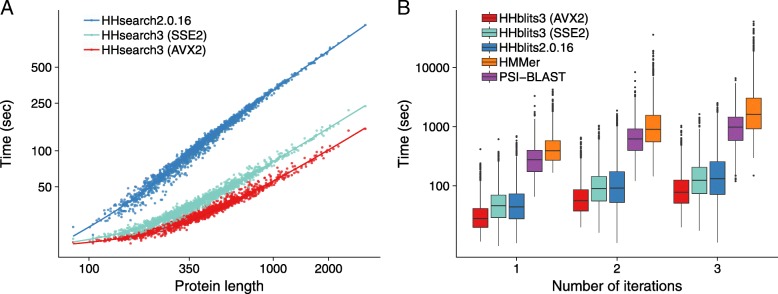
Background: HH-suite is a widely used open source software suite for sensitive sequence similarity searches and protein fold recognition. It is based on pairwise alignment of profile Hidden Markov models (HMMs), which represent multiple sequence alignments of homologous proteins. Results: We developed a single-instruction multiple-data (SIMD) vectorized implementation of the Viterbi algorithm for profile HMM alignment and introduced various other speed-ups. These accelerated the search methods HHsearch by a factor 4 and HHblits by a factor 2 over the previous version 2.0.16. HHblits3 is ∼10× faster than PSI-BLAST and ∼20× faster than HMMER3. Jobs to perform HHsearch and HHblits searches with many query profile HMMs can be parallelized over cores and over cluster servers using OpenMP and message passing interface (MPI). The free, open-source, GPLv3-licensed software is available at https://github.com/soedinglab/hh-suite . Conclusion: The added functionalities and increased speed of HHsearch and HHblits should facilitate their use in large-scale protein structure and function prediction, e.g. in metagenomics and genomics projects.
Overview
The claims and statistics of this paper haven’t been checked yet.
Free: it reads the open-access text and checks the first 5 claims that cite a source we can check. Create a free account to check every claim.
Integrity signals
Registry
Cites
Statistics
Figures
Verification
Claims the paper makes
The claims and statistics of this paper haven’t been checked yet.
Free: it reads the open-access text and checks the first 5 claims that cite a source we can check. Create a free account to check every claim.
Claims other papers make about this one
Each is checked against this paper’s own text: does it say what the citing paper says it does?
The cited source says what the claim attributes to it.
In the citing paper
“Although some advanced sequence-based methods can already assist in this task39–41, the availability of predicted structures may help identify meaningful evolutionary relationships.”
From Clustering predicted structures at the scale of the known protein universe (2023) · cites this paper as [39]
The cited source says what the claim attributes to it.
In the citing paper
“Amino acid sequence analysis27 also detects the previously observed lipase sequence motifs HG and GXSXG (where X is a wildcard) from Mycoplasma mycoides subsp. mycoides LC.70”
From Toward the Complete Functional Characterization of a Minimal Bacterial Proteome (2022) · cites this paper as [27]
The check wasn’t confident either way, so it gives no verdict — never disputed.
In the citing paper
“Two methods were used to identify non-interacting proteins, first a set of proteins with no reported interaction signal in Yeast Two-Hybrid Experiments41 and secondly complexes whose individual proteins were found in different APMS benchmark complexes42. This dataset contains in total 3989 non-interacting pairs.”
From Improved prediction of protein-protein interactions using AlphaFold2 (2021) · cites this paper as [41]
Experimental — accuracy not yet measuredThe check wasn’t confident either way, so it gives no verdict — never disputed.
In the citing paper
“Fortunately, the Continuous Automated Model Evaluation (CAMEO) experiment (7) tests structure prediction servers blindly on protein structures as they are submitted to the PDB.”
From Accurate prediction of protein structures and interactions using a 3-track network (2021) · cites this paper as [7]
Experimental — accuracy not yet measured
Self-check
Percentages, sums and reported differences re-computed from the paper’s own numbers.
The self-check needs the paper’s full text.
Citations
Cites
Gapped BLAST and PSI-BLAST: a new generation of protein database search programs
Altschul, S. (1997) · Nucleic Acids Research · doi:10.1093/nar/25.17.3389 · Cited by 73,302
Berman, H. M. (2000) · Nucleic Acids Research · doi:10.1093/nar/28.1.235 · Cited by 40,196 · cited 2×
“The PDB70 contains profile HMMs for a representative set of sequences from the PDB [22], filtered with a maximum pairwise sequence identity of 70%.”
MethodSearch and clustering orders of magnitude faster than BLAST
Edgar, R. C. (2010) · Bioinformatics · doi:10.1093/bioinformatics/btq461 · Cited by 20,826
Kabsch, W., & Sander, C. (1983) · Biopolymers · doi:10.1002/bip.360221211 · Cited by 15,320 · cited 3×
“pl, and we added structurally defined secondary structure states from DSSP [36] using addss.”
MethodInfluentialFast and sensitive protein alignment using DIAMOND
Buchfink, B., Xie, C., & Huson, D. H. (2015) · Nature Methods · doi:10.1038/nmeth.3176 · Cited by 14,201 · cited 1×
“In recent years, various sequence search tools have been developed that are up to four orders of magnitude faster than BLAST [15–18].”
MethodAccelerated Profile HMM Searches
Eddy, S. R. (2011) · PLoS Computational Biology · doi:10.1371/journal.pcbi.1002195 · Cited by 6,975
Eddy, S. R. (1998) · Bioinformatics · doi:10.1093/bioinformatics/14.9.755 · Cited by 5,515
MMseqs2 enables sensitive protein sequence searching for the analysis of massive data sets
Steinegger, M., & Söding, J. (2017) · Nature Biotechnology · doi:10.1038/nbt.3988 · Cited by 4,840
Self-citationSWISS-MODEL: modelling protein tertiary and quaternary structure using evolutionary information
Biasini, M., Bienert, S., Waterhouse, A., Arnold, K., Studer, G., Schmidt, T., Kiefer, F., Cassarino, T. G., Bertoni, M., Bordoli, L., et al. (2014) · Nucleic Acids Research · doi:10.1093/nar/gku340 · Cited by 4,632
The Pfam protein families database in 2019
El-Gebali, S., Mistry, J., Bateman, A., Eddy, S. R., Luciani, A., Potter, S. C., Qureshi, M., Richardson, L. J., Salazar, G. A., Smart, A., et al. (2019) · Nucleic Acids Research · doi:10.1093/nar/gky995 · Cited by 4,602
Cited by
Items 1,001–1,070 of 1,070
Detecting remote homolog using structure alignment algorithms and machine learningPreprint
Costa, P. C. D. S., & Sakamoto, T. (2022) · bioRxiv (Cold Spring Harbor Laboratory) · doi:10.1101/2022.12.15.520536
Homology Modeling and Binding Site Analysis of SARS-CoV-2 (COVID-19) Main Protease 3D Structure
Adebiyi, M. O., & Obagbuwa, I. C. (2022) · Advances in healthcare information systems and administration book series · doi:10.4018/978-1-6684-5656-9.ch004
Computational Tools for Protein-Protein Interaction Prediction and Analysis
Bell, E. F. (2022) · Deep Blue (University of Michigan) · doi:10.7302/6926
Nikonov, O. S., Nikonova, E. Y., Tarabarova, A. G., Mikhaylina, A. O., Kravchenko, O. V., Nevskaya, N. A., & Nikonov, S. V. (2023) · Biochemistry (Moscow) · doi:10.1134/s0006297923020062
“PDB70 database was used to search for the model templates [22].”
MethodGogoi, J., Kuri, P., Karunakaran, M., & Mondal, M. (2023) · Research Square · doi:10.21203/rs.3.rs-2858709/v1
Broad functional profiling of fission yeast proteins using phenomics and machine learningPreprint
Rodríguez‐López, M., Bordin, N., Lees, J., Scholes, H. M., Hassan, S., Saintain, Q., Kamrad, S., Orengo, C. A., & Bähler, J. (2023) · eLife · doi:10.7554/elife.88229.1 · Cited by 3
María, R.-L., Bordin, N., Jon, L., et al. (2023) · eLife · doi:10.7554/elife.88229.1.sa2
María, R.-L., Nicola, B., Jon, L., et al. (2023) · eLife · doi:10.7554/elife.88229.1.sa0
María, R.-L., Bordin, N., Jon, L., et al. (2023) · eLife · doi:10.7554/elife.88229.1.sa1
Rizk, M. S. (2023) · Egyptian Journal of Desert Research · doi:10.21608/ejdr.2023.200096.1132
“The SWISS-MODEL template library has been used for template selection and search with BLAST and HHBlits (Camacho et al., 2009; Remmert et al., 2011 and Steinegger et al., 2019).”
de Moraes, V. N. (2023) · Digital Library of Theses and Dissertations (Universidade de São Paulo) · doi:10.11606/t.17.2023.tde-29062023-134910
Predicting Protein Interaction Sites Using PITHIA
Hosseini, S., & Ilie, L. (2023) · Methods in molecular biology · doi:10.1007/978-1-0716-3327-4_29
Thibau, A. (2023) · Publication Server of Goethe University Frankfurt am Main (Goethe University Frankfurt) · doi:10.21248/gups.74352
Bhandari, A., & Ramakrishnan, V. (2023) · Springer protocols handbooks/Springer protocols · doi:10.1007/978-1-0716-3405-9_2
Simpson, G. A., Rezende, I. F., Peixoto, A. D. S., Soares, I. B. D. O., Barbosa, J. A. R. G., de Freitas, S. M., & Valadares, N. F. (2023) · BBA Advances · doi:10.1016/j.bbadva.2023.100098
RetractedStructural Models and Sequence Alignment Results of the Rhodospirillum rubrum Proteome
Davidson, R. B., Coletti, M. A., Gao, M., & Sedova, A. (2023) · OSTI OAI (U.S. Department of Energy Office of Scientific and Technical Information) · doi:10.13139/ornlnccs/1987876
Structural Models and Sequence Alignment Results of the Desulfovibrio vulgaris Proteome
Davidson, R. B., Coletti, M. A., Gao, M., & Sedova, A. (2023) · OSTI OAI (U.S. Department of Energy Office of Scientific and Technical Information) · doi:10.13139/ornlnccs/1988139
Caspase-1 activates gasdermin A in non-mammalsPreprint
Billman, Z. P., Kovacs, S. B., Wei, B., Kang, K., Cissé, O. H., & Miao, E. A. (2024) · eLife · doi:10.7554/elife.92362.2 · Cited by 5
Disordered regions and folded modules in CAF-1 promote histone deposition in S. pombePreprint
Ouasti, F., Audin, M., Fréon, K., Quivy, J., Tachekort, M., Cesard, E., Thureau, A., Ropars, V., Varela, P. F., Moal, G., et al. (2024) · eLife · doi:10.7554/elife.91461.2
Ouasti, F., Audin, M., Fréon, K., et al. (2024) · eLife · doi:10.7554/elife.91461.2.sa1
Reviewer #2 (Public Review): Caspase-1 activates gasdermin A in non-mammals
Billman, Z. P., Kovacs, S. B., Wei, B., et al. (2024) · eLife · doi:10.7554/elife.92362.3.sa0
Author Response: Caspase-1 activates gasdermin A in non-mammals
Billman, Z. P., Kovacs, S. B., Wei, B., Kang, K., Cissé, O. H., & Miao, E. A. (2024) · eLife · doi:10.7554/elife.92362.3.sa3
Johnson, S. R., Peshwa, M., & Sun, Z. (2024) · eLife · doi:10.7554/elife.91415.2.sa2
Structural Modeling of T9SS Outer Membrane Proteins and Their Complexes
Lorenz, C. D., Curtis, M. A., & Garnett, J. A. (2024) · Methods in molecular biology · doi:10.1007/978-1-0716-3734-0_20
Seefelder, M., Alva, V., Huang, B., Engler, T., Baumeister, W. P., Guo, Q., Fernández‐Busnadiego, R., Lupas, A. N., & Kochanek, S. (2020) · Figshare · doi:10.6084/m9.figshare.13357707
Seefelder, M., Alva, V., Huang, B., Engler, T., Baumeister, W. P., Guo, Q., Fernández‐Busnadiego, R., Lupas, A. N., & Kochanek, S. (2020) · Figshare · doi:10.6084/m9.figshare.13357692
Seefelder, M., Alva, V., Huang, B., Engler, T., Baumeister, W. P., Guo, Q., Fernández‐Busnadiego, R., Lupas, A. N., & Kochanek, S. (2020) · Figshare · doi:10.6084/m9.figshare.13357695
Seefelder, M., Alva, V., Huang, B., Engler, T., Baumeister, W. P., Guo, Q., Fernández‐Busnadiego, R., Lupas, A. N., & Kochanek, S. (2020) · Figshare · doi:10.6084/m9.figshare.13357728
Macedo, D. H., Grybchuk, D., Režnarová, J., Votýpka, J., Klocek, D., Yurchenko, T., Ševčík, J., Magri, A., Dolinská, M. U., Záhonová, K., et al. (2023) · Figshare · doi:10.6084/m9.figshare.24123807
Seefelder, M., Alva, V., Huang, B., Engler, T., Baumeister, W. P., Guo, Q., Fernández‐Busnadiego, R., Lupas, A. N., & Kochanek, S. (2020) · Figshare · doi:10.6084/m9.figshare.13357713
Macedo, D. H., Grybchuk, D., Režnarová, J., Votýpka, J., Klocek, D., Yurchenko, T., Ševčík, J., Magri, A., Dolinská, M. U., Záhonová, K., et al. (2023) · Figshare · doi:10.6084/m9.figshare.24123813
Seefelder, M., Alva, V., Huang, B., Engler, T., Baumeister, W. P., Guo, Q., Fernández‐Busnadiego, R., Lupas, A. N., & Kochanek, S. (2020) · Figshare · doi:10.6084/m9.figshare.13357710
Seefelder, M., Alva, V., Huang, B., Engler, T., Baumeister, W. P., Guo, Q., Fernández‐Busnadiego, R., Lupas, A. N., & Kochanek, S. (2020) · Figshare · doi:10.6084/m9.figshare.13357704
Seefelder, M., Alva, V., Huang, B., Engler, T., Baumeister, W. P., Guo, Q., Fernández‐Busnadiego, R., Lupas, A. N., & Kochanek, S. (2020) · Figshare · doi:10.6084/m9.figshare.13357719
Seefelder, M., Alva, V., Huang, B., Engler, T., Baumeister, W. P., Guo, Q., Fernández‐Busnadiego, R., Lupas, A. N., & Kochanek, S. (2020) · Figshare · doi:10.6084/m9.figshare.13357701
Macedo, D. H., Grybchuk, D., Režnarová, J., Votýpka, J., Klocek, D., Yurchenko, T., Ševčík, J., Magri, A., Dolinská, M. U., Záhonová, K., et al. (2023) · Figshare · doi:10.6084/m9.figshare.24123810
Seefelder, M., Alva, V., Huang, B., Engler, T., Baumeister, W. P., Guo, Q., Fernández‐Busnadiego, R., Lupas, A. N., & Kochanek, S. (2020) · Figshare · doi:10.6084/m9.figshare.13357716
Seefelder, M., Alva, V., Huang, B., Engler, T., Baumeister, W. P., Guo, Q., Fernández‐Busnadiego, R., Lupas, A. N., & Kochanek, S. (2020) · Figshare · doi:10.6084/m9.figshare.13357725
Seefelder, M., Alva, V., Huang, B., Engler, T., Baumeister, W. P., Guo, Q., Fernández‐Busnadiego, R., Lupas, A. N., & Kochanek, S. (2020) · Figshare · doi:10.6084/m9.figshare.13357722
Nikonov, O. S., Nikonova, E. Y., Tarabarova, A. G., Mikhaylina, A. O., Kravchenko, O. V., Nevskaya, N. A., & Nikonov, S. V. (2023) · Biochemistry (Moscow) · doi:10.31857/s0320972523020100
Belkevich, A. E., Khalil, A. Y., Decatur, W. A., Palumbo, R. J., & Knutson, B. A. (2024) · Transcription · doi:10.1080/21541264.2024.2350162
“…as profile Hidden Markov Models (HMMs), was built from the set of protein sequences identified for E. cuniculi available at Ensembl (version Encephalitozoon_cuni culi_ecuniii_l_gca_001078035.ECIIIL.pep.all.fa.gz) against the Uniclust30 database (version UniRef 30_2020_06_hhsuite.tar.gz) [27–29].”
Protein Structural Bioinformatics: An Overview
Gromiha, M. M., Ridha, F., & Selvaraj, S. (2024) · Elsevier eBooks · doi:10.1016/b978-0-323-95502-7.00026-9
Protein Structure Classification in the Era of AlphaFold2
Waman, V., Dawson, N. L., Das, S., Lees, J., & Orengo, C. A. (2024) · Elsevier eBooks · doi:10.1016/b978-0-323-95502-7.00047-6
Characterising Protein Search Drift using exhaustive protein search and Alphafold2Preprint
Buchan, D. W. A. (2024) · bioRxiv (Cold Spring Harbor Laboratory) · doi:10.1101/2024.11.14.623594
GP-nano: a geometric graph network for nanobody polyreactivity prediction
Zhou, X., Yuan, Q., Zheng, S., Wang, Y., & Yang, Y. (2024) · IEEE International Conference on Bioinformatics and Biomedicine (BIBM) · doi:10.1109/bibm62325.2024.10822038 · Cited by 1
“…significance threshold; (8) Profile HMM Features: a 27-state feature vector giving residues’ emission and transition probabilities derived from HH-suite3 [44]; 3) Surface contact features: We calculate a set of normal vector feature to describe surface contact obtained by modeling protein surfaces.”
Mrozek, D., Pawłowicz, P., Sunderam, V. S., Hung, C., Kwiecień, A., & Mrozek, D. (2024) · IEEE International Conference on Big Data (BigData) · doi:10.1109/bigdata62323.2024.10825877
“Computational comparative analysis of proteins (both amino acid sequence-based and 3D structure-based) plays an important role in all investigations within protein analytics [2], e.g., in fold recognition [3] and protein annotation [4].”
Saha, C. K., Roghanian, M., Häußler, S., & Guy, L. (2025) · bioRxiv (Cold Spring Harbor Laboratory) · doi:10.1101/2025.01.23.634437
Refinement and curation of homologous groups facilitated by structure prediction
Schaeffer, R. D., Pei, J., Zhang, J., Cong, Q., & Grishin, N. V. (2025) · Protein Science · doi:10.1002/pro.70074
“The HHsuite manual suggests that 95% homology is “ near certain, ” but our experience suggests even 90% or greater can be assigned with few false positives (as long as alignment coverage is considered) (Steinegger et al. 2019).”
Assessing Structural Classification Using AlphaFold2 Models Through ECOD ‐Based Comparative Analysis
Kawabata, T., & Kinoshita, K. (2025) · Proteins Structure Function and Bioinformatics · doi:10.1002/prot.26828
“Then, if BLAST fails to identify any significant similarities, the profile-profile comparison methods such as HHsearch [18] are performed to check for further remote homology.”
Modeling CAPRI Targets of Round 55 by Combining AlphaFold and Docking
Singh, A., Copeland, M. M., Kundrotas, P. J., & Vakser, I. A. (2025) · Proteins Structure Function and Bioinformatics · doi:10.1002/prot.26853 · Cited by 1
Virtual-Cardio-Drug: Ai-Powered Sbvs for Cardiovascular Drug Discovery
Navarro, Á. S., Arenas, J. I. A., Calatayud, A. G., Enríquez, J. A., Martínez, F., & Sánchez‐Cabo, F. (2025) · Proceedings - IEEE Symposium on Computer-Based Medical Systems · doi:10.1109/cbms65348.2025.00118
Burroughs, A. M., Nicastro, G. G., & Aravind, L. (2025) · eLife · doi:10.7554/elife.108061.1
Ahmad, S. M., Ganai, N. A., & Bhat, B. A. (2025) · Elsevier eBooks · doi:10.1016/b978-0-443-30252-7.00006-7
Duan, H., Li, Z., Wu, Y., Ren, B., Chen, W. Q., Wang, F., Lan, D., Wang, Y., & Xia, L. C. (2025) · Lecture notes in computer science · doi:10.1007/978-981-95-0695-8_18
Structural evolution of nitrogenase enzymes over geologic timePreprint
Cuevas-Zuviría, B., Detemple, F., Amritkar, K., Garcia, A. K., Seefeldt, L. C., Einsle, O., & Kaçar, B. (2025) · eLife · doi:10.7554/elife.105613.2
Emergence and stabilization of a neo-Y chromosome in nematode species with rare males
Letcher, B., Stevens, L., Saclier, N., Hsiao, A., Kieninger, M. R., Wenger, E., Launay, C., Blaxter, M., & Delattre, M. (2026) · Molecular Biology and Evolution · doi:10.1093/molbev/msag177
An RNA-mediated DNA melting mechanism for CRISPR-Cas9Preprint
Hedger, G., Jiang, V., Ekman, F. K., Wang, Q., & Shaw, D. E. (2025) · bioRxiv (Cold Spring Harbor Laboratory) · doi:10.1101/2025.09.04.674090
Tariq, A., Ahmed, A., Khatoon, A., & Karim, A. (2025) · Computers in Biology and Medicine · doi:10.1016/j.compbiomed.2025.111058
多样化线粒体基因组变异推动欧亚树麻雀(Passer montanus)的种群分化
Shan, C.-B., 内蒙古大学生命科学学院省部共建草原家畜生殖调控与繁育国家重点实验室, 内. 呼., Ning, W., Wei, L., Xiang-Jiang, Z., Long-Wu, W., Le, Y., Qiong, L., Yan-Lin, L., Hao, M., et al. (2025) · 动物学研究 · doi:10.24272/j.issn.2095-8137.2025.073
“Protein structures were predicted using AlphaFold2 (Jumper et al., 2021) and AlphaFold2-multimer (Evans et al., 2021), with homologous sequence alignments generated via MMseqs2 (Mirdita et al., 2019) and HHsearch (Steinegger et al., 2019).”
Johnson, S. R., Peshwa, M., & Sun, Z. (2023) · doi:10.1101/2023.07.26.550718
Disordered regions and folded modules in CAF-1 promote histone deposition in S. pombe
Ouasti, F., Audin, M., Freon, K., Quivy, J.-P., Tachekort, M., Cesard, E., Thureau, A., Ropars, V., Varela, P. F., Moal, G., et al. (2023) · doi:10.1101/2023.06.02.543505
“The resulting alignments were filtered using hhfilter(Steinegger et al. 2019) using parameters (‘id’=100, ‘qid’=25, ‘cov’=50) and the taxonomy assigned to every sequence keeping only one sequence per species.”
Method
Metadata
- Authors
- Steinegger, M., Meier, M., Mirdita, M., Vöhringer, H., Haunsberger, S. J., & Söding, J.
- Affiliations
- Johns Hopkins University (US)
- Max Planck Institute for Biophysical Chemistry (DE)
- European Bioinformatics Institute (GB)
- Royal College of Surgeons in Ireland (IE)
- Corresponding author
- Söding, Johannes
- Venue
- BMC Bioinformatics
- Published
- 2019-09-14
- Volume
- 20
- Issue
- 1
- Pages
- 473-473
- ISSN
- 1471-2105 (ISSN-L)
- PMC
- PMC6744700
- OpenAlex
- W2972411752
- Cited by
- 1,145
- References
- 38
- Citations by year
- 2026: 106 · 2025: 167 · 2024: 208 · 2023: 248 · 2022: 168 · 2021: 176 · 2020: 63 · 2019: 7
- FWCI
- 35.23
- Type
- journal article
- Language
- en
- Open access
- gold
- doi.org
- Licence
- cc-by
- creativecommons.org/licenses/by/4.0/ (tdm)
- creativecommons.org/licenses/by/4.0/ (vor)
- Locations
- BMC Bioinformatics (publishedVersion, cc-by)
- bioRxiv (Cold Spring Harbor Laboratory) (acceptedVersion, cc-by-nc-nd)
- PubMed Central (publishedVersion, cc-by)
- PubMed (publishedVersion)
- DOAJ (DOAJ: Directory of Open Access Journals) (submittedVersion)
- Figshare (submittedVersion, cc-by)
- GoeScholar The Publication Server of the Georg-August-Universität Göttingen (Georg-August-Universität Göttingen) (submittedVersion, cc-by)
- MPG.PuRe (Max Planck Society) (submittedVersion, other-oa)
- Seoul National University Open Repository (Seoul National University) (submittedVersion)
- Funders
- Horizon 2020 (685778)
- Topics
- Life Sciences › Biochemistry, Genetics and Molecular Biology › Molecular Biology › Genomics and Phylogenetic Studies
- Life Sciences › Biochemistry, Genetics and Molecular Biology › Molecular Biology › Protein Structure and Dynamics
- Life Sciences › Biochemistry, Genetics and Molecular Biology › Molecular Biology › Machine Learning in Bioinformatics
- Keywords
- profile hidden Markov models, Viterbi algorithm, SIMD vectorization, remote homology detection, protein fold recognition, protein annotation, sequence similarity search, parallel computing, protein structure prediction, metagenomics
- MeSH terms
- Algorithms, Markov Chains, Software, Sequence Alignment, Sequence Analysis, Protein, Molecular Sequence Annotation
About these checks
Registry, retraction, Cites and statistics results are computed, not judged, with one exception: a printed reference that no index lists is read once by a model before it counts as a citation error. Claims are extracted by a model and kept only when their quote appears verbatim in the text; each cited source is then checked, with a model’s help, for whether it says what the claim relies on. Those verdicts can be wrong — read the claim’s quote and the cited source before relying on one.
Statistics and arithmetic are recomputed, not judged.
Confidence bands are shown only for fields calibrated on our annotated test set. None is calibrated yet, so no band is shown.
What counts as a claim ›How we measure confidence ›How we check this ›
Are you an author, or do you see a problem with this page? Request a review
Data sources
Bibliographic data: Semantic Scholar, OpenAlex, Crossref.
Contains information from the Semantic Scholar Academic Graph Datasets, made available under the ODC Attribution License (ODC-BY 1.0).
Semantic Scholar’s data is described in: Kinney, R., et al. (2023). The Semantic Scholar Open Data Platform. arXiv:2301.10140.
