

Electronic media use and sleep in children and adolescents in western countries: a systematic review
Open accessThe DOI matches its Crossref record; 76 of the 76 references it cites were found in a registry or an index.
Abstract
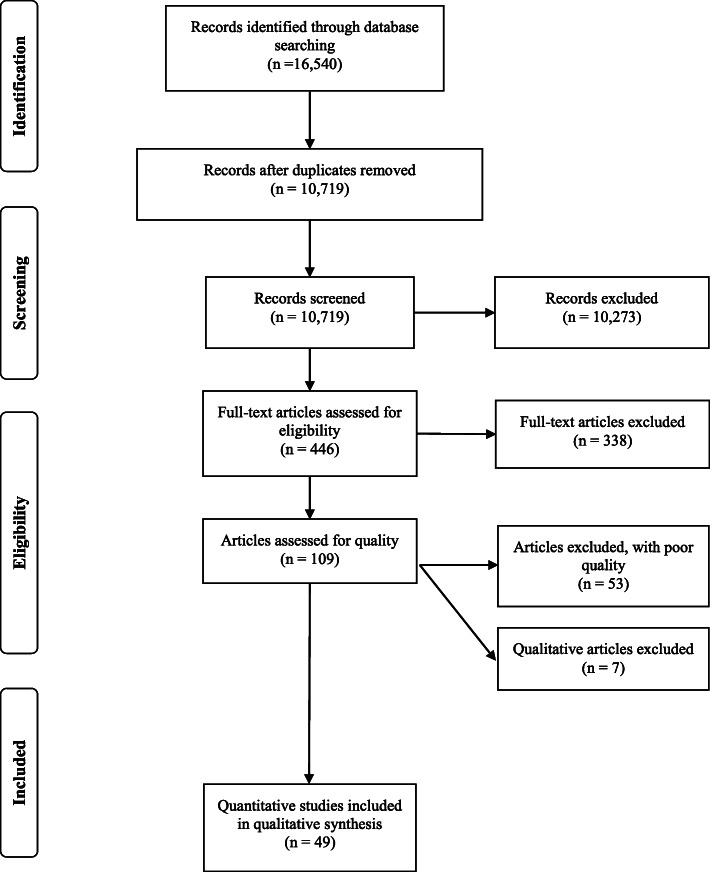
Background: Sleep is essential for child and adolescent health and well-being. There is an increasing interest in whether electronic media use affects children and young adolescents’ sleep. Prior reviews have focused on a school-aged population. Moreover, it is crucial that research continuously addresses the processes of technology and media use and the implication on sleep. This systematic review examines the evidence of electronic media use related to sleep among 0–15-year-olds. Methods: Searches were carried out in four databases (CINAHL, Web of Science, EMBASE, and Medline). Inclusion criteria included age ≤ 15 years, and intervention, cohort, or cross-sectional studies from western countries. Methodological quality was rated using the Quality Assessment Tool for Quantitative Studies by two independent reviewers. Data was extracted using a standardized data extraction form. Synthesis was done by summarizing results across studies by age groups of 0–5, 6–12, and 13–15 years within four sleep domains: Bedtime and sleep onset; Sleep quality; Sleep duration; Daytime tiredness. Results: The search identified 10,719 unique studies, of which 109 fulfilled inclusion and exclusion criteria and were assessed for methodological quality. In total, 49 studies were included in the review. The study designs were randomized controlled trials ( n = 3), quasi-experimental studies ( n = 2), prospective cohort studies ( n = 15), and cross-sectional studies ( n = 29). Evidence for an association between electronic media use and sleep duration was identified, with stronger evidence for 6–15-years-olds than 0–5-year-olds. The evidence for a relationship between electronic media use and other sleep outcomes was more inconclusive. However, for 6–12-year-old children, there was evidence for associations of electronic media use with delayed bedtime and poor sleep quality. For 13–15-year-olds, there was evidence for associations between screen time and problems falling asleep, and between social media use and poor sleep quality. Conclusions: Overall, electronic media use was generally associated with shorter sleep duration in children and adolescents. Studies with stronger research design and of higher quality are needed to draw solid conclusions about electronic media’s impact on other sleep outcomes. Public awareness and interventions could be promoted about the potential negative impact on children’s sleep of electronic media devices that are used excessively and close to bedtime.
Overview
The claims and statistics of this paper haven’t been checked yet.
Free: it reads the open-access text and checks the first 5 claims that cite a source we can check. Create a free account to check every claim.
Integrity signals
Registry
Cites
Statistics
Figures
Verification
Claims the paper makes
The claims and statistics of this paper haven’t been checked yet.
Free: it reads the open-access text and checks the first 5 claims that cite a source we can check. Create a free account to check every claim.
Claims other papers make about this one
Each is checked against this paper’s own text: does it say what the citing paper says it does?
The source backs part of the claim, not all of it — or backs it for a different population, condition or comparison.
In the citing paper
“Strong evidence exists on the disruptive impact of digital media on child and teen sleep duration, onset, and quality.200-204”
From Digital Ecosystems, Children, and Adolescents: Technical Report (2026) · cites this paper as [217]
Experimental — accuracy not yet measuredThe source backs part of the claim, not all of it — or backs it for a different population, condition or comparison.
In the citing paper
“Even among children, there is a problem with extended use of social media sites, which result in sleep deprivation due to delayed bedtimes and reduced total sleep duration and quality of rest [31,65].”
From The Use of Social Media in Children and Adolescents: Scoping Review on the Potential Risks. (2022) · cites this paper as [65]
Experimental — accuracy not yet measuredIn the citing paper
“Moreover, the evidence on which these guidelines are based largely comes from cross-sectional studies with many inherent limitations.2,10,11,12”
From Screen Use at Bedtime and Sleep Duration and Quality Among Youths (2024) · cites this paper as [10]
Self-check
Percentages, sums and reported differences re-computed from the paper’s own numbers.
The self-check needs the paper’s full text.
Citations
Cites
Dewald, J. F., Meijer, A. M., Oort, F. J., Kerkhof, G. A., & Bögels, S. M. (2010) · Sleep Medicine Reviews · doi:10.1016/j.smrv.2009.10.004 · Cited by 1,526
Screen time and sleep among school-aged children and adolescents: a systematic literature review
Hale, L., & Guan, S. (2015) · Sleep Medicine Reviews · doi:10.1016/j.smrv.2014.07.007 · Cited by 1,468
Insufficient Sleep in Adolescents and Young Adults: An Update on Causes and Consequences
Owens, J., ADOLESCENT SLEEP WORKING GROUP, COMMITTEE ON ADOLESCENCE, Au, R., Carskadon, M., Millman, R., Wolfson, A., Braverman, P. K., Adelman, W. P., Breuner, C. C., et al. (2014) · Pediatrics · doi:10.1542/peds.2014-1696 · Cited by 1,413
Electronic media use and sleep in school-aged children and adolescents: A review
Cain, N., & Gradisar, M. (2010) · Sleep Medicine · doi:10.1016/j.sleep.2010.02.006 · Cited by 1,376
Children and Adolescents and Digital Media
Reid Chassiakos, Y. (., Radesky, J., Christakis, D., Moreno, M. A., Cross, C., COUNCIL ON COMMUNICATIONS AND MEDIA, Hill, D., Ameenuddin, N., Hutchinson, J., Levine, A., et al. (2016) · Pediatrics · doi:10.1542/peds.2016-2593 · Cited by 1,340
Sleep and emotions: a focus on insomnia
Baglioni, C., Spiegelhalder, K., Lombardo, C., & Riemann, D. (2010) · Sleep Medicine Reviews · doi:10.1016/j.smrv.2009.10.007 · Cited by 873
Carter, B., Rees, P., Hale, L., Bhattacharjee, D., & Paradkar, M. S. (2016) · JAMA Pediatrics · doi:10.1001/jamapediatrics.2016.2341 · Cited by 718
Evidence for the validity of a sleep habits survey for adolescents
Wolfson, A. R., Carskadon, M. A., Acebo, C., Seifer, R., Fallone, G., Labyak, S. E., & Martin, J. L. (2003) · Sleep · doi:10.1093/sleep/26.2.213 · Cited by 682
Protective and risk factors for adolescent sleep: A meta-analytic review
Bartel, K. A., Gradisar, M., & Williamson, P. (2015) · Sleep Medicine Reviews · doi:10.1016/j.smrv.2014.08.002 · Cited by 563
Calamaro, C. J., Mason, T. B. A., & Ratcliffe, S. J. (2009) · Pediatrics · doi:10.1542/peds.2008-3641 · Cited by 499
Chaput, J.-P., Gray, C. E., Poitras, V. J., Carson, V., Gruber, R., Birken, C. S., MacLean, J. E., Aubert, S., Sampson, M., & Tremblay, M. S. (2017) · BMC Public Health · doi:10.1186/s12889-017-4850-2 · Cited by 410
Digital Media and Sleep in Childhood and Adolescence
LeBourgeois, M. K., Hale, L., Chang, A.-M., Akacem, L. D., Montgomery-Downs, H. E., & Buxton, O. M. (2017) · Pediatrics · doi:10.1542/peds.2016-1758j · Cited by 383
Twenge, J. M., Krizan, Z., & Hisler, G. (2017) · Sleep Medicine · doi:10.1016/j.sleep.2017.08.013 · Cited by 303 · cited 1×
“In this study, social media use was not related to sleep duration, whereas Twenge et al. (2017) found an association between social media and short sleep duration.”
BackgroundGuglielmo, D., Gazmararian, J. A., Chung, J., Rogers, A. E., & Hale, L. (2018) · Sleep Health · doi:10.1016/j.sleh.2017.09.005 · Cited by 291
Cheung, C. H. M., Bedford, R., Saez De Urabain, I. R., Karmiloff-Smith, A., & Smith, T. J. (2017) · Scientific Reports · doi:10.1038/srep46104 · Cited by 264
Arora, T., Broglia, E., Thomas, G. N., & Taheri, S. (2014) · Sleep Medicine · doi:10.1016/j.sleep.2013.08.799 · Cited by 261 · cited 1×
“Arora et al. (2014) showed that high frequency of gaming at bedtime was associated with a 6.2 min prolonged sleep onset on weekdays [33].”
BackgroundInfluentialShort, M. A., Gradisar, M., Wright, H., Lack, L. C., Dohnt, H., & Carskadon, M. A. (2011) · Sleep · doi:10.5665/sleep.1052 · Cited by 242
What keeps low-SES children from sleeping well: the role of presleep worries and sleep environment
Bagley, E. J., Kelly, R. J., Buckhalt, J. A., & El-Sheikh, M. (2015) · Sleep Medicine · doi:10.1016/j.sleep.2014.10.008 · Cited by 237
Sleep duration, restfulness, and screens in the sleep environment
Falbe, J., Davison, K. K., Franckle, R. L., Ganter, C., Gortmaker, S. L., Smith, L., Land, T., & Taveras, E. M. (2015) · PEDIATRICS · doi:10.1542/peds.2014-2306 · Cited by 237 · cited 2×
“Falbe et al. (2015) reported that each hour per day of gaming was associated with a 9.8 min Fig.”
BackgroundInfluentialScott, H., Biello, S. M., & Woods, H. C. (2019) · BMJ Open · doi:10.1136/bmjopen-2019-031161 · Cited by 221 · cited 1×
“Scott 2019 No + + Cross-sectional Moderate Tavernier 2017 No 0 0 Cohort study High Twenge 2017 No + Cross-sectional Moderate Van der Schuur 2019 No + +/0 Cohort study Moderate Vernon 2015 No + Cross-sectional Moderate Vernon 2017 No + Cohort study Moderate”
BackgroundTelevision viewing, bedroom television, and sleep duration from infancy to mid-childhood
Cespedes, E. M., Gillman, M. W., Kleinman, K., Rifas-Shiman, S. L., Redline, S., & Taveras, E. M. (2014) · Pediatrics · doi:10.1542/peds.2013-3998 · Cited by 219
Protective Effects of Parental Monitoring of Children’s Media Use: A Prospective Study
Gentile, D. A., Reimer, R. A., Nathanson, A. I., Walsh, D. A., & Eisenmann, J. C. (2014) · JAMA Pediatrics · doi:10.1001/jamapediatrics.2014.146 · Cited by 219
Chahal, H., Fung, C., Kuhle, S., & Veugelers, P. J. (2013) · Pediatric Obesity · doi:10.1111/j.2047-6310.2012.00085.x · Cited by 198
Nodding off or switching off? The use of popular media as a sleep aid in secondary‐school children
Eggermont, S., & Van den Bulck, J. (2006) · Journal of Paediatrics and Child Health · doi:10.1111/j.1440-1754.2006.00892.x · Cited by 196
Night-time screen-based media device use and adolescents' sleep and health-related quality of life
Mireku, M. O., Barker, M. M., Mutz, J., Dumontheil, I., Thomas, M. S. C., Röösli, M., Elliott, P., & Toledano, M. B. (2019) · Environment International · doi:10.1016/j.envint.2018.11.069 · Cited by 187
Green, A., Cohen-Zion, M., Haim, A., & Dagan, Y. (2017) · Chronobiology International · doi:10.1080/07420528.2017.1324878 · Cited by 158
Nuutinen, T., Roos, E., Ray, C., Villberg, J. J., Välimaa, R. S., Rasmussen, M., Holstein, B. E., Godeau, E., Beck, F., Léger, D., et al. (2014) · International Journal of Public Health · doi:10.1007/s00038-014-0561-y · Cited by 144
Nuutinen, T., Ray, C., & Roos, E. (2013) · BMC Public Health · doi:10.1186/1471-2458-13-684 · Cited by 144
What do people do before going to bed? A study of bedtime procrastination using time use surveys
Chung, S. J., An, H., & Suh, S. (2020) · Sleep · doi:10.1093/sleep/zsz267 · Cited by 135
Youth Screen Time and Behavioral Health Problems: The Role of Sleep Duration and Disturbances
Parent, J., Sanders, W., & Forehand, R. (2016) · Journal of Developmental & Behavioral Pediatrics · doi:10.1097/dbp.0000000000000272 · Cited by 131
van der Schuur, W. A., Baumgartner, S. E., & Sumter, S. R. (2019) · Health Communication · doi:10.1080/10410236.2017.1422101 · Cited by 129
Perrault, A. A., Bayer, L., Peuvrier, M., Afyouni, A., Ghisletta, P., Brockmann, C., Spiridon, M., Hulo Vesely, S., Haller, D. M., Pichon, S., et al. (2019) · Sleep · doi:10.1093/sleep/zsz125 · Cited by 119
Foerster, M., Henneke, A., Chetty-Mhlanga, S., & Röösli, M. (2019) · International Journal of Environmental Research and Public Health · doi:10.3390/ijerph16030518 · Cited by 113
Arora, T., Hussain, S., Lam, K.-B. H., Yao, G., Thomas, G. N., & Taheri, S. (2013) · International Journal of Obesity · doi:10.1038/ijo.2012.209 · Cited by 108
Vernon, L., Modecki, K. L., & Barber, B. L. (2017) · Journal of Clinical Child & Adolescent Psychology · doi:10.1080/15374416.2016.1188702 · Cited by 108
Predictors of shorter sleep in early childhood
McDonald, L., Wardle, J., Llewellyn, C. H., van Jaarsveld, C. H. M., & Fisher, A. (2014) · Sleep Medicine · doi:10.1016/j.sleep.2014.01.005 · Cited by 104
Vernon, L., Barber, B. L., & Modecki, K. L. (2015) · Cyberpsychology Behavior and Social Networking · doi:10.1089/cyber.2015.0107 · Cited by 104
The Impact of a Healthy Media Use Intervention on Sleep in Preschool Children
Garrison, M. M., & Christakis, D. A. (2012) · Pediatrics · doi:10.1542/peds.2011-3153 · Cited by 98
Identifying Adolescent Sleep Problems
Short, M. A., Gradisar, M., Gill, J., & Camfferman, D. (2013) · PLoS ONE · doi:10.1371/journal.pone.0075301 · Cited by 98
Xu, H., Wen, L. M., Hardy, L. L., & Rissel, C. (2016) · Acta Paediatrica · doi:10.1111/apa.13285 · Cited by 90
Hours of Television Viewing and Sleep Duration in Children: A Multicenter Birth Cohort Study
Marinelli, M., Sunyer, J., Alvarez-Pedrerol, M., Iñiguez, C., Torrent, M., Vioque, J., Turner, M. C., & Julvez, J. (2014) · JAMA Pediatrics · doi:10.1001/jamapediatrics.2013.3861 · Cited by 85
Mobile youth culture: A conceptual development
Vanden Abeele, M. M. P. (2016) · Mobile Media & Communication · doi:10.1177/2050157915601455 · Cited by 83
Sleep as a Mediator of Screen Time Effects on US Children's Health Outcomes: A prospective study
Barlett, N. D., Gentile, D. A., Barlett, C. P., Eisenmann, J. C., & Walsh, D. A. (2012) · Journal of Children and Media · doi:10.1080/17482798.2011.633404 · Cited by 82
Wallenius, M., Rimpelä, A., Punamäki, R., & Lintonen, T. (2009) · Journal of Applied Developmental Psychology · doi:10.1016/j.appdev.2008.12.021 · Cited by 81
on behalf of the “Ci piace sognare” Study Group, Brambilla, P., Giussani, M., Pasinato, A., Venturelli, L., Privitera, F., Miraglia del Giudice, E., Sollai, S., Picca, M., Di Mauro, G., et al. (2017) · Italian Journal of Pediatrics · doi:10.1186/s13052-016-0324-x · Cited by 77
Beyens, I., & Nathanson, A. I. (2019) · Health Communication · doi:10.1080/10410236.2017.1422102 · Cited by 77
Redmayne, M., Smith, E., & Abramson, M. J. (2013) · Environmental Health · doi:10.1186/1476-069x-12-90 · Cited by 75
Lange, K., Cohrs, S., Skarupke, C., Goerke, M., Szagun, B., & Schlack, R. (2015) · Journal of Neural Transmission · doi:10.1007/s00702-015-1482-5 · Cited by 75
The relationship between sleep and problematic smartphone use among adolescents: A systematic review
Mac Cárthaigh, S., Griffin, C., & Perry, J. (2020) · Developmental Review · doi:10.1016/j.dr.2020.100897 · Cited by 75
Vandendriessche, A., Ghekiere, A., Van Cauwenberg, J., De Clercq, B., Dhondt, K., DeSmet, A., Tynjälä, J., Verloigne, M., & Deforche, B. (2019) · International Journal of Environmental Research and Public Health · doi:10.3390/ijerph16061072 · Cited by 69
Nathanson, A. I., & Beyens, I. (2018) · Behavioral Sleep Medicine · doi:10.1080/15402002.2016.1188389 · Cited by 64
Media multitasking and sleep problems: A longitudinal study among adolescents
van der Schuur, W. A., Baumgartner, S. E., Sumter, S. R., & Valkenburg, P. M. (2018) · Computers in Human Behavior · doi:10.1016/j.chb.2017.12.024 · Cited by 62
Plancoulaine, S., Reynaud, E., Forhan, A., Lioret, S., Heude, B., Charles, M.-A., Annesi-Maesano, I., Bernard, J. Y., Botton, J., Charles, M. A., et al. (2018) · Sleep Medicine · doi:10.1016/j.sleep.2018.03.030 · Cited by 60
Mindell, J. A. A., Sedmak, R., Boyle, J. T., Butler, R., & Williamson, A. A. (2016) · Journal of Clinical Sleep Medicine · doi:10.5664/jcsm.6338 · Cited by 54
Screen and nonscreen sedentary behavior and sleep in adolescents
Brunetti, V. C., O'Loughlin, E. K., O'Loughlin, J., Constantin, E., & Pigeon, É. (2016) · Sleep Health · doi:10.1016/j.sleh.2016.09.004 · Cited by 53 · cited 2×
“Brunetti et al. (2016), for example, found that computer use doubled the odds of a short night’s sleep, while talking on a mobile phone tripled the odds of a short night’s sleep [22].”
BackgroundLongitudinal associations between time spent using technology and sleep duration among adolescents☆
Mazzer, K., Bauducco, S., Linton, S. J., & Boersma, K. (2018) · Journal of Adolescence · doi:10.1016/j.adolescence.2018.05.004 · Cited by 53 · cited 1×
“Mazzer et al. (2018), who examined eighth- and ninth-grade students over a year, found that of electronic media use was associated with short sleep duration [42].”
BackgroundHuss, A., van Eijsden, M., Guxens, M., Beekhuizen, J., van Strien, R. T., Kromhout, H., Vrijkotte, T. G. M., & Vermeulen, R. C. H. (2015) · PLoS ONE · doi:10.1371/journal.pone.0139869 · Cited by 45
Zhang, Z., Sousa‐Sá, E., Pereira, J. R., Chaput, J., Okely, A. D., Feng, X., & Santos, R. (2018) · Sleep Medicine · doi:10.1016/j.sleep.2018.08.035 · Cited by 45
Interactive vs passive screen time and nighttime sleep duration among school-aged children
Yland, J., Guan, S., Emanuele, E., & Hale, L. (2015) · Sleep Health · doi:10.1016/j.sleh.2015.06.007 · Cited by 42
Duchaine, C. S., Ndjaboué, R., Lévesque, M., Vézina, M., Trudel, X., Gilbert‐Ouimet, M., Dionne, C. E., Mâsse, B. R., Pearce, N. E., & Brisson, C. (2017) · BMC Public Health · doi:10.1186/s12889-017-4014-4 · Cited by 42
Beyond Access and Exposure: Implications of Sneaky Media Use for Preschoolers’ Sleep Behavior
Moorman, J. D., & Harrison, K. (2018) · Health Communication · doi:10.1080/10410236.2017.1422103 · Cited by 39
A Preliminary Evaluation of a School-Based Media Education and Reduction Intervention
Bickham, D. S., Hswen, Y., Slaby, R. G., & Rich, M. (2018) · The Journal of Primary Prevention · doi:10.1007/s10935-018-0510-2 · Cited by 39
Das‐Friebel, A., Perkinson‐Gloor, N., Brand, S., Dewald‐Kaufmann, J., Grob, A., Wolke, D., & Lemola, S. (2018) · Sleep Medicine · doi:10.1016/j.sleep.2018.11.010 · Cited by 39
Why won’t she sleep? Screen exposure and sleep patterns in young infants
Ribner, A., & McHarg, G. (2019) · Infant Behavior and Development · doi:10.1016/j.infbeh.2019.101334 · Cited by 39
Reciprocal Longitudinal Associations Between Adolescents’ Media Consumption and Sleep
Poulain, T., Vogel, M., Buzek, T., Genuneit, J., Hiemisch, A., & Kiess, W. (2019) · Behavioral Sleep Medicine · doi:10.1080/15402002.2018.1491851 · Cited by 37
Adolescents' technology and face-to-face time use predict objective sleep outcomes
Tavernier, R., Heissel, J. A., Sladek, M. R., Grant, K. E., & Adam, E. K. (2017) · Sleep Health · doi:10.1016/j.sleh.2017.04.005 · Cited by 36
Associations among physical activity, screen time, and sleep in low socioeconomic status urban girls
Greever, C., Ahmadi, M. N., Sirard, J. R., & Alhassan, S. (2017) · Preventive Medicine Reports · doi:10.1016/j.pmedr.2017.01.014 · Cited by 35
72nd Congress of the Italian Society of Pediatrics: Florence, Italy. 16-19 November 2016
Braghero, M., Staiano, A., Biasin, E., Matarazzo, P., Einaudi, S., Manicone, R., Felicetti, F. C., Brignardello, E., Fagioli, F., Bignamini, E., et al. (2017) · The Italian Journal of Pediatrics/Italian journal of pediatrics · doi:10.1186/s13052-017-0327-2 · Cited by 30
Media devices, family relationships and sleep patterns among adolescents in an urban area
Continente, X., Pérez, A., Espelt, A., & López, M. J. (2016) · Sleep Medicine · doi:10.1016/j.sleep.2016.04.006 · Cited by 29
Lin, Q., Spruyt, K., Leng, Y., Jiang, Y., Wang, G., Dong, S., Mei, H., & Jiang, F. (2019) · Sleep Medicine Reviews · doi:10.1016/j.smrv.2019.07.006 · Cited by 27
Delayed bedtime due to screen time in schoolchildren: Importance of area deprivation
Ogunleye, A. A., Voss, C., & SANDERCOCK, G. R. H. (2014) · Pediatrics International · doi:10.1111/ped.12447 · Cited by 26
Moorman, J. D., Morgan, P., & Adams, T. (2019) · Current Sleep Medicine Reports · doi:10.1007/s40675-019-00151-0 · Cited by 26
A Profile of Knee Injuries Suffered by Australian Army Reserve Soldiers
Schram, B. L., Orr, R. M., & Pope, R. (2018) · International Journal of Environmental Research and Public Health · doi:10.3390/ijerph16010012 · Cited by 23
Ononogbu, S., Wallenius, M., Punamäki, R., Saarni, L. A., Lindholm, H. J., & Nygård, C. (2014) · Sleep Disorders · doi:10.1155/2014/315808 · Cited by 10
Addicting Content, Blue Light, and Curtailed Sleep: The ABCs of Social Media Use and Sleep
Yau, J. C., Sun, B. T., & Moreno, J. D. (2019) · Advances in psychology, mental health, and behavioral studies (APMHBS) book series · doi:10.4018/978-1-5225-9412-3.ch009 · Cited by 7
Yetish, G. M., & Samson, D. R. (2018) · Sleep Health · doi:10.1016/j.sleh.2018.10.006 · Cited by 3
Research works printed but not linked: 1
- Carter B Rees P Hale L Bhattacharjee D Paradkar MS Association between portable screen-based media device access or use and sleep outcomes JAMA Pediatr 2016 170 12 1202 1208 10.1001/jamapediatrics.2016.2341 27802500 PMC5380441 · DOI · Paper page
Cited by
The role of insufficient sleep and circadian misalignment in obesity
Chaput, J.-P., McHill, A. W., Cox, R. C., Broussard, J. L., Dutil, C., da Costa, B. G. G., Sampasa-Kanyinga, H., & Wright, K. P. (2023) · Nature Reviews Endocrinology · doi:10.1038/s41574-022-00747-7 · Cited by 649
The Use of Social Media in Children and Adolescents: Scoping Review on the Potential Risks.
Bozzola, E., Spina, G., Agostiniani, R., Barni, S., Russo, R., Scarpato, E., Di Mauro, A., Di Stefano, A. V., Caruso, C., Corsello, G., et al. (2022) · International Journal of Environmental Research and Public Health · doi:10.3390/ijerph19169960 · Cited by 552
“[65] Review Relationship between social media use, late sleep onset, sleep quality, and duration.”
BackgroundDigital media use and sleep in late adolescence and young adulthood: A systematic review
Brautsch, L. A., Lund, L., Andersen, M. M., Jennum, P. J., Folker, A. P., & Andersen, S. (2023) · Sleep Medicine Reviews · doi:10.1016/j.smrv.2022.101742 · Cited by 218
Self-citationPediatric Inflammatory Bowel Disease
Bouhuys, M., Lexmond, W. S., & van Rheenen, P. F. (2022) · PEDIATRICS · doi:10.1542/peds.2022-058037 · Cited by 170
How's Life for Children in the Digital Age?
OECD (2025) · OECD eBooks · doi:10.1787/0854b900-en · Cited by 180
Metadata
- Authors
- Lund, L., Sølvhøj, I. N., Danielsen, D., & Andersen, S.
- Affiliations
- University of Southern Denmark (DK)
- Corresponding author
- Andersen, Susan
- Venue
- BMC Public Health
- Published
- 2021-09-30
- Volume
- 21
- Issue
- 1
- Pages
- 1598-1598
- ISSN
- 1471-2458 (ISSN-L)
- PMC
- PMC8482627
- OpenAlex
- W3203689824
- Cited by
- 188
- References
- 76
- Citations by year
- 2026: 46 · 2025: 48 · 2024: 44 · 2023: 27 · 2022: 20 · 2021: 2
- FWCI
- 3.81
- Type
- journal article
- Language
- en
- Open access
- gold
- doi.org
- Licence
- cc-by
- creativecommons.org/licenses/by/4.0 (tdm)
- creativecommons.org/licenses/by/4.0 (vor)
- Locations
- BMC Public Health (publishedVersion, cc-by)
- Europe PMC (PubMed Central) (publishedVersion, other-oa)
- PubMed Central (publishedVersion, cc-by)
- PubMed (publishedVersion)
- University of Southern Denmark Research Portal (University of Southern Denmark) (publishedVersion, cc-by)
- DOAJ (DOAJ: Directory of Open Access Journals) (submittedVersion, cc-by-sa)
- Topics
- Social Sciences › Psychology › Experimental and Cognitive Psychology › Sleep and related disorders
- Social Sciences › Education › Child Development and Digital Technology
- Social Sciences › Sociology and Political Science › Impact of Technology on Adolescents
- Keywords
- electronic media use, screen time, sleep duration, bedtime, sleep onset, sleep quality, daytime fatigue, children, adolescents, social media use
- MeSH terms
- Adolescent, Child, Child, Preschool, Cross-Sectional Studies, Electronics, Humans, Infant, Infant, Newborn, Sleep Initiation and Maintenance Disorders, Prospective Studies, Sleep
About these checks
Registry, retraction, Cites and statistics results are computed, not judged, with one exception: a printed reference that no index lists is read once by a model before it counts as a citation error. Claims are extracted by a model and kept only when their quote appears verbatim in the text; each cited source is then checked, with a model’s help, for whether it says what the claim relies on. Those verdicts can be wrong — read the claim’s quote and the cited source before relying on one.
Statistics and arithmetic are recomputed, not judged.
Confidence bands are shown only for fields calibrated on our annotated test set. None is calibrated yet, so no band is shown.
What counts as a claim ›How we measure confidence ›How we check this ›
Are you an author, or do you see a problem with this page? Request a review
Data sources
Bibliographic data: Semantic Scholar, OpenAlex, Crossref.
Contains information from the Semantic Scholar Academic Graph Datasets, made available under the ODC Attribution License (ODC-BY 1.0).
Semantic Scholar’s data is described in: Kinney, R., et al. (2023). The Semantic Scholar Open Data Platform. arXiv:2301.10140.
