

Association between friendship quality and subjective wellbeing among adolescents: a systematic review
Open accessThe DOI matches its Crossref record; 131 of the 135 references it cites were found in a registry or an index; 8 of the 41 sources its claims cite were checked for support.
Abstract
Background: Social integration with friends has an important role in shaping adolescents’ behavior and determining their wellbeing. Friendship features such as companionship, trust, closeness, intimacy, and conflicts all form the concept of friendship quality. The quality of friendships can either enhance or impede mental development during adolescence. Therefore, this systematic review was conducted to understand the association between friendship quality and adolescents’ mental wellbeing. Methods: In November 2020 and later in August 2022, the search for evidence was conducted on five databases (Medline, Embase, ProQuest, Scopus, and PsycINFO). Only peer-reviewed quantitative studies published from January 2000 to August 2022 that investigated friendship quality as their exposure variable in relation to six constructs of subjective wellbeing (mood, loneliness, life satisfaction, happiness, self-esteem, and subjective wellbeing) were included. After screening for eligibility, two reviewers independently extracted the data based on population characteristics, study design, exposure and outcome variables, outcome measures used, and results. Risk of bias assessment was performed utilizing the NIH Quality Assessment Tool. Narrative evidence synthesis was performed based on the constructs of subjective wellbeing. Results: Forty-three articles out of 21,585 records were included in the review. The relationship between friendship quality and depression has been investigated extensively in the literature and negative (beneficial) associations were found in eighteen studies out of twenty-three. Poor peer relationship was associated with loneliness in nine studies out of ten. All seven studies on life satisfaction and quality of peer connection found a positive association. In five studies, better peer relationship was found to be associated with happiness. A positive association between friendship quality and self-esteem was observed in five out of six applicable studies. Friendship quality was found to be positively associated with subjective well-being in all of five included studies. Conclusions: Although majority of the included studies were cross-sectional in nature, this review demonstrates the paramount value of promoting healthy friendship to adolescents’ subjective wellbeing constructs. Interventions that aim to promote subjective wellbeing among adolescents should consider the development and maintenance of healthy friendships. Systematic review registration: PROSPERO CRD42020219312.
Overview
CoChat Summary
TL;DR
This systematic review synthesized 43 studies on friendship quality and six subjective wellbeing constructs in adolescents. It reports mostly beneficial associations, especially for depression, loneliness, life satisfaction, happiness, self-esteem, and subjective wellbeing, but evidence is limited by predominantly cross-sectional designs.
Key findings
- From 21,585 records, 43 articles were included; depressive symptoms were the most studied outcome (23 studies), with 18 of 23 studies finding a negative (beneficial) association between friendship quality and depressive symptoms.
- Poor peer relationships were associated with loneliness in 9 of 10 studies; all 7 studies on life satisfaction and quality of peer connection found a positive association; self-esteem was positively associated in 5 of 6 applicable studies.
- Better peer relationships were associated with happiness in 5 studies, and friendship quality was reported as positively associated with subjective wellbeing in all 5 included studies in the abstract; the results table notes one longitudinal subjective wellbeing study found no significant association.
Methods
- Systematic review registered as PROSPERO CRD42020219312, following PRISMA and SWiM; searches were run in Medline, Embase, ProQuest, Scopus, and PsycINFO in November 2020 and August 2022.
- Included peer-reviewed English quantitative studies published January 2000–August 2022, with mean population age 10–19 years, global friendship quality as the exposure, and at least one of six subjective wellbeing outcomes: mood, loneliness, life satisfaction, happiness, self-esteem, and subjective wellbeing.
- Data were extracted by reviewers, study quality was assessed with the NIH Quality Assessment Tool plus three added items, and findings were narratively synthesized by subjective wellbeing construct.
Limitations
- The authors state that only English-language studies were included, no meta-analysis was performed because most studies poorly reported effect estimates (only 12 reported effect estimates with standard errors or obtainable measures), and most included studies were cross-sectional with few longitudinal, mediator, or moderator studies.
- The text also makes evident that methodological quality varied widely, some studies used weak statistical analysis, some had gender-ratio imbalance, and longitudinal findings for depression and subjective wellbeing were inconsistent.
Model-written summary. Check it against the paper before relying on it.
Integrity signals
Registry
Cites
Statistics
Figures
Verification
Claims the paper makes
5 Valid · 1 Not valid · 16 Not checked · 51 Own results and interpretations
The sources with a verdict support this claim; the rest weren’t checked yet, have no full text we could read, or their verdicts aren’t rated yet.
In the paper
“Irrespective of the quality of evidence, the replicability of the same results and conclusions across different populations, stages of adolescence, types of friendship quality in respect to gender and whether it is between best friends only, all supported the hypothesis that positive peer relationships were associated with lower levels of loneliness [55, 62, 67–71, 93].”
§ Association between friendship quality and subjective wellbeing among adolescents: a systematic review > Results > Friendship quality and loneliness
What the sources say
- Not checked — no full text of the sourcecites [55] Chang Y-C Chen C-H Huang P-C Lin L-Y Understanding the characteristics of friendship quality, activity participation, and emotional well-being in Taiwanese adolescents with autism spectrum disorder Scand J Occup Ther 2019 26 6 452 462 10.1080/11038128.2018.1449887 29529904 source
- Not checked — no full text of the sourcecites [62] Lieb RW Bohnert AM Relations Between Executive Functions, Social Impairment, and Friendship Quality on Adjustment Among High Functioning Youth with Autism Spectrum Disorder J Autism Dev Disord 2017 47 9 2861 2872 10.1007/s10803-017-3205-2 28624964 source
- Supportedcites [67] Spithoven AWM Lodder GMA Goossens L Bijttebier P Bastin M Verhagen M Adolescents’ Loneliness and Depression Associated with Friendship Experiences and Well-Being: A Person-Centered Approach J Youth Adolesc. 2017 46 2 429 441 10.1007/s10964-016-0478-2 27055683 source
The Results section (“Latent Clusters and Outcome Measures”; page not available) reports lower friendship quality and fewer friends among adolescents in the predominantly lonely cluster. The Discussion also links high-loneliness clusters with poorer friendship experiences, supporting the stated association. (LLM, conf=0.92)
- Not checked — no full text of the sourcecites [68] Vanhalst J Luyckx K Goossens L Experiencing loneliness in adolescence: A matter of individual characteristics, negative peer experiences, or both? Soc Dev 2014 23 1 100 118 10.1111/sode.12019 source
- Supportedcites [69] Lodder GMA Scholte RHJ Goossens L Verhagen M Loneliness in Early Adolescence: Friendship Quantity, Friendship Quality, and Dyadic Processes J Clin Child Adolesc Psychol. 2017 46 5 709 720 10.1080/15374416.2015.1070352 26514598 source
The Results section, “Loneliness and Friendship Quantity” (page not provided), reports that friendship quality was negatively associated with loneliness. Adolescents reporting more loneliness also tended to report lower friendship quality and fewer reciprocal friendships, supporting the attributed association without implying causation. (LLM, conf=0.91)
- Not checked — no full text of the sourcecites [70] Al-Yagon M Perceived Close Relationships With Parents, Teachers, and Peers: Predictors of Social, Emotional, and Behavioral Features in Adolescents With LD or Comorbid LD and ADHD J Learn Disabil 2016 49 6 597 615 10.1177/0022219415620569 26762121 source
- Not checked — no full text of the sourcecites [71] Corsano P Majorano M Champretavy L Psychological well-being in adolescence: The contribution of interpersonal relations and experience of being alone Adolescence. 2006 41 162 341 353 16981621
- Supportedcites [93] Forgeron PA, Dick BD, Chambers C, Cohen J, Lamontagne C, Finley GA. Are they still friends? friendship stability of adolescents with chronic pain: 1-year follow-up. Front Pain Res. 2022;2. PMC8915730 35295468 source
The Introduction says adolescent friendships protect against loneliness. It also reports that greater positive friendship quality in a dyad including an adolescent with chronic pain was associated with lower loneliness in the other friend. The study's finding that friendship breakup was not associated with loneliness concerns a different question. (LLM, conf=0.91)
plainstates an association- Asserted: passes — The authors put it forward as true.
- Checkable: passes — It can be checked against evidence.
- Load-bearing: passes — The paper’s conclusions depend on it.
- Based: passes — The paper gives a reason why it holds.
The cited sources support only part of this claim — read each source’s verdict below.
In the paper
“Five studies assumed that good companionship is associated with better self-esteem perception among teens [66, 67, 78, 79, 93], while only one study suggests the opposite [80, 87].”
§ Association between friendship quality and subjective wellbeing among adolescents: a systematic review > Results > Friendship quality and self-esteem
What the sources say
- Not checked — no full text of the sourcecites [66] Smokowski PR Evans CBR Cotter KL Guo S Ecological correlates of depression and self-esteem in rural youth Child Psychiatry Hum Dev 2014 45 5 500 518 10.1007/s10578-013-0420-8 24242288 source
- Supportedcites [67] Spithoven AWM Lodder GMA Goossens L Bijttebier P Bastin M Verhagen M Adolescents’ Loneliness and Depression Associated with Friendship Experiences and Well-Being: A Person-Centered Approach J Youth Adolesc. 2017 46 2 429 441 10.1007/s10964-016-0478-2 27055683 source
The Results section (‘Latent Clusters and Outcome Measures’; page unavailable) reports that adolescents in the common cluster had both better friendship quality and higher self-esteem than those in the other clusters. This supports the claimed association between good companionship and self-esteem, although the paper compares clusters rather than establishing a causal effect. (LLM, conf=0.86)
- Not matchedcites [78] Sasikala S Cecil N Parental bonding, peer attachment and psychological well-being among adolescents: A mediation analysis. Ainsworth Armsden, Baron, Bishop, Bowlby, Cai, Canetti, Elliot, Evans, Garber, Goldberg, Harter, Hiremath, Kenny, Klein, Laible, Laible, McFarlane, Micucci, Nada Raja, O’Koon, Parker, Perry, Resnick, Rosenberg, Salmivalli, Sartorius, Steinberg, Wilkinson A, editor J Psychosoc Res 2016 11 1 21 31
Its entry has no title and year that we can search by.
- Not checked — no full text of the sourcecites [79] Balluerka N Gorostiaga A Alonso-Arbiol I Aritzeta A Peer attachment and class emotional intelligence as predictors of adolescents’ psychological well-being: A multilevel approach J Adolesc 2016 53 1 9 10.1016/j.adolescence.2016.08.009 27596053 source
- Partly supportedcites [93] Forgeron PA, Dick BD, Chambers C, Cohen J, Lamontagne C, Finley GA. Are they still friends? friendship stability of adolescents with chronic pain: 1-year follow-up. Front Pain Res. 2022;2. PMC8915730 35295468 sourceExperimental — accuracy not yet measured
In Results > Bivariate Correlations (Table 4; page unavailable), positive friendship quality was positively correlated with self-esteem at the one-year follow-up (r = 0.270). Methods > Measures says companionship is one dimension of that quality measure, but the paper does not report a separate companionship–self-esteem association; Table 3 shows no such association for the overall positive-quality score at baseline. (LLM, conf=0.84)
plainstates an association- Asserted: passes — The authors put it forward as true.
- Checkable: passes — It can be checked against evidence.
- Load-bearing: passes — The paper’s conclusions depend on it.
- Based: passes — The paper gives a reason why it holds.
A result the paper reports from its own data — it cites no other source for it, so there is none to check. The quote shows it is in the paper.
In the paper
“All four studies found a significant positive association between friendship quality and subjective wellbeing.”
§ Association between friendship quality and subjective wellbeing among adolescents: a systematic review > Results
plainstates an association- Asserted: passes — The authors put it forward as true.
- Checkable: passes — It can be checked against evidence.
- Load-bearing: passes — The paper’s conclusions depend on it.
- Based: passes — The paper gives a reason why it holds.
None of the sources cited for this claim have been checked yet.
In the paper
“The evidence is indicative of an association between peer relationship quality and depressed mood [4, 56–67, 83–86, 88, 92–95, 97, 98].”
§ Association between friendship quality and subjective wellbeing among adolescents: a systematic review > Discussion
What the sources say
- Not checked — no full text of the sourcecites [4] Field T Diego M Sanders C Adolescent depression and risk factors Adolescence. 2001 36 143 490 498 11817630
- Not checked — no full text of the sourcecites [56] Whitehouse AJO Durkin K Jaquet E Ziatas K Friendship, loneliness and depression in adolescents with Asperger’s Syndrome J Adolesc 2009 32 2 309 322 10.1016/j.adolescence.2008.03.004 18692233 source
- Not checked — no full text of the sourcecites [57] De Matos MG Barrett P Dadds M Shortt A Anxiety, depression, and peer relationships during adolescence: Results from the Portuguese national health behaviour in school-aged children survey Eur J Psychol Educ 2003 18 1 3 14 10.1007/BF03173600 source
- Not checked — no full text of the sourcecites [58] Kullik A Petermann F Attachment to Parents and Peers as a Risk Factor for Adolescent Depressive Disorders: The Mediating Role of Emotion Regulation Child Psychiatry Hum Dev 2013 44 4 537 548 10.1007/s10578-012-0347-5 23242707 source
- Not matchedcites [59] Wong SL Depression level in inner-city Asian American adolescents: The contributions of cultural orientation and interpersonal relationships. Aldwin Aseltine, Atkinson, Avison, Berry, Cuellar, Erikson, Finch, Gil, Golding, Hollingshead, Hurd, Kuo, Padilla, Padilla, Radloff, Radloff, Reynolds, Roberts, Sluzki, Sue, Tsai, Ying, Ying, Ying, Ying A, editor J Hum Behav Soc Environ 2001 3 3–4 49 64
Its entry has no title and year that we can search by.
- Not checked — no full text of the sourcecites [60] Afifi M Al Riyami A Morsi M Al KH Depressive symptoms among high school adolescents in Oman East Mediterr Health J 2006 12 S126 S137 17361684
- Not checked — no full text of the sourcecites [61] Biggs BK Nelson JM Sampilo ML Peer relations in the anxiety–depression link: test of a mediation model Anxiety, Stress Coping 2010 23 4 431 447 10.1080/10615800903406543 19916088 source
- Not checked — no full text of the sourcecites [62] Lieb RW Bohnert AM Relations Between Executive Functions, Social Impairment, and Friendship Quality on Adjustment Among High Functioning Youth with Autism Spectrum Disorder J Autism Dev Disord 2017 47 9 2861 2872 10.1007/s10803-017-3205-2 28624964 source
- Not checked — no full text of the sourcecites [63] Huang Y-T Chen Y-W Risk Factors for Depressed Mood in a Taiwanese School-Based Sample of Adolescents: Does Spirituality Have Protective Effects? Br J Soc Work 2015 45 7 2020 2037 10.1093/bjsw/bcu016 source
- Not checked — no full text of the sourcecites [64] MacPhee AR Andrews JJW Risk factors for depression in early adolescence Adolescence. 2006 41 163 435 466 17225661
hedgedstates an association- Asserted: passes — The authors put it forward as true.
- Checkable: passes — It can be checked against evidence.
- Load-bearing: passes — The paper’s conclusions depend on it.
- Based: passes — The paper gives a reason why it holds.
A result the paper reports from its own data — it cites no other source for it, so there is none to check. The quote shows it is in the paper.
In the paper
“Poor peer relationship was associated with loneliness in nine studies out of ten.”
§ Association between friendship quality and subjective wellbeing among adolescents: a systematic review > Abstract > Results
plainstates an association- Asserted: passes — The authors put it forward as true.
- Checkable: passes — It can be checked against evidence.
- Load-bearing: passes — The paper’s conclusions depend on it.
- Based: passes — The paper gives a reason why it holds.
29 more claims
Create a free account to see all 73 claims and to verify the 1 reference still open.
- Probably not a substantial claim. 26
- It may state two separate claims as one. 21
Self-check
Percentages, sums and reported differences re-computed from the paper’s own numbers.
Each contradiction between two passages listed here was confirmed by an independent check.
Rated minor: it would not touch a result — a value no result rests on, a p-value that stays on the same side of the significance level, or a conflict that is clerical, resolved elsewhere in the paper, or outside its own findings.
In the paper
§ Association between friendship quality and subjective wellbeing among adolescents: a systematic review > Results
“Happiness (5 studies) | Cross-sectional: 4 studies [63; 74; 69, 60].”
§ Association between friendship quality and subjective wellbeing among adolescents: a systematic review > Results > Friendship quality and happiness
“This association was cross-sectionally examined in four studies [67, 70, 76, 81]”
Rated minor: it would not touch a result — a value no result rests on, a p-value that stays on the same side of the significance level, or a conflict that is clerical, resolved elsewhere in the paper, or outside its own findings.
In the paper
“Setting: SchoolN = 1863Participants were categorized into three groups bases on their parents’ migration status:(i) Nonparent migrant group: N = 643 (49.6% female), age (mean) = 14.34 (SD) = 0.87(ii) Both-parent migrant group: N = 409 (45.7% female), age (mean) = 14.33 (SD) = 1.19(iii) Father-only migrant group: N = 750”
§ Association between friendship quality and subjective wellbeing among adolescents: a systematic review > Results
Reported 1863 · recomputed 1802
Rated minor: it would not touch a result — a value no result rests on, a p-value that stays on the same side of the significance level, or a conflict that is clerical, resolved elsewhere in the paper, or outside its own findings.
In the paper
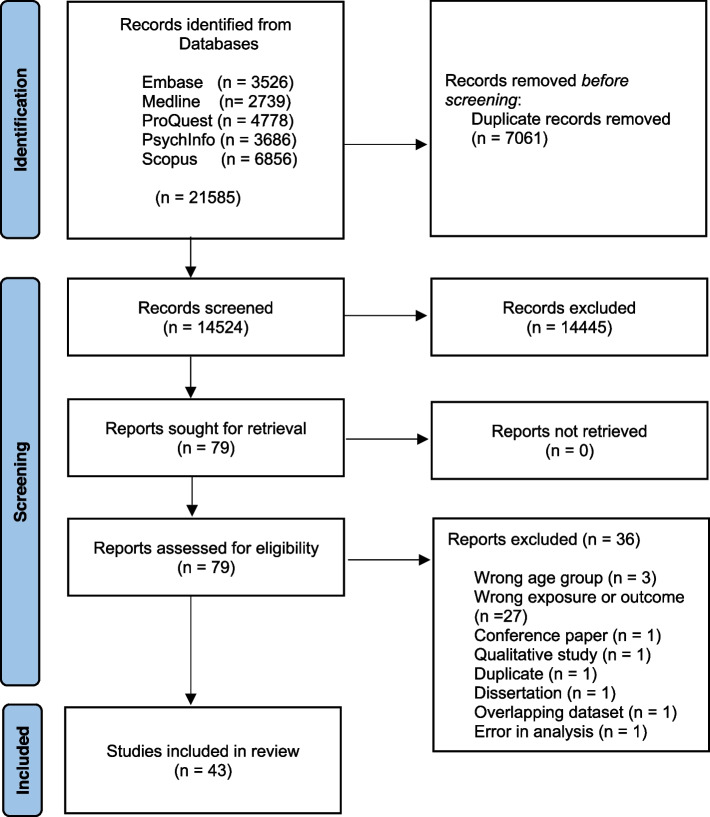
“A total of 21,585 articles were found in the five databases, out of which 14,524 articles remained after duplicates were removed. Title and abstract screening resulted in the exclusion of 14,481 irrelevant articles. Seventy-nine articles were deemed eligible for full text screening”
§ Association between friendship quality and subjective wellbeing among adolescents: a systematic review > Results
Reported 79 · recomputed 43
Rated minor: it would not touch a result — a value no result rests on, a p-value that stays on the same side of the significance level, or a conflict that is clerical, resolved elsewhere in the paper, or outside its own findings.
In the paper
§ Association between friendship quality and subjective wellbeing among adolescents: a systematic review > Results > Friendship quality and depressive symptoms
“the methodological quality index of the included studies varies widely and ranges from six to fourteen.”
§ Association between friendship quality and subjective wellbeing among adolescents: a systematic review > Results
“Depression (23 studies) | Cross-sectional: 16 studies [4, 57–67, 88, 93, 95, 97]. | Fourteen studies found a significant benificial association between friendship quality and depressive symptoms, while two found no association. | 6–15”
Rated minor: it would not touch a result — a value no result rests on, a p-value that stays on the same side of the significance level, or a conflict that is clerical, resolved elsewhere in the paper, or outside its own findings.
In the paper
§ Association between friendship quality and subjective wellbeing among adolescents: a systematic review > Results
“The study found no significant longitudinal association between friendship quality and happiness.”
§ Association between friendship quality and subjective wellbeing among adolescents: a systematic review > Results
“No significant longitudinal association was found between friendship quality (T1) and adolescents’ wellbeing (T2)”
1 more finding
Create a free account to see every finding of this check.
Citations
Cites
The CES-D Scale: A Self-Report Depression Scale for Research in the General Population
Radloff, L. S. (1977) · Applied Psychological Measurement · doi:10.1177/014662167700100306 · Cited by 53,267
The PHQ-9: Validity of a brief depression severity measure
Kroenke, K., Spitzer, R. L., & Williams, J. B. W. (2001) · Journal of General Internal Medicine · doi:10.1046/j.1525-1497.2001.016009606.x · Cited by 44,910
The satisfaction with life scale
Diener, E., Emmons, R. A., Larsen, R. J., & Griffin, S. (1985) · Journal of Personality Assessment · doi:10.1207/s15327752jpa4901_13 · Cited by 31,768
The need to belong: Desire for interpersonal attachments as a fundamental human motivation.
Baumeister, R. F., & Leary, M. R. (1995) · Psychological Bulletin · doi:10.1037//0033-2909.117.3.497 · Cited by 23,245
Stress, social support, and the buffering hypothesis
Cohen, S., & Wills, T. A. (1985) · Psychological Bulletin · doi:10.1037/0033-2909.98.2.310 · Cited by 18,093
Subjective well-being: Three decades of progress.
Diener, E., Suh, E. M., Lucas, R. E., & Smith, H. L. (1999) · Psychological Bulletin · doi:10.1037/0033-2909.125.2.276 · Cited by 12,910
The benefits of frequent positive affect: Does happiness lead to success?
Lyubomirsky, S., King, L., & Diener, E. (2005) · Psychological Bulletin · doi:10.1037/0033-2909.131.6.803 · Cited by 7,143
Subjective well-being. The science of happiness and a proposal for a national index
Diener, E. (2000) · American Psychologist · doi:10.1037/0003-066x.55.1.34 · Cited by 7,121
UCLA loneliness scale (version 3): reliability, validity, and factor structure
Russell, D. W. (1996) · Journal of Personality Assessment · doi:10.1207/s15327752jpa6601_2 · Cited by 5,800
The detection of psychiatric illness by questionnaire
Goldberg, D. P. (1972) · Oxford University Press eBooks · Cited by 5,097
Synthesis without meta-analysis (SWiM) in systematic reviews: reporting guideline
Campbell, M., McKenzie, J. E., Sowden, A., Katikireddi, S. V., Brennan, S. E., Ellis, S., Hartmann-Boyce, J., Ryan, R., Shepperd, S., Thomas, J., et al. (2020) · BMJ · doi:10.1136/bmj.l6890 · Cited by 4,628
A Measure of Subjective Happiness: Preliminary Reliability and Construct Validation
Lyubomirsky, S., & Lepper, H. S. (1999) · Social Indicators Research · doi:10.1023/a:1006824100041 · Cited by 4,071
Armsden, G. C., & Greenberg, M. T. (1987) · Journal of Youth and Adolescence · doi:10.1007/bf02202939 · Cited by 4,031
Baumeister, R. F., Campbell, J. D., Krueger, J. I., & Vohs, K. D. (2003) · Psychological Science in the Public Interest · doi:10.1111/1529-1006.01431 · Cited by 3,893
Robins, L. N. (1988) · Archives of General Psychiatry · doi:10.1001/archpsyc.1988.01800360017003 · Cited by 2,909
Two Shorter Forms of the CES-D Depression Symptoms Index
Kohout, F. J., Berkman, L. F., Evans, D. A., & Cornoni-Huntley, J. (1993) · Journal of Aging and Health · doi:10.1177/089826439300500202 · Cited by 2,284
Parker, J. G., & Asher, S. R. (1993) · Developmental Psychology · doi:10.1037//0012-1649.29.4.611 · Cited by 2,199
A Meta-Analysis of Interventions to Reduce Loneliness
Masi, C. M., Chen, H.-Y., Hawkley, L. C., & Cacioppo, J. T. (2011) · Personality and Social Psychology Review · doi:10.1177/1088868310377394 · Cited by 1,995
The clinical significance of loneliness: a literature review
Heinrich, L. M., & Gullone, E. (2006) · Clinical Psychology Review · doi:10.1016/j.cpr.2006.04.002 · Cited by 1,986
Rating scales to assess depression in school-aged children.
Kovács, M. (1981) · PubMed · Cited by 1,924
The Development of a Rasch-Type Loneliness Scale
de Jong-Gierveld, J., & Kamphuls, F. (1985) · Applied Psychological Measurement · doi:10.1177/014662168500900307 · Cited by 1,291
Psychosocial models of the role of social support in the etiology of physical disease.
Cohen, S. (1988) · Health Psychology · doi:10.1037/0278-6133.7.3.269 · Cited by 1,273
Theory and Validity of Life Satisfaction Scales
Diener, E., Inglehart, R., & Tay, L. (2013) · Social Indicators Research · doi:10.1007/s11205-012-0076-y · Cited by 1,272
Asher, S. R., Hymel, S., & Renshaw, P. D. (1984) · Child Development · doi:10.2307/1130015 · Cited by 1,219
Co–Rumination in the Friendships of Girls and Boys
Rose, A. J. (2002) · Child Development · doi:10.1111/1467-8624.00509 · Cited by 1,172
Initial development of the student's life satisfaction scale
Huebner, E. S. (1991) · School Psychology International · doi:10.1177/0143034391123010 · Cited by 1,101
Youth Life Satisfaction: A Review of the Literature
Proctor, C. L., Linley, P. A., & Maltby, J. (2009) · Journal of Happiness Studies · doi:10.1007/s10902-008-9110-9 · Cited by 1,081
Bukowski, W. M., Hoza, B., & Boivin, M. (1994) · Journal of Social and Personal Relationships · doi:10.1177/0265407594113011 · Cited by 994
Meta-Analysis of the Relationships Between Social Support and Well-Being in Children and Adolescents
Chu, P. S., Saucier, D. A., & Hafner, E. (2010) · Journal of Social and Clinical Psychology · doi:10.1521/jscp.2010.29.6.624 · Cited by 962
WEISSMAN, M. M., ORVASCHEL, H., & PADIAN, N. (1980) · The Journal of Nervous and Mental Disease · doi:10.1097/00005053-198012000-00005 · Cited by 890
Measuring happiness with a single-item scale
Abdel-Khalek, A. M. (2006) · Social Behavior and Personality: an international journal · doi:10.2224/sbp.2006.34.2.139 · Cited by 808
A revised class play method of peer assessment.
Masten, A. S., Morison, P., & Pellegrini, D. S. (1985) · Developmental Psychology · doi:10.1037//0012-1649.21.3.523 · Cited by 760
Self-Esteem Development Across the Lifespan
Robins, R. W., & Trzesniewski, K. H. (2005) · Current Directions in Psychological Science · doi:10.1111/j.0963-7214.2005.00353.x · Cited by 748
A review of loneliness: concept and definitions, determinants and consequences
Gierveld, J. D. J. (1998) · Reviews in Clinical Gerontology · doi:10.1017/s0959259898008090 · Cited by 632
Mushtaq, R. (2014) · JOURNAL OF CLINICAL AND DIAGNOSTIC RESEARCH · doi:10.7860/jcdr/2014/10077.4828 · Cited by 622
Does Social Connectedness Promote a Greater Sense of Well‐Being in Adolescence Over Time?
Jose, P. E., Ryan, N., & Pryor, J. (2012) · Journal of Research on Adolescence · doi:10.1111/j.1532-7795.2012.00783.x · Cited by 488
Methods and Measures: The Network of Relationships Inventory: Behavioral Systems Version
Furman, W., & Buhrmester, D. (2009) · International Journal of Behavioral Development · doi:10.1177/0165025409342634 · Cited by 467
Academic Correlates of Children and Adolescents' Life Satisfaction
Suldo, S. M., Riley, K. N., & Shaffer, E. J. (2006) · School Psychology International · doi:10.1177/0143034306073411 · Cited by 429
Subjective Well-Being: Measuring Happiness, Suffering, and Other Dimensions of Experience
Stone, A. A., & Mackie, C. (2013) · Cited by 428
Maass, S. W. M. C., Roorda, C., Berendsen, A. J., Verhaak, P. F. M., & de Bock, G. H. (2015) · Maturitas · doi:10.1016/j.maturitas.2015.04.010 · Cited by 420
Life Satisfaction in Early Adolescence: Personal, Neighborhood, School, Family, and Peer Influences
Oberle, E., Schonert-Reichl, K. A., & Zumbo, B. D. (2011) · Journal of Youth and Adolescence · doi:10.1007/s10964-010-9599-1 · Cited by 353
Measuring friendship quality in late adolescents and young adults: McGill Friendship Questionnaires.
Mendelson, M. J., & Aboud, F. E. (1999) · Canadian Journal of Behavioural Science / Revue canadienne des sciences du comportement · doi:10.1037/h0087080 · Cited by 311
Marcoen, A., Goossens, L., & Caes, P. (1987) · Journal of Youth and Adolescence · doi:10.1007/bf02138821 · Cited by 289
Friendship, loneliness and depression in adolescents with Asperger's Syndrome
Whitehouse, A. J. O., Durkin, K., Jaquet, E., & Ziatas, K. (2009) · Journal of Adolescence · doi:10.1016/j.adolescence.2008.03.004 · Cited by 286
Depression in Taiwan: epidemiological survey utilizing CES-D.
Chien, C. P., & Cheng, T. A. (1985) · PubMed · Cited by 282
Self-concept: The construct validity of interpretations based upon the SDQ.
Marsh, H. W., Relich, J. D., & Smith, I. D. (1983) · Journal of Personality and Social Psychology · doi:10.1037//0022-3514.45.1.173 · Cited by 280
Investigating Validity Evidence of the Satisfaction with Life Scale Adapted for Children
Gadermann, A. M., Schonert-Reichl, K. A., & Zumbo, B. D. (2010) · Social Indicators Research · doi:10.1007/s11205-009-9474-1 · Cited by 258
Friendships and family support reduce subsequent depressive symptoms in at‐risk adolescents
van Harmelen, A.-L., Gibson, J. L., St Clair, M. C., Owens, M., Brodbeck, J., Dunn, V., Lewis, G., Croudace, T., Jones, P. B., Kievit, R. A., et al. (2016) · PLOS ONE · doi:10.1371/journal.pone.0153715 · Cited by 248
Jacka, F. N., Kremer, P. J., Leslie, E. R., Berk, M., Patton, G. C., Toumbourou, J. W., & Williams, J. W. (2010) · Australian & New Zealand Journal of Psychiatry · doi:10.3109/00048670903571598 · Cited by 245
Peer social network processes and adolescent health behaviors: A systematic review
Montgomery, S. C., Donnelly, M., Bhatnagar, P., Carlin, A., Kee, F., & Hunter, R. F. (2020) · Preventive Medicine · doi:10.1016/j.ypmed.2019.105900 · Cited by 238
Self-citationConsequences of youth tobacco use: a review of prospective behavioural studies
Mathers, M., Toumbourou, J. W., Catalano, R. F., Williams, J., & Patton, G. C. (2006) · Addiction · doi:10.1111/j.1360-0443.2006.01438.x · Cited by 232
Gauze, C., Bukowski, W. M., Aquan‐Assee, J., & Sippola, L. K. (1996) · Child Development · doi:10.1111/j.1467-8624.1996.tb01852.x · Cited by 231
Raboteg-Saric, Z., & Sakic, M. (2014) · Applied Research in Quality of Life · doi:10.1007/s11482-013-9268-0 · Cited by 217
The Effects of Positive and Negative Social Exchanges on Aging Adults
Ingersoll-Dayton, B., Morgan, D., & Antonucci, T. (1997) · The Journals of Gerontology Series B: Psychological Sciences and Social Sciences · doi:10.1093/geronb/52b.4.s190 · Cited by 211
(2001) · PubMed · Cited by 206
Supportive Peer Relationships and Mental Health in Adolescence: An Integrative Review
Roach, A. (2018) · Issues in Mental Health Nursing · doi:10.1080/01612840.2018.1496498 · Cited by 200
Huebner, E. S. (1991) · Journal of Psychoeducational Assessment · doi:10.1177/073428299100900408 · Cited by 185
Depressed Mood in Childhood and Subsequent Alcohol Use Through Adolescence and Young Adulthood
Crum, R. M., Green, K. M., Storr, C. L., Chan, Y.-F., Ialongo, N., Stuart, E. A., & Anthony, J. C. (2008) · Archives of General Psychiatry · doi:10.1001/archpsyc.65.6.702 · Cited by 180
Khan, M. A., Kumbhari, V., Ngamruengphong, S., Ismail, A., Chen, Y.-I., Chavez, Y. H., Bukhari, M., Nollan, R., Ismail, M. K., Onimaru, M., et al. (2017) · Digestive Diseases and Sciences · doi:10.1007/s10620-016-4373-1 · Cited by 175
Peer attachment and self-esteem: A meta-analytic review
Gorrese, A., & Ruggieri, R. (2013) · Personality and Individual Differences · doi:10.1016/j.paid.2013.04.025 · Cited by 164
Gender differences in perceived intimacy with different members of adolescents' social networks
Blyth, D. A., & Foster-Clark, F. S. (1987) · Sex Roles · doi:10.1007/bf00287683 · Cited by 164
Gauze, C., Bukowski, W. M., Aquan-Assee, J., & Sippola, L. K. (1996) · Child Development · doi:10.2307/1131618 · Cited by 160
Alcohol Consumption and Psychological Distress in Adolescents: A Multi-Country Study
Balogun, O. O., Koyanagi, A., Stickley, A., Gilmour, S., & Shibuya, K. (2013) · Journal of Adolescent Health · doi:10.1016/j.jadohealth.2013.07.034 · Cited by 160
Vanhalst, J., Luyckx, K., & Goossens, L. (2014) · Social Development · doi:10.1111/sode.12019 · Cited by 151
Behavioral and Neurobiological Convergence of Odor, Mood and Emotion: A Review
Kontaris, I., East, B. S., & Wilson, D. A. (2020) · Frontiers in Behavioral Neuroscience · doi:10.3389/fnbeh.2020.00035 · Cited by 150
Assessing Peer Network and Dyadic Loneliness
Hoza, B., Bukowski, W. M., & Beery, S. (2000) · Journal of Clinical Child Psychology · doi:10.1207/s15374424jccp2901_12 · Cited by 150
Association Between Social Networks and Subjective Well-Being in Adolescents: A Systematic Review
Webster, D., Dunne, L., & Hunter, R. (2021) · Youth & Society · doi:10.1177/0044118x20919589 · Cited by 148
Self-citationThe Relationship between Social Support and Life Satisfaction as a Function of Family Structure
Wan, C. K., Jaccard, J., & Ramey, S. L. (1996) · Journal of Marriage and the Family · doi:10.2307/353513 · Cited by 147
Impact of Modeling on Adolescent Suicidal Behavior
Insel, B. J., & Gould, M. S. (2008) · Psychiatric Clinics of North America · doi:10.1016/j.psc.2008.01.007 · Cited by 145
(2006) · PubMed · Cited by 143
Loneliness in Early Adolescence: Friendship Quantity, Friendship Quality, and Dyadic Processes
Lodder, G. M. A., Scholte, R. H. J., Goossens, L., & Verhagen, M. (2017) · Journal of Clinical Child & Adolescent Psychology · doi:10.1080/15374416.2015.1070352 · Cited by 133
Systematic Review of Social Network Analysis in Adolescent Cigarette Smoking Behavior*
Seo, D., & Huang, Y. (2012) · Journal of School Health · doi:10.1111/j.1746-1561.2011.00663.x · Cited by 132
The sleep patterns and well‐being of Australian adolescents☆
Short, M. A., Gradisar, M., Lack, L. C., Wright, H. R., & Dohnt, H. (2013) · Journal of Adolescence · doi:10.1016/j.adolescence.2012.09.008 · Cited by 127
Review: Low self‐esteem and internalizing disorders in young people – a systematic review
Keane, L., & Loades, M. (2017) · Child and Adolescent Mental Health · doi:10.1111/camh.12204 · Cited by 124
Munafò, M. R., Hitsman, B., Rende, R., Metcalfe, C., & Niaura, R. (2008) · Addiction · doi:10.1111/j.1360-0443.2007.02052.x · Cited by 123
Immigration, Stress, and Depressive Symptoms in a Mexican-American Community
GOLDING, J. M., & BURNAM, M. A. (1990) · The Journal of Nervous and Mental Disease · doi:10.1097/00005053-199003000-00003 · Cited by 123
(2006) · PubMed · Cited by 120
Stressful life events and adolescent well‐being: The role of parent and peer relationships
McMahon, G., Creaven, A., & Gallagher, S. (2020) · Stress and Health · doi:10.1002/smi.2923 · Cited by 114
You are my best friend: Commitment and stability in adolescents’ same‐sex friendships
BRANJE, S. J. T., FRIJNS, T., FINKENAUER, C., ENGELS, R., & MEEUS, W. (2007) · Personal Relationships · doi:10.1111/j.1475-6811.2007.00173.x · Cited by 113
Croezen, S., Picavet, H. S. J., Haveman-Nies, A., Verschuren, W. M., de Groot, L. C., & van't Veer, P. (2012) · BMC Public Health · doi:10.1186/1471-2458-12-65 · Cited by 101
Kullik, A., & Petermann, F. (2013) · Child Psychiatry & Human Development · doi:10.1007/s10578-012-0347-5 · Cited by 99
Zika virus infection in pregnancy: a systematic review of disease course and complications
Chibueze, C. E., Tirado, V., Lopes, K. D. S., Balogun, O. O., Takemoto, Y., Swa, T., Dagvadorj, A., Nagata, C., Morisaki, N., Menéndez, C., et al. (2017) · Reproductive Health · doi:10.1186/s12978-017-0285-6 · Cited by 97
Peer Influence on Marijuana Use in Different Types of Friendships
Tucker, J. S., de la Haye, K., Kennedy, D. P., Green, H. D., & Pollard, M. S. (2014) · Journal of Adolescent Health · doi:10.1016/j.jadohealth.2013.07.025 · Cited by 96
Applications of social network analysis to obesity: a systematic review
Zhang, S., de la Haye, K., Ji, M., & An, R. (2018) · Obesity Reviews · doi:10.1111/obr.12684 · Cited by 95
The Best Friend and Friendship Group Influence on Adolescent Nonsuicidal Self-injury
You, J., Lin, M. P., Fu, K., & Leung, F. (2013) · Journal of Abnormal Child Psychology · doi:10.1007/s10802-013-9734-z · Cited by 94
Spithoven, A. W. M., Lodder, G. M. A., Goossens, L., Bijttebier, P., Bastin, M., Verhagen, M., & Scholte, R. H. J. (2017) · Journal of Youth and Adolescence · doi:10.1007/s10964-016-0478-2 · Cited by 86
Al-Yagon, M. (2016) · Journal of Learning Disabilities · doi:10.1177/0022219415620569 · Cited by 85
Subjective Well-Being for Children in a Rural Community
Newland, L. A., Giger, J. T., Lawler, M. J., Carr, E. R., Dykstra, E. A., & Roh, S. (2014) · Journal of Social Service Research · doi:10.1080/01488376.2014.917450 · Cited by 83
Proctor, C., & Linley, P. A. (2014) · Cross-cultural advancements in positive psychology · doi:10.1007/978-94-017-8669-0_13 · Cited by 83
Shin, H. (2017) · Journal of Youth and Adolescence · doi:10.1007/s10964-017-0702-8 · Cited by 81
Thrul, J., & Kuntsche, E. N. (2015) · Addiction · doi:10.1111/add.12862 · Cited by 78
Frison, E., Subrahmanyam, K., & Eggermont, S. (2016) · Journal of Youth and Adolescence · doi:10.1007/s10964-016-0436-z · Cited by 76
Son, D., & Padilla-Walker, L. M. (2020) · Journal of Happiness Studies · doi:10.1007/s10902-019-00154-2 · Cited by 73
Peng, C., Kwok, C. L., Law, Y. W., Yip, P. S. F., & Cheng, Q. (2019) · Aging & Mental Health · doi:10.1080/13607863.2017.1423035 · Cited by 72
Balluerka, N., Gorostiaga, A., Alonso‐Arbiol, I., & Aritzeta, A. (2016) · Journal of Adolescence · doi:10.1016/j.adolescence.2016.08.009 · Cited by 71
de Matos, M. G., Barrett, P., Dadds, M., & Shortt, A. (2003) · European Journal of Psychology of Education · doi:10.1007/bf03173600 · Cited by 70
Peer relations in the anxiety–depression link: test of a mediation model
Biggs, B. K., Nelson, J. M., & Sampilo, M. L. (2010) · Anxiety, Stress & Coping · doi:10.1080/10615800903406543 · Cited by 68
Egele, V. S., Kiefer, L. H., & Stark, R. (2021) · PsycTESTS Dataset · doi:10.1037/t82936-000 · Cited by 68
Looking on the bright side: An assessment of factors associated with adolescents’ happiness
Lambert, M. V., Fleming, T. M., Ameratunga, S. N., Robinson, E., Crengle, S. M., Sheridan, J. L., Denny, S., Clark, T. C., & Merry, S. (2014) · Advances in Mental Health · doi:10.1080/18374905.2014.11081888 · Cited by 67
Mental health disorders and adolescent peer relationships
Long, E., Gardani, M., McCann, M., Sweeting, H., Tranmer, M., & Moore, L. (2020) · Social Science & Medicine · doi:10.1016/j.socscimed.2020.112973 · Cited by 64
Sawka, K. J., McCormack, G. R., Nettel‐Aguirre, A., & Swanson, K. C. (2015) · Eating Behaviors · doi:10.1016/j.eatbeh.2015.03.002 · Cited by 64
Schacter, H. L., Lessard, L. M., Kiperman, S., Bakth, F., Ehrhardt, A., & Uganski, J. (2021) · School Mental Health · doi:10.1007/s12310-021-09417-x · Cited by 62
Laghi, F., Pallini, S., Baumgartner, E., Guarino, A., & Baiocco, R. (2015) · Time & Society · doi:10.1177/0961463x15577282 · Cited by 62
Kim, H. H., & Chun, J. (2018) · Journal of School Health · doi:10.1111/josh.12630 · Cited by 60
Kamper‐DeMarco, K. E., & Ostrov, J. M. (2013) · Journal of Clinical Child & Adolescent Psychology · doi:10.1080/15374416.2013.844595 · Cited by 56
O’Connor, R., van den Bedem, N. P., Blijd-Hoogewys, E. M. A., Stockmann, L., & Rieffe, C. J. (2022) · Autism · doi:10.1177/13623613211073448 · Cited by 55
Lee, H.-Y., Oh, J., Kawachi, I., Heo, J., Kim, S., Lee, J.-K., & Kang, D. (2019) · BMJ Open · doi:10.1136/bmjopen-2018-023036 · Cited by 51
Oppenheimer, C. W., & Hankin, B. L. (2011) · Journal of Clinical Child & Adolescent Psychology · doi:10.1080/15374416.2011.563462 · Cited by 50
Positive and negative affect in parenting disabled children
Margalit, M., & Ankonina, D. B. (1991) · Counselling Psychology Quarterly · doi:10.1080/09515079108254437 · Cited by 48
Chang, Y.-C., Chen, C.-H., Huang, P.-C., & Lin, L.-Y. (2019) · Scandinavian Journal of Occupational Therapy · doi:10.1080/11038128.2018.1449887 · Cited by 46
Zhao, J., Sun, X., & Wang, Q. (2021) · Journal of Affective Disorders · doi:10.1016/j.jad.2021.08.073 · Cited by 45
Depression among Adolescents of Rural Nepal: A Community-Based Study
Gautam, P., Dahal, M., Ghimire, H. C., Chapagain, S., Baral, K., Acharya, R., Khanal, S., & Neupane, A. (2021) · Depression Research and Treatment · doi:10.1155/2021/7495141 · Cited by 44
Lieb, R. W., & Bohnert, A. M. (2017) · Journal of Autism and Developmental Disorders · doi:10.1007/s10803-017-3205-2 · Cited by 43
Luijten, C. C., van de Bongardt, D., Jongerling, J., & Nieboer, A. P. (2021) · Social Science & Medicine · doi:10.1016/j.socscimed.2021.114387 · Cited by 37
(2006) · PubMed · Cited by 36
Ecological Correlates of Depression and Self-Esteem in Rural Youth
Smokowski, P. R., Evans, C. B. R., Cotter, K. L., & Guo, S. (2014) · Child Psychiatry & Human Development · doi:10.1007/s10578-013-0420-8 · Cited by 33
Kühner, S., Lau, M. K.-W., & Addae, E. A. (2021) · Child Indicators Research · doi:10.1007/s12187-021-09831-2 · Cited by 33
Types of Social Connectedness and Loneliness: the Joint Moderating Effects of Age and Gender
Ang, C.-S. (2016) · Applied Research in Quality of Life · doi:10.1007/s11482-015-9428-5 · Cited by 30
A Validation Study of the Peer Relationship Quality Scale for Adolescents
Man, B. S., 홍지영, & Ho, H. M. (2015) · Korean Journal of Youth Studies · Cited by 30
Lim, S. A. (2022) · Child & Youth Care Forum · doi:10.1007/s10566-022-09703-y · Cited by 28
You, J., Zheng, C., Lin, M., & Leung, F. Y. K. (2016) · Journal of Adolescence · doi:10.1016/j.adolescence.2015.12.008 · Cited by 26
Powell, V. E., Riglin, L., Ng‐Knight, T., Frederickson, N. L., Woolf, K., McManus, I. C., Collishaw, S., Shelton, K. H., Thapar, A., & Rice, F. J. (2021) · Research on Child and Adolescent Psychopathology · doi:10.1007/s10802-021-00798-w · Cited by 26
Fadda, D., Scalas, L. F., & Meleddu, M. (2015) · Journal of Adolescence · doi:10.1016/j.adolescence.2015.05.019 · Cited by 25
Putri, F. E., & Muttaqin, D. (2022) · Psikohumaniora Jurnal Penelitian Psikologi · doi:10.21580/pjpp.v7i1.10394 · Cited by 20
The Impact of Aggression Subtypes and Friendship Quality on Child Symptoms of Depression
Preddy, T. M., & Fite, P. J. (2012) · Child Indicators Research · doi:10.1007/s12187-012-9143-9 · Cited by 15
Developmetrics A balanced and short Best Friend Index for children and young adolescents
Kouwenberg, M., Rieffe, C. J., & Banerjee, R. A. (2012) · European Journal of Developmental Psychology · doi:10.1080/17405629.2012.707780 · Cited by 14
Choe, C., & Yu, S. (2022) · Cyberpsychology Behavior and Social Networking · doi:10.1089/cyber.2022.0015 · Cited by 13
Are They Still Friends? Friendship Stability of Adolescents With Chronic Pain: 1-Year Follow-Up
Forgeron, P. A., Dick, B. D., Chambers, C., Cohen, J., Lamontagne, C., & Finley, G. A. (2022) · Frontiers in Pain Research · doi:10.3389/fpain.2021.767236 · Cited by 12
Schwartz‐Mette, R. A., Lawrence, H. R., & Harrington, R. V. (2021) · Journal of Applied Developmental Psychology · doi:10.1016/j.appdev.2021.101266 · Cited by 9
Huang, Y.-T., & Chen, Y.-W. (2015) · British Journal of Social Work · doi:10.1093/bjsw/bcu016 · Cited by 8
Children’s Depression Inventory (CDI)
(2011) · Encyclopedia of Child Behavior and Development · doi:10.1007/978-0-387-79061-9_4285 · Cited by 5
Jose, P. E. (2015) · Springer eBooks · doi:10.1007/978-94-017-9603-3_16 · Cited by 5
Friendship and Happiness in Latin America: A Review
Garcia, A., Pereira, F. N., & Corrêa de Macedo, M. D. (2015) · Friendship and Happiness · doi:10.1007/978-94-017-9603-3_13 · Cited by 3
Research works printed but not linked: 27
- Berndt TJ. 15 Exploring the effects of friendship quality on social development. The company they keep: friendships in childhood and adolescence. 1998;13:346.
- Haines ME Others A The Effects of Depressed Mood on Academic Performance in College Students J Coll Stud Dev 1996 37 5 519 526
- Wong SL Depression level in inner-city Asian American adolescents: The contributions of cultural orientation and interpersonal relationships. Aldwin Aseltine, Atkinson, Avison, Berry, Cuellar, Erikson, Finch, Gil, Golding, Hollingshead, Hurd, Kuo, Padilla, Padilla, Radloff, Radloff, Reynolds, Roberts, Sluzki, Sue, Tsai, Ying, Ying, Ying, Ying A, editor J Hum Behav Soc Environ 2001 3 3–4 49 64
- Sasikala S Cecil N Parental bonding, peer attachment and psychological well-being among adolescents: A mediation analysis. Ainsworth Armsden, Baron, Bishop, Bowlby, Cai, Canetti, Elliot, Evans, Garber, Goldberg, Harter, Hiremath, Kenny, Klein, Laible, Laible, McFarlane, Micucci, Nada Raja, O’Koon, Parker, Perry, Resnick, Rosenberg, Salmivalli, Sartorius, Steinberg, Wilkinson A, editor J Psychosoc Res 2016 11 1 21 31
- Nyarko K The influence of peer and parent relationships on adolescents’ self-esteem. Adams Berndt, Bishop, Bowlby, Carlson, Dornbusch, Erikson, Hansen, Harter, Helsen, Holmbeck, Khurshid, Kupersmidt, Mason, Masten, Micucci, Parish, Robinson, Rosenberg, Rubenstein, Santrock, Savin-Williams, Shagle, Simons, Steinberg, Steinberg, Zimmerman B, editor IFE Psychol An Int J 2012 20 2 234 243
- Jose PE. How are positive and negative peer relations related to positive and negative affect in adolescents over time in New Zealand? Friendship Happiness. 2015:275–89. · DOI
- Nyarko K. The influence of peer and parent relationships on adolescents' self-esteem. IFE PsychologIA. 2012;20(2):161–7.
- Rosenberg M Rosenberg self-esteem scale (RSE) Accept Commit Ther Meas Packag 1965 61 52 18
- Noam GG Goldstein LS The resilience inventory 1998 Unpubl Protoc
- Song M Two studies on the Resilience Inventory (RI): Toward the goal of creating a culturally sensitive measure of adolescence resilience Diss Abstr Int Sect B Sci Eng 2004 64 8-B 4089
- World Health Organization Composite international. Diagnostic interview 1990 Geneva WHO
- Lang M Tisher M Children’s Depression Scale, CDS (9–16 Years): Research Edition 1978 Australian Council for Educational Research
- Kovacs M Children’s depression inventory: Manual 1992 Multi-Health Systems North Tonawanda, NY
- Margalit M The salutogenic approach and learning disabilities: Coherence, friendship and loneliness In: annual conference of the Society for Research in Child Development, Indianapolis IN 1995
- Moos RH Cronkite RL Billings AG Finney JW Revised health and daily living form manual 1987 Palo Alto CA Veterans Adm Stanford Univ Med Centers
- Bracken BA Assessment of interpersonal relations 1993 Pro-ed
- Melotti G Corsano P Majorano M Scarpuzzi P An Italian application of the Louvain Loneliness Scale for Children and Adolescents (LLCA). Ammaniti Bentler, Bentler, Browne, Buchholz, Buchholz, Buchholz, Corsano, Corsano, Endler, Endler, Erikson, Fan, Goossens, Goossens, Harrist, Hayden, Hoffert, Hu, Hu, Joreskog, Joreskog, Joreskog, Larson, Larson, Marcia, Marcoen, Marcoen, Marsh, Miceli, A, editor TPM-Testing, Psychom Methodol Appl Psychol 2006 13 3 237 254
- Wu CH We YC Hsu WY Shiau RJ Development of the Taiwan Relationship Inventory for Children and Adolescents (TRICA) and its psychometric study Psychol Test 2008 55 3 535 557
- Karcher MJ The Hemingway: Measure of Adolescent Connectedness (Adolescent Version 5.5 and Child “Pre-Adolescent” Version 5): A manual for scoring and interpretation. Unpubl manuscript, Univ Texas San Antonio Retrieved August 2011 2013
- Piers EV Herzberg DS Piers-Harris 2 2002 Piers-Harris Child Self
- Bowen GL Richman JM The school success profile 2008 Chapel Hill NC Univ North Carolina
- Diener E Emmons RA Larsem RJ Griffin S The Satisfaction With Life Scale J Person Assess 2010 49 1 71 75 10.1207/s15327752jpa4901_13 16367493 · DOI · Paper page
- Min B The effects of school life adaptation and self-concept on academic achievement. Unpubl Master’s thesis Seoul, Korea Hongik Univ 1991
- Yun HJ Association of Sleep Duration and Quality of Sleep with Depression in Middle School Students: Based on the Korean Children and Youth Panel Survey J Korean Acad Soc Home Heal Care Nurs 2020 27 2 189 197
- Angold A, Costello EJ, Messer SC. Pickles A, Winder, F, Silver, D. Development of a short questionnaire for use in epidemiological studies of depression in children and adolescents. Int J Methods Psychiatr Res 1995;5:1–13.
- Gore S Stress-buffering functions of social supports: An appraisal and clarification of research models. Stress life events their Context 1981 202 222
- Proctor CL Linley PA Maltby J Youth life satisfaction: A review of the literature J Happiness Stud 2009 10 5 583 630 10.1007/s10902-008-9110-9 · DOI · Paper page
Cited by
McNaughton, K. A., Moss, A., Yarger, H. A., & Redcay, E. (2024) · Autism · doi:10.1177/13623613241238269 · Cited by 28
The Association of Quality of Life with Psychosocial Factors in Adolescents with Tourette Syndrome
Watson, K. H., Eckland, M. R., Schwartzman, J. M., Molnar, A. E., Boon, W., Hiller, M., Scholer, S. J., Mace, R. L., Rothman, A. M., Claassen, D. O., et al. (2024) · Child Psychiatry & Human Development · doi:10.1007/s10578-023-01656-0 · Cited by 25
Anderson, K. N., Okwori, G., Hutchins, H. J., Donney, J. F., Swedo, E. A., Lee, N., Niolon, P. H., Leeb, R. T., & Bacon, S. (2024) · Adversity and Resilience Science · doi:10.1007/s42844-024-00138-z · Cited by 18
Li, Z., Jiang, K., Zhu, Y., Du, H., Im, H., Zhu, Y., Feng, L., Zhu, W., Zhao, G. W., Jia, X., et al. (2024) · NeuroImage · doi:10.1016/j.neuroimage.2024.120690 · Cited by 17
Improving mental health care in depression: A call for action
Eder, J., Dom, G., Gorwood, P. A. P. M., Kärkkäinen, H., Decraene, A., Kumpf, U., Beezhold, J., Samochowiec, J., Kurimay, T., Gäebel, W., et al. (2023) · European Psychiatry · doi:10.1192/j.eurpsy.2023.2434 · Cited by 21
Metadata
- Authors
- Alsarrani, A., Hunter, R. F., Dunne, L., & Garcia, L.
- Affiliations
- Queen's University Belfast (GB)
- Corresponding author
- Alsarrani, Abdullah
- Venue
- BMC Public Health
- Published
- 2022-12-23
- Volume
- 22
- Issue
- 1
- Pages
- 2420-2420
- ISSN
- 1471-2458 (ISSN-L)
- PMC
- PMC9784006
- OpenAlex
- W4312178673
- Cited by
- 124
- References
- 135
- Citations by year
- 2026: 56 · 2025: 41 · 2024: 21 · 2023: 6
- FWCI
- 2.54
- Type
- journal article
- Language
- en
- Open access
- gold
- doi.org
- Licence
- cc-by
- creativecommons.org/licenses/by/4.0 (tdm)
- creativecommons.org/licenses/by/4.0 (vor)
- Locations
- BMC Public Health (publishedVersion, cc-by)
- PubMed Central (publishedVersion, cc-by)
- PubMed (publishedVersion)
- Research Portal (Queen's University Belfast) (submittedVersion, cc-by)
- DOAJ (DOAJ: Directory of Open Access Journals) (submittedVersion, cc-by-sa)
- Funders
- Queen's University Belfast
- Taibah University
- Queen's University
- Topics
- Social Sciences › Psychology › Social Psychology › Psychological Well-being and Life Satisfaction
- Social Sciences › Psychology › Clinical Psychology › Child and Adolescent Psychosocial and Emotional Development
- Social Sciences › Health › Health disparities and outcomes
- Keywords
- friendship quality, subjective well-being, adolescents, loneliness, life satisfaction, happiness, self-esteem, depression, peer relationships, social integration
- MeSH terms
- Adolescent, Affect, Humans, Interpersonal Relations, Loneliness, Peer Group, Friends
About these checks
Registry, retraction, Cites and statistics results are computed, not judged, with one exception: a printed reference that no index lists is read once by a model before it counts as a citation error. Claims are extracted by a model and kept only when their quote appears verbatim in the text; each cited source is then checked, with a model’s help, for whether it says what the claim relies on. Those verdicts can be wrong — read the claim’s quote and the cited source before relying on one.
The claim verdicts this report counts are experimental: their accuracy is not yet measured.
A language model drew the claims from the paper on 2026-10-10, under version 3 of the claim definition (model deepseek-v4.1-flash, prompt extract-v3).
A second model labelled each claim on 2026-10-10 (model jev-1.13-20260917, definition revision gold-guideline-v0.2).
Cited sources are checked with a language model’s help (gpt-6-sol).
Statistics and arithmetic are recomputed, not judged.
Confidence bands are shown only for fields calibrated on our annotated test set. None is calibrated yet, so no band is shown.
What counts as a claim ›How we measure confidence ›How we check this ›
Are you an author, or do you see a problem with this page? Request a review
Data sources
Bibliographic data: Semantic Scholar, OpenAlex, Crossref.
Contains information from the Semantic Scholar Academic Graph Datasets, made available under the ODC Attribution License (ODC-BY 1.0).
Semantic Scholar’s data is described in: Kinney, R., et al. (2023). The Semantic Scholar Open Data Platform. arXiv:2301.10140.
