

Predictors of antenatal care utilization among the Rohingya population in the refugee camps of Cox's Bazar, Bangladesh
Open accessPublished version of a preprint
The DOI matches its Crossref record; 65 of the 65 references it cites were found in a registry or an index; 40 of the 59 sources its claims cite were checked for support.
Abstract
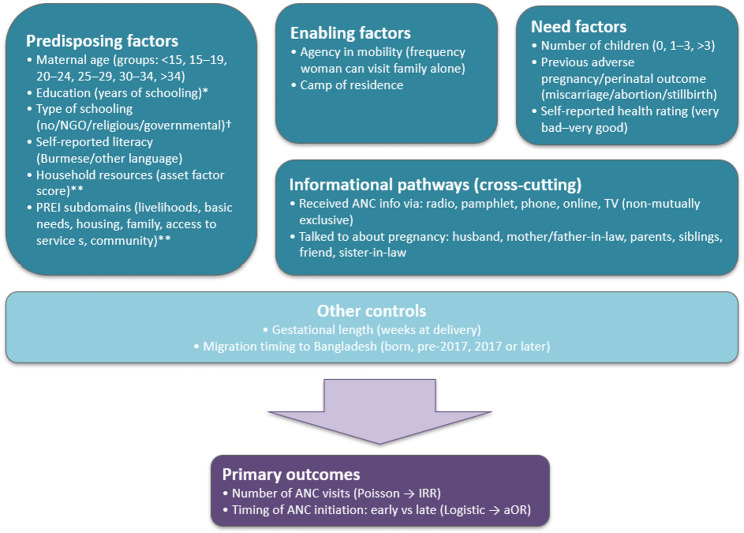
BACKGROUND: While studies in both high- and low-income settings have demonstrated the importance of early and regular antenatal care (ANC) utilization, evidence from crisis-affected populations remains limited. Rohingya refugees in Cox's Bazar, Bangladesh, face unique barriers to healthcare; previous studies have found low rates of ANC utilization. This study examines the predictors of number of visits and timing of initiation of ANC among pregnant Rohingya women in Cox's Bazar. METHODS: Data came from a prenatal birth cohort study of "Intergenerational Risk and Resilience of Rohingya in Displacement" (iRRRd). Women (N = 2,322) were recruited during pregnancy between 2023 and 2024. ANC utilization was assessed via surveys at the birth follow-up visit with 2,065 new mothers. Primary outcomes included the number of ANC visits and the timing of the first visit. Predictors were categorized using the Andersen-Newman model (predisposing, enabling, and need factors). We used Poisson regression for number of visits, and logistic regression to analyze timing of first visit. RESULTS: The average number of ANC visits was 6.9 (SD = 2.6), with only 19.2% of women delaying care until after the first trimester. Women with one to three children reported fewer visits (IRR = 0.94, p = 0.01), as did those with more than three (IRR = 0.91, p = 0.02). Women with more years of education also showed higher number of visits (IRR = 1.015, p = 0.02) and higher likelihood of first trimester initiation (aOR = 0.891, p = 0.02) of ANC. More freedom of movement was associated with lower likelihood of delaying care (aOR = 0.871, p = 0.03), whereas higher self-rated health predicted delayed initiation (aOR = 1.187, p = 0.01). Socioeconomic indicators and education of relatives were not associated with ANC use. Receiving information via radio was unexpectedly associated with delayed initiation (aOR = 1.534, p = 0.03). Location of residence explained minimal variance (2%). CONCLUSIONS: ANC coverage in the Rohingya camps appears high, yet some groups remain at risk for delayed care. Feeling healthy, high parity, and restricted mobility contributed to late initiation. Conventional predictors like household resources showed limited relevance in this context. Further work is needed to better understand the quality of services and effective communication strategies to address remaining underutilization of ANC.
Overview
CoChat Summary
## TL;DR
This cohort study of 2,065 pregnant Rohingya women in Cox’s Bazar found relatively high antenatal care (ANC) use: the mean was 6.9 visits and 19.2% delayed first ANC until after the first trimester. Education, mobility, parity, self-rated health, and some information pathways were associated with ANC timing or number of visits, but most socioeconomic indicators were not.
## Key findings
- Among 2,065 women, the average number of ANC visits was 6.9 (SD 2.6), 5.67% had fewer than 4 visits, more than a third had at least 8 visits, and 19.2% delayed ANC until after the first trimester.
- Each additional year of the pregnant woman’s formal education was associated with 1.5% more ANC visits and a 10% lower odds of delaying ANC until after the first trimester (reported as IRR = 1.015, p = 0.02; aOR = 0.891, p = 0.02).
- Higher parity was linked to fewer visits: women with 1–3 children had IRR = 0.94 (p = 0.01) and those with more than 3 children had IRR = 0.91 (p = 0.02).
- Greater freedom of movement was associated with earlier initiation (aOR = 0.871, p = 0.03 for delaying care), while higher self-rated health predicted delayed initiation (aOR = 1.187, p = 0.01); receiving ANC information via radio was also associated with delayed initiation (aOR = 1.534, p = 0.03).
- Socioeconomic indicators and relatives’ education were not associated with ANC use; camp location explained 2% of variance, and the Poisson model had low pseudo R² = 0.015.
## Methods
- Longitudinal prenatal birth cohort study from the iRRRd project in 11 purposively selected refugee camps near Cox’s Bazar, Bangladesh; 2,322 pregnant Rohingya women were recruited between February 2023 and March 2024, and 2,065 new mothers with birth follow-up data were analyzed.
- ANC use was measured by post-birth survey as number of ANC visits and whether the first ANC visit occurred after the first trimester; predictors were organized using the Andersen-Newman Behavioral Model.
- Analysis used Poisson regression for number of visits and logistic regression for delayed initiation, with robust standard errors and complete cases; factor analysis was used to derive asset/PREI constructs, and an OLS sensitivity analysis estimated explanatory power.
## Limitations
- The authors state that research in the Rohingya context is difficult because of power differentials and linguistic barriers, which may contribute to misunderstandings and biased responses.
- They note that women may have reported health center visits generally rather than ANC visits specifically. They also note some uncertainty in gestational timing because a small percentage had discrepancies in reported menstrual dates and weeks pregnant, though gestational age was triangulated from multiple sources.
- The study did not assess ANC quality; the authors state it therefore cannot say whether high reported ANC use reflects effective care. This limitation is explicitly stated, and the text also makes evident that self-report and restricted measurement of literacy/SES may limit inference.
Model-written summary. Check it against the paper before relying on it.
Integrity signals
Registry
Cites
Statistics
Figures
Verification
Claims the paper makes
18 Valid · 8 Not valid · 15 Not checked · 82 Own results and interpretations
At least one cited source doesn’t support this claim or points to a different paper, and none confirmed it — see the verdicts below.
In the paper
“and in refugee settings specifically [33].”
§ Predictors of antenatal care utilization among the Rohingya population in the refugee camps of Cox’s Bazar, Bangladesh > Introduction > ANC in contexts of humanitarian crisis and forced displacement
What the sources say
- Disputedcites [33] Shafiq Y, Muhammad A, Suhag ZH, et al. Navigating challenges in access to antenatal and intrapartum care: Afghan refugee women’s experiences amidst the COVID-19 pandemic in Pakistan. Womens Health. 2025;21:17455057251347081. 10.1177/17455057251347081. PMC12188067 40554753 sourceExperimental — accuracy not yet measured
The Results (Healthcare seeking during pregnancy and childbirth; page unavailable) report low ANC use among Afghan refugee women during the pandemic, but do not establish a decline from before it. The Discussion (Understanding the impact of COVID-19 on maternal healthcare access; page unavailable) says the pandemic’s impact on access in this setting was less pronounced than expected and that COVID-19-related concerns were not significant barriers. (LLM, conf=0.85)
Checked by a reasoning model — may be wrong.
plainstates a cause- Asserted: passes — The authors put it forward as true.
- Checkable: passes — It can be checked against evidence.
- Load-bearing: passes — The paper’s conclusions depend on it.
- Based: passes — The paper gives a reason why it holds.
- Disputed
The cited sources support only part of this claim — read each source’s verdict below.
In the paper
“This study relies on data collected in 2023 using retrospective self-report on pregnancies in the two years prior to data collection.”
§ Predictors of antenatal care utilization among the Rohingya population in the refugee camps of Cox’s Bazar, Bangladesh > Introduction > ANC in contexts of humanitarian crisis and forced displacement
What the sources say
- Partly supportedcites [31] Khan MN, Khanam SJ, Alam MB. Exploring the impact of preconception care and unintended pregnancy on access to antenatal healthcare services among Rohingya women: insights from a cross-sectional survey. J Migr Health. 2024;9:100213. 10.1016/j.jmh.2024.100213. 38312934 PMC10835278 sourceExperimental — accuracy not yet measured
The Methods (Sampling techniques; Outcome variable) describe a survey of Rohingya women who had given birth within two years before it and were asked to recall antenatal care during their most recent pregnancy. The Discussion also calls the data collection retrospective. Our copy does not establish that the survey data were collected in 2023; the two-year criterion applies to births, not necessarily to when the pregnancies began. (LLM, conf=0.82)
plain- Asserted: passes — The authors put it forward as true.
- Checkable: passes — It can be checked against evidence.
- Load-bearing: passes — The paper’s conclusions depend on it.
- Based: passes — The paper gives a reason why it holds.
- Partly supported
The cited sources support only part of this claim — read each source’s verdict below.
In the paper
“In low-income countries and fragile and conflict areas, pregnant women’s formal education [6, 11–15] and their partner’s education [13, 14, 16] significantly predicted adequate utilization of ANC.”
§ Predictors of antenatal care utilization among the Rohingya population in the refugee camps of Cox’s Bazar, Bangladesh > Introduction > Predictors of ANC utilization
What the sources say
- Could not verifycites [6] Saaka M, Rauf AA. Relationship between uptake of antenatal care services and low birth weight in the Gushegu district of Northern Ghana. Lifescience Global. 2013;2(3):1–6. sourceExperimental — accuracy not yet measured
The Background (p. 238) says the study aimed to identify factors associated with at least four ANC visits, but the available passages do not report whether women’s formal education was a significant predictor. Searches for formal education, educational status, and education-related ANC results found no decisive passage; the relevant results may be missing from our copy. (LLM, conf=0.68)
- Partly supportedcites [11] Raru TB, Ayana GM, Zakaria HF, Merga BT. Association of higher educational attainment on antenatal care utilization among pregnant women in east Africa using Demographic and Health Surveys (DHS) from 2010 to 2018: a multilevel analysis. Int J Womens Health. 2022. 10.2147/IJWH.S350510. 35140524 PMC8819274 sourceExperimental — accuracy not yet measured
The Results and Discussion report a significant association between women’s education and optimal ANC utilization in 11 East African countries. The paper does not establish that finding specifically for fragile or conflict-affected areas, so the citing sentence extends beyond the study’s setting. (LLM, conf=0.86)
- Partly supportedcites [12] Duodu PA, Bayuo J, Mensah JA, et al. Trends in antenatal care visits and associated factors in Ghana from 2006 to 2018. BMC Pregnancy Childbirth. 2022;22(1):59. 35062909 PMC8783507 sourceExperimental — accuracy not yet measured
The Results (Correlates of antenatal care visits) and Discussion report that higher formal education was associated with greater likelihood of adequate and/or optimal ANC attendance among women in Ghana. The paper studies Ghana; these passages do not establish the claim for low-income countries generally or for fragile and conflict-affected areas. (LLM, conf=0.86)
- Partly supportedcites [13] Alexandre PK, Saint-Jean G, Crandall L, Fevrin E. Prenatal care utilization in rural areas and urban areas of Haiti. Rev Panam Salud Publica. 2005;18(2):84–92. 16156958 sourceExperimental — accuracy not yet measured
Our copy supports the core attribution for one low-income country: the Abstract and Discussion ("The education levels of both mothers and their partners is a dominant predictor of prenatal care use"; "the education level of both mothers and their partners was found to be an important predictor of the decision to seek prenatal care services in both urban and rural Haiti") and the results in Seeking prenatal care (Table 2: rural OR 2.13 primary, 3.46 secondary; urban OR 2.06 secondary) and Levels of prenatal care among users (Table 3: mother's secondary education IRR 1.2205 rural, 1.2654 urban; primary 1.1211 urban) show women's formal education significantly predicting ANC use. The parts not supported are the outcome qualifier "adequate" utilization — the paper models only whether a woman sought care and how many visits she made, noting descriptively that rural users averaged 3.78 visits against the WHO four-visit benchmark, never testing adequacy as an outcome — and the framing of "fragile and conflict areas," which the paper does not address; its setting is a single 2000 DHS sample from rural and urban Haiti. (LLM, conf=0.75)
- Partly supportedcites [14] Talukder A, Siddiquee T, Noshin N, Afroz M, Ahammed B, Halder HR. Utilization of antenatal care services in Bangladesh: a cross-sectional study exploring the associated factors. Anatol J Fam Med. 2021;4(1):49. sourceExperimental — accuracy not yet measured
Our copy supports the low-income-country half of the sentence: the Abstract and RESULTS report that in the nationally representative Bangladesh DHS 2014 sample (n=4488, women 15-49), women's education significantly predicted attendance, with primary (RRR=1.344, p<0.001), secondary and higher education raising the likelihood of the ≥4-visit category (52.4% of highly educated women vs 7.5% of illiterate), and the DISCUSSION stating 'better-educated women were more likely to utilize ANC services compared to illiterate women'. What this source does not support is the 'fragile and conflict areas' setting: the study is confined to the eight divisions of Bangladesh (Barisal, Chittagong, Dhaka, Khulna, Rajshahi, Rangpur, Sylhet) with no conflict-affected or fragile-context sample, and it never frames its results that way. The 'adequate utilization' wording is a reasonable paraphrase of its ≥4 visits outcome category (the INTRODUCTION treats ≤4 visits as inadequate), so that part holds. (LLM, conf=0.72)
- Supportedcites [15] Adam IF, Nakamura K, Kizuki M, Al Rifai R, Vanching U. Relationship between implementing interpersonal communication and mass education campaigns in emergency settings and use of reproductive healthcare services: evidence from Darfur, Sudan. BMJ Open. 2015;5(9):e008285. 26373400 PMC4577869 source
In the Results (Table 4; page not supplied), women with basic or secondary education had significantly higher adjusted odds of receiving at least three ANC visits than women with informal or no education. The finding comes from women in Darfur displacement camps, a conflict setting. (LLM, conf=0.91)
plainstates an association- Asserted: passes — The authors put it forward as true.
- Checkable: passes — It can be checked against evidence.
- Load-bearing: unclear — It is unclear whether the paper’s conclusions depend on it.
- Based: passes — The paper gives a reason why it holds.
- Could not verify
Every source the paper cites for this claim was checked and supports it.
In the paper
“there was a marked decline in ANC utilization during the COVID-19 pandemic in Bangladesh more generally [32]”
§ Predictors of antenatal care utilization among the Rohingya population in the refugee camps of Cox’s Bazar, Bangladesh > Introduction > ANC in contexts of humanitarian crisis and forced displacement
What the sources say
- Supportedcites [32] Hossain AT, Akter E, Manna RM, et al. Impact of COVID-19 on the utilisation of maternal health services in Bangladesh: a division-level analysis. J Glob Health. 2024;14:05040. 10.7189/jogh.14.05040. 39575613 PMC11583111 source
The Results (ANC first visit; Monthly change: ANC first visit) report a noticeable drop in first ANC visits across all Bangladeshi divisions in April 2020, with most divisions still below pre-pandemic levels in 2021. The study measures recorded first ANC visits, rather than every form of ANC utilisation. (LLM, conf=0.91)
plainstates a cause- Asserted: passes — The authors put it forward as true.
- Checkable: passes — It can be checked against evidence.
- Load-bearing: passes — The paper’s conclusions depend on it.
- Based: passes — The paper gives a reason why it holds.
- Supported
The sources with a verdict support this claim; the rest weren’t checked yet, have no full text we could read, or their verdicts aren’t rated yet.
In the paper
“previous studies have found low rates of ANC utilization.”
- Also stated in: § Study design and setting · plain
“In a 2018 survey, more than half of the Rohingya women in Cox’s Bazar who had given birth in the previous year reported that they had not received any ANC [41].”
§ Predictors of antenatal care utilization among the Rohingya population in the refugee camps of Cox’s Bazar, Bangladesh > Abstract > Background
What the sources say
- Not checked — no full text of the sourcecites [41] Bhatia A, Mahmud A, Fuller A, et al. The Rohingya in cox’s bazar: when the stateless seek refuge. Health Hum Rights. 2018;20(2):105. 30568406 PMC6293360
- Supportedcites [31] Khan MN, Khanam SJ, Alam MB. Exploring the impact of preconception care and unintended pregnancy on access to antenatal healthcare services among Rohingya women: insights from a cross-sectional survey. J Migr Health. 2024;9:100213. 10.1016/j.jmh.2024.100213. 38312934 PMC10835278 source
The Discussion reports substantial non-use of antenatal care in the Rohingya camps and says it aligns with a previously reported rate of 46.5% in 2018. The Methods identify the study setting as the Kutupalong camps in Cox’s Bazar. Our copy does not provide page numbers for these passages. (LLM, conf=0.90)
plain- Asserted: passes — The authors put it forward as true.
- Checkable: passes — It can be checked against evidence.
- Load-bearing: passes — The paper’s conclusions depend on it.
- Based: passes — The paper gives a reason why it holds.
- Also stated in: § Study design and setting · plain
55 more claims · 2 with their cited sources checked
Create a free account to see all 123 claims and to verify the 6 references still open.
- Probably not a substantial claim. 47
- It may state two separate claims as one. 24
- The quote only partly states this claim. 2
Citations
Cites
Regression Analysis of Count Data
Cameron, A. C., & Trivedi, P. K. (2013) · doi:10.1017/cbo9781139013567 · Cited by 6,640 · cited 1×
“The Self-Reported Health Rating described how well someone rated their physical health on a 5-point scale ranging from very bad (0) to very good (4).”
(2009) · Cited by 4,453
Societal and Individual Determinants of Medical Care Utilization in the United States
ANDERSEN, R., & NEWMAN, J. F. (2005) · The Milbank Quarterly · doi:10.1111/j.1468-0009.2005.00428.x · Cited by 3,611
Societal and Individual Determinants of Medical Care Utilization in the United States
Andersen, R., & Newman, J. F. (1973) · The Milbank Memorial Fund Quarterly. Health and Society · doi:10.2307/3349613 · Cited by 2,838
Every Newborn: progress, priorities, and potential beyond survival
Lawn, J. E., Blencowe, H., Oza, S., You, D., Lee, A. C., Waiswa, P., Lalli, M., Bhutta, Z., Barros, A. J., Christian, P., et al. (2014) · The Lancet · doi:10.1016/s0140-6736(14)60496-7 · Cited by 1,929 · cited 1×
“Deaths of young children have been linked to adverse birth outcomes, like preterm delivery or low birth weight [2, 3].”
The analysis of count data: a gentle introduction to poisson regression and its alternatives.
Coxe, S., West, S. G., & Aiken, L. S. (2009) · Journal of Personality Assessment · doi:10.1080/00223890802634175 · Cited by 1,172 · cited 1×
“Because pseudo R-squared in Poisson regression models measures improvements in model fit relative to the null model rather than explained variance, it does not allow for a direct interpretation of the proportion of variance accounted for by the predictors [56].”
Simkhada, B., Teijlingen, E. R. V., Porter, M., & Simkhada, P. (2008) · Journal of Advanced Nursing · doi:10.1111/j.1365-2648.2007.04532.x · Cited by 977 · cited 1×
“Links between knowledge, attitudes, and ANC utilization have been observed in other low-income countries [70–72].”
Katz, J., Lee, A. C., Kozuki, N., Lawn, J. E., Cousens, S., Blencowe, H., Ezzati, M., Bhutta, Z. A., Marchant, T., Willey, B. A., et al. (2013) · The Lancet · doi:10.1016/s0140-6736(13)60993-9 · Cited by 922 · cited 1×
“Deaths of young children have been linked to adverse birth outcomes, like preterm delivery or low birth weight [2, 3].”
Finlayson, K., & Downe, S. (2013) · PLoS Medicine · doi:10.1371/journal.pmed.1001373 · Cited by 472 · cited 1×
“Links between knowledge, attitudes, and ANC utilization have been observed in other low-income countries [70–72].”
Bai, J., Wong, F. W. S., Bauman, A., & Mohsin, M. (2002) · American Journal of Obstetrics and Gynecology · doi:10.1067/mob.2002.119639 · Cited by 351 · cited 1×
“However, women with four or more pregnancies also face higher risk [66, 67].”
Titaley, C. R., Ariawan, I., Hapsari, D., Muasyaroh, A., & Dibley, M. J. (2019) · Nutrients · doi:10.3390/nu11051106 · Cited by 341 · cited 1×
“Both the ANC utilization and the time of initiation models used robust standard errors to overcome the effects of potential clustering [58] and used complete cases only, which excluded approximately 6% of the data points due to missingness (119 and 118 observations respectively).”
Parity and low birth weight and preterm birth: a systematic review and meta‐analyses
SHAH, P. S., & on behalf of Knowledge Synthesis Group on Determinants of LBW/PT births (2010) · Acta Obstetricia et Gynecologica Scandinavica · doi:10.3109/00016349.2010.486827 · Cited by 336
Under-attending free antenatal care is associated with adverse pregnancy outcomes
Raatikainen, K., Heiskanen, N., & Heinonen, S. (2007) · BMC Public Health · doi:10.1186/1471-2458-7-268 · Cited by 326 · cited 1×
“Studies in high-income countries show that many of those adverse outcomes could be prevented with early and regular antenatal care (ANC) [4, 5].”
Benova, L., Tunçalp, Ö., Moran, A. C., & Campbell, O. M. R. (2018) · BMJ Global Health · doi:10.1136/bmjgh-2018-000779 · Cited by 281 · cited 2×
“Additionally, the quality of available ANC has been shown to predict its utilization [6, 22].”
Measuring socioeconomic status in multicountry studies: results from the eight-country MAL-ED study
Psaki, S. R., Seidman, J. C., Miller, M., Gottlieb, M., Bhutta, Z. A., Ahmed, T., Ahmed, A. S., Bessong, P., John, S. M., Kang, G., et al. (2014) · Population Health Metrics · doi:10.1186/1478-7954-12-8 · Cited by 268 · cited 1×
“Socioeconomic status (SES) conceptualizes access to resources and is often measured using the possession of assets and in low-income countries, access to basic sanitary facilities [21].”
Maternal age and risk for adverse outcomes
Sheen, J.-J., Wright, J. D., Goffman, D., Kern-Goldberger, A. R., Booker, W., Siddiq, Z., D’Alton, M. E., & Friedman, A. M. (2018) · American Journal of Obstetrics and Gynecology · doi:10.1016/j.ajog.2018.08.034 · Cited by 212 · cited 1×
“Furthermore, maternal age is a well established factor in pregnancy outcomes, with adolescents and women aged 30 and above, facing higher risks of complications compared to those in their twenties [68, 69].”
Islam, M. M., & Masud, M. S. (2018) · PLOS ONE · doi:10.1371/journal.pone.0204752 · Cited by 205 · cited 1×
“Our finding that primiparous women showed higher rates of ANC aligns with previous research in Bangladesh [14, 64].”
The Rohingya people of Myanmar: health, human rights, and identity
Mahmood, S. S., Wroe, E., Fuller, A., & Leaning, J. (2017) · The Lancet · doi:10.1016/s0140-6736(16)00646-2 · Cited by 174 · cited 1×
“It has been shown that Rohingya in Ban-gladesh have an exceptionally high stillbirth rate [38], and Rohingya displaced to Malaysia have on average higher rates of low birth weight babies than their host community [39].”
The association between parity and spontaneous preterm birth: a population based study
Koullali, B., van Zijl, M. D., Kazemier, B. M., Oudijk, M. A., Mol, B. W., Pajkrt, E., & Ravelli, A. C. J. (2020) · BMC Pregnancy and Childbirth · doi:10.1186/s12884-020-02940-w · Cited by 171 · cited 1×
“However, women with four or more pregnancies also face higher risk [66, 67].”
Reducing the Incidence of Low Birth Weight in Low-Income Countries Has Substantial Economic Benefits
Alderman, H. (2006) · The World Bank Research Observer · doi:10.1093/wbro/lkj001 · Cited by 157 · cited 1×
“Enhancing ANC utilization has the potential to benefit individuals and families by reducing suffering and improving livelihoods through decreased medical costs and increased productivity and learning [9].”
Doku, D. T., & Neupane, S. (2017) · International Journal of Epidemiology · doi:10.1093/ije/dyx125 · Cited by 117 · cited 1×
“This could reduce maternal, neonatal and under-5 mortality rates, and address developmental delays observed in the Rohingya community [43, 44].”
An assessment of antenatal care among Syrian refugees in Lebanon
Benage, M., Greenough, P. G., Vinck, P., Omeira, N., & Pham, P. (2015) · Conflict and Health · doi:10.1186/s13031-015-0035-8 · Cited by 116 · cited 1×
“Pre-disposing factors include socio-cultural characteristics that exist before a person’s need for health services arose.”
Alibhai, K. M., Ziegler, B. R., Meddings, L., Batung, E., & Luginaah, I. (2022) · Conflict and Health · doi:10.1186/s13031-022-00459-9 · Cited by 94 · cited 2×
“…has seen a push toward understanding ANC utilization behavior and the effects of targeted community-based programs, including the training of community health workers, home visits, and peer-led educational campaigns on ANC utilization and facility-based deliveries in crisis settings [18, 28–30].”
Evaluations of reproductive health programs in humanitarian settings: a systematic review
Casey, S. E. (2015) · Conflict and Health · doi:10.1186/1752-1505-9-s1-s1 · Cited by 92 · cited 1×
“…has seen a push toward understanding ANC utilization behavior and the effects of targeted community-based programs, including the training of community health workers, home visits, and peer-led educational campaigns on ANC utilization and facility-based deliveries in crisis settings [18, 28–30].”
Determinants of utilisation of health services by women in rural and urban areas in Ghana
Buor, D. (2004) · GeoJournal · doi:10.1007/s10708-005-1929-6 · Cited by 91
Delivering maternal and neonatal health interventions in conflict settings: a systematic review
Munyuzangabo, M., Gaffey, M. F., Khalifa, D. S., Als, D., Ataullahjan, A., Kamali, M., Jain, R. P., Meteke, S., Radhakrishnan, A., Shah, S., et al. (2021) · BMJ Global Health · doi:10.1136/bmjgh-2020-003750 · Cited by 91 · cited 1×
“…has seen a push toward understanding ANC utilization behavior and the effects of targeted community-based programs, including the training of community health workers, home visits, and peer-led educational campaigns on ANC utilization and facility-based deliveries in crisis settings [18, 28–30].”
Singh, N. S., Smith, J., Aryasinghe, S., Khosla, R., Say, L., & Blanchet, K. (2018) · PLOS ONE · doi:10.1371/journal.pone.0199300 · Cited by 89
Raru, T. B., Ayana, G. M., Zakaria, H. F., & Merga, B. T. (2022) · International Journal of Women's Health · doi:10.2147/ijwh.s350510 · Cited by 81 · cited 6×
“We expected to find relations between the woman’s years of formal education with ANC behaviors given the robust association in literature [6, 11, 13, 14, 46].”
InfluentialHeaman, M. I., Martens, P. J., Brownell, M. D., Chartier, M. J., Derksen, S. A., & Helewa, M. E. (2019) · Journal of Obstetrics and Gynaecology Canada · doi:10.1016/j.jogc.2018.09.006 · Cited by 75 · cited 1×
“Studies in high-income countries show that many of those adverse outcomes could be prevented with early and regular antenatal care (ANC) [4, 5].”
(2018) · Europe PMC (PubMed Central) · Cited by 72
Trends in antenatal care visits and associated factors in Ghana from 2006 to 2018
Duodu, P. A., Bayuo, J., Mensah, J. A., Aduse-Poku, L., Arthur-Holmes, F., Dzomeku, V. M., Dey, N. E. Y., Agbadi, P., & Nutor, J. J. (2022) · BMC Pregnancy and Childbirth · doi:10.1186/s12884-022-04404-9 · Cited by 71 · cited 6×
“…child, pregnant women utilized ANC significantly less often [14], and Duodu and colleagues [12] found in one of their cohorts that multi-parity was associated with fewer ANC visits compared to women who were pregnant for the first time; however, this finding was not replicated in recent data [12].”
InfluentialImpact of maternal age on obstetric and neonatal morbidity: a retrospective cohort study
Vandekerckhove, M., Guignard, M., Civadier, M.-S., Benachi, A., & Bouyer, J. (2021) · BMC Pregnancy and Childbirth · doi:10.1186/s12884-021-04177-7 · Cited by 70 · cited 1×
“Furthermore, maternal age is a well established factor in pregnancy outcomes, with adolescents and women aged 30 and above, facing higher risks of complications compared to those in their twenties [68, 69].”
Buor, D. (2002) · GeoJournal · doi:10.1023/a:1022452311911 · Cited by 65 · cited 1×
“To simplify and make their studies comparable, many authors focus solely on the number of visits [14, 23–25].”
Carrara, V. I., Hogan, C., De Pree, C., Nosten, F., & McGready, R. (2011) · BMC Pregnancy and Childbirth · doi:10.1186/1471-2393-11-45 · Cited by 53 · cited 1×
“However, literacy showed mixed effects on ANC utilization in the literature [17].”
A Record Review on the Health Status of Rohingya Refugees in Bangladesh
Joarder, T., Sutradhar, I., Hasan, M. I., & Bulbul, M. M. I. (2020) · Cureus · doi:10.7759/cureus.9753 · Cited by 53 · cited 1×
“It has been shown that Rohingya in Ban-gladesh have an exceptionally high stillbirth rate [38], and Rohingya displaced to Malaysia have on average higher rates of low birth weight babies than their host community [39].”
Prenatal care utilization in rural areas and urban areas of Haiti
Alexandre, P. K., Saint-Jean, G., Crandall, L., & Fevrin, E. (2005) · Revista Panamericana de Salud Pública · doi:10.1590/s1020-49892005000700002 · Cited by 52 · cited 2×
“We expected to find relations between the woman’s years of formal education with ANC behaviors given the robust association in literature [6, 11, 13, 14, 46].”
Arefaynie, M., Kefale, B., Yalew, M., Adane, B., Dewau, R., & Damtie, Y. (2022) · Reproductive Health · doi:10.1186/s12978-022-01347-4 · Cited by 49 · cited 1×
“Others used Poisson regression models [53, 54].”
Bhowmik, K. R., Das, S., & Islam, M. A. (2020) · PLOS ONE · doi:10.1371/journal.pone.0228215 · Cited by 49 · cited 2×
“Others used Poisson regression models [53, 54].”
Jeffries, R., Abdi, H., Ali, M., Bhuiyan, A. T. M. R. H., El Shazly, M., Harlass, S., Ishtiak, A., Mazhar, M. K. A., Prajapati, M., Pang, Q. Y., et al. (2021) · PLoS ONE · doi:10.1371/journal.pone.0253013 · Cited by 47 · cited 1×
“This was accompanied by continued capacity building among health workers and community advocacy [59].”
Muyunda, B., Makasa, M., Jacobs, C., Musonda, P., & Michelo, C. (2016) · Frontiers in Public Health · doi:10.3389/fpubh.2016.00127 · Cited by 46 · cited 3×
“In low-income countries and fragile and conflict areas, pregnant women’s formal education [6, 11–15] and their partner’s education [13, 14, 16] significantly predicted adequate utilization of ANC.”
McEwen, F. S., Biazoli, C. E., Popham, C. M., Moghames, P., Saab, D., Fayyad, J. A., Karam, E. G., Bosqui, T. J., & Pluess, M. (2022) · Nature Mental Health · doi:10.1038/s44220-023-00017-z · Cited by 42 · cited 2×
“…the household possesses (chairs, beds, fans, chicken, solar panels, gas cylinders, tables, trunks, plastic drums, grams of gold) and questions from the perceived refugee environment index (PREI), which was developed to assess the quality of the refugee environment and Access to Resources [45].”
Ainul, S., Ehsan, I., Haque, E., Amin, S., Rob, U., Melnikas, A., & Falcone, J. (2018) · doi:10.31899/pgy7.1022 · Cited by 42 · cited 2×
“…and fathers-in-law (especially fathers-in-law) and lower odds of late ANC initiation was surprising given the rather conservative beliefs around reproductive health in the Rohingya community, where husbands’ and mothers-in-law’s knowledge and opinions often shape reproductive decisions [7, 42].”
Oduse, S., Zewotir, T. T., & North, D. (2021) · BMC Pregnancy and Childbirth · doi:10.1186/s12884-020-03531-5 · Cited by 39 · cited 1×
“This could reduce maternal, neonatal and under-5 mortality rates, and address developmental delays observed in the Rohingya community [43, 44].”
Khanal, V., Brites da Cruz, J. L. N., Mishra, S. R., Karkee, R., & Lee, A. H. (2015) · BMC Pregnancy and Childbirth · doi:10.1186/s12884-015-0646-5 · Cited by 37 · cited 4×
“We expected to find relations between the woman’s years of formal education with ANC behaviors given the robust association in literature [6, 11, 13, 14, 46].”
InfluentialFeng, Y., Ahuru, R. R., Anser, M. K., Osabohien, R. A., Ahmad, M., & Efegbere, H. A. (2021) · African Journal of Reproductive Health · doi:10.29063/ajrh2021/v25i6.15 · Cited by 28
Neupane, S., Scott, S., Piwoz, E., Kim, S. S., Menon, P., & Nguyen, P. H. (2023) · PLOS Global Public Health · doi:10.1371/journal.pgph.0001991 · Cited by 26 · cited 1×
“However, the adequacy of ANC utilization depends not only on the number of visits and the time of initiation, but also type and quality of services [26].”
Islam, M. A., Kabir, M. R., & Talukder, A. (2020) · Clinical Epidemiology and Global Health · doi:10.1016/j.cegh.2020.04.030 · Cited by 26 · cited 1×
“A Bangladesh-wide study reported that primary and secondary education was associated with 27% and 57% more ANC visits, respectively, compared to those without schooling [61].”
Adam, I. F., Nakamura, K., Kizuki, M., Al Rifai, R., & Vanching, U. (2015) · BMJ Open · doi:10.1136/bmjopen-2015-008285 · Cited by 24 · cited 2×
“In low-income countries and fragile and conflict areas, pregnant women’s formal education [6, 11–15] and their partner’s education [13, 14, 16] significantly predicted adequate utilization of ANC.”
Nisha, M. K., Alam, A., Rahman, A., & Raynes-Greenow, C. (2021) · Midwifery · doi:10.1016/j.midw.2020.102881 · Cited by 20 · cited 1×
“Based on evidence from Bangladesh more generally, it is not uncommon for women not to reveal their pregnancy to their family until after the first trimester, which would preclude them seeking health services [63].”
Ekholuenetale, M., Nzoputam, C. I., & Barrow, A. (2022) · PLOS Global Public Health · doi:10.1371/journal.pgph.0000136 · Cited by 14
Ahmed, Z. A., Khoja, S., & Tirmizi, S. (2012) · eCommons - AKU (Aga Khan University) · Cited by 13
Talukder, A. (2020) · The Anatolian Journal of Family Medicine · doi:10.5505/anatoljfm.2020.97269 · Cited by 13
Khan, M. N., Khanam, S. J., & Alam, M. B. (2024) · Journal of Migration and Health · doi:10.1016/j.jmh.2024.100213 · Cited by 10 · cited 4×
“Our results stand in marked contrast to Khan and colleagues’ findings that 47% of Rohingya women in Cox’s Bazar had not attended any ANC services [31].”
InfluentialSingh, D. R., Sah, R. K., Simkhada, B., & Darwin, Z. J. (2024) · PLoS ONE · doi:10.1371/journal.pone.0309888 · Cited by 10
Antenatal care among Palestine refugees in Jordan: factors associated with UNRWA attendance
Tittle, V., Bennett, D. L., Hajat, S., Shishtawi, A., Zeidan, W., Abuzabaida, F., Ballout, G., Abu‐Zayed, I., Hababeh, M., Khader, A., et al. (2019) · Eastern Mediterranean Health Journal · doi:10.26719/emhj.18.017 · Cited by 10 · cited 2×
“Additionally, 70% of Palestinian refugees in Jordanian camps attended ANC at least four times [25].”
Hossain, A. T., Akter, E., Manna, R. M., Ara, T., Hossain, M. A., Tanvir, K., Rahman, M. H., Sayeed, A., Siddique, A. B., Ahamed, B., et al. (2024) · Journal of Global Health · doi:10.7189/jogh.14.05040 · Cited by 9 · cited 1×
“Given the timing of the pregnancies reported on in this study it is important to note that there was a marked decline in ANC utilization during the COVID-19 pandemic in Bangladesh more generally [32], and in refugee settings specifically [33].”
Self-citationDetecting overdispersion in count data: A zero-inflated Poisson regression analysis
Muhamad Jamil, S. A., Abdullah, M. A. A., Kek, S. L., Nor, M. E., Mohamed, M., & Ismail, N. (2017) · Journal of Physics: Conference Series · doi:10.1088/1742-6596/890/1/012170 · Cited by 8 · cited 1×
“Overdispersion was tested by comparing whether the variance exceeded the mean [55].”
Statistical Analysis of Factors Affecting Utilization of Antenatal Care in Nepal
Shrestha, G., & Shrestha, G. (2012) · Nepal Journal of Science and Technology · doi:10.3126/njst.v12i0.6512 · Cited by 7
Laxmaiah, A., Brahmam, G. N. V., Meshram, I. I., Rao, K., Reddy, C. C. O., Krishna, K., & Kodali, V. (2014) · International Journal of Medicine and Public Health · doi:10.4103/2230-8598.144075 · Cited by 6 · cited 3×
“Most studies similar to this used principal component analysis (PCA) to construct wealth or asset indices, and then divided the population into quintiles or terciles relying on assets and some additional variables measuring basic living conditions [11, 12, 14, 46–50].”
Shafiq, Y., Muhammad, A., Suhag, Z. H., Tahir, R., Jan, A., Atiq, H., Khakwani, S., Ahmed, M., Eva, D., Ragazzoni, L., et al. (2025) · Women's Health · doi:10.1177/17455057251347081 · Cited by 5 · cited 1×
“Given the timing of the pregnancies reported on in this study it is important to note that there was a marked decline in ANC utilization during the COVID-19 pandemic in Bangladesh more generally [32], and in refugee settings specifically [33].”
Zakaria, M. (2024) · Journal of Psychosexual Health · doi:10.1177/26318318231221947 · Cited by 4 · cited 1×
“This seems contradictory to a recent study that found that listening to the radio contributed to good STI and HIV knowledge among women in the Cox’s Bazar refugee camps [73].”
Acculturation and Psychological Adaptation among Refugees
Berry, J. W. (1989) · Brill | Nijhoff eBooks · doi:10.1163/9789004642041_016 · Cited by 4
Saaka, M., & Rauf, A. A. (2013) · International Journal of Child Health and Nutrition · doi:10.6000/1929-4247.2013.02.03.6 · Cited by 3 · cited 5×
“We expected to find relations between the woman’s years of formal education with ANC behaviors given the robust association in literature [6, 11, 13, 14, 46].”
InfluentialUtilization of antenatal care services in Syrian refugee camps in Erbil, Iraq
Fareed, S., & Ismail, K. (2019) · Zanco Journal of Medical Sciences · doi:10.15218/zjms.2019.032 · Cited by 2
(2008) · PubMed
Research works printed but not linked: 2
- Inter-Agency Working Group on Reproductive Health in Crisis. Newborn health in humanitarian settings: Field guide, 2017. 26203479
- Health Sector Coordination Team. Health Sector Bulletin: Feb 2024, 2024.
Cited by
Wilson, H. J., Yang, N., & Karim, M. N. (2026) · PLOS Global Public Health · doi:10.1371/journal.pgph.0007223
“…design limits causal inference and observed associations may reflect unmeasured confounding such as high rates of complex developmental issues related to malnutrition and pregnancy-related complications that may modulate individual abilities to engage with the education sector [35,36].”
Molelekoa, T. C., & Oyekale, A. S. (2026) · International Journal of Environmental Research and Public Health · doi:10.3390/ijerph23091218
Metadata
- Authors
- Simon, D., Michael, D., Rahman, M. S., Hiott, M. C., Rahim, A., Sanin, K. I., Tofail, F., & Wuermli, A. J.
- Affiliations
- Global TIES for Children (US)
- International Centre for Diarrhoeal Disease Research (BD)
- Corresponding author
- Wuermli, Alice J.
- Venue
- Conflict and Health
- Published
- 2025-12-03
- Volume
- 20
- Issue
- 1
- Pages
- 1-1
- ISSN
- 1752-1505 (ISSN-L)
- PMC
- PMC12781834
- OpenAlex
- W4416953110
- Cited by
- 2
- References
- 55
- Citations by year
- 2026: 2
- FWCI
- 3.04
- Type
- journal article
- Language
- en
- Open access
- gold
- doi.org
- Licence
- cc-by-nc-nd
- creativecommons.org/licenses/by-nc-nd/4.0 (tdm)
- creativecommons.org/licenses/by-nc-nd/4.0 (vor, 35 d)
- Locations
- Conflict and Health (publishedVersion, cc-by-nc-nd)
- Research Square (acceptedVersion, cc-by)
- PubMed (publishedVersion)
- PubMed Central (publishedVersion, cc-by-nc-nd)
- DOAJ (DOAJ: Directory of Open Access Journals) (submittedVersion, cc-by-sa)
- Topics
- Health Sciences › Medicine › Pediatrics, Perinatology and Child Health › Global Maternal and Child Health
- Health Sciences › Medicine › Pediatrics, Perinatology and Child Health › Maternal and Neonatal Healthcare
- Social Sciences › Psychology › Clinical Psychology › Migration, Health and Trauma
- Keywords
- antenatal care utilization, Rohingya refugees, Cox's Bazar refugee camps, delayed antenatal care, parity, maternal education, self-rated health, freedom of movement, barriers to care, crisis-affected populations, access to maternal health services
About these checks
Registry, retraction, Cites and statistics results are computed, not judged, with one exception: a printed reference that no index lists is read once by a model before it counts as a citation error. Claims are extracted by a model and kept only when their quote appears verbatim in the text; each cited source is then checked, with a model’s help, for whether it says what the claim relies on. Those verdicts can be wrong — read the claim’s quote and the cited source before relying on one.
The claim verdicts this report counts are experimental: their accuracy is not yet measured.
A language model drew the claims from the paper on 2026-10-10, under version 3 of the claim definition (model deepseek-v4.1-flash, prompt extract-v3).
A second model labelled each claim on 2026-10-10 (model jev-1.13-20260917, definition revision gold-guideline-v0.2).
Cited sources are checked with a language model’s help (gpt-6-sol and qwen3.8-omni-flash).
Statistics and arithmetic are recomputed, not judged.
Confidence bands are shown only for fields calibrated on our annotated test set. None is calibrated yet, so no band is shown.
What counts as a claim ›How we measure confidence ›How we check this ›
Are you an author, or do you see a problem with this page? Request a review
Data sources
Bibliographic data: Semantic Scholar, OpenAlex, Crossref.
Contains information from the Semantic Scholar Academic Graph Datasets, made available under the ODC Attribution License (ODC-BY 1.0).
Semantic Scholar’s data is described in: Kinney, R., et al. (2023). The Semantic Scholar Open Data Platform. arXiv:2301.10140.
