

A benchmark of batch-effect correction methods for single-cell RNA sequencing data
Open accessThe DOI matches its Crossref record; 45 of the 45 references it cites were found in a registry or an index.
Abstract
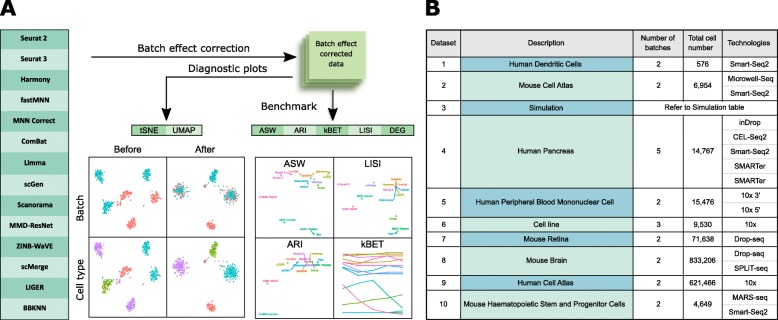
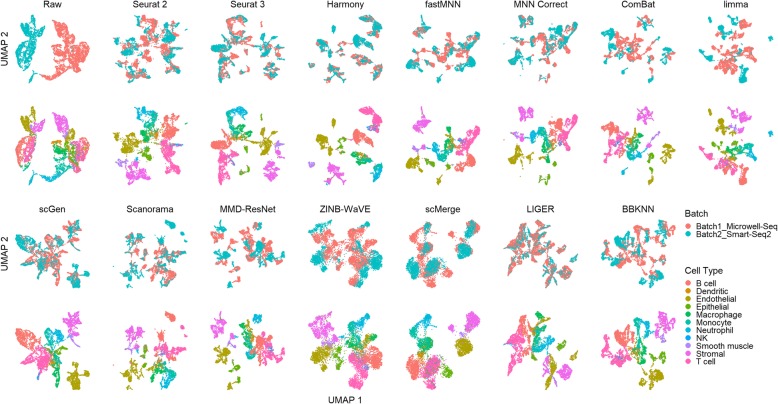
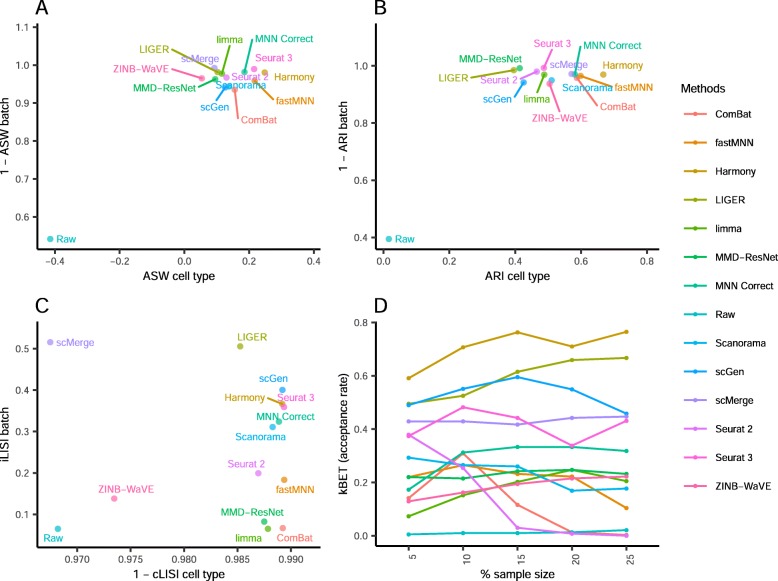
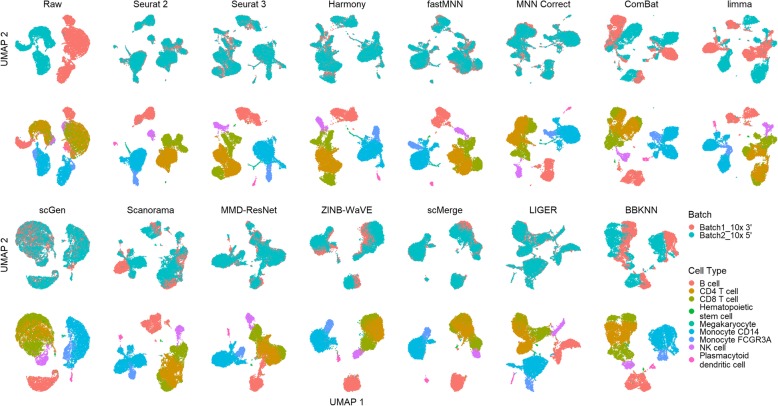
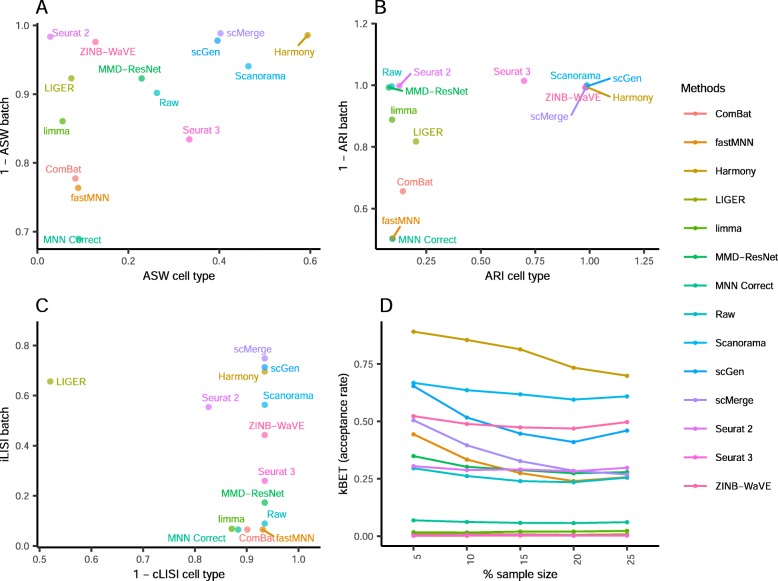
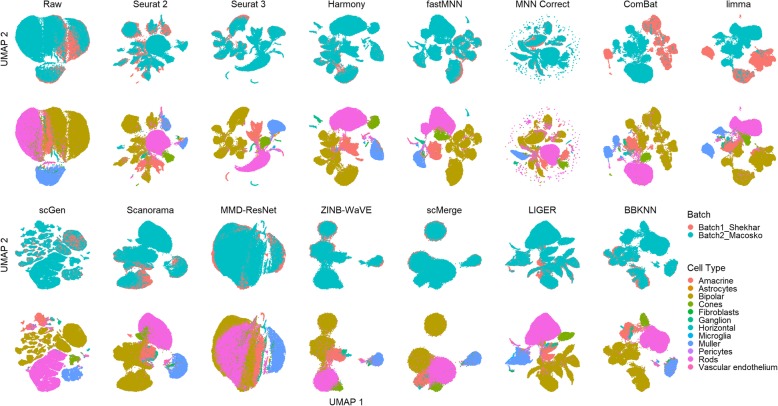
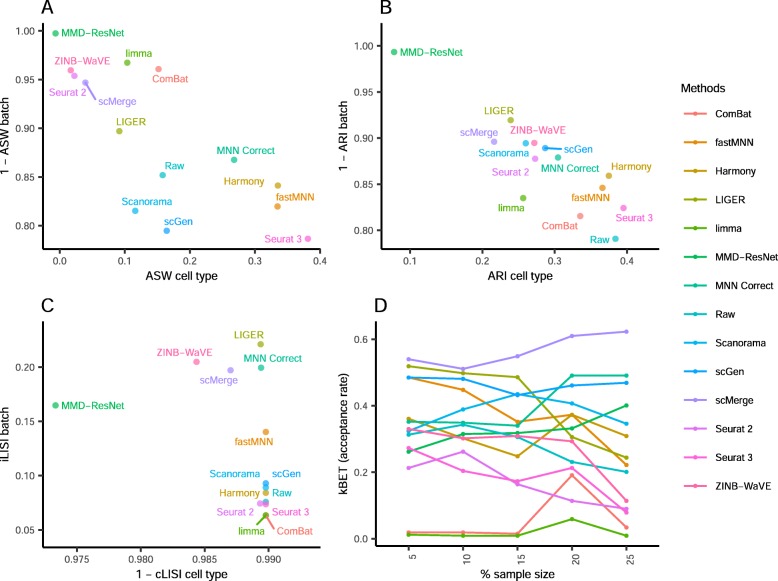
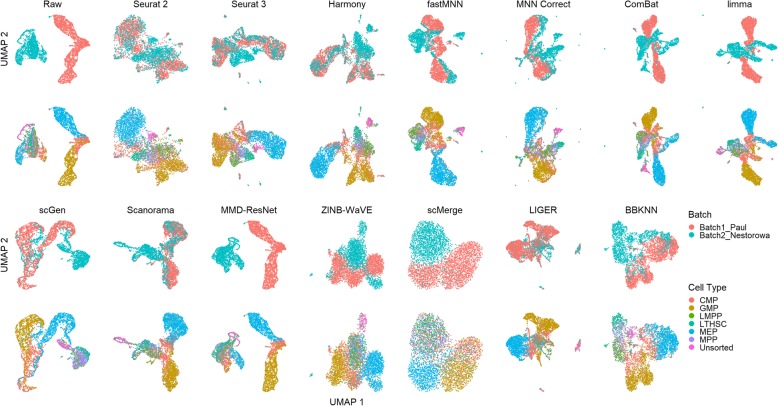
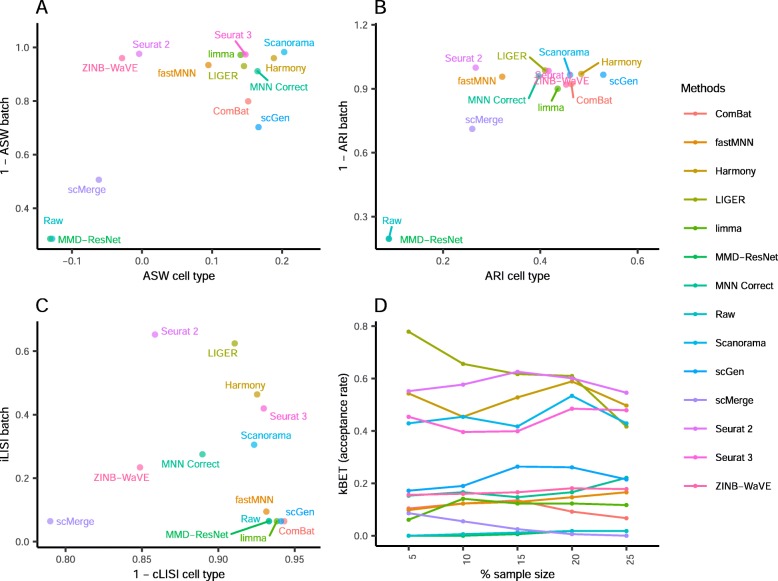
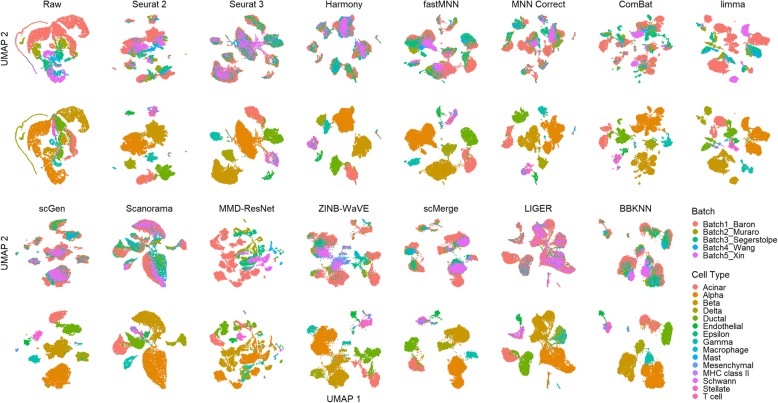
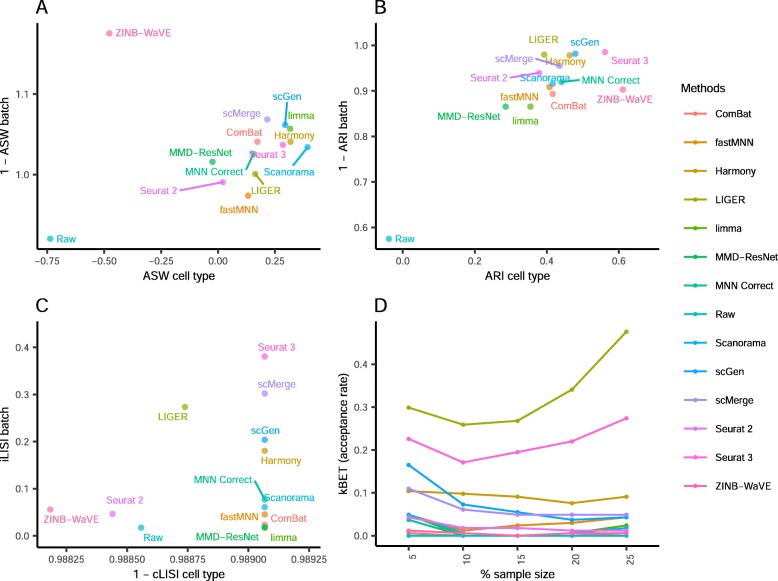
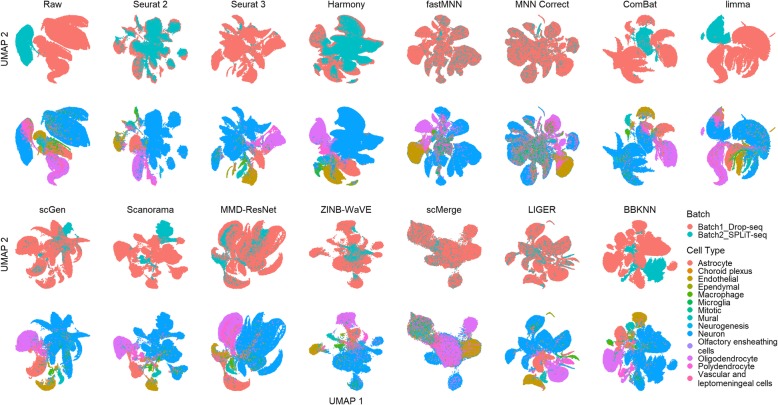
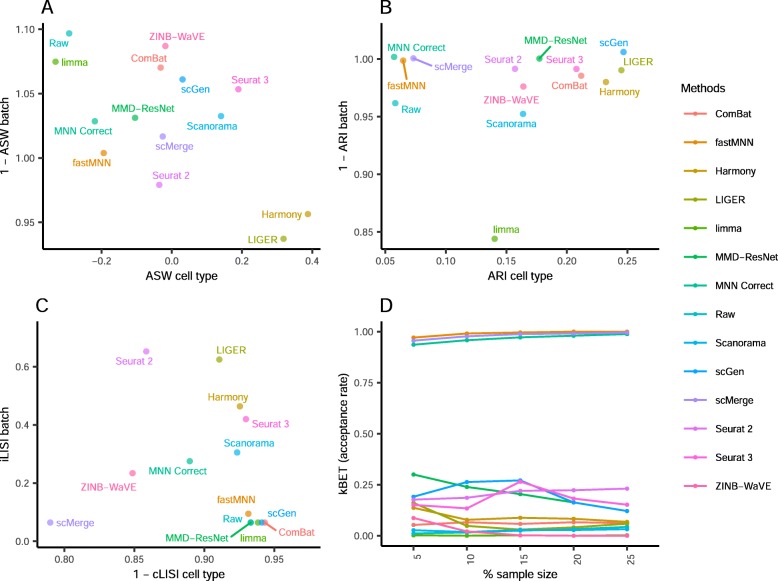
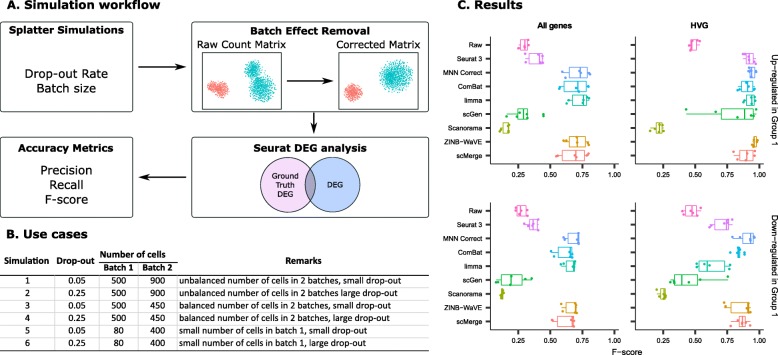
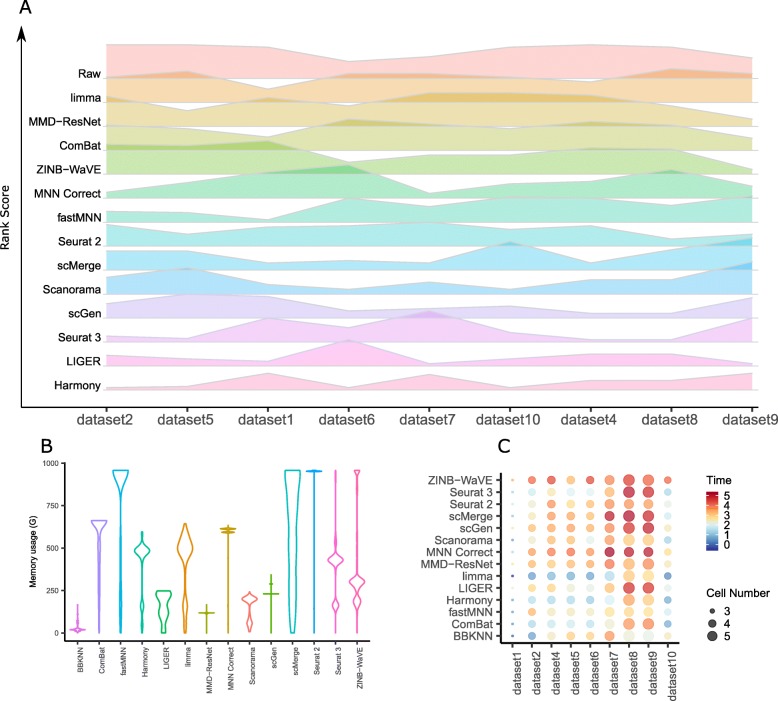
Background: Large-scale single-cell transcriptomic datasets generated using different technologies contain batch-specific systematic variations that present a challenge to batch-effect removal and data integration. With continued growth expected in scRNA-seq data, achieving effective batch integration with available computational resources is crucial. Here, we perform an in-depth benchmark study on available batch correction methods to determine the most suitable method for batch-effect removal. Results: We compare 14 methods in terms of computational runtime, the ability to handle large datasets, and batch-effect correction efficacy while preserving cell type purity. Five scenarios are designed for the study: identical cell types with different technologies, non-identical cell types, multiple batches, big data, and simulated data. Performance is evaluated using four benchmarking metrics including kBET, LISI, ASW, and ARI. We also investigate the use of batch-corrected data to study differential gene expression. Conclusion: Based on our results, Harmony, LIGER, and Seurat 3 are the recommended methods for batch integration. Due to its significantly shorter runtime, Harmony is recommended as the first method to try, with the other methods as viable alternatives.
Overview
The claims and statistics of this paper haven’t been checked yet.
Free: it reads the open-access text and checks the first 5 claims that cite a source we can check. Create a free account to check every claim.
Integrity signals
Registry
Cites
Statistics
Figures
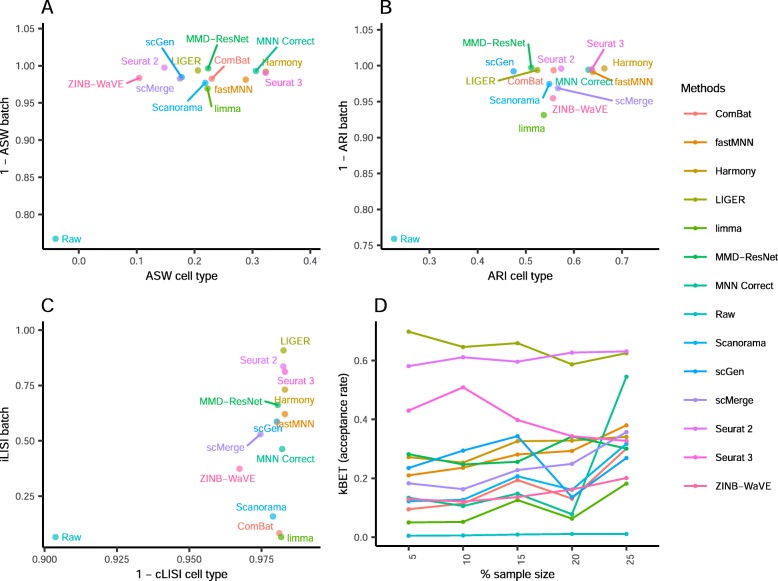
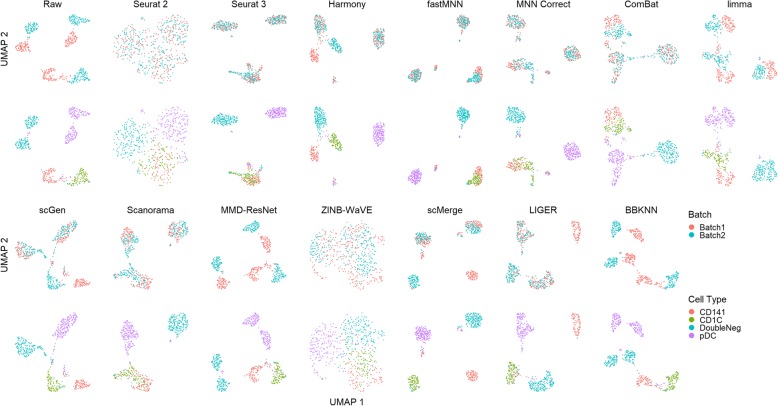
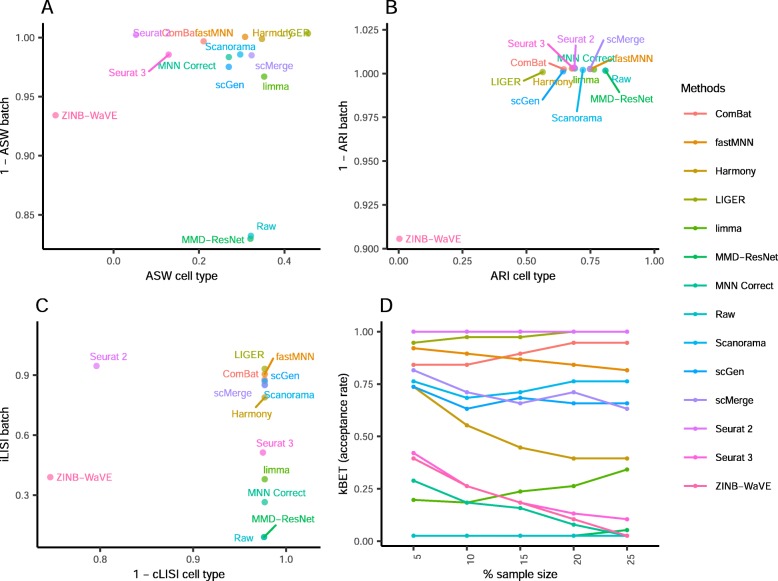
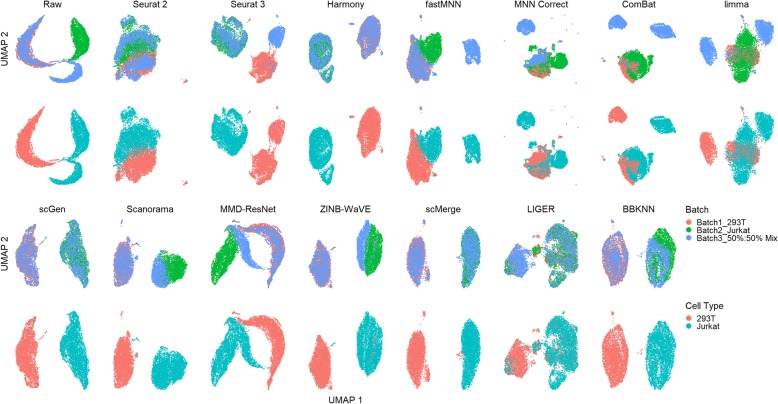
Verification
Claims the paper makes
The claims and statistics of this paper haven’t been checked yet.
Free: it reads the open-access text and checks the first 5 claims that cite a source we can check. Create a free account to check every claim.
Claims other papers make about this one
Each is checked against this paper’s own text: does it say what the citing paper says it does?
The cited source doesn’t support the claim as written.
In the citing paper
“Recent benchmark studies indicate that for simpler integration problems with relatively low biological complexity and relatively small batch effects in scRNA-Seq datasets, linear methods outperform nonlinear, more complex methods136,137, while for complicated integration tasks with large biological complexity and bigger batch effects, nonlinear methods such as scVI/scanVI outperform others138.”
From A high-resolution transcriptomic and spatial atlas of cell types in the whole mouse brain (2023) · cites this paper as [137]
Checked by a reasoning model — may be wrong.
Experimental — accuracy not yet measuredIn the citing paper
“Although SCING GRN based batch correction was not as optimized as the dedicated batch correction methods, many typical batch correction methods do not provide a batch corrected gene expression matrix for downstream analysis.44”
From SCING: Inference of robust, interpretable gene regulatory networks from single cell and spatial transcriptomics (2023) · cites this paper as [44]
In the citing paper
“Linear-embedding models such as canonical correlation analysis36 and Harmony37 were shown to perform well for batch correction on simpler integration tasks with distinct batch structures38,39.”
From Best practices for single-cell analysis across modalities (2023) · cites this paper as [38]
Self-check
Percentages, sums and reported differences re-computed from the paper’s own numbers.
The self-check needs the paper’s full text.
Citations
Cites
(2008) · Journal of Machine Learning Research · Cited by 33,051
Silhouettes: A graphical aid to the interpretation and validation of cluster analysis
Rousseeuw, P. J. (1987) · Journal of Computational and Applied Mathematics · doi:10.1016/0377-0427(87)90125-7 · Cited by 21,392 · cited 2×
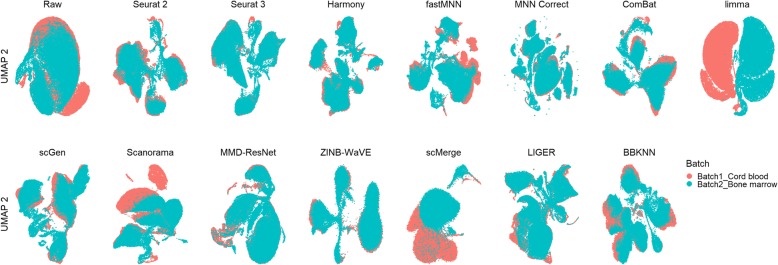
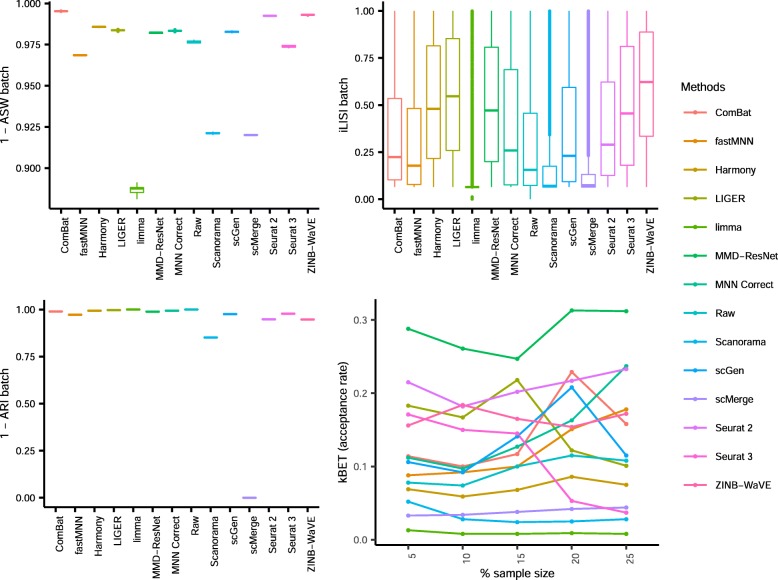
“…and Uniform Manifold Approximation and Projection (UMAP) [21] visualizations in conjunction with the k - nearest neighbor batch-effect test (kBET) [22], local inverse Simpson ’ s index (LISI) [13, 23], average silhouette width (ASW) [24], and adjusted rand index (ARI) benchmarking metrics [25].”
MethodGAN(Generative Adversarial Nets)
(2017) · Journal of Japan Society for Fuzzy Theory and Intelligent Informatics · doi:10.3156/jsoft.29.5_177_2 · Cited by 19,270
Comprehensive Integration of Single-Cell Data
Stuart, T., Butler, A., Hoffman, P., Hafemeister, C., Papalexi, E., Mauck, W. M., Hao, Y., Stoeckius, M., Smibert, P., & Satija, R. (2019) · Cell · doi:10.1016/j.cell.2019.05.031 · Cited by 15,453
Integrating single-cell transcriptomic data across different conditions, technologies, and species
Butler, A., Hoffman, P., Smibert, P., Papalexi, E., & Satija, R. (2018) · Nature Biotechnology · doi:10.1038/nbt.4096 · Cited by 13,174 · cited 6×
“Seurat alignment CCA, multiCCA (Seurat 2) Seurat multiCCA uses canonical correlation analysis (CCA) to first compute the linear combinations of genes with maximum correlation between batches [4].”
BackgroundMethodInfluentialFast, sensitive and accurate integration of single-cell data with Harmony
Korsunsky, I., Millard, N., Fan, J., Slowikowski, K., Zhang, F., Wei, K., Baglaenko, Y., Brenner, M., Loh, P.-R., & Raychaudhuri, S. (2019) · Nature Methods · doi:10.1038/s41592-019-0619-0 · Cited by 10,488 · cited 5×
“Another local level metric is the LISI proposed by Kor-sunsky et al. [13, 22], which can be used to assesses batch and cell type mixing.”
MethodInfluentialSCANPY: large-scale single-cell gene expression data analysis
Wolf, F. A., Angerer, P., & Theis, F. J. (2018) · Genome Biology · doi:10.1186/s13059-017-1382-0 · Cited by 8,881 · cited 1×
“The batch correction by Scanorama was performed in conjunction with the Scanpy workflow [29].”
MethodAdjusting batch effects in microarray expression data using empirical Bayes methods
Johnson, W. E., Li, C., & Rabinovic, A. (2007) · Biostatistics · doi:10.1093/biostatistics/kxj037 · Cited by 8,658 · cited 3×
“ComBat was originally developed for microarray gene expression data [1], but had been successfully employed”
MethodHubert, L., & Arabie, P. (1985) · Journal of Classification · doi:10.1007/bf01908075 · Cited by 8,219
Massively parallel digital transcriptional profiling of single cells
Zheng, G. X. Y., Terry, J. M., Belgrader, P., Ryvkin, P., Bent, Z. W., Wilson, R., Ziraldo, S. B., Wheeler, T. D., McDermott, G. P., Zhu, J., et al. (2017) · Nature Communications · doi:10.1038/ncomms14049 · Cited by 7,353
Research works printed but not linked: 5
- Lun A Further MNN algorithm development 2019
- Goodfellow I, Pouget-Abadie J, Mirza M, Xu B, Warde-Farley D, Ozair S, et al. Generative adversarial nets. In: Ghahramani Z, Welling M, Cortes C, Lawrence ND, Weinberger KQ, editors. Adv Neural Inf Process Syst 27: Curran Associates, Inc; 2014. p. 2672–80. Available from: http://papers.nips.cc/paper/5423-generative-adversarial-nets.pdf. Accessed 11 Mar 2019.
- Korsunsky I LISI 2019
- Deng Y, Bao F, Dai Q, Wu LF, Altschuler SJ. Massive single-cell RNA-seq analysis and imputation via deep learning. bioRxiv. 2018:315556 Available from: http://biorxiv.org/content/early/2018/11/27/315556.abstract. Accessed 5 July 2019.
- Tran HTN, Ang KS, Chevrier M, Zhang X, Lee NYS, Goh M, Chen J. A benchmark of batch-effect correction methods for single-cell RNA sequencing data. Simulations. Github Repository. https://github.com/JinmiaoChenLab/Batch-effect-removal-benchmarking. 2019. PMC6964114 31948481
Cited by
Items 101–200 of 1,005
Self-supervised contrastive learning for integrative single cell RNA-seq data analysis
Han, W., Cheng, Y., Chen, J., Zhong, H., Hu, Z., Chen, S., Zong, L., Hong, L., Chan, T., King, I., et al. (2022) · Briefings in Bioinformatics · doi:10.1093/bib/bbac377 · Cited by 110
Self-citationHe, L., Fan, Y., Zhang, Y., Tu, T.-T., Zhang, Q., Yuan, F., & Cheng, C. (2022) · Journal of Pineal Research · doi:10.1111/jpi.12803 · Cited by 105
Multiscale drug screening for cardiac fibrosis identifies MD2 as a therapeutic target
Zhang, H., Thai, P. N., Shivnaraine, R. V., Ren, L., Wu, X., Siepe, D. H., Liu, Y., Tu, C., Shin, H. S., Caudal, A., et al. (2024) · Cell · doi:10.1016/j.cell.2024.09.034 · Cited by 102
Unsupervised Spatially Embedded Deep Representation of Spatial Transcriptomics
Fu, H., Xu, H., Chong, K., Li, M., Ang, K. S., Lee, H. K., Ling, J., Chen, A., Shao, L., Liu, L., et al. (2021) · bioRxiv (Cold Spring Harbor Laboratory) · doi:10.1101/2021.06.15.448542 · Cited by 83
Self-citationJoint cell segmentation and cell type annotation for spatial transcriptomics
Littman, R., Hemminger, Z., Foreman, R., Arneson, D., Zhang, G., Gómez‐Pinilla, F., Yang, X., & Wollman, R. (2021) · Molecular Systems Biology · doi:10.15252/msb.202010108 · Cited by 93
“Harmo-nization between datasets is an active area of research, and JSTA will benefit from these advances (preprint: Lopez et al, 2019; Stuart et al, 2019; Welch et al, 2019; Abdelaal et al, 2020; Tran et al, 2020).”
BackgroundEvaluating the Utilities of Foundation Models in Single‐Cell Data Analysis
Liu, T., Li, K., Wang, Y., Li, H., & Zhao, H. (2026) · Advanced Science · doi:10.1002/advs.202514490 · Cited by 61
Single-cell omics: experimental workflow, data analyses and applications
Sun, F., Li, H., Sun, D., Fu, S., Gu, L., Shao, X., Wang, Q., Dong, X., Duan, B., Xing, F., et al. (2024) · Science China Life Sciences · doi:10.1007/s11427-023-2561-0 · Cited by 102
Flexible comparison of batch correction methods for single-cell RNA-seq using BatchBench
Chazarra-Gil, R., van Dongen, S., Kiselev, V. Y., & Hemberg, M. (2021) · Nucleic Acids Research · doi:10.1093/nar/gkab004 · Cited by 93
Tzec-Interián, J. A., González‐Padilla, D., & Góngora‐Castillo, E. (2025) · Quantitative Biology · doi:10.1002/qub2.78 · Cited by 100
“For scRNA ‐ seq, several batch effect correction methods have been developed that can be categorized into five groups [214, 215]: ( i ) Anchor ‐ based methods rely on identifying pairs of cells across batches with similar expression patterns (anchors) to guide batch integration and removal of batch…”
Watanabe, N., Fujita, Y., Nakayama, J., Mori, Y., Kadota, T., Hayashi, Y., Shimomura, I., Ohtsuka, T., Okamoto, K., Araya, J., et al. (2022) · American Journal of Respiratory Cell and Molecular Biology · doi:10.1165/rcmb.2021-0555oc · Cited by 93
Defining the Design Principles of Skin Epidermis Postnatal Growth
Dekoninck, S., Hannezo, E., Sifrim, A., Miroshnikova, Y. A., Aragona, M., Malfait, M., Gargouri, S., de Neunheuser, C., Dubois, C., Voet, T., et al. (2020) · Cell · doi:10.1016/j.cell.2020.03.015 · Cited by 91
“To better compare the young and adult epidermis, we also combined the two datasets using Harmony (Korsunsky et al., 2019; Tran et al., 2020), a method of batch s Postnatal Development opulation of DPs undergoes stochastic fate choices with a constant imbalance ), together with an ever-decreasing…”
MethodInfluentialWhat are the applications of single-cell RNA sequencing in cancer research: a systematic review
Li, L., Xiong, F., Wang, Y., Zhang, S., Gong, Z., Li, X., He, Y., Shi, L., Wang, F., Liao, Q., et al. (2021) · Journal of Experimental & Clinical Cancer Research · doi:10.1186/s13046-021-01955-1 · Cited by 112
“Based on a variety of evaluation indicators, Harmony, Liger, and Seurat 3 are the recommended methods for dealing with batch effects, among which Harmony is the first choice due to its shorter run time [28].”
MethodPresent and future challenges for the investigation of transgenerational epigenetic inheritance
Fallet, M., Blanc, M., Criscio, M. D., Antczak, P., Engwall, M., Guerrero‐Bosagna, C., Rüegg, J., & Keiter, S. H. (2023) · Environment International · doi:10.1016/j.envint.2023.107776 · Cited by 121
“Several techniques have proposed to deal with batch effects including ComBat(-seq), linear mixed effect model, or Passing-Bablok regression approaches (Luo, 2010; Tran, 2020; Müller, 2016).”
Precise identification of cell states altered in disease using healthy single-cell references
Dann, E., Cujba, A.-M., Oliver, A. J., Meyer, K. B., Teichmann, S. A., & Marioni, J. C. (2023) · Nature Genetics · doi:10.1038/s41588-023-01523-7 · Cited by 96
“We found that basal cells in the ACR design IPF-enriched neighborhoods overexpressed marker genes for KRT5 + KRT17 hi aberrant basal cells identified in bronchial brushings of patients with IPF 40 (Fig.”
MethodInfluentialSeyfferth, C., Eekhout, T., Shi, D., Neumann, M., Berg, L. S., Ke, Y., Shahan, R., Cox, K. L., Gómez-Cano, F., Nelissen, H., et al. (2024) · The Plant Cell · doi:10.1093/plcell/koae003 · Cited by 92
Evaluating batch correction methods for image-based cell profiling
Arevalo, J., Su, E., van Dijk, R., Carpenter, A. E., & Singh, S. (2023) · doi:10.1101/2023.09.15.558001 · Cited by 89
“In contrast to the RNA-seq domain where multiple benchmark studies exist 13,17 , image-based profiling lacks a comprehensive comparison of batch effect correction methods, and there are no agreed evaluation criteria.”
BackgroundMethodResultInfluentialAltered cell and RNA isoform diversity in aging Down syndrome brains
Palmer, C. R., Liu, C. S., Romanow, W. J., Lee, M.-H., & Chun, J. (2021) · Proceedings of the National Academy of Sciences · doi:10.1073/pnas.2114326118 · Cited by 89
“In addition to matching samples for age, sex, and RIN, potential batch effects were accounted for by randomizing samples during processing and utilizing Seurat v3 for analysis ( Materials and Methods ) (21).”
Iterative single-cell multi-omic integration using online learning
Gao, C., Liu, J., Kriebel, A. R., Preissl, S., Luo, C., Castanon, R., Sandoval, J., Rivkin, A., Nery, J. R., Behrens, M. M., et al. (2021) · Nature Biotechnology · doi:10.1038/s41587-021-00867-x · Cited by 90
Toward a mathematical theory of trajectory inference
Lavenant, H., Zhang, S. X., Kim, Y., & Schiebinger, G. R. (2024) · The Annals of Applied Probability · doi:10.1214/23-aap1969 · Cited by 142
Karagiannis, T. T., Dowrey, T. W., Villacorta-Martín, C., Montano, M. A., Reed, E. R., Belkina, A. C., Andersen, S. L., Perls, T. T., Monti, S., Murphy, G. J., et al. (2023) · EBioMedicine · doi:10.1016/j.ebiom.2023.104514 · Cited by 95
The covariance environment defines cellular niches for spatial inference
Haviv, D., Remšík, J., Gatie, M. I., Snopkowski, C., Takizawa, M., Pereira, N., Bashkin, J., Jovanovich, S. B., Nawy, T., Chaligné, R., et al. (2024) · Nature Biotechnology · doi:10.1038/s41587-024-02193-4 · Cited by 107
Machine Intelligence in Single-Cell Data Analysis: Advances and New Challenges
Liu, J., Fan, Z., Zhao, W., & Zhou, X. (2021) · Frontiers in Genetics · doi:10.3389/fgene.2021.655536 · Cited by 105
A guidebook of spatial transcriptomic technologies, data resources and analysis approaches
Yue, L., Liu, F., Hu, J., Yang, P., Wang, Y., Dong, J., Shu, W., Huang, X., & Wang, S. (2023) · Computational and Structural Biotechnology Journal · doi:10.1016/j.csbj.2023.01.016 · Cited by 96
“Some researchers have tested these tools and made recommendations for different situations [68,69].”
BackgroundKriebel, A. R., & Welch, J. D. (2022) · Nature Communications · doi:10.1038/s41467-022-28431-4 · Cited by 83
Batch alignment of single-cell transcriptomics data using deep metric learning
Yu, X., Xu, X., Zhang, J., & Li, X. (2023) · Nature Communications · doi:10.1038/s41467-023-36635-5 · Cited by 96
SIMBA: single-cell embedding along with features
Chen, H., Ryu, J., Vinyard, M. E., Lerer, A., & Pinello, L. (2024) · Nature Methods · doi:10.1038/s41592-023-01899-8 · Cited by 84
“1511 1512 For batch correction using Seurat v3, default options are used for pancreas dataset whereas for 1513 mouse atlas dataset no cutoff was used for the minimum number of cells and genes as in Tran 1514 et al.(25).”
Song, D., & Li, J. J. (2021) · Genome biology · doi:10.1186/s13059-021-02341-y · Cited by 93
Causal machine learning for single-cell genomics
Tejada-Lapuerta, A., Bertin, P., Bauer, S., Aliee, H., Bengio, Y., & Theis, F. J. (2025) · Nature Genetics · doi:10.1038/s41588-025-02124-2 · Cited by 104
Becker, L. M., Chen, S.-H., Rodor, J., de Rooij, L. P. M. H., Baker, A. H., & Carmeliet, P. (2022) · Cardiovascular Research · doi:10.1093/cvr/cvac018 · Cited by 85
A guide to systems-level immunomics
Bonaguro, L., Schulte-Schrepping, J., Ulas, T., Aschenbrenner, A. C., Beyer, M., & Schultze, J. L. (2022) · Nature Immunology · doi:10.1038/s41590-022-01309-9 · Cited by 86
“One, if not the major, aspect when planning omics applications, particularly with increasing sample sizes generated across different institutions, is the consideration of the effect from technical parameters, often referred to as ‘batch’ effects 64,65 .”
BackgroundThe future of rapid and automated single-cell data analysis using reference mapping
Lotfollahi, M., Hao, Y., Theis, F. J., & Satija, R. (2024) · Cell · doi:10.1016/j.cell.2024.03.009 · Cited by 86
Benchmarking integration of single-cell differential expression
Hai, N. C. T., Baik, B., Yoon, S., Park, T., & Nam, D. (2023) · Nature Communications · doi:10.1038/s41467-023-37126-3 · Cited by 88
“However, these two results exhibited some similarity: (1) poor controls of false positives and false discoveries using edgeR-related methods, especially edgeR_wFisher, (2) poor false positives controls of DE methods that used scGen BEC data, and (3) good controls of false-positives and false discoveries using Wilcoxon…”
BackgroundMethodResultInfluentialDefining and benchmarking open problems in single-cell analysis
Luecken, M. D., Gigante, S., Burkhardt, D. B., Cannoodt, R., Strobl, D. C., Markov, N. S., Zappia, L., Palla, G., Lewis, W., Dimitrov, D., et al. (2025) · Nature Biotechnology · doi:10.1038/s41587-025-02694-w · Cited by 106
A Comprehensive Review of Deep Learning Applications with Multi-Omics Data in Cancer Research
Sartori, F., Codicè, F., Caranzano, I., Rollo, C., Birolo, G., Fariselli, P., & Pancotti, C. (2025) · Genes · doi:10.3390/genes16060648 · Cited by 88
“This is followed by correcting for batch effects [46–48], filtering low-expressed genes in RNA-seq data, and normalizing expression levels.”
Voß, H., Schlumbohm, S., Barwikowski, P., Wurlitzer, M., Dottermusch, M., Neumann, P., Schlüter, H., Neumann, J. E., & Krisp, C. (2022) · Nature Communications · doi:10.1038/s41467-022-31007-x · Cited by 83
Integration of Single-Cell RNA-Seq Datasets: A Review of Computational Methods
Ryu, Y., Han, G. H., Jung, E., & Hwang, D. (2023) · Molecules and Cells · doi:10.14348/molcells.2023.0009 · Cited by 82
“Linear decomposition methods are the simplest, thereby providing an advantage in terms of analysis speed (Tran et al., 2020) (Supplementary Table S1, Speed).”
Large language models in biomedicine and healthcare
Zhou, J., Li, H., Chen, S., Chen, Z., Han, Z., & Gao, X. (2025) · Yearbook of pediatric endocrinology · doi:10.1038/s44387-025-00047-1 · Cited by 77
“Batch effect correction aims to remove systematic technical variations introduced during different experimental runs, sample preparations, or sequencing batches that obscure biological signals 60 .”
An integrated single-cell transcriptomic dataset for non-small cell lung cancer
Prazanowska, K. H., & Lim, S. B. (2023) · Scientific Data · doi:10.1038/s41597-023-02074-6 · Cited by 84
Deep learning tackles single-cell analysis—a survey of deep learning for scRNA-seq analysis
Flores, M. A., Liu, Z., Zhang, T., Hasib, M. M., Chiu, Y., Ye, Z., Paniagua, K., Jo, S., Zhang, J., Gao, S., et al. (2021) · Briefings in Bioinformatics · doi:10.1093/bib/bbab531 · Cited by 80
SRTsim: spatial pattern preserving simulations for spatially resolved transcriptomics
Zhu, J., Shang, L., & Zhou, X. (2023) · Genome biology · doi:10.1186/s13059-023-02879-z · Cited by 81
Semi-supervised integration of single-cell transcriptomics data
Andreatta, M., Hérault, L., Gueguen, P., Gfeller, D., Berenstein, A. J., & Carmona, S. J. (2024) · Nature Communications · doi:10.1038/s41467-024-45240-z · Cited by 79
Advances and applications in single-cell and spatial genomics
Wang, J., Ye, F., Chai, H., Jiang, Y., Wang, T., Ran, X., Xia, Q., Xu, Z., Fu, Y., Zhang, G., et al. (2024) · Science China Life Sciences · doi:10.1007/s11427-024-2770-x · Cited by 79
Computational methods for single-cell multi-omics integration and alignment
Stanojevic, S., Li, Y., Ristivojevic, A., & Garmire, L. X. (2022) · Genomics, Proteomics & Bioinformatics · doi:10.1016/j.gpb.2022.11.013 · Cited by 74
Critical downstream analysis steps for single-cell RNA sequencing data
Zhang, Z., Cui, F., Lin, C., Zhao, L., Wang, C., & Zou, Q. (2021) · Briefings in Bioinformatics · doi:10.1093/bib/bbab105 · Cited by 73
Progress and opportunities of foundation models in bioinformatics
Li, Q., Hu, Z., Wang, Y., Li, L., Fan, Y., King, I., Jia, G., Wang, S., Song, L., & Li, Y. (2024) · Briefings in Bioinformatics · doi:10.1093/bib/bbae548 · Cited by 91
Computational methods for the integrative analysis of single-cell data
Forcato, M., Romano, O., & Bicciato, S. (2021) · Briefings in Bioinformatics · doi:10.1093/bib/bbaa042 · Cited by 71
scCancer: a package for automated processing of single-cell RNA-seq data in cancer
Guo, W., Wang, D., Wang, S., Shan, Y., Liu, C., & Gu, J. (2020) · Briefings in Bioinformatics · doi:10.1093/bib/bbaa127 · Cited by 76
Micheroli, R., Elhaï, M., Edalat, S. G., Frank‐Bertoncelj, M., Bürki, K., Ciurea, A., MacDonald, L., Kurowska‐Stolarska, M., Lewis, M., Goldmann, K., et al. (2022) · RMD Open · doi:10.1136/rmdopen-2021-001949 · Cited by 75
“14 If not otherwise stated, default settings were used for each integration method.”
Wu, S. Z., Roden, D. L., Al‐Eryani, G., Bartoniček, N., Harvey, K., Cazet, A., Chan, C., Junankar, S. R., Hui, M. N., Millar, E. A., et al. (2021) · Genome Medicine · doi:10.1186/s13073-021-00885-z · Cited by 81
“In particular for microfluidic dropletbased scRNA-Seq, this can result in batch effects for larger studies processed over several time points [4], where cell fixation and cryopreservation methods can minimise such issues.”
BackgroundLiu, I., Cruzeiro, G. A. V., Bjerke, L. M., Rogers, R. F., Grabovska, Y., Beck, A., Mackay, A. G., Barron, T., Hack, O. A., Quezada, M. A., et al. (2024) · Cancer Cell · doi:10.1016/j.ccell.2024.08.006 · Cited by 71
Contrastive learning enables rapid mapping to multimodal single-cell atlas of multimillion scale
Yang, M., Yang, Y., Xie, C., Ni, M., Liu, J., Yang, H., Mu, F., & Wang, J. (2022) · Nature Machine Intelligence · doi:10.1038/s42256-022-00518-z · Cited by 81
Single cell metabolism: current and future trends
Ali, A., Davidson, S. M., Fraenkel, E., Gilmore, I. S., Hankemeier, T., Kirwan, J., Lane, A. N., Lanekoff, I., Larion, M., McCall, L., et al. (2022) · Metabolomics · doi:10.1007/s11306-022-01934-3 · Cited by 72
Loveless, I. M., Kemp, S. B., Hartway, K. M., Mitchell, J. T., Wu, Y., Zwernik, S. D., Salas-Escabillas, D. J., Brender, S. M., George, M., Makinwa, Y., et al. (2024) · Clinical Cancer Research · doi:10.1158/1078-0432.ccr-24-2183 · Cited by 68
“Many groups have compared existing batch correction algorithms for speed and removal of technical artifacts while maintaining biological relevance (20, 75).”
Bi-order multimodal integration of single-cell data
Dou, J., Liang, S., Mohanty, V., Miao, Q., Huang, Y., Liang, Q., Cheng, X., Kim, S., Choi, J., Li, Y., et al. (2022) · Genome Biology · doi:10.1186/s13059-022-02679-x · Cited by 66
“To address this challenge, existing computational approaches followed two directions [18]: (1) aligning features empirically before aligning cells [19–22] and (2) obtaining separate embeddings for each modality, followed by performing unsupervised manifold alignment [23–25].”
MethodLi, Y.-R., Fang, Y., Niu, S., Zhu, Y., Chen, Y., Lyu, Z., Zhu, E., Tian, Y., Huang, J., Rezek, V. K., et al. (2025) · Nature Communications · doi:10.1038/s41467-025-56270-6 · Cited by 69
Li, Y.-R., Li, Z., Zhu, Y., Li, M., Chen, Y., Lee, D. P. H., Ochoa, C. J., Singh, T., DiBernardo, G., Guo, W., et al. (2025) · Med · doi:10.1016/j.medj.2025.100804 · Cited by 70
CSS: cluster similarity spectrum integration of single-cell genomics data
He, Z., Brazovskaja, A., Ebert, S., Camp, J. G., & Treutlein, B. (2020) · Genome Biology · doi:10.1186/s13059-020-02147-4 · Cited by 64
Identifying tumor cells at the single-cell level using machine learning
Dohmen, J., Baranovskii, A., Ronen, J., Uyar, B., Franke, V., & Akalin, A. (2022) · Genome biology · doi:10.1186/s13059-022-02683-1 · Cited by 66
“This variability presents a challenge for developing machine learning models, because the data coming from different conditions will have different underlying distributions, meaning that methods trained on one dataset will not generalize to other datasets [16].”
BackgroundTao, X., Zhang, R., Du, R., Yu, T., Yang, H., Li, J., Wang, Y., Liu, Q., Zuo, S., Wang, X., et al. (2022) · The Journal of Experimental Medicine · doi:10.1084/jem.20212414 · Cited by 65
A universal deep neural network for in-depth cleaning of single-cell RNA-Seq data
Li, H., Brouwer, C. R., & Luo, W. (2022) · Nature Communications · doi:10.1038/s41467-022-29576-y · Cited by 58
A review of computational strategies for denoising and imputation of single-cell transcriptomic data
Patruno, L., Maspero, D., Craighero, F., Angaroni, F., Antoniotti, M., & Graudenzi, A. (2020) · Briefings in Bioinformatics · doi:10.1093/bib/bbaa222 · Cited by 56
Prioritization of cell types responsive to biological perturbations in single-cell data with Augur
Squair, J. W., Skinnider, M. A., Gautier, M., Foster, L. J., & Courtine, G. (2021) · Nature Protocols · doi:10.1038/s41596-021-00561-x · Cited by 61
Grancharova, T., Gerbin, K. A., Rosenberg, A. B., Roco, C. M., Arakaki, J. E., DeLizo, C. M., Dinh, S. Q., Donovan-Maiye, R. M., Hirano, M., Nelson, A. M., et al. (2021) · Scientific Reports · doi:10.1038/s41598-021-94732-1 · Cited by 61
The shaky foundations of simulating single-cell RNA sequencing data
Crowell, H. L., Leonardo, S. X. M., Soneson, C., & Robinson, M. D. (2023) · Genome biology · doi:10.1186/s13059-023-02904-1 · Cited by 66
“As a result, simulations have been applied to benchmark methods across a wide range of tasks, including differential expression analysis [9–11], trajectory inference [12], and data integration [13, 14].”
MethodThe Application of Single‐Cell RNA Sequencing in Vaccinology
Noé, A., Cargill, T. N., Nielsen, C. M., Russell, A. J. C., & Barnes, E. J. (2020) · Journal of Immunology Research · doi:10.1155/2020/8624963 · Cited by 66
“(iii) Batch effects may be corrected by a number of bioinformatics tools and/or packages [161, 162]”
SpaMask: Dual masking graph autoencoder with contrastive learning for spatial transcriptomics
Min, W., Fang, D., Chen, J., & Zhang, S. (2025) · PLoS Computational Biology · doi:10.1371/journal.pcbi.1012881 · Cited by 63
“To further assess multi-slice integration correction, we employed the F1LISI metric (See Sect F in S1 Text) [46], where values close to 1 indicate strong correction.”
Self-citationSMILE: mutual information learning for integration of single-cell omics data
Xu, Y., Das, P., & McCord, R. P. (2021) · Bioinformatics · doi:10.1093/bioinformatics/btab706 · Cited by 60
Methods and Insights from Single-Cell Expression Quantitative Trait Loci
Kang, J. B., Raveane, A., Nathan, A., Soranzo, N., & Raychaudhuri, S. (2023) · Annual Review of Genomics and Human Genetics · doi:10.1146/annurev-genom-101422-100437 · Cited by 63
“Removing batch effects using one of the many available batch correction methods (19, 80, 89, 144) can help improve downstream results and is essential to ensure that state variables are consistently defined across samples.”
MethodZhong, Z., Hou, J., Yao, Z., Dong, L., Liu, F., Yue, J., Wu, T., Zheng, J., Ouyang, G., Yang, C. J., et al. (2024) · Nature Communications · doi:10.1038/s41467-024-46413-6 · Cited by 66
Characterizing the impacts of dataset imbalance on single-cell data integration
Maan, H., Zhang, L., Yu, C., Geuenich, M. J., Campbell, K. R., & Wang, B. (2024) · Nature Biotechnology · doi:10.1038/s41587-023-02097-9 · Cited by 66
“We included frequently used and best-performing scRNA-seq integration techniques based on previous benchmarking studies 4,7 , but we tested only one method that focuses specifically on preserving biological heterogeneity when differing cell populations are present, in CIDER 37 .”
InfluentialNew horizons at the interface of artificial intelligence and translational cancer research
Yates, J., & Allen, E. M. V. (2025) · Cancer Cell · doi:10.1016/j.ccell.2025.03.018 · Cited by 63
iMAP: integration of multiple single-cell datasets by adversarial paired transfer networks
Wang, D., Hou, S., Zhang, L., Wang, X., Liu, B., & Zhang, Z. (2021) · Genome biology · doi:10.1186/s13059-021-02280-8 · Cited by 61
Are batch effects still relevant in the age of big data?
Goh, W. W. B., Yong, C. H., & Wong, L. (2022) · Trends in biotechnology · doi:10.1016/j.tibtech.2022.02.005 · Cited by 64
Johnson, T. S., Yu, C. Y., Huang, Z., Xu, S., Wang, T., Dong, C., Shao, W., Zaid, M. I. A., Huang, X., Wang, Y., et al. (2022) · Genome Medicine · doi:10.1186/s13073-022-01012-2 · Cited by 64
STACAS: Sub-Type Anchor Correction for Alignment in Seurat to integrate single-cell RNA-seq data
Andreatta, M., & Carmona, S. J. (2020) · Bioinformatics · doi:10.1093/bioinformatics/btaa755 · Cited by 58
Leveraging Single-Cell Approaches in Cancer Precision Medicine
Nath, A., & Bild, A. (2021) · Trends in cancer · doi:10.1016/j.trecan.2021.01.007 · Cited by 72
“Thus, it is important to ensure that single-cell data is properly normalized and appropriately adjusted to account for batch-effects for a fair comparison across experiments [72,73].”
BackgroundSingle-cell and spatially resolved transcriptomics for liver biology
Lin, P., Yan, X., Jing, S., Wu, Y., Shan, Y., Guo, W., Gu, J., Li, Y., Zhang, H., & Li, H. (2024) · Hepatology · doi:10.1097/hep.0000000000000387 · Cited by 46
“Experimental technologies and computational strategies offering multiomic or multimodal solutions merit more attention.[199,200] Multiomic techniques such as CITE-seq and NanoString CosMx Spatial Molecular Imager have already unveiled new insights into chronic liver diseases.”
Deciphering radiological stable disease to immune checkpoint inhibitors
Luo, J., Wu, S., Rizvi, H. A., Zhang, Q., Egger, J. V., Osorio, J. C., Schoenfeld, A. J., Plodkowski, A. J., Ginsberg, M. S., Callahan, M. K., et al. (2022) · Annals of Oncology · doi:10.1016/j.annonc.2022.04.450 · Cited by 57
Normalization and de-noising of single-cell Hi-C data with BandNorm and scVI-3D
Zheng, Y., Shen, S., & Keleş, S. (2022) · Genome biology · doi:10.1186/s13059-022-02774-z · Cited by 56
“All the scaling-based normalization methods and methods that do not have built-in batch correction are coupled with Harmony [25], which has established effectiveness for scRNA-seq [26] and performed well in our experiments (Section 2.”
MethodCellcano: supervised cell type identification for single cell ATAC-seq data
Ma, W., Lu, J., & Wu, H. (2023) · Nature Communications · doi:10.1038/s41467-023-37439-3 · Cited by 59
A Roadmap for the Human Gut Cell Atlas
Zilbauer, M., James, K. R., Kaur, M., Pott, S., Li, Z., Burger, A., Thiagarajah, J. R., Burclaff, J., Jahnsen, F. L., Perrone, F., et al. (2023) · Nature Reviews Gastroenterology & Hepatology · doi:10.1038/s41575-023-00784-1 · Cited by 55
Plasticity and heterogeneity of thermogenic adipose tissue
Sun, W., Modica, S., Dong, H., & Wolfrum, C. (2021) · Nature Metabolism · doi:10.1038/s42255-021-00417-4 · Cited by 54
Robust single-cell matching and multimodal analysis using shared and distinct features
Zhu, B., Chen, S., Bai, Y., Chen, H. M., Liao, G., Mukherjee, N., Vazquez, G., McIlwain, D. R., Tzankov, A., Lee, I. T., et al. (2023) · Nature Methods · doi:10.1038/s41592-022-01709-7 · Cited by 55
scMAE: a masked autoencoder for single-cell RNA-seq clustering
Fang, Z., Zheng, R., & Li, M. (2024) · Bioinformatics · doi:10.1093/bioinformatics/btae020 · Cited by 62
“…studies (Pollen et al. 2014, Macosko et al. 2015, Baron et al. 2016, Shekhar et al. 2016, Tirosh et al. 2016, Bach et al. 2017, Cao et al. 2017, Guo et al. 2018, Hrvatin et al. 2018, Tabula Muris Consortium et al. 2018, Tosches et al. 2018, Wang et al. 2018, Young et al. 2018, Tran et al. 2020).”
BackgroundScanorama: integrating large and diverse single-cell transcriptomic datasets
Hie, B., Kim, S., Rando, T. A., Bryson, B. D., & Berger, B. (2024) · Nature Protocols · doi:10.1038/s41596-024-00991-3 · Cited by 55
“Batch correction methods for scRNA-seq data can be categorized into four broad categories: global models 14 , nearest neighbor methods 4–7, 11 , graph-based methods Multiple benchmarks have been conducted to evaluate the performance of various batch correction and data integration methods 3,17,18 .”
Kannan, S., Farid, M., Lin, B. L., Miyamoto, M., & Kwon, C. (2021) · PLOS Computational Biology · doi:10.1371/journal.pcbi.1009305 · Cited by 52
“While batch correction algorithms have been developed [22], they are primarily designed for correcting or integrating datasets with multiple well-defined cell types with significantly different gene expression patterns rather than one continuously evolving cell type.”
MethodHow to Get Started with Single Cell RNA Sequencing Data Analysis
Balzer, M. S., Ma, Z., Zhou, J., Abedini, A., & Suszták, K. (2021) · Journal of the American Society of Nephrology · doi:10.1681/asn.2020121742 · Cited by 52
Ma, W., Su, K., & Wu, H. (2021) · Genome biology · doi:10.1186/s13059-021-02480-2 · Cited by 53
“There are several methods specifically designed for scRNA-seq to remove the batch effect, and they are comprehensively compared in [44].”
MethodHu, H., Li, Z., Li, X., Yu, M., & Pan, X. (2021) · Briefings in Bioinformatics · doi:10.1093/bib/bbab321 · Cited by 55
Korshoj, L. E., & Kielian, T. (2024) · Nature Communications · doi:10.1038/s41467-024-54581-8 · Cited by 51
“…dif-ferentialexpressionanalysesperformedwithunbalancedcellnumbers have been shown to skew true positive and false positive identi fi cations 63 , and we observed that any single cutoff equally applied to both bio fi lm and planktonic datasets was heavily unbalanced with 3 – 20× greater cell…”
Single-Cell RNA Sequencing in Parkinson’s Disease
Ma, S., & Lim, S. B. (2021) · Biomedicines · doi:10.3390/biomedicines9040368 · Cited by 62
Inamo, J., Keegan, J., Griffith, A. M., Ghosh, T., Horisberger, A., Howard, K., Pulford, J. F., Murzin, E., Hancock, B. L., Dominguez, S. T., et al. (2025) · Journal of Clinical Investigation · doi:10.1172/jci185217 · Cited by 53
CellMixS: quantifying and visualizing batch effects in single-cell RNA-seq data
Lütge, A., Zyprych-Walczak, J., Brykczynska Kunzmann, U., Crowell, H. L., Calini, D., Malhotra, D., Soneson, C., & Robinson, M. D. (2021) · Life Science Alliance · doi:10.26508/lsa.202001004 · Cited by 58
Spatial Transcriptomics: Molecular Maps of the Mammalian Brain
Ortiz, C., Carlén, M., & Meletis, K. (2021) · Annual Review of Neuroscience · doi:10.1146/annurev-neuro-100520-082639 · Cited by 54
Consensus clustering of single-cell RNA-seq data by enhancing network affinity
Cui, Y., Zhang, S., Liang, Y. J., Wang, X., Ferraro, T. N., & Chen, Y. (2021) · Briefings in Bioinformatics · doi:10.1093/bib/bbab236 · Cited by 53
“However, due to the complexity of the cell typing problem caused by high levels of technical noise from different protocols [26, 27] and a large number of zeros (zeros commonly make up >50% of the total estimated genes with expression, known as dropouts) in scRNA-seq data [28, 29], no clustering method performs well f…”
BackgroundMethodDevKidCC allows for robust classification and direct comparisons of kidney organoid datasets
Wilson, S. B., Howden, S. E., Vanslambrouck, J. M., Dorison, A., Alquicira-Hernández, J., Powell, J. E., & Little, M. H. (2022) · Genome Medicine · doi:10.1186/s13073-022-01023-z · Cited by 50
Du, J.-H., Cai, Z., & Roeder, K. (2022) · Proceedings of the National Academy of Sciences · doi:10.1073/pnas.2214414119 · Cited by 48
“And it is hard to incorporate different types of covariates for batch effect adjustment while retaining biological variation [29, 18, 6].”
A Systems Approach to Brain Tumor Treatment
Park, J. H., de Lomana, A. L. G., Marzese, D. M., Juarez, T., Feroze, A. H., Hothi, P., Cobbs, C., Patel, A. P., Kesari, S., Huang, S., et al. (2021) · Cancers · doi:10.3390/cancers13133152 · Cited by 55
Guerrero‐Juarez, C. F., Lee, G. H., Liu, Y., Wang, S., Karikomi, M. K., Sha, Y., Chow, R. Y., Nguyen, T. T. L., Iglesias, V. S., Aasi, S. Z., et al. (2022) · Science Advances · doi:10.1126/sciadv.abm7981 · Cited by 54
“Although no algorithm is unflawed ( 64 ), we demonstrated that use of benchmark integration using several different methods increases user confidence in clustering of the underlying data.”
BackgroundMimicking and analyzing the tumor microenvironment
Crouigneau, R., Li, Y., Auxillos, J., Gonçalves‐Alves, E., Marie, R., Sandelin, A., & Pedersen, S. F. (2024) · Cell Reports Methods · doi:10.1016/j.crmeth.2024.100866 · Cited by 53
“While many technical challenges remain, mainly reflecting the lower amount of material per reaction (see Tran et al. 172 ), scRNA-seq data allow for a range of analyses not possible with bulk RNA-seq data.”
Metadata
- Authors
- Tran, H. T. N., Ang, K. S., Chevrier, M., Zhang, X., Lee, N. Y. S., Goh, M., & Chen, J.
- Affiliations
- Agency for Science, Technology and Research (SG)
- Corresponding author
- Chen, Jinmiao
- Venue
- Genome Biology
- Published
- 2020-01-16
- Volume
- 21
- Issue
- 1
- Pages
- 12-12
- ISSN
- 1465-6906 (ISSN-L)
- 1474-760X
- PMC
- PMC6964114
- OpenAlex
- W3002417351
- Cited by
- 1,113
- References
- 45
- Citations by year
- 2026: 145 · 2025: 170 · 2024: 188 · 2023: 187 · 2022: 180 · 2021: 178 · 2020: 62
- FWCI
- 50.62
- Type
- journal article
- Language
- en
- Open access
- gold
- doi.org
- Licence
- cc-by
- creativecommons.org/licenses/by/4.0/ (tdm)
- creativecommons.org/licenses/by/4.0/ (vor)
- Locations
- Genome biology (publishedVersion, cc-by)
- PubMed Central (publishedVersion, cc-by)
- PubMed (publishedVersion)
- DOAJ (DOAJ: Directory of Open Access Journals) (submittedVersion, cc-by-sa)
- Funders
- Singapore Immunology Network (NA)
- Topics
- Life Sciences › Biochemistry, Genetics and Molecular Biology › Molecular Biology › Single-cell and spatial transcriptomics
- Life Sciences › Biochemistry, Genetics and Molecular Biology › Molecular Biology › Gene expression and cancer classification
- Life Sciences › Biochemistry, Genetics and Molecular Biology › Molecular Biology › Bioinformatics and Genomic Networks
- Keywords
- batch effect correction, single-cell RNA sequencing, benchmarking, data integration, harmony, LIGER, Seurat, LiSi, adjusted Rand index, differential gene expression, computational time
- MeSH terms
- Big Data, RNA-Seq, Algorithms, Animals, Humans, Benchmarking, Mice, Single-Cell Analysis
About these checks
Registry, retraction, Cites and statistics results are computed, not judged, with one exception: a printed reference that no index lists is read once by a model before it counts as a citation error. Claims are extracted by a model and kept only when their quote appears verbatim in the text; each cited source is then checked, with a model’s help, for whether it says what the claim relies on. Those verdicts can be wrong — read the claim’s quote and the cited source before relying on one.
Statistics and arithmetic are recomputed, not judged.
Confidence bands are shown only for fields calibrated on our annotated test set. None is calibrated yet, so no band is shown.
What counts as a claim ›How we measure confidence ›How we check this ›
Are you an author, or do you see a problem with this page? Request a review
Data sources
Bibliographic data: Semantic Scholar, OpenAlex, Crossref.
Contains information from the Semantic Scholar Academic Graph Datasets, made available under the ODC Attribution License (ODC-BY 1.0).
Semantic Scholar’s data is described in: Kinney, R., et al. (2023). The Semantic Scholar Open Data Platform. arXiv:2301.10140.
